
1948 Palestine war
The 1948 Palestine war[c] (30 November 1947 – 10 March 1949) was fought in the territory of what had been, at the start of the war, British-ruled Mandatory Palestine.[17] It began as a civil war between the Arab and Jewish communities following the United Nations Partition Plan and became an international conflict with the Declaration of the Establishment of the State of Israel,[d] the termination of the British mandate, and the entry of the armies of neighbouring Arab states into Palestine. During the war, Zionist forces[e] conquered about 78% of the former territory of the mandate, causing the expulsion and flight of over 700,000 Palestinians. Transjordan took control of the territory west of the Jordan River and Egypt occupied the coastal territory around Gaza. The war formally ended with the 1949 Armistice Agreements, which established the Green Linede facto borders of the State of Israel, the West Bank, and the Gaza Strip. It was the first war of the Israeli–Palestinian conflict and the broader Arab–Israeli conflict.
The war had two main phases, the first being the 1947–1948 civil war, which began on 30 November 1947,[18] a day after the United Nations voted to adopt the Partition Plan for Palestine, which planned for the division of the territory into Jewish and Arab sovereign states. During this period, the British still maintained a declining rule over Palestine and occasionally intervened in the violence.[19][20] Initially on the defensive, the Zionist forces switched to the offensive in April 1948.[21][22] In anticipation of an invasion by Arab armies,[23] they enacted Plan Dalet, an operation aimed at securing territory for the establishment of a Jewish state.[24]
The second phase of the war began on 14 May 1948, with the declaration of the establishment of the State of Israel and the termination of the British Mandate at midnight. The following morning, the surrounding Arab armies invaded Palestine, beginning the 1948 Arab–Israeli War. The Egyptians advanced in the south-east while the Jordanian Arab Legion and Iraqi forces captured the central highlands. Syria and Lebanon fought against the Israeli forces in the north. The newly formed Israel Defense Forces managed to halt the Arab forces and in the following months began pushing them back and capturing territory.
During the war, massacres and acts of terror were conducted by both sides. A campaign of massacres and violence against the Arab population, such as occurred at Lydda and Ramle and the Battle of Haifa, led to the expulsion and flight of over 700,000 Palestinians, with most of their urban areas being depopulated and destroyed. This violence and dispossession is remembered by Palestinians as the Nakba (Arabic for "the catastrophe")[25] and resulted in the beginning of the Palestinian refugee problem. Hundreds of thousands of Jews fled or were expelled from Arab states in the three years following the Arab defeat in the war, over 260,000 of which settled in Israel.[26][27][28]
Background
The 1948 war came as the culmination of 30 years of friction between Jews and Arabs during the period of British rule of Palestine when, under the terms of the League of Nations mandate held by the British, conditions intended to lead to the establishment of a Jewish National Home in the area were created.[29]:7
Jewish immigration to Palestine
Zionism formed in Europe as the national movement of the Jewish people. It sought to reestablish Jewish statehood in the ancient homeland. The first wave of Zionist immigration, dubbed the First Aliyah, lasted from 1882 to 1903. Some 30,000 Jews, mostly from the Russian Empire, reached Ottoman Palestine. They were driven both by the Zionist idea and by the wave of antisemitism in Europe, especially in the Russian Empire, which came in the form of brutal pogroms. They wanted to establish Jewish agricultural settlements and a Jewish majority in the land that would allow them to gain statehood.[29]:1–2
لم يكن سكان فلسطين العثمانية العرب، الذين رأوا اليهود الصهاينة من الهجرة الأولى يستقرون بجوارهم، مرتبطين بأي حركة قومية في نهاية القرن التاسع عشر. تاريخيًا، لم تُدار فلسطين أو تُعترف بها كإقليم مستقل من قبل أي من حكامها المسلمين. [ 29 ] : 6-7
ابتداءً من عام ١٨٨٢، أصدر العثمانيون سلسلة من "الأوامر التقييدية" ضد الاستيطان اليهودي وشراء الأراضي في فلسطين. إلا أنه نتيجةً لقلة أهميتها في نظرهم، ولعدم كفاءة البيروقراطية العثمانية، لم يكن لهذه القيود تأثير يُذكر. وبفضل الرشاوى، كانت السلطات العثمانية تدعم المستوطنين اليهود في كثير من الأحيان بمنحهم "تصاريح دخول وتمديدها، وصفقات أراضٍ، وحقوق بناء". [ ٢٩ ] : ٧-٨، ٤٠-٤١
حتى عشرينيات القرن العشرين، لم يواجه الصهاينة سوى القليل من العنف، نظرًا لافتقار العرب للوعي السياسي وتشتت صفوفهم. [ 29 ] : 7-8. بين عامي 1909 و1914، تغير هذا الوضع، إذ قتل العرب 12 حارسًا من حراس المستوطنات اليهودية، وازدادت النزعة القومية العربية، وتصاعدت معارضة المشروع الصهيوني. في عام 1911، حاول العرب إحباط إنشاء مستوطنة يهودية في وادي يزرعيل ، وأسفر النزاع عن مقتل رجل عربي وحارس يهودي. أطلق العرب على اليهود لقب "الصليبيين الجدد"، وازدهرت الخطابات المعادية للصهيونية (وأحيانًا المعادية للسامية) . [ 29 ] : 7 [ و ] [ 29 ] : 7-8
الحرب العالمية الأولى ووعد بلفور
خلال الحرب، مثّلت فلسطين خط المواجهة بين الإمبراطورية العثمانية والإمبراطورية البريطانية في مصر. وقد أوقفت الحرب لفترة وجيزة التوتر بين اليهود والعرب. غزا البريطانيون فلسطين عامي 1915 و1916 بعد هجومين عثمانيين فاشلين على سيناء. وتلقوا مساعدة من القبائل العربية في الحجاز ، بقيادة الهاشميين ، ووعدوهم بالسيادة على المناطق العربية في الإمبراطورية العثمانية. واستُثنيت فلسطين من هذا الوعد، الذي كان من المفترض في البداية أن تكون أرضًا مشتركة بين بريطانيا وفرنسا.
After the Balfour Declaration in November 1917, it was designated as a "national home for the Jewish people", with the stipulation that "nothing shall be done which may prejudice the civil and religious rights of existing non-Jewish communities in Palestine." Several factors influenced the decision to support Zionism. Zionist lobbying, led by Chaim Weizmann, played a significant role, along with religious and humanitarian motivations. The fact that the Arabs of Palestine supported the Ottoman fight against the Allied Powers also contributed. Additionally, the British believed that a British-backed state would help defend the Suez Canal. At that time, the Arab Hashemites did not seem opposed to Jewish rule over Palestine.[29]:9–10
Early years of the British Mandate
After World War I, the League of Nations granted Britain the Mandate for Palestine, which required it to implement the Balfour Declaration. As the numbers and strength of the Yishuv (the Jewish community in Palestine) grew, tensions between the Jewish and Arab communities deepened. Significant bouts of violence happened during the 1920 Jerusalem Riots, as well as in 1921 and 1929. In addition to the emerging Palestinian Arab nationalism, the violence also drew on religious inspirations, such as the accusation that the Jews intended to take over the Temple Mount.[29]:11–12
Despite Arab opposition to Jewish immigration, leading Palestinian families continued to sell land to Zionists throughout the period. At least one quarter of members of the Palestinian Arab Executive benefited financially from such purchases, including the mayor of Jerusalem and the al-Husayni family.[30]
The Zionist leaders intermittently attempted to reach a compromise with the Arabs, but none proved possible.[29]:15
1936–1939 Arab revolt in Palestine

The peasant-led 1936–1939 Arab revolt in Palestine broke out in the context of increased Jewish migration to Palestine and the plight of the rural native fallāḥīn.[31] It sparked following the murder of three Jewish drivers on April 15, 1936, whose funeral led rapidly spreading disturbances.[32] The revolt began with a general strike among Palestinian Arabs on April 19, 1936, which escalated into intercommunal violence.[33] The brutal suppression of the revolt by the British significantly weakened the Palestinian Arabs in advance of the 1948 war.[34]
Jewish insurgency in Mandatory Palestine

Particularly after the White Paper of 1939, the Zionist paramilitary organizations Irgun, Lehi, and Haganah carried out a campaign of acts of terror and sabotage against British rule. Among these attacks was the 1946 King David Hotel bombing carried out by the Irgun which killed 91 people.[35][36][37][38][39]
The Arab states
Following World War II, the surrounding Arab states were emerging from mandatory rule. Transjordan, under the Hashemite ruler Abdullah I, gained independence from Britain in 1946 and was called Jordan in 1949, but remained under heavy British influence. Egypt gained nominal independence in 1922, but Britain continued to exert a strong influence on it until the Anglo-Egyptian Treaty of 1936 limited Britain's presence to a garrison of troops on the Suez Canal until 1945. Lebanon became an independent state in 1943, but French troops did not withdraw until 1946, the same year Syria won its independence from France.
In 1945, at British prompting, Egypt, Iraq, Lebanon, Saudi Arabia, Syria, Transjordan, and Yemen formed the Arab League to coordinate policy among the Arab states. Iraq and Transjordan coordinated closely, signing a mutual defence treaty, while Egypt, Syria, and Saudi Arabia feared that Transjordan would annex part or all of Palestine and use it as a stepping stone to attack or undermine Syria, Lebanon, and the Hijaz.[29]:66–69
The 1947 UN Partition Plan

On 29 November 1947, the United Nations General Assembly adopted a resolution "recommending to the United Kingdom, as the mandatory Power for Palestine, and to all other Members of the United Nations the adoption and implementation, with regard to the future government of Palestine, of the Plan of Partition with Economic Union", UN General Assembly Resolution 181(II).[40] This was an attempt to resolve the Arab-Jewish conflict by partitioning Palestine into "Independent Arab and Jewish States and the Special International Regime for the City of Jerusalem". Each state would comprise three major sections; the Arab state would also have an enclave in Jaffa, which had an Arab-majority population and provided the Arab state with a port on the Mediterranean.
With about 32% of the population, the Jews were allocated 56% of the territory (most of it the Negev desert). It contained 499,000 Jews and 438,000 Arabs.[41] The Palestinian Arabs were allocated 42% of the land, which had a population of 818,000 Palestinian Arabs and 10,000 Jews. In consideration of its religious significance, the Jerusalem area, including Bethlehem, with 100,000 Jews and an equal number of Palestinian Arabs, was to become a corpus separatum, to be administered by the UN.[42] The residents in the UN-administered territory were given the right to choose to be citizens of either of the new states.[43]

The Jewish leadership accepted the partition plan as "the indispensable minimum",[44] glad to gain international recognition but sorry that they did not receive more.[45] The representatives of the Palestinian Arabs and the Arab League firmly opposed the UN action and rejected its authority in the matter, arguing that the partition plan was unfair to the Arabs because of the population balance at that time.[46] According to the Israeli historian Benny Morris, the Arabs rejected the partition, not because it was supposedly unfair, but because their leaders rejected any form of partition.[47][48] They held "that the rule of Palestine should revert to its inhabitants, in accordance with the provisions of ... the Charter of the United Nations". According to Article 73b of the Charter, the UN should develop self-government of the peoples in a territory under its administration. In the immediate aftermath of the UN's approval of the partition plan, explosions of joy in the Jewish community were counterbalanced by discontent in the Arab community. Soon after, violence broke out and became more prevalent. Murders, reprisals, and counter-reprisals came fast upon each other, resulting in dozens killed on both sides. The sanguinary impasse persisted as no force intervened to put a stop to the escalating violence.
First phase: 1947–1948 civil war in Mandatory Palestine

The first phase of the war took place from the United Nations General Assembly vote for the Partition Plan for Palestine on 29 November 1947 until the termination of the British Mandate and Israeli proclamation of statehood on 14 May 1948.[49] During this period the Jewish and Arab communities of the British Mandate clashed, while the British organised their withdrawal and intervened only occasionally. In the first two months of the Civil War, around 1,000 people were killed and 2,000 injured,[50] and by the end of March, the figure had risen to 2,000 dead and 4,000 wounded.[51] These figures correspond to an average of more than 100 deaths and 200 casualties per week in a population of 2,000,000.
ابتداءً من شهر يناير، اتسمت العمليات بطابع عسكري متزايد. تسللت عدة كتائب من جيش التحرير العربي إلى فلسطين، ونشطت كل منها في قطاعات مختلفة حول المدن الساحلية. وعززت وجودها في الجليل والسامرة . [ 52 ] وصل جيش الجهاد ، بقيادة عبد القادر الحسيني ، من مصر ومعه بضع مئات من الرجال. وبعد أن جند بضعة آلاف من المتطوعين، نظم الحسيني حصارًا على مئة ألف من سكان القدس اليهود. [ 53 ]

لمواجهة ذلك، حاولت سلطات المستوطنات اليهودية تزويد المدينة بقوافل تضم ما يصل إلى 100 مركبة مدرعة، لكن العملية أصبحت غير عملية بشكل متزايد مع ازدياد عدد الضحايا في قوافل الإغاثة . وبحلول مارس، أثمرت تكتيكات الحسيني. فقد دُمرت جميع المركبات المدرعة التابعة للهاجاناه تقريبًا ، وأصبح الحصار ساريًا بالكامل، وقُتل المئات من أعضاء الهاجاناه الذين حاولوا إدخال الإمدادات إلى المدينة. [ 54 ] أما الوضع بالنسبة للمستوطنات اليهودية في النقب المعزول بشدة وشمال الجليل فكان أكثر خطورة.
دفع هذا الولايات المتحدة إلى سحب دعمها لخطة التقسيم، وبدأت جامعة الدول العربية تعتقد أن الفلسطينيين العرب، مدعومين بجيش التحرير العربي، قادرون على إنهاء التقسيم. وفي 7 فبراير 1948، قررت بريطانيا دعم ضم شرق الأردن للجزء العربي من فلسطين. [ 55 ]
بينما أُمر السكان اليهود بالبقاء في مواقعهم في كل مكان مهما كلف الأمر، [ 56 ] فقد تأثر السكان العرب سلبًا بظروف انعدام الأمن العامة. وقد نزح ما يصل إلى 100 ألف عربي من الطبقات العليا والمتوسطة في المدن في حيفا ويافا والقدس، أو المناطق ذات الأغلبية اليهودية، إلى الخارج أو إلى المراكز العربية في الشرق. [ 57 ]
خطة داليت والمرحلة الثانية
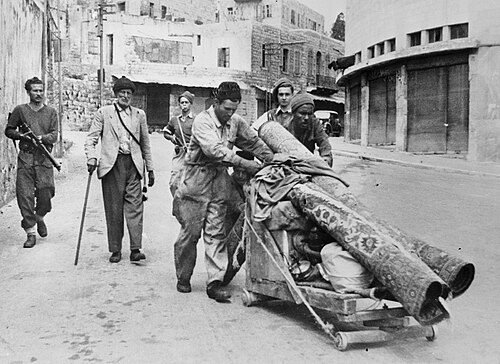
أمر ديفيد بن غوريون يغال يادين بالتخطيط للتدخل المعلن للدول العربية. وكانت نتيجة تحليله خطة داليت ، التي وُضعت موضع التنفيذ في بداية أبريل، والتي مثّلت المرحلة الثانية من الحرب، [ 58 ] حيث شنّت الهاغاناه هجومًا. [ 29 ] : 118
كانت العملية الأولى، نحشون ، موجهة لرفع الحصار عن القدس . [ 59 ] في الأسبوع الأخير من مارس، حاولت 136 شاحنة إمداد الوصول إلى القدس، ولم تصل منها سوى 41 شاحنة. اشتدت الهجمات العربية على الاتصالات والطرق. أدى فشل القوافل وفقدان المركبات المدرعة اليهودية إلى زعزعة ثقة قادة المستوطنات اليهودية. انقطعت إمدادات الغذاء والماء عن المدينة. [ 60 ] [ 61 ] كانت القدس على وشك المجاعة في مايو، [ 29 ] : حيث تم تطبيق نظام تقنين الغذاء والماء . [ 62 ]
خلال هذه الفترة، ارتكبت جماعات الإرجون وليحي شبه العسكرية ، بدعم من الهاجاناه والبلماخ، [ 63 ] [ 64 ] مجزرة دير ياسين ، التي راح ضحيتها ما لا يقل عن 107 من القرويين العرب، بينهم نساء وأطفال، وطُردوا بقية سكان القرية (حوالي 750 شخصًا). حظيت هذه الحادثة بتغطية إعلامية واسعة، وكان لها أثر بالغ على معنويات السكان العرب، مما ساهم بشكل كبير في تهجير الفلسطينيين ونزوحهم .
نُفذت مجزرة قافلة هداسا الطبية على يد القوات العربية انتقاماً لمجزرة دير ياسين. وقُتل 79 يهودياً في الهجوم الذي أدى إلى مزيد من تدهور العلاقات اليهودية العربية. [ 65 ] [ 66 ]
في الفترة من 4 إلى 15 أبريل ، انتهت أول عملية واسعة النطاق لجيش التحرير العربي بهزيمة ساحقة، حيث مُني بهزيمة نكراء في مشمار هعيمق . [ 67 ] وانشق حلفاؤهم الدروز عنهم . [ 68 ]

كجزء من خطة داليت، استولت الهاجاناه والبلماخ والإرجون على المراكز الحضرية في طبريا وحيفا ( انظر : معركة حيفا ) وصفد وبيسان ويافا وعكا ، وقامت بطرد أكثر من 250 ألف فلسطيني عربي بالقوة . [ 69 ]
The British had essentially withdrawn their troops. The situation pushed the neighbouring Arab states to intervene, but their preparation was not completed, and they could not assemble sufficient forces to turn the tide of the war. The majority of Palestinian Arab hopes lay with the Arab Legion of Transjordan's monarch, King Abdullah I. However Abdullah did not intend to create a Palestinian state, but hoped to annex much of Eastern Palestine. Playing both sides, he was in contact with both the Israelis and the Arab League.[70]
Preparing for Arab intervention from neighbouring states, Haganah successfully launched Operations Yiftah[71] and Ben-'Ami[72] to secure the Jewish settlements of Galilee, and Operation Kilshon. This created an Israeli-controlled front around Jerusalem. The inconclusive meeting between Golda Meir and Abdullah I, followed by the Kfar Etzion massacre on 13 May by the Arab Legion, led to predictions that the battle for Jerusalem would be merciless.
Israeli historians Benny Morris and Benjamin Kedar revealed that during the 1948 war, Israel conducted a biological warfare operation codenamed Cast Thy Bread, using typhoid bacteria to contaminate wells in Arab areas to prevent reentry and deter advancing Arab forces.[73]
Second phase: 1948 Arab–Israeli War
Arab League entry

On 14 May 1948, the day before the expiration of the British Mandate, David Ben-Gurion declared the establishment of a Jewish state in Eretz Israel, to be known as the State of Israel.[74] Both superpower leaders, U.S. President Harry S. Truman and Soviet leader Joseph Stalin, immediately recognised the new state, while the Arab League refused to accept the UN Partition Plan, proclaimed the right of self-determination for the Arabs across the whole of Palestine, and maintained that the absence of legal authority made it necessary to intervene to protect Arab lives and property.[75] The Palestinians' Arab Higher Committee rejected the Partition Resolution and any kind of Jewish state and refused to negotiate with "the Zionist Project".[76]

Over the next few days, contingents of four of the seven countries of the Arab League at that time, Egypt, Iraq, Transjordan, and Syria, invaded the former British Mandate of Palestine and fought the Israelis. They were supported by the Arab Liberation Army, Muslim Brotherhood contingents,[77] and corps of volunteers from Saudi Arabia, Lebanon and Yemen. The Arab armies launched a simultaneous offensive on all fronts: Egyptian forces invaded from the south, Jordanian and Iraqi forces from the east, and Syrian forces invaded from the north. Cooperation among the various Arab armies was poor.
First truce: 11 June – 8 July 1948
The UN declared a truce on 29 May, which began on 11 June and lasted 28 days. The ceasefire was overseen by UN mediator Folke Bernadotte and a team of UN Observers, army officers from Belgium, United States, Sweden and France. Bernadotte was voted in by the General Assembly to "assure the safety of the holy places, to safeguard the well being of the population, and to promote 'a peaceful adjustment of the future situation of Palestine'".[78] He spoke of "peace by Christmas" but saw that the Arab world had continued to reject the existence of a Jewish state, whatever its borders.[79]
An arms embargo was declared with the intention that neither side would make gains from the truce. Neither side respected the truce; both found ways around the restrictions. Both the Israelis and the Arabs used this time to improve their positions, a direct violation of the terms of the ceasefire.[80]
"The Arabs violated the truce by reinforcing their lines with fresh units (including six companies of Sudanese regulars,[79] a Saudi battalion[81] and contingents from Yemen and Morocco[82]) and by preventing supplies from reaching isolated Israeli settlements; occasionally, they opened fire along the lines".[83] The Israeli Defense Forces acquired weapons from Czechoslovakia in contravention to the terms of the truce, improving the training of its forces, and reorganising the army. Yitzhak Rabin, an IDF commander who would later become Israel's fifth prime minister, said, "[w]ithout the arms from Czechoslovakia... it is very doubtful whether we would have been able to conduct the war".[80] As well as violating the arms and personnel embargo, both sides sent fresh units to the front.[83] Israel's army increased its manpower from approximately 30,000 or 35,000 men to almost 65,000 during the truce and its arms supply to "more than twenty-five thousand rifles, five thousand machine guns, and more than fifty million bullets".[83]

As the truce began, a British officer stationed in Haifa said the four-week-long truce "would certainly be exploited by the Jews to continue military training and reorganization while the Arabs would waste [them] feuding over the future divisions of the spoils".[84] On 7 July, the day before the truce expired, Egyptian forces under General Muhammad Naguib renewed the war by attacking Negba.[85]
Second phase: 8–18 July 1948
Israeli forces launched a simultaneous offensive on all three fronts: Dani, Dekel, and Kedem. The fighting was dominated by large-scale Israeli offensives and a defensive Arab posture and continued for ten days until the UN Security Council issued the Second Truce on 18 July.[83]

Israeli Operation Dani resulted in the expulsion from Lydda and Ramle of 60,000 Palestinian residents. According to Benny Morris, in Ben-Gurion's view, Ramlah and Lydda constituted a special danger because their proximity might encourage cooperation between the Egyptian army, which had started its attack on Kibbutz Negbah, and the Arab Legion, which had taken the Lydda police station. Widespread looting took place during these operations, and about 100,000 Palestinians became refugees.[86] In Operation Dekel, Nazareth was captured on 16 July. In Operation Brosh, Israel tried and failed to drive the Syrian army out of northeastern Galilee. By the time the second truce took effect at 19:00 18 July, Israel had taken the lower Galilee from Haifa Bay to the Sea of Galilee.
With smuggled Boeing B-17 Flying Fortress planes acquired in violation of the international arms embargo, Israel bombed a residential neighborhood in Cairo on July 15.[87][88][89]
18 July 1948 – 10 March 1949
At 19:00 on 18 July, the second truce of the conflict went into effect after intense diplomatic efforts by the UN. On 16 September, a new partition plan for Palestine was proposed but it was rejected by both sides.
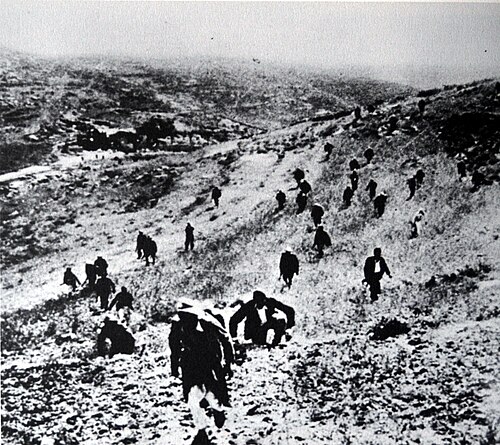
 Palmach Infantry go into action during the fight for Beersheba, 21 October
 Israeli soldiers attack Sasa during Operation Hiram, October
 IDF forces near Beit Natif (near Hebron) after it was occupied, October
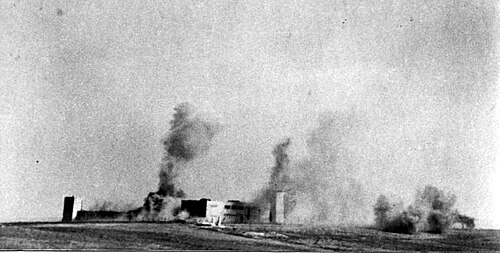 Israeli bombardment of the Iraq Suwaydan fort, held by the Egyptian army, on 9 November
 Palmach soldiers are instructed before Operation Yoav
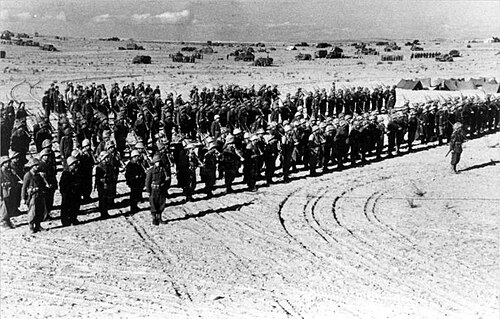 Negev Brigade prior to Operation Horev

During the truce, the Egyptians regularly blocked the passage of supply convoys to the beleaguered northern Negev settlements by firing on them, contrary to the truce terms. On 15 October, they attacked another supply convoy, and the already planned Operation Yoav was launched.[90] Its goal was to drive a wedge between the Egyptian forces along the coast and the Beersheba-Hebron-Jerusalem road, and to open the road to the encircled Negev settlements. Yoav was headed by Southern Front commander Yigal Allon. The operation was a success, shattering the Egyptian army ranks and forcing Egyptian forces to retreat from the northern Negev, Beersheba, and Ashdod. Meanwhile, on 19 October, Operation Ha-Har commenced operations in the Jerusalem Corridor.
On 22 October, the third truce went into effect.[91]
Before dawn on 22 October, in defiance of the UN Security Council ceasefire order, ALA units stormed the IDF hilltop position of Sheikh Abd, overlooking KibbutzManara. The kibbutz was now besieged. Ben-Gurion initially rejected Moshe Carmel's demand to launch a major counteroffensive. He was wary of antagonising the United Nations on the heels of its ceasefire order. During 24–25 October, ALA troops regularly sniped at Manara and traffic along the main road. In contacts with UN observers, Fawzi al-Qawuqji demanded that Israel evacuate neighbouring Kibbutz Yiftah and thin out its forces in Manara. The IDF demanded the ALA's withdrawal from the captured positions and, after a "no" from al-Qawuqji, informed the UN that it felt free to do as it pleased.[92] On 24 October, the IDF launched Operation Hiram and captured the entire upper Galilee, originally attributed to the Arab state by the Partition Plan. It drove the ALA back to Lebanon. At the end of the month, Israel had captured the whole Galilee and had advanced 5 miles (8.0 km) into Lebanon to the Litani River.
On 22 December, large IDF forces started Operation Horev. Its objective was to encircle the Egyptian Army in the Gaza Strip and force the Egyptians to end the war. The operation was a decisive Israeli victory, and Israeli raids into the Nitzana area and the Sinai Peninsula forced the Egyptian army into the Gaza Strip, where it was surrounded. Israeli forces withdrew from Sinai and Gaza under international pressure and after the British threatened to intervene against Israel. The Egyptian government announced on 6 January 1949 that it was willing to enter armistice negotiations. Allon persuaded Ben-Gurion to continue as planned, but Ben-Gurion told him: "Do you know the value of peace talks with Egypt? After all, that is our great dream!"[93] He was sure that Transjordan and the other Arab states would follow suit. On 7 January 1949, a truce was achieved.
On 5 March, Israel launched Operation Uvda; by 10 March, the Israelis reached Umm Rashrash (where Eilat was built later) and took it without a battle. The Negev Brigade and Golani Brigade took part in the operation. They raised a hand-made flag ("The Ink Flag") and claimed Umm Rashrash for Israel.
Aftermath
Armistice lines
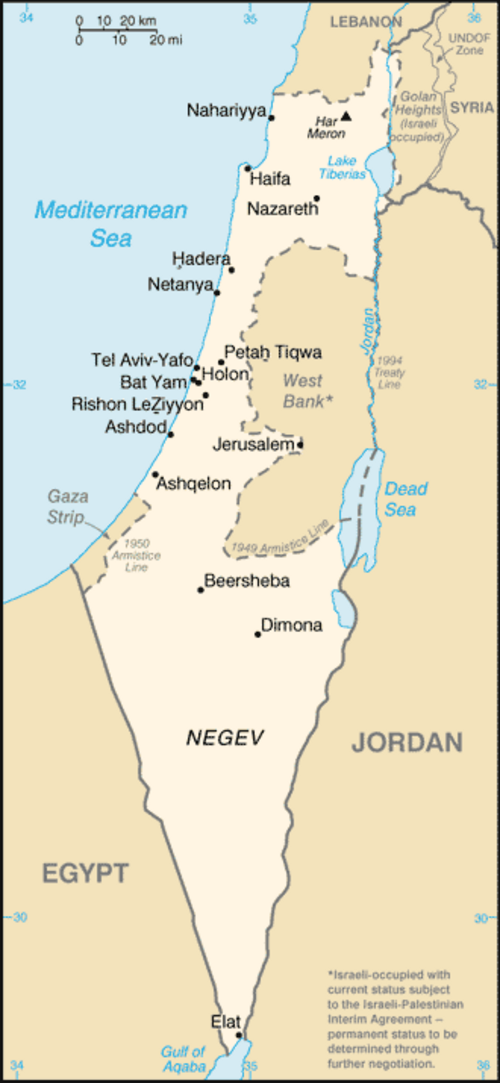
In 1949, Israel signed separate armistices with Egypt on 24 February, Lebanon on 23 March, Transjordan on 3 April, and Syria on 20 July. The armistice lines saw Israel holding about 78% of Mandatory Palestine (as it stood after the independence of Transjordan in 1946), 22% more than the UN Partition Plan had allocated. These ceasefire lines were known afterwards as the "Green Line". The Gaza Strip and the West Bank were occupied by Egypt and Transjordan, respectively. The United Nations Truce Supervision Organization and Mixed Armistice Commissions were set up to monitor ceasefires, supervise the armistice agreements, to prevent isolated incidents from escalating, and assist other UN peacekeeping operations in the region.
Casualties
Israel lost 6,373 people, about 1% of its population, in the war. About 4,000 were soldiers and the rest were civilians. The exact number of Arab losses is unknown but is estimated at between 4,000 for Egypt (2,000), Jordan and Syria (1,000 each) and 15,000.[94]
According to Benny Morris,[95]
بالنظر إلى أن النصف الأول من الحرب انطوى على أعمال عدائية بين ميليشيات متمركزة في عدد كبير من المجتمعات المدنية المتناثرة، والاستيلاء على حوالي مائتي قرية ومركز حضري، والاستيلاء اللاحق على مائتي قرية إضافية، فإن عام 1948 جدير بالذكر بالفعل بسبب العدد القليل نسبيًا من الضحايا المدنيين سواء في المعارك نفسها أو في الفظائع التي رافقتها أو تلتها (قارن هذا، على سبيل المثال، بمعدلات الخسائر والفظائع في حروب يوغوسلافيا في التسعينيات أو الحروب الأهلية السودانية في الخمسين عامًا الماضية).
النتائج الديموغرافية
خلال الحرب الأهلية في فلسطين الانتدابية (1947-1948) والحرب العربية الإسرائيلية التي تلتها (1948)، نزح أو طُرد نحو 700 ألف فلسطيني عربي . [ 25 ] وفي عام 1951، قدّرت لجنة المصالحة التابعة للأمم المتحدة لفلسطين عدد اللاجئين الفلسطينيين الذين نزحوا من إسرائيل بنحو 711 ألفًا. [ 96 ] ولم يشمل هذا العدد الفلسطينيين النازحين داخل الأراضي التي تسيطر عليها إسرائيل. وتضم قائمة القرى التي أُخليت من سكانها خلال الصراع العربي الإسرائيلي أكثر من 400 قرية عربية، بالإضافة إلى نحو عشر قرى وأحياء يهودية، ما أدى إلى عدم وجود أي يهودي في الأراضي التي تسيطر عليها إسرائيل أو عدم قدرته على العودة إليها. [ 97 ] [ 98 ]
تُعدّ أسباب النزوح الفلسطيني عام 1948 موضوعًا مثيرًا للجدل بين المؤرخين. [ 99 ] كما تُشكّل مشكلة اللاجئين الفلسطينيين والجدل الدائر حول حق عودتهم قضايا رئيسية في الصراع الإسرائيلي الفلسطيني . وينظم الفلسطينيون مظاهرات واحتجاجات سنوية في 15 مايو من كل عام.
خلال حرب 1948 العربية الإسرائيلية، أُجبر نحو 10,000 يهودي على إخلاء منازلهم في فلسطين أو إسرائيل. [ 100 ] وقد أسفرت الحرب بشكل غير مباشر عن نزوح اليهود من الأراضي العربية والإسلامية . وبسبب الحرب بين اليهود والعرب في فلسطين، تعرض مئات الآلاف من اليهود المقيمين في الدول العربية للترهيب والفرار، أو طُردوا من أوطانهم، ووصل معظمهم إلى إسرائيل. وكانت الأسباب المباشرة لهذا النزوح هي العداء الشعبي العربي، بما في ذلك المذابح والإجراءات الحكومية المعادية لليهود، [ 101 ] بالإضافة إلى رغبة العديد من اليهود في الانضمام إلى دولة إسرائيل المُنشأة حديثًا.
بحسب بيني موريس، فإن "تجربة التمييز والاضطهاد في العالم العربي... التي سبقت عام 1948... خلّفت كراهية عميقة، بل حقداً، تجاه ذلك العالم لدى [الجيل الأول من اليهود الذين فروا أو طُردوا] وذريتهم". ويؤثر هذا على السياسة الإسرائيلية من خلال النظرة السلبية للعرب و"أنماط التصويت اليمينية المتشددة". ويؤكد أن هذه عواقب غير مباشرة طويلة الأمد للحرب. [ 102 ]
في السنوات الثلاث التي أعقبت الحرب، هاجر نحو 700 ألف يهودي إلى إسرائيل، حيث تم استيعابهم وتوفير الطعام والمأوى لهم [ 103 ] بشكل رئيسي على طول الحدود وفي الأراضي الفلسطينية السابقة. [ 104 ] ابتداءً من عام 1948 وحتى عام 1972، هاجر ما يُقدّر بنحو 800 ألف إلى مليون يهودي إلى إسرائيل. [ 105 ] [ 106 ] [ 107 ] من عام 1945 وحتى إغلاق مخيمات اللاجئين عام 1952، عاش أكثر من 250 ألف نازح يهودي في مخيمات اللاجئين الأوروبية . هاجر منهم نحو 136 ألفًا إلى إسرائيل. [ 108 ] هاجر أكثر من 270 ألف يهودي من أوروبا الشرقية، [ 109 ] معظمهم من رومانيا وبولندا ( أكثر من 100 ألف من كل منهما). استقر 700 ألف يهودي في إسرائيل، [ 110 ] مما ضاعف عدد سكانها اليهود. [ 111 ] [ 112 ]
علم التأريخ
منذ الحرب، فسّرت تقاليد تاريخية مختلفة أحداث عام 1948 تفسيرات متباينة؛ فبحسب المؤرخ الجديد آفي شلايم ، "يتبنى كل طرف رواية مختلفة للأحداث". [ 16 ] ففي الرواية الإسرائيلية، تُعدّ الحرب حرب استقلال إسرائيل. [ 16 ] أما في الرواية الفلسطينية، فترتبط حرب 1948 ارتباطًا وثيقًا بالنكبة ، وتُصوّر الحركة الصهيونية على أنها استعمار استيطاني ، [ 113 ] ويُنظر إلى الإسرائيليين على أنهم غزاة والفلسطينيين على أنهم ضحايا. [ 16 ] وتعكس الروايات المختلفة لأحداث 1948 هذه التصورات المتباينة. [ 16 ]
An issue affecting the historiography of 1948 is access to sources and archives, which may have been destroyed, appropriated, censored, or otherwise made unavailable to some or all researchers.[114]:xxxiv–xxxvii[115][116] Linguistic barriers represent another hurdle, as most research is published exclusively in the author's native language and is not translated.[116]:214
The historiography of 1948 is tied to political legitimacy in the present and has implications for the Israeli–Palestinian conflict.[117] According to Avraham Sela and Neil Caplan:
A major reason for this grip of the past over the present is the unfulfilled quest of both Israelis and Palestinians for legitimacy, in one or more of the following three senses: (a) each party's sense of its own legitimacy as a national community entitled to its own sovereign state; (b) each party's willingness to grant legitimacy to at least part of the competing national narrative of the other; and (c) the international community's extension of legitimacy to the competing rights and claims of Israelis and Palestinians.[117]
The narratives of 1948 have also had implications for Palestinian refugees.[116]:211
Israeli narratives
Being the victors, the Israelis "were able to propagate more effectively than their opponents their version of this fateful war", in the words of Avi Shlaim.[16] Only in 1987 was that narrative effectively challenged outside the Arab world.[16]
Zionist narrative
Avi Shlaim gives the conventional Zionist narrative or the "old history" of the 1948 war as follows:
The conflict between Jews and Arabs in Palestine came to a head following the passage, on 29 November 1947, of the United Nations partition resolution that called for the establishment of two states, one Jewish and one Arab. The Jews accepted the U.N. plan despite the painful sacrifices it entailed, but the Palestinians, the neighboring Arab states, and the Arab League rejected it. Great Britain did everything in its power toward the end of the Palestine Mandate to frustrate the establishment of the Jewish state envisaged in the UN. plan. With the expiry of the Mandate and the proclamation of the State of Israel, seven Arab states sent their armies into Palestine with the firm intention of strangling the Jewish state at birth. The subsequent struggle was an unequal one between a Jewish David and an Arab Goliath. The infant Jewish state fought a desperate, heroic, and ultimately successful battle for survival against overwhelming odds. During the war, hundreds of thousands of Palestinians fled to the neighboring Arab states, mainly in response to orders from their leaders and despite Jewish pleas to stay and demonstrate that peaceful coexistence was possible. After the war, the story continues, Israeli leaders sought peace with all their heart and all their might but there was no one to talk to on the other side. Arab intransigence was alone responsible for the political deadlock, which was not broken until President Anwar Sadat's visit to Jerusalem thirty years later.[16]
According to Shlaim, this narrative is "not history in the proper sense of the word", as most of the literature on the war was produced—not by professional academic historians—but rather by participants in the war, politicians, soldiers, and state-sponsored historians, as well as by sympathetic journalists, chroniclers, and biographers.[16] It also portrays Israelis as morally superior, lacks political analysis, and gives undue weight to "the heroic feats of the Israeli fighters."[16] This nationalist narrative was taught in Israeli schools and used for gaining legitimacy internationally.[16]
New Historians
ظلّت الرواية الصهيونية التقليدية للحرب سائدةً دون منازع خارج العالم العربي حتى الذكرى الأربعين للحرب، حين صدرت حينها مجموعة من الكتب النقدية، منها كتاب سيمحا فلابان " ميلاد إسرائيل: أساطير وحقائق" (1987)، وكتاب بيني موريس " ميلاد مشكلة اللاجئين الفلسطينيين" (1987)، وكتاب إيلان بابيه " بريطانيا والصراع العربي الإسرائيلي، 1948-1951" (1988)، وكتاب شلايم " التواطؤ عبر الأردن: الملك عبد الله، والحركة الصهيونية، وتقسيم فلسطين" (1988). [ 16 ] عُرف هؤلاء الكتّاب فيما بعد بالمؤرخين الجدد أو "ما بعد الصهاينة". [ 118 ] وفقًا لشلايم، اختلف المؤرخون الجدد مع الرواية الصهيونية في ست نقاط رئيسية: السياسة البريطانية تجاه المستوطنات اليهودية في نهاية الانتداب على فلسطين، والتوازن العسكري عام 1948، وأصول مشكلة اللاجئين الفلسطينيين، وطبيعة العلاقات بين الإسرائيليين والأردنيين خلال الحرب، والأهداف العربية في الحرب، وأسباب استمرار استحالة تحقيق السلام بعد الحرب. [ 16 ]
كان من بين أشد منتقديهم حدةً شبتاي تيفيت ، كاتب سيرة ديفيد بن غوريون ، الذي نشر سلسلة مقالات بعنوان "المؤرخون الجدد"، مؤلفة من أربع مقالات أسبوعية كاملة الصفحات، هاجم فيها المؤرخين الجدد، وذلك في صحيفة هآرتس في مايو 1989. [ 16 ] زعم تيفيت أن التأريخ الجديد معيب في ممارسته، وأنه ذو دوافع سياسية، وأنه مؤيد للفلسطينيين ويهدف إلى نزع الشرعية عن دولة إسرائيل. [ 16 ]
الروايات الصهيونية الجديدة
Ilan Pappé identifies a turn in predominant Israeli narratives about 1948 in September 2000. In the climate of the Second Intifada and in the Post-9/11 period, "not only were Israel's brutal military operations against the Palestinians during the new intifada seen as justified, but so was their systematic expulsion in 1948."[118] Evidence of the expulsions, massacres, and war crimes of 1948 brought to light by the New Historians could no longer be ignored, but writers of what Pappé calls a "neo-Zionist" narrative justified these as necessary or unavoidable.[118] In this period, the focus of Israeli historical writing on 1948 shifted largely from its human impact back to its military aspects.[118] Neo-Zionist writers were given selective access to top-secret material, to which writers critical of Zionism would not have been given access, and much of their work was published by the Israeli Ministry of Defense.[118]
Among those Pappé associated with the neo-Zionist perspective were Benny Morris (who had become more outspokenly defensive of Zionism by this time), Daniel Gutwein, Mordechai Bar-On, Yoav Gelber, Tamir Goren, Arnon Golan, Alon Kadish, and Yoav Peleg, as well as the journal Techelet.[118]
Palestinian narratives
Unlike Israeli narratives that shifted over the decades, Palestinian narratives of 1948 have been more or less constant, focusing on Palestinians' indigenous rights to Palestine, Palestinian victimhood, dispossession, displacement, exile, statelessness, and more "unrequited grievances against colonialism and Zionism."[116]:209–211 The term 'Nakba' to describe the Palestinian catastrophe in the war of 1948 was coined in Constantin Zureiq's 1948 book Ma'na an-Nakba.[119]Yoav Gelber identifies Aref al-Aref's six volume an-Nakba written in Arabic in the 1950s as thorough and notable.[120]
Palestinian narratives have focused on countering the dominant Zionist narrative; the preëminent Palestinian historian of 1948 Walid Khalidi has dedicated much of his career to disproving the official Israeli narrative that the 1948 Palestinian expulsion and flight was voluntary.[116]:211
Rashid Khalidi and other historians hold that "there is no established, authoritative Palestinian master narrative."[116]:212 They attribute this to, among other reasons, the dispersed and fragmented state of the Palestinian community and the loss, destruction, or appropriation by Israel of relevant documents and libraries.[114]:xxxiv–xxxvii[116]:212 Without access to much in the way of archival materials, Palestinian historians have made use of oral history.[121][116]:214
Arab narratives
In the narratives of the wider Arab-Muslim world, 1948 is seen as an "Arab debacle", representative of the region's social and political decline from its "glorious distant past".[116]:210 The official narratives of Arab states on 1948 tended to be apologetic with the goal of defending their political legitimacy, while the Arab nationalists wrote with a focus on distilling and extracting historical lessons to galvanize Arab society, politics, and ideology in preparation for the next conflict with Israel—neither approach bridled itself too much with historical accuracy.[122]:6
United States narratives
The American journalist Joan Peters' 1984 book From Time Immemorial had a massive impact on how 1948 was understood in popular and political narratives in the United States.[123][124]
Ilan Pappé asserts the neo-Zionist narrative was pushed in the United States most passionately by Michael Walzer, and by Anita Shapira and Derek Penslar with their 2003 Israeli Historical Revisionism: From Left to Right.[118]
Terminology
The 1948 Palestine war is also sometimes referred to as the 1948 Arab–Israeli war, the First Arab–Israeli war, or simply the 1948 war, although the term "Arab-Israeli war" often refers to the international phase of the war between Arab countries and Israel after May 15, 1948. Palestinians and the Arab world often refer to the war as the Nakba ("the catastrophe"), while in Israel the conflict is known as the War of Independence (Milhemet Ha'atzma'ut).[125][126][127]
In popular culture
A 1960 movie Exodus starring Paul Newman as Haganah rebel Ari Ben Canaan, a decorated former captain in the Jewish Brigade of the British Army in the Second World War, obtains a cargo ship. He smuggles 611 Jews out of a Cyprus camp run by the British and onto the ship for an illegal voyage to Mandatory Palestine. An American epichistorical drama film about the founding of the State of Israel. Produced and directed by Otto Preminger, the screenplay was adapted from the 1958 novel of the same name by Leon Uris.
A 1966 movie Cast a Giant Shadow starring Kirk Douglas as US Colonel Mickey Marcus (1901–1948) who commanded units of the fledgling Israel Defense Forces during the 1948 Arab-Israeli War. One of the well known Israeli Machal soldiers, becoming Israel's first modern general[128] (Hebrew: Aluf). He was killed by friendly fire.[129]
A 1966 movie Judith (1966 film) starring Sophia Loren as Judith Auerbach Schiller, a Jewish former wife of a former German tank commander, General Gustav Schiller, who is teaching the Arabs battle tactics while in Palestine shortly before the end of the British mandate, the Haganah are unable to locate him but hopes that she can identify him. Judith and colleagues are smuggled into Damascus, and after days of searching, they find Schiller. As they are about to capture him, Judith shoots and wounds him. Schiller is smuggled back to Palestine and interrogated.
A 2015 PBSdocumentary, A Wing and a Prayer, depicts the Al Schwimmer-led airborne smuggling missions to arm Israel.[130]
يروي الفيلم الدرامي التاريخي "فرحة" لعام 2021 قصة فتاة فلسطينية خلال تهجير الفلسطينيين من وطنهم عام 1948. [ 131 ]
انظر أيضاً
ملحوظات
- ↑ متطوعون من ألبانيا ، والبوسنة والهرسك الاشتراكية ، وكرواتيا الاشتراكية . [ 7 ]


- ↑ يذكر عارف العارف أن عدد القتلى الفلسطينيين بلغ 13,000، غالبيتهم من المدنيين. [ 13 ] [ 14 ] ويكتب إيلان بابي أن "بضعة آلاف لقوا حتفهم في مجازر". [ 15 ] ويقدر بيني موريس إجمالي الخسائر الفلسطينية بأكثر من 5,800 قتيل، وأن حوالي 800 مدني وأسير حرب قُتلوا في مجازر. [ 10 ]
- ↑ يعتبر الفلسطينيون أحداث عام 1948 جزءًا من النكبة ( العربية : النَكْبَة )، وتعني حرفيًا "الكارثة". في إسرائيل يطلق عليها اسم حرب الاستقلال ( اللغة العبرية : मलहमт हͦमаот ; Milkhemet Ha'Atzma'ut ). [ 16 ]
- ↑ في ظهيرة يوم 14 مايو 1948، أعلن ديفيد بن غوريون ، الرئيس التنفيذي للمنظمة الصهيونية ورئيس الوكالة اليهودية لفلسطين ، قيام دولة يهودية في فلسطين تُعرف باسم دولة إسرائيل.
- ↑ قاتلت المنظمات شبه العسكرية هاجاناه وإرجون وليحي نيابةً عن المستوطنات اليهودية حتى أواخر مايو 1948، عندما تم تأسيس جيش الدفاع الإسرائيلي وحلّ القوات المسلحة اليهودية الأخرى. كما كان هناك دعم من متطوعين من الخارج، يُعرفون باسم" المحال " .
- ↑ يقتبس المصدر عدة أمثلة، مثل قصيدة نُشرت في صحيفة فلسطين: "اليهود، أضعف الشعوب وأقلها شأناً، يساوموننا على أرضنا".
الاقتباسات
- ↑ أنيتا شابيرا، خيال إسرائيل : تاريخ الثقافة السياسية (2005)، اللطرون : ذاكرة المعركة ، الفصل. ثالثا. 1 الحدث ص 91-96
- ↑ بيني موريس (2008)، ص 419.
- ↑Nisan, Mordechai (2015). Minorities in the Middle East: A History of Struggle and Self-Expression (2d ed.). McFarland. p. 284. ISBN 978-0-7864-5133-3.
This Jewish-Druze partnership was often referred to as a "covenant of blood," in recognition of the common military yoke carried by the two peoples for the security of the country.
- ↑"The Druze in Israel: Questions of Identity, Citizenship, and Patriotism"(PDF). Archived from the original(PDF) on 4 March 2016. Retrieved 24 February 2022.
- ↑Palestine Post, "Israel's Bedouin Warriors", Gene Dison, August 12, 1948
- ↑AFP (24 April 2013). "Bedouin army trackers scale Israel social ladder". Al Arabiya. Archived from the original on 31 March 2022. Retrieved 7 May 2015.
- ↑Frantzman, Seth (1 January 2009). "Strange bedfellows: The Bosnians and Yugoslav volunteers in the 1948 war in Israel/Palestine". Istorija 20. veka– via www.academia.edu.
- ↑Pollack, 2004; Sadeh, 1997
- 12Sandler, Stanley (2002). Ground Warfare: An International Encyclopedia. ABC-CLIO. p. 160. ISBN 978-1-57607-344-5. Archived from the original on 20 March 2023. Retrieved 23 April 2019.
- 12Morris (2008), p. 406.
- ↑Esber, Rosemarie (2009). Under the Cover of War. Arabicus Books & Media. p. 28.
- ↑Clodfelter, Micheal (2017). Warfare and Armed Conflicts: A Statistical Encyclopedia of Casualty and Other Figures, 1492–2015 (4th ed.). McFarland. p. 572. ISBN 978-0-7864-7470-7.
- ↑R. Khalidi 1997: Palestinian Identity: The Construction of Modern National Consciousness, Columbia University Press http://www.jstor.org/stable/10.7312/khal15074. "[...] al-Arif, in al-Nakba, vol. 6, is able to list the names, dates, and places of death of 1,953 Palestinians (out of a total he puts at 13,000) who died as "martyrs" in the war of 1947-49."
- ↑Henry Laurens, La question de Palestine, Vol. 3. 1947-1967, l'accomplissement des prophéties (2007), citing al-Nakba, vol. 6
- ↑ 1. بابي الأول. تاريخ فلسطين الحديثة. الطبعة الثالثة. مطبعة جامعة كامبريدج؛ 2022.
- 1 2 3 4 5 6 7 8 9 10 11 12 13 14 15 شلايم، آفي (1995). "الجدل حول عام 1948" . المجلة الدولية لدراسات الشرق الأوسط . 27 (3): 287-304 . doi : 10.1017/S0020743800062097 . ISSN 0020-7438 . JSTOR 176252. S2CID 55258863. مؤرشف من الأصل في 2 مارس 2023. تم الاسترجاع في 2 مارس 2023 .
- ↑
- يُقدّر مايكل ر. فيشباخ، الباحث الأمريكي في أرشيفات لجنة الأمم المتحدة للتوفيق من أجل فلسطين ، أن الفلسطينيين فقدوا ما بين 6 إلى 8 ملايين دونم (1.5 إلى 2 مليون فدان) من أراضيهم، دون احتساب الأراضي المشتركة التي تزرعها القرى أو أراضي الدولة. مطر، فيليب (2005). "النكبة" . في مطر، فيليب (محرر). موسوعة الفلسطينيين . إنفوبيس . ISBN 9780816069866تمت أرشفة هذا النص من النسخة الأصلية بتاريخ 28 نوفمبر 2022.
- فايرستون، رؤوفين (2012). الحرب المقدسة في اليهودية: سقوط وصعود فكرة مثيرة للجدل . مطبعة جامعة أكسفورد . ص 10، 296. ISBN 978-0-19-986030-2أُرشف من الأصل بتاريخ ٢٨ نوفمبر ٢٠٢٢.
بالنسبة لليهود، تُعرف الحرب اليهودية العربية ١٩٤٧-١٩٤٨ بحرب الاستقلال ( ميلخيمت هآتزماؤوت ). أما بالنسبة للعرب، وخاصة الفلسطينيين، فهي النكبة أو الكارثة. لذلك، أتجنب تسمية الحروب. أشير إلى الحروب بين دولة إسرائيل وجيرانها العرب والفلسطينيين وفقًا لتواريخها: ١٩٤٨، ١٩٥٦، ١٩٦٧، ١٩٧٣، و١٩٨٢.
- كابلان، نيل (2011). الصراع الإسرائيلي الفلسطيني: تاريخ متنازع عليه . جون وايلي وأولاده . ص 17. ISBN 978-1-4443-5786-8لعلّ
أشهر مثال على الاختلاف في تسمية الأحداث هو حرب 1948 (أو بالأحرى، القتال الذي دار من ديسمبر 1947 إلى يناير 1949). فبالنسبة لإسرائيل، هي "حرب التحرير" أو "حرب الاستقلال" (بالعبرية: milhemet ha-atzama'ut )، وهي حربٌ زاخرةٌ بمشاعر الخلاص والنجاة. أما بالنسبة للفلسطينيين، فهي النكبة ، والتي تعني "الكارثة"، وتشمل في نطاقها تدمير مجتمعهم وتهجير نحو 700 ألف لاجئ.
- كابلان، نيل (1997). الدبلوماسية العقيمة: الأمم المتحدة، والقوى العظمى، وصنع السلام في الشرق الأوسط 1948-1954 . المجلد 3. فرانك كاس وشركاه. ص 17. ISBN 978-0-7146-4756-2
على الرغم من أن بعض المؤرخين قد يشيرون إلى 14 مايو 1948 باعتباره بداية الحرب المعروفة بأسماء مختلفة مثل حرب الاستقلال الإسرائيلية، أو النكبة (الكارثة الفلسطينية)، أو حرب فلسطين الأولى، إلا أنه من الأدق اعتبار تلك الحرب قد بدأت في 30 نوفمبر 1947
. - "النكبة"نكبةالمعاني . ص 1. تم الاطلاع عليه بتاريخ 21 أغسطس 2021 .
- ↑ بيني موريس (2008) ، ص 77
- ↑ بيني موريس (2008) ، الصفحات 77-79
- ↑ تال (2003) ، ص 41
- ↑ موريس (2004)، ص 13: "اتخذت الهاجاناه موقفًا دفاعيًا، رغبةً منها في عدم إثارة غضب البريطانيين أثناء إعادة تنظيم صفوفها وتسليحها للحرب؛ إذ كانت تدرك أن التحدي الحقيقي لن يأتي من الفلسطينيين، بل من جيوش الدول المجاورة. وحتى نهاية يناير/كانون الثاني 1948، لم تكن الغلبة لأي من الطرفين. ولكن في فبراير/شباط ومارس/آذار، ألحق كمائن عربية هزائم كبيرة بقوافل الهاجاناه على طول الطرق، لا سيما بين تل أبيب والقدس (اليهودية الغربية). وبدا لقادة المستوطنات اليهودية أن القدس اليهودية - التي يبلغ عدد سكانها 100 ألف نسمة - قد تسقط محاصرةً؛ وكانت هناك مخاوف مماثلة بشأن العديد من تجمعات المستوطنات الريفية اليهودية حول القدس وفي الجليل الغربي. وقد دفعت الهزائم والخسائر الفادحة التي تكبدتها المستوطنات اليهودية إلى إعادة النظر في استراتيجيتها. وفي بداية أبريل/نيسان، تحولت الهاجاناه إلى الهجوم، وشنت أخيرًا سلسلة من الهجمات المضادة الكبرى."
- ↑ بيني موريس (2008) ، ص 77-78
- ↑Morris (2004), p.163: "The British evacuation, which would remove the last vestige of law and order in the cities and on the roads, was only weeks away, and the neighbouring Arab states were mobilising to intervene. The Yishuv was struggling for its life; an invasion by the Arab states could deliver the coup de grâce. It was with this situation and prospect in mind that the Haganah chiefs, in early March, produced ‘Tochnit Dalet’ (Plan D), a blueprint for securing the emergent Jewish state and the blocs of settlements outside the state’s territory against the expected invasion on or after 15 May."
- ↑Khalidi, Walid (1 October 1988). "Plan Dalet: Master Plan for the Conquest of Palestine". Journal of Palestine Studies. 18 (1): 4–19. doi:10.2307/2537591. ISSN 0377-919X. JSTOR 2537591.
'Plan Dalet' or 'Plan D' was the name given by the Zionist High Command to the general plan for military operations within the framework of which the Zionists launched successive offensives in April and early May 1948 in various parts of Palestine. These offensives, which entailed the destruction of the Palestinian Arab community and the expulsion and pauperization of the bulk of the Palestine Arabs, were calculated to achieve the military fait accompli upon which the state of Israel was to be based.
- 12
- Morris, Benny (2004). The Birth of the Palestinian Refugee Problem Revisited. Cambridge University Press. pp. 602–604. ISBN 978-0-521-00967-6.
It is impossible to arrive at a definite persuasive estimate. My predilection would be to opt for the loose contemporary British formula, that of 'between 600,000 and 760,000' refugees; but, if pressed, 700,000 is probably a fair estimate
- Memo US Department of State, 4 May 1949. Foreign Relations of the United States. 1949. p. 973. Archived from the original on 12 July 2019.
One of the most important problems which must be cleared up before a lasting peace can be established in Palestine is the question of the more than 700,000 Arab refugees who during the Palestine conflict fled from their homes in what is now Israeli occupied territory and are at present living as refugees in Arab Palestine and the neighbouring Arab states.
- Memorandum on the Palestine Refugee Problem, 4 May 1949. Foreign Relations of the United States. 1949. p. 984. Archived from the original on 12 July 2019.
Approximately 700,000 refugees from the Palestine hostilities, now located principally in Arab Palestine, Transjordan, Lebanon and Syria, will require repatriation to Israel or resettlement in the Arab states.
- Morris, Benny (2004). The Birth of the Palestinian Refugee Problem Revisited. Cambridge University Press. pp. 602–604. ISBN 978-0-521-00967-6.
- ↑Hacohen, Dvora (2003). "Aliyah to Israel by Country of Origin and Year of Aliyah, 14 May 1948–31 December 1953". Immigrants in Turmoil: Mass Immigration to Israel and Its Repercussions in the 1950s and After. Syracuse University Press. ISBN 978-0-8156-2969-6. Retrieved 18 February 2024.
- ↑Morris, 2001, pp. 259–260.
- ↑Fischbach, Michael R. Jewish Property Claims Against Arab Countries. Columbia University Press, 2008, p. 27
- 12345678910111213Benny Morris (2008). 1948: a history of the first Arab-Israeli war. Yale University Press. ISBN 978-0-300-12696-9. Archived from the original on 19 January 2023. Retrieved 13 July 2013.
- ↑Morris (2001), p.111
- ↑Nadan, Amos (26 July 2017). "Economic Aspects of the Peasant-Led National Palestinian Revolt, 1936-39". Journal of the Economic and Social History of the Orient. 60 (5): 647–682. doi:10.1163/15685209-12341436. ISSN 1568-5209.
- ↑Benny Morris (2001), p.128
- ↑Britain, Palestine and Empire: The Mandate Years. Routledge. 15 April 2016. doi:10.4324/9781315570006. ISBN 978-1-315-57000-6.
- ↑Benny Morris (2001), p.121
- ↑Zvada, Ľubomír; Lach, Jiří (13 September 2022). "Bloody years of the Jewish Insurgency in British Mandatory Palestine 1939-1948: From the White Paper to the State of Israel". Vojenské rozhledy. 31 (3): 121–136. doi:10.3849/2336-2995.31.2022.03.121-136. ISSN 1210-3292.
- ↑Shpiro, Shlomo (September 2013). "The Intellectual Foundations of Jewish National Terrorism: Avraham Stern and the Lehi". Terrorism and Political Violence. 25 (4): 606–620. doi:10.1080/09546553.2013.814502. ISSN 0954-6553.
- ↑Bell, J. Bowyer (1979). Terror out of Zion: Irgun Zvai Leumi, LEHI, and the Palestine underground, 1929-1949. Dublin: Academy Press. ISBN 978-0-906187-11-1.
- ↑Morris 2004, "the upsurge during 1944–1947 of anti-British Jewish terrorism by the Revisionist Irgun Zvai Leumi (IZL) (the National Military Organisation or 'Irgun') and Lohamei Herut Yisrael (LHI) (Freedom Fighters of Israel or 'Stern Gang')"
- ↑Pappé 2006 "the Jewish terrorist attack on the King David Hotel"
- ↑"A/RES/181(II) of 29 November 1947". domino.un.org. 1947. Archived from the original on 24 May 2012. Retrieved 11 January 2012.
- ↑Benny Morris (2008), 1948: An History the First Arab-Israeli War, p. 47.
- ↑Pappe, 2006, p. 35
- ↑Karsh, p.7
- ↑El-Nawawy, 2002, p. 1-2
- ↑Morris, Righteous Victims, 2001, p. 190
- ↑Gold, 2007, p. 134
- ↑United Nations Conciliation Commission for Palestine A/AC.25/W/19 30 July 1949Archived 2 October 2013 at the Wayback Machine,"The Arabs rejected the United Nations Partition Plan so that any comment of theirs did not specifically concern the status of the Arab section of Palestine under partition but rather rejected the scheme in its entirety."
- ↑Benny Morris (2008). 1948: a history of the first Arab-Israeli war. Yale University Press. p. 67. ISBN 978-0-300-12696-9. Archived from the original on 19 January 2023. Retrieved 13 July 2013.
p. 67, "The League's Political Committee met in Sofar, Lebanon, on 16–19 September, and urged the Palestine Arabs to fight partition, which it called "aggression," "without mercy"'; p. 70, '"On 24 November the head of the Egyptian delegation to the General Assembly, Muhammad Hussein Heykal, said that "the lives of 1,000,000 Jews in Moslem countries would be jeopardized by the establishment of a Jewish state."
- ↑Resolution 181 (II). Future government of Palestine A/RES/181(II)(A+B) 29 November 1947Archived June 17, 2011, at the Wayback Machine
- ↑Special UN commission (16 April 1948), § II.5
- ↑Yoav Gelber (2006), p.85
- ↑Yoav Gelber (2006), pp.51-56
- ↑Dominique Lapierre et Larry Collins (1971), chap.7, pp.131-153
- ↑Benny Morris (2003), p. 163
- ↑Henry Laurens (2005), p.83
- ↑Dominique Lapierre et Larry Collins (1971), p.163
- ↑Benny Morris (2003), p.67
- ↑David Tal, War in Palestine, 1948: Israeli and Arab Strategy and Diplomacy, Routledge 2004 p. 89.
- ↑Benny Morris (2008). 1948: a history of the first Arab-Israeli war. Yale University Press. p. 116. ISBN 978-0-300-12696-9. Archived from the original on 19 January 2023. Retrieved 13 July 2013.
At the time, Ben-Gurion and the HGS believed that they had initiated a one-shot affair, albeit with the implication of a change of tactics and strategy on the Jerusalem front. In fact, they had set in motion a strategic transformation of Haganah policy. Nahshon heralded a shift from the defensive to the offensive and marked the beginning of the implementation of tochnit dalet (Plan D)—without Ben-Gurion or the HGS ever taking an in principle decision to embark on its implementation.
- ↑Gilbert, Martin (1996). Jerusalem in the Twentieth Century. John Wiley & Sons. p. 207. ISBN 9780471163084.
- ↑Gleick, Peter H., ed. (2014). The World's Water The Biennial Report on Freshwater Resources. Volume 8. Island Press. p. 183. ISBN 9781610914819.
- ↑Hirsch, Moshe; Lapidoth, Ruth (20 January 2025). The Jerusalem Question and Its Resolution: Selected Documents. Brill. p. 54. ISBN 9789004638969.
- ↑Benny Morris, Righteous Victims - "The most important event during Operation Nahshon was probably the conquest by the IZL and LHI, assisted by the Haganah, of the village of Deir Yassin"
- ↑Benny Morris "The Historiography of Deir Yassin" (2005), The Journal of Israeli History. "In the course of the battle, the dissidents ran low on ammunition and asked for and obtained thousands of rounds from the Haganah; Haganah squads also provided covering fire and fired on the refugees fleeing southward, towards "Ein Karim. Two squads of the Palmah (the elite strike force of the Haganah) also arrived on the scene and helped evacuate the wounded and take some of the houses."
- ↑Edelheit, Hershel; Edelheit, Abraham J. (2019). History of Zionism : A Handbook And Dictionary. Routledge. p. 224. ISBN 9780367160258.
- ↑Kumaraswamy, P.R. (2023). The Arab-Israeli Conflict: A Ringside View. Taylor & Francis. p. 76. ISBN 9781000871845.
- 12Benny Morris (2003), pp. 242-243
- ↑Benny Morris (2003), p.242
- ↑Henry Laurens (2005), pp.85-86
- ↑Pappe 2006
- ↑Benny Morris (2003), pp.248-252
- ↑Benny Morris (2003), pp.252-254
- ↑Morris, Benny; Kedar, Benjamin Z. (1 January 2022). "'Cast thy bread': Israeli biological warfare during the 1948 War". Middle Eastern Studies. 59 (5): 752–776. doi:10.1080/00263206.2022.2122448. ISSN 0026-3206. S2CID 252389726.
- ↑Israel Ministry of Foreign Affairs: Declaration of Establishment of State of Israel: 14 May 1948 Retrieved 9 April 2012Archived 21 March 2012 at the Wayback Machine
- ↑The Origins and Evolution of the Palestine Problem, Part II, 1947–1977"Archived 2011-05-26 at the Wayback Machine, United Nations
- ↑Herf, Jeffrey (2022). Israel's Moment: International Support for and Opposition to Establishing the Jewish State, 1945–1949. Cambridge University Press. p. 354. ISBN 9781009058773.
- ↑Benny Morris (1 October 2008). 1948: A History of the First Arab-Israeli War. Yale University Press. p. 85. ISBN 978-0-300-14524-3.
- ↑Morris, Benny (2008). 1948: A History of the First Arab-Israeli War. Yale University Press. ISBN 978-0-300-12696-9.
- 12Benny Morris (2008), p.269
- 12Ahron Bregman; Jihan El-Tahri (1999). The Fifty Years War: Israel and the Arabs. BBC Books. p. 43. ISBN 978-1-57500-057-2.
- ↑Benny Morris (2008), p.322
- ↑Benny Morris (2008), p.205
- 1234Morris, Benny. 1948: A History of the First Arab-Israeli War.
- ↑Morris, Benny (2008). 1948: A History of the First Arab-Israeli War. Yale University Press. p. 267. ISBN 978-0-300-12696-9.
- ↑Alfred A. Knopf. A History of Israel from the Rise of Zionism to Our Time. New York. 1976. p. 330. ISBN 978-0-394-48564-5.
- ↑Morris, 2004, p. 448.
- ↑"CAIRO IS BOMBED BY ISRAEL FLIER; Arab Planes Counter With Air Blows at Jerusalem, Haifa -- Land Fronts Quiet". The New York Times. Retrieved 13 December 2023.
- ↑Freeman-Maloy, Dan (2011). "Mahal and the Dispossession of the Palestinians". Journal of Palestine Studies. 40 (2): 43–61. doi:10.1525/jps.2011.xl.2.43. ISSN 0377-919X. JSTOR 10.1525/jps.2011.xl.2.43.
- ↑Morris, Benny (31 December 2017), "The First Truce, 11 June–8 July 1948, the International Community, and the War", 1948 : a history of the first Arab-Israeli war, Yale University Press, pp. 264–272, doi:10.12987/9780300145243-009, ISBN 978-0-300-14524-3, S2CID 246151766, retrieved 14 December 2023
- ↑Benny Morris (2008), p.323.
- ↑Shapira, Anita. Yigal Allon; Native Son; A Biography, Translated by Evelyn Abel, University of Pennsylvania Press ISBN 978-0-8122-4028-3 p 247
- ↑Benny Morris (2008). 1948: a history of the first Arab-Israeli war. Yale University Press. p. 339. ISBN 978-0-300-12696-9. Archived from the original on 19 January 2023. Retrieved 13 July 2013.
Al-Qawuqji supplied the justification for Operation Hiram, in which the IDF overran the north-central Galilee "pocket" and a strip of southern Lebanon... In truth, as with Yoav, Operation Hiram had been long in the planning... on 6 October, at the IDF General Staff meeting, Carmel had pressed for [Hiram] authorization, but the Cabinet held back. The Arabs were shortly to give him his chance. Before dawn on 22 October, in defiance of the UN Security Council cease-fire order, ALA units stormed the IDF hilltop position of Sheikh Abd, just north of, and overlooking, Kibbutz Manara... Manara was imperiled... Ben-Gurion initially rejected Carmel's demand to launch a major counteroffensive. He was chary of antagonizing the United Nations so close on the heels of its cease-fire order. ... The kibbutz was now besieged, and the main south-north road through the Panhandle to Metulla was also under threat. During the 24–25 October ALA troops regularly sniped at Manara and at traffic along the main road. In contacts with UN observers, al-Qawuqji demanded that Israel evacuate neighboring Kibbutz Yiftah... and thin out its forces in Manara. The IDF demanded the ALA's withdrawal from the captured positions and, after a "no" from al-Qawuqji, informed the United Nations that it felt free to do as it pleased. Sensing what was about to happen, the Lebanese army "ordered" al-Qawuqji to withdraw from Israeli territory—but to no avail. Al-Qawuqji's provocation at Sheikh Abd made little military sense... On 16 October, a week before the attack on Sheikh Abd, Carmel ... had pressed Ben-Gurion to be allowed "to begin in the Galilee." Ben-Gurion had refused, but on 24–25 October he gave the green light.
- ↑Benny Morris (2008), p.369.
- ↑Chris Cook, World Political Almanac, 3rd Ed. (Facts on File: 1995)
- ↑Benny Morris (2008), p.406
- ↑United Nations General AssemblySession 5 General Progress Report and Supplementary Report of the United Nations Conciliation Commission for Palestine, Covering the Period from 11 December 1949 to 23 October 1950A/1367/REV.1(SUPP) page 24. 23 October 1950. Retrieved 21 July 2020.
- ↑Curtis, Michael (2013). Jews, Antisemitism, and the Middle East. Transaction Publishers. p. 247. ISBN 9781412851411.
- ↑Morris, Benny (2004). The Birth of the Palestinian Refugee Problem Revisited. Cambridge University Press. pp. 602–604. ISBN 978-0-521-00967-6.
- ↑L. Rogan, Eugene; Shlaim, Avi. "The War for Palestine. Rewriting the History of 1948". Institute of Historical Research. Archived from the original on 28 September 2006. Retrieved 8 August 2009.
- ↑"Jewish Refugees of the Israeli Palestinian Conflict". Mideast Web. Archived from the original on 9 October 2013. Retrieved 13 July 2008.
- ↑Benny Morris (1 October 2008). 1948: A History of the First Arab-Israeli War. Yale University Press. p. 412. ISBN 978-0-300-14524-3. Archived from the original on 20 March 2023. Retrieved 21 September 2016.
The war indirectly created a second, major refugee problem. Partly because of the clash of Jewish and Arab arms in Palestine, some five to six hundred thousand Jews who lived in the Arab world emigrated, were intimidated into flight, or were expelled from their native countries, most of them reaching Israel, with a minority resettling in France, Britain, and the other Western countries. The immediate propellants to flight were the popular Arab hostility, including pogroms, triggered by the war in Palestine and specific governmental measures, amounting to institutionalized discrimination against and oppression of the Jewish minority communities.
- ↑Morris, Benny (2008). 1948: A History of the First Arab-Israeli War. New Haven: Yale University Press. p. 415. ISBN 9780300145243.
- ↑David J Goldberg (28 August 2010). "A book review of: In Ishmael's House: A History of Jews in Muslim Lands by Martin Gilbert". The Guardian. Archived from the original on 5 March 2017. Retrieved 10 December 2016.
while it is pertinent to point out that 850,000 Jewish refugees from Arab lands have been fed, housed and absorbed by Israel since 1948 while 750,000 Palestinian refugees languish in camps, dependent on United Nations handouts
- ↑Benny Morris, Righteous Victims, chap. VI.
- ↑Malka Hillel Shulewitz, The Forgotten Millions: The Modern Jewish Exodus from Arab Lands, Continuum 2001.
- ↑Ada Aharoni "The Forced Migration of Jews from Arab CountriesArchived 2012-02-13 at the Wayback Machine, Historical Society of Jews from Egypt website. Accessed April 4, 2013.
- ↑ يهودا تسفي بلوم (1987). من أجل صهيون . مطبعة الجامعة المتحدة. ص 69. ISBN 978-0-8453-4809-3.
- ↑ "النازحون" . متحف الهولوكوست الأمريكي. مؤرشف من الأصل في 30 مارس 2010. تم الاطلاع عليه في 29 أكتوبر 2007 .
- ↑ سيجيف، توم (1986). 1949. الإسرائيليون الأوائل . دار نشر أول بوكس. ص 96.
- ↑ بيني موريس، الضحايا الصالحون ، الفصل السادس.
- ↑ السكان، حسب الدين والفئة السكانية ، المكتب المركزي للإحصاء في إسرائيل، 2006، مؤرشف من الأصل في 30 سبتمبر 2007 ، تم استرجاعه في 7 أغسطس 2007
- ↑ دفورا هاكوهين، المهاجرون في حالة اضطراب: الهجرة الجماعية إلى إسرائيل وتداعياتها في الخمسينيات وما بعدها ، مطبعة جامعة سيراكيوز، 2003
- ↑ خالدي، رشيد (2020). حرب المائة عام على فلسطين : تاريخ الاستعمار الاستيطاني والمقاومة، 1917-2017 . هنري هولت وشركاه ( الطبعة الأولى). نيويورك. ISBN 978-1-62779-855-6. OCLC 1090697006 .
{{cite book}}: CS1 maint: موقع الناشر مفقود ( رابط ) - 1 2 خالدي، رشيد (2006). القفص الحديدي : قصة الكفاح الفلسطيني من أجل إقامة الدولة . منشورات ون وورلد. ISBN 978-1-78074-808-5. OCLC 1050548811 .
- ↑ شلايم، آفي (1995). " الجدل حول عام 1948" . المجلة الدولية لدراسات الشرق الأوسط . 27 (3): 287-304 . doi : 10.1017/S0020743800062097 . ISSN 0020-7438 . JSTOR 176252. S2CID 55258863. مؤرشف من الأصل في 2 مارس 2023. تم الاطلاع عليه في 2 مارس 2023 .
- ١ ٢ ٣ ٤ ٥ ٦ ٧ ٨ ٩ حرب ١٩٤٨ : تمثيلات الذاكرة والروايات الإسرائيلية والفلسطينية . أبراهام سيلا، ألون كاديش. بلومنجتون. ٢٠١٦. ISBN 978-0-253-02341-4. OCLC 957554870 .
{{cite book}}: صيانة CS1: موقع الناشر مفقود ( رابط ) صيانة CS1: أخرى ( رابط ) - 1 2 سيلا، أفراهام؛ كابلان، نيل (2016). "خاتمة: تأملات في تاريخ وذاكرة ما بعد أوسلو الإسرائيلي والفلسطيني لعام 1948" . حرب 1948 : تمثيلات الذاكرة والروايات الإسرائيلية والفلسطينية . أفراهام سيلا، ألون كاديش. بلومنجتون. ISBN 978-0-253-02341-4. OCLC 957554870 .
{{cite book}}: CS1 maint: موقع الناشر مفقود ( رابط ) - 1 2 3 4 5 6 7 بابي، إيلان (1 أكتوبر 2009). "تقلبات كتابة تاريخ إسرائيل عام 1948". مجلة الدراسات الفلسطينية . 39 (1): 6-23 . doi : 10.1525/jps.2010.XXXIX.1.6 . hdl : 10871/15209 . ISSN 0377-919X .
- ↑ خالدي، رشيد (2007). "1 الفلسطينيون و1948: الأسباب الكامنة وراء الفشل". حرب فلسطين : إعادة كتابة تاريخ 1948. يوجين ل. روغان، آفي شلايم ( الطبعة الثانية). كامبريدج: مطبعة جامعة كامبريدج. ISBN 978-0-511-37135-6. OCLC 192047956 .
- ↑ جيلبر، يوآف (23 أبريل 2010). "تاريخ التأريخ الصهيوني: من الدفاع إلى الإنكار" . صناعة إسرائيل . بيني موريس. مطبعة جامعة ميشيغان. ISBN 978-0-472-02652-4.
- ↑ خالدي، رشيد ر. (1988). " وجهات نظر تنقيحية حول التاريخ الحديث لفلسطين: 1948" . مجلة الدراسات العربية الفصلية . 10 (4): 425-432 . ISSN 0271-3519 . JSTOR 41857981. مؤرشف من الأصل في 4 مارس 2023. تم الاطلاع عليه في 4 مارس 2023 .
- ↑ الحرب من أجل فلسطين : إعادة كتابة تاريخ عام 1948. يوجين ل. روغان، آفي شلايم ( الطبعة الثانية). كامبريدج: مطبعة جامعة كامبريدج. 2007. ISBN 978-0-511-37135-6. OCLC 192047956 .
{{cite book}}صيانة CS1: أخرى ( رابط ) - ↑ سعيد، إدوارد و. (1 يناير 1986). "قضية جوان بيترز*: منذ الأزل: أصول الصراع العربي اليهودي على فلسطين، بقلم جوان بيترز". مجلة الدراسات الفلسطينية . 15 (2): 144-150 . doi : 10.2307/2536835 . ISSN 0377-919X . JSTOR 2536835 .
- ↑ فينكلشتاين، إن جي 1988. "التضليل وقضية فلسطين: حالة جوان بيترز غير الغريبة من كتابها "منذ زمن بعيد"". في كتاب " لوم الضحايا، والدراسات الزائفة، وقضية فلسطين "، تحرير إي دبليو سعيد وسي هيتشنز، ص 33-69. لندن: فيرسو .
- ↑ بلاك، إيان (2017). الأعداء والجيران: العرب واليهود في فلسطين وإسرائيل، 1917-2017 . لندن: دار بنجوين للنشر المحدودة. ص 105.
- ↑ موريس، بيني (2008). 1948: تاريخ الحرب العربية الإسرائيلية الأولى . مطبعة جامعة ييل. ISBN 978-0-300-12696-9.
- ↑ "حرب 1948 العربية الإسرائيلية" . موسوعة بريتانيكا . تم الاطلاع عليه بتاريخ 30 مارس 2025 .
- ↑ "ميكي ماركوس: الجنرال الأمريكي لإسرائيل" . الجمعية التاريخية اليهودية الأمريكية . مؤرشف من الأصل في 29 مارس 2012.
عيّن بن غوريون ميكي ماركوس فريقًا، وهو أول جنرال في جيش إسرائيل منذ ما يقرب من ألفي عام.
- ↑ بيركمان، تيد (1962). يلقي بظلال عملاقة . دابلداي.تُعد سيرة بيركمان السيرة الذاتية الشاملة الوحيدة لماركوس. وقد كانت مصدر الفيلم الذي يحمل نفس الاسم.
- ↑ «سلاح الجو الإسرائيلي، ولا سيما بداياته المتواضعة، يُلهم ثلاثة أفلام» . وكالة التلغراف اليهودية . ١٢ مايو ٢٠١٥. مؤرشف من الأصل في ١٧ نوفمبر ٢٠١٥. تم الاطلاع عليه في ١٠ ديسمبر ٢٠١٥ .
- ↑ سلام، دارين ؛ مارتن، ميشيل (29 يناير 2023). "يروي فيلم "فرحة" قصة فتاة فلسطينية عام 1948. NPR . نص مقابلة مع دارين سلام.
{{cite web}}: CS1 maint: postscript ( link )
فهرس
- عبد الجواد، صالح (2006). "الروايات العربية والفلسطينية لحرب 1948". في روبرت آي. روتبرغ (محرر). الروايات الإسرائيلية والفلسطينية للصراع: الحلزون المزدوج للتاريخ . مطبعة جامعة إنديانا. ISBN 978-0-253-21857-5.
- كابلان، نيل (19 سبتمبر 2011). "الحرب: عتزماؤوت والنكبة" . الصراع الإسرائيلي الفلسطيني: تاريخ متنازع عليه . جون وايلي وأولاده. ISBN 978-1-4443-5786-8.
- يواف غيلبر ، فلسطين 1948 ، مطبعة ساسكس الأكاديمية، برايتون، 2006، رقم ISBN 978-1-84519-075-0
- إفرايم كارش ، الصراع العربي الإسرائيلي: حرب فلسطين 1948 ، دار نشر أوسبري، 2002.
- وليد الخالدي (محرر)، كل ما تبقى . رقم ISBN 978-0-88728-224-9.
- وليد خالدي ، وثائق مختارة عن حرب فلسطين عام 1948 ، مجلة الدراسات الفلسطينية ، 27(3)، 79، 1998.
- ليفيت، جوردون (1991). "الجسر الجوي 'الآخر'". مجلة عشاق الطيران . العدد 44. الصفحات 17-25 . الرقم الدولي الموحد للدوريات 0143-5450 .
- بيني موريس ، 1948 ، مطبعة جامعة ييل، 2008، رقم ISBN 978-0-300-12696-9
- بيني موريس ، ضحايا أبرياء ، دار فينتج بوكس (طبعة معاد طباعتها)، 2001، رقم ISBN 978-0679744757
- بيني موريس ، نشأة مشكلة اللاجئين الفلسطينيين، 1947-1949 ، مطبعة جامعة كامبريدج، 2004، رقم ISBN 978-0521009676
- إيلان بابي ، التطهير العرقي لفلسطين ، منشورات ون وورلد، 2006، رقم ISBN 978-1-85168-555-4
- يوجين روغان وآفي شلايم ، الحرب من أجل فلسطين - إعادة كتابة تاريخ عام 1948 ، مطبعة جامعة كامبريدج، 2001.
- ديفيد تال ، الحرب في فلسطين، 1948. الاستراتيجية والدبلوماسية ، روتليدج ، 2004.
- ويليامسون، بروس. "عالقون في الوسط: القتال الجوي بين إسرائيل وسلاح الجو الملكي البريطاني، 1948". مجلة عشاق الطيران 115 ، يناير-فبراير 2005، ص 2-10 ، الرقم الدولي الموحد للدوريات 0143-5450
- حرب فلسطين عام 1948
- حرب 1948 العربية الإسرائيلية
- تاريخ فلسطين (المنطقة)
- عام 1948 في إسرائيل
- عام 1947 في فلسطين الانتدابية
- عام 1948 في فلسطين الانتدابية
- عام 1948 في محافظة الضفة الغربية
- 1948 في فلسطين (غزة)
- الحروب الأهلية القائمة على أساس عرقي
- طرد الفلسطينيين وفرارهم عام 1948
- حروب الاستقلال