
Tin
Tin is a chemical element; it has the symbolSn (fromLatin stannum) and atomic number 50. A metallic-gray metal, tin is soft enough to be cut with little force,[13] and a bar of tin can be bent by hand with little effort. When bent, a bar of tin makes a sound, the so-called "tin cry", as a result of twinning in tin crystals.[14]
Tin is a post-transition metal in group 14 of the periodic table of elements. It is obtained chiefly from the mineralcassiterite, which contains stannic oxide, SnO2. Tin shows a chemical similarity to both of its neighbors in group 14, germanium and lead, and has two main oxidation states, +2 and the slightly more stable +4. Tin is the 49th most abundant element on Earth, making up 0.00022% of its crust, and with 10 stable isotopes, it has the largest number of stable isotopes in the periodic table, due to its magic number of protons.
It has two main allotropes: at room temperature, the stable allotrope is β-tin, a silvery-white, malleable metal; at low temperatures it is less dense grey α-tin, which has the diamond cubic structure. Metallic tin does not easily oxidize in air or water.
The first tin alloy used on a large scale was bronze, made of 1⁄8 tin and 7⁄8 copper (12.5% and 87.5% respectively), from as early as 3000 BC. After 600 BC, pure metallic tin was produced. Pewter, which is an alloy of 85–90% tin with the remainder commonly consisting of copper, antimony, bismuth, and sometimes lead and silver, has been used for flatware since the Bronze Age. In modern times, tin is used in many alloys, most notably tin-lead soft solders, which are typically 60% or more tin, and in the manufacture of transparent, electrically conducting films of indium tin oxide in optoelectronic applications. Another large application is corrosion-resistant tin plating of steel. Because of the low toxicity of inorganic tin, tin-plated steel is widely used for food packaging as "tin cans". Some organotin compounds can be extremely toxic.
Characteristics
Physical
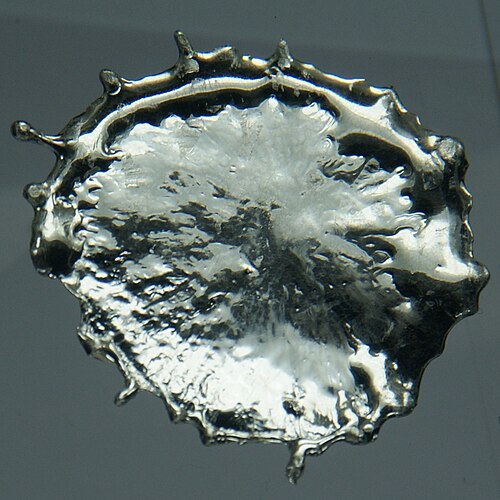
Tin is a soft, malleable, ductile and highly crystalline silvery-white metal. When a bar of tin is bent a crackling sound known as the "tin cry" can be heard from the twinning of the crystals.[14] This trait is shared by indium, cadmium, zinc, and mercury in its solid state. Tin melts at about 232 °C (450 °F), the lowest in group 14, and boils at 2,602 °C (4,716 °F), the second lowest (ahead of lead) in its group. The melting point is further lowered to 177.3 °C (351.1 °F) for 11 nm particles.[15][16]
القصدير بيتا، المعروف أيضًا بالقصدير الأبيض ، هو أحد أشكال القصدير العنصري، وهو مستقر عند درجة حرارة الغرفة وما فوقها. يتميز بخواصه المعدنية وقابليته للطرق، وله بنية بلورية رباعية مركزية الجسم . أما القصدير ألفا، أو القصدير الرمادي ، فهو الشكل غير المعدني. وهو مستقر عند درجات حرارة أقل من 13.2 درجة مئوية (55.8 درجة فهرنهايت) وهش . يتميز القصدير ألفا ببنية بلورية مكعبة تشبه الماس ، كما هو الحال في الماس والسيليكون . لا يمتلك القصدير ألفا خواصًا معدنية لأن ذراته تُشكل بنية تساهمية لا تسمح للإلكترونات بالحركة بحرية. يُعد القصدير ألفا مادة مسحوقية رمادية باهتة ، ولا يُستخدم عادةً إلا في تطبيقات أشباه الموصلات المتخصصة . [ 14 ] يوجد القصدير غاما والقصدير سيغما عند درجات حرارة أعلى من 161 درجة مئوية (322 درجة فهرنهايت) وضغوط أعلى من عدة جيجا باسكال . [ 17 ]
في الظروف الباردة، يميل القصدير بيتا إلى التحول تلقائيًا إلى قصدير ألفا، وهي ظاهرة تُعرف باسم " آفة القصدير " أو "مرض القصدير". [ 18 ] كما تشير بعض المصادر غير الموثوقة إلى أنه خلال حملة نابليون على روسيا عام 1812، انخفضت درجات الحرارة إلى درجةٍ أدت إلى تفتت أزرار القصدير على بزات الجنود بمرور الوقت، مما ساهم في هزيمة الجيش الكبير ، [ 19 ] وهي أسطورةٌ لا تزال رائجة. [ 20 ] [ 21 ] [ 22 ]
تبلغ درجة حرارة التحول من طور ألفا إلى طور بيتا 13.2 درجة مئوية (55.8 درجة فهرنهايت) ، ولكن الشوائب (مثل الألومنيوم والزنك وغيرها) تخفضها إلى ما دون الصفر المئوي (32 درجة فهرنهايت) . وبإضافة الأنتيمون أو البزموت ، قد لا يحدث التحول إطلاقًا، مما يزيد من المتانة. [ 23 ] وتقاوم أنواع القصدير التجارية (بنسبة قصدير 99.8%) التحول بسبب التأثير المثبط لكميات ضئيلة من البزموت والأنتيمون والرصاص والفضة الموجودة كشوائب. [ 24 ]
Alloying elements such as copper, antimony, bismuth, cadmium, and silver increase the hardness of tin.[24] Tin easily forms hard, brittle intermetallic phases that are typically undesirable. It does not mix into a solution with most metals and elements so tin does not have much solid solubility. Tin mixes well with bismuth, gallium, lead, thallium and zinc, forming simple eutectic systems.[23]
Tin becomes a superconductor below 3.72 K[25] and was one of the first superconductors to be studied.[26] The Meissner effect, one of the characteristic features of superconductors, was first discovered in superconducting tin crystals.[26]
Chemical
Tin resists corrosion from water, but can be corroded by acids and alkalis. Tin can be highly polished and is used as a protective coat for other metals.[14] When heated in air it oxidizes slowly to form a thin passivation layer of stannic oxide (SnO2) that inhibits further oxidation.[27][28]
Isotopes
Tin has seven to ten stable isotopes, the greatest number of any element. Their mass numbers are 112, 114, 115, 116, 117, 118, 119, 120, 122, and 124. Seven, 114-120Sn, are theoretically stable, while the remaining three, 112Sn, 122Sn, and 124Sn, are potentially radioactive to double beta decay, but have not been observed to decay. Tin-120 makes up almost a third of all tin. Tin-118 and tin-116 are also common. Tin-115 is the least common stable isotope.[29] The isotopes with even mass numbers have no nuclear spin, while those with odd mass numbers have a nuclear spin of 1/2. It is thought that tin has such a great multitude of stable isotopes because of tin's atomic number being 50, which is a "magic number" in nuclear physics.[30][31]
Tin is one of the easiest elements to detect and analyze by NMR spectroscopy, which relies on molecular weight and its chemical shifts are referenced against tetramethyltin (SnMe4).[b][32]
Of the stable isotopes, tin-115 has a high neutron capture cross section for thermal neutrons, at 30 barns. Tin-117 has a cross section of 2.3 barns, one order of magnitude smaller, while tin-119 has a slightly smaller cross section of 2.2 barns.[33] Before these cross sections were well known, it was proposed to use tin-lead solder as a coolant for fast reactors because of its low melting point. Current studies are for lead or lead-bismuth reactor coolants because both heavy metals are nearly transparent to fast neutrons, with very low capture cross sections.[34] In order to use a tin or tin-lead coolant, the tin would first have to go through isotopic separation to remove the isotopes with odd mass number. Combined, these three isotopes make up about 17% of natural tin but represent nearly all of the capture cross section. Of the remaining seven isotopes tin-112 has a capture cross section of 1 barn. The other six isotopes forming 82.7% of natural tin have capture cross sections of 0.3 barns or less, making them effectively transparent to neutrons.[33]
Tin has 33 unstable isotopes, ranging in mass number from 98 to 140. The unstable tin isotopes have half-lives of less than a year except for tin-126, which has a half-life of about 230,000 years. Tin-100 and tin-132 are two of the very few nuclides with a "doubly magic" nucleus; though they are unstable, being far off the valley of stability in neutron–proton ratio, the tin isotopes lighter than tin-100 and heavier than tin-132 are even less stable.[35] Another 55 metastable isomers have been identified for tin isotopes between 111 and 131, the most stable being tin-121m, with a half-life of 43.9 years.[36]
Etymology
تتشارك اللغات الجرمانية كلمة "tin" ويمكن تتبع أصلها إلى الكلمة الجرمانية البدائية المُعاد بناؤها * tin-om ؛ ومن الكلمات المشابهة لها: الألمانية Zinn ، والسويدية tenn ، والهولندية tin . ولا توجد هذه الكلمة في فروع أخرى من اللغات الهندية الأوروبية ، إلا عن طريق الاقتراض من اللغات الجرمانية (مثل كلمة tinne الأيرلندية المُقتبسة من الإنجليزية). [ 37 ] [ 38 ]
الاسم اللاتيني للقصدير، stannum أو stagnum ، كان في الأصل يعني سبيكة من الفضة والرصاص، وأصبح يعني "القصدير" في القرن الرابع [ 39 ] - وكانت الكلمة اللاتينية السابقة له هي plumbum candidum ، أو "الرصاص الأبيض". ويبدو أن كلمة Stannum مشتقة من كلمة stāgnum السابقة (التي تعني نفس المادة)، [ 37 ] وهو أصل المصطلحات الرومانسية والسلتية للقصدير ، مثل الفرنسية étain ، والإسبانية estaño ، والإيطالية stagno ، والأيرلندية stán . [ 37 ] [ 40 ] أما أصل كلمة stannum / stāgnum فغير معروف؛ وقد يكون قبل اللغة الهندية الأوروبية . [ 41 ]
يشير معجم مايرز كونفرسيشنز بدلاً من ذلك إلى أن القصدير جاء من ستان كورنيش ، وهو دليل على أن كورنوال في القرون الأولى الميلادية كانت المصدر الرئيسي للقصدير.
الكلمة اليونانية القديمة هي κασσίτερος ( كاسيتيروس ). [ 42 ] يقترح بيكس أن الاسم قد يكون اسمًا يُطلق على شعب الكاشيين (الآشوريين الجدد 𒂵𒅆𒄿 ؛ ka₃-ši-i ، kašši) في العصر البرونزي في الشرق الأدنى القديم . [ 43 ]
تاريخ

Tin extraction and use can be dated to the beginnings of the Bronze Age around 3000 BC, when it was observed that copper objects formed of polymetallicores with different metal contents had different physical properties.[44] The earliest bronze objects had a tin or arsenic content of less than 2% and are believed to be the result of unintentional alloying due to trace metal content in the copper ore.[45] The addition of a second metal to copper increases its hardness, lowers the melting temperature, and improves the casting process by producing a more fluid melt that cools to a denser, less spongy metal.[45] This was an important innovation that allowed for the much more complex shapes cast in closed molds of the Bronze Age. Arsenical bronze objects appear first in the Near East where arsenic is commonly found with copper ore, but the health risks were quickly realized and the quest for sources of the much less hazardous tin ores began early in the Bronze Age.[46] This created the demand for rare tin metal and formed a trade network that linked the distant sources of tin to the markets of Bronze Age cultures.[47]
Cassiterite (SnO2), the oxide form of tin, was most likely the original source of tin. Other tin ores are less common sulfides such as stannite that require a more involved smelting process. Cassiterite often accumulates in alluvial channels as placer deposits because it is harder, heavier, and more chemically resistant than the accompanying granite.[45] Cassiterite is usually black or dark in color, and these deposits can be easily seen in river banks. Alluvial (placer) deposits may incidentally have been collected and separated by methods similar to gold panning.[48]
Tin replaced silver as the main export commodity of Bolivia in the early 20th century as it was used in solder as the canning industry greatly expanded.[49] Starting in the late 1920s tin prices began a long trend of gradual decline.[49] During the Second World War Bolivian tin mining magnate Simón Iturri Patiño was believed to be one of the five wealthiest men in the world.[50]
Later, in 1985 the crash of international tin prices led to the 1985 Bolivian economic crisis.[49] Bolivian company Corporación Minera de Bolivia (COMIBOL) was forced to lay off over 20,000 miners.[51][52]
Compounds and chemistry
In the great majority of its compounds, tin has the oxidation state II or IV. Compounds containing bivalent tin are called stannous while those containing tetravalent tin are termed stannic.
Inorganic compounds
Halide compounds are known for both oxidation states. For Sn(IV), all four halides are well known: SnF4, SnCl4, SnBr4, and SnI4. The three heavier members are volatile molecular compounds, whereas the tetrafluoride is polymeric. All four halides are known for Sn(II) also: SnF2, SnCl2, SnBr2, and SnI2. All are polymeric solids. Of these eight compounds, only the iodides are colored.[53]
Tin(II) chloride (also known as stannous chloride) is the most important commercial tin halide. Illustrating the routes to such compounds, chlorine reacts with tin metal to give SnCl4 whereas the reaction of hydrochloric acid and tin produces SnCl2 and hydrogen gas. Alternatively SnCl4 and Sn combine to stannous chloride by a process called comproportionation:[54]
- SnCl4 + Sn → 2 SnCl2
Tin can form many oxides, sulfides, and other chalcogenide derivatives. The dioxide SnO2 (cassiterite) forms when tin is heated in the presence of air.[53]SnO2 is amphoteric, which means that it dissolves in both acidic and basic solutions.[55] Stannates with the structure [Sn(OH)6]2−, like K2[Sn(OH)6], are also known, though the free stannic acid H2[Sn(OH)6] is unknown.
Sulfides of tin exist in both the +2 and +4 oxidation states: tin(II) sulfide and tin(IV) sulfide (mosaic gold).

Hydrides
Stannane (SnH4), with tin in the +4 oxidation state, is unstable. Organotin hydrides are however well known, e.g. tributyltin hydride (Sn(C4H9)3H).[14] These compounds release transient tributyl tin radicals, which are rare examples of compounds of tin(III).[57]
Organotin compounds
Organotin compounds, sometimes called stannanes, are chemical compounds with tin–carbon bonds.[58] Of the tin compounds, the organic derivatives are commercially the most useful.[59] Some organotin compounds are highly toxic and have been used as biocides. The first organotin compound to be reported was diethyltin diiodide ((C2H5)2SnI2), reported by Edward Frankland in 1849.[60]
Most organotin compounds are colorless liquids or solids that are stable to air and water. They adopt tetrahedral geometry. Tetraalkyl- and tetraaryltin compounds can be prepared using Grignard reagents:[59]
- SnCl4 + 4 RMgBr → R4Sn + 4 MgBrCl
The mixed halide-alkyls, which are more common and more important commercially than the tetraorgano derivatives, are prepared by redistribution reactions:
- SnCl4 + R4Sn → 2 SnCl2R2
مركبات القصدير العضوية ثنائية التكافؤ غير شائعة، على الرغم من أنها أكثر شيوعًا من مركبات الجرمانيوم العضوية والسيليكون العضوية ثنائية التكافؤ ذات الصلة. يُعزى الاستقرار الأكبر الذي يتمتع به القصدير الثنائي (Sn(II)) إلى " تأثير الزوج الخامل ". تشمل مركبات القصدير العضوية (II) كلاً من الستانيلينات (صيغتها: R₂Sn ، كما هو الحال في الكاربينات المفردة ) وثنائي الستانيلينات ( R₄Sn₂ ) ، والتي تُعادل تقريبًا الألكينات . تُظهر كلتا الفئتين تفاعلات غير عادية. [ 61 ]
حدوث
يتم توليد القصدير من خلال عملية s الطويلة في النجوم ذات الكتلة المنخفضة إلى المتوسطة (بكتلة تتراوح من 0.6 إلى 10 أضعاف كتلة الشمس ) ، وأخيراً عن طريق تحلل بيتا للنظائر الثقيلة للإنديوم . [ 62 ]
يُعد القصدير العنصر التاسع والأربعين الأكثر وفرة في قشرة الأرض ، حيث يمثل 2 جزء في المليون مقارنة بـ 75 جزء في المليون للزنك، و50 جزء في المليون للنحاس، و14 جزء في المليون للرصاص. [ 63 ]
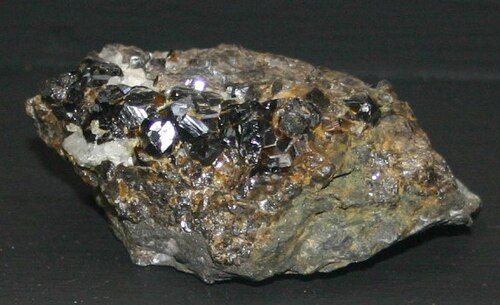
لا يوجد القصدير كعنصر طبيعي، بل يجب استخراجه من خامات مختلفة. الكاسيتريت ( SnO₂)2 ) هو المصدر الوحيد ذو الأهمية التجارية للقصدير، على الرغم من استخلاص كميات ضئيلة منه منالكبريتيداتمثلالستانيت،والأسطوانيدريت،والفرانكيت،والكانفيلديت،والتيليت. وترتبط المعادن التي تحتوي على القصدير دائمًا تقريبًاالجرانيت، وعادةً ما يكون محتواها من أكسيد القصدير 1%. [ 64 ]
بسبب الكثافة النوعية العالية لثاني أكسيد القصدير، يُستخرج حوالي 80% من القصدير من رواسب ثانوية تقع أسفل مجاري الأنهار من العروق الرئيسية. وغالبًا ما يُستخلص القصدير من حبيبات جرفتها المياه في الماضي وترسبت في الوديان أو البحر. وتُعدّ عمليات التجريف والاستخراج الهيدروليكي والمناجم المكشوفة من أكثر طرق استخراج القصدير اقتصادية . ويُنتج معظم القصدير في العالم من رواسب غرينية ، والتي قد تحتوي على نسبة ضئيلة من القصدير تصل إلى 0.015%. [ 65 ]
| دولة | الاحتياطيات |
|---|---|
 الصين الصين | 1,500,000 |
 ماليزيا ماليزيا | 250,000 |
 بيرو بيرو | 310,000 |
 أندونيسيا أندونيسيا | 800,000 |
 البرازيل البرازيل | 590,000 |
 بوليفيا بوليفيا | 400,000 |
 روسيا روسيا | 350,000 |
 أستراليا أستراليا | 180,000 |
 تايلاند تايلاند | 170,000 |
| آخر | 180,000 |
| المجموع | 4,800,000 |
| سنة | مليون طن |
|---|---|
| 1965 | 4265 |
| 1970 | 3930 |
| 1975 | 9060 |
| 1980 | 9100 |
| 1985 | 3060 |
| 1990 | 7100 |
| 2000 | 7100 [ 66 ] |
| 2010 | 5200 [ 66 ] |
تم استخراج حوالي 253 ألف طن من القصدير في عام 2011، معظمها في الصين (110 آلاف طن)، وإندونيسيا (51 ألف طن)، وبيرو (34.6 ألف طن)، وبوليفيا (20.7 ألف طن)، والبرازيل (12 ألف طن). [ 66 ] وقد تباينت تقديرات إنتاج القصدير تاريخيًا تبعًا لظروف السوق وتقنيات التعدين. وتشير التقديرات إلى أنه بالمعدلات الحالية للاستهلاك والتقنيات المستخدمة، سينفد مخزون القصدير القابل للتعدين على كوكب الأرض خلال 40 عامًا. [ 67 ] وفي عام 2006، أشار ليستر براون إلى أن مخزون القصدير قد ينفد خلال 20 عامًا استنادًا إلى تقديرات متحفظة لمعدل نمو سنوي قدره 2%. [ 68 ]
يُعدّ القصدير الخردة مصدراً مهماً لهذا المعدن. وقد ازداد استخلاص القصدير من خلال إعادة التدوير بشكل سريع منذ عام 2019. [ 69 ] في حين أن الولايات المتحدة لم تستخرج القصدير (منذ عام 1993) ولم تصهره (منذ عام 1989)، إلا أنها كانت أكبر منتج ثانوي، حيث أعادت تدوير ما يقرب من 14000 طن في عام 2006. [ 66 ]
تم الإبلاغ عن وجود رواسب جديدة في منغوليا ، [ 70 ] وفي عام 2009، تم اكتشاف رواسب جديدة من القصدير في كولومبيا. [ 71 ]
إنتاج
| شركة | النظام السياسي | 2006 | 2007 | 2017 [ 73 ] | نسبة التغير 2006-2017 |
|---|---|---|---|---|---|
| يونان تين | الصين | 52,339 | 61,129 | 74,500 | 42.3 |
| بي تي تيماه | أندونيسيا | 44,689 | 58,325 | 30200 | -32.4 |
| شركة ماليزيا للصهر | ماليزيا | 22850 | 25,471 | 27200 | 19.0 |
| يوننان تشنغفنغ | الصين | 21,765 | 18000 | 26800 | 23.1 |
| مينسور | بيرو | 40,977 | 35,940 | 18000 | -56.1 |
| إي إم فينتو | بوليفيا | 11804 | 9448 | 12600 | 6.7 |
| قصدير الصين غوانغشي | الصين | / | / | 11500 | / |
| تايساركو | تايلاند | 27,828 | 19826 | 10600 | -61.9 |
| ميتالو-كيميك | بلجيكا | 8049 | 8372 | 9700 | 20.5 |
| جيجيو زي لي | الصين | / | / | 8700 | / |
يُنتج القصدير عن طريق الاختزال الكربوني الحراري لخام الأكسيد باستخدام الكربون أو فحم الكوك. ويمكن استخدام كل من الفرن العاكس والفرن الكهربائي : [ 74 ] [ 75 ] [ 76 ]
- SnO₂ + C فرن القوس الكهربائي → Sn + CO₂ ↑
التعدين والصهر
صناعة
أنتجت أكبر عشر شركات منتجة للقصدير معظم إنتاج العالم من القصدير في عام 2007.
يتم تداول معظم القصدير في العالم في بورصة لندن للمعادن، من 8 دول، تحت 17 علامة تجارية. [ 77 ]
The International Tin Council was established in 1947 to control the price of tin. It collapsed in 1985. In 1984, the Association of Tin Producing Countries was created, with Australia, Bolivia, Indonesia, Malaysia, Nigeria, Thailand, and Zaire as members.[78]
Price and exchanges
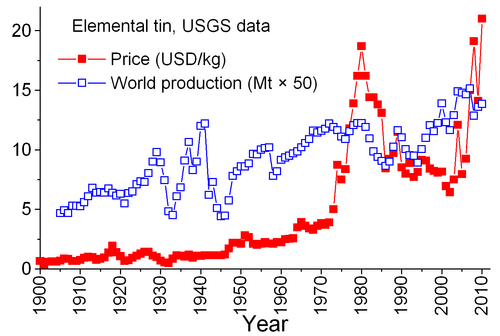
Tin is unique among mineral commodities because of the complex agreements between producer countries and consumer countries dating back to 1921. Earlier agreements tended to be somewhat informal and led to the "First International Tin Agreement" in 1956, the first of a series that effectively collapsed in 1985. Through these agreements, the International Tin Council (ITC) had a considerable effect on tin prices. ITC supported the price of tin during periods of low prices by buying tin for its buffer stockpile and was able to restrain the price during periods of high prices by selling from the stockpile. This was an anti-free-market approach, designed to assure a sufficient flow of tin to consumer countries and a profit for producer countries. However, the buffer stockpile was not sufficiently large, and during most of those 29 years tin prices rose, sometimes sharply, especially from 1973 through 1980 when rampant inflation plagued many world economies.[79]
During the late 1970s and early 1980s, the U.S. reduced its strategic tin stockpile, partly to take advantage of historically high tin prices. The 1981–82 recession damaged the tin industry. Tin consumption declined dramatically. ITC was able to avoid truly steep declines through accelerated buying for its buffer stockpile; this activity required extensive borrowing. ITC continued to borrow until late 1985 when it reached its credit limit. Immediately, a major "tin crisis" ensued—tin was delisted from trading on the London Metal Exchange for about three years. ITC dissolved soon afterward, and the price of tin, now in a free-market environment, fell to $4 per pound and remained around that level through the 1990s.[79] The price increased again by 2010 with a rebound in consumption following the 2008 financial crisis and the Great Recession, accompanying restocking and continued growth in consumption.[66]
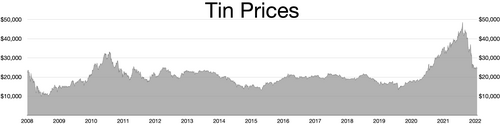
London Metal Exchange (LME) is tin's principal trading site.[66] Other tin contract markets are Kuala Lumpur Tin Market (KLTM) and Indonesia Tin Exchange (INATIN).[80]
نتيجةً لعوامل أزمة سلاسل التوريد العالمية عام 2021 ، تضاعفت أسعار القصدير تقريبًا خلال الفترة 2020-2021، مسجلةً أكبر ارتفاع سنوي لها منذ أكثر من 30 عامًا. وانخفض استهلاك القصدير المكرر عالميًا بنسبة 1.6% في عام 2020، حيث أدى تفشي جائحة كوفيد-19 إلى تعطيل الصناعات التحويلية العالمية. [ 81 ]
التطبيقات
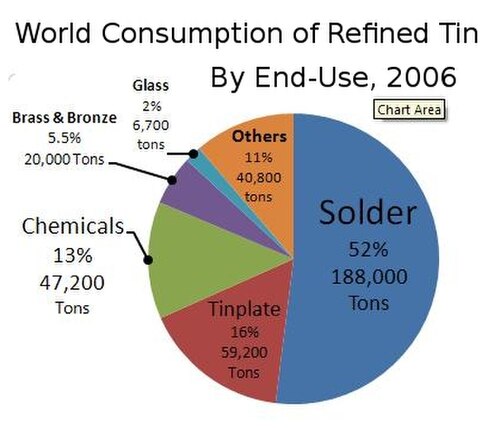
في عام 2018، استُخدم ما يقارب نصف إجمالي إنتاج القصدير في اللحام. أما الباقي فقد وُزِّع بين طلاء القصدير، والمواد الكيميائية القصديرية، وسبائك النحاس الأصفر والبرونز، واستخدامات متخصصة. [ 82 ]
الأصباغ
يُعرف الصبغ الأصفر 38، كبريتيد القصدير (IV) ، باسم الذهب الفسيفسائي . [ 83 ]
كان اللون الأرجواني لكاسيوس ، أو الصبغة الحمراء 109، وهو ستانات ذهبية مزدوجة مائية ، يقتصر استخدامه في الرسم بشكل أساسي على المنمنمات نظرًا لتكلفته العالية. وقد استُخدم على نطاق واسع في صناعة زجاج التوت البري . كما استُخدم في الفنون لتلوين الخزف . [ 84 ]
كان الأصفر الرصاصي القصديري (الذي يوجد في صورتين صفراوتين - ستانات وسيليكات ) صبغةً ذات أهمية تاريخية بالغة في الرسم الزيتي ، وقد استُخدمت في بعض أعمال الفريسكو في صورتها السيليكاتية. [ 85 ] يُعرف ستانات الرصاص أيضًا في صورته البرتقالية ، ولكنه لم يُستخدم على نطاق واسع في الفنون الجميلة. وهو متوفر للشراء كصبغة من موردي لوازم الفنانين المتخصصين. وهناك شكل آخر أقل شيوعًا، من حيث الاستخدام الفني والتوافر، من الأصفر الرصاصي القصديري يُعرف باسم الأصفر الرصاصي القصديري الأنتموني، أو الأصفر النابولي . [ 86 ]
لا يزال اللون الأزرق السماوي ، وهو لون أزرق سماوي باهت نوعًا ما يُعرف كيميائيًا باسم ستانات الكوبالت ، صبغةً مهمةً للفنانين. يشبه لونه لون الأزرق المنغنيزي (صبغة زرقاء 33)، على الرغم من أنه يفتقر إلى ألوان تلك الصبغة ويكون أكثر عتامة. [ 87 ] عادةً ما يضطر الفنانون للاختيار بين ستانات الكوبالت وتقليد الأزرق المنغنيزي المصنوع من ظل الفثالوسيانين الأزرق المخضر (صبغة زرقاء 15:3)، حيث توقف الإنتاج الصناعي لصبغة الأزرق المنغنيزي في سبعينيات القرن الماضي. [ 88 ] مع ذلك، كان اللون الأزرق السماوي المصنوع من ستانات الكوبالت شائعًا بين الفنانين قبل إنتاج الأزرق المنغنيزي. [ 89 ] [ 90 ]
Pigment Red 233, commonly known as Pinkcolor or Potter's Pink and more precisely known as Chrome Tin Pink Sphene, is a historically important pigment in watercolor.[91] However, it has enjoyed a large resurgence in popularity due to Internet-based word-of-mouth. It is fully lightfast and chemically stable in both oil paints and watercolors. Other inorganic mixed metal complex pigments, produced via calcination, often feature tin as a constituent. These pigments are known for their lightfastness, weatherfastness, chemical stability, lack of toxicity, and opacity. Many are rather dull in terms of colorfulness. However, some possess enough colorfulness to be competitive for use cases that require more than a moderate amount of it. Some are prized for other qualities. For instance, Pinkcolor is chosen by many watercolorists for its strong granulation, even though its chroma is low. Recently, NTP Yellow (a pyrochlore) has been brought to market as a non-toxic replacement for lead(II) chromate with greater opacity, lightfastness, and weathering resistance than proposed organic lead chromate replacement pigments possess.[92] NTP Yellow possesses the highest level of color saturation of these contemporary inorganic mixed metal complex pigments. More examples of this group include Pigment Yellow 158 (Tin Vanadium Yellow Cassiterite),[93] Pigment Yellow 216 (Solaplex Yellow),[94] Pigment Yellow 219 (TitaniumZincAntimony Stannate),[95] Pigment Orange 82 (Tin Titanium Zinc oxide, also known as Sicopal Orange),[96] Pigment Red 121 (also known as Tin Violet and Chromium stannate),[97] Pigment Red 230 (Chrome Alumina Pink Corundum),[98] Pigment Red 236 (Chrome Tin Orchid Cassiterite),[99] and Pigment Black 23 (Tin Antimony Grey Cassiterite).[100] Another blue pigment with tin and cobalt is Pigment Blue 81, Cobalt Tin Alumina Blue Spinel.[101]
Pigment White 15, tin(IV) oxide, is used for its iridescence, most commonly as a ceramic glaze.[102] There are no green pigments that have been used by artists that have tin as a constituent and purplish pigments with tin are classified as red, according to the Colour Index International.
Solder
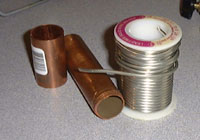
Tin has long been used in alloys with lead as solder, in amounts of 5 to 70% w/w. Tin with lead forms a eutectic mixture at the weight proportion of 61.9% tin and 38.1% lead (the atomic proportion: 73.9% tin and 26.1% lead), with melting temperature of 183 °C (361.4 °F). Such solders are primarily used for joining pipes or electric circuits. Since the European Union Waste Electrical and Electronic Equipment Directive (WEEE Directive) and Restriction of Hazardous Substances Directive came into effect on 1 July 2006, the lead content in such alloys has decreased. While lead exposure is associated with serious health problems, lead-free solder is not without its challenges, including a higher melting point, and the formation of tin whiskers that cause electrical problems. Tin pest can occur in lead-free solders, leading to loss of the soldered joint. Replacement alloys are being found, but the problems of joint integrity remain.[103] A common lead-free alloy is 99% tin, 0.7% copper, and 0.3% silver, with melting temperature of 217 °C (422.6 °F).[104]
Tin plating

Tin bonds readily to iron and is used for coating lead, zinc, and steel to prevent corrosion. Tin-plated (or tinned) steel containers are widely used for food preservation, and this forms a large part of the market for metallic tin. A tinplate canister for preserving food was first manufactured in London in 1812.[105] Speakers of British English call such containers "tins", while speakers of U.S. English call them "cans" or "tin cans". One derivation of such use is the slang term "tinnie" or "tinny", meaning "can of beer" in Australia. The tin whistle is so called because it was mass-produced first in tin-plated steel.[106][107]

Copper cooking vessels such as saucepans and frying pans are frequently lined with a thin plating of tin, by electroplating or by traditional chemical methods, since use of copper cookware with acidic foods can be toxic.[108][109]Tin foil, a thin foil made of tin, has been made since the Eastern Zhou period of China[110] and is variously used to decorate and wrap objects.[111] The term is sometimes used to describe the cheaper, more durable aluminium foil that largely supplanted its use by the 20th century.[112]
Specialized alloys
Tin in combination with other elements forms a wide variety of useful alloys. Tin is most commonly alloyed with copper. Pewter is 85–99% tin,[113] and bearing metal has a high percentage of tin as well.[114][115]Bronze is mostly copper with 12% tin, while the addition of phosphorus yields phosphor bronze. Bell metal is also a copper–tin alloy, containing 22% tin. Tin has sometimes been used in coinage; it once formed a single-digit percentage (usually five percent or less) of American[116] and Canadian[117] pennies.
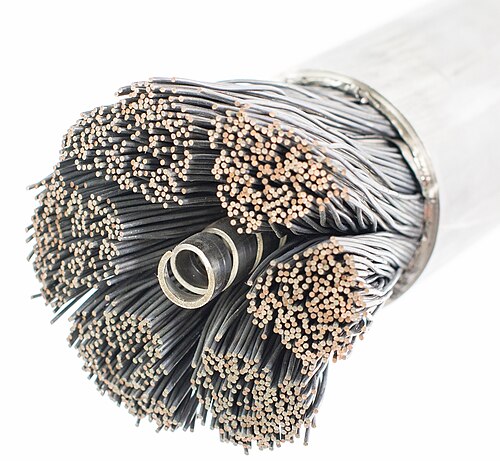
The niobium–tin compound Nb3Sn is commercially used in coils of superconducting magnets for its high critical temperature (18 K) and critical magnetic field (25 T). A superconducting magnet weighing as little as two kilograms is capable of producing the magnetic field of a conventional electromagnet weighing tons.[118]
A small percentage of tin is added to zirconium alloys for the cladding of nuclear fuel.[119]
تُصنع معظم الأنابيب المعدنية في آلة الأرغن من سبيكة القصدير والرصاص، وتُعدّ نسبة 50/50 هي الأكثر شيوعًا. وتُحدد نسبة القصدير في الأنبوب نغمته، نظرًا لما يتمتع به القصدير من رنين نغمي مرغوب. عند تبريد سبيكة القصدير والرصاص، يتصلب الرصاص أولًا، ثم عند الوصول إلى درجة حرارة الانصهار، يتشكل من السائل المتبقي بنية القصدير والرصاص الطبقية اللامعة؛ ويُنتج التباين مع الرصاص تأثيرًا مُرقطًا أو مُبقعًا. تُعرف هذه السبيكة المعدنية باسم المعدن المُبقع. تشمل المزايا الرئيسية لاستخدام القصدير في صناعة الأنابيب مظهره، وسهولة تشكيله، ومقاومته للتآكل. [ 120 ] [ 121 ]
تصنيع المواد الكيميائية
تُستخدم مركبات القصدير في إنتاج مواد كيميائية متنوعة، بما في ذلك مثبتات البولي فينيل كلوريد (PVC) ومحفزات العمليات الصناعية. وتوفر سبائك القصدير المادة الخام اللازمة لهذه التفاعلات الكيميائية، مما يضمن جودة وأداءً ثابتين. [ 122 ]
الإلكترونيات الضوئية
أكاسيد الإنديوم والقصدير موصلة للكهرباء وشفافة، وتستخدم لصنع أغشية موصلة للكهرباء شفافة ذات تطبيقات في الأجهزة الإلكترونية الضوئية مثل شاشات الكريستال السائل . [ 123 ]
تطبيقات أخرى
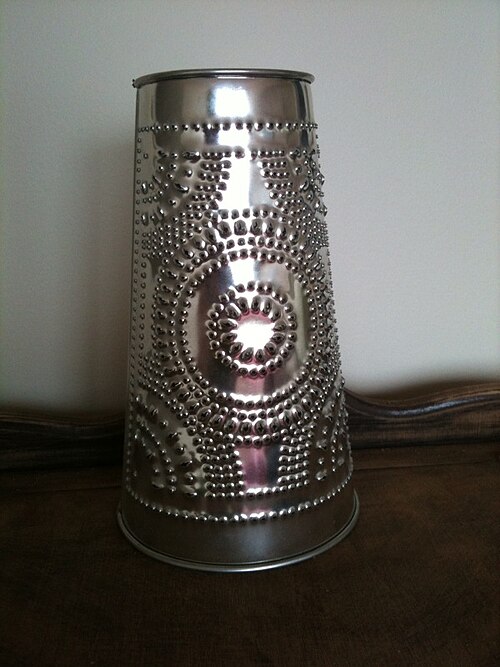

الفولاذ المطلي بالقصدير المثقوب، أو ما يُعرف أيضًا بالقصدير المثقوب، هو تقنية حرفية نشأت في أوروبا الوسطى لصناعة أدوات منزلية عملية وزخرفية. تتنوع تصاميم الثقوب الزخرفية بشكل كبير، استنادًا إلى التقاليد المحلية ومهارة الحرفي. تُعد الفوانيس المصنوعة من القصدير المثقوب أكثر استخدامات هذه التقنية الحرفية شيوعًا. يُضفي ضوء الشمعة المتسلل عبر التصميم المثقوب نمطًا ضوئيًا زخرفيًا على الغرفة التي توضع فيها. صُنعت الفوانيس وغيرها من المصنوعات المصنوعة من القصدير المثقوب في العالم الجديد منذ أقدم المستوطنات الأوروبية. ومن الأمثلة الشهيرة فانوس ريفير، الذي سُمي تيمنًا ببول ريفير . [ 124 ]
في أمريكا، كانت خزائن حفظ الفطائر والأطعمة شائعة الاستخدام قبل اختراع الثلاجات. كانت هذه الخزائن عبارة عن خزائن خشبية بأشكال وأحجام متنوعة، بعضها قائم على الأرض والبعض الآخر معلق، وكان الغرض منها منع دخول الحشرات والقوارض وحماية المواد الغذائية القابلة للتلف من الغبار. احتوت هذه الخزائن على حشوات من الصفيح في الأبواب، وأحيانًا في الجوانب، يقوم صاحب المنزل أو النجار أو صانع الصفائح المعدنية بثقبها بتصاميم مختلفة للسماح بتهوية المكان ومنع دخول الذباب. ولا تزال النسخ الحديثة من هذه الخزائن شائعة في أمريكا الشمالية. [ 125 ]
Window glass is most often made by floating molten glass on molten tin (float glass), resulting in a flat and flawless surface. This is also called the "Pilkington process".[126]
Tin is used as a negative electrode in advanced Li-ion batteries. Its application is somewhat limited by the fact that some tin surfaces catalyze decomposition of carbonate-based electrolytes used in Li-ion batteries.[127]
Tin(II) fluoride is added to some dental care products[128] as stannous fluoride (SnF2). Tin(II) fluoride can be mixed with calcium abrasives while the more common sodium fluoride gradually becomes biologically inactive in the presence of calcium compounds.[129] It has also been shown to be more effective than sodium fluoride in controlling gingivitis.[130]
Tin is used as a target to create laser-induced plasmas that act as the light source for extreme ultraviolet lithography.[131]
Organotin compounds
Organotin compounds are organometallic compounds containing tin–carbon bonds. Worldwide industrial production of organotin compounds likely exceeds 50,000 tonnes.[132]
PVC stabilizers
The major commercial application of organotin compounds is in the stabilization of PVC plastics. In the absence of such stabilizers, PVC would rapidly degrade under heat, light, and atmospheric oxygen, resulting in discolored, brittle products. Tin scavenges labile chloride ions (Cl−), which would otherwise strip HCl from the plastic material.[133] Typical tin compounds are carboxylic acid derivatives of dibutyltin dichloride, such as dibutyltin dilaurate.[134]
Biocides
تُعدّ بعض مركبات القصدير العضوية سامة نسبيًا، ولها مزاياها وعيوبها. تُستخدم هذه المركبات لخصائصها المبيدة للجراثيم ، مثل مبيدات الفطريات ، ومبيدات الآفات ، ومبيدات الطحالب ، ومواد حفظ الأخشاب ، ومواد منع التلوث البيولوجي . [ 133 ] يُستخدم أكسيد ثلاثي بوتيل القصدير كمادة حافظة للأخشاب . [ 135 ] يُستخدم ثلاثي بوتيل القصدير لأغراض صناعية متنوعة، مثل مكافحة الطحالب في مصانع الورق وتطهير مياه التبريد الصناعية المتداولة. [ 136 ] استُخدم ثلاثي بوتيل القصدير كمادة مضافة لطلاء السفن لمنع نمو الكائنات الحية المسببة للتلوث البيولوجي عليها، إلا أن استخدامه تراجع بعد أن تم تصنيف مركبات القصدير العضوية كملوثات عضوية ثابتة ذات سمية عالية لبعض الكائنات البحرية ( مثل حلزون البحر ). [ 137 ] حظر الاتحاد الأوروبي استخدام مركبات القصدير العضوية في عام 2003، [ 138 ] بينما أدت المخاوف بشأن سمية هذه المركبات للحياة البحرية وإلحاق الضرر بتكاثر ونمو بعض الأنواع البحرية [ 133 ] (تصف بعض التقارير آثارًا بيولوجية على الحياة البحرية عند تركيز 1 نانوغرام لكل لتر) إلى حظر عالمي من قبل المنظمة البحرية الدولية . [ 139 ] تقيد العديد من الدول الآن استخدام مركبات القصدير العضوية على السفن التي يزيد طولها عن 25 مترًا (82 قدمًا) . [ 133 ] يعتمد بقاء ثلاثي بوتيل القصدير في البيئة المائية على طبيعة النظام البيئي. [ 140 ] نظرًا لهذا البقاء واستخدامه كمادة مضافة في طلاء السفن، فقد تم العثور على تركيزات عالية من ثلاثي بوتيل القصدير في الرواسب البحرية الموجودة بالقرب من أحواض بناء السفن. [ 141 ] استُخدم ثلاثي بوتيل القصدير كمؤشر حيوي لظاهرة التذكير الجنسي في الرخويات البطنقدمية الحديثة ، مع وجود 82 نوعًا معروفًا على الأقل. [ 142 ] ونظرًا لارتفاع مستويات ثلاثي بوتيل القصدير في المناطق الساحلية المحلية، نتيجةً لأنشطة الشحن، فقد تأثرت الرخويات سلبًا. [ 140 ] التذكير الجنسي هو فرض الخصائص الجنسية الذكرية على الإناث، حيث ينمو لها قضيب وقناة ناقلة للأسهر . [ 142 ] [ 143 ] A high level of TBT can damage mammalian endocrine glands, reproductive and central nervous systems, bone structure and gastrointestinal tract.[143] Tributyltin also affect mammals, Including sea otters, whales, dolphins, and humans.[143]
Organic chemistry
Some tin reagents are useful in organic chemistry. In the largest application, stannous chloride is a common reducing agent for the conversion of nitro and oxime groups to amines. The Stille reaction couples organotin compounds with organic halides or pseudohalides.[144]
Li-ion batteries
Tin forms several inter-metallic phases with lithium metal, making it a potentially attractive material for battery applications. Large volumetric expansion of tin upon alloying with lithium and instability of the tin-organic electrolyte interface at low electrochemical potentials are the greatest challenges to employment in commercial cells.[145] Tin inter-metallic compound with cobalt and carbon was implemented by Sony in its Nexelion cells released in the late 2000s. The composition of the active material is approximately Sn0.3Co0.4C0.3. Research showed that only some crystalline facets of tetragonal (beta) Sn are responsible for undesirable electrochemical activity.[146]
Precautions
Cases of poisoning from tin metal, its oxides, and its salts are almost unknown. On the other hand, certain organotin compounds are almost as toxic as cyanide.[59]
Exposure to tin in the workplace can occur by inhalation, skin contact, and eye contact. The US Occupational Safety and Health Administration (OSHA) set the permissible exposure limit for tin exposure in the workplace as 2 mg/m3 over an 8-hour workday. The National Institute for Occupational Safety and Health (NIOSH) determined a recommended exposure limit (REL) of 2 mg/m3 over an 8-hour workday. At levels of 100 mg/m3, tin is immediately dangerous to life and health.[147]
See also
- Cassiterides (the mythical Tin Islands)
- Stannary
- Terne
- Tin pest
- Tin mining in Britain
- Tinning
- Whisker (metallurgy) (tin whiskers)
Notes
- ↑The thermal expansion of β-Sn is anisotropic: the parameters (at 20 °C) for each crystal axis are αa = 16.19×10⁻⁶/K, αc = 32.89×10⁻⁶/K, and αaverage = αV/3 = 21.76×10⁻⁶/K.[3]
- ↑Only hydrogen, fluorine, phosphorus, thallium and xenon are easier to use NMR analysis with for samples containing isotopes at their natural abundance.
References
- ↑"Standard Atomic Weights: Tin". CIAAW. 1983.
- ↑Prohaska, Thomas; Irrgeher, Johanna; Benefield, Jacqueline; Böhlke, John K.; Chesson, Lesley A.; Coplen, Tyler B.; Ding, Tiping; Dunn, Philip J. H.; Gröning, Manfred; Holden, Norman E.; Meijer, Harro A. J. (4 May 2022). "Standard atomic weights of the elements 2021 (IUPAC Technical Report)". Pure and Applied Chemistry. doi:10.1515/pac-2019-0603. ISSN 1365-3075.
- 12345Arblaster, John W. (2018). Selected Values of the Crystallographic Properties of Elements. Materials Park, Ohio: ASM International. ISBN 978-1-62708-155-9.
- ↑Sn(−3) has been observed in [Sn2]6−, e.g. in (Ba2)4+(Mg4)8+Sn4−(Sn2)6−Sn2− (with square (Sn2−)n sheets), see Papoian, Garegin A.; Hoffmann, Roald (2000). "Hypervalent Bonding in One, Two, and Three Dimensions: Extending the Zintl–Klemm Concept to Nonclassical Electron-Rich Networks". Angew. Chem. Int. Ed. 2000 (39): 2408–2448. doi:10.1002/1521-3773(20000717)39:14<2408::aid-anie2408>3.0.co;2-u. PMID 10941096. Retrieved 2015-02-23.
- ↑Sn(−2) has been observed in SrSn; see Holleman, Arnold F.; Wiberg, Egon; Wiberg, Nils (2008). Lehrbuch der Anorganischen Chemie (in German) (102 ed.). Walter de Gruyter. p. 1007. ISBN 978-3-11-020684-5.
- ↑Sn(−1) has been observed in CsSn; see Holleman, Arnold F.; Wiberg, Egon; Wiberg, Nils (2008). Lehrbuch der Anorganischen Chemie (in German) (102 ed.). Walter de Gruyter. p. 1007. ISBN 978-3-11-020684-5.
- ↑"New Type of Zero-Valent Tin Compound". Chemistry Europe. 27 August 2016.
- ↑"HSn". NIST Chemistry WebBook. National Institute of Standards and Technology. Retrieved 2013-01-23.
- ↑"SnH3". NIST Chemistry WebBook. National Institure of Standards and Technology. Retrieved 2013-01-23.
- ↑Lide, D. R., ed. (2005). "Magnetic susceptibility of the elements and inorganic compounds". CRC Handbook of Chemistry and Physics(PDF) (86th ed.). Boca Raton (FL): CRC Press. ISBN 0-8493-0486-5.
- ↑Weast, Robert (1984). CRC, Handbook of Chemistry and Physics. Boca Raton, Florida: Chemical Rubber Company Publishing. pp. E110. ISBN 0-8493-0464-4.
- ↑Kondev, F. G.; Wang, M.; Huang, W. J.; Naimi, S.; Audi, G. (2021). "The NUBASE2020 evaluation of nuclear properties"(PDF). Chinese Physics C. 45 (3) 030001. doi:10.1088/1674-1137/abddae.
- ↑Gray, Theodore (2007). "Tin Images". The Elements. Black Dog & Leventhal.
- 12345Holleman, Arnold F.; Wiberg, Egon; Wiberg, Nils (1985). "Tin". Lehrbuch der Anorganischen Chemie (in German) (91–100 ed.). Walter de Gruyter. pp. 793–800. ISBN 978-3-11-007511-3.
- ↑"Ink with tin nanoparticles could print future circuit boards". Phys.org. 12 April 2011. Archived from the original on 2011-09-16.
- ↑Jo, Yun Hwan; Jung, Inyu; Choi, Chung Seok; Kim, Inyoung; Lee, Hyuck Mo (2011). "Synthesis and characterization of low temperature Sn nanoparticles for the fabrication of highly conductive ink". Nanotechnology. 22 (22) 225701. Bibcode:2011Nanot..22v5701J. doi:10.1088/0957-4484/22/22/225701. PMID 21454937. S2CID 25202674.
- ↑Molodets, A.M.; Nabatov, S.S. (2000). "Thermodynamic potentials, diagram of state, and phase transitions of tin on shock compression". High Temperature. 38 (5): 715–721. Bibcode:2000HTemp..38..715M. doi:10.1007/BF02755923. S2CID 120417927.
- ↑"Tin Pests | Center for Advanced Life Cycle Engineering". calce.umd.edu. Retrieved 2022-11-04.
- ↑Le Coureur, Penny; Burreson, Jay (2004). Napoleon's Buttons: 17 molecules that changed history. New York: Penguin Group, USA.
- ↑Öhrström, Lars (2013). The Last Alchemist in Paris. Oxford: Oxford University Press. ISBN 978-0-19-966109-1.
- ↑Cotton, Simon (29 April 2014). "Book review: The last alchemist in Pari". Chemistry World. Royal Society of Chemistry. Archived from the original on 2014-08-10. Retrieved 2019-11-22.
- ↑Emsley, John (1 October 2011) [2001]. Nature's Building Blocks: an A-Z Guide to the Elements (New ed.). New York, United States: Oxford University Press. p. 552. ISBN 978-0-19-960563-7.
Only officers had metal buttons, and those were made of brass.
- 12Schwartz, Mel (2002). "Tin and alloys, properties". Encyclopedia of Materials, Parts and Finishes (2nd ed.). CRC Press. ISBN 978-1-56676-661-6.
- 12"Tin Alloys – Characteristics and Uses". Nuclear Power. Retrieved 2022-11-04.
- ↑Dehaas, W.; Deboer, J.; Vandenberg, G. (1935). "The electrical resistance of cadmium, thallium and tin at low temperatures". Physica. 2 (1–12): 453. Bibcode:1935Phy.....2..453D. doi:10.1016/S0031-8914(35)90114-8.
- 12Meissner, W.; R. Ochsenfeld (1933). "Ein neuer effekt bei eintritt der Supraleitfähigkeit". Naturwissenschaften. 21 (44): 787–788. Bibcode:1933NW.....21..787M. doi:10.1007/BF01504252. S2CID 37842752.
- ↑Craig, Bruce D.; Anderson, David S.; International, A. S. M. (January 1995). Handbook of corrosion data. ASM International. p. 126. ISBN 978-0-87170-518-1. Archived from the original on 2016-05-11.
- ↑Crutchlow, Charlotte (25 June 2021). "Tin-Formation About the Element Tin | Periodic Table". ChemTalk. Retrieved 2022-11-04.
- ↑"Tin | NIDC: National Isotope Development Center". www.isotopes.gov. Retrieved 2025-04-13.
- ↑"Testing the Possible Doubly Magic Nature of Tin-100, Researchers Study the Electromagnetic Properties of Indium Isotopes". Energy.gov. Retrieved 2025-04-13.
- ↑Yang, X. F.; Wang, S. J.; Wilkins, S. G.; Ruiz, R. F. Garcia (1 March 2023). "Laser spectroscopy for the study of exotic nuclei". Progress in Particle and Nuclear Physics. 129 104005. arXiv:2209.15228. Bibcode:2023PrPNP.12904005Y. doi:10.1016/j.ppnp.2022.104005. ISSN 0146-6410. OSTI 1961011.
- ↑"Interactive NMR Frequency Map". Archived from the original on 2011-06-04. Retrieved 2009-05-05.
- 12Sears, Varley F. (January 1992). "Neutron scattering lengths and cross sections". Neutron News. 3 (3): 26–37. doi:10.1080/10448639208218770. ISSN 1044-8632. Table of cross sections available at NIST: Neutron Scattering Lengths and cross sections.
- ↑"Westinghouse Nuclear > Energy Systems > Lead-cooled Fast Reactor".
- ↑Walker, Phil (1994). "Doubly Magic Discovery of Tin-100". Physics World. 7 (June): 28. doi:10.1088/2058-7058/7/6/24.
- ↑Kondev, F. G.; Wang, M.; Huang, W. J.; Naimi, S.; Audi, G. (2021). "The NUBASE2020 evaluation of nuclear properties"(PDF). Chinese Physics C. 45 (3) 030001. doi:10.1088/1674-1137/abddae.
- 1 2 3 "قصدير" . قاموس أكسفورد الإنجليزي ( النسخة الإلكترونية). مطبعة جامعة أكسفورد. (يشترط الاشتراك أو عضوية المؤسسة المشاركة .)
- ↑ هاربر، دوغلاس. "قصدير" . قاموس أصل الكلمات على الإنترنت .
- ↑ الموسوعة البريطانية، الطبعة الحادية عشرة ، 1911، مادة " القصدير "، نقلاً عن هـ. كوب
- ↑ "التعدين القديم للقصدير" . oxleigh.freeserve.co.uk . مؤرشف من الأصل بتاريخ 3 أبريل 2009. تم الاطلاع عليه بتاريخ 7 يوليو 2009 .
- ↑ قاموس التراث الأمريكي
- ^ "κασσίτερος" . logeion.uchicago.edu (باللغة اليونانية) . تم الاسترجاع 2026-02-27 .
- ↑ بيكس، آر إس بي؛ بيك، لوسيان فان (2010). قاموس اشتقاقي للغة اليونانية . سلسلة قواميس اشتقاقية هندية أوروبية من ليدن. ليدن؛ بوسطن: بريل. ISBN 978-90-04-17418-4.
- ↑ سيرني، ج.؛ وايسجيربر، ج. (2003). "مناجم القصدير في العصر البرونزي في آسيا الوسطى". في: جيومليا-ماير، أ.؛ لو شيافو، ف. (محرران). مشكلة القصدير المبكر . أكسفورد: أركيوبراس. ص 23-31 . ISBN 978-1-84171-564-3.
- 1 2 3 بينهالوريك، آر دي (1986). القصدير في العصور القديمة: تعدينه وتجارته في جميع أنحاء العالم القديم مع إشارة خاصة إلى كورنوال . لندن: معهد المعادن. ISBN 978-0-904357-81-3.
- ↑ لامبرغ-كارلوفسكي، سي سي؛ فرانكلين، آلان دي؛ أولين، جاكلين إس؛ ويرتايم، ثيودور إيه ، محرران (يوليو 1980). "تطور استخدام القصدير والبرونز القصديري: بعض المشكلات". البحث عن القصدير القديم . المجلد 21. واشنطن العاصمة: ندوة نظمها ثيودور إيه. ويرتايم وعُقدت في مؤسسة سميثسونيان والمكتب الوطني للمعايير، واشنطن العاصمة، 14-15 مارس 1977. ص 474. doi : 10.2307/3103162 . JSTOR 3103162 .
{{cite book}}تم|journal=تجاهله ( مساعدة ) - ↑ "مشروع القصدير القديم" .
- ↑ دوبي، آر كيه (سبتمبر 2006). "العلاقة المتبادلة بين الذهب والقصدير: منظور تاريخي" . نشرة الذهب . 39 (3): 103-113 . doi : 10.1007/BF03215537 .
- 1 2 3 موراليس، خوان أنطونيو؛ ساكس، جيفري (6 يونيو 1988). الأزمة الاقتصادية في بوليفيا (ملف PDF) (تقرير). المكتب الوطني للبحوث الاقتصادية.
- ↑ السيرة الذاتية الحالية . شركة إتش دبليو ويلسون . 1941. الصفحات 645-647 .
- ↑ "ملاحظة خلفية: بوليفيا" . وزارة الخارجية الأمريكية . نوفمبر 2002. مؤرشف من الأصل في 1 أغسطس 2003. يتضمن هذا المقال نصًا من هذا المصدر، وهو متاح للاستخدام العام .

{{cite web}}: CS1 maint: postscript ( link ) - ↑ مان، آرثر جيه؛ باستور، مانويل (1989). "سياسات الاستقرار الأرثوذكسية وغير الأرثوذكسية في بوليفيا وبيرو: 1985-1988". مجلة الدراسات الأمريكية والشؤون العالمية . 31 (4): 163-192 . doi : 10.2307/165997 . JSTOR 165997 .
- 1 2 هولمان، أرنولد فريدريك؛ ويبرغ، إيغون (2001)، ويبرغ، نيلز (محرر)، الكيمياء غير العضوية ، ترجمة إيغلسون، ماري؛ بروير، ويليام، سان دييغو/برلين: أكاديميك برس/دي غرويتر، ISBN 0-12-352651-5
- ↑ غرينوود، نورمان ن.؛ إيرنشو، آلان (1997). كيمياء العناصر ( الطبعة الثانية). باتروورث-هاينمان. doi : 10.1016/C2009-0-30414-6 . ISBN 978-0-08-037941-8.
- ↑ تايلور، ف. شيروود (1942). الكيمياء غير العضوية والنظرية ( الطبعة السادسة). هاينمان.
- ↑ ليجيه، جيه إم؛ هاينز، جيه؛ عطوف، أ. (1996). "سلوك طوري الكوتونيت وما بعد الكوتونيت في PbCl2 و SnCl2 تحت الضغط العالي2 ".J. Phys. Chem. Solids.57(1):7–16.Bibcode:1996JPCS...57....7L.doi:10.1016/0022-3697(95)00060-7.
- ^ جور، دي بي؛ سريفاستافا، ج؛ ميهروترا، RC (1973). "المشتقات العضوية للقصدير. III. تفاعلات إيثوكسيد ثلاثي ألكيلتين مع الألكانولامينات". Zeitschrift für Anorganische und Allgemeine Chemie . 398 (1): 72. بيب كود : 1973ZAACh.398...72G . دوى : 10.1002/zaac.19733980109 .
- ↑ إيلشنبرويش، كريستوف (2006). المركبات العضوية الفلزية (الطبعة الثالثة، منقحة وموسعة بالكامل ). فاينهايم: وايلي-في سي إتش. رقم ISBN 3-527-29390-6. OCLC 64305455 .
- 123Graf, Günter G. (15 June 2000). "Tin, Tin Alloys, and Tin Compounds". Ullmann's Encyclopedia of Industrial Chemistry. Weinheim: Wiley-VCH. doi:10.1002/14356007.a27_049. ISBN 978-3-527-30385-4.
- ↑Thoonen, Sander H. L.; Deelman, Berth-Jan; van Koten, Gerard (2004). "Synthetic aspects of tetraorganotins and organotin(IV) halides"(PDF). Journal of Organometallic Chemistry. 689 (13): 2145–2157. doi:10.1016/j.jorganchem.2004.03.027. hdl:1874/6594. S2CID 100214292. Archived from the original(PDF) on 2011-08-07. Retrieved 2009-07-31.
- ↑Peng, Yang; Ellis, Bobby D.; Wang, Xinping; Fettinger, James C.; Power, P. P. (2009). "Reversible Reactions of Ethylene with Distannynes Under Ambient Conditions". Science. 325 (5948): 1668–1670. Bibcode:2009Sci...325.1668P. doi:10.1126/science.1176443. PMID 19779193. S2CID 3011002.
- ↑Shu, Frank H. (1982). The physical universe: An introduction to astronomy. University Science Books. pp. 119–121. ISBN 978-0-935702-05-7.
- ↑Emsley 2001, pp. 124, 231, 449 and 503.
- 12"Tin: From Ore to Ingot". International Tin Research Institute. 1991. Archived from the original on 2009-03-22. Retrieved 2009-03-21.
- ↑Sutphin, David M.; Sabin, Andrew E.; Reed, Bruce L. (1 June 1992). Tin – International Strategic Minerals Inventory Summary Report. DIANE. p. 9. ISBN 978-0-941375-62-7. Archived from the original on 2016-04-28.
- 1234567Carlin, James F. Jr. "Tin: Statistics and Information"(PDF). United States Geological Survey. Archived from the original on 2008-12-06. Retrieved 2008-11-23.
- ↑ رايلي، مايكل (26 مايو 2007). "إلى متى سيستمر؟". مجلة نيو ساينتست . 194 (2605): 38-39 . Bibcode : 2007NewSc.194...38R . doi : 10.1016/S0262-4079(07)61508-5 .
- ↑ براون، ليستر (2006). الخطة ب 2.0 . نيويورك: دبليو دبليو نورتون. ص 109. ISBN 978-0-393-32831-8.
- ↑ ألفيس، برونا (15 فبراير 2024). "إعادة تدوير القصدير السنوية في الولايات المتحدة 2023" . ستاتيستا . تم الاسترجاع في 23 يونيو 2024 .
- ↑ كوفالينكو، في. آي.؛ يارموليوك، في. في. (1995). "تكوينات خامات المعادن النادرة الداخلية وتكوين المعادن النادرة في منغوليا". الجيولوجيا الاقتصادية . 90 (3): 520. Bibcode : 1995EcGeo..90..520K . doi : 10.2113/gsecongeo.90.3.520 .
- ↑ «مجموعة سيمينول الكولومبية تكتشف خام قصدير عالي الجودة في غابات الأمازون» . بيان صحفي من FreePR101. مؤرشف من الأصل بتاريخ 26 أغسطس 2014.
- ↑ "أكبر عشر شركات منتجة للقصدير" . itri.co.uk. المعهد الدولي لأبحاث القصدير. مؤرشف من الأصل بتاريخ 7 ديسمبر 2008. تم الاطلاع عليه بتاريخ 5 مايو 2009 .
- ↑ "أكبر منتجي القصدير في العالم" . ذا بالانس . ١٣ يناير ٢٠١٩. مؤرشف من الأصل في ٥ مايو ٢٠١٩. تم الاطلاع عليه في ٥ مايو ٢٠١٩ .
- ↑ شريدر، جورج ف.؛ الشناوي، أحمد ك.؛ دويل، لورانس إي. (يوليو 2000). عمليات التصنيع والمواد . جمعية مهندسي التصنيع. ISBN 978-0-87263-517-3تمت أرشفة النسخة الأصلية بتاريخ 2016-05-11 .
- ↑ لويس، هنري (1911). علم المعادن للقصدير . شركة ماكجرو هيل للنشر.
- ↑ كنور، كلاوس (1945). القصدير تحت السيطرة . مطبعة جامعة ستانفورد. ISBN 978-0-8047-2136-3تمت أرشفة النسخة الأصلية بتاريخ 19-05-2016 .
{{cite book}}عدم توافق رقم ISBN / التاريخ ( مساعدة ) - ↑ "ماركات القصدير في بورصة لندن للمعادن" . ITRI.co.uk. المعهد الدولي لأبحاث القصدير. مؤرشف من الأصل بتاريخ 7 ديسمبر 2008. تم الاطلاع عليه بتاريخ 5 مايو 2009 .
- ↑ "اتفاقية إنشاء رابطة الدول المنتجة للقصدير [ 1984 ] ATS 10" . معهد المعلومات القانونية الأسترالي، مكتبة المعاهدات الأسترالية .
- 1 2 كارلين، جيمس ف. الابن (1998). "الأحداث الهامة التي أثرت على أسعار القصدير منذ عام 1958" (ملف PDF) . هيئة المسح الجيولوجي الأمريكية. مؤرشف من الأصل (ملف PDF) بتاريخ 28-10-2011.
- ^ "12 يناير بيماساران بيردانا إناتين" . 15 كانون الأول/ديسمبر 2011 مؤرشفة من الأصلي بتاريخ 26-04-2012.
- ↑ دالي، توم (5 ديسمبر 2021). "ارتفاع أسعار القصدير يُفاقم مشاكل سلاسل التوريد لشركات الإلكترونيات والطاقة الشمسية والسيارات" . رويترز . تاريخ الاسترجاع: 7 ديسمبر 2021 .
- ↑ "انخفاض الطلب على القصدير - الرابطة الدولية للقصدير" . موقع Mining.com . ١٨ أكتوبر ٢٠١٩. تاريخ الاطلاع: ٣ يوليو ٢٠٢١ .
- ↑ "قاعدة بيانات ألوان أصباغ الفن - الصبغة الصفراء - PY" . artiscreation . 2024. تم الاطلاع عليه بتاريخ 17 أغسطس 2024 .
- ↑ "قاعدة بيانات ألوان الفن - الصبغة الحمراء - العلاقات العامة" . artiscreation . 2024. تم الاطلاع عليه بتاريخ 17 أغسطس 2024 .
- ↑ "قاعدة بيانات ألوان أصباغ الفن - الصبغة الصفراء - PY" . artiscreation . 2024. تم الاطلاع عليه بتاريخ 17 أغسطس 2024 .
- ↑ أغريستي، جورجيا؛ بارالدي، بيترو؛ بيلوسي، كلوديا؛ سانتاماريا، أولدريكو (2016). "الأصباغ الصفراء القائمة على الرصاص والقصدير والأنتيمون: وصفات قديمة، وتركيب، وخصائص، واختيار اللون في الأعمال الفنية" . بحث وتطبيق الألوان . 41 (3): 226-231 . doi : 10.1002/col.22026 . ISSN 0361-2317 .
- ↑ "قاعدة بيانات ألوان أصباغ الفن - الصبغة الزرقاء - PB" . artiscreation . 2024. تم الاطلاع عليه بتاريخ 17 أغسطس 2024 .
- ↑ "قاعدة بيانات ألوان أصباغ الفن - الصبغة الزرقاء - PB" . artiscreation . 2024. تم الاطلاع عليه بتاريخ 17 أغسطس 2024 .
- ↑ "الأصباغ الزرقاء" . دورات التطوير المهني، والتعليم عن بعد، والاستشارات . 30 أغسطس 2021. تاريخ الاسترجاع: 13 أبريل 2025 .
- ↑ هاتش، إيفي (15 أكتوبر 2021). "دليل ألوان الصبغات: الصبغات الزرقاء - مدونة جاكسون الفنية" . مدونة جاكسون الفنية . مؤرشف من الأصل بتاريخ 8 يناير 2025. تم الاطلاع عليه بتاريخ 13 أبريل 2025 .
- ↑ "قاعدة بيانات ألوان الفن - الصبغة الحمراء - العلاقات العامة" . artiscreation . 2024. تم الاطلاع عليه بتاريخ 17 أغسطس 2024 .
- ↑ "قاعدة بيانات ألوان أصباغ الفن - الصبغة الصفراء - PY" . artiscreation . 2024. تم الاطلاع عليه بتاريخ 17 أغسطس 2024 .
- ↑ "قاعدة بيانات ألوان أصباغ الفن - الصبغة الصفراء - PY" . artiscreation . 2024. تم الاطلاع عليه بتاريخ 17 أغسطس 2024 .
- ↑ "قاعدة بيانات ألوان أصباغ الفن - الصبغة الصفراء - PY" . artiscreation . 2024. تم الاطلاع عليه بتاريخ 17 أغسطس 2024 .
- ↑ "قاعدة بيانات ألوان أصباغ الفن - الصبغة الصفراء - PY" . artiscreation . 2024. تم الاطلاع عليه بتاريخ 17 أغسطس 2024 .
- ↑ "قاعدة بيانات ألوان أصباغ الفن - الصبغة البرتقالية - PO" . artiscreation . 2024. تم الاطلاع عليه بتاريخ 17 أغسطس 2024 .
- ↑ "قاعدة بيانات ألوان الفن - الصبغة الحمراء - العلاقات العامة" . artiscreation . 2024. تم الاطلاع عليه بتاريخ 17 أغسطس 2024 .
- ↑ "قاعدة بيانات ألوان الفن - الصبغة الحمراء - العلاقات العامة" . artiscreation . 2024. تم الاطلاع عليه بتاريخ 17 أغسطس 2024 .
- ↑ "قاعدة بيانات ألوان الفن - الصبغة الحمراء - العلاقات العامة" . artiscreation . 2024. تم الاطلاع عليه بتاريخ 17 أغسطس 2024 .
- ↑"The Color of Art Pigment Database – Pigment Black – PBk". artiscreation. 2024. Retrieved 2024-08-17.
- ↑"The Color of Art Pigment Database: Pigment Blue - PB". Art is Creation. Retrieved 2026-05-01.
- ↑"The Color of Art Pigment Database – Pigment White – PW". artiscreation. 2024. Retrieved 2024-08-17.
- ↑Black, Harvey (2005). "Getting the Lead Out of Electronics". Environmental Health Perspectives. 113 (10): A682–5. doi:10.1289/ehp.113-a682 (inactive 1 January 2026). PMC 1281311. PMID 16203230.
{{cite journal}}: CS1 maint: DOI inactive as of January 2026 (link) - ↑"Technical data Sheet - Lead free alloy"(PDF). RS Online. Retrieved 2023-06-18.
- ↑Childs, Peter (July 1995). "The tin-man's tale". Education in Chemistry. Vol. 32, no. 4. Royal Society of Chemistry. p. 92. Retrieved 2018-06-19.
- ↑Control, Tin Under (1945). Tin Under Control. Stanford University Press. pp. 10–15. ISBN 978-0-8047-2136-3. Archived from the original on 2016-05-31.
{{cite book}}: ISBN / Date incompatibility (help) - ↑Panel On Tin, National Research Council (U.S.). Committee on Technical Aspects of Critical and Strategic Materials (1970). Trends in the use of tin. pp. 10–22. Archived from the original on 2016-05-22.
- ↑"Cooking utensils and nutrition Information | Mount Sinai - New York". Mount Sinai Health System. Retrieved 2025-04-13.
- ↑ علي سلطان، سيف علي؛ أحمد خان، فؤاد؛ وهاب، عبد؛ فاطمة، بتول؛ خالد، حراء؛ بهادر، علي؛ صافي، شير زمان؛ سيلفاراج، تشاندرا بوس؛ علي، عابد؛ العمر، سليمان يوسف؛ عمران، محمد (24 يوليو 2023). " تقييم تسرب العناصر الخطرة المحتملة من أواني الطهي أثناء الطهي: مصدر قلق بالغ للصحة العامة" . مجلة السموم . 11 (7): 640. Bibcode : 2023Toxic..11..640A . doi : 10.3390/toxics11070640 . ISSN 2305-6304 . PMC 10386729. PMID 37505605 .
- ^ وانغ ، ينجشن. مي، جيانجون؛ يو، يونغبين؛ شياو، تشينغيون. شيانغ، قوانغهوا؛ تشاو، ديكسيانج؛ تشين ، كونلونغ (نوفمبر 2019). “مستوردة أم محلية؟ أول رقائق قصدير مزورة تم العثور عليها في الصين “. مجلة التراث الثقافي . 40 : 177– 182. دوى : 10.1016/j.culher.2019.05.020 .
- ↑ "الطلاء بالرقائق المعدنية: الرسم بالترتر في أمريكا" . منظمة الفنون الجميلة التقليدية . 12 سبتمبر 2012. تطوير الرقائق المعدنية . تم الاطلاع عليه بتاريخ 21 ديسمبر 2025 .
- ↑ بيرغر، كينيث ر. (ديسمبر 2002). "تاريخ موجز للتغليف" . جامعة فلوريدا. مؤرشف من الأصل في 9 سبتمبر 2014.
- ↑ هول، تشارلز (1992). القصدير . دار نشر أوسبري. الصفحات 1-5 . ISBN 978-0-7478-0152-8.
- ↑ بريكس، جيمس (2009). "مقدمة" . تحليل بابيت . BiblioBazaar, LLC. ص 1-2 . ISBN 978-1-110-11092-6.
- ↑ ويليامز، روبرت س. (2007). مبادئ علم المعادن . دار ريد للنشر. الصفحات 46-47 . ISBN 978-1-4067-4671-6.
- ↑ "تركيبة السنت" . دار سك العملة الأمريكية. مؤرشف من الأصل بتاريخ 25-10-2011 . تم الاطلاع عليه بتاريخ 28-10-2011 .
- ↑ "مكونات العملات الكندية" (ملف PDF) . دار سك العملة الكندية. مؤرشف من الأصل (ملف PDF) بتاريخ 13 يناير 2012. تم الاطلاع عليه بتاريخ 28 أكتوبر 2011 .
- ↑ جيبال، ثيودور هـ. (أكتوبر 1993). "الموصلية الفائقة: من الفيزياء إلى التكنولوجيا". مجلة الفيزياء اليوم . 46 (10): 52-56 . Bibcode : 1993PhT....46j..52G . doi : 10.1063/1.881384 .
- ↑ كامبل، فليك سي. (2008). "الزركونيوم" . عناصر علم المعادن وسبائك الهندسة . الجمعية الأمريكية للمعادن الدولية. ص 597. ISBN 978-0-87170-867-0تمت أرشفة النسخة الأصلية بتاريخ 28-05-2016 .
- ↑ روبرت بالميري ، محرر. (2006). "Pipe Metal" . موسوعة آلات المفاتيح . نيويورك: جارلاند. ص 411. ISBN 978-0-415-94174-7.
- ↑ جورج أشدون أودسلي (1988). "الأنابيب المعدنية: والمواد المستخدمة في صناعتها" . فن صناعة الأرغن، أودسلي، جورج أشدون . منشورات كوريير دوفر. ص 501. ISBN 978-0-486-21315-6.
- ↑ "التنقل في عملية الحصول على شهادة BIS لسبائك القصدير وفقًا للمعيار IS 26 مع شركة Omega QMS PVT. Ltd" . globalomega.com . 25 سبتمبر 2024. تاريخ الاطلاع: 15 نوفمبر 2025 .
- ↑ كيم، هـ.؛ جيلمور، س.؛ بيك، أ.؛ هورويتز، ج.؛ ماتوسي، هـ .؛ موراتا، هـ.؛ كفافي، ز.؛ كريسي، د. (1999). "الخواص الكهربائية والبصرية والبنيوية لأغشية أكسيد الإنديوم والقصدير الرقيقة لأجهزة الإضاءة العضوية". مجلة الفيزياء التطبيقية . 86 (11): 6451. Bibcode : 1999JAP....86.6451K . doi : 10.1063/1.371708 .
- ↑ بريدج، جانيت (سبتمبر 1996). صناعة وتزيين إطارات الصور . دار نشر نورث لايت. رقم ISBN 978-0-89134-739-2.
- ↑ "ثقب الصفيح" . مؤرشف من الأصل بتاريخ 11-08-2011 . تم الاطلاع عليه بتاريخ 15-08-2011 .
- ↑ بيلكينغتون، لاب (1969). "محاضرة مراجعة. عملية الزجاج المصقول". وقائع الجمعية الملكية في لندن . السلسلة أ، العلوم الرياضية والفيزيائية . 314 (1516): 1-25 . Bibcode : 1969RSPSA.314....1P . doi : 10.1098/rspa.1969.0212 . JSTOR 2416528. S2CID 109981215 .
- ↑ لوكاس، إيفان ت.؛ سيزديك، ياروسلاف؛ كوستيكي، روبرت (2011). "العمليات البينية عند أقطاب β-Sn أحادية البلورة في محاليل إلكتروليتية من الكربونات العضوية". اتصالات الكيمياء الكهربائية . 13 (11): 1271-1275 . doi : 10.1016/j.elecom.2011.08.026 .
- ↑ "كولجيت جيل-كام" . مؤرشف من الأصل بتاريخ 27-04-2009 . تم الاطلاع عليه بتاريخ 05-05-2009 .
- ↑ حطاب، ف. (أبريل 1989). "حالة الفلورايد في معاجين الأسنان". مجلة طب الأسنان . 17 (2): 47-54 . doi : 10.1016/0300-5712(89)90129-2 . PMID 2732364 .
- ↑ بيرليش، إم إيه؛ باكا، إل إيه؛ بولمر، بي دبليو؛ لانزالكو، إيه سي؛ ماكلاناهان، إس إف؛ سيواك، إل كيه؛ بيسوانجر، بي بي؛ إيشولد، دبليو إيه؛ هول، جيه آر؛ وآخرون . (1995). "التأثير السريري لمعجون أسنان يحتوي على فلوريد القصدير المستقر على تكوّن البلاك، والتهاب اللثة، ونزيف اللثة: دراسة لمدة ستة أشهر". مجلة طب الأسنان السريري . 6 (عدد خاص): 54-58 . PMID 8593194 .
- ↑ فيرسولاتو، أوسكار أو. (2019). "فيزياء مصادر بلازما القصدير المُشغَّلة بالليزر لإشعاع الأشعة فوق البنفسجية القصوى لتقنية الطباعة النانوية" . مجلة علوم وتكنولوجيا مصادر البلازما . 28 (8). رمز Bibcode : 2019PSST...28h3001V . doi : 10.1088/1361-6595/ab3302 .
- ↑ إبدون، ل.؛ بريطانيا)، الجمعية الملكية للكيمياء (بريطانيا العظمى (2001). "المركبات العضوية القصديرية في المنتجات الصناعية والمنزلية" . تحديد أنواع العناصر النزرة للبيئة والغذاء والصحة . الجمعية الملكية للكيمياء. ص 144. ISBN 978-0-85404-459-7تمت أرشفة النسخة الأصلية بتاريخ 21-05-2016 .
- 1 2 3 4 أتكينز، بيتر؛ شرايفر، دوارد ف.؛ أوفرتون، تينا؛ وروك، جوناثان (2006). الكيمياء غير العضوية ( الطبعة الرابعة). دبليو إتش فريمان. الصفحات 343، 345. ISBN 978-0-7167-4878-6.
- ↑ ويلكس، تشارلز إي.؛ سامرز، جيمس دبليو.؛ دانيلز، تشارلز أنتوني؛ بيرارد، مارك تي. (أغسطس 2005). دليل PVC . هانسر. ص 108. ISBN 978-1-56990-379-7تمت أرشفة النسخة الأصلية بتاريخ 2016-05-09 .
- ^ ديفيد ن.س. حضرة؛ نوبو شيراشي، محرران. (2001). "الحفاظ على الخشب" . الخشب والكيمياء السليلوزية . نيويورك، نيويورك: ديكر. ص. 799. ردمك 978-0-8247-0024-9.
- ↑ أنتيزار-لاديسلاو، بلانكا (1 فبراير 2008). "المستويات البيئية، والسمية، والتعرض البشري للبيئة البحرية الملوثة بمادة ثلاثي بوتيل القصدير (TBT). مراجعة". مجلة البيئة الدولية . 34 (2): 292-308 . Bibcode : 2008EnInt..34..292A . doi : 10.1016/j.envint.2007.09.005 . PMID 17959247 .
- ↑ إيسلر، رونالد. "مخاطر القصدير على الأسماك والحياة البرية واللافقاريات: مراجعة شاملة" (ملف PDF) . مركز باتوكسنت لأبحاث الحياة البرية، دائرة الأسماك والحياة البرية الأمريكية. مؤرشف (ملف PDF) من الأصل بتاريخ 18 يناير 2012.
- ↑ "اللائحة (EC) رقم 782/2003 الصادرة عن البرلمان الأوروبي والمجلس بتاريخ 14 أبريل 2003 بشأن حظر مركبات القصدير العضوية على السفن" . europa.eu . تم الاطلاع عليه بتاريخ 5 مايو 2009 .
- ↑ دور، سيمون؛ توماسون، جيريمي، محرران. (2008). "التلوث البيولوجي على السفن" . التلوث البيولوجي . أكسفورد: بلاكويل. ص 227. ISBN 978-1-4051-6926-4.
- 1 2 ماغواير، ر. جيمس (1987). "الجوانب البيئية لمركب ثلاثي بوتيل القصدير". الكيمياء العضوية المعدنية التطبيقية . 1 (6): 475-498 . doi : 10.1002/aoc.590010602 .
- ↑ دي مورا، إس جيه؛ ستيوارت، سي؛ فيليبس، دي (1 يناير 1995). "مصادر ومعدل تحلل ثلاثي (ن-بيوتيل) القصدير في الرواسب البحرية بالقرب من أوكلاند، نيوزيلندا". نشرة التلوث البحري . 30 (1): 50-57 . Bibcode : 1995MarPB..30...50D . doi : 10.1016/0025-326X(94)00178-C .
- 1 2 أكسياك، فيكتور؛ ميكاليف، ديان؛ مسقط، جوان؛ فيلا، ألفريد؛ مينتوف ، برنارديت (1 مارس 2003). “Imposex كأداة للرصد الحيوي للتلوث البحري بواسطة ثلاثي بوتيل القصدير: بعض الملاحظات الإضافية”. البيئة الدولية . سيكوتوكس SI 28 (8): 743–749 . بيب كود : 2003EnInt..28..743A . دوى : 10.1016/S0160-4120(02)00119-8 . بميد 12605923 .
- 1 2 3 "تأثيرات ثلاثي بوتيل القصدير على البيئة البحرية" . ساينس باز . 17 نوفمبر 2018. مؤرشف من الأصل في 25 يناير 2021. تم الاطلاع عليه في 17 نوفمبر 2020 .
- ↑ فارينا، فيتوريو؛ كريشنامورثي، فينكات؛ سكوت، ويليام ج. (1997). "تفاعل ستيل". التفاعلات العضوية . ص 1-652 . doi : 10.1002/0471264180.or050.01 . ISBN 0-471-26418-0.
- ↑ مو، هاوي؛ شياو، وي؛ مياو، تشانغ؛ لي، روي؛ يو، ليمينغ (2020). "مواد القصدير ومركباته كأقطاب موجبة في بطاريات الليثيوم أيون والصوديوم أيون: مراجعة" . مجلة فرونتيرز إن كيمستري . 8 141. Bibcode : 2020FrCh....8..141M . doi : 10.3389/fchem.2020.00141 . PMC 7096543. PMID 32266205 .
- ↑ لوكاس، إيفان؛ سيزديك، ياروسلاف (2011). "العمليات البينية عند أقطاب β-Sn أحادية البلورة في محاليل إلكتروليتية من الكربونات العضوية". اتصالات الكيمياء الكهربائية . 13 (11): 1271. doi : 10.1016/j.elecom.2011.08.026 .
- ↑ "دليل الجيب للمخاطر الكيميائية - القصدير" الصادر عن المعهد الوطني للسلامة والصحة المهنية . مراكز السيطرة على الأمراض والوقاية منها . مؤرشف من الأصل بتاريخ 25 نوفمبر 2015. تم الاطلاع عليه بتاريخ 24 نوفمبر 2015 .
فهرس
- تتضمن هذه المقالة نصًا من هذا المصدر، وهو متاح للعموم : كارلين ، جيمس ف.، الابن (1998). "الأحداث الهامة التي أثرت على أسعار القصدير منذ عام 1958" . هيئة المسح الجيوديسي الوطنية الأمريكية
- ليد، ديفيد ر.، محرر. (2006). دليل الكيمياء والفيزياء ( الطبعة 87). بوكا راتون، فلوريدا: مطبعة سي آر سي، مجموعة تايلور وفرانسيس. رقم ISBN 978-0-8493-0487-3.
- إمسلي، جون (2001). "القصدير" . لبنات بناء الطبيعة: دليل شامل للعناصر . أكسفورد، إنجلترا، المملكة المتحدة: مطبعة جامعة أكسفورد. الصفحات 445-450 . ISBN 978-0-19-850340-8.
- غرينوود، نورمان ن .؛ إيرنشو، آلان (1997). كيمياء العناصر ( الطبعة الثانية). باتروورث-هاينمان. doi : 10.1016/C2009-0-30414-6 . ISBN 978-0-08-037941-8.
- هايسرمان، ديفيد ل. (1992). "العنصر 50: القصدير" . استكشاف العناصر الكيميائية ومركباتها . نيويورك: دار نشر TAB. ISBN 978-0-8306-3018-9.
- ماكنتوش، روبرت م. (1968). "القصدير". في: كليفورد أ. هامبل (محرر). موسوعة العناصر الكيميائية . نيويورك: مؤسسة رينهولد للنشر. الصفحات 722-732 . رقم مكتبة الكونغرس 68-29938 .
- Stwertka, Albert (1998). "Tin". Guide to the Elements (Revised ed.). Oxford University Press. ISBN 978-0-19-508083-4.
External links
- Tin at The Periodic Table of Videos (University of Nottingham)
- Theodore Gray's Wooden Periodic Table Table: Tin samples and castings
- Base Metals: TinArchived 2012-07-12 at the Wayback Machine
- CDC – NIOSH Pocket Guide to Chemical Hazards
- Tin (USD cents per kg)
- Tin
- Chemical elements
- Post-transition metals
- Native element minerals
- Chemical elements with body-centered tetragonal structure
- Semimetals