
Ramesses II
Ramesses II[a] (/ˈræməsiːz,ˈræmsiːz,ˈræmziːz/; Ancient Egyptian: rꜥ-ms-sw, Rīꜥa-masē-sə,[b]Ancient Egyptian pronunciation:[ɾiːʕamaˈseːsə]; c.1303 BC – 1213 BC),[7] commonly known as Ramesses the Great,[8] was the third pharaoh of the Nineteenth Dynasty of Egypt. Ramesses II is often regarded as the greatest, most celebrated, and most powerful pharaoh of the New Kingdom, which itself was the most powerful period of ancient Egypt.[9][10] He is also widely considered one of ancient Egypt's most successful warrior pharaohs, conducting no fewer than 15 military campaigns, all resulting in victories, excluding the Battle of Kadesh, which is generally considered a stalemate.[11] His 66-year rule was also the longest recorded reign of any pharaoh (and one of the longest in history), possibly alongside Pepi II, who lived 1000 years earlier and is said to have reigned for over 90 years.
In ancient Greek sources, he is called Ozymandias,[c][12] derived from the first part of his Egyptian-language regnal name: Usermaatre Setepenre.[d][13] Contemporary documents, particularly cuneiform letters discovered at Hattusa indicate that the name Ramesses was pronounced Riamessesa and the full titulary pronounced Wasmuriya Satepnaria Riamessesa Maiamana.[14]
Ramesses was also referred to as the "Great God" by successor pharaohs, who prayed to enjoy his longevity and glory.[15]
اعتلى رمسيس العرش في سن الخامسة والعشرين، وخلال الجزء الأول من حكمه، ركز على بناء المدن والمعابد والآثار. بعد تأسيس مدينة بي رمسيس في دلتا النيل ، جعلها عاصمة مصر الجديدة، واتخذها نقطة انطلاق رئيسية لحملاته في سوريا . قاد رمسيس عدة حملات عسكرية إلى بلاد الشام ، حيث أعاد بسط سيطرة مصر على كنعان وفينيقيا ؛ كما قاد عددًا من الحملات إلى النوبة ، والتي خُلدت جميعها في نقوش بيت الولي وجرف حسين . واحتفل رمسيس بما لا يقل عن ثلاثة عشر أو أربعة عشر مهرجانًا من مهرجانات سد ، وهو عدد لم يسبقه إليه أي فرعون آخر. [ 16 ]
تتفاوت التقديرات حول عمره عند وفاته، إلا أن 90 أو 91 عامًا يُعتبر الرقم الأرجح. [ 17 ] [ 18 ] بعد وفاته، دُفن في مقبرة ( KV7 ) في وادي الملوك ؛ [ 19 ] نُقل جثمانه لاحقًا إلى الخزينة الملكية ، حيث اكتشفه علماء الآثار عام 1881. تُعرض مومياء رمسيس الآن في المتحف القومي للحضارة المصرية ، الواقع في مدينة القاهرة . [ 20 ]
كان رمسيس الثاني أحد الفراعنة القلائل الذين عُبدوا كإله خلال حياته . [ 21 ]
يشكك الباحثون في ارتباط رمسيس الثاني بالتصوير الشعبي والمعاصر له كفرعون الخروج ، بمن فيهم الأمين العام السابق للمجلس الأعلى للآثار في مصر مصطفى وزير والمؤرخ اليهودي ليستر إل. جرابي . [ 22 ] [ 23 ]
وقت مبكر من الحياة
لم يولد رمسيس الثاني أميراً. كان جده، رمسيس الأول ، وزيراً ( تجاتي ) وضابطاً عسكرياً خلال عهد الفرعون حورمحب ، الذي عين رمسيس الأول خليفة له؛ في ذلك الوقت، كان رمسيس الثاني يبلغ من العمر حوالي إحدى عشرة سنة. [ 24 ]
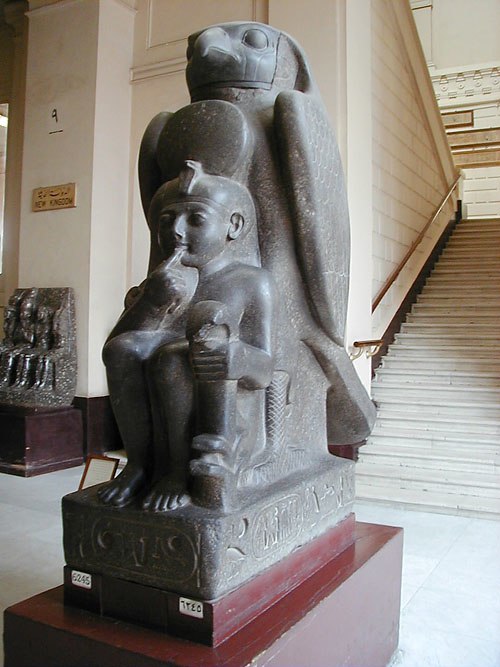
بعد وفاة رمسيس الأول، أصبح ابنه سيتي الأول ملكاً، وعيّن ابنه رمسيس الثاني أميراً وصياً على العرش في سن الرابعة عشرة تقريباً. [ 10 ]
مدة الحكم
Ramesses' date of accession to the throne is recorded as III Shemu (11th month), day 27, which most Egyptologists believe to be 31 May 1279 BC.[17][18]
The Jewish historian Josephus, in his book Contra Apionem which included material from Manetho's Aegyptiaca, assigned Ramesses II ("Armesses Miamun") a reign of 66 years, 2 months.[25] This is essentially confirmed by the calendar of Papyrus Gurob fragment L, where Year 67, I Akhet day 18 of Ramesses II is immediately followed by Year 1, II Akhet day 19 of Merneptah (Ramesses II's son), meaning Ramesses II died about 2 months into his 67th Regnal year.[26]
In 1994, A. J. Peden proposed that Ramesses II died between days 3 and 13 of II Akhet on the basis of Theban graffito 854+855, equated to Merneptah's Year 1 II Akhet day 2.[27] The workman's village of Deir el-Medina preserves a fragment of a mid-20th dynasty necropolis journal (P. Turin prov. nr. 8538 recto I, 5; unpublished) which records that the date II Akhet day 6 was a Free feast day for the "Sailing of UsimaRe-Setepenre." (for Ramesses II).[28] As the Egyptologist Robert J. Demarée notes in a 2016 paper:
- The feast called ẖnw – 'Sailing' – was clearly observed in Thebes or at Deir el-Medina during the Ramesside Period in remembrance of the passing of deified royals. The 'Sailing' of Ahmose-Nefertari was celebrated on II Shemu 15; the 'Sailing' of Seti I on III Shemu 24; and the 'Sailing' of Ramesses II on II Akhet 6.[28]
The date of Ramesses II's recorded death on II Akhet (2nd month) day 6 falls perfectly within Peden's estimated timeline for the king's death in the interval between II Akhet day 3 and II Akhet day 13. This means that Ramesses II died on 13 August 1213 BC (Year 67, II Akhet day 6), after reigning 66 years and 74 days.[e] This also falls perfectly within the calculations of Jürgen von Beckerath, who placed Ramesses' death on either late July or early August 1213 BC.[17]
Military campaigns
Early in his life, Ramesses II embarked on numerous campaigns to restore possession of previously held territories lost to the Nubians and Hittites and to secure Egypt's borders. He was also responsible for suppressing some Nubian revolts and carrying out a campaign in Libya. Though the Battle of Kadesh often dominates the scholarly view of Ramesses II's military prowess and power, he nevertheless enjoyed more than a few outright victories over Egypt's enemies. During his reign, the Egyptian army is estimated to have totaled some 100,000 men: a formidable force that he used to strengthen Egyptian influence.[29]
Battle against Sherden pirates
In his second year, Ramesses II decisively defeated the Sherden sea pirates who were wreaking havoc along Egypt's Mediterranean coast by attacking cargo-laden vessels travelling the sea routes to Egypt.[30] The Sherden people probably came from the coast of Ionia, from southwest Anatolia or perhaps, also from the island of Sardinia.[31][32][33] Ramesses posted troops and ships at strategic points along the coast and patiently lured the pirates to attack their perceived prey before ambushing them in a sea battle and capturing them all in a single action.[34] A stele from Tanis speaks of them coming "in their war-ships from the midst of the sea, and none were able to stand before them". There probably was a naval battle somewhere near the mouth of the Nile, as shortly afterward, many Sherden are seen among the pharaoh's body-guard where they are conspicuous by their horned helmets with a ball projecting from the middle, their round shields, and the great Naue II swords with which they are depicted in inscriptions of the Battle of Kadesh.[35] In that sea battle, together with the Sherden, the pharaoh also defeated the Lukka (L'kkw, possibly the people later known as the Lycians), and the Šqrsšw (Shekelesh) peoples.
Syrian campaigns
First Syrian campaign

The immediate antecedents to the Battle of Kadesh were the early campaigns of Ramesses II into Canaan. His first campaign seems to have taken place in the fourth year of his reign and was commemorated by the erection of what became the first of the Commemorative stelae of Nahr el-Kalb near what is now Beirut. The inscription is almost totally illegible due to weathering.
In the fourth year of his reign, he captured the Hittite vassal state of the Amurru during his campaign in Syria.[37]
Second Syrian campaign
The Battle of Kadesh in his fifth regnal year was the climactic engagement in a campaign that Ramesses fought in Syria, against the resurgent Hittite forces of Muwatalli II. The pharaoh wanted a victory at Kadesh both to expand Egypt's frontiers into Syria, and to emulate his father Seti I's triumphal entry into the city just a decade or so earlier.
He also constructed his new capital, Pi-Ramesses. There he built factories to manufacture weapons, chariots, and shields, supposedly producing some 1,000 weapons in a week, about 250 chariots in two weeks, and 1,000 shields in a week and a half. After these preparations, Ramesses moved to attack territory in the Levant, which belonged to a more substantial enemy than any he had ever faced in war: the Hittite Empire.[38]
After advancing through Canaan for exactly a month, according to the Egyptian sources, Ramesses arrived at Kadesh on 1 May 1274 BC.[39] Here, Ramesses' troops were caught in a Hittite ambush and were initially outnumbered by the enemy, whose chariotry smashed through the second division of Ramesses' forces and attacked his camp. Receiving reinforcements from other Egyptian divisions arriving on the battlefield, the Egyptians counterattacked and routed the Hittites, whose survivors abandoned their chariots and swam the Orontes River to reach the safe city walls.[40] Although left in possession of the battlefield, Ramesses, logistically unable to sustain a long siege, returned to Egypt.[41][42] While Ramesses claimed a great victory, and this was technically true in terms of the actual battle, it is generally considered that the Hittites were the ultimate victors as far as the overall campaign was concerned, since the Egyptians retreated after the battle, and Hittite forces invaded and briefly occupied the Egyptian possessions in the region of Damascus.[43]
الحملة السورية الثالثة

انحصر نفوذ مصر آنذاك في كنعان، بينما سقطت سوريا في أيدي الحيثيين. وبدأ أمراء كنعان، بدافع من عجز المصريين عن فرض إرادتهم وتحريض من الحيثيين، ثورات ضد مصر. لم يرضَ رمسيس الثاني بهذا الوضع، فاستعد لمواجهة تقدم الحيثيين بحملات عسكرية جديدة. ولأن هذه الحملات مسجلة على آثاره مع قلة الإشارات إلى تواريخها الدقيقة أو سنة حكمه، فإن التسلسل الزمني الدقيق للحملات اللاحقة غير واضح. [ 44 ] في أواخر السنة السابعة من حكمه (أبريل/مايو 1272 ق.م. [ 45 ] )، عاد رمسيس الثاني إلى سوريا مرة أخرى. هذه المرة، حقق نجاحًا أكبر ضد أعدائه الحيثيين. خلال هذه الحملة، قسم جيشه إلى قوتين. قاد إحداهما ابنه، آمون حر خيبشف ، وطاردت محاربي قبائل شاسو عبر النقب حتى البحر الميت ، واستولت على أدوم سعير . ثم زحفت هذه القوات للاستيلاء على موآب. أما القوة الأخرى، بقيادة رمسيس نفسه، فقد هاجمت القدس وأريحا . ثم دخل هو الآخر موآب، حيث انضم إلى ابنه. بعد ذلك، زحف الجيش الموحد نحو حِسبون ، ثم دمشق، وصولاً إلى كوميدي ، وأخيراً استعاد أوبي (الأرض المحيطة بدمشق)، مُعيداً بذلك بسط نفوذ مصر السابق. [ 46 ] [ 47 ]
الحملات السورية اللاحقة

Ramesses extended his military successes in his eighth and ninth years. He crossed the Dog River (Nahr al-Kalb) and pushed north into Amurru. His armies managed to march as far north as Dapur,[48] where he had a statue of himself erected. The Egyptian pharaoh thus found himself in northern Amurru, well past Kadesh, in Tunip, where no Egyptian soldier had been seen since the time of Thutmose III, almost 120 years earlier. He laid siege to Dapur before capturing it, and returning to Egypt.[49] By November 1272 BC, Ramesses was back in Egypt, at Heliopolis.[45] His victory in the north proved ephemeral. After having reasserted his power over Canaan, Ramesses led his army north. A mostly illegible stele at the Dog River near Beirut, (Lebanon), which appears to be dated to the king's second year, was probably set up there in his tenth year (1269 BC).[50][51] The thin strip of territory pinched between Amurru and Kadesh did not make for a stable possession. Within a year, they had returned to the Hittite fold, so that Ramesses had to march against Dapur once more in his tenth year. This time he claimed to have fought the battle without even bothering to put on his corslet, until two hours after the fighting began. Six of Ramesses's youthful sons, still wearing their side locks, took part in this conquest. He took towns in Retjenu,[52] and Tunip in Naharin,[53] later recorded on the walls of the Ramesseum.[54] This second success at the location was equally as meaningless as his first, as neither power could decisively defeat the other in battle.[55] In year eighteen, Ramesses erected a stele at Beth Shean, on 19 January 1261 BC.[56]
Peace treaty with the Hittites

In Year 21 of Ramesses's reign, he concluded a peace treaty with the Hittites known to modern scholars as the Treaty of Kadesh. Though this treaty settled the disputes over Canaan, its immediate impetus seems to have been a diplomatic crisis that occurred following Ḫattušili III's accession to the Hittite throne. Ḫattušili had come to power by deposing his nephew Muršili III in the brief and bitter Hittite Civil War. Though the deposed king was initially sent into exile in Syria, he subsequently attempted to regain power and fled to Egypt once these attempts were discovered.[57]
When Ḫattušili demanded his extradition, Ramesses II denied any knowledge of his whereabouts. When Ḫattušili insisted that Muršili was in Egypt, Ramesses's response suggested that Ḫattušili was being deceived by his subjects.[57][58] This demand precipitated a crisis, and the two empires came close to war. Eventually, in the twenty-first year of his reign (1259 BC[59]), Ramesses concluded an agreement at Kadesh to end the conflict.[46]
The peace treaty was recorded in two versions, one in Egyptian hieroglyphs, the other in Hittite, using cuneiform script; both versions survive. Such dual-language recording is common to many subsequent treaties. This treaty differs from others, in that the two language versions are worded differently. While the majority of the text is identical, the Hittite version says the Egyptians came suing for peace and the Egyptian version says the reverse.[60] The treaty was given to the Egyptians in the form of a silver plaque, and this "pocket-book" version was taken back to Egypt and carved into the temple at Karnak. The Egyptian account records Ramesses II's receipt of the Hittite peace treaty tablets on I Peret 21 of Year 21, corresponding to 10 November 1259 BC, according to the standard "Low Chronology" used by Egyptologists.[61]
أُبرمت المعاهدة بين رمسيس الثاني وحاتوشيلي الثالث في السنة الحادية والعشرين من حكم رمسيس (حوالي 1259 قبل الميلاد). [ 59 ] [ 62 ] تنص بنودها الثمانية عشر على السلام بين مصر وحاتي، ثم تُشير إلى أن آلهتهما تُطالبان بالسلام أيضًا. لم تُحدد الحدود في هذه المعاهدة، ولكن يُمكن استنتاجها من وثائق أخرى. تصف بردية أناستاسي كنعان خلال الجزء الأخير من حكم رمسيس الثاني، وتُعدد وتُسمي المدن الساحلية الفينيقية الخاضعة للسيطرة المصرية. ذُكرت مدينة سومور الساحلية ، شمال جبيل ، باعتبارها أقصى مدينة شمالية تابعة لمصر، مما يُشير إلى أنها كانت تضم حامية مصرية. [ 63 ]
لم تُذكر أي حملات مصرية أخرى في كنعان بعد إبرام معاهدة السلام. ويبدو أن الحدود الشمالية كانت آمنة وهادئة، لذا كان حكم الفرعون قويًا حتى وفاة رمسيس الثاني، وما تلا ذلك من أفول السلالة. [ 64 ] عندما حاول ملك ميرا إقحام رمسيس في عمل عدائي ضد الحيثيين، رد المصري بأن زمن المؤامرات لدعم مورسيلي الثالث قد ولّى. وكتب حاتوشيلي الثالث إلى قادشمان إنليل الثاني ، ملك كاردونياش ( بابل ) الكاشي ، بنفس الروح، مذكراً إياه بالوقت الذي عرض فيه والده، قادشمان تورغو ، قتال رمسيس الثاني، ملك مصر. وشجع ملك الحيثيين البابلي على مواجهة عدو آخر، والذي لا بد أنه كان ملك آشور ، الذي قتل حلفاؤه رسول الملك المصري. شجع حاتوشيلي كاداشمان إنليل على القدوم لمساعدته ومنع الآشوريين من قطع الصلة بين مقاطعة كنعان في مصر ومورسيلي الثالث، حليف رمسيس.
حملات نوبية
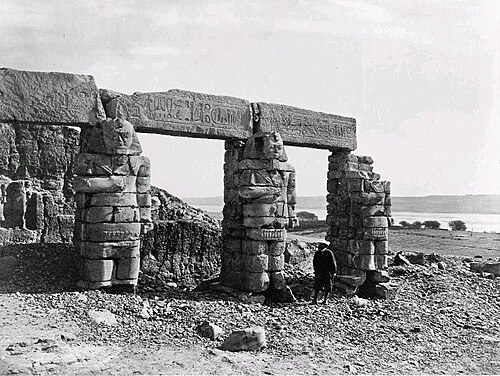
شنّ رمسيس الثاني حملات عسكرية جنوب الشلال الأول لنهر النيل باتجاه النوبة . وعندما بلغ رمسيس الثانية والعشرين من عمره تقريبًا، رافقه اثنان من أبنائه، أحدهما آمون حر خيبسف ، في إحدى تلك الحملات على الأقل. وبحلول عهد رمسيس، كانت النوبة مستعمرة منذ مئتي عام، إلا أن غزوها ظلّ حاضرًا في زخارف المعابد التي بناها رمسيس الثاني في بيت الولي [ 65 ] (الذي كان موضوع دراسة نقشية أجراها المعهد الشرقي خلال حملة إنقاذ الآثار النوبية في ستينيات القرن العشرين)، [ 66 ] وجرف حسين وكلابشة في شمال النوبة. على الجدار الجنوبي لمعبد بيت الولي، يُصوَّر رمسيس الثاني وهو يندفع إلى المعركة ضد قبائل جنوب مصر على متن عربة حربية، بينما يظهر ابناه الصغيران، آمون حر خيبسف وخعمواست، خلفه، أيضًا على متن عربات حربية. يقول جدار في أحد معابد رمسيس إنه اضطر لخوض معركة واحدة مع تلك القبائل دون مساعدة من جنوده.

الحملات الليبية
خلال عهد رمسيس الثاني، كان المصريون نشطين بشكل واضح على امتداد 300 كيلومتر (190 ميلاً) على طول ساحل البحر الأبيض المتوسط ، على الأقل حتى زاوية أم الرخم ، حيث عُثر على بقايا حصن وُصف في نصوصه بأنه بُني على أرض ليبية. [ 67 ] ورغم أن الأحداث الدقيقة المحيطة بتأسيس الحصون والقلاع الساحلية غير واضحة، إلا أنه لا بد من وجود قدر من السيطرة السياسية والعسكرية على المنطقة للسماح ببنائها.
لا توجد روايات مفصلة عن العمليات العسكرية الكبيرة التي شنها رمسيس الثاني ضد الليبيين ، بل سجلات عامة فقط عن غزوه لهم وسحقه لهم، والتي قد تشير أو لا تشير إلى أحداث محددة لم تُسجل. ربما تُشير بعض السجلات، مثل مسلة أسوان التي تعود إلى عامه الثاني، إلى وجود رمسيس في حملات والده على ليبيا. لعل سيتي الأول هو من حقق هذه السيطرة المزعومة على المنطقة، وهو من خطط لإنشاء نظام دفاعي، على غرار إعادة بناء تلك الموجودة شرقًا، أي "طرق حورس" عبر شمال سيناء .
مهرجانات سيد


As of Year 28 of his reign, Ramesses II favored the god Amun above all other divinities, as evidenced in the texts of two separate ostraca discovered at Deir el-Medina.[68]
By tradition, in the 30th year of his reign, Ramesses celebrated a jubilee called the Sed festival. These were held to honour and rejuvenate the pharaoh's strength.[69] Only halfway through what would be a 66-year reign, Ramesses had already eclipsed all but a few of his greatest predecessors in his achievements. He had brought peace, maintained Egyptian borders, and built numerous monuments across the empire. His country was more prosperous and powerful than it had been in nearly a century.
Sed festivals traditionally were held again every three years after the 30th year; Ramesses II, who sometimes held them after two years, eventually celebrated an unprecedented thirteen or fourteen.[70]
Building projects and monuments
In the third year of his reign, Ramesses started the most ambitious building project after the pyramids, which were built almost 1,500 years earlier. Ramesses built extensively from the Delta to Nubia, "covering the land with buildings in a way no monarch before him had."[71]

Some of the activities undertaken were focused on remodeling or usurping existing works, improving masonry techniques, and using art as propaganda.
- In Thebes, the ancient temples were transformed, so that each of them reflected honour to Ramesses as a symbol of his putative divine nature and power.
- The elegant but shallow reliefs of previous pharaohs were easily transformed, and so their images and words could easily be obliterated by their successors. Ramesses insisted that his carvings be deeply engraved into the stone, which made them not only less susceptible to later alteration, but also made them more prominent in the Egyptian sun, reflecting his relationship with the sun deity, Ra.
- Ramesses used art as a means of propaganda for his victories over foreigners, which are depicted on numerous temple reliefs.
- His cartouches are prominently displayed even in buildings that he did not construct.[72]
- He founded a new capital city in the Delta during his reign, called Pi-Ramesses. It previously had served as a summer palace during Seti I's reign.[73]
- Ramesses II expanded gold mining operations in Akuyati (modern day Wadi Allaqi).[74]
Ramesses also undertook many new construction projects. Two of his biggest works, besides Pi-Ramesses, were the temple complex of Abu Simbel and the Ramesseum, a mortuary temple in western Thebes.
Pi-Ramesses
Ramesses II moved the capital of his kingdom from Thebes in the Nile valley to a new site in the eastern Delta. His motives are uncertain, although he possibly wished to be closer to his territories in Canaan and Syria. The new city of Pi-Ramesses (or to give the full name, Pi-Ramesses Aa-nakhtu, meaning "Domain of Ramesses, Great in Victory")[75] was dominated by huge temples and his vast residential palace, complete with its own zoo. In the 10th century AD, the Bible exegete Rabbi Saadia Gaon believed that the biblical site of Ramesses had to be identified with Ain Shams.[76] For a time, during the early 20th century, the site was misidentified as that of Tanis, due to the amount of statuary and other material from Pi-Ramesses found there, but it now is recognized that the Ramesside remains at Tanis were brought there from elsewhere, and the real Pi-Ramesses lies about 30 km (18.6 mi) south, near modern Qantir.[77] The colossal feet of the statue of Ramesses are almost all that remains above ground today. The rest is buried in the fields.[75]
Ramesseum
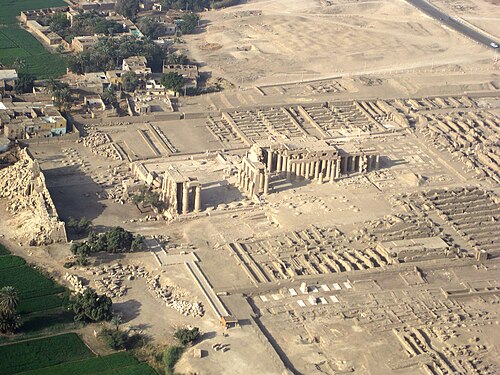
The temple complex built by Ramesses II between Qurna and the desert has been known as the Ramesseum since the 19th century. The Greek historianDiodorus Siculus marveled at the gigantic temple, now no more than a few ruins.[78]
Oriented northwest and southeast, the temple was preceded by two courts. An enormous pylon stood before the first court, with the royal palace at the left and the gigantic statue of the king at the back. Only fragments of the base and torso remain of the syenite statue of the enthroned pharaoh, 17 metres (56 ft) high and weighing more than 1,000 tonnes (980 long tons; 1,100 short tons). Scenes of the pharaoh and his army triumphing over the Hittite forces fleeing before Kadesh are represented on the pylon. Remains of the second court include part of the internal facade of the pylon and a portion of the Osiride portico on the right. Scenes of war and the alleged rout of the Hittites at Kadesh are repeated on the walls. In the upper registers, feast and honour of the phallic deity Min, god of fertility.
On the opposite side of the court, the few Osiride pillars and columns still remaining may furnish an idea of the original grandeur.[79] Scattered remains of the two statues of the seated king also may be seen, one in pink granite and the other in black granite, which once flanked the entrance to the temple. Thirty-nine out of the forty-eight columns in the great hypostyle hall (41 × 31 m) still stand in the central rows. They are decorated with the usual scenes of the king before various deities.[80] Part of the ceiling, decorated with gold stars on a blue ground, also has been preserved. Ramesses's children appear in the procession on the few walls left. The sanctuary was composed of three consecutive rooms, with eight columns and the tetrastyle cell. Part of the first room, with the ceiling decorated with astral scenes, and few remains of the second room are all that is left. Vast storerooms built of mud bricks stretched out around the temple.[79] Traces of a school for scribes were found among the ruins.[81]
A temple of Seti I, of which nothing remains beside the foundations, once stood to the right of the hypostyle hall.[80]
Abu Simbel

In 1255 BC, Ramesses and his queen Nefertari had traveled into Nubia to inaugurate a new temple, Abu Simbel. It is said to be ego cast into stone; the man who built it intended not only to become Egypt's greatest pharaoh, but also one of its deities.[82]
اكتُشف معبد أبو سمبل عام 1813 على يد المستشرق والرحالة السويسري يوهان لودفيج بوركهارت . غطت كومة هائلة من الرمال واجهة المعبد وتماثيله الضخمة بالكامل تقريبًا، مما حال دون الوصول إلى مدخله لأربع سنوات أخرى. وصل المستكشف البادواني جيوفاني باتيستا بلزوني إلى داخل المعبد في 4 أغسطس 1817. [ 83 ]
آثار نوبية أخرى
إلى جانب معابد أبو سمبل، ترك رمسيس آثارًا أخرى لنفسه في النوبة. وتُصوّر حملاته المبكرة على جدران معبد بيت الوالي (الذي نُقل لاحقًا إلى كلابشة الجديدة ). ومن المعابد الأخرى المخصصة لرمسيس معبدا دير وجرف حسين (اللذان نُقلا أيضًا إلى كلابشة الجديدة). أما معبد آمون في جبل بركل ، فيُرجّح أن يكون تأسيسه قد بدأ في عهد تحتمس الثالث، بينما شُيّد المعبد خلال عهده وعهد رمسيس الثاني. [ 84 ]
اكتشافات أثرية أخرى

يعود تاريخ تمثال رمسيس الثاني الضخم إلى 3200 عام، وقد اكتُشف في الأصل مُجزّأً إلى ست قطع في معبد بالقرب من ممفيس بمصر. يبلغ وزنه حوالي 83 طنًا (82 طنًا بريطانيًا؛ 91 طنًا أمريكيًا) ، وقد نُقل وأُعيد بناؤه ونُصب في ساحة رمسيس بالقاهرة عام 1955. في أغسطس 2006، نقله المقاولون إلى موقع آخر لحمايته من عوادم السيارات التي كانت تُسبب تدهوره. [ 85 ] يقع الموقع الجديد بالقرب من المتحف المصري الكبير . [ 86 ]
في عام ٢٠١٨، اكتشف فريق من علماء الآثار في حي المطرية بالقاهرة أجزاءً من مقصورة ذات مقعد، يُعتقد، بناءً على بنيتها وعمرها، أنها ربما كانت تُستخدم من قِبل رمسيس. [ ٨٧ ] [ ٨٨ ] "تتكون المقصورة الملكية من أربع درجات تؤدي إلى منصة مكعبة، يُعتقد أنها كانت قاعدة مقعد الملك أثناء الاحتفالات أو التجمعات العامة"، مثل حفل تنصيب رمسيس ومهرجان سد. وربما استُخدمت لاحقًا من قِبل آخرين في العصر الرعامسي ، وفقًا لرئيس البعثة. كما كشفت بعثة التنقيب عن "مجموعة من الجعارين والتمائم والأواني الفخارية والكتل المنقوشة بنصوص هيروغليفية ". [ ٨٨ ]
في ديسمبر/كانون الأول 2019، كشفت بعثة أثرية مصرية عن تمثال نصفي ملكي من الجرانيت الأحمر للملك رمسيس الثاني في قرية ميت رهينة بالجيزة. يصور التمثال رمسيس الثاني مرتدياً شعراً مستعاراً عليه رمز "كا". بلغت أبعاده 55 سم عرضاً، و45 سم سمكاً، و105 سم طولاً. وإلى جانب التمثال، عُثر على كتل من الحجر الجيري تُظهر رمسيس الثاني أثناء طقوس "حب سد" الدينية. [ 89 ] وقال عالم الآثار مصطفى وزيري: "يُعتبر هذا الاكتشاف من أندر الاكتشافات الأثرية، فهو أول تمثال "كا" مصنوع من الجرانيت يُكتشف على الإطلاق. التمثال الوحيد الذي عُثر عليه سابقاً مصنوع من الخشب، ويعود لأحد ملوك الأسرة الثالثة عشرة في مصر القديمة، وهو معروض في المتحف المصري بساحة التحرير " .
في مايو 2023، تمكن علماء آثار فرنسيون من جامعة السوربون في باريس من تحديد جزء من التابوت الجرانيتي الأصلي لرمسيس الثاني. [ 90 ] وقد أعاد استخدام هذا الجزء من التابوت الجرانيتي كاهن كبير من الأسرة الحادية والعشرين يُدعى منخبر رع ، حوالي عام 1000 قبل الميلاد، لكن مالكه الأصلي ظل مجهولاً حتى كشف التحليل الدقيق الذي أجراه فريدريك بايرودو عن وجود خرطوش رمسيس الثاني عليه. [ 91 ] يعود تاريخ التابوت إلى ما يقارب 1279-1213 قبل الميلاد، وهو ما يتوافق مع عهد رمسيس الثاني، و"يؤكد تصميمه المتقن ونقوشه على التقاليد الفنية والدينية لتلك الحقبة". [ 90 ] ويذكر بايرودو في دراسته المنشورة في مجلة علم المصريات :
- "إن جودة الصنعة والإشارات المحددة إلى آلهة مثل رع وأوزيريس تشير بقوة إلى أن هذا التابوت كان مخصصًا في الأصل لرمسيس الثاني،" [ 92 ]
في سبتمبر 2024، نُشر أنه خلال عملية تنقيب أثرية في حصن عمره 3200 عام على طول نهر النيل، عثر الباحثون على سيف ذهبي يحمل توقيع رمسيس الثاني. [ 93 ]
الموت والدفن
آخر سجل مؤرخ لحكم رمسيس الثاني هو السنة 67، الشهر الأول من موسم الفيضان (أخت)، اليوم 18. [ 94 ] التاريخ التالي، في الوثيقة نفسها، هو السنة 1 (من مرنبتاح)، الشهر الثاني من أخت، اليوم 18، مما يشير إلى أن رمسيس الثاني توفي خلال الأسابيع الفاصلة. [ 95 ] بعد عقود، ترك الملك رمسيس الرابع نصًا تذكاريًا في أبيدوس طلب فيه من الآلهة أن "...يضاعفوا لي عمري المديد وحكمي الطويل (رمسيس الثاني)، الإله العظيم... لأن (في الحقيقة) أكثر بكثير ما فعلته... مما فعله (رمسيس الثاني)... لكم في سنواته الـ 67!" [ 96 ] نسب مؤلفون كلاسيكيون، بمن فيهم مانيتون (القرن الثالث قبل الميلاد)، إلى رمسيس حكمًا دام 66 عامًا وشهرين. [ 97 ] وبناءً على ذلك، يبدو أن مدة حكم رمسيس كانت ستة وستين عامًا كاملة، حيث توفي الملك مبكرًا في عامه السابع والستين.

عند وفاته، عن عمر يناهز التسعين عامًا، كان رمسيس يعاني من مشاكل حادة في الأسنان، بالإضافة إلى التهاب المفاصل وتصلب الشرايين وأمراض القلب . [ 98 ] [ 99 ] تشير صور الأشعة السينية والتصوير المقطعي المحوسب للمومياء إلى أنه ربما كان يمشي بانحناءة واضحة. [ 100 ] سبب وفاته غير معروف، [ 101 ] ولكن أحد الاحتمالات هو تمزق خراج في فكه، مما تسبب في عدوى شديدة. [ 102 ]
مومياء
دُفن رمسيس الثاني في الأصل في المقبرة KV7 بوادي الملوك ، [ 103 ] ولكن بسبب أعمال النهب التي شهدها الوادي، نقل الكهنة جثمانه لاحقًا إلى منطقة مخصصة، وأعادوا لفه، ووضعوه داخل مقبرة الملكة أحمس إينهابي . [ 104 ] وبعد 72 ساعة، نُقل مرة أخرى إلى مقبرة الكاهن الأعظم بينجم الثاني . وقد سُجلت كل هذه الأحداث بالهيروغليفية على الكتان الذي غطى نعشه. [ 105 ] اكتُشفت مومياؤه في النهاية عام 1881 في الموقع TT320 داخل نعش خشبي عادي أُعيد استخدامه [ f ] ، وهي الآن معروضة في المتحف القومي للحضارة المصرية بالقاهرة ( كانت معروضة في المتحف المصري حتى 3 أبريل 2021 ). [ 107 ]

The pharaoh's mummy reveals an aquiline nose and strong jaw. It stands at about 1.7 metres (5 ft 7 in).[108]Gaston Maspero, who first unwrapped the mummy of Ramesses II, writes, "on the temples there are a few sparse hairs, but at the poll the hair is quite thick, forming smooth, straight locks about five centimeters in length. White at the time of death, and possibly auburn during life, they have been dyed a light red by the spices (henna) used in embalming ... the moustache and beard are thin. ... The hairs are white, like those of the head and eyebrows ... the skin is of earthy brown, splotched with black ... the face of the mummy gives a fair idea of the face of the living king."[109][110]
According to Egyptologist Frank J. Yurco, the mummy held features characteristic of northern Egyptians as Rameses II originated from the far north-eastern nome of Egypt rather than deriving from a southern regions as the case with the 12th dynasty, 17th dynasty and 18th dynasty.[111] In his view, this reflected a wider continuum of admixture and physical variation exhibited across Egyptian royal dynasties.[112]
In 1975, Maurice Bucaille, a French doctor, examined the mummy at the Cairo Museum and found it in poor condition. French President Valéry Giscard d'Estaing succeeded in convincing Egyptian authorities to send the mummy to France for treatment. In September 1976, it was greeted at Paris–Le Bourget Airport with full military honours befitting a king, then taken to a laboratory at the Musée de l'Homme.[113][114][115] Persistent claims that the mummy was issued with a passport for the journey are incorrect, but may be based on the French word passeport being used to describe the extensive documentation required.[116]
The mummy was forensically tested in 1976 by Pierre-Fernand Ceccaldi, the chief forensic scientist at the Criminal Identification Laboratory of Paris. Ceccaldi observed that the mummy had slightly wavy, red hair. From this trait combined with cranial features, he concluded that Ramesses II was of a "Berber type" and hence – according to Ceccaldi's analysis – fair-skinned.[117][118] Subsequent microscopic inspection of the roots of Ramesses II's hair proved that the king's hair originally was red. Unlike Maspero, who had assumed the hair had been dyed by the mummification process, Bucaille confirmed that the red hair was natural, which suggests that he came from a family of redheads.[119][120] This has more than just cosmetic significance: in ancient Egypt people with red hair were associated with the deity Set, the slayer of Osiris, and thus the enemy of Horus (Horus being the son of Osiris).[121] In addition, it's noted that Ramesses had familiar connections to Set; the name of Ramesses II's father, Seti I, means "follower of Set", and Seti's father, Ramesses I, had served as the High Priest of Set under Amenhotep III.[122]Cheikh Anta Diop disputed the results of the study, arguing that the structure of hair morphology cannot determine the ethnicity of a mummy and that a comparative study should have featured Nubians in Upper Egypt before a conclusive judgement was reached.[123]
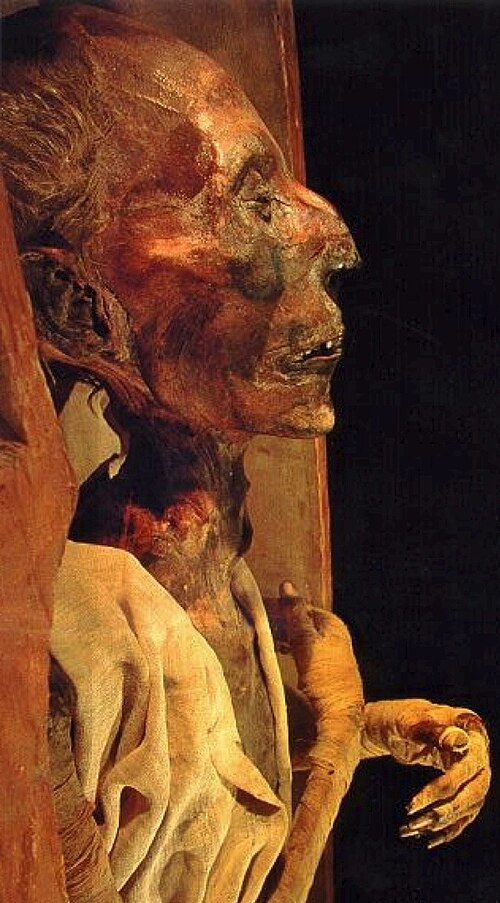
In 2006, French police arrested a man who tried to sell several tufts of Ramesses' hair on the Internet. Jean-Michel Diebolt said he had got the relics from his late father, who had been on the analysis team in the 1970s. They were returned to Egypt the following year.[124] Ramesses II's arthritis is believed to have made him walk with a hunched back for the last decades of his life.[125] A 2004 study excluded ankylosing spondylitis as a possible cause and proposed diffuse idiopathic skeletal hyperostosis as a possible alternative,[126] which was confirmed by more recent work.[127] A significant hole in the pharaoh's mandible was detected. Researchers observed "an abscess by his teeth (which) was serious enough to have caused death by infection, although this cannot be determined with certainty".[125]
After being irradiated in an attempt to eliminate fungi and insects, the mummy was returned from Paris to Egypt in May 1977.[128]
In April 2021, his mummy was moved from the old Egyptian Museum to the new National Museum of Egyptian Civilization along with those of 17 other kings and 4 queens in an event termed the Pharaohs' Golden Parade.[20]
Burial of wives and relatives
Tomb of Nefertari


اكتشف إرنستو شياباريلي مقبرة نفرتاري، أهم زوجات رمسيس، عام ١٩٠٤. [ ٧٩ ] [ ٨٣ ] ورغم تعرضها للنهب في العصور القديمة، إلا أن مقبرة نفرتاري ذات أهمية بالغة، إذ تُعتبر زخارفها الجدارية الرائعة من أعظم إنجازات الفن المصري القديم . يؤدي درج منحوت في الصخر إلى غرفة الانتظار، المزينة بلوحات مستوحاة من الفصل السابع عشر من كتاب الموتى . يُمثل السقف الفلكي السماء، وهو مطلي باللون الأزرق الداكن، ويتزين بعدد لا يُحصى من النجوم الذهبية الخماسية. يقطع الجدار الشرقي لغرفة الانتظار فتحة كبيرة، يحيط بها تمثال لأوزيريس على اليسار وتمثال لأنوبيس على اليمين؛ وتؤدي هذه الفتحة بدورها إلى الغرفة الجانبية، المزينة بمشاهد القرابين، ويسبقها ردهة تُصور فيها اللوحات نفرتاري وهي تُقدم للآلهة التي ترحب بها. على الجدار الشمالي للغرفة الأمامية يوجد الدرج المؤدي إلى غرفة الدفن، وهي غرفة رباعية الأضلاع واسعة تبلغ مساحتها حوالي 90 مترًا مربعًا (970 قدمًا مربعًا ) ، وسقفها ذو الزخارف الفلكية مدعوم بأربعة أعمدة مزخرفة بالكامل. في الأصل، كان تابوت الملكة المصنوع من الجرانيت الأحمر موجودًا في وسط هذه الغرفة. ووفقًا للعقائد الدينية السائدة آنذاك، كانت هذه الغرفة، التي أطلق عليها المصريون القدماء اسم القاعة الذهبية، هي المكان الذي تتم فيه عملية تجديد حياة المتوفى. استُلهمت هذه الرسوم التوضيحية الزخرفية على جدران غرفة الدفن من الفصلين 144 و146 من كتاب الموتى: ففي النصف الأيسر من الغرفة، توجد مقاطع من الفصل 144 تتعلق ببوابات وأبواب مملكة أوزوريس، وحراسها، والصيغ السحرية التي كان على المتوفى أن يتلوها لعبور هذه الأبواب. [ 83 ]
المقبرة KV5
In 1995, Professor Kent Weeks, head of the Theban Mapping Project, rediscovered Tomb KV5. It has proven to be the largest tomb in the Valley of the Kings, and originally contained the mummified remains of some of this king's estimated 52 sons. Approximately 150 corridors and tomb chambers have been located in this tomb as of 2006 and the tomb may contain as many as 200 corridors and chambers.[129] It is believed that at least four of Ramesses's sons, including Meryatum, Sety, Amun-her-khepeshef (Ramesses's first-born son) and "the King's Principal Son of His Body, the Generalissimo Ramesses, justified" (i.e., deceased) were buried there from inscriptions, ostraca or canopic jars discovered in the tomb.[130]Joyce Tyldesley writes that thus far
no intact burials have been discovered and there have been little substantial funeral debris: thousands of potsherds, faience ushabti figures, beads, amulets, fragments of Canopic jars, of wooden coffins ... but no intact sarcophagi, mummies or mummy cases, suggesting that much of the tomb may have been unused. Those burials which were made in KV5 were thoroughly looted in antiquity, leaving little or no remains.[130]
In literature and the arts
Ramesses is the basis for Percy Bysshe Shelley's poem "Ozymandias". Diodorus Siculus gives an inscription on the base of one of his sculptures as: "King of Kings am I, Osymandias. If anyone would know how great I am and where I lie, let him surpass one of my works."[131] This is paraphrased in Shelley's poem.
The life of Ramesses II has inspired many fictional representations, including the historical novels of the French writer Christian Jacq, the Ramsès series; the graphic novel Watchmen, in which the character of Adrian Veidt uses Ramesses II to form part of the inspiration for his alter-ego, Ozymandias; Norman Mailer's novel Ancient Evenings, which is largely concerned with the life of Ramesses II, though from the perspective of Egyptians living during the reign of Ramesses IX; and the Anne Rice book The Mummy, or Ramses the Damned (1989), in which Ramesses was the main character. In The Kane Chronicles Ramesses is an ancestor of the main characters Sadie and Carter Kane. Ramesses II is one of the characters in the video game Civilization V, as well as in additional downloadable content for its sequel, Civilization VI.
The East Village underground rock band The Fugs released their song "Ramses II Is Dead, My Love" on their 1968 album It Crawled into My Hand, Honest.[132]
Ramesses II is a main character in the fiction book The Heretic Queen by Michelle Moran, published in 2008. It is a novel about the love story and beginning years of the marriage of Pharaoh Ramesses and Queen Nefertari, during the time Ramesses is trying to decide who will be queen between his two wives, Nefertari and Iset. Nefertari is the daughter and orphan of Queen Mutnodjmet and General Nakhtmin, niece of Queen Nefertiti and Pharaoh Ankhenaten. The book is told from the perspective of Nefertari and is fiction, but deals with many historical events during the beginning of Ramesses' reign and many historical people, giving readers a view of what life and these historical figures may have been like.
As the pharaoh of the Exodus

Though scholars generally do not recognize the biblical portrayal of the Exodus as an actual historical event,[133] various historical pharaohs have been proposed as the corresponding ruler at the time the story takes place.
Though Ramesses II is often portrayed in films and popular media as the Pharaoh of the Exodus, this is in dispute by historical evidence to the contrary from Egyptologists.[22] Numerous biblical passages, including the singular verse highlighted by proponents (Exodus 1:11), reveal that neither Ramesses II or any of the Ramesside Dynasty pharaohs could have been the pharaoh during The Exodus.[134] In 2023, Mostafa Waziry, who was then secretary-general of Egypt's Supreme Council of Antiquities, said that there is no archaeological or historical evidence in Egyptian antiquities that indicates Ramesses II is the Pharaoh of the Exodus, or any other Egyptian king, and added the Hyksos were the ruling power at the time.[22] In addition, academic research points to a lack of archeological evidence of Israelite labor, and no references of foreign slave labor in state projects in Egyptian records of the time in the construction of Pi-Ramsses, or any other cities.[135]
Jewish historian Lester L. Grabbe wrote in The Dawn of Israel: A History of Canaan in the Second Millennium BCE, that the association of Ramesses II with the Exodus and its associated stories in the Bible are because of his historical prominence. "Strangely, though, it is often proposed that the exodus and/or conquest of Canaan by the Israelites took place under his reign – apparently overlooking that he was one of the strongest of the pharaohs who had a firm hold of the whole region well into Syria and reigned for so much of the thirteenth century – and did not drown in the Red Sea. One cannot imagine an Egypt devastated by plagues, with a huge population leaving the country and an army destroyed in the wilderness near the Red Sea, as compatible with everything we know about this ruler." he wrote.[23]
He is cast in this role in the 1944 novella The Tables of the Law by Thomas Mann. Although not a major character, Ramesses appears in Joan Grant's So Moses Was Born, a first-person account from Nebunefer, the brother of Ramose, which paints a picture of the life of Ramose from the death of Seti, replete with the power play, intrigue, and assassination plots of the historical record, and depicting the relationships with Bintanath, Tuya, Nefertari, and Moses.
In Cecil B. DeMille's 1956 film The Ten Commandments, Ramesses is played by Yul Brynner, portrayed as a vengeful tyrant as well as the main antagonist of the film, ever scornful of his father's preference for Moses over "the son of [his] body".[136] The animated film The Prince of Egypt (1998) also features a depiction of Ramesses (voiced by Ralph Fiennes, for both the speaking and the singing), portrayed as Moses' adoptive brother, and ultimately as the film's villain with essentially the same motivations as in The Ten Commandments. Joel Edgerton played Ramesses in the 2014 film Exodus: Gods and Kings. Sérgio Marone plays Ramesses in the 2015–2016 Brazilian telenovela series Os Dez Mandamentos (English: 'The Ten Commandments').
In the 2013 miniseries The Bible, he is portrayed by Stewart Scudamore.
Ali Gomaa announced in 2020 that when there were tests run on the body of Ramesses, the reason of death was found to be suffocation. Egyptian archaeologistZahi Hawass however states that it's not possible to know whether he died of drowning or not, as the lungs are not present in the mummy.[137][99][138]
Gallery
 Ramesses as crown prince – 19th Dynasty – Musée du Louvre.
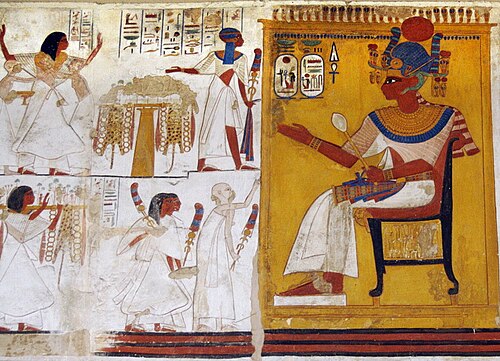 Relief of Ramesses II from the early years of his reign as it shows his regnal name as "Usermaatre" (he changed it to Usermaatre-Setepenre in the second regnal year), and his eldest son (first in the upper row) is still called by his birth name Amenherwenemef, instead of the better known Amenherkhopsef. British Museum
 This statue shows a young Ramesses II holding the Heka Sceptre.
 Ramesses II wearing the Khepresh, Museo Egizio (Turin)
 Painted colossal statue of Ramesses II from Abydos, now at the Penn Museum
 Statue at Abu Simbel of Ramesses II
 Relief of Ramesses II with his mother Tuya, Kunsthistorisches Museum
 Seated statue of Ramesses II (far left), sitting with Horus, Osiris, Isis, and Ramesses's deified father Seti I. Abydos
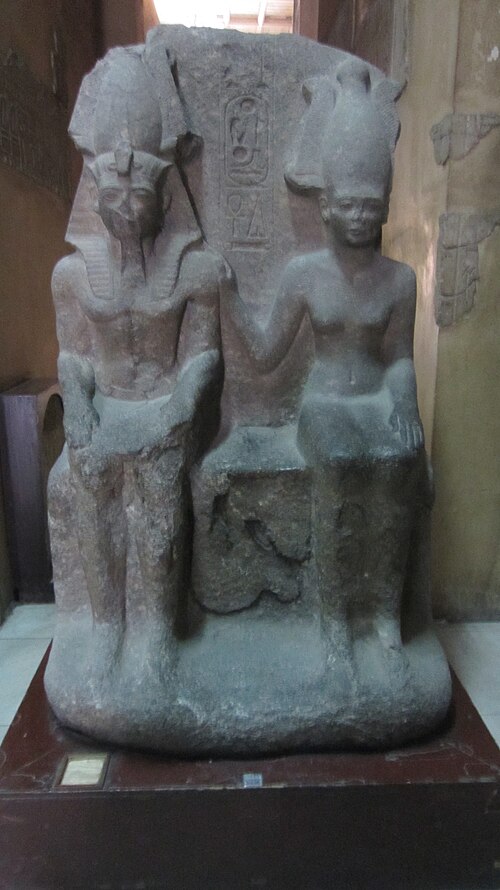
 Seated statue of Ramesses II with Isis and Hathor with the features of his wives Nefertari and Isetnofret, respectively

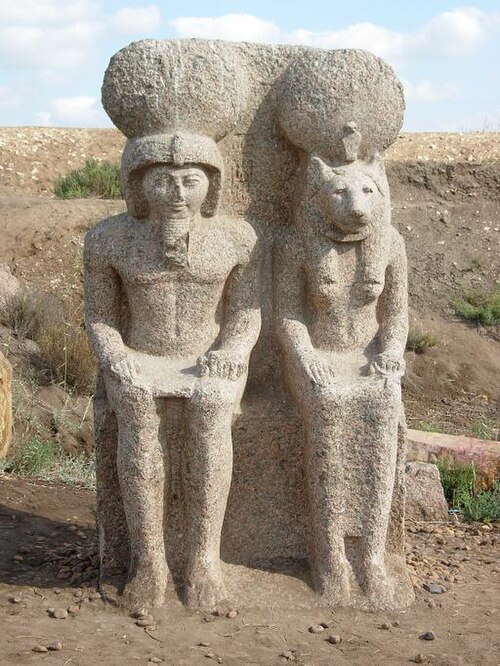 A statue of Wadjet and Ramesses II from Tanis, Cairo Museum
 Ramesses II running for the Heb-Sed celebration
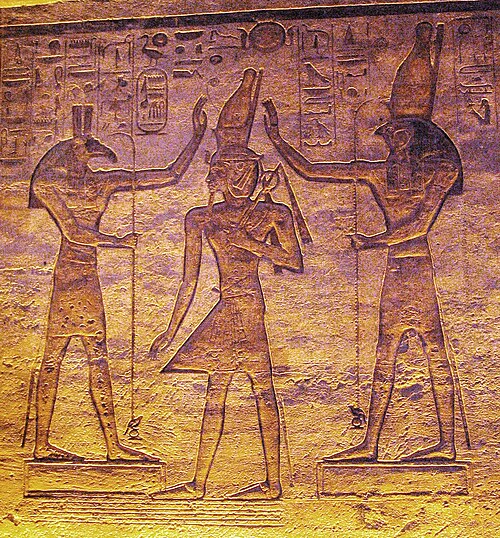
 Relief of the god Horus offers life to Ramesses II
 Wall relief of Ramesses II making an offering to Horus at the Temple of Beit el-Wali
 Fragment of a painted relief of Ramesses II being accompanied by Horus
 Ramesses II fighting in a chariot at the Battle of Kadesh with two archers, one with the reins tied around his waist to free both hands. Abu Simbel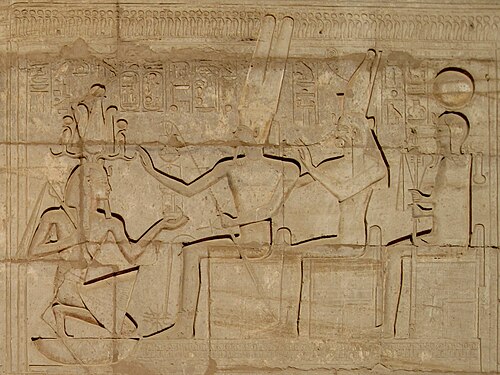
 Relief of Ramesses II in the Temple of Derr
 The inner sanctuary of the Great Temple of Abu Simbel, showing (from right to left) rock cut sculptures of four seated figures: Ra-Horakhty, the deified Ramesses II, and the gods Amun Ra and Ptah.
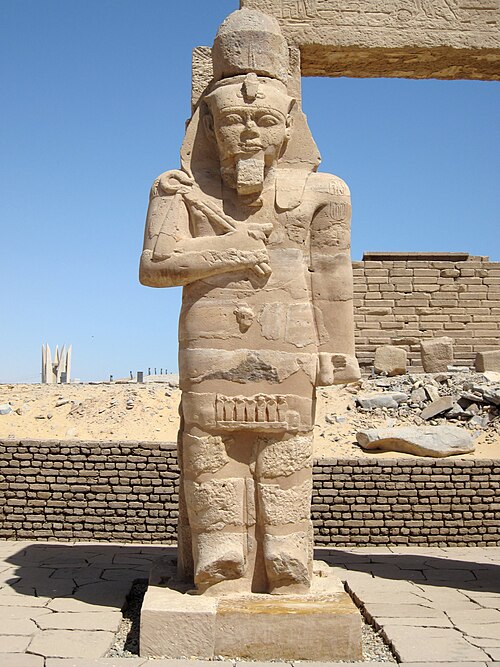 Somewhat "squat" statue of Ramesses II in the courtyard of the Temple of Gerf Hussein
 Statue of Ramesses II from Heracleopolis Magna
 Statue of Ramesses II that was reworked in Roman times, now at the Louvre
 Top of a triumphal stela of Ramesses II giving offerings to Amun, excavated at Beth Shean, now at the Penn Museum
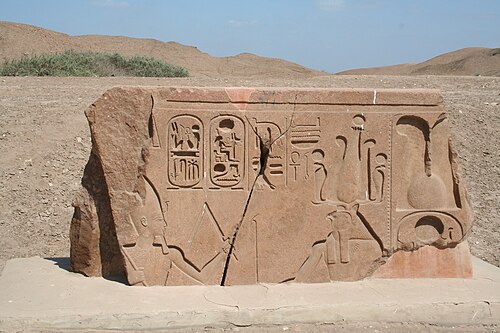 Reused building block found in Tanis that is thought originally to have been part of a depiction of the Sed festival for Ramesses II
 Sphinx of Ramesses II from the Temples of Wadi es-Sebua
 Statue of a kneeling Ramesses II offering a rebus of his name. Alexandria National Museum
 Commemorative stelae of Nahr el-Kalb show Assyrian king (Esarhaddon) (left) and Egyptian pharaoh (Ramesses II) (right). Photo taken in 1922.
 Birth and throne cartouches of Rameses II, from the early years of his reign as it shows his regnal name as "Usermaatre" instead of "Usermaatre-Setepenre"
See also
Notes
- ↑Other Egyptian transliterations include Ramses and Rameses (from Koine Greek: Ῥαμέσσης, Rhaméssēs).[6]
- ↑Meaning "Ra is the one who bore him" in the Egyptian language.
- ↑Koine Greek: Ὀσυμανδύας, Osymandýas.
- ↑"The Maat of Ra is powerful—chosen of Ra."
- ↑That is, 66 years, 2 months, and 14 days according to the Egyptian calendar, which does not match the Julian nor Gregorian calendar. All twelve Egyptian months had exactly 30 days, with an additional intercalary month of 5 days to complete the 365-cycle.
- ↑The coffin of Ramesses II is thought to have been originally commissioned for Horemheb before being reused for the reburial of Ramesses II during the Wehem Mesut.[106]
References
- 12345Leprohon (2013), pp. 114–115.
- 123Tyldesley (2001), p. xxiv.
- 12Clayton (1994), p. 146.
- ↑"Mortuary temple of Ramesses II at Abydos". Archived from the original on 22 December 2008. Retrieved 28 October 2008.
- 12Anneke Bart. "Temples of Ramesses II". Archived from the original on 28 April 2008. Retrieved 23 April 2008.
- ↑"Rameses". Webster's New World College Dictionary. Wiley Publishing. 2004. Archived from the original on 2 October 2011. Retrieved 27 April 2011.
- ↑"Ramses". Webster's New World College Dictionary. Wiley Publishing. 2004. Archived from the original on 24 January 2012. Retrieved 27 April 2011.
- ↑Prosperity during the reign of Ramses II (Britannica.com)
- ↑"The greatest pharaohs of Ancient Egypt". Sky HISTORY TV channel. Retrieved 17 December 2025.
- 12Putnam (1990), p. .
- ↑Ji, Ziqing; Kulkarni, Pranav; Neskovic, Marko; Nolan, Kevin; Xu, Yan (2023). "Exploring Semantic Perturbations on Grover". arXiv:2302.00509 [cs.LG].
- ↑Diodorus Siculus. "Diodorus Siculus, Bibliotheca Historica, Books I-V, book 1, chapter 47, section 4". perseus.tufts.edu. Archived from the original on 6 May 2011. Retrieved 10 October 2011.
- ↑"Ozymandias". PBS. November 2000. Archived from the original on 13 December 2007. Retrieved 30 March 2008.
- ↑P. Brand, Ramesses II: Egypt's Ultimate Pharaoh (2023), pp. 86-89
- ↑Ramesses IV at Abydos: Breasted, Ancient Records of EgyptVol. 4, §471; K. Kitchen, Ramesside Inscriptions: Translations, Vol. 6, pp. 20-21.
- ↑O'Connor & Cline (1998), p. 16.
- 123von Beckerath (1997), pp. 108, 190.
- 12Brand (2000), pp. 302–305.
- ↑Leblanc, Christian. "Gerard". Archived from the original on 4 December 2007. Retrieved 23 April 2008.
- 12Parisse, Emmanuel (5 April 2021). "22 Ancient Pharaohs Have Been Carried Across Cairo in an Epic 'Golden Parade'". ScienceAlert. Archived from the original on 27 March 2022. Retrieved 5 April 2021.
- ↑Habachi, L. (1969). Features of the Deification of Ramesses II; Brand, P. J. (2023). Ramesses II: Egypt’s Ultimate Pharaoh, pp. 381-406
- 123Samir, Salwa (23 April 2023). "Egypt archaeologists refute Ramses II-Exodus connection - AL-Monitor: The Middle Eastʼs leading independent news source since 2012". Al-monitor. Archived from the original on 23 April 2023. Retrieved 12 March 2026.
- 12Grabbe, Lester (15 December 2022). The Dawn of Israel: A History of Canaan in the Second Millennium BCE. T&T Clark. p. 107. ISBN 978-0567663214.
- ↑Darnell, J. C., & Manassa, C. (2007). Tutankhamun's Armies: Battle and Conquest During Ancient Egypt's Late Eighteenth Dynasty. John Wiley & Sons.
- ↑Josephus © 2011–2023 by Peter Lundström—Some Rights Reserved—V. 4.0.
- ↑A. H. Gardiner (1948). Ramesside Administrative Documents, Oxford, pp. 30, 10, and 14.
- ↑A. J. Peden, A Note on the Accession Date of Merenptah, p. 69.
- 12R. J. Demarée, Announcement of the Passing of Ramesses II, JEOL 46 (2016), p. 125.
- ↑Gabriel, R. (2002). The Great Armies of Antiquity. Greenwood Publishing Group. p. 6. ISBN 9780275978099.
- ↑Grimal (1992), pp. 250–253.
- ↑Drews (1993), p. 54: "Already in the 1840s Egyptologists had debated the identity of the "northerners, coming from all lands," who assisted the Libyan King Meryre in his attack upon Merneptah. Some scholars believed that Meryre's auxiliaries were merely his neighbors on the Libyan coast, while others identified them as Indo-Europeans from north of the Caucasus. It was one of Maspero's most illustrious predecessors, Emmanuel de Rougé, who proposed that the names reflected the lands of the northern Mediterranean: the Lukka, Ekwesh, Tursha, Shekelesh, and Shardana were men from Lydia, Achaea, Tyrsenia (western Italy), Sicily, and Sardinia." De Rougé and others regarded Meryre's auxiliaries—these "peoples de la mer Méditerranée"—as mercenary bands, since the Sardinians, at least, were known to have served as mercenaries already in the early years of Ramesses the Great. Thus the only "migration" that the Karnak Inscription seemed to suggest was an attempted encroachment by Libyans upon neighboring territory."
- ↑Gale, N. H. (2011). "Source of the Lead Metal used to make a Repair Clamp on a Nuragic Vase recently excavated at Pyla-Kokkinokremos on Cyprus". In Karageorghis, V.; O. Kouka (eds.). On Cooking Pots, Drinking Cups, Loomweights and Ethnicity in Bronze Age Cyprus and Neighbouring Regions.
- ↑O'Connor & Cline (1998), pp. 112–113.
- ↑Tyldesley (2000), p. 53.
- ↑"The Naue Type II Sword". Archived from the original on 20 July 2008. Retrieved 30 May 2008.
- ↑Richardson, Dan (2013). Cairo and the Pyramids (Rough Guides Snapshot Egypt). Rough Guides UK. p. 14. ISBN 978-1-4093-3544-3. Archived from the original on 8 July 2020. Retrieved 4 July 2020.
- ↑Grimal (1992), pp. 253 ff.
- ↑Tyldesley (2000), p. 68.
- ↑Obsomer 2012: 134; the date is Gregorian, equivalent to the Julian 12 May.
- ↑Detailed analysis of the Egyptian sources in Obsomer 2012: 127–171; see also Bryce 2005: 234–239.
- ↑The Battle of Kadesh in the context of Hittite history. Archived 14 October 2013 at the Wayback Machine.
- ↑100 Battles, Decisive Battles that Shaped the World, Dougherty, Martin, J., Parragon, pp. 10–11.
- ↑Bryce 2005. pp. 238–239.
- ↑Obsomer 2012: 188, within a detailed discussion on 173-192.
- 12Obsomer 2012: 530.
- 12Grimal (1992), p. 256.
- ↑Kitchen 1982: 67; Obsomer 2012: 189–190 doubts the dating of the Moabite campaign to Year 7–8 by Kitchen, on the grounds that Amun-her-khepshef might have been too young to carry out such an independent role.
- ↑Kitchen (1996), p. 26.
- ↑Kitchen 1982: 68–70.
- ↑Kitchen (1979), pp. 223–224.
- ↑Obsomer 2012: 531.
- ↑Kitchen (1996), p. 33.
- ↑Kitchen (1996), p. 47.
- ↑Kitchen (1996), p. 46.
- ↑Kitchen (1982), p. 68.
- ↑Obsomer 2012: 190–192, 531.
- 12Bryce, Trevor (2023). Warriors of Anatolia: A Concise history of the Hittites. Bloomsbury. pp. 183–195. ISBN 978-1-3503-4885-1.
- ↑Kitchen (1982), p. 74.
- 12Kitchen 1982: 75; Obsomer 2012: 195, 531.
- ↑Kitchen (1982), pp. 62–64, 73–79.
- ↑Obsomer 2012: 195, 531.
- ↑Grimal (1992), p. 257.
- ↑Stieglitz (1991), p. 45.
- ↑Kitchen (1982), p. 215.
- ↑"Beit el-Wali". University of Chicago. Archived from the original on 6 September 2008. Retrieved 21 April 2008.
- ↑Ricke, Hughes & Wente (1967), p. .
- ↑Eyre, Christopher (1998). Proceedings of the Seventh International Congress of Egyptologists, Cambridge, 3-9 September 1995. Leuven: Peeters. p. 171.
- ↑Treasure, Matthew (1 January 2021). "Four Faces on One Neck: The Tetracephalic Ram as an Iconographic Form in New Kingdom Egypt". Retrieved 13 January 2025– via Academia.edu.
- ↑"Sed festival". The Global Egyptian Museum. Archived from the original on 6 September 2008. Retrieved 7 April 2008.
- ↑"Renewal of the kings' Reign : The Sed Heb of Ancient Egypt". Archived from the original on 6 November 2016. Retrieved 5 November 2016.
- ↑Westendorf (1969), p. .
- ↑Edwards, Amelia Ann Blandford. "Chapter XV: Rameses the Great". Archived from the original on 13 May 2008. Retrieved 23 April 2008.
- ↑Kitchen (1982), p. 119.
- ↑Kitchen (30 April 1985). Pharaoh Triumphant. Aris & Phillips. pp. 49–50. ISBN 0-85668-215-2.
- 12Kitchen (2003), p. 255.
- ↑Saadia Gaon, Judeo-Arabic Translation of Pentateuch (Tafsir), s.v. Exodus 21:37 and Numbers 33:3 ("רעמסס: "עין שמס); Rabbi Saadia Gaon's Commentaries on the Torah (ed. Yosef Qafih), Mossad Harav Kook: Jerusalem, Israel, 1984, p. 164 (Numbers 33:3) (in Hebrew).
- ↑Van Seters, John (2001). "The Geography of the Exodus". In Dearman, John Andrew; Graham, Matt Patrick; Miller, James Maxwell (eds.). The Land that I Will Show You: Essays on the History and Archaeology of the Ancient Near East in Honour of J. Maxwell Miller. Sheffield Academic Press. p. 265. ISBN 978-1-84127-257-3.
- ↑Siculus, Diodorus (1814). "11". The Historical Library of Diodorus the Sicilian. Printed by W. MʻDowall for J. Davis. p. 33.
- 123Skliar (2005), p. .
- 12Guy Lecuyot. "The Ramesseum (Egypt), Recent Archaeological Research"(PDF). Archived from the original(PDF) on 29 May 2008. Retrieved 10 April 2008.
- ↑"À l'école des Scribes" (in French). Archived from the original on 23 April 2008. Retrieved 21 April 2008.
- ↑Kitchen (1982), pp. 64–65.
- 123Siliotti (1994), p. .
- ↑Török, László (2001). The Image of the Ordered World in Ancient Nubian Art: The Construction of the Kushite Mind, 800 Bc-300 Ad. Brill. p. 48.
- ↑"Giant Ramses statue gets new home". BBC News. 25 August 2006. Archived from the original on 20 July 2008. Retrieved 5 July 2008.
- ↑Hawass, Zahi. "The removal of Ramses II Statue". Archived from the original on 12 March 2007. Retrieved 17 March 2007.
- ↑"Egypt: Prehistoric 'Pharaoh's Seat' Discovered in Egypt – Document – Gale General OneFile". AllAfrica Global Media. 26 October 2018. Retrieved 12 October 2022.
- 12"Egyptian archeologists unearth pharaoh's celebration compartment in Cairo". Xinhua News Agency. 25 October 2018. Retrieved 12 October 2022.
- ↑"Red Granite Bust of Ramesses II Unearthed in Giza". Archaeology Magazine. 13 December 2019. Archived from the original on 14 August 2020. Retrieved 17 September 2020.
- 12Dario Radley, Archaeologists have identified the original sarcophagus of pharaoh Ramesses II Archaeology News Online, May 23, 2024
- ↑Ibid.
- ↑Ibid.,
- ↑Sands, Leo (2024). "Sword with pharaoh's mark found in Egypt, still shimmering 3,000 years later".
- ↑A.H. Gardiner, Ramesside Administrative Documents (1948), 30:10, 30:14.
- ↑Erik Hornung, Ancient Egyptian Chronology, 211—212 with references
- ↑K. Kitchen, Ramesside Inscriptions: Translations Vol 6, pp. 18—21; Breasted, Ancient Records of Egypt, IV, pp. 227—228 (§471).
- ↑James, Peter (2020). Manetho, with an English translation by W.G. Waddell. Alpha Editions. p. 151.
- ↑"La momie de Ramsès II. Contribution scientifique à l'égyptologie". Archived from the original on 2 June 2010. Retrieved 27 February 2015.
- 12Pain, Stephanie. "Ramesses rides again". New Scientist. Retrieved 16 April 2025.
- ↑Hawass, Z. A., & Saleem, S. N. (2016). Scanning the Pharaohs: CT Imaging in the New Kingdom Royal Mummies, pp. 160—166, 250; Harris, J. E., & Weeks, K. R. (1973). X-Raying the Pharaohs, pp. 153—156
- ↑Hawass & Saleem, Scanning the Pharaohs p. 166
- ↑Bucaille, M. (1990). Mummies of the Pharaohs: Modern Medical Examinations (A. D. Pannell, Trans.), pp. 104--106
- ↑"Rameses II | Theban Mapping Project". thebanmappingproject.com. Archived from the original on 19 March 2023. Retrieved 19 March 2023.
- ↑Rohl (1995), pp. 72–73, 75.
- ↑Rohl (1995), pp. 78–79.
- ↑Reeves, Nicholas (2017). "The coffin of Ramesses II". In Amenta, Alessia; Guichard, Helene (eds.). Proceedings First Vatican Coffin Conference 19–22 June 2013 Volume 2. Edizioni Musei Vaticani. pp. 425–438. Retrieved 15 December 2021.
- ↑"NMEC". nmec.shorthandstories.com. Retrieved 18 August 2023.
- ↑Tyldesley (2000), p. 14.
- ↑Romer, John. Valley of the Kings. Castle Books. p. 184.
- ↑Maspero, Gaston (1892). Egyptian Archaeology. Putnam. pp. 76–77.
- ↑Yurco, Frank J. (1989). Were the Ancient Egyptians Black Or White?. Biblical Archaeology Society.
- ↑Yurco, Frank J. (1989). Were the Ancient Egyptians Black Or White?. Biblical Archaeology Society.
- ↑Farnsworth, Clyde H. (28 September 1976). "Paris Mounts Honor Guard For a Mummy". The New York Times. p. 5. Archived from the original on 1 November 2019. Retrieved 31 October 2019.
- ↑Pain, Stephanie. "Ramesses rides again". New Scientist. Archived from the original on 15 August 2014. Retrieved 13 December 2013.
- ↑"Was the great Pharaoh Ramesses II a true redhead?". The University of Manchester. 3 February 2010. Archived from the original on 16 February 2020. Retrieved 16 February 2020.
- ↑"This image was digitally created for representative purposes | Fact Check". AFP Fact Check. 20 October 2020. Retrieved 18 June 2024.
- ↑Ceccaldi, Pierre-Fernand (1987). "Recherches sur les momies: Ramsès II". Bulletin de l'Académie de Médecine. 171 (1): 119.
- ↑"Bulletin de l'Académie nationale de médecine". Gallica. 6 January 1987. Archived from the original on 15 July 2018. Retrieved 15 July 2018.
- ↑Tyldesley (2001), p. ??.
- ↑Brier (1994), p. 153.
- ↑Brier (1994), pp. 200–201.
- ↑P. Montert, Everyday Life in Egypt in the Days of Ramesses The Great, 1974, p. 197.
- ↑Diop, Cheikh Anta (1991). Civilization or barbarism : an authentic anthropology (First ed.). pp. 67–68. ISBN 1556520484.
- ↑"Ancient pharaoh's hair returns to Egypt". Associated Press. 10 April 2007. Retrieved 9 December 2022.
- 12Brier (1998), p. 153.
- ↑Chhem, R. K.; Schmit, P.; Fauré, C. (October 2004). "Did Ramesses II really have ankylosing spondylitis? A reappraisal". Can Assoc Radiol Journal. 55 (4): 211–217. PMID 15362343.
- ↑Saleem, Sahar N.; Hawass, Zahi (2014). "Brief Report: Ankylosing Spondylitis or Diffuse Idiopathic Skeletal Hyperostosis in Royal Egyptian Mummies of the 18th–20th Dynasties? Computed Tomography and Archaeology Studies". Arthritis & Rheumatology. 66 (12): 3311–3316. doi:10.1002/art.38864. ISSN 2326-5205. PMID 25329920. S2CID 42296180.
- ↑"'Cleaned-Up' Mummy Flown Home to Egypt". Los Angeles Times. Associated Press. 11 May 1977. p. 20. Archived from the original on 30 October 2019. Retrieved 30 October 2019.
CAIRO (AP)—The 3,212-year-old mummy of Pharaoh Ramses II was returned from Paris Tuesday, hopefully cured by radiation of 60 types of fungi and two strains of insects.
- ↑"Tomb of Ramses II sons". Archived from the original on 27 February 2015. Retrieved 27 February 2015.
- 12Tyldesley (2000), pp. 161–162.
- ↑Shelley, Percy Bysshe. "Ozymandias". Archived from the original on 10 October 2006. Retrieved 18 September 2006– via Representative Poetry Online. First publication: — (11 January 1818). "Ozymandias". The Examiner. No. 524.
- ↑Sanders, Ed (1997). 1968: A History in Verse. Black Sparrow Press. p. 255.
- ↑Grabbe, Lester (2014). "Exodus and History". In Dozeman, Thomas; Evans, Craig A.; Lohr, Joel N. (eds.). The Book of Exodus: Composition, Reception, and Interpretation. BRILL. pp. 61–87. ISBN 9789004282667.
- ↑Eames, Christopher. "Who Was the Pharaoh of the Exodus?". Armstrong Institute. Retrieved 12 March 2026.
- ↑Schipper, Bernd (2015). "Raamses, Pithom, and the Exodus: A Critical Evaluation of Ex 1:11". Vetus Testamentum. 65 (2): 265–288 – via JSTOR.
- ↑Ray, John. "Ramesses the Great". BBC history. Archived from the original on 16 October 2012. Retrieved 30 May 2008.
- ↑"Is Ramses II the Pharaoh of Moses?". EgyptToday. 14 May 2020. Retrieved 16 April 2025.
- ↑"The story of Maurice Bucaille's inspiring conversion to Islam". Arab News. 1 March 2013. Retrieved 16 April 2025.
Bibliography
- von Beckerath, Jürgen (1997). Chronologie des Pharaonischen Ägypten. Mainz: Philipp von Zabern.
- Brand, Peter J. (2000). The Monuments of Seti I: Epigraphic, Historical and Art Historical Analysis. NV Leiden: Brill. ISBN 978-90-04-11770-9. Archived from the original on 10 July 2024. Retrieved 8 September 2022.
- Brier, Bob (1994). Egyptian Mummies: Unravelling the Secrets of an Ancient Art. New York: William Morrow & Co.
- Brier, Bob (1998). The Encyclopedia of Mummies. Checkmark Books.
- Clayton, Peter (1994). Chronology of the Pharaohs. Thames & Hudson.
- Drews, Robert (1993). The End of the Bronze Age: Changes in Warfare and the Catastrophe Ca. 1200 B.C. Princeton University Press. ISBN 9780691209975.
- Grimal, Nicolas-Christophe (1992). A History of Ancient Egypt. Oxford: Blackwell. ISBN 978-0-631-17472-1.
- Kitchen, Kenneth (1982). Pharaoh Triumphant: The Life and Times of Ramesses II, King of Egypt. London: Aris & Phillips. ISBN 978-0-85668-215-5.
- Kitchen, Kenneth Anderson (1996). Ramesside Inscriptions Translated and Annotated: Translations. Volume 2: Ramesses II; Royal Inscriptions. Oxford: Blackwell Publishers. ISBN 978-0-631-18427-0. Translations and (in the 1999 volume below) notes on all contemporary royal inscriptions naming the king.
- Kitchen, Kenneth Anderson (1979). Ramesside Inscriptions Translated and Annotated: Notes and Comments. Volume 2: Ramesses II; Royal Inscriptions. Oxford: Blackwell Publishers.
- Kitchen, Kenneth Anderson (2003). On the Reliability of the Old Testament. Michigan: William B. Eerdmans Publishing Company. ISBN 978-0-8028-4960-1.
- Leprohon, Ronald J. (2013). The Great Name: Ancient Egyptian Royal Titulary. SBL Press. ISBN 978-1-58983-736-2.
- O'Connor, David; Cline, Eric, eds. (1998). Amenhotep III: Perspectives on his reign. University of Michigan Press. ISBN 9780472088331.
- Obsomer, Claude, Ramsès II, Paris, 2012.
- Putnam, James (1990). An introduction to Egyptology.
- Ricke, Herbert; Hughes, George R.; Wente, Edward F. (1967). The Beit el-Wali Temple of Ramesses II.
- Rohl, David M. (1995). Pharaohs and Kings: A Biblical Quest (illustrated, reprint ed.). Crown Publishers. ISBN 978-0-517-70315-1. Archived from the original on 14 March 2020. Retrieved 30 March 2019.
- Siliotti, Alberto (1994). Egypt: temples, people, gods.
- Skliar, Ania (2005). Grosse kulturen der welt-Ägypten.
- Stieglitz, Robert R. (1991). "The City of Amurru". Journal of Near Eastern Studies. 50 (1): 45–48. doi:10.1086/373464. S2CID 161341256.
- Tyldesley, Joyce (2000). Ramesses: Egypt's Greatest Pharaoh. London: Viking. ISBN 9780670884872.
- Tyldesley, Joyce (26 April 2001). Ramesses: Egypt's Greatest Pharaoh. London: Penguin Books. ISBN 9780141949789. Retrieved 20 October 2020.
- Westendorf, Wolfhart (1969). Das alte Ägypten (in German).
Further reading
- Balout, L.; Roubet, C.; Desroches-Noblecourt, C. (1985). La Momie de Ramsès II: Contribution Scientifique à l'Égyptologie (in French).
- Bietak, Manfred (1995). Avaris: Capital of the Hyksos – Recent Excavations. London, England: British Museum Press. ISBN 978-0-7141-0968-8.
- Brand, Peter J. (2023). Ramesses II, Egypt's Ultimate Pharaoh. Lockwood Press. ISBN 978-1-948488-49-5.
- Dodson, Aidan; Dyan Hilton (2004). The Complete Royal Families of Ancient Egypt. Thames & Hudson. ISBN 978-0-500-05128-3.
- Grajetzki, Wolfram (2005). Ancient Egyptian Queens – A Hieroglyphic Dictionary. London, England: Golden House Publications. ISBN 978-0-9547218-9-3.
- Hasel, Michael G. (1994). "Israel in the Merneptah Stela". Bulletin of the American Schools of Oriental Research. 296 (296): 45–61. doi:10.2307/1357179. JSTOR 1357179. S2CID 164052192.
- Kuhrt, Amelie (1995). The Ancient Near East c. 3000–330 BC. Vol. 1. London, England: Routledge. ISBN 978-0-415-16763-5.
- Rice, Michael (1999). Who's Who in Ancient Egypt. London; New York: Routledge. ISBN 978-0-415-15448-2.
- Hasel, Michael Gerald (1998). Domination and Resistance: Egyptian Military Activity in the Southern Levant, 1300–1185 BC. Probleme der Ägyptologie. Leiden Boston Köln: Brill. ISBN 978-90-04-10984-1.
- Hasel, Michael G. (2003). "Merenptah's Inscription and Reliefs and the Origin of Israel". In Nakhai, Beth Alpert (ed.). The Near East in the Southwest: Essays in Honor of William G. Dever. The Annual of the American Schools of Oriental Research. Boston, MA: American Schools of Oriental Research. pp. 19–44. ISBN 978-0-89757-065-7.
- Hasel, Michael G. (2004). "The Structure of the Final Hymnic-Poetic Unit on the Merenptah Stela". Zeitschrift für die alttestamentliche Wissenschaft. 116: 75–81. doi:10.1515/zatw.2004.005.
- James, T. G. H. (2002). Ramesses II. New York, NY: Friedman/Fairfax. ISBN 978-1-58663-719-4. A large-format volume by the former Keeper of Egyptian Antiquities at the British Museum, filled with colour illustrations of buildings, art, etc. related to Ramesses II.
- The Epigraphic Survey (1954). Reliefs and Inscriptions at Karnak III: The Bubastite Portal. Oriental Institute Publications. Vol. 74. Chicago, Ill.: The University of Chicago Press.
External links
- Egypt's Golden Empire: Ramesses II
- Ramesses II Usermaatre-setepenre (c. 1279–1213 BC)
- List of Ramesses II's family members and state officials
- Rita Gautschy, Reassessment of Absolute Chronology of the Egyptian New Kingdom and its ´Brotherly´ Countries, Ägypten und Levante 24, 2014, pp. 141-158 PDF
- Ramesses II
- 13th-century BC pharaohs
- Pharaohs of the Nineteenth Dynasty of Egypt
- 13th-century BC deaths
- 14th-century BC births
- Ancient Egyptian mummies
- Egyptian Museum
- Seti I
- Book of Exodus