
فن مصر القديمة


يشير الفن المصري القديم إلى الفنون التي أُنتجت في مصر القديمة بين الألفية السادسة قبل الميلاد والقرن الرابع الميلادي ، ممتدًا من مصر ما قبل التاريخ وحتى تنصير مصر الرومانية . ويشمل هذا الفن اللوحات والمنحوتات والرسومات على ورق البردي والخزف والمجوهرات والعاج والعمارة وغيرها من الوسائط الفنية. وقد كان هذا الفن تقليدًا محافظًا لم يتغير أسلوبه كثيرًا عبر الزمن. وتأتي معظم الأمثلة الباقية من المقابر والآثار، مما يُلقي الضوء على معتقدات المصريين القدماء عن الحياة الآخرة، مثل المومياوات المصرية.
لم تكن اللغة المصرية القديمة تحتوي على كلمة تُعادل "الفن". كانت الأعمال الفنية تخدم غرضًا وظيفيًا أساسيًا مرتبطًا بالدين والأيديولوجيا . [ 1 ] كان تجسيد موضوع ما في الفن بمثابة منحه الخلود؛ ولذلك، صوّر الفن المصري القديم نسخة مثالية وغير واقعية من العالم. لم يكن هناك تقليد يُذكر للتعبير الفني الفردي، إذ كان الفن يخدم غرضًا أوسع وأكثر شمولًا يتمثل في الحفاظ على النظام ( ماعت ).
فن مصر ما قبل الأسرات (6000-3000 قبل الميلاد)
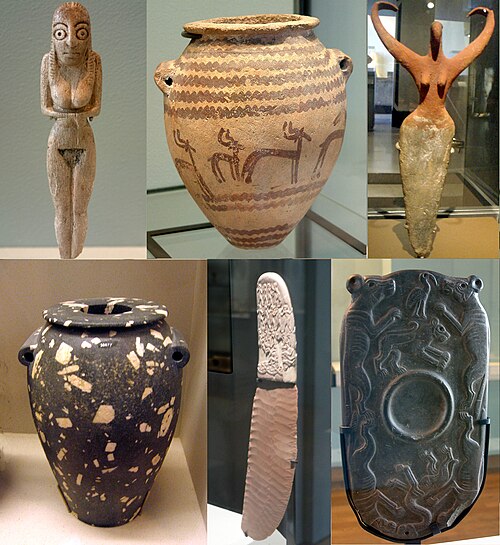
امتدت مصر ما قبل الأسرات، والتي تتوافق مع فترة العصر الحجري الحديث من عصور ما قبل التاريخ في مصر ، من حوالي 6000 قبل الميلاد إلى بداية فترة الأسرات المبكرة ، حوالي 3100 قبل الميلاد.
أجبر التوسع المستمر للصحراء أسلاف المصريين الأوائل على الاستقرار حول نهر النيل وتبني نمط حياة أكثر استقرارًا خلال العصر الحجري الحديث . لم تترك الفترة من 9000 إلى 6000 قبل الميلاد سوى القليل من الأدلة الأثرية، ولكن حوالي عام 6000 قبل الميلاد، بدأت المستوطنات الحجرية الحديثة بالظهور في جميع أنحاء مصر. [ 2 ] وقد عزت الدراسات القائمة على البيانات المورفولوجية ، [ 3 ] والوراثية ، [ 4 ] والأثرية [ 5 ] هذه المستوطنات إلى مهاجرين من الهلال الخصيب عائدين خلال الثورة الزراعية ، جالبين معهم الزراعة إلى المنطقة. [ 6 ]
حضارة ميريمدي (5000-4200 قبل الميلاد)
ازدهرت حضارة مرمده في مصر السفلى، بين عامي 5000 و4200 قبل الميلاد تقريبًا، وهي حضارة معروفة فقط من موقع استيطاني كبير على حافة دلتا النيل الغربية. [ 7 ] وترتبط هذه الحضارة ارتباطًا وثيقًا بحضارة الفيوم وبلاد الشام. سكن الناس في أكواخ صغيرة، وصنعوا فخارًا بسيطًا غير مزخرف، واستخدموا أدوات حجرية. كما رُبّيت الأبقار والأغنام والماعز والخنازير، وزُرعت محاصيل القمح والذرة الرفيعة والشعير. وكان سكان مرمده يدفنون موتاهم داخل مستوطناتهم، ويصنعون تماثيل طينية. [ 8 ] ويعود تاريخ أول رأس مصري بالحجم الطبيعي مصنوع من الطين إلى مرمده. [ 9 ]
الثقافة البدارية (4400–4000 ق.م.)
امتدت حضارة البداريين ، من حوالي 4400 إلى 4000 قبل الميلاد، [ 10 ] نسبةً إلى موقع البداري بالقرب من دير تاسا. وقد تلت حضارة تاسا (حوالي 4500 قبل الميلاد)، إلا أنها كانت شديدة الشبه بها لدرجة أن الكثيرين يعتبرونهما فترة متصلة واحدة. استمرت حضارة البداريين في إنتاج الفخار الأسود (وإن كان بجودة محسّنة بشكل كبير)، وقد حُددت لها أرقام التأريخ التسلسلي (SD) من 21 إلى 29. [ 11 ] يتمثل الاختلاف الرئيسي الذي يمنع الباحثين من دمج الفترتين في أن مواقع البداريين تستخدم النحاس بالإضافة إلى الحجر، وبالتالي فهي مستوطنات من العصر النحاسي ، بينما لا تزال مواقع تاسا النيوليثية تُعتبر من العصر الحجري . [ 11 ]
 دفن بدارية. 4500-3850 ق.م
 سلسلة من الخرز؛ 4400-3800 قبل الميلاد؛ الخرز مصنوع من العظم والسربنتينيت والصدف؛ الطول: 15 سم؛ متحف متروبوليتان للفنون
 مزهرية على شكل فرس نهر. عصر ما قبل الأسرات المبكر، باداري. الألفية الخامسة قبل الميلاد
ثقافة نقادة (4000–3000 ق.م.)
تُعدّ حضارة نقادة حضارة أثرية من العصر النحاسي في مصر ما قبل الأسرات (حوالي 4400-3000 قبل الميلاد)، وقد سُميت نسبةً إلى مدينة نقادة في محافظة قنا . وتنقسم هذه الحضارة إلى ثلاث فترات فرعية: نقادة الأولى، والثانية، والثالثة.
نقادة 1


امتدت حضارة نقادة الأولى (العمراتية) من حوالي 4000 إلى 3500 قبل الميلاد. [ 10 ] استمر ظهور الأواني ذات الأسطح السوداء، ولكن عُثر أيضًا في هذه الفترة على أوانٍ بيضاء مزخرفة بخطوط متقاطعة - وهو نوع من الفخار مُزين بمجموعات متقاطعة من خطوط بيضاء متوازية متقاربة . تقع الفترة العمراتية بين عامي 30 و39 قبل الميلاد. [ 14 ]
 إناء من الطين المحروق ذو قمة سوداء بيضاوية الشكل من العصر النقادي الأول (الأمراتي)، (حوالي 3800-3500 قبل الميلاد)
 وعاء أبيض ذو أربعة أرجل، مزين بخطوط متقاطعة؛ 3700-3500 قبل الميلاد؛ فخار مطلي؛ الارتفاع: 15.6 سم، القطر: 19.7 سم؛ متحف متروبوليتان للفنون
نقادة ٢


امتدت حضارة نقادة الثانية ( الجرزية ) من حوالي 3500 إلى 3200 قبل الميلاد، [ 10 ] وسُميت نسبةً إلى موقع جرزة . مثّلت هذه الحضارة المرحلة التالية في التطور الحضاري المصري، وخلالها وُضعت أسس مصر الفرعونية. تُعتبر حضارة نقادة الثانية امتدادًا متصلًا لحضارة نقادة الأولى ، حيث امتدت من منطقة أعالي النيل باتجاه دلتا النيل والنوبة. [ 17 ] حُددت قيم SD لخزف نقادة الثانية بين 40 و62، وهو يختلف اختلافًا واضحًا عن خزف نقادة الأولى ذي الخطوط المتقاطعة البيضاء أو ذي السطح الأسود. [ 14 ] رُسمت هذه الخزفيات في الغالب باللون الأحمر الداكن برسومات حيوانات وبشر وسفن، بالإضافة إلى رموز هندسية يبدو أنها مستوحاة من الحيوانات. [ 17 ] أصبحت المقابض المتموجة، التي كانت نادرة قبل هذه الفترة (على الرغم من العثور عليها أحيانًا في وقت مبكر يصل إلى SD 35)، أكثر شيوعًا وأكثر تفصيلًا حتى أصبحت زخرفية بالكامل تقريبًا. [ 14 ]
خلال هذه الفترة، دخلت مصر قطع أثرية وأشكال فنية أجنبية بوضوح، مما يشير إلى وجود تواصل مع أجزاء عديدة من آسيا، ولا سيما بلاد ما بين النهرين. فقد عُثر في مصر على قطع أثرية مثل مقبض سكين جبل العراك ، الذي يحمل نقوشًا بارزة بلاد ما بين النهرين واضحة المعالم، [ 18 ] كما أن الفضة التي ظهرت في هذه الفترة لا يمكن أن تكون قد جُلبت إلا من آسيا الصغرى . [ 17 ] إضافةً إلى ذلك، صُنعت قطع أثرية مصرية تُحاكي بوضوح الأشكال الرافدية. [ 19 ] وظهرت في مصر الأختام الأسطوانية، فضلًا عن فن العمارة ذي الألواح الغائرة. وصُنعت النقوش المصرية على علب مستحضرات التجميل بنفس أسلوب حضارة أوروك الرافدية المعاصرة ، وصُنعت رؤوس الهراوات الاحتفالية من أواخر العصر الجرزي وأوائل العصر السيميناني على الطراز الرافدي "الكمثري الشكل"، بدلًا من الطراز المصري الأصلي. [ 20 ]
يصعب تحديد مسار هذه التجارة، لكن التواصل مع كنعان لا يسبق العصر الأسري المبكر، لذا يُفترض عادةً أنه كان عبر البحر. [ 21 ] خلال الفترة التي شاعت فيها نظرية السلالات الحاكمة، طُرحت نظرية مفادها أن بحارة أوروك طافوا حول الجزيرة العربية ، لكن من المرجح أن يكون المسار عبر البحر الأبيض المتوسط ، ربما عن طريق وسطاء عبر جبيل ، كما يتضح من وجود آثار جبيلية في مصر. [ 21 ]
إن وجود العديد من مواقع نقادة الثانية عند مصبات الأودية المؤدية إلى البحر الأحمر قد يشير إلى وجود قدر من التجارة عبر البحر الأحمر (مع أن التجارة البيبلية ربما عبرت سيناء ثم وصلت إلى البحر الأحمر). [ 22 ] كما يُستبعد أن يكون أسلوب معماري معقد كالتصميم ذي الألواح الغائرة قد وصل إلى مصر بطريقة غير مباشرة، ويُشتبه عادةً في وجود مجموعة صغيرة على الأقل من المهاجرين. [ 21 ]
على الرغم من هذه الأدلة على التأثير الأجنبي، يتفق علماء المصريات عموماً على أن ثقافة نقادة الثانية هي ثقافة محلية في مصر في المقام الأول.
 جرة خزفية مزخرفة تصور قوارب وأشجارًا؛ 3650-3500 قبل الميلاد؛ فخار مطلي؛ الارتفاع: 16.2 سم، القطر: 12.9 سم؛ متحف متروبوليتان للفنون (مدينة نيويورك)
 تمثال أنثوي؛ حوالي 3600 قبل الميلاد؛ تيراكوتا؛ 29.2 × 14 × 5.7 سم؛ من المعمرية (مصر)؛ متحف بروكلين (مدينة نيويورك)
 تميمة على شكل رأس فيل؛ 3500-3300 قبل الميلاد؛ سربنتين (الجزء الأخضر) وعظم (العينان)؛ 3.5 × 3.6 × 2.1 سم؛ متحف متروبوليتان للفنون (مدينة نيويورك)
 سكين جبل العرق ؛ 3300-3200 قبل الميلاد؛ عاج الفيل (المقبض) والصوان (النصل)؛ الطول: 25.5 سم؛ على الأرجح من أبيدوس (مصر)؛ متحف اللوفر
 جرة بمقابض بارزة؛ حوالي 3500-3050 قبل الميلاد؛ ديوريت ؛ الارتفاع: 13 سم؛ متحف مقاطعة لوس أنجلوس للفنون (الولايات المتحدة الأمريكية)
فترة ما قبل الأسرات (نقادة الثالثة)


تعتبر فترة نقادة الثالثة، من حوالي 3200 إلى 3000 قبل الميلاد، [ 10 ] بشكل عام متطابقة مع فترة ما قبل الأسرات ، التي تم خلالها توحيد مصر.
تُعدّ نقادة الثالثة من أبرز العصور التي شهدت استخدام الهيروغليفية (مع وجود خلاف حول هذا الأمر)، والاستخدام المنتظم الأول للسرخس ، والري الأول، وظهور المقابر الملكية لأول مرة. [ 26 ] تميّز فن نقادة الثالثة برقيّه، ويتجلى ذلك في لوحات مستحضرات التجميل . استُخدمت هذه اللوحات في مصر ما قبل الأسرات لطحن وتطبيق مكونات مستحضرات تجميل الوجه والجسم. وبحلول عصر الأسرات الأولى، يبدو أن لوحات الزينة قد فقدت وظيفتها، وأصبحت تُستخدم لأغراض تذكارية وزخرفية، وربما احتفالية. صُنعت هذه اللوحات بشكل شبه حصري من الحجر الطيني ، الذي كان يُستخرج من محاجر وادي الحمامات . عُثر على العديد من هذه اللوحات في هيراكونبوليس ، مركز القوة في صعيد مصر ما قبل الأسرات. بعد توحيد البلاد، لم تعد هذه اللوحات تُوجد ضمن مجموعات المقابر.

 مشط ديفيس ؛ 3200-3100 قبل الميلاد؛ عاج؛ 5.5 × 3.9 × 0.5 سم؛ متحف متروبوليتان للفنون
 لوحة ساحة المعركة؛ 3100 قبل الميلاد؛ حجر طيني؛ العرض: 28.7 سم، العمق: 1 سم؛ من أبيدوس (مصر)؛ المتحف البريطاني (لندن)
 تمثال قرد البابون يحمل اسم الفرعون نارمر على قاعدته؛ حوالي 3100 قبل الميلاد؛ مصنوع من الكالسيت ، ارتفاعه: 52 سم؛ المتحف المصري في برلين (ألمانيا)
فن مصر الفرعونية
ج. الفترة الأسرية المبكرة (3100-2685 قبل الميلاد)

يُعتبر العصر الأسري المبكر في مصر، الذي يلي مباشرة توحيد مصر العليا والسفلى ، حوالي عام 3100 قبل الميلاد، شاملاً بشكل عام الأسرتين الأولى والثانية ، والتي استمرت من نهاية الفترة الأثرية نقادة الثالثة حتى حوالي عام 2686 قبل الميلاد، أو بداية المملكة القديمة . [ 10 ]
بلغت لوحات مستحضرات التجميل مستوىً جديدًا من التطور خلال هذه الفترة، التي شهدت أيضًا تطورًا ملحوظًا في نظام الكتابة المصري. في البداية، كانت الكتابة المصرية تتألف بشكل أساسي من بضعة رموز تدل على كميات مواد مختلفة، وتُعرف أيضًا بالكتابة الهيروغليفية. في لوحات مستحضرات التجميل، استُخدمت الرموز جنبًا إلى جنب مع الأوصاف التصويرية. وبحلول نهاية الأسرة الثالثة، توسع هذا النظام ليشمل أكثر من 200 رمز، منها رموز صوتية ورموز تصويرية . [ 29 ]
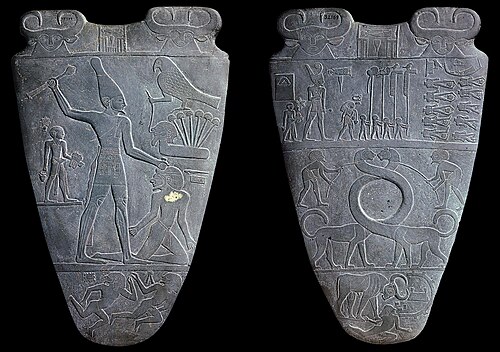 كلا جانبي لوحة نارمر ؛ حوالي 3100 قبل الميلاد؛ حجر رملي رمادي ؛ الارتفاع: 63 سم؛ من هيراكونبوليس (مصر)؛ المتحف المصري ( القاهرة )
 بطاقة تصور الملك دين ؛ حوالي 3000 قبل الميلاد؛ عاج؛ 4.5 × 5.3 سم؛ من أبيدوس (مصر)؛ المتحف البريطاني (لندن) [ 30 ]
 لوحة رانيب ؛ حوالي 2880 قبل الميلاد؛ جرانيت؛ الارتفاع: 1 متر، العرض: 41 سم؛ متحف متروبوليتان للفنون (مدينة نيويورك)
 سوار؛ حوالي 2650 قبل الميلاد؛ ذهب؛ القطر: 6 سم؛ متحف متروبوليتان للفنون
 رأس من الحجر الجيري لملك مصري قديم، متحف بيتري. يعتقد الباحثون المعاصرون أن هذا التمثال النصفي الحجري يصور فرعونًا من العصر الفرعوني المبكر أو عصر الدولة القديمة . [ 31 ] [ 32 ] [ 33 ] [ 34 ]
المملكة القديمة (2686–2181 قبل الميلاد)

المملكة القديمة في مصر هي الفترة الممتدة من حوالي 2686 إلى 2181 قبل الميلاد. وتُعرف أيضًا باسم "عصر الأهرامات" أو "عصر بناة الأهرامات"، إذ تشمل عهود بناة الأهرامات العظام من الأسرة الرابعة . وقد أتقن الملك سنفرو فن بناء الأهرامات ، وشُيّدت أهرامات الجيزة في عهد الملوك خوفو وخفرع ومنكاورع . [ 36 ] بلغت مصر ذروة حضارتها الأولى، وهي أولى فترات ما يُعرف بـ"الممالك" الثلاث (تلتها المملكة الوسطى والمملكة الحديثة ) ، والتي تُمثل ذروة الحضارة في وادي النيل السفلي .
 تمثال الفرعون خوفو / خوفو، متحف القاهرة
 تمثال منكاورع مع حتحور وسينوبوليس ؛ 2551-2523 قبل الميلاد ؛ حجر الشيست ؛ الارتفاع: 95.5 سم؛ المتحف المصري (القاهرة). يُظهر تمثالاً جماعياً بخصائص ونسب المملكة القديمة. [ 37 ]

 مجموعة صور شخصية جالسة لديرسيندج وزوجته نوفريتكا؛ حوالي 2400 قبل الميلاد؛ جرانيت وردي؛ المتحف المصري في برلين
المملكة الوسطى (حوالي 2055-1650 قبل الميلاد)
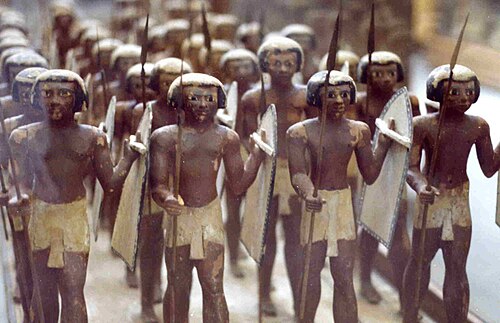

تميزت المملكة الوسطى في مصر (المعروفة أيضًا باسم "فترة التوحيد") بانقسام سياسي عُرف بالفترة الانتقالية الأولى . امتدت المملكة الوسطى من حوالي عام 2050 قبل الميلاد إلى حوالي عام 1710 قبل الميلاد، من توحيد مصر في عهد منتوحتب الثاني من الأسرة الحادية عشرة إلى نهاية الأسرة الثانية عشرة . حكمت الأسرة الحادية عشرة من طيبة ، بينما حكمت الأسرة الثانية عشرة من اللشت . خلال فترة المملكة الوسطى، أصبح أوزيريس الإله الأهم في الديانة الشعبية . [ 38 ] أعقبت المملكة الوسطى الفترة الانتقالية الثانية في مصر ، وهي فترة انقسام أخرى شهدت غزوات أجنبية للبلاد من قبل الهكسوس القادمين من غرب آسيا.
بعد إعادة توحيد مصر في عصر الدولة الوسطى، تمكن ملوك الأسرتين الحادية عشرة والثانية عشرة من إعادة تركيز اهتمامهم على الفن. ففي عهد الأسرة الحادية عشرة، شُيِّدت آثار الملوك بأسلوب متأثر بنماذج منف من الأسرتين الخامسة والسادسة، واختفى أسلوب النقوش البارزة الطيبة الذي كان سائداً قبل التوحيد تقريباً. كان لهذه التغييرات غاية أيديولوجية، إذ كان ملوك الأسرة الحادية عشرة يُرسّخون دولة مركزية، ويعودون إلى المُثُل السياسية للدولة القديمة. [ 39 ] وفي أوائل الأسرة الثانية عشرة، اتسمت الأعمال الفنية بتجانس أسلوبها بفضل تأثير ورش العمل الملكية. عند هذه المرحلة، بلغت جودة الإنتاج الفني لنخبة المجتمع ذروة لم تُضاهى، وإن كانت قد وُفِّقت في فترات أخرى. [ 40 ] وانعكس ازدهار مصر في أواخر الأسرة الثانية عشرة على جودة المواد المستخدمة في بناء الآثار الملكية والخاصة.
 تمثال أوزيري لأول فرعون من الدولة الوسطى، منتوحتب الثاني ؛ 2061-2010 قبل الميلاد؛ حجر رملي مطلي ؛ 138 × 47 سم؛ المتحف المصري (القاهرة)
 رأس تمثال نصفي لمصري من طيبة ؛ حوالي 2000 قبل الميلاد؛ جرانيت؛ المتحف المصري في برلين (ألمانيا)
 جعران؛ حوالي 1980 قبل الميلاد؛ ذهب؛ الطول الإجمالي: 1.1 سم؛ متحف كليفلاند للفنون ( كليفلاند ، أوهايو ، الولايات المتحدة الأمريكية)
 تابوت سينبي؛ 1918-1859 قبل الميلاد؛ خشب أرز مطلي ومُجصص؛ الأبعاد: 70 × 55 سم؛ متحف كليفلاند للفنون
 صندوق مجوهرات سيثاثوريونت؛ ١٨٨٧-١٨١٣ قبل الميلاد؛ خشب الأبنوس، العاج، الذهب، العقيق الأحمر، الخزف الأزرق، والفضة؛ الارتفاع: ٣٦.٧ سم؛ متحف متروبوليتان للفنون
 مرآة بمقبض على شكل ورق البردي؛ ١٨١٠-١٧٠٠ قبل الميلاد؛ نحاس نقي وذهب وأبنوس؛ ٢٢٫٣ × ١١٫٣ × ٢٫٥ سم؛ متحف متروبوليتان للفنون
 تمثال حارس يعكس ملامح وجه الملك الحاكم، على الأرجح أمنمحات الأول أو سنوسرت الأول ، وكان بمثابة حارس إلهي للإيموت . مصنوع من خشب الأرز والجص حوالي 1919-1885 قبل الميلاد [ 41 ] .
 نقش بارز من كنيسة مشرف القوات سهيتبيبر؛ ١٨٠٢-١٦٤٠ قبل الميلاد؛ حجر جيري مطلي؛ ٣٠٫٥ × ٤٢٫٥ سم؛ متحف متروبوليتان للفنون
 عتبة أمنمحات الأول والآلهة؛ 1981-1952 قبل الميلاد؛ حجر جيري مطلي؛ 36.8 × 172 سم؛ متحف متروبوليتان للفنون (مدينة نيويورك)
 مجموعة من شعوب غرب آسيا (ربما كنعانيون وأسلاف الهكسوس المستقبليين ) تصور دخولهم مصر حوالي عام 1900 قبل الميلاد. من مقبرة خنوم حتب الثاني، أحد مسؤولي الأسرة الثانية عشرة . [ 42 ] [ 43 ] [ 44 ] [ 45 ]
الفترة الانتقالية الثانية (حوالي 1650-1550 قبل الميلاد)
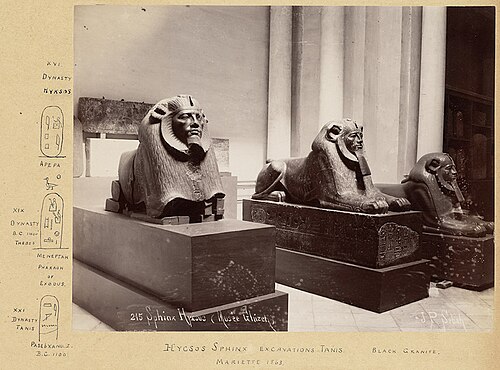
لا يبدو أن الهكسوس ، وهم سلالة حاكمة من بلاد الشام ، قد أنتجوا أي فنون بلاطية، [ 47 ] بل استولوا على آثار من سلالات سابقة بكتابة أسمائهم عليها. العديد من هذه الآثار منقوش عليها اسم الملك خيان . [ 48 ] تم الكشف عن قصر كبير في أفاريس ، بُني على الطراز الشامي وليس المصري، على الأرجح في عهد خيان. [ 49 ] من المعروف أن الملك أبيبي كان راعيًا لثقافة الكتابة المصرية، حيث كلف بنسخ بردية ريند الرياضية . [ 50 ] قد تعود القصص المحفوظة في بردية وستكار أيضًا إلى عهده. [ 51 ]
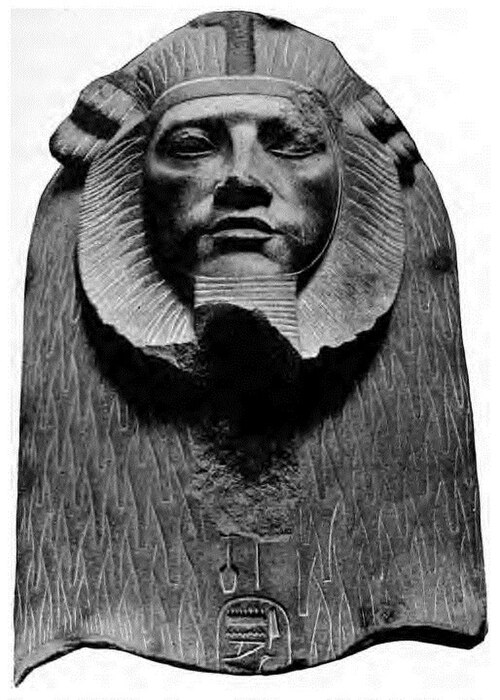
تُعرف ما يُسمى بـ" أبو الهكسوس " أو "أبو الهول التاني" بمجموعة من تماثيل أبو الهول الملكية التي تُصوّر الفرعون أمنمحات الثالث (الأسرة الثانية عشرة)، وتتميز ببعض السمات غير المألوفة مقارنةً بالتماثيل التقليدية، كعظام الخدين البارزة وعُرف الأسد الكثيف، بدلاً من غطاء الرأس التقليدي (النمس). سُميت هذه التماثيل بـ"أبو الهكسوس" لأنها نُقشت لاحقًا من قِبل العديد من ملوك الهكسوس، وكان يُعتقد في البداية أنها تُمثلهم. حاول علماء القرن التاسع عشر استخدام ملامح هذه التماثيل لتحديد أصل الهكسوس العرقي. [ 52 ] استولى الهكسوس على هذه التماثيل من مدن المملكة الوسطى ، ثم نقلوها إلى عاصمتهم أفاريس، حيث نُقشت عليها أسماء مالكيها الجدد، وزُيّنت بها قصورهم. [ 46 ] عُثر على سبعة من تلك التماثيل لأبي الهول، جميعها من تانيس ، ومعظمها موجود الآن في المتحف المصري بالقاهرة . [ 46 ] [ 53 ] كما عُثر على تماثيل أخرى لأمنحت الثالث في تانيس، وترتبط بالهكسوس بنفس الطريقة.
 مسؤولٌ يرتدي تسريحة شعر "الرأس الفطرية"، وهي تسريحةٌ شائعةٌ أيضاً في اللوحات المعاصرة التي تصوّر أجانب من غرب آسيا، كما هو الحال في مقبرة خنوم حتب الثاني في بني حسن . وقد اكتُشفت هذه المقبرة في أفاريس ، عاصمة الهكسوس. (المجموعة الحكومية للفن المصري) . [ 54 ] [ 55 ] [ 56 ] [ 57 ]
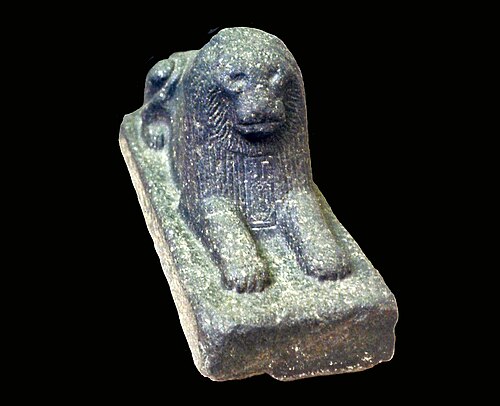 أسد منقوش عليه اسم حاكم الهكسوس خيان ، عُثر عليه في بغداد ، مما يشير إلى وجود صلات مع بابل . يظهر اسم خيان ولقبه على صدره. المتحف البريطاني ، EA 987. [ 58 ] [ 59 ]
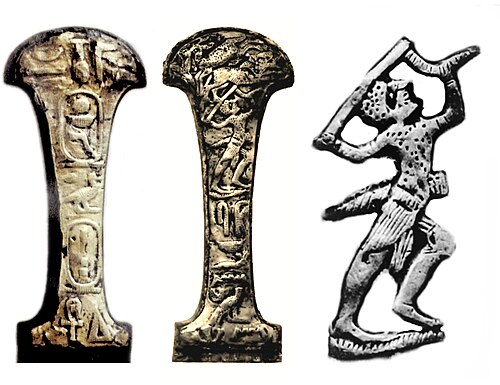 مقبض خنجر من الإلكتروم لجندي من جنود فرعون الهكسوس، أبيبي ، يصور الجندي وهو يصطاد بقوس قصير وسيف. النقوش: "الإله الكامل، سيد الأرضين، نبخيبشر أبيبي " و"تابع سيده نحميان"، عُثر عليه في مدفن بسقارة . [ 60 ] معروض الآن في متحف الأقصر . [ 61 ] [ 62 ]
 مثال على خزف تل اليهودية المصري ، وهو نمط متأثر بالفن الشامي.
المملكة الحديثة (حوالي 1550-1069 قبل الميلاد)
المملكة الحديثة ، أو ما يُعرف أيضًا باسم "الإمبراطورية المصرية"، هي الفترة الممتدة بين القرنين السادس عشر والحادي عشر قبل الميلاد، وتشمل الأسر الثامنة عشرة والتاسعة عشرة والعشرين في مصر . وقد أعقبت المملكة الحديثة الفترة الانتقالية الثانية ، وتلتها الفترة الانتقالية الثالثة . كانت هذه الفترة أزهى عصور مصر ، وبلغت فيها ذروة قوتها. [ 63 ] يُعزى هذا الثراء الهائل إلى مركزية السلطة البيروقراطية، والعديد من الحملات العسكرية الناجحة التي فتحت طرقًا تجارية. ومع توسع الإمبراطورية المصرية، تمكن الملوك من الوصول إلى سلع مهمة مثل خشب الأرز من لبنان، ومواد فاخرة مثل اللازورد والفيروز .
تنقسم الأعمال الفنية التي أُنتجت خلال عصر الدولة الحديثة إلى ثلاث فترات رئيسية: ما قبل العمارنة، والعمارنة، والرمسيسية . وعلى الرغم من حدوث تغييرات أسلوبية نتيجة لتغيرات السلطة وتنوع المُثل الدينية، إلا أن التماثيل والنقوش البارزة في جميع أنحاء عصر الدولة الحديثة استمرت في تجسيد المبادئ الأساسية للفن المصري: المواجهة والمحورية، والتسلسل الهرمي في الحجم، والتكوين المركب.
ما قبل العمارنة
تميزت فترة ما قبل العمارنة، بداية الأسرة الثامنة عشرة من الدولة الحديثة، بتنامي قوة مصر كإمبراطورية مترامية الأطراف. وتعكس الأعمال الفنية مزيجًا من تقنيات ومواضيع الدولة الوسطى مع المواد والأساليب الجديدة التي تم الوصول إليها من بلدان أجنبية. [ 64 ] وقد أنتجت الملكة حتشبسوت جزءًا كبيرًا من فنون وعمارة فترة ما قبل العمارنة، حيث قادت حملة بناء واسعة النطاق لجميع الآلهة خلال فترة حكمها من 1473 إلى 1458 قبل الميلاد. وأضافت إضافات كبيرة إلى معبد الكرنك ، وشَيَّدت معبدًا جنائزيًا ضخمًا في الدير البحري، وأنتجت كمية وفيرة من التماثيل والنقوش البارزة من الحجر الصلب. وقد أتاح مركزة السلطة في طيبة وإعادة فتح طرق التجارة من قِبَل حاكم الدولة الحديثة السابق أحمس الأول، إمكانية تنفيذ هذه المشاريع الإنشائية الضخمة. [ 65 ]
يُقدّم معبد حتشبسوت الجنائزي الفخم في الدير البحري العديد من الأمثلة المحفوظة جيدًا للأعمال الفنية التي أُنتجت خلال فترة ما قبل تل العمارنة. بُني هذا المعبد الضخم ذو الأعمدة، والمكون من ثلاثة مستويات، في منحدرات طيبة، وزُيّن بنقوش بارزة مُلوّنة. تنوعت مواضيع هذه النقوش بين صور جنائزية تقليدية وإضفاء الشرعية على حتشبسوت كحاكمة إلهية لمصر، ومشاهد معارك وحملات في بلاد أجنبية. كما ضمّ المعبد العديد من تماثيل الملكة والآلهة، ولا سيما آمون رع، وبعضها كان ضخمًا للغاية. تتميز الأعمال الفنية من عهد حتشبسوت بإعادة دمج الثقافة والأسلوب الشماليين نتيجة لتوحيد مصر. كما أمر تحتمس الثالث، سلف حتشبسوت، بإنتاج كميات هائلة من الأعمال الفنية الضخمة، وبحلول وفاته، كانت مصر أقوى إمبراطورية في العالم. [ 65 ]
المعابد التي ترعاها الدولة
خلال عصر الدولة الحديثة، ولا سيما الأسرة الثامنة عشرة، كان من المعتاد أن يأمر الملوك ببناء معابد ضخمة ومتقنة مخصصة لآلهة مصر الرئيسية. هذه المباني، المبنية من الحجر الجيري أو الحجر الرملي (مواد أكثر متانة من الطوب اللبن المستخدم في المعابد السابقة)، والمزينة بمواد نادرة ورسوم جدارية نابضة بالحياة، تُجسد ثراء الإمبراطورية المصرية ووفرة مواردها خلال عصر الدولة الحديثة. ويُعد معبد الكرنك ، المخصص للإله آمون رع، أحد أكبر وأفضل الأمثلة الباقية على هذا النوع من العمارة التي ترعاها الدولة. [ 64 ]
 عين؛ 1550-1069 قبل الميلاد؛ عين من المرمر من تابوت؛ الطول: 50.8 مم؛ متحف أوكلاند التذكاري للحرب ( أوكلاند ، نيوزيلندا)
 تمثال أوشابتي لأمنحتب الثاني ؛ 1427-1400 قبل الميلاد؛ سربنتين ؛ 29 × 9 × 0.65 سم، 1.4 كجم؛ المتحف البريطاني (لندن)
 لوحة ذراع من كرسي احتفالي للملك تحتمس الرابع ؛ 1400-1390 قبل الميلاد؛ خشب ( فيكوس سيكوموروس ؟)؛ الارتفاع: 25.1 سم؛ متحف متروبوليتان للفنون (مدينة نيويورك)
 لوحة لعب منقوشة لأمنحتب الثالث مع درج منزلق منفصل؛ 1390-1353 قبل الميلاد؛ خزف مزجج؛ 5.5 × 7.7 × 21 سم؛ متحف بروكلين (مدينة نيويورك)
 تمثال قرد البابون؛ 1390-1352 قبل الميلاد؛ كوارتزيت؛ 68.5 × 38.5 × 45 سم، 180 كجم (تقديري)؛ المتحف البريطاني
 تمثال صغير للسيدة تي ؛ 1390-1349 قبل الميلاد؛ خشب، عقيق أحمر ، ذهب، زجاج، أزرق مصري وطلاء؛ الارتفاع: 24 سم؛ متحف متروبوليتان للفنون (مدينة نيويورك)
 أبو سمبل ، معبد رمسيس الثاني
 سوريون يقدمون هدايا إلى تحتمس الثالث ، في مقبرة رخمير ، حوالي عام 1450 قبل الميلاد. وقد وُصفوا بأنهم "رؤساء ريتجينو ". [ 66 ] [ 67 ]
فن العمارنة (حوالي 1350 قبل الميلاد)

يُنسب فن العمارنة إلى الموقع الأثري الواسع في تل العمارنة ، حيث نقل الفرعون إخناتون العاصمة في أواخر الأسرة الثامنة عشرة . تُشكل هذه الفترة، والسنوات التي سبقتها، أكبر انقطاع في أسلوب الفن المصري في الدول القديمة والوسطى والحديثة، نتيجةً لتنامي أهمية اللاهوت الشمسي الجديد والتحول التدريجي نحو عبادة آتون في عهد إخناتون. [ 68 ] يتميز فن العمارنة بإحساسه بالحركة و"إدراكه الذاتي والحسي" للواقع كما بدا في العالم. غالبًا ما تتضمن المشاهد شخصيات متداخلة تُوحي بوجود حشد، وهو أمر كان أقل شيوعًا في العصور السابقة.
كانت الأعمال الفنية التي أُنتجت في عهد إخناتون انعكاسًا للتغيرات الجذرية التي طرأت على الثقافة والأسلوب والدين في عهده. عُرفت هذه الديانة الجديدة أحيانًا باسم "اللاهوت الشمسي الجديد"، وكانت عبادة توحيدية للشمس، أو آتون. وقد أكد إخناتون على نفسه بوصفه "شريكًا في الحكم" إلى جانب آتون، بل وناطقًا باسمه. ولأن قرص الشمس كان يُعبد باعتباره القوة المانحة للحياة في هذا اللاهوت الجديد، فقد كان كل ما تلمسه أشعة الشمس يُعتبر مباركًا بهذه القوة. ونتيجة لذلك، يُرجح أن القرابين والعبادات كانت تُقام في ساحات مفتوحة، كما استُخدمت تقنية النقش الغائر ، التي تُناسب المنحوتات الخارجية، في الأعمال الفنية الداخلية أيضًا.
شهد تصوير الجسد البشري تحولاً جذرياً في عهد إخناتون. فعلى سبيل المثال، تُظهر العديد من الصور جسد إخناتون بصفات أنثوية واضحة، كالأرداف العريضة، والصدر البارز، والبطن والفخذين الممتلئين. أما تصوير وجه إخناتون، كما في تمثاله الرملي ، فيُظهره بذقن ممدود، وشفتين ممتلئتين، وخدين غائرين. لم تقتصر هذه السمات الأسلوبية على تصوير إخناتون فحسب، بل استُخدمت أيضاً في تصوير جميع أفراد العائلة المالكة، كما هو الحال في صورة ميريتاتون وجزء من وجه ملكة. ويمثل هذا اختلافاً عن الفن المصري القديم، الذي كان يُركز على الشباب المثالي والرجولة في الشخصيات الذكورية.
كان من أبرز الابتكارات في عهد إخناتون الارتقاء الديني بالعائلة المالكة، بما في ذلك زوجته نفرتيتي وبناته الثلاث. [ 69 ] فبينما صوّرت فترات سابقة من الفن المصري الملكَ باعتباره الرابط الأساسي بين البشر والآلهة، امتدت هذه السلطة في عصر العمارنة لتشمل أفراد العائلة المالكة. [ 69 ] وكما هو مُصوَّر في نقش العائلة المالكة وكتل التلاتات المختلفة ، فإن كل شخصية من العائلة المالكة مُتأثرة بأشعة آتون . ويُعتقد أن نفرتيتي تحديدًا قد اضطلعت بدور طقوسي هام خلال هذه الفترة. [ 70 ]
لم يبقَ الكثير من المباني من هذه الفترة، ويعود ذلك جزئيًا إلى أنها شُيّدت باستخدام كتل قياسية الحجم تُعرف باسم "تلاتات"، والتي كان من السهل جدًا إزالتها وإعادة استخدامها. وتماشيًا مع هذا التوجه، لم تتبع معابد تل العمارنة العادات المصرية التقليدية، فكانت مفتوحة، بلا أسقف، وبدون أبواب تُغلق. وفي الأجيال التي تلت وفاة إخناتون، عاد الفنانون إلى الأساليب المصرية التقليدية للفترات السابقة. وظلت آثار أسلوب هذه الفترة باقية في الفن اللاحق، ولكن في معظم النواحي، استعاد الفن المصري، كالدين المصري، خصائصه المعتادة كما لو أن تلك الفترة لم تكن موجودة. هُجرت تل العمارنة نفسها، وبُذلت جهود كبيرة لتشويه آثار عهده، بما في ذلك تفكيك المباني وإعادة استخدام الكتل مع توجيه زخارفها نحو الداخل، كما اكتُشف مؤخرًا في أحد المباني اللاحقة. [ 71 ] وسعى حورمحب ، آخر ملوك الأسرة الثامنة عشرة ، إلى القضاء على تأثير فن وثقافة تل العمارنة وإعادة إحياء تقليد عبادة آمون القوي. [ 72 ]
 نقش بارز للعائلة المالكة: أخناتون ، نفرتيتي وبناتها الثلاث؛ 1352-1336 قبل الميلاد؛ حجر جيري مطلي ؛ 25 × 20 سم؛ المتحف المصري في برلين (ألمانيا)

 كتلة تلاتات منقوشة عليها صورة نفرتيتي وهي تصلي؛ حوالي 1350 قبل الميلاد؛ حجر رملي مطلي؛ الارتفاع: 23.4 سم؛ من الكرنك ؛ المتحف المصري في برلين
 كتلة تالاتات عليها صورة إخناتون واقفًا إلى اليمين، رافعًا يديه في صلاة لأشعة إله الشمس آتون ؛ حوالي 1350 قبل الميلاد؛ حجر رملي مطلي؛ من الكرنك؛ المتحف المصري في برلين
 تمثال شابتي لأخناتون؛ 1353-1336 قبل الميلاد؛ خزف؛ الارتفاع: 11 سم، العرض: 7.6 سم، العمق: 5.2 سم؛ متحف متروبوليتان للفنون (مدينة نيويورك)
 جزء من وجه ملكة؛ ١٣٥٣-١٣٣٦ قبل الميلاد؛ حجر اليشب الأصفر ؛ الارتفاع: ١٣ سم، العرض: ١٢.٥ سم، العمق: ١٢.٥ سم؛ متحف متروبوليتان للفنون
 طبق تجميل على شكل بطة مربوطة؛ ١٣٥٣-١٣٢٧ قبل الميلاد؛ عاج فرس النهر (ملون)؛ البطة (يسار)، الطول: ٩٫٥ سم، العرض: ٤٫٦ سم؛ الغطاء (يمين)، الطول: ٧٫٣ سم، العرض: ٤ سم؛ متحف متروبوليتان للفنون
العصر الرعامسة (حوالي 1209-1077 قبل الميلاد)
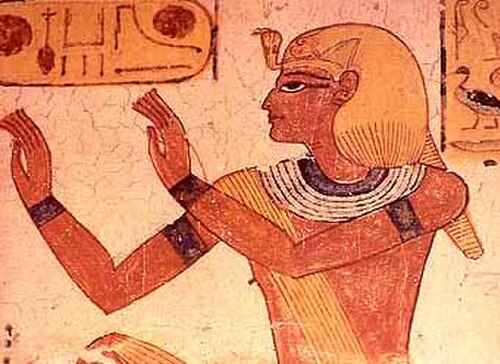
بفضل الجهود الحثيثة التي بذلها حورمحب، آخر ملوك الأسرة الثامنة عشرة، للقضاء على فنون العمارنة وتأثيرها، تحوّل أسلوب الفن والعمارة في الإمبراطورية إلى أسلوب العصر الرعامسي خلال ما تبقى من عصر الدولة الحديثة ( الأسرتين التاسعة عشرة والعشرين ). [ 65 ] واستجابةً للثورة الدينية والفنية التي شهدها عصر العمارنة، أظهرت الأعمال التي كلّفتها الدولة عودةً واضحةً إلى الأشكال التقليدية وتجديدًا للتفاني في عبادة آمون رع. ومع ذلك، بقيت بعض عناصر تناسبات الجسم التي ميزت عصر العمارنة؛ فلم يعد أسفل الظهر إلى ارتفاعه المنخفض الذي كان سائدًا في عصر الدولة الوسطى، وظلت الأطراف البشرية طويلةً بعض الشيء. ومع بعض التعديلات، واصل ملوك الأسرتين التاسعة عشرة والعشرين بناء معابدهم الجنائزية، التي كانت مخصصة لآمون رع وتقع في طيبة، على غرار أسلوب أسلافهم. كما واصل ملوك رمسيس بناء تماثيل ضخمة كتلك التي أمرت بها حتشبسوت. [ 64 ]
خلال العصر الرعامسة، قدّم الملوك إسهامات إضافية لمعبد الكرنك. تتألف قاعة الأعمدة الكبرى، التي أمر ببنائها سيتي الأول (الأسرة التاسعة عشرة)، من 134 عمودًا من الحجر الرملي تدعم سقفًا بارتفاع 20 مترًا، وتغطي مساحة فدان واحد. زيّن سيتي الأول معظم الأسطح بنقوش بارزة متقنة، بينما أضاف خليفته، رمسيس الثاني، نقوشًا غائرة إلى الجدران والأعمدة في الجانب الجنوبي من القاعة الكبرى. تُظهر المنحوتات الداخلية تفاعلات الملك مع الإله، مثل مشاهد إضفاء الشرعية التقليدية على السلطة، والمواكب، والطقوس. تغطي رسومات واسعة النطاق للحملات العسكرية الجدران الخارجية لقاعة الأعمدة. تُعدّ مشاهد المعارك التي تُصوّر أعداءً فوضويين منتشرين في الأرض المفتوحة والملك المنتصر كأبرز شخصية، سمة مميزة للعصر الرعامسة. [ 64 ]
تُظهر الفترة الأخيرة من المملكة الحديثة عودةً إلى الشكل والأسلوب المصريين التقليديين، لكن الثقافة لم تكن مجرد عودة إلى الماضي. يُظهر فن العصر الرعامسة دمج الأشكال المصرية الراسخة مع الابتكارات والمواد الحديثة. وتُبرز تطورات مثل تزيين جميع أسطح المقابر بالرسومات والنقوش، وإضافة نصوص جنائزية جديدة إلى غرف الدفن، الطبيعة الديناميكية لهذه الفترة. [ 64 ]
الفترة الانتقالية الثالثة (حوالي 1069-664 قبل الميلاد)


كانت الفترة الانتقالية الثالثة فترة انحدار وعدم استقرار سياسي، تزامنت مع انهيار حضارات الشرق الأدنى وشرق البحر الأبيض المتوسط في أواخر العصر البرونزي (بما في ذلك العصور المظلمة اليونانية ). تميزت هذه الفترة بانقسام الدولة طوال معظمها، وغزو وحكم الأجانب. [ 73 ] بعد فترة مبكرة من التفكك، أعيد توحيد البلاد بقوة على يد الأسرة الثانية والعشرين التي أسسها شوشنق الأول عام 945 قبل الميلاد (أو 943 قبل الميلاد)، والذي ينحدر من مهاجرين من المشوش ، أصلهم من ليبيا القديمة . شهدت الفترة التالية من الأسرة الرابعة والعشرين ازدياد نفوذ المملكة النوبية في الجنوب، التي استغلت هذا الانقسام وما تبعه من عدم استقرار سياسي. ثم حوالي عام 732 قبل الميلاد، زحف بيي شمالًا وهزم القوة المشتركة لعدد من الحكام المصريين الأصليين: بفتجوباست، وأوسوركون الرابع ملك تانيس، وإيوبوت الثاني ملك ليونتوبوليس، وتفناخت ملك سايس. أسس الأسرة الخامسة والعشرين من "الفراعنة السود" الذين ينحدرون من النوبة.
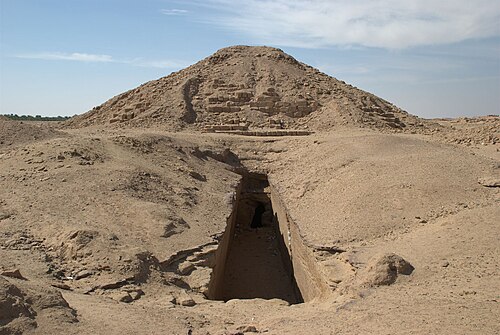
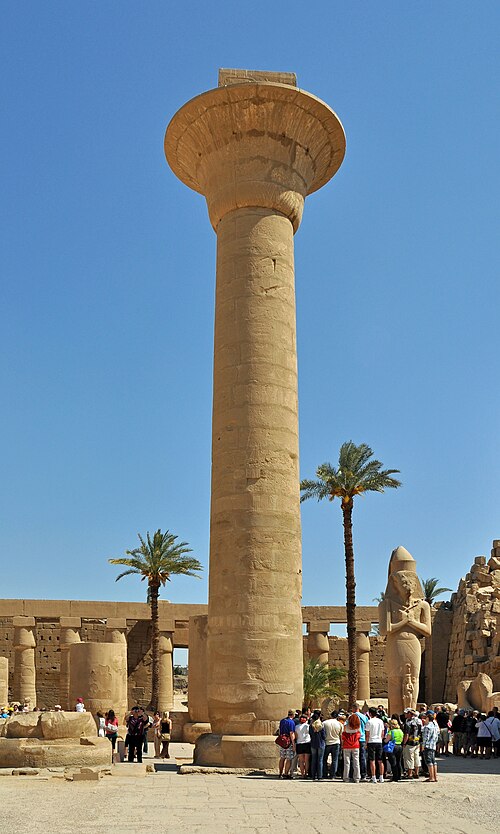
شهدت الفترة الانتقالية الثالثة عمومًا عودةً إلى الأساليب المصرية القديمة، مع إشارة خاصة إلى فنون المملكة القديمة والوسطى . [ 74 ] يتألف فن هذه الفترة أساسًا من الأساليب المصرية التقليدية، التي أُعيد تقديمها لأسباب غير معروفة في وقت مبكر من عهد شوشنق الخامس أو أوسركون الثالث ، [ 75 ] وأحيانًا مع إضافة بعض الخصائص الأجنبية، مثل الأيقونات المميزة لتماثيل حكام النوبة من الأسرة الخامسة والعشرين . [ 74 ] على الرغم من أن الأسرة الخامسة والعشرين حكمت مصر القديمة لمدة 73 عامًا فقط، إلا أنها تحتل مكانة مهمة في التاريخ المصري نظرًا لإعادة إحياء القيم والثقافة والفنون والعمارة المصرية التقليدية، إلى جانب بعض الإبداعات الأصلية مثل عمود طهارقة الضخم في الكرنك . [ 76 ] [ 77 ] خلال الأسرة الخامسة والعشرين، حُكمت مصر من نبتة في النوبة ، التي تقع الآن في السودان الحديث ، وسمحت الأسرة بدورها بتوسع الأساليب المعمارية المصرية إلى مصر السفلى والنوبة . [ 74 ]

 طهارقة تقدم جرار نبيذ للإله الصقر هيمين ؛ [ 77 ] 690-664 قبل الميلاد؛ برونز، حجر رملي رمادي، ذهب وخشب؛ الطول: 26 سم، الارتفاع: 19.7 سم، العرض: 10.3 سم؛ متحف اللوفر
الفترة المتأخرة (حوالي 664-332 قبل الميلاد)

في عام 525 قبل الميلاد، استولى الفرس على الدولة السياسية في مصر، بعد قرابة قرن ونصف من بداية العصر المتأخر. وبحلول عام 404 قبل الميلاد، طُرد الفرس من مصر، لتبدأ فترة قصيرة من الاستقلال. تميزت هذه السنوات الستون من الحكم المصري بكثرة الغزاة وقصر فترات الحكم. ثم أعاد الأخمينيون احتلال مصر حتى عام 332 قبل الميلاد مع وصول الإسكندر الأكبر . تشير المصادر إلى أن المصريين هللوا عند دخول الإسكندر العاصمة لأنه طرد الفرس الذين كانوا مكروهين بشدة. يتميز العصر المتأخر بوفاة الإسكندر الأكبر وبداية السلالة البطلمية . [ 80 ] على الرغم من أن هذه الفترة شهدت اضطرابات سياسية وتغيرات هائلة في مصر، إلا أن فنونها وثقافتها استمرت في الازدهار.
يتجلى هذا في المعابد المصرية بدءًا من الأسرة الثلاثين ، الأسرة الخامسة في العصر المتأخر، وامتدادًا إلى العصر البطلمي. امتدت هذه المعابد من دلتا النيل إلى جزيرة فيلة . [ 80 ] ورغم تأثر مصر بعوامل خارجية من خلال التجارة والغزوات الأجنبية، إلا أن هذه المعابد حافظت على الطراز المصري التقليدي مع تأثير هلنستي ضئيل للغاية.
ومن بين النقوش البارزة الأخرى التي تعود إلى الأسرة الثلاثين، التشكيل الدائري للجسم والأطراف، [ 80 ] مما أضفى على الشخصيات مظهرًا أكثر امتلاءً وثقلًا. فعلى سبيل المثال، في رسومات النساء، كانت أثداؤهن تنتفخ وتغطي الجزء العلوي من الذراع. أما في التصويرات الأكثر واقعية، فكان الرجال يظهرون بدينين أو مجعدين.
من بين أنواع الفنون الأخرى التي شاعت خلال هذه الفترة، تماثيل حورس . [ 80 ] تعود أصول هذه التماثيل إلى أواخر عصر الدولة الحديثة والفترة الانتقالية، لكنها انتشرت بشكل متزايد خلال القرن الرابع الميلادي وحتى العصر البطلمي. غالبًا ما كانت هذه التماثيل تصور حورس الشاب ممسكًا بثعابين وواقفًا على نوع من الوحوش الخطيرة. يستمد تصوير حورس من الأسطورة المصرية التي تروي قصة حورس الشاب الذي نجا من لدغة عقرب، مما أكسبه القدرة على السيطرة على جميع الحيوانات الخطيرة. استُخدمت هذه التماثيل "لصد هجمات المخلوقات الضارة، ولعلاج لدغات الثعابين ولسعات العقارب". [ 80 ]

 تاج من ورق البردي المركب؛ 380-343 قبل الميلاد؛ حجر رملي مطلي؛ الارتفاع: 126 سم؛ متحف متروبوليتان للفنون (مدينة نيويورك)
 لوحة سحرية أو تمثال حورس ؛ 332-280 قبل الميلاد؛ شيست الكلوريت؛ الارتفاع: 20.5 سم؛ متحف متروبوليتان للفنون
العصر البطلمي (305-30 قبل الميلاد)

تشمل الاكتشافات التي أُجريت منذ نهاية القرن التاسع عشر حول مدينة هيراكليون المصرية القديمة (المغمورة الآن) في الإسكندرية، تمثالًا لإيزيس يعود إلى القرن الرابع قبل الميلاد، يتميز بتفاصيله الحسية الدقيقة وطابعه الأنثوي (بدلًا من تصويرها كإلهة) ، مما يُشير إلى مزيج من الأشكال المصرية والهلنستية بدأ تقريبًا في وقت غزو الإسكندر الأكبر لمصر في الفترة ما بين 332 و331 قبل الميلاد. مع ذلك، كان هذا الأمر غير معتاد في فن النحت البطلمي، الذي تجنب عمومًا مزج الأساليب المصرية مع الأسلوب الهلنستي المستخدم في فنون البلاط في عهد البطالمة ، [ 82 ] بينما استمرت المعابد في بقية أنحاء البلاد في استخدام نسخ متأخرة من الصيغ المصرية التقليدية. [ 83 ] وقد اقترح الباحثون "أسلوبًا إسكندريًا" في النحت الهلنستي، ولكن في الواقع لا يوجد ما يربطه بالإسكندرية. [ 84 ]
استُخدم الرخام على نطاق واسع في فنون البلاط، على الرغم من أنه كان يُستورد بالكامل، واستُخدمت تقنيات مختلفة لترشيد استهلاكه، مثل استخدام قطع متعددة مُلصقة بالجص ؛ فقد يُصوَّر الرأس بأجزاء منفصلة تشمل اللحية ومؤخرة الرأس والشعر. [ 85 ] وعلى النقيض من فنون الممالك الهلنستية الأخرى ، اتسمت صور الملوك البطلميين بالعمومية والمثالية، مع قلة الاهتمام بتجسيد شخصية كل فرد، مع أن العملات المعدنية تُتيح تحديد بعض التماثيل التي تُصوِّر أحد الملوك الخمسة عشر بطليموس. [ 86 ] ومن الواضح أن العديد من الصور اللاحقة قد أُعيد تشكيل وجوهها لتُظهر ملكًا لاحقًا. [ 87 ] ومن السمات المصرية إبراز الملكات بشكل أكبر من غيرهن من السلالات التي خلفت الإسكندر، حيث كان يُصوَّر الزوجان الملكيان غالبًا معًا. وقد سبق هذا الأمر القرن الثاني الميلادي، عندما مارست سلسلة من الملكات سلطة حقيقية. [ 88 ]
في القرن الثاني الميلادي ، بدأت منحوتات المعابد المصرية في إعادة استخدام نماذج البلاط الملكي في وجوهها، وكثيراً ما استخدمت منحوتات الكهنة أسلوباً هلنستياً لإضفاء طابع مميز على رؤوسهم. [ 89 ] وقد أُنتجت العديد من التماثيل الصغيرة، وكان من أكثرها شيوعاً تمثال الإسكندر، وتمثال "الملك بطليموس" بشكل عام، وتمثال أفروديت عارية . وشملت التماثيل الفخارية أشكالاً غريبة وسيدات أنيقات على طراز تماثيل تاناغرا . [ 83 ] وتميزت المجموعات الإيروتيكية بأعضاء تناسلية ذكرية ضخمة بشكل مبالغ فيه. وتضمنت بعض تجهيزات الديكورات الداخلية الخشبية صقوراً متعددة الألوان ذات نقوش دقيقة للغاية مصنوعة من الخزف.
 بطليموس الثاني عشر يقدم القرابين للآلهة المصرية، في معبد حتحور، 54 قبل الميلاد، دندرة ، مصر
 نقش نذري مزدوج الجوانب؛ حوالي 305 قبل الميلاد؛ حجر جيري؛ 8.3 × 6.5 × 1.4 سم؛ متحف كليفلاند للفنون ( كليفلاند ، أوهايو ، الولايات المتحدة الأمريكية)
 تابوت على شكل طائر أبو منجل؛ 305-30 قبل الميلاد؛ خشب، فضة، ذهب، وكريستال صخري؛ 38.2 × 20.2 × 55.8 سم؛ متحف بروكلين (مدينة نيويورك)
العصر الروماني (30 قبل الميلاد - 619 ميلادي)


تُعدّ صور المومياوات في الفيوم أشهر مثال على الفن المصري خلال العصر الروماني. وهي عبارة عن لوحات واقعية مرسومة على ألواح خشبية، تُعلّق على مومياوات الطبقة العليا في مصر الرومانية . تنتمي هذه الصور إلى فن الرسم على الألواح ، أحد أرقى الفنون في العالم الكلاسيكي . وتُعتبر صور الفيوم المجموعة الفنية الكبيرة الوحيدة المتبقية من هذا الفن.
عُثر على صور المومياوات في أنحاء متفرقة من مصر ، لكنها أكثر شيوعًا في حوض الفيوم ، لا سيما في هوارة (ومن هنا جاء الاسم الشائع) ومدينة أنتينوبوليس الرومانية التي تعود إلى العصر الهادرياني . ويُستخدم مصطلح "صور الفيوم" عادةً كوصفٍ أسلوبي، وليس جغرافيًا. وبينما يعود تاريخ توابيت المومياوات المرسومة والمغلفة بالكرتوناج إلى العصر الفرعوني، فإن صور مومياوات الفيوم كانت ابتكارًا يعود إلى زمن الاحتلال الروماني لمصر . [ 92 ]
تعود هذه اللوحات إلى العصر الروماني الإمبراطوري ، من أواخر القرن الأول قبل الميلاد أو أوائل القرن الأول الميلادي فصاعدًا. ولا يُعرف على وجه الدقة متى توقف إنتاجها، لكن تشير الأبحاث الحديثة إلى منتصف القرن الثالث الميلادي. وهي من بين أكبر المجموعات القليلة المتبقية من فن الرسم على الألواح في العالم الكلاسيكي، والذي استمر في التقاليد البيزنطية والغربية في العالم ما بعد الكلاسيكي، بما في ذلك التقاليد المحلية للأيقونات القبطية في مصر.
 تجسد صور المومياوات في الفيوم التقاء الحضارتين المصرية والرومانية.
 قناع مومياء لرجل؛ أوائل القرن الأول الميلادي؛ جص، مذهب ومطلي؛ 51.5 × 33 × 20 سم؛ متحف بروكلين (مدينة نيويورك)
 صورة لامرأة شابة ترتدي اللون الأحمر؛ حوالي 90-120 ؛ رسم بالشمع على خشب الزيزفون مع ورق الذهب ؛ الارتفاع: 38 سم (15 بوصة) ؛ متحف متروبوليتان للفنون (مدينة نيويورك)
 تمثال هيرمانوبيس ؛ 100-138؛ رخام؛ الارتفاع: 1.5 متر، العرض: 50 سم؛ من تيفولي ( روما )؛ متاحف الفاتيكان ( مدينة الفاتيكان ) [ 93 ]
 صورة مومياء لرجل؛ أواخر القرن الأول الميلادي؛ رسم بالشمع على الخشب؛ متحف والترز للفنون ( بالتيمور ، ماريلاند ، الولايات المتحدة الأمريكية)
 إيزيس ترضع طفلها حورس (الذي لم يبق منه سوى ساقه اليسرى)؛ القرن الأول الميلادي؛ حجر الغرين (الأساس: الحجر الجيري)؛ الارتفاع: 33.9 سم؛ من متانة آسفو ; Staatliche Sammlung für Ägyptische Kunst ( ميونيخ ، ألمانيا)
صفات
يُعرف الفن المصري بأسلوبه المميز في رسم الشخصيات الرئيسية، سواءً في النقوش البارزة أو اللوحات، حيث تُفصل الأرجل (في حال عدم الجلوس) ويُصوَّر الرأس من الجانب، بينما يُصوَّر الجذع من الأمام. كما تتميز هذه الشخصيات بنسب قياسية، إذ يبلغ طولها من الأرض إلى منبت الشعر على الجبهة ما يُعادل 18 قبضة يد. [ 94 ] وقد ظهر هذا الأسلوب في وقت مبكر، كما في لوحة نارمر من الأسرة الأولى، إلا أن هذا الأسلوب المثالي في رسم الشخصيات لا يُستخدم في تصوير الشخصيات الثانوية المنخرطة في أنشطة معينة، مثل الأسرى والجثث. [ 95 ] ومن بين الأساليب الأخرى، تصوير تماثيل الذكور بلون أغمق من تماثيل الإناث. ظهرت تماثيل بورتريه تقليدية للغاية منذ عهد الأسرة الثانية (قبل 2780 قبل الميلاد)، [ 96 ] وباستثناء فن عصر العمارنة في عهد أخناتون [ 97 ] وبعض الفترات الأخرى كالأسرة الثانية عشرة، لم تتغير الملامح المثالية للحكام، شأنها شأن التقاليد الفنية المصرية الأخرى، إلا قليلاً حتى الغزو اليوناني. [ 98 ] يستخدم الفن المصري نسبًا هرمية ، حيث يشير حجم الشخصيات إلى أهميتها النسبية. عادةً ما تكون الآلهة أو الفرعون الإلهي أكبر من الشخصيات الأخرى، بينما تكون شخصيات كبار المسؤولين أو صاحب المقبرة أصغر حجمًا، أما أصغر مقياس فتظهر فيه الخدم والفنانون والحيوانات والأشجار والتفاصيل المعمارية. [ 99 ]
إخفاء الهوية

نادرًا ما كان الفنانون المصريون القدماء يُخلّدون أسماءهم. ويُعزى ذلك جزئيًا إلى أن العمل الفني المصري كان جماعيًا في أغلب الأحيان. وقد كتب ديودور الصقلي ، الذي سافر إلى مصر وعاش فيها: "بعد أن يُحدد الحرفيون ارتفاع التمثال، يعودون جميعًا إلى منازلهم لصنع الأجزاء التي اختاروها" (1، 98). [ 100 ]
الرمزية
تغلغلت الرمزية في الفن المصري ولعبت دورًا هامًا في ترسيخ النظام. فعلى سبيل المثال، مثّلت حليّ الفرعون سلطته في الحفاظ على النظام. كما كانت الحيوانات رموزًا بارزة في الفن المصري. وكانت بعض الألوان معبرة. [ 101 ]
كانت اللغة المصرية القديمة تحتوي على أربعة مصطلحات أساسية للألوان: كيم (أسود)، هيدج (أبيض/فضي)، وادج (أخضر/أزرق)، ودشر (أحمر/برتقالي/أصفر). فعلى سبيل المثال، كان اللون الأزرق يرمز إلى الخصوبة والولادة ومياه النيل المانحة للحياة. [ 102 ] وكان الأزرق والأخضر لونَي النباتات، وبالتالي لونَي التجدد. وكان من الممكن تصوير أوزيريس ببشرة خضراء؛ ففي الأسرة السادسة والعشرين ، كانت وجوه التوابيت تُلوّن غالبًا باللون الأخضر للمساعدة في البعث. [ 103 ]
يُفسر هذا الرمز اللوني شيوع استخدام الفيروز والخزف في تجهيزات الجنائز. وبالمثل ، فإن استخدام اللون الأسود للشخصيات الملكية يُعبر عن خصوبة التربة الطميية [ 101 ] لنهر النيل الذي نشأت منه مصر، ويحمل دلالات على الخصوبة والتجدد. ولذلك، غالبًا ما كانت تماثيل الملك أوزوريس تُظهره ببشرة سوداء. كما ارتبط اللون الأسود بالحياة الآخرة، وكان لون آلهة الجنائز مثل أنوبيس .
كان الذهب رمزًا للألوهية نظرًا لمظهره غير الطبيعي وارتباطه بالمواد الثمينة. [ 101 ] علاوة على ذلك، اعتبره المصريون القدماء "جسد الإله". [ 104 ] وبالمثل، أطلق المصريون على الفضة اسم "الذهب الأبيض"، وكانوا يسمونها "عظام الإله". [ 104 ]
كانت الألوان الأحمر والبرتقالي والأصفر ألوانًا ذات دلالات متناقضة. ارتبطت هذه الألوان، بطبيعة الحال، بالشمس؛ فكانت الأحجار الحمراء، مثل الكوارتزيت، مفضلة في التماثيل الملكية التي أبرزت الجوانب الشمسية للملكية. وللعقيق الأحمر دلالات رمزية مماثلة في صناعة المجوهرات. كما استُخدم الحبر الأحمر لكتابة الأسماء المهمة على وثائق البردي . وكان الأحمر أيضًا لون الصحاري، وبالتالي ارتبط بالإله ست .
مواد
خزف
الخزف المصري مادة خزفية تُصنع من رمل الكوارتز (أو الكوارتز المسحوق)، وكميات قليلة من الجير، ورماد النباتات أو النطرون. تُخلط المكونات معًا، ثم تُطلى وتُحرق حتى تُصبح لامعة وصلبة. استُخدم الخزف على نطاق واسع من عصر ما قبل الأسرات حتى العصر الإسلامي في التطعيمات والأشياء الصغيرة، وخاصة تماثيل الأوشابتي . يُطلق عليه بدقة أكبر اسم "التركيب المزجج"، وقد أطلق عليه علماء المصريات الأوائل هذا الاسم لتشابهه الظاهري مع الأواني الفخارية المطلية بالقصدير في إيطاليا في العصور الوسطى (التي صُنعت في الأصل في فايينزا ). الكلمة المصرية له هي "تجيهينت " ، والتي تعني "مبهر"، وربما استُخدم، قبل كل شيء، كبديل رخيص للمواد الأكثر قيمة مثل الفيروز واللازورد . في الواقع، كان الخزف يُصنع في الغالب بدرجات اللون الأزرق المخضر، على الرغم من إمكانية إنتاج مجموعة واسعة من الألوان. [ 105 ]
 ويليام فرس النهر المصنوع من الخزف ؛ 1961-1878 قبل الميلاد؛ خزف؛ 11.2 × 7.5 سم؛ متحف متروبوليتان للفنون (مدينة نيويورك)

 وعاء؛ 200-150 قبل الميلاد؛ خزف؛ 4.8 × 16.9 سم؛ متحف متروبوليتان للفنون
زجاج
على الرغم من أن المواد الزجاجية، كالفيانس والأزرق المصري ، كانت تُصنع في مصر منذ فترة مبكرة، إلا أن تقنية صناعة الزجاج نفسها لم تُتقن إلا في أوائل الأسرة الثامنة عشرة . ويُرجح أنها كانت تُستورد من بلاد الشام ، إذ أن الكلمات المصرية القديمة للزجاج ذات أصل أجنبي. وقد تضمنت المقتنيات الجنائزية لأمنحتب الثاني العديد من القطع الأثرية الزجاجية، مما يدل على تنوع التقنيات المستخدمة. في تلك الفترة، كانت هذه المادة باهظة الثمن ونادرة، وربما كانت حكرًا على العائلة المالكة. ومع ذلك، بحلول نهاية الأسرة الثامنة عشرة، يُحتمل أن مصر كانت تُنتج كميات كافية لتصدير الزجاج إلى مناطق أخرى من شرق البحر الأبيض المتوسط. وقد تم التنقيب عن ورش زجاج في تل العمارنة وبي رعمس . وكانت المواد الخام - السيليكا والقلويات والجير - متوفرة بكثرة في مصر، على الرغم من أن سبائك الزجاج الأزرق الجاهزة كانت تُستورد أيضًا من بلاد الشام، وقد عُثر عليها ضمن حمولة حطام سفينة أولوبورون قبالة الساحل الجنوبي لتركيا . [ 106 ]
 مزهرية كحل على شكل عمود نخلة ؛ 1550-1086 قبل الميلاد؛ زجاج؛ الارتفاع: 8.9 سم؛ متحف والترز للفنون ( بالتيمور ، الولايات المتحدة الأمريكية)
 زجاجة؛ 1353-1336 قبل الميلاد؛ زجاج؛ الارتفاع: 8.1 سم؛ متحف متروبوليتان للفنون (مدينة نيويورك)
 زجاجة؛ 1295-1070 قبل الميلاد؛ زجاج؛ الارتفاع: 10 سم (3.9 بوصة) ؛ متحف متروبوليتان للفنون
الأزرق المصري
الأزرق المصري مادةٌ تُشبه الخزف والزجاج، لكنها تختلف عنهما. يُعرف أيضًا باسم "الفريت"، وكان يُصنع من الكوارتز والقلويات والجير وعامل تلوين واحد أو أكثر (عادةً مركبات النحاس ). تُسخّن هذه المكونات معًا حتى تنصهر لتُشكّل كتلةً بلوريةً ذات لونٍ موحد (على عكس الخزف الذي يكون فيه اللب والطبقة السطحية بلونين مختلفين). كان يُمكن تشكيل الأزرق المصري يدويًا أو ضغطه في قوالب لصنع التماثيل الصغيرة وغيرها من الأشياء الصغيرة. كما كان يُمكن طحنه لإنتاج الصبغة. ذُكر استخدامه لأول مرة في عهد الأسرة الرابعة ، لكنه اكتسب شعبيةً خاصةً في العصر البطلمي والعصر الروماني ، حيث كان يُعرف باسم "الأزرق السماوي" . [ 107 ]
لم يُستخدم اللون الأزرق إلا نادرًا حتى أواخر عهد الأسرة الرابعة، حيث وُجد اللون يزين أنماط الحصائر في مقبرة سقارة، التي شُيدت خلال الأسرة الأولى. وقبل هذا الاكتشاف، لم يكن اللون الأزرق معروفًا في الفن المصري. [ 108 ]
 مسحوق الأزرق المصري
 أمفورة، مثال على ما يسمى بالخزف "الأزرق المصري"؛ 1380-1300 قبل الميلاد؛ الارتفاع: 12.6 سم (5.0 بوصة) ؛ متحف والترز للفنون ( بالتيمور ، الولايات المتحدة الأمريكية)
المعادن
على الرغم من أنها لم تكن مركزاً رائداً في علم المعادن، إلا أن مصر القديمة طورت تقنيات لاستخراج ومعالجة المعادن الموجودة داخل حدودها وفي الأراضي المجاورة.
كان النحاس أول معدن يُستغل في مصر. عُثر على خرزات صغيرة في مقابر البداريين ، بينما صُنعت قطع أكبر في أواخر عصر ما قبل الأسرات ، باستخدام مزيج من صب القوالب والتلدين والطرق على البارد. بلغ إنتاج المصنوعات النحاسية ذروته في عصر الدولة القديمة ، حيث صُنعت أعداد هائلة من أزاميل النحاس لقطع كتل أحجار الأهرامات. تُعد تماثيل بيبي الأول ومرن رع النحاسية من هيراكونبوليس من الآثار النادرة الباقية من صناعة المعادن واسعة النطاق.
أصبح كنز توت عنخ آمون الذهبي رمزًا لثروة مصر القديمة ، ويُجسّد أهمية الذهب في الحضارة الفرعونية. كانت حجرة الدفن في المقابر الملكية تُسمى "بيت الذهب". ووفقًا للديانة المصرية، كان جسد الآلهة مصنوعًا من الذهب. وباعتباره معدنًا لامعًا لا يصدأ، فقد كان المادة المثالية لصنع تماثيل الآلهة، ولتجهيزات الجنائز الملكية، ولإضفاء بريق على قمم المسلات . كما استُخدم على نطاق واسع في صناعة المجوهرات، ووُزّع على المسؤولين كمكافأة على خدماتهم المخلصة ("ذهب الشرف").
كان لا بد من استيراد الفضة من بلاد الشام ، وندرتها في البداية منحتها قيمة أكبر من الذهب (الذي كان، مثل الإلكتروم ، متوفرًا بكثرة داخل حدود مصر والنوبة). ومن الأمثلة المبكرة على المشغولات الفضية أساور حتب حرس . وبحلول عصر الدولة الوسطى ، يبدو أن قيمة الفضة قد انخفضت مقارنةً بالذهب، ربما بسبب ازدياد التجارة مع الشرق الأوسط. وتألف كنز التود من مجموعة من القطع الفضية، يُرجح أنها صُنعت في بحر إيجة، بينما عُثر على مجوهرات فضية صُنعت لنساء من العائلة المالكة في الأسرة الثانية عشرة في دهشور ولاهون . وفي الديانة المصرية، قيل إن عظام الآلهة كانت مصنوعة من الفضة. [ 109 ]
كان الحديد آخر المعادن التي استغلها المصريون على نطاق واسع. استُخدم الحديد النيزكي في صناعة الخرز منذ العصر البداري. مع ذلك، لم تُدخل التكنولوجيا المتقدمة اللازمة لصهر الحديد إلى مصر إلا في العصر المتأخر. قبل ذلك، كانت المصنوعات الحديدية تُستورد، ولذا كانت تُقدّر قيمتها لندرتها. تشير رسائل تل العمارنة إلى هدايا دبلوماسية من الحديد أرسلها حكام الشرق الأدنى، وخاصة الحيثيون ، إلى أمنحتب الثالث وإخناتون . لم تنتشر الأدوات والأسلحة الحديدية في مصر إلا في العصر الروماني .


 تمثال صغير لحورس كإله الصقر بتاج مصري؛ حوالي 500 قبل الميلاد؛ الفضة والإلكتروم . الارتفاع: 26.9 سم؛ Staatliche Sammlung für Ägyptische Kunst ( ميونيخ ، ألمانيا)
 تمثال صغير لإيزيس وحورس؛ 305-30 قبل الميلاد؛ مصبوب من البرونز الصلب؛ 4.8 × 10.3 سم؛ متحف كليفلاند للفنون ( كليفلاند ، أوهايو ، الولايات المتحدة الأمريكية)
خشب
نظراً لقلة بقاء الخشب نسبياً في المواقع الأثرية، فإنه لا يُمثّل تمثيلاً جيداً بين القطع الأثرية من مصر القديمة. ومع ذلك، من الواضح أن صناعة الأخشاب كانت تُمارس بمستوى عالٍ منذ فترة مبكرة. وشملت الأشجار المحلية نخيل التمر ونخيل الدوم ، حيث استُخدمت جذوعها كعوارض في المباني، أو شُطرت لإنتاج ألواح. كما استُخدمت أشجار الأثل والأكاسيا والجميز في صناعة الأثاث، بينما استُخدم خشب الدردار عند الحاجة إلى مرونة أكبر (على سبيل المثال في صناعة الأوعية). ومع ذلك، كانت جميع هذه الأخشاب المحلية ذات جودة رديئة نسبياً؛ وكان لا بد من استيراد أنواع أجود منها، وخاصة من بلاد الشام . [ 110 ]
 نموذج لموكب حاملي القرابين. متحف متروبوليتان للفنون (مدينة نيويورك)
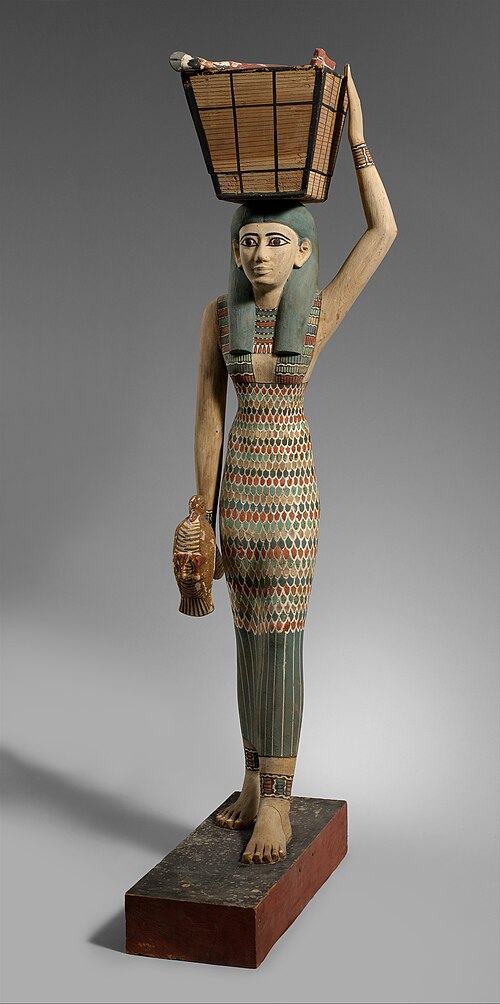 تمثال صغير لخادمة تحمل مؤنًا؛ 1981-1975 قبل الميلاد؛ خشب مطلي وجص؛ 112 × 17 سم؛ متحف متروبوليتان للفنون (مدينة نيويورك)
 نموذج لمركب شراعي؛ 1981-1975 قبل الميلاد؛ خشب مطلي، جص، خيوط كتان، وقماش كتان؛ الطول: 145 سم؛ متحف متروبوليتان للفنون
 تمثال إيزيس ؛ السلالة البطلمية ؛ خشب مطلي وجص ؛ الارتفاع: 40.5 سم؛ متحف رومر وبيليزايوس هيلدسهايم ( هيلدسهايم ، ألمانيا)
اللازورد
اللازورد حجر كريم شبه ثمين ذو لون أزرق داكن، حظي بتقدير كبير لدى المصريين القدماء لارتباطه الرمزي بالسماء. كان يُستورد عبر طرق التجارة البعيدة من جبال شمال شرق أفغانستان ، [ 111 ] وكان يُعتبر أرقى من جميع المواد الأخرى باستثناء الذهب والفضة. وكان الزجاج الملون أو الخزف يُستخدمان كبديل رخيص له. أول ذكر موثق للازورد يعود إلى عصر ما قبل الأسرات . وربما يعكس الانقطاع المؤقت في توريده خلال عهد الأسرتين الثانية والثالثة تغيرات سياسية في الشرق الأدنى القديم . بعد ذلك، استُخدم على نطاق واسع في صناعة المجوهرات والتماثيل الصغيرة والتمائم. [ 112 ]
 خاتم على شكل جعران؛ 1850-1750 قبل الميلاد؛ القطر: 2.5 سم، الجعران: 1.8 سم؛ متحف متروبوليتان للفنون (مدينة نيويورك)
 تمثال عبادة للإله بتاح ؛ 945-600 قبل الميلاد؛ ارتفاع التمثال: 5.2 سم، ارتفاع المنصة: 0.4 سم؛ متحف متروبوليتان للفنون
 تميمة فالكوم؛ 664-332 قبل الميلاد؛ الارتفاع: 2.2 سم؛ متحف متروبوليتان للفنون
 تميمة إله طفل (هاربوكراتس؟)؛ 664-30 قبل الميلاد؛ الارتفاع: 4.3 سم، العرض: 1.2 سم، العمق: 1.6 سم؛ متحف متروبوليتان للفنون
مواد أخرى
- اليشب هو نوع غير نقي من العقيق الأبيض ، يتميز بوجود عروق أو بقع حمراء أو خضراء أو صفراء. كان اليشب الأحمر، رمز الحياة والجوانب الإيجابية للكون، يُستخدم بشكل أساسي في صناعة التمائم. وكان مثاليًا لبعض التمائم، مثل تميمة التيت (المعروفة أيضًا باسم عقدة إيزيس )، كما هو مذكور في التعويذة رقم 156 من كتاب الموتى . أما اليشب الأخضر، الأقل استخدامًا، فكان يُستخدم بشكل خاص في صناعة الجعارين ، ولا سيما جعارين القلب.
- السربنتين هو المصطلح العام لسيليكات المغنيسيوم المائية. يأتي في الغالب من الصحراء الشرقية، ويتواجد بألوان عديدة، من الأخضر الفاتح إلى الأسود الداكن. استُخدم منذ أقدم العصور، وكان يُبحث عنه خصيصًا لصنع جعارين القلب.
- الحجر الصابوني (المعروف أيضًا باسم حجر الصابون) هو معدن من عائلة الكلوريت، ويتميز بسهولة تشكيله. عُثر على تمائم مصنوعة من الحجر الصابوني في مواقع تعود إلى ما قبل عصر الأسرات ، مع أنه في العصور اللاحقة كان يُغطى عادةً بطبقة رقيقة من الفخار ويُستخدم في صناعة العديد من الجعارين.
- الفيروز حجرٌ معتم، يتراوح لونه بين الأزرق السماوي والأزرق المخضر. وهو فوسفات ألومنيوم طبيعي، اكتسب لونه الأزرق من آثار النحاس . يرتبط الفيروز ارتباطًا وثيقًا بالإلهة حتحور ، وكان يُستخرج بشكل رئيسي من مناجم سيناء (في سرابيط الخادم ). كان المصريون القدماء مولعين بشكل خاص بدرجات اللون الأخضر، التي ترمز إلى الحيوية والتجدد. في العصر المتأخر ، أصبح الفيروز (مثل اللازورد) مرادفًا للفرح والبهجة.
 قلادة؛ حوالي عام 1069 قبل الميلاد؛ ذهب وفيروز؛ الأبعاد الكلية: 5.1 × 2.3 سم؛ متحف كليفلاند للفنون ( كليفلاند ، الولايات المتحدة الأمريكية)
 جعران قلب هاتنفر؛ 1492-1473 قبل الميلاد؛ سربنتين (الجعران) وذهب؛ 5.3 × 2.8 سم؛ سلسلة: 77.5 سم؛ متحف متروبوليتان للفنون
 رأس من ملعقة على شكل فتاة تسبح؛ ١٣٩٠-١٣٥٣ قبل الميلاد؛ حجر الترافرتين (الرأس) والستياتيت (الشعر)؛ ٢٫٨ × ٢٫٧ سم؛ متحف متروبوليتان للفنون
 تميمة؛ 1295-1070 قبل الميلاد؛ يشب أحمر؛ 2.3 × 1.2 سم؛ متحف متروبوليتان للفنون
منحوتة

The monumental sculpture of ancient Egypt's temples and tombs is well known,[113] but refined and delicate small works exist in much greater numbers. The Egyptians used the technique of sunk relief, which is best viewed in sunlight for the outlines and forms to be emphasized by shadows. The distinctive pose of standing statues facing forward with one foot in front of the other was helpful for the balance and strength of the piece. This singular pose was used early in the history of Egyptian art and well into the Ptolemaic period, although seated statues were common as well.
Egyptian pharaohs were always regarded as gods, but other deities are much less common in large statues, except when they represent the pharaoh as another deity; however, the other deities are frequently shown in paintings and reliefs. The famous row of four colossal statues outside the main temple at Abu Simbel each show Rameses II, a typical scheme, though here exceptionally large.[114] Most larger sculptures survived from Egyptian temples or tombs; massive statues were built to represent gods and pharaohs and their queens, usually for open areas in or outside temples. The very early colossal Great Sphinx of Giza was never repeated, but avenues lined with very large statues including sphinxes and other animals formed part of many temple complexes. The most sacred cult image of a god in a temple, usually held in the naos, was in the form of a relatively small boat or barque holding an image of the god, and apparently usually in precious metal – none of these are known to have survived.
By Dynasty IV (2680–2565 BC), the idea of the Ka statue was firmly established. These were put in tombs as a resting place for the ka portion of the soul, and so there is a good number of less conventionalized statues of well-off administrators and their wives, many in wood as Egypt is one of the few places in the world where the climate allows wood to survive over millennia, and many block statues. The so-called reserve heads, plain hairless heads, are especially naturalistic, though the extent to which there was real portraiture in ancient Egypt is still debated.
Early tombs also contained small models of the slaves, animals, buildings and objects such as boats (and later ushabti figures) necessary for the deceased to continue his lifestyle in the afterlife.[115] However, the great majority of wooden sculpture have been lost to decay, or probably used as fuel. Small figures of deities, or their animal personifications, are very common, and found in popular materials such as pottery. There were also large numbers of small carved objects, from figures of the gods to toys and carved utensils. Alabaster was used for expensive versions of these, though painted wood was the most common material, and was normal for the small models of animals, slaves and possessions placed in tombs to provide for the afterlife.
Very strict conventions were followed while crafting statues, and specific rules governed the appearance of every Egyptian god. For example, the sky god (Horus) was to be represented with a falcon's head, the god of funeral rites (Anubis) was to be shown with a jackal's head. Artistic works were ranked according to their compliance with these conventions, and the conventions were followed so strictly that, over three thousand years, the appearance of statues changed very little. These conventions were intended to convey the timeless and non-ageing quality of the figure's ka.
A common relief in ancient Egyptian sculpture was the difference between the representation of men and women. Women were often represented in an idealistic form, young and pretty, and rarely shown in an older maturity. Men were shown in either an idealistic manner or a more realistic depiction.[63] Sculptures of men often showed men that aged, since the regeneration of ageing was a positive thing for them whereas women are shown as perpetually young.[116]
- Both sides of the Narmer Palette; c. 3100 BC; greywacke; height: 63 cm; from Hierakonpolis (Egypt); Egyptian Museum (Cairo). This very old palette shows the canonical Egyptian profile view and proportions of the figure

 Portrait statue of Henka, administrator of the two pyramids of pharaoh Snofru; 2500–2350 BC; limestone; height: 40 cm; Egyptian Museum of Berlin (Germany)
 The Ka statue of Awibre Hor, which provided a physical place for the ka to manifest; c. 1700 BC; wood, rock crystal, quartz, plaster, traces of gold; height: 1.7 m; from Dahshur; Egyptian Museum (Cairo)
 Kneeling portrait statue of Amenemhat holding a stele with an inscription; circa 1500 BC; limestone; Egyptian Museum of Berlin
 Portrait head of pharaoh Hatshepsut or Thutmose III; 1480–1425 BC; most probably granite; height: 16.5 cm; Egyptian Museum of Berlin
 Portrait statuette of Taitai; 1380–1300 BC; greywacke; height: height: 27.5 cm; Egyptian Museum of Berlin
 The Anubis Shrine; 1336–1327 BC; painted wood and gold; 1.1 × 2.7 × 0.52 m; from the Valley of the Kings; Egyptian Museum (Cairo)
 Osiris on a lapis lazuli pillar in the middle, flanked by Horus on the left, and Isis on the right; 875–850 BC; gold and lapis lazuli; 9 cm; Louvre
 Four cats; 664–332 BC; wood; height: 14 cm, width: 27 cm; Louvre
 Statuette of Anubis; 332–30 BC; plastered and painted wood; 42.3 cm; Metropolitan Museum of Art (New York City)
Stele

A stele is an upright tablet of stone or wood, often with a curved top, painted and carved with text and pictures. Numerous examples were produced throughout Egyptian history for a variety of purposes, including funerary, votive and commemorative. Funerary stelae, attested from the early 1st Dynasty, typically bore the name and titles of the deceased. This basic form, which served to identify the tomb owner, evolved into a key component of the funerary equipment with a magical function. Hence, from the 2nd Dynasty onward, the owner was usually shown seated before an offering table piled with food and drink; in the Middle Kingdom, the offering formula was generally inscribed along the top of the stele. Both were designed to ensure a perpetual supply of offerings in the afterlife. Votive stelae, inscribed with prayers to deities, were dedicated by worshipers seeking a favorable outcome to a particular situation. In the Middle Kingdom, many hundreds were set up by pilgrims on the "terrace of the great god" at Abydos, so that they might participate in the annual procession of Osiris. One particular variety of votive stele common in the New Kingdom was the ear stele, inscribed with images of human ears to encourage the deity to listen to the prayer or request.
Commemorative stelae were produced to proclaim notable achievements (for example, the stela of Horwerra, recording a mining expedition to Serabit el-Khadim, and the Restoration Stela of Tutankhamun, celebrating the restoration of the traditional cults at the end of the Amarna period); to celebrate military victories (for instance, the Merneptah Stele); and to establish frontiers (for example the Semna stele of Senusret III and the boundary stelae around Amarna).[118]
 Kamose stela; circa 1550 BC; limestone; height: 2.3 m, width: 1.1 m, depth: 28.5 cm; from the Karnak Temple (Egypt); Luxor Museum (Luxor, Egypt)[119]
 Stela of Pepi, chief of the potters; 8th century BC; painted limestone; Hermitage (Sankt Petersburg, Russia)
 Stela of Nacht-Mahes-eru; 664–610 BC; polychromy on wood; 42 × 31.5 × 3.5 cm; National Museum in Warsaw (Poland)
Pyramidia
A pyramidion is a capstone at the top of a pyramid. Called benbenet in ancient Egyptian language, it associated the pyramid as a whole with the sacred Benben stone. Pyramidia may have been covered in gold leaf to reflect the rays of the sun; in the Middle Kingdom, they were often inscribed with royal titles and religious symbols.[120]

 Pyramidion from the pyramid of Nebamun; circa 1380 BC; painted limestone; height: 23 cm; Staatliche Sammlung für Ägyptische Kunst (Munich, Germany)
 Pyramidion from the tomb of the priest Rer in Abydos, Egypt. Hermitage Museum
 Pyramidion of Iufaa; 664–525 BC; painted limestone; height: 36 cm; Metropolitan Museum of Art (New York City)
Painting

Not all Egyptian reliefs were painted, and less-prestigious works in tombs, temples and palaces were merely painted on a flat surface. Stone surfaces were prepared by whitewash, or if rough, a layer of coarse mud plaster, with a smoother gesso layer above; some finer limestones could take paint directly. Pigments were mostly mineral, chosen to withstand strong sunlight without fading. The binding medium used in painting remains unclear: egg tempera and various gums and resins have been suggested. It is clear that true fresco, painted into a thin layer of wet plaster, was not used. Instead, the paint was applied to dried plaster, in what is called fresco a secco in Italian. After painting, a varnish or resin was usually applied as a protective coating, and many paintings with some exposure to the elements have survived remarkably well, although those on fully exposed walls rarely have.[121] Small objects including wooden statuettes were often painted using similar techniques.
Many ancient Egyptian paintings have survived in tombs, and sometimes temples, due to Egypt's extremely dry climate. The paintings were often made with the intent of making a pleasant afterlife for the deceased. The themes included journeys through the afterworld or protective deities introducing the deceased to the gods of the underworld (such as Osiris). Some tomb paintings show activities that the deceased were involved in when they were alive and wished to carry on doing for eternity.
From the New Kingdom period and afterwards, the Book of the Dead was buried with the entombed person. It was considered important for an introduction to the afterlife.[122]
Egyptian paintings are painted in such a way to show a side view and a front view of the animal or person at the same time. For example, the painting to the right shows the head from a profile view and the body from a frontal view. Their main colors were red, blue, green, gold, black and yellow.
Paintings showing scenes of hunting and fishing can have lively close-up landscape backgrounds of reeds and water, but in general Egyptian painting did not develop a sense of depth, and neither landscapes nor a sense of visual perspective are found, the figures rather varying in size with their importance rather than their location.
 Block from a relief depicting a battle; 1427–1400 BC; painted sandstone; height: 61.5 cm (24.2 in); Metropolitan Museum of Art (US)
 Fresco which depicts Nebamun hunting birds; 1350 BC; paint on plaster; 98 × 83 cm (2 ft 9 in) × 2 ft 8.7 in); British Museum (London)
 Fresco which depicts the pool in Nebamun's estate garden; c. 1350 BC; painted plaster; height: 64 cm; British Museum
 Frescos in the Tomb of Nefertari, in which appear Khepri sitting on a very colourful square-shaped throne
 Wall painting from Tutankhamun's tomb depicting Ay performing the Opening of the Mouth ceremony
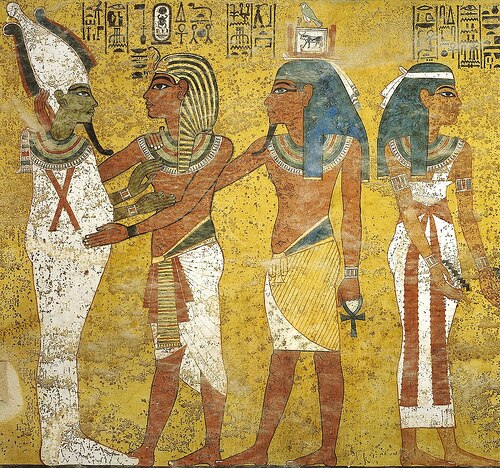 Scene from the tomb of Tutankhamun in which appears Osiris
 The Book of the Dead of Hunefer; c. 1275 BC; ink and pigments on papyrus; 45 × 90.5 cm; British Museum (London)
Architecture

Ancient Egyptian architects used sun-dried and kiln-baked bricks, fine sandstone, limestone and granite. Architects carefully planned all their work. The stones had to fit precisely together, since no mud or mortar was used. When creating the pyramids it is unknown how the workers or stones reached the top of them as no records were kept of their construction. When the top of the structure was completed, the artists decorated from the top down, removing ramp sand as they went down. Exterior walls of structures like the pyramids contained only a few small openings. Hieroglyphic and pictorial carvings in brilliant colors were abundantly used to decorate Egyptian structures, including many motifs, like the scarab, sacred beetle, the solar disk, and the vulture. They described the changes the Pharaoh would go through to become a god.[124]
As early as 2600 BC the architect Imhotep made use of stone columns whose surface was carved to reflect the organic form of bundled reeds, like papyrus, lotus and palm; in later Egyptian architecture faceted cylinders were also common. Their form is thought to derive from archaic reed-built shrines. Carved from stone, the columns were highly decorated with carved and painted hieroglyphs, texts, ritual imagery and natural motifs. One of the most important types are the papyriform columns. The origin of these columns goes back to the 5th Dynasty. They are composed of lotus (papyrus) stems which are drawn together into a bundle decorated with bands: the capital, instead of opening out into the shape of a bellflower, swells out and then narrows again like a flower in bud. The base, which tapers to take the shape of a half-sphere like the stem of the lotus, has a continuously recurring decoration of stipules. At the Luxor Temple, the columns are reminiscent of papyrus bundles, perhaps symbolic of the marsh from which the ancient Egyptians believed the creation of the world to have unfolded.
 Pair of obelisks of Nebsen; 2323–2100 BC; limestone; (the one from left) height: 52.7 cm, (the one from right) height: 51.1 cm; Metropolitan Museum of Art (New York City)
 Model of a house; 1750–1700 BC; pottery; 27 x 27 x 17 cm; Metropolitan Museum of Art
 Ceiling painting from the palace of Amenhotep III; circa 1390–1353 BC; dried mud, mud plaster and paint Gesso; 140 x 140 cm; Metropolitan Museum of Art
 Window grill from a palace of Ramesses III; 1184–1153 BC; painted sandstone; height: 103.5 cm, width: 102.9 cm, depth: 14.6 cm; Metropolitan Museum of Art
 Column with Hathor-emblem capital and names of Nectanebo I on the shaft; 380–362 BC; limestone; height: 102 cm, width: 34.3 cm; Metropolitan Museum of Art
 The Temple of Dendur; completed by 10 BC; aeolian sandstone; temple proper: height: 6.4 m, width: 6.4 m; length: 12.5 m; Metropolitan Museum of Art
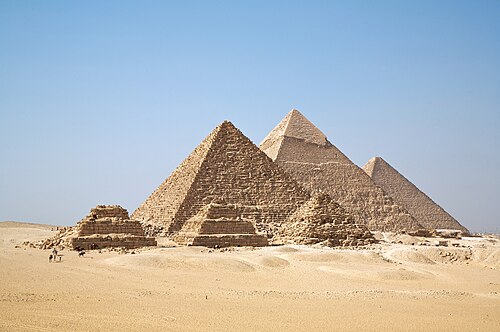 A view of the pyramids at Giza. From left to right, the three largest are: the Pyramid of Menkaure, the Pyramid of Khafre and the Great Pyramid of Khufu
 The well preserved Temple of Isis from Philae (Egypt) is an example of Egyptian architecture and architectural sculpture
- The Great Temple of Ramesses II from Abu Simbel, founded in circa 1264 BC, in the Aswan Governorate (Egypt)
 Relief from the Dendera Temple complex (Egypt)
 Illustrations of various types of capitals, drawn by the Egyptologist Karl Richard Lepsius
 Illustrations with two types of columns from the hall of the Ramses II Temple, drawn in 1849
Jewelry


The ancient Egyptians exhibited a love of ornament and personal decoration from earliest Predynastic times. Badarian burials often contained strings of beads made from glazed steatite, shell and ivory. Jewelry in gold, silver, copper and faience is also attested in the early Predynastic period; more varied materials were introduced in the centuries preceding the 1st Dynasty. By the Old Kingdom, the combination of carnelian, turquoise and lapis lazuli had been established for royal jewelry, and this was to become standard in the Middle Kingdom. Less sophisticated pieces might use bone, mother-of-pearl or cowrie shells.
The particular choice of materials depended upon practical, aesthetical and symbolic considerations. Some types of jewelry remained perennially popular, while others went in and out of fashion. In the first category were bead necklaces, bracelets, armlets and girdles. Bead aprons are first attested in the 1st Dynasty, while usekh broad collars became a standard type from the early Old Kingdom. In the Middle Kingdom, they had fallen from favor, to be replaced by finger-rings and ear ornaments (rings and plugs). New Kingdom jewelry is generally more elaborate and garish than that of earlier periods, and was influenced by styles from the Ancient Greece and the Levant. Many fine examples were found in the tomb of Tutankhamun. Jewelry, both royal and private, was replete with religious symbolism. It was also used to display the wealth and rank of the wearer. Royal jewels were always the most elaborate, as exemplified by the pieces found at Dahshur and Lahun, made for princesses of the 18th Dynasty, favored courtiers were rewarded with the "gold of honor" as a sign of royal favor.
The techniques of jewelry-making can be reconstructed from surviving artifacts and from tomb decoration. A jeweler's workshop is shown in the tomb of Mereruka; several New Kingdom tombs at Thebes contain similar scenes.[125]
 Broad collar of Wah; 1981–1975 BC; faience and linen thread; height: 34.5 cm, width: 39 cm; Metropolitan Museum of Art (New York City)
 Pectoral and necklace of Princess Sithathoriunet; 1887–1813 BC; gold, carnelian, lapis lazuli, turquoise, garnet & feldspar; height of the pectoral: 4.5 cm; Metropolitan Museum of Art
 Broad collar of Senebtisi; 1850–1775 BC; faience, gold, carnelian and turquoise; outside diameter: 25 cm, maxim width: 7.5 cm; Metropolitan Museum of Art
 Pectoral (chest jewellery) of Tutankhamun; 1336–1327 BC (Reign of Tutankhamun); gold, silver and meteoric glass; height: 14.9 cm; Egyptian Museum (Cairo)
 Pectoral of Horus with sundisk; circa 1325 BC; gold with gemstones; width: 12.6 cm; Egyptian Museum (Cairo)
 Illustration of jewelry from the tomb of princess Merit
Amulets
An amulet is a small charm worn to afford its owner magical protection, or to convey certain qualities (for example, a lion amulet might convey strength, or a set-square amulet might convey rectitude). Attested from the Badarian period onward, amulets were produced both for the living and the dead. Particular amulets were placed at specific places in the mummy wrappings. The heart scarab was a specialized form of amulet to protect the heart of the deceased in the afterlife. Amulets were made from a wide variety of materials, including faience, glass, and precious stones – with color often playing an important symbolic role – and in a wide variety of forms. They might depict sacred objects (such as the Djed pillar, Tyet girdle or Wedjad eye); animals (bull's head amulets were particularly common in the late Predynastic period); or hieroglyphs (for example, Ankh or Sa). From the New Kingdom onward, deities – especially household deities such as Bes and Taweret – were popular subjects for amulets.[126]

 Amulet that depicts Thoth as a baboon holding the Eye of Horus; 664–332 BC; Egyptian faience with light green glaze; height: 3.9 cm, width: 2.4 cm, depth: 2.5 cm; Walters Art Museum (Baltimore, US)
 Amulet which depicts a triad of Isis, Horus and Nephthys; 664–332 BC; faience; height: 4.5 cm, width: 3 cm, depth: 2.2 cm; Metropolitan Museum of Art (New York City)
Scarab-shaped amulets
The protective amulet for the heart was in the form of the scarab beetle, the manifestation of the creator and solar deity Khepri. It was a symbol of new life and resurrection. The scarab beetle was seen to push a ball of dung along the ground, and from this came the idea of the beetle rolling the sun across the sky. Subsequently, the young beetles were observed to hatch from their eggs inside the ball, hence the idea of creation: life springs forth from primordial mud.
The heart scarab was a large scarab amulet which was wrapped in the mummy bandaging over the deceased's heart. It was made from a range of green and dark-colored materials, including faience, glass, glazed steatite, schist, feldspar, hematite and obsidian.[127] Black was also associated with the afterlife, while blue and green were associated with the birth and the life-giving waters of the Nile.
 Heart scarab of the singer of Amun Iakai; 1550–1186 BC; glass; length: 4.8 cm, width: 3.5 cm, height: 1.5 cm; Metropolitan Museum of Art (New York City)
 The back of a heart scarab of the singer of Amun Iakai; 1550–1186 BC; glass; length: 4.8 cm, width: 3.5 cm, height: 1.5 cm; Metropolitan Museum of Art
 Commemorative scarab of Amenhotep III, recording a lion hunt; 1390–1352 BC; blue-glazed steatite; length: 8 cm; Metropolitan Museum of Art
 The back of a commemorative scarab of Amenhotep III, recording a lion hunt; 1390–1352 BC; blue glazed steatite; length: 8 cm; Metropolitan Museum of Art
Pottery
Different types of pottery items were deposited in tombs of the dead. Some such pottery items represented interior parts of the body, such as the lungs, the liver and smaller intestines, which were removed before embalming. A large number of smaller objects in enamel pottery were also deposited with the dead. It was customary for the tomb walls to be crafted with cones of pottery, about 15 to 25 cm (6 to 10 in) tall, on which were engraved or impressed legends relating to the dead occupants of the tombs. These cones usually contained the names of the deceased, their titles, offices which they held, and some expressions appropriate to funeral purposes.
 Blue-painted jar from Malqata; 1390–1353 BC; painted pottery; height: 69 cm; Metropolitan Museum of Art (New York City)
 Cup ornated with papyrus flowers; 653–640 BC; terracotta; Louvre
 Goblet ornated with uraeuses; 653–640 BC; terracotta; Louvre
Calligraphy
Egyptian writing remained a remarkably conservative system, and the preserve of a tiny literate minority, while the spoken language underwent considerable change. Egyptian stelas are decorated with finely carved hieroglyphs.
The use of hieroglyphic writing arose from proto-literate symbol systems in the Early Bronze Age, around the 32nd century BC (Naqada III), with the first decipherable sentence written in the Egyptian language dating to the Second Dynasty (28th century BC). Egyptian hieroglyphs developed into a mature writing system used for monumental inscription in the classical language of the Middle Kingdom period; during this period, the system made use of about 900 distinct signs. The use of this writing system continued through the New Kingdom and Late Period, and on into the Persian and Ptolemaic periods. Late use of hieroglyphics are found in the Roman period, extending into the 4th century AD.
 Relief with hieroglyphs from the Edfu Temple (Edfu, Egypt)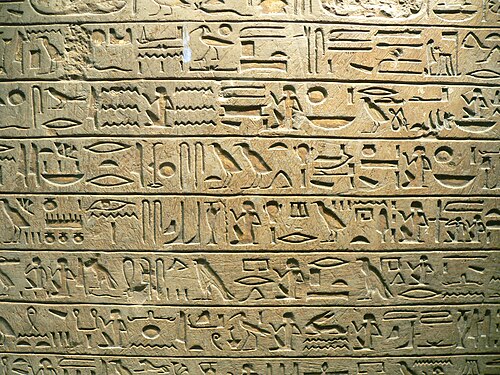
 Detail from the side of a sarcophagus, circa 530 BC, in the British Museum (London)
 Hieroglyphs from the tomb of Seti I
Furniture

Although, by modern standards, ancient Egyptian houses would have been very sparsely furnished, woodworking and cabinet-making were highly developed crafts. All the main types of furniture are attested, either as surviving examples or in tomb decoration. Chairs were only for the wealthy; most people would have used low stools. Beds consisted of a wooden frame, with matting or leather webbing to provide support; the most elaborate beds also had a canopy, hung with netting, to provide extra privacy and protection from insects. The feet of chairs, stools and beds were often modeled to resemble bull hooves or, in later periods, lion feet or duck heads. Wooden furniture was often coated with a layer of plaster and painted.
Royal furniture was more elaborate, making use of inlays, veneers and marquetry. Funerary objects from the tomb of Tutankhamun include tables, boxes and chests, a gilded throne, and ritual beds shaped like elongated hippos and cattle. The burial equipment of Hetepheres included a set of travelling furniture, light and easy to dismantle. Such furniture must have been used on military campaigns and other royal journeys.[128] Egyptian furniture has highly influenced the development of Greco-Roman furniture. It also was one of the principal sources of inspiration of a style known as Empire.[129] The main motifs used are: palm and lotus leaves, flowers, lion heads and claws, bull hooves, bird heads, and geometric combinations. Everything is sober and with a monumental character.[130]
 Furniture leg in shape of bull's leg; 2960–2770 BC; hippopotamus ivory; height: 17 cm, width: 3.4 cm, depth: 5.8 cm; Metropolitan Museum of Art (New York City)
 Stool with woven seat; 1991–1450 BC; wood & reed; height: 13 cm; Metropolitan Museum of Art
 Inlaid box for cosmetic vessels of Sithathoryunet; 1887–1813 BC; ebony, inlaid with ivory and red wood (restored) and gold trim; height: 25.2 cm, length: 36.4 cm, depth: 25.2 cm; Metropolitan Museum of Art
 Headrest; 1539–1190 BC; wood; 17.8 x 28.6 x 7.6 cm; Brooklyn Museum (New York City)
 Chair of Hatnefer; 1492–1473 BC; boxwood, cypress, ebony & linen cord; height: 53 cm; Metropolitan Museum of Art
 The Throne of Tutankhamun; 1336–1327 BC; wood covered with sheets of gold, silver, semi-precious and other stones, faience, glass and bronze; height: 1 m; Egyptian Museum (Cairo)
 Armchair of Tutankhamun; 1336–1326 BC; wood, ebony, ivory and gold leaf; height: 71 cm; Exposition of Tutankhamun Treasure in Paris (2019)
Clothing
Artistic representations, supplemented by surviving garments, are the main sources of evidence for ancient Egyptian fashion. The two sources are not always in agreement, however, and it seems that representations were more concerned with highlighting certain attributes of the person depicted than with accurately recordings their true appearance. For example, women were often shown with restrictive, tight-fitting dresses, perhaps to emphasize their figures.
As in most societies, fashions in Egypt changed over time; different clothes were worn in different seasons of the year, and by different sections of society. Particular office-holders, especially priests and the king, had their own special garments.
For the general population, clothing was simple, predominantly of linen, and probably white or off-white in color. It would have shown the dirt easily, and professional launderers are known to have been attached to the New Kingdom workmen's village at Deir el-Medina. Men would have worn a simple loin-cloth or short kilt (known as shendyt), supplemented in winter by a heavier tunic. High-status individuals could express their status through their clothing, and were more susceptible to changes in fashion.
Longer, more voluminous clothing made an appearance in the Middle Kingdom; flowing, elaborately pleated, diaphanous robes for men and women were particularly popular in the late 18th Dynasty and the Ramesside period. Decorated textiles also became more common in the New Kingdom. In all periods, women's dresses may have been enhanced by colorful bead netting worn over the top. In the Roman Period, Egypt became known for the manufacture of fine clothing. Coiled sewn sandals or sandals of leather are the most commonly attested types of footwear. Examples of these, together with linen shirts and other clothing, were discovered in the tomb of Tutankhamun.[131]

 Illustration from the book Ancient Egyptian, Assyrian, and Persian costumes and decorations
 Illustration of a goddess from Ancient Egyptian, Assyrian, and Persian costumes and decorations
 Statue of Tjahapimu wearing a shendyt, Metropolitan Museum of Art
Cosmetics
Use of makeup, especially around the eyes, was a characteristic feature of ancient Egyptian culture from Predynastic times. Black kohl (eye-paint) was applied to protect the eyes, as well as for aesthetic reasons. It was usually made of galena, giving a silvery-black color; during the Old Kingdom, green eye-paint was also used, made from malachite. Egyptian women painted their lips and cheeks, using rouge made from red ochre. Henna was applied as a dye for hair, fingernails and toenails, and perhaps also nipples. Creams and unguents to condition the skin were popular, and were made from various plant extracts.[132]
 Cosmetic Box of the Royal Butler Kemeni; 1814–1805 BC; cedar with ebony, ivory veneer and silver mounting; height: 20.3 cm (8.0 in); Metropolitan Museum of Art (New York City)
 Cosmetic dish in the shape of a tilapia fish; 1479–1425 BC; glazed steatite; 8.6 cm × 18.1 cm (3.4 in × 7.1 in); Metropolitan Museum of Art
 Cosmetic box in the shape of an Egyptian composite capital, its cap being in the left side; 664–300 BC; glassy faience; 8.5 cm × 9 cm (3.3 in × 3.5 in); Metropolitan Museum of Art
 Perfume vase in shape of an amphoriskos; 664–630 BC; glass: 8 cm × 4 cm (3.1 in × 1.6 in); Metropolitan Museum of Art
 An 18th Dynasty ancient Egyptian kohl container inscribed for Queen Tiye (1410–1372 BC)
Music
On secular and religious occasions, music played an important part in celebrations. Musicians, playing instruments such as the castanets and flute, are depicted on objects from the Predynastic Period. A wide range of percussions, wind and string instruments were known to the ancient Egyptian. They include rattles, clappers, drums, tambourines and the sistrum; pipes, flutes and trumpets; and harps (particularly popular at feasts). The lyre and lute were introduced from the Levant. Musical notation is not attested until the early Ptolemaic Period. Groups of musicians, either mixed gender or female only, are known from the Old Kingdom. Women singers and sistrum-players had an important role in temple cults, especially those of Hathor and Isis. Tomb decoration from all periods indicates that, as today, groups of workers sang to generate a sense of solidarity and to maintain their enthusiasm.[133]
 A blind harpist from a mural of the 15th century BC
 Arched Harp (shoulder harp); 1390–1295 BC; wood; length of sound box: 36 cm; Metropolitan Museum of Art (New York City)
 Head of Hathor from a clapper; 1295–664 BC; possibly boxwood; 12 × 6.2 cm; Metropolitan Museum of Art
 Detail of a frieze from TT52 in which are depicted three musicians
 Illustration of a harper playing in front of god Shu
Sistrum
A sistrum (plural: sistra) is a rattle used in religious ceremonies, especially temple rituals, and usually played by women. Called a "seshsehet" in Egyptian, the name imitates the swishing sound the small metal disks made when the instrument was shaken. It was closely associated with Hathor in her role as "lady of music", and the handle was often decorated with a Hathor head. Two kinds of sistrum are attested, naos-shaped and hoop-shaped; the latter became the more common.[134]
 Sistrum decorated with a Hathor face; 664–332 BC; faience; length: 15.5 cm, width: 6.4 cm; Metropolitan Museum of Art (New York City)
 Sistrum inscribed with the name of Ptolemy I; 305–282 BC; faience; 26.7 × 7.5 cm; Metropolitan Museum of Art
 Sistrum with the face of the goddess Hathor depicted with cow ears; 380–250 BC; bronze; 36.3 cm; Walters Art Museum (Baltimore, US)
 1st–2nd century AD; bronze or copper alloy; 20.6 × 14 cm; Metropolitan Museum of Art
Funerary art
Coffins

The earliest purpose-built funerary containers for bodies were simple rectangular wooden boxes, attested in the 1st Dynasty. A coffin swiftly became an essential part of the burial equipment. Known euphemistically as the "lord of life", its primary function was to provide a home for the Ka and to protect the physical body from harm. In the 4th Dynasty, the development of longer coffins allowed the body to be buried fully extended (rather than curled up on its side in a foetal position). At the end of the Old Kingdom, it became customary once more for the body to be laid on its side. The side of the coffin that faced east in the tomb was decorated with a pair of eyes so that the deceased could look out towards the rising sun with its promise of daily rebirth. Coffins also began to be decorated on the outside with bands of funerary texts, while pictures of food and drink offerings were painted on the inside to provide a magical substitute for the real provisions placed in the tomb.
In the First Intermediate Period, decorated coffins became a substitute for tomb decoration; in the Middle Kingdom, coffin texts made their first appearance, sometimes accompanied by detailed maps of the underworld. Middle Kingdom coffins show a number of distinct regional styles, echoing the cultural fragmentation of the preceding period. In the 17th and early 18th Dynasties, the Theban area produced characteristic anthropoid rishi (feathered) coffins. These were replaced (except for kings) by other styles of anthropoid coffins which became the standard form throughout the country for the remainder of Egyptian history. The predominance of decorated tombs in the New Kingdom removed the need of object friezes, so coffins were generally undecorated on the inside. However, this situation was reversed again in the Third Intermediate Period when new types of coffin decoration focused on the Osiris myth and extracts from the Book of the Dead, to aid the resurrection of the deceased. In the Ptolemaic and Roman periods, a cartonnage mask was often fixed directly onto the mummy wrappings as a substitute for a coffin.
Coffins were generally made of wood; those of high-status individuals used fine quality, imported cedar. From the Middle Kingdom onward, wealthy individuals were often provided with a set of two or three nested coffins. The most sumptuous coffins might be inlaid with glass or precious stones, while royal coffins were often made from gold or silver.[135]
 Coffin of the estate manager Khnumhotep; 1981–1802 BC; painted wood (ficus sycomorus); height: 81.3 cm (32.0 in); Metropolitan Museum of Art (New York City)
 Coffin of Nesykhonsu; c. 976 BC; gessoed and painted sycamore fig; overall: 70 cm; Cleveland Museum of Art (Cleveland, Ohio, US)
 Inner coffin of Amenemopet; 975–909 BC; painted wood & gesso; length: 195 cm (77 in); Metropolitan Museum of Art
 Coffin of Irtirutja; 332–250 BC; plastered, painted and gilded wood; length: 198.8 cm (78.3 in); Metropolitan Museum of Art
Canopic jars
Canopic jars are vessels which were used for storing the internal organs removed during mummification. These were named after the human-headed jars that were worshiped as personifications of Kanops (the helmsman of Menelaus in Greek mythology) by the inhabitants of ancient Canopus. The practice of evisceration is first attested in the burial of Hetepheres in the early 4th Dynasty. Her organs were stored in a travertinecanopic chest divided into four compartments. Later, each organ – the liver, lungs, stomach and intestines – was provided with a separate jar, of stone or pottery, and placed under the symbolic protection of one of the Four sons of Horus. During the First Intermediate Period, the stoppers of canopic jars began to be modeled in the form of human heads. From the late 18th Dynasty, they were more commonly modelled to resemble the heads of the protecting genii (baboon, jackal, falcon and human). This became the standard for canopic equipment in the 19th Dynasty. In the Third Intermediate Period, the mummified organs were generally returned to the body, but wealthy burials could still include a dummy set of jars. The last known royal set of canopic jars were made of Apries. The manufacture of canopic equipment continued into the Ptolemaic Period but ceased by Roman times.[136]

 Canopic jars of Tutankhamun; 1333–1323 BC; alabaster; total height: 85.5 cm; Egyptian Museum (Cairo)
 Complete set of canopic jars decorated with hieroglyphics; 744–656 BC; painted sycomore fig wood; various heights; British Museum (London)
Masks
Funerary masks have been used at all periods. Examples range from the gold masks of Tutankhamun and Psusennes I to the Roman "mummy portraits" from Hawara and the Fayum. Whether in a funerary or religious context, the purpose of a mask was the same: to transform the wearer from a mortal to a divine state.[137]
 Mask of Sitdjehuti; c. 1500 BC; linen, plaster, gold and paint; height: 61 cm (24 in); British Museum (London)
 Mask of Tjuyu; c. 1387–1350 BC; gold, past of glass, alabaster and other materials; height: 40 cm; Egyptian Museum (Cairo)
- The Mask of Tutankhamun; c. 1327 BC; gold, glass and semi-precious stones; height: 54 cm (21 in); Egyptian Museum
 Mummy portrait of a young woman; 100–150 AD; cedar wood, encaustic painting and gold; height: 42 cm, width: 24 cm; Louvre
Ushabti
Ushabtis (a.k.a. shawabti or shabti) are funerary figurines. Their purpose was to act as a substitute for the deceased when he was called upon to perform agricultural work or corvée labor in the afterlife. Ushabtis evolved in the Middle Kingdom from the servant statues included among grave goods. The earliest examples were crude statuettes in wax, clay or wood; later, they were fashioned as mummiform figures and, from the end of the 12th Dynasty, they were customarily inscribed with the "ushabti text" (chapter 6 of the Book of the dead which specifies the ushabti's duties).[138]
 Shabti of Paser, the vizier of Seti I and Ramesses II; 1294–1213 BC; faience; height: 15 cm, width: 4.9 cm; Metropolitan Museum of Art (New York City)
 Four ushabtis of Khabekhnet and their box; 1279–1213 BC; painted limestone; height of the ushabtis: 16.7 cm; Metropolitan Museum of Art
 Ushabti; 360–343 BC; ceramic and enamel; 26.7 × 7.1 cm; from Saqqara; Museum of Art and History (Geneva, Switzerland)
Art of Meroë
Ancient Egypt shared a long and complex history with the Nile Valley to the south, the region called Nubia (modern Sudan). Beginning with the Kerma culture and continuing with the Kingdom of Kush based at Napata and then Meroë, Nubian culture absorbed Egyptian influences at various times, for both political and religious reasons. The result is a rich and complex visual culture.
The artistic production of Meroë reflects a range of influences. First, it was an indigenous African culture with roots stretching back thousands of years. To this is added the fact that the wealth of Meroë was based on trade with Egypt when it was ruled by the Ptolemaic dynasty (332–330 BC) and the Romans (30 BC – 395 AD), so Hellenistic and Roman objects and ideas were imported, as well as Egyptian influences.
 Votive plaque of king Tanyidamani; c. 100 BC; siltstone; 18.5 × 9.5 cm; Walters Art Museum (Baltimore, US)

 Beaker; 300 BC – 350 BAD; terracotta; height: 10.5 cm; Egyptian Museum of Berlin
Egyptian Revival art
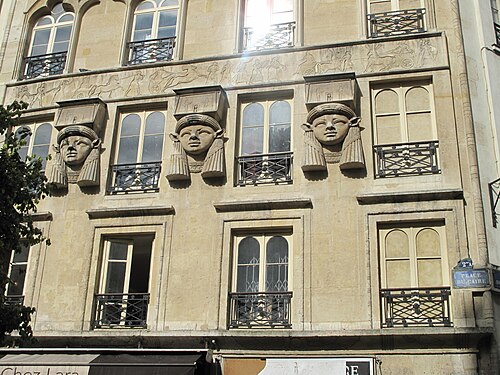
Egyptian Revival art is a style in Western art, mainly of the early nineteenth century, in which Egyptian motifs were applied to a wide variety of decorative arts objects. It was underground in American decorative arts throughout the nineteenth century, continuing into the 1920s. The major motifs of Egyptian art, such as obelisks, hieroglyphs, the sphinx, and pyramids, were used in various artistic media, including architecture, furniture, ceramics, and silver. Egyptian motifs provided an exotic alternative to the more traditional styles of the day. Over the course of the nineteenth century, American tastes evolved from a highly ornamented aesthetic to a simpler, sparer sense of decoration; the vocabulary of ancient Egyptian art would be interpreted and adapted in different ways depending on the standards and motivations of the time.[139] This legacy endures in contemporary Egyptian art, as seen in the work of Rasha Amin, whose Cairo upbringing shapes her multidisciplinary pieces, reflecting the influence of Egypt’s rich cultural heritage.[140]
Enthusiasm for the artistic style of Ancient Egypt is generally attributed to the excitement over Napoleon's conquest of Egypt and, in Britain, to Admiral Nelson's defeat of Napoleon at the Battle of the Nile in 1798. Napoleon took a scientific expedition with him to Egypt. Publication of the expedition's work, the Description de l'Égypte, began in 1809 and came out in a series though 1826, inspiring everything from sofas with sphinxes for legs, to tea sets painted with the pyramids. It was the popularity of the style that was new, Egyptianizing works of art had appeared in scattered European settings from the time of the Renaissance.
 The Egyptian Revival portico of the Hôtel Beauharnais from Paris
 Coin cabinet; by François-Honoré-Georges Jacob-Desmalter; 1809–1819; mahogany with silver; 90.2 x 50.2 x 37.5 cm; Metropolitan Museum of Art (New York City)
 1862 lithograph of the Aegyptischer Hof (English: Egyptian court), from the Neues Museum (Berlin)
 Center table; 1870–1875; rosewood, walnut and marble; 79.4 x 119.4 x 78.7 cm; Metropolitan Museum of Art
 Side chair and armchair; 1870–1875; rosewood and prickly juniper veneer; various dimensions; Metropolitan Museum of Art
 Pitcher; circa 1872; silver; overall: 28.6 x 15.6 x 21.9 cm; Metropolitan Museum of Art
 Design for a costume of Princess Amnéris; by Henri de Montaut; 1879; pencil and watercolor paint; unknown dimensions; in a temporary exhibition called "L'aventure Champollion" at the Site François-Mitterrand, part of the Bibliothèque nationale de France, Paris
 Clock; by Tiffany & Co.; circa 1885; marble & bronze; 46 x 51.1 x 19.7 cm; Metropolitan Museum of Art
 The Supreme Constitutional Court of Egypt.
See also
Notes
- ↑It is disputed whether Cleopatra was deliberately depicted as a male or whether a stele made under her father with his portrait was later inscribed with an inscription for Cleopatra. On this and other uncertainties regarding this stele, see Pfeiffer (2015, pp. 177–181).
References
- ↑Morris, Amy (2022). "Ancient Egyptian Art – Survey of Western Art History I". University of Nebraska Pressbooks. Archived from the original on 11 January 2026. Retrieved 11 January 2026.
- ↑Redford 1992, p. 6.
- ↑Brace, C. Loring; Seguchi, Noriko; Quintyn, Conrad B.; Fox, Sherry C.; Nelson, A. Russell; Manolis, Sotiris K.; Qifeng, Pan (2006). "The questionable contribution of the Neolithic and the Bronze Age to European craniofacial form". Proceedings of the National Academy of Sciences of the United States of America. 103 (1): 242–247. Bibcode:2006PNAS..103..242B. doi:10.1073/pnas.0509801102. PMC 1325007. PMID 16371462.
- ↑Genetic data:
- Chicki, L; Nichols, RA; Barbujani, G; Beaumont, MA (2002). "Y genetic data support the Neolithic demic diffusion model". Proc. Natl. Acad. Sci. USA. 99 (17): 11008–11013. Bibcode:2002PNAS...9911008C. doi:10.1073/pnas.162158799. PMC 123201. PMID 12167671.
- "Estimating the Impact of Prehistoric Admixture on the Genome of Europeans, Dupanloup et al., 2004". Mbe.oxfordjournals.org. Retrieved 1 May 2012.
- Semino, O; Magri, C; Benuzzi, G; et al. (May 2004). "Origin, Diffusion, and Differentiation of Y-Chromosome Haplogroups E and J: Inferences on the Neolithization of Europe and Later Migratory Events in the Mediterranean Area, 2004". Am. J. Hum. Genet. 74 (5): 1023–1034. doi:10.1086/386295. PMC 1181965. PMID 15069642.
- Cavalli-Sforza (1997). "Paleolithic and Neolithic lineages in the European mitochondrial gene pool". Am J Hum Genet. 61 (1): 247–54. doi:10.1016/S0002-9297(07)64303-1. PMC 1715849. PMID 9246011. Retrieved 1 May 2012.
- Chikhi (21 July 1998). "Clines of nuclear DNA markers suggest a largely Neolithic ancestry of the European gene". PNAS. 95 (15): 9053–9058. Bibcode:1998PNAS...95.9053C. doi:10.1073/pnas.95.15.9053. PMC 21201. PMID 9671803.
- ↑Archaeological data:
- Bar Yosef, Ofer (1998). "The Natufian Culture in the Levant, Threshold to the Origins of Agriculture". Evolutionary Anthropology. 6 (5): 159–177. doi:10.1002/(sici)1520-6505(1998)6:5<159::aid-evan4>3.0.co;2-7. S2CID 35814375.
- Zvelebil, M. (1986). Hunters in Transition: Mesolithic Societies and the Transition to Farming. Cambridge, UK: Cambridge University Press. pp. 5–15, 167–188.
- Bellwood, P. (2005). First Farmers: The Origins of Agricultural Societies. Malden, MA: Blackwell.
- Dokládal, M.; Brožek, J. (1961). "Physical Anthropology in Czechoslovakia: Recent Developments". Current Anthropology. 2 (5): 455–477. doi:10.1086/200228. S2CID 161324951.
- Zvelebil, M. (1989). "On the transition to farming in Europe, or what was spreading with the Neolithic: a reply to Ammerman". Antiquity. 63 (239): 379–383. doi:10.1017/S0003598X00076110. S2CID 162882505.
- ↑Diamond, Jared (1999). Guns, Germs, and Steel. New York: Norton Press. ISBN 0-393-31755-2.
- ↑Carvajal, Guillermo (2024-06-25). "The Enigmatic Merimde Culture, the Origin of Egyptian Civilization". La Brújula Verde. Retrieved 2026-07-09.
- ↑Eiwanger, Josef (1999). "Merimde Beni-salame". In Bard, Kathryn A. (ed.). Encyclopedia of the Archaeology of Ancient Egypt. London/New York. pp. 501–505.
{{cite book}}: CS1 maint: location missing publisher (link) - ↑"picture of the Merimde head" (in German). Auswaertiges-amt.de. Archived from the original on 2 March 2012. Retrieved 1 May 2012.
- 12345Shaw, Ian, ed. (2000). The Oxford History of Ancient Egypt. Oxford University Press. p. 479. ISBN 0-19-815034-2.
- 12Gardiner, Alan, Egypt of the Pharaohs (Oxford: University Press, 1964), p. 389.
- ↑"Vase". Royal Museums of Art and History, Brussels.
- ↑Campagno, Marcelo (2005). "On the Post-Firing Incised Potmarks with Human Figures from Naqada". Journal of Serbian Archaeology Society. 21 (125–132): 127, fig.8.
- 123Gardiner, Alan, Egypt of the Pharaohs (Oxford: University Press, 1964), p. 390.
- 12"Site officiel du musée du Louvre". cartelfr.louvre.fr.
- ↑Cooper, Jerrol S. (1996). The Study of the Ancient Near East in the Twenty-first Century: The William Foxwell Albright Centennial Conference. Eisenbrauns. pp. 10–14. ISBN 9780931464966.
- 123Redford 1992, p. 16.
- ↑Shaw, Ian. & Nicholson, Paul, The Dictionary of Ancient Egypt, (London: British Museum Press, 1995), p. 109.
- ↑Redford 1992, p. 18.
- ↑Redford 1992, p. 17.
- 123Redford 1992, p. 22.
- ↑Redford 1992, p. 20.
- ↑"tell el-farkha". Egypt Museum.
- ↑Ciałowicz, Krzysztof M. (2012). "Votive figurines from Tell el-Farkha and their counterparts". Archéo-Nil. 22 (1): 88–90. doi:10.3406/arnil.2012.1044.
- ↑The Wisdom of Thoth: Magical Texts in Ancient Mediterranean Civilisations. Archaeopress Publishing Ltd. 2016. p. 27. ISBN 978-1784912475.
Golden figures depicting most probably a Pre-dynastic ruler and his son and heir, which are the oldest known in Egypt.
- ↑"Naqada III". Faiyum.com. Retrieved 1 May 2012.
- ↑Baqué-Manzano, Lucas (2002). "Further arguments on the Coptos colossi". Bulletin de l'Institut français d'archéologie orientale (102): 17–61.
- ↑"Exhibit notice". Ashmolean Museum. 6 September 2025.
- ↑Kinnaer, Jacques. "Early Dynastic Period"(PDF). The Ancient Egypt Site. Retrieved 4 April 2012.
- ↑Campbell, Price (2018). Ancient Egypt - Pocket Museum. Thames & Hudson. p. 31. ISBN 978-0-500-51984-4.
- ↑Trope, Betsy Teasley; Quirke, Stephen; Lacovara, Peter; Museum, Michael C. Carlos; Archaeology, Petrie Museum of Egyptian (2005). Excavating Egypt: Great Discoveries from the Petrie Museum of Egyptian Archaeology, University College, London. Michael C. Carlos Museum, Emory University. p. 18. ISBN 978-1-928917-06-9.
- ↑Stevenson, Alice (2015). "A face in the crowd: chance encounters with Egyptian sculpture". Petrie Museum of Egyptian Archaeology. UCL Press: 44–45.
- ↑Charron, Alain (1990). "L'époque thinite" in L'Egypte des millénaires obscurs (in French). Hatier. p. 97.
- ↑"Jacket illustration: Head of an unknown Egyptian king, probably Second Dynasty." Wilkinson, Toby. Early Dynastic Egypt. p. Back cover.
- ↑"Stèle de Néfertiabet". Louvre Museum. 2025.
- ↑Mark, Joshua J. (26 September 2016). "Old Kingdom of Egypt". World History Encyclopedia. Retrieved 2017-12-04.
- ↑"Statue of Menkaure with Hathor and Cynopolis". The Global Egyptian Museum.
- ↑David, Rosalie (2002). Religion and Magic in Ancient Egypt. Penguin Books. p. 156
- ↑Robins 2008, p. 90.
- ↑Robins 2008, p. 109.
- ↑"Guardian Figure". www.metmuseum.org. Metropolitan Museum of Art. Retrieved 9 February 2022.
- ↑Bard 2015, p. 188.
- ↑Van de Mieroop 2010, p. 131.
- ↑Kamrin, Janice (2009). "The Aamu of Shu in the Tomb of Khnumhotep II at Beni Hassan". Journal of Ancient Egyptian Interconnections. 1 (3): 22–36. S2CID 199601200.
- ↑Curry, Andrew (2018). "The Rulers of Foreign Lands – Archaeology Magazine". www.archaeology.org.
- 123el-Shahawy 2005, p. 160.
- ↑Bietak 1999, p. 379.
- ↑Müller 2018, p. 212.
- ↑Bard 2015, p. 213.
- ↑Van de Mieroop 2021, pp. 151–153.
- ↑Redford 1992, p. 122.
- ↑Candelora 2018, p. 54.
- ↑Sayce, A. H. (1895). The Egypt of the Hebrews and Herodotos. Books on Demand. p. 17. ISBN 978-3-7347-3964-4.
{{cite book}}: ISBN / Date incompatibility (help) - ↑Candelora, Danielle. "The Hyksos". www.arce.org. American Research Center in Egypt.
- ↑Roy 2011, pp. 291–292.
- ↑"The Rulers of Foreign Lands". Archaeology Magazine.
A head from a statue of an official dating to the 12th or 13th Dynasty (1802–1640 B.C.) sports the mushroom-shaped hairstyle commonly worn by non-Egyptian immigrants from western Asia such as the Hyksos.
- ↑Potts, Daniel T. (2012). A Companion to the Archaeology of the Ancient Near East. John Wiley & Sons. p. 841. ISBN 978-1-4443-6077-6.
- ↑Weigall, Arthur E. P. Brome (2016). A History of the Pharaohs. Cambridge University Press. p. 188. ISBN 978-1-108-08291-4.
- ↑"Statue". The British Museum.
- ↑O'Connor 2009, pp. 116–117.
- ↑Wilkinson, Toby (2013). Lives of the Ancient Egyptians. Thames and Hudson Limited. p. 96. ISBN 978-0-500-77162-4.
- ↑Daressy 1906, pp. 115–120.
- 12Shaw, Ian, ed. (2000). The Oxford History of Ancient Egypt. Oxford University Press. p. 481. ISBN 978-0-19-815034-3.
- 12345Robin, Gay (2008). The Art of Ancient Egypt. Cambridge, MA: Harvard University Press. pp. 127–193.
- 123Aldred, Cyril (1951). New Kingdom Art in Ancient Egypt during the Eighteenth Dynast. London: Alec Tiranti.
- ↑Hawass, Zahi A.; Vannini, Sandro (2009). The lost tombs of Thebes: life in paradise. Thames & Hudson. p. 120. ISBN 9780500051597.
The foreigners of the fourth register, with long hairstyles and calf-length fringed robes, are labeled Chiefs of Retjenu, the ancient name tor the Syrian region. Like the Nubians, they come with animals, in this case horses, an elephant, and a bear; they also offer weapons and vessels most likely filled with precious substance.
- ↑Zakrzewski, Sonia; Shortland, Andrew; Rowland, Joanne (2015). Science in the Study of Ancient Egypt. Routledge. p. 268. ISBN 978-1-317-39195-1.
- ↑Hornung, Erik (2001). Akhenaten and the Religion of Light. Cornell University Press. pp. 19–30. ISBN 0801436583.
- 12Fazzini, Richard (October 1973). "ART from the Age of Akhenaten". Archaeological Institute of America. 26 (4): 298–302.
- ↑Williamson, Jacqueline (2015). "Alone before the God". Journal of the American Research Center in Egypt. 51: 179–192. doi:10.5913/jarce.51.2015.a008 (inactive 11 July 2025).
{{cite journal}}: CS1 maint: DOI inactive as of July 2025 (link) - ↑Brand, Peter (September 25, 2010). "Reuse and Restoration". UCLA Encyclopedia of Egyptology. 1 (1) – via Escholarship.
- ↑Aldred, Cyril (1951). New Kingdom Art in Ancient Egypt. New Kingdom: Alec Tiranti.
- ↑Egyptian Art in the Age of the Pyramids. Metropolitan Museum of Art. 1999. p. 20. ISBN 978-0-87099-907-9.
- 123Leahy, Anthony (1992). "Royal Iconography and Dynastic Change, 750–525 BC: The Blue and Cap Crowns". The Journal of Egyptian Archaeology. 78: 239–240. doi:10.2307/3822074. ISSN 0307-5133. JSTOR 3822074.
- ↑Leahy, Anthony (1992). "Royal Iconography and Dynastic Change, 750–525 BC: The Blue and Cap Crowns". The Journal of Egyptian Archaeology. 78: 238–329. doi:10.2307/3822074. ISSN 0307-5133. JSTOR 3822074.
- ↑Robins 2008, p. 216.
- 123"Taharqa et Hémen". Louvre Collections. 690.
- ↑Razmjou, Shahrokh (1954). Ars orientalis; the arts of Islam and the East. Freer Gallery of Art. pp. 81–101.
- ↑Manley, Bill (2017). Egyptian Art. Thames & Hudson. p. 280. ISBN 978-0-500-20428-3.
- 12345Gay., Robins (1997). The art of ancient Egypt. Cambridge, Mass.: Harvard University Press. ISBN 0674046609.
- ↑"The long skirt shown wrapped around this statue’s body and tucked in at the upper edge of the garment is typically Persian. The necklace, called a torque, is decorated with images of ibexes, symbols in ancient Persia of agility and sexual prowess. The depiction of this official in Persian dress may have been a demonstration of loyalty to the new rulers." "Egyptian Man in a Persian Costume". www.brooklynmuseum.org. Brooklyn Museum.
- ↑Smith 1991, pp. 206, 208–209.
- 12Smith 1991, p. 210.
- ↑Smith 1991, p. 205.
- ↑Smith 1991, p. 206.
- ↑Smith 1991, p. 207.
- ↑Smith 1991, p. 209.
- ↑Smith 1991, p. 208.
- ↑Smith 1991, pp. 208–209, 210.
- ↑Tiradritti 2005, pp. 21, 212.
- ↑Stadter, Philip A.; Van der Stockt, L. (2002). Sage and Emperor: Plutarch, Greek Intellectuals, and Roman Power in the Time of Trajan (98–117 A.D.). Leuven University Press. p. 75. ISBN 978-90-5867-239-1.
Trajan was, in fact, quite active in Egypt. Separate scenes of Domitian and Trajan making offerings to the gods appear on reliefs on the propylon of the Temple of Hathor at Dendera. There are cartouches of Domitian and Trajan on the column shafts of the Temple of Knum at Esna, and on the exterior a frieze text mentions Domitian, Trajan, and Hadrian
- ↑Berman, Lawrence, Freed, Rita E., and Doxey, Denise. Arts of Ancient Egypt. p. 193. Museum of Fine Arts Boston. 2003. ISBN 0-87846-661-4
- ↑Campbell, Price (2018). Ancient Egypt - Pocket Museum. Thames & Hudson. p. 266. ISBN 978-0-500-51984-4.
- ↑Smith & Simpson 1998, p. 33.
- ↑Smith & Simpson 1998, pp. 12–13 and note 17.
- ↑Smith & Simpson 1998, pp. 21–24.
- ↑Smith & Simpson 1998, pp. 170–178, 192–194.
- ↑Smith & Simpson 1998, pp. 102–103, 133–134.
- ↑The Art of Ancient Egypt. A resource for educators(PDF). New York: The Metropolitan Museum of Art. p. 44. Archived from the original(PDF) on June 7, 2013. Retrieved July 7, 2013.
- ↑Constantin Daniel (1980). Arta Egipteană și Civilizațiile Mediteraneene (in Romanian). Bucharest: Editura Meridiane. p. 54.
- 123Historical Atlas of Ancient Egypt, Bill Manley (1996) p. 83
- ↑Mark, Joshua J. (8 January 2017). "Color in Ancient Egypt". World History Encyclopedia. Retrieved 2018-10-04.
- ↑Wilkinson 2008, p. 55.
- 12Lacovara, Peter; Markowitz, Yvonne J. (2001). "Materials and Techniques in Egyptian Art". The Collector's Eye: Masterpieces of Egyptian Art from the Thalassic Collection, Ltd. Atlanta: Michael C. Carlos Museum. pp. XXIII–XXVIII.
- ↑Wilkinson 2008, p. 78.
- ↑Wilkinson 2008, p. 92.
- ↑Wilkinson 2008, pp. 73 & 74.
- ↑Smith, William (1999). The Art and Architecture of Ancient Egypt (The Yale University Press Pelican History of Art). Yale: Yale University Press. pp. 23–24.
- ↑Wilkinson 2008, pp. 153 & 154.
- ↑Wilkinson 2008, p. 263.
- ↑Magalini, M., Guidorzi, L., Re, A. et al (2026). An IBA multivariate-driven provenance investigation of ancient lapis lazuli amulets from the Museo Egizio (Turin, Italy). inː The European Physical Journal Plus, 141, 31. https://doi.org/10.1140/epjp/s13360-026-07501-2
- ↑Wilkinson 2008, pp. 134 & 135.
- ↑Smith & Simpson 1998, p. 2.
- ↑Smith & Simpson 1998, pp. 4–5, 208–209.
- ↑Smith & Simpson 1998, pp. 89–90.
- ↑Sweeney, Deborah (2004). "Forever Young? The Representation of Older and Ageing Women in Ancient Egyptian Art". Journal of the American Research Center in Egypt. 41: 67–84. doi:10.2307/20297188. JSTOR 20297188.
- ↑Fortenberry, Diane (2017). THE ART MUSEUM. Phaidon. p. 15. ISBN 978-0-7148-7502-6.
- ↑Wilkinson 2008, p. 235.
- ↑Campbell, Price (2018). Ancient Egypt - Pocket Museum. Thames & Hudson. p. 128. ISBN 978-0-500-51984-4.
- ↑Wilkinson 2008, p. 197.
- ↑Grove
- ↑Mark, Joshua J. (24 March 2016). "Egyptian Book of the Dead". World History Encyclopedia. Retrieved 2019-04-23.
- ↑Jones, Denna (2014). Architecture The Whole History. Thames & Hudson. p. 31. ISBN 978-0-500-29148-1.
- ↑Jenner, Jan (2008). Ancient Civilizations. Toronto: Scholastic.
- ↑Wilkinson 2008, pp. 119 & 120.
- ↑Wilkinson 2008, pp. 24 & 25.
- ↑Gahlin, Lucia (2014). Egypt God, Myths and Religion. Hermes House. p. 159.
- ↑Wilkinson 2008, p. 87.
- ↑Ecaterina Oproiu, Tatiana Corvin (1975). Enciclopedia căminului (in Romanian). Editura științifică și enciclopedică. p. 17.
- ↑Graur, Neaga (1970). Stiluri în arta decorativă (in Romanian). Cerces. p. 16 & 17.
- ↑Wilkinson 2008, p. 53.
- ↑Wilkinson 2008, p. 57.
- ↑Wilkinson 2008, p. 161.
- ↑Wilkinson 2008, p. 230.
- ↑Wilkinson 2008, pp. 53, 54 & 55.
- ↑Wilkinson 2008, p. 48.
- ↑Wilkinson 2008, p. 144.
- ↑Wilkinson 2008, p. 226.
- ↑Sara Ickow (July 2012). "Egyptian Revival". The Metropolitan Museum of Art.
- ↑Staff (2024-03-31). "Rasha Amin's Visual Stories of Hope". Gallery & Studio. Retrieved 2025-03-11.
Sources
- Bard, Kathryn A. (2015). An Introduction to the Archaeology of Ancient Egypt (2nd ed.). Wiley-Blackwell. ISBN 9780470673362.
- el-Shahawy, Abeer (2005). The Egyptian Museum in Cairo: A Walk Through the Alleys of Ancient Egypt. Farid Atiya Press. ISBN 977-17--2183-6.
- Bietak, Manfred (1999). "Hyksos". In Bard, Kathryn A. (ed.). Encyclopedia of the Archaeology of Ancient Egypt. Routledge. pp. 377–379. ISBN 9781134665259.
- Evers, Hans Gerhard: Staat aus dem Stein – Denkmäler, Geschichte und Bedeutung der ägyptischen Plastik während des Mittleren Reichs. 2 volumes, Bruckmann, Munich 1929 (download at archiv.evers.frydrych.org).
- Müller, Vera (2018). "Chronological Concepts for the Second Intermediate Period and Their Implications for the Evaluation of Its Material Culture". In Forstner-Müller, Irene; Moeller, Nadine (eds.). THE HYKSOS RULER KHYAN AND THE EARLY SECOND INTERMEDIATE PERIOD IN EGYPT: PROBLEMS AND PRIORITIES OF CURRENT RESEARCH. Proceedings of the Workshop of the Austrian Archaeological Institute and the Oriental Institute of the University of Chicago, Vienna, July 4 – 5, 2014. Holzhausen. pp. 199–216. ISBN 978-3-902976-83-3.
- von Beckerath, Jürgen (1999). Handbuch der ägyptischen Königsnamen. von Zabern. ISBN 3-8053-2591-6.
- Candelora, Danielle (2018). "Entangled in Orientalism: How the Hyksos Became a Race". Journal of Egyptian History. 11 (1–2): 45–72. doi:10.1163/18741665-12340042. S2CID 216703371.
- Roy, Jane (2011). The Politics of Trade: Egypt and Lower Nubia in the 4th Millennium BC. Brill. ISBN 978-90-04-19610-0.
- Pfeiffer, Stefan (2015). Griechische und lateinische Inschriften zum Ptolemäerreich und zur römischen Provinz Aegyptus. Einführungen und Quellentexte zur Ägyptologie (in German). Vol. 9. Münster: Lit.
- O'Connor, David (2009). "Egypt, the Levant, and the Aegean: From the Hyksos Period to the Rise of the New Kingdom". In Aruz, Joan; Benzel, Kim; Evans, Jean M. (eds.). Beyond Babylon : art, trade, and diplomacy in the second millennium B.C. Yale University Press. pp. 108–122. ISBN 9780300141436.
- Daressy, Georges (1906). "Un poignard du temps des Rois Pasteurs". Annales du Service des Antiquités de l'Égypte. 7: 115–120.
- Redford, Donald B. (1992). Egypt, Canaan, and Israel in Ancient Times. Princeton University Press. ISBN 978-0-691-03606-9.
- Robins, Gay (2008). The Art of Ancient Egypt. Harvard University Press. ISBN 978-0-674-03065-7.
- Smith, R.R.R. (1991). Hellenistic Sculpture, a handbook. Thames & Hudson. ISBN 0500202494.
- Smith, W. Stevenson; Simpson, William Kelly (1998). The Art and Architecture of Ancient Egypt. Penguin/Yale History of Art (3rd ed.). Yale University Press. ISBN 0300077475.
- Tiradritti, Francesco (2005). "The Return of Isis in Egypt: Remarks on Some Statues of Isis and the Diffusion of Her Cult in the Graeco-Roman World". In Hoffmann, Adolf (ed.). Ägyptische Kulte und ihre Heiligtümer im Osten des Römischen Reiches. Internationales Kolloquium 5./6. September 2003 in Bergama (Türkei). Ege Yayınları. ISBN 978-1-55540-549-6.
- Van de Mieroop, Marc (2010). A History of Ancient Egypt. John Wiley & Sons. ISBN 978-1-4051-6070-4.
- Van de Mieroop, Marc (2021). A History of Ancient Egypt. Second edition. Wiley-Blackwell. ISBN 978-1-1196-2087-7.
- Wilkinson, Toby (2008). Dictionary of Ancient Egypt. Thames & Hudson. ISBN 978-0-500-20396-5.
Further reading
هيل، مارشا (2007). هدايا للآلهة: صور من المعابد المصرية . نيويورك: متحف متروبوليتان للفنون. ISBN 9781588392312.
روابط خارجية
- الفن المصري القديم - ألدوكان
- مجموعة سنوسرت : مقدمة مشروحة جيدًا لفنون مصر
- فن مصر القديمة
- الفن المصري