
تاريخ الفن


يركز تاريخ الفن على الأشياء التي صنعها الإنسان لأغراض روحية وسردية وفلسفية ورمزية ومفاهيمية وتوثيقية وزخرفية، وحتى وظيفية وغيرها، مع التركيز بشكل أساسي على شكلها البصري الجمالي . يمكن تصنيف الفنون البصرية بطرق متنوعة ، مثل فصل الفنون الجميلة عن الفنون التطبيقية ؛ أو التركيز بشكل شامل على الإبداع البشري؛ أو التركيز على وسائط مختلفة كالعمارة والنحت والرسم والسينما والتصوير الفوتوغرافي والفنون التخطيطية . في السنوات الأخيرة ، أدت التطورات التكنولوجية إلى ظهور فن الفيديو ، وفن الحاسوب ، وفن الأداء ، والرسوم المتحركة ، والتلفزيون ، وألعاب الفيديو .
غالبًا ما يُروى تاريخ الفن كتسلسل زمني للروائع الفنية التي أُبدعت خلال كل حضارة . وبالتالي، يمكن تأطيره كقصة للثقافة الراقية ، التي تجسدها عجائب الدنيا . من جهة أخرى، يمكن أيضًا دمج التعبيرات الفنية الشعبية في السرديات التاريخية الفنية، ويُشار إليها بالفنون أو الحرف الشعبية . كلما تعمق مؤرخ الفن في دراسة هذه الأشكال الأخيرة من الثقافة الشعبية ، زادت احتمالية أن يُعرّف عمله بأنه دراسة للثقافة البصرية أو المادية ، أو أنه يُسهم في مجالات ذات صلة بتاريخ الفن، مثل الأنثروبولوجيا أو علم الآثار . في هذه الحالات الأخيرة، قد يُشار إلى القطع الفنية بأنها آثار أثرية .
ما قبل التاريخ
يشمل فن ما قبل التاريخ طيفًا واسعًا من الأعمال الفنية التي أبدعها الرسامون والنحاتون من ثقافاتٍ لم تكن تعرف القراءة والكتابة، بما في ذلك بعض أقدم القطع الأثرية البشرية. ومن بين أقدم القطع الفنية، نجد قطعًا زخرفية من العصر الحجري الأوسط في أفريقيا. [ 1 ] [ 2 ] [ 3 ] كما عُثر في جنوب أفريقيا على أوعية من تلك الفترة، يُحتمل أنها كانت تُستخدم لحفظ الدهانات التي يعود تاريخها إلى ما يصل إلى 100 ألف عام. [ 4 ]
يُعدّ فنّ فينوس شكلاً من أشكال الفنّ ما قبل التاريخ، وقد وُجد في جميع أنحاء العالم، وخاصة في أوروبا. تميّزت هذه التماثيل الصغيرة، المعروفة باسم تماثيل فينوس ، بصدر وبطن مُبالغ فيهما، ومن أشهرها تمثال فينوس هول فيلس وتمثال فينوس ويلندورف ، اللذان عُثِر عليهما في ألمانيا والنمسا . معظم هذه التماثيل لها رؤوس صغيرة، وأرداف عريضة، وأرجل مدببة. غالباً ما تكون الأذرع والأقدام غائبة، وعادةً ما يكون الرأس صغيراً وبلا ملامح.
يُعد تمثال فينوس هول فيلس أحد القطع الأثرية العديدة التي عُثر عليها في موقع كهوف وفنون العصر الجليدي في جبال شفابن جورا، وهو موقع تراث عالمي لليونسكو ، حيث تم اكتشاف أقدم الأعمال الفنية البشرية غير الثابتة حتى الآن، على شكل تماثيل منحوتة لحيوانات وبشر، بالإضافة إلى أقدم الآلات الموسيقية التي تم الكشف عنها حتى الآن، ويعود تاريخ هذه القطع الأثرية إلى ما بين 43000 و35000 قبل الميلاد. [ 5 ] [ 6 ] [ 7 ] [ 8 ]
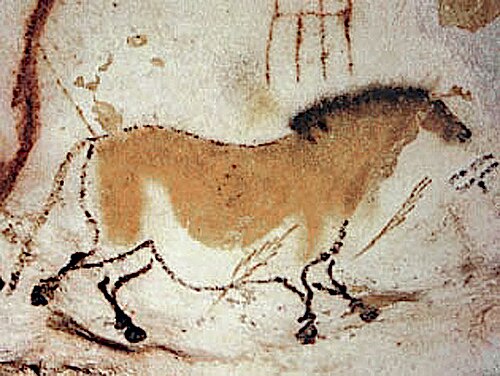
تُعدّ رسومات الكهوف الضخمة التي تعود إلى العصر الحجري القديم ، والتي تصوّر الحيوانات في أوروبا القارية، من أشهر الأعمال الفنية التي تعود إلى عصور ما قبل التاريخ ، ولا سيما تلك الموجودة في لاسكو بمنطقة دوردوني في فرنسا. ويُعرف مئات الكهوف المزخرفة، والتي تعود إلى العصر الحجري القديم الأعلى (حوالي 38000-12000 قبل الميلاد). وتوجد أمثلة على هذه الرسومات في أوكرانيا وإيطاليا وبريطانيا العظمى ، لكن معظمها يقع في فرنسا وإسبانيا . وقد طُرحت العديد من النظريات حول الغرض من هذه الرسومات ، وأكثرها قبولاً أنها كانت جزءًا من طقوس دينية، ربما لاستحضار التوفيق في الصيد.
 عظمة غزال عملاق من إينهورنهول ، حوالي 49000 قبل الميلاد؛ عظمة ميغالوسيروس؛ إينهورنهول، ألمانيا
 رسم وحيد القرن ؛ حوالي 32000-14000 قبل الميلاد؛ فحم على صخرة؛ الطول: حوالي 2 متر؛ كهف شوفيه ( أرديش ، فرنسا) [ 9 ]
 فينوس ويليندورف ؛ حوالي 25000 قبل الميلاد؛ حجر جيري ذو لون مغرة ؛ الارتفاع: 11 سم؛ متحف التاريخ الطبيعي ( فيينا ، النمسا) [ 10 ]
العصور القديمة
الشرق الأدنى القديم
امتدت منطقة الشرق الأدنى القديم من تركيا وساحل البحر الأبيض المتوسط غربًا إلى إيران وشبه الجزيرة العربية شرقًا. وعلى مرّ العصور، ظهرت حضارات عديدة، ازدهرت واختفت في هذه المنطقة. وكانت بلاد ما بين النهرين إحدى أهم هذه المناطق ، إذ شهدت خلال الألفية الرابعة قبل الميلاد ظهور أولى المدن وأقدم أشكال الكتابة. وتشمل بلاد ما بين النهرين القديمة العراق الحالي ، وأجزاء من سوريا وتركيا . ويُشكّل نصفها الشمالي جزءًا من " الهلال الخصيب "، حيث ظهرت تطورات مهمة في العصر الحجري الحديث ، مثل الزراعة المبكرة والمستوطنات القروية الدائمة. ولأن المنطقة تقع ضمن دلتا نهري دجلة والفرات ، فقد سكنتها حضارات عديدة، أبرزها سومر وأكاد وآشور وبابل . وتميزت العمارة في بلاد ما بين النهرين باستخدام الطوب والعتبات والفسيفساء المخروطية . ومن الأمثلة البارزة على ذلك الزقورات ، وهي معابد ضخمة على شكل أهرامات مدرجة .
أدت التقاليد السياسية والاقتصادية والفنية والمعمارية للسومريين إلى تأسيس الحضارة الغربية . ظهرت في سومر العديد من الأشياء لأول مرة: أول مدينة دولة ( أوروك )، التي حكمها الملك جلجامش ؛ أول ديانة منظمة، قائمة على بنية هرمية من الآلهة والشعب والطقوس؛ أول كتابة معروفة، وهي الكتابة المسمارية ؛ أول نظام ري وأولى المركبات ذات العجلات. كما ظهرت الأختام الأسطوانية هنا، المنقوشة بنقوش ورسوم توضيحية صغيرة. ومن الحضارات الأخرى التي ازدهرت هنا الإمبراطورية الأكادية ، أول إمبراطورية عظيمة في العالم.
خلال أوائل الألفية الأولى قبل الميلاد، وبعد الأكاديين، سيطرت إمبراطورية آشور على الشرق الأوسط بأكمله، ممتدةً من الخليج العربي إلى البحر الأبيض المتوسط . امتلأت مدنها بمبانٍ وفنون رائعة. اشتهر الفن الآشوري بنقوشه الحجرية الدقيقة، التي تصوّر مشاهد من حياة البلاط، والممارسات الدينية، والصيد، والمعارك الملحمية. رُسمت هذه النقوش في البداية بألوان زاهية ووُضعت في القصور. وإلى جانب جمالها، تُصوّر هذه النقوش أيضًا الحياة الآشورية ونظرة الآشوريين للعالم، بما في ذلك الملابس والأثاث الآشوري.
لاحقًا، غزا البابليون الإمبراطورية الآشورية. وخلال القرن السادس قبل الميلاد، أصبحت بابل أكبر مدينة في العالم. عند دخول بابل، كان الزوار يستقبلون ببوابة عشتار المهيبة ، بجدرانها المكسوة بالطوب الأزرق المزجج الزاهي ونقوشها البارزة التي تصور التنانين والثيران والأسود. سُميت هذه البوابة على اسم عشتار ، إلهة الحرب والحب.
في منتصف القرن السادس قبل الميلاد، وبعد سلسلة من الحملات العسكرية، سقطت الإمبراطورية البابلية في يد الإمبراطورية الأخمينية ، التي حكمها الملك كورش الثاني ، وامتدت عبر الشرق الأوسط وآسيا الوسطى ، من مصر إلى وادي السند . يضم فنها عناصر من مختلف أنحاء الإمبراطورية، احتفاءً بثروتها وقوتها. كانت برسيبوليس ( إيران ) عاصمة الإمبراطورية، وهي تزخر بمنحوتات رائعة تُصوّر رموزًا دينية وشخصيات من الإمبراطورية. كما توجد فيها أطلال قصر، يضم قاعة استقبال كبيرة لاستقبال الضيوف.
إلى جانب بلاد ما بين النهرين وإيران، ازدهرت حضارات قديمة أخرى أنتجت فنونًا وعمارة في مناطق أخرى أيضًا. ففي الأناضول ( تركيا الحالية )، ظهرت الإمبراطورية الحثية . وخلال العصور القديمة، كان جنوب الجزيرة العربية مركزًا هامًا لإنتاج وتجارة العطور، مما جلب الثراء للممالك التي كانت قائمة في هذه المنطقة. وقبل حوالي 4000 قبل الميلاد، كان مناخ الجزيرة العربية أكثر رطوبة مما هو عليه اليوم. وفي الجنوب الغربي، ظهرت عدة ممالك، مثل سبأ . وعادةً ما يكون شكل الإنسان في جنوب الجزيرة العربية مُنمّقًا، قائمًا على أشكال مستطيلة، ولكنه يتميز بتفاصيل دقيقة. [ 11 ] [ 12 ] [ 13 ]
 معيار أور (السومري)؛ حوالي 2600-2400 قبل الميلاد؛ صدفة، حجر جيري أحمر ولازورد على خشب؛ الطول: 49.5 سم؛ المتحف البريطاني (لندن) [ 14 ]
 ريتون غزال ( حثي )؛ حوالي 1400-1200 قبل الميلاد؛ فضة مرصعة بالذهب؛ الارتفاع: 13 سم؛ متحف متروبوليتان للفنون (مدينة نيويورك) [ 15 ]
 مبخرة ( جنوب الجزيرة العربية قبل الإسلام )؛ حوالي منتصف الألفية الأولى قبل الميلاد؛ برونز؛ الارتفاع: 27.6 سم؛ متحف متروبوليتان للفنون [ 16 ]
 ثيران مجنحة ( العصر الآشوري الحديث )؛ حوالي 710 قبل الميلاد؛ المرمر ؛ الارتفاع (الأقصى): 4.2 متر؛ متحف اللوفر [ 17 ]
 وفد يحمل الهدايا ( الفرس الأخمينيين )؛ حوالي 490 قبل الميلاد؛ حجر جيري؛ حوالي 260 × 150 سم؛ في الموقع، برسيبوليس ( إيران ) [ 18 ]
مصر
نشأت في مصر إحدى أوائل الحضارات العظيمة ، والتي تميزت بأعمال فنية متقنة ومعقدة أبدعها فنانون وحرفيون محترفون. كان الفن المصري ذا طابع ديني ورمزي. ونظرًا لبنية السلطة المركزية والتسلسل الهرمي في تلك الحضارة، فقد أُبدع قدر كبير من الفن لتكريم الفرعون ، بما في ذلك بناء آثار عظيمة. وقد ركز الفن والثقافة المصرية على المفهوم الديني للخلود. ومن بين الفنون المصرية اللاحقة الفن القبطي والفن البيزنطي .
تتميز العمارة بالهياكل الضخمة المبنية من كتل حجرية كبيرة وعتبات وأعمدة متينة . تشمل المعالم الجنائزية المصاطب ، وهي مقابر مستطيلة الشكل؛ والأهرامات ، ومنها الأهرامات المدرجة ( سقارة ) أو الأهرامات ذات الجوانب الملساء ( الجيزة )؛ والمقابر الجوفية ( وادي الملوك ). ومن المباني العظيمة الأخرى المعابد ، التي كانت في الغالب مجمعات ضخمة تسبقها جادة من تماثيل أبو الهول والمسلات . استخدمت المعابد الصروح والجدران شبه المنحرفة مع قاعات ذات أعمدة وأضرحة . وتُعد معابد الكرنك والأقصر وفيلة وإدفو أمثلة جيدة على ذلك . وهناك نوع آخر من المعابد وهو المعبد الصخري ، على شكل مقبرة جوفية ، الموجود في أبو سمبل والدير البحري .
استخدم الرسم في العصر المصري أسلوبًا يعتمد على تراكب المستويات. وكانت الصور تُصوَّر بشكل هرمي، أي أن الفرعون كان أكبر حجمًا من الشخصيات الأخرى أو الأعداء المرسومين بجانبه. رسم المصريون القدماء الخطوط الخارجية للرأس والأطراف من الجانب، بينما رسموا الجذع واليدين والعينين من الأمام. ازدهرت الفنون التطبيقية في مصر، ولا سيما النجارة والمعادن . ومن الأمثلة الرائعة على ذلك أثاث الأرز المرصع بالأبنوس والعاج ، والذي يمكن رؤيته في مقابر المتحف المصري . ومن الأمثلة الأخرى القطع التي عُثر عليها في مقبرة توت عنخ آمون ، والتي تتمتع بقيمة فنية عظيمة. [ 19 ]
 نبامون يصطاد في المستنقعات؛ حوالي 1380 قبل الميلاد؛ طلاء على الجص ؛ 98 × 83 سم؛ المتحف البريطاني (لندن) [ 20 ]
 أخناتون ونفرتيتي مع بناتهما؛ حوالي 1345 قبل الميلاد؛ حجر جيري مطلي ؛ 32.5 × 39 سم؛ المتحف المصري في برلين (ألمانيا) [ 21 ]
 قناع توت عنخ آمون ؛ حوالي 1327 قبل الميلاد ؛ ذهب وزجاج وأحجار شبه كريمة؛ الارتفاع: 54 سم؛ المتحف المصري ( القاهرة )
 تمثال نصفي لنفرتيتي ؛ 1352-1336 قبل الميلاد؛ حجر جيري مطلي ؛ الارتفاع: 50 سم؛ المتحف الجديد ( برلين ، ألمانيا) [ 22 ]
حضارة وادي السند
اكتُشفت حضارة وادي السند، المعروفة أيضًا باسم حضارة هارابا ( حوالي 2400-1900 قبل الميلاد)، عام 1922، بعد فترة طويلة من حضارات بلاد ما بين النهرين ومصر المعاصرة لها، وهي تُعتبر اليوم حضارة متقدمة للغاية، تُضاهي في بعض جوانبها تلك الحضارات. تمتد مواقعها على مساحة شاسعة من شمال شرق أفغانستان الحالية ، مرورًا بمعظم باكستان ، وصولًا إلى غرب وشمال غرب الهند . من أبرز مدن هذه الحضارة هارابا وموهينجو دارو ، الواقعتان على التوالي في إقليمي البنجاب والسند شمال باكستان، ومدينة لوثال الساحلية في ولاية غوجارات ( الهند ). أكثر القطع الأثرية عددًا هي الأختام المربعة والمستطيلة ، وبصمات الأختام التي تحمل صور حيوانات، غالبًا ما تكون ثيرانًا، بالإضافة إلى نصوص هارابا القصيرة جدًا . كما عُثر في مواقع هارابا على العديد من التماثيل الطينية المُنمّقة، وعدد قليل من المنحوتات الحجرية والبرونزية، التي تُعدّ أكثر واقعية من المنحوتات الخزفية. [ 24 ]
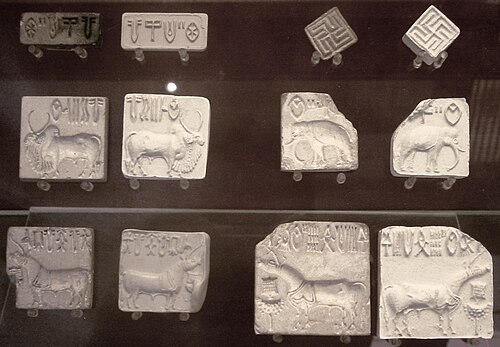 أختام عليها كتابة وطبعات من وادي السند؛ 2500-2000 قبل الميلاد؛ حجر الصابون ؛ أحجام مختلفة، معظمها حوالي 3 سم؛ المتحف البريطاني (لندن) [ 25 ]
 راقصة ؛ حوالي 2400-1900 قبل الميلاد؛ برونز؛ الارتفاع: 10.8 سم؛ المتحف الوطني ( نيودلهي ، الهند) [ 24 ]
 ختم بروتو-شيفا ؛ حوالي 2400-1900 قبل الميلاد؛ حجر الصابون؛ الارتفاع: 3.6 سم؛ المتحف الوطني (نيودلهي) [ 24 ]
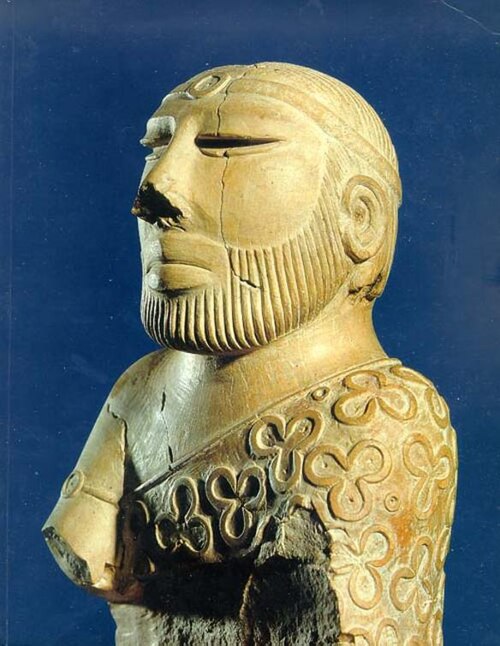 كاهن ملك ؛ حوالي 2400-1900 قبل الميلاد؛ حجر الصابون؛ الارتفاع: 17.5 سم؛ المتحف الوطني لباكستان ( كراتشي ) [ 24 ]
 ختم عليه ثور ذو قرنين ونقش؛ حوالي 2010 قبل الميلاد؛ حجر الصابون؛ الأبعاد الكلية: 3.2 × 3.2 سم؛ متحف كليفلاند للفنون ( كليفلاند ، أوهايو ، الولايات المتحدة الأمريكية)
الصين
صُنعت أولى القطع المعدنية في الصين قبل حوالي 4000 عام، خلال عهد أسرة شيا ( حوالي 2100-1700 قبل الميلاد). وخلال العصر البرونزي الصيني ( عهد أسرتي شانغ وتشو ) ، كان الشامان (ربما الملك نفسه) يُجري طقوس التوسط والتواصل مع عالم الأرواح في البلاط. في عهد أسرة شانغ ( حوالي 1600-1050 قبل الميلاد)، كان الإله الأعلى هو شانغدي ، لكن العائلات الأرستقراطية فضّلت التواصل مع أرواح أسلافها. فكانوا يُعدّون لهم ولائم فاخرة من الطعام والشراب، تُسخّن وتُقدّم في أوانٍ برونزية طقسية . اتّخذت هذه الأواني البرونزية أشكالًا عديدة، تبعًا لغرضها: للنبيذ، والماء، والحبوب، أو اللحوم، وكان بعضها يحمل نقوشًا مقروءة، مما يدل على تطور الكتابة. وقد اكتُشفت هذه الأواني، ذات الجودة العالية والتعقيد، في وادي النهر الأصفر بمقاطعة خنان ، في مواقع مثل إرليتو ، وأنيانغ ، وتشنغتشو . استُخدمت هذه الأواني في الطقوس الدينية لترسيخ سلطة أسرة شانغ، وعندما سقطت عاصمتها حوالي عام 1050 قبل الميلاد، استمر غزاة أسرة تشو ( حوالي 1050-156 قبل الميلاد) في استخدامها في الطقوس الدينية، ولكن بشكل أساسي للطعام لا الشراب. إذ اتُهم بلاط شانغ بالإفراط في الشرب، وقامت أسرة تشو، التي روّجت للإله الإمبراطوري تيان ("السماء") باعتباره القوة الروحية الرئيسية بدلاً من الأجداد، بتقييد استخدام النبيذ في الطقوس الدينية، لصالح الطعام. واستمر استخدام الأواني البرونزية الطقسية حتى أوائل عهد أسرة هان (206 قبل الميلاد - 220 ميلادي).
كان أحد أكثر الزخارف استخدامًا هو " التاوتي" ، وهو عبارة عن وجه مُنمّق مُقسّم في المنتصف إلى نصفين متطابقين تقريبًا، مع فتحات أنف وعينين وحاجبين وفكين وخدين وقرون، مُحاطة بنقوش محفورة. ولا يُمكن تحديد ما إذا كان "التاوتي" يُمثل كائنات حقيقية أو أسطورية أو خيالية تمامًا.
تُعدّ التماثيل البرونزية الغامضة في سانشينغدوي ، بالقرب من غوانغهان (في مقاطعة سيتشوان )، دليلاً على نظام ديني غامض قائم على القرابين، لا مثيل له في أي مكان آخر في الصين القديمة، ويختلف تماماً عن فن أسرة شانغ المعاصرة في أنيانغ . كشفت الحفريات في سانشينغدوي منذ عام 1986 عن أربع حفر تحتوي على مصنوعات من البرونز واليشم والذهب . عُثر على تمثال برونزي ضخم لشخصية بشرية يقف على قاعدة مزينة برؤوس أفيال مجردة. إلى جانب التمثال، احتوت الحفرتان الأوليان على أكثر من 50 رأسًا برونزيًا، بعضها يرتدي أغطية رأس، وثلاثة منها مغطاة بورق الذهب . كما عُثر هنا على شظايا برونزية أنبوبية الشكل ذات فروع صغيرة، يُحتمل أنها تُمثل أشجارًا، بالإضافة إلى أوراق وثمار وطيور برونزية. وقد عُثر على أكثر من 4000 قطعة أثرية في سانشينغدوي عام 1986.
بعد سلالة شانغ، حكمت سلالة تشو (1050-221 قبل الميلاد) لفترة أطول من أي سلالة أخرى في التاريخ الصيني. تميزت قرونها الأخيرة بالعنف، وعُرفت تلك الحقبة بفترة الممالك المتحاربة . خلال هذه الفترة المضطربة، ظهرت بعض الحركات الفلسفية: الكونفوشيوسية ، والطاوية ، والقانونية .
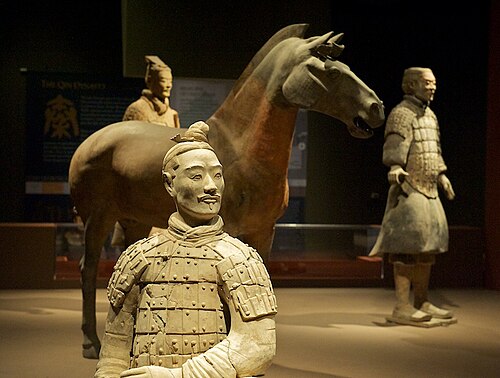
انتهت فترة الممالك المتحاربة على يد تشين شي هوانغدي ، الذي وحّد الصين عام 221 قبل الميلاد. أمر ببناء ضريح ضخم، حرسه جيش التيراكوتا . كما شُيّد مشروع ضخم آخر، كان بمثابة نواة لسور الصين العظيم ، لصدّ غارات القبائل الشمالية. بعد وفاة الإمبراطور، لم تدم سلالة تشين (221-206 قبل الميلاد) سوى ثلاث سنوات. وخلف تشين شي هوانغدي سلالة هان (202 قبل الميلاد - 220 ميلادي)، التي شهدت تطورًا ملحوظًا في طريق الحرير ، جالبةً معها تأثيرات ثقافية جديدة إلى الصين. [ 27 ] [ 28 ]
 إناء ماء برونزي بنقش تنين ملتف، أواخر عهد أسرة شانغ ( حوالي القرن الرابع عشر - منتصف القرن الحادي عشر قبل الميلاد)
 مرجل مستطيل الشكل؛ القرن الثاني عشر - الحادي عشر قبل الميلاد؛ برونز؛ متحف متروبوليتان للفنون (مدينة نيويورك)
 إناء نبيذ برونزي على شكل وحيد القرن، القرن الحادي عشر قبل الميلاد
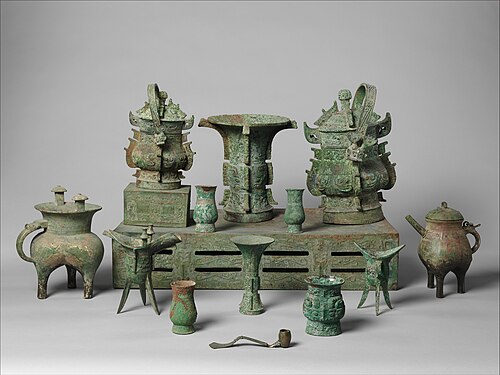 مجموعة مذبح؛ أواخر القرن الحادي عشر قبل الميلاد؛ برونز؛ متحف متروبوليتان للفنون
 طبل بإطار عليه طائر ونمر، من صنع تشو (ولاية)، مصنوع من الورنيش ، القرن الثامن قبل الميلاد
 فانغ لي؛ حوالي 925-875 قبل الميلاد ؛ برونز؛ الارتفاع: 22.8 سم؛ المتحف الوطني الصيني ( بكين ، الصين) [ 27 ]
 إناء من البرونز من عهد أسرة شانغ ، كان يُستخدم لحفظ المشروبات؛ الألفية الثانية قبل الميلاد
 "الرجل القوي"، من سلسلة الأكروبات . ضريح الإمبراطور الأول تشين ، 210 قبل الميلاد.
 تمثال طائر الفينيق المطلي بالورنيش، ولاية تشو ، حوالي القرن الخامس قبل الميلاد
 إناء مزدوج مطلي بالورنيش من قبر الماركيز يي من تشنغ حوالي 433 قبل الميلاد
 صندوق ورنيش من مقبرة جينغمن (荊門楚墓؛ Jīngmén chƔ mù) في ولاية تشو (704–223 قبل الميلاد)
 شاشة مطلية بالورنيش ومزخرفة بنقوش حيوانية، من فترة الممالك المتحاربة (حوالي القرن الرابع قبل الميلاد)
 جدارية قبر من عهد أسرة هان الغربية تصور الفيلسوف كونفوشيوس ؛ حوالي القرن الأول قبل الميلاد؛ من مقاطعة دونغ بينغ، شاندونغ
 أرواح حامية على هيئة حيوانات تحرس منتصف الليل والصباح، ترتدي أثوابًا صينية ، من عهد أسرة هان (202 قبل الميلاد - 220 ميلادي)، على بلاطة خزفية
 خاتم ذو تنينين، من أوائل عهد أسرة شانغ (الألفية الثانية قبل الميلاد)
 قرص من اليشم ذو تصميم مفتوح، نانيوي (حوالي القرن الثاني قبل الميلاد)
 تنينان برونزيان توأمان من عهد أسرة تشين، تم العثور عليهما بالقرب من ضريح الإمبراطور الأول لأسرة تشين.
اليونانية


بفضل التناسق المتناغم والتركيز على الجماليات، أصبح الفن اليوناني والروماني القديم أساسًا ومصدر إلهام للفن الغربي برمته، ومعيارًا سعى إليه معظم الفنانين الأوروبيين حتى القرن التاسع عشر. [ 30 ] وقد أشار الشاعر اللاتيني هوراس ، الذي كتب في عهد الإمبراطور الروماني أغسطس (القرن الأول قبل الميلاد إلى القرن الأول الميلادي)، إلى أنه على الرغم من هزيمتها في ساحة المعركة، "تغلبت اليونان الأسيرة على غازيها المتوحش، وجلبت الفنون إلى روما الريفية". تكمن قوة الفن اليوناني في تصويره للشكل البشري، وتركيزه على البشر والآلهة المتجسدة كمواضيع رئيسية. كانت الأعمال الفنية اليونانية تهدف إلى تزيين المعابد والمباني العامة، والاحتفاء بانتصارات المعارك والشخصيات البارزة، وتخليد ذكرى الموتى. كما كانت تُقدم كقرابين للآلهة.
على الرغم من عدم وجود انتقال حاسم، يُقسّم الفن عادةً من الناحية الأسلوبية إلى أربع فترات: الهندسية، والقديمة، والكلاسيكية، والهيلينية. خلال الفترة الكلاسيكية (القرنين الخامس والرابع قبل الميلاد)، كان هناك توازن دقيق بين الواقعية والمثالية. بالمقارنة، قد تبدو أعمال العصر الهندسي (القرنين التاسع والثامن قبل الميلاد) والقديمة (القرنين السابع والسادس قبل الميلاد) بدائية، لكن هؤلاء الفنانين كانت لديهم أهداف مختلفة: لم يكن التمثيل الطبيعي بالضرورة غايتهم. بنى الفنانون اليونانيون على الأسس الفنية المصرية، وطوّروا فنون النحت والرسم والعمارة والخزف. ومن بين التقنيات التي أتقنوها أساليب نحت وصبّ التماثيل، والرسم الجداري، وبناء مبانٍ فخمة.
جمع عشاق الفن الروماني أعمالًا أصلية من الفن اليوناني القديم، ونسخًا رومانية منه، ولوحات ومنحوتات حديثة الصنع بأساليب يونانية متنوعة، فحافظوا بذلك على أعمال فنية كانت ستضيع لولا ذلك. زيّنت اللوحات الجدارية واللوحات الخشبية والمنحوتات والفسيفساء الأماكن العامة والمنازل الخاصة. كما ظهرت الصور اليونانية على المجوهرات الرومانية، والأواني المصنوعة من الذهب والفضة والبرونز والطين، وحتى على الأسلحة والموازين التجارية. أُعيد اكتشاف فنون اليونان القديمة خلال عصر النهضة المبكر ، وانتقلت عبر الإمبراطورية الرومانية ، وشكّلت أساس الفن الغربي حتى القرن التاسع عشر. [ 31 ]
منذ بزوغ العصر الكلاسيكي في أثينا ، في القرن الخامس قبل الميلاد، تغلغل أسلوب البناء الكلاسيكي بعمق في الفهم الغربي للعمارة، بل وللحضارة نفسها. [ 32 ] من حوالي 850 قبل الميلاد إلى حوالي 300 ميلادي، ازدهرت الحضارة اليونانية القديمة في البر اليوناني الرئيسي ، وفي شبه جزيرة بيلوبونيز ، وفي جزر بحر إيجة . خمس من عجائب الدنيا كانت يونانية: معبد أرتميس في أفسس ، وتمثال زيوس في أولمبيا ، وضريح موسولوس في هاليكارناسوس ، وتمثال رودس العملاق ، ومنارة الإسكندرية . مع ذلك، تشتهر العمارة اليونانية القديمة بمعابدها ، التي ينتشر العديد منها في جميع أنحاء المنطقة، ويُعد البارثينون مثالًا بارزًا على ذلك. لاحقًا، شكلت هذه المعابد مصدر إلهام للمعماريين الكلاسيكيين الجدد خلال أواخر القرن الثامن عشر والتاسع عشر. أشهر المعابد هي البارثينون والإريختيون ، وكلاهما يقعان على الأكروبوليس في أثينا . ومن أنواع المباني اليونانية القديمة المهمة الأخرى المسارح. وقد استخدمت المعابد والمسارح مزيجًا معقدًا من الخدع البصرية والنسب المتوازنة.
عند النظر إلى البقايا الأثرية للمباني القديمة، يسهل تصورها على أنها من الحجر الجيري والخرسانة بلون رمادي باهت، والاعتقاد بأن المباني القديمة كانت أحادية اللون. إلا أن العمارة كانت متعددة الألوان في معظم أنحاء العالم القديم. ومن أبرز المباني القديمة، البارثينون ( حوالي 447-432 قبل الميلاد) في أثينا ، الذي زُينت تفاصيله بألوان زاهية من الأحمر والأزرق والأخضر. وإلى جانب المعابد القديمة، لم تكن كاتدرائيات العصور الوسطى بيضاء بالكامل، إذ كانت معظمها مزينة بلمسات ملونة على تيجان الأعمدة . [ 33 ] وقد هُجرت هذه الممارسة في تلوين المباني والأعمال الفنية خلال عصر النهضة المبكر. ويعود ذلك إلى أن ليوناردو دافنشي وفنانين آخرين من عصر النهضة، بمن فيهم مايكل أنجلو ، روّجوا للوحة ألوان مستوحاة من الآثار اليونانية الرومانية القديمة، التي أصبحت بيضاء اللون بسبب الإهمال والتدهور المستمر خلال العصور الوسطى، على الرغم من كونها ملونة في الأصل. وكانت الأصباغ المستخدمة في العالم القديم حساسة وعرضة للتلف بفعل العوامل الجوية. بدون العناية اللازمة، تتلاشى الألوان التي تتعرض للمطر والثلج والأوساخ وعوامل أخرى بمرور الوقت، وبهذه الطريقة أصبحت المباني والأعمال الفنية القديمة بيضاء، كما هي اليوم وكما كانت خلال عصر النهضة. [ 34 ]
 تمثال حصان ( هندسي )؛ حوالي 800-700 قبل الميلاد ؛ برونز؛ الارتفاع: 17.6 سم؛ متحف متروبوليتان للفنون (مدينة نيويورك)
 إناء خزفي ذو قاعدة (هندسي)؛ حوالي 750 قبل الميلاد ؛ تيراكوتا؛ الارتفاع: 108.3 سم، القطر: 72.4 سم؛ متحف متروبوليتان للفنون [ 35 ]
 تمثال كوروس نيويورك ( العصر القديم )؛ حوالي 600 قبل الميلاد ؛ رخام وصبغة؛ الارتفاع: 1.95 متر؛ متحف متروبوليتان للفنون [ 36 ]
 جرة باناثينايك (العصر القديم)؛ حوالي 530 قبل الميلاد ؛ خزف؛ الارتفاع: 62.2 سم؛ متحف متروبوليتان للفنون [ 37 ]
 كأس أحمر الشكل ( كلاسيكي )؛ حوالي 480 قبل الميلاد ؛ خزف؛ الارتفاع: 12.7 سم، القطر: 27.2 سم؛ متحف كيمبل للفنون ( فورت وورث، تكساس ، الولايات المتحدة) [ 38 ]
 زيوس أرتميسيون (الكلاسيكي)؛ حوالي 460 قبل الميلاد ؛ برونز؛ الارتفاع: 209 سم؛ المتحف الأثري الوطني ( أثينا ، اليونان) [ 39 ]

 مزهرية سنتوريب ( هلنستية )؛ حوالي 300-100 قبل الميلاد؛ خزف؛ الارتفاع: 9.4 سم؛ متحف متروبوليتان للفنون [ 41 ]
سلتيك

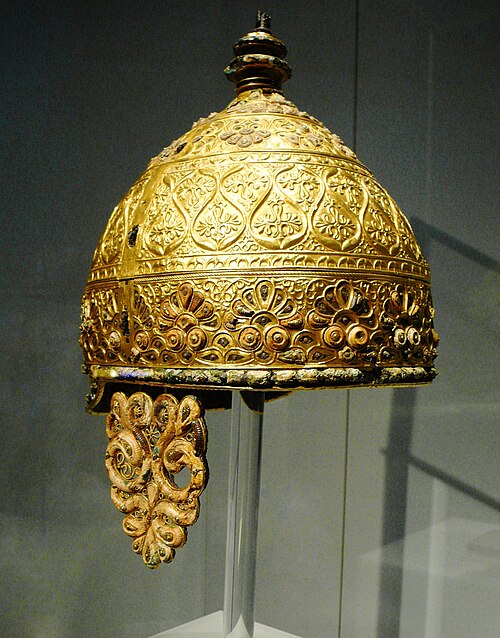

تطور الفن السلتي، المعروف بنقوشه المعقدة وزخارفه الرمزية وتصاميمه المميزة، على مدى فترة طويلة، حيث تمتد جذوره إلى أوائل العصر الحديدي. يمتد هذا التراث الفني الغني والمتنوع عبر عدة قرون ومناطق، ويشمل بشكل أساسي ما يُعرف اليوم بأيرلندا وبريطانيا وفرنسا وأجزاء من وسط وشرق أوروبا. يمكن تقسيم تاريخ الفن السلتي إلى فترتين رئيسيتين: [ 42 ]
حضارة هالشتات (حوالي 800-500 قبل الميلاد): يرتبط أقدم شكل معروف للفن السلتي بحضارة هالشتات، التي امتدت في ما يُعرف اليوم بالنمسا والمناطق المحيطة بها. شهدت هذه الفترة تطور تقنيات مميزة في صناعة المعادن، لا سيما الذهب والبرونز والحديد. غالبًا ما تتميز القطع الأثرية من هذا العصر بأنماط هندسية، وزخارف حيوانية منمقة، وأشكال حلزونية مجردة. [ 43 ]
حضارة لا تين (حوالي 500 قبل الميلاد - 1 ميلادي): تُعتبر حضارة لا تين ذروة الفن السلتي المبكر. خلال هذه الفترة، شهدت التصاميم زيادة ملحوظة في التعقيد والدقة. ابتكر الحرفيون في لا تين أسلحةً ومجوهراتٍ وأدواتٍ يوميةً مزينةً بأنماطٍ حلزونيةٍ وعقدٍ ورسومٍ حيوانيةٍ مُنمقة. كما يُذكر هذا العصر بالاستخدام الأول البارز لـ"العقدة السلتية"، وهي شكلٌ من أشكال التصميم الحلقي اللانهائي الذي يرمز إلى الخلود والاستمرارية. [ 44 ]
روما

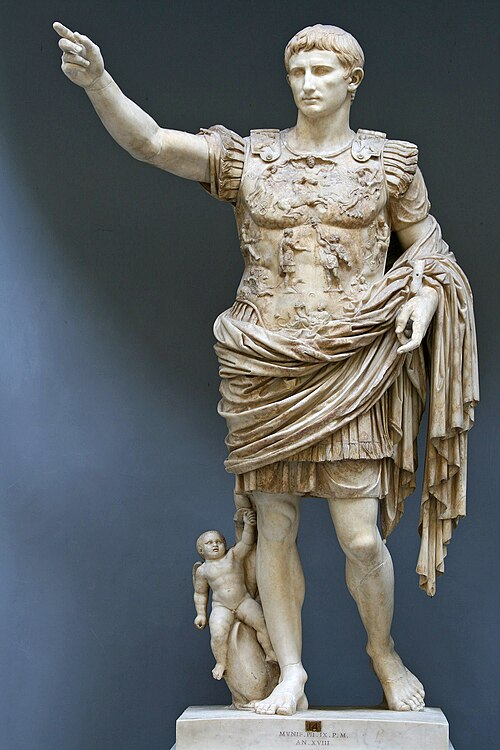
لم تترك أي حضارة أثراً عميقاً ودائماً على الفن الغربي مثل الإمبراطورية الرومانية . ويتجلى إرث روما القديمة بوضوح خلال العصور الوسطى وبداية العصر الحديث ، ولا يزال الفن الروماني يُعاد استخدامه في العصر الحديث في كل من الأعمال الفنية التقليدية وما بعد الحداثية . [ 46 ] يُنظر إليه أحياناً على أنه مستمد من النماذج اليونانية، ولكنه يتميز أيضاً بخصائصه الفريدة، بعضها موروث من الفن الأتروري . غالباً ما يكون النحت الروماني أقل مثالية من نظيراته اليونانية، إذ يتسم بالواقعية الشديدة. وكثيراً ما استخدمت العمارة الرومانية الخرسانة ، كما تم ابتكار عناصر معمارية مثل القوس الدائري والقبة . وتُعتبر التحف الفاخرة المصنوعة من المعادن ، ونقش الأحجار الكريمة ، ومنحوتات العاج ، والزجاج، في بعض الأحيان، وفقاً للمعايير الحديثة، أشكالاً ثانوية من الفن الروماني، [ 47 ] على الرغم من أن هذا لم يكن بالضرورة هو الحال بالنسبة للمعاصرين. ومن الابتكارات التي أتاحها التطور الروماني في نفخ الزجاج، الزجاج المنقوش . حيث كان يتم أولاً صنع "صدفة" بيضاء، ثم يُنفخ فيها الزجاج الملون لإنتاج بطانة داخلية. ثم قُطعت القشرة البيضاء لتشكيل أنماط بارزة بيضاء على خلفية داكنة. كما صنعوا الفسيفساء ، منتجين بذلك فنًا تصويريًا متينًا باستخدام مكعبات حجرية مقطوعة ( تيسيرا ) و/أو رقائق من الطين الملون والزجاج. غطت بعض فيلات الرومان الأثرياء جدرانها بلوحات جدارية ( فريسكو )، بهدف إبهار الضيوف وإمتاعهم. يأتي جزء كبير من اللوحات الجدارية الرومانية الباقية من مواقع حول خليج نابولي ، ولا سيما بومبي وهيركولانيوم ، وهما مدينتان مزدهرتان حُفظتا تحت أمتار من الحطام البركاني عندما ثار بركان فيزوف عام 79 ميلادي. ونتيجة لذلك، غالبًا ما تُناقش اللوحات الجدارية الرومانية من حيث أربعة "أنماط بومبية". [ 48 ]
تأثر الرومان بشدة بجميع جوانب الثقافة الهلنستية . ففي العمارة، كما في غيرها من الفنون ، تبنوا اللغة الكلاسيكية وطوروها لتناسب السياقات والاستخدامات الجديدة. كما أضاف الرومان ابتكاراتهم الخاصة إلى العمارة الكلاسيكية، حيث استخدموا الأنماط الدوريكية والأيونية والكورنثية بحرية أكبر بكثير من اليونانيين، فابتكروا نسختهم الخاصة من النمط الدوري، واستخدموا النمط الكورنثي بشكل أكثر شيوعًا. وأضافوا نمطين جديدين: النمط التوسكاني ، وهو نسخة أبسط وأكثر ضخامة من النمط الدوري، مستوحى من العمارة الأترورية ؛ والنمط المركب ، الذي يجمع بين الزخارف الحلزونية للنمط الأيوني وأوراق الأقنثوس للنمط الكورنثي . ومن الابتكارات المهمة الأخرى القوس والقبة، حيث استخدموا الأقواس لبناء القنوات المائية وأقواس النصر الضخمة . كان الأباطرة الرومان يفتخرون بفتوحاتهم، ويخلدونها في ديارهم وفي الأراضي المفتوحة عبر أقواس النصر، ومن الأمثلة البارزة على ذلك قوس قسطنطين في روما. بين عامي 30 و15 قبل الميلاد، نشر المهندس المعماري والعسكري ماركوس فيتروفيوس بوليو كتابًا هامًا بعنوان " دي أركيتكتورا" (De Architectura )، والذي أثر في المهندسين المعماريين حول العالم لقرون. [ 49 ] [ 50 ]
بعد العصور الوسطى ، ومع عصر النهضة الذي بدأ في فلورنسا ( إيطاليا )، ازداد الاهتمام بروما القديمة. وخلال هذه الفترة، ولأول مرة منذ العصور الكلاسيكية القديمة ، أصبح الفن واقعيًا بشكل مقنع. كما أثار عصر النهضة الاهتمام بالأدب اليوناني والروماني القديم، وليس فقط بالفن والعمارة. [ 51 ]
 جدارية الأسرار؛ منتصف القرن الأول قبل الميلاد؛ جدارية ؛ الارتفاع: 1.62 متر؛ فيلا الأسرار ( بومبي ، إيطاليا) [ 52 ]
 مزهرية بورتلاند ؛ أواخر القرن الأول قبل الميلاد؛ زجاج؛ الارتفاع: 24 سم؛ المتحف البريطاني ( لندن ) [ 53 ]
 فسيفساء بحرية (لوحة مركزية من ثلاث لوحات من أرضية)؛ 200-230؛ فسيفساء (قطع من الحجر والزجاج)؛ 2915 مم × 2870 مم؛ متحف الفنون الجميلة ( بوسطن ، الولايات المتحدة الأمريكية)
 قوس قسطنطين (روما)، الذي يخلد ذكرى انتصار قسطنطين الكبير بعد انتصاره على ماكسينتيوس في معركة جسر ميلفيان ، 316 [ 54 ]
الجرمانية

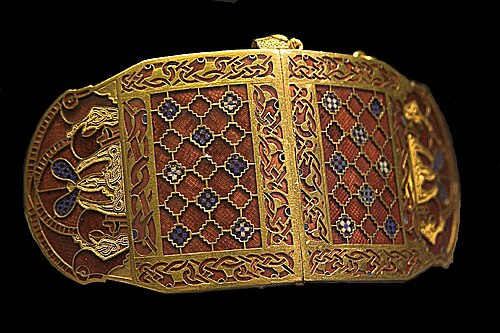
يعكس الفن الجرماني خلال فترة الهجرة ( حوالي 300-900 ميلادي) التطورات الثقافية والفنية للشعوب الجرمانية أثناء هجرتها عبر أوروبا واستقرارها في مناطق مختلفة، بما في ذلك المنطقة المعروفة اليوم بألمانيا. شهدت هذه الفترة، التي تزامنت مع انهيار الإمبراطورية الرومانية الغربية وتلتها، انخراط الشعوب الجرمانية في تقاليد فنية تأثرت بالأساليب الرومانية وتميزت عنها في الوقت نفسه، وذلك أثناء تأسيسها للممالك الجرمانية [ 55 ] [ 56 ] [ 57 ] ، وهي دول أسستها شعوب غير رومانية (جرمانية في المقام الأول) في أوروبا وشمال إفريقيا عقب انهيار الإمبراطورية الرومانية الغربية في القرن الخامس. [ 55 ] [ 56 ] [ 57 ] وكانت هذه الممالك الجرمانية هي الحكومات الرئيسية في أوروبا الغربية خلال العصور الوسطى المبكرة . يُعتبر عهد الممالك البربرية قد انتهى بتتويج شارلمان إمبراطورًا عام 800، على الرغم من استمرار عدد قليل من الممالك الأنجلوسكسونية الصغيرة حتى قام ألفريد العظيم وخلفاؤه بتوحيدها بدءًا من أواخر القرن التاسع. [ 58 ] [ 59 ]
كان أسلوب الحيوانات أحد الأساليب الفنية الرئيسية في الأراضي الجرمانية القديمة ، وقد انتشر عبر سهوب أوراسيا، ثم تطور في الدول الاسكندنافية وشمال ألمانيا، وامتد تأثيره ليشمل أوروبا بأكملها. [ 60 ] [ 61 ] تميز هذا الأسلوب بتصويره المعقد والمجرد للحيوانات، وكان شائعًا في المشغولات المعدنية والحلي الشخصية. في ألمانيا الحديثة، كانت منطقتا الراين وأعالي الراين مركزين بارزين لهذه الأعمال، حيث استُخدمت أنماط حيوانية في قطع مثل الدبابيس والأبازيم والمجوهرات. ومن الأمثلة الشهيرة على هذا الأسلوب دبوس بينجربروك، وهو دبوس زخرفي عُثر عليه في منطقة الراين، ويُظهر الأشكال الحيوانية المتشابكة المميزة للفن الجرماني. كما يظهر هذا الأسلوب جليًا في القطع الأثرية من كنز ساتون هو ، حيث تظهر زخارف حيوانية مماثلة في الفن الأنجلوسكسوني، لكنها تعكس التأثير الأوسع للفن الجرماني في شمال أوروبا.
كان لأسلوب الألوان المتعددة، الذي طوره القوط في منطقة البحر الأسود، تأثير كبير على الفن الجرماني، لا سيما في جنوب ألمانيا وأجزاء من فرنسا وإسبانيا. اشتهر هذا الأسلوب باستخدام الذهب والأحجار الكريمة، وتجلى ذلك في قطع مثل دبابيس الزينة المرصعة بالعقيق وأبازيم الأحزمة. تُظهر قطع مثل تاج ريسيسوينث القوطي الغربي الذي عُثر عليه في إسبانيا مدى انتشار هذا الأسلوب، ولكن تم اكتشاف أمثلة مماثلة من المشغولات المعدنية متعددة الألوان في ألمانيا، وخاصة في مملكة الفرنجة ، حيث كانت لهذه القطع أدوار زخرفية ورمزية في آن واحد.
في القرنين السادس والسابع الميلاديين، بدأت الشعوب الجرمانية باعتناق المسيحية، مما أدى إلى تحول في تقاليدها الفنية. وبدأت الرموز المسيحية بالظهور في الفن الجرماني، مما مثّل تحولاً عن الزخارف الوثنية البحتة. وأدى إدخال الأيقونات المسيحية في المشغولات المعدنية والمخطوطات الجرمانية إلى تطور الفن الكارولنجي وأنماط إقليمية أخرى في جميع أنحاء أوروبا. وفي ألمانيا، شهدت هذه الفترة ازدهار الفن الفرنجي، لا سيما في عهد شارلمان (حكم من 768 إلى 814 )، الذي مزج بين التقاليد الجرمانية والصور المسيحية.
الإسلام
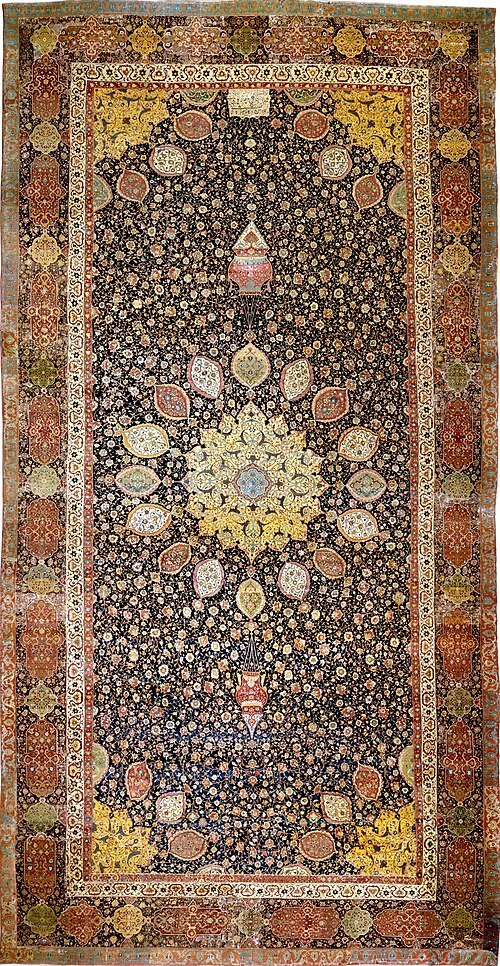
يشتهر الفن الإسلامي منذ العصور الوسطى باستخدامه للأنماط الهندسية المتقنة ، والبلاط الملون، والزخارف الطبيعية المُنمّقة، والخط العربي المُفصّل. ونادرًا ما كان للكتابة تأثيرٌ عميقٌ كهذا على الفنون التطبيقية والعمارة. ظهر الإسلام في غرب الجزيرة العربية في القرن السابع الميلادي من خلال الوحي الذي أُنزل على النبي محمد في مكة . وفي غضون قرن من وفاة محمد، سيطرت الإمبراطوريات الإسلامية على الشرق الأوسط ، وإسبانيا، وأجزاء من آسيا وأفريقيا. ولهذا السبب، وكما هو الحال مع الفن الروماني ، كان للفن والعمارة الإسلامية نسخٌ إقليمية. ومع امتداد العالم الإسلامي إلى مراكز حضارة العصور القديمة المتأخرة، ازدهر بالحركات الفلسفية والفكرية. وشجعت الخلافات المبكرة ترجمة الأعمال اليونانية إلى العربية، والتقدم في الرياضيات والعلوم. وهذا يتناقض مع التصور الحديث بأن الفن الإسلامي جامدٌ وغير قابل للتغيير. لم يكن تمثيل الإنسان والحيوان نادرًا، بل اقتصر على فتراتٍ معينة (كما هو الحال مع تحطيم الأيقونات البيزنطي ). [ 62 ]
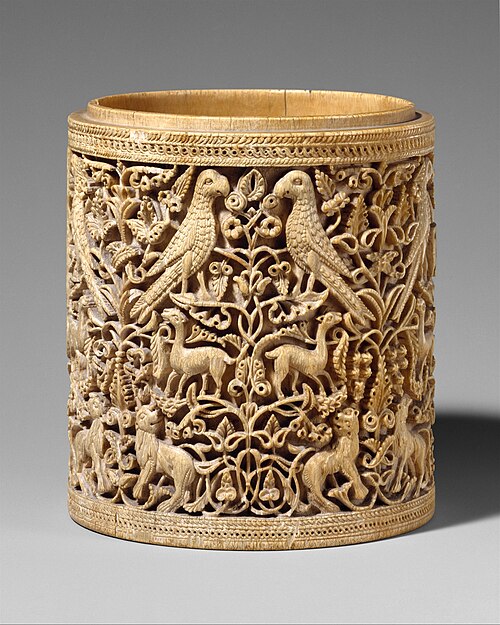
 محراب ؛ 961-976؛ فسيفساء من الجص والزجاج؛ القطر (القوس الداخلي): حوالي 2.3 متر ؛ جامع قرطبة ( قرطبة، إسبانيا ) [ 63 ]

الأمريكتين
أمريكا الوسطى
نشأت بعض الحضارات العظيمة الأولى في الأمريكتين في أمريكا الوسطى (بمعنى "الأمريكتين الوسطى")، وأشهرها حضارة المايا والأزتيك .
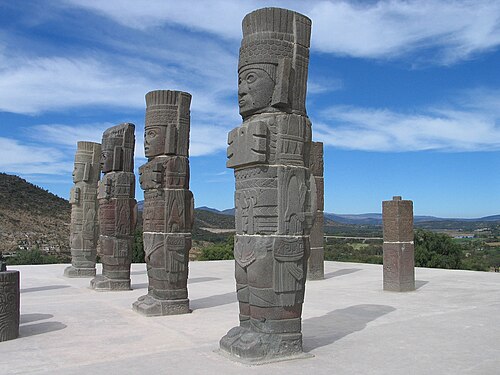
كانت حضارة الأولمك ( حوالي 1400-400 قبل الميلاد) أول حضارة رئيسية في المكسيك الحالية. تعود أصول العديد من عناصر حضارات أمريكا الوسطى، مثل بناء الأهرامات، والتقويم المعقد، ومجمع الآلهة، والكتابة الهيروغليفية، إلى ثقافة الأولمك. وقد صنعوا تماثيل من اليشم والخزف، ورؤوسًا ضخمة ، وأهرامات تعلوها معابد، كل ذلك دون استخدام الأدوات المعدنية. كان اليشم بالنسبة لهم حجرًا أثمن من الذهب، ويرمز إلى القوى الإلهية والخصوبة. تم اكتشاف 17 رأسًا ضخمًا من حضارة الأولمك ، يزن كل منها بضعة أطنان. كل رأس، بأنفه المسطح وشفتيه الغليظتين، يرتدي خوذة، تشبه تلك التي تُرتدى خلال مباريات الكرة الرسمية، وربما تُمثل ملوكًا أو مسؤولين.
بدأت حضارة المايا حوالي عام 1800 قبل الميلاد ، وازدهرت حتى وصول المستعمرين الإسبان في القرن السادس عشر الميلادي. سكنوا جنوب شرق المكسيك، وغواتيمالا ، وبليز ، وأجزاء من هندوراس والسلفادور . تاجر المايا مع مدن مثل تيوتيهواكان ، ومع العديد من حضارات أمريكا الوسطى، مثل الزابوتيك ، والمجموعات الأخرى من المناطق الوسطى والساحلية في المكسيك، وكذلك مع شعوب لم تسكن أراضي أمريكا الوسطى، مثل التاينو من منطقة الكاريبي . أنتجوا صورًا ملكية رائعة، وأواني خزفية متعددة الألوان ، وتماثيل فخارية، ومنحوتات خشبية، ونصبًا تذكارية ، وبنوا مدنًا معقدة تضم أهرامات. وقد اكتُشفت معظم الأواني الخزفية متعددة الألوان المحفوظة جيدًا في مقابر النبلاء.
انطلق الأزتيك من بدايات متواضعة كجماعة بدوية، ليؤسسوا أكبر إمبراطورية في تاريخ أمريكا الوسطى، والتي امتدت من عام 1427 إلى 1521. لم يُطلقوا على أنفسهم اسم "الأزتيك"، بل المكسيكا. وقد أطلق المؤرخون عليهم هذا الاسم. حوّلوا عاصمة إمبراطوريتهم، تينوتشتيتلان ، إلى مركزٍ أبدع فيه فنانو أمريكا الوسطى أعمالًا فنية رائعة لسادتهم الجدد. بُنيت مدينة مكسيكو الحالية فوق عاصمة الأزتيك، تينوتشتيتلان. [ 67 ] [ 68 ] [ 69 ]
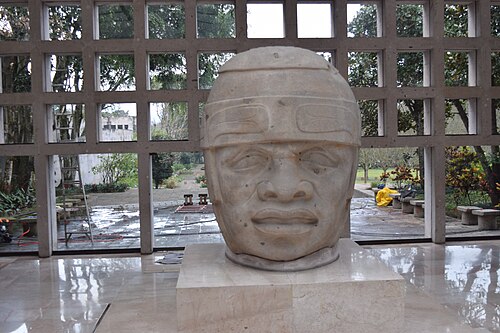 رأس ضخم ؛ ج. 1050 ق.م. الحجر الصخري . الارتفاع: 2.2 م؛ متحف خالابا للأنثروبولوجيا ( خالابا ، المكسيك) [ 70 ]
 شامان جالس في وضعية طقسية على شكل قلادة ( أولمك )؛ القرن التاسع - الخامس قبل الميلاد؛ سربنتين وزنجفر ؛ الارتفاع: 18.5 سم؛ متحف دالاس للفنون ( دالاس ، تكساس ، الولايات المتحدة) [ 70 ]
 تمثال خفاش ( زابوتيك )؛ حوالي 50 قبل الميلاد؛ اليشم والصدف؛ الارتفاع: 28 سم؛ المتحف الوطني للأنثروبولوجيا ( مدينة مكسيكو ) [ 71 ]
 إناء عليه مشهد عرش (مايا)؛ أواخر القرن السابع - الثامن الميلادي؛ خزف؛ 21.59 سم؛ متحف متروبوليتان للفنون (مدينة نيويورك)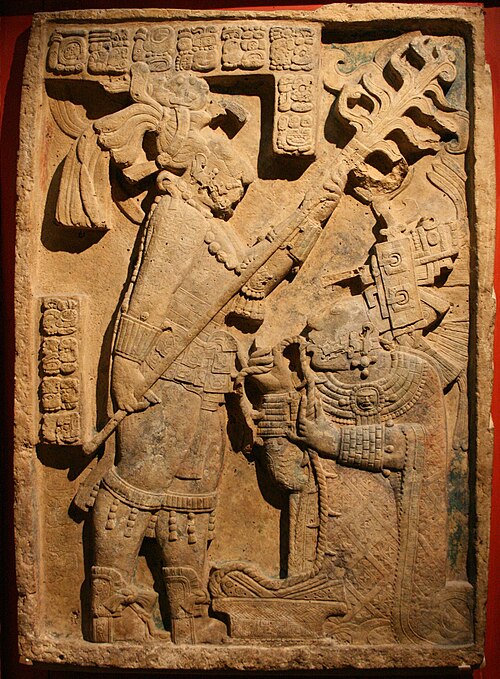
 ثعبان ذو رأسين ( الأزتيك )؛ حوالي 1450-1521؛ خشب الأرز، الفيروز ، الصدف وآثار التذهيب؛ الطول: 43.3 سم؛ المتحف البريطاني [ 74 ]
 حجر كويولكسوهكي (الأزتيك)؛ حوالي 1469-1481؛ حجر؛ القطر: 3 أمتار؛ متحف تيمبلو مايور ( مدينة مكسيكو ) [ 74 ]
 إناء على شكل تمثال تلالوك (الأزتيك)؛ حوالي 1440-1469؛ خزف مطلي؛ الارتفاع: 35 سم؛ متحف تمبلو مايور [ 74 ]
كولومبيا
على غرار أمريكا الوسطى، تُعدّ أراضي كولومبيا الحالية منطقةً ازدهرت فيها حضاراتٌ متعددة قبل وصول المستعمرين الإسبان. هنا، صُنعت حُليٌّ ذهبيةٌ للجسم، كثيرٌ منها ذهبيٌّ، ولكن أيضًا كثيرٌ منها مصنوعٌ من التومباغا ، وهي سبيكةٌ غير مُحددةٍ من الذهب والنحاس أطلقها الغزاة الإسبان على المعادن المُكوّنة من هذه العناصر والتي كانت شائعة الاستخدام في أمريكا الوسطى قبل كولومبوس في أمريكا الشمالية والجنوبية .
 قلادة على شكل رأس حيوان ( يوتوكو )؛ القرن الأول - السابع الميلادي؛ ذهب؛ الارتفاع: 6.35 سم؛ متحف متروبوليتان للفنون (مدينة نيويورك)
 إناء من الجير ( كيمبايا )؛ القرن الخامس - التاسع الميلادي؛ ذهب؛ الارتفاع: 23 سم؛ متحف متروبوليتان للفنون
 قلادة ( تايرونا )؛ القرن العاشر - السادس عشر الميلادي؛ ذهب؛ الارتفاع: 14 سم؛ متحف متروبوليتان للفنون
مناطق الأنديز

احتضنت الحضارات القديمة في بيرو وبوليفيا تقاليد فنية فريدة، من بينها واحدة من أكثر تقاليد فنون الألياف إبهارًا من الناحية الجمالية في العالم. ومن أوائل الثقافات المهمة التي نشأت في هذه الأرض ثقافتا تشافين وباراكاس .
تشتهر حضارة باراكاس في الساحل الجنوبي لبيرو بنسيجها ذي النقوش المعقدة، ولا سيما المعاطف. سيطرت حضارة موتشي على وديان الأنهار في الساحل الشمالي، بينما امتد نفوذ حضارة نازكا في جنوب بيرو على طول الصحاري الساحلية والجبال المتاخمة. تشتهر حضارة نازكا بخطوط نازكا الشهيرة ، وهي مجموعة من النقوش الأرضية في صحراء جنوب بيرو. كما أنتجوا خزفًا ومنسوجات متعددة الألوان متأثرة بحضارة باراكاس، واستخدموا ما لا يقل عن عشرة ألوان في صناعة الفخار. ازدهرت كلتا الحضارتين بين عامي 100 و800 ميلادي. يُعد فخار موتشي من بين أكثر أنواع الفخار تنوعًا في العالم. أما في الشمال، فتشتهر إمبراطورية واري (أو هواري) بإنجازاتها في فن العمارة الحجرية والنحت.
سبق حضارة تشيمو أسلوب خزفي بسيط يُعرف باسم سيكان (700-900 ميلادي). أنتج شعب تشيمو أعمالًا فنية رائعة من المعادن، لا سيما الذهب والفضة. لاحقًا، امتدت إمبراطورية الإنكا (1100-1533) عبر جبال الأنديز . صنعوا تماثيل من المعادن النفيسة، ومثل حضارات أخرى من المنطقة نفسها، نسجوا منسوجات معقدة. كانت حيوانات اللاما ذات أهمية كبيرة، نظرًا لصوفها وقدرتها على حمل الأثقال. [ 76 ] [ 77 ] [ 78 ]
 الطائر الطنان، أحد خطوط نازكا ( نازكا )؛ حوالي 200 قبل الميلاد - 600 ميلادي؛ صخور وحصى وتراب؛ الطول: 50 مترًا؛ مقاطعات نازكا وبالبا ( بيرو) [ 79 ]
 زجاجة على شكل رأس بورتريه ( موتشي )؛ القرن الثالث - السادس الميلادي؛ خزف مطلي؛ الأبعاد الكلية: 26.35 × 16.21 سم؛ متحف متروبوليتان للفنون (مدينة نيويورك)
 تمثال فسيفسائي لرجل نبيل ( واري )؛ القرن السابع - التاسع؛ خشب، صدف، حجر وفضة ؛ الارتفاع: 10.2 سم؛ متحف كيمبل للفنون ( فورت وورث، تكساس ، الولايات المتحدة) [ 80 ]
 سترة ملكية ( إنكا )؛ 1476-1534؛ ألياف الإبل والقطن؛ الارتفاع: 91 سم؛ دمبارتون أوكس ( واشنطن العاصمة، الولايات المتحدة الأمريكية) [ 81 ]
آسيوي
تشمل الحضارة الشرقية آسيا عمومًا، وتضم تراثًا فنيًا عريقًا. يقسم أحد مناهج دراسة تاريخ الفن الشرقي هذا المجال حسب الدول، مع التركيز على الفن الهندي ، والفن الصيني ، والفن الياباني . ونظرًا لاتساع قارة آسيا، يبرز بوضوح التباين بين شرق آسيا وجنوبها في مجال الفنون. في معظم أنحاء آسيا، كان الفخار شكلًا فنيًا سائدًا، وغالبًا ما يُزين بأنماط هندسية أو تمثيلات تجريدية للحيوانات أو البشر أو النباتات. ومن بين الأشكال الفنية الأخرى واسعة الانتشار، النحت والرسم.
آسيا الوسطى
تطورت فنون آسيا الوسطى في مناطق تُطابق اليوم قيرغيزستان وكازاخستان وأوزبكستان وتركمانستان وأذربيجان وطاجيكستان وأفغانستان وباكستان ، وأجزاء من منغوليا والصين وروسيا. [ 82 ] [ 83 ] يعكس فن آسيا الوسطى القديمة والوسيطة التاريخ العريق لهذه المنطقة الشاسعة ، موطن تنوع هائل من الشعوب والأديان وأنماط الحياة. تُظهر البقايا الفنية للمنطقة مزيجًا رائعًا من التأثيرات التي تُجسد الطبيعة متعددة الثقافات لمجتمع آسيا الوسطى. يُعد انتقال الفن عبر طريق الحرير، والفن السكيثي، والفن اليوناني البوذي، والفن السيرندي، والثقافة الفارسية في الآونة الأخيرة ، جزءًا من هذا التاريخ المُعقد . لطالما كانت آسيا الوسطى ملتقى طرق للتبادل الثقافي، ومحور ما يُسمى طريق الحرير - ذلك النظام المُعقد من طرق التجارة الممتدة من الصين إلى البحر الأبيض المتوسط. في العصر البرونزي (الألفية الثالثة والثانية قبل الميلاد)، شكلت المستوطنات المتنامية جزءًا من شبكة تجارية واسعة تربط آسيا الوسطى بوادي السند وبلاد ما بين النهرين ومصر. [ 84 ]
 تمثال جالس ( باكتريان )؛ الألفية الثالثة - الثانية قبل الميلاد؛ الكلوريت والحجر الجيري ؛ الارتفاع: 9 سم؛ متحف متروبوليتان للفنون (مدينة نيويورك) [ 84 ]
 مشبك حزام؛ القرن الثالث - الأول قبل الميلاد؛ ذهب؛ الارتفاع: 7.9 سم؛ متحف متروبوليتان للفنون [ 85 ]
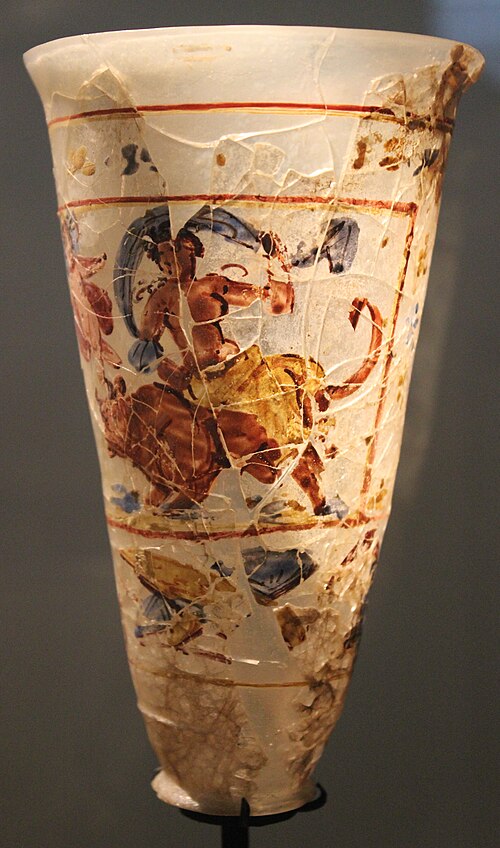 كأس يصور اغتصاب أوروبا وجانيميد ، جزء من كنز باجرام ؛ القرن الأول الميلادي؛ زجاج مطلي؛ الارتفاع: 16 سم، القطر: 10 سم؛ متحف غيميه (باريس) [ 86 ]
 إلهة وموسيقي سماوي ( بوذي )؛ القرن السابع؛ أصباغ على الجص؛ الارتفاع: 2.03 متر؛ متحف الفن الآسيوي ( برلين ، ألمانيا) [ 87 ]
هندي
طوّر البوذيون الأوائل في الهند رموزًا مرتبطة ببوذا . بدأت أهم آثار الفن البوذي الباقية في الفترة التي تلت حكم الموريين ، وتحديدًا في شمال الهند، مع فن كوشان ، والفن اليوناني البوذي في غاندارا، وأخيرًا في العصر الكلاسيكي لفن غوبتا . إضافةً إلى ذلك، ظهرت مدرسة أندرا قبل مدرسة غاندارا، وكان مقرها في جنوب الهند. [ 89 ] لا تزال كميات كبيرة من المنحوتات باقية من بعض المواقع الرئيسية مثل سانشي ، وبهارهوت، وأمارافاتي ، بعضها لا يزال في مكانه الأصلي ، والبعض الآخر في متاحف في الهند أو حول العالم. كانت المعابد البوذية (ستوبا) محاطة بأسوار احتفالية، تتوسطها أربع بوابات مزخرفة ( تورانا ) منحوتة بكثافة ، تواجه الجهات الأصلية. هذه البوابات مصنوعة من الحجر، وإن كانت تتخذ أشكالًا مستوحاة من الخشب. ويمكن تزيينها، هي وجدران المعبد نفسه، بنقوش بارزة، تُصوّر في معظمها حياة بوذا. تدريجيًا، نُحتت تماثيل بالحجم الطبيعي، بدايةً بنقوش بارزة عميقة، ثم أصبحت قائمة بذاتها. [ 90 ] كان فن ماثورا أهم مركز في هذا التطور، الذي شمل الفن الهندوسي والجيني والبوذي على حد سواء. [ 91 ] حافظت واجهات وداخلية قاعات الصلاة المنحوتة في الصخر (تشايتيا) والأديرة (فيهارا) على حالتها بشكل أفضل من الهياكل القائمة بذاتها المماثلة في أماكن أخرى، والتي كانت لفترة طويلة مصنوعة في الغالب من الخشب. تحتوي الكهوف في أجانتا وكارلي وبهاجا وغيرها على منحوتات مبكرة ، غالبًا ما تفوقها في العدد أعمال لاحقة مثل التماثيل الأيقونية لبوذا وبوديساتفا ، والتي لم يُعثر عليها قبل عام 100 ميلادي على الأقل.

 رأس الأسد لأشوكا ؛ حوالي 250 قبل الميلاد؛ حجر رملي مصقول ؛ الارتفاع: 2.2 متر؛ متحف سارناث (الهند) [ 93 ]
 بوديساتفا بادماپاني ؛ حوالي 450-490؛ أصباغ على الصخور؛ الارتفاع: حوالي 1.2 متر؛ كهوف أجانتا (الهند) [ 94 ]

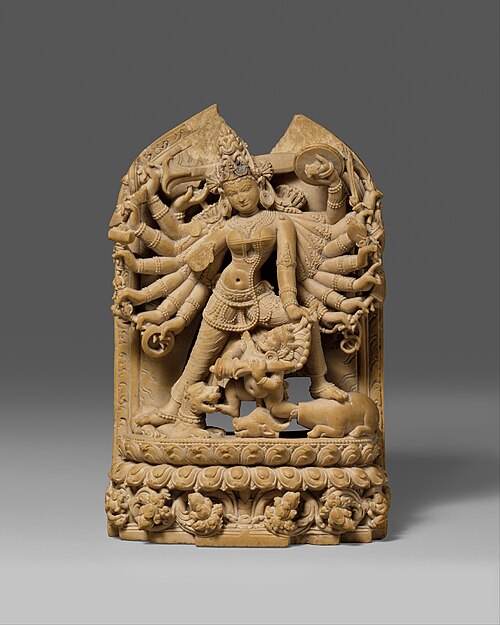 دورجا تقتل شيطان الجاموس؛ حوالي عام 1150؛ أرجيلليت ؛ الارتفاع: 13.5 سم؛ متحف متروبوليتان للفنون (مدينة نيويورك) [ 97 ]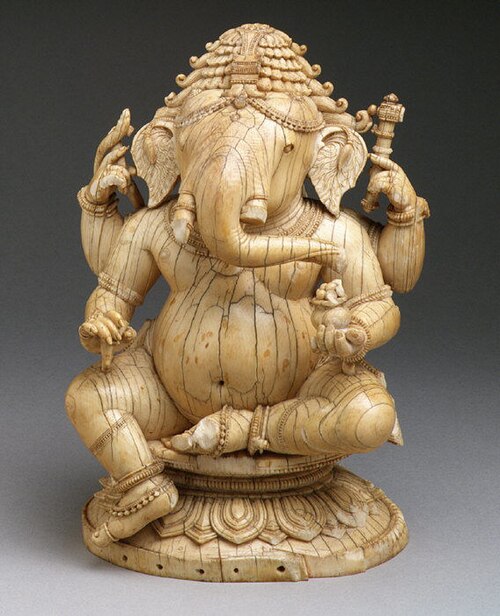
 باساوان أكبرنامه؛ حوالي عام 1590؛ ألوان مائية على ورق؛ 33 × 20 سم؛ متحف فيكتوريا وألبرت (لندن) [ 98 ]
الصينية
في شرق آسيا، استُمدّ فن الرسم من فن الخط، ورُسمت الصور الشخصية والمناظر الطبيعية على قماش الحرير. تُصوّر معظم اللوحات مناظر طبيعية أو صورًا شخصية. أما أروع المنحوتات فهي التماثيل البرونزية الطقسية ومنحوتات سانشينغدوي البرونزية . ومن الأمثلة الشهيرة على الفن الصيني جيش التيراكوتا ، الذي يصور جيوش تشين شي هوانغ ، أول إمبراطور للصين. وهو شكل من أشكال الفن الجنائزي الذي دُفن مع الإمبراطور في الفترة ما بين 210 و209 قبل الميلاد، وكان الغرض منه حماية الإمبراطور في حياته الآخرة.
يُعدّ الفن الصيني من أقدم الفنون التقليدية المستمرة في العالم، ويتميز بدرجة استثنائية من الاستمرارية والوعي بهذا التراث، إذ يفتقر إلى ما يُماثله من انهيار الأساليب الكلاسيكية في الغرب ثم تعافيها التدريجي. وتُعتبر الوسائط التي تُصنّف عادةً في الغرب منذ عصر النهضة ضمن الفنون الزخرفية ذات أهمية بالغة في الفن الصيني، وقد أُنتجت معظم الأعمال الفنية الرائعة في ورش عمل أو مصانع كبيرة على يد فنانين مغمورين، لا سيما في مجال الخزف الصيني . إنّ تنوّع وجودة السلع التي زيّنت القصور والمنازل الصينية وسكانها أمرٌ مُبهر. وقد جُلبت المواد من مختلف أنحاء الصين وخارجها: الذهب والفضة، والصدف ، والعاج وقرن وحيد القرن، والخشب واللك ، واليشم وحجر الصابون ، والحرير والورق.

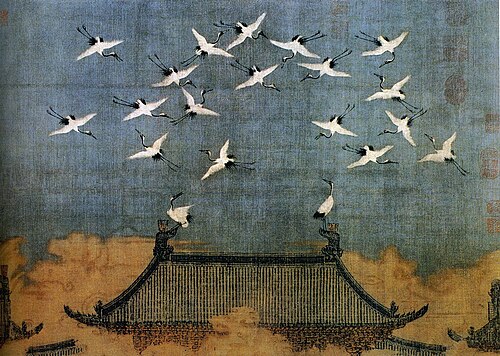 رسم الإمبراطور هويزونغ طيور الكركي الميمونة في مشهد نادر على قمة بوابة المدينة في 16 يناير 1112.
 أوائل الخريف بريشة تشيان شوان ، مثال على الرسم الصيني للطيور والزهور (القرن الثالث عشر)
 جزء من مخطوطة التنانين التسعة الشهيرة ، التي اكتملت في عام 1244 ميلادي
 لوحة منظر ثلجي للفنان ما يوان (حوالي 1160-1225)، متحف القصر الوطني في تايبيه
 الرقص والغناء (الفلاحون العائدون من العمل) حوالي عام 1200
 لوحة على طراز غونغبي بريشة الإمبراطور هويزونغ
 لوحة طبيعة صامتة أخرى على طراز غونغبي من سلالة سونغ الجنوبية
 طيور في غابة من أشجار الخيزران والبرقوق، القرن الثاني عشر.
 الدجاجة الأم وفراخها، من عهد أسرة سونغ . يُعد التباين العالي الناتج عن الخلفية السوداء نادرًا جدًا في الرسم الصيني .
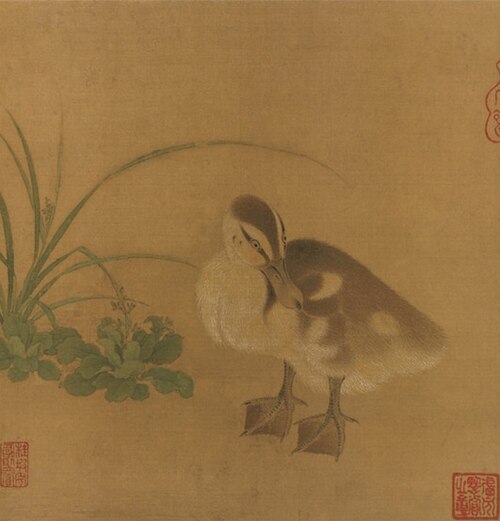 أغنية البطة الصغيرة على طريقة غونغبي
 طائر على غصن من أعمال لي أنتشونغ، أواخر عهد أسرة سونغ الشمالية حوالي عام 1130
 نهر الأصفر يكسر مجراه - سلالة سونغ
 قسم من ثمانية مناظر لمدينة شياوشيانغ ، جولة تخيلية في شياوشيانغ بريشة لي شي؛ القرن الثاني عشر. متحف طوكيو الوطني
 صخور أنيقة وأشجار متفرقة بريشة تشاو منغفو (1254-1322)
 أوائل الربيع ؛ بقلم غو شي ؛ 1072؛ لفافة معلقة، حبر على حرير؛ 1.58 × 1.08 متر؛ متحف القصر الوطني ( تايبيه ، تايوان) [ 101 ]
 تمثال لوهان تامرابهادرا، أحد تماثيل لوهان المصنوعة من الفخار المزجج من ييشيان؛ القرن العاشر - الثالث عشر؛ تيراكوتا مزججة؛ الارتفاع: 123 سم؛ متحف غيميه (باريس)
 غوانيين البحار الجنوبية؛ القرن الحادي عشر - الثاني عشر؛ خشب مطلي ومذهب؛ الارتفاع: 2.41 متر؛ متحف نيلسون-أتكينز للفنون ( كانساس سيتي ، ميسوري ، الولايات المتحدة) [ 102 ]
 سيدات يجهزن الحرير؛ لوحة من القرن الثامن من عهد أسرة تانغ بريشة تشانغ شوان ، نُسخت وأعيد إنتاجها في عهد أسرة سونغ ؛ حبر وألوان على الحرير؛ 0.37 × 1.47 متر؛ متحف الفنون الجميلة ( بوسطن ، الولايات المتحدة) [ 103 ]
 صندوق مزخرف من عهد أسرة سونغ الجنوبية ، حوالي القرن الثالث عشر
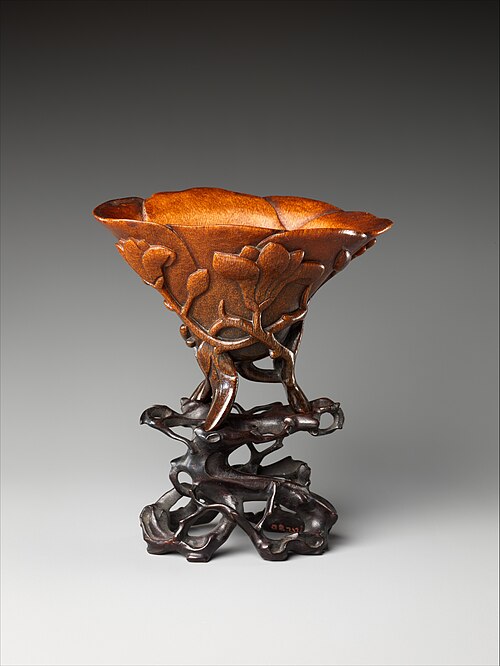 كأس؛ أوائل القرن السابع عشر؛ قرن وحيد القرن؛ الارتفاع: 10.2 سم؛ متحف متروبوليتان للفنون
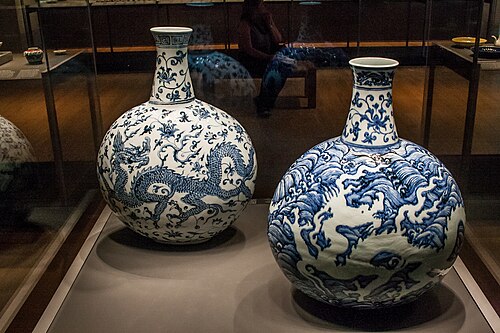 سلالة مينغ ، 1403-1424.
 صندوق مطلي بالمينا ؛ القرن الثامن عشر؛ مينا مطلية بالمينا على النحاس مع برونز مذهب؛ 20.5 × 19.8 سم؛ متحف والترز للفنون ( بالتيمور ، ماريلاند ، الولايات المتحدة الأمريكية)
اليابانية
يشمل الفن الياباني مجموعة واسعة من الأساليب الفنية والوسائط، بما في ذلك الفخار القديم ، والنحت ، والرسم بالحبر والخط على الحرير والورق، ولوحات أوكيو-إي والمطبوعات الخشبية ، والسيراميك، والأوريغامي ، ومؤخراً المانغا - الرسوم المتحركة والقصص المصورة اليابانية الحديثة - إلى جانب عدد لا يحصى من الأنواع الأخرى.
كان شعب جومون ( حوالي 11000-300 قبل الميلاد) أول من استوطن اليابان . وقد صنعوا أواني تخزين فخارية مزخرفة ببذخ ، وتماثيل طينية تُسمى دوغو . تعرضت اليابان لغزوات مفاجئة من الأفكار الجديدة ، تلتها فترات طويلة من الحد الأدنى من التواصل مع العالم الخارجي. ومع مرور الوقت، طور اليابانيون القدرة على استيعاب وتقليد واستيعاب عناصر الثقافة الأجنبية التي تُكمل أذواقهم الجمالية. أُنتجت أقدم الفنون المعقدة في اليابان في القرنين السابع والثامن الميلاديين، بالتزامن مع البوذية . وفي القرن التاسع الميلادي، مع بدء اليابانيين بالابتعاد عن الصين وتطوير أشكال تعبيرية محلية، اكتسبت الفنون الدنيوية أهمية متزايدة؛ وحتى أواخر القرن الخامس عشر الميلادي، ازدهرت الفنون الدينية والدنيوية على حد سواء. بعد حرب أونين (1467-1477)، دخلت اليابان فترة من الاضطرابات السياسية والاجتماعية والاقتصادية استمرت لأكثر من قرن. في الدولة التي نشأت تحت قيادة شوغونية توكوغاوا ، لعب الدين المنظم دورًا أقل أهمية بكثير في حياة الناس، وكانت الفنون التي نجت علمانية في المقام الأول.

 تمثال أنثوي؛ حوالي 1670-1690؛ خزف مع مينا متعدد الألوان فوق الطلاء؛ الارتفاع: 39.7 سم؛ متحف متروبوليتان للفنون (مدينة نيويورك)
 الموجة العظيمة قبالة كاناغاوا ، للفنان كاتسوشيكا هوكوساي ؛ حوالي 1830-1832؛ طباعة خشبية ملونة بالكامل؛ 25.7 × 37.9 سم؛ متحف متروبوليتان للفنون [ 106 ]
 حديقة البرقوق في كاميدو ؛ للفنان هيروشيغي ؛ 1857؛ طباعة خشبية ملونة بالكامل؛ 36.4 × 24.4 سم؛ متحف ريكز ( أمستردام ، هولندا )
أفريقيا جنوب الصحراء
يشمل فن أفريقيا جنوب الصحراء الكبرى كلاً من النحت ، الذي يتميز بمنحوتات النحاس الأصفر لشعب بنين ، وإيغبو أوكو، ومملكة إيفي ، والتماثيل الطينية لمدن جيني-جينو ، وإيفي، وحضارة نوك القديمة ، بالإضافة إلى الفنون الشعبية . بالتزامن مع العصور الوسطى الأوروبية، في القرن الحادي عشر الميلادي، تأسست في زيمبابوي الكبرى دولة اشتهرت بعمارتها الفخمة، ومنحوتاتها الذهبية، ومجوهراتها المتقنة. وفي الوقت نفسه، كان شعب اليوروبا في نيجيريا الحالية يصنع منحوتات رائعة من النحاس الأصفر . وفي مملكة بنين ، الواقعة أيضاً في جنوب نيجيريا، والتي بدأت في نفس الفترة تقريباً، تم ابتكار أنياب مذبح أنيقة، ورؤوس نحاسية، ولوحات نحاسية، وعمارة فخمة. انتهت مملكة بنين على يد البريطانيين عام 1897، ولم يتبق سوى القليل من فنونها في نيجيريا. واليوم، يُعد بينالي جوهانسبرغ أهم مركز فني في أفريقيا .
تتميز منطقة أفريقيا جنوب الصحراء بتنوع ثقافي كبير. ومن أبرز هذه الثقافات: شعب دوغون من مالي ؛ وشعوب إيدو ، ويوروبا ، وإيغبو ، وحضارة نوك من نيجيريا ؛ وشعب كوبا ولوبا من وسط أفريقيا ؛ وشعب أشانتي من غانا ؛ وشعب زولو من جنوب أفريقيا ؛ وشعب فانغ من غينيا الاستوائية (85%)، والكاميرون، والغابون؛ وشعوب حضارة ساو من تشاد؛ وشعب كويلي من شرق الغابون، وجمهورية الكونغو ، والكاميرون.
تُشكّل الأشكال المتعددة للفن الأفريقي جزءًا لا يتجزأ من بعض أكثر التقاليد الفنية حيويةً وتفاعلاً في العالم، وهي عنصر أساسي في حياة الأفارقة. تُصنع الأعمال الفنية لأغراض محددة، ويمكنها أن تُظهر أهميتها المستمرة من خلال تحولات مادية تُحسّن مظهرها وقوتها. تُصنع العديد من أشكال الفن الأفريقي التقليدي كقنوات للتواصل مع العالم الروحي، وتتغير هيئتها بإضافة مواد تُعزز جمالها وقوتها. كلما زاد استخدام العمل الفني وتبريكه، ازداد تجريدًا مع تراكم المواد المستخدمة في القرابين وتلاشي التفاصيل الأصلية.
 تمثال جالس؛ من صنع فنانين من ثقافة نوك ؛ القرن الخامس قبل الميلاد - القرن الخامس الميلادي؛ فخار (وسط نيجيريا)؛ الارتفاع: 38 سم؛ متحف كواي برانلي ، باريس [ 107 ]
 إناء؛ من إيغبو-أوكو ( نيجيريا )؛ القرن التاسع؛ برونز؛ أبعاد غير معروفة؛ المتحف الوطني النيجيري ، لاغوس
 تمثال الرأس البرونزي لأوني أوبالوفون ، كاليفورنيا. القرن الثاني عشر، تم اكتشافه في مدينة اليوروبا المقدسة Yoruba Ilé-Ifẹ̀ ؛ المتحف الوطني النيجيري ، لاغوس
 رأس ملك أو شخصية مرموقة؛ من صنع فنانين من شعب اليوروبا ؛ القرن الثاني عشر - الخامس عشر الميلادي؛ تيراكوتا؛ 19 سم؛ اكتُشف في إيفي (نيجيريا)؛ متحف برلين الإثنولوجي ، ألمانيا
 تمثال لشخص جالس؛ من صنع فنانين من ثقافة دجيني-دجينو (مالي)؛ القرن الثالث عشر؛ خزف؛ العرض: 29.9 سم؛ متحف متروبوليتان للفنون ، مدينة نيويورك [ 107 ]
 قناع معلق ؛ من صنع فنانين من شعب إيدو (نيجيريا)؛ القرن السادس عشر (؟)؛ عاج وحديد؛ الارتفاع: 24.5 سم؛ المتحف البريطاني ، لندن [ 108 ]
 ندوب ، الملك ميشي ميشياانغ مامبول؛ من قبل فنانين من مملكة كوبا ( جمهورية الكونغو الديمقراطية )؛ القرن الثامن عشر؛ خشب؛ 49.5 سم؛ متحف بروكلين ، مدينة نيويورك [ 109 ]
 ماندو يينو (عرش نسانغو)؛ من صنع فنانين من مملكة بامون ؛ حوالي عام 1870؛ خشب، خرز زجاجي، خزف وصدفة؛ الارتفاع: 1.75 متر؛ متحف برلين الإثنولوجي [ 110 ]
 قناع نغاد-أ-مواش؛ من صنع فنانين من شعب كوبا؛ أواخر القرن التاسع عشر - أوائل القرن العشرين؛ خشب، أصداف، خرز زجاجي، رافيا وصبغة؛ الارتفاع: 82 سم؛ معهد ديترويت للفنون ، ديترويت ، ميشيغان ، الولايات المتحدة [ 109 ]
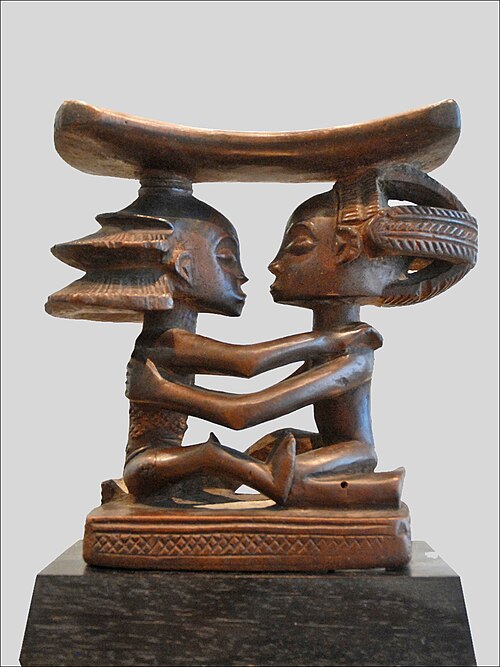 مسند رأس؛ من صنع فنانين من شعب لوبا ؛ القرن التاسع عشر؛ خشب؛ الارتفاع: 18.5 سم؛ متحف كواي برانلي (باريس) [ 111 ]
أوقيانوسيا
يشمل فن أوقيانوسيا المناطق الجغرافية التالية: ميكرونيزيا ، بولينيزيا ، أستراليا، نيوزيلندا، وميلانيزيا . يتناول أحد المناهج هذه المنطقة من منظور موضوعي، مع التركيز على الأصول ، والحرب، والجسد، والجنس، والتجارة، والدين، والسياحة . لسوء الحظ، لم يبقَ إلا القليل من الفن القديم من أوقيانوسيا. ويعتقد الباحثون أن السبب في ذلك هو استخدام الفنانين لمواد قابلة للتلف، كالخشب والريش، التي لم تصمد في المناخ الاستوائي، بالإضافة إلى عدم وجود سجلات تاريخية تشير إلى معظم هذه المواد. لذا، يبدأ فهم الثقافات الفنية في أوقيانوسيا بتوثيقها من قبل الغربيين، مثل الكابتن جيمس كوك ، في القرن الثامن عشر. وفي مطلع القرن العشرين، أمضى الفنان الفرنسي بول غوغان فترات طويلة في تاهيتي، حيث عاش مع السكان المحليين وأبدع فنًا حديثًا، وهو ما أصبح جزءًا لا يتجزأ من الثقافة البصرية التاهيتية حتى يومنا هذا. غالبًا ما يبدو الفن الأصلي في أستراليا كفن حديث تجريدي، ولكنه متجذر بعمق في الثقافة المحلية.
يُعدّ فن أوقيانوسيا آخر تقاليد الفن العظيمة التي حظيت بتقدير العالم أجمع. ورغم كونه أحد أقدم تقاليد الفن المستمرة في العالم، إذ يعود تاريخه إلى خمسين ألف عام على الأقل، فقد ظلّ غير معروف نسبياً حتى النصف الثاني من القرن العشرين.
إن طبيعة المواد الفنية الأسترالية الأصلية، التي غالبًا ما تكون سريعة الزوال، تجعل من الصعب تحديد قدم معظم أشكال الفن الممارس اليوم. أما أكثر الأشكال ديمومةً فهي النقوش والرسومات الصخرية المنتشرة في أنحاء القارة. ففي منحدر أرض أرنهيم، تشير الأدلة إلى أن الرسومات كانت تُصنع قبل خمسين ألف عام، أي قبل الرسومات الصخرية التي تعود إلى العصر الحجري القديم في ألتاميرا ولاسكو في أوروبا .
 هوا هاكاناناي ، مثال على موآي ؛ حوالي 1200 م؛ حمم بركانية متدفقة؛ الارتفاع: 242 سم؛ المتحف البريطاني (لندن) [ 112 ]
 تورابا ( مؤخرة زورق الماوري )؛ أواخر الثامن عشر - أوائل القرن التاسع عشر؛ الخشب والقشر الارتفاع: 148 سم؛ متحف كواي برانلي (باريس) [ 114 ]
 لوحة أسترالية تُصوّر الكنغر كأحد الأجداد الرمزيين؛ حوالي عام ١٩١٥؛ رسم على لحاء الشجر؛ ٩٢٫٥ × ٣٥٫٥ سم؛ متحف كواي برانلي
أوروبي
العصور الوسطى
مع انحسار الإمبراطورية الرومانية حوالي عام 300 ميلادي ، بدأت فترة عُرفت لاحقًا بالعصور الوسطى . استمرت هذه الفترة قرابة ألف عام، حتى بداية عصر النهضة حوالي عام 1400 ميلادي . تميزت المراحل الأولى من هذه الفترة بالفن المسيحي المبكر ، تلاه الفن البيزنطي ، والفن الأنجلوسكسوني ، وفن الفايكنج ، والفن الأوتوني ، والفن الرومانسكي ، والفن القوطي ، مع هيمنة الفن الإسلامي على شرق البحر الأبيض المتوسط. نشأ فن العصور الوسطى من التراث الفني للإمبراطورية الرومانية وبيزنطة ، ممزوجًا بالثقافة الفنية "البربرية" لشمال أوروبا. [ 115 ]
في الفن البيزنطي والقوطي في العصور الوسطى ، أدت هيمنة الكنيسة إلى إنتاج كمية كبيرة من الفن الديني . وشهد هذا الفن استخداماً واسعاً للذهب في اللوحات، التي قدمت الشخصيات بأشكال مبسطة.
البيزنطي


يتألف الفن البيزنطي من مجموعة المنتجات الفنية اليونانية المسيحية للإمبراطورية الرومانية الشرقية (البيزنطية)، [ 117 ] [ 118 ] بالإضافة إلى الدول والشعوب التي ورثت ثقافيًا من تلك الإمبراطورية. ورغم أن الإمبراطورية البيزنطية نفسها انبثقت من رحم انهيار روما واستمرت حتى سقوط القسطنطينية عام 1453، [ 119 ] فإن تاريخ بدء العصر البيزنطي أكثر وضوحًا في تاريخ الفن منه في التاريخ السياسي، وإن كان لا يزال غير دقيق. وقد حافظت العديد من الدول الأرثوذكسية الشرقية في شرق ووسط أوروبا، وكذلك إلى حد ما الدول الإسلامية في شرق البحر الأبيض المتوسط ، على جوانب عديدة من ثقافة الإمبراطورية وفنونها لقرون لاحقة.
معظم الفن البيزنطي الباقي ذو طابع ديني، وهو -باستثناءات في فترات معينة- شديد التنميط، إذ يتبع نماذج تقليدية تُترجم لاهوت الكنيسة المُحكم إلى مصطلحات فنية. وكانت الرسومات الجدارية ، والمخطوطات المزخرفة ، والألواح الخشبية، والفسيفساء (خاصة في الفترات المبكرة) الوسائط الرئيسية، بينما كان النحت التصويري نادرًا جدًا باستثناء المنحوتات العاجية الصغيرة . وقد حافظت رسومات المخطوطات حتى النهاية على بعض من تقاليد الواقعية الكلاسيكية التي غابت عن الأعمال الأكبر حجمًا. [ 120 ] حظي الفن البيزنطي بمكانة مرموقة وإقبال كبير في أوروبا الغربية، حيث استمر تأثيره على فنون العصور الوسطى حتى قرب نهايتها. وكان هذا جليًا في إيطاليا، حيث استمرت الأساليب البيزنطية بشكل مُعدّل حتى القرن الثاني عشر، وأصبحت من المؤثرات الأساسية على فن عصر النهضة الإيطالي . إلا أن التأثيرات الخارجية كانت قليلة على الأسلوب البيزنطي. ومع توسع الكنيسة الأرثوذكسية الشرقية، انتشرت الأشكال والأساليب البيزنطية في جميع أنحاء العالم الأرثوذكسي وخارجه. [ 121 ] يمكن العثور على تأثيرات العمارة البيزنطية، وخاصة في المباني الدينية، في مناطق متنوعة من مصر والجزيرة العربية إلى روسيا ورومانيا.
تشتهر العمارة البيزنطية باستخدام القباب . كما تميزت بأعمدة رخامية، وأسقف مزخرفة، وزخارف فخمة، بما في ذلك الاستخدام الواسع للفسيفساء ذات الخلفيات الذهبية. لم يعد الرخام مادة البناء التي استخدمها المعماريون البيزنطيون، والتي كان الإغريق القدماء يُقدرونها تقديرًا كبيرًا. استخدم البيزنطيون في الغالب الحجر والطوب، بالإضافة إلى صفائح رقيقة من المرمر للنوافذ. استُخدمت الفسيفساء لتغطية جدران الطوب، وأي سطح آخر لا يُناسب الرسم الجداري . من الأمثلة الجيدة على الفسيفساء من العصر البيزنطي المبكر كنيسة هاغيوس ديمتريوس في سالونيك (اليونان)، وكنيسة سانت أبوليناري نوفو وكنيسة سان فيتالي (كلاهما في رافينا بإيطاليا)، وآيا صوفيا في إسطنبول . تختلف المعابد اليونانية الرومانية والكنائس البيزنطية اختلافًا كبيرًا من حيث مظهرها الخارجي والداخلي. في العصور القديمة، كان المظهر الخارجي أهم جزء في المعبد، إذ لم يكن يُسمح بدخول الداخل، الذي يضم تمثال الإله الذي بُني المعبد من أجله، إلا للكاهن. كانت طقوس المعبد تُقام في الخارج، وما يراه المصلون هو واجهة المعبد، المؤلفة من أعمدة، مع إفريز وجملونين. في المقابل، كانت الطقوس المسيحية تُقام داخل الكنائس، ولذلك كان المظهر الخارجي عادةً ما يكون بسيطًا أو خاليًا من الزخارف. [ 122 ] [ 123 ]
 المسيح الراعي الصالح ؛ حوالي 425-430؛ فسيفساء؛ العرض: حوالي 3 أمتار؛ ضريح غالا بلاسيديا ( رافينا ، إيطاليا) [ 124 ]
 إطعام الخمسة آلاف ؛ حوالي 520؛ فسيفساء؛ أبعاد غير معروفة؛ كنيسة سانت أبوليناري نوفو ، رافينا ، إيطاليا
 كنيسة سانت أبوليناري في كلاسي ، رافينا، مهندس معماري غير معروف، ج. 530 [ 125 ]
 ورقة ثنائية مع إمبراطورة بيزنطية؛ القرن السادس؛ عاج مع آثار من التذهيب والورق؛ الارتفاع: 26.5 سم؛ متحف تاريخ الفنون ( فيينا ، النمسا) [ 126 ]
 قلادة؛ أواخر القرن السادس - السابع؛ ذهب، زمرد، ياقوت، جمشت ولآلئ ؛ القطر : 23 سم ؛ من ورشة عمل في القسطنطينية ؛ مجموعة الآثار القديمة في برلين ( برلين ، ألمانيا) [ 127 ]
 صفحة من كتاب الإنجيل مع تعليقات: صورة مرقس؛ 1000-1100؛ حبر، تمبرا ، ذهب، غلاف من الرق والجلد؛ مقاس الورقة: 28 × 23 سم؛ متحف كليفلاند للفنون ( كليفلاند ، أوهايو ، الولايات المتحدة الأمريكية)
 سلم الصعود الإلهي ؛ أواخر القرن الثاني عشر؛ تمبرا وورق الذهب على لوحة؛ 41 × 29.5 سم؛ دير سانت كاترين ( شبه جزيرة سيناء ، مصر) [ 128 ]
 مادونا والطفل على عرش منحني ؛ حوالي عام 1280؛ تمبرا على لوحة؛ 81.5 × 49 سم؛ المعرض الوطني للفنون ، واشنطن العاصمة [ 129 ]
الكارولنجية والأوتونية


ظهر الفن الكارولنجي (القرنين الثامن والتاسع) في عهد شارلمان، ممزوجًا بين التأثيرات الرومانية والمسيحية المبكرة والجرمانية، ليُشكّل أسلوبًا فنيًا مميزًا. وقد مثّل هذا الفن عصر النهضة الكارولنجية، حيث ركّز على إحياء التقاليد الفنية الرومانية الكلاسيكية مع دمج العناصر الجرمانية المحلية. ومن أبرز سماته المخطوطات المزخرفة، مثل أناجيل آخن ، والأيقونات الدينية، والأعمال المعدنية المتقنة، والهندسة المعمارية . ومن الأعمال البارزة كنيسة قصر شارلمان في آخن. وقد ركّز الفن الكارولنجي على المواضيع المسيحية، من خلال تصويرات مُتقنة للقديسين والمشاهد التوراتية والزخارف الكلاسيكية، مما مهّد الطريق لفن العصور الوسطى اللاحقة في أوروبا الغربية.
Ottonian art is a style in pre-romanesqueGerman art, covering also some works from the Low Countries, northern Italy and eastern France. It was named by the art historian Hubert Janitschek after the Ottonian dynasty which ruled Germany and northern Italy between 919 and 1024 under the kings Henry I, Otto I, Otto II, Otto III and Henry II.[130] With Ottonian architecture, it is a key component of the Ottonian Renaissance (circa 951–1024). However, the style neither began nor ended to neatly coincide with the rule of the dynasty. It emerged some decades into their rule and persisted past the Ottonian emperors into the reigns of the early Salian dynasty, which lacks an artistic "style label" of its own.[131] In the traditional scheme of art history, Ottonian art follows Carolingian art and precedes Romanesque art, though the transitions at both ends of the period are gradual rather than sudden. Like the former and unlike the latter, it was very largely a style restricted to a few of the small cities of the period, to important monasteries, as well as to the court circles of the emperor and his leading vassals.
After the decline of the 9th-century Carolingian Empire, the Holy Roman Empire was re-established under the Saxon Ottonian dynasty. From this emerged a renewed faith in the idea of Empire and a reformed Church, creating a period of heightened cultural and artistic fervour. In this atmosphere masterpieces were created that fused the traditions from which Ottonian artists derived their inspiration: models of Late Antique, Carolingian, and Byzantine origin. Surviving Ottonian art is very largely religious, in the form of illuminated manuscripts and metalwork, and was produced in a small number of centres for a narrow range of patrons in the circle of the Imperial court, as well as for important figures in the church. However much of it was designed for display to a wider public, especially to pilgrims.[132]
The style is generally grand and heavy, sometimes to excess, and initially less sophisticated than the Carolingian equivalents, with less direct influence from Byzantine art and less understanding of its classical models, but around 1000 a striking intensity and expressiveness emerge in many works, as "a solemn monumentality is combined with a vibrant inwardness, an unworldly, visionary quality with sharp attention to actuality, surface patterns of flowing lines and rich bright colours with passionate emotionalism".[133]
Romanesque
The Romanesque, the first pan-European style to emerge after the Roman Empire, spanned the mid-tenth century to the thirteenth. The period saw a resurgence of monumental stone structures with complex structural programmes.
Romanesque churches are characterized by rigid articulation and geometric clarity, incorporated into a unified volumetric whole. The architecture is austere but enlivened by decorative sculpting of capitals and portals, as well as frescoed interiors. Geometric and foliate patterning gives way to increasingly three-dimensional figurative sculpture.
St. Michael's Church, Hildesheim, Germany, 1001–1030, is seen by some as a Proto-Romanesque church.[134]
From the mid-eleventh to the early thirteenth centuries, Romanesque paintings were two-dimensional, defined by bold, linear outlines and geometry, particularly in the handling of drapery; painters emphasised symmetry and frontality. Virtually all Western churches were painted, but probably only a few wall-painters were monks; instead, itinerant artists carried out most of this work. Basic blocking-out was done on wet plaster with earth colours. A limited palette, dominated by white, red, yellow ochres and azure, was employed for maximum visual effect, with dense colouring forming a backdrop of bands, a practice that originated in late Classical art as an attempt to distinguish earth and sky.
During the later eleventh and twelfth centuries, the great age of Western monasticism, Europe experienced unprecedented economic, social and political change, leading to burgeoning wealth among landowners, including monasteries. There was increasing demand for books, and economic wealth encouraged the production of richly illuminated manuscripts.
One of the outstanding artefacts of the age is the 70 m long Bayeux Tapestry.[135][136][137] It depicts the events leading up to the Norman conquest of England with protagonists William, Duke of Normandy, and Harold, Earl of Wessex, later King of England, and culminating in the Battle of Hastings of 1066. It is thought to date from the 11th century. It tells the story from the point of view of the conquering Normans, but is now agreed to have been made in England - most likely by women, although the designer is unknown. It is housed in France.
 'Holy Face'; 904–1018; wood with polychromy; height: 2.9 m; Sansepolcro Cathedral (Sansepolcro, Italy)[138]

 Head of pope Alexander; 1145; wood, silver, gilt bronze, gems, pearls and champlevé enamel; height: c. 45 cm; Art & History Museum (Brussels, Belgium)[141]
 The stoning of Saint Stephen; 1160s; fresco; height: 1.3 m; Saint John Abbey (Val Müstair, Canton of Grisons, Switzerland)[142]
Gothic
Gothic art developed in Northern France out of Romanesque in the 12th century AD, and led by the concurrent development of Gothic architecture. It spread to all of Western Europe, and much of Southern and Central Europe, never quite effacing more classical styles in Italy. In the late 14th century, the sophisticated court style of International Gothic developed, which continued to evolve until the late 15th century.
Brick Gothic was a specific style of Gothic architecture common in Northeast and Central Europe especially in the regions in and around the Baltic Sea, which do not have resources of standing rock. The buildings are essentially built using bricks.
The imposing Gothic cathedrals, with their sculptural programmes and stained glass windows, epitomize the Gothic style.[143] It differs from Romanesque through its rib-shaped vaults, and the use of ogives. Instead of the thick Romanesque walls, Gothic buildings are thin and tall. Spiral stairs in towers are specific to Gothic architecture.[144]
Gothic painting, much of it executed in tempera and, later, oils on panel, as well as fresco, and with an increasingly broad palette of secondary colours, is generally seen as more 'naturalistic' than Romanesque. The humanity of religious narrative was highlighted, and the emotional state of the characters individualized.[145] The increased urbanity of the medieval economy and the rise of the clerical and lay patron saw a change in the nature of the art market, which can be seen in developments in Gothic manuscript illumination. Workshops employed specialists for different elements of the page, such as figures or marginal vine motifs.[146]
 North transept windows; c. 1230–1235; stained glass; diameter (rose window): 10.2 m; Chartres Cathedral (Chartres, France)[147]
 Ekkehard and Uta; attributed to the Master of Namburg; 1245–1260; limestone and polychromy; height: c. 1.9 m; Naumburg Cathedral (Naumburg, Germany)[149]
 Arrest of Christ and Annunciation of the Virgin; by Jean Pucelle; 1324–1328; grisaille and temprea on vellum; 8.9 x 12.4 cm; Metropolitan Museum of Art (New York City)[146]
 The Wilton Diptych; c. 1395–1459; tempera and gold on panel; 53 × 37 cm; National Gallery (London)[145]
 St. Mary's Church, 1265-1352, in Lübeck, Germany
 Brick Gothic with some decoration of stone, Old St. John's Hospital, 13th to 15th century, in Bruges, Belgium
Renaissance
Encompassing Early, Northern and High Renaissance, the term Renaissance describes the 'rebirth' in Europe of a new interest for Classical antiquity. For the first time since antiquity, art became convincingly lifelike. Besides the ancient past, Renaissance artists also studied nature, understanding the human body, animals, plants, space, perspective and the qualities of light. The most common theme were religious subjects, but depictions of mythological stories were produced as well. Also, there was no uniform Renaissance style. Each artist developed their own distinct visual language, influenced by their predecessors and contemporaries.
The Early Renaissance was a period of great creative and intellectual activity when artists broke away completely from the parameters of Byzantine art. It is generally accepted that it started in Florence in present-day Italy in the early 15th century. It is characterized by a surge of interest in classical literature, philosophy and art, the growth of commerce, the discovery of new continents, and new inventions. There was a revival of interest in the art and literature of ancient Rome, and the study of ancient Greek and Latin texts instigated concepts of individualism and reason, which became known as humanism. Humanists considered life in the present and emphasized the importance of individual thought, which affected artists' approaches.
Despite being highly associated with Italy, particularly with Florence, Rome, and Venice, the rest of Western Europe participated to the Renaissance as well.[150] The Northern Renaissance occurred in Europe north of the Alps from the early 15th century, following a period of artistic cross-fertilization between north and south known as 'International Gothic'. There was a big difference between the Northern and Italian Renaissance. The North artists did not seek to revive the values of ancient Greece and Rome like the Italians, while in the south Italian artists and patrons were amazed by the empirical study of nature and the human society, and by the deep colors that northern artists could achieve in the newly developed medium of oil paint. The Protestant Reformation increased the northern interest in secular painting, like portraits or landscapes. Two key northern artists are Hieronymus Bosch, known for his surreal paintings filled with hybrid creatures like The Garden of Earthly Delights, and Albrecht Dürer, who brought the new art of printmaking to a new level.
The High Renaissance took place in the late 15th-early 16th centuries and was influenced by the fact that as papal power stabilized in Rome, several popes commissioned art and architecture, determined to recreate the city's former glory. Raphael and Michelangelo produced vast and grandiose projects for the popes. The most famous artwork of this part of the Renaissance is probably the ceiling of the Sistine Chapel.
Mannerism broke away from High Renaissance ideals of harmony and a rational approach to art, to embrace exaggerated forms, elongated proportions, and more vibrant colors. It developed in Italy between 1510 and 1520, among artists who prized originality above all. The name of this movement comes from the Italian maniera, meaning 'style' or 'manner'. The word was meant to describe the standard of excellence achieved during the High Renaissance, to which all art should now adhere, but in practice it led to stylization and art 'to show art', sometimes with great success, an example being Raphael's pupil Giulio Romano. Mannerism has also been used more generally to describe a period following the Renaissance and preceding the Baroque.[151]
 The Florence Cathedral (Florence, Italy), 1294–1436, by Arnolfo di Cambio, Filippo Brunelleschi and Emilio De Fabris[152]
 Crucifix; by Giotto; c. 1300; tempera on panel; 5.78 x 4.06 m; Santa Maria Novella (Florence, Italy)[153]
 Arnolfini Portrait; by Jan van Eyck; 1434; oil on panel; 82.2 x 60 cm; National Gallery (London)[154]
 Saint George and the Dragon; by Paolo Uccello; c. 1470; oil on canvas; 55.6 x 74.2 cm; National Gallery (London)[156]
 Primavera; by Sandro Botticelli; c. 1478; tempera on panel; 2 x 3.1 m; Uffizi Gallery (Florence)[157]

 The Garden of Earthly Delights; by Hieronymus Bosch; c. 1504; oil on panel; 2.2 x 1.95 m; Museo del Prado (Madrid, Spain)[160]
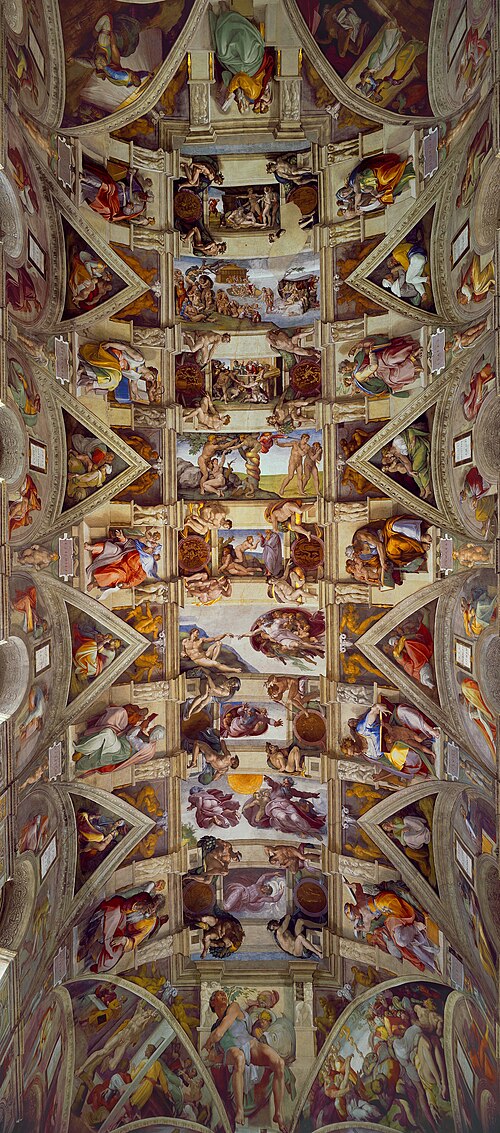 Sistine Chapel ceiling; by Michelangelo; 1508–1512; fresco; 13.7 x 39 m; Sistine Chapel (Vatican City)[161]
 The School of Athens; by Raphael; 1509–1510; fresco; 5.8 x 8.2 m; Apostolic Palace (Vatican City)[162]
 The Rhinoceros; by Albrecht Dürer; 1515; woodcut; 23.5 × 29.8 cm; National Gallery of Art (Washington, D.C., US)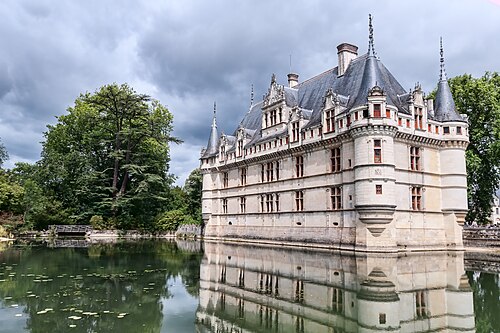
 The Tower of Babel; by Pieter Bruegel the Elder; 1563; oil on panel; 1.14 x 1.55 m; Kunsthistorisches Museum (Vienna, Austria)[164]
 Cupboard; c. 1580; walnut and oak, partially gilded and painted; height: 2.06 m, width: 1.50 m; Louvre[165]
Baroque


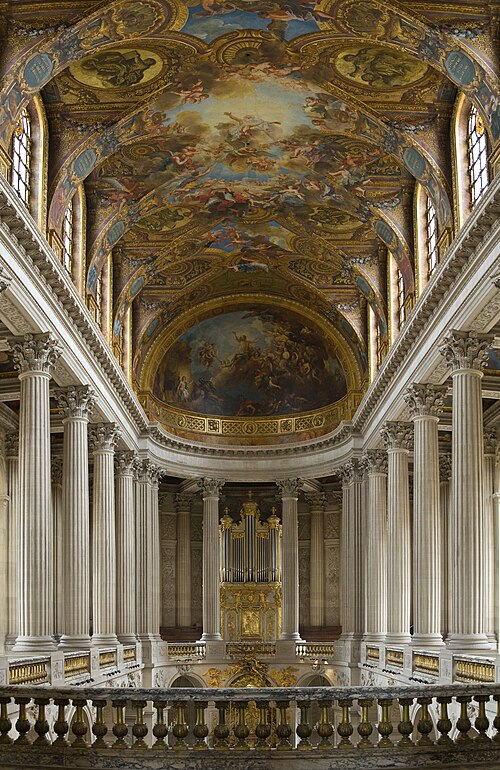


The 17th century was a period of volatile change, both in science, through inventions and developments, such as the telescope or the microscope, and in religion, as the Catholic Counter-Reformation contested the growing popularity of Protestant faith. After the Protestant Reformation the Catholic Church reacted with the Counter-Reformation, decreeing that art should inspire viewers with passionate religious themes.
Succeeding Mannerism, and developing as a result of religious tensions across Europe, Baroque art emerged in the late 16th century. The name may derive from 'barocco', the Portuguese word for misshaped pearl, and it describes art that combined emotion, dynamism and drama with powerful color, realism and strong tonal contrasts. Between 1545 and 1563 at the Council of Trent, it was decided that religious art must encourage piety, realism and accuracy, and, by attracting viewers' attention and empathy, glorify the Catholic Church and strengthen the image of Catholicism. In the next century the radical new styles of Baroque art both embraced and developed High Renaissance models, and broke new ground both in religious art and in new varieties of secular art – above all landscape. The Baroque and its late variant the Rococo were the first truly global styles in the arts, dominating more than two centuries of art and architecture in Europe, Latin America and beyond from circa 1580 to circa 1750. Born in the painting studios of Bologna and Rome in the 1580s and 1590s, and in Roman sculptural and architectural ateliers in the second and third decades of the 17th century, the Baroque spread swiftly throughout Italy, Spain and Portugal, Flanders, France, the Netherlands, England, Scandinavia, and Russia, as well as to central and eastern European centres from Munich (Germany) to Vilnius (Lithuania). The Portuguese, Spanish and French empires and the Dutch trading network had a leading role in spreading the two styles into the Americas and colonial Africa and Asia, to places such as Lima, Mozambique, Goa and the Philippines.
Just like paintings and sculptures, Baroque cathedrals and palaces are characterised by the use of illusion and drama as well. They also frequently use dramatic effects of light and shade, and have sumptuous, highly decorated interiors that blurred the boundaries between architecture, painting and sculpture. Another important characteristic of Baroque architecture was the presence of dynamism, done through curves, Solomonic columns and ovals. In France, Baroque is synonymous with the reign of Louis XIV between 1643 and 1715, since multiple monumental buildings were built in Paris, Versailles and other parts of France during his rule, such as the Palace of Versailles, the Château de Maisons, the Château de Vaux-le-Vicomte, the Louvre Colonnade or The Dôme des Invalides. Besides the building itself, the space where it was placed has a role too. Baroque buildings try to seize viewers' attention and to dominate their surroundings, whether on a small scale such as the San Carlo alle Quattro Fontane in Rome, or on a massive one, like the new facade of the Santiago de Compostela Cathedral, designed to tower over the city. Applied arts prospered during this period as well. Baroque furniture could be as bombastic as the rooms they were meant to adorn, and their motifs and techniques were carefully calibrated to coordinate with the architect's overall decorative programme. One of the most prestigious furniture makers was André Charles Boulle, known for his marquetry technique, made by gluing sheets of tortoiseshell and brass together and cut to form the design. His works were also adorned with gilded bronze mounts. Complex Gobelins tapestries featured scenes inspired by classical antiquity, and the Savonnerie manufactory produced big highly detailed carpets for the Louvre. These carpets with black or yellow backgrounds had a central motif or a medallion. Chinese porcelain, Delftware and mirrors fabricated at Saint-Gobain (France) spread rapidly in all princely palaces and aristocratic residences in France. During the reign of Louis XIV, big mirrors are put above fireplace mantels, and this trend will last long after the Baroque period.[166]
 The Four Continents; by Peter Paul Rubens; c.1615; oil on canvas; 209 x 284 cm; Kunsthistorisches Museum (Vienna, Austria)
 The Rape of the Sabine Women; by Nicolas Poussin; 1634–1635; oil on canvas; 1.55 × 2.1 m; Metropolitan Museum of Art (New York City)[168]
 The Night Watch; by Rembrandt; 1642; oil on canvas; 3.63 × 4.37 m; Rijksmuseum (Amsterdam, the Netherlands)[169]
 Ecstasy of Saint Teresa; by Gian Lorenzo Bernini; 1647–1652; marble; height: 3.5 m; Santa Maria della Vittoria (Rome)[170]
 Las Meninas; by Diego Velázquez; 1656; oil on canvas; 318 cm × 2.76 m; Museo del Prado (Madrid, Spain)[171]
 Vanitas Still Life; by Maria van Oosterwijck; 1668; oil on canvas; 73 x 88.5 cm; Kunsthistorisches Museum[172]
 Carpet with fame and fortitude; by the Savonnerie manufactory; 1668–1685; knotted and cut wool pile, woven with about 90 knots per square inch; 909.3 x 459.7 cm; Metropolitan Museum of Art
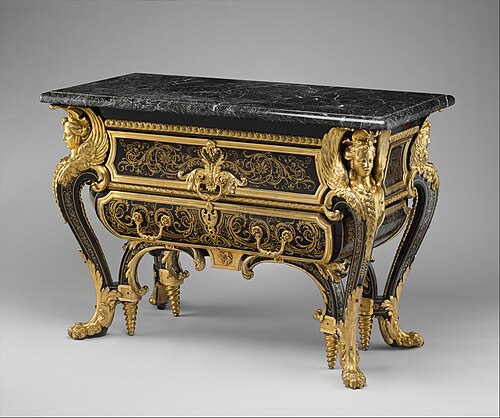 Commode; by André Charles Boulle; c. 1710–1732; walnut veneered with ebony and marquetry of engraved brass and tortoiseshell, gilt-bronze mounts, antique marble top; 87.6 x 128.3 x 62.9 cm; Metropolitan Museum of Art[174]
 Part of a Meissen porcelain tea and chocolate service, c. 1725, given to Vittorio Amadeo II, King of Sardinia (1666–1732) by Augustus the Strong, owner of the Meissen factory
Rococo

Originating in c.1720 Paris, Rococo is characterized by natural motifs, soft colours, curving lines, asymmetry and themes including love, nature and light-hearted entertainment. Its ideals were delicacy, gaiety, youthfulness and sensuality.
Beginning in France as a reaction against the heavy Baroque grandeur of Louis XIV's court at the Palace of Versailles, the rococo movement became associated particularly with the powerful Madame de Pompadour (1721–1764), the mistress of the new king Louis XV (1710–1774). Because of this, the style was also known as 'Pompadour'. The name of the movement derives from the French 'rocaille', or pebble, and refers to stones and shells that decorate the interiors of caves, as similar shell forms became a common feature in Rococo design. It began as a design and decorative arts style, and was characterized by elegant flowing shapes. Architecture followed and then painting and sculpture. The French painter with whom the term Rococo is most often associated is Jean-Antoine Watteau, whose pastoral scenes, or fêtes galantes, dominate the early part of the 18th century.
Although there are some important Bavarian churches in this style, such as the Wieskirche, Rococo is most often associated with secular buildings, principally great palaces and salons where educated elites would meet to discuss literary and philosophical ideas. In Paris, its popularity coincided with the emergence of the salon as a new type of social gathering, the venues for which were often decorated in the Rococo style. Among the most characteristically elegant and refined examples is the Salon Oval de la Princesse of the Hôtel de Soubise, one of the most beautiful 18th century mansions in Paris. The Rococo introduced dramatic changes to elite furniture, as it favoured smaller pieces with narrow, sinewy frames and more delicate, often asymmetrical decoration, often including elements of chinoiserie. The taste for Far Eastern objects (mainly Chinese) lead to the use of Chinese painted and lacquered panels for furniture.
The movement spread quickly throughout Europe and as far as Ottoman Turkey and China thanks to ornament books featuring cartouches, arabesques and shell work, as well as designs for wall panels and fireplaces. The most popular were made by Juste-Aurèle Meissonnier (1695–1750), Jacques-François Blondel (1705–1774), Pierre-Edmé Babel (1720–1775) and François de Cuvilliés (1695–1768).[176]
 The Embarkation for Cythera; by Jean-Antoine Watteau; 1718; oil on canvas; 1.29 x 1.94 m; Schloss Charlottenburg[177]
 The Salon Oval de la Princesse of the Hôtel de Soubise (Paris), 1737–1739, by Germain Boffrand, Charles-Joseph Natoire and Jean-Baptiste Lemoyne[179]
 Candelabrum; by Jean Joseph de Saint-Germain; c.1750; gilt bronze; overall: 72.4 x 49.3 x 39.7 cm; Cleveland Museum of Art (Cleveland, Ohio, US)
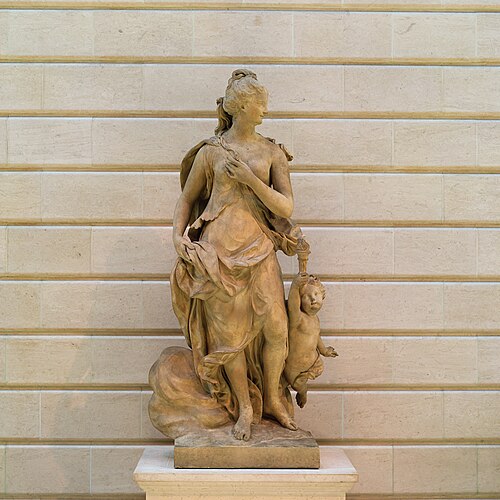 Fire; by Jean-Pierre Defrance; c.1750-1760; limestone; height: 223 cm; Metropolitan Museum of Art (New York City)
 Pilgrimage Church of Wies, Steingaden, Germany, by Dominikus and Johann Baptist Zimmermann, 1754[180]
 Side table (commode en console); by Bernard II van Risamburgh; c.1755-1760; Japanese lacquer, gilt-bronze mounts and Sarrancolin marble top; height: 90.2 cm; Metropolitan Museum of Art
 Madame de Pompadour; by François Boucher; 1756; oil on canvas; 2.01 x 1.57 m; Alte Pinakothek (Munich, Germany)[179]
 Coffeepot; 1757; silver; height: 29.5 cm; Metropolitan Museum of Art
 Covered tureen (terrine du roi); by the Manufacture nationale de Sèvres 1756; soft-paste porcelain with enamel and gilt decoration; overall: 24.2 cm; Cleveland Museum of Art
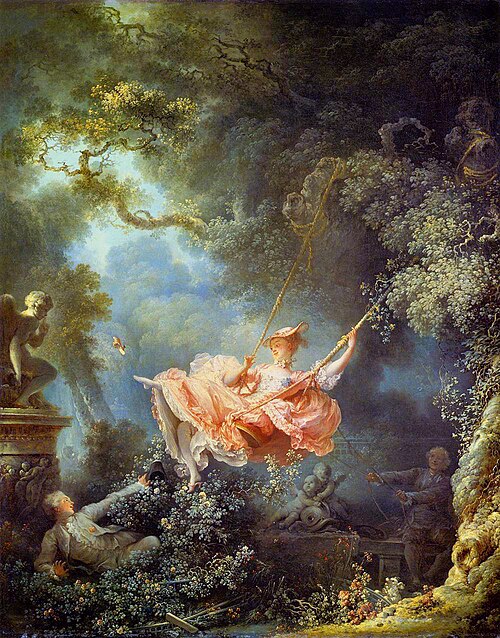 The Swing; by Jean-Honoré Fragonard; 1767; oil on canvas; 81 x 64 cm; Wallace Collection (London)[179]
 Marie-Antoinette with the Rose; by Élisabeth Vigée Le Brun; 1783; oil on canvas; 130 x 87 cm; Palace of Versailles (Versailles, France)
Neoclassicism

Inspired by the excavations of the ancient Roman cities of Pompeii and Herculaneum from 1748, a renewed interest in the arts of antiquity occurred. Neoclassicism dominates Western art from the mid to late 18th century until the 1830s. Embracing order and restraint, it developed in reaction to the perceived frivolity, hedonism and decadence of Rococo and exemplifying the rational thinking of the 'Age of Enlightenment' (aka the 'Age of Reason'). Initially, the movement was developed not by artists, but by Enlightenment philosophers. They requested replacing Rococo with a style of rational art, moral and dedicated to the soul.[182] This fit well with a perception of Classical art as the embodiment of realism, restraint and order. Inspired by ancient Greek and Roman art, the classical history paintings of the French artist Nicolas Poussin (1594–1665) and the ideas of the German writer Anton Raphael Mengs (1728–1779) and the German archaeologist and art historian Johann Joachim Winckelmann (1717–1768), Neoclassicism began in Rome, but soon spread throughout Europe. Rome had become the main focus of the Grand Tour by the mid-18th century, and aristocratic travellers went there in search of Classical visions to recreate on their country estates, thus spreading the style across Europe, particularly in England and France. The tour was also an opportunity for collecting Classical antiquities. Neoclassical paintings tended to be populated with figures posed like Classical statues or reliefs, set in locations filled with archaeological details. The style favoured Greek art over Roman, considering it purer and more authentically classical in its aesthetic goal.
In 1789, France was on the brink of its first revolution and Neoclassicism sought to express their patriotic feelings. Politics and art were closely entwined during this period. They believed that art should be serious, and valued drawings above painting; smooth contours and paint with no discernible brushstrokes were the ultimate aim. Both painting and sculpture exerted calmness and restraint and focused on heroic themes, expressing such noble notions as self-sacrifice and nationalism.
This movement paved the way for Romanticism, that appeared when the idealism of the revolution faded away and after the Napoleonic period came to an end in the early 19th century. Neoclassicism should not be seen as the opposite of Romanticism, however, but in some ways an early manifestation of it.[183][184]
 Fantasy View with the Pantheon and other Monuments of Ancient Rome, by Giovanni Paolo Panini, 1737, oil on canvas, Museum of Fine Arts, Houston, US
 The ancient Capitol ascended by approximately one hundred steps . . ., by Giovanni Battista Piranesi, c.1750, etching, Metropolitan Museum of Art, New York City

 A Philosopher Lecturing on the Orrery, by Joseph Wright of Derby, c.1766, oil on canvas, Derby Museum and Art Gallery, Derby, England[187]

 Brandenburg Gate in Berlin (1788–1791) by Carl Gotthard Langhans
 Washstand (athénienne or lavabo), 1800–1814, legs, base and shelf of yew wood, gilt-bronze mounts, iron plate beneath shelf, Metropolitan Museum of Art
 Portrait of Charlotte du Val d'Ognes, by Marie-Denise Villers, 1801, oil on canvas, Metropolitan Museum of Art[190]
 The Three Graces, by Antonio Canova, 1813–1816, marble, Hermitage Museum, Saint Petersburg, Russia[191]
 Altes Museum in Berlin (1825–1830) by Karl Friedrich Schinkel
Western art after 1770

Many art historians place the origins of modern art in the late 18th century, others in the mid 19th century. Art historian H. Harvard Arnason stated "a gradual metamorphosis took place in the course of a hundred years."[192] Events such as the Age of Enlightenment, revolutions and democracies in America and France, and the Industrial Revolution had far reaching affects in western culture. People, commodities, ideas, and information could travel between countries and continents with unprecedented speed and these changes were reflected in the arts. The invention of photography in the 1830s further altered certain aspects of art, particularly painting. By the dawn of the 19th century, a long and gradual paradigm shift was complete, from the Gothic when artists were viewed as craftsmen in the service of the church and monarchies, to the idea of art for art's sake, where the ideas and visions of the individual artist were held in the high regard, with patronage from an increasingly literate, affluent, and urban middle and upper class population that had been emerging for 200 years (particularly in Paris and London). A dichotomy began in the late 18th century between neoclassicism and romanticism that subdivided and continued to run through virtually every new movement in modern art: "Spreading like waves, these "isms" defy national, ethnic, and chronological boundaries; never dominant anywhere for long, they compete or merge with each other in endlessly shifting patterns."[193]
Modern art has consistently moved toward international influences and exchanges, from the exotic curiosity of Orientalism, the deeper influence of Japonisme, to the arts of Oceania, Africa, and the Americas. Conversely modern art has increasingly extended beyond western Europe. In Russia and the US the arts were developing to a degree that rivaled the leading European countries by the end of the 19th century. Many of the major movements appeared in Latin America, Australia, and Asia too and geography and nationality became increasingly insignificant with each passing decade. By the 20th century important and influential artists were emerging around the world: e.g. Foujita (Japan), Arshile Gorky (Armenia), Diego Rivera and Frida Kahlo (Mexico), Wifredo Lam (Cuba), Edvard Munch (Norwegian), Roberto Matta (Chilean), Mark Rothko (Lithuanian-American), Fernando Botero Angulo (Colombia), Constantin Brâncuși and Victor Brauner (Romania).[194][195][196][197][198]
 Newton's Cenotaph, exterior by night; by Étienne-Louis Boullée; 1784; ink and wash, 40.2 × 63.3 cm.; Bibliothèque Nationale
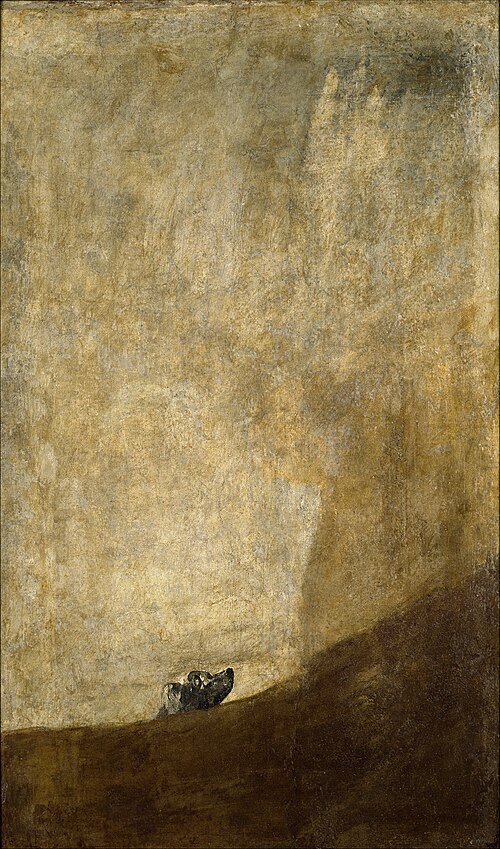 The Dog; Francisco de Goya; ca. 1819–1823; mural transferred to canvas, 131.5 × 79.3 cm.; Museo del Prado
 Toothless Man Laughing, Charles Philipon form Célébrités du Juste milieu; Honoré Daumier; 1832–33; painted clay, 16.4 x 13 x 10.6 cm; Musée d'Orsay
 Still life with statue of Jupiter Tonans; by Louis Jacques Daguerre; c. 1839; daguerreotype
19th century
Romanticism (c. 1790–1880)


Romanticism emerged in the late 18th century out of the German Sturm und Drang movement and flourished in the first half of the 19th century with significant and international manifestations in music, literature, and architecture, as well as the visual arts. It grew from a disillusionment with the rationalism of 18th century Enlightenment. Despite being often viewed as the opposite of Neoclassicism, there were some stylistic overlapping with both movements, and many Romantic artists were excited by classicism. The movement focused on intense emotions, imagination, and on the impressive power of nature, a bigger and more powerful force than the one of men, with its potential for disaster. "Neoclassicism is a new revival of classical antiquity... while Romanticism refers not to a specific style but to an attitude of mind that may reveal itself in any number of ways."[200]
One of the earliest expressions of romanticism was in the English landscape garden, carefully designed to appear natural and standing in dramatic contrast to the formal gardens of the time. The concept of the "natural" English garden was adopted throughout Europe and America in the following decades. In architecture, the romantics frequently turned to alternative sources other than the Greek and Roman examples admired by the neo-classicist. Romantic architecture often revived Gothic forms and other styles such as exotic eastern models. The Palace of Westminster (Houses of Parliament), London is an example of romantic architecture that is also referred to as Gothic Revival.[200] In painting romanticism is exemplified by the paintings of Francisco Goya in Spain, Eugène Delacroix and Théodore Géricault in France, William Blake, Henry Fuseli, Samuel Palmer, and William Turner in England, Caspar David Friedrich and Philipp Otto Runge in Germany, Francesco Hayez in Italy, Johan Christian Claussen Dahl in Norway, and Thomas Cole in America. Examples of sculptors of the romantic period include Antoine-Louis Barye, Jean-Baptiste Carpeaux, Auguste Préault, and François Rude. As romanticism ran its course, some aspects of the movement evolved into symbolism.[201][202][197][203][204]
 Elohim Creating Adam; by William Blake; 1795; color print finished in ink and watercolour on paper; 43.1 × 53.6 cm; Tate Britain (London)[205]
 The Morning, by Philipp Otto Runge, 1808
 The Third of May 1808; by Francisco Goya; 1814; oil on canvas; 2.68 × 3.47 m; Museo del Prado (Madrid, Spain)[206]

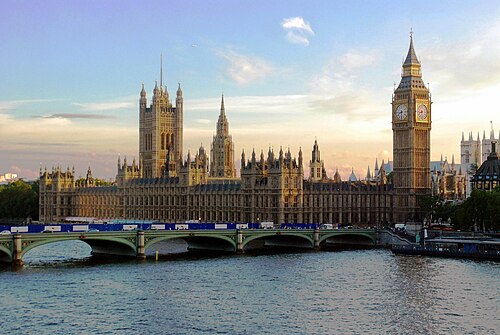
 Schwerin Castle, Schwerin, Mecklenburg-Vorpommern, Germany, 1845-1857, by Gottfried Semper, Friedrich August Stüler, Georg Adolf Demmler and Ernst Friedrich Zwirner
Academism
Academism is the codification of art into rules that can be learned in art academies. It promotes the Classical ideals of beauty and artistic perfection. There was also a very strict hierarchy of subjects. At the top, there were paintings that depicted historic events, including the biblical and Classical ones, followed by the portrait and by the landscape. At the bottom of the hierarchy were still life and genre painting. Nicolas Poussin was the artist whose works and theories played the most significant role in the development of academism. The values of academism were situated in the centre of the Enlightenment project of discovering the basic principles and ideals of art.
During the 18th century, across all Europe, many academies were founded, that will later dominate the art of the 19th century. In order to study at an art academy, young artists had to take an admission exam, and after being admitted, they would study there for multiple years. Most of the 19th century French art movements were exterior or even opposing the values of academism.
Some of the most important artists of the French academy were William Bouguereau (1825–1905), Jean-Léon Gérôme (1824–1904), Alexandre Cabanel (1823–1889) and Thomas Couture (1815–1879). Academic art is closely related to Beaux-Arts architecture, which developed in the same place and holds to a similar classicizing ideal. The Beaux-Arts style takes its name from the École des Beaux-Arts in Paris, where it developed and where many of the main exponents of the style studied.[210][211]

 Pollice Verso (Thumbs Down); by Jean-Léon Gérôme; 1872; oil on canvas; height: 96.5 cm; Phoenix Art Museum (Phoenix, Arizona, US)
 The Birth of Venus; by William-Adolphe Bouguereau; 1879; oil on canvas; 300 x 215 cm; Musée d'Orsay (Paris)[213]
 Phaedra; by Alexandre Cabanel; 1880; oil on canvas; 194 x 286 cm; Musée Fabre (Montpellier, France)[214]
 The Roses of Heliogabalus; by Lawrence Alma-Tadema; 1888; oil on canvas; 1.3 x 2.1 m; private collection of Juan Antonio Pérez Simón[215]
Revivalism and Eclecticism
When it comes to architecture and applied arts, the 19th century is best known as the century of revivals. One of the most well-known revivalist styles is the Gothic Revival or Neo-Gothic, which first appeared in the mid-18th century in a few houses in England, like the Strawberry Hill House in London. However, these houses were isolated cases, since the beginning of the 19th century was dominated by Neoclassicism. Later, between 1830 and 1840, a taste and nostalgia for the rediscovery of past styles, ranging from the Middle Ages to the 18th century, developed under the influence of romanticism. Approximatively until World War I, rehashes of the past dominated the world of architecture and applied arts. Associations between styles and building types appeared, for example: Egyptian for prisons, Gothic for churches, or Renaissance Revival for banks and exchanges. These choices were the result of other associations: the pharaohs with death and eternity, the Middle Ages with Christianity, or the Medici family with the rise of banking and modern commerce. Sometimes, these styles were also seen in a nationalistic way, on the idea that architecture might represent the glory of a nation. Some of them were seen as 'national styles', like the Gothic Revival in the UK and the German states or the Romanian Revival in Romania. Augustus Pugin called the Gothic style the 'absolute duty'[216] of the English architect, despite the fact that the style is of French origin. This way, architecture and the applied arts were used to grant the aura of a highly idealized glorious past. Some architects and designers associated historic styles, especially the medieval ones, with an idealized fantasy organic life, which they put in comparison with the reality of their time.[217]
Despite revivalism being so prevalent, this doesn't mean that there was no originality in these works. Architects, ébénistes and other craftsmen, especially during the second half of the 19th century, created mixes of styles, by extracting and interpreting elements specific to certain eras and areas. This practice is known as eclecticism. This stylistic development occurred during a period when the competition of World's Fairs motivated many countries to invent new industrial methods of creation.
 Egyptian Revival - Coin cabinet; 1809–1819; mahogany (probably Swietenia mahagoni), with applied and inlaid silver; 90.2 x 50.2 x 37.5 cm; Metropolitan Museum of Art
 Gothic Revival - Pair of vases; manufactured in 1832, decorated in 1844; hard-paste porcelain; 36.4 x 32.7 x 20 cm; Metropolitan Museum of Art
 Renaissance Revival - Buffet; by Henri-Auguste Fourdinois, Nivillier, Party, Hugues Protat, Primo and Maigret; 1867; walnut, jasper and lapis lazuli marquetry, and ivory and silver-inlayed interior; unknown dimensions; Musée des Arts Décoratifs (Paris)
 Rococo Revival - Apartment building no. 8 on Rue de Miromesnil (Paris), 1900, by P. Lobrot
Realism (c. 1830–1890)
Realism emerged in the mid-nineteenth century, c. 1840, and had counterparts in sculpture, literature, and drama, often referred to as Naturalism in literature. In nineteenth-century painting, the term Realism refers more to the subject matter depicted than to the style or technique. Realist paintings typically represent ordinary places and people engaged in everyday activities, as opposed to grand, idealized landscapes, mythological gods, biblical subjects, and historical figures and events that had often dominated painting in western culture. Courbet said "I cannot paint an angel because I have never seen one".[200]
Realism was also in part a reaction to the often dramatic, exotic, and emotionally charged work of romanticism. The term realism is applied relative to the idealized imagery of neo-classicism and the romanticized imagery of romanticism. Artists such as Jean-Baptiste-Camille Corot and Honoré Daumier had loose associations with realism, as did members of the Barbizon School, particularly Jean-François Millet, but it was perhaps Gustave Courbet who was the central figure in the movement, self identifying as a realist, advocating realism, and influencing younger artists such as Édouard Manet. One significant aspect of realism was the practice of painting landscapes en plein air and its subsequent influence on impressionism.
Beyond France, realism is exemplified by artists such as Wilhelm Leibl in Germany, Ford Madox Brown in England, and Winslow Homer in the United States. Art historian H. H. Arnason wrote, "The chronological sequence of neo-classicism, romanticism, and realism is, of course, only a convenient stratification of movements or tendencies so inextricably bound up with one another and with the preceding movements that it is impossible to tell where one ended and another began",[218] and this becomes even more pertinent and complex as one follows all of the movements and "isms" into the late 19th and early 20th centuries.[219][220][221][222]
 The Painter's Studio; by Gustave Courbet; 1854–1855; oil on canvas; 3.59 x 5.98 m; Musée d'Orsay (Paris)[223]
 The Third-Class Carriage; by Honoré Daumier; c.1862–1864; oil on canvas; 65.4 x 90.2 cm; Metropolitan Museum of Art (New York City)
 The Iron Rolling Mill; by Adolph von Menzel; 1875; oil on canvas; 153 x 253 cm; Alte Nationalgalerie (Berlin, Germany)[224]
 The Poor, Picking up Pieces of Coal; by Nikolay Kasatkin; 1894; oil on canvas; 80 x 107 cm; Russian Museum (Saint Petersburg, Russia)[224]
Impressionism (c. 1865–1885)

Impressionism emerged in France, under the influences of Realism, the Barbizon School, and en plein air painters like Eugène Boudin, Camille Corot, Charles-Francois Daubigny, and Johan Barthold Jongkind. Starting in the late 1850s, several of the impressionists had made acquaintances and friendships as students in Paris, notably at the free Académie Suisse and Charles Gleyre's studio. Their progressive work was frequently rejected by the conservative juries of the prestigious Académie des Beaux Arts salons, a forum where many artist turned to establish their reputations, and many of the young artist were included in a highly publicized, but much ridiculed Salon des Refusés in 1863. In 1874 they formed the Société Anonyme Coopérative des Artistes Peintres, Sculpteurs, Graveurs, independent of the academy, and mounted the first of several impressionist exhibitions in Paris, through to 1886 when their eighth and final exhibition was held. Important figures in the movement included Frédéric Bazille, Gustave Caillebotte, Mary Cassatt, Paul Cézanne, Edgar Degas, Armand Guillaumin, Édouard Manet, Claude Monet, Berthe Morisot, Camille Pissarro, Pierre-Auguste Renoir, and Alfred Sisley. Although impressionism was primarily a movement of painters, Degas and Renoir also produced sculptures and others like Auguste Rodin and Medardo Rosso are sometimes linked to impressionism. By 1885 impressionism had achieved some prominence, and yet a younger generation were already pushing the limits beyond impressionism. Artist from Russia, Australia, America and Latin America soon adopted impressionist styles. A few of the original impressionist continued producing significant work into the 1910s and 1920s.[220][226][227]
Although not unprecedented, many of the techniques used were in contrast to traditional methods. Paintings were often completed in hours or days with wet paint applied to wet paint (opposed to wet on dry paint, completed in weeks and months). Rather than applying glazes and mixed colors, pure colors were often applied side by side, in thick, opaque, impasto strokes; blending in the eye of the viewer when observed from a distance. Black was used very sparingly, or not at all, and defining lines replaced with nuanced strokes of color forming the subjects, contours, and shapes. Art historian H. W. Janson said "instead of adding to the illusion of real space, it strengthens the unity of the actual painted surface."[200] Impressionist paintings typically depict landscapes, portraits, still lifes, domestic scenes, daily leisure and nightlife, all treated in a realist manner. Compositions were often based on unusual perspectives, appearing spontaneous and candid. The paintings were usually void of didactic, symbolic, or metaphoric meanings, and rarely addressed the biblical, mythological, and historical subjects that were so highly regarded by the academies or the darker and psychological interest explored by the symbolist. The nuances of light, shadow, atmosphere, and reflections of colors from surfaces were examined, sometimes emphasizing changes of these elements in time. The painting itself was the subject of the painting. It was art for art's sake, an idea that had been floating around for a few of decades but it perhaps reached a new high and consistency in impressionism.[196][220][226][227]
 At the Races in the Countryside; by Edgar Degas; 1869; oil on canvas; 36.5 x 56 cm; Museum of Fine Arts (Boston, US)[225]
 Boulevard des Capucines; by Claude Monet; 1873; oil on canvas; 80.5 x 60.2 cm; Nelson-Atkins Museum of Art (Kansas City, Missouri, US)[225]
 Hoarfrost: Old Road to Ennery, Pontoise; by Camille Pissarro; 1873; oil on canvas; 64.7 x 92.6 cm; Musée d'Orsay (Paris)[225]
 Banks of the Seine near Bougival; by Alfred Sisley; 1873; oil on canvas; 46.2 x 62.1 cm; Montreal Museum of Fine Arts (Montreal, Canada)[225]

 Paris Street; Rainy Day; by Gustave Caillebotte; 1877; oil on canvas; 212.2 × 276.2 cm; Art Institute of Chicago[228]
 Summer's Day; by Berthe Morisot; 1879; oil on canvas; 45.7 cm × 75.2 cm; National Portrait Gallery (London)[228]
 A Bar at the Folies-Bergère; by Édouard Manet; 1881–1882; oil on canvas; 96 × 130 cm.; Courtauld Institute of Art (London)[229]
 Ox-Drawn Cart; by Nicolae Grigorescu; 1899; oil on canvas; 66 x 81 cm; National Museum of Art of Romania (Bucharest, Romania)
Symbolism (c. 1860–1915)
Symbolism emerged in France and Belgium in the 3rd quarter of the nineteenth century and spread throughout Europe in the 1870s, and later to America to a lesser extent. It evolved from romanticism without a clear or defining demarcation point, although poetry, literature, and specifically the publication of Charles Baudelaire's Les Fleurs du mal (The Flowers of Evil) in 1857 were significant in the development of symbolism. It had international expression in poetry, literature, drama, and music. In architecture, the applied arts, and decorative arts symbolism closely paralleled and overlapped into Art Nouveau. Symbolism is often inextricably linked to other contemporary art movements, surfacing and finding expression within other styles like Post-Impressionism, Les Nabis, the Decadent Movement, the Fin-de Siecle, Art Nouveau, The Munich Secession, The Vienna Secession, Expressionism, and even the Pre-Raphaelites, which had formed before and influenced symbolism as well. Artist as diverse as James McNeill Whistler, Eugène Carrière, Ferdinand Hodler, Fernand Khnopff, Giovanni Segantini, Lucien Lévy-Dhurmer, Jean Delville, and James Ensor all had varying degrees of association with symbolism. Art historian Robert L. Delevoy wrote "Symbolism was less a school than the atmosphere of a period."[230] It quickly began to fade with the onset of Fauvism, Cubism, Futurism and had largely dissipated by the outbreak of the First World War, however it did find some sustained development and relevance in the metaphysical school, which in turn had a profound influence on surrealism.[230][196][231]
The subjects, themes, and meanings of symbolist art are frequently veiled and obscure, but at its best still manage to resonate deeply on psychological or emotional levels. The subjects are often presented as metaphors or allegories, aiming to evoke highly subjective, personal, introspective emotions and ideas in the viewer, without clearly defining or addressing the subject directly. The poet Stéphane Mallarmé wrote "depict not the thing but the effect it produces"[232] and "To name an object is to suppress three quarters of the pleasure of the poem which is made to be understood little by little".[231] The English painter George Frederic Watts stated "I paint ideas, not things."[230][196][231]
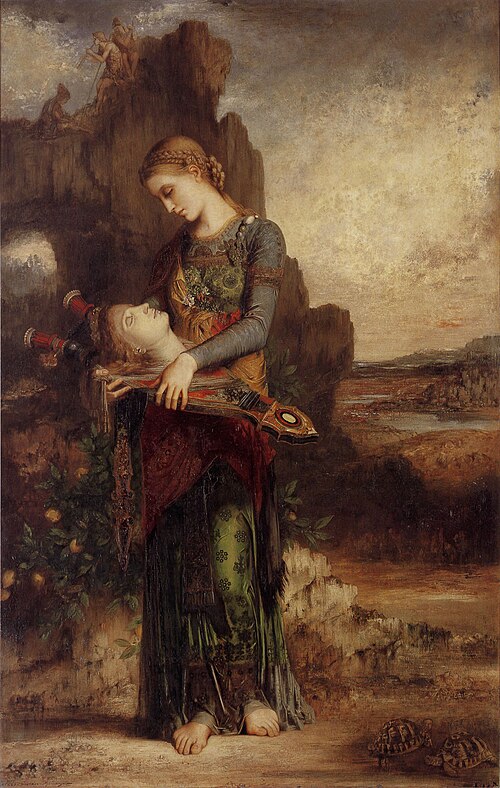 Thracian Girl with Head of Orpheus on his Lyre; by Gustave Moreau; 1865; oil; 154 × 99.5 cm; Musée d'Orsay (Paris)
 Vision After the Sermon (Jacob Wrestling with the Angel); 1888; oil on canvas; 73 x 92 cm; Scottish National Gallery (Edinburgh, Scotland)[233]
 The Scream; by Edvard Munch; 1893; tempera and crayon on cardboard; 91 x 73.5 cm; National Gallery (Oslo, Norway)[233]
 The Cyclops; by Odilon Redon; c.1914; oil on cardboard on panel; 64 x 51 cm; Kröller-Müller Museum (Otterlo, the Netherlands)[233]
Post-Impressionism (c. 1885–1910)

Post-Impressionism is a rather imprecise term applied to a diverse generation of artists. In its strictest sense, it pertains to four highly influential artists: Paul Cézanne,[236][237]Paul Gauguin,[238][239]Georges Seurat,[240][241] and Vincent van Gogh.[242][243] Each passed through an impressionist phase, but ultimately emerged with four very original but different styles. Collectively, their work anticipated, and often directly influenced, much of the avant-garde art that appeared before the First World War including fauvism, cubism, expressionism, and early abstraction. Cézanne (particularly influential on cubism) and Van Gogh worked in relative isolation, away from Paris, at critical points in their careers, while Seurat and Gauguin worked in groups, more collaboratively, at key points in their development. Another important artist of the period is Toulouse-Lautrec, an influential painter as well as graphic artist.[244][245] In a broader sense, post-impressionism includes a generation of predominantly French and Belgian artists who worked in a range of styles and groups. Most had come under the sway of impressionism at some point, but pushed their work beyond it into a number of factions as early as the mid-1880s, sometimes as a logical development of impressionism, other times as a reaction against it. Post-Impressionists typically depicted impressionist subjects, but the work, particularly synthetism, often contained symbolism, spiritualism, and moody atmospheres that rarely appeared in impressionism. Unnatural colors, patterns, flat plains, odd perspectives and viewpoints pushed to extremes, all moved the center of modernism a step closer to abstraction with a standard for experimentation.[218][246][247]
Neo-Impressionism (Divisionism or Pointillism, c. 1884–1894) explored light and color based on scientific color theories, creating mosaics of brush strokes in pure colors, sometimes laid out in rhythmic patterns with lines influenced by Art Nouveau. The leading artists were Georges Seurat and Paul Signac, others include Henri-Edmond Cross, Maximilien Luce, Albert Dubois-Pillet, and for a period Pissarro and Van Gogh. It was influential on fauvism, and elements of the style appeared in expressionism, cubism, and early abstraction. Synthetism (Cloisonnism c. 1888–1903) Cloisonnism was conceived by Émile Bernard and immediately taken up and developed by Paul Gauguin and others while at an artists' colony in Pont-Aven (Brittany, France). The style resembled cloisonné enamel or stained glass, with flat, bold colors outlined in black or dark colors. Synthetism, exemplified in the work of Gauguin and Paul Sérusier, is slightly a broader term with less emphasis on dark outlines and cloisonné qualities. Other artist include Cuno Amiet, Louis Anquetin, Charles Filiger, Jacob Meyer de Haan, Charles Laval, and Armand Seguin. Their work greatly influenced fauvism and expressionism. Les Nabis (c. 1890–1905: Hebrew for prophets or illuminati) was a larger movement in France and Belgium that eclectically drew on progressive elements in synthetism, neo-impressionism, symbolism, and Art Nouveau. Perhaps more influential than the art, were the numerous theories, manifestoes, and infectious enthusiasm for the avant-garde, setting the tone for the proliferation of movements and "isms" in the first quarter of the 20th century. La Revue Blanche often published Les Nabis and symbolist content. The work of Édouard Vuillard,[248][249] and Pierre Bonnard,[250][251] ca. 1890–1910 is exemplary of Les Nabis, though both evolved in their styles and produced significant work into the 1940s. Other artist include Maurice Denis, Maxime Dethomas, Meyer de Haan, Henri-Gabriel Ibels, Georges Lacombe, Aristide Maillol, Paul Ranson, Ker-Xavier Roussel, Armand Séguin, Paul Sérusier, Félix Vallotton, Jan Verkade, and others.[218][246][247]
 The Starry Night; by Vincent van Gogh; 1889; oil on canvas; height: 73.7 cm; Museum of Modern Art (New York City)
 Félix Fénéon; by Paul Signac; 1890; oil on canvas; 73.5 x 92.5 cm; Museum of Modern Art (New York City)[235]
 Aha Oe Feii? (Are You Jealous?); by Paul Gauguin; 1892; oil on canvas; 68 x 92 cm; Pushkin Museum (Moscow, Russia)[235]
 At the Moulin Rouge; by Henri de Toulouse-Lautrec; 1892/1895; oil on canvas, 1.23 × 1.41 m; Art Institute of Chicago[235]
 The Bathers; by Paul Cézanne; 1898–1905; oil on canvas; 210.5 cm × 250.8 cm; Philadelphia Museum of Art (Philadelphia, US)
Early 20th century
The history of 20th-century art is a narrative of endless possibilities and the search for new standards, each being torn down in succession by the next. The art movements of Fauvism, Expressionism, Cubism, abstract art, Dadaism and Surrealism led to further explorations of new creative styles and manners of expression. Increasing global interaction during this time saw an equivalent influence of other cultures into Western art, such as Pablo Picasso being influenced by Iberian sculpture, African sculpture and Primitivism. Japonism, and Japanese woodcuts (which had themselves been influenced by Western Renaissance draftsmanship) had an immense influence on Impressionism and subsequent artistic developments. The influential example set by Paul Gauguin's interest in Oceanic art and the sudden popularity among the cognoscenti in early 20th century Paris of newly discovered African fetish sculptures and other works from non-European cultures were taken up by Picasso, Henri Matisse, and many of their colleagues. Later in the 20th century, Pop Art and Abstract Expressionism came to prominence.
Art Nouveau (c. 1890–1914)


Art Nouveau (French: new art) was an international and widespread art and design movement that emerged in the final decades of the 19th century until the First World War in 1914. It was catapulted into international prominence with the 1900 Exposition Universelle in Paris. Developing almost simultaneously in parts of Europe and the US, it was an attempt to create a unique and modern form of expression that evoked the spirit of the new century. It manifested in painting, illustration, sculpture, jewellery, metalwork, glass, ceramics, textiles, graphic design, furniture, architecture, costume design and fashion. Art Nouveau artists aimed to raise the status of craft and design to the level of fine art.
The movement is highly associated with sinuous organic forms, such as flowers, vines and leaves, but also insects and animals, through the works of artists like Alphonse Mucha, Victor Horta, Hector Guimard, Antoni Gaudí, René Lalique, Otto Eckmann or Émile Gallé. Art Nouveau designs and buildings can often be asymmetrical. Although there are identifying characteristics, the style also displayed many regional and national interpretations.
Despite being a short-lived fashion, it paved the way for the modern architecture and design of the 20th century. It was the first architectural style without historic precedent, the 19th century being notorious for a practice known as Historicism, which is the use of visual styles that consciously echo the style of a previous artistic era. Between c.1870 and 1900, a crisis of historicism occurred, during which the historicist culture was critiqued, one of the voices being Friedrich Nietzsche in 1874, who diagnosed 'a malignant historical fervour' as one of the crippling symptoms of a modern culture burdened by archaeological study and faith in the laws of historical progression. Despite this, Art Nouveau was also heavily influenced by styles from the past such as Celtic, Gothic and Rococo art, and also by the Arts and Crafts movement, Aestheticism, Symbolism and especially by Japanese art.[253][254]
Fauvism (c. 1898–1909)
Fauvism emerged from post-impressionism, gradually developing into the first major movement of the 20th century. Its genesis was in 1895 when Henri Matisse, the oldest and central figure, entered the studio of Gustave Moreau at the Ecole des Beaux-Arts. There he met Georges Rouault, Charles Camoin, Henri Manguin, and Albert Marquet. Marquet said "As early as 1898 Matisse and I were working in what was later to be called the Fauve manner. The first exhibitions at the Indepéndants in which we were, I believe, the only ones to paint in pure tones, go back to 1901."[255] By 1902–03 the circle of like-minded artist had grown to include Georges Braque, André Derain, Raoul Dufy, Othon Friesz, Jean Metzinger, Jean Puy, Louis Valtat, Kees van Dongen, and Maurice de Vlaminck. During this period a number of influential retrospective exhibitions were held in Paris: Seurat (1900, 1905), Van Gogh (1901, 1905), Toulouse-Lautrec (1902), Gauguin (1906), Cézanne (1907), all relatively unknown to the public at that time. Matisse and Derain collected African carvings, a novel but growing curiosity of the time. Matisse spent the summer of 1904 in Saint-Tropez painting with the neo-impressionist Paul Signac and Henri-Edmond Cross, followed in 1905 by Camoin, Manguin, and Marquet. The artists exhibited regularity at the Salon des Indepéndants and the Salon d'Automne 1903–1908 and in 1905 their work created a sensation and a scandal. Matisse stated "We were exhibiting at the Salon d'Automne, Derain, Manguin, Marquet, Puy, and a few others were hung together in one of the larger galleries. In the center of this room the sculptor Marque exhibited a bust of a child very much in the Italian style. Vauxcelles [art critic for Gil Blas] entered the room and said, Well! well! Donatello in the mist of wild beasts! [Donatello chez les fauves]."[256] The movement had not been perceived as an entity by the public, but once published the name stuck. Unlike the impressionist and their long struggle for acceptance, the avant-garde had an eager audience by 1906–1907 and the fauvist were attracting collectors from America to Russia. However fauvism largely dissolved in 1908, as cubism appeared, most of the artist began exploring other styles and moving in different directions. Only Matisse and Dufy continued to explore fauvism into the 1950s.[255][257][258][259][260]
The fauvist painted landscapes en plein air, interiors, figures, and still lifes, following examples of realism, impressionism, and post-impressionism. They applied paint with loose brushstrokes, in thick, unnatural, often contrasting, vibrant colors, at times straight from the tube. Gauguin's influence, with his exploration of the expressive values and spatial aspects of patterning with flat, pure colors, as well as his interest in primitivism were significant, as was neo-impressionism. Matisse explained – for a long time color served as a complement of design, the painters of the Renaissance constructed the picture by line, adding local color afterwards – writing: "From Delacroix to Van Gogh and chiefly to Gauguin, by way of the Impressionist, who cleared the ground, and Cézanne, who gave the final impulse and introduced colored volumes, we can follow this rehabilitation of color's function, this restoration of its emotive power."[255] Fauvism was the culmination in a shift, from drawing and line as the fundamental foundations of design in painting to color, and they depicted their subjects on the verge of abstraction.[255][257][258][259][260]
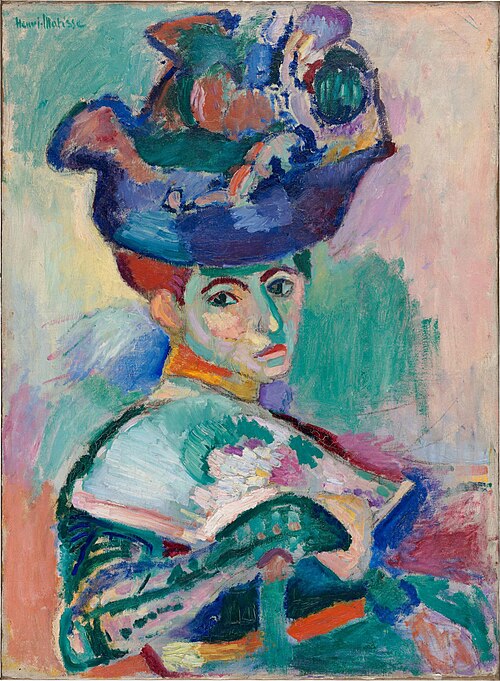 Woman with a Hat; by Henri Matisse; 1905; oil on canvas; 80.7 x 59.7 cm; San Francisco Museum of Modern Art (San Francisco, US)[261]
 Fauve Landscape; by Louis Valtat; 1905–1906; oil on canvas; Speed Art Museum (Louisville, Kentucky, US)
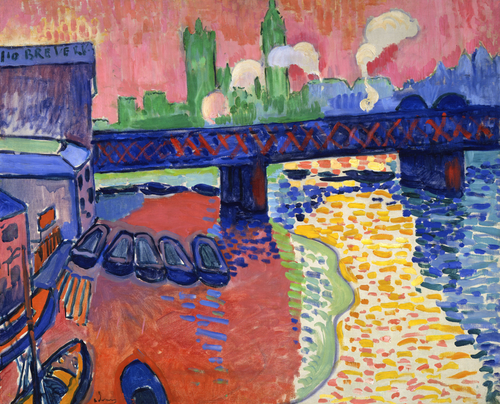 Charing Cross Bridge, London; by André Derain; 1906; oil on canvas, 80.3 × 100.3 cm.; National Gallery of Art (Washington, D.C., US)
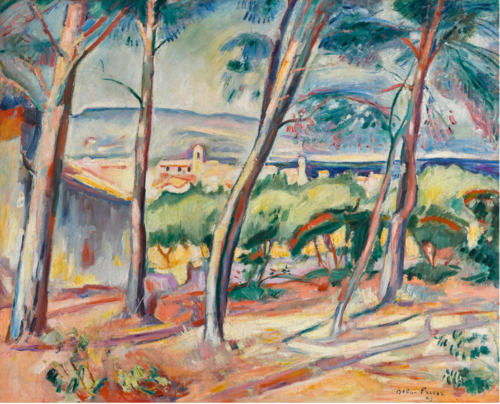 La Ciotat; by Othon Friesz; 1907; oil on canvas, 65.7 by 81 cm.; unknown collection
Expressionism (c. 1905–1930)

Expressionism was an international movement in painting, sculpture, the graphic arts, poetry, literature, theater, film, and architecture. Some associate the Second Viennese School and other music of the period with the movement. Most historians place the beginning of expressionism in 1905 with the founding of Die Brücke ("The Bridge") in Dresden, Germany. However, several artists were producing influential work in the spirit of expressionism c. 1885–1905 including Lovis Corinth, James Ensor, Käthe Kollwitz, Paula Modersohn-Becker, Edvard Munch, Emil Nolde, and Christian Rohlfs among others. Many of these artists later exhibited and associated with various expressionist groups. Expressionist painting is characterized by loose, spontaneous, often thick, impasto brushwork. It often conveyed how the artist felt about their subject, opposed to what it looked like, putting intuition and gut feelings over realistic representations or art theories. Expressionism was frequently infused with an angst or joy, and an overall engagement with contemporary life and social issues that was often absent from fauvism's focus on design and color applied to neutral subjects. Woodcut prints are particularly noteworthy in expressionism. Expressionism can sometimes overlap and integrate with other styles and movements, such as symbolism, fauvism, cubism, futurism, abstraction, and dada. Several groups and factions of expressionists appeared at various times and places.[218][247][263][264]
Die Brücke aspired to connect "all revolutionary and surging elements."[263] It was founded by four architectural students Ernst Ludwig Kirchner, Erich Heckel, Karl Schmidt-Rottluff, and Fritz Bleyl. Sharing a studio in Dresden they produced paintings, carvings, prints, and organized exhibitions, separating in the summer to work independently. Their first exhibit was in 1905, later joined by Emil Nolde and Max Pechstein in 1906, and Otto Mueller in 1910 among others. Influences included Gothic art, primitivism, Art Nouveau, and developments in Paris, particularly Van Gogh and fauvism. The group shifted to Berlin in 1911 and later dissolved in 1913. Der Blaue Reiter (The Blue Rider: 1911–1914), founded by Wassily Kandinsky and Franz Marc, was a relatively informal group that organized exhibitions of art from Paris and Europe, as well their own. It was one in a series of increasingly progressive groups splitting from the Art Academy in Munich including The Munich Secession in 1892 (realist and impressionist), Phalanx in 1901 (postimpressionist), Neue Kunstler Vereiningung in 1909, and The Blue Rider in 1911. Artist associated with the latter two groups included the Burliuk brothers, Heinrich Campendonk, Alexej von Jawlensky, Paul Klee, August Macke, Gabriele Münter, and Marianne von Werefkin. The euphonious almanac Der Blaue Reiter, a collection of influential essays, and Kandinsky's Concerning the Spiritual in Art with his ideas on non-objective art were both published in 1912. The Blue Rider ended with the outbreak of World War I in which Macke and Marc both died.[218][247][265][263][264]
Other artists such as Oskar Kokoschka, Egon Schiele, and Richard Gerstl emerged in Austria. French artist Georges Rouault and Chaïm Soutine had affinities with the movement. Sculptors include Ernst Barlach, Wilhelm Lehmbruck, Gerhard Marcks, and William Wauer. Architects associated with expressionism include Max Berg, Hermann Finsterlin, Johann Friedrich Höger, Michel de Klerk, Erich Mendelsohn, Hans Poelzig, Hans Scharoun, Rudolf Steiner, and Bruno Taut. Der Sturm (The Storm 1910–1932) was a magazine with much expressionist content founded by Herwarth Walden, with an associated gallery in Berlin opened in 1912 and a theater company and school opened in 1918. Films regarded as expressionistic, some considered as classics, include The Cabinet of Dr. Caligari (Robert Wiene, 1920), Nosferatu (F. W. Murnau, 1922), and Metropolis (Fritz Lang, 1927).[218][247][265][263][264]
After World War I a tendency to withdraw from the avant-garde by many artist occurred, seen in the work of the original fauvists during the 1920s, Picasso and Stravinsky's neoclassical periods, and De Chirico's late work. This tendency was called New Objectivity (ca. 1919–1933) in Germany, and in contrast to the nostalgic nature of this work elsewhere, it was characterized by disillusionment and ruthless social criticisms. New objectivity artists mostly emerged from expressionist and dada milieus including Otto Dix, Christian Schad, Rudolf Schlichter, Georg Scholz, and Jeanne Mammen. Max Beckmann and George Grosz also had some association with new objectivity for a period. Although not intrinsically expressionistic, the Staatliches Bauhaus (School of Building: 1919–1933) was an influential German school merging crafts, decorative, and fine arts. Moving from Weimar, to Dessau, to Berlin, it changed and evolved in focus with time. Directors included architects Walter Gropius (1919–1928), Hannes Meyer (1928–1930), and Ludwig Mies van der Rohe (1930–1933). At various points the faculty included Josef Albers, Theo van Doesburg, Lyonel Feininger, Johannes Itten, Paul Klee, Wassily Kandinsky, El Lissitzky, Gerhard Marcks, László Moholy-Nagy, Oskar Schlemmer. Bauhaus architects greatly influenced the International Style, which was characterized by simplified forms, a lack of ornamentation, a union of design and function, and the idea that mass production could be compatible with personal artistic vision. As the Nazi Party rose to power, modern art was dubbed "degenerate art" and the Bauhaus was closed in 1933, subduing modernism in Germany for several years.[218][247][265][263][264]
- The Scream; by Edvard Munch; 1893; tempera and crayon on cardboard; 91 x 73.5 cm; National Gallery of Norway (Oslo)[266]
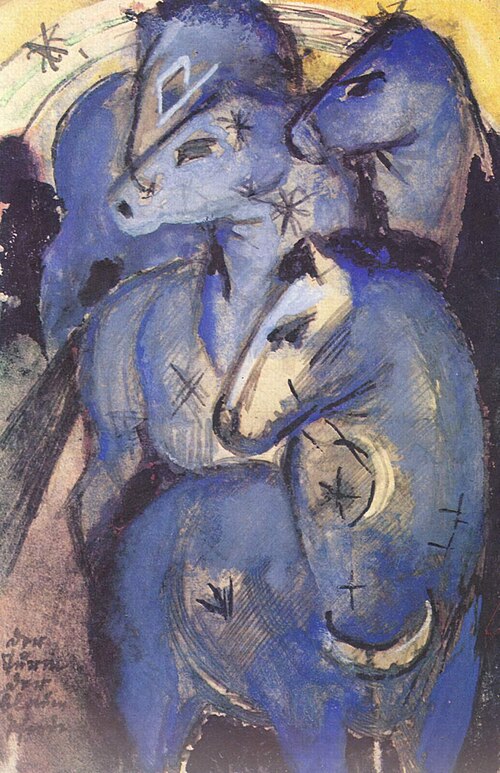 Tower of Blue Horses; by Franz Marc; 1912; ink and guache on card; 14.3 x 9.4 cm; Bavarian State Painting Collections (Munich, Germany)[262]
 Composition VII; by Wassily Kandinsky; 1913; oil on canvas; 2 x 3 m; Tretyakov Gallery (Moscow, Russia)[267]
 Actor's Mask; by Paul Klee; 1924; oil on canvas mounted on board; 36.7 x 33.8 cm; Museum of Modern Art (New York City)[269]
Cubism (c. 1907–1914)
Cubism consisted in the rejection of perspective, which leads to a new organisation of space where viewpoints multiply producing a fragmentation of the object that renders the predilection for form over the content of the representation obvious. Pablo Picasso, Georges Braque and other Cubist artists, were inspired by the sculptures of Iberia, Africa and Oceania exhibited in the Louvre and the ethnographic museum in the Trocadéro, and which were being offered at flee markets and in sale rooms.
'A Picasso studies an object the way a surgeon dissects a corpse,' wrote the critic and poet Guillaume Apollinaire in 1913. Five years earlier, Pablo Picasso and Georges Braque – friends, colleagues and rivals – had begun to reject perspectival realism for a form of artistic autopsy: an utterly revolutionary painting style that looked inside and around objects, presenting them analytically, objectively and completely impersonally.[270]
 Les Demoiselles d'Avignon; by Pablo Picasso; 1907; oil on canvas; 2.43 × 2.3 m; Museum of Modern Art[270]
 Violin and Pitcher; by Georges Braque; 1909–1910; oil on canvas; 1.17 x 0.73 cm; Kunstmuseum Basel (Basel, Switzerland)[270]
 The Eiffel Tower; by Robert Delaunay; 1911; oil on canvas; 2.02 x 1.38 m; Solomon R. Guggenheim Museum (New York City)[271]
 Breakfast; by Juan Gris; 1914; gouache, oil and crayon on cut-and-pasted printed paper on canvas; 80.9 x 59.7 cm; Museum of Modern Art (New York City)[271]
Art Deco (c. 1920–1940)
Art Deco appeared in France as a style of luxury and modernity. Soon, it spread quickly throughout the world, most dramatically in America, becoming more streamlined through the 1930s. The style was named after the International Exhibition of Modern Decorative and Industrial Arts held in Paris in 1925. Its exuberance and fantasy captured the spirit of the 'roaring 20s' and provided an escape from the realities of the Great Depression during the 1930s. It had ancient Greek, Roman, African, Aztec and Japanese influences, but also Futurist, Cubist and Bauhaus ones. It sometimes blended with the Egyptian Revival style, due to the discovery in 1922 of the Tomb of Tutankhamun and the Egyptomania that it caused. Two examples of this are Le Louxor Cinema in Paris, 1919–1921, by Henri Zipcy, and the Egyptian Theatre in DeKalb (Illinois, US), 1929–1930, by Elmer F. Behrns. In decorative arts, including architecture, low-relief designs, and angular patterns and shapes were used. Predominant materials include chrome, brass, polished steel and aluminum, inlaid wood, stone and stained glass.
Some of the most important Art Deco artists are the Paris-based Polish painter Tamara de Lempicka, the Ukrainian-born French poster artist Adolphe Jean-Marie Mouron, known as Cassandre, and the French furniture designer and interior decorator Émile-Jacques Ruhlmann.[272][273]
Surrealism (c. 1924–1966)
Surrealism emerged as a faction of Dada, formally announcing its inception in 1924 with André Breton's Manifesto of Surrealism.[274] Originally a literary group of poets and writers in Paris, it soon developed into an international movement that included painters, sculptors, photographers, and filmmakers. A Second Manifeste du Surréalisme was published in 1929.[275] Surrealism did not have significant expression in applied or decorative arts, architecture, or music, although a few isolated examples could be identified (e.g. chess sets, furniture, and Las Pozas). The small and short lived Metaphysical School (c. 1910–1921), with Giorgio de Chirico as its principal figure, was highly influential on surrealism. The surrealist explored a myriad of innovative techniques, some had recently been developed in Cubism and Dada, others were new, including collage, found objects, assemblage, random chance, rayographs (photograms), painting on sand, dripping and flinging paint, decalcomania, frottage, fumage, and raclage. Two fundamental approaches predominate surrealist art. Automatism dominated in the early years which can be seen in the work of artist like André Masson and Joan Miró. Other artists, swayed by work of Giorgio de Chirico, used more traditional methods and mediums to illustrate unfiltered thoughts and incongruous juxtapositions, including Salvador Dalí and René Magritte. Significant artist include Jean Arp, Hans Bellmer, Victor Brauner, Luis Buñuel, Joseph Cornell, Óscar Domínguez, Max Ernst, Wifredo Lam, Yves Tanguy, Man Ray, Alberto Giacometti, Méret Oppenheim, and Roberto Matta. Other important artist informally accosted with surrealism include Marcel Duchamp, Pablo Picasso, and Frida Kahlo. Surrealist ideas and theories were discussed in a successive series of journals, La Révolution Surréaliste (1924–1929), Le Surrealisme au service de la revolution (1930–1933), Minotaure (1933–1939), VVV (1942–1944). The automatic paintings produced by André Masson and Joan Miró, as well as latecomers to surrealism like Roberto Matta and Arshile Gorky had a considerable influence on the abstract expressionist in the late 1940s.[276][277][278][279][280][281]
With a measure of Dada's irreverence and contempt for the traditional political, religious, and bourgeois values of western culture that they believed had led the world into the First World War (Breton and other founding members were veterans); the surrealist explored the possibilities that had been opened up by Sigmund Freud regarding the subconscious mind: "Pure psychic automatism, by which one intends to express verbally, in writing or by any other method, the real functioning of the mind. Dictation by thought, in the absence of any control exercised by reason, and beyond any aesthetic or moral preoccupation."[274] Surrealism sought to express pure thought, unfiltered and uncensored by political, religious, moral, or rational principles.[276][277][278][279][280][281]
 The Song of Love; by Giorgio de Chirico; 1914; oil on canvas; 73 x 59.1 cm; Museum of Modern Art (New York City)[282]
Mid and late 20th century
As Europe struggled to recover from World War II, America moved into a position of political, economic and cultural strength. During the 1940s and 1950s, Abstract Expressionism emerged as the first specifically American art movement to have an international impact. In consequence, the art world's focus shifted from Europe to New York. Abstract Expressionists were a small group of loosely associated artists who had similar outlooks but different approaches. They were influenced by Surrealism, and believed in spontaneity, freedom of expression and abandonment of the themes of American life that had characterized national art of recent decades. One of the most famous representatives of this movement was Jackson Pollock, known for his painting made by pouring, flicking and dripping paint on to huge canvases on the ground. Other artists include Willem de Kooning, Franz Kline, Robert Motherwell, Barnett Newman, Mark Rothko and Clyfford Still.
After World War II, consumerism and the mass media surged, and as a result, Pop art developed in both London and New York. In a London exhibition in 1956, the word 'Pop' was used in a collage created by Richard Hamilton (1922–2011) made of American magazines. Pop art was a reaction against Abstract Expressionism, and interpreted ideas of pop culture. In celebrating and commenting on consumerism, pop artists, as they became known, produced colorful images based on advertising, the media and shopping, featuring film stars, comic strips, flags, packaging and food – things that everyone, rather than just a highbrow few, could relate to.
The term Minimalism was not new, but it gained momentum in the 1960s, specifically describing a style of art characterized by detached restraint. Originating in New York, it was a reaction against Abstract Expressionism, but it also embraced Constructivist ideas that art should be made of modern materials. Thus, Minimalist artists, primarily sculptors, often used non-traditional materials and production methods, often employing industrial or specialist fabricators to produce works to their specifications. The term was chiefly used to describe a group of American sculptors who re-evaluated the space around them, aiming to challenge assumptions and present familiar objects in new ways. Their artworks don't have any symbolism or hidden meaning, as they try to enable viewers to re-evaluate art and space around forms. Unlike a figural sculpture on which the viewer focuses to the exclusion of the room in which it stands, Minimalist art becomes one with its space. By focusing on the effects of context and the theatricality of the viewing experience, Minimalism exerted an indirect but powerful influence on later developments in Conceptual and Performance art, as well as providing a foil for the rise of Postmodernism.
Despite developing almost 50 years after Marcel Duchamp's ideas, Conceptual art showed that art does not always have to be judged aesthetically. It was never a single, cohesive movement, but an umbrella term that now covers several types of art and emerged more or less concurrently in America and Europe, first defined in New York. Conceptual artists promote the art of ideas, or concepts, suggesting that they can be more valid in the modern world than technical skill or aesthetics. No matter the art media of an artwork, it is considered as no more than a vehicle for presenting the concept. At its most extreme, Conceptual art foregoes the physical object completely, using verbal or written message to convey the idea.[283][284][285]
Traditionally, many creative acts such as sewing, weaving, and quilting have been considered as women's work, described as crafts, and denied the cachet and public recognition of so-called high or fine arts such as sculpture and painting. Many artists have now challenged this hierarchy by either expanding the scope of a fine art such as sculpture, by creating soft sculptures using unconventional materials and practices, or by reclaiming and redefining the materials and methods of so-called craftwork, publicly exhibiting their work in museums and galleries and thus elevating the status of the decorative and applied arts.[286] Artists of the twentieth and twenty first centuries effecting this radical change include Maria Martinez, Anni Albers, Lucie Rie, Lenore Tawney, Louise Bourgeois, Miriam Schapiro, Faith Ringgold, Magdalena Abakanowicz, Sheila Hicks, Marva Lee Pitchford-Jolly, Judy Chicago, and Dindga McCannon.
 IKB 191; by Yves Klein; 1962
 The Boxers; by Keith Haring; 1987
 El Cap de Barcelona; by Roy Lichtenstein; 1991–1992
See also
- History of animation
- History of Asian art
- History of film
- History of literature
- History of music
- History of nude art
- History of painting
- History of photography
- History of poetry
- History of theatre
- History of video games
- List of art movements
- List of French artistic movements
- Periods in Western art history
- Timeline for invention in the arts
- Timeline of art
- Women artists
Notes
- ↑Henshilwood, Christopher; et al. (2002). "Emergence of Modern Human Behavior: Middle Stone Age Engravings from South Africa". Science. 295 (5558): 1278–1280. Bibcode:2002Sci...295.1278H. doi:10.1126/science.1067575. PMID 11786608. S2CID 31169551.
- ↑Henshilwood, Christopher S.; d'Errico, Francesco; Watts, Ian (2009). "Engraved ochres from the Middle Stone Age levels at Blombos Cave, South Africa". Journal of Human Evolution. 57 (1): 27–47. Bibcode:2009JHumE..57...27H. doi:10.1016/j.jhevol.2009.01.005. PMID 19487016.
- ↑Texier, P. J.; Porraz, G.; Parkington, J.; Rigaud, J. P.; Poggenpoel, C.; Miller, C.; Tribolo, C.; Cartwright, C.; Coudenneau, A.; Klein, R.; Steele, T.; Verna, C. (2010). "A Howiesons Poort tradition of engraving ostrich eggshell containers dated to 60,000 years ago at Diepkloof Rock Shelter, South Africa". Proceedings of the National Academy of Sciences. 107 (14): 6180–6185. Bibcode:2010PNAS..107.6180T. doi:10.1073/pnas.0913047107. PMC 2851956. PMID 20194764.
- ↑"African Cave Yields Evidence of a Prehistoric Paint Factory". The New York Times. 13 October 2011.
- ↑"Place Stanislas, Place de la Carrière and Place d'Alliance in Nancy". UNESCO World Heritage Centre. United Nations Educational, Scientific, and Cultural Organization. Retrieved 17 October 2021.
- ↑"World's Oldest Figurative Art is Now an Official World Treasure".
- ↑"Earliest music instruments found". BBC News. 24 May 2012.
- ↑Hodge 2017, p. 12; Fortenberry 2017, pp. 1 & 2.
- ↑Fortenberry 2017, p. 2.
- ↑Fortenberry 2017, p. 3.
- ↑Fortenberry 2017, p. 4, 5, 6, 9, 12, 13.
- ↑Gipson, Ferren (2021). The Ultimate Art Museum. Phaidon. pp. 20, 21. ISBN 978-1-83866-2967.
- ↑Farthing, Stephen (2020). ARTA Istoria Artei de la pictura rupestră la arta urbană (in Romanian). rao. p. 20. ISBN 978-606-006-392-6.
- 12Fortenberry 2017, p. 4.
- ↑Fortenberry 2017, p. 12.
- ↑Fortenberry 2017, p. 13.
- ↑10,000 YEARS OF ART. Phaidon. 2009. p. 66. ISBN 978-0-7148-4969-0.
- ↑10,000 YEARS OF ART. Phaidon. 2009. p. 82. ISBN 978-0-7148-4969-0.
- ↑Azcárate 1983, pp. 29–34.
- ↑Fortenberry 2017, p. 19.
- ↑10,000 YEARS OF ART. Phaidon. 2009. p. 48. ISBN 978-0-7148-4969-0.
- ↑Fortenberry 2017, p. 16.
- ↑Rogers, Gumuchdjian & Jones 2014, p. 30.
- 1234Fortenberry 2017, p. 209.
- ↑India - A History in Objects. Thames & Hudson. 2022. p. 28. ISBN 978-0-500-48064-9.
- ↑Fortenberry 2017, p. 74.
- 12Fortenberry 2017, p. 71.
- ↑Farthing, Stephen (2020). ARTA Istoria Artei de la pictura rupestră la arta urbană (in Romanian). rao. pp. 42, 43, 44. ISBN 978-606-006-392-6.
- ↑Nixey, Catherine (2017). The Darkening Age: The Christian Destruction of the Classical World. Macmillan Publishers. ISBN 978-0544800885.
- ↑Hodge 2017, p. 13.
- ↑Fortenberry 2017, p. 25.
- ↑Hopkins 2014, p. 6.
- ↑Zukowsky, John (2019). A Chronology of Architecture. Thames & Hudson. p. 23. ISBN 978-0-500-34356-2.
- ↑Vinzenz Brinkmann, Renée Dreyfus and Ulrike Koch-Brinkmanny (2017). Gods in Color – polychromy in the ancient world. Fine Arts Museums of San Francisco, Legion of Honor. p. 13. ISBN 978-3-7913-5707-2.
- ↑Fortenberry 2017, p. 30.
- ↑Fortenberry 2017, p. 33.
- ↑Smith, David Michael (2017). Pocket Museum - Ancient Greece. Thames & Hudson. p. 163. ISBN 978-0-500-51958-5.
- ↑Smith, David Michael (2017). Pocket Museum - Ancient Greece. Thames & Hudson. p. 178. ISBN 978-0-500-51958-5.
- ↑Susan Woodford (2020). Greek and Roman Art. Thames & Hudson. p. 29. ISBN 978-0-500-29525-0.
- 12Rogers, Gumuchdjian & Jones 2014, p. 32.
- ↑Susan Woodford (2020). Greek and Roman Art. Thames & Hudson. p. 265. ISBN 978-0-500-29525-0.
- ↑"Celtic Art: Unique Meaning and Significance".
- ↑"The Hallstatt Culture People of the European Iron Age".
- ↑"La Tene Celtic Culture: Definition, Characteristics".
- ↑Fortenberry 2017, p. 52.
- ↑Rogers, Gumuchdjian & Jones 2014, p. 46.
- ↑Toynbee 1971, pp. 439–442.
- ↑Fortenberry 2017, p. 57, 56, 55.
- ↑Hopkins 2014, p. 12; Hodge 2019, p. 16.
- ↑Jonathan, Glancey (2006). Architecture A Visual History. DK, Penguin Random House. p. 63. ISBN 978-0-2412-8843-6.
- ↑Hodge 2017, pp. 16 & 18.
- ↑Fortenberry 2017, p. 51.
- ↑Fortenberry 2017, p. 57.
- ↑Irving 2019, p. 36.
- 12Croke 2003, p. 349.
- 12Kulikowski 2012, p. 31.
- 12Delogu 2002, p. 84.
- ↑"Alfred | Biography, Reign, & Facts | Britannica". www.britannica.com. 2024-08-04. Retrieved 2024-08-14.
- ↑Molyneaux, George (3 November 2017) [2015]. The Formation of the English Kingdom in the Tenth Century. Oxford University Press. ISBN 9780192542939. Retrieved 20 September 2025.
On one level, the formation of the English kingdom was a consequence of a series of campaigns and agreements during the late ninth century and the first half of the tenth: when Alfred (now often styled 'the Great') became king of the West Saxons in 871, his power stretched little north of the Thames, but over subsequent decades he and his successors extended their domination across what would later constitute Domesday Anglia [...].
- ↑Emma C.Bunker, Animal Style Art from East to West, Asia Society. p. 13
- ↑Werness, Hope B. (1 January 2006) [2004]. "Animal Style". Continuum Encyclopedia of Animal Symbolism in World Art (reprint ed.). New York: Continuum. pp. 6–7. ISBN 9780826419132. Retrieved 20 September 2025.
Animal Style. Refers to the animal-dominated art of 1st millennium BCE cultures in the Eurasian steppes, from Central Europe to northwest China. [...] The style, kept alive by nomadic groups, eventually diffused throughout Northern Europe, affecting design as late as early Medieval Art and reflected in the early art of Scandinavia and the British Isles.
- ↑Fortenberry 2017, p. 117.
- 12Fortenberry 2017, p. 119.
- ↑Fortenberry 2017, p. 125.
- ↑Rogers, Gumuchdjian & Jones 2014, p. 120.
- ↑Fortenberry 2017, p. 128.
- ↑Gipson, Ferren (2021). The Ultimate Art Museum. Phaidon. pp. 92, 93, 94. ISBN 978-1-83866-2967.
- ↑Fortenberry 2017, p. 229, 232, 234.
- ↑Farthing, Stephen (2020). ARTA Istoria Artei de la pictura rupestră la arta urbană (in Romanian). rao. pp. 34, 35. ISBN 978-606-006-392-6.
- 12Fortenberry 2017, p. 229.
- ↑10,000 YEARS OF ART. Phaidon. 2009. p. 129. ISBN 978-0-7148-4969-0.
- ↑Fortenberry 2017, p. 232.
- ↑10,000 YEARS OF ART. Phaidon. 2009. p. 174. ISBN 978-0-7148-4969-0.
- 123Fortenberry 2017, p. 234.
- 12Fortenberry 2017, p. 238.
- ↑Gipson, Ferren (2021). The Ultimate Art Museum. Phaidon. p. 95. ISBN 978-1-83866-2967.
- ↑Fortenberry 2017, p. 238, 239, 240.
- ↑Farthing, Stephen (2020). ARTA Istoria Artei de la pictura rupestră la arta urbană (in Romanian). rao. pp. 19, 113. ISBN 978-606-006-392-6.
- ↑Farthing, Stephen (2020). ARTA Istoria Artei de la pictura rupestră la arta urbană (in Romanian). rao. p. 18. ISBN 978-606-006-392-6.
- ↑Fortenberry 2017, p. 240.
- ↑Fortenberry 2017, p. 241.
- ↑Tamara Talbot Rice (July 2011). Visual Arts. Oxford.
- ↑İz, Fahir; Wylie, Turrell V.; Rice, Tamara Talbot (7 December 2023). "Central Asian arts". Britannica.
- 12Fortenberry 2017, p. 66.
- ↑Fortenberry 2017, p. 67.
- ↑"Mussée National des Arts Asiatiques Guimet". Conaissance des Arts.
- ↑Barkman, Adam (2015). Making sense of Islamic art & architecture. Thames & Hudson. p. 68. ISBN 978-0-500-29171-9.
- ↑Barkman, Adam (2015). Making sense of Islamic art & architecture. Thames & Hudson. p. 40. ISBN 978-0-500-29171-9.
- ↑Keiko 2010, pp. 57–63.
- ↑Harle 1994, pp. 26–47, 105–117.
- ↑Harle 1994, pp. 59–70.
- ↑Hodge 2019, p. 15.
- ↑Fortenberry 2017, p. 210.
- 12Fortenberry 2017, p. 213.
- 12Fortenberry 2017, p. 215.
- ↑Rogers, Gumuchdjian & Jones 2014, p. 114.
- ↑10,000 YEARS OF ART. Phaidon. 2009. p. 228. ISBN 978-0-7148-4969-0.
- ↑Fortenberry 2017, p. 217.
- ↑Hodge 2019, p. 99.
- ↑Rogers, Gumuchdjian & Jones 2014, p. 140.
- ↑Fortenberry 2017, p. 82.
- ↑Fortenberry 2017, p. 75.
- ↑Fortenberry 2017, p. 79.
- ↑Rogers, Gumuchdjian & Jones 2014, p. 144.
- ↑Fortenberry 2017, p. 105.
- ↑Fortenberry 2017, p. 103.
- 12Fortenberry 2017, p. 309.
- ↑Fortenberry 2017, p. 311.
- 123Fortenberry 2017, p. 314.
- ↑Robertson, Hutton (2022). The History of Art - From Prehistory to Presentday - A Global View. Thames & Hudson. p. 1040. ISBN 978-0-500-02236-8.
- ↑Fortenberry 2017, p. 318.
- ↑British Museum 2014, p. 65.
- ↑British Museum 2014, p. 52.
- ↑Brunt et al. 2018, p. 104.
- ↑Hodge 2017, p. 15.
- ↑Hodge 2019, p. 62.
- ↑Cavarnos & Michelis 1956, p. 506.
- ↑Weitzmann 1981, p. ?.
- ↑Kitzinger 1977, pp. 1‒3.
- ↑Rice 1968; Weitzmann 1982.
- ↑Rice 1968, Chapters 15–17; Weitzmann 1982, Chapters 2–7; Evans 2004, pp. 389–555.
- ↑George D. Hurmuziadis (1979). Cultura Greciei (in Romanian). Editura științifică și enciclopedică. p. 92 & 93.
- ↑Hopkins 2014, p. 17.
- ↑Fortenberry 2017, p. 108.
- ↑Gombrich, E. H. (2020). Istoria Artei (in Romanian). ART. p. 135. ISBN 978-606-710-751-7.
- ↑Fortenberry 2017, p. 114.
- ↑Fortenberry 2017, p. 115.
- ↑Farthing, Stephen (2020). ARTA Istoria Artei de la pictura rupestră la arta urbană (in Romanian). rao. p. 76. ISBN 978-606-006-392-6.
- ↑Gombrich, E. H. (2020). Istoria Artei (in Romanian). ART. p. 138. ISBN 978-606-710-751-7.
- ↑"Dictionary of Art Historians: Janitschek, Hubert". Retrieved 2013-07-18.
- ↑Suckale-Redlefsen, 524
- ↑Beckwith, 81–86; Lasko, 82; Dodwell, 123–126
- ↑Honour and Fleming, 277
- ↑Gardner, Helen; Kleiner, Fred S. (2009). Gardner's Art through the Ages: A Global History (13th ed.). Australia: Thomson/Wadsworth.
- ↑Caviness 2001, p. 106.
- ↑Koslin 1990, pp. 28–29.
- ↑Musset & Bertrand 1966, p. 23.
- ↑Fortenberry 2017, p. 146.
- ↑"Der Kaiserdom zu Speyer - Bauwerk". Archived from the original on 2016-01-02. Retrieved 2009-03-03.
- ↑Hodge 2019, p. 24.
- ↑Fortenberry 2017, p. 147.
- ↑Fortenberry 2017, p. 144.
- ↑Fortenberry 2017, p. 149.
- ↑Graur 1970, pp. 52–53.
- 12Fortenberry 2017, p. 151.
- 12Fortenberry 2017, p. 152.
- ↑Fortenberry 2017, p. 153.
- ↑Melvin, Jeremy (2006). …isme Să Înțelegem Stilurile Arhitecturale (in Romanian). Enciclopedia RAO. p. 39. ISBN 973-717-075-X.
- ↑Fortenberry 2017, p. 150.
- ↑Little, Stephen (2005). …isme Să Înțelegem Arta (in Romanian). Enciclopedia RAO. p. 12. ISBN 973-717-041-5.
- ↑Hodge 2017, pp. 16, 17, 18, 19, 21; Fortenberry 2017, p. 156, 182, 188; Hodge 2019, p. 26.
- ↑Hodge 2019, p. 82.
- ↑Fortenberry 2017, p. 157.
- ↑Fortenberry 2017, p. 191.
- ↑Fortenberry 2017, p. 165.
- ↑Fortenberry 2017, p. 168.
- ↑Fortenberry 2017, p. 170.
- ↑Hodge 2019, p. 26.
- ↑Hodge 2017, p. 68.
- ↑Fortenberry 2017, p. 194.
- ↑Fortenberry 2017, p. 177.
- ↑Fortenberry 2017, p. 175.
- ↑Hopkins 2014, p. 47.
- ↑Fortenberry 2017, p. 201.
- ↑Jacquemart, Albert (2012). Decorative Art. Parkstone. p. 67. ISBN 978-1-84484-899-7.
- ↑Hodge 2017, p. 23; Fortenberry 2017, p. 243; Hopkins 2014, pp. 70, 73, 84; Bailey 2012, pp. 4, 205, 286; Graur 1970, pp. 175, 176.
- ↑Hopkins 2014, p. 85.
- ↑Fortenberry 2017, p. 243.
- ↑Fortenberry 2017, p. 256.
- ↑Fortenberry 2017, p. 252.
- ↑Fortenberry 2017, p. 262.
- ↑Morrill, Rebecca (2019). Great Women Artists. Phaidon. p. 304. ISBN 978-0-7148-7877-5.
- ↑Bailey 2012, p. 238.
- ↑Bailey 2012, p. 287.
- ↑Marnie, Fogg (2013). Fashion: The Whole Story (in Romanian). Thames & Hudson. p. 111 & 112. ISBN 9780500291108.
- ↑Hodge 2017, p. 24; Fortenberry 2017, p. 256; Hopkins 2014, pp. 92, 95; Bailey 2012, pp. 272, 288; Graur 1970, pp. 194, 195.
- ↑Fortenberry 2017, p. 265.
- ↑Hall, William (2019). Stone. Phaidon. p. 185. ISBN 978-0-7148-7925-3.
- 123Fortenberry 2017, p. 267.
- ↑Jones 2014, p. 238.
- ↑Fortenberry 2017, p. 276.
- ↑Farthing, Stephen (2020). ARTA Istoria Artei de la pictura rupestră la arta urbană (in Romanian). rao. p. 260. ISBN 978-606-006-392-6.
- ↑Hodge 2017, p. 25; Fortenberry 2017, p. 273.
- ↑Bailey 2012, p. 407.
- ↑de Martin, Henry (1925). Le Style Louis XV (in French). Flammarion. p. 13.
- ↑Rogers, Gumuchdjian & Jones 2014, p. 272.
- ↑Fortenberry 2017, p. 275.
- ↑Fortenberry 2017, p. 274.
- ↑Honour, Hugh; Fleming, John (2009). A World History of Art - Revised Seventh Edition. Laurence King. p. 616. ISBN 978-1-85669-584-8.
- ↑Morrill, Rebecca (2019). Great Women Artists. Phaidon. p. 419. ISBN 978-0-7148-7877-5.
- ↑Fortenberry 2017, p. 278.
- ↑Arnason 1977, p. 740.
- ↑Janson 1977, p. 767.
- ↑Starobinski 1964.
- ↑Keyser 1965, p. ?.
- 1234Ponente 1965, p. ?.
- 12Toman 2000, p. ?.
- ↑Daval 1979, p. 221.
- ↑Weston, Richard (2011). 100 Ideas That Changed Architecture. Laurence King. p. 84. ISBN 978-1-78627-567-7.
- 1234Janson 1977, p. ?.
- ↑Hodge 2017, p. 26.
- ↑Farthing, Stephen (2020). ARTA Istoria Artei de la pictura rupestră la arta urbană (in Romanian). rao. p. 267. ISBN 978-606-006-392-6.
- ↑Bris 1981, p. ?.
- ↑Clay 1981, p. ?.
- ↑Hodge 2019, p. 286.
- ↑Fortenberry 2017, p. 286.
- ↑Fortenberry 2017, p. 280.
- ↑Fortenberry 2017, p. 281.
- ↑Hodge 2019, p. 114.
- ↑Farthing, Stephen (2020). ARTA Istoria Artei de la pictura rupestră la arta urbană (in Romanian). rao. pp. 276, 277. ISBN 978-606-006-392-6.
- ↑Little, Stephen (2005). …isme Să Înțelegem Arta (in Romanian). Rao. p. 64. ISBN 973-717-041-5.
- ↑Rogers, Gumuchdjian & Jones 2014, p. 296.
- ↑Farthing, Stephen (2020). ARTA Istoria Artei de la pictura rupestră la arta urbană (in Romanian). rao. p. 278. ISBN 978-606-006-392-6.
- ↑Farthing, Stephen (2020). ARTA Istoria Artei de la pictura rupestră la arta urbană (in Romanian). rao. p. 277. ISBN 978-606-006-392-6.
- ↑Victoria Clarke, ed. (2020). FLOWER: Exploring the World in Bloom. Phaidon. p. 28.
- ↑Luckhurst, Roger (2021). GOTHIC – An Illustrated History. Thames & Hudson. p. 19. ISBN 978-0-500-25251-2.
- ↑Bergdoll 2000, pp. 139, 141, 142.
- 1234567Arnason 1977, p. ?.
- ↑Leymarie 1962, p. ?.
- 123Blunden 1976, p. ?.
- ↑Clay 1973, p. ?.
- ↑Faunce 1993, p. ?.
- 12Fortenberry 2017, p. 289.
- 12Farthing, Stephen (2020). ARTA Istoria Artei de la pictura rupestră la arta urbană (in Romanian). rao. p. 302. ISBN 978-606-006-392-6.
- 123456Fortenberry 2017, p. 291.
- 12Courthion 1979, p. ?.
- 12Leymarie 1955, p. ?.
- 123Fortenberry 2017, p. 293.
- ↑Fortenberry 2017, p. 294.
- 123Delevoy 1978, p. ?.
- 123Cassou 1979, p. ?.
- ↑Morris, Roderick Conway (2007-03-16). "The elusive Symbolist movement". The New York Times. Archived from the original on 2021-04-30. Retrieved 2021-04-30.
- 123Fortenberry 2017, p. 307.
- ↑"Odilon Redon. Green Death. c. 1905". moma.org. Retrieved 28 April 2022.
- 1234Fortenberry 2017, p. 305.
- ↑Raynal 1954, p. ?.
- ↑Schapiro 1962, p. ?.
- ↑Estienne 1953a, p. ?.
- ↑Goldwater 1972, p. ?.
- ↑Courthion 1988, p. ?.
- ↑Alexandrian 1980, p. ?.
- ↑Estienne 1953b, p. ?.
- ↑Schapiro 1950, p. ?.
- ↑Lassaigne 1950, p. ?.
- ↑Cooper 1966, p. ?.
- 12Raynal 1953, p. ?.
- 123456Daval 1979, p. ?.
- ↑Preston 1974, p. ?.
- ↑Warnod 1989, p. ?.
- ↑Terrasse 1964, p. ?.
- ↑Fermigier 1969, p. ?.
- ↑Hopkins 2014, p. 141.
- ↑Bergdoll, Barry (2000). European Architecture 1750–1890. Oxford University Press. pp. 269, 279. ISBN 978-0-19-284222-0.
- ↑Hodge 2017, p. 31; Hopkins 2014, pp. 140, 141; Hodge 2019, p. 36.
- 1234Leymarie 1959, p. ?.
- ↑Clay 1978.
- 12Clay 1978, p. ?.
- 12Diehl, Gaston (1972) The Fauves: Library of Great Art Movements. Harry N. Abrams, Inc., Publishers, New York. 168 pp. ISBN 0-8109-0114-5
- 12Lassaigne 1959, p. ?.
- 12Jacobus, J. (1973) Matisse: Library of Great Painters. Harry N. Abrams, Inc., Publishers, New York, 184 pp.
- ↑Dempsey 2018, p. 31.
- 12Fortenberry 2017, p. 335.
- 12345Dube 1983, p. ?.
- 1234Richard 1978, p. ?.
- 123Daval 1980, p. ?.
- ↑Hodge 2017, p. 118.
- ↑Fortenberry 2017, p. 336.
- ↑Hodge 2019, p. 156.
- ↑Hodge 2017, p. 32.
- 123Fortenberry 2017, p. 330.
- 12Fortenberry 2017, p. 332.
- ↑Dempsey 2018, p. 70.
- ↑Hodge 2019, p. 44.
- 12Breton 1924, p. ?.
- ↑Breton 1929, p. ?.
- 12Waldberg 1962, p. ?.
- 12Rubin 1968, p. ?.
- 12Schneede 1974, p. ?.
- 12Passeron 1975, p. ?.
- 12Picon 1977, p. ?.
- 12Jean 1980, p. ?.
- ↑Fortenberry 2017, p. 351.
- ↑Hodge 2017, pp. 42, 44, 46, 47.
- ↑Dempsey 2018, pp. 104, 136.
- ↑Fortenberry 2017, p. 387.
- ↑Gipson, Ferren (2022). Women's work: from feminine arts to feminist art. London: Frances Lincoln. ISBN 978-0-7112-6465-6.
References
- Alexandrian, Sarane (1980). Seurat. New York: Crown. ISBN 0-517-54106-8.
- Arnason, H. H. (1977). History of Modern Art: Painting, Sculpture, Architecture (2d ed., rev. and enl. ed.). Englewood Cliffs, N.J.: Prentice-Hall. ISBN 0-13-390351-6. Archived from the original on 2021-04-30. Retrieved 2021-04-30.
- Azcárate, José María de (1983). Historia del arte (in Spanish). Madrid: Anaya. ISBN 84-207-1408-9.
- Bailey, Gauvin Alexander (2012). Baroque & Rococo. Phaidon. ISBN 978-0-7148-5742-8.
- Blunden, Maria (1976). Impressionists and impressionism. Geneva: Skira. ISBN 0-8478-0047-4.
- Bris, Michel Le (1981). Romantics and Romanticism by Michel Le Bris. MacMillan. Archived from the original on 2021-04-30. Retrieved 2021-04-30.
- Breton, André (1929-12-15) [1930]. Kra, Simon (ed.). "Second Manifeste du Surréalisme"[Second manifesto of surrealism](PDF). La Révolution surréaliste (in French). 2 (12). Paris: Éditions Kra. Archived(PDF) from the original on 2021-03-08. Retrieved 2021-04-30.
- Breton, André (1924), Manifeste du Surrealism: Poissòn Soluble[Manifesto of Surrealism: Poissòn Soluble] (in French), vol. 1st, Paris: Aux du Sagittaire, archived from the original on 2021-04-27, retrieved 2021-04-30
- Masterpieces of the British Museum. The British Museum. 2014. p. 166. ISBN 978-0-7141-5105-2.
- Brunt, Peter William; Thomas, Nicholas; Salmond, Anne; Kasarherou, Emmanuel; Mel, Michael A. (2018). Oceania. Royal Academy of Arts. ISBN 978-1-910350-49-2. Archived from the original on 2021-04-30. Retrieved 2021-04-30.
- Cassou, Jean (1979). The concise encyclopedia of symbolism. Secaucus, N.J.: Chartwell Books. ISBN 0-89009-706-2.
- Cavarnos, Constantine; Michelis, P. A. (1956) [1946]. "An Aesthetic Approach to Byzantine Art". The Journal of Aesthetics and Art Criticism. 14 (4). doi:10.2307/426006. JSTOR 426006. Archived from the original on 2021-04-23. Retrieved 2021-04-23.
- Caviness, Madeline Harrison (2001). Reframing Medieval Art: Difference, Margins, Boundaries. Medford, MA: Tufts University. Archived from the original on 2021-04-30. Retrieved 2021-04-30.
- Clay, Jean (1973). Impressionism. Secaucus: Chartwell Books Inc. ISBN 0-399-11039-9.
- Clay, Jean, ed. (1978). From Impressionism to Modern Art 1890–1918. Secaucus, New Jersey: Chartwell Books Inc. ISBN 0-89009-544-2.
- Clay, Jean (1981). Romanticism. New Jersey: Chartwell Books, Inc. Secaucus.
- Cooper, Douglas (1966). Henri de Toulouse-Lautrec. New York: H.N. Abrams. ISBN 0-8109-0512-4. Archived from the original on 2021-04-30. Retrieved 2021-04-30.
- Courthion, Pierre (1979). Impressionism. New York: H.N. Abrams. ISBN 0-8109-0202-8.
- Courthion, Pierre (1988). Georges Seurat. New York: H.N. Abrams. ISBN 0-8109-1519-7. Archived from the original on 2021-04-30. Retrieved 2021-04-30.
- Croke, Brian (2003). "Latin Historiography and the Barbarian Kingdoms". Greek and Roman Historiography in Late Antiquity: Fourth to Sixth Century A.D. Leiden: Brill. ISBN 90-04-11275-8.
- Daval, Jean Luc (1979). Modern art: The decisive years 1884–1914 (in French). Translated by Harrison, Helga. Geneva: Skira. ISBN 0-8478-0212-4. Archived from the original on 2021-04-30. Retrieved 2021-04-30.
- Daval, Jean-Luc (1980). Avant-garde art, 1914–1939. Geneva: Skira. ISBN 0-8478-0334-1. Archived from the original on 2021-04-30. Retrieved 2021-04-30.
- Delevoy, Robert L. (1978). Symbolists and Symbolism. New York: Skira. ISBN 0-8478-0141-1.
- Delogu, Paolo (2002). Introduction to Medieval History. Bristol: Bristol Classical Press. ISBN 978-0715630792.
- Dempsey, Amy (2018). Modern Art. Thames & Hudson. ISBN 978-0-500-29322-5.
- Dube, Wolf Dieter (1983). Expressionists and expressionism. Geneva: Skira. ISBN 978-0-8478-0494-8. Archived from the original on 2021-04-30. Retrieved 2021-04-30.
- Estienne, Charles (1953a). Gauguin: Biographical and Critical Studies: The Taste of Our Time. Vol. 1. Skira. Archived from the original on 2021-04-30. Retrieved 2021-04-30.
- Estienne, Charles (1953b). Van Gogh: Critical Study: The Taste of Our Time (in French). Vol. 2. Geneva: Skira. Archived from the original on 2021-04-30. Retrieved 2021-04-30.
- Evans, Helen C. (2004). Byzantium, Faith and Power (1261–1557). New York, NY: Metropolitan Museum of Art/Yale University Press. ISBN 978-1-58839-114-8.
- Faunce, Sarah (1993). Gustave Courbet. New York: H.N. Abrams. ISBN 0-8109-3182-6.
- Fermigier, André (1969). Pierre Bonnard: The Library of Great Painters (1st ed.). New York: Harry N. Abrams. ISBN 0-8109-0041-6.
- Fortenberry, Diane (2017). The Art Museum (Revised ed.). London: Phaidon Press. ISBN 978-0-7148-7502-6. Archived from the original on 2021-04-23. Retrieved 2021-04-23.
- Goldwater, Robert (1972). Paul Gauguin: The Library of Great Painters. Harry N. Abrams. Archived from the original on 2021-04-30. Retrieved 2021-04-30.
- Graur, Neaga (1970). Stiluri în arta decorativă (in Romanian). Cerces.
- Harle, J. C. (1994). The art and architecture of the Indian subcontinent (2nd ed.). New Haven: Yale University Press. ISBN 0-300-06217-6.
- Hodge, Susie (2017). The Short Story of Art. Laurence King Publishing. ISBN 978-1-78067-968-6.
- Hodge, Susie (2019). The Short Story of Architecture. Laurence King Publishing. ISBN 978-1-7862-7370-3.
- Hopkins, Owen (2014). Architectural Styles: A Visual Guide. Laurence King. ISBN 978-178067-163-5.
- Irving, Mark (2019). 1001 Buildings You Must See Before You Die. Cassell Illustrated. ISBN 978-1-78840-176-0.
- Janson, Anthony F. (1977). History of art, second edition, H.W. Janson. Instructor's manual. Englewood Cliffs, N.J.: Prentice-Hall. ISBN 0-13-389304-9. OCLC 17656707.
- Jean, Marcel (1980). The Autobiography of Surrealism. New York: Viking Press. ISBN 0-670-14235-2.
- Jones, Denna, ed. (2014). Architecture The Whole Story. Thames & Hudson. ISBN 978-0-500-29148-1.
- Keiko, Yamada (2010). Origin and Historical Evolution of the Identity of Modern Telugus. Economic and Political Weekly.
- Keyser, Eugénie de (1965). The Romantic West, 1789–1850. World Publishing Company, Cleveland. ISBN 978-0-320-06349-7. Archived from the original on 2021-04-30. Retrieved 2021-04-30.
- Kitzinger, Ernst (1977). Byzantine Art in the Making: Main Lines of Stylistic Development in Mediterranean Art, 3rd‒7th Century. Cambridge: Cambridge University Press. ISBN 978-0571111541.
- Koslin, Desirée (1990). "Turning Time in the Bayeux Embroidery". Textile & Text. 13.
- Kulikowski, Michael (2012). "The Western Kingdoms". In Fitzgerald Johnson, Scott (ed.). The Oxford Handbook of Late Antiquity. Oxford: Oxford University Press. ISBN 978-0195336931.
- Lassaigne, James (1950). Lautrec: Biographical and Critical Studies, The Taste of Our Time. Vol. 3. Skira. Archived from the original on 2021-04-30. Retrieved 2021-04-30.
- Lassaigne, Jacques (1959). Matisse: Biographical and Critical Study. Skira. Archived from the original on 2021-04-30. Retrieved 2021-04-30.
- Leymarie, Jean (1955). Impressionism, Vols. 11 & 12: The Taste of Our Time. Vol. 11–12. Geneva: Skira.
- Leymarie, Jean (1959). Fauvism: Biographical and Critical Study. Translated by James Emmons. Vol. 28. Geneva: Skira. Archived from the original on 2021-04-30. Retrieved 2021-04-30.
- Leymarie, Jean (1962). French Painting: The Nineteenth Century. Geneva: Skira. Archived from the original on 2021-04-30. Retrieved 2021-04-30.
- Musset, Lucien; Bertrand, Simone (1966). La tapisserie de Bayeux: œuvre d'art et document historique[The Bayeux tapestry: work of art and historical document] (in French). La Pierre-qui-Vire: Zodiaque. ISBN 978-2-7369-0170-7. Archived from the original on 2021-04-30. Retrieved 2021-04-30.
et combien pauvre alors ce nom de broderie nous apparaît-il!
[and how poor then this name of embroidery appears to us!] - Passeron, René (1975). The Concise Encyclopedia of Surrealism. Secaucus, N.J.: Chartwell. ISBN 0-89009-664-3.
- Picon, Gaëtan (1977). Surrealists and Surrealism, 1919-1939. New York: Rizzoli International. ISBN 0-8478-0041-5.
- Ponente, Nello (1965). The Structures of the Modern World, 1850-1900. Skira. Archived from the original on 2021-04-30. Retrieved 2021-04-30.
- Preston, Stuart (1974). Édouard Vuillard. Harry N. Abrams, Inc.
- Raynal, Maurice (1953). Modern Painting: Painting, Color, History (in French). Translated by Gilbert, Stuart. Skira. Archived from the original on 2021-04-30. Retrieved 2021-04-30.
- Raynal, Maurice (1954). Cézanne: Biographical and Critical Study: The Taste of Our Time. Vol. 8. Geneva: Skira. Archived from the original on 2021-04-30. Retrieved 2021-04-30.
- Rice, David Talbot (1968). Byzantine Art (3rd ed.). Harmondsworth: Penguin Books Limited.
- Richard, Lionel (1978). The Concise Encyclopedia of Expressionism. Secaucus, N.J.: Chartwell. ISBN 0-89009-665-1. Archived from the original on 2021-04-30. Retrieved 2021-04-30.
- Rogers, Richard; Gumuchdjian, Philip; Jones, Denna (2014). Architecture The Whole Story. Thames & Hudson. ISBN 978-0-500-29148-1.
- Rubin, William (1968). Dada and surrealist art. New York: H.N. Abrams. ISBN 0-8109-0060-2.
- Schneede, Uwe M. (1974). Surrealism. New York: H.N. Abrams. ISBN 0-8109-0499-3.
- Schapiro, Meyer (1950). Vincent van Gogh: The Library of Great Painters. Abrams. Archived from the original on 2021-04-30. Retrieved 2021-04-30.
- Schapiro, Meyer (1962). Paul Cézanne. Abrams. ISBN 978-0-8109-0052-3. Archived from the original on 2021-04-30. Retrieved 2021-04-30.
{{cite book}}: ISBN / Date incompatibility (help) - Starobinski, Jean (1964). The invention of liberty: 1700–1789 (in Spanish). Skira. Archived from the original on 2021-04-30. Retrieved 2021-04-30.
- Terrasse, Antoine (1964). Bonnard: Biographical and Critical Study, The Taste of Our Time. Vol. 42. Skira. Archived from the original on 2021-04-30. Retrieved 2021-04-30.
- Toman, Rolf (2000). Neoclassicism and Romanticism: Architecture, Sculpture, Painting, Drawings, 1750–1848. Cologne: Könemann. ISBN 3-8290-1575-5. OCLC 45588077.
- Toynbee, J. M. C. (December 1971). "Roman Art". The Classical Review. 21 (3): 439–442. doi:10.1017/S0009840X00221331. JSTOR 708631. S2CID 163488573.
- Waldberg, Patrick (1962). Surrealismus. Vol. 37. Skira. Archived from the original on 2021-04-30. Retrieved 2021-04-30.
- Warnod, Jeanine (1989). E. Vuillard. New York: Crown Publishers. ISBN 0-517-57277-X.
- Weitzmann, Kurt (1981). Classical heritage in Byzantine and Near Eastern art. London: Variorum Reprints. ISBN 0-86078-087-2.
- Weitzmann, Kurt (1982). The Icon. London: Evans Brothers. ISBN 978-0-237-45645-0.
Further reading
- 30,000 Years of Art: The Story of Human Creativity Across Time & Space (2nd ed.). London: Phaidon Press. 2015.
- Adams, Laurie (2007). Art across Time (3rd ed.). Boston: McGraw-Hill.
- Andrew, Graham-Dixon (2018). Art : the definitive visual guide. Dorling Kindersley Limited. ISBN 978-0-241-25710-4.
- Bar-Yosef, Ofer (2016). "The Archaeological Framework of the Upper Paleolithic Revolution". Diogenes. 54 (2): 3–18. doi:10.1177/0392192107076869. ISSN 0392-1921. S2CID 145584993.
- Belfer-Cohen, Anna; Bar-Yosef, Ofer (1981). "The Aurignacian at Hayonim Cave". Paléorient. 7 (2): 19–42. doi:10.3406/paleo.1981.4296. Archived from the original on 2019-05-05. Retrieved 2019-05-05.
- Bell, Julian (2010). Mirror of the World: A New History of Art (2nd ed.). London: Thames & Hudson. ISBN 978-0-500-28754-5.
- Benson, Elizabeth P. (1996). "110. Votive Axe". In Elizabeth P. Benson; Beatriz de la Fuente (eds.). Olmec Art of Ancient Mexico (To accompany an exhibition at the National Gallery of Art, Washington, 30 June to 20 October 1996 ed.). Washington, D.C.: National Gallery of Art. ISBN 0-89468-250-4.
- Blundell, Geoffrey (2006). Origins: The Story of the Emergence of Humans and Humanity in Africa. Juta and Company Ltd. ISBN 9781770130401. Archived from the original on 2020-01-24. Retrieved 2019-05-11.
- Boardman, John; Johnston, Alan; Smith, R. R. R.; Pollitt, Jerome Jordan; Huskinson, Janet (1993). The Oxford History of Classical Art. Oxford: Oxford University Press. ISBN 0-19-814386-9. Archived from the original on 2021-09-13. Retrieved 2019-08-20.
- Bouillon, Jean-Paul (1985). Journal de l'art nouveau : 1870–1914[Journal of Art Nouveau: 1870-1914]. Genèva: Skira. ISBN 2-605-00069-9. Archived from the original on 2021-04-30. Retrieved 2021-04-30.
- Branan, Nicole (2010). "Neandertal Symbolism: Evidence Suggests a Biological Basis for Symbolic Thought". Scientific American Mind. 21 (2). doi:10.1038/scientificamericanmind0510-7c. ISSN 1555-2284. Archived from the original on 2018-06-14. Retrieved 2019-05-13.
- Dissanayake, Ellen (1974). "A Hypothesis of the Evolution of Art from Play". Leonardo. 7 (3): 211–217. doi:10.2307/1572893. ISSN 0024-094X. JSTOR 1572893. S2CID 49569697.
- Drimba, Ovidiu (1985). Istoria Culturii și Civilizației[History of Culture and Civilization]. Editura Științifică și Enciclopedică. ISBN 973-44-0118-1. OCLC 20934624.
- Gombrich, E.H. (1990). The Story of Art (15th ed.). Englewood Cliffs, NJ: Prentice-Hall.
- Grau, Oliver, ed. (2007). MediaArtHistories. Cambridge, MA: MIT-Press.
- Haidle, M.N. (2014). "Examining the evolution of artistic capacities: searching for mushrooms?". In Sütterlin, Christa; Schiefenhövel, Wulf; Lehmann, Christian; Forster, Johanna; Apfelauer, Gerhard (eds.). Art as behaviour. An ethological approach to visual and verbal art, music and architecture. Oldenburg: Bis-Verlag der Carl von Ossietzky Universität Oldenburg. pp. 237–251. Archived from the original on 2021-09-13. Retrieved 2021-02-22.
- Hitti, Philip K. (2002). History of The Arabs (10th ed.). Basingstoke: Palgrave Macmillan. ISBN 978-1-137-03982-8. Archived from the original on 2021-04-30. Retrieved 2021-04-30.
- Honour, Hugh; Fleming, John (2002). A World History of Art (Fifth ed.). London: Laurence King. ISBN 978-1-85669-314-1. Archived from the original on 2021-04-23. Retrieved 2021-04-23.
- Honour, H.; Fleming, J. (2005). A World History of Art. Laurence King. ISBN 978-1-85669-451-3. Archived from the original on 2021-09-13. Retrieved 2020-09-04.
- Janson, H.W.; Davies, Penelope J.E. (2007). Janson's History of Art: The Western Tradition (7th ed.). Upper Saddle River, NJ: Pearson Prentice Hall.
- Joordens, Josephine C. A.; d'Errico, Francesco; Wesselingh, Frank P.; Munro, Stephen; de Vos, John; Wallinga, Jakob; Ankjærgaard, Christina; Reimann, Tony; Wijbrans, Jan R.; Kuiper, Klaudia F.; Mücher, Herman J. (2015). "Homo erectus at Trinil on Java used shells for tool production and engraving". Nature. 518 (7538): 228–231. Bibcode:2015Natur.518..228J. doi:10.1038/nature13962. ISSN 1476-4687. PMID 25470048. S2CID 4461751. Archived from the original on 2021-03-02. Retrieved 2021-04-17.
- Keay, John (2000). India: A History (1st ed.). New York: Grove Press. ISBN 0-87113-800-X. Archived from the original on 2021-04-23. Retrieved 2021-04-23.
- La Plante, John D. (1992). Asian Art (3rd ed.). Dubuque, IA: Wm. C. Brown.
- Laing, Lloyd Robert (2001). The Picts and the Scots (Rev. pbk. ed.). Stroud: Sutton Pub. ISBN 0-7509-2873-5. Archived from the original on 2021-04-23. Retrieved 2021-04-23.
- Lamberg-Karlovsky, C. C. (2002). "Archaeology and Language: The Indo-Iranians". Current Anthropology. 43 (1). doi:10.1086/324130. hdl:1808/21124. ISSN 0011-3204. S2CID 162536112. Archived from the original on 2021-04-30. Retrieved 2021-04-30.
- Lipiński, Edward; Lerberghe, Karel van (1995). Immigration and Emigration Within the Ancient Near East: Festschrift E. Lipiński. Leuven: Peeters Publishers. ISBN 978-90-6831-727-5. Archived from the original on 2021-09-13. Retrieved 2020-09-04.
- MacKenzie, Andrew (1986). Archaeology in Romania: The Mystery of the Roman Occupation. London: Hale. ISBN 0-7090-2724-9.
- Marshall, John (1931). Mohenjo-Daro and the Indus Civilisation: Being an Official Account of Archaeological Excavations at Mohenjo-Daro Carried Out by the Government of India Between the Years 1922 and 1927. Arthur Probsthain.
- Mattinson, Lindsay (2019). Understanding Architecture: A Guide To Architectural Styles. London: Amber Books. ISBN 978-1-78274-748-2.
- Megaw, M. Ruth (2001). Celtic art: From Its Beginnings to the Book of Kells (Rev. and expanded ed.). New York: Thames & Hudson. ISBN 0-500-28265-X. Archived from the original on 2021-04-23. Retrieved 2021-04-23.
- McCoid, Catherine Hodge; McDermott, Leroy D. (1996). "Toward Decolonizing Gender: Female Vision in the Upper Paleolithic". American Anthropologist. 98 (2): 319–326. doi:10.1525/aa.1996.98.2.02a00080. JSTOR 682890.
- McIntosh, Jane (2008). The Ancient Indus Valley: New Perspectives. ABC-CLIO. ISBN 978-1-57607-907-2.
- Miller, Mary Ellen (2006). The Art of Mesoamerica: From Olmec to Aztec. World of Art (4th ed.). London: Thames & Hudson.
- Molina, Antonio Luis Ramos. La magia de la química fotográfica: El quimigrama. Conceptos, técnicas y procedimientos del quimigrama en la expresión artística, In: Tesis Doctoral, Universidad de Granada 2018.
- Morriss-Kay, Gillian M. (2010). "The evolution of human artistic creativity". Journal of Anatomy. 216 (2): 158–176. doi:10.1111/j.1469-7580.2009.01160.x. ISSN 0021-8782. PMC 2815939. PMID 19900185.
- Mountain, Harry (1998). The Celtic encyclopedia (1 ed.). Parkland, Fla.: Universal Publishers. ISBN 1-58112-889-4.
- Mura, Andrea (2012). "The Symbolic Function of Transmodernity"(PDF). Language and Psychoanalysis. 1 (1): 68–87. doi:10.7565/landp.2012.0005 (inactive 1 July 2025). Archived from the original(PDF) on 8 October 2015.
{{cite journal}}: CS1 maint: DOI inactive as of July 2025 (link) - Onians, John (2004). Atlas of World Art. London: Laurence King Publishing. ISBN 978-1-85669-377-6.
- Petrie, Milton; Rose, Frederick; Tisch, Laurence A.; Grant, Eugene M.; Zuckerman, Mortimer B. (1986). O'Neill, John Patrick; Howard, Kathleen (eds.). Treasures of the Holy Land: Ancient Art from the Israel Museum. New York: Metropolitan Museum of Art. ISBN 978-0-87099-470-8. Archived from the original on 2021-04-23. Retrieved 2019-05-05.
- Pevsner, Nikolaus (2005). Pioneers of Modern Design: From William Morris to Walter Gropius (4th ed.). New Haven, Connecticut: Yale University Press. ISBN 0-300-10571-1.
- Pierce, James Smith; Janson, H.W. (2004). From Abacus to Zeus: A Handbook of Art History (7th ed.). Upper Saddle River, New Jersey: Pearson Prentice Hall.
- Piper, David, ed. (1981). The Random House Library of Painting and Sculpture: Vol. 2, The History of Art: I - From the Beginnings to the Late 18th Century / Vol. 3, The History of Art II - From the French Revolution to the Present. New York: Random House. ISBN 978-0394500928.
- Pohl, Frances K. (2002). Framing America: A Social History of American Art. New York: Thames & Hudson.
- Stokstad, Marilyn (2008). Art History (3rd ed.). Upper Saddle River, New Jersey: Pearson Education.
- Thomas, Nicholas (1995). Oceanic Art. World of Art. New York: Thames and Hudson.
- Thuillier, Jacques (2002). Histoire de l'art. Paris: Flammarion. ISBN 2-08-012535-4.
- Wilkins, David G.; Schultz, Bernard; Linduff, Katheryn M. (2008). Art Past, Art Present (6th ed.). Upper Saddle River, New Jersey: Pearson Education.
External links
- "Art: The history of ideas in literature and the arts in aesthetic theory and literary criticism"Archived 2009-03-25 at the Wayback Machine – The Dictionary of the History of Ideas
- Art History resources
- Ars Summum Project
Timelines
- History of art
- Art historians