
الفن الصيني


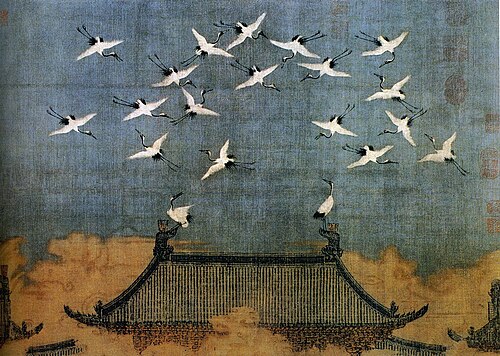

الفن الصيني هو فن بصري نشأ في الصين أو الصين الكبرى أو يمارس فيه ، أو على يد فنانين صينيين. ويمكن اعتبار الفن الذي يبدعه الصينيون المقيمون خارج الصين جزءًا من الفن الصيني عندما يستند إلى الثقافة والتراث والتاريخ الصيني أو يستلهم منه . وتشمل الأشكال الفنية الرئيسية الرسم، والخط، والنحت، والعمارة، وتصميم الحدائق، والأثاث، والخزف، والأعمال البرونزية، والطلاء، والمنسوجات، وتتشارك هذه الأشكال في الزخارف والمبادئ الجمالية، وغالبًا ما تتكامل لخلق بيئات موحدة، تشمل العمارة والحدائق والتصميمات الداخلية والأشياء الموجودة فيها. [ 1 ]
يعود تاريخ فنون العصر الحجري المبكر إلى 10000 قبل الميلاد، وتتألف في معظمها من الفخار والمنحوتات البسيطة. بعد تلك الفترة، صُنِّف الفن الصيني، كالتاريخ الصيني، عادةً وفقًا لتعاقب السلالات الحاكمة للأباطرة الصينيين ، والتي استمر معظمها لعدة قرون. يضم متحف القصر في بكين والمتحف الوطني للقصر في تايبيه مجموعات واسعة من الفن الصيني. [ 2 ] [ 3 ]
يتميز الفن الصيني بدرجة استثنائية من الاستمرارية والوعي بالتقاليد، وهو ما يفتقر إلى ما يُماثل انهيار الأساليب الكلاسيكية الغربية ثم تعافيها التدريجي . وتحتل الفنون الزخرفية مكانة بالغة الأهمية في الفن الصيني، وقد أُنتجت معظم الأعمال الفنية الرائعة في ورش عمل أو مصانع كبيرة على يد فنانين مغمورين، لا سيما في صناعة الخزف الصيني ، حيث خدمت البراعة التقنية مُثُلاً جمالية أوسع، ودقة التزجيج، ونقاء الشكل، مما رفع الحرفة إلى مستوى التأمل. [ 4 ]
أُنتجت معظم الأعمال الخزفية الأكثر تعقيدًا من الناحية التقنية في المصانع الإمبراطورية، على الرغم من أن الأفران الشعبية وورش العمل الإقليمية أنتجت أيضًا سلعًا ذات قيمة فنية استثنائية. في المقابل، طوّر فن الرسم بالحبر ، الذي مارسه بشكل رئيسي العلماء والمسؤولون ورسامو البلاط، وخاصةً في رسم المناظر الطبيعية والزهور والطيور ، قيمًا جمالية تعتمد على الخيال الفردي والملاحظة الموضوعية للفنان، وهي قيم مشابهة لتلك الموجودة في الغرب، ولكنها سبقت تطورها هناك بزمن طويل.
بعد تأسيس جمهورية الصين الشعبية عام ١٩٤٩، أصبحت الواقعية الاشتراكية الأسلوب الفني السائد والمعتمد رسميًا، وخضعت الفنون التقليدية للتدقيق الأيديولوجي، لا سيما خلال الثورة الثقافية (١٩٦٦-١٩٧٦)، حيث تم قمع أو تدمير جزء كبير من التراث الفني الصيني. ومنذ ثمانينيات القرن العشرين، أُعيد تأهيل وإحياء طيف واسع من أشكال الفن التقليدي، في حين ظهرت أيضًا حركات طليعية معاصرة، حظيت باعتراف دولي لأعمالها التي تتناول بنظرة نقدية التراث الفني الصيني ومجتمعه سريع التغير. [ ٥ ]
تاريخ
الفخار النيوليثي
تُعدّ حضارة يانغشاو النيوليثية ، التي يعود تاريخها إلى الألفية السادسة قبل الميلاد، من أقدم أشكال الفن في الصين. وقد كشفت الاكتشافات الأثرية، مثل تلك التي عُثر عليها في بانبو، أن شعب يانغشاو كان يصنع الفخار؛ وكانت القطع الخزفية الأولى غير مطلية، وغالبًا ما كانت تحمل علامات الحبال. وشملت الزخارف الأولى الأسماك ووجوه البشر والنباتات، وهي صور مألوفة لشعب يانغشاو في نمط حياتهم الزراعي. ثم تطورت هذه الزخارف لاحقًا إلى تصاميم أكثر ألوانًا وتعقيدًا وتجريدًا، تميزت بأنماط هندسية مستوحاة من علم الفلك. وعلى عكس حضارة لونغشان اللاحقة ، لم تستخدم حضارة يانغشاو عجلات الفخار في صناعته، بل اعتمدت على تقنيات يدوية كاللفّ . ومع ذلك، تشير الحفريات التي عُثر فيها على قطع تحمل أنماطًا بخطوط متوازية وشبكات خلال المرحلة المتأخرة من حضارة يانغشاو إلى استخدام طريقة الغزل لطلاء الفخار. [ 6 ]
حملت العديد من الرموز والتصاميم المرسومة دلالات دينية وروحية. فالنقوش التي تضم الضفادع والأسماك ترمز إلى الرخاء، بينما ترمز النقوش التي تضم الطيور والماء إلى احترام الطبيعة. ومن المرجح أن مشاهد الحياة اليومية التي تشمل المجتمع، مثل الرقصات والصيد، كانت ذات أهمية ضمن طقوس واحتفالات يانغشاو. [ 7 ]
كشفت الحفريات أن حضارة يانغشاو استخدمت الفخار في دفن الموتى في جرار. ويُظهر تحليل أنماط الجرار المرسومة أن التصاميم ربما عكست أحداثًا تاريخية وتجارب حياة الشخص المدفون. ومن المرجح أن دفن الموتى في الجرار، بهذا المعنى، كان بمثابة مؤشر على الطبقة الاجتماعية، يُظهر قوة الشخص وبطولته ومكانته في المجتمع. وبالمثل، ضمّن شعب لونغشان الفخار، إلى جانب إبداعات فنية أخرى، مثل مصنوعات اليشم ، في دفنهم للأفراد ذوي المكانة الرفيعة. [ 7 ]
 إناء أحمر ذو "أذنين"؛ من حضارة بيليغانغ ؛ 6000-5200 قبل الميلاد؛ خزف؛ متحف شنغهاي
 إناء فخاري منقط، من النوع شبه الجبلي؛ من ثقافة يانغشاو في الصين؛ 2700-2300 قبل الميلاد؛ متحف مقاطعة قانسو ( لانتشو )
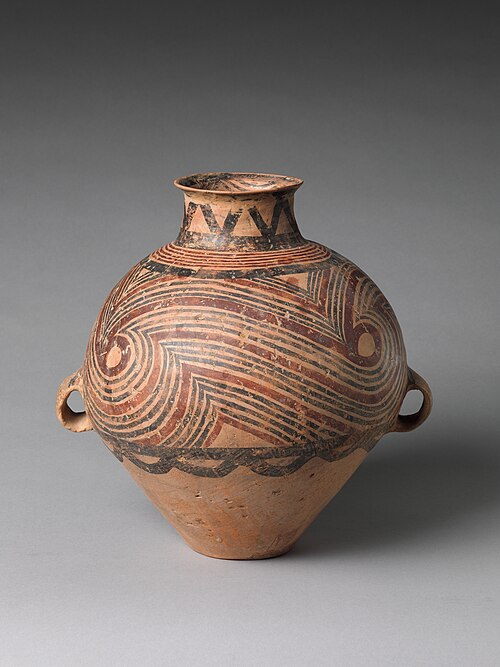 جرة؛ 2650-2350 قبل الميلاد؛ فخار مزخرف برسومات؛ الارتفاع: 34 سم؛ متحف متروبوليتان للفنون (مدينة نيويورك)
 إناء ذو نقش هندسي شبكي؛ من حضارة ماجياياو ؛ 2600-2300 قبل الميلاد؛ خزّاف مطلي؛ متحف شنغهاي
ثقافة اليشم
كانت حضارة ليانغتشو آخر حضارات اليشم في العصر الحجري الحديث في دلتا نهر اليانغتسي ، وامتدت على مدى 1300 عام تقريبًا. يتميز اليشم من هذه الحضارة بصناعته الدقيقة، وخاصةً القطع الطقسية الكبيرة مثل أسطوانات كونغ ، وأقراص بي ، وفؤوس يو، بالإضافة إلى المعلقات والزخارف على شكل لوحات وأطباق منحوتة ومفرغة، وتماثيل لطيور صغيرة وسلاحف وأسماك. يتميز يشم ليانغتشو بلونه الأبيض الحليبي الذي يشبه لون العظم، وذلك بسبب أصله من صخور التريموليت وتأثير السوائل المائية في مواقع الدفن.
 كونغ ، الألفية الثالثة قبل الميلاد
 خاتم ذو تنينين، من أوائل عهد أسرة شانغ (الألفية الثانية قبل الميلاد)
 التنين اليشمي، تشو الغربية
 سيف جيان صدئ من عهد أسرة تشو بمقبض من اليشم، حوالي القرن التاسع قبل الميلاد
صب البرونز


بدأ العصر البرونزي في الصين مع سلالة شيا . وقد عُثر على نماذج من هذه الفترة في أطلال حضارة إرليتو في شانشي، وتشمل أدوات نفعية معقدة ولكنها بسيطة. وفي عهد سلالة شانغ اللاحقة ، صُنعت أدوات أكثر تفصيلاً، بما في ذلك العديد من الأواني الطقسية. ويُذكر الشانغ ببراعتهم في صب البرونز، الذي تميز بدقة تفاصيله. وكان صانعو البرونز في عهد شانغ يعملون عادةً في مصانع خارج المدن لصنع الأواني الطقسية، وأحيانًا الأسلحة وتجهيزات العربات أيضًا. وكانت الأواني البرونزية بمثابة أوعية لتخزين أو تقديم مختلف المواد الصلبة والسائلة المستخدمة في أداء الطقوس المقدسة. وتتميز بعض الأشكال، مثل " كو" و "جوي" ، برشاقة فائقة، لكن القطع الأقوى هي " دينغ "، التي توصف أحيانًا بأنها تتمتع بـ"هيبة مهيبة".
من سمات أسلوب شانغ المتطور تزيين جميع المساحات المتاحة، وغالبًا ما تكون هذه المساحات مزينة بأشكال منمقة لحيوانات حقيقية وخيالية. أكثر الزخارف شيوعًا هو " تاوتي" ، الذي يصور كائنًا أسطوريًا مواجهًا كما لو كان مضغوطًا على سطح أفقي ليشكل تصميمًا متناظرًا. لا يزال المعنى المبكر لـ "تاوتي" غير واضح، لكن الأساطير حوله كانت موجودة في أواخر عهد أسرة تشو . كان يُعتقد أنه رجل طماع نُفي لحراسة ركن من السماء من الوحوش الشريرة؛ أو وحش برأس فقط يحاول التهام البشر لكنه لا يؤذي إلا نفسه.
تغيرت وظيفة ومظهر البرونز تدريجيًا من عهد أسرة شانغ إلى عهد أسرة تشو، إذ تحول استخدامه من الطقوس الدينية إلى أغراض عملية أكثر. وبحلول فترة الممالك المتحاربة ، أصبحت الأواني البرونزية قطعًا فنية تُمتع النظر. زُيّن بعضها بمشاهد اجتماعية، كالمآدب أو رحلات الصيد، بينما عُرضت أخرى بأنماط تجريدية مرصعة بالذهب أو الفضة أو الأحجار الكريمة وشبه الكريمة.
للقطع الأثرية البرونزية دلالات وأدوار بالغة الأهمية في عهد أسرة هان. فقد استُخدمت في طقوس الدفن، مما يعكس الجوانب الجمالية والفنية لتلك الحقبة. [ 10 ] وتتخذ العديد من الأواني البرونزية التي عُثر عليها في مقابر مقاطعة جيانغسو الصينية أشكالًا متنوعة، مثل دينغ وهو وشون، والتي تُمثل الجماليات الصينية التقليدية. [ 10 ] وتُعد هذه الأواني نماذج كلاسيكية للفن السماوي الصيني، الذي لعب دورًا محوريًا في تواصل الصينيين القدماء مع أرواح أسلافهم. [ 10 ] وإلى جانب الأواني، عُثر أيضًا على أسلحة برونزية وأدوات يومية وآلات موسيقية في مقابر العائلات الملكية في عهد أسرة هان في جيانغسو. ويُشير امتلاك مجموعة كاملة من آلة بيانتشونغ في المقبرة إلى مكانة الفرد وطبقته الاجتماعية في عهد أسرة هان، إذ كان هذا النوع من الآلات حكرًا على العائلات الملكية والثريّة. [ 10 ] يبدو أن آلة البيانوتشونغ والموسيقى كانتا تُستخدمان أيضًا كوسيلةٍ للتواصل بين حكام أسرة هان وآلهتهم. [ 10 ] يُبرز اكتشاف آلة البيانوتشونغ، وهي آلةٌ ملكيةٌ نموذجيةٌ عُثر عليها في الصين القديمة، تطور الأنظمة الموسيقية المعقدة في عهد أسرة هان. [ 10 ] قد تختلف مجموعة البيانوتشونغ في كثير من الحالات؛ فعلى سبيل المثال، تضمنت مجموعةٌ محددةٌ من آلات البيانوتشونغ المكتشفة في مقاطعة جيانغسو مجموعاتٍ مختلفةً من الأجراس، مثل أجراس نيوتشونغ ويونغتشونغ، ويظهر العديد منها على هيئة حيواناتٍ كالتنين، وهو حيوانٌ روحيٌّ صينيٌّ تقليديٌّ. [ 10 ]
حظيت تماثيل شانغ البرونزية بتقدير كبير كقطع فنية منذ عهد أسرة سونغ ، حيث جُمعت واعتُزّ بها ليس فقط لشكلها وتصميمها، بل أيضاً لألوانها المتنوعة من الأخضر والأزرق المخضر وحتى الأحمر، والتي تشكلت بفعل التفاعلات الكيميائية أثناء دفنها في الأرض. وتُعدّ دراسة صب البرونز الصيني المبكر مجالاً متخصصاً في تاريخ الفن.

 رأس برونزي من سانكسينغدوي ، الألفية الثانية قبل الميلاد
 شجرة البرونز المقدسة، سانشينغدوي
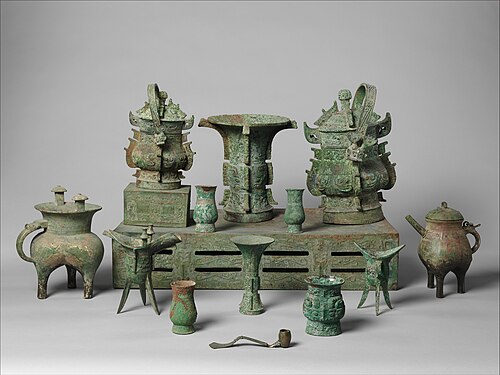 طقم مذبح؛ أواخر القرن الحادي عشر قبل الميلاد؛ برونز ؛ الأبعاد الكلية (الطاولة): الارتفاع: 18.1 سم (7 1/8 بوصة )، العرض: 46.4 سم (18 1/4 بوصة )، العمق: 89.9 سم (35 3/8 بوصة ) ؛ متحف متروبوليتان للفنون (مدينة نيويورك، الولايات المتحدة الأمريكية )
 زون مربع الشكل مزين بأربعة رؤوس خراف، من عهد أسرة شانغ
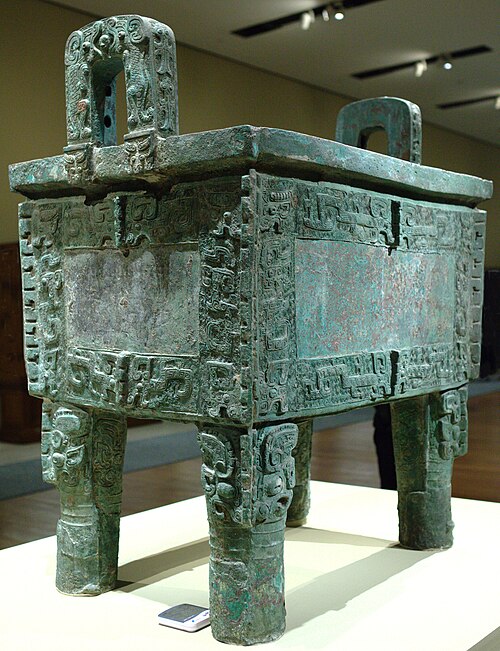 هوموو دينغ ، أكبر تمثال برونزي قديم تم العثور عليه على الإطلاق؛ 1300-1046 قبل الميلاد؛ المتحف الوطني الصيني .
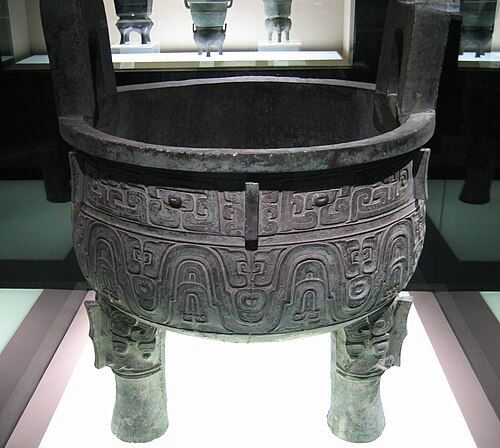 دا كي دينغ ؛ سلالة تشو الغربية؛ الارتفاع: 93.1 سم (36.7 بوصة) ، العرض: 75.6 سم (29.8 بوصة) (القطر الداخلي) و 74.9 سم (29.5 بوصة) (القطر الداخلي)؛ اكتُشف عام 1890، في بلدة فامن ( مقاطعة فوفنغ ، شنشي)؛ متحف شنغهاي
 جرس (لاي تشونغ)؛ 800-700 قبل الميلاد (سلالة تشو الغربية)؛ 70.3 × 37 × 26.6 سم (27 5/8 × 14 9/16 × 10 7/16 بوصة ) ؛ من ميشيان، شنشي؛ متحف كليفلاند للفنون . في الصين القديمة ، كان للموسيقى والطقوس دلالة سياسية ، وارتبطت ارتباطًا وثيقًا بسلطة الدول .
 حامل برونزي للأواني الاحتفالية؛ تم استخراجه من قبر ابن الملك تشوانغ من تشو (حكم من 613 إلى 591 قبل الميلاد)
 شي زون ؛ 1600-1046 ق.م. الارتفاع: 40 سم (16 بوصة) ؛ اكتشف في تشوانكسينغشان ( مقاطعة شيانغتان ، هونان)؛ متحف هونان
سلالة تشو ( حوالي 1046 - 256 قبل الميلاد)
خلال فترة تشو، لم يُسجل سوى عدد قليل من المنحوتات، وخاصة المنحوتات التي تُجسد الإنسان أو الحيوان، في الآثار الموجودة، ولا يبدو أن هناك تقليدًا نحتيًا كبيرًا. [ 13 ] [ 14 ] ومن بين هذه الصور القليلة جدًا المعروفة في الصين قبل ذلك التاريخ: أربعة تماثيل خشبية [ 15 ] من ليانغدايكون (梁帶村) في هانتشنغ (韓城)، شنشي ، والتي يُحتمل أن يعود تاريخها إلى القرن التاسع قبل الميلاد؛ وتمثالان خشبيان لأجانب يُحتمل أنهما يُمثلان حاملي محفة من مقبرة تابعة لسلالة تشين في لونغشيان (隴縣)، شنشي، من حوالي 700 قبل الميلاد؛ والعديد من التماثيل الصغيرة من حوالي القرن الخامس لموسيقيين برونزيين في منزل مصغر من شاوشينغ (紹興) في تشجيانغ ؛ حامل مصباح على شكل إنسان يعود للقرن الرابع الميلادي، عُثر عليه في مقبرة بينغشان الملكية بمقاطعة خبي . أما تمثال فارس تايربو، فهو تمثال من الطين المحروق يعود لعصر أسرة تشو، وتحديدًا إلى عهد أسرة تشين المحاربة، وقد عُثر عليه في مقبرة تايربو بالقرب من شيانيانغ في مقاطعة شنشي، ويعود تاريخه إلى القرنين الرابع والثالث قبل الميلاد. كما عُثر على تمثال آخر مطابق تقريبًا في المقبرة نفسها. تشير الثقوب الصغيرة في يديه إلى أنه كان يمسك في الأصل بزمام حصانه بيد، وسلاحًا باليد الأخرى. [ 16 ] يُعد هذا أقدم تمثيل معروف لفارس في الصين. [ 16 ]
 إناء على شكل ثور من فترة الربيع والخريف ، القرن السادس قبل الميلاد
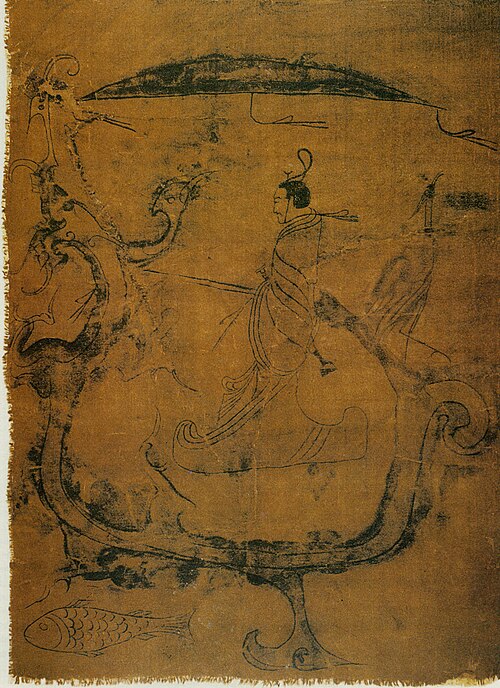 لوحة حريرية تصور رجلاً يمتطي تنينًا ، القرن الرابع قبل الميلاد
 أسرة تشو الغربية، القرن الحادي عشر - التاسع قبل الميلاد
 مقبض سيف ذهبي، من عهد أسرة تشو الشرقية
 إبزيم حزام فضي مرصع بالذهب واليشم، من فترة الممالك المتحاربة، حوالي القرن الرابع قبل الميلاد
 إناء " دوي" برونزي مزين بنقوش سحابية هندسية مطعمة، من العصر الجورجي الشرقي
ثقافة تشو والثقافات الجنوبية (حوالي 1030 قبل الميلاد - 223 قبل الميلاد)
كانت مملكة تشو ، التي ازدهرت في وادي نهر اليانغتسي، مصدرًا غنيًا للفنون في الصين القديمة . وقد كشفت الحفريات في مقابر تشو عن منحوتات خشبية مطلية، وأقراص من اليشم، وخرز زجاجي، وآلات موسيقية، ومجموعة متنوعة من الأواني المطلية . تتميز العديد من هذه الأواني المطلية برسومات دقيقة، باللون الأحمر على الأسود أو الأسود على الأحمر. كما كشف موقع في تشانغشا ، بمقاطعة هونان، عن بعض أقدم اللوحات على الحرير التي تم اكتشافها حتى الآن.
 صندوق مطلي بالورنيش على شكل خنزيرين متقابلين من الخلف.
 كان فن فينغهوانغ رمزًا شائعًا في فن تشو، بينما كان التنين أكثر شيوعًا في الولايات الأخرى الواقعة شمالها.
 طلاء مزدوج مع قاعدة على شكل طائر الفينيق.
الصين الإمبراطورية المبكرة (221 قبل الميلاد - 220 ميلادي)
فن تشين


يضم جيش التيراكوتا ، الموجود داخل ضريح الإمبراطور الأول لسلالة تشين، أكثر من 7000 تمثال من التيراكوتا بالحجم الطبيعي لمحاربين وخيول دُفنت مع تشين شي هوانغ، الذي نصّب نفسه إمبراطورًا للصين، في الفترة ما بين 210 و209 قبل الميلاد. رُسمت التماثيل قبل وضعها في القبو، وكانت ألوانها الأصلية ظاهرة عند استخراجها لأول مرة. إلا أن تعرضها للهواء تسبب في بهتان الألوان، لذا تبدو التماثيل اليوم بلون التيراكوتا. تتخذ التماثيل أوضاعًا متعددة، منها جنود المشاة الواقفون والرماة الراكعون، بالإضافة إلى سائقي العربات والخيول. ويبدو رأس كل تمثال فريدًا، إذ يُظهر تنوعًا في ملامح الوجه وتعبيراته، فضلًا عن تسريحات الشعر. يُعدّ الواقعية المذهلة التي تُظهرها المنحوتات دليلًا على تطور الفن خلال عهد أسرة تشين. [ 17 ] وهو أمر غير مسبوق في السجل التاريخي للفن في شرق آسيا. [ 13 ] [ 14 ]
طُوِّرت آلة موسيقية تُسمى تشين-زيثارة خلال عهد أسرة تشين. لطالما حظيت الجوانب الجمالية بأهمية تُضاهي أهمية الجوانب الوظيفية في الآلات الموسيقية في التاريخ الصيني. تتكون آلة تشين-زيثارة من سبعة أوتار. ورغم أن تشين-زيثارة قد تُذكّر البعض أحيانًا بفترات تاريخية مضطربة، إلا أنها تُعتبر في كثير من الأحيان رمزًا للسلام والوئام. [ 18 ]
فن هان

خلال عهد أسرة تشين، تم توحيد الخط الصيني وأنظمة القياس والعملة بهدف تحقيق مزيد من التوحيد. [ 20 ] كما تم توسيع سور الصين العظيم كبناء دفاعي ضد الغزاة الشماليين. [ 20 ]
اشتهرت سلالة هان بصناعة بدلات الدفن المصنوعة من اليشم . ومن أقدم الصور المعروفة للمناظر الطبيعية في الفن الصيني لوحتان من بلاط مجوف على باب من مقبرة تعود إلى سلالة هان الغربية بالقرب من تشنغتشو ، ويعود تاريخها إلى 60 قبل الميلاد. [ 21 ] يُجسد المشهد انحسارًا تدريجيًا للعمق من خلال الخطوط المتعرجة التي تمثل الطرق وجدران الحدائق، مما يوحي بأن المرء ينظر من أعلى تلة. [ 21 ] وقد صُنع هذا المشهد الفني من خلال الضغط المتكرر لأختام قياسية على الطين وهو لا يزال طريًا قبل حرقه. [ 21 ] ومع ذلك، فإن أقدم تقليد معروف لفن المناظر الطبيعية بالمعنى الكلاسيكي للرسم هو عمل للفنان تشان زيكيان من سلالة سوي (581-618).
إلى جانب المصنوعات اليشمية، يُعدّ البرونز مادةً مفضلةً أخرى لدى الفنانين لصلابته ومتانته. وقد أُنتجت المرايا البرونزية بكميات كبيرة في عهد أسرة هان، إذ وُجدت مرايا في كل مقبرة تقريبًا تعود إلى عهد هذه الأسرة. [ 22 ] عادةً ما يُصنع الجانب العاكس من مزيج من البرونز والنحاس والقصدير والرصاص. [ 22 ] تعني كلمة "مرآة" في اللغة الصينية "الانعكاس" أو "النظر في"، لذا استُخدمت المرايا البرونزية كرمزٍ لعكس الواقع. [ 22 ] اعتقد الصينيون القدماء أن المرآة تُجسّد الواقع، مما يُساعدهم على إدراك الوضع الراهن بشكلٍ أفضل؛ كما استُخدمت المرايا كوسيلةٍ لنقل أو عرض انعكاسٍ للأحداث الماضية. [ 22 ] تتميز المرايا البرونزية المصنوعة في عهد أسرة هان بزخارف معقدة على جانبها غير العاكس؛ بعضها يحمل قصصًا سردية. [ 22 ] تعكس الروايات نفسها دائماً النظريات الشائعة والأساسية لحياة شعب الهان. [ 23 ]
 كلب من الفخار المزجج، مزين بنقوش على سطحه على شكل طوق؛ من سلالة هان الشرقية، القرن الأول الميلادي.
 اشتهرت الأواني المطلية بالورنيش في عهد أسرة هان بتصاميمها المعقدة والأنيقة.
 تم العثور على أنماط مجردة ولكنها معقدة على توابيت السيدة شين تشوي (217 قبل الميلاد - 168 قبل الميلاد).
 زوجان من عائلة هان يتناولان العشاء معًا، من لويانغ حوالي عام 220 ميلادي
 خادمة أنثى ومستشار ذكر في تماثيل هان شينيي ، وهي تماثيل من الطين المحروق من عهد أسرة هان الغربية.
 تمثال برونزي صغير لحيوان الكيلين ، القرن الأول الميلادي
 إناء شرب من اليشم من ناني، القرن الأول قبل الميلاد
 جدارية قبر من عهد أسرة هان الغربية تصور الفيلسوف كونفوشيوس ؛ 202 قبل الميلاد - 9 ميلادي؛ من مقاطعة دونغ بينغ ، شاندونغ
 جزء من جدارية تعود إلى عهد أسرة هان الشرقية (25-220 ميلادي) تصور 9 عربات و50 حصانًا وأكثر من 70 رجلاً، من مقبرة في لويانغ ، الصين

 مشبك حزام ذهبي مزين بنقش تنين، من العصر الهاني الغربي
 جدارية قبر داهوتينغ (打虎亭漢墓; DáhƔtíng hàn mù ) من أواخر هان الشرقية، وتقع في تشنغتشو، خنان
 تمثال خزفي من عهد أسرة هان الشرقية لامرأة جالسة تحمل مرآة برونزية ، تم اكتشافه في مقبرة سونغجيالين، مقاطعة بي ، سيتشوان
 عُثر في ماوانغدوي على حزم من الحرير تحمل جميع أنواع التصاميم المعقدة.

أولى المنحوتات الحجرية الضخمة (117 قبل الميلاد)

كانت التماثيل الطينية معروفة في الصين منذ زمن طويل، لكن لا توجد أمثلة معروفة لتماثيل حجرية ضخمة قبل المنحوتات الحجرية في ضريح هوو تشوبينغ (140-117 قبل الميلاد)، وهو جنرال في جيش الإمبراطور هان وودي الذي ذهب إلى المناطق الغربية لمحاربة شيونغنو . [ 24 ] في المصادر الأدبية، يوجد سجل واحد فقط يعود إلى القرنين الثالث والرابع الميلاديين لمثال أقدم محتمل: تمثالان حجريان ضخمان مزعومان لحيوان الكيلين (وحيد القرن الصيني) قيل إنهما نُصبا فوق قبر الإمبراطور الأول تشين شي هوانغ . [ 25 ] أشهر تماثيل هوو تشوبينغ هو تمثال حصان يدوس محاربًا من شيونغنو . [ 24 ]
يضم ضريح هوو تشوبينغ (الواقع في ماولينغ ، ضريح هان وودي) 15 تمثالًا حجريًا إضافيًا. هذه التماثيل أقل واقعية من تمثال "الحصان الذي يدوس شيونغنو"، وتميل إلى محاكاة الشكل الطبيعي للحجر، حيث لا تظهر تفاصيل الشخصيات إلا في النقوش البارزة. [ 26 ] بعد هذه المحاولات المبكرة، لم يتطور استخدام التماثيل الحجرية الضخمة إلا من نهاية عهد أسرة هان الغربية إلى عهد أسرة هان الشرقية. [ 27 ]
أصبحت التماثيل الحجرية الضخمة شكلاً فنياً رئيسياً في الفترة ما بين القرنين الرابع والسادس الميلاديين مع ظهور النحت البوذي الضخم في الصين. [ 28 ]
فترة الانقسام (220-581)

تأثير البوذية
وصلت البوذية إلى الصين حوالي القرن الأول الميلادي (مع وجود بعض الروايات عن زيارة راهب للصين خلال عهد أشوكا )، وبلغت ذروتها في القرن الثامن الميلادي، حيث ازدهرت الفنون البوذية وتطورت بشكل ملحوظ، لا سيما في مجال النحت. وبعد أن استقبلت الصين هذه الديانة البعيدة، سرعان ما أدمجت سمات صينية بارزة في تعبيرها الفني.
في القرنين الخامس والسادس الميلاديين، اتجهت السلالات الشمالية ، التي كانت بعيدة نسبيًا عن مصادر إلهامها الأصلية، إلى تطوير أساليب تمثيلية رمزية ومجردة، ذات خطوط تخطيطية. ويُقال أيضًا إن أسلوبها كان مهيبًا وجليلًا. وقد أدى افتقار هذا الفن إلى التجسيد المادي، وابتعاده عن الهدف البوذي الأصلي المتمثل في التعبير عن المثل الأعلى للتنوير بطريقة واقعية ومتاحة للجميع، إلى البحث تدريجيًا نحو مزيد من الطبيعية والواقعية، مما أفضى إلى ظهور فن تانغ البوذي.
 جدارية من كهوف موغاو ، وي الغربية ، (535-556 م)
 جدارية دونهوانغ ، منتصف القرن السادس
 فن الكهوف البوذي، راقصة تدور بينما تعزف الأوركسترا.
 فيروتشانا، مغارات لونغمن ، 500-900 ميلادي
 رسم توضيحي لإغراء ساكياموني بواسطة مارا
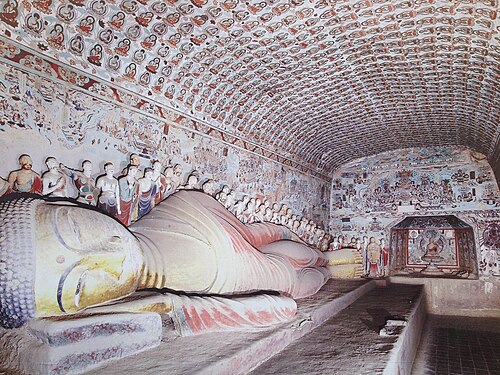 بوذا المتكئ، فترة تانغ العليا
الخط العربي
في الصين القديمة، كان الرسم والخط من أرقى الفنون وأكثرها تقديرًا في أوساط البلاط، وكان إنتاجهما حكرًا تقريبًا على الهواة والأرستقراطيين والعلماء المسؤولين الذين كانوا وحدهم يملكون الوقت الكافي لإتقان التقنية والحساسية اللازمتين لإتقان فن الرسم. كان يُعتقد أن الخط هو أرقى أشكال الرسم وأكثرها نقاءً. وكانت أدواته الفرشاة المصنوعة من شعر الحيوانات، والحبر الأسود المصنوع من سخام الصنوبر والغراء الحيواني. وكان يُكتب ويُرسم على الحرير. ولكن بعد اختراع الورق في القرن الأول الميلادي، استُبدل الحرير تدريجيًا بهذه المادة الجديدة الأرخص ثمنًا. وقد حظيت كتابات الخطاطين المشهورين الأصلية بتقدير كبير عبر تاريخ الصين، وتُثبّت على لفائف وتُعلّق على الجدران كما تُعلّق اللوحات.
كان وانغ شيجي خطاطًا صينيًا شهيرًا عاش في القرن الرابع الميلادي. أشهر أعماله هو " لانتينغ شو" ، وهو مقدمة لمجموعة من القصائد. غالبًا ما يُحتفى بخطه باعتباره ذروة أسلوب "الخط الراكض" شبه المتصل في تاريخ الخط الصيني.
كانت وي شو خطاطة مشهورة من سلالة جين الشرقية، وقد وضعت قواعد مهمة حول الكتابة المنتظمة . ومن أشهر أعمالها نقش المحظية الشهيرة (名姬帖 Ming Ji Tie) ونقش وي شي خنان (衛氏和南帖 Wei-shi He'nan Tie).
تلوين


غو كاي تشي رسام صيني شهير من الصين القديمة، وُلد في ووشي . ألّف ثلاثة كتب في نظرية الرسم: " في الرسم" (畫論)، و" مقدمة عن اللوحات الشهيرة من عهد أسرتي وي وجين" (魏晉名畫記)، و" رسم جبل يونتاي " (畫雲臺山記). كتب: "في رسم الشخصيات، لم تكن الملابس والمظاهر ذات أهمية كبيرة، بل كانت العيون هي الروح والعامل الحاسم". لا تزال ثلاث من لوحات غو موجودة حتى اليوم: " نصائح المعلمة لسيدات البلاط " ، و"حورية نهر لو" (洛神賦)، و" النساء الحكيمات والكريمات" .
توجد أمثلة أخرى على فن الرسم في مقابر أسرة جين. من بينها لوحة " حكماء غابة الخيزران السبعة"، المرسومة على جدار من الطوب في مقبرة تقع بالقرب من مدينة نانجينغ الحديثة، والموجودة الآن في متحف مقاطعة شنشي. تحمل كل شخصية من الشخصيات المرسومة اسمًا، وتُظهرها اللوحة إما وهي تشرب أو تكتب أو تعزف على آلة موسيقية. كما تُصوّر لوحات أخرى في المقابر مشاهد من الحياة اليومية، مثل رجال يحرثون الحقول بفرق من الثيران.
 لوحات جنائزية، من قبر سيما جينلونغ ، 484 م
 مشهد لفارسين على ظهور الخيل من لوحة جدارية في قبر لو روي في تاييوان ، شانشي، سلالة تشي الشمالية (550-577).
 مزهرية مزخرفة بنقش زهرة اللوتس من شمال تشي ، القرن السادس الميلادي
 حامل شموع على شكل أسد من سلالة جين الغربية، حوالي القرن الرابع الميلادي
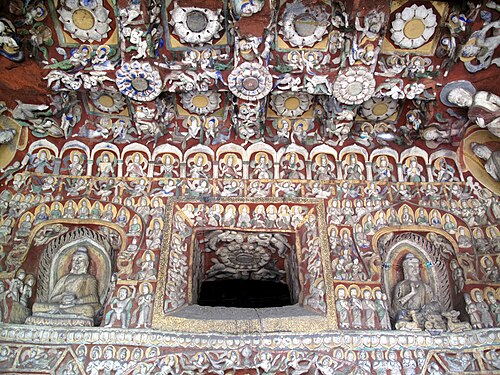
 جداريات وتماثيل مطلية من عهد أسرة وي الشمالية من كهوف يونغانغ ، يعود تاريخها إلى القرنين الخامس والسادس.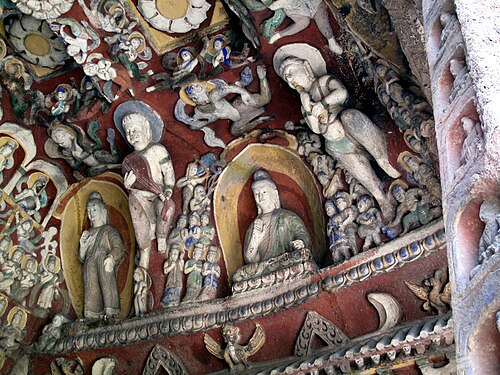

سلالتا سوي وتانغ (581-960)

العمارة والمنحوتات البوذية
بعد مرحلة انتقالية في عهد أسرة سوي ، تطورت المنحوتات البوذية في عهد أسرة تانغ نحو تعبير واقعي بشكل ملحوظ. ونتيجة لانفتاح الأسرة على التجارة الخارجية والتأثيرات عبر طريق الحرير ، اتخذت المنحوتات البوذية في عهد أسرة تانغ شكلاً كلاسيكياً إلى حد ما، مستوحى من الفن اليوناني البوذي في آسيا الوسطى.
إلا أن التأثيرات الأجنبية أصبحت تُنظر إليها نظرة سلبية مع اقتراب نهاية عهد أسرة تانغ. ففي عام 845، حظر الإمبراطور ووزونغ جميع الديانات "الأجنبية" (بما في ذلك المسيحية النسطورية والزرادشتية والبوذية) لدعم الطاوية المحلية . وصادر الممتلكات البوذية وأجبر أتباعها على ممارسة شعائرهم سرًا، مما أثر سلبًا على تطور الدين وفنونه في الصين.
تشتهر تماثيل المقابر الفخارية المزججة أو المطلية التي تعود إلى عهد أسرة تانغ ، وهي ممثلة بشكل جيد في متاحف حول العالم. لم ينجُ معظم منحوتات تانغ الخشبية، على الرغم من أنه لا يزال بالإمكان رؤية نماذج من أسلوب تانغ العالمي في نارا ، اليابان. وقد أثبتت المنحوتات الحجرية ديمومتها بشكل أكبر. يمكن رؤية بعض أروع الأمثلة في لونغمن ، بالقرب من لويانغ ، ويونغانغ بالقرب من داتونغ ، ومعبد بينغلينغ في غانسو . ومن أشهر المعابد البوذية الصينية معبد البجعة البرية العملاقة ، الذي بُني عام 652 ميلادي.
 لوحة من سلالة تانغ من دونهوانغ .
 لوحة جدارية من دونهوانغ تصور العمارة النموذجية لسلالة تانغ
 لوحة فارجاباني
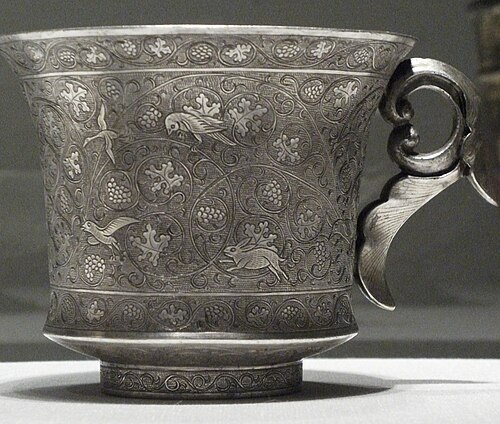 يمكن ملاحظة تأثير آسيا الوسطى في شكل هذا الكأس.

تلوين

ابتداءً من عهد أسرة تانغ (618-907)، كان الموضوع الرئيسي للرسم هو المناظر الطبيعية، والمعروفة باسم رسم شانشوي (ماء الجبل). في هذه المناظر الطبيعية، التي عادة ما تكون أحادية اللون وبسيطة، لم يكن الهدف هو إعادة إنتاج مظهر الطبيعة بدقة، بل التقاط شعور أو جو معين من أجل التقاط "إيقاع" الطبيعة.
كان الرسم على الطريقة التقليدية يعتمد بشكل أساسي على نفس تقنيات الخط، وكان يُنفذ بفرشاة مغموسة في حبر أسود أو ملون، دون استخدام الألوان الزيتية. وكما هو الحال في الخط، كانت أكثر المواد شيوعًا للرسم هي الورق والحرير. ثم تُثبت الأعمال الفنية المنجزة على لفائف، يمكن تعليقها أو لفها. كما كان الرسم التقليدي يُنفذ في ألبومات، وعلى الجدران، وفي أعمال الطلاء، وباستخدام وسائط أخرى.
كان دونغ يوان رسامًا نشطًا في مملكة تانغ الجنوبية. اشتهر بلوحاته التي تُصوّر الشخصيات والمناظر الطبيعية، وجسّد الأسلوب الأنيق الذي أصبح معيارًا للرسم بالفرشاة في الصين على مدى 900 عام تالية. وكما هو الحال مع العديد من الفنانين في الصين، عمل دونغ يوان موظفًا حكوميًا، حيث درس الأساليب الفنية السائدة آنذاك لكل من لي سيكسون ووانغ وي. إلا أنه أضاف إلى عدد من التقنيات، بما في ذلك منظور أكثر دقة، واستخدام التنقيط والتهشير المتقاطع لإضفاء تأثير حيوي على اللوحة.
كان تشان زيكيان رسامًا خلال عهد أسرة سوي. لوحته الوحيدة الموجودة هي " نزهة في الربيع" ، وهي لوحة تصور الجبال بمنظور ثلاثي الأبعاد. ولأن لوحات المناظر الطبيعية الخالصة كانت نادرة في أوروبا حتى القرن السابع عشر، فمن المرجح أن تكون "نزهة في الربيع" أول لوحة مناظر طبيعية في العالم.


سلالتا سونغ ويوان (960-1368)

لوحة الأغنية
خلال عهد أسرة سونغ (960-1279)، ظهرت مناظر طبيعية ذات تعبير أكثر دقة؛ حيث تم تصوير مسافات شاسعة من خلال استخدام خطوط ضبابية، وتلاشي تضاريس الجبال في الضباب، ومعالجة انطباعية للظواهر الطبيعية. وتم التركيز على الجوانب الروحية للوحة وعلى قدرة الفنان على إظهار الانسجام الداخلي بين الإنسان والطبيعة، كما يُفهم وفقًا للمفاهيم الطاوية والبوذية .
كان ليانغ كاي رسامًا صينيًا عاش في القرن الثالث عشر (عهد أسرة سونغ). أطلق على نفسه لقب "ليانغ المجنون"، وقضى حياته بين الشرب والرسم. وفي النهاية، اعتزل وأصبح راهبًا بوذيًا . يُنسب إلى ليانغ ابتكار مدرسة الزن في الفن الصيني. أما ون تونغ، فكان رسامًا عاش في القرن الحادي عشر. اشتهر بلوحاته الحبرية للخيزران . كان قادرًا على حمل فرشاتين في يد واحدة ورسم نوعين مختلفين من الخيزران في آن واحد، على مسافات متباعدة. لم يكن بحاجة لرؤية الخيزران أثناء الرسم لكثرة ما رآه منه.
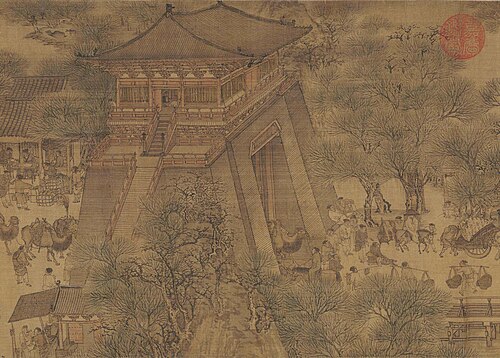
كان تشانغ زيدوان رسامًا بارزًا اشتهر بلوحته الأفقية " على ضفاف النهر خلال مهرجان تشينغمينغ" ، التي تُصوّر المناظر الطبيعية والحضرية. تُعتبر هذه اللوحة من أشهر اللوحات الصينية، وقد أُعيد إنتاجها مرات عديدة عبر التاريخ الصيني. [ 29 ] ومن اللوحات الشهيرة الأخرى " سهرات هان شيزاي الليلية" ، التي رسمها الفنان غو هونغ تشونغ من أسرة تانغ الجنوبية في القرن العاشر، بينما تُعدّ النسخة المعروفة منها إعادة إنتاج من القرن الثاني عشر لعصر أسرة سونغ. وهي عبارة عن لفافة أفقية كبيرة تُصوّر مشهدًا منزليًا لرجال من الطبقة الأرستقراطية يستمتعون بالموسيقى والرقص، بينما يتناولون الطعام والشراب، وتُقدّم لهم الخادمات أحواض الغسيل. في عام 2000، ابتكر الفنان المعاصر وانغ تشينغ سونغ محاكاة ساخرة لهذه اللوحة، باستخدام صورة فوتوغرافية أفقية طويلة لأشخاص يرتدون ملابس عصرية، ويؤدون تعابير وجه وحركات وإيماءات يد مشابهة لتلك الموجودة في اللوحة الأصلية.




 معبد بوذي في الجبال ، القرن الحادي عشر، حبر على حرير، متحف نيلسون-أتكينز للفنون ، مدينة كانساس (ميسوري).
 بوديساتفا أفالوكيتسفارا ( غوانيين ) جالسًا ، خشب وصبغة، القرن الحادي عشر، سلالة سونغ الشمالية الصينية ، متحف سانت لويس للفنون
 تقويم الطيور والحيوانات ، مثال نموذجي لأنماط غونغبي الشائعة خلال عهد أسرة سونغ
 ثلاثة أصدقاء للشتاء يصورون البرقوق والصنوبر والخيزران، ولا تزال تستخدم للزينة خلال رأس السنة الجديدة من قبل دول في المجال الصيني
 السفر على النهر في الثلج . تفاصيل بالغة التعقيد تمنح المؤرخين نظرة ثاقبة على بناء السفن الصينية في العصور الوسطى .
 كان الإمبراطور هويزونغ من سلالة سونغ رسامًا غزير الإنتاج
 لوحة "طائر على غصن" للفنان لي أنتشونغ ؛ لها شكل دائري لأنها رُسمت في الأصل لمروحة دائرية .
 فاكهة اللوز الهندي وطائر جبلي ، أغنية الجنوب (1127-1279)؛ كانت اللوحات الصغيرة على أوراق الألبوم مثل هذه شائعة بين النبلاء والعلماء المسؤولين .
 المد الربيعي يجلب المطر، بقلم لي دي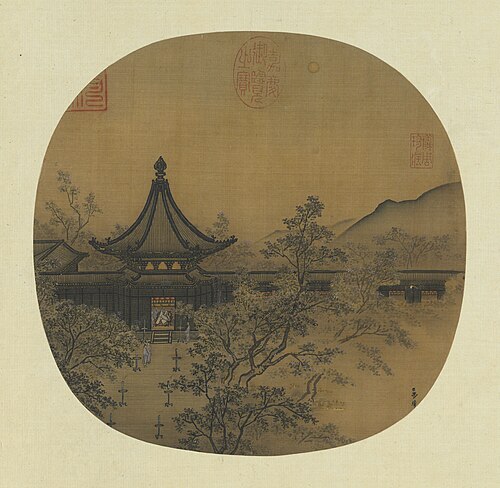
 طائر القرقس على شجرة في الشتاء ؛ 1187 ميلادي.
 عصافير الشتاء بريشة كوي باي
 المسافرون بين الجبال والجداول (谿山行旅)، فان كوان (960 – 1032)
 "مائة طفل يلعبون في الربيع" لسو هانشن ((1094–1172))
 بائع التحف الصغيرة لسو هانشن؛ أصبحت تصويرات الحياة اليومية موضوعًا شائعًا خلال سنوات ازدهار سلالة سونغ


لوحة يوان

مع سقوط سلالة سونغ في عام 1279 ، وما تلاه من اضطراب ناجم عن تأسيس سلالة يوان على يد الغزاة المغول ، انسحب العديد من فناني البلاط والأدباء من الحياة الاجتماعية، وعادوا إلى الطبيعة، من خلال لوحات المناظر الطبيعية، وتجديد أسلوب "الأزرق والأخضر" لعصر تانغ. [ 30 ]
كان وانغ مينغ أحد هؤلاء الرسامين، ومن أشهر أعماله لوحة " كهف الغابة ". أما تشاو مينغفو ، فكان عالماً ورساماً وخطاطاً صينياً خلال عهد أسرة يوان. ويُعتقد أن رفضه لأسلوب الرسم الرقيق والناعم الذي ساد عصره، لصالح الأسلوب الأكثر خشونة في القرن الثامن، قد أحدث ثورةً أدت إلى ظهور فن رسم المناظر الطبيعية الصيني الحديث. كما برزت أعمال الفنان تشيان شوان (1235-1305) الزاهية والغنية بالتفاصيل، والذي خدم في بلاط أسرة سونغ، ورفض بدافع وطنيته خدمة المغول، واتجه بدلاً من ذلك إلى الرسم. واشتهر أيضاً بإحيائه وإعادة إنتاجه لأسلوب الرسم الذي ساد في عهد أسرة تانغ.
تتميز أواخر عهد أسرة يوان بأعمال ما يُعرف بـ"الأساتذة الأربعة العظام". وكان أبرزهم هوانغ غونغوانغ (1269-1354)، الذي لاقت مناظره الطبيعية الهادئة والمتزنة إعجاب معاصريه، وكذلك رسامي الأدباء الصينيين في القرون اللاحقة. وكان ني زان (1301-1374) ذا تأثير كبير أيضًا، إذ كان يُرتب لوحاته غالبًا بمقدمة وخلفية قويتين وواضحتين، تاركًا المساحة الوسطى فارغة. وقد اعتمد رسامو أسرتي مينغ وتشينغ اللاحقين هذا الأسلوب بشكل متكرر . [ 30 ]
الفخار
يُصنع الخزف الصيني من عجينة صلبة تتكون من طين الكاولين ومعدن فلسبار يُسمى بيتونتسي ، يعمل على تماسك الإناء وسد مسامه . وقد ارتبط اسم الصين بالخزف عالي الجودة. وتأتي معظم أواني الخزف من مدينة جينغدتشن في مقاطعة جيانغشي . ويُعدّ خزف جينغدتشن ، بأسماء مختلفة، ركيزة أساسية في صناعة الخزف في الصين منذ عهد أسرة يوان على الأقل.
أواخر العصر الإمبراطوري في الصين (1368-1912)
لوحة مينغ
في عهد أسرة مينغ ، ازدهرت الثقافة الصينية. وحظيت اللوحات السردية، التي تميزت بنطاق ألوان أوسع وتكوين أكثر كثافة من لوحات أسرة سونغ، بشعبية هائلة خلال تلك الفترة.
قام وين تشنغمينغ (1470-1559) بتطوير أسلوب مدرسة وو في سوتشو ، والتي هيمنت على الرسم الصيني خلال القرن السادس عشر. [ 31 ]
وقد أثر دونغ تشيتشانغ (1555-1636) بشكل أكبر على تاريخ الفن في شرق آسيا من خلال استيعاب أفكار بوذية تشان وطرح نظرية "المدارس الجنوبية والشمالية". [ 32 ]
بدأت الثقافة الأوروبية تؤثر على الفن الصيني خلال هذه الفترة. زار الكاهن اليسوعي ماتيو ريتشي مدينة نانجينغ حاملاً معه العديد من الأعمال الفنية الغربية، والتي كان لها تأثير كبير في إظهار تقنيات مختلفة للمنظور والتظليل. [ 33 ]

 مهرجان الخوخ للملكة الأم الغربية، أوائل القرن السابع عشر، سلالة مينغ.
 لوحة " زهرة البرقوق الثلجية والكركي التوأم" لبيان جينغتشاو ، والتي تتضمن أسلوب غونبي ، من القرن الخامس عشر.
 الإمبراطور شينزونغ والإمبراطورة شياودوان
 ماجنوليا والصخور المنتصبة (玉堂柱石圖)
 كما تأثرت فنون رسم البورتريه في عهد أسرة مينغ بأساليب أسرة سونغ، إلا أنها تخلت عن التزامها بالبساطة والتقشف.
 تفاصيل من لوحة "اقتراب الإمبراطور" تُظهر العربة الملكية للإمبراطور وانلي وهي تجرها الأفيال ويرافقها سلاح الفرسان ( اللوحة البانورامية الكاملة هنا )
لوحات من أوائل عهد أسرة تشينغ
تطورت سلالة تشينغ المبكرة في اتجاهين رئيسيين: المدرسة الأرثوذكسية، ورسامو المدرسة الفردية، وكلاهما اتبع نظريات دونغ تشيتشانغ، لكن مع التركيز على جوانب مختلفة تمامًا. [ 34 ] كما تأثرت لوحات البلاط في عهد سلالة تشينغ بشكل كبير بفنانين غربيين مثل جان دينيس أتيريه (1702-1768) وجوزيبي كاستيليوني (1688-1766). [ 32 ]
اشتهر أربعة من أساتذة وانغ، بمن فيهم وانغ جيان (1598-1677) ووانغ شيمين (1592-1680)، في المدرسة الأرثوذكسية ، واستلهموا من إعادة إحياء الأساليب الفنية القديمة، ولا سيما المهارات التقنية في ضربات الفرشاة والخط لدى الأساتذة القدماء. أما وانغ يوانكي الأصغر (1642-1715)، فقد رسّخ نهج التفاعل مع أعمال الأساتذة القدماء واستلهامها. وكثيراً ما كانت أعماله مصحوبة بتعليقات تتضمن نظرياته حول كيفية ارتباط لوحاته بنماذج الأساتذة القدماء. [ 35 ]
شمل الرسامون الفرديون بادا شانرن (1626-1705) وشيتاو (1641-1707). وقد استقوا من الأفكار الثورية لتجاوز التقاليد لتحقيق أساليب فردية أصلية؛ وبهذه الطريقة كانوا أكثر التزامًا بنهج دونغ تشيتشانغ من المدرسة الأرثوذكسية (التي كانت من أتباعه المباشرين الرسميين). [ 36 ]
اكتسب الرسامون من خارج التقاليد الأدبية والعلمية والأرستقراطية شهرةً واسعة، حيث قام بعض الفنانين برسم لوحات لبيعها. ومن هؤلاء ما كوان (أواخر القرن السابع عشر - القرن الثامن عشر)، الذي صوّر الزهور والطيور والحشرات الشائعة، وهي مواضيع لم تكن شائعة بين العلماء. مع ذلك، لم يكن هؤلاء الرسامون منفصلين عن مدارس الرسم الرسمية، بل كانوا عادةً ملمين بالأساليب والتقنيات الفنية. على سبيل المثال، استوحت ما كوان أسلوبها في الرسم من نماذج أسرة سونغ. [ 37 ] في الوقت نفسه، استمر رسامو مثل يون شوبينغ (1633-1690) وحفيده يون بينغ في استخدام تقنية الرسم بدون عظم ( بالصينية :沒骨畫)، التي يُعتقد أنها نشأت كخطوة تحضيرية عند رسم الصور ذات الخطوط الذهبية خلال عهد أسرة تانغ . [ 38 ]
مع تطور تقنيات الطباعة الملونة، بدأت تُنشر كتيبات مصورة عن فن الرسم. ولا يزال كتاب "جيزيوان هواجوان" (دليل حديقة بذور الخردل)، وهو عمل من خمسة مجلدات نُشر لأول مرة عام 1679، يُستخدم ككتاب تقني للفنانين والطلاب منذ ذلك الحين.
 الإمبراطور يونغ تشنغ يستمتع بوقته خلال الشهر القمري الثامن ، بريشة فنانين مجهولين من البلاط، 1723-1735 م، متحف القصر ، بكين، يظهر استخدام المنظور الخطي .
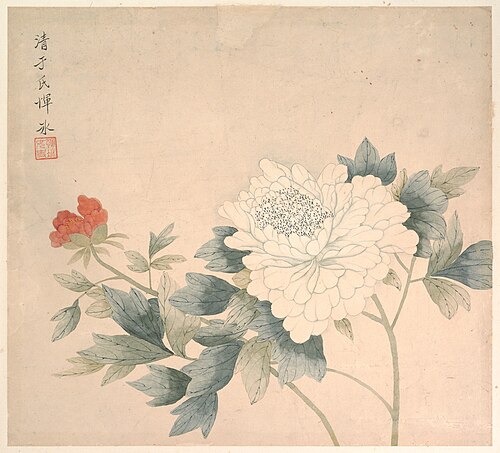 ورقة ألبوم ، يون بينغ ، القرن السابع عشر، متحف متروبوليتان للفنون ، نيويورك، توضح تقنية "بدون عظم".
 لوحة صينية من عام 1664 للفنان كون كان من سلالة تشينغ
فن أواخر عهد أسرة تشينغ
يشير مصطلح أواخر عهد أسرة تشينغ عمومًا إلى الفترة الممتدة من حرب الأفيون عام 1840 إلى سقوط أسرة تشينغ عام 1912. خلال هذه الفترة، تراجعت قوة بلاط تشينغ على المستوى الوطني، وتفاقمت الاضطرابات الداخلية والخارجية، وكثرت الحروب، واضطرت البلاد إلى الانفتاح على العالم الخارجي. [ 39 ] تدفقت الثقافة الغربية والاقتصاد التجاري إلى الصين بأعداد كبيرة، وتفككت البنية الاجتماعية الإقطاعية التقليدية تدريجيًا. وازدهرت التجارة الحضرية، لا سيما في الموانئ التجارية مثل شنغهاي، ازدهارًا سريعًا.
أثرت التغيرات الجذرية في الوضع الاجتماعي بشكل مباشر على تطور فن الرسم: فالرسم التقليدي، الذي كان في الأصل حكرًا على البلاط والعلماء والأدباء، لم يعد محصورًا بأسلوب رفيع ومنعزل، بل بدأ يتجه نحو عامة الناس والسوق. كما أدى تلاقح الثقافتين الصينية والغربية إلى تخلي الرسم عن الأساليب القديمة، مما أسفر عن تحول جذري في الجماليات والأسلوب. وأصبحت العلمنة والتجارة وتكامل الثقافتين الصينية والغربية أبرز سمات فن الرسم في أواخر عهد أسرة تشينغ.
كانت مدرسة شنغهاي (海派) ( هايباي ) أبرز مدارس الرسم في أواخر عهد أسرة تشينغ ، وقد نشأت انطلاقًا من ميناء شنغهاي التجاري. [ 40 ] ومع التطور التجاري وتوسع الطبقة الوسطى الحضرية في شنغهاي، أصبحت فنون الخط والرسم سلعًا رائجة. لم يعد الرسامون يسعون فقط إلى تحقيق التصور الفني السامي للعلماء، بل باتوا يحرصون على تلبية المعايير الجمالية لعامة الناس. وقد أصبحت مواضيعهم أكثر شيوعًا، وألوانهم أكثر حيوية، ولوحاتهم أكثر جاذبية وإثارة للاهتمام.
من أبرز شخصيات مدرسة شنغهاي: رن بونيان ، وو تشانغشو ، شو غو ، وتشاو تشي تشيان . وقد طرأ تغيير ملحوظ على أسلوبها مقارنةً بفترة منتصف عهد أسرة تشينغ، إذ تخلّت عن السعي الأعمى وراء الأناقة والبرودة، وأصبحت الألوان غنيةً زاهية، وحركات الفرشاة حرةً وجريئة. [ 41 ] وتوسّعت مواضيعها من عزلة المناظر الطبيعية التقليدية لتشمل عامة الناس، والزهور، والطيور، والحيوانات الميمونة، والمواضيع الشعبية الميمونة. وفي الوقت نفسه، دمجت المدرسة قوة ضربات فرشاة فن الخط على المعادن والأحجار، مع تكوين فني متكامل وفخم يجذب الأذواق الراقية والشعبية على حد سواء. فهي لا تحافظ فقط على أساس الرسم الأدبي التقليدي بالفرشاة والحبر، بل تتوافق أيضًا بشكل وثيق مع حياة المواطنين والسوق التجارية، مما أرسى أساسًا هامًا لتحوّل الرسم الصيني الحديث.

كانت نيان هوا نوعاً من المطبوعات الخشبية الملونة في الصين، تصور صوراً للزينة خلال رأس السنة الصينية . وفي القرن التاسع عشر، استُخدمت نيان هوا كوسيلة لنشر الأخبار.
مدرسة شنغهاي
تُعدّ مدرسة شنغهاي مدرسةً صينيةً بالغة الأهمية في الفنون التقليدية، ازدهرت خلال عهد أسرة تشينغ والقرن العشرين. وبفضل جهود أساتذة هذه المدرسة، بلغ الفن الصيني التقليدي ذروةً جديدة، واستمرّ حتى يومنا هذا في أشكال الرسم الصيني (中國畫)، أو ما يُعرف اختصارًا بـ "غوهوا " (國畫). تحدّت مدرسة شنغهاي التقاليد الأدبية للفن الصيني، بل وكسرتها، مع الحفاظ على تقديرها الفني للأساتذة القدماء، وتطويرها للتقنيات التقليدية القائمة. كان أعضاء هذه المدرسة أنفسهم من الأدباء المثقفين الذين تساءلوا عن مكانتهم ومعنى الفن، واستشرفوا التحديث الوشيك للمجتمع الصيني. في عصر التغيرات الاجتماعية المتسارعة، اتسمت أعمال مدرسة شنغهاي بالابتكار والتنوع، وغالبًا ما احتوت على تعليقات اجتماعية عميقة ودقيقة. أشهر الشخصيات من هذه المدرسة هم رن شيونغ ، رن بونيان ، تشاو تشي تشيان ، وو تشانغشو ، شا مينغهاي ، بان تيانشو ، فو باوشي ، هي تيانجيان ، وشي تشي ليو . ومن بين الرسامين المشهورين الآخرين وانغ تشن وتشانغ شيونغ ويانغ بورون .
تلوين

الرسم الصيني التقليدي، كفن الخط الصيني ، يُنفذ بفرشاة مغموسة في حبر أسود أو ملون ؛ ولا تُستخدم الألوان الزيتية. وكما هو الحال في فن الخط، فإن أكثر المواد شيوعًا للرسم هي الورق والحرير. ويمكن تثبيت العمل الفني النهائي على لفائف، مثل اللفائف المعلقة أو اللفائف اليدوية . كما يُمكن الرسم التقليدي على أوراق الألبومات، والجدران، والأواني المطلية ، والشاشات القابلة للطي ، وغيرها من الوسائط.
الأسلوبان الرئيسيان في الرسم الصيني هما:
- أسلوب غونغ-بي (工筆)، الذي يعني "الدقيق"، يستخدم ضربات فرشاة دقيقة للغاية تحدد التفاصيل بدقة متناهية. يتميز هذا الأسلوب بألوانه الزاهية، وعادةً ما يصور شخصيات أو مواضيع سردية. يمارسه عادةً الفنانون العاملون في البلاط الملكي أو في ورش عمل مستقلة. وكثيراً ما كانت لوحات الطيور والزهور تُصوَّر بهذا الأسلوب.
- الرسم بالحبر والغسل ، أو ما يُعرف بالصينية باسم "شوي مو" (水墨[ 42 ] )، ويُطلق عليه أيضًا اسم الرسم بالألوان المائية أو الرسم بالفرشاة، ويُعرف أيضًا باسم رسم الأدباء ، كونه أحد الفنون الأربعة لطبقة العلماء والمسؤولين الصينيين . [ 43 ] نظريًا، كان هذا الفن حكرًا على النبلاء، وهو تمييز بدأ يظهر في كتابات الفن منذ عهد أسرة سونغ، مع أن مسيرة كبار الفنانين استفادت منه بشكل كبير. [ 44 ] يُشار إلى هذا الأسلوب أيضًا باسم "شي يي" (寫意) أو أسلوب الرسم الحر.
رسم الفنانون من عهد أسرتي هان وتانغ في الغالب الشكل البشري. ويأتي معظم ما نعرفه عن فن رسم الشخصيات في الصين القديمة من مواقع الدفن، حيث حُفظت الرسومات على رايات حريرية، وأشياء مطلية، وجدران المقابر. وكان الهدف من العديد من رسومات المقابر القديمة حماية الموتى أو مساعدة أرواحهم على الوصول إلى الجنة. بينما جسّدت رسومات أخرى تعاليم الفيلسوف الصيني كونفوشيوس ، أو عرضت مشاهد من الحياة اليومية. وكانت معظم الصور الشخصية الصينية تُظهر وجهاً أمامياً كاملاً، وتُستخدم داخل الأسرة في تبجيل الأجداد . أما الصور الشخصية الإمبراطورية فكانت أكثر مرونة، ولكنها لم تكن تُرى عموماً خارج البلاط، ولم تُشكّل الصور الشخصية جزءاً من الدعاية الإمبراطورية، كما هو الحال في ثقافات أخرى.
يعتبر العديد من النقاد فن المناظر الطبيعية أرقى أشكال الرسم الصيني. وتُعرف الفترة الممتدة من عهد الممالك الخمس إلى عهد أسرة سونغ الشمالية (907-1127) بـ"العصر الذهبي لفن المناظر الطبيعية الصينية". ففي الشمال، رسم فنانون مثل جينغ هاو ، ولي تشنغ ، وفان كوان ، وغو شي ، صورًا للجبال الشاهقة، مستخدمين خطوطًا سوداء قوية، وتقنية غسل الحبر، وضربات فرشاة حادة منقطة لتجسيد الصخور الوعرة. أما في الجنوب، فقد رسم دونغ يوان، وجوران ، وفنانون آخرون التلال المتموجة والأنهار في ريفهم الأصلي في مشاهد هادئة، مستخدمين ضربات فرشاة أكثر نعومة وانسيابية. وقد أصبح هذان النوعان من المشاهد والتقنيات الأسلوبين الكلاسيكيين لفن المناظر الطبيعية الصينية.
 أوائل الخريف ؛ للفنان تشيان شوان ؛ القرن الثالث عشر؛ حبر وألوان على لفافة ورقية؛ 26.7 × 120.7 سم؛ معهد ديترويت للفنون . من المحتمل أن تكون أوراق اللوتس الذابلة واليعسوب الذي يحوم فوق المياه الراكدة نقدًا مبطنًا للحكم المغولي. [ 45 ]
 لوهان يظهر نفسه على هيئة غوانيين ذات أحد عشر رأسًا ؛ حوالي عام 1178؛ حبر وألوان على الحرير؛ 111.5 × 53.1 سم؛ متحف الفنون الجميلة، بوسطن .
 ببغاء وحشرة بين أزهار الكمثرى؛ من رسم هوانغ جوتساي ؛ النصف الثاني من القرن الثالث عشر؛ حبر وألوان على الحرير؛ 27.6 × 27.6 سم؛ متحف الفنون الجميلة، بوسطن.
 المضيفون الثمانية لديفا وناغا وياكشي؛ 1454؛ لفافة معلقة، حبر وألوان على الحرير؛ أبعاد اللوحة: 140.2 × 78.8 سم؛ متحف كليفلاند للفنون .
 وانغ شيمنغ ، ألف لي من الأنهار والجبال (千里江山圖)، التفاصيل. أسرة سونغ الشمالية، ج. 1113. مخطوطة يدوية، حبر وأصباغ معدنية على الحرير. متحف القصر.
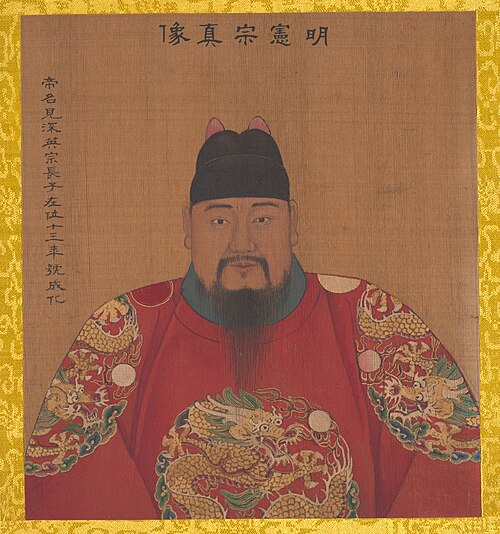 صورة شخصية؛ أوائل القرن العشرين (؟)؛ ألبوم من عشرين ورقة، حبر وألوان على حرير؛ 28.3 × 22.2 سم؛ متحف متروبوليتان للفنون
 سيدات البلاط في مملكة شو السابقة، بقلم تانغ يين
 متحف بروكلين – الحاج البوذي الصيني شوانزانغ
منحوتة
تعود التماثيل البرونزية الطقسية الصينية من عهد أسرتي شانغ وتشو الغربية إلى فترة تزيد عن ألف عام، بدءًا من حوالي 1500 قبل الميلاد، وقد أثرت بشكل مستمر على الفن الصيني. تتميز هذه التماثيل بزخارف معقدة ذات أنماط ورسوم حيوانية ، لكنها تتجنب تصوير الإنسان، على عكس التماثيل الضخمة التي اكتُشفت مؤخرًا في سانشينغدوي . [ 46 ] جُمع جيش التيراكوتا الرائع لضريح تشين شي هوانغ ، أول إمبراطور للصين الموحدة من 221 إلى 210 قبل الميلاد، كنسخة إمبراطورية فخمة من التماثيل التي كانت تُوضع في المقابر منذ القدم لتمكين المتوفى من التمتع بنفس نمط الحياة في الآخرة كما كان في حياته، ليحل محل القرابين الفعلية التي كانت تُقدم في فترات مبكرة جدًا. وُضعت تماثيل أصغر حجمًا مصنوعة من الفخار أو الخشب في المقابر لعدة قرون لاحقة، وبلغت ذروة جودتها في تماثيل مقابر أسرة تانغ . [ 47 ]
لا تستخدم الديانات الصينية الأصلية عادةً صورًا للآلهة، أو حتى تمثيلها، وتُعدّ المنحوتات الدينية الكبيرة بوذية في معظمها، ويعود تاريخها في الغالب إلى الفترة ما بين القرنين الرابع والرابع عشر، وقد استُخدمت في البداية نماذج يونانية بوذية وصلت عبر طريق الحرير . كما تُشكّل البوذية سياقًا لجميع منحوتات البورتريه الكبيرة؛ فعلى النقيض تمامًا من بعض المناطق الأخرى في الصين في العصور الوسطى، كانت حتى الصور المرسومة للإمبراطور تُعتبر خاصة. تتميز المقابر الإمبراطورية بممرات وصول رائعة تصطف على جانبيها حيوانات حقيقية وأسطورية بحجم يُضاهي مصر، وتُزيّن نسخ أصغر منها المعابد والقصور. [ 48 ] وقد أُنتجت تماثيل ومجموعات بوذية صغيرة بجودة عالية جدًا باستخدام مجموعة متنوعة من الوسائط، [ 49 ] كما هو الحال مع الزخرفة البارزة لجميع أنواع الأشياء، وخاصة في المشغولات المعدنية واليشم . [ 50 ] كان يُنظر إلى النحاتين من جميع الأنواع على أنهم حرفيون، ولم يُسجّل سوى عدد قليل جدًا من الأسماء. [ 51 ]
 إناء زون على شكل طائر يعود إلى ماركيز جين، حوالي القرن الحادي عشر - العاشر قبل الميلاد. متحف شانشي .
 تمثال برونزي مذهب قائم لأفالوكيتشفارا (غوانيين)، من عهد أسرة تانغ (618-907). متحف القصر الوطني.
 تمثال بوذا الجالس الضخم، الكهف رقم 20، مغارات يونغانغ ، شانشي. سلالة وي الشمالية (القرن الخامس).
 تمثال لوهان تامرابهادرا، أحد مجموعة لوهان الخزف المزجج من ييشيان ؛ القرن العاشر - الثالث عشر؛ تيراكوتا مزججة؛ الارتفاع: 123 سم؛ متحف غيميه .
 غوانيين القمر المائي ، سلالة لياو (القرن الحادي عشر - الثاني عشر). خشب متعدد الألوان ومذهب. متحف نيلسون-أتكينز للفنون.
 فيل مزخرف، من عهد أسرة لياو. متحف كليفلاند للفنون.
 Seated luohan; 18th–19th century; lapis lazuli; height: 18.1 cm, width: 25.4 cm; Metropolitan Museum of Art
 Limestone right hand of Buddha from Northern Xiangtangshan Caves, Northern Qi dynasty (550–577). Metropolitan Museum of Art.
Ceramics
Chinese ceramic ware shows a continuous development since the pre-dynastic periods, and is one of the most significant forms of Chinese art. China is richly endowed with the raw materials needed for making ceramics. The first types of ceramics were made during the Palaeolithic era, and in later periods range from construction materials such as bricks and tiles, to hand-built pottery vessels fired in bonfires or kilns, to the sophisticated Chinese porcelain wares made for the imperial court. Most later Chinese ceramics, even of the finest quality, were made on an industrial scale, thus very few individual potters or painters are known. Many of the most renowned workshops were owned by or reserved for the Emperor, and large quantities of ceramics were exported as diplomatic gifts or for trade from an early date.
The Song dynasty (960–1279) is often regarded as the golden age of Chinese ceramics, particularly for its refined monochrome wares. The "Five Great Kilns", Ru, Guan, Ge, Jun, and Ding, produced wares for the imperial court that have been prized by collectors for centuries.[52]
With the advent of the Ming Dynasty (1368-1644), Chinese ceramic art ushered in another golden age. Supported by the imperial court, the official kilns were defined by rigorous craftsmanship and strict regulations.[53] Ming Dynasty blue-and-white porcelain, notable for its balanced blue glaze and dynamic patterns, became a signature category. Themes included landscapes, flowers and birds, figures, and auspicious designs. This not only highlighted royal grandeur but also integrated folk aesthetics. Additionally, underglaze red porcelain, using copper for its vivid color, stands out for its firing difficulty and rarity. In the late Ming Dynasty, polychrome porcelain emerged, introducing rich colors, strong contrasts, and elaborate decorations. This innovation broke away from monochrome styles and advanced ceramic decorative art.
As China entered the modern era, ceramic craftsmanship continued to evolve, blending traditional manual skills with modern industrial technology. Despite these changes, Jing De Zhen's role as the porcelain capital remains unchanged. It preserves the essence of traditional ceramic craftsmanship and classic production techniques, such as blue-and-white porcelain and powder enamel, while embracing innovation through modern design concepts.[54] This enables the development of ceramic works that suit contemporary lifestyles and tastes. In this new context, Jing De Zhen serves as both the core base for China's ceramic production and research and a key platform for cultural exchange between Chinese and foreign ceramics. Traditional handcrafted kilns coexist with modern ceramic enterprises, retaining time-honored processes such as "throwing, glazing, and firing" while integrating modern technology to optimize processes and improve quality.[54] Through continuous innovation and inheritance, Chinese ceramic art maintains its unique charm, becoming a cultural bridge connecting the past, present, and world.
 Ru ware brush washer with inscription (汝窯青瓷奉華款洗), Northern Song dynasty, late 11th–early 12th century. National Palace Museum.
 Gooseneck vase (汝窯天藍釉刻花鵝頸瓶) with sky-blue glaze and incised floral decoration, Ru ware, Northern Song dynasty, c. 1086–1125 CE
 Jun ware miniature incense burner with blue glaze, Song–Yuan dynasty (12th–14th century). Metropolitan Museum of Art.
 Jun ware vase, Qing dynasty (1644–1912), Cleveland Museum of Art.
 Glazed ceramic taoshou (套獸, corner beam finial) from the Old Summer Palace, Qing dynasty, Qianlong period (1736–1796). Royal Ontario Museum.
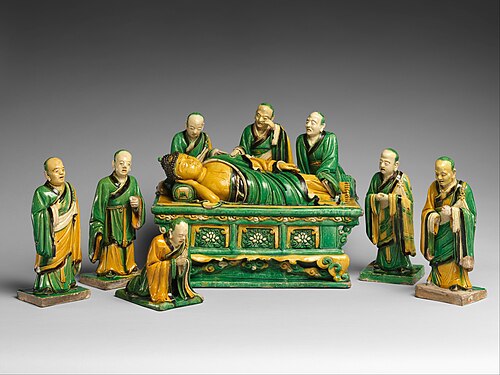 Buddhist figurines; by Qiao Bin; circa 1503; glazed pottery; various dimensions; Metropolitan Museum of Art
 Early Yaozhou ware from the Five Dynasties period, 10th century AD
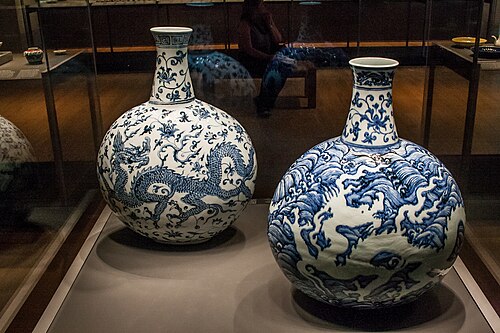 Two flasks with dragons; 1403–1424; underglaze blue porcelain; height (the left one): 47.8 cm, height (the right one): 44.6 cm; British Museum
 Jar: 18th century; porcelain painted in overglaze famille rose enamels; height: 61 cm; Metropolitan Museum of Art
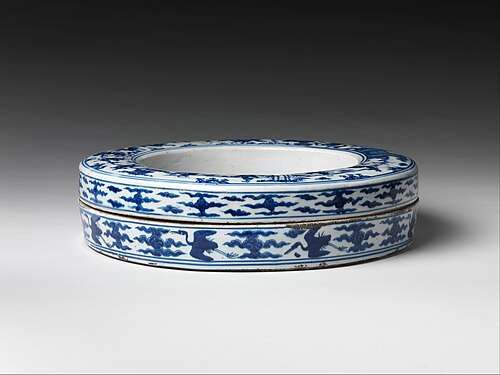 Jingdezhen blue and white porcelain court bead box (chao zhu he 朝珠盒), Ming dynasty, Jiajing period (1522–1566). Metropolitan Museum of Art.
 Yohen tenmoku (曜変天目) tea bowl, Southern Song dynasty (1127–1279). Seikadō Bunko Art Museum, Tokyo.
 Ding ware pillow in the shape of a recumbent child, Northern Song dynasty (12th century). National Palace Museum.
 Red-glazed bowl with incised dragon decoration, Ming dynasty, Hongwu period (before 1398). National Palace Museum.
 Ruby red glazed monk's cap ewer (sengmaophu), Ming dynasty, Xuande mark and period (1426–1435). National Palace Museum.
 Revolving vase with goldfish design on cobalt blue glaze with gilt tracing, Qing dynasty, Qianlong period (1736–1795). National Palace Museum.
 Rotating bowl with celadon glaze and Fencai enamel, Qing dynasty, Qianlong period. National Palace Museum.
 Cong-shaped vase (zongshi ping 琮式瓶) with cobalt blue glaze, Qing dynasty (before 1908). The form derives from the cong 琮, a jade ritual object of the Neolithic period later replicated in bronze during the Shang and Zhou dynasties. National Palace Museum.
 Doucai dish with floral and kui-phoenix design, Qing dynasty, Qianlong period. Nanjing Museum.
 Wucai "Hundred Deer" vase (bailu zun 百鹿尊), Ming dynasty, Wanli period (1573–1620). National Palace Museum.
 Black-glazed tea bowl with "partridge feather" splashes (zhegu ban 鷓鴣斑), Song dynasty (960–1279), Jizhou ware. National Palace Museum.
Furniture
Chinese furniture, particularly from the Ming dynasty (1368–1644), is regarded as one of the highest achievements in furniture design and craftsmanship. Ming furniture is characterized by elegant proportions, minimal ornamentation, and sophisticated joinery techniques that require no nails or glue. Its aesthetic principles, emphasizing negative space, structural honesty, and the natural beauty of materials, have influenced modern designers, including Danish furniture maker Hans Wegner.[55] The modern systematic study of classical Chinese furniture began with scholar Wang Shixiang (王世襄, 1914–2009), whose Classic Chinese Furniture: Ming and Early Qing Dynasties (1985) established the field.[56][57]
The most prized materials are huanghuali (黃花梨, a type of rosewood) and zitan (紫檀, padauk), both dense hardwoods with distinctive grain patterns, Hongmu (紅木, blackwood) was also widely used for fine furniture, particularly in the Qing dynasty. These woods were scarce even during the Ming dynasty and are now extremely rare. The refined aesthetics of Ming furniture—clean lines, subtle curves, and respect for natural wood grain—reflect the tastes of the scholar-official class and literati culture.[58]
Construction relies on complex mortise-and-tenon joinery (榫卯結構), with dozens of distinct joint types developed over centuries. This interlocking system allows furniture to expand and contract with humidity changes while maintaining structural integrity for hundreds of years.[59]
Qing dynasty furniture (1644–1912) shifted toward heavier proportions, more elaborate carving, and the use of lacquer and inlay decoration, reflecting Manchu court tastes and increased contact with European design.[60][61]
 Huanghuali folding horseshoe-back armchair (jiaoyi) with carved floral splat, Ming dynasty, 16th–17th century. Nelson-Atkins Museum of Art.
 Huanghuali painting table, Ming dynasty, late 16th–early 17th century. Metropolitan Museum of Art, New York.
 Zitan table stand (front), Qing dynasty, 17th–18th century. Metropolitan Museum of Art.
 Zitan table stand (side), Qing dynasty, 17th–18th century. Metropolitan Museum of Art.
 Red lacquer armchair with painted gold and black motifs, Qing dynasty, 18th–19th century.
 Huanghuali twelve-panel folding screen with chilong, bat, and figural narrative scenes, Ming–Qing dynasty, 17th century.
 Daybed (ta), Ming dynasty, 16th–17th century. Shanghai Museum.
 Huanghuali display cabinet (lianggegui) with openwork dragon (chilong) apron, Ming dynasty, 17th century.
 Hongmu bench (bandeng), Qing dynasty, late 17th century. Honolulu Museum of Art.
 Huanghuali circular incense stand (xiangji) with five cabriole legs, Ming dynasty. Shanghai Museum.
Decorative arts
As well as porcelain, a wide range of materials that were more valuable were worked and decorated with great skill for a range of uses or just for display.[50] Chinese jade was attributed with magical powers, and was used in the Stone and Bronze Ages for large and impractical versions of everyday weapons and tools, as well as the bi disks and cong vessels.[62] Later a range of objects and small sculptures were carved in jade, a difficult and time-consuming technique. Bronze, gold and silver, rhinoceros horn, Chinese silk, ivory, lacquer and carved lacquer, cloisonne enamel and many other materials had specialist artists working in them. Cloisonne underwent an interesting process of artistic hybridization in China, particularly in the pieces promoted by missionaries and Chinese Christian communities.[63]
Folding screens (Chinese:屏風; pinyin:píngfēng) are often decorated with beautiful art; major themes include mythology, scenes of palace life, and nature. Materials such as wood panel, paper and silk are used in making folding screens. They were considered ideal ornaments for many painters to display their paintings and calligraphy.[64][65] Many artists painted on paper or silk and applied it onto the folding screen.[64] There were two distinct artistic folding screens mentioned in historical literature of the era.
 Jadeite Cabbage with Insects (翠玉白菜), Qing dynasty, 19th century. Carved from a single piece of jadeite, with a katydid and locust on the leaves. National Palace Museum, Taipei.
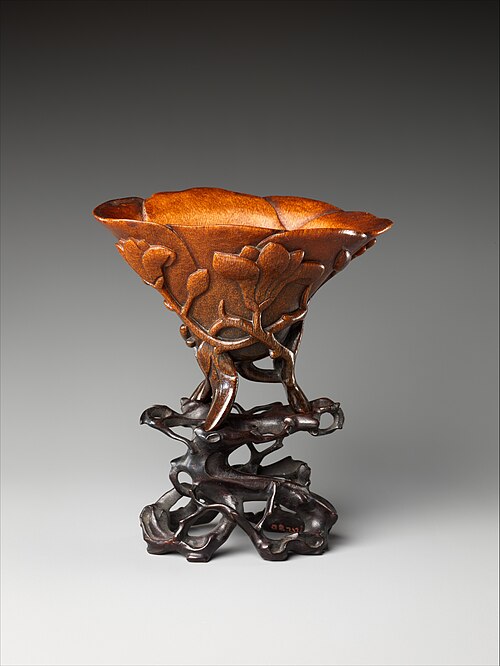 Cup; early 17th century; rhinoceros horn; height: 10.2 cm; Metropolitan Museum of Art.
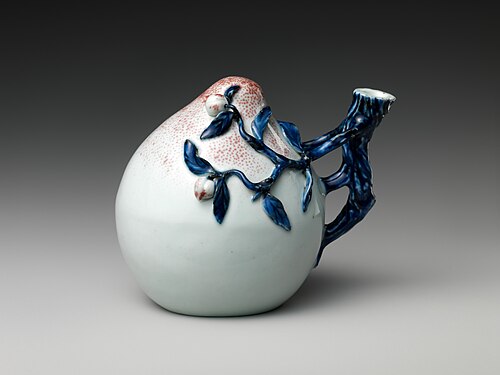 Container with colored enamel decoration over transparent glaze, Jingdezhen ware, 19th century, Metropolitan Museum of Art.
 Incense burner in the shape of a rooster; 18th century; cloisonné enamel on copper; Metropolitan Museum of Art
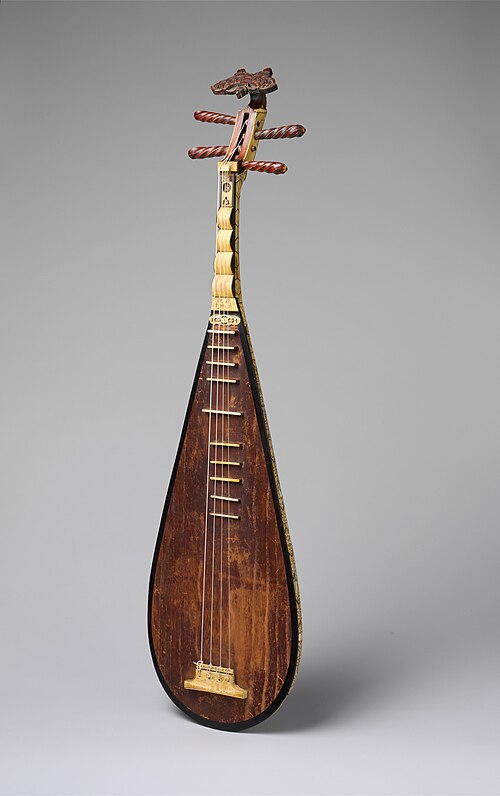 Pipa with carved and inlaid decoration, Qing dynasty. Metropolitan Museum of Art.
 Rank badge (buzi) with mythical beast, silk embroidery, Ming dynasty (1368–1644). Metropolitan Museum of Art.
 Miniature landscape with figures, Qing dynasty, 18th–19th century. Carved from a single piece of ivory depicting mountains, pavilions, bridges, streams, nine boats, and thirty-four figures. National Palace Museum.
 Hongmu panel with ivory inlay depicting landscape and figures, Qing dynasty, Daoguang period (1821–1850).
Architecture


Chinese architecture refers to a style of architecture that has taken shape in East Asia over many centuries. Especially Japan, Korea, Vietnam and Ryukyu. The structural principles of Chinese architecture have remained largely unchanged, the main changes being only the decorative details. Since the Tang dynasty, Chinese architecture has had a major influence on the architectural styles of Korea, Vietnam, and Japan.
From the Neolithic era Longshan culture and Bronze Age era Erlitou culture, the earliest rammed earth fortifications exist, with evidence of timber architecture. The subterranean ruins of the palace at Yinxu dates back to the Shang. In historic China, architectural emphasis was laid upon the horizontal axis, in particular the construction of a heavy platform and a large roof that floats over this base, with the vertical walls not as well emphasized. This contrasts Western architecture, which tends to grow in height and depth. Chinese architecture stresses the visual impact of the width of the buildings. The deviation from this standard is the tower architecture of the Chinese tradition, which began as a native tradition and was eventually influenced by the Buddhist building for housing religious sutras—the stupa—which came from Nepal. Ancient Chinese tomb model representations of multiple story residential towers and watchtowers date to the Han. However, the earliest extant Buddhist Chinese pagoda is the Songyue Pagoda, a 40 m (130 ft) tall circular-based brick tower built in Henan in the year 523 CE From the 6th century onwards, stone-based structures become more common, while the earliest are from stone and brick arches found in Han dynasty tombs. The Zhaozhou Bridge built from 595 to 605 CEis China's oldest extant stone bridge, as well as the world's oldest fully stone open-spandrel segmental arch bridge.
The vocational trade of architect, craftsman, and engineer was not as highly respected in premodern Chinese society as the scholar-bureaucrats who were drafted into the government by the civil service examination system. Much of the knowledge about early Chinese architecture was passed on from one tradesman to his son or associative apprentice. However, there were several early treatises on architecture in China, with encyclopedic information on architecture dating back to the Han dynasty. The height of the classical Chinese architectural tradition in writing and illustration can be found in the Yingzao Fashi, a building manual written by 1100 and published by Li Jie (1065–1110) in 1103. In it there are numerous and meticulous illustrations and diagrams showing the assembly of halls and building components, as well as classifying structure types and building components.
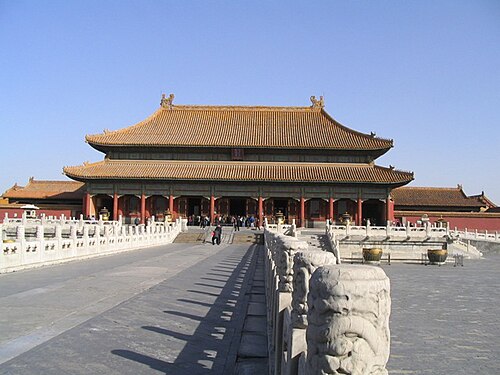
There were certain architectural features that were reserved solely for buildings built for the Emperor of China. One example is the use of yellow roof tiles; yellow having been the Imperial color, yellow roof tiles still adorn most of the buildings within the Forbidden City. The Temple of Heaven, however, uses blue roof tiles to symbolize the sky. The roofs are almost invariably supported by brackets, a feature shared only with the largest of religious buildings. The wooden columns of the buildings, as well as the surface of the walls, tend to be red in colour.
Modern Chinese architecture has been shaped by multiple influences: Soviet-style architecture dominated the 1950s, exemplified by the Ten Great Buildings of Beijing (1959); since the Reform and Opening (1978), post-modern and Western styles have become prevalent, with international architects such as I. M. Pei, Rem Koolhaas, and Zaha Hadid contributing major projects.
 Relief from the Wu Family Shrines (Jiaxiang County, Shandong) that shows Han dynasty architecture, 151 CE
 Great Hall of Nanchan Temple, Shanxi, Tang dynasty, 782 CE. The oldest surviving wooden building in China.
 The East Main Hall of Foguang Temple, Shanxi, constructed in 857 CE; one of only three surviving wooden building from the Tang dynasty in China
 Pagoda of Fogong Temple, Shanxi, 1056
 The Songyue Pagoda, Henan, 523
 The Guanyian Pavilion of the Dule Monastery (Jixian, China), 984
 Hall of Prayer for Good Harvests, the main building of the Temple of Heaven (Beijing), 1703–1790
 The Longxing Temple in Hebei (Zhengding, China), 1052
Garden
Performing art
Modern Chinese art
New China art (1912–1949)

Modern art movement
The movement to modernize Chinese art started toward the end of the Qing dynasty. The traditional art form started to lose its appeal as the feudalistic structure of the society was dissolving. The modern view of the world had to be expressed in a different form. The explorations went on two main paths: one was to draw from the past to enrich the present (汲古潤今)*, the other was to "learn the new methods" (學習新法).*[66]

Draw from the past
The literati art for the social elite was not appealing to the bourgeois patrons. Wu Changshuo (1844–1927) was among the Shanghai-based artists responsible for flowers and plants as the subject matter. His paintings used bold colors and energetic brush strokes, making them more accessible to the general public. Qi Baishi (1864–1957) painted images like crabs and shrimps that were even more approachable to the common people. Huang Binhong (1865–1955) denounced the literati paintings of the Qing dynasty and created his own style of landscape paintings by extensive investigations in Chinese art history. Zhang Daqian (1899–1983) used wall paintings in the Dunhuang (敦煌) caves to help him move beyond the literati tradition.
Learn new methods
The Lingnan School (岭南画派) made some borrowings from the language of Western art in their ink paintings. Gao Jianfu (1879–1951), one of the founders of Lingnan School, was an active participant in the revolutionary movement of Sun Yat-sen (1866–1925). He was innovative in that he intended to use his paintings to highlight national issues, a medium for positive change in society.
 Flames on the Eastern Battlefront by Gao Jianfu, 1937 ink and colors on paper
 Portrait of Madam Cheng (1941), oil on board, Xu Beihong
 Warhorse by Xu Beihong
A more radical style change started with Kang Youwei (1858–1927), a reformer who admired the more reality-based art of the Song dynasty. He believed that Chinese art could be rejuvenated by employing the reality-oriented art techniques of Europe. Xu Beihong (1895–1953) took this idea to heart and went to Paris to acquire the necessary skills. Liu Haisu (1896–1994), on the other hand, went to Japan to learn western techniques. Both Xu, and Liu became presidents of prestigious art schools, instilling new concepts and skills in the next generation of artists. Cai Yuanpei (1868–1940) was one of the leaders in the New Culture Movement (新文化运动). Those involved believed that intellectual activities should benefit all, not just the elites. Cai's belief that art could play a public, socially reformist role was adopted by Lin Fengmian (1900–1991).
Together with Yan Wenliang (1893–1988), Xu, Liu, and Lin were considered the "Four Great Academy Presidents" (四大校長), who spearheaded the national modern art movement. However, the subsequent upheaval caused by the Sino–Japanese war and the civil war did not allow this movement to grow. The Chinese modern art movement after the war developed differently in the four the regions: the Mainland, Taiwan, Hong Kong, and overseas.
Postwar Chinese art (1949–1976)
The postwar era is roughly from 1949, the end of Chinese civil war, to 1976, the opening of mainland China to the outside world.
Mainland
The postwar era in mainland China could be divided into two periods: 1949 to 1966 is generally called "The 17 Years"; 1966 to 1976 is the period of the "Cultural Revolution".
The 17 Years
Chinese artists adopted social realism as a form of expression; it was a combination of revolutionary realism and revolutionary romanticism. Artwork was not valued on its own terms but was subservient to a political purpose. According to Mao Zedong, art should be a "powerful weapon for uniting and educating the people, fighting and destroying the enemy". Praising political leaders and celebrating the achievements of socialism became the theme of all artwork. Western art forms, including Cubism, Fauvism, Abstraction, and Expressionism were deemed superficial and were categorized as formalism.
The biggest blow to art was the Anti-Rightist Campaign of 1957. Artists who were labeled as rightists were stripped of their right to create and even their jobs, and worse, the social standing of the artists and their families was placed at the lowest level, causing great mental suffering.
Some influential paintings from this period are:
- Li Keran, Reddening of Ten Thousand Mountains (李可染《万山红遍》)
- Huang Zhou, The Snowstorm (黄胄《洪荒风雪》)
- Dong Xiwen, The Founding Ceremony of the Nation (董希文《开国大典》) had gone through several revisions, due to the changing political situation. Gao Gang was taken out when he went out of favor, Liu Shaoqi was replaced by Dong Biwu for a while, then the prototype was restored.
Cultural Revolution
These ten years could also be called the "Ten Years of Calamity" (十年浩劫). In order to destroy everything that supported the old social order, countless temples, historic sites, artworks, and books were ravaged and burnt. During this period the portrait of Mao and propaganda posters of revolution were everywhere. Anything that was remotely suspected of being out of line was destroyed, and the person behind it was prosecuted. For example, Owl by Huang Yongyu had one eye open and one eye closed; it was deemed an expression of dissatisfaction with current events. Zong Qixiang's painting, which shows three tigers, was deemed critical of the leader Lin Biao, whose name contained a character that had three tigers in it. Residual Lotus by Li Kuchan had eight lotus flowers; it was deemed to be critical of the eight communist approved movies (样板戏). Many prominent artists were persecuted during this time. For example, Yan, Xu, Liu, and Lin, the "Four Great Academy Presidents" 四大校長 (except for Xu who died before the Cultural Revolution), were all prosecuted and jailed, and all their work was destroyed during this time. However, despite the difficult environment, some noteworthy paintings were created. The following are some examples:
Hong Kong
Hong Kong was a British colony from 1842 to 1997. The local art organizations were mostly run by Westerners who outnumbered Chinese painters until a large migration of Chinese from Southern China during Sino–Japanese War. Innovative art colleges were established after the war. The shows organized by local artists started in the early 1960s. After a reaction against the traditional Western artistic practices of the 1940s and the 1950s, some experimental works that combined both western and eastern techniques were made. Then came the call for a return to Chinese traditional art and the creation of forms of art that Hong Kong could call its own. The trend was led by Lui Shou Kwan. Some western concepts were incorporated into his Chinese ink paintings.[67]
Overseas
Paris
Many Chinese artists went to study western art in Paris in the early 1900s, for example: Fang Ganmin (方幹民), Wu Dayu (吳大羽), Ong Schan Tchow (翁占秋), Lin Fengmian (林風眠), Yan Wenliang (顏文樑), Wu Guanzhong (吳冠中), Zao Wou-Ki (趟無極). All except Zao completed their education before 1949 and returned to become leaders in the modern art movement. (Zao happened to be in Paris in 1949 and did not return.) Some Chinese artists went to stay there because of the rich international art environment, for example: Sanyu, Pan Yuliang (潘玉良), Chu Teh-Chun (朱德群). Zao, Sanyu, Pang, and Chu all had shows in Paris and the Republic. All their paintings had varying degrees of Chinese elements in them. These artists not only had a profound influence in Chinese modern art, but they also continued to engage Parisians with modern art from the East.[68]
United States
Li Tiefu (1869–1952) was an accomplished oil painter educated in Canada and the United States. He was an active participant in the revolutionary movement of Sun Yat-sen (1866–1925).
Zeng Youhe 曾佑和 (1925–2017)[69] was born in Beijing. She started receiving international recognition in 1946, when Michael Sullivan began praising and writing about her work. Zeng moved to Honolulu in 1949 and visited Hong Kong and Taiwan in 1960. Like those of the Fifth Moon Group (五月畫會), her paintings were abstract; but the flavor of traditional Chinese ink paintings were not as pronounced.
Taiwan
Because of its history, traditional Chinese art does not have strong roots in Taiwan. The art forms in Taiwan were generally decorative, until youths growing up under the Japanese occupation received formal art education in Japan. Not burdened with traditional art form, their exploration generally followed the path of "learning the new methods" (學習新法). When the Nationalists arrived in Taiwan, a group of ambitious youths who came with the Nationalists continued the modern art movement. The most notable were the Fifth Moon Group (五月畫會) and the Ton-Fan Art Group (東方畫會).
Fifth Moon Group

The original members of the group were alumni with art majors from the Academic Teachers College (師範大學), the only university with an art major at the time. Their first intention was to show that the effort to create new art was worthwhile in itself, even if it did not directly enhance art pedagogy. Later, it became a movement to modernize Chinese art.
The members of the Fifth Moon Group studied western art movements, and concluded that the abstract art form was the best medium for modern Chinese art. They felt the best the Chinese paintings were ones that de-emphasized realistic representation, and emphasized atmosphere and "vividness", which comes from the brush strokes and the natural interaction between ink and paper. To further that idea, one does not need representation of objects in painting, or strictly use ink and paper. The beauty of a painting can be appreciated directly from the forms, textures, and colors on the canvas without their relation to real objects. The group was active from 1957 to 1972. The main members are Liu Guosong, Chuang Che (莊喆), Hu Chi-Chung (胡奇中), Fong Chung-ray (馮鍾睿), and Han Hsiang-ning.
Ton-Fan Art Group (東方畫會)
The members of this group were students who attended private art classes offered by Li Zhongsheng (李仲生), a mainland-born artist who had been one of the active participants in the modern art movement. He and a number of mainland artists who painted in a western style continued the modern art movement by publishing magazines and writing articles to introduce modern art to Taiwan. His teaching style was unconventional and socratic in nature.
The original intention of the group was to introduce modern art to the public. They believed there should be no restriction on the form or style of a modern Chinese painting, as long as the painting expressed meaning that was Chinese in nature. The group was active from 1957 to 1971. The main members were: Ho Kan (霍剛), Li Yuan-chia, Wu Hao (吳昊),[70] Oyan Wen-Yuen (歐陽文苑), Hsia Yan (夏陽), Hsiao Chin (蕭勤), Tommy Chen (陳道明),[71] and Hsiao Ming-Hsien (蕭明賢). The following are a sample of their paintings from that period:
- Ho Kan, 1967
- Hsia Yan, 1965
- Hsiao Chin, 1955Archived July 19, 2019, at the Wayback Machine
Redevelopment (mid-1980s – 1990s)
Contemporary art
Contemporary Chinese art (Chinese:中國當代藝術; pinyin:Zhongguo Dangdai Yishu) often referred to as Chinese avant-garde art, continued to develop since the 1980s as an outgrowth of modern art developments post-Cultural Revolution.

Contemporary Chinese art fully incorporates painting, film, video, photography, and performance. Until recently, art exhibitions deemed controversial have been routinely shut down by police, and performance artists in particular faced the threat of arrest in the early 1990s. More recently there has been greater tolerance by the Chinese government, though many internationally acclaimed artists are still restricted from media exposure at home or have exhibitions ordered closed. Leading contemporary visual artists include Ai Weiwei, Cai Guoqiang, Cai Jin, Chan Shengyao, Concept 21, Ding Yi, Fang Lijun, Fu Wenjun, He Xiangyu, Huang Yan, Huang Yong Ping, Han Yajuan, Kong Bai Ji, Li Hongbo, Li Hui, Liu Bolin, Lu Shengzhong, Ma Liuming, Qiu Deshu, Qiu Shihua, Shen Fan, Shen Shaomin, Shi Jinsong, Song Dong, Li Wei, Wang Guangyi, Wenda Gu, Xu Bing, Yang Zhichao, Zhan Wang, Zheng Lianjie, Zhang Dali, Zhang Xiaogang, Zhang Huan, Zhu Yu, Wu Shaoxiang, Ma Kelu, Ding Fang, Shang Yang, Gao Minglu, and Guo Jian.
Visual art
Beginning in the late 1980s, there was unprecedented exposure for younger Chinese visual artists in the west to some degree through the agency of curators based outside the country such as Hou Hanru. Local curators within the country such as Gao Minglu and critics such as Li Xianting reinforced this promotion of particular brands of painting that had recently emerged, while also spreading the idea of art as a strong social force within Chinese culture. There was some controversy as critics identified these imprecise representations of contemporary Chinese art as having been constructed out of personal preferences, a kind of programmatized artist-curator relationship that only further alienated the majority of the avant-garde from Chinese officialdom and western art market patronage.
Chinoiserie
Chinoiserie is the European interpretation and imitation of Chinese and East Asian artistic traditions, especially in the decorative arts, garden design, architecture, literature, theatre, and music.[72] The aesthetic of Chinoiserie has been expressed in different ways depending on the region. It is related to the broader current of Orientalism, which studied Far East cultures from a historical, philological, anthropological, philosophical, and religious point of view. First appearing in the 17th century, this trend was popularized in the 18th century due to the rise in trade with China and East Asia.[73]
As a style, chinoiserie is related to the rococo style.[74] Both styles are characterized by exuberant decoration, asymmetry, a focus on materials, and stylized nature and subject matter that focuses on leisure and pleasure. Chinoiserie focuses on subjects that were thought by colonial-era Europeans to be typical of Chinese culture.

 Kneehole writing table; circa 1760; mahogany, mahogany veneer and gilt bronze; 88.9 × 97.8 × 62.2 cm; Metropolitan Museum of Art (New York City)
 Audience of the Chinese Emperor; 1766; hard-paste porcelain; overall: 39.8 × 33.2 × 21.7 cm; Metropolitan Museum of Art
 Drop-front secretaire (secrètaire à abattant); 1770–1775; painted and varnished oak, mahogany, purplewood and gilt-bronze mounts; 152.4 × 67.9 × 34 cm; Metropolitan Museum of Art
 Ornamental Design from "Nouvelle suite de cahiers chinois a l'usage des Dessinateurs et des peintres"; after 1775; etching with colored inks à la poupé on off-white laid paper; Cooper Hewitt, Smithsonian Design Museum (New York City)
 The Chinese Room in the Royal Palace (Berlin); 1850; brush and watercolor and gouache, graphite on white wove paper; Cooper Hewitt, Smithsonian Design Museum
 Pair of round and flat bodied bottles; 1870–1880; porcelain; first bottle: 26.4 × 21 × 10.6 cm, second bottle: 25.7 × 20.2 × 10.2 cm; Metropolitan Museum of Art
 The Tea House at Myasnitskaya Street in Moscow (Russia)
Art market

Today, the market for Chinese art, both antique and contemporary, is widely reported to be among the hottest and fastest-growing in the world, attracting buyers all over the world.[75][76][77] The Voice of America reported in 2006 that modern Chinese art is raking in record prices both internationally and in domestic markets, some experts even fearing the market might be overheating.[78]The Economist reported that Chinese art has become the latest darling in the world market according to the record sales from Sotheby's and Christie's, the biggest fine-art auction houses.[79]
Contemporary Chinese art saw record sales throughout the 2000s. In 2007, it was estimated that 5 of the world's 10 best selling living artists at art auction were from China, with artists such as Zhang Xiaogang whose works were sold for a total of $56.8 million at auction in 2007.[80] In terms of buying-market, China overtook France in the late 2000s as the world's third-largest art market, after the United States and the United Kingdom, due to the growing middle-class in the country.[81][82]Sotheby's noted that contemporary Chinese art has rapidly changed the contemporary Asian art world into one of the most dynamic sectors on the international art market.[83] During the global economic crisis, the contemporary Asian art market and the contemporary Chinese art market experienced a slow down in late 2008.[84][85] The market for Contemporary Chinese and Asian art saw a major revival in late 2009 with record level sales at Christie's.[86]
For centuries largely made-up of European and American buyers, the international buying market for Chinese art has also begun to be dominated by Chinese dealers and collectors in recent years.[87] It was reported in 2011, China has become the world's second biggest market for art and antiques, accounting for 23 percent of the world's total art market, behind the United States (which accounts for 34 percent of the world's art market).[88] Another transformation driving the growth of the Chinese art market is the rise of a clientele no longer mostly European or American. New fortunes from countries once thought of as poor often prefer non-Western art; a large gallerist in the field has offices in both New York and Beijing, but clients mainly hailing from Latin America, Asia and the Middle East.[89]
One of the areas that has revived art concentration and also commercialized the industry is the 798 Art District in Dashanzi of Beijing. The artist Zhang Xiaogang sold a 1993 painting for US$2.3 million in 2006, which included blank faced Chinese families from the Cultural Revolution era,[90] while Yue Minjun's work Execution in 2007 was sold for a then record of nearly $6 million at Sotheby's.[91] Collectors including Stanley Ho,[92] the owner of the Macau Casinos, investment manager Christopher Tsai,[93] and casino developer Steve Wynn,[94] would capitalize on the art trends. Items such as Ming dynasty vases and assorted Imperial pieces were auctioned off.
Other art works were sold in places such as Christie's including a Chinese porcelain piece with the mark of the Qianlong Emperor sold for HKD $ $151.3 million. Sotheby's and Christie's act as major market platforms for classical Chinese porcelain art pieces to be sold, including Ming dynasty, Xuande mark and period (1426–35) Blue and White jar (Five-Clawed Dragon Print), which was auctioned for Approx. USD 19,224,491.2, through Christie's in Spring 2016[95] The International Herald Tribune reported that Chinese porcelains were fought over in the art market as "if there was no tomorrow".[96]
A 1964 painting by Li Keran"All the Mountains Blanketed in Red" was sold for HKD $35 million. Auctions were also held at Sotheby's where Xu Beihong's 1939 masterpiece "Put Down Your Whip" sold for HKD $72 million.[97] The industry is not limited to fine arts, as many other types of contemporary pieces were also sold. In 2000, a number of Chinese artists were included in Documenta and the Venice Biennale of 2003. China now has its own major contemporary art showcase with the Venice Biennale. Fuck Off was a notorious art exhibition which ran alongside the Shanghai Biennial Festival in 2000 and was curated by independent curator Feng Boyi and contemporary artist Ai Weiwei.
Notable museums
Greater China
Public
Private
International
See also
References
- ↑Clunas, Craig (April 15, 2009). Art in China (2nd ed.). Oxford University Press.
- ↑"Collections|The Palace Museum". en.dpm.org.cn. Archived from the original on October 4, 2022. Retrieved October 4, 2022.
- ↑Museum, National Palace (June 25, 2021). "Collection". National Palace Museum. Retrieved October 4, 2022.
- ↑Leidy, Denise Patry (2015). "How to Read Chinese Ceramics - The Metropolitan Museum of Art". www.metmuseum.org. Retrieved January 29, 2026.
- ↑Yang, Guey-Meei; Suchan, Tom (2009). "The Cultural Revolution and Contemporary Chinese Art". Art Education. 62 (6): 25–32. doi:10.1080/00043125.2009.11519042. ISSN 0004-3125. JSTOR 20694799.
- ↑Li, Chunqing; Li, Shan; Guo, Changbao; Liu, Shaojin (2025), "Aesthetic Phenomena of the Prehistoric Period", in Li, Chunqing; Li, Shan; Guo, Changbao; Liu, Shaojin (eds.), The Chinese History of Literary Theory in Pre-Qin Period, Singapore: Springer Nature, pp. 31–45, doi:10.1007/978-981-95-0175-5_2, ISBN 978-981-95-0175-5, retrieved April 10, 2026
- 12Gu, Yixuan; Said, Tajul Shuhaizam bin; Gu, Yixuan; Said, Tajul Shuhaizam bin (December 15, 2025). "The Social Function of Painted Pottery Motifs in the Yangshao Culture of Neolithic China". Herança. 8 (4): 152–167. doi:10.52152/heranca.v8i4/1169. ISSN 2184-3090.
- ↑Dillon, Michael (December 1, 2016). Encyclopedia of Chinese History. Taylor & Francis. p. 485. ISBN 978-1-317-81716-1.
- ↑"Aurora Museum page 上海震旦博物馆". auroramuseum.cn. Archived from the original on May 2, 2023. Retrieved October 27, 2023.
- 1234567Zebin, Li (September 2013). "FASHION AND RITUALS OF THE HAN DYNASTY: Cultural Relics of the Royal Houses of Jiangsu". Orientations. 44: 5–7 – via Ebscohost.
- ↑Ritual wine server (guang), Indianapolis Museum of Art, 2012, retrieved May 21, 2012
- ↑Mino, Yutaka; Robinson, James (1983). Beauty and Tranquility: The Eil Lilly Collection of Chinese Art. Indianapolis: Indianapolis Museum of Art. pp. 100–101. ISBN 978-0-936260-14-3.
- 12Nickel, Lukas (October 2013). "The First Emperor and sculpture in China". Bulletin of the School of Oriental and African Studies. 76 (3): 413–414. doi:10.1017/S0041977X13000487. ISSN 0041-977X.
Sculpture as an artistic medium was widely employed in the arts of Greece and the Hellenistic East, but played only a minor role in ancient East Asia. This changed dramatically with the First Emperor of China (...) Naturalistic sculpture was entirely unknown. No long-standing sculptural tradition preceded the making of the First Emperor's famous terracotta warriors. No earlier or contemporary member of the Chinese elite had demonstrated any significant interest in sculpture at all.
- 12Nickel, Lukas (October 2013). "The First Emperor and sculpture in China". Bulletin of the School of Oriental and African Studies. 76 (3): 416–418. doi:10.1017/S0041977X13000487. ISSN 0041-977X.
From the centuries immediately preceding the Qin Dynasty again we know of only a few depictions of the human figure (...) figures of people and animals were very rare exceptions to the conventional imagery of the Zhou period (...) Depictions of the human figure were not a common part of the representational canon in China before the Qin Dynasty (...) In von Falkenhausen's words, "nothing in the archaeological record prepares one for the size, scale, and technically accomplished execution of the First Emperor's terracotta soldiers". For his contemporaries, the First Emperor's sculptures must have been something dramatically new.
- ↑Image from Liangdaicun Ruiguo Relics Museum (梁带村芮国遗址博物馆)
- 12Khayutina, Maria (Autumn 2013). "From wooden attendants to terracotta warriors"(PDF). Bernisches Historisches Museum the Newsletter. 65: 2, Fig.4.
Other noteworthy terracotta figurines were found in 1995 in a 4th–3rd century BCE tomb in the Taerpo cemetery near Xianyang in Shaanxi Province, where the last Qin capital of the same name was located from 350 to 207 BCE. These are the earliest representations of cavalrymen in China discovered up to this day. One of this pair can now be seen at the exhibition in Bern (Fig. 4). A small, ca. 23 cm tall, figurine represents a man sitting on a settled horse. He stretches out his left hand, whereas his right hand points downwards. Holes pierced through both his fists suggest that he originally held the reins of his horse in one hand and a weapon in the other. The rider wears a short jacket, trousers and boots – elements of the typical outfit of the inhabitants of the Central Asian steppes. Trousers were first introduced in the early Chinese state of Zhao during the late 4th century BCE, as the Chinese started to learn horse riding from their nomadic neighbours. The state of Qin should have adopted the nomadic clothes about the same time. But the figurine from Taerpo also has some other features that may point to its foreign identity: a hood-like headgear with a flat wide crown framing his face and a high, pointed nose.
Also in Khayutina, Maria (2013). Qin: the eternal emperor and his terracotta warriors (1. Aufl ed.). Zürich: Neue Zürcher Zeitung. p. cat. no. 314. ISBN 978-3-03823-838-6. - ↑Stokstad, Marilyn; Cothren, Michael Watt (2018). Art history (Sixth ed.). Upper Saddle River: Pearson. ISBN 978-0-13-447588-2. OCLC 953927607.
- ↑Kouwenhoven, Frank (2001). "Meaning and Structure: The Case of Chinese Qin (Zither) Music". British Journal of Ethnomusicology. 10 (1): 39–62. doi:10.1080/09681220108567309. JSTOR 3060771. S2CID 191483792.
- ↑Paludan, Ann. (1998). Chronicle of the Chinese Emperors: the Reign-by-Reign Record of the Rulers of Imperial China. London: Thames & Hudson Ltd., pp 34–36, ISBN 0-500-05090-2.
- 12Tsao, Ruby (January–March 2017). "The Great Wall Of China". Chinese American Forum. 32: 34–37 – via Academic Search Complete.
- 123Needham, Joseph (1986). Science and Civilization in China: Volume 4, Physics and Physical Technology, Part 3: Civil Engineering and Nautics. Taipei: Caves Books, Ltd. Plate CCCXII
- 12345Wang, Yuejin (September 1994). "Mirror, Death, and Rhetoric: Reading Late Han Chinese Bronze Artifacts". Art Bulletin. LXXVI (3): 511–534. doi:10.1080/00043079.1994.10786601.
- ↑Högerl, Johann; Tensi, Hans M.; Schulten, Caroline (May 1, 1996). "Analyzing the metallurgical and cultural backgrounds of two Han-dynasty bronze-mirror fragments". JOM. 48 (5): 57–59. Bibcode:1996JOM....48e..57S. doi:10.1007/BF03222946. ISSN 1543-1851. S2CID 138946370.
- 12Qingbo, Duan (2022). "Sino-Western Cultural Exchange as Seen through the Archaeology of the First Emperor's Necropolis". Journal of Chinese History 中國歷史學刊. 7: 48–50. doi:10.1017/jch.2022.25. ISSN 2059-1632. S2CID 251690411.
Before the appearance of the large-scale stone sculptures in front of the tomb of Huo Qubing 霍去病 (d. 117 BCE) of the middle Western Han period (see Figure 9), no monumental works of sculptural stone art like this had ever been seen in Qin culture or in those of the other Warring States polities.
- ↑Qingbo, Duan (2022). "Sino-Western Cultural Exchange as Seen through the Archaeology of the First Emperor's Necropolis". Journal of Chinese History 中國歷史學刊. 7: 48–50. doi:10.1017/jch.2022.25. ISSN 2059-1632. S2CID 251690411. quoting the anonymous 3rd century CE "Miscellaneous Notes on the Western Capital" (西京雜記): "There were two stone statues of qilin [Chinese unicorns]. The flanks of each animal bore carved inscriptions. These once stood atop the tomb mound of the First Emperor of Qin. Their heads stood one zhang and three chi in height [approx. three meters]"
- ↑Qingbo, Duan (2022). "Sino-Western Cultural Exchange as Seen through the Archaeology of the First Emperor's Necropolis". Journal of Chinese History 中國歷史學刊. 7: 48–50. doi:10.1017/jch.2022.25. ISSN 2059-1632. S2CID 251690411.
The sixteen large stone sculptures in front of the tomb of the Han general Huo Qubing 霍去病 (ca. 117 BCE), are mostly sculpted following the form of the original stone (see Figure 9). They employ techniques such as sculpting in the round, raised relief, and engraved intaglio lines to carve stone sculptures of oxen, horses, pigs, tigers, sheep, a fantastic beast eating a sheep, a man fighting a bear, a horse trampling a Xiongnu warrior, and other images. It is hard to find any evidence in China for this type of crude but concise lifelike rendering before these monuments.
- ↑徐, 龙国 (2017). "山东发现的汉代大型胡人石雕像再研究"(PDF). 美术研究 (Art Research).
近年来,考古发现的一些西汉墓葬,如陕西咸阳西汉阳陵、河南商丘梁孝王陵园、[32] 江苏盱眙江都王刘非陵园、江西南昌海昏侯刘贺墓园等,都发现墓葬周围有冢茔、庙寝、门阙、司马道等,此时墓上石刻还没有发展起来,除汉武帝时期的霍去病墓、张骞墓外,其他墓葬均未发现墓上石刻。西汉晚期至东汉时期,墓上石刻逐渐发展起来
- ↑Qingbo, Duan (April 9, 2019). "Persian and Greek Participation in the making of China's First Empire (Video timing: 45:00–47:00)". Video of 2018 conference at UCLA.
- ↑Bradsher, Keith (July 3, 2007). "'China's Mona Lisa' Makes a Rare Appearance in Hong Kong". The New York Times. China;Hong Kong;Great Britain. Retrieved November 13, 2011.
- 12Capon and Pang, pg. 12
- ↑Capon and Pang, pg. 42
- 12"Transcultural Dialogues: The Journey of East Asian Art to The West". Fu Qiumeng. Retrieved November 25, 2024.
- ↑Capon and Pang, pg. 120
- ↑Capon and Pang, pg. 90, 91
- ↑Capon and Pang, pg. 90
- ↑Capon and Pang, pg. 91
- ↑Zhao, Yanqing 赵燕青 (2009), "浅议马荃的花鸟画风" [Discussion of Ma Quan's bird and flower paintings style], Dazhong Wenyi (Lilun) (in Chinese) (3): 44
- ↑van Briessen, Fritz (1998), "3", The Way of the Brush: Painting Techniques of China and Japan, Vermont: Tuttle Publishing
- ↑Hearn, Maxwell K. "The Qing Dynasty (1644–1911): The Traditionalists - The Metropolitan Museum of Art". www.metmuseum.org. Archived from the original on January 24, 2026. Retrieved May 12, 2026.
- ↑"Beijing School and Shanghai School (京派与海派)", Contextual Dictionary of Chinese Cultural Knowledge, Springer, Singapore, 2025, pp. 499–500, doi:10.1007/978-981-99-5009-6_11077, ISBN 978-981-99-5009-6, retrieved May 12, 2026
- ↑"百度安全验证". wappass.baidu.com. Retrieved May 12, 2026.
- ↑The Chinese character mo means ink and shui means water
- ↑Sickman, 222
- ↑Rawson, 114–119; Sickman, Chapter 15
- ↑"Early Autumn (29.1)". Detroit Institute of Arts. Archived from the original on October 2, 2008. Retrieved 2008-12-18.
- ↑Rawson, Chapter 1, 135–136
- ↑Rawson, 138-138
- ↑Rawson, 135–145; 145–163
- ↑Rawson, 163–165
- 12Rawson, Chapters 4 and 6
- ↑Rawson, 135
- ↑"The Five Great Kilns in Song Dynasty (宋代五大名窑)", Contextual Dictionary of Chinese Cultural Knowledge, Springer, Singapore, 2025, pp. 904–905, doi:10.1007/978-981-99-5009-6_10368, ISBN 978-981-99-5009-6, retrieved January 18, 2026
- ↑"Pottery: Ming Dynasty (1368–1644)". Britannica.com.
{{cite web}}: CS1 maint: url-status (link) - 12"景德镇陶瓷发展 (Jingdezhen Ceramics Development)". The Palace Museum.
- ↑"When the West Looks East | Cooper Hewitt, Smithsonian Design Museum". July 15, 2017. Retrieved January 18, 2026.
- ↑Wang, Shixiang (1986). Classic Chinese furniture: Ming and early Qing dynasties. Internet Archive. San Francisco: China Books & Periodicals. ISBN 978-0-8351-1769-2.
- ↑woodcut, contemporary; K., G. N. (1946). "Chinese Furniture". Brooklyn Museum Bulletin. 7 (5). ISSN 2578-7640. JSTOR 26458381.
- ↑Cheah, Walter (1994). "Chinese Furniture". Journal of the Malaysian Branch of the Royal Asiatic Society. 67 (1 (266)): 69–80. ISSN 0126-7353. JSTOR 41493242.
- ↑Wang, Jie; Han, Jun. "The essence of traditional Chinese furniture: Applied expansive research on tendon-and-mortise structure in modern furniture design". akjournals.com. doi:10.1556/606.2016.11.2.14. Retrieved January 18, 2026.
- ↑Asiatique, Cabinet Gauchet Art (January 25, 2024). "Chinese Furniture Art and Craftsmanship: A Journey Through the Ming and Qing Dynasties". Gauchetartasiatique. Retrieved January 18, 2026.
- ↑Xuefeng Hu; Rosjana Chandhasa (March 10, 2023). "The study of Ming and Qing Dynasty Furniture Styles using Analysis the Principles of Furniture Design". Journal of Namibian Studies. 33. doi:10.59670/jns.v33i.578. ISSN 2197-5523.
- ↑Rawson, 50–54
- ↑Parada López de Corselas, Manuel; Vela-Rodrigo, Alberto A. (2021). "Cultural Hybridization in Christian China: The Art of Cloisonné at The Service of God". Religions. 12 (12): 1103. doi:10.3390/rel12121103.
- 12Mazurkewich, Karen; Ong, A. Chester (2006). Chinese Furniture: A Guide to Collecting Antiques. Tuttle Publishing. pp. 144–146. ISBN 978-0-8048-3573-2.
- ↑Needham, Joseph; Tsien, Tsuen-hsuin (1985). Paper and printing, Volume 5. Cambridge University Press. p. 120. ISBN 978-0-521-08690-5.
- ↑Clarke, David. Modern Chinese Art.
- ↑Man, Eva. "Experimental Painting and Painting Theories in Colonial Hong Kong"(PDF). Archived from the original(PDF) on October 21, 2019. Retrieved July 19, 2019.
- ↑Twigg, Melissa (January 6, 2017). "Three generations of Chinese artists who've made Paris home, and how they changed French art".
- ↑"Tseng Yuho (1925–2017)". December 21, 2017.
- ↑"吳昊".
- ↑"陳道明's 藝術家專屬網站-全球華人藝術網". Archived from the original on January 9, 2020. Retrieved July 19, 2019.
- ↑"Chinois". The Oxford English Dictionary. Retrieved December 9, 2015.
- ↑Beevers, David (2009). Chinese Whispers: Chinoiserie in Britain, 1650–1930. Brighton: Royal Pavilion & Museums. p. 19. ISBN 978-0-948723-71-1.
- ↑Victoria and Albert Museum. "Style Guide: Chinoiserie". www.vam.ac.uk. Retrieved April 12, 2018.
- ↑Vogel, Carol (October 20, 2005). "Christie's Going, Going to China to Hold Auctions. The New York Times". The New York Times. China. Retrieved November 13, 2011.
- ↑Barboza, David (January 4, 2007). "Booming Chinese Art Market – Report. The New York Times". The New York Times. China. Retrieved November 13, 2011.
- ↑Vogel, Carol (December 24, 2006). "Chinese Art – Report. The New York Times". The New York Times. China. Retrieved November 13, 2011.
- ↑"Market Red Hot for Modern Chinese Art". Archived from the original on October 24, 2006. Retrieved October 24, 2006.
{{cite web}}: CS1 maint: bot: original URL status unknown (link) - ↑"The over-heating art market. The Economist". The Economist. January 11, 2007. Retrieved November 13, 2011.
- ↑Barboza, David (May 7, 2008). "Some Contemporary Chinese Artists Are Angry About an April Auction at Sotheby's – New York Times". The New York Times. China. Retrieved November 13, 2011.
- ↑"Culture and art Beijing style. Emirates Business-24". Business24-7.ae. Archived from the original on January 30, 2010. Retrieved 2011-11-13.
- ↑China way ahead of India in contemporary art. The Economic Times
- ↑"Sotheby's".
- ↑Pomfret, James (October 8, 2008). "Chinese art sales weak in Sotheby's HK auction. Reuters". Reuters. Retrieved November 13, 2011.
- ↑Barboza, David (March 10, 2009). "China's Art Market: Cold or Maybe Hibernating? New York Times". The New York Times. China. Retrieved November 13, 2011.
- ↑Santini, Laura (December 4, 2009). ""Christie's Sees Hong Kong Revival As Auction Pulls In $212.5 Million". The Wall Street Journal". The Wall Street Journal. Retrieved November 13, 2011.
- ↑"Chinese Bidders Conquer Market" article by Souren Melikian in The New York Times April 2, 2010
- ↑AFP (March 18, 2011). "China overtakes Britain as second biggest art market". The Independent. UK. Retrieved November 13, 2011.
- ↑Genis, Daniel (April 11, 2015). "Eli Klein on Riding the Wave of China's Contemporary Art Scene". www.Newsweek.com. Archived from the original on May 16, 2019. Retrieved May 30, 2015.
- ↑Msnbc. "Msnbc ." China's Art scene. Retrieved 2007-05-30.
- ↑Chinese painting sets sales record at London auction. thestaronline.com. Retrieved 2011-11-11.
- ↑Fowler, Geoffrey A. (September 21, 2007). "In Macau, Moguls Bet Big on Donated Art". Wall Street Journal.
- ↑"China Becoming a Major Player in International Art World". Miami Herald. Retrieved August 25, 2015.
- ↑"7 of Steve Wynn's most notable art purchases". July 9, 2011.
- ↑Yi Ching, Leung. "2016 Top 20 Chinese porcelain auctions (Sotheby's/ Christie's)". www.zentopia-culture.com/. Leung Yi Ching. Archived from the original on February 24, 2019. Retrieved January 15, 2017.
- ↑Melikian, Souren (July 30, 2005). "Disregarded yesterday; pricey Chinese art today. International Herald Tribune". International Herald Tribune. Retrieved November 13, 2011.
- ↑Bloomberg."Bloomberg." Stanley Ho Buys Chinese Emperor's Throne for HK$13.7 Million. Retrieved 2007-05-30.
Additional sources
- Edmund Capon and Mae Anna Pang, Chinese Paintings of the Ming and Qing Dynasties, Catalogue, 1981, International Cultural Corporation of Australia Ltd.
- Rawson, Jessica (ed). The British Museum Book of Chinese Art, 2007 (2nd edn), British Museum Press, ISBN 978-0-7141-2446-9
- Sickman, Laurence, in: Sickman L. & Soper A., The Art and Architecture of China, Pelican History of Art, 3rd ed 1971, Penguin (now Yale History of Art), LOC 70–125675
- MSN Encarta (Archived 2009-10-31)
- The Columbia Electronic Encyclopedia
- SHiNE Art Space Gallery
Further reading
- Barnhart, Richard M., et al. Three Thousand Years of Chinese Painting. Wadsworth Atheneum Museum of Art: 2002. ISBN 0-300-09447-7.
- Chi, Lillian, et al. A Dictionary of Chinese Ceramics. Sun Tree Publishing: 2003. ISBN 981-04-6023-6.
- Clunas, Craig. Art in China. Oxford University Press: 1997. ISBN 0-19-284207-2.
- Fong, Wen (1973). Sung and Yuan paintings. New York: The Metropolitan Museum of Art. ISBN 978-0-87099-084-7.
- Gesterkamp, Lennert. The Heavenly Court: Daoist Temple Painting in China, 1200–1400. Brill 2011. ISBN 978-90-04-18490-9.
- Gowers, David, et al. Chinese Jade from the Neolithic to the Qing. Art Media Resources: 2002. ISBN 1-58886-033-7.
- Harper, Prudence Oliver. China: Dawn Of A Golden Age (200–750 AD). Yale University Press: 2004. ISBN 0-300-10487-1.
- Koon, Yeewan (2014). A Defiant Brush: Su Renshan and the Politics of Painting in Early 19th-Century Guangdong(PDF). Hong Kong: Hong Kong University Press. ISBN 978-988-8139-61-3. Archived from the original(PDF) on July 20, 2019. Retrieved July 20, 2019.
- Leidy, Denise Patry; Strahan, Donna (2010). Wisdom embodied: Chinese Buddhist and Daoist sculpture in the Metropolitan Museum of Art. New York: The Metropolitan Museum of Art. ISBN 978-1-58839-399-9.
- Little, Stephen, et al. Taoism and the Arts of China. University of California Press: 2000. ISBN 0-520-22784-0.
- Mascarelli, Gloria, and Robert Mascarelli. The Ceramics of China: 5000 BC to 1900 AD. Schiffer Publishing: 2003. ISBN 0-7643-1843-8.
- Sturman, Peter Charles. Mi Fu: Style and the Art of Calligraphy in Northern Song China. Yale University Press: 2004. ISBN 0-300-10487-1.
- Sullivan, Michael. The Arts of China. Fourth edition. University of California Press: 2000. ISBN 0-520-21877-9.
- Tregear, Mary. Chinese Art. Thames & Hudson: 1997. ISBN 0-500-20299-0.
- Valenstein, S. (1998). A handbook of Chinese ceramics, Metropolitan Museum of Art, New York. ISBN 978-0-87099-514-9 .
- Watt, James C.Y.; et al. (2004). China: dawn of a golden age, 200–750 AD. New York: The Metropolitan Museum of Art. ISBN 978-1-58839-126-1.
- Wang, Jianjiang, and Wynn, Keaton. Bie-Modern: Works and Commentary. China Social Science Press: 2018
- Watson, William. The Arts of China to AD 900. Yale University Press: 1995. ISBN 0-300-05989-2.
- S. Diglio, Urban Development and Historic Heritage Protection in Shanghai, in Fabio Maniscalco ed., "Web Journal on Cultural Patrimony", 1, 2006
External links
- The Final Frontier – Chinese contemporary art at LUX Mag
- Chinese art, calligraphy, painting, ceramics, carving at China Online Museum
- Art History of Chinese calligraphy, painting, and seal making
- China the Beautiful – Chinese Art and Literature Introductions & art classics texts
- Gallery of China – Traditional Chinese Art Essay on Chinese art from Neolithic to communist times
- Fine Chinese Art And Chinese Painting The Chinese Ancient Paintings
- Chinese art
- Chinese painting
- Chinese sculpture