
أكبر الحيوانات التي عاشت في عصور ما قبل التاريخ

تشمل أكبر الحيوانات التي عاشت في عصور ما قبل التاريخ أنواعًا من الفقاريات واللافقاريات . يرد وصف العديد منها أدناه، إلى جانب نطاق أحجامها المعتاد (للاطلاع على التواريخ العامة لانقراضها، انظر الرابط الخاص بكل نوع). قد لا تكون العديد من الأنواع المذكورة هي في الواقع أكبر ممثل لسلالتها نظرًا لعدم اكتمال السجل الأحفوري، والعديد من الأحجام المذكورة هي مجرد تقديرات لعدم العثور على أي عينة كاملة. كتلة أجسامها، على وجه الخصوص، هي في الغالب مجرد تخمين لأن الأنسجة الرخوة نادرًا ما تتحجر. بشكل عام، كان حجم الأنواع المنقرضة خاضعًا لقيود طاقية [ 1 ] وميكانيكية حيوية [ 2 ] .
الزواحف الثديية غير الثديية (Synapsida)
الكاسياصورات (Caseasauria)
كان أليراسورس، وهو ديناصور عاشب، أكبر ديناصور من فصيلة الكاسيد وأكبر ديناصور من فصيلة السلويات عاش في ذلك الوقت، حيث قُدِّر طوله بحوالي 6-7 أمتار (20-23 قدمًا) . [ 3 ] كما أن كوتيلورينكوس هانكوكي كبير الحجم أيضًا، حيث قُدِّر طوله ووزنه بما لا يقل عن 6 أمتار (20 قدمًا) [ 4 ] وأكثر من 500 كيلوغرام (1100 رطل) . [ 5 ]
الإدافوصورات (Edaphosauridae)
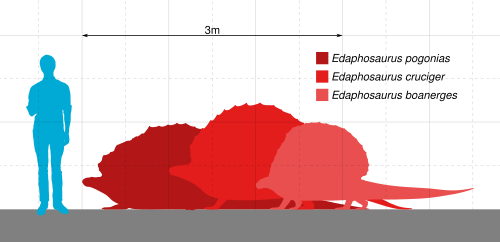
كان أكبر أنواع الإيدافوصوريات هو اللوبيوصور الذي بلغ طوله 3 أمتار ( 9.8 قدم) [ 6 ] والإيدافوصور الذي كان يمكن أن يصل طوله إلى أكثر من 3 أمتار (9.8 قدم) [ 7 ] بوزن 166 كيلوغرامًا (366 رطلاً) [ 8 ] و 300 كيلوغرام (660 رطلاً) [ 9 ] على التوالي.
عائلة سفيناكودونتيد (Sphenacodontidae)
كان الديمترودون أكبر الزواحف اللاحمة من فصيلة السنابسيدات في العصر البرمي المبكر ، إذ بلغ طوله 4.6 متر (15 قدمًا) ووزنه 250 كيلوغرامًا (550 رطلًا) . [ 10 ] كما كانت أكبر أفراد جنس الديمترودون أول الحيوانات المفترسة الرئيسية البرية بالكامل في العالم . [ 11 ]
عائلة التابينوصوريات
قُدِّر طول التابينوصور الذي عاش في العصر البرمي الأوسط بـ 5.5 متر (18 قدمًا) ، وهو ما يقارب حجم أكبر الديناصورات الرأسية . [ 12 ]
الثيرابسيدات (ثيرابسيدا)
الأنومودونتيا (Anomodonti)
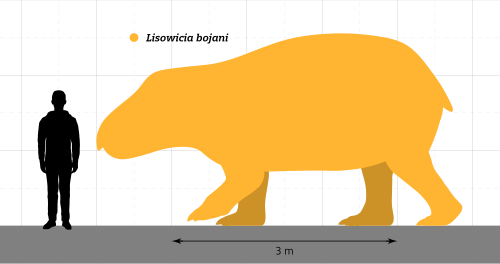
يُعدّ حيوان ليسويشيا بوجاني، وهو من فصيلة الديسينودونتات العاشبة، أكبر أنواع الزواحف الثديية غير الثديية المعروفة، إذ يبلغ طوله حوالي 4.5 متر (15 قدمًا) ، وارتفاعه 2.6 متر (8 أقدام و6 بوصات) ، وكتلة جسمه 9000 كيلوغرام (20000 رطل) . [ 13 ] [ 14 ] [ 15 ] ومع ذلك، في عام 2019، تم تقدير وزنه بشكل أكثر دقة من خلال نمذجة كتلته بناءً على الحجم الكلي المُقدّر لجسمه. تفاوتت هذه التقديرات تبعًا لمحيط قفصه الصدري وكمية الأنسجة الرخوة المحيطة بالهيكل العظمي، حيث بلغ متوسط وزنه الإجمالي 5.9 طن متري (6.5 طن أمريكي)، مع أدنى تقدير عند الحد الأدنى من الدهون والأنسجة الأخرى، والذي بلغ 4.9 طن متري (5.4 طن أمريكي)، وأقصى تقدير بلغ 7 أطنان مترية (7.7 طن أمريكي) في أضخم حالاته. [ 16 ]
البيارموسوكيين (Biarmosuchia)
ربما كان طول إيوتيتانوسوكس (الذي يُحتمل أن يكون مرادفًا لـ بيارموسوكس [17])، الذي عاش في أواخر العصر البرمي، يزيد عن 2.5 متر ( 8 أقدام وبوصتين ) ، وربما يصل إلى 6 أمتار ( 20 قدمًا) ، ويزن أكثر من 600 كيلوغرام (1300 رطل) بالنسبة للعينات البالغة. [ 17 ]
الديناصورات الرأسية (دينوسيفاليا)

- ربما كان أكبر الديناصورات المعروفة من فصيلة التيتانوسوخيد هو جونكيريا تروكولينتا ، حيث تشير النماذج الحجمية إلى أنه ربما كان يزن 985 كيلوغرامًا (2172 رطلًا) . [ 18 ] أما تابينوكانينوس باميلاي فكان أصغر حجمًا بقليل، وتشير النماذج الحجمية إلى أنه كان يزن 892.63 كيلوغرامًا (1967.9 رطلًا) . [ 19 ]
- كان الأنتيصور ، وهو من فصيلة الأنتيصورات ، أكبر الزواحف اللاحمة غير الثديية ، إذ بلغ طوله 5-6 أمتار (16-20 قدمًا) ووزنه 500-600 كيلوغرام (1100-1300 رطل) . [ 20 ] [ 21 ] ومن المرجح أن جمجمة التيتانوفونيوس البالغ ، المنتمي إلى نفس الفصيلة، كانت بطول متر واحد (3.3 قدم) . [ 21 ]
الغورغونوبسيا (Gorgonopsia)

يُعدّ Inostrancevia latifrons أكبر أنواع الغورغونوبسيات المعروفة ، إذ يبلغ طول جمجمته أكثر من 60 سم (24 بوصة) ، وطوله الإجمالي يقارب 3.5 متر (11 قدمًا) ، وكتلته 300 كجم (660 رطلًا) . [ 22 ] أما Rubidgea atrox فهو أكبر أنواع الغورغونوبسيات الأفريقية، إذ يبلغ طول جمجمته حوالي 45 سم (18 بوصة) . [ 23 ] ومن بين أنواع الغورغونوبسيات الكبيرة الأخرى: Dinogorgon بجمجمة يبلغ طولها حوالي 40 سم (16 بوصة) ، [ 24 ] و Leontosaurus بجمجمة يبلغ طولها حوالي 40 سم (16 بوصة) ، [ 23 ] و Sycosaurus بجمجمة يبلغ طولها حوالي 38 سم (15 بوصة) . [ 23 ]
الثيروسفاليين (ثيروسفاليا)
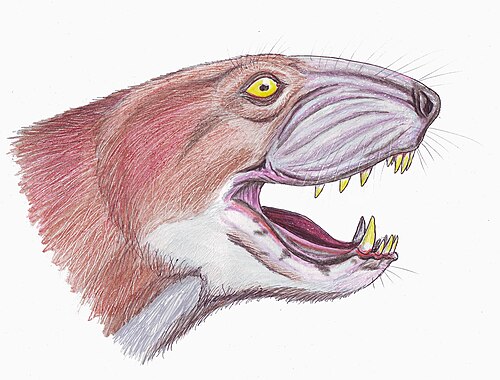
- كان أكبر أنواع الوايتسيد ، بالإضافة إلى أكبر أنواع الإيوثيروسيفاليان والثيروسيفاليان ، هو ميغاوايتسيا ، الذي قُدِّر طول جمجمته بـ 40-50 سم (16-20 بوصة) . [ 25 ]
- كان أكبر أنواع السكيلاصورات المعروفة هو جولوغناثوس ، حيث بلغ طول جمجمته المقدر 43 سم (17 بوصة) . [ 26 ]
- ربما كان أكبر ديناصور من فصيلة الليكوسوكيد ، وهو من فصيلة الثيروسيفاليان، هو " سيمونوصور ماجور " [ 27 ] [ 28 ] ، ويُقدّر طول جمجمته بنحو 40 سم (16 بوصة) [ 29 ] . وكان يُعتقد أن " سيمونوصور " يُشابه في حجمه الضبع الحديث [ 30 ] . ومن بين ديناصورات الليكوسوكيد الكبيرة الأخرى، كان هناك "سيمورينيللا"، الذي يُقدّر طول جمجمته بنحو 37 سم (15 بوصة) [ 31 ] .
- كان Gorynychus sundyrensis من الثيروسفاليين القاعديين الكبار، ويبلغ طول جمجمته المقدر 35-40 سم (14-16 بوصة) . [ 32 ]
سينودونتات غير الثدييات (سينودونتيا)
- أكبر حيوان معروف من فصيلة الكلبيات غير الثديية ، بالإضافة إلى كونه أكبر عضو في فصيلة الكلبيات الفكية ، هو سكالينودونتويدس ، وهو من فصيلة ترافيرسودونتيد ، والذي بلغ أقصى طول لجمجمته حوالي 61.7 سنتيمتر (24.3 بوصة) استنادًا إلى عينة مجزأة. [ 33 ]
- كان باسيودون دافيدي أكبر أنواع المورجانوكودونتات ، وهي من الكلبيات القريبة من الثدييات. ويُعرف بضرسه السفلي الأيمن الذي يبلغ طوله 3.3 ملم (0.13 بوصة) ، وهو أكبر من أضراس جميع المورجانوكودونتات الأخرى. [ 34 ]
- كان أكبر حيوان دوكودونت معروف هو كاستوروكودا ، الذي يبلغ طوله حوالي 50 سم (20 بوصة) . [ 35 ]
الثدييات (Mammalia)
الثدييات غير الثرية
جوبيكونودونتا (Gobiconodonta)
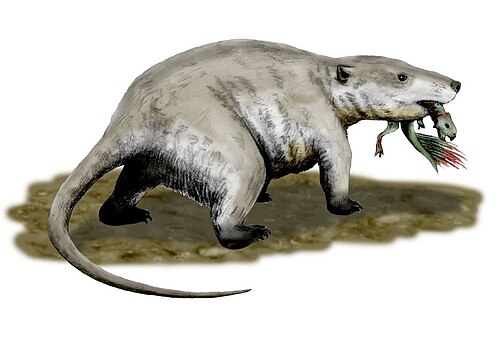
كان ريبينوماموس أكبر أنواع القوبيكونودون وأكبر الثدييات المعروفة في حقبة الحياة الوسطى . [ 36 ] [ 37 ] [ 38 ] [ 39 ] [ 40 ] [ 41 ] بلغ طول ريبينوماموس العملاق البالغ المعروف حوالي متر واحد (3 أقدام و3 بوصات) وكتلته المقدرة بين 12 و14 كيلوغرامًا (26-31 رطلاً) . [ 38 ] وبهذه المواصفات، تفوق في الحجم على العديد من ديناصورات الثيروبود الصغيرة في العصر الطباشيري المبكر . [ 42 ] كان القوبيكونودون أيضًا من الثدييات الكبيرة، [ 40 ] [ 41 ] إذ بلغ وزنه 5.4 كيلوغرامات (12 رطلاً) ، [ 38 ] وكان طول جمجمته 10 سنتيمترات (3.9 بوصات) ، وطول جسمه قبل العجز 35 سنتيمترًا (14 بوصة) . [ 43 ]
متعددات الدرنات (Multituberculata)
يُعدّ حيوان Taeniolabis taoensis، وهو أكبر حيوان متعدد الحدبات ، [ 44 ] أكبر حيوان ثديي غير ثديي معروف، حيث قد يتجاوز وزنه 100 كيلوغرام (220 رطلاً) . [ 45 ]
الثدييات البيوضة (Monotremata)

- كان أكبر حيوان ثديي بيوض معروف على الإطلاق هو نوع منقرض من حيوان الإيكيدنا ذي المنقار الطويل يُعرف باسم مورايغلوسوس هاكيتي ، والذي عُثر عليه من خلال عظمتين في غرب أستراليا. كان بحجم خروف، وربما كان وزنه يصل إلى 30 كيلوغرامًا (66 رطلاً) . [ 46 ]
- أكبر أنواع طيور الأورنيثورينكيد المعروفة هو Obdurodon tharalkooschild . [ 47 ]
- من المحتمل أن يكون حيوان كوليكودون ريتشي أكبر حيوان أحادي المسلك في حقبة الحياة الوسطى . وقد يصل طول جسمه إلى متر واحد (3 أقدام و3 بوصات) . [ 48 ]
الميتاثيريان (الميتاثيريا)
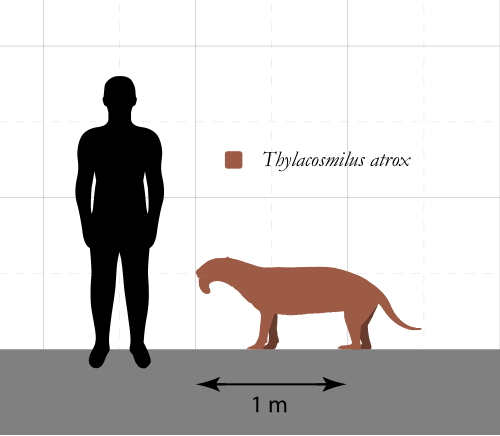
- كان حيوان بروبورهينا جيجانتيا (Proborhyaena gigantea ) أكبر الثدييات الجرابية غير الجرابيّة ، وأكبر الثدييات الجرابية اللاحمة، ويُقدّر وزنه بين 50 و200 كيلوغرام (110-440 رطلاً) . [ 49 ] [ 50 ] [ 51 ] [ 52 ] ومن الثدييات الجرابية الكبيرة الأخرى حيوان ثيلاكو سميلوس أتروكس (Thylacosmilus atrox )، الذي تراوح وزنه بين 80 و120 كيلوغرامًا (180-260 رطلاً) ، [ 53 ] [ 54 ] مع تقديرٍ يُشير إلى 150 كيلوغرامًا (330 رطلاً) . [ 55 ] أما حيوان أسترالوهينا (Australohyaena ) فهو من الثدييات الجرابية الكبيرة الأخرى، إذ يصل وزنه إلى 70 كيلوغرامًا (150 رطلاً) . [ 56 ]
- كان حيوان ديدلفودون، وهو من الثدييات الستاغودونتية ، أحد أكبر الثدييات الميتاثياري في حقبة الحياة الوسطى ، بل وأكبر ثدييات العصر الطباشيري . [ 57 ] وقد يصل طول جمجمته إلى أكثر من 10 سنتيمترات (3.9 بوصة) [ 58 ] ويبلغ وزن الحيوان الكامل 5.2 كيلوغرامات (11 رطلاً) . [ 59 ]
الجرابيات (الجرابيات)

- أكبر الجرابيات المعروفة ، وأكبر الثدييات الجرابية ، هو حيوان الديبروتودون المنقرض ، الذي يبلغ طوله حوالي 3 أمتار (9.8 قدم) ، وارتفاعه مترين (6 أقدام و7 بوصات) ، ووزنه يصل إلى 2786 كيلوغرامًا (6142 رطلًا) . [ 60 ] وكان حيوان بالورشيستس أزيل، وهو من فصيلة الزومباتيفورم، مشابهًا له في الطول، حيث بلغ طوله حوالي 2.5 متر (8.2 قدم) ، وتشير تقديرات كتلة جسمه إلى أنه قد يتجاوز 1000 كيلوغرام (2200 رطل) . [ 61 ]
- كان حيوان ثيلاكوليو كارنيفكس أكبر الجرابيات اللاحمة المعروفة . وتشير القياسات المأخوذة من عدد من العينات إلى أن متوسط وزنها تراوح بين 101 و164 كيلوغرامًا (223 إلى 362 رطلًا) . [ 62 ] [ 63 ] أما أكبر أنواع الكوالا المعروفة فهو الكوالا العملاق ( فاسكولاركتوس ستيرتوني )، والذي يُقدر وزنه بنحو 13 كيلوغرامًا (29 رطلًا) ، وهو نفس وزن ذكر كوالا معاصر كبير. [ 64 ] وكان أكبر عضو على الإطلاق من جنس شيطان تسمانيا هو ساركوفيلوس لانيريوس، الذي كان أكبر بنحو 15% وأثقل بنحو 50% من الشياطين الحديثة. [ 65 ]
- كان أكبر كنغر معروف نوعاً لم يُسمَّ بعد.يُقدّر وزن نوع من أنواع الكنغر العملاق (Macropus giganteus ) بنحو 274 كيلوغرامًا (604 رطلًا) ، [ 66 ] وهو أكبر من أكبر عينة معروفة من نوع بروكوبتودون (Procoptodon )، الذي كان يصل طوله إلى مترين (6 أقدام و7 بوصات) ووزنه إلى 230 كيلوغرامًا (510 رطلًا) . [ 67 ] وكانت بعض أنواع جنس ستينوروس (Sthenurus) مماثلة في الحجم أو أكبر قليلًا من الكنغر الرمادي الموجود حاليًا ( Macropus giganteus ). [ 68 ] أما أكبر كنغر شجري على الإطلاق، وهو البوهرا (Bohra )، فقد قُدّر وزنه بنحو 35-47 كيلوغرامًا (77-104 رطلًا) . [ 69 ]
- كان أكبر حيوان بوتوري تم تسجيله على الإطلاق هو بورونجابودي ، الذي كان أكبر بنسبة 30٪ تقريبًا من أكبر الأنواع الحية وبلغ وزنه 10 كجم (22 رطلاً) . [ 70 ]
- أكبر عضو في Thylacinidae هو Thylacinus megiriani ، وهو أكبر إلى حد ما من الذئب التسماني ( Thylacinus cynocephalus )، وأكبر من قريبه من العصر الميوسيني Thylacinus Potens ، وعادة ما يبلغ وزنه 57.3 كجم. [ 71 ]
الثدييات المشيمية غير المشيمية
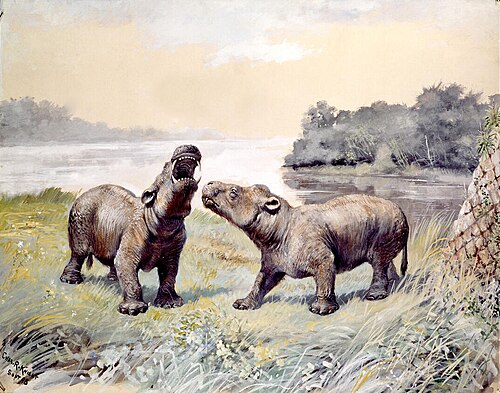
سيموليستانس (سيموليستا)
أكبر أنواع السيمولستان المعروفة هو الكوريفودون ، الذي بلغ ارتفاعه مترًا واحدًا (3 أقدام و3 بوصات) عند الكتف، وطوله 2.5 متر (8 أقدام وبوصتين) [ 72 ] [ 73 ] ، ووزنه يصل إلى 700 كيلوغرام (1500 رطل) [ 74 ] . وكان الباريلامدا أيضًا من الثدييات الضخمة، حيث بلغ وزنه 650 كيلوغرامًا (1430 رطلًا) [ 75 ] . وكان كل من وورتمانيا وبسيتاكوثيريوم، من مجموعة تاينيودونتا، من بين أكبر الثدييات في العصر الباليوسيني المبكر [ 76 ] . عاش وورتمانيا بعد نصف مليون سنة من نهاية العصر الطباشيري-الباليوجيني ، ووصل وزنه إلى 20 كيلوغرامًا (44 رطلًا) . أما بسيتاكوثيريوم ، الذي ظهر بعد مليوني سنة، فوصل وزنه إلى 50 كيلوغرامًا (110 أرطال) [ 76 ] .
الليبكتيدات (ليبكتيدا)
أكبر دب من فصيلة الليبتيكتيدات تم اكتشافه على الإطلاق هو ليبتيكتيديوم توبيني من العصر الإيوسيني الأوسط في ألمانيا . بلغ طول جمجمته 101 ملم (4.0 بوصة) ، وطول رأسه مع جذعه 375 ملم (14.8 بوصة) ، وطول ذيله 500 ملم (20 بوصة) . [ 77 ] أما أقاربه الأوروبيون المقربون من نفس الفصيلة ، بسودورينكو سيونيداي، فكانت جماجمهم تتراوح أطوالها بين 67 و101 ملم (2.6 و4.0 بوصة) . [ 77 ]
التينريك وحلفاؤها (أفروسيدا)
يُقدّر أن أكبر نوع من نوعي حيوان البينريك المنقرض من مدغشقر ( Plesiorycteropus madagascariensis )، والذي كان من أقارب حيوان التينريك المنقرض من مدغشقر ، كان يزن ما بين 10 إلى 18 كيلوغرامًا (21 إلى 40 رطلاً). [ 78 ]
ذوات الحوافر الزوجية الأصابع (Artiodactyla)
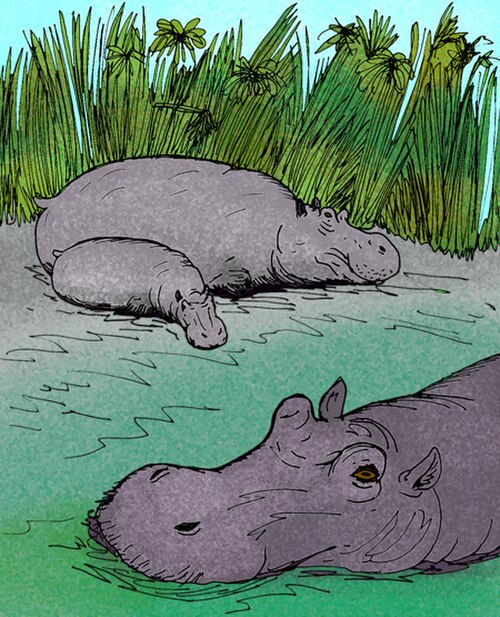
- كان فرس النهر القديم (Hippopotamus antiquus ) أكبر حيوان معروف من ذوات الحوافر البرية ، [ 79 ] ويُقدّر طوله بـ 4.3 متر (14.1 قدمًا) ووزنه بـ 3500-4200 كيلوغرام (7700-9300 رطل) . [ 80 ] ومع ذلك، تشير النماذج الحجمية إلى أنه كان أصغر قليلاً، حيث بلغ وزنه 3174 كيلوغرامًا (6997 رطلًا) . [ 79 ] في حين يُقدّر وزن فرس النهر العملاق (Hippopotamus gorgops) بأكثر من 4000 كيلوغرام (8800 رطل) ، [ 81 ] يعتبره خبراء آخرون أصغر من فرس النهر القديم . [ 79 ] كان كل من دايودون وبارينتيلودون [ 82 ] أكبر أنواع الإنتيلودونت المعروفة على الإطلاق، إذ بلغ طولهما 3.7 متر (12 قدمًا) وارتفاعهما 1.77 متر (5.8 قدمًا) عند الكتف. [ 83 ] أما أندروزأركوس ، الذي عاش في العصر الإيوسيني في منغوليا الداخلية ، فكانت جمجمته بطول 83.4 سم (32.8 بوصة) تقريبًا [ 84 ] على الرغم من أن تصنيف هذا الجنس محل خلاف. [ 85 ] [ 86 ]
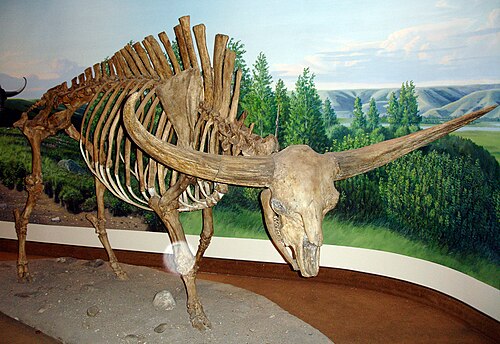
- ربما كان البيسون ذو الجبهة العريضة (Bison latifrons ) أكبر أنواع الأبقار والثيران . فقد بلغ وزنه ما بين 1250 كيلوغرامًا (2760 رطلًا) [ 87 ] [ 88 ] وربما 2000 كيلوغرام (4400 رطلًا) [ 89 ] ، وطوله 4.75 مترًا (15.6 قدمًا) ، وارتفاع كتفه 2.31 مترًا (7.6 قدمًا) [ 90 ] ، وبلغ طول قرونه 2.13 مترًا (7 أقدام ) [ 91 ] . وربما كان الجاموس الأفريقي العملاق ( Syncerus antiquus ) يُضاهي البيسون ذو الجبهة العريضة في الحجم. تراوح وزنه بين 1200 كيلوغرام (2600 رطل) و 2000 كيلوغرام (4400 رطل) ، [ 92 ] وبلغ طوله 3 أمتار (9.8 قدم) من الخطم إلى نهاية الذيل، وارتفاعه 1.85 متر (6.1 قدم) عند الكاهل ، و1.7 متر (5.6 قدم) عند المؤخرة، [ 93 ] [ 94 ] ووصلت المسافة بين طرفي قرنيه إلى 2.4 متر (7 أقدام و10 بوصات) . [ 93 ] وبلغ وزن حيوان البيلوروفيس الأفريقي طنين (2.2 طن قصير) ، وكان طول النواة العظمية لقرونه حوالي متر واحد (3 أقدام و3 بوصات) . [ 95 ] بلغ طول البيسون الأمريكي الشمالي (Bison antiquus ) 4.6 متر (15 قدمًا) ، وارتفاعه 2.27 متر (7.4 قدمًا) ، ووزنه 1588 كيلوغرامًا (3501 رطلًا) ، [ 96 ] وبلغ طول قرنيه مترًا واحدًا (3.3 قدمًا) . [ 90 ] وبصرف النظر عن التجمعات المحلية والأنواع الفرعية من الأنواع الموجودة، مثل تجمع الغور في سريلانكا، والبيسون الأوروبي في الجزر البريطانية، والبيسون القوقازي، والبيسون الكارباتي ، فإن أكبر أنواع الأبقار المنقرضة الحديثة هو الثور البري ( Bos primigenius). يبلغ متوسط ارتفاع ثيران الأوروش عند الكتفين 155-180 سم (61-71 بوصة)، بينما يبلغ متوسط ارتفاع إناثها 135-155 سم (53-61 بوصة) ، في حين وصل ارتفاع ثيران الأوروش في المجر إلى 155-160 سم (61-63 بوصة) . [ 97 ] أما الكوبري ( Bos sauveli )، الذي يصل ارتفاعه عند الكتفين إلى 1.7-1.9 متر (5 أقدام و7 بوصات - 6 أقدام و3 بوصات) ، [ 98 ] [ 99 ] فقد وُجد منذ العصر البليستوسيني الأوسط [ 100 ] ويُعتقد أنه ربما انقرض. [ 101 ] [ 102 ]
- يُعدّ الميغالوتراغوس طويل الأرجل على الأرجح أكبر أنواع الأبقار المعروفة من فصيلة الألسيلفين ، [ 103 ] وهو أكبر من حيوان النو الموجود حاليًا . [ 104 ] وقد وُجدت أطراف قرون الميغالوتراغوس بريسكوس على مسافة حوالي 1.2 متر (3 أقدام و11 بوصة) من بعضها البعض. [ 105 ]

- بلغ ارتفاع الأيل الأيرلندي المنقرض ( Megaloceros giganteus ) أكثر من 2.1 متر (7 أقدام) ، ووزنه 680 كيلوغرامًا (1500 رطل) ، وقد يصل طول قرونه إلى 4.3 متر (14 قدمًا) ، أي ما يقارب ضعف أقصى طول لقرون الأيل الأمريكي. [ 106 ] [ 107 ] أما الأيل الأمريكي العملاق ( Cervalces latifrons ) فقد بلغ ارتفاعه من 2.1 إلى 2.4 متر (من 6.9 إلى 7.9 قدم) [ 108 ] وكان ضعف وزن الأيل الأيرلندي، إلا أن طول قرونه، الذي بلغ 2.5 متر (8.2 قدم)، كان أصغر من طول قرون الأيل الأيرلندي . [ 109 ] [ 110 ] بلغ طول الأيل الأمريكي الشمالي ( Cervalces scotti ) 2.5 متر (8.2 قدم) ووزنه 708.5 كيلوغرام (1562 رطلاً) . [ 111 ] [ 112 ]
- أكبر أنواع الزرافات المعروفة ، باستثناء الزرافة الموجودة حاليًا، هو سيفاثيريوم ، ويبلغ وزن جسمه 1250 كجم (2760 رطلاً) . [ 113 ]
- كان أكبر أنواع البروتوسيراتيد هو سينثيتوسيراس ، حيث بلغ طوله مترين (6 أقدام و7 بوصات) وكتلته 150-200 كيلوغرام (330-440 رطلاً) . [ 114 ] [ 115 ]
- كان أكبر خنزير بري معروف على الإطلاق هو كوبانوشيروس جيجاس ، الذي بلغ وزنه 500 كيلوغرام (1100 رطل) وارتفاعه حوالي متر واحد (3 أقدام و3 بوصات) عند الكتف. [ 116 ] وقد يكون ميغالوكويروس مماثلاً له في الحجم، حيث ربما بلغ وزنه 303 كيلوغرامات (668 رطلاً) أو 526 كيلوغراماً (1160 رطلاً) . [ 117 ]
- كانت أكبر أنواع حيوانات البلاتيجونوس المنقرضة من فصيلة التاياسويدي مشابهة في الحجم لحيوانات البيكاري الحديثة، وخاصة البيكاري العملاق ، حيث بلغ طول جسمها حوالي متر واحد (3.3 قدم) ، وكانت تمتلك أرجلًا طويلة، مما سمح لها بالجري جيدًا. كما كان لديها خطم يشبه خطم الخنزير وأنياب طويلة ربما استخدمت لصد الحيوانات المفترسة. [ 118 ]
- كان تيتانوتيلوبوس، الذي عاش في العصر الميوسيني في أمريكا الشمالية، أكبر أنواع الجماليات . ربما بلغ وزنه 2485.6 كيلوغرامًا (5480 رطلًا) وارتفاعه عند الكتف أكثر من 3.4 متر (11 قدمًا) . [ 119 ] [ 120 ] وكان الجمل السوري ضعف حجم الجمال الحديثة. [ 121 ] إذ بلغ ارتفاعه عند الكتف 3 أمتار (9.8 قدمًا) [ 122 ] وطوله 4 أمتار (13 قدمًا) . [ 121 ] وكانت أرجل الجمل السوري أطول بنسبة 20% من أرجل الجمل العربي ، وبلغ ارتفاعه عند الكتف حوالي 2.3 متر (7 أقدام و7 بوصات) ، ووزنه حوالي 1000 كيلوغرام (2200 رطل) . [ 123 ]
- يُعتقد أن حيوان الأنوبلوثيريوم، وهو من فصيلة الأنوبلوثيريوم ، كان قادرًا على بلوغ وزن يصل إلى 271 كيلوغرامًا (597 رطلًا) في حالة نوع A. commune، و 229 كيلوغرامًا (505 أرطال) في حالة نوع A. latipes . [ 124 ] وقد بلغ طول A. latipes تحديدًا أكثر من 2.5 متر (8 أقدام وبوصتين ) وارتفاعه عند الكتف 1.25 متر (4 أقدام وبوصة واحدة ) . ونظرًا لقدرته المحتملة على المشي على قدمين ، فقد يكون قادرًا على بلوغ ارتفاع يزيد عن 3 أمتار (9.8 أقدام) . [ 125 ]
الحيتانيات (Cetacea)

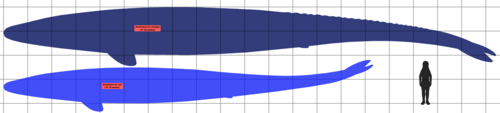

- كان بيروسيتوس أثقل الحيتان القديمة ، حيث قُدِّر وزنه بين 85 و340 طنًا (84-335 طنًا إنجليزيًا؛ 94-375 طنًا أمريكيًا) ، بينما قُدِّر طوله بين 17.0 و20.1 مترًا (55.8-65.9 قدمًا) . [ 126 ] ومع ذلك، جادل موتاني وبينسون في عام 2024 بأنه من الصعب للغاية على بيروسيتوس منافسة الحوت الأزرق أو تجاوزه في الوزن. وناقشا أنه نظرًا لأن بيروسيتوس أقصر بكثير من الحوت الأزرق في الطول، فإنه يجب أن يكون أكثر كثافة بمقدار 3.375 مرة على الأقل أو أكثر سمنة بمقدار 1.83 مرة ليكون أثقل وزنًا، وهو أمر مستحيل بالنسبة للفقاريات التي تتراوح كثافة جسمها الكلي بين 0.75 و1.2. اختبر موتاني وبينسون فرضيات بيانوتشي وزملائه باستخدام طرق مختلفة لتقدير كتلة الجسم: أسفر التقدير القائم على الانحدار والتقدير الحجمي للكتلة عن 60-114 طنًا (59-112 طنًا إنجليزيًا؛ 66-126 طنًا أمريكيًا) لطول يتراوح بين 17-20 مترًا (56-66 قدمًا) ، على الرغم من أن نطاق كتلة الجسم المحتمل يقع ضمن 60-70 طنًا (59-69 طنًا إنجليزيًا؛ 66-77 طنًا أمريكيًا) . كما زعما أن التقدير السابق مبالغ فيه بسبب افتراض التساوي في القياس، وأن تأثير تضخم العظام على تقدير كتلة الجسم ليس ضئيلاً، إذ أدى إلى التقليل من تقديرها. [ 127 ] قام بول ولارامندي (2025) بتقليص حجم بيروسيتوس إلى 15-16 مترًا في الطول و35-40 طنًا في الوزن. [ 128 ] كان أطول حيتان الأركيوسيت المعروفة في العصر الإيوسيني هو الباسيلوسورس ، حيث بلغ طوله 17-20 مترًا (56-66 قدمًا) . [ 129 ] [ 130 ] [ 131 ]
- كان أكبر أنواع أسماك السكوالودلفين هو ماكروسكوالودلفيس بطول 3.5 متر (11 قدمًا) . [ 132 ]
- كانت بعض حيتان البالين في العصر النيوجيني تُضاهي في حجمها أقاربها الضخمة الحديثة. وقُدِّر حجم حوت البارابالاينوبتيرا بحجم الحوت الرمادي الحديث تقريبًا ، [ 133 ] أي بطول 16 مترًا (52 قدمًا) . وربما نافست بعض حيتان البالين الحوت الأزرق في الحجم، [ 133 ] على الرغم من أن دراسات أخرى تُخالف هذا الرأي، إذ لا تُشير إلى أن أي حوت باليني قد بلغ هذا الحجم في العصر الميوسيني . [ 134 ]
- يُعدّ حوت ليفياتان أكبر أنواع حيتان العنبر المفترسة ، ويُقدّر طوله بما يتراوح بين 13.5 و17.5 مترًا (44-57 قدمًا) ووزنه بما يُقدّر بـ 57 طنًا قصيرًا (62.8 طنًا) بناءً على تقدير طوله البالغ 17.5 مترًا. [ 135 ]
ذوات الحوافر الفردية الأصابع (Perisodactyla)
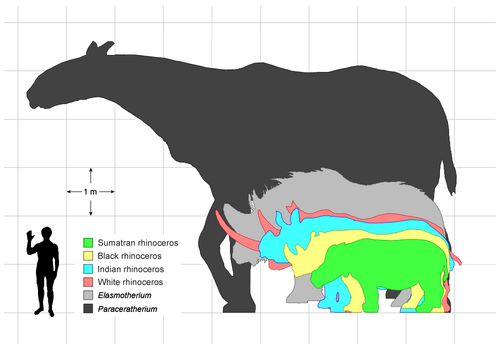

- يُعدّ نوعٌ غير مُسمى من جنس دزونجاريوثيريوم ، أحد أكبر الثدييات البرية المعروفة من رتبة فرديات الأصابع ، وثاني أكبر الثدييات البرية (انظر Palaeoloxodon namadicus ) ، وقد يكون أكبر مما كان يُعتقد، إذ قُدّر وزنه بحوالي 20.6 طن (22.7 طن قصير) . [ 136 ] كما نما قريبه الأكثر شهرة، باراسيراتيريوم ، إلى أحجام كبيرة. وقُدّر ارتفاع أكبر فرد معروف من نوع باراسيراتيريوم ترانسوراليكوم بـ 4.8 متر (15.7 قدم) عند الكتفين، وطوله من الأنف إلى العجز بـ 7.4 متر (24.3 قدم) ، ووزنه بـ 17 طن (18.7 طن قصير) . [ 137 ] [ 138 ]
- كما نمت بعض أنواع وحيد القرن القرني التي عاشت في عصور ما قبل التاريخ إلى أحجام كبيرة. فقد بلغ طول أكبر أنواع الإيلاسومثيريوم 5-5.2 متر (16-17 قدمًا) ، [ 139 ] وارتفاعه 2.5 متر (8 أقدام وبوصتين ) ، [ 140 ] ووزنه 3.5-5 أطنان (3.9-5.5 طن قصير) . [ 141 ] [ 139 ] [ 140 ] وتجعله هذه المواصفات أكبر وحيد قرن في العصر الرباعي . [ 141 ] بلغ وزن وحيد القرن الصوفي ( Coelodonta antiquitatis ) في نفس الفترة 1100-1500 كجم (2400-3300 رطل) [ 142 ] أو 2000 كجم (4400 رطل) ، [ 143 ] [ 144 ] وبلغ ارتفاعه عند الكتف 1.93 متر (6 أقدام و4 بوصات) وطوله 4.6 متر (15 قدمًا) . [ 145 ]
- وصل طول الميتامينودون ، وهو من فصيلة الأمينودونتيدات ، إلى 4 أمتار (13 قدمًا) ، وهو ما يضاهي فرس النهر في القياس والشكل. [ 146 ]
- كان التابير العملاق ( Tapirus augustus ) أكبر أنواع التابير على الإطلاق، إذ بلغ وزنه حوالي 623 كيلوغرامًا (1373 رطلًا) [ 147 ] وطوله مترًا واحدًا (3.3 قدمًا) عند الكتفين. [ 148 ] في وقت سابق، قُدِّر حجم هذا الثديي بأنه أكبر، إذ بلغ طوله 1.5 مترًا (4.9 قدمًا) ، وصُنِّف ضمن جنس منفصل هو Megatapirus . [ 148 ]
- أكبر أنواع اللوفيدونت المعروفة هو اللوفيدون ، حيث يُقدر وزن اللوفيدون لوتريسنس بأكثر من 2000 كيلوغرام (4400 رطل) . [ 149 ]
- كان موروبوس أحد أكبر أنواع الكاليكوثيرات . [ 150 ] وكان يبلغ ارتفاعه حوالي 2.4 متر (8 أقدام) عند الكتف. [ 151 ]
- بلغت أحجام حيوانات البرونتوثيرييدي ، وهي حيوانات فردية الأصابع من العصر الإيوسيني المتأخر، أحجامًا هائلة. فقد وصل ارتفاع ميغاسيروبس (المعروف أيضًا باسم برونتوثيريوم [ 152 ] ) في أمريكا الشمالية إلى 2.5 متر (8 أقدام وبوصتين ) عند الكتفين، [ 153 ] وطوله إلى 5 أمتار (16 قدمًا) ، [ 152 ] ووزنه إلى 3-3.5 طن (6600-7700 رطل) . [ 154 ] [ 155 ] وكان إمبولوثيريوم من آسيا مماثلاً له في الحجم. [ 156 ]
- كان أكبر حصان ما قبل التاريخ هو حصان إيكوس جيجانتوس في أمريكا الشمالية. وقُدِّر وزنه بأكثر من 1250 كيلوغرامًا (1.38 طن قصير) وارتفاعه مترين (6 أقدام و7 بوصات) عند الكتفين. [ 157 ] أما أكبر الخيول من فصيلة أنكيثيرين فكان هيبوهيبوس، حيث تراوح وزنه بين 403 و600 كيلوغرام (888 إلى 1323 رطلًا) ، وهو وزن يُضاهي وزن الخيول المنزلية الحديثة الكبيرة . [ 158 ] [ 159 ] ويُعد ميغاهيبوس نوعًا آخر من الخيول الكبيرة من فصيلة أنكيثيرين. وبكتلة جسمه البالغة 266.2 كيلوغرامًا (587 رطلًا) ، كان أثقل بكثير من معظم أقاربه المقربين. [ 158 ]
- يُعدّ جنس Palaeotherium من بين أكبر أجناس الباليوثيريوم حجمًا ، وهو جنسٌ قريبٌ من الخيول، حيث يُقدّر وزن P. giganteum بأكثر من 700 كيلوغرام (1500 رطل) . [ 160 ] قبل تسمية P. giganteum عام 1994، كان يُعتبر P. magnum أكبر أنواع الباليوثيريوم ، [ 161 ] إذ يُحتمل أن يصل ارتفاعه عند الكتف إلى 1.3 متر (4 أقدام و3 بوصات) وطوله إلى 2.52 متر (8 أقدام و3 بوصات) . [ 162 ] ويُقدّر وزن نوعٍ آخر من الباليوثيريوم، وهو Cantabrotherium، بحوالي 600 كيلوغرام (1300 رطل) . [ 160 ]
الفيناكودونتيات (Phenacodontidae)
أكبر أنواع الفيناكودونتيد المعروفة هو فيناكودوس . كان طوله 1.5 متر (4 أقدام و11 بوصة) [ 163 ] ووزنه يصل إلى 56 كيلوغرامًا (123 رطلاً) . [ 164 ]
دينوسيراتانز (دينوسيراتا)

كان إيوباسيلوس أكبر الديناصورات المعروفة من فصيلة الديناصورات ، إذ بلغ طول جمجمته 102 سم (40 بوصة) ، وارتفاعه 2.1 متر (6 أقدام و11 بوصة) من الخلف، و 1.5 متر (4 أقدام و11 بوصة) عند الكتف. [ 165 ] ومن الحيوانات الضخمة الأخرى في هذه المجموعة، يونتاثيريوم ، الذي بلغ طول جمجمته 76 سم (30 بوصة) ، وارتفاعه 1.5 متر (4 أقدام و11 بوصة) عند الكتف، [ 165 ] وطوله 4 أمتار (13 قدمًا) ، ووزنه 2.25 طن (2.48 طن قصير) ، أي بحجم وحيد القرن . [ 166 ] وعلى الرغم من ضخامة حجمهما، كان لدى كل من إيوباسيلوس ويونتاثيريوم دماغ صغير جدًا. [ 165 ] [ 166 ]
آكلات اللحوم (Carnivora)
الكلبيات
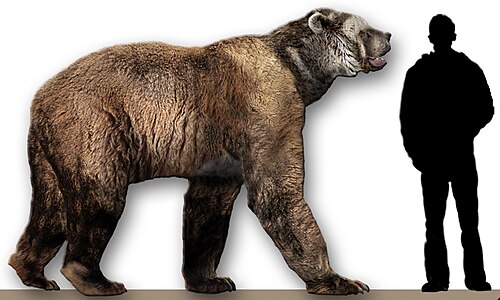


- كان الدب العملاق قصير الوجه من أمريكا الجنوبية (Arctotherium angustidens ) أكبر حيوان ثديي مفترس بري، وأكبر دب معروف، وأكبر حيوان لاحم بري على الإطلاق . تشير عظمة العضد لهذا الدب، التي عُثر عليها في بوينس آيرس، إلى أن ذكور هذا النوع ربما كانت تزن ما بين 1588 و1749 كيلوغرامًا (3501-3856 رطلًا) ، ويبلغ طولها 3.4 مترًا (11 قدمًا) على الأقل عند وقوفها على أطرافها الخلفية. [ 167 ] [ 168 ] ومن الدببة الضخمة الأخرى الدب العملاق قصير الوجه من أمريكا الشمالية ( Arctodus simus )، بمتوسط وزن 625 كيلوغرامًا (1378 رطلًا) ، ووزن أقصى يُقدر بـ 957 كيلوغرامًا (2110 أرطال) . [ 169 ] يُعتقد أن أكبر أفراد هذا النوع قد بلغ وزنًا أكبر، يصل إلى 1200 كيلوغرام (2600 رطل) . [ 167 ] كان دب الكهوف المنقرض ( Ursus spelaeus ) أثقل وزنًا من العديد من الدببة الحديثة. إذ بلغ وزن أكبر الذكور 1000 كيلوغرام (2200 رطل) . [ 170 ] ويُقدّر أيضًا أن وزن أكبر ذكور السلالة الفرعية التي ربما تكون قد تعرضت لانقطاع في التنوع البيولوجي من الدب البني ( Ursus arctos )، وهي دب السهوب البني ( Ursus arctos priscus )، بلغ 1000 كيلوغرام (2200 رطل) . [ 171 ] كان هناك نوع آخر من الدببة الكبيرة، وهو Agriotherium africanum ، الذي قُدِّر وزنه في البداية بـ 750 كيلوغرامًا (1650 رطلًا) ، [ 172 ] [ 173 ] لكن التقديرات الأحدث تشير إلى أنه ربما كان يزن ما بين 317 و540 كيلوغرامًا (699-1190 رطلًا) . [ 174 ] [ 55 ] كان Ailuropoda baconi من العصر البليستوسيني أكبر من الباندا العملاقة الحديثة ( Ailuropoda melanoleuca ). [ 175 ]
- يُعدّ بونتوليس ماغنوس أكبر أنواع الفقمات الزعنفية القدمية ، وأحد أكبرها على الإطلاق، إذ يبلغ طول جمجمته 60 سم (24 بوصة) (أي ضعف حجم جمجمة ذكور الفظ الحديثة ) [ 176 ] ، ويبلغ طول جسمه الإجمالي أكثر من 4 أمتار (13 قدمًا) [ 177 ] [ 178 ] . ولا يصل إلى أحجام مماثلة سوى ذكور فقمات الفيل الحديثة ( ميرونغا ) [ 177 ] . أما ثاني أكبر الفقمات الزعنفية القدمية في عصور ما قبل التاريخ فهو غومفوتاريا بوغناكس، ويبلغ طول جمجمته حوالي 47 سم (19 بوصة) [ 176 ] .
- يُعدّ ثالاسوليون أحد أكبر أنواع الفقمات الأذنية التي عاشت في عصور ما قبل التاريخ ، وهو يُضاهي في حجمه أكبر فقمات الفراء الموجودة حاليًا . ويُقدّر وزن ثالاسوليون المكسيكي بما لا يقل عن 295-318 كيلوغرامًا (650-701 رطلًا) . [ 179 ]
- يُرجّح أن يكون أكبر حيوان من فصيلة العرسيات على الإطلاق هو ثعلب الماء العملاق، Enhydriodon omoensis . فقد تجاوز طوله 3 أمتار (9.8 قدم) ، وبلغ وزنه حوالي 200 كيلوغرام (440 رطلاً) ، وهو أكبر بكثير من أي حيوان آخر معروف من فصيلة العرسيات، سواءً كان حيًا أو منقرضًا. [ 180 ] [ 181 ] [ 182 ] وُجدت أنواع أخرى من ثعالب الماء العملاقة، مثل Siamogale ، الذي بلغ وزنه حوالي 50 كيلوغرامًا (110 أرطال) [ 183 ] و Megalenhydris ، الذي كان أكبر من ثعلب الماء النهري العملاق في العصر الحديث. [ 184 ] كان Megalictis أكبر حيوان من فصيلة العرسيات يعيش على اليابسة فقط [ 185 ] (على الرغم من أن Enhydriodon ذُكر مؤخرًا كأكبر حيوان من فصيلة العرسيات الذي يُعد أيضًا مفترسًا بريًا [ 180 ] ). كان ميغاليكتيس فيروكس ، الذي يُشبه النمر الأمريكي في حجمه ، يمتلك جمجمة أعرض، تكاد تُضاهي جمجمة الدب الأسود . [ 185 ] ومن بين حيوانات العرسيات الضخمة الأخرى، حيوان إيكوروس الذي يشبه القطط ظاهريًا، والذي عاش في العصر الميوسيني في أفريقيا. بلغ وزن إيكوروس، ذو الأرجل الطويلة، حوالي 44 كيلوغرامًا (97 رطلًا) ، وكان بحجم الذئب تقريبًا . [ 186 ] ومن حيوانات العرسيات الضخمة الأخرى بيرونيوم [ 187 ] وإيوميلفورا ، وهو حيوان لاحم للغاية ، وكلاهما عاش في أواخر العصر الميوسيني . [ 188 ]
- ربما كان حيوان تشابالمالانيا، وهو من أمريكا الجنوبية، أثقل أنواع الراكونيات . فقد بلغ طول جسمه 1.5 متر (4.9 قدم) مع ذيل قصير، ووزنه 150 كيلوغرامًا (330 رطلًا) ، وهو ما يُقارب حجم الدب الأسود الأمريكي ( Ursus americanus ). [ 189 ] ومن الراكونيات الضخمة الأخرى حيوان سيوناسوا ، الذي تراوح وزنه بين 15 و25 كيلوغرامًا (33-55 رطلًا) ، وهو ما يُقارب حجم كلب متوسط الحجم. [ 190 ]
- The largest canid of all time was Epicyon haydeni, which stood 90 cm (35 in) tall at the shoulder, had a body length of 2.4 m (7.9 ft) and weighed 100–125 kg (220–276 lb),[191][192][193] with the heaviest known specimen weighing up to 170 kg (370 lb).[55] The extinct dire wolf (Aenocyon dirus) reached 1.5 m (4.9 ft) in length and weighed between 50 and 110 kg (110 and 243 lb).[55][194] The largest wolf (Canis lupus) subspecies ever existed in Europe is the Canis lupus maximus from the Late Pleistocene of France. Its long bones are 10% larger than those of extant European wolves and 20% longer than those of C. l. lunellensis.[195] The Late Pleistocene Italian wolf was morphometrically close to C. l. maximus.[196]
- The largest amphicyonid (bear-dogs) was a species of Pseudocyon weighing around 773 kg (1,704 lb), representing a very large individual.[197]
Feliformia


- كان أكبر أنواع فصيلة باربوروفيلينا ، وكذلك أكبر أنواع فصيلة نمرافي ، هو باربوروفيلس فريكي ، الذي بلغ ارتفاع كتفه 90 سم (35 بوصة) وربما وصل وزنه إلى 328 كجم (723 رطلاً) . [ 198 ] [ 199 ] ومع ذلك، قدرت دراسة أجريت عام 2024 كتلة أقل قليلاً تبلغ 256 كجم (564 رطلاً) . [ 200 ] (بما في ذلك المواد التكميلية ). كان أكبر أنواع فصيلة نمرافينا هو كويرسيلوروس ماجور، حيث تشير أحافيره إلى أنه كان يزن 200 كجم (440 رطلاً)، وهو حجم مشابه لحجم الأسد الحديث، وكان متسلقًا . أما دينايلوريكتيس بوندالي، وهو نوع وثيق الصلة به ، فكان أصغر قليلاً حيث بلغ وزنه 130 كجم (290 رطلاً) ، مما يجعله بحجم لبؤة. [ 201 ] يُعتبر Eusmilus adelos أكبر أفراد فصيلة Hoplophonena الفرعية، إذ يصل وزنه إلى 111 كيلوغرامًا (245 رطلًا) ، وهو وزن يُقارب وزن أسد أفريقي صغير . [ 198 ] بينما كان يُعتقد أن وزن Hoplophoneus occidentalis قد يصل إلى 160 كيلوغرامًا (350 رطلًا) ، [ 55 ] اقترح خبراء آخرون أنه كان أصغر حجمًا، [ 198 ] بحجم نمر تقريبًا . [ 202 ] أشارت دراسة أُجريت عام 2012 إلى أن وزن هذا النوع قد يصل إلى 65 كيلوغرامًا (143 رطلًا) . [ 203 ]
- كان أكبر أنواع السنوريات ذات الأسنان السيفية ( Machairodont ) هو Amphimachairodus kabir ، حيث يُحتمل أن يصل وزن الذكور إلى 350-490 كجم (770-1080 رطلًا) . [ 204 ] وكان Smilodon populator منافسًا قويًا، حيث تراوح وزن الذكور بين 220-450 كجم (490-990 رطلًا) . [ 55 ] [ 205 ] ويُقدّر وزن نوع آخر كبير من جنس Amphimachairodus ، وهو A. horribilis ، [ 206 ] [ 207 ] بـ 405 كجم (893 رطلًا) . [ 208 ] وكان Nimravides catocopis منافسًا آخر [ 209 ] حيث بلغ وزن أكبر عينة منه 427 كجم (941 رطلًا) . [ 210 ] نوع غير مسمى من زينوسميلوس يُعتقد أن وزنه كان يتراوح بين 347-410 كيلوغرامات (765-904 رطل) . [ 211 ]
- كانت أثقل أنواع السنوريات المعروفة هي الأسود المنقرضة (Panthera fossilis )، التي قُدِّر وزنها الأقصى بين 400 و500 كيلوغرام (880-1100 رطل) ، [ 212 ] والأسد الأمريكي ( Panthera atrox )، الذي وصل وزنه إلى 363 كيلوغرامًا (800 رطل) ، [ 213 ] [ 214 ] وأسد ناتودوميري في شرق إفريقيا، الذي كان حجمه مماثلاً لحجم أفراد كبيرة من P. atrox . [ 215 ] وقُدِّر وزن نمر نغانغدونغ (Panthera tigris soloensis) بما يصل إلى 486 كيلوغرامًا ( 1071 رطلًا ) ، [ 205 ] إلا أن هذا الرقم محل خلاف، حيث تشير بعض التقديرات إلى أن أكبر الأفراد وزنًا بلغ 298 كيلوغرامًا (657 رطلًا) . [ 216 ]
- كان أكبر أنواع السنوريات هو السنوري القطبي (Acinonyx pleistocaenicus )، حيث بلغ وزن أكبر عينة منه 188 كيلوغرامًا (414 رطلًا) . [ 217 ] أما قريبه، الفهد العملاق ( Acinonyx pardinensis )، فقد وصل وزنه إلى 60-121 كيلوغرامًا (132-267 رطلًا) ، أي ما يقارب ضعف حجم الفهد الحديث . [ 218 ] وكان حيوان البراتيفليس (Pratifelis) في أمريكا الشمالية أكبر حجمًا من الكوجر الموجود حاليًا . [ 219 ]
- أكبر أنواع الزباديات المعروفة التي وُجدت هو Viverra leakeyi ، والذي كان بحجم الذئب أو النمر الصغير تقريبًا بوزن 41 كجم (90 رطلاً) . [ 220 ]
- كانت أكبر الضباع المنقرضة المعروفة هي ضبع بيركروكوتيد [ 221 ] [ 222 ] [ 223 ] ، واسمه العلمي Dinocrocuta gigantea . قُدِّر وزنه في الأصل بـ 380 كيلوغرامًا (840 رطلًا) [ 224 ] . مع ذلك، تشير تقديرات الوزن الحديثة إلى أنه ربما كان أقل وزنًا. يُقدَّر وزن فرد يبلغ طول جمجمته 32.2 سم (12.7 بوصة) بـ 200 كيلوغرام (440 رطلًا) [ 225 ] . كما ورد أن طول جمجمة عينة أخرى يبلغ 40 سم (16 بوصة) [ 226 ] . أما ضبع باتشيكروكوتا بريفيروستريس، فكان ضبعًا كبيرًا منقرضًا آخر. يُقدَّر طوله عند الكتف بـ 90-100 سم (35-39 بوصة) [ 227 ] ، ووزنه بـ 190 كيلوغرامًا (420 رطلًا) . [ 55 ] مع ذلك، رجّح خبراء آخرون أن وزن 150 كيلوغرامًا (330 رطلًا) يُمثّل الحد الأقصى لوزن هذا النوع. [ 228 ] عُرفت ضباع كروكوتا أيضًا بأحجامها الكبيرة، حتى أنها كانت أكبر من الضبع المرقط الموجود حاليًا، ولا سيما سلالة الضبع المرقط المنقرضة ، ضبع الكهوف ، حيث بلغ متوسط وزن الأفراد 88 كيلوغرامًا (194 رطلًا) . [ 229 ] كان ضبع كروكوتا إيتورنو نوعًا آخر كبيرًا من ضباع كروكوتا ، وتشير التقديرات إلى أن وزن هذا النوع ربما بلغ 85 كيلوغرامًا (187 رطلًا) . [ 230 ]
- كان لدى حيوان الفوسا العملاق المنقرض ( Cryptoprocta spelea ) كتلة جسم تتراوح من 17 كجم (37 رطلاً) [ 231 ] إلى 20 كجم (44 رطلاً) [ 232 ] ، وهو أكبر بكثير من وزن الفوسا الحديث (يصل إلى 8.6 كجم (19 رطلاً) للذكور البالغين [ 233 ] ).
الضباعيات (Hyaenodonta)
- كان أكبر أنواع الهياينيلوريد ، وكذلك أكبر أنواع الهياينودونت، هو ميجيستوثيريوم أوستيوثلاستيس، الذي تراوح وزنه بين 500 و880 كيلوغرامًا (1100-1940 رطلًا) . [ 234 ] [ 55 ] في حين قُدِّر وزن قريبه، سيمباكوبوا كوتوكا أفريكا ، بين 208 و1554 كيلوغرامًا (459-3426 رطلًا) ، أشارت نفس المعادلة إلى أن ميجيستوثيريوم كان أكبر من سيمباكوبوا . [ 235 ] كان الهياينيلوروس نوعًا آخر كبيرًا من الهياينيلوريد. أما أكبر أنواع هذا الجنس، فهو الهياينيلوروس بوجتينسيس ، الذي ربما تراوح وزنه بين 267 و1744 كيلوغرامًا (589-3845 رطلًا) . [ 235 ]
- كان أكبر أنواع الضباع هو الضبع العملاق (Hyaenodon gigas )، الذي بلغ وزنه حوالي 378 كجم (833 رطلاً) . [ 236 ]
الأوكسيانيدات (Oxyaenidae)
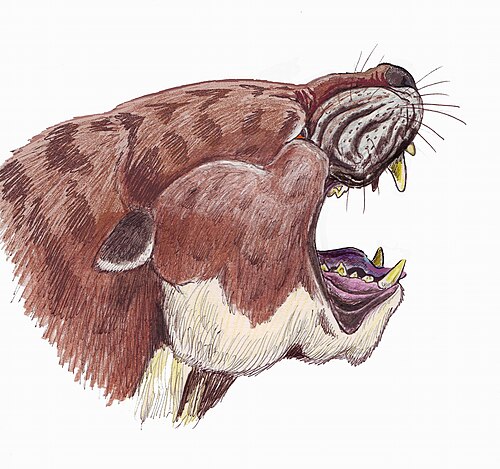
كان أكبر أنواع الأوكسيانيد المعروفة هو ساركاستودون الذي بلغ وزنه 800 كجم (1800 رطل) . [ 55 ]
الميزونيكيون (ميزونيكيا)
بلغ حجم بعض الميزونيكيات حجم الدب. ومن هذه الأنواع الضخمة مونغولونيكس من آسيا [ 237 ] وأنكالاغون من أمريكا الشمالية. [ 238 ] [ 239 ] ومن الميزونيكيات الضخمة الأخرى هارباغوليستس، الذي يصل طول جمجمته إلى نصف متر في بعض الأنواع. [ 237 ]
الخفافيش (الخفافيش)
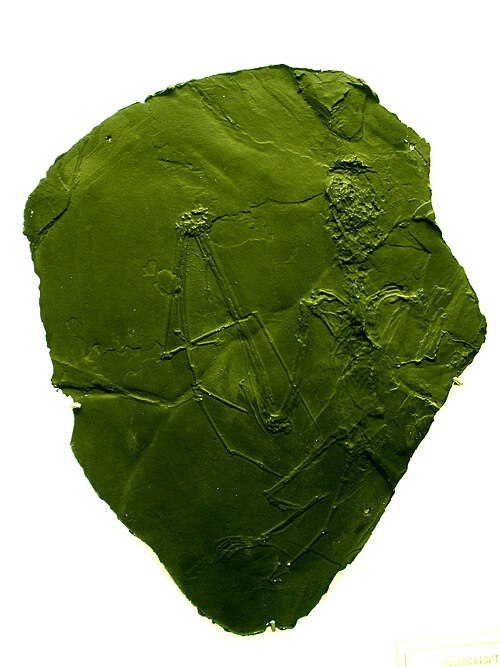
- عُثر على خفاش ديسمودوس دراكولاي في رواسب العصر الرباعي في أمريكا الجنوبية والوسطى، وكان يبلغ طول جناحيه 0.5 متر (20 بوصة) ووزنه يصل إلى 60 غرامًا (2.1 أونصة) . هذه النسب تجعله أكبر خفاش مصاص دماء تطور على الإطلاق. [ 240 ]
- كان خفاش الأركيوبتروبوس من إيطاليا أحد أكبر الخفافيش الأحفورية المعروفة على الإطلاق . إذ بلغ طول جناحيه ما يقدر بـ 82 إلى 90 سنتيمترًا (2.69 إلى 2.95 قدمًا) ، مما جعله ينافس الخفاش الطيفي الحديث والعديد من أنواع الثعالب الطائرة في الحجم. [ 241 ]
القنافذ، والزبابات، والزبابات، والخلد (Eulipotyphla)

كان أكبر حيوان معروف من مجموعة Eulipotyphla هو Deinogalerix ، [ 242 ] حيث بلغ طوله الإجمالي 60 سم (24 بوصة) ، وبلغ طول جمجمته 21 سم (8.3 بوصة) . [ 243 ]
القوارض (Rodentia)

- كانت العديد من قوارض الدينوميد المنقرضة في أمريكا الجنوبية أكبر بكثير من القوارض الحديثة. يُعدّ جوزيفوارتيغاسيا مونيسي أكبر قارض معروف على الإطلاق، حيث قُدّر وزنه بحوالي 480-500 كيلوغرام (1060-1100 رطل) . [ 244 ] أما فوبروميس باترسوني، فكان وزنه 125-150 كيلوغرام (276-331 رطل) . [ 244 ] وبلغ ارتفاع كل من جوزيفوارتيغاسيا وفوبروميس حوالي 1.5 متر (4 أقدام و11 بوصة) عند الكتف. [ 245 ] بينما بلغ وزن ديناميد ضخم آخر، وهو تيلكوميس جيجانتيسيموس، 200 كيلوغرام (440 رطل) كحد أدنى . [ 245 ]
- كان حيوان Amblyrhiza inundata من عائلة Heptaxodontidae حيوانًا ضخمًا، حيث تراوح وزنه بين 50 و200 كيلوغرام (110-440 رطلًا) . [ 246 ] [ 245 ]
- كان أكبر أنواع القنادس هو القندس العملاق ( Castoroides ) في أمريكا الشمالية. فقد بلغ طوله أكثر من مترين، ووزنه ما يقارب 90 إلى 125 كيلوغرامًا (198 إلى 276 رطلاً) ، مما يجعله أيضًا أحد أكبر القوارض التي وُجدت على الإطلاق. [ 247 ]
- كان أكبر أنواع النيص في العالم القديم هو النيص الأحمر (Hystrix refossa) ، وكان أكبر من النيص الحي. كان أكبر بنسبة 20% تقريبًا من أقرب أقربائه، وهو النيص الهندي الحي ( H. indica )، حيث وصل طوله إلى أكثر من 115 سم (45 بوصة) .
الأرانب البرية، والأرانب البرية، والبيكا (Lagomorpha)
أكبر حيوان أرنبي معروف من عصور ما قبل التاريخ هو الأرنب العملاق المينوركي نورالاغوس ريكس الذي يبلغ وزنه 12 كجم (26 رطلاً) . [ 248 ]
البنغول (Pholidota)
كان أكبر حيوان آكل النمل الحرشفي هو المنقرض Manis palaeojavanica [ 249 ] ويبلغ طوله الإجمالي 2.5 متر (8.2 قدم) . [ 250 ]
الرئيسيات (الرئيسيات)
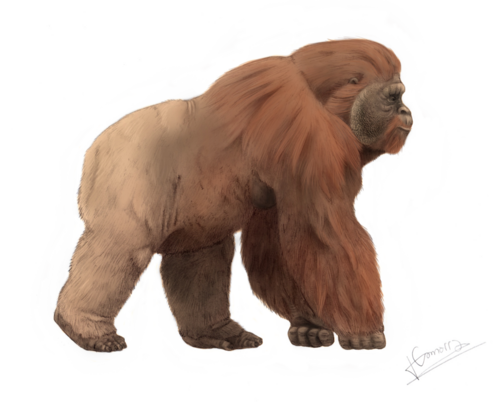
- أكبر الرئيسيات غير البشرية المعروفة هو جيجانتوبيثيكوس بلاكي . تشير الدراسات إلى أن طوله يتراوح بين 2.74 و3.66 متر (9 أقدام - 12 قدمًا ) ، ووزنه بين 225 و300 كيلوغرام (496-661 رطلًا) . [ 251 ] [ 252 ] [ 253 ] وقد أشار البعض إلى أنه لا يتجاوز طوله 2.3 متر (7 أقدام و7 بوصات) مع وضعية المشي على قدمين. [ 254 ] وهناك قرد عملاق آخر هو ميجانثروبوس باليوجافانيكوس، الذي بلغ طوله 2.4 متر (7 أقدام و10 بوصات) ، [ 255 ] على الرغم من أن بقاياه شحيحة للغاية. [ 256 ]
- خلال العصر البليستوسيني ، كان بعض البشر القدماء قريبين في الحجم، أو حتى أكبر، من الإنسان الحديث المبكر . فقد بلغ متوسط وزن إنسان نياندرتال ( Homo neanderthalensis ) 77.6 كيلوغرامًا (171 رطلًا) للذكور و 66.4 كيلوغرامًا (146 رطلًا) للإناث، وهو ما يتجاوز متوسط وزن الإنسان الحديث ( Homo sapiens ) ( 68.5 كيلوغرامًا (151 رطلًا) للذكور و 59.2 كيلوغرامًا (131 رطلًا) للإناث). [ 257 ] وتشير عظمة قصبة ساق عُثر عليها في كابوي (زامبيا) إلى فرد من جنس هومو غير محدد، ربما بلغ طوله 181.2 سنتيمترًا ( 71.3 بوصة ) . وكان من أطول البشر في العصر البليستوسيني الأوسط، وكبير الحجم بشكل ملحوظ حتى بالمقارنة مع البشر المعاصرين. [ 258 ] بلغ طول أطول أفراد الإنسان العاقل من العصر البليستوسيني الأوسط في إسبانيا 194 سم (76 بوصة) للذكور و 174 سم (69 بوصة) للإناث. [ 258 ] وقد يصل طول بعض أفراد الإنسان المنتصب إلى 185 سم (73 بوصة) ووزنهم إلى 68 كجم (150 رطلاً) . [ 259 ] [ 260 ]
- يُعدّ قرد البابون ما قبل التاريخ ، ثيروبيثيكوس أوزوالدي، أثقل قرد معروف في العالم القديم، إذ بلغ وزنه 72 كيلوغرامًا (159 رطلًا) ، [ 261 ] بل ذهب البعض إلى اقتراح أنه وصل إلى 128 كيلوغرامًا (282 رطلًا) . [ 262 ] ويتجاوز وزن ذكر من قرد دينوبيثيكوس ، يُقدّر متوسط وزنه بـ 46 كيلوغرامًا (101 رطلًا) وقد يصل إلى 57 كيلوغرامًا (126 رطلًا) ، الرقم القياسي لوزن بابون تشاكما ، وهو أكبر أنواع البابون الموجودة حاليًا. [ 262 ]
- كان أكبر قرد معروف في العالم الجديد هو قرد كارتيليس ، الذي دُرِسَ كعينة من بروتوبيثيكوس ، حيث بلغ وزنه 34.27 كيلوغرامًا (75.6 رطلًا) . ويُعدّ قرد كايبورا بامبويروم نوعًا كبيرًا آخر، إذ بلغ وزنه 27.74 كيلوغرامًا (61.2 رطلًا) . [ 263 ]
- كانت أكبر أنواع الأوموميات هي ماكروتارسوس وأورايا من العصر الإيوسيني الأوسط . وبلغ وزن كل منهما 1.5-2 كجم (3.3-4.4 رطل) . [ 264 ]
- نمت بعض الرئيسيات الليمورية الشكل التي عاشت في عصور ما قبل التاريخ إلى أحجام هائلة. كان الأركيويندريس ليمورًا كسولًا يبلغ طوله 1.5 متر (4.9 قدم) عاش في مدغشقر ، وتراوح وزنه بين 150 و187.8 كيلوغرامًا (331-414 رطلًا) ، [ 265 ] وهو بحجم غوريلا ذكر بالغ . [ 266 ] وكان الباليوبروبيثيكوس، من نفس العائلة، أثقل وزنًا من معظم الليمورات الحديثة ، حيث تراوح وزنه بين 25.8 و45.8 كيلوغرامًا (57-101 رطلًا) . [ 267 ] أما الميغالادابيس فهو ليمور منقرض كبير آخر، إذ تراوح طوله بين 1.3 و1.5 متر (4 أقدام و3 بوصات إلى 4 أقدام و11 بوصة) ، وبلغ متوسط كتلة جسمه حوالي 140 كيلوغرامًا (310 أرطال) . [ 268 ] تشير تقديرات أخرى إلى أن وزنه يتراوح بين 46.5 و85.1 كيلوغرام (103-188 رطلاً)، ولكنه لا يزال أكبر بكثير من أي نوع من الليمور الموجود حاليًا. [ 267 ]
الأفيال والماموث والماستودون (الخرطوميات)


- يُعتقد أن الفيل Palaeoloxodon namadicus كان أكبر حيوان ثديي بري على الإطلاق، استنادًا إلى عظم فخذ جزئي ضخم بشكل خاص، قُدِّر وزنه بنحو 22 طنًا (24.3 طنًا قصيرًا) وارتفاعه عند الكتف بنحو 5.2 متر (17.1 قدمًا) ، مع أن مُعدّ التقدير أشار إلى أنه مجرد تخمين ويجب التعامل معه بحذر. [ 137 ] في عام 2023، قدّر منشورٌ لغريغوري س. بول ولارامندي أن عينة أخرى، تم تحديدها على أنها cf. P. namadicus ، والتي لا يُعرف عنها سوى عظم فخذ جزئي، كان وزنها يتراوح بين 18 و19 طنًا (40,000-42,000 رطل). وقد لاحظ باحثون آخرون أن تقديرات وزن الخرطوميات، المستندة إلى عظام منفردة، قد تؤدي إلى تقديرات "غير محتملة للغاية" مقارنةً بالتقديرات الدقيقة المستندة إلى هياكل عظمية كاملة. [ 269 ] في عام 2024، قدّر بيسواس وتشانغ وتساي أقصى ارتفاع للكتف بأكثر من 4.5 متر (15 قدمًا)، وأشاروا إلى أن كتلة الجسم لخمس عينات تم قياسها تراوحت بين 13.2 و18.5 طنًا (29000 إلى 41000 رطل) من عينات من تايوان . [ 270 ] قُدّر أن أكبر فرد تم الإبلاغ عنه من ماموث السهوب في أوراسيا ( Mammuthus trogontherii ) وصل ارتفاعه إلى 4.5 متر (14.8 قدمًا) عند الكتفين، ووزنه إلى 14.3 طنًا (15.8 طنًا قصيرًا) . [ 137 ] [ 271 ] بلغ وزن Stegodon zdanskyi ، وهو أكبر أنواع Stegodon ، 13 طنًا (14.3 طنًا قصيرًا) . [ 137 ] ومن بين الخرطوميات الضخمة الأخرى، نجد Stegotetrabelodon syrticus ، الذي يزيد ارتفاعه عن 4 أمتار (13 قدمًا) ويتراوح وزنه بين 11 و12 طنًا (12.1 إلى 13.2 طنًا قصيرًا) . [ 137 ] أما الماموث الكولومبي ( Mammuthus columbi ) فكان ارتفاعه عند الكتف حوالي 4 أمتار (13.1 قدمًا)، لكن وزنه لم يكن كبيرًا كباقي الخرطوميات الضخمة. بلغ متوسط وزنه 9.5 طنًا (10.5 طنًا قصيرًا) ، مع وجود عينة واحدة ضخمة بشكل استثنائي بلغ وزنها حوالي 12.5 طنًا (13.8 طنًا قصيرًا) . [ 137 ]
- يُعدّ الماموت بورسوني ، وهو من فصيلة الماموتيات، أحد أكبر الخرطوميات والثدييات البرية المعروفة. يُقدّر متوسط طول الذكر البالغ بـ 4.1 متر (13 قدمًا) ووزنه بحوالي 16 طنًا (17.6 طنًا قصيرًا) ، وقد يُضاهي حجم الذكور الضخمة حجم أكبر أنواع الباليولوكسودون ناماديكوس . [ 137 ] كما امتلك هذا النوع أطول الأنياب بين جميع الحيوانات، حيث بلغ طول أكبر عينة مُسجّلة 5.02 متر (16.5 قدمًا) من القاعدة إلى الطرف على طول المنحنى. [ 272 ]
- كان حيوان الدينوثيريوم أكبر أنواع الخرطوميات فيعائلة الدينوثيريات . وتؤكد العظام التي عُثر عليها في جزيرة كريت وجود عينة يبلغ ارتفاعها 4.1 متر (13 قدمًا) عند الكتفين،ووزنها أكثر من 14 طنًا (15.4 طنًا قصيرًا) . [ 137 ]
أبقار البحر (سيرينيا)

تشير التقارير إلى أن أبقار ستيلر البحرية تنمو لتصل إلى طول يتراوح بين 8 و9 أمتار (26 إلى 30 قدمًا) عند البلوغ، وهو حجم أكبر بكثير من أي من حيوانات الأطوميات الموجودة حاليًا . [ 273 ] ويُقدّر وزن أبقار ستيلر البحرية بما يتراوح بين 8 و10 أطنان (8.8 إلى 11 طنًا قصيرًا) . [ 274 ]
كان سلفها المباشر، بقرة البحر كويستا، يبلغ طوله حوالي 9 أمتار (30 قدمًا) وربما وزنه 10 أطنان (11 طنًا قصيرًا). [ 275 ]
Embrithopods (Embrithopoda)

كان أكبر أنواع الأَمبريثوبودات المعروفة هو الأرسينوثيريوم من فصيلة الأرسينوثيريد . بلغ ارتفاع الأرسينوثيريوم زيتلي 1.75 متر (5 أقدام و9 بوصات) عند الكتفين، وطوله 3 أمتار (9.8 أقدام) . [ 276 ] [ 277 ] وصل الأرسينوثيريوم العملاق إلى حجم أكبر من الأرسينوثيريوم زيتلي . [ 278 ]
الوبريات (Hyracoidea)
كانت بعض أنواع الوبر ما قبل التاريخ ضخمة للغاية مقارنةً بأقاربها الصغيرة الحديثة. يُعدّ تيتانوهيراكس ألتيموس أكبر أنواع الوبر التي تطورت على الإطلاق . [ 279 ] بكتلة تُقدّر بين 600 كيلوغرام (1300 رطل) وأكثر من 1300 كيلوغرام (2900 رطل) ، كان حجمه قريبًا من حجم وحيد القرن السومطري . [ 280 ] ومن أنواع الوبر الضخمة الأخرى ميغالوهيراكس، الذي بلغ طول جمجمته 391 مليمترًا (15.4 بوصة) [ 281 ] ووصل إلى حجم حيوان التابير. [ 279 ] [ 282 ] أما جيجانتوهيراكس الأحدث ، فكان أكبر بثلاث مرات من قريبه الحالي بروكافيا كابينسيس ، [ 283 ] على الرغم من أنه أصغر حجمًا بشكل ملحوظ من ميغالوهيراكس وتيتانوهيراكس السابقين . [ 284 ]
ديسموستيليانز (ديسموستيليا)

كان أكبر حيوان معروف من فصيلة ديسموستيليوس ، بطول جمجمة يبلغ 81.8 سم (32.2 بوصة) وهو مماثل في الحجم لبقرة ستيلر البحرية . [ 285 ]
يُعرف Paleoparadoxia أيضًا بأنه أحد أكبر أنواع desmostylians، حيث يبلغ طول جسمه 3.03 متر (9.9 قدم) . [ 286 ]
حيوانات الجليبتودونت، والأرماديلو، والبامباثير (Cingulata)
أكبر حيوان من فصيلة الحزاميات المعروفة هو الدوديكوروس ، الذي يبلغ طوله 4 أمتار (13 قدمًا) ، وارتفاعه 1.5 متر (4 أقدام و11 بوصة) [ 166 ] ، ويصل وزنه إلى ما يقارب 1910 إلى 2370 كيلوغرامًا (2.11 إلى 2.61 طنًا قصيرًا) . أما أكبر أنواع الجليبتودون ، وهو الجليبتودون كلافيبس ، فيبلغ طوله 3-3.3 متر (9.8-10.8 قدمًا) [ 287 ] [ 166 ] ، ووزنه طنين (2.2 طن قصير) .
آكلات النمل والكسلان (Pilosa)

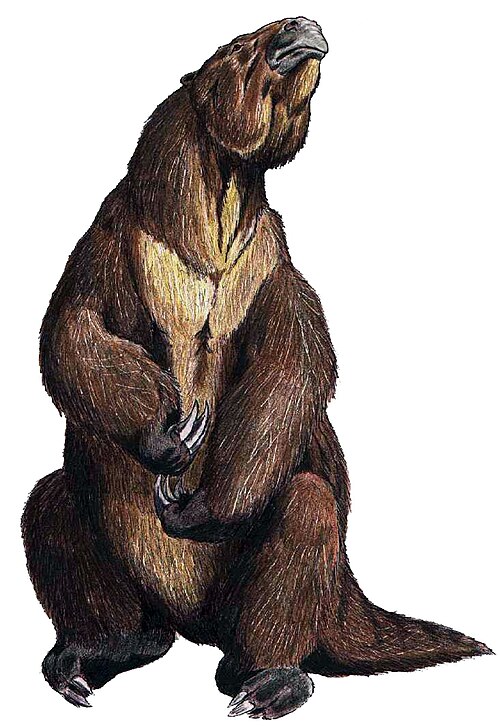
- كان أكبر حيوان معروف من فصيلة البيلوسان ، وكذلك أكبر حيوان كسلان، هو حيوان الميغاثيريوم لوريلاردي ، وهو كسلان أرضي قُدِّر وزنه مبدئيًا بنحو 6.55 طن (7.22 طن قصير) وطوله بنحو 6 أمتار (20 قدمًا) ، [ 288 ] وهو بحجم فيل الأدغال الأفريقي . مع ذلك، توصلت العديد من الدراسات إلى تقديرات أقل، حيث أشارت إحدى الدراسات إلى أن 4.49 طن (4.95 طن قصير) هو التقدير الأكثر دقة لحجم حيوان بالغ. [ 289 ] أما حيوان الميغاثيريوم أمريكانوم ، وهو كسلان أرضي وثيق الصلة به ، فكان أصغر حجمًا بقليل، إذ بلغ طوله 6 أمتار (20 قدمًا) ، [ 290 ] ووزنه 3.7 طن (4.1 طن قصير) استنادًا إلى النماذج الحجمية. [ 291 ]
- كان أكبر حيوان معروف من فصيلة الميلودونتويد هو Lestodon armatus ، والذي قُدِّر طوله بـ 15 قدمًا (4.6 مترًا) ، [ 292 ] ووزنه بـ 4100 كيلوغرام (9000 رطل) . [ 293 ]
- كان أكبر آكل نمل منقرض هو Neotamandua borealis ، والذي يقدر وزنه بين 10 و 100 كيلوغرام (22 و 220 رطلاً) . [ 294 ]
أسترابوثريا (أسترابوثيريا)
كان أكبر أنواع الأسترابوثيريوم هو هيلاركوثيريوم ميو ، بوزن يُقدّر بـ 6.4 طن (7.1 طن قصير) . [ 295 ] أما أنواع الأسترابوثيريوم الكبيرة الأخرى التي بلغ وزنها حوالي 3-4 أطنان (3.3-4.4 طن قصير) ، مثل جنس غراناسترابوثيريوم [ 296 ] وبعض أنواع باراسترابوثيريوم ( باراسترابوثيريوم مارتيال ). [ 297 ]
Litopterns (Litopterna)
كان أكبر حيوان معروف من فصيلة الليتوبترن هو ماكراوشينيا ، الذي كان يمتلك ثلاثة حوافر في كل قدم. وكان حيوانًا كبيرًا نسبيًا، حيث بلغ طول جسمه حوالي 3 أمتار (9.8 قدم) . [ 298 ]
النوتونغوليتات (Notoungulata)

أكبر حيوان من فصيلة النوتونغوليت معروف ببقاياه الكاملة هو التوكسودون . بلغ طول جسمه حوالي 2.7 متر (8 أقدام و10 بوصات) ، وارتفاعه عند الكتف حوالي 1.5 متر (4 أقدام و11 بوصة) ، وكان يشبه وحيد القرن الضخم. على الرغم من عدم اكتمالها، تشير الأحافير المحفوظة إلى أن الميكسوتوكسودون كان أضخم أفراد هذه المجموعة، بوزن يبلغ حوالي 3.8 طن (4.2 طن قصير) . [ 299 ]
البيروثرية (Pyrotheria)
كان حيوان البيروثيريوم أكبر الثدييات في رتبة البيروثيريا في أمريكا الجنوبية، حيث بلغ طوله 2.9-3.6 متر (9 أقدام و6 بوصات - 11 قدمًا و10 بوصات) ووزنه 1.8-3.5 طن (4000-7700 رطل) . [ 300 ]
الزواحف (الزواحف)
السحالي والثعابين (الحرشفيات)

- الموزاسورات هي أكبر الزواحف الحرشفية المعروفة . يُرجح أن يكون أكبر موزاسور معروف هو التيلوصور ريكس ، حيث بلغ طول أكبر عينة معروفة منه 13.2 مترًا (43 قدمًا) . [ 301 ] وهناك موزاسور عملاق آخر هو الموزاصور هوفماني ، الذي قُدِّر في الأصل أنه وصل إلى طول أكبر يبلغ 17 مترًا (56 قدمًا) . [ 302 ] [ 303 ] إلا أن هذه التقديرات تستند إلى نسبة طول الرأس إلى طول الجسم الكلي 1:10، وهي نسبة غير مرجحة بالنسبة للموزاصور ، ومن المرجح أن تكون هذه النسبة حوالي 1:7، وحجمًا أكثر تواضعًا يبلغ حوالي 12 مترًا (39 قدمًا) . [ 304 ] [ 305 ]
- أكبر ثعبان معروف من عصور ما قبل التاريخ هو تيتانوبوا سيريجونينسيس ، ويُقدّر طوله بـ 12.8 مترًا (42 قدمًا) أو حتى 14.3 مترًا (47 قدمًا) [ 306 ] ، ويتراوح وزنه بين 730 و1135 كيلوغرامًا (1609-2502 رطلًا) . [ 307 ] [ 308 ] ربما كان ثعبان فاسكي إنديكوس، من فصيلة المادتسويد، يُضاهي تيتانوبوا في الطول أو يتجاوزه ، إلا أن أبعاد فقراته كانت أصغر مقارنةً به. [ 309 ] ويُعدّ ثعبان باليوفيس كولوسايوس البحري ، من فصيلة الباليوفيد ، منافسًا قويًا لهذه الثعابين في الحجم، إذ يُقدّر طوله بحوالي 9 أمتار (30 قدمًا) [ 307 ] [ 310 ] [ 311 ] أو حتى 12.3 مترًا (40 قدمًا) . [ 312 ] من بين الثعابين الأحفورية الضخمة المعروفة الأخرى، ثعبان Gigantophis garstini ، الذي يُقدّر طوله بين 9.3 و10.7 متر (31-35 قدمًا) ، [ 313 ] [ 314 ] على الرغم من أن دراسة لاحقة تُشير إلى تقدير أصغر يتراوح بين 6.6 و7.2 متر (22-24 قدمًا) . ومع ذلك، أشار الباحثون إلى ضرورة التعامل مع هذا التقدير بحذر. [ 315 ] أما أكبر ثعبان أحفوري من نوع البايثون فهو Liasis dubudingala، ويبلغ طوله حوالي 9 أمتار (30 قدمًا) . [ 316 ] وأكبر أفعى سامة ، بالإضافة إلى كونها أكبر ثعبان سام تم تسجيله على الإطلاق، هو Laophis crotaloides من العصر البليوسيني المبكر في اليونان . وقد بلغ طول هذا الثعبان أكثر من 3 أمتار (9.8 قدمًا) ووزنه 26 كيلوغرامًا (57 رطلًا) . [ 317 ] [ 318 ] أفعى أحفورية ضخمة أخرى هي نوع غير محدد من جنس الأفاعي (Vipera ). يبلغ طولها حوالي مترين (6 أقدام و7 بوصات)، وكانت من أكبر المفترسات في مايوركا خلال العصر البليوسيني المبكر. [ 319 ] أكبر ثعبان أعمى معروف هو Boipeba tayasuensis بطول إجمالي يقدر بـ 1.1 متر (3 أقدام و7 بوصات) . [ 320 ]
- يُعتقد أن أكبر سحلية برية معروفة هي ميغالانيا ( Varanus priscus )، حيث تشير أحدث الدراسات إلى أن طولها كان حوالي 5.5 متر (18 قدمًا) . [ 321 ] وباعتبارها من أقاربها الأحياء، فمن المحتمل أن تكون ميغالانيا سامة، وفي هذه الحالة، كانت هذه السحلية أيضًا أكبر فقاري سام تطور على الإطلاق. [ 321 ] ومع ذلك، فإن الحجم الأقصى لهذا الحيوان لا يزال محل نقاش. [ 322 ]
السلاحف البرية والبحرية وأقاربها المقربين (Pantestudines)
كريبتوديرا
- كانت أكبر سلحفاة معروفة على الإطلاق هي سلحفاة أرتشيلون إيشيروس، بطول 5 أمتار (16 قدمًا) ووزن 2200 كيلوغرام (4900 رطل) . [ 323 ] ويُحتمل أن تكون سلحفاة بروتوستيغا ثاني أكبر سلحفاة بحرية، بطول 3.9 متر (13 قدمًا) . [ 324 ] [ 325 ] وهناك عينة أكبر من هذا الجنس من تكساس، يُقدر طولها الإجمالي بـ 4.2 متر (14 قدمًا) . [ 326 ] [ 324 ] ويُقدر طول سلحفاة كراتوشيلون، المعروفة جزئيًا، بـ 4 أمتار (13 قدمًا) . [ 327 ] وهناك سلحفاة بحرية ضخمة أخرى من عصور ما قبل التاريخ، وهي سلحفاة جيجانتاتيبوس التي عاشت في أواخر العصر الطباشيري، ويُقدر طولها بأكثر من 3.5 متر (11 قدمًا) . [ 328 ] بلغ طول جسم سمكة Psephophorus terrypratchetti من العصر الإيوسيني 2.3-2.5 متر (7.5-8.2 قدم) . [ 329 ]
- كانت أكبر السلاحف هي ميغالوشيلس أطلس، حيث بلغ طول درعها مترين (6.6 قدم) [ 330 ] ووزنها 0.8-1.0 طن (1800-2200 رطل) . [ 154 ] أما ميغالوشيلس مارغاي، فكان طول درعها 1.4-2 متر (4.6-6.6 قدم) ؛ ووصل طول درع نوع غير مُسمى من جاوة إلى 1.75 متر (5.7 قدم) على الأقل . [ 331 ] كما كانت سلاحف تيتانوشيلون في العصر السينوزوي أكبر من السلاحف العملاقة الموجودة حاليًا ، حيث بلغ طول درعها مترين (6 أقدام و7 بوصات) . [ 332 ] [ 333 ] تشمل أنواع السلاحف العملاقة الأخرى Centrochelys marocana التي يتراوح طول درعها بين 1.8 و2 متر (5.9-6.6 قدم) ، وMesoamerican Hesperotestudo sp. التي يبلغ طول درعها 1.5 متر (4.9 قدم) . [ 331 ]
- أكبر درع ثلاثي الأرجل تم تسجيله على الإطلاق هو العينة غير المحددة GSP-UM 3019 من العصر الإيوسيني الأوسط في باكستان . يبلغ طول الدرع العظمي لهذه العينة 120 سم (3.9 قدم) وعرضه 110 سم (3.6 قدم)، مما يشير إلى أن القطر الكلي للدرع (مع الحافة الرخوة) يبلغ حوالي مترين (6.6 قدم) . [ 334 ] أما درع Drazinderetes tethyensis من نفس التكوين، فكان طوله العظمي 80 سم (2.6 قدم) وعرضه 70 سم (2.3 قدم) . [ 334 ] ومن أنواع الدرع ثلاثي الأرجل الضخمة الأخرى، درع Axestemys byssinus من أمريكا الشمالية، الذي يزيد طوله الكلي عن مترين (6.6 قدم) . [ 335 ]
السلاحف ذات الرقبة الجانبية (Pleurodira)

كانت سلحفاة ستوبنديميس ، وهي من فصيلة بودوكنيميد ، أكبر سلحفاة مياه عذبة على الإطلاق ، حيث بلغ طول درعها المقدر 2.86 متر (9 أقدام و5 بوصات) ووزنها 1145 كيلوغرامًا (2524 رطلًا) . [ 336 ] أما سلحفاة كاربونيميس كوفرييني، من نفس الفصيلة، فكان طول درعها حوالي 1.72 متر (5 أقدام و8 بوصات) ، [ 337 ] [ 338 ] [ 339 ] وقُدِّر طول درعها الكامل بـ 1.8 متر (5.9 قدم) . [ 340 ]
عائلة الماكروبينيدات (Macrobaenidae)
كانت أكبر أنواع الماكروبينيدات هي ياكيميس من العصر الطباشيري المبكر ، وأناتولميس من العصر الطباشيري المتأخر ، وجوديثيميس وكاربونيميس من العصر الباليوسيني . وقد بلغ طول درع كل منها 70 سم (2.3 قدم) . [ 341 ]
Meiolaniformes

كانت أكبر أنواع الميولانيات هي الميولانيا . بلغ طول درع الميولانيا بلاتيسيبس 100 سم (3.3 قدم) [ 331 ] ، وربما وصل طول جسمها الكلي إلى أكثر من 3 أمتار (9.8 قدم) [ 342 ] . وكان نوعٌ آخر غير مُسمى من العصر البليستوسيني المتأخر في كوينزلاند أكبر حجمًا، حيث بلغ طول درعه 200 سم (6.6 قدم) [ 331 ]. ووصل طول درع نينجميس أويني إلى 100 سم (3.3 قدم) [ 331 ] ، ووزنه إلى 200 كجم (440 رطل) [ 343 ] .
الزواحف (Sauropterygia)
البلاكودونتيات والأقارب المقربين (Placodontiformes)
كان البلاكودوس من بين أكبر البلاكودونتات ، حيث بلغ طوله 3 أمتار (9.8 قدم) . [ 344 ]
النوثوصورات والأقارب المقربين (نوثوصورويديا)
كان أكبر أنواع النوثوصور، وكذلك أكبر أنواع الزواحف البحرية في العصر الترياسي، هو النوثوصور العملاق (Nothosaurus giganteus ) بطول 7 أمتار (23 قدمًا) . [ 345 ]
البليزوصورات (بليزوصوريا)
- كان أكبر بليزوصورات معروف عينة غير محددة النوع، يُحتمل أنها تنتمي إلى جنس أريستونكتس (تم تحديدها على أنها من جنس أريستونكتس )، بطول جسم يتراوح بين 11 و11.9 مترًا (36-39 قدمًا) وكتلة جسم تتراوح بين 10.7 و13.5 طنًا متريًا (11.8-14.9 طنًا أمريكيًا) . [ 346 ] ومن البليزوصورات الطويلة الأخرى ألبرتونكتس، بطول يتراوح بين 11.2 و11.6 مترًا (37-38 قدمًا) . [ 347 ] ونافسه في الحجم ثالاسوميدون ، بطول يتراوح بين 10.86 و11.6 مترًا (35.6-38.1 قدمًا) . [ 348 ] ومن البليزوصورات الكبيرة الأخرى ستيكسوصور وإيلاسوموصور ، حيث بلغ طول كل منهما أكثر من 10 أمتار (33 قدمًا) . [ 349 ] [ 350 ] بلغ طول جسم الهيدرالومصور (الذي كان يُعتبر سابقًا مرادفًا للإيلاسوموصور والستيكسوصور ) 9.44 مترًا (31.0 قدمًا) . [ 350 ] في الماضي، كان يُعتقد أن طول الماويصور يزيد عن 8 أمتار (26 قدمًا) ، [ 351 ] [ 350 ] ولكن تم تحديده لاحقًا على أنه اسم مشكوك فيه . [ 352 ]
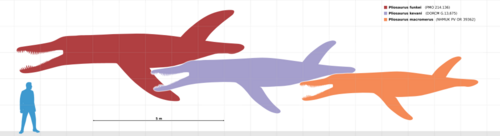
- هناك جدل واسع حول أكبر أنواع البليوصورات المعروفة . يُعرف البليوصور فونكي (المعروف أيضًا باسم " المفترس إكس ") بأنه نوع من البليوصورات الضخمة، وقد عُثر على بقاياه في النرويج عام 2008. قُدّر طول هذا البليوصور بما بين 10 و13 مترًا (33-43 قدمًا) . [ 353 ] مع ذلك، في عام 2002، اكتشف فريق من علماء الحفريات في المكسيك بقايا بليوصور أُطلق عليه اسم " وحش أرامبيري "، والذي قُدّر طوله أيضًا بما بين 15 مترًا (49 قدمًا) ، [ 354 ] مع تقدير أقل يبلغ حوالي 11.5 مترًا (38 قدمًا) . [ 355 ] يُزعم أن هذا النوع كان صغيرًا في السن، وأنه تعرض لهجوم من بليوصور أكبر حجمًا. [ 356 ] زعمت بعض المصادر الإعلامية أن وحش أرامبيري كان من فصيلة ليوبليورودون، لكن لم يتم تأكيد نوعه حتى الآن. [ 354 ] ومن بين البليوصورات الضخمة الأخرى، بليوصور ماكروميروس ، المعروف من فك سفلي واحد غير مكتمل يبلغ طوله 2.8 متر (9.2 قدم) . [ 357 ] يُقدّر طول كرونوصور كوينزلانديكوس، الذي عاش في العصر الطباشيري المبكر، بين 9 و10.9 متر ( 30-36 قدمًا) ، ووزنه بين 10.6 و12.1 طن (11.7-13.3 طن قصير) . [ 358 ] [ 355 ] أما ميغالنيوصور ريكس، الذي عاش في أواخر العصر الجوراسي، فقد بلغ طوله ما بين 7.6 و9.1 متر (25-30 قدمًا) . [ 359 ] [ 360 ] كان المنافس الأقرب من حيث الحجم هو ميغاسيفالوصوروس يوليرتي الذي عاش في أواخر العصر الطباشيري، والذي يتراوح طوله بين 6 و9 أمتار (20-30 قدمًا) . [ 361 ]
بروتيروسوكيدا (Proterosuchidae)
يُعدّ Proterosuchus fergusi أكبر أنواع البروتيروسوكيات المعروفة ، حيث يبلغ طول جمجمته 47.7 سم (18.8 بوصة) وطول جسمه المحتمل 3.5-4 أمتار (11-13 قدمًا) . [ 362 ]
الإريثروسوكيات (Erythrosuchidae)

كان أكبر أنواع الإريثروسوكيد هو إريثروسوكس أفريكانوس بطول أقصى يتراوح بين 4.75 و 5 أمتار (15.6-16.4 قدم) . [ 363 ]
الفيتوصورات (Phytosauria)
تشمل بعض أكبر الفيتوصورات المعروفة ريدونداصور بطول 6.4 متر (21 قدمًا) [ 364 ] وسميلوسوكوس بطول يزيد عن 7 أمتار (23 قدمًا) . [ 365 ]
الزواحف الزائفة غير التمساحية (Pseudosuchia)

- كان سيلوسوكس أكبر أنواع الشوفوصوريات وأحد أكبر أنواع الزواحف الشبيهة بالتماسيح من العصر الترياسي . وقد يصل طول أكبر العينات إلى 9-10 أمتار (30-33 قدمًا) . [ 366 ] [ 367 ]
- يُعدّ لوريكاتان فاسولاسوكس تيناكس (Fasolasuchus tenax ) أكبر أنواع الزواحف اللاحمة المعروفة من العصر الترياسي ، حيث قُدّر طوله بما بين 8 و10 أمتار (26 إلى 33 قدمًا) . [ 366 ] [ 367 ] [ 368 ] وهو أكبر أنواع " الرويسوكيان " المعروفة علميًا، وأكبر مفترس بري غير ديناصوري تم اكتشافه على الإطلاق. بلغ طول أكبر أفراد بوستوسوكس [ 369 ] وسوروسوكس [ 370 ] حوالي 7 أمتار (23 قدمًا) . وتشير عينة من بريستوسوكس (Prestosuchus) تم اكتشافها عام 2010 إلى أن هذا الحيوان وصل أيضًا إلى طول يقارب 7 أمتار (23 قدمًا)، مما يجعله أحد أكبر الزواحف الترياسية. [ 371 ]
- كان ديسماتوسوكس على الأرجح أحد أكبر أنواع الأيتوصورات المعروفة ،حيث بلغ طوله حوالي 4-6 أمتار (13-20 قدمًا) ووزنه 280 كيلوغرامًا (620 رطلًا) . [ 372 ] [ 373 ] [ 374 ]
التماسيح وأقاربها المقربين (كروكوديلومورفا)
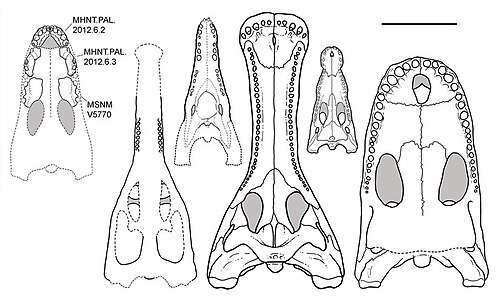
عائلة الأيجيبتوسوخيدات (Aegyptosuchidae)
قُدِّر طول إيجيسوكس، الذي عاش في أواخر العصر الطباشيري، في الأصل بنحو 15 مترًا ( 49 قدمًا ) وفقًا للتقدير الأدنى، و 22 مترًا (72 قدمًا) وفقًا للتقدير الأعلى، مع العلم أن طولًا يزيد عن 15 مترًا يُعد على الأرجح مبالغة كبيرة. [ 375 ] ومع ذلك، يُرجَّح أن يكون هذا التقدير ناتجًا عن خطأ في الحساب، وأن طوله الحقيقي لا يتجاوز 3.9 مترًا (13 قدمًا) . [ 376 ]
التماسيح (كروكوديليا)
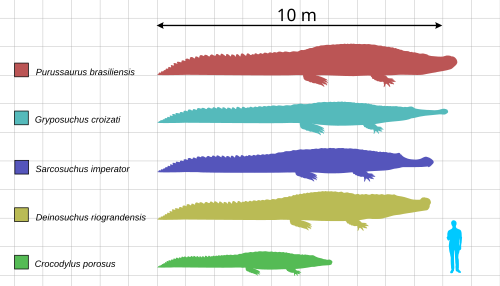
- كان أكبر أنواع التماسيح ، وربما أحد أكبر التماسيح على الإطلاق، هو بوروسورس برازيليينسيس، الذي قُدِّر طوله بـ 11-13 مترًا (36-43 قدمًا) . [ 377 ] ووفقًا لمعلومات أخرى، بلغ أقصى تقدير لطوله 11.4 مترًا (37 قدمًا) ووزنه حوالي 7.8 طن (8.6 طن قصير) . [ 378 ] مع ذلك، قدّرت دراسة أجريت عام 2022 طوله بـ 7.6-9.2 مترًا (25-30 قدمًا) وكتلته بـ 2-6.2 طن متري (2.2-6.8 طن قصير) باستخدام منهجية التطور السلالي؛ وطوله بـ 9.2-10 أمتار (30-33 قدمًا) وكتلته بـ 3.9-4.9 طن متري (4.3-5.4 طن قصير) باستخدام منهجية غير تطورية. [ 379 ]
- كان موراسوكوس نوعًا آخر من التماسيح العملاقة . تشير تقديرات مختلفة إلى أن أكبر العينات وصلت إلى طول 9.47 متر (31.1 قدم) ووزن 8.5 طن (9.4 طن قصير) . [ 380 ] لكن تقديرات أحدث تشير إلى أن طول الجسم يتراوح بين 4.7 و5.98 متر (15.4-19.6 قدم) . [ 379 ]
- يُرجّح أن يكون أكبر أنواع التمساحيات هو Deinosuchus riograndensis و Deinosuchus hatcheri ، إذ يبلغ طول كل منهما 12 مترًا (39 قدمًا) ووزنه 8.5 طن (9.4 طن قصير) . [ 381 ] [ 382 ] مع ذلك، أشارت دراسة أُجريت عام 2025، والتي أعادت تصنيف Deinosuchus ضمن التمساحيات الحقيقية، إلى أن التقديرات السابقة ربما بالغت في تقدير حجمه نظرًا لامتلاك هذا الجنس خطمًا طويلًا نسبيًا، إلا أن هذه التقديرات استندت إلى أنواع ذات خطم أقصر (مثل التمساح الأمريكي). وقدّر الباحثون أن طول D. riograndensis الإجمالي قد يصل على الأرجح إلى 10.5 متر (34 قدمًا) . [ 383 ]
- كان أكبر أنواع التمساح المنقرضة من جنس التمساح هو تمساح هايل ( Alligator hailensis )، الذي بلغ طول جمجمته 52.5 سم (20.7 بوصة)، وكان حجمه مشابهاً لحجم التمساح الأمريكي الموجود حالياً ( Alligator mississippiensis ). [ 384 ]
- كانت أكبر أنواع الغافياليدات هي رامفوسوكس كراسيدنز الآسيوي ، الذي يُقدّر طوله بـ 8-11 مترًا (26-36 قدمًا) [ 385 ] [ 386 ] [ 378 ] ، وغريبوسوكس من أمريكا الجنوبية، الذي بلغ طوله 10.15 مترًا (33.3 قدمًا) [ 387 ] [ 386 ].
- كان التمساح القاعدي أستورغوسوكوس بوغتينسيس، الذي عاش في العصر الأوليغوسيني، ضخمًا. وقُدِّر طوله بـ 8 أمتار (26 قدمًا) . [ 386 ]
- كان أكبر تمساح حقيقي معروف هو تمساح Euthecodon، الذي قُدِّر طوله بين 6.4 و8.6 متر (21-28 قدمًا)، أو حتى 10 أمتار (33 قدمًا) . [ 388 ] [ 378 ] أما أكبر أنواع التمساح الحديث (Crocodylus) فكانت Crocodylus thorbjarnarsoni الكيني بطول 7.56 متر (24.8 قدمًا) ، [ 389 ] [ 378 ] وCrocodylus anthropophagus التنزاني بطول 7.5 متر (25 قدمًا) ، [ 390 ] [ 391 ] ونوع غير محدد من كالي جيديه ( جاوة ) بطول 6-7 أمتار (20-23 قدمًا) . [ 392 ]
- أكبر أنواع الميكوسوخيات المعروفة هو بالوديركس فينسينتي ، الذي يُقدّر طوله بنحو 5 أمتار (16 قدمًا) . [ 393 ] [ 394 ] [ 395 ] تشير عينة جزئية من الفك من العصر البليوسيني، تُنسب إلى كوينكانا، إلى فرد يبلغ طوله حوالي 6-7 أمتار (20-23 قدمًا) ، [ 395 ] على الرغم من أن الأنواع الأخرى (المعروفة من العصر الأوليغوسيني إلى العصر البليستوسيني ) أصغر حجمًا، حيث يتراوح طولها بين 1.5 و3 أمتار (4 أقدام و11 بوصة - 9 أقدام و10 بوصات) . [ 396 ] [ 397 ] [ 398 ]
عائلة Paralligatoridae (Paralligatoridae)
من المرجح أن أكبر أنواع الباراليجاتوريد كان كانساجسوكس ، الذي يقدر طوله بما يصل إلى 8 أمتار (26 قدمًا) . [ 399 ]
التيثيسوكيين (Tethysuchia)
- وصلت بعض أنواع الفوليدوصورات المنقرضة إلى أحجام عملاقة. في الماضي، كان يُعتقد أن ساركوسوكس إمبيراتور هو أكبر التماسيح، حيث أشارت التقديرات الأولية إلى طول يبلغ 12 مترًا (39 قدمًا) ووزن 8 أطنان (8.8 طن قصير) . [ 400 ] ومع ذلك، انخفضت التقديرات الحديثة إلى طول يتراوح بين 9 و9.5 مترًا (29.5 إلى 31.2 قدمًا) ووزن يتراوح بين 3.5 و4.3 أطنان مترية (3.9 إلى 4.7 طن قصير) . [ 401 ] ومن المحتمل أن يكون تشالاوان تايلانديكوس ، وهو نوع قريب من ساركوسوكس ، قد وصل طوله إلى أكثر من 10 أمتار (33 قدمًا) ، [ 402 ] على الرغم من أن تقديرات أخرى تشير إلى طول يتراوح بين 7 و8 أمتار (23 إلى 26 قدمًا) . [ 386 ]
- كان أكبر ديناصور من فصيلة الديروسوريات هو فوسفاتوصوروس جافيالويدس ، الذي قُدِّر طوله بـ 9 أمتار (30 قدمًا) . [ 403 ] [ 386 ]
ستوماتوسوشيدا (Stomatosuchidae)
قُدِّرطول ستوماتوسوكس ، وهو من فصيلة ستوماتوسوكيد ، بـ 10 أمتار (33 قدمًا) . [ 404 ]
النوتوسوكيين (نوتوسوشيا)
- من بين أكبر التماسيح الأرضية من فصيلة نوتوسوكيان، كان هناك تمساح باريناسوكس من العصر الميوسيني ، ذو جمجمة يتراوح طولها بين 95 و110 سم (37-43 بوصة) ، وتمساح دينتانوسوكس من العصر الإيوسيني ، ذو فك سفلي يُقدّر طوله بمتر واحد (3.3 قدم) . [ 405 ] [ 406 ] تشير تقديرات مختلفة إلى أن طول هذه الحيوانات يتراوح بين 3 و10 أمتار (9.8-32.8 قدم) . وباستخدام نسبة من تمساح ستراتيوتوسوكس، الذي يُعدّ كبيرًا أيضًا بجمجمة طولها 47 سم (19 بوصة) ، [ 407 ] يُقدّر طول باريناسوكس بما لا يقل عن 6.3 متر (21 قدمًا) . [ 405 ] [ 406 ]
- ومن بين أنواع النوتوسوخيات الضخمة الأخرى، على الرغم من أنها معروفة فقط من خلال بقايا مجزأة، إلا أن هناك نوعًا مبكرًا يُدعى رازاناندرونغوب ، والذي قد يتجاوز حجم جمجمته حجم جمجمة باريناسوكس ، وقد يصل طوله الإجمالي إلى حوالي 7 أمتار (23 قدمًا) . [ 408 ] [ 409 ]
الثالاتوسوكيين (Thalattosuchia)

- يُعرف أكبر أنواع الثالاتوسوكيان، بالإضافة إلى أكبر أنواع التيلوصورويد، من بقايا أحفورية غير مُسماة من تكوين باجا ، والتي قد تعود إلى حيوان يبلغ طوله 9.6 متر (31 قدمًا) ، [ 410 ] وهو حجم يُقارب التقديرات القديمة لطول الماكيموسورس ريكس من العصر الطباشيري المبكر ، والذي قُدِّر طوله مؤخرًا بـ 7.15 متر (23.5 قدمًا) . [ 411 ] أما النيوستينوسورس إدواردسي (المعروف سابقًا باسم ستينوسورس إدواردسي [ 412 ] ) فكان أكبر تماسيح العصر الجوراسي الأوسط ، حيث بلغ طوله 6.6 متر (22 قدمًا) . [ 411 ]
- كان البليزيوسوكس من الميتريورينكيدات الضخمة جدًا. إذ بلغ طوله 6.83 مترًا (22.4 قدمًا) ، متجاوزًا بذلك بعض البليوصورات التي عاشت في نفس الحقبة والموقع، مثل الليوبلورودون . [ 413 ] ومن الميتريورينكيدات الضخمة الأخرى التي عُثر عليهاتيرانونوستس بطول 5 أمتار ( 16 قدمًا) [ 414 ] وتورفونوستسبطول 4.7 متر (15 قدمًا) . [ 415 ]
التماسيح القاعدية
كان ريدوندافيناتور أكبر تم تسجيله على الإطلاق من التماسيح التي عاشت في العصر الترياسي ، [ 416 ] بجمجمة لا يقلطولها عن 60 سم (2.0 قدم) . [ 417 ] [ 418 ] ومن التماسيح القاعدية الضخمة الأخرى كارنوفكس [ 416 ] الذي بلغ طوله 3 أمتار (9.8 قدم) على الرغم من أنه لا يزال في طور النمو. [ 419 ]
التيروصورات (بتيروصوريا)

- كان أكبر تيروصور معروف هو كيتزالكواتلوس نورثروبي ، بوزن 127 كيلوغرامًا (280 رطلًا) وامتداد جناحين يتراوح بين 10 و12 مترًا (33-39 قدمًا) . [ 420 ] ويُعد هاتزيغوبتريكس منافسًا قويًا آخر ، إذ بلغ امتداد جناحيه 12 مترًا (39 قدمًا) أو أكثر. [ 420 ] ويستند هذا التقدير إلى جمجمة طولها 3 أمتار (9.8 قدمًا) . [ 421 ] ومن بين المنافسين المحتملين الآخرين على هذا اللقب، كريودراكون الذي بلغ امتداد جناحيه 10 أمتار (33 قدمًا) . [ 422 ] وقد يصل امتداد جناحي تيروصور من نوع بتيروداكتيلويد، لم يُسمَّ بعد، من تكوين نيميغت، إلى ما يقرب من 10 أمتار (33 قدمًا) . [ 423 ] [ 424 ] وفقًا لعدة افتراضات، تراوح طول جناحي فراشة أرامبورجيانيا فيلادلفيا بين 8 أمتار (26 قدمًا) وأكثر من 10 أمتار (33 قدمًا) . [ 423 ] [ 422 ] وبلغ أقصى طول جناحي فراشة تروبيوغناثوس في أمريكا الجنوبية 8.7 متر (29 قدمًا) . [ 425 ] [ 426 ]
- كان ديارك أكبر أنواع التيروصورات غير البتروداكتيلويدية ، وأكبر تيروصورات العصر الجوراسي [ 427 ] ، حيث قُدِّر طول جناحيه بين 2.2 متر (7 أقدام و3 بوصات) و 3.8 متر (12 قدمًا) [ 428 ] . لم يكن هناك سوى عينة مجزأة من الرامفورينكيد من ألمانيا أكبر منه (184% من حجم أكبر أنواع الرامفورينكوس ) [ 429 ] . ومن التيروصورات الكبيرة الأخرى غير البتروداكتيلويدية: سيريسيبتيروس ، وكامبيلوغناثويدس ، وهارباكتوغناثوس ، حيث بلغ طول جناحيها 1.73 متر (5 أقدام و8 بوصات) [ 430 ] ، و1.75 متر (5 أقدام و 9 بوصات) [ 430 ] ، و 2.5 متر (8 أقدام وبوصتين ) [ 429 ] على التوالي.
Choristoderes (Choristodera)
يُقدّر أن أكبر أنواع الكوريستوديرا المعروفة ، Kosmodraco dakotensis (المعروف سابقًا باسم Simoedosaurus dakotensis [ 431 ] )، كان يبلغ طوله الإجمالي حوالي 5 أمتار (16 قدمًا) . [ 432 ] [ 431 ]
عائلة التانيستروفيديات (Tanystropheidae)

وصل طول تانستروفوس ، وهو أكبر أنواع التانستروفيدات ، إلى 5 أمتار (16 قدمًا) . [ 433 ]
الثالاتوسورات (Thalattosauria)
بلغ طول أكبر أنواع الثالاسوصورات ، ميودينتوصور بريفيس، أكثر من 4 أمتار (13 قدمًا) . [ 434 ] أما ثاني أكبر أفراد هذه المجموعة فهو كونكافيسبينا، الذي بلغ طوله 3.64 متر (11.9 قدمًا) . [ 435 ]
الإكثيوصورات (الإكثيوصوريا)
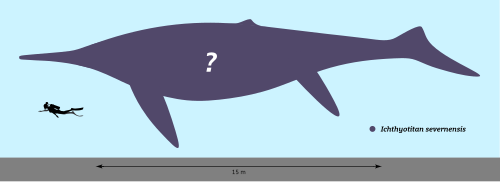
- كان الإكثيوتيتان أكبر أنواع الشاستاصورات والإكثيوصورات والزواحف البحرية المعروفة ، ويُقدّر طوله بنحو 25 مترًا (82 قدمًا) . أما عينة أوست (المعروفة أيضًا باسم أوست كولوسوس ) فقد بلغ طولها أكثر من 30 مترًا (98 قدمًا) . [ 436 ] وهناك شاستاصور ضخم آخر هو شاستاصور سيكانينسيس، الذي بلغ طوله 21 مترًا (69 قدمًا) [ 437 ] [ 438 ] ووزنه 81.5 طنًا (180,000 رطل) . [ 439 ] وكان شونيصور بوبولاريس إكثيوصورًا ضخمًا آخر، إذ بلغ طوله 15 مترًا (49 قدمًا) ووزنه 29.7 طنًا (65,000 رطل) . [ 438 ]
- كان أكبر أنواع الإكثيوصورات من عائلة السيمبوسبونديليداي ، فضلاً عن كونه أكبر حيوان في العصر الترياسي الأوسط، هو السيمبوسبونديلوس يونغوروم، حيث بلغ طوله 17.65 مترًا (57.9 قدمًا) [ 439 ] ووزنه 44.7 طنًا (99000 رطل) . [ 439 ]
- على الرغم من أن حجم Thalattoarchon saurophagis أصغر بكثير من Cymbospondylus youngorum ، إلا أنه كبير الحجم نسبياً، حيث يبلغ طوله 8.6 متر (28 قدم) ووزنه حوالي 4.3 طن (9500 رطل) ، ويبلغ طول جمجمته 1.2 متر (3.9 قدم) . [ 440 ]
البارياسورات (Pareiasauria)
بلغ طول أكبر البارياسورات 3 أمتار (9.8 قدم) . ومن بين هذه الأحجام ، براديصور وإمبريثوصور ونوتشيليصور من العصر البرمي الأوسط في جنوب إفريقيا ، [ 441 ] وسكوتوصور من العصر البرمي المتأخر في روسيا . [ 441 ] وبلغ وزن أقوى أنواع السكوتوصور 1.16 طن (2600 رطل) . [ 441 ]
عائلة كابتورينيد (Captorhinidae)
يُعدّ موراديسورس غرانديس ، ذو البنية الضخمة ، بطول مترين (6 أقدام و7 بوصات) ، [ 442 ] أكبر أنواع الكابتورينيد المعروفة . [ 443 ] أما ثاني أكبر أنواع الكابتورينيد فهو لابيدوسوريكوس، الذي بلغ طول أكبر جمجمة بالغة لديه 28 سم (11 بوصة) . [ 444 ]
الديناصورات غير الطائرة (الديناصورات)
السوروبودومورفات (Sauropodomorpha)
كان الإيوسكيلوسورس أكبر أنواع السوروبودومورف غير السوروبودية (" البروسوروبود ") . بلغ طوله 12.2 مترًا (40 قدمًا) ووزنه طنينين (2.2 طن قصير). [ 445 ] كما بلغ طول السوروبودومورف الضخم الآخر ، يونانوسورس يونغي، 13 مترًا (43 قدمًا) . [ 446 ]
السوروبودات (Sauropoda)
- يُعدّ ديناصور مارابونيسورس فراجيليموس (المعروف سابقًا باسم أمفيكولياس فراجيليموس )، وهو من فصيلة الصوروبودات الضخمة ، أحد أكبر الديناصورات المعروفة في التاريخ. قُدّر طوله الأقصى بين 58 و60 مترًا (190-197 قدمًا) ووزنه بين 122,400 كيلوغرام (269,800 رطل) . [ 447 ] وللأسف، فُقدت بقايا هذا الديناصور الأحفورية. [ 447 ] وفي الآونة الأخيرة، قُدّر طوله بين 35 و40 مترًا (115-131 قدمًا) ووزنه بين 80 و120 طنًا (180,000-260,000 رطل) . [ 448 ]
- عُرف ديناصور Bruhathkayosaurus matleyi، الذي عاش في أواخر العصر الطباشيري ، من بقايا غير مكتملة ومتفتتة، وكان ديناصورًا ضخمًا بشكل غير عادي من فصيلة الصوروبودات . [ 449 ] أشارت تقديرات غير رسمية إلى أبعاد هائلة، حيث بلغ طوله 45 مترًا (148 قدمًا) ووزنه ما بين 139 و220 طنًا (306,000 و 485,000 رطل) . [ 450 ] مع ذلك، تشير بعض التقديرات إلى أن طوله كان 37 مترًا (121 قدمًا) ووزنه 95 طنًا (209,000 رطل) ، ولكنه لا يزال أثقل بكثير من معظم الصوروبودات الأخرى. [ 450 ] وقد حددت تقديرات أحدث أجراها غريغوري بول في عام 2023 نطاق وزنه بين 110 أطنان (240,000 رطل) و 170 طنًا (370,000 رطل) . إذا صح ذلك، فسيكون بروهاتكايوصور أكبر حيوان بري مشى على الأرض، وكان سينافس أكبر حوت أزرق مسجل. [ 451 ]
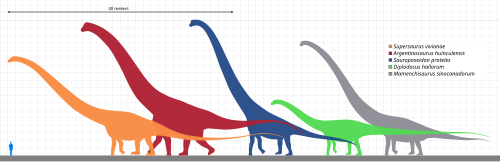
- قد تنتمي الفقرة العنقية الضخمة BYU 9024، التي عُثر عليها في ولاية يوتا ، [ 452 ] إلى ديناصور من نوع باروصور لينتوس [ 453 ] [ 454 ] أو سوبرصور فيفيانا [ 455 ] ، وهو ديناصور ضخم الحجم، ربما يتراوح طوله بين 45 و48 مترًا (148-157 قدمًا) وكتلته بين 60 و66 طنًا (132,000-146,000 رطل) . [ 453 ] [ 456 ] وقد يكون سوبرصور فيفيانا نفسه أطول ديناصور تم اكتشافه حتى الآن، حيث أشارت دراسة أجريت على 3 عينات إلى أن طوله قد يصل إلى 39 مترًا (128 قدمًا) أو أكثر من 40 مترًا (130 قدمًا) . [ 455 ]

- كان مامينشيسورس سينوكانادوروم على الأرجح أكبر أنواع المامينشيسوريد ، إذ بلغ طولهحوالي 35 مترًا (115 قدمًا) ووزنه 60-80 طنًا (130,000-180,000 رطل) . [ 448 ] أما شينجيانغتيتان شانشانيسيس، من نفس العائلة، فكان له رقبة طولها 15 مترًا (49 قدمًا) ، أي ما يقارب 55% من طوله الإجمالي الذي قد يصل إلى 27 مترًا (89 قدمًا) على الأقل . [ 457 ]
- ذُكر ديناصور بريفيباروبوس تاجبالوتينسيس، الذي عاش في العصر الجوراسي الأوسط، في موسوعة غينيس للأرقام القياسية كأطول ديناصور بطول 48 مترًا (157 قدمًا)، على الرغم من أن هذا الحيوان معروف فقط من خلال آثار أقدامه الأحفورية . [ 458 ] [ 459 ] كان يُعتقد في البداية أنه من فصيلة البراكيوصورات ، ولكن تم تحديده لاحقًا على أنه من فصيلة الدبلودوكويدات الضخمة ، ربما بلغ طوله 33.5 مترًا (110 أقدام) ووزنه 62 طنًا (137,000 رطل) . [ 460 ]
- كان أطول ديناصور من فصيلة الصوروبودات هو سوروبوسيدون بروتيلس، الذي قُدِّر ارتفاعه بين 16.5 و18 مترًا (54-59 قدمًا) . [ 461 ] [ 462 ] [ 463 ] ويمكن أن يصل ارتفاع أسياتوسورس إلى 17.5 مترًا (57 قدمًا) ، ولكن لا يُعرف عنه سوى أسنانه. [ 461 ] وقُدِّر ارتفاع جيرافتيتان بـ 16 مترًا (52 قدمًا) . [ 464 ]

تشمل أنواع الصوروبودات الضخمة الأخرى الأرجنتينوصور ، والألاموصور ، والبويرتاصور، والتي قُدِّر طولها بـ 30-33 مترًا (98-108 قدمًا) ووزنها بـ 50-80 طنًا (55-88 طنًا قصيرًا) . [ 465 ] وقُدِّر طول الباتاغوتيتان بـ 37 مترًا (121 قدمًا) [ 466 ] ووزنه بمتوسط 57 طنًا (63 طنًا قصيرًا) ، [ 467 ] وكان حجمه مشابهًا لحجم الأرجنتينوصور والبويرتاصور . [ 468 ] وربما كانت الصوروبودات العملاقة الأخرى، مثل السوبرصور ، والسوروبوسيدون ، والدبلودوكس ، تضاهيها في الطول، ولكن ليس في الوزن. [ 447 ] قُدِّر وزن ديناصور دريدنوتوس بـ 49 طنًا (108,000 رطل) [ 467 ] وطوله بـ 26 مترًا (85 قدمًا) ، ولكن كان الهيكل الأكثر اكتمالًا غير ناضج عند نفوقه. [ 469 ] يُعتبر ديناصور تورياصور أكبر ديناصور من أوروبا، [ 470 ] [ 471 ] بطول مُقدَّر بـ 30 مترًا (98 قدمًا) ووزن 50 طنًا (55 طنًا قصيرًا) . [ 465 ] [ 471 ] مع ذلك، فإن التقديرات الأقل، بطول 21 مترًا (69 قدمًا) ووزن 30 طنًا (66,000 رطل)، تجعله أصغر من ديناصور لوسوتيتان البرتغالي ، الذي بلغ طوله 24 مترًا (79 قدمًا) ووزنه 34 طنًا (75,000 رطل) . [ 472 ]
لا تزال العديد من الديناصورات الضخمة من فصيلة الصوروبودات بلا أسماء، وقد تنافس حاملي الأرقام القياسية الحاليين:
- " رئيس الأساقفة "، وهو براكيوصور ضخم تم اكتشافه عام 1930. اعتبارًا من أكتوبر 2023لا تزال الورقة العلمية المتعلقة بالعينة قيد الإعداد. [ 473 ]
- يُعدّ براكيوصور نوغاريدي نوعًا آخر من البراكيوصورات الضخمة التي عاشت في شمال أفريقيا خلال العصر الطباشيري المبكر. فُقدت بقاياه، لكن بقي رسمٌ لعظم العجز. ويشير هذا الرسم إلى أنطول عظم العجز يبلغ حوالي 1.3 متر (4.3 قدم) ، [ 474 ] مما يجعله أكبر عظم عجز لديناصور تم اكتشافه حتى الآن، باستثناء عظمي العجز لدى الأرجنتينوصور والأباتوصور. [ 475 ]
- في عام 2010، تم اكتشاف عظم فخذ ديناصور ضخم من فصيلة الصوروبود في فرنسا. يشير عظم الفخذ إلى حيوان كان ينمو إلى أحجام هائلة. [ 476 ]
الثيروبودات غير الطائرة (ثيروبودا)

- أكبر ديناصور ثيروبود فردي ، وأكبر مفترس بري فردي معروف حتى الآن، هو عينة من التيرانوصور ركس تُلقب بـ"سكوتي" (RSM P2523.8)، موجودة في متحف ساسكاتشوان الملكي، ويُقال إن طولها يبلغ 13 مترًا (43 قدمًا). وباستخدام تقنية تقدير الكتلة التي تعتمد على استقراء محيط عظم الفخذ، قُدِّر وزن "سكوتي" بأنه أكبر عينة معروفة، حيث بلغ 8.87 طن متري (9.78 طن أمريكي) [ 477 ] .
- من بين الديناصورات اللاحمة الكبيرة الأخرى ذات الحجم المماثل، كان هناك جيجانوتوصور كاروليني وسبينوصور إيجيبتياكوس ، حيث قُدِّر طول أكبر عيناتهما المعروفة بـ 13.2 مترًا (43 قدمًا) [ 478 ] و 12.3 مترًا (40 قدمًا) [ 479 ] على التوالي، وتراوح وزنها بين 4.2 و13.8 طنًا (4.6 إلى 15.2 طنًا قصيرًا) [ 480 ] [ 481 ] [ 482 ] [ 483 ] ، بينما بلغ طول عينة سبينوصور 14 مترًا (46 قدمًا) ووزنها 7.4 أطنان مترية (8.2 أطنان قصيرة) [ 484 ] على التوالي (مما يجعل سبينوصور أطول حيوان لاحم بري). وربما نافستها في الحجم بعض الديناصورات اللاحمة العملاقة الأخرى البارزة (مثل كاركارودونتوصور ، وأكروكانثوصور ، ومابوصور ).
- يُعدّ بيض الديناصورات من نوع ماكروإيلونجاتوليثوس ، الذي يتراوحطوله بين 34 و61 سم (1.12-2.00 قدم) ، [ 485 ] أكبر أنواع بيض الديناصورات المعروفة . [ 486 ] ويُصنّف ضمن فصيلة الأوفيرابتوروصورات مثل بيبيلونج . [ 486 ]
الديناصورات المدرعة (ثيروفورا)
كان أنكيلوصور أكبر أنواع الثايروفوران المعروفة، إذ بلغ طوله 9 أمتار (30 قدمًا) ووزنه 6 أطنان (6.6 طن قصير) . [ 487 ] [ 488 ] وكان ستيغوصور أيضًا بطول 9 أمتار (30 قدمًا) [ 471 ] ولكن بوزن حوالي 5 أطنان (5.5 طن قصير) .
المارجينوسيفاليا (Marginocephalia)
الباكيسيفالوصورات (باكيسيفالوصوريا)
كان أكبر أنواع الباكيسيفالوصور هو الباكيسيفالوصور الذي يحمل اسمه . وقد زُعم سابقًا أن طوله يبلغ 7 أمتار (23 قدمًا) ، [ 471 ] ولكن قُدِّر لاحقًا بحوالي 4.5 متر (14.8 قدمًا) ووزنه بحوالي 450 كيلوغرامًا (990 رطلًا) . [ 489 ]
السيراتوبسيات (Ceratopsia)
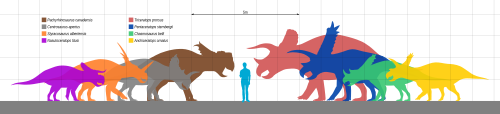
أكبر أنواع السيراتوبسيات المعروفة هو الترايسيراتوبس هوريدوس ، إلى جانب الإيوتريسيراتوبس زيرينسولاريس القريب منه، ويُقدّر طول كل منهما بنحو 9 أمتار (30 قدمًا) . ويُنافسهما في الحجم البنتاسيراتوبس والعديد من أنواع السيراتوبسيات الأخرى. [ 490 ] امتلك التيتانوسيراتوبس واحدة من أطول الجماجم بين جميع الحيوانات البرية، إذ بلغ طولها 2.65 متر (8.7 قدم) . [ 491 ] وقد يتجاوز حجم التوروصور المكتشف حديثًا (المُلقّب بـ"آدم") هذا الحجم، إذ يبلغ طول جمجمته 3 أمتار (9.8 قدم) . [ 492 ]
طيور القدم (Ornithopoda)
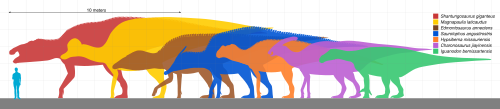
- كانت أكبر أنواع الأورنيثوبودات المعروفة ، مثل شانتونغوصور، ثقيلة الوزن كحجم السوروبودات متوسطة الحجم، حيث بلغ وزنها 23 طنًا (25 طنًا قصيرًا) ، [ 493 ] [ 494 ] وطولها 16.6 مترًا (54 قدمًا) . [ 493 ] وبلغ طول ماغنابوليا 12.5 مترًا (41 قدمًا) ، [ 495 ] أو، وفقًا للوصف الأصلي، 15 مترًا (49 قدمًا) . [ 496 ] [ 471 ] أما السورولوفوس المنغولي ، S. angustirostris ، فبلغ طوله 13 مترًا (43 قدمًا) وربما أكثر. [ 497 ] وقد يصل وزن هذا الحيوان إلى 11 طنًا (12 طنًا قصيرًا) . [ 497 ] بلغ طول أكبر إدمونتوصور 12 مترًا (39 قدمًا) ووزنه حوالي 6 أطنان (6.6 طن قصير) . [ 498 ] يُقدّر أقصى طول لبراكيلوفوصور بـ 11 مترًا (36 قدمًا) بوزن 7 أطنان (7.7 طن قصير) . [ 499 ] يُعدّ PASAC-1، المسمى بشكل غير رسمي " سابينوصور " ، أكبر أنواع السورولوفين المعروفة في أمريكا الشمالية، [ 500 ] إذ يبلغ طوله حوالي 11 مترًا (36 قدمًا) ، أي أكبر بنسبة 20% تقريبًا من العينات الأخرى المعروفة. [ 501 ] وصل طول هيبسيبيما ميسوريينسيس إلى 10.7 مترًا (35 قدمًا) . [ 502 ] [ 503 ] قُدِّر طول شارونوصور العصر الطباشيري المتأخر بحوالي 10 أمتار (33 قدمًا) ووزنه بحوالي 5 أطنان (5.5 طن قصير) . [ 471 ] [ 504 ]
- كان الإغوانودون على الأرجح أكبر طائر من فصيلة الأورنيثوبودات خارج فصيلة الهادروصورويديا . بلغ طول أكبر عينات الإغوانودون 11 مترًا (36 قدمًا) [ 505 ] [ 506 ] ، ووزنها حوالي 4.5 طن (5 أطنان قصيرة) [ 507 ] . ومن الأورنيثوبودات الكبيرة الأخرى الإغواناكولوسوس ، الذي بلغ طوله 9 أمتار (30 قدمًا) ووزنه 5 أطنان (5.5 أطنان قصيرة) [ 508 ] [ 509 ] .
- كان أكبر أنواع الرابدودونتيد هو ماثيرونودون ، الذي قُدِّر طوله بـ 4.8 متر (16 قدمًا) . [ 510 ] وبلغ طول الرابدودون حوالي 4 أمتار (13 قدمًا) ووزنه 250 كيلوغرامًا (550 رطلًا) وفقًا لتقديرات عام 2016. [ 511 ]
الطيور (Aves)

قد يكون أكبر طائر في السجل الأحفوري هو طائر الفيل المنقرض ( Aepyornis maximus) من مدغشقر ، وأقرب أقربائه الأحياء هو طائر الكيوي . تجاوز ارتفاع طيور الفيل العملاقة 2.3 متر (7.5 قدم) ، وبلغ متوسط وزنها 850 كيلوغرامًا (1870 رطلًا) [ 512 ] أو ربما وصل إلى 1000 كيلوغرام (2200 رطل) [ 513 ] [ 514 ] .
كان أكبر الطيور هو طائر الميهيرونغ درومورنيس ستيرتوني الأسترالي . وقد تجاوز ارتفاعه 2.7 متر (8.9 قدم) ، وبلغ متوسط كتلته 500 كيلوغرام (1100 رطل) [ 515 ] .
ومن بين المنافسين الآخرين طائر برونتورنيس بورميستيري ، وهو طائر منقرض لا يطير من أمريكا الجنوبية ، وصل وزنه إلى 319 كجم (703 رطل) وطوله إلى حوالي 2.8 متر (9.2 قدم) . [ 516 ]
أطول طائر مسجل هو Pachystruthio dmanisensis ، وهو قريب من النعامة . بلغ طول هذا النوع من الطيور 3.5 متر (11.5 قدم) ومتوسط وزنه 450 كيلوغرام (990 رطل) [ 517 ].
أكبر طائر نيواف معروف لا يطير هو طائر الرعب Paraphysornis brasiliensis في أمريكا الجنوبية، وقد تجاوز وزن طائر الرعب البرازيلي 240 كجم (530 رطلاً) ، [ 518 ] .
جدول أثقل أنواع الطيور المنقرضة
إنانثيورنيثانس (Enantiornithes)
كان طائر إنانتيورنيس أحد أكبر طيور الإينانتيورنيثيات ، [ 539 ] حيث بلغ طوله عند الولادة حوالي 78.5 سم (30.9 بوصة) ، وارتفاعه عند الورك 34 سم (13 بوصة) ، ووزنه 6.75 كجم (14.9 رطل) ، [ 540 ] وكان طول جناحيه مماثلاً لبعض طيور النورس الحديثة، حوالي 1.2 متر (3 أقدام و11 بوصة) . [ 539 ] أما طائر جوريلينيا فكان أكبر طائر من العصر الوسيط من منغوليا ، حيث بلغ طوله 53 سم (21 بوصة) ، وارتفاعه عند الورك 23.2 سم (9.1 بوصة) ، ووزنه 2.1 كجم (4.6 رطل) . [ 540 ]
عائلة الأفصوريات
كان حجم الأفيصوروس، الذي عاش في أواخر العصر الطباشيري، يقارب حجم الإينانتيورنيس . بلغ طول جناحيه حوالي 1.2 متر (3 أقدام و11 بوصة) ، [ 539 ] وقُدِّر وزنه في أحد الكتب بـ 5.1 كيلوغرام (11 رطلاً)، [ 540 ] لكن دراسة لاحقة قدّرت وزنه بما يصل إلى 1.7 كيلوغرام (3.7 رطلاً) . [ 541 ]
عائلة Pengornithidae
كان طائر Pengornis أحد أكبر طيور العصر الطباشيري المبكر من فصيلة enantiornithine، حيث بلغ طوله 50 سم (1.6 قدم) [ 471 ] وطول جمجمته 54.7 مم (2.15 بوصة) . [ 542 ]
عائلة Gargantuaviidae
يُعدّ طائر غارغانتوافيس أكبر طائر معروف من العصر الوسيط ، ويتراوح حجمه بين حجم طائر الكاسواري والنعامة، ويبلغ وزنه 140 كيلوغرامًا (310 أرطال)، وهو وزن مماثل للنعام الحديث. [ 543 ] في عام 2019، تم قياس العينات MDE A-08 وIVPP-V12325، حيث بلغطولها 1.8 متر (5 أقدام و11 بوصة) ، وارتفاعها عند الورك 1.3 متر (4 أقدام و3 بوصات) ، ووزنها 120 كيلوغرامًا (260 رطلًا) . [ 525 ]
درومورنيثيفورميس

كان أكبر أنواع الدرومورنيثيد هو درومورنيس ستيرتوني الذي يزيد طوله عن 3 أمتار (9.8 قدم) [ 544 ] ويتراوح وزن الذكور بين 528 و 584 كيلوغرامًا (1164-1287 رطلًا) . [ 545 ]
جاستورنيد (جاستورنيثيفورميس)
يصل ارتفاع أفراد طائر جاستورنيس الكبيرة إلى مترين (6 أقدام و7 بوصات). [ 546 ] ويتراوح وزنها بين 100 كيلوغرام ( 220 رطلاً ) و 156 كيلوغراماً ( 344 رطلاً ) ، وقد يصل أحياناً إلى 180 كيلوغراماً (400 رطلاً) في العينات الأوروبية، وبين 160 كيلوغراماً (350 رطلاً) و 229 كيلوغراماً (505 أرطال) في عينات أمريكا الشمالية. [ 547 ] [ 523 ] [ 548 ]
الطيور المائية (Anseriformes)

ربما كان طائر غارغانورنيس بالماني ، الذي عاش في العصر الميوسيني، غير قادر على الطيران، وكان أكبر من أي فرد حيّ من رتبة الإوزيات ، إذ تراوحت كتلة جسمه بين 15.3 و22.3 كيلوغرامًا (34-49 رطلًا) . [ 549 ] ومن الإوزيات الضخمة الأخرى غير القادرة على الطيران، إوزة نيوزيلندا ( كنيميورنيس )، التي بلغ وزنها 15-18 كيلوغرامًا (33-40 رطلًا) ، مقتربةً في حجمها من أنواع صغيرة من طيور الموآ. [ 550 ]
البجع (Cygnini)
كان أكبر أنواع البجع المعروفة هو البجعة العملاقة ( Cygnus falconeri ) التي عاشت في العصر البليستوسيني ، حيث بلغ طولها من المنقار إلى الذيل حوالي 190-210 سم (75-83 بوصة) ، [ 551 ] ووزنها حوالي 16 كجم (35 رطلاً) ، وامتداد جناحيها 3 أمتار (9.8 قدم) . [ 534 ] [ 552 ] [ 553 ] أما بجعة نيوزيلندا ( Cygnus sumnerensis ) فكان وزنها يصل إلى 10 كجم (22 رطلاً) ، مقارنةً بالبجعة السوداء الموجودة حاليًا والتي يبلغ وزنها 6 كجم (13 رطلاً) فقط . [ 554 ] وتجاوزت البجعة البحرية الكبيرة Annakacygna yoshiiensis التي عاشت في العصر الميوسيني في اليابان البجعة الأخرس الموجودة حاليًا بكثير في كل من الحجم والوزن. [ 555 ]
أناتيني
بلغ وزن بطة فينش ( Chenonetta finschi ) 1-2 كيلوغرام (2.2-4.4 رطل) ، متجاوزة بذلك وزن بطة الخشب الأسترالية الحديثة ذات الصلة ( 800 غرام (1.8 رطل) ). [ 556 ]
البجع، وأبو منجل، وما شابهها (Pelecaniformes)
- كان بجع "بيليكانوس شرايبيري" الذي عاش في أوائل العصر البليوسيني أكبر حجماً من معظم أنواع البجع الموجودة حالياً. وربما كان بجع "بيليكانوس أوديسانوس" الذي عاش في أواخر العصر الميوسيني بنفس حجم بجع "بيليكانوس شرايبيري" ، إذ يبلغ طول عظم مشط القدم لديه 150 ملم ( 5.9 بوصة) . [ 557 ]
- كان أكبر أنواع البلشون هو بلشون بينو ( Ardea bennuides ). استنادًا إلى البقايا المكتشفة، كان طوله حوالي مترين (6.6 قدم) وكان طول جناحيه يصل إلى 2.7 متر (8.9 قدم) ، متجاوزًا بذلك حجم أكبر الأنواع الحية في عائلة البلشون، وهو بلشون جالوت . [ 558 ]
- كان طائر أبو منجل الجامايكي ( Xenicibis xympithecus ) طائر أبو منجل كبير الحجم، يزن حوالي 2 كجم (70 أونصة).
اللقلق وحلفاؤه (Ciconiiformes)

كان أكبر أنواع طيور اللقلق المعروفة هو Leptoptilos robustus ، الذي بلغ طوله 1.8 متر (5 أقدام و11 بوصة) ووزنه حوالي 16 كيلوغرامًا (35 رطلاً) . [ 559 ] [ 535 ] أما Ciconia maltha فهو نوع كبير نسبيًا من طيور اللقلق ، إذ يزيد ارتفاعه عن 1.5 متر (5 أقدام) ويصل طول جناحيه إلى 3 أمتار (10 أقدام) . [ 560 ]
الكركي (Gruiformes)
كان طائر الكركي الحقيقي الكبير ( Gruinae ) من أواخر العصر الميوسيني ( التورتوني ) في ألمانيا مساوياً في الحجم لأكبر أنواع الكركي الموجودة حالياً، وكان يشبه طائر الكركي السيبيري ذو المنقار الطويل ( Leucogeranus leucogeranus ). [ 561 ]
الطيور الشاطئية (Charadriiformes)
كان طائر ميومانكالا هواردي أكبر طائر معروف من فصيلة الزقزاقيات على مر العصور، حيث كان يزن حوالي 0.6 كجم (1.3 رطل) أكثر من ثاني أكبر عضو فيها، وهو طائر الأوك الكبير ( بينجوينوس إمبينيس ). [ 562 ]
هيسبيرورنيثين (هيسبيرورنيثيس)
كان أكبر أنواع الهيسبيرورنيثين المعروفة هو Canadaga arctica بطول 2.2 متر (7 أقدام و3 بوصات) . [ 563 ]
نسور العالم الجديد (Cathartiformes)

كان طائر الأرجنتافيس ، وهو من فصيلة التيراتورنيثيدات التي عاشت في العصر الميوسيني، من أثقل الطيور الطائرة على مر العصور . قُدِّر طول جناحي هذا الطائر الضخم بما يتراوح بين 5.09 و6.5 متر (16.7-21.3 قدم) [ 527 ] [ 564 ] ، ووزنه بما يتراوح بين 70 و72 كيلوغرامًا (154-159 رطلًا) [ 565 ] [ 527 ] . وكان عظم العضد لدى الأرجنتافيس أقصر بقليل من ذراع الإنسان [ 566 ] . ومن التيراتورنيثيدات الضخمة الأخرى طائر الأيولورنيس ، الذي بلغ طول جناحيه حوالي 5 أمتار (16 قدمًا) . [ 567 ] بلغ وزن طائر تيراتورنيس ميريامي الذي عاش في العصر البليستوسيني 13.7 كيلوغرامًا (30 رطلاً) وبلغ طول جناحيه 2.94-3.38 مترًا (9.6-11.1 قدمًا) ، مع تقديرات أقل لحجمه تتجاوز أكبر عينات كوندور كاليفورنيا ( Gymnogyps californianus ). [ 568 ]
رتبة السيريماس وحلفائها (كارياميفورميس)
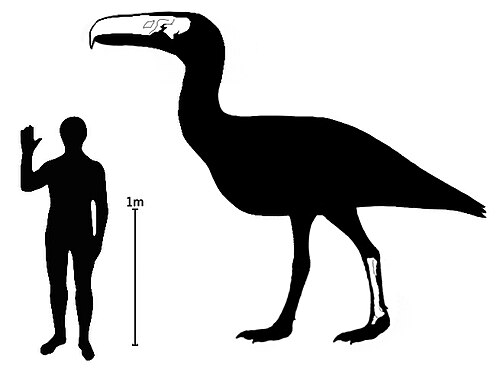
كان طائر برونتورنيس أكبر طائر معروف من رتبة الكارياميفورم وأكبر طائر من فصيلة فوروسراكيد أو "طائر الرعب" (وهي طيور مفترسة للغاية وغير قادرة على الطيران تعيش في أمريكا) ، حيث بلغ ارتفاعه حوالي 175 سم (69 بوصة) عند الكتف، وكان بإمكانه رفع رأسه 2.8 متر (9 أقدام وبوصتين) فوق سطح الأرض، وربما وصل وزنه إلى 400 كجم (880 رطلاً) . [ 569 ] أما طائر كيلينكين الضخم من فصيلة فوروسراكيد، فقد بلغ ارتفاعه 3 أمتار (9.8 قدم) [ 570 ] [ 571 ]، وكان طول جمجمته 716 ملم (28.2 بوصة) ( 460 ملم (18 بوصة) منها منقار)، وكان يمتلك أكبر رأس بين جميع الطيور المعروفة. [ 570 ] كان طول حيوان فوروسراكوس في أمريكا الجنوبية يتراوح بين 2.4 و2.7 متر (7.9-8.8 قدم)، وكان وزنه يقارب 130 كيلوغرامًا (290 رطلًا) ، أي ما يعادل وزن نعامة ذكر . [ 572 ] [ 573 ] أما أكبر حيوانات فوروسراكوس في أمريكا الشمالية فكان تيتانيس ، الذي بلغ ارتفاعه حوالي 2.5 متر (8.2 قدم)، [ 574 ] وهو أطول قليلًا من فيل الغابات الأفريقي .
Accipitriformes (Accipitriformes)

كان نسر هاست الضخم ( Hieraetus moorei ) أكبر طائر جارح معروف على الإطلاق ، إذ بلغ طول جناحيه من 2.6 إلى 3 أمتار (من 8 أقدام و6 بوصات إلى 9 أقدام و10 بوصات) ، وهو طول قصير نسبيًا بالنسبة لحجمه. [ 575 ] [ 576 ] وربما بلغ طوله الإجمالي 1.4 متر (4 أقدام و7 بوصات) لدى الإناث [ 577 ] ، وتراوح وزنه بين 10 و15 كيلوغرامًا (من 22 إلى 33 رطلاً) . [ 578 ] ومن أنواع الصقور العملاقة المنقرضة الأخرى، نسر تيتانوهيراكس (Titanohirax ) الذي بلغ وزنه حوالي 7.3 كيلوغرامات (16 رطلاً)، والذي عاش في جزر الأنتيل وجزر البهاما ، حيث كان من بين أبرز المفترسات. [ 579 ] وقد يكون نسر غير مسمى من العصر الرباعي المتأخر من جزيرة هيسبانيولا أكبر بنسبة 15-30% من النسر الذهبي الحديث ( Aquila chrysaetos ). [ 580 ] تفوقت بعض أنواع جنس Buteogallus المنقرضة على أقاربها الموجودة حاليًا في الحجم. كان Buteogallus borrasi أكبر بنحو 33% من الصقر الأسود الكبير الحديث ( B. urubitinga ). [ 581 ] وكان B. daggetti ، المعروف أيضًا باسم "النسر الماشي"، أكبر بنحو 40% من صقر السافانا ( B. meridionalis ). [ 582 ] وكان مرزة إيلز ( Circus eylesi ) من العصر البليستوسيني - الهولوسيني في نيوزيلندا أثقل بأكثر من الضعف من C. approximans الموجود حاليًا . [ 583 ]
موآ (دينورنيثيفورميس)

كان أطول طائر معروف هو طائر الموآ العملاق من الجزيرة الجنوبية ( دينورنيس روبوستوس )، وهو جزء من عائلة الموآ في نيوزيلندا التي انقرضت منذ حوالي 500 عام. بلغ طوله 3.7 متر (12 قدمًا) ، [ 584 ] وكان وزنه يعادل نصف وزن طائر الفيل الكبير تقريبًا نظرًا لبنيته النحيلة نسبيًا. [ 585 ]
طيور التيناموس (Tinamiformes)
يُعتقد أن العينة MPLK-03، وهي عينة من حيوان التينامو عاشت خلال العصر البليستوسيني المتأخر في الأرجنتين ، تنتمي إلى جنس Eudromia الحديث ، وتتفوق على النوعين الحاليين E. elegans و E. formosa في الحجم بنسبة 2.2-8% و 6-14% على التوالي. [ 586 ]
طيور الفيل (Aepyornithiformes)
قد يكون أكبر طائر في السجل الأحفوري هو طائر الفيل المنقرض ( فورومبي ، إيبورنيس ) في مدغشقر، والذي كان من فصيلة النعام. وقد تجاوز طوله 3 أمتار (9.8 قدم) ووزنه 500 كيلوغرام (1100 رطل) . [ 585 ]
النعام (Struthioniformes)
بكتلة جسم تبلغ 450 كيلوغرامًا (990 رطلًا) ، كان طائر Pachystruthio dmanisensis، الذي عاش في العصر البليستوسيني السفلي في شبه جزيرة القرم، أكبر طائر سُجّل في أوروبا على الإطلاق. وعلى الرغم من ضخامته، كان عداءً ماهرًا. [ 587 ] وبلغ وزن عينة محتملة من Pachystruthio، عُثر عليها في العصر البليستوسيني السفلي في مقاطعة خبي ( الصين )، حوالي 300 كيلوغرام (660 رطلًا) ، أي ضعف وزن النعامة الشائعة ( Struthio camelus ). [ 588 ] وتشير بقايا النعامة الآسيوية الضخمة ( Struthio asiaticus )، التي تعود إلى العصر البليوسيني [ 589 ] ، إلى أن حجمها كان أكبر بنسبة 20% من حجم الذكر البالغ من النعامة الشائعة ( Struthio camelus ) الموجودة حاليًا . [ 590 ]
الحمام واليمام (رتبة الحماميات)
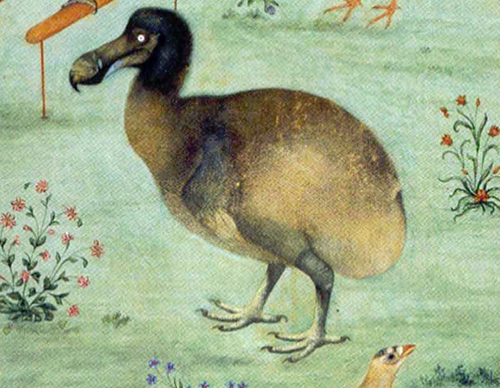
كان طائر الدودو ( Raphus cucullatus ) أكبر أنواع الحمام المعروفة ، وربما تجاوز طوله مترًا واحدًا (3.3 قدم) ووزنه 28 كيلوغرامًا (62 رطلاً) ، على الرغم من أن التقديرات الحديثة تشير إلى أن متوسط وزن طائر الدودو البري كان أقل بكثير، حيث بلغ حوالي 10.2 كيلوغرام (22 رطلاً) . [ 591 ] [ 592 ]
طيور التدرج، والديك الرومي، وطيور الصيد وما شابهها (Galliformes)
كان أكبر أنواع الدجاجيات المعروفة على الأرجح هو دجاجة المالي العملاقة ، التي يمكن أن يصل وزنها إلى 7 كيلوغرامات (15 رطلاً) . [ 593 ]
الطيور المغردة (العصافير)
أكبر طائر مغرد معروف هو طائر غروسبيك العملاق المنقرض ( Chloridops regiskongi ) بطول 280 ملم (11 بوصة) .
الغاق وحلفاؤه (Suliformes)

- كان أكبر أنواع الغاق المعروفة هو الغاق ذو النظارة في شمال المحيط الهادئ ( Phalacrocorax perspicillatus )، والذي انقرض حوالي عام 1850 وكان متوسط وزنه حوالي 6.4 كجم (14 رطلاً) وطوله 1.15 متر (3 أقدام و9 بوصات) . [ 538 ]
- كان أكبر أنواع سمك الرماح المعروفة هو سمك الجيجانهينجا، الذي قُدِّر وزنه بحوالي 17.7 كجم (39 رطلاً) ، [ 533 ] بل إن دراسة سابقة زعمت أن وزنه بلغ 25.7 كجم (57 رطلاً) . [ 594 ]
- أكبر طائر معروف من فصيلة البطريق ، وهو طائر يشبه البطريق ولا يطير، هو Copepteryx titan، والذي عُرف من عظم فخذه الذي يبلغ طوله 22 سم (8.7 بوصة) ، أي ما يقرب من ضعف طول عظم فخذ البطريق الإمبراطوري . [ 595 ]
طيور الغطاس (Podicipediformes)
وصل طول أكبر طائر غطاس معروف، وهو غطاس أتيتلان ( Podylimbus gigas )، إلى حوالي 46-50 سنتيمترًا (18-20 بوصة) . [ 596 ]
الطيور ذات الأسنان العظمية (Odontopterygiformes)
كانت أكبر الطيور المعروفة من رتبة أودونتوبتريجيفورميس - وهي مجموعة تم تصنيفها بشكل مختلف مع رتب بروسيلاريفورميس وبليكانيفورميس وإونسيريفورميس - وأكبر الطيور الطائرة على مر العصور باستثناء طائر أرجنتافيس ، هي طيور بيلاجورنيس وسيفورنيس وداسورنيس وجيجانتورنيس وأوستيودونتورنيس الضخمة . بلغ طول جناحيها 5.5-6 أمتار (18-20 قدمًا) وبلغ ارتفاعها حوالي 1.2 متر (3 أقدام و11 بوصة) . لا يزال من غير الممكن تحديد الحجم الدقيق لهذه الطيور أو الحكم على أيها كان الأكبر، نظرًا لأن عظامها كانت رقيقة الجدران وخفيفة وهشة للغاية، وبالتالي فإن معظمها معروف فقط من بقايا غير مكتملة.
نقار الخشب وحلفاؤه (رتبة نقاريات الشكل)
أكبر أنواع نقار الخشب المعروفة هو نقار الخشب الإمبراطوري ( Campephilus imperialis ) الذي ربما يكون قد انقرض، ويبلغ طوله الإجمالي حوالي 56-60 سم (22-24 بوصة) . [ 597 ]
الببغاوات (Psittaciformes)
أكبر ببغاء معروف هو ببغاء هيراكليس إينكسبكتاتوس المنقرض ، ويبلغ طوله حوالي متر واحد (3.3 قدم). [ 598 ]
طيور البطريق (Sphenisciformes)
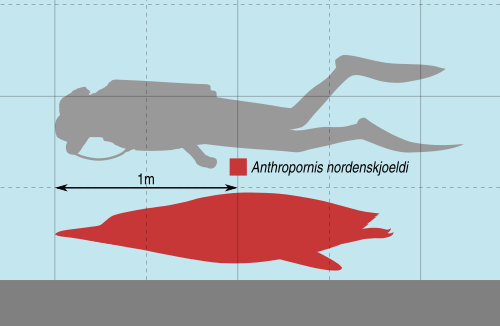
يُعدّ بطريق كوميمانو فورديسي (Kumimanu fordycei ) من أثقل أنواع البطاريق المعروفة على الإطلاق ، إذ يُقدّر وزنه بين 148 و159.7 كيلوغرامًا (326 إلى 352 رطلًا) ، استنادًا إلى قياسات عظم العضد. [ 599 ] ومثال آخر هو بطريق باليودبتس كليكوفسكي (Palaeeudyptes klekowskii) من القارة القطبية الجنوبية ، حيث يُقدّر طوله من المنقار إلى الذيل بـ 2.02 متر (6 أقدام و8 بوصات) ، ويُقدّر وزنه بـ 84.2 كيلوغرامًا (186 رطلًا) ، وهو أقل بقليل من التقديرات السابقة. [ 599 ] [ 600 ] ويُقارن به في الحجم بطريق أنثروبورنيس نوردنسكيولدي (Anthropornis nordenskjoeldi ) الذي عاش في العصر الإيوسيني ، والذي قُدّر طوله سابقًا بـ 2.05 متر (6 أقدام و9 بوصات) ووزنه بـ 108 كيلوغرامات (238 رطلًا) . [ 601 ] مع ذلك، تشير التقديرات الحديثة المستندة إلى قياسات عظم العضد إلى أن وزن بطريق نوردنسكيولدي (A. nordenskjoeldi) أقرب إلى 67 كيلوغرامًا (148 رطلًا) . [ 599 ] ومن أنواع البطاريق الكبيرة الأخرى بطريق نيوزيلندا العملاق ( Pachydyptes pondeorsus ) الذي يتراوح وزنه بين 65.4 و94.6 كيلوغرامًا (144 إلى 209 أرطال) ، وبطريق إكاديبتس سالاسي (Icadyptes salasi ) الذي يتراوح وزنه بين 52.8 و73.0 كيلوغرامًا (116.4 إلى 160.9 أرطال) . [ 602 ] [ 599 ]
البوم (Strigiformes)
أكبر بومة معروفة على الإطلاق كانت بومة أورنيميغالونيكس الكوبية التي بلغ طولها 1100 ملم (43.3 بوصة) وربما تجاوز وزنها 9 كجم (20 رطلاً) . [ 603 ]
البرمائيات (Amphibia)
البرمائيات الحديثة (Lissamphibia)
الضفادع والعلاجيم (Anura)

The largest known frog ever was an as yet unnamed Eocene species that was about 58–59-centimetre-long (22.8–23.2 in).[604] The Late CretaceousBeelzebufo grew to at least 23.2 cm (9.1 in) (snout-vent length), which is around the size of a modern African bullfrog.[605]
Salamanders, newts and allies (Urodela)

- Andrias matthewi was the largest lissamphibian ever known, with total length up to 2.3 m (7.5 ft).[606]
- Habrosaurus was the largest sirenid. It reached 1.6 m (5.2 ft) long.[607]
Diadectomorphs (Diadectomorpha)
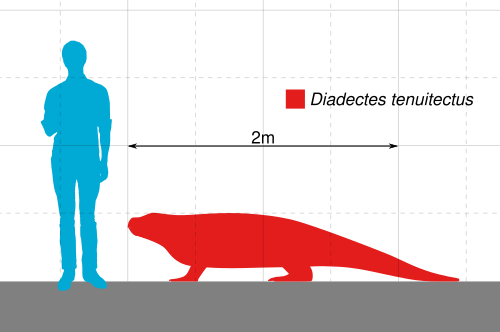
The largest known diacectid, herbivorous Diadectes, was a heavily built animal, up to 3 m (9.8 ft) long, with thick vertebrae and ribs.[608][609]
Anthracosauria
The largest known anthracosaur was Anthracosaurus, with skull about 40 cm (16 in) in length.[610]
Embolomeri

The longest member of this group was Eogyrinus attheyi, species sometimes placed under genus Pholiderpeton.[611] Its skull had length about 41 cm (16 in).[612]
Temnospondyls (Temnospondyli)
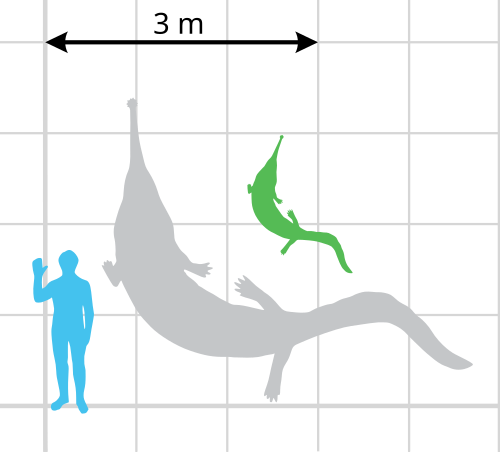
The largest known temnospondyl, as well as the largest amphibian, was Prionosuchus, which grew to lengths of 9 m (30 ft).[613] Unnamed species of temnospondyl from Lesotho is partial, but possible body length estimation is 7 m (23 ft).[614] Another huge temnospondyl was Mastodonsaurus giganteus at 6 m (20 ft) long.[615] Another large temnospondly was Koolasuchus, which measured 3 metres (9.8 ft) in length and weighed 500 kilograms (1,100 lb).[616][617][618]
Fishes (Pisces)
Fishes are a paraphyletic group of non-tetrapod vertebrates.
Jawless fish (Agnatha)
Conodonts (Conodonta)
Iowagnathus grandis is estimated to have length over 50 cm (1.6 ft).[619]
Heterostracans (Heterostraci)
Some members of Psammosteidae such as Obruchevia and Tartuosteus are estimated to reached up to 2 m (6.6 ft).[620]
Thelodonts (Thelodonti)
Although known from partial materials, Thelodus parvidens (=T. macintoshi) is estimated to reached up to 1 m (3.3 ft).[621]
Cephalaspidomorphs (Cephalaspidomorphi)
A species of Parameteoraspis reached up to 1 m (3.3 ft).[622]
Spiny sharks (Acanthodii)
The largest of the now-extinct Acanthodii was Xylacanthus grandis, an ischnacanthiform based on a ~35 cm (14 in) long jaw bone. Based on the proportions of its relative Ischnacanthus, X. grandis had an estimated total length of 2.5 m (8 ft 2 in).[623]
Placoderms (Placodermi)

The largest known placoderm was the giant predatory Dunkleosteus. The largest and most well known species was D. terrelli, was initially estimated to be 6–10 m (19.7–32.8 ft)[624][625][626] in length and 1–4 t (1.1–4.4 short tons) in weight.[624][627] However, more recent reconstructions suggest estimates over 5 m (16 ft) is poorly supported. Instead the largest D. terrelli probably measured 4.1 metres (13 ft) in length and weighed 1,494–1,764 kilograms (3,294–3,889 lb).[628][629] Another large placoderm, Titanichthys clarki, may have rivaled it in size.[630] Recent reconstructions suggest T. clarki was estimated to have a length around 4.15 m (13.6 ft).[628]
Cartilaginous fish (Chondrichthyes)
Mackerel sharks (Lamniformes)
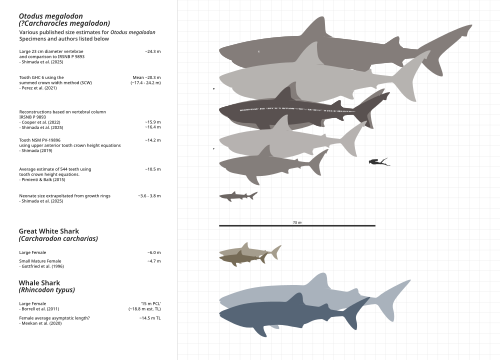
- Species in the extinct genus Otodus were extremely large. With the species Otodus megalodon[631][632][633] being by far the biggest mackerel shark as well as non-tetropod fish ever known.[634] Most estimates of megalodon's size extrapolate from teeth, with maximum length estimates up to 10.6–20 m (35–66 ft)[632][633][635] with a 2025 study estimating a maximum length estimate of 24.3 metres (80 ft)[636] and modal length estimates based on individuals from all ontogenetic stages (life stages) of 10.5 m (34 ft).[637][638] Due to fragmentary remains, there have been many contradictory size estimates for megalodon, as they can only be drawn from fossil teeth and vertebrae.[639]:87[640] With the 2025 study suggesting that the animal had a more elongated slender appearance.[636] Mature male megalodon may have had a body mass of 12.6 to 33.9 metric tons (13.9 to 37.4 short tons), and mature females may have been 27.4 to 59.4 metric tons (30.2 to 65.5 short tons), assuming that males could range in length from 10.5 to 14.3 m (34 to 47 ft) and females 13.3 to 17 m (44 to 56 ft).[641] With maximum weight estimates between 83.6–104.7 tonnes (92.2–115.4 short tons)[636]. Related to megalodon, Otodus angustidens and O. chubutensis also reached large sizes. Being estimated at 9.3 m (31 ft)[642] and 12.2 m (40 ft),[643] respectively.
- Other giant mackerel sharks were Pseudoscapanorhynchidae from the Cretaceous period. Cretodus had a size range of 9–11 m (30–36 ft) (for C. crassidens),[644]Leptostyrax reached lengths of 6.3–8.3 m (21–27 ft).[645]
- The CenozoicParotodus reached up to 7.6 m (25 ft) in length.[646]
- The heaviest thresher shark was likely Alopias grandis. It was similar in size or even larger than the extant great white shark and probably did not have an elongated dorsal tail, characteristic of modern relatives.[647] With the related Alopias palatasi also reaching a large size range.[648]
Ground sharks (Carcharhiniformes)
The CenozoicHemipristis serra was considerably larger than its modern-day relatives and had much larger teeth. Its total length is estimated to be at 6 metres (20 ft) long.[649]
Hybodonts (Hybodontiformes)
One of the largest hybodontiforms was the Jurassic Asteracanthus with body length of up to 3 m (9.8 ft).[650]Crassodus reifi is known from less materials, however it is estimated that reached over 3 m (9.8 ft).[651]
Ctenacanthiformes
The largest member of ctenacanthiformes is Saivodus striatus with estimated length around 6–9 m (20–30 ft).[652][628]
Skates and allies (Rajiformes)
The giant sclerorhynchidOnchopristis reached about 4.25 m (13.9 ft) in length.[653]
Eugeneodonts (Eugeneodontida)

The largest known eugeneodont is an as-yet unnamed species of Helicoprion discovered in Idaho. The specimens suggest an animal that possibly exceeded 12 m (39 ft) in length.[654] Another fairly large eugeneodont is Parahelicoprion. Being slimmer than Helicoprion, it reached nearly the same size,[654] possibly up to 12 m (39 ft) in length,[655] although these numbers originate from non-academic amateur researchers and are not supported by scientific literature.[254] Despite being known from limited remains, it is possible that Campyloprion is larger, making it the largest Carboniferous helicoprionid eugeneodont ever known, with a length of 9 m (30 ft) based on its tooth size.[656]
Lobe-finned fish (Sarcopterygii)
Coelacanths (Actinistia)

The largest coelacanth is Cretaceous Mawsonia gigas with estimated total length up to 5.3 m (17 ft). Jurassic Trachymetopon may have reached size close to that, about 5 m (16 ft).[657] An undetermined mawsoniid from the Maastrichtian deposits of Morocco probably reached 3.65–5.52 m (12.0–18.1 ft) in length.[658][657]
Lungfish (Dipnoi)
Cretaceous Ceratodus sp. from Western Interior is estimated to have had a length of around 4 m (13 ft).[659]
Stem-tetrapods (Tetrapodomorpha)
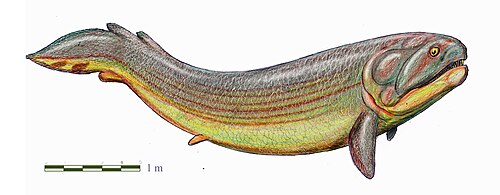

- Not only the largest known rhizodont, but also the largest lobe-finned fish was the 5.63–7 m (18.5–23.0 ft) long Rhizodus.[660][628] Another large rhizodonts were Strepsodus with estimated length around 3–5 m (9.8–16.4 ft) and Barameda estimated at 3–4 m (9.8–13.1 ft) in length.[661][662]
- TristichopteridHyneria reached length up to 3.5 m (11 ft).[628]
Ray-finned fish (Actinopterygii)
Acipenseriformes
- Gyrosteus, which belongs to extinct acipenseriform family Chondrosteidae, is estimated to have standard length about 6–7 m (20–23 ft).[663]
- The largest known fossil sturgeon is "Acipenser" gigantissimus known from fragmentary remains, which is estimated to reach up to 5.8 m (19 ft).[664]
- The largest known fossil paddlefish is unnamed remain from Judith River Formation, it may exceeded 2 m (6 ft 7 in), known remains exceeded size of recently extinct Chinese paddlefish, which scientifically reported to exceed 3 m (9.8 ft).[665]
Pachycormiformes

The largest known ray-finned fish and largest bony fish of all time was the pachycormid, Leedsichthys problematicus, at around 16.5 m (54 ft) long.[666] Earlier estimates have had claims of larger individuals with lengths over 27 m (89 ft).[667][668]
Ichthyodectiformes
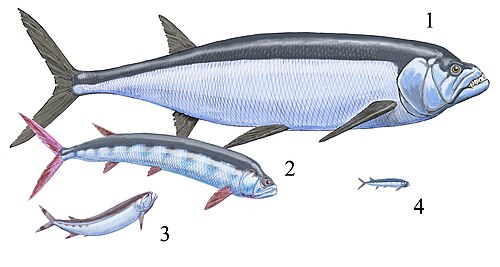
The largest known of ichthyodectiform fish was Xiphactinus, which measured up to 6.1 m (20 ft) long.[669]Ichthyodectes reached 3 m (9.8 ft) long, twice lesser than Xiphactinus.[670]
Pycnodontiformes
The largest known pycnodontiform was Gyrodus circularis, with length up to 2 m (6 ft 7 in).[671]
Bichirs (Polypteriformes)
The Late CretaceousBawitius was likely the largest bichir of all time. It reached up to 3 m (9.8 ft) in length.[672]
Opahes, ribbonfishes, oarfishes and allies (Lampriformes)
Megalampris was likely the largest fossil opah. This fish was around 4 m (13 ft) in length when alive, which is twice the length of the largest living opah species, Lampris guttatus.[673]
Salmon and trout (Salmoniformes)
The largest salmon was Oncorhynchus rastrosus, varying in size from 1.9 m (6 ft 3 in) and 177 kg (390 lb)[674] to 2.4 m (7 ft 10 in) and 200 kg (440 lb).[675][674]
Pufferfishes, boxfishes, triggerfishes, ocean sunfishes and allies (Tetraodontiformes)
- Austromola angerhoferi had total body length about 3.2 m (10 ft), and total height 4 m (13 ft), comparable with largest ocean sunfish.[676][677]
- Some extinct species of Balistes like B. vegai and B. crassidens are estimated to have total length up to 1.8 m (5 ft 11 in).[678]
Lizardfishes (Aulopiformes)
The largest lizardfish was Stratodus which could reach length of 5 m (16 ft).[679]
Echinoderms (Echinodermata)
Crinozoa
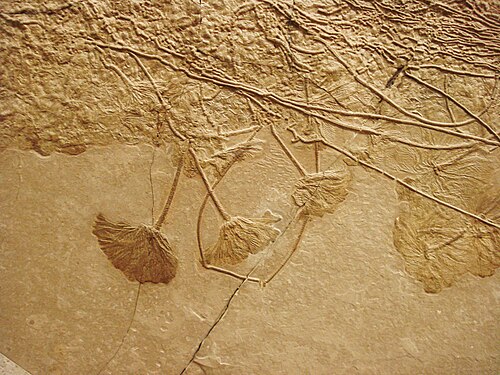
Sea lilies (Crinoidea)
The longest stem of Seirocrinus subangularis reached over 26 m (85 ft).[680]
Asterozoa
Starfish (Asteroidea)
Helianthaster from Hunsrück Slate had a radius of about 25 cm (9.8 in).[681]
Graptolites (Graptolithina)
The longest known graptoloid graptolite is Stimulograptus halli at 1.45 m (4.8 ft). It was found in Silurian deposits of the United Kingdom.[682]
Kinorhynchs (Kinorhyncha)
Cambriankinorhynchs from Qingjiang biota, also known as "mud dragons", reached 4 cm (1.6 in) in length, much larger than extant relatives that grow only a few millimeters in length.[683][684]
Arthropods (Arthropoda)
Dinocaridida
Gilled lobopodians

Based on the findings of mouthparts, the Cambrian gilled lobopodianOmnidens amplus is estimated to have been 1.5 metres (4.9 ft).[685] It is also known as the largest Cambrian animal known to exist.[685]
Radiodont (Radiodonta)

The largest known radiodont is Aegirocassis benmoulai, estimated to have been at least 2 m (6 ft 7 in) long.[686][687]
Chelicerata
Sea spiders (Pycnogonida)
The largest fossil sea spider is Palaeoisopus problematicus with legspan about 32 cm (13 in).[688]
Horseshoe crabs and allies (Xiphosura)
- Willwerathia reached 9 cm (3.5 in) in carapace width and was the largest species of basal ("synziphosurine") xiphosurans.[689][690] However, the DevonianMaldybulakia reached nearly 11.5 cm (4.5 in)[691] and was assigned to xiphosurans in 2013.[690]
- Horseshoe crab trackway icnofossilKouphichnium lithographicum from Cerin in Ain indicates length of animal 77.4–85.1 cm (30.5–33.5 in).[692]
Chasmataspidids (Chasmataspidida)

The largest chasmataspidids were the OrdovicianHoplitaspis at 29 cm (11 in) in length and similar in size range Chasmataspis.[693]
Eurypterids (Eurypterida)
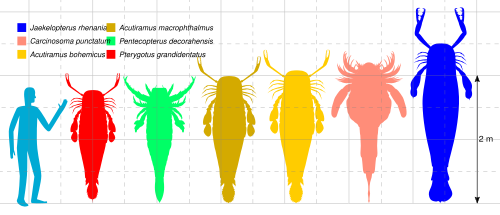
- The largest known eurypterid was Jaekelopterus rhenaniae at 2.5 m (8 ft 2 in) in length, which is also the largest arthropod known to exist.[694]Erettopterus grandis possibly reached this same length but this is based on an incomplete telson only. A close contender was Acutiramus bohemicus at 2.1 m (6 ft 11 in) in length.[695] The largest megalograptid as well as the largest Ordovician eurypterid was Pentecopterus. It reached up to 1.7 m (5 ft 7 in) in length.[696] All these were eurypterine eurypterids.[695][696]
- The largest stylonurine eurypterid was Hibbertopterus, with 1.8 m (5 ft 11 in) in length.[695]
Arachnids (Arachnida)
- There are two contenders for largest-known arachnid as well as the largest scorpions of all time: Pulmonoscorpius kirktonensis and Praearcturus gigas (previously also known as Brontoscorpio).[697] Each was estimated to have been 70 cm (28 in),[698] and up to 100 cm (39 in),[699] respectively.
- Mongolarachne jurassica is the largest described fossil spider, with the total body length of female is approximately 24.6 mm (0.97 in) while the front legs reach about 56.5 mm (2.22 in) in length.[700]Dinodiplura ambulacra had larger body length, combined length of carapace and opisthosoma reaches 26.15 mm (1.030 in).[701]
- The largest of prehistoric whipscorpions and possibly the largest-known whipscorpion ever discovered[702] was Mesoproctus rayoli. The type specimen has body length reaching 65.9 mm (2.59 in) with a carapace of 25.7 mm (1.01 in) in length, while another specimen has a carapace of 32.5 mm (1.28 in) in length and 16 mm (0.63 in) in width, comparable or even larger than the extant Mastigoproctus.[703][704]
- The largest Ricinulei to ever exist was Curculioides bohemondi with a body length of 21.77 mm (0.857 in).[705]
- The largest fossil acariformmite and also the largest erythraeoid mite ever recorded was Immensmaris chewbaccei with idiosoma of more than 8 mm (0.31 in) in length.[706]
- The largest known trigonotarbid was Kreischeria with a minimal length of 51 mm (2.0 in).[707] The second largest was Pleophrynus at 36 mm (1.4 in) in length.[707]
Artiopods (Artiopoda)
Retifacies probably reached up to 55 cm (22 in).[708]Tegopelte is another one example of large non-trilobite artiopod, reached 280 mm (11 in) long[709] and was the largest of the Burgess Shale bilaterians, surpassing all other benthic organisms by at least twice.[709]
Trilobites (Trilobita)
Some of trilobites exceeded 60 cm (24 in) in length. A nearly complete specimen of Isotelus rex from Manitoba attained a length over 70 cm (28 in), and an Ogyginus forteyi from Portugal was almost as long. Fragments of trilobites suggest even larger record sizes. An isolated pygidium of Hungioides bohemicus implies that the full animal was 90 cm (35 in) long.[710]
Myriapods (Myriapoda)

The largest known myriapod by far was Arthropleura. Measuring 2.5 metres (8 ft 2 in) long[711] and 50 centimetres (20 in) wide.[712] Some specimens could have been even larger, up to 2.63 metres (8 ft 8 in) in length and 50 kilograms (110 lb) in weight.[713][714]
Non-hexapod crustaceans (Crustacea)
Cycloids (Cyclida)
The largest cyclid was Opolanka decorosa, the Late TriassicHalicyne-like cycloid which reached over 6 cm (2.4 in) across the carapace.[715]
Remipedes (Remipedia)
Tesnusocaris had body length at least 9.5 cm (3.7 in),[716] larger than all living remipedes which can reach up to 4.5 cm (1.8 in).[717]
Insects (Insecta)
Sawflies, wasps, bees, ants and allies (Hymenoptera)

- The largest known of this group was the giant ant Titanomyrma giganteum with queens growing to 6 cm (2.4 in). It had a wingspan of 15 cm (5.9 in).[718]
- Apis lithohermaea is one of the largest honey bees ever found, comparable in size to the modern Apis dorsata.[719]
- The giant horntailYpresiosirex orthosemos reached 67.9 mm (2.67 in) in length including the incomplete ovipositor.[720] Another example of a giant sawfly is Hoplitolyda duolunica, with wingspan over 92 mm (3.6 in).[721]
Fleas (Siphonaptera)
The largest known in Siphonaptera was probably Pseudopulex magnus, growing to 0.90 in (22.8 mm) in length.[722]
Earwigs (Dermaptera)

Extinct as recently as after 1967[723][724] and also submitted as the Holocenesubfossils,[725] the Saint Helena giant earwig (Labidura herculeana, with synonym Labidura loveridgei) reached 84 mm (3.3 in) in length including forceps 34 mm (1.3 in) long.[723]
Chresmodidae
Chresmodidae had long specialized legs like of the modern Gerridae family. One of the Chresmodidae, Chresmoda obscura, could have reached a size of about 19 centimetres (7.5 in).[726]
Beetles (Coleoptera)
One of the largest known fossil beetles in the superfamilyScarabaeoidea is Protognathinus spielbergi. It had total length including mandibles about 5.5 centimetres (2.2 in).[727] The largest fossil scarabaeid was Oryctoantiquus borealis with an estimated body length of 5 centimetres (2.0 in).[728]
Titanopterans (Titanoptera)

Related to modern orthopterans, titanopterans from the Triassic period were much larger. The wingspan of Gigatitan vulgaris was up to 40 centimetres (16 in).[729]Clatrotitan andersoni also reached a huge size, having a forewing 13.8 centimetres (5.4 in) long.[730]
Antlions and related net-winged insects (Neuroptera)
Makarkinia adamsi from the Crato Formation is estimated to have the longest forewings of any neuropteran species, estimated at 160 mm (6.3 in).[731]
Cockroaches, termites, mantises and allies (Dictyoptera)
- The largest known roachoid, cockroach-like stem dictyopteran, is Opsiomylacris sp., with wing length of 75 mm (3.0 in), which is comparable to a modern Megaloblatta longipennis.[732]
- Cretaceous cockroachPtiloteuthis foliatus had a 7.9 cm (3.1 in) long wing.[733]
- Found in the Miocene of Austria, the giant termite Gyatermes styriensis reached 25 mm (0.98 in) in body length and had a wingspan of 76 mm (3.0 in).[734]
Dragonflies, damselflies and griffinflies (Odonatoptera)

- The largest known odonatopteran insect was Meganeuropsis permiana with a single wing of 33 cm (13 in). Meganeura had a 32 cm (13 in) long wing.[735]
- TriadotypidodonatanReisia gelasii (=Triadotypus guillaumei) from Triassic had 136 millimetres (5.4 in) long wing, and wingspan can be 280 millimetres (11 in).[736][737]
Mayflies (Ephemeroptera)
- The largest known mayfly is Permian Ponalex maximus, with 55 mm (2 in) long hindwing.[738] Cretaceous Epicharmeropsis quadrivenulosus had 37 mm (1 in) long forewing.[739]
- Although Bojophlebia prokopi from the Upper Carboniferous of Moravia (Czech Republic) with a wingspan of 45 cm (18 in) is described as the largest mayfly,[740] later study shows that this insect is not related to mayflies.[741]
Palaeodictyoptera
The largest known palaeodictyopteran was Mazothairos, with an estimated wingspan of up to 560 mm (22 in).[742] If a subcircular wing known from Piesberg Quarry belongs to a palaeodictyopteran, it possibly had single wing length at least 30 cm (12 in).[743]
Archaeognatha (jumping bristletails) and other wingless primitive insects
- The largest known machilid is Triassic Gigamachilis, with 40 millimetres (1.6 in) body length not counting the length of the filament, and estimated total length about 80 millimetres (3.1 in).[744]
- The largest specimens of the extinct suborder Monura reached 30 millimetres (1.2 in) or more, not counting the length of the filament.[745]
- Although Ramsdelepidion was once considered as a 60 millimetres (2.4 in)-long silverfish,[746] it was later considered that classification is uncertain and just treated as stem group insect.[747]
- The wingless early insect Carbotriplura had body length about 103 millimetres (4.1 in) without tail filaments.[748]
Arrow worms (Chaetognatha)
The Cambrian stem-chaetognathanTimorebestia koprii had reached up to 20 cm (7.9 in) in body length and 30 cm (12 in) including the antennae.[749]Capinatator had a third of length, about 10 cm (3.9 in), but it is not considered as stem member and still had length similar to the largest modern arrow worms.[749][750]
Ringed worms (Annelida)
Websteroprion is the largest known fossil eunicidanannelid, with estimated length ranges 0.42–8.3 m (1 ft 5 in – 27 ft 3 in), however comparison with closely related extant taxa indicates length around 1–2 m (3 ft 3 in – 6 ft 7 in).[751] It also had the biggest scolecodonts of any prehistoric polychaete, up to 13.2 mm (0.52 in) in length and possibly larger.[751]
Molluscs (Mollusca)
Snails and slugs (Gastropoda)

- The largest known gastropods were in the genus Campanile, with the extinct Campanile giganteum having shell lengths up to 90 cm (35 in)[752] or even more than 120 cm (47 in).[753]
- The largest known cowrie is Vicetia bizzottoi, with shell length of 33.5 cm (13.2 in).[754]
- Pebasiconcha immanis is the largest land snail ever known, shell height is 25.6 cm (10.1 in) with a partial specimen that may exceed 30 cm (12 in) in height.[755]
Bivalves (Bivalvia)
- The largest known bivalve ever as well as the largest inoceramid was Platyceramus platinus, a giant that usually had an axial length of 1 m (3 ft 3 in), but some individuals could reach an axial length of up to 3 m (9.8 ft).[756] Another large prehistoric bivalve was Inoceramus. In 1952, 187 cm (6.14 ft)-long specimen of Inoceramus steenstrupi was found in the Late Cretaceous deposits of Greenland.[757]
- Some Permian alatoconchid genus like Shikamaia had shell length about 1 m (3 ft 3 in).[758] Previous estimation reconstructed length of Shikamaia around 1.6 m (5 ft 3 in).[759]
- The longest ostreid is Konbostrea, with shell height reaching up to 1.2 m (3 ft 11 in).[760]
- RudistTitanosarcolites had overall size around 2 m (6 ft 7 in).[761]
Tusk shells (Scaphopoda)
- Complete shell length of tusk shellProdentalium onoi is estimated to be over 30 cm (12 in).[762]
Cephalopods (Cephalopoda)

Nautiloids (Nautiloidea)
The largest and longest known of nautiloids was Endoceras giganteum with a shell length of 5.73 m (18.8 ft). There is a record of an individual whose shell length had reached 9.14 m (30.0 ft), but it is doubtful.[763]
Ammonites (Ammonoidea)
The largest known ammonite was Parapuzosia seppenradensis.[764] A partial fossil specimen found in Germany had a shell diameter of 1.95 m (6 ft 5 in), but the living chamber was incomplete, so the estimated shell diameter was probably about 3.5 m (11 ft) and weighed about 705 kg (1,554 lb) when it was alive.[765] However, a later study estimates shell diameter up to around 2 m (6 ft 7 in).[766]
Belemnites (Belemnoidea)
The largest known belemnite was Megateuthis gigantea, reaching about 50 and 700 mm (2.0 and 27.6 in) in maximum diameter and length of rostrum, respectively.[767]
Squids, octopuses, cuttlefishes and allies (Neocoleoidea)
- In 2026, the finned octopusNanaimoteuthis haggarti was estimated to be between 7 and 19 m long, making it possibly the largest animal in the Late Cretaceous oceans and the largest known invertebrate.[768]
- A specimen of Octopod, a member of family Muensterellidae and Enchoteuthinae, Enchoteuthis melanae (NDGS 241) which was previously attributed to Tusoteuthis longa (another more dubious member), had a mantle length of up to 2 metres (6 ft 7 in), comparable to the modern-day giant squid. Previously, this taxon was considered similar to the giant squid, with total length including arms over 10 metres (33 ft). However, considering other fossil relatives, the total length including arms is estimated to be less than 3 metres (9.8 ft), to be realistic and reasonable.[769]
- Both non-octopod Yezoteuthis and teuthidHaboroteuthis are estimated to be similar in size to the modern-day giant squid.[770][771] Incomplete jaw specimen from Yezo Group (KMNH IvP 902007) is twice as large as those of Yezotuethis.[772]
Brachiopods (Brachiopoda)

The largest brachiopod ever evolved was Striatifera striata from Akkermanovka Quarry, Russia, with height up to 0.5 metres (1 ft 8 in).[773] Another huge brachiopod was the CarboniferousGigantoproductus giganteus, with shell width from 30 cm (12 in)[774] to over 35 centimetres (14 in).[761][775]Titanaria costellata had large and long shell 35–36 cm (14–14 in) in width, nearly as large as Gigantoproductus.[776]
Hyoliths (Hyolitha)
The largest hyolith is Macrotheca almgreeni, with length about 50 centimetres (20 in).[761][777]
Cnidarians (Cnidaria)
Jellyfishes and allies (Medusozoa)
The largest fossil jellyfish is CambrianCordubia gigantea, with diameter of 88 centimetres (35 in).[778] Specimens from the Cambrian of Wisconsin reached 70 cm (28 in) in length.[779]
Vendobionts (Vendobionta)
Petalonamids (Petalonamae)
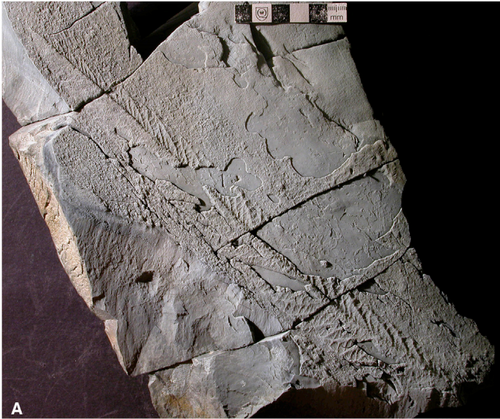
Longest specimens of Trepassia wardae (also known as Charnia wardi) reached 185 cm (73 in) in length.[780]Charnia masoni is known from specimens as small as only 1 cm (0.39 in), up to the largest specimens of 66 cm (26 in) in length.[781]
Proarticulata
Dickinsonia tenuis reached 1.4 m (4.6 ft) in length, that makes it one of the largest precambrian organisms.[782][783]
Sponges (Porifera)
The largest known Permian sponge Gigantospongia had diameter up to 2.5 metres (8 ft 2 in).[784]
See also
References
- ↑Carbone, Chris; Teacher, Amber; Rowcliffe, J (2007). "The Costs of Carnivory". PLOS Biology. 5 (2) e22. doi:10.1371/journal.pbio.0050022. PMC 1769424. PMID 17227145.
- ↑Hokkanen, J.E.I. (February 1986). "The size of the largest land animal". Journal of Theoretical Biology. 118 (4): 491–499. Bibcode:1986JThBi.118..491H. doi:10.1016/S0022-5193(86)80167-9. PMID 3713220.
- ↑Romano, Marco; Citton, Paolo; Maganuco, Simone; Sacchi, Eva; Caratelli, Martina; Ronchi, Ausonio; Nicosia, Umberto (May 2019). "New basal synapsid discovery at the Permian outcrop of Torre del Porticciolo (Alghero, Italy)". Geological Journal. 54 (3): 1554–1566. Bibcode:2019GeolJ..54.1554R. doi:10.1002/gj.3250. S2CID 133755506.
- ↑"Subcommission on Permian Stratigraphy"(PDF). permian.stratigraphy.org. International Commission on Stratigraphy International Union of Geological Sciences. Archived(PDF) from the original on 3 December 2018. Retrieved 8 September 2022.
- ↑Reisz, Robert R.; Fröbisch, Jörg (16 April 2014). "The Oldest Caseid Synapsid from the Late Pennsylvanian of Kansas, and the Evolution of Herbivory in Terrestrial Vertebrates". PLOS ONE. 9 (4) e94518. Bibcode:2014PLoSO...994518R. doi:10.1371/journal.pone.0094518. PMC 3989228. PMID 24739998.
- ↑Romer, A.S.; Price, L.W. (1940). "Review of the Pelycosauria". Geological Society of America Special Papers (28): 400, 403.
- ↑"Edaphosaurus". Palaeos. Archived from the original on 20 February 2022. Retrieved 9 September 2022.
- ↑Romer, A.S.; Price, L.W. (1940). Review of the Pelycosauria. pp. 400, 403. ISBN 978-0-8137-2028-9.
{{cite book}}: ISBN / Date incompatibility (help);|journal=ignored (help) - ↑"Edaphosaurus". Palaeos. Archived from the original on 20 February 2022. Retrieved 9 September 2022.
- ↑Berman, D.S.; Reisz, R.R.; Martens, T.; Henrici, A.C. (2001). "A new species of Dimetrodon (Synapsida: Sphenacodontidae) from the Lower Permian of Germany records first occurrence of genus outside of North America"(PDF). Canadian Journal of Earth Sciences. 38 (5): 803–812. Bibcode:2001CaJES..38..803B. doi:10.1139/cjes-38-5-803.
- ↑Brink, Kirstin S.; Reisz, Robert R. (16 October 2014). "Hidden dental diversity in the oldest terrestrial apex predator Dimetrodon". Nature Communications. 5 3269. Bibcode:2014NatCo...5.3269B. doi:10.1038/ncomms4269. PMID 24509889.
- ↑Olson, E.C. (1955). "Parallelism in the evolution of the Permian reptilian faunas of the Old and New Worlds". Fieldiana. 37 (13): 395. Retrieved 8 September 2022.
- ↑St. Fleur, Nicholas (4 January 2019). "An Elephant-Size Relative of Mammals That Grazed Alongside Dinosaurs". The New York Times. Retrieved 9 September 2022.
- ↑Sulej, Tomasz; Niedzwiedzki, Grzegorz (4 January 2019). "An elephant-sized Late Triassic synapsid with erect limbs". Science. 363 (6422): 78–80. Bibcode:2019Sci...363...78S. doi:10.1126/science.aal4853. PMID 30467179.
- ↑"Gigantic mammal 'cousin' discovered". ScienceDaily (Press release). Uppsala University. 23 November 2018.
- ↑Romano, Marco; Manucci, Fabio (3 April 2021). "Resizing Lisowicia bojani: volumetric body mass estimate and 3D reconstruction of the giant Late Triassic dicynodont". Historical Biology. 33 (4): 474–479. Bibcode:2021HBio...33..474R. doi:10.1080/08912963.2019.1631819. ISSN 0891-2963.
- 12"Eotitanosuchidae". Kheper. M.Alan Kazlev. Archived from the original on 6 August 2019. Retrieved 9 September 2022.
- ↑Benoit, Julien; Midzuk, A. J. (January 2024). "Estimating the endocranial volume and body mass of Anteosaurus, Jonkeria, and Moschops (Dinocephalia, Therapsida) using 3D sculpting"(PDF). Palaeontologia Electronica. 27 (2). doi:10.26879/1377.
- ↑Romano, M., & Rubidge, B. (2019). First 3D reconstruction and volumetric body mass estimate of the tapinocephalid dinocephalian Tapinocaninus pamelae (Synapsida: Therapsida). Historical Biology, 33(4), 498–505. https://doi.org/10.1080/08912963.2019.1640219
- ↑van Valkenburgh, Blaire; Jenkins, Ian (2002). "Evolutionary Patterns in the History of Permo-Triassic and Cenozoic synapsid predators". Paleontological Society Papers 8: 267–288.
- 12"Brithopodidae / Anteosauridae". Kheper. M.Alan Kazlev. Archived from the original on 12 August 2019. Retrieved 9 September 2022.
- ↑Prothero, Donald R. (18 April 2022). "20. Synapsids: The Origin of Mammals". Vertebrate Evolution: From Origins to Dinosaurs and Beyond. Boca Raton: CRC Press. doi:10.1201/9781003128205-4. ISBN 978-0-367-47316-7. S2CID 246318785.
- 123Kammerer, Christian F. (2016). "Systematics of the Rubidgeinae (Therapsida: Gorgonopsia)". PeerJ. 4 e1608. doi:10.7717/peerj.1608. PMC 4730894. PMID 26823998.
- ↑Pages 158–159 in: Angielczyk, Kenneth D.; Kammerer, Christian F. (2018). "Non-Mammalian synapsids: The deep roots of the mammalian family tree". Mammalian Evolution, Diversity and Systematics. pp. 117–198. doi:10.1515/9783110341553-005. ISBN 978-3-11-034155-3.
- ↑Mikhail F. Ivakhnenko (2008). "The First Whaitsiid (Therocephalia, Theromorpha)". Paleontological Journal. 42 (4): 409–413. doi:10.1134/S0031030108040102. S2CID 140547244.
- ↑Suchkova, Yu. A.; Golubev, V. K. (1 May 2019). "A New Primitive Therocephalian (Theromorpha) from the Middle Permian of Eastern Europe". Paleontological Journal. 53 (3): 305–314. doi:10.1134/S0031030119030158. ISSN 1555-6174. S2CID 195299565.
- ↑J. Van Den Heever (1987), Dissertation Presented for the Degree of Doctor of Philosophy at the University of Stellenbosch
- ↑Lydekker, R. (1908). "The Year's Vertebrate Palæontology". Science Progress in the Twentieth Century (1906-1916). 2 (7): 501–524. JSTOR 43776634.
- ↑Boonstra, L. D. (1954). "The pristerognathid therocephalians from the Tapinocephalus-Zone in the South African Museum". Annals of the South African Museum. 42 (Part 2): 65–107.
- ↑Broom, Robert (1903). "On Some New Primitive Theriodonts". Annals of the South African Museum. 4.
- ↑Abdala, F.; Kammerer, C. F.; Day, M. O.; Jirah, S.; Rubidge, B. S. (2014). "Adult morphology of the therocephalian Simorhinella baini from the middle Permian of South Africa and the taxonomy, paleobiogeography, and temporal distribution of the Lycosuchidae". Journal of Paleontology. 88 (6): 1139. doi:10.1666/13-186. S2CID 129323281.
- ↑Suchkova, J.A.; Golubev, V.K. (2019). "New Permian therocephalian (Therocephalia, Theromorpha) from the Sundyr Assemblage of Eastern Europe". Paleontological Journal (4): 87–92. doi:10.1134/S0031031X19040123.
- ↑Tolchard, Frederick; Kammerer, Christian F.; Butler, Richard J.; Hendrickx, Christophe; Benoit, Julien; Abdala, Fernando; Choiniere, Jonah N. (4 March 2021). "A new large gomphodont from the Triassic of South Africa and its implications for Gondwanan biostratigraphy"(PDF). Journal of Vertebrate Paleontology. 41 (2) e1929265. Bibcode:2021JVPal..41E9265T. doi:10.1080/02724634.2021.1929265.
- ↑William A. Clemens (2011). "New morganucodontans from an Early Jurassic fissure filling in Wales (United Kingdom)". Palaeontology. 54 (5): 1139–1156. Bibcode:2011Palgy..54.1139C. doi:10.1111/j.1475-4983.2011.01094.x.
- ↑Rose 2006, p. 56.
- ↑Paul Selden; John Nudds (19 September 2012). Evolution of Fossil Ecosystems. Second edition. Academic Press. p. 178. ISBN 978-0-12-404629-0. Retrieved 25 August 2022.
- ↑Zofia Kielan-Jaworowska; Richard L. Cifelli; Zhe-Xi Luo (2004). "Chapter 12: Metatherians". Mammals from the Age of Dinosaurs: origins, evolution, and structure. New York: Columbia University Press. p. 243. ISBN 978-0-231-11918-4.
- 123Prothero, Donald R. (15 November 2016). The Princeton Field Guide to Prehistoric Mammals. Princeton University Press. p. 33. ISBN 978-0-691-15682-8. Retrieved 22 September 2022.
- ↑Frank Zachos, Robert Asher (22 October 2018). Mammalian Evolution, Diversity and Systematics. De Gruyter. p. 224. ISBN 978-3-11-034155-3. Retrieved 25 August 2022.
- 12Rose 2006, p. 62.
- 12Kielan-Jaworowska, Zofia (2013). In Pursuit of Early Mammals. Indiana University Press. p. 115. ISBN 978-0-253-00824-4. Retrieved 25 August 2022.
- ↑Hu, Yaoming; Meng, Jin; Wang, Yuanqing; Li, Chuankui (13 January 2005). "Large Mesozoic mammals fed on young dinosaurs"(PDF). Nature. 433 (7022): 149–152. Bibcode:2005Natur.433..149H. doi:10.1038/nature03102. PMID 15650737.
- ↑T. S. Kemp (2005). The Origin and Evolution of Mammals. Oxford University Press, USA. p. 183. ISBN 978-0-19-850761-1. Retrieved 22 September 2022.
- ↑Rose 2006, p. 60.
- ↑Williamson, Thomas E.; Brusatte, Stephen L.; Secord, Ross; Shelley, Sarah (May 2016). "A new taeniolabidoid multituberculate (Mammalia) from the middle Puercan of the Nacimiento Formation, New Mexico, and a revision of taeniolabidoid systematics and phylogeny: Revision of Taeniolabidoidea". Zoological Journal of the Linnean Society. 177 (1): 183–208. doi:10.1111/zoj.12336.
- ↑"Zaglossus hacketti – extinct giant echidna". Tourism Western Australia. Archived from the original on 26 January 2014. Retrieved 28 April 2014.
- ↑Pian, Rebecca; Archer, Michael; Hand, Suzanne J. (1 November 2013). "A new, giant platypus, Obdurodon tharalkooschild, sp. nov. (Monotremata, Ornithorhynchidae), from the Riversleigh World Heritage Area, Australia". Journal of Vertebrate Paleontology. 33 (6): 1255–1259. Bibcode:2013JVPal..33.1255P. doi:10.1080/02724634.2013.782876. S2CID 85776473.
- ↑Weil, Anne (2005). "Mammalian palaeobiology: Living large in the Cretaceous". Nature. 433 (7022) (published 12 January 2005): 116–117. Bibcode:2005Natur.433..116W. doi:10.1038/433116b. PMID 15650725. S2CID 52869101.
- ↑Engelman, Russell K.; Flynn, John J. (John Joseph); Wyss, André R.; Croft, Darin A. (17 July 2020). Eomakhaira molossus, a new saber-toothed sparassodont (Metatheria: Thylacosmilinae) from the early Oligocene (?Tinguirirican) Cachapoal locality, Andean Main Range, Chile. (American Museum novitates, no. 3957) (Report). American Museum of Natural History. hdl:2246/7235.
- ↑A. M. Forasiepi; M. Judith Babot; N. Zimicz (2014). "Australohyaena antiqua (Mammalia, Metatheria, Sparassodonta), a large predator from the Late Oligocene of Patagonia". Journal of Systematic Palaeontology. 13 (6): 503–525. Bibcode:2015JSPal..13..503F. doi:10.1080/14772019.2014.926403. hdl:11336/59430.
- ↑Prevosti, Francisco J.; Forasiepi, Analía M. (2018). "South American Endemic Mammalian Predators (Order Sparassodonta)". Evolution of South American Mammalian Predators During the Cenozoic: Paleobiogeographic and Paleoenvironmental Contingencies. Springer Geology. p. 67. Bibcode:2018esam.book.....P. doi:10.1007/978-3-319-03701-1. ISBN 978-3-319-03700-4. S2CID 134939823.
- ↑Tarquini, S. D.; Ladevèze, S.; Prevosti, F. J. (2022). "The multicausal twilight of South American native mammalian predators (Metatheria, Sparassodonta)". Scientific Reports. 12 (1): 1224. Bibcode:2022NatSR..12.1224T. doi:10.1038/s41598-022-05266-z. PMC 8786871. PMID 35075186.
- ↑Prevosti, Francisco J.; Forasiepi, Analía; Zimicz, Natalia (5 November 2011). "The Evolution of the Cenozoic Terrestrial Mammalian Predator Guild in South America: Competition or Replacement?". Journal of Mammalian Evolution. 20 (1): 3–21. doi:10.1007/s10914-011-9175-9. hdl:11336/2663. S2CID 15751319.
- ↑Ercoli, Marcos Darío; Prevosti, Francisco Juan (1 December 2011). "Estimación de Masa de las Especies de Sparassodonta (Mammalia, Metatheria) de Edad Santacrucense (Mioceno Temprano) a Partir del Tamaño del Centroide de los Elementos Apendiculares: Inferencias Paleoecológicas" [Mass Estimation of the Holy Cross (Early Miocene) Sparassodonta (Mammalia, Metatheria) Species from the Centroid Size of the Appendicular Elements: Paleoecological Inferences]. Ameghiniana (in Spanish). 48 (4): 462–479. Bibcode:2011Amegh..48..462E. doi:10.5710/amgh.v48i4(347). S2CID 129838311.
- 123456789Sorkin, Boris (December 2008). "A biomechanical constraint on body mass in terrestrial mammalian predators". Lethaia. 41 (4): 333–347. Bibcode:2008Letha..41..333S. doi:10.1111/j.1502-3931.2007.00091.x.
- ↑Forasiepi, Analía M.; Judith Babot, M.; Zimicz, Natalia (3 June 2015). "Australohyaena antiqua (Mammalia, Metatheria, Sparassodonta), a large predator from the Late Oligocene of Patagonia". Journal of Systematic Palaeontology. 13 (6): 503–525. Bibcode:2015JSPal..13..503F. doi:10.1080/14772019.2014.926403. hdl:11336/59430.
- ↑Rose 2006, p. 78.
- ↑Zofia Kielan-Jaworowska; Richard L. Cifelli; Zhe-Xi Luo (2004). "Chapter 12: Metatherians". Mammals from the Age of Dinosaurs: origins, evolution, and structure. New York: Columbia University Press. p. 428. ISBN 978-0-231-11918-4.
- ↑Wilson, G.P.; Ekdale, E.G.; Hoganson, J.W.; Calede, J.J.; Linden, A.V. (2016). "A large carnivorous mammal from the Late Cretaceous and the North American origin of marsupials". Nature Communications. 7 13734. Bibcode:2016NatCo...713734W. doi:10.1038/ncomms13734. PMC 5155139. PMID 27929063.
- ↑"Ice Age Marsupial Topped Three Tons, Scientists Say". Archived from the original on 13 April 2010.
- ↑Richards, Hazel L.; Wells, Rod T.; Evans, Alistair R.; Fitzgerald, Erich M. G.; Adams, Justin W. (13 September 2019). "The extraordinary osteology and functional morphology of the limbs in Palorchestidae, a family of strange extinct marsupial giants". PLOS ONE. 14 (9) e0221824. Bibcode:2019PLoSO..1421824R. doi:10.1371/journal.pone.0221824. PMC 6744111. PMID 31518353.
- ↑Alloing-Séguier, Léanie; Sánchez-Villagra, Marcelo R.; Lee, Michael S. Y.; Lebrun, Renaud (2013). "The Bony Labyrinth in Diprotodontian Marsupial Mammals: Diversity in Extant and Extinct Forms and Relationships with Size and Phylogeny". Journal of Mammalian Evolution. 20 (3): 191–198. doi:10.1007/s10914-013-9228-3. S2CID 16385939.
- ↑Wroe, S.; Myers, T. J.; Wells, R. T.; Gillespie, A. (1999). "Estimating the weight of the Pleistocene marsupial lion, Thylacoleo carnifex (Thylacoleonidae:Marsupialia): implications for the ecomorphology of a marsupial super-predator and hypotheses of impoverishment of Australian marsupial carnivore faunas". Australian Journal of Zoology. 47 (5): 489. doi:10.1071/ZO99006.
- ↑Prideaux, Gavin J.; Roberts, Richard G.; Megirian, Dirk; Westaway, Kira E.; Hellstrom, John C.; Olley, Jon M. (2007). "Mammalian responses to Pleistocene climate change in southeastern Australia"(PDF). Geology (FTP). p. 33. Bibcode:2007Geo....35...33P. doi:10.1130/G23070A.1.(To view documents see Help:FTP)
- ↑Owen and Pemberton, p. 35.
- ↑Hocknull, Scott A.; Lewis, Richard; Arnold, Lee J.; Pietsch, Tim; Joannes-Boyau, Renaud; Price, Gilbert J.; Moss, Patrick; Wood, Rachel; Dosseto, Anthony; Louys, Julien; Olley, Jon; Lawrence, Rochelle A. (18 May 2020). "Extinction of eastern Sahul megafauna coincides with sustained environmental deterioration". Nature Communications. 11 (1): 2250. Bibcode:2020NatCo..11.2250H. doi:10.1038/s41467-020-15785-w. PMC 7231803. PMID 32418985.
- ↑Helgen, K. M.; Wells, R. T.; Kear, B. P.; Gerdtz, W. R.; Flannery, T. F. (2006). "Ecological and evolutionary significance of sizes of giant extinct kangaroos". Australian Journal of Zoology. 54 (4): 293–303. doi:10.1071/ZO05077.
- ↑Janis, CM; Buttrill, K; Figueirido, B (2014). "Locomotion in Extinct Giant Kangaroos: Were Sthenurines Hop-Less Monsters?". PLOS ONE. 9 (10) e109888. Bibcode:2014PLoSO...9j9888J. doi:10.1371/journal.pone.0109888. PMC 4198187. PMID 25333823.
- ↑Prideaux, Gavin J.; Warburton, Natalie M. (7 June 2023). "A review of the late Cenozoic genus Bohra (Diprotodontia: Macropodidae) and the evolution of tree-kangaroos". Zootaxa. 5299 (1): 1–95. doi:10.11646/zootaxa.5299.1.1. ISSN 1175-5334. PMID 37518576.
- ↑Long, John A. (2002). Prehistoric Mammals of Australia and New Guinea: One Hundred Million Years of Evolution. Johns Hopkins University Press. p. 174. ISBN 978-0-8018-7223-5.
- ↑Yates, A.M. (12 May 2015). "Thylacinus (Marsupialia: Thylacinidae) from the Mio-Pliocene boundary and the diversity of Late Neogene thylacinids in Australia". PeerJ. 3 e931. doi:10.7717/peerj.931. PMC 4435473. PMID 26019996.
- ↑Kazimierz Kowalski (1976). Mammals. An Outline of Theriology. Polish Scientific Publishers. p. 442. Retrieved 17 September 2022.
- ↑John W. Hoganson (2007). Dinosaurs, Sharks, and Woolly Mammoths. State Historical Society of North Dakota. p. 36. ISBN 978-1-891419-33-1. Retrieved 17 September 2022.
- ↑Uhen, Mark D.; Gingerich, Philip D. (1995). "Evolution of Coryphodon (Mammalia, Pantodonta) in the Late Paleocene and Early Eocene of Northwestern Wyoming". Contributions from the Museum of Paleontology, University of Michigan. 29 (10): 264. hdl:2027.42/48649. OCLC 742731820.
- ↑"Paleocene mammals of the world". Archived from the original on 11 September 2022.
- 12"Paleocene mammals of the world". www.paleocene-mammals.de. Archived from the original on 3 August 2022. Retrieved 17 September 2022.
- 12TJ Meehan, Larry D. Martin (1 September 2012). "New Large Leptictid Insectivore from the Late Paleogene of South Dakota, USA". Acta Palaeontologica Polonica. 57 (3): 509–518. doi:10.4202/app.2011.0035. S2CID 129358395.
- ↑MacPhee, R. D. E. (1994). "Morphology, adaptations, and relationships of Plesiorycteropus: And a diagnosis of a new order of eutherian mammals". Bulletin of the American Museum of Natural History (220): 148. hdl:2246/828.
- 123Romano, Marco; Manucci, Fabio; Bellucci, Luca (30 July 2024). "Body mass estimate and in-vivo reconstruction of Hippopotamus antiquus from Figline, Upper Valdarno (Tuscany)". Historical Biology. 37 (6): 1541–1552. doi:10.1080/08912963.2024.2380358. ISSN 0891-2963.
- ↑Martino, Roberta; Ríos, Maria Ibanez; Mateus, Octavio; Pandolfi, Luca (December 2022). "Taxonomy, chronology, and dispersal patterns of Western European Quaternary hippopotamuses: New insight from Portuguese fossil material". Quaternary International. 674–675: 121–137. doi:10.1016/j.quaint.2022.12.010. S2CID 255029640.
- ↑Hutchinson, John R. (1 June 2021). "The evolutionary biomechanics of locomotor function in giant land animals". Journal of Experimental Biology. 224 (11) jeb217463. Bibcode:2021JExpB.224B7463H. doi:10.1242/jeb.217463. ISSN 0022-0949. PMC 8214834. PMID 34100541.
- ↑Donald R. Prothero, Scott E. Foss (2007). The Evolution of Artiodactyls. The Johns Hopkins University Press. pp. 128–129. ISBN 978-0-8018-8735-2. Retrieved 26 September 2020.
- ↑Peterson, O. A. (1909). "A revision of the Entelodontidae". Memoirs of the Carnegie Museum. 4 (3): 41–158. doi:10.5962/p.234831. hdl:2027/mdp.39015017493571. S2CID 247000277.
- ↑Osborn, Henry Fairfield; Olsen, George; Central Asiatic Expeditions (1924). "Andrewsarchus, giant mesonychid of Mongolia". American Museum Novitates (146). hdl:2246/3226.
- ↑Thewissen, J. G. M.; Cooper, Lisa Noelle; Clementz, Mark T.; Bajpai, Sunil; Tiwari, B. N. (2009). "Thewissen et al. Reply". Nature. 458 (7236) E5. Bibcode:2009Natur.458....5T. doi:10.1038/nature07775. S2CID 4431497.
- ↑Tabuce, Rodolphe; Clavel, Julien; Antunes, Miguel Telles (February 2011). "A structural intermediate between triisodontids and mesonychians (Mammalia, Acreodi) from the earliest Eocene of Portugal". Naturwissenschaften. 98 (2): 145–155. Bibcode:2011NW.....98..145T. doi:10.1007/s00114-010-0747-y. PMID 21181109.
- ↑East, Shirley G. (29 December 2011). The Dream Hunters Epoch: The Paleo Indians Series. Xlibris Corporation. ISBN 978-1-4653-9694-5.
- ↑Fariña, Richard A.; Vizcaíno, Sergio F.; Iuliis, Gerry De (22 May 2013). Megafauna: Giant Beasts of Pleistocene South America. Indiana University Press. ISBN 978-0-253-00719-3.
- ↑Froese, Duane; Stiller, Mathias; Heintzman, Peter D.; Reyes, Alberto V.; Zazula, Grant D.; Soares, André E. R.; Meyer, Matthias; Hall, Elizabeth; Jensen, Britta J. L.; Arnold, Lee J.; MacPhee, Ross D. E.; Shapiro, Beth (28 March 2017). "Fossil and genomic evidence constrains the timing of bison arrival in North America". Proceedings of the National Academy of Sciences. 114 (13): 3457–3462. Bibcode:2017PNAS..114.3457F. doi:10.1073/pnas.1620754114. PMC 5380047. PMID 28289222.
- 12"Extinct Long-horned Bison & Ancient Bison (Bison latifrons and B. antiquus) Fact Sheet: Summary. San Diego Zoo Global Library". Archived from the original on 15 January 2021.
- ↑Kurten, B.; Anderson, E. (1980). "Order Artiodactyla". Pleistocene mammals of North America (1st ed.). New York: Columbia University Press. pp. 295–339. ISBN 0-231-03733-3.
- ↑Donald R. Prothero (2016). The Princeton Field Guide to Prehistoric Mammals. Princeton University Press. p. 184. ISBN 978-0-691-15682-8. Retrieved 31 August 2022.
- 12Camps, Gabriel (1992). "Bubalus antiquus". In Camps, Gabriel (ed.). Encyclopédie Berbère (in French). Vol. 11. Aix-en-Provence: Edisud. pp. 1642–1647. doi:10.4000/encyclopedieberbere.1875. Archived from the original on 18 July 2020. Retrieved 31 August 2022.
- ↑Pomel, Auguste (1893). Bubalus antiquus. Carte de Géologie de l'Algérie – Paléontologie Monographies de Vertébrés (in French). Algiers: imprimerie P. Fontana. pp. 1–94, pl.1–10. doi:10.5962/bhl.title.13867.
- ↑Palmer 1999, p. 281.
- ↑"Warkworth Western Weekend Rodeo | Competitors". Archived from the original on 21 August 2011. Retrieved 30 May 2012.
- ↑Kysely, René. "Aurochs and potential crossbreeding with domestic cattle in Central Europe in the Eneolithic period. A metric analysis of bones from the archaeological site of Kutná Hora-Denemark (Czech Republic)". Anthropozoologica. 43 (2): 2008.
- ↑"Kouprey (Bos sauveli)". Archived from the original on 10 August 2011.
- ↑Burnie, D.; Wilson, D.E., eds. (2005). Animal: The Definitive Visual Guide to the World's Wildlife. DK Adult. ISBN 0-7894-7764-5.
- ↑K. Suraprasit; J.-J. Jaegar; Y. Chaimanee; O. Chavasseau; C. Yamee; P. Tian; S. Panha (2016). "The Middle Pleistocene vertebrate fauna from Khok Sung (Nakhon Ratchasima, Thailand): biochronological and paleobiogeographical implications". ZooKeys (613): 1–157. Bibcode:2016ZooK..613....1S. doi:10.3897/zookeys.613.8309. PMC 5027644. PMID 27667928.
- ↑Douglas M. Considine; Glenn D. Considine (2013). Van Nostrand's Scientific Encyclopedia. Springer US. p. 446. ISBN 978-1-4757-6918-0. Retrieved 28 August 2022.
- ↑Herring, Andy D. (2014). Beef Cattle Production Systems. CABI. p. 22. ISBN 978-1-78064-507-0. Retrieved 28 August 2022.
- ↑Terry Harrison (27 January 2011). Paleontology and Geology of Laetoli: Human Evolution in Context. Volume 2: Fossil Hominins and the Associated Fauna. Springer Netherlands. p. 404. ISBN 978-90-481-9962-4. Retrieved 17 September 2022.
- ↑Discovery. Magazine of the Peabody Museum of Natural History, Yale University. Volumes 13–16. Peabody Museum of Natural History. 1978. p. 9. Retrieved 17 September 2022.
- ↑Churchill, S.E.; Brink, J.S.; Berger, L.R.; Hutchison, R.A.; Rossouw, L.; Stynder, D.; Hancox, P.J.; Brandt, D.; Woodborne, S.; Loock, J.C.; Scott, L.; Ungar, P. (2000). "Erfkroon: a new Florisian fossil locality from fluvial contexts in the western Free State, South Africa". South African Journal of Science. 96 (4): 161–163. hdl:10520/AJA00382353_8897.
- ↑David Petersen (1989). "Of Moose, Megaloceros and Miracles". Motherearthnews.com. Archived from the original on 4 May 2017.
- ↑Moen, Ron A.; Pastor, John; Cohen, Yosef (1999). "Antler growth and extinction of Irish elk"(PDF). Evolutionary Ecology Research: 235–249. Archived from the original on 18 July 2020.
- ↑Kevrekidis, Charalampos; Kostopoulos, Dimitris S. (2017). The southernmost occurrence of Cervalces latifrons (Johnson, 1874) (Artiodactyla: Cervidae) in Europe. 44. Treffen des Arbeitskreises Wirbeltierpaläontologie, 24-26.3.2017, Münster. doi:10.13140/RG.2.2.24751.53928.
- ↑Geist, Valerius (1998). Deer of the world: their evolution, behaviour, and ecology. Stackpole Books. pp. 111, 126, 247–250. ISBN 978-0-8117-0496-0.
- ↑Breda, Marzia (2010). "Cervalces latifrons". Natural History Museum. Archived from the original on 4 January 2014.
- ↑Strauss, Bob. "Stag Moose – Facts and Figures". Thoughtco.com. Archived from the original on 4 November 2021. Retrieved 11 October 2022.
- ↑"Cervalces". Escenarios prehistóricos (in Spanish). Laignoranciadelconocimiento.blogspot.com.es. 23 December 2011. Archived from the original on 27 January 2022. Retrieved 11 October 2022.
- ↑Basu, Christopher; Falkingham, Peter L.; Hutchinson, John R. (January 2016). "The extinct, giant giraffid Sivatherium giganteum: skeletal reconstruction and body mass estimation". Biology Letters. 12 (1) 20150940. doi:10.1098/rsbl.2015.0940. PMC 4785933. PMID 26763212.
- ↑Palmer 1999, p. 273.
- ↑Janis, Christine M.; Theodor, Jessica M.; Boisvert, Bethany (14 March 2002). "Locomotor evolution in camels revisited: a quantitative analysis of pedal anatomy and the acquisition of the pacing gait". Journal of Vertebrate Paleontology. 22 (1): 110–121. doi:10.1671/0272-4634(2002)022[0110:LEICRA]2.0.CO;2.
- ↑Teeth: Kubanochoerus gigas lii (GUAN). tesorosnaturales.es
- ↑Pickford, M. (2006). "New suoid specimens from Gebel Zelten, Libya". Estudios Geológicos. 62 (1): 499–514. doi:10.3989/egeol.0662147.
- ↑Palmer 1999, p. 269.
- ↑Giant Camel Disappeared SpeciesArchived 10 November 2013 at the Wayback Machine. Intechinc.com (5 July 2011)
- ↑Mendoza, M.; Janis, C. M.; Palmqvist, P. (September 2006). "Estimating the body mass of extinct ungulates: a study on the use of multiple regression". Journal of Zoology. 270 (1): 90–101. doi:10.1111/j.1469-7998.2006.00094.x.
- 12"Giant camel fossil found in Syria". BBC News. 10 October 2006. Archived from the original on 27 September 2019. Retrieved 17 April 2013.
- ↑Rebecca Wragg Sykes (17 June 2022). Néandertal, un parent: À la découverte de nos origines. Delachaux et Niestlé. ISBN 978-2-603-02968-8. Retrieved 28 August 2022.
- ↑Anthony J. Stuart, 2021, Vanished Giants: The Lost World of the Ice Age, "6.17 Yesterday's Camel: Camelops Hesternus", p. 99, University of Chicago Press
- ↑Badiola, Ainara; De Vicuña, Nahia Jiménez; Perales-Gogenola, Leire; Gómez-Olivencia, Asier (2023). "First clear evidence of Anoplotherium (Mammalia, Artiodactyla) in the Iberian Peninsula: an update on the Iberian anoplotheriines". The Anatomical Record: Advances in Integrative Anatomy and Evolutionary Biology. 308 (6): 1783–1800. doi:10.1002/ar.25238. PMC 12062563. PMID 37221992. S2CID 258864256.
- ↑Hooker, Jerry J. (2007). "Bipedal browsing adaptations of the unusual Late Eocene–earliest Oligocene tylopod Anoplotherium (Artiodactyla, Mammalia)". Zoological Journal of the Linnean Society. 151 (3): 609–659. doi:10.1111/j.1096-3642.2007.00352.x.
- ↑Bianucci, G.; Lambert, O.; Urbina, M.; Merella, M.; Collareta, A.; Bennion, R.; Salas-Gismondi, R.; Benites-Palomino, A.; Post, K.; de Muizon, C.; Bosio, G.; Di Celma, C.; Malinverno, E.; Pierantoni, P.P.; Villa, I.M.; Amson, E. (2023). "A heavyweight early whale pushes the boundaries of vertebrate morphology". Nature. 620 (7975): 824–829. Bibcode:2023Natur.620..824B. doi:10.1038/s41586-023-06381-1. hdl:10281/434998. PMID 37532931. S2CID 260433513.
- ↑Motani, Ryosuke; Pyenson, Nicholas D. (29 February 2024). "Downsizing a heavyweight: factors and methods that revise weight estimates of the giant fossil whale Perucetus colossus". PeerJ. 12 e16978. doi:10.7717/peerj.16978. ISSN 2167-8359. PMC 10909350. PMID 38436015.
- ↑Paul, Gregory; Larramendi, Asier (2025). "Further trimming down the marine heavyweights: Perucetus colossus did not come close to, much less exceed, the tonnage of blue whales, and the latter are not ultra-sized either". Palaeontologia Electronica. doi:10.26879/1435.
- ↑Gingerich, P. D.; Arif, M; Bhatti, M Akram; Anwar, M; Sanders, William J (1997). "Basilosaurus drazindai and Basiloterus hussaini, New Archaeoceti (Mammalia, Cetacea) from the Middle Eocene Drazinda Formation, with a Revised Interpretation of Ages of Whale-Bearing Strata in the Kirthar Group of the Sulaiman Range, Punjab (Pakistan)". Contributions from the Museum of Paleontology, University of Michigan. 30 (2): 55–81. hdl:2027.42/48652. OCLC 742731913.
- ↑Kellogg R. A review of the Archaeoceti. Carnegie Institution of Washington Publications. 1936; 482: 1–366.
- ↑Voss, Manja; Antar, Mohammed Sameh M.; Zalmout, Iyad S.; Gingerich, Philip D. (2019). "Stomach contents of the archaeocete Basilosaurus isis: Apex predator in oceans of the late Eocene". PLOS ONE. 14 (1). e0209021. Bibcode:2019PLoSO..1409021V. doi:10.1371/journal.pone.0209021. PMC 6326415. PMID 30625131.
- ↑Bianucci, Giovanni; Bosio, Giulia; Malinverno, Elisa; de Muizon, Christian; Villa, Igor M.; Urbina, Mario; Lambert, Olivier (April 2018). "A new large squalodelphinid (Cetacea, Odontoceti) from Peru sheds light on the Early Miocene platanistoid disparity and ecology". Royal Society Open Science. 5 (4) 172302. Bibcode:2018RSOS....572302B. doi:10.1098/rsos.172302. hdl:11568/955787. PMC 5936943. PMID 29765678.
- 12Deméré, T.A.; Berta, A.; McGowen, M.R. (2005). "The taxonomic and evolutionary history of fossil and modern balaenopteroid mysticetes". Journal of Mammalian Evolution. 12 (1/2): 99–143. doi:10.1007/s10914-005-6944-3. S2CID 90231.
- ↑Slater, Graham J.; Goldbogen, Jeremy A.; Pyenson, Nicholas D. (31 May 2017). "Independent evolution of baleen whale gigantism linked to Plio-Pleistocene ocean dynamics". Proceedings of the Royal Society B: Biological Sciences. 284 (1855). 20170546. doi:10.1098/rspb.2017.0546. PMC 5454272. PMID 28539520.
- ↑Lambert, Olivier; Bianucci, Giovanni; Post, Klaas; de Muizon, Christian; Salas-Gismondi, Rodolfo; Urbina, Mario; Reumer, Jelle (2010). "The giant bite of a new raptorial sperm whale from the Miocene epoch of Peru"(PDF). Nature. 466 (7302): 105–108. Bibcode:2010Natur.466..105L. doi:10.1038/nature09067. PMID 20596020. S2CID 4369352. Archived from the original(PDF) on 1 December 2017.
- ↑Li, Shijie; Jiangzuo, Qigao; Deng, Tao (6 July 2022). "Body mass of the giant rhinos (Paraceratheriinae, Mammalia) and its tendency in evolution". Historical Biology. 37 (11): 2513–2524. doi:10.1080/08912963.2022.2095908. ISSN 0891-2963.
- 12345678Larramendi, Asier (2015). "Proboscideans: Shoulder Height, Body Mass and Shape". Acta Palaeontologica Polonica. doi:10.4202/app.00136.2014.
- ↑Fortelius, M.; Kappelman, J. (1993). "The largest land mammal ever imagined". Zoological Journal of the Linnean Society. 108: 85–101. doi:10.1111/j.1096-3642.1993.tb02560.x.
- 12Zhegallo, V.; Kalandadze, N.; Shapovalov, A.; Bessudnova, Z.; Noskova, N.; Tesakova, E. (2005). "On the fossil rhinoceros Elasmotherium (including the collections of the Russian Academy of Sciences)"(PDF). Cranium. 22 (1): 17–40.
- 12Schvyreva, A.K. (2016). Эласмотерии плейстоцена Евразии(PDF) (in Russian). pp. 103–105.
- 12Kosintsev, P.; Mitchell, K. J.; Devièse, T.; van der Plicht, J.; Kuitems, M.; Petrova, E.; Tikhonov, A.; Higham, T.; Comeskey, D.; Turney, C.; Cooper, A.; van Kolfschoten, T.; Stuart, A. J.; Lister, A. M. (2019). "Evolution and extinction of the giant rhinoceros Elasmotherium sibiricum sheds light on late Quaternary megafaunal extinctions". Nature Ecology & Evolution. 3 (1): 31–38. doi:10.1038/s41559-018-0722-0. hdl:11370/78889dd1-9d08-40f1-99a4-0e93c72fccf3. PMID 30478308. S2CID 53726338.
- ↑Krause, Hans (2011). "Hkhpe 07 02". hanskrause.de. Archived from the original on 28 August 2022. Retrieved 10 September 2022.
- ↑Hans-Dieter Sues, Ross D.E. MacPhee (30 June 1999). Extinctions in Near Time. Causes, Contexts, and Consequences. Springer US. p. 262. ISBN 978-0-306-46092-0. Retrieved 17 September 2022.
- ↑Boeskorov, G. G. (2012). "Some specific morphological and ecological features of the fossil woolly rhinoceros (Coelodonta antiquitatis Blumenbach 1799)". Biology Bulletin. 39 (8): 692–707. Bibcode:2012BioBu..39..692B. doi:10.1134/S106235901208002X. S2CID 24868968.
- ↑"Coelodonta antiquitatis (Mammal)". Triebold Paleontology, Inc. Archived from the original on 2 June 2012. Retrieved 28 August 2022.
- ↑"Amynodonts". Archived from the original on 8 September 2006.
- ↑Maclaren, Jamie A; Hulbert, Richard C; Wallace, Steven C; Nauwelaerts, Sandra (5 October 2018). "A morphometric analysis of the forelimb in the genus Tapirus (Perissodactyla: Tapiridae) reveals influences of habitat, phylogeny and size through time and across geographical space". Zoological Journal of the Linnean Society. 184 (2): 499–515. doi:10.1093/zoolinnean/zly019.
- 12Stanislav Drobyshevsky (2021). Палеонтология антрополога. Том 3. Кайнозой (Paleontology of anthropologist. Volume 3. Cenozoic). LitRes. ISBN 978-5-04-380567-6. Retrieved 19 September 2022.
- ↑Robinet, Céline; Remy, Jean A.; Laurent, Yves; Danilo, Laure; Lihoreau, Fabrice (2015). "A new genus of Lophiodontidae (Perissodactyla, Mammalia) from the early Eocene of La Borie (Southern France) and the origin of the genus Lophiodon Cuvier, 1822". Geobios. 48 (1): 25–38. Bibcode:2015Geobi..48...25R. doi:10.1016/j.geobios.2014.11.003.
- ↑Patricia Vickers Rich; Thomas Hewitt Rich; Mildred Adams Fenton; Carroll Lane (15 January 2020). The Fossil Book: A Record of Prehistoric Life. Dover Publications. p. 573. ISBN 978-0-486-83855-7. Retrieved 25 August 2022.
- ↑Agate Fossils National Monument NPS Natural Resource Report NPS/NRPC/GRD/NRR-2009/080 (J. Graham, March 2009)
- 12Bob Strauss. "Overview of Brontotherium (Megacerops)". About. Archived from the original on 21 November 2021.
- ↑"Brontotherium – Titanothere – Oligocene epoch". Archived from the original on 26 May 2013.
- 12Gregory S. Paul; Guy D. Leahy (1994). "Terramegathermy in the time of the titans: Restoring the metabolics of colossal dinosaurs"(PDF). The Paleontological Society Special Publications. 7 (Dino Fest): 177–198. doi:10.1017/S2475262200009515. Archived from the original(PDF) on 20 September 2022.
- ↑Fletcher, Tom (19 October 2023). "8 The Age Of Ice And Fire". In Bright, Michael (ed.). Life On Our Planet: A Stunning Re-examination of Prehistoric Life on Earth. Sourcebooks. p. 259. ISBN 978-1-4642-1611-4.
- ↑"Brontotheriidae. American Museum of Natural History". Archived from the original on 20 November 2021.
- ↑Eisenmann, Vera (2003). "Gigantic horses"(PDF). Advances in Vertebrate Paleontology.
- 12Bruce J. MacFadden (1992). Fossil Horses: Systematics, Paleobiology, and Evolution of the Family Equidae. Cambridge University Press. p. 284. ISBN 0-521-47708-5. Retrieved 21 September 2022.
- ↑Kathleen M. Janis (1998). Evolution of Tertiary Mammals of North America: Volume 1, Terrestrial, Carnivores, Ungulates and Ungulatel-like mammals. Cambridge University Press. p. 545. ISBN 978-0-521-35519-3. Retrieved 21 September 2022.
- 12Badiola, Ainara; Perales-Gogenola, Leire; Astibia, Humberto; Suberbiola, Xabier Pereda (2022). "A synthesis of Eocene equoids (Perissodactyla, Mammalia) from the Iberian Peninsula: new signs of endemism". Historical Biology. 34 (8): 1623–1631. Bibcode:2022HBio...34.1623B. doi:10.1080/08912963.2022.2060098. S2CID 248164842.
- ↑Franzen, Jens L. (1968). Revision der Gattung Palaeotherium Cuvier, 1804 (Palaeotheriidae, Perissodactyla, Mammalia) (Inaugural Dissertation). Vol. 1. University of Freiburg.
- ↑Roman, Frédéric (1922). Monographie de la faune de mammifères de Mormoiron (Vaucluse) ludien supérieur. Société géologique de France.
- ↑T. S. Kemp (4 November 2004). The Origin and Evolution of Mammals. Oxford University Press, USA. p. 237. ISBN 978-0-19-154517-7. Retrieved 21 September 2022.
- ↑Jerison, H.J. (2007). "What Fossils Tell Us about the Evolution of the Neocortex". Evolution of Nervous Systems. pp. 1–12. doi:10.1016/B0-12-370878-8/00065-3. ISBN 978-0-12-370878-6.
- 123Patricia Vickers Rich; Thomas Hewitt Rich; Mildred Adams Fenton; Carroll Lane Fenton (15 January 2020). The Fossil Book: A Record of Prehistoric Life. Dover Publications. p. 555. ISBN 978-0-486-83855-7. Retrieved 4 September 2022.
- 1234"Ice Age Mammals - EnchantedLearning.com".
- 12Soibelzon, Leopoldo H.; Schubert, Blaine W. (January 2011). "The largest known bear, Arctotherium angustidens, from the early Pleistocene Pampean region of Argentina: with a discussion of size and diet trends in bears". Journal of Paleontology. 85 (1): 69–75. doi:10.1666/10-037.1. hdl:11336/104215.
- ↑Dell'Amore, C. (2011): Biggest Bear Ever Found, National Geographic News, Published 3 February 2011
- ↑Figueirido, Borja; Pérez-Claros, Juan A.; Torregrosa, Vanessa; Martín-Serra, Alberto; Palmqvist, Paul (29 January 2010). "Demythologizing Arctodus simus, the 'short-faced' long-legged and predaceous bear that never was". Journal of Vertebrate Paleontology. 30 (1): 262–275. Bibcode:2010JVPal..30..262F. doi:10.1080/02724630903416027. hdl:10630/33066.
- ↑"Huge Cave Bears: When and Why They Disappeared". Live Science. 25 November 2008.
- ↑Marciszak, A., Schouwenburg, C., Lipecki, G., Talamo, S., Shpansky, A., Malikov, D., & Gornig, W. (2019). Steppe brown bear Ursus arctos "priscus" from the Late Pleistocene of Europe. Quaternary International, 534, 158–170. https://doi.org/10.1016/j.quaint.2019.02.042
- ↑Palmer, D., ed. (1999). The Marshall Illustrated Encyclopedia of Dinosaurs and Prehistoric Animals. London: Marshall Editions. p. 217. ISBN 1-84028-152-9.
- ↑Burness, G. P., Diamond, J., & Flannery, T. (2001). Dinosaurs, dragons, and dwarfs: The evolution of maximal body size. Proceedings of the National Academy of Sciences, 98(25), 14518–14523. https://doi.org/10.1073/pnas.251548698
- ↑Oldfield, C. C.; McHenry, C. R.; Clausen, P. D.; Chamoli, U.; Parr, W. C. H.; Stynder, D. D.; Wroe, S. (2012). "Finite element analysis of ursid cranial mechanics and the prediction of feeding behaviour in the extinct giant Agriotherium africanum". Journal of Zoology. 286 (2): 171. doi:10.1111/j.1469-7998.2011.00862.x. ISSN 1469-7998.
- ↑Jin, Changzhu; Ciochon, Russell L.; Dong, Wei; Hunt, Robert M.; Liu, Jinyi; Jaeger, Marc; Zhu, Qizhi (26 June 2007). "The first skull of the earliest giant panda". Proceedings of the National Academy of Sciences. 104 (26): 10932–10937. Bibcode:2007PNAS..10410932J. doi:10.1073/pnas.0704198104. PMC 1904166. PMID 17578912.
- 12Berta, Annalisa (2017). The Rise of Marine Mammals: 50 Million Years of Evolution. Johns Hopkins University Press. p. 110. ISBN 978-1-4214-2325-8. Retrieved 21 August 2022.
- 12Xénia Keighley; Morten Tange Olsen; Peter Jordan; Sean P.A. Desjardins (2021). The Atlantic Walrus: Multidisciplinary Insights into Human-Animal Interactions. Charlotte Cockle. p. 17. ISBN 978-0-12-817431-9. Retrieved 21 August 2022.
- ↑Churchill, Morgan; Clementz, Mark T.; Kohno, Naoki (January 2015). "Cope's rule and the evolution of body size in Pinnipedimorpha (Mammalia: Carnivora)". Evolution. 69 (1): 201–215. doi:10.1111/evo.12560. PMID 25355195.
- ↑István Fozy; István Szente; Gareth Dyke (1977). Otarioid seals of the Neogene. Geological Survey Professional Paper, Volume 992. Geological Survey (U.S.). pp. 61–62. Retrieved 21 August 2022.
- 12Grohe, Camille; Uno, Kevin; Boisserie, Jean-Renaud (2022). "Lutrinae Bonaparte, 1838 (Carnivora, Mustelidae) from the Plio-Pleistocene of the Lower Omo Valley, southwestern Ethiopia: systematics and new insights into the paleoecology and paleobiogeography of the Turkana otters". Comptes Rendus Palevol (in French). 30 (30): 684–693. doi:10.5852/cr-palevol2022v21a30. S2CID 252106648.
- ↑Geraads, Denis; Alemseged, Zeresenay; Bobe, René; Reed, Denné (2011). "Enhydriodon dikikae, sp. nov. (Carnivora: Mammalia), a gigantic otter from the Pliocene of Dikika, Lower Awash, Ethiopia". Journal of Vertebrate Paleontology. 31 (2): 447–453. Bibcode:2011JVPal..31..447G. doi:10.1080/02724634.2011.550356. S2CID 84797296.
- ↑"The Bear Otter". Wired. 26 March 2011.
- ↑"Siamogale melilutra: Giant Otter Fossils Reveal New Species – Paleontology – Sci-News.com". sci-news.com.
- ↑"Islands of otters and strange foxes". scienceblogs.com.
- 12Valenciano, Alberto; Baskin, Jon A.; Abella, Juan; Pérez-Ramos, Alejandro; Álvarez-Sierra, M. Ángeles; Morales, Jorge; Hartstone-Rose, Adam (7 April 2016). "Megalictis, the Bone-Crushing Giant Mustelid (Carnivora, Mustelidae, Oligobuninae) from the Early Miocene of North America". PLOS ONE. 11 (4) e0152430. Bibcode:2016PLoSO..1152430V. doi:10.1371/journal.pone.0152430. PMC 4824437. PMID 27054570.
- ↑Prothero, Donald R. (2016). The Princeton Field Guide to Prehistoric Mammals. Princeton University Press. p. 144. ISBN 978-1-4008-8445-2. Retrieved 28 August 2022.
- ↑Orlov, Jury A. (June 1948). "Perunium Ursogulo Orlov, A New Gigantic Extinct Mustelid (A Contribution to the Morphology of the Skull and Brain and to the Phylogeny of Mustelidae)". Acta Zoologica. 29 (1): 63–105. doi:10.1111/j.1463-6395.1948.tb00028.x.
- ↑Valenciano, Alberto; Abella, Juan; Sanisidro, Oscar; Hartstone-Rose, Adam; Álvarez-Sierra, María Ángeles; Morales, Jorge (4 July 2015). "Complete description of the skull and mandible of the giant mustelid Eomellivora piveteaui Ozansoy, 1965 (Mammalia, Carnivora, Mustelidae), from Batallones (MN10), late Miocene (Madrid, Spain)". Journal of Vertebrate Paleontology. 35 (4) e934570. Bibcode:2015JVPal..35E4570V. doi:10.1080/02724634.2014.934570.
- ↑Forasiepi, Analía M.; Prevosti, Francisco J. (2018). Evolution of South American mammalian predators during the Cenozoic: paleobiogeographic and paleoenvironmental contingencies. Cham: Springer. pp. 124–125. ISBN 978-3-319-03701-1.
- ↑Tarquini, Juliana; Toledo, Néstor; Soibelzon, Leopoldo H.; Morgan, Cecilia C. (March 2017). "Body mass estimation for †Cyonasua (Procyonidae, Carnivora) and related taxa based on postcranial skeleton". Historical Biology. 30 (4): 496–506. doi:10.1080/08912963.2017.1295042. hdl:11336/49670. S2CID 90408657.
- ↑Díaz-Sibaja, R. (2010). "Titanes Vol. 1 Mamíferos." Fósil Revista de Paleontología. ISSN 0717-9235
- ↑Andersson, Ki (2005). "Were there pack-hunting canids in the Tertiary, and how can we know?". Paleobiology. 41 (4): 333–347. Bibcode:2005Pbio...31...56A. doi:10.1666/0094-8373(2005)031<0056:WTPCIT>2.0.CO;2. S2CID 85306826.
- ↑Wang, Xiaoming; Tedford, Richard H. (2008). Dogs: Their Fossil Relatives & Evolutionary History.
- ↑"Wolves, Coyotes, and Dogs (Genus Canis)". Museum.state.il.us. Retrieved 23 October 2011.
- ↑Boudadi-Maligne, Myriam (October 2012). "Une nouvelle sous-espèce de loup (Canis lupus maximus nov. subsp.) dans le Pléistocène supérieur d'Europe occidentale". Comptes Rendus Palevol. 11 (7): 475–484. Bibcode:2012CRPal..11..475B. doi:10.1016/j.crpv.2012.04.003.
- ↑F.BERTÈ, DAVIDE; PANDOLFI, LUCA (30 November 2014). "Canis Lupus (Mammalia, Canidae) from the Late Pleistocene Deposit of Avetrana (Taranto, Southern Italy)". Rivista italiana di Paleontologia e Stratigrafia. 120. doi:10.13130/2039-4942/6079.
- ↑Figueirido, Borja; Pérez-Claros, Juan A.; Hunt, Robert M.; Palmqvist, Paul (June 2011). "Body Mass Estimation in Amphicyonid Carnivoran Mammals: A Multiple Regression Approach from the Skull and Skeleton". Acta Palaeontologica Polonica. 56 (2): 225–246. doi:10.4202/app.2010.0005.
- 123Barrett, Paul Zachary (26 October 2021). "The largest hoplophonine and a complex new hypothesis of nimravid evolution". Scientific Reports. 11 (1) 21078. Bibcode:2021NatSR..1121078B. doi:10.1038/s41598-021-00521-1. PMC 8548586. PMID 34702935. S2CID 240000358.
- ↑Antón, Mauricio (22 November 2013). Sabertooth. Indiana University Press. pp. 104–107. ISBN 978-0-253-01049-0. Retrieved 26 August 2022.
- ↑Juhn, Mark S.; Balisi, Mairin A.; Doughty, Evan M.; Friscia, Anthony R.; Howenstine, Aidan O.; Jacquemetton, Christiane; Marcot, Jonathan; Nugen, Sarah; Valkenburgh, Blaire Van (2024). "Cenozoic climate change and the evolution of North American mammalian predator ecomorphology". Paleobiology. 50 (3): 452–461. doi:10.1017/pab.2024.27. ISSN 0094-8373.
- ↑Peigne, Stephane (May 2003). "Systematic review of European Nimravinae (Mammalia, Carnivora, Nimravidae) and the phylogenetic relationships of Palaeogene Nimravidae". Zoologica Scripta. 32 (3): 199–229. doi:10.1046/j.1463-6409.2003.00116.x. S2CID 86827900.
- ↑Turner, Alan (1997). The Big Cats and their Fossil Relatives: an illustrated guide. New York: Columbia University Press. pp. 234. ISBN 978-0-231-10228-5.
- ↑Meachen, J. A. (2012). "Morphological convergence of the prey-killing arsenal of sabertooth predators". Paleobiology. 38 (1): 1–14. doi:10.1666/10036.1. JSTOR 41432156.
- ↑Peigné, S.; de Bonis, L.; Likius, A.; Mackaye, H. T.; Vignaud, P.; Brunet, M. (2005). "A new machairodontine (Carnivora, Felidae) from the Late Miocene hominid locality of TM 266, Toros-Menalla, Chad". Comptes Rendus Palevol. 4 (3): 243–253. Bibcode:2005CRPal...4..243P. doi:10.1016/j.crpv.2004.10.002.
- 12Sherani, Shaheer (2016). "A new specimen-dependent method of estimating felid body mass"(PDF). PeerJ Preprints: 16. doi:10.7287/peerj.preprints.2327v2. Archived from the original(PDF) on 20 September 2022. Retrieved 25 August 2022.
- ↑Ruiz-Ramoni, Damián; Rincón, Ascanio D.; Montellano-Ballesteros, Marisol (2020). "Taxonomic revision of a Machairodontinae (Felidae) from the Late Hemphillian of México". Historical Biology. 32 (10): 1312–1319. Bibcode:2020HBio...32.1312R. doi:10.1080/08912963.2019.1583750. S2CID 91277834.
- ↑Wang, Xiaoming; Carranza-Castañeda, Oscar; Tseng, Z. Jack (2023). "Fast spread followed by anagenetic evolution in Eurasian and North American Amphimachairodus". Historical Biology. 35 (5): 780–798. Bibcode:2023HBio...35..780W. doi:10.1080/08912963.2022.2067756. S2CID 248597661.
- ↑Deng, Tao; Zhang, Y. X; Tseng, Z. J; Kuan-Su, Hou (October 2016). "A skull of Machairodus horribilis and new evidence for gigantism as a mode of msaic evolution in machairodonts (Felidae, Carnivora)". Vertebrata PalAsiatica. 54 (4): 302–318.
- ↑Jiangzuo, Qigao; Li, Shijie; Deng, Tao (2022). "Parallelism and lineage replacement of the late Miocene scimitar-toothed cats from the old and New World"(PDF). iScience. 25 (12) 105637. Bibcode:2022iSci...25j5637J. doi:10.1016/j.isci.2022.105637. PMC 9730133. PMID 36505925.
- ↑Orcutt, John D.; Calede, Jonathan J.M. (September 2021). "Quantitative Analyses of Feliform Humeri Reveal the Existence of a Very Large Cat in North America During the Miocene". Journal of Mammalian Evolution. 28 (3): 729–751. doi:10.1007/s10914-021-09540-1.
- ↑Manzuetti, Aldo; Jones, Washington; Rinderknecht, Andrés; Ubilla, Martín; Perea, Daniel (December 2024). "Body mass of a large-sized Homotheriini (Felidae, Machairodontinae) from the Late Pliocene-Middle Pleistocene in Southern Uruguay: Paleoecological implications". Journal of South American Earth Sciences. 149 105231. Bibcode:2024JSAES.14905231M. doi:10.1016/j.jsames.2024.105231.
- ↑Marciszak, Adrian; Gornig, Wiktoria (September 2024). "From giant to dwarf: A trend of decreasing size in Panthera spelaea (Goldfuss, 1810) and its likely implications". Earth History and Biodiversity. 1 100007. doi:10.1016/j.hisbio.2024.100007.
- ↑Merriam, J. C. & Stock, C. 1932: The Felidae of Rancho La Brea. Carnegie Institution of Washington Publications 442, 1–231.
- ↑DeSantis, L. R.; Schubert, B. W.; Scott, J. R.; Ungar, P. S. (2012). "Implications of diet for the extinction of saber-toothed cats and American lions". PLOS ONE. 7 (12) e52453. Bibcode:2012PLoSO...752453D. doi:10.1371/journal.pone.0052453. PMC 3530457. PMID 23300674.
- ↑Manthi, Fredrick K.; Brown, Francis H.; Plavcan, Michael J.; Werdelin, Lars (March 2018). "Gigantic lion, Panthera leo, from the Pleistocene of Natodomeri, eastern Africa". Journal of Paleontology. 92 (2): 305–312. Bibcode:2018JPal...92..305M. doi:10.1017/jpa.2017.68.
- ↑Volmer, Rebekka; Hertler, Christine; van der Geer, Alexandra (1 January 2016). "Niche overlap and competition potential among tigers (Panthera tigris), sabertoothed cats (Homotherium ultimum, Hemimachairodus zwierzyckii) and Merriam's dog (Megacyon merriami) in the Pleistocene of Java". Palaeogeography, Palaeoclimatology, Palaeoecology. 441: 901–911. Bibcode:2016PPP...441..901V. doi:10.1016/j.palaeo.2015.10.039. hdl:10795/3286.
- ↑Jiangzuo, Q.; Wang, Y.; Madurell-Malapeira, J.; Bartolini Lucenti, S.; Li, S.; Wang, S.; Li, Z.; Yang, R.; Jia, Y.; Zhang, L.; Chen, S.; Jin, C.; Wang, Y.; Liu, J. (2024). "Massive early Middle Pleistocene cheetah from eastern Asia shed light onto the evolution of Acinonyx in Eurasia". Quaternary Science Reviews. 332 108661. Bibcode:2024QSRv..33208661J. doi:10.1016/j.quascirev.2024.108661.
- ↑Anne Schmidt-Kuentzel; Laurie Marker; Lorraine K. Boast (2017). Cheetahs: Biology and Conservation. Elsevier Science. p. 30. ISBN 978-0-12-804120-8. Retrieved 4 September 2022.
- ↑Lane, H. H. (1947). "Survey of the Fossil Vertebrates of Kansas: Part V: The Mammals (Continued)". Transactions of the Kansas Academy of Science. 50 (3/4): 273–314. doi:10.2307/3625600. JSTOR 3625600.
- ↑Alan Turner, National Geographic Prehistoric Mammals National Geographic, 2004, ISBN 0-7922-7134-3
- ↑Pérez-Claros, Juan A. (26 April 2023). "An ecomorphological characterization of the percrocutoid hyaenids: a multivariate approach using postcanine dentition". Journal of Vertebrate Paleontology. 42 (5) e2197972. doi:10.1080/02724634.2023.2197972.
- ↑Xiong, Wuyang (1 May 2022). "New species of Percrocuta (Carnivora, Hyaenidae) from the early middle Miocene of Tongxin, China". Historical Biology. 35 (5): 799–820. doi:10.1080/08912963.2022.2067757. ISSN 0891-2963. S2CID 248627038.
- ↑Wuyang, Xiong (October 2019). "Basicranial morphology of Late Miocene Dinocrocuta gigantea (Carnivora: Hyaenidae) from Fugu, Shaanxi". Vertebrata PalAsiatica. 57 (4): 274–307.
- ↑Deng, Tao; Tseng, Zhijie J. (2010). "Osteological evidence for predatory behavior of the giant percrocutid (Dinocrocuta gigantea) as an active hunter". Chinese Science Bulletin. 55 (17): 1790–1794. Bibcode:2010ChSBu..55.1790D. doi:10.1007/s11434-010-3031-9. S2CID 84720997.
- ↑Tseng, Z. J. (2008). "Cranial function in a late Miocene Dinocrocuta gigantea (Mammalia: Carnivora) revealed by comparative finite element analysis". Biological Journal of the Linnean Society. 96: 51–67. doi:10.1111/j.1095-8312.2008.01095.x.
- ↑Antón, Mauricio (12 January 2016). "SABERTOOTH'S BANE: INTRODUCING DINOCROCUTA". chasing sabretooths. Retrieved 12 January 2025.
- ↑Turner, Alan; Antón, Mauricio (1996). "The giant hyaena Pachycrocuta brevirostris (Mammalia, Carnivora, Hyaenidae)". Geobios. 29 (#4): 455–468. Bibcode:1996Geobi..29..455T. doi:10.1016/S0016-6995(96)80005-2.
- ↑Liu, Jinyi; Liu, Jinyuan; Zhang, Hanwen; et al. (2021). "The giant short-faced hyena Pachycrocuta brevirostris (Mammalia, Carnivora, Hyaenidae) from Northeast Asia: A reinterpretation of subspecies differentiation and intercontinental dispersal". Quaternary International. 577: 29–51. Bibcode:2021QuInt.577...29L. doi:10.1016/j.quaint.2020.12.031.
- ↑Sauqué, V; Rabal-Garcés, R; Madurell-Malaperia, J; Gisbert, M; Zamora, S; Torres, T; Ortíz, J; Cuenca-Bescós, G (2017). "Pleistocene cave hyenas in the Iberian Peninsula: New insights from Los Aprendices cave (Moncayo, Zaragoza)". Palaeontologia Electronica. doi:10.26879/622. ISSN 1094-8074.
- ↑Hopley, Philip J.; Cerling, Thure E.; Crété, Lucile; et al. (2023). "Stable isotope analysis of carnivores from the Turkana Basin, Kenya: Evidence for temporally-mixed fossil assemblages". Quaternary International. 650: 12–27. Bibcode:2023QuInt.650...12H. doi:10.1016/j.quaint.2022.04.004.
- ↑Personal communication from R. Dewer in Burness et al., 2001, table 1
- ↑Wroe et al., 2004, p. 297
- ↑Goodman, S. (2009). "Family Eupleridae (Madagascar Carnivores)". In Wilson, D.; Mittermeier, R. (eds.). Handbook of the Mammals of the World. Volume 1: Carnivores. Lynx Edicions. ISBN 978-84-96553-49-1. Archived from the original on 25 July 2011. Retrieved 31 May 2010.
- ↑Savage, R. J. G. (1973). "Megistotherium, gigantic hyaenodont from Miocene of Gebel Zelten, Libya". Bulletin of the British Museum (Natural History), Geology. 22 (7): 483–511. doi:10.5962/p.150151.
- 12Borths, M. R.; Stevens, N. J. (2019). "Simbakubwa kutokaafrika, gen. et sp. nov. (Hyainailourinae, Hyaenodonta, "Creodonta," Mammalia), a gigantic carnivore from the earliest Miocene of Kenya". Journal of Vertebrate Paleontology. 39 (1) e1570222. Bibcode:2019JVPal..39E0222B. doi:10.1080/02724634.2019.1570222. S2CID 145972918.
- ↑Wang, Xiaoming; Tedford, Richard H. (2008). Dogs: Their Fossil Relatives and Evolutionary History. New York: Columbia University Press. p. 1. doi:10.7312/wang13528. ISBN 978-0-231-13528-3. JSTOR 10.7312/wang13528.
- 12N. N. Kramarenko (1974). Зоогеография палеогена Азии[Zoogeography of Paleogene of Asia] (in Russian). Publishing office "Nauka". pp. 113–114. Retrieved 18 September 2022.
- ↑O'Leary, Maureen A.; Lucas, Spencer G.; Williamson, Thomas E. (2000). "A new specimen of Ankalagon (Mammalia, Mesonychia) and evidence of sexual dimorphism in mesonychians". Journal of Vertebrate Paleontology. 20 (2): 387–93. doi:10.1671/0272-4634(2000)020[0387:ANSOAM]2.0.CO;2. JSTOR 4524103. S2CID 86542114.
- ↑Paleocene mammals of the world "Carnivores, creodonts and carnivorous ungulates: Mammals become predators"
- ↑de Lazaro, Enrico (26 July 2021). "100,000-Year-Old Fossil of Giant Vampire Bat Found in Argentina | Sci.News". Sci.News.
- ↑Schutt, William A.; Simmons, Nancy B. (1 March 1998). "Morphology and Homology of the Chiropteran Calcar, with Comments on the Phylogenetic Relationships of Archaeopteropus". Journal of Mammalian Evolution. 5 (1): 1–32. doi:10.1023/A:1020566902992. ISSN 1573-7055.
- ↑Villier, Boris (18 January 2013). "Deinogalerix: a giant hedgehog from the Miocene". Sezione di Museologia Scientifica e Naturalistica. 6: 93–102. doi:10.15160/1824-2707/417.
- ↑Freudenthal, M. (1972). "Deinogalerix koenigswaldi nov. gen., nov. spec., a giant insectivore from the Neogene of Italy". Scripta Geologica. 14: 1–19.
- 12Engelman, Russell K. (June 2022). "Resizing the largest known extinct rodents (Caviomorpha: Dinomyidae, Neoepiblemidae) using occipital condyle width". Royal Society Open Science. 9 (6) 220370. Bibcode:2022RSOS....920370E. doi:10.1098/rsos.220370. PMC 9198521. PMID 35719882.
- 123Defler, Thomas (2018). History of Terrestrial Mammals in South America. Springer International Publishing. pp. 151–154. ISBN 978-3-319-98449-0. Retrieved 27 August 2022.
- ↑Biknevicus, A. R.; McFarlane, D. A.; MacPhee, R. D. E. (1993). "Body size in Amblyrhiza inundata (Rodentia: Caviomorpha), an extinct megafaunal rodent from the Anguilla Bank, West Indies: Estimates and implications". American Museum Novitates (3079). New York: American Museum of Natural History: 1–25. hdl:2246/4976.
- ↑Swinehart, Anthony L.; Richards, Ronald L. (22 December 2001). "Palaeoecology of a Northeast Indiana Wetland harboring remains of the pleistocene giant beaver (Castoroides ohioenis)". Proceedings of the Indiana Academy of Science: 151–167. S2CID 130809143. Gale A83518043.
- ↑Milius, Susan (2011). "The Bunny That Ruled Minorca". Science News. 179 (9): 18. doi:10.1002/scin.5591790921.
- ↑Gaudin, Timothy J.; Emry, Robert J.; Wible, John R. (December 2009). "The Phylogeny of Living and Extinct Pangolins (Mammalia, Pholidota) and Associated Taxa: A Morphology Based Analysis". Journal of Mammalian Evolution. 16 (4): 235–305. doi:10.1007/s10914-009-9119-9.
- ↑Hooijer, D.A. (1947). "A femur of Manis palaeojavanica Dubois from Western Java". Proceedings of the Koninklijke Nederlandsche Akademie van Wetenschappen. 50 (4): 423–418.
- ↑Ciochon, Russell L. "The Ape that Was – Asian fossils reveal humanity's giant cousin". University of Iowa. Archived from the original on 25 May 2015. Retrieved 7 September 2022.
- ↑Pettifor, Eric (2000) [1995]. "From the Teeth of the Dragon: Gigantopithecus Blacki". Selected Readings in Physical Anthropology. Kendall/Hunt Publishing Company. pp. 143–149. ISBN 978-0-7872-7155-8. Archived from the original on 5 March 2016. Retrieved 7 September 2022.
- ↑Zhang, Yingqi; Harrison, Terry (January 2017). "Gigantopithecus blacki: a giant ape from the Pleistocene of Asia revisited". American Journal of Physical Anthropology. 162 (S63): 153–177. Bibcode:2017AJPA..162S.153Z. doi:10.1002/ajpa.23150. PMID 28105715. S2CID 46838584.
- 12Gayford, Joel H.; Engelman, Russell K.; Sternes, Phillip C.; Itano, Wayne M.; Bazzi, Mohamad; Collareta, Alberto; Salas-Gismondi, Rodolfo; Shimada, Kenshu (September 2024). "Cautionary tales on the use of proxies to estimate body size and form of extinct animals". Ecology and Evolution. 14 (9) e70218. Bibcode:2024EcoEv..1470218G. doi:10.1002/ece3.70218. ISSN 2045-7758. PMC 11368419. PMID 39224151.
- ↑Wibowo, Andri (2020). Steps of the Asian Giants: Modeling the Body Size Related Foraging Ecology of Meganthropus palaeojavanicus, a 8 Feet Hominid in Central Java (Preprint). doi:10.20944/preprints202011.0504.v1.
- ↑Zanolli, Clément; Kullmer, Ottmar; Kelley, Jay; Bacon, Anne-Marie; Demeter, Fabrice; Dumoncel, Jean; Fiorenza, Luca; Grine, Frederick E.; Hublin, Jean-Jacques; Nguyen, Anh Tuan; Nguyen, Thi Mai Huong; Pan, Lei; Schillinger, Burkhard; Schrenk, Friedemann; Skinner, Matthew M.; Ji, Xueping; Macchiarelli, Roberto (8 April 2019). "Evidence for increased hominid diversity in the Early to Middle Pleistocene of Indonesia"(PDF). Nature Ecology & Evolution. 3 (5): 755–764. Bibcode:2019NatEE...3..755Z. doi:10.1038/s41559-019-0860-z. PMID 30962558.
- ↑Froehle AW, Churchill SE (2009). "Energetic Competition Between Neandertals and Anatomically Modern Humans"(PDF). PaleoAnthropology: 96–116. Retrieved 12 September 2022.
- 12Carretero, José-Miguel; Rodríguez, Laura; García-González, Rebeca; Arsuaga, Juan-Luis; Gómez-Olivencia, Asier; Lorenzo, Carlos; Bonmatí, Alejandro; Gracia, Ana; Martínez, Ignacio (2012). "Stature estimation from complete long bones in the Middle Pleistocene humans from the Sima de los Huesos, Sierra de Atapuerca (Spain)"(PDF). Journal of Human Evolution. 62 (2): 242–255. Bibcode:2012JHumE..62..242C. doi:10.1016/j.jhevol.2011.11.004. PMID 22196156.
- ↑Alan Walker, Richard Leakey (1993). The Nariokotome Homo erectus skeleton. Harvard University Press. p. 412. ISBN 978-0-674-60075-1. Retrieved 2 October 2022.
- ↑Migliano, Andrea Bamberg; Guillon, Myrtille (December 2012). "The Effects of Mortality, Subsistence, and Ecology on Human Adult Height and Implications for Homo Evolution". Current Anthropology. 53 (S6): S359–S368. doi:10.1086/667694.
- ↑Jablonski, N.G.; Leakey, M.G.; Anton, M. (2008). "Systematic Paleontology of the Cercopithecines". In Jablonski, N.G.; Leakey, M.G. (eds.). The Fossil Monkeys. Koobi Fora Research Project. Vol. 6. San Francisco: California Academy of Sciences. pp. 103–300. Retrieved 10 September 2022.
- 12Delson, Eric; Terranova, Carl J.; Jungers, William J.; Sargis, Sargis; Jablonski, Nina G.; Dechow, Paul C. (2000). "Body mass in Cercopithecidae (Primates, Mammalia): estimation and scaling in extinct and extant taxa". Anthropological Papers of the American Museum of Natural History. 83: 1–159.
- ↑Perry, Jonathan M. G.; Cooke, Siobhán B.; Runestad Connour, Jacqueline A.; Burgess, M. Loring; Ruff, Christopher B. (2018). "Articular scaling and body mass estimation in platyrrhines and catarrhines: Modern variation and application to fossil anthropoids". Journal of Human Evolution. 115: 20–35. Bibcode:2018JHumE.115...20P. doi:10.1016/j.jhevol.2017.10.008. PMID 29150186.
- ↑Dunn, Rachel H. (May 2010). "Additional postcranial remains of omomyid primates from the Uinta Formation, Utah and implications for the locomotor behavior of large-bodied omomyids". Journal of Human Evolution. 58 (5): 406–417. Bibcode:2010JHumE..58..406D. doi:10.1016/j.jhevol.2010.02.010. PMID 20381124.
- ↑Jungers, W. L.; Demes, B.; Godfrey, L. R. (2008). "How Big were the "Giant" Extinct Lemurs of Madagascar?". In Fleagle, J. G.; Gilbert, C. C. (eds.). Elwyn Simons: A Search for Origins. Developments in Primatology: Progress and Prospects. p. 350. doi:10.1007/978-0-387-73896-3_23. ISBN 978-0-387-73895-6.
- ↑Godfrey, L. R.; Jungers, W. L. (2002). "Quaternary fossil lemurs". In Hartwig, W. C (ed.). The Primate Fossil Record. Cambridge University Press. p. 101. ISBN 978-0-521-66315-1.
- 12Crowley, Brooke E.; Godfrey, Laurie R.; Irwin, Mitchell T. (January 2011). "A glance to the past: subfossils, stable isotopes, seed dispersal, and lemur species loss in Southern Madagascar". American Journal of Primatology. 73 (1): 25–37. doi:10.1002/ajp.20817. PMID 20205184.
- ↑Megaladapis edwardsi: Scientific information. Archived copy from 20 January 2021.
- ↑Paul, Gregory S.; Larramendi, Asier (11 April 2023). "Body mass estimate of Bruhathkayosaurus and other fragmentary sauropod remains suggest the largest land animals were about as big as the greatest whales". Lethaia. 56 (2): 1–11. Bibcode:2023Letha..56..2.5P. doi:10.18261/let.56.2.5. ISSN 0024-1164.
- ↑Romano, Marco; Bellucci, Luca; Antonelli, Matteo; Manucci, Fabio; Palombo, Maria Rita (2023). "Body mass estimate of Anancus arvernensis (Croizet and Jobert 1828): comparison of the regression and volumetric methods". Journal of Quaternary Science. 38 (8): 1357–1381. Bibcode:2023JQS....38.1357R. doi:10.1002/jqs.3549. ISSN 0267-8179.
- ↑Osborn, H. F. (1942). Proboscidea, Vol. II. New York: The American Museum Press.
- ↑Mol, D. and van Logchem, W. 2009. The mastodon of Milia: the longest tusks in the world. Deposits 19: 28–32.
- ↑Marsh, Helene; O'Shea, Thomas J.; Reynolds III, John E. (2011). "Steller's sea cow: discovery, biology and exploitation of a relict giant sirenian". Ecology and Conservation of the Sirenia: Dugongs and Manatees. New York, New York: Cambridge University Press. pp. 18–35. ISBN 978-0-521-88828-8. OCLC 778803577.
- ↑Scheffer, Victor B. (November 1972). "The Weight of the Steller Sea Cow". Journal of Mammalogy. 53 (4): 912–914. doi:10.2307/1379236. JSTOR 1379236.
- ↑Mawatari, Shunsuke F. (1986). "A new genus and species of celleporid bryozoan with ancestrula triad from Hokkaido, Japan". Journal of Natural History. 20 (1): 193–202. Bibcode:1986JNatH..20..193M. doi:10.1080/00222938600770161. ISSN 0022-2933.
- ↑Andrews, C.W. (1906). A descriptive catalogue of the Tertiary Vertebrata of the Fayûm. British Museum, London. Taylor and Francis. p. 324.
- ↑Mondéjar-Fernández; et al. (2008). "El género Arsinoitherium: catálogo de la colección inédita del Muséum d'Histoire Naturelle de París y el problema del número de especies". Palaeontologica Nova (in Spanish). 8: 291–304.
- ↑Sanders, William J.; Kappelman, John; Rasmussen, D. Tab (2004). "New large-bodied mammals from the late Oligocene site of Chilga, Ethiopia - Acta Palaeontologica Polonica". Acta Palaeontologica Polonica. 49 (3): 365–392.
- 12Rose 2006, p. 260.
- ↑Tabuce, Rodolphe (18 April 2016). "A mandible of the hyracoid mammal Titanohyrax andrewsi in the collections of the Muséum National d'Histoire Naturelle, Paris (France) with a reassessment of the species"(PDF). Palaeovertebrata. 40 (1) e4. doi:10.18563/pv.40.1.e4.
- ↑J. G. M. Thewissen; E. L. Simons (2001). "Skull of Megalohyrax eocaenus (Hyracoidea, Mammalia) from the Oligocene of Egypt". Journal of Vertebrate Paleontology. 21 (1): 98–106. doi:10.1671/0272-4634(2001)021[0098:SOMEHM]2.0.CO;2. JSTOR 4524175. S2CID 86063305.
- ↑Prothero, Donald R.; Schoch, Robert M. (1989). The Evolution of Perissodactyls. Oxford University Press. p. 65. ISBN 978-0-19-506039-3.
- ↑Skinner, J. D.; Chimimba, Christian T. (2005). The Mammals of the Southern African Sub-region. Cambridge University Press. p. 41. ISBN 978-1-107-39405-6. Retrieved 20 September 2022.
- ↑Werdelin, Lars; Sanders, William Joseph (2010). Cenozoic Mammals of Africa. University of California Press. p. 143. ISBN 978-0-520-25721-4. Retrieved 20 September 2022.
- ↑Pyenson, Nicholas D.; Vermeij, Geerat J. (2016). "The rise of ocean giants: Maximum body size in Cenozoic marine mammals as an indicator for productivity in the Pacific and Atlantic Oceans". Biology Letters. 12 (7). doi:10.1098/rsbl.2016.0186. PMC 4971165. PMID 27381883. S2CID 1652462.
- ↑Hayashi, Shoji; Houssaye, Alexandra; Nakajima, Yasuhisa; Chiba, Kentaro; Ando, Tatsuro; Sawamura, Hiroshi; Inuzuka, Norihisa; Kaneko, Naotomo; Osaki, Tomohiro (2 April 2013). "Bone Inner Structure Suggests Increasing Aquatic Adaptations in Desmostylia (Mammalia, Afrotheria)". PLOS ONE. 8 (4) e59146. Bibcode:2013PLoSO...859146H. doi:10.1371/journal.pone.0059146. PMC 3615000. PMID 23565143.
- ↑Lister, Adrian (24 April 2018). Darwin's Fossils. The Collection That Shaped the Theory of Evolution. Smithsonian. p. 57. ISBN 978-1-58834-617-9. Retrieved 4 September 2022.
- ↑Larmon, Jean T.; McDonald, H. Gregory; Ambrose, Stanley; DeSantis, Larisa R. G.; Lucero, Lisa J. (27 February 2019). "A year in the life of a giant ground sloth during the Last Glacial Maximum in Belize". Science Advances. 5 (2) eaau1200. Bibcode:2019SciA....5.1200L. doi:10.1126/sciadv.aau1200. PMC 6392778. PMID 30820449.
- ↑Barbosa, Fernando H. De S.; Alves-Silva, Laís; Liparini, Alexandre; Porpino, Kleberson De Oliveira (August 2023). "Reviewing the body size of some extinct Brazilian Quaternary Xenarthrans". Journal of Quaternary Science. 39 (8): 1160–1167. doi:10.1002/jqs.3560. ISSN 0267-8179.
- ↑Naish, Darren (November 2005). "Fossils explained 51: Sloths". Geology Today. 21 (6): 232–238. doi:10.1111/j.1365-2451.2005.00538.x. ISSN 0266-6979.
- ↑Brassey, Charlotte A.; Gardiner, James D. (August 2015). "An advanced shape-fitting algorithm applied to quadrupedal mammals: improving volumetric mass estimates". Royal Society Open Science. 2 (8) 150302. Bibcode:2015RSOS....250302B. doi:10.1098/rsos.150302. ISSN 2054-5703. PMC 4555864. PMID 26361559.
- ↑Tomassini, Rodrigo L.; Montalvo, Claudia I.; Garrone, Mariana C.; Domingo, Laura; Ferigolo, Jorge; Cruz, Laura E.; Sanz-Pérez, Dánae; Fernández-Jalvo, Yolanda; Cerda, Ignacio A. (2 July 2020). "Gregariousness in the giant sloth Lestodon (Xenarthra): multi-proxy approach of a bonebed from the Last Maximum Glacial of Argentine Pampas". Scientific Reports. 10 (1): 10955. Bibcode:2020NatSR..1010955T. doi:10.1038/s41598-020-67863-0. ISSN 2045-2322. PMC 7331707. PMID 32616813.
- ↑Bargo, M. Susana; Vizcaíno, Sergio F.; Archuby, Fernando M.; Blanco, R. Ernesto (25 September 2000). "Limb bone proportions, strength and digging in some Lujanian (Late Pleistocene-Early Holocene) mylodontid ground sloths (Mammalia, Xenarthra)". Journal of Vertebrate Paleontology. 20 (3): 601–610. doi:10.1671/0272-4634(2000)020[0601:LBPSAD]2.0.CO;2. ISSN 0272-4634.
- ↑Kay, R.F. & Madden, R.H. (1997). "Mammals and rainfall: paleoecology of the middle Miocene at La Venta (Colombia, South America)"(PDF). Journal of Human Evolution (FTP). pp. 170–171. Bibcode:1997JHumE..32..161K. doi:10.1006/jhev.1996.0104. PMID 9061556. Retrieved 23 July 2012.(To view documents see Help:FTP)
- ↑Carrillo, Juan D.; Amson, Eli; Jaramillo, Carlos; Sánchez, Rodolfo; Quiroz, Luis; Cuartas, Carlos; Rincón, Aldo F.; Sánchez-Villagra, Marcelo R. (27 July 2018). "The Neogene Record of Northern South American Native Ungulates". Smithsonian Contributions to Paleobiology (101): iv–67. doi:10.5479/si.1943-6688.101. S2CID 135113342.
- ↑Johnson, Steven C. and Madden, Richard H.. Uruguaytheriinae Astrapotheres of Tropical South America. Chapter 22 in "Vertebrate Paleontology in the Neotropics. The Miocene Fauna of La Venta, Colombia". Edited by Richard F. Kay, Richard H. Madden, Richard L. Cifelli, and John J. Flynn. Smithsonian Institution Press. Washington and London.
- ↑Kramarz, Alejandro G.; Bond, Mariano (2008). "Revision of Parastrapotherium (Mammalia, Astrapotheria) and other Deseadan astrapotheres of Patagonia". Ameghiniana. 45 (3). Retrieved 1 March 2013.
- ↑Gingerich, Philip D. (1998). "Paleobiological Perspectives on Mesonychia, Archaeoceti, and the Origin of Whales". In Thewissen, J.G.M. (ed.). The emergence of whales: evolutionary patterns in the origin of Cetacea. New York: Plenum Press. pp. 423–450. ISBN 978-0-306-45853-8.
- ↑Elissamburu, A (2012). "Estimación de la masa corporal en géneros del Orden Notoungulata". Estudios Geológicos. 68 (1): 91–111. doi:10.3989/egeol.40336.133. hdl:11336/197170.
- ↑Croft, Darin A.; Gelfo, Javier N.; López, Guillermo M. (30 May 2020). "Splendid Innovation: The Extinct South American Native Ungulates". Annual Review of Earth and Planetary Sciences. 48 (1): 259–290. Bibcode:2020AREPS..48..259C. doi:10.1146/annurev-earth-072619-060126.
- ↑Zietlow, Amelia R.; Polcyn, Michael J.; Tykoski, Ronald S. (21 May 2026). "A gigantic new species of Tylosaurus (Squamata, Mosasauridae) from Texas: and a revised character list for phylogenetic analyses of Mosasauridae". Bulletin of the American Museum of Natural History (482): 1–77.
- ↑Dortangs, Rudi W.; Schulp, Anne S.; Eric W. A. Mulder; John W.M. Jagt (2002). "A large new mosasaur from the Upper Cretaceous of The Netherlands". Netherlands Journal of Geosciences. 81 (1): 1–8. Bibcode:2002NJGeo..81....1D. doi:10.1017/S0016774600020515.
- ↑Grigoriev, Dimitry V. (2014). "Giant Mosasaurus hoffmanni (Squamata, Mosasauridae) from the Late Cretaceous (Maastrichtian) of Penza, Russia"(PDF). Proceedings of the Zoological Institute RAS. 318 (2): 148–167. doi:10.31610/trudyzin/2014.318.2.148. S2CID 53574339.
- ↑Fanti, Federico; Cau, Andrea; Negri, Alessandra (May 2014). "A giant mosasaur (Reptilia, Squamata) with an unusually twisted dentition from the Argille Scagliose Complex (late Campanian) of Northern Italy". Cretaceous Research. 49: 91–104. Bibcode:2014CrRes..49...91F. doi:10.1016/j.cretres.2014.01.003.
- ↑Gayford, Joel H.; Engelman, Russell K.; Sternes, Phillip C.; Itano, Wayne M.; Bazzi, Mohamad; Collareta, Alberto; Salas-Gismondi, Rodolfo; Shimada, Kenshu (September 2024). "Cautionary tales on the use of proxies to estimate body size and form of extinct animals". Ecology and Evolution. 14 (9) e70218. Bibcode:2024EcoEv..1470218G. doi:10.1002/ece3.70218. ISSN 2045-7758. PMC 11368419. PMID 39224151.
- ↑Head, Jason; Bloch, Jonathan; Moreno Bernal, Jorge; Rincón Burbano, Aldo Fernando; Bourque, Jason (October 2013). Cranial osteology, body size, systematics, and ecology of the giant Paleocene snake Titanoboa cerrejonensis. 73nd Annual Meeting of the Society of vertebrate Paleontology. Los Angeles, California: Society of Vertebrate Paleontology. pp. 140–141. Retrieved 22 May 2017.
- 12Head, Jason J.; Bloch, Jonathan I.; Hastings, Alexander K.; Bourque, Jason R.; Cadena, Edwin A.; Herrera, Fabiany A.; Polly, P. David; Jaramillo, Carlos A. (5 February 2009). "Giant boid snake from the Palaeocene neotropics reveals hotter past equatorial temperatures". Nature. 457 (7230): 715–717. Bibcode:2009Natur.457..715H. doi:10.1038/nature07671. PMID 19194448.
- ↑Feldman, A.; Sabath, N.; Pyron, R.A.; Mayrose, I.; Meiri, S. (2016). "Body sizes and diversification rates of lizards, snakes, amphisbaenians and the tuatara". Global Ecology and Biogeography. 25 (2): 187–197. Bibcode:2016GloEB..25..187F. doi:10.1111/geb.12398. S2CID 25049185.
- ↑Datta, Debajit; Bajpai, Sunil (18 April 2024). "Largest known madtsoiid snake from warm Eocene period of India suggests intercontinental Gondwana dispersal". Scientific Reports. 14 (1): 8054. Bibcode:2024NatSR..14.8054D. doi:10.1038/s41598-024-58377-0. PMC 11549349. PMID 38637509.
- ↑Rage, Jean-Claude; Bajpai, Sunil; Thewissen, Johannes G. M.; Tiwari, Brahma N. (2003). "Early eocene snakes from Kutch, Western India, with a review of the Palaeophiidae"(PDF). Geodiversitas. 25 (4): 695–716.
- ↑Rage, J.-C. (1983). "Palaeophis colossaeus nov. sp. (le plus grand Seprent connu?) de l'Eocène du Mali et le problème du genre chez les Palaeopheinae". Comptes Rendus des Séances de l'Académie des Sciences. 3 (296): 1741–1744.
- ↑McCartney, Jacob; Roberts, Eric; Tapanila, Leif; O'Leary, Maureen (2018). "Large palaeophiid and nigerophiid snakes from Paleogene Trans-Saharan Seaway deposits of Mali". Acta Palaeontologica Polonica. 63. doi:10.4202/app.00442.2017.
- ↑Head, J. & Polly, D. 2004. They might be giants: morphometric methods for reconstructing body size in the world's largest snakes. Journal of Vertebrate Paleontology 24 (Supp. 3), 68A-69A.
- ↑"A giant among snakes". newscientist.com.
- ↑Rio, Jonathan P.; Mannion, Philip D. (4 July 2017). "The osteology of the giant snake Gigantophis garstini from the upper Eocene of North Africa and its bearing on the phylogenetic relationships and biogeography of Madtsoiidae". Journal of Vertebrate Paleontology. 37 (4) e1347179. Bibcode:2017JVPal..37E7179R. doi:10.1080/02724634.2017.1347179. hdl:10044/1/48946. S2CID 90335531.
- ↑Scanlon, John D.; Mackness, Brian S. (1 January 2001). "A new giant python from the Pliocene Bluff Downs Local Fauna of northeastern Queensland". Alcheringa: An Australasian Journal of Palaeontology. 25 (4): 425–437. Bibcode:2001Alch...25..425S. doi:10.1080/03115510108619232. S2CID 85185368.
- ↑Owen, R. (1857). "On the Fossil Vertebrae of a Serpent (Laophis crotaloides, Ow.) discovered by Capt. Spratt, R.N., in a Tertiary Formation at Salonica". Quarterly Journal of the Geological Society. 13 (1–2): 196–199. Bibcode:1857QJGS...13..196O. doi:10.1144/GSL.JGS.1857.013.01-02.28. S2CID 131142130.
- ↑Benjamin P. Kear (2014). "Rediscovery of Laophis crotaloides – the worlds largest viper?". researchgate.net. Retrieved 14 September 2022.
- ↑Bailon, Salvador; Bover, Pere; Quintana, Josep; Alcover, Josep Antoni (June 2010). "First fossil record of Vipera Laurenti 1768 'Oriental vipers complex' (Serpentes: Viperidae) from the Early Pliocene of the western Mediterranean islands". Comptes Rendus Palevol. 9 (4): 147–154. doi:10.1016/j.crpv.2010.04.001.
- ↑Fachini, Thiago Schineider; Onary, Silvio; Palci, Alessandro; Lee, Michael S. Y.; Bronzati, Mario; Hsiou, Annie Schmaltz (18 December 2020). "Cretaceous Blind Snake from Brazil Fills Major Gap in Snake Evolution". iScience. 23 (12) 101834. Bibcode:2020iSci...23j1834F. doi:10.1016/j.isci.2020.101834. PMC 7718481. PMID 33305189.
- 12Fry, Bryan G.; Wroe, Stephen; Teeuwisse, Wouter; van Osch, Matthias J. P.; Moreno, Karen; Ingle, Janette; McHenry, Colin; Ferrara, Toni; Clausen, Phillip; Scheib, Holger; Winter, Kelly L.; Greisman, Laura; Roelants, Kim; van der Weerd, Louise; Clemente, Christofer J.; Giannakis, Eleni; Hodgson, Wayne C.; Luz, Sonja; Martelli, Paolo; Krishnasamy, Karthiyani; Kochva, Elazar; Kwok, Hang Fai; Scanlon, Denis; Karas, John; Citron, Diane M.; Goldstein, Ellie J. C.; Mcnaughtan, Judith E.; Norman, Janette A. (2 June 2009). "A central role for venom in predation by Varanus komodoensis (Komodo Dragon) and the extinct giant Varanus (Megalania ) priscus". Proceedings of the National Academy of Sciences. 106 (22): 8969–8974. Bibcode:2009PNAS..106.8969F. doi:10.1073/pnas.0810883106. PMC 2690028. PMID 19451641.
- ↑Irmis, Randall B. (27 June 2005). "Dragons in the Dust: the Paleobiology of the Giant Monitor Lizard Megalania". Journal of Vertebrate Paleontology. 25 (2): 479. doi:10.1671/0272-4634(2005)025[0479:R]2.0.CO;2.
- ↑Colston, T. J.; Kulkarni, P.; Jetz, W.; Pyron, R. A. (2020). "Phylogenetic and spatial distribution of evolutionary diversification, isolation, and threat in turtles and crocodilians (non-avian archosauromorphs)". BMC Evolutionary Biology. 20 (1): 81. Bibcode:2020BMCEE..20...81C. doi:10.1186/s12862-020-01642-3. PMC 7350713. PMID 32650718.
- 12Mike Everhart. "Marine turtles from the Western Interior Sea". Oceans of Kansas. Archived from the original on 7 April 2022.
- ↑Danilov, Igor G.; Obraztsova, Ekaterina M.; Arkhangelsky, Maxim S.; Ivanov, Alexey V.; Averianov, Alexander O. (July 2022). "Protostega gigas and other sea turtles from the Campanian of Eastern Europe, Russia". Cretaceous Research. 135 105196. Bibcode:2022CrRes.13505196D. doi:10.1016/j.cretres.2022.105196.
- ↑Derstler, K.; Leitch, A. D.; Larson, P. L.; Finsley, C.; Hill, L. (1993). "The World's Largest Turtles – The Vienna Archelon (4.6 m) and the Dallas Protostega (4.2 m), Upper Cretaceous of South Dakota and Texas". Journal of Vertebrate Paleontology. 13 (Supplement to No. 3).
- ↑Kear, Benjamin P. (11 September 2006). "Reassessment of Cratochelone Berneyi Longman, 1915, a giant sea turtle from the Early Cretaceous of Australia". Journal of Vertebrate Paleontology. 26 (3): 779–783. doi:10.1671/0272-4634(2006)26[779:ROCBLA]2.0.CO;2.
- ↑H. F. Kaddumi (2006). "A new genus and species of gigantic marine turtles (Chelonioidea: Cheloniidae) from the Maastrichtian of the Harrana Fauna-Jordan"(PDF). PalArch's Journal of Vertebrate Palaeontology. 3 (1): 1–14. Archived from the original(PDF) on 24 February 2012. Retrieved 4 February 2010.
- ↑Kohler, R. (September 1995). "A new species of the fossil turtle Psephophorus (Order Testudines) from the Eocene of the South Island, New Zealand". Journal of the Royal Society of New Zealand. 25 (3): 371–384. Bibcode:1995JRSNZ..25..371K. doi:10.1080/03014223.1995.9517495.
- ↑Naish, Darren (31 January 2024). "Megalochelys, Truly a Giant Tortoise". Tetrapod Zoology. Retrieved 30 May 2024.
- 12345Rhodin, Anders; Thomson, Scott; Georgalis, Georgios; Karl, Hans-Volker; Danilov, Igor; Takahashi, Akio; de la Fuente, Marcelo; Bourque, Jason; Delfino, Massimo; Bour, Roger; Iverson, John; Shaffer, Bradley; Van Dijk, Peter Paul (2015). "Turtles and Tortoises of the World During the Rise and Global Spread of Humanity: First Checklist and Review of Extinct Pleistocene and Holocene Chelonians". Conservation Biology of Freshwater Turtles and Tortoises. Chelonian Research Monographs. Vol. 5. doi:10.3854/crm.5.000e.fossil.checklist.v1.2015. ISBN 978-0-9653540-9-7.
- ↑Pérez-García, Adán; Vlachos, Evangelos (1 November 2014). "New generic proposal for the European Neogene large testudinids (Cryptodira) and the first phylogenetic hypothesis for the medium and large representatives of the European Cenozoic record". Zoological Journal of the Linnean Society. 172 (3): 653–719. doi:10.1111/zoj12183.
- ↑Pérez-García, Adán; Vlachos, Evangelos; Arribas, Alfonso (March 2017). "The last giant continental tortoise of Europe: A survivor in the Spanish Pleistocene site of Fonelas P-1". Palaeogeography, Palaeoclimatology, Palaeoecology. 470: 30–39. Bibcode:2017PPP...470...30P. doi:10.1016/j.palaeo.2017.01.011. hdl:11336/53105.
- 12Head, J. J.; Raza, S. M.; Gingerich, Philip D. (1999). "Drazinderetes tethyensis, a new large trionychid (Reptilia: Testudines) from the marine Eocene Drazinda Formation of the Sulaiman Range, Punjab (Pakistan)". Contributions from the Museum of Paleontology, University of Michigan. 30 (7): 199–214. hdl:2027.42/48657.
- ↑Grande, Lance (14 June 2013). The Lost World of Fossil Lake: Snapshots from Deep Time. University of Chicago Press. p. 200. ISBN 978-0-226-92296-6.
- ↑Cadena, E.-A.; Scheyer, T.M.; Carrillo-Briceño, J.D.; Sánchez, R.; Aguilera-Socorro, O.A.; Vanegas, A.; Pardo, M.; Hansen, D.M.; Sánchez-Villagra, M.R. (12 February 2020). "The anatomy, paleobiology, and evolutionary relationships of the largest extinct side-necked turtle". Science Advances. 6 (7) eaay4593. Bibcode:2020SciA....6.4593C. doi:10.1126/sciadv.aay4593. PMC 7015691. PMID 32095528.
- ↑"Researchers reveal ancient giant turtle fossil". Phys.org. 17 May 2012. Archived from the original on 22 September 2022. Retrieved 13 October 2022.
- ↑Maugh II, Thomas H. (18 May 2012). "Researchers find fossil of a turtle that was size of a Smart car". Los Angeles Times. Archived from the original on 23 September 2022. Retrieved 13 October 2022.
- ↑Freeman, David (17 May 2012). "Car-Sized Reptile Lived Alongside Titanoboa, Scientists Say". Huffington Post. Archived from the original on 23 September 2022. Retrieved 13 October 2022.
- ↑Cadena, Edwin A.; Ksepka, Daniel T.; Jaramillo, Carlos A.; Bloch, Jonathan I. (June 2012). "New pelomedusoid turtles from the late Palaeocene Cerrejón Formation of Colombia and their implications for phylogeny and body size evolution". Journal of Systematic Palaeontology. 10 (2): 313–331. Bibcode:2012JSPal..10..313C. doi:10.1080/14772019.2011.569031.
- ↑Tong, Haiyan; Chanthasit, Phornphen; Naksri, Wilailuck; Ditbanjong, Pitaksit; Suteethorn, Suravech; Buffetaut, Eric; Suteethorn, Varavudh; Wongko, Kamonlak; Deesri, Uthumporn; Claude, Julien (30 November 2021). "Yakemys multiporcata n. g. n. sp., a Large Macrobaenid Turtle from the Basal Cretaceous of Thailand, with a Review of the Turtle Fauna from the Phu Kradung Formation and Its Stratigraphical Implications". Diversity. 13 (12): 630. Bibcode:2021Diver..13..630T. doi:10.3390/d13120630.
- ↑Brown, Lauren (October 2019). "The enigmatic palaeoecology and palaeobiogeography of the giant, horned, fossil turtles of Australasia: a review and reanalysis of the data". Herpetological Journal. 29 (4): 252–263. doi:10.33256/hj29.4.252263.
- ↑Ross D.E. MacPhee, Hans-Dieter Sues (1999). Extinctions in near time: causes, contexts, and consequences. Kluwer Academic/Plenum Publishers. p. 251. ISBN 978-0-306-46092-0.
- ↑"PLACODONTS: The bizarre "walrus-turtles" of the Triassic". Oceans of Kansas. Archived from the original on 30 January 2022.
- ↑Liu, Jun (27 November 2014). "A gigantic nothosaur (Reptilia: Sauropterygia) from the Middle Triassic of SW China and its implications for the Triassic biotic recovery". Scientific Reports. 4 7142. Bibcode:2014NatSR...4.7142L. doi:10.1038/srep07142. PMC 4245812. PMID 25429609.
- ↑O'Gorman, J.P.; Santillana, S.; Otero, R.; Reguero, M. (October 2019). "A giant elasmosaurid (Sauropterygia; Plesiosauria) from Antarctica: New information on elasmosaurid body size diversity and aristonectine evolutionary scenarios". Cretaceous Research. 102: 37–58. Bibcode:2019CrRes.102...37O. doi:10.1016/j.cretres.2019.05.004. S2CID 181725020.
- ↑Kubo, T.; Mitchell, M. T.; Henderson, D. M. (2012). "Albertonectes vanderveldei, a new elasmosaur (Reptilia, Sauropterygia) from the Upper Cretaceous of Alberta". Journal of Vertebrate Paleontology. 32 (3): 557–572. Bibcode:2012JVPal..32..557K. doi:10.1080/02724634.2012.658124. S2CID 129500470.
- ↑Smith, Elliott (1 January 2020). "Revision of the Genus Styxosaurus and Relationships of the Late Cretaceous Elasmosaurids (Sauropterygia: Plesiosauria) of the Western Interior Seaway". Theses, Dissertations and Capstones.
- ↑Mike Everhart (2005). "Bite marks on an elasmosaur (Sauropterygia; Plesiosauria) paddle from the Niobrara Chalk (Upper Cretaceous) as probable evidence of feeding by the lamniform shark, Cretoxyrhina mantelli"(PDF). PalArch's Journal of Vertebrate Paleontology. 2 (2). Archived(PDF) from the original on 16 July 2011. Retrieved 2 October 2009.
- 123O'Gorman, J. P. (2016). "A Small Body Sized Non-Aristonectine Elasmosaurid (Sauropterygia, Plesiosauria) from the Late Cretaceous of Patagonia with Comments on the Relationships of the Patagonian and Antarctic Elasmosaurids". Ameghiniana. 53 (3): 245–268. Bibcode:2016Amegh..53..245O. doi:10.5710/AMGH.29.11.2015.2928. hdl:11336/54311. S2CID 133139689.
- ↑Hiller, Norton; Mannering, Al A.; Jones, Craig M.; Cruickshank, Arthur R. I. (30 September 2005). "The nature of Mauisaurus haasti Hector, 1874 (Reptilia: Plesiosauria)". Journal of Vertebrate Paleontology. 25 (3): 588–601. doi:10.1671/0272-4634(2005)025[0588:TNOMHH]2.0.CO;2.
- ↑Hiller, Norton; O'Gorman, José P.; Otero, Rodrigo A.; Mannering, Al A. (3 April 2017). "A reappraisal of the Late Cretaceous Weddellian plesiosaur genus Mauisaurus Hector, 1874". New Zealand Journal of Geology and Geophysics. 60 (2): 112–128. Bibcode:2017NZJGG..60..112H. doi:10.1080/00288306.2017.1281317.
- ↑Knutsen, Espen M.; Druckenmiller, Patric S.; Hurum, Jørn H. (2012). "A new species of Pliosaurus (Sauropterygia: Plesiosauria) from the Middle Volgian of central Spitsbergen, Norway". Norwegian Journal of Geology. 92: 235–258.
- 12Buchy, M.-C.; Frey, E.; Stinnesbeck, W.; López-Oliva, J.G. (2003). "First occurrence of a gigantic pliosaurid plesiosaur in the late Jurassic (Kimmeridgian) of Mexico"(PDF). Bulletin de la Société Géologique de France. 174 (3): 271–278. doi:10.2113/174.3.271. hdl:2042/260.
- 12McHenry, Colin Richard (2009). Devourer of Gods: the palaeoecology of the Cretaceous pliosaur Kronosaurus queenslandicus (Thesis). hdl:1959.13/935911.
- ↑"Monster von Arramberri". Archived from the original on 3 March 2012. Retrieved 10 September 2022.
- ↑"The Cumnor monster mandible". Archived from the original on 11 October 2011. Retrieved 10 September 2022.
- ↑Kear, Benjamin P. (June 2003). "Cretaceous marine reptiles of Australia: a review of taxonomy and distribution". Cretaceous Research. 24 (3): 277–303. Bibcode:2003CrRes..24..277K. doi:10.1016/S0195-6671(03)00046-6.
- ↑"The Largest Pliosaurid from North America". Archived from the original on 1 August 2016.
- ↑Massare, Judy A.; Wahl, William R.; Ross, Mike; Connely, Melissa V. (January 2014). "Palaeoecology of the marine reptiles of the Redwater Shale Member of the Sundance Formation (Jurassic) of central Wyoming, USA". Geological Magazine. 151 (1): 167–182. Bibcode:2014GeoM..151..167M. doi:10.1017/S0016756813000472.
- ↑Schumacher, Bruce A.; Carpenter, Kenneth; Everhart, Michael J. (May 2013). "A new Cretaceous Pliosaurid (Reptilia, Plesiosauria) from the Carlile Shale (middle Turonian) of Russell County, Kansas". Journal of Vertebrate Paleontology. 33 (3): 613–628. Bibcode:2013JVPal..33..613S. doi:10.1080/02724634.2013.722576.
- ↑Desojo 2013, p. 20.
- ↑Desojo 2013, p. 22.
- ↑"Redondasaurus". New Mexico Museum of Natural History and Science. Archived from the original on 20 December 2015. Retrieved 15 October 2022.
- ↑Hans-Dieter Sues (2019). The Rise of Reptiles: 320 Million Years of Evolution. Johns Hopkins University Press. p. 176. ISBN 978-1-4214-2867-3. Retrieved 28 August 2022.
- 12Desojo 2013, p. 260.
- 12Sterling J. Nesbitt (2011). "The Early Evolution of Archosaurs: Relationships and the Origin of Major Clades". Bulletin of the American Museum of Natural History. 352: 1–292. doi:10.1206/352.1. hdl:2246/6112. S2CID 83493714.
- ↑Nesbitt, Sterling J.; Brusatte, Stephen L.; Desojo, Julia B.; Liparini, Alexandre; De França, Marco A. G.; Weinbaum, Jonathan C.; Gower, David J. (January 2013). "Rauisuchia". Geological Society, London, Special Publications. 379 (1): 241–274. Bibcode:2013GSLSP.379..241N. doi:10.1144/SP379.1.
- ↑Desojo 2013, p. 527.
- ↑Benton, Michael J. (2014). Vertebrate Palaeontology. John Wiley & Sons. p. 158. ISBN 978-1-118-40755-4.
- ↑Liparini, Alexandre; Schultz, Cesar L. (January 2013). "A reconstruction of the thigh musculature of the extinct pseudosuchian Prestosuchus chiniquensis from the Dinodontosaurus Assemblage Zone (Middle Triassic Epoch), Santa Maria 1 Sequence, southern Brazil". Geological Society, London, Special Publications. 379 (1): 441–468. Bibcode:2013GSLSP.379..441L. doi:10.1144/SP379.20.
- ↑Parker, W.G. (2005). "A new species of the Late Triassic aetosaur Desmatosuchus (Archosauria: Pseudosuchia)". Comptes Rendus Palevol. 4 (4): 327–340. Bibcode:2005CRPal...4..327P. doi:10.1016/j.crpv.2005.03.002.
- ↑Desojo, Julia B.; Heckert, Andrew B.; Martz, Jeffrey W.; Parker, William G.; Schoch, Rainer R.; Small, Bryan J.; Sulej, Tomasz (January 2013). "Aetosauria: a clade of armoured pseudosuchians from the Upper Triassic continental beds". Geological Society, London, Special Publications. 379 (1): 203–239. Bibcode:2013GSLSP.379..203D. doi:10.1144/SP379.17.
- ↑von Baczko, M. Belén; Desojo, Julia. B.; Gower, David J.; Ridgely, Ryan; Bona, Paula; Witmer, Lawrence M. (October 2022). "New digital braincase endocasts of two species of Desmatosuchus and neurocranial diversity within Aetosauria (Archosauria: Pseudosuchia)". The Anatomical Record. 305 (10): 2415–2434. doi:10.1002/ar.24798. hdl:11336/152847. PMID 34662509.
- ↑Casey M. Holliday and Nicholas M. Gardner (2012). "A New Eusuchian Crocodyliform with Novel Cranial Integument and Its Significance for the Origin and Evolution of Crocodylia". PLOS ONE. 7 (1) e30471. Bibcode:2012PLoSO...730471H. doi:10.1371/journal.pone.0030471. PMC 3269432. PMID 22303441.
- ↑Gayford, Joel H.; Engelman, Russell K.; Sternes, Phillip C.; Itano, Wayne M.; Bazzi, Mohamad; Collareta, Alberto; Salas-Gismondi, Rodolfo; Shimada, Kenshu (2 September 2024). "Cautionary tales on the use of proxies to estimate body size and form of extinct animals". Ecology and Evolution. 14 (9) e70218. Bibcode:2024EcoEv..1470218G. doi:10.1002/ece3.70218. ISSN 2045-7758. PMC 11368419. PMID 39224151.
- ↑Bocquentin, Jean; Melo, Janira (2006). "Stupendemys souzai sp. nov (Pleurodira, Podocnemididae) from the Miocene-Pliocene of the Solimões Formation, Brazil". Revista Brasileira de Paleontologia. 9 (2): 187–192. Bibcode:2006RvBrP...9..187B. doi:10.4072/rbp.2006.2.02.
- 1234"Крупнейшие крокодиломорфы". vk.com (in Russian). Retrieved 6 September 2022.
- 12Paiva, Ana Laura S.; Godoy, Pedro L.; Souza, Ray B.B.; Klein, Wilfried; Hsiou, Annie S. (October 2022). "Body size estimation of Caimaninae specimens from the Miocene of South America". Journal of South American Earth Sciences. 118 103970. Bibcode:2022JSAES.11803970P. doi:10.1016/j.jsames.2022.103970.
- ↑Cidade, Giovanne M.; Rincón, Ascanio D.; Solórzano, Andrés (3 October 2021). "New cranial and postcranial elements of Mourasuchus (Alligatoroidea: Caimaninae) from the late Miocene of Venezuela and their palaeobiological implications". Historical Biology. 33 (10): 2387–2399. Bibcode:2021HBio...33.2387C. doi:10.1080/08912963.2020.1795844.
- ↑Schwimmer, David R. (2002). "The Size of Deinosuchus". King of the Crocodylians: The Paleobiology of Deinosuchus. Indiana University Press. pp. 42–63. ISBN 978-0-253-34087-0.
- ↑Lucas, Spencer G.; Sullivan, Robert M.; Spielmann, Justin A. (2006). "The Giant Crocodylian Deinosuchus from the Upper Cretaceous of the San Juan Basin, New Mexico"(PDF). New Mexico Museum of Natural History and Science Bulletin. 35. Archived from the original(PDF) on 17 June 2009. Retrieved 11 May 2010.
- ↑Walter, Jules D.; Massonne, Tobias; Paiva, Ana Laura S.; Martin, Jeremy E.; Delfino, Massimo; Rabi, Márton (23 April 2025). "Expanded phylogeny elucidates Deinosuchus relationships, crocodylian osmoregulation and body-size evolution". Communications Biology. 8 (1) 611. doi:10.1038/s42003-025-07653-4. ISSN 2399-3642. PMC 12018936. PMID 40269118.
- ↑Stout, Jeremy B. (23 October 2020). "New early Pleistocene Alligator (Eusuchia: Crocodylia) from Florida bridges a gap in Alligator evolution". Zootaxa. 4868 (1) zootaxa.4868.1.3. doi:10.11646/zootaxa.4868.1.3. PMID 33311408.
- ↑Head, J. J. (2001). "Systematics and body size of the gigantic, enigmatic crocodyloid Rhamphosuchus crassidens, and the faunal history of Siwalik Group (Miocene) crocodylians". Journal of Vertebrate Paleontology. 21 (Supplement to No. 3): 1–117. doi:10.1080/02724634.2001.10010852. S2CID 220414868.
- 12345Martin, Jeremy E.; Antoine, Pierre-Olivier; Perrier, Vincent; Welcomme, Jean-Loup; Metais, Gregoire; Marivaux, Laurent (4 July 2019). "A large crocodyloid from the Oligocene of the Bugti Hills, Pakistan"(PDF). Journal of Vertebrate Paleontology. 39 (4) e1671427. Bibcode:2019JVPal..39E1427M. doi:10.1080/02724634.2019.1671427.
- ↑Riff, Douglas; Aguilera, Orangel A. (June 2008). "The world's largest gharials Gryposuchus: description of G. croizati n. sp. (Crocodylia, Gavialidae) from the Upper Miocene Urumaco Formation, Venezuela". Paläontologische Zeitschrift. 82 (2): 178–195. Bibcode:2008PalZ...82..178R. doi:10.1007/bf02988408.
- ↑Storrs, G. W. (2003). Late Miocene-Early Pliocene crocodilian fauna of Lothagam, southwest Turkana Basin, Kenya. In: Lothagam: The Dawn of Humanity in Eastern Africa pp. 137–159. New York. Columbia University Press. ISBN 0-231-11870-8.
- ↑Brochu, C. A.; Storrs, G. W. (2012). "A giant crocodile from the Plio-Pleistocene of Kenya, the phylogenetic relationships of Neogene African crocodylines, and the antiquity of Crocodylus in Africa". Journal of Vertebrate Paleontology. 32 (3): 587. Bibcode:2012JVPal..32..587B. doi:10.1080/02724634.2012.652324. S2CID 85103427.
- ↑"Crocodylus anthropophagus". Palaeocritti.com. Archived from the original on 14 June 2016.
- ↑Ewen Callaway (24 February 2010). "Monster crocodile was ancient human nightmare". New Scientist. Archived from the original on 7 December 2021.
- ↑Delfino, Massimo; De Vos, John (March 2014). "A giant crocodile in the Dubois Collection from the Pleistocene of Kali Gedeh (Java)". Integrative Zoology. 9 (2): 141–147. doi:10.1111/1749-4877.12065. hdl:2318/141647. PMID 24673759.
- ↑"Crikey! Massive prehistoric croc emerges from South East Queensland". ScienceDaily. Retrieved 9 January 2021.
- ↑Wroe, S.; Field, J.H.; Archer, M.; Grayson, D.K.; Price, G.J.; Louys, J.; Faith, T.; Webb, G.E.; Davidson, I.; Mooney, S.D. (2013). "Climate change frames debate over the extinction of megafauna in Sahul (Pleistocene Australia-New Guinea)". Proceedings of the National Academy of Sciences. 110 (22): 8777–8781. Bibcode:2013PNAS..110.8777W. doi:10.1073/pnas.1302698110. PMC 3670326. PMID 23650401.
- 12Molnar, Ralph E. (2004). Dragons in the Dust: The Paleobiology of the Giant Monitor Lizard Megalania. Indiana University Press. pp. 174–175. ISBN 978-0-253-34374-1. OCLC 52775128.
- ↑Wroe, Stephen (2002). "A review of terrestrial mammalian and reptilian carnivore ecology in Australian fossil faunas, and factors influencing their diversity: the myth of reptilian domination and its broader ramifications". Australian Journal of Zoology. 50 (1): 1. doi:10.1071/zo01053.
- ↑Flannery, T. F. (1990). "Pleistocene faunal loss: implications of the aftershock for Australia's past and future". Archaeology in Oceania. 25 (2): 45–55. doi:10.1002/j.1834-4453.1990.tb00232.x.
- ↑Sobbe, Ian H.; Price, Gilbert J.; Knezour, Robert A. (2013). "A ziphodont crocodile from the late Pleistocene King Creek catchment, Darling Downs, Queensland". Memoirs of the Queensland Museum. 52 (2): 601–606. doi:10.17082/j.2204-1478.56.2.2013-14.
- ↑Storrs, G. W.; Efimov, M. B. (2000). "Mesozoic crocodyliforms of north-central Eurasia". In Michael J. Benton; Mikhail A. Shishkin; David M. Unwin; Evgenii N. Kurochkin (eds.). The Age of Dinosaurs in Russia and Mongolia. Cambridge University Press. pp. 402–419.
- ↑Lyon, Gabrielle (9 December 2001). "Fact Sheet". SuperCroc. Project Exploration. Retrieved 22 September 2007.
- ↑O'Brien, Haley D; Lynch, Leigha M; Vliet, Kent A; Brueggen, John; Erickson, Gregory M; Gignac, Paul M (January 2019). "Crocodylian Head Width Allometry and Phylogenetic Prediction of Body Size in Extinct Crocodyliforms". Integrative Organismal Biology. 1 (1) obz006. doi:10.1093/iob/obz006. PMC 7671145. PMID 33791523.
- ↑Martin, J. E.; Lauprasert, K.; Buffetaut, E.; Liard, R. & Suteethorn, V. (2013). "A large pholidosaurid in the Phu Kradung Formation of north-eastern Thailand". Palaeontology. 57 (4): 757–769. doi:10.1111/pala.12086. S2CID 128482290.
- ↑Buffetaut, E. (1978). "Les Dyrosauridae (Crocodylia, Mesosuchia) des phosphates de l'Eocène inférieur de Tunisie: Dyrosaurus, Rhabdognathus, Phosphatosaurus". Géologie Méditerranéenne. 5 (2): 237–256. doi:10.3406/geolm.1978.1046.
- ↑Naish, D. 2002. Fossils explained 34: Crocodilians. Geology Today2: 71–77. Archived copy from 24 January 2019.
- 12Molnar RE, de Vasconcellos FM (2016). "Cenozoic dinosaurs in South America – revisited". Memoirs of Museum Victoria. 74: 363–377. doi:10.24199/j.mmv.2016.74.25.
- 12Martin, Jeremy E.; Pochat-Cottilloux, Yohan; Laurent, Yves; Perrier, Vincent; Robert, Emmanuel; Antoine, Pierre-Olivier (28 October 2022). "Anatomy and phylogeny of an exceptionally large sebecid (Crocodylomorpha) from the middle Eocene of southern France". Journal of Vertebrate Paleontology. 42 (4) e2193828. Bibcode:2022JVPal..42E3828M. doi:10.1080/02724634.2023.2193828.
- ↑Riff, D.; Kellner, A.W.A. (2011). "Baurusuchid crocodyliforms as theropod mimics: clues from the skull and appendicular morphology of Stratiotosuchus maxhechti (Upper Cretaceous of Brazil)". Zoological Journal of the Linnean Society. 163 (s1): s37–s56. doi:10.1111/j.1096-3642.2011.00713.x.
- ↑Dal Sasso, C.; Pasini, G.; Fleury, G.; Maganuco, S. (2017). "Razanandrongobe sakalavae, a gigantic mesoeucrocodylian from the Middle Jurassic of Madagascar, is the oldest known notosuchian". PeerJ. 5 e3481. doi:10.7717/peerj.3481. PMC 5499610. PMID 28690926.
- ↑"Giant croc had teeth like a T. rex". BBC News. BBC. 4 July 2017. Retrieved 22 April 2020.
- ↑Cortés, Dirley; Larsson, Hans C.E.; Maxwell, Erin E.; Parra Ruge, Mary Luz; Patarroyo, Pedro; Wilson, Jeffrey A. (6 October 2019). "An Early Cretaceous Teleosauroid (Crocodylomorpha: Thalattosuchia) from Colombia". Ameghiniana. 56 (5): 365. Bibcode:2019Amegh..56..365C. doi:10.5710/amgh.26.09.2019.3269. S2CID 210110716.
- 12Young, Mt; Rabi, M; Bell, Ma; Foffa, D; Steel, L; Sachs, S; Peyer, K (2016). "Big-headed marine crocodyliforms and why we must be cautious when using extant species as body length proxies for long-extinct relatives". Palaeontologia Electronica. doi:10.26879/648.
- ↑Johnson, Michela M.; Young, Mark T.; Brusatte, Stephen L. (2020). "The phylogenetics of Teleosauroidea (Crocodylomorpha, Thalattosuchia) and implications for their ecology and evolution". PeerJ. 8 e9808. doi:10.7717/peerj.9808. PMC 7548081. PMID 33083104.
- ↑Young, M. T.; Brusatte, S. L.; De Andrade, M. B.; Desojo, J. B.; Beatty, B. L.; Steel, L.; Fernández, M. S.; Sakamoto, M.; Ruiz-Omeñaca, J. I.; Schoch, R. R. (2012). Butler, Richard J (ed.). "The Cranial Osteology and Feeding Ecology of the Metriorhynchid Crocodylomorph Genera Dakosaurus and Plesiosuchus from the Late Jurassic of Europe". PLOS ONE. 7 (9) e44985. Bibcode:2012PLoSO...744985Y. doi:10.1371/journal.pone.0044985. PMC 3445579. PMID 23028723.
- ↑Young, Mark T.; de Andrade, Marco Brandalise; Brusatte, Stephen L.; Sakamoto, Manabu; Liston, Jeff (May 2013). "The oldest known metriorhynchid super-predator: a new genus and species from the Middle Jurassic of England, with implications for serration and mandibular evolution in predacious clades". Journal of Systematic Palaeontology. 11 (4): 475–513. Bibcode:2013JSPal..11..475Y. doi:10.1080/14772019.2012.704948.
- ↑Young, Mark T.; Brusatte, Stephen L.; de Andrade, Marco Brandalise; Desojo, Julia B.; Beatty, Brian L.; Steel, Lorna; Fernández, Marta S.; Sakamoto, Manabu; Ruiz-Omeñaca, Jose Ignacio; Schoch, Rainer R. (18 September 2012). "The Cranial Osteology and Feeding Ecology of the Metriorhynchid Crocodylomorph Genera Dakosaurus and Plesiosuchus from the Late Jurassic of Europe". PLOS ONE. 7 (9) e44985. Bibcode:2012PLoSO...744985Y. doi:10.1371/journal.pone.0044985. PMC 3445579. PMID 23028723.
- 12Zanno, Lindsay E.; Drymala, Susan; Nesbitt, Sterling J.; Schneider, Vincent P. (19 March 2015). "Early crocodylomorph increases top tier predator diversity during rise of dinosaurs". Scientific Reports. 5 (1): 9276. Bibcode:2015NatSR...5.9276Z. doi:10.1038/srep09276. PMC 4365386. PMID 25787306.
- ↑Nesbitt, Sterling J.; Irmis, Randall B.; Lucas, Spencer G.; Hunt, Adrian P. (2005). "A giant crocodylomorph from the Upper Triassic of New Mexico". Paläontologische Zeitschrift. 79 (4): 471–478. Bibcode:2005PalZ...79..471N. doi:10.1007/bf02988373. S2CID 128541365.
- ↑Crocodylomorpha. Crocodiles and their relatives, archive copy from 20 June 2022.
- ↑Zanno, Lindsay E.; Drymala, Susan; Nesbitt, Sterling J.; Schneider, Vincent P. (19 March 2015). "Early crocodylomorph increases top tier predator diversity during rise of dinosaurs". Scientific Reports. 5 9276. Bibcode:2015NatSR...5.9276Z. doi:10.1038/srep09276. PMC 4365386. PMID 25787306.
- 12Witton, M. P.; Naish, D. (2008). McClain, Craig R (ed.). "A Reappraisal of Azhdarchid Pterosaur Functional Morphology and Paleoecology". PLOS ONE. 3 (5) e2271. Bibcode:2008PLoSO...3.2271W. doi:10.1371/journal.pone.0002271. PMC 2386974. PMID 18509539.
- ↑Buffetaut, E.; Grigorescu, D.; Csiki, Z. (2002). "A new giant pterosaur with a robust skull from the latest Cretaceous of Romania"(PDF). Naturwissenschaften. 89 (4): 180–184. Bibcode:2002NW.....89..180B. doi:10.1007/s00114-002-0307-1. PMID 12061403. S2CID 15423666.
- 12Paul, Gregory S. (2022). The Princeton Field Guide to Pterosaurs. Princeton University Press. pp. 155–172. doi:10.1515/9780691232218. ISBN 978-0-691-23221-8. S2CID 249332375.
- 12Takanobu Tsuihiji; Brian Andres; Patrick M O'Connor; Mahito Watabe; Khishigjav Tsogtbaatar; Mainbayar Buuvei (2017). "Gigantic pterosaurian remains from the Upper Cretaceous of Mongolia". Journal of Vertebrate Paleontology. 37 (5) e1361431. Bibcode:2017JVPal..37E1431T. doi:10.1080/02724634.2017.1361431. S2CID 134424023.
- ↑"Ancient Winged Terror Was One of the Largest Animals to Fly". 31 October 2017. Archived from the original on 30 March 2019.
- ↑Kellner, A. W. A.; Campos, D. A.; Sayão, J. M.; Saraiva, A. N. A. F.; Rodrigues, T.; Oliveira, G.; Cruz, L. A.; Costa, F. R.; Silva, H. P.; Ferreira, J. S. (2013). "The largest flying reptile from Gondwana: A new specimen of Tropeognathus cf. T. Mesembrinus Wellnhofer, 1987 (Pterodactyloidea, Anhangueridae) and other large pterosaurs from the Romualdo Formation, Lower Cretaceous, Brazil". Anais da Academia Brasileira de Ciências. 85 (1): 113–135. doi:10.1590/S0001-37652013000100009. PMID 23538956.
- ↑Rodrigues, T.; Kellner, A. (2013). "Taxonomic review of the Ornithocheirus complex (Pterosauria) from the Cretaceous of England". ZooKeys (308): 1–112. Bibcode:2013ZooK..308....1R. doi:10.3897/zookeys.308.5559. PMC 3689139. PMID 23794925.
- ↑"Fossil of largest Jurassic pterosaur found on Skye". BBC News. 22 February 2022. Retrieved 22 February 2022.
- ↑Natalia Jagielska; Michael O’Sullivan; Gregory F. Funston; et al. (February 2022). "A skeleton from the Middle Jurassic of Scotland illuminates an earlier origin of large pterosaurs". Current Biology. 32: 1–8. doi:10.1016/J.CUB.2022.01.073. ISSN 0960-9822. PMID 35196508. Wikidata Q110984418.
- 12Spindler, Frederik; Ifrim, Christina (2021). "Die Spur einer Spur – ein möglicher erster Flugsaurier aus Ettling Trace of a trace – a putative first pterosaur from the Ettling locality". Archaeopteryx. 37: 75–83.
- 12Andres, Brian; Clark, James M.; Xing, Xu (29 January 2010). "A new rhamphorhynchid pterosaur from the Upper Jurassic of Xinjiang, China, and the phylogenetic relationships of basal pterosaurs". Journal of Vertebrate Paleontology. 30 (1): 163–187. Bibcode:2010JVPal..30..163A. doi:10.1080/02724630903409220.
- 12Brownstein, C.D. (2022). "High morphological disparity in a bizarre Paleocene fauna of predatory freshwater reptiles". BMC Ecol Evol. 22 (34) 34. doi:10.1186/s12862-022-01985-z. PMC 8935759. PMID 35313822.
- ↑Matsumoto, R.; Evans, S. E. (2010). "Choristoderes and the freshwater assemblages of Laurasia". Journal of Iberian Geology. 36 (2): 253–274. Bibcode:2010JIbG...36..253M. doi:10.5209/rev_JIGE.2010.v36.n2.11.
- ↑De-Oliveira, Tiane M.; Pinheiro, Felipe L.; Stock Da-Rosa, Átila Augusto; Dias-Da-Silva, Sérgio; Kerber, Leonardo (8 April 2020). "A new archosauromorph from South America provides insights on the early diversification of tanystropheids". PLOS ONE. 15 (4) e0230890. Bibcode:2020PLoSO..1530890D. doi:10.1371/journal.pone.0230890. PMC 7141609. PMID 32267850.
- ↑Zhao, Li-Jun; Sato, Tamaki; Liu, Jun; Li, Chun; Wu, Xiao-Chun (2010). "A new skeleton of Miodentosaurus brevis (Diapsida: Thallatosauria) with a further study of the taxon"(PDF). Vertebrata PalAsiatica. 48 (1): 1–10.
- ↑Liu, Jun; Zhao, Li-Jun; Li, Chun; He, Tao (March 2013). "Osteology of Concavispina biseridens (Reptilia, Thalattosauria) from the Xiaowa Formation (Carnian), Guanling, Guizhou, China". Journal of Paleontology. 87 (2): 341–350. Bibcode:2013JPal...87..341L. doi:10.1666/12-059R1.1.
- ↑Lomax, Dean R.; Salle, Paul de la; Perillo, Marcello; Reynolds, Justin; Reynolds, Ruby; Waldron, James F. (17 April 2024). "The last giants: New evidence for giant Late Triassic (Rhaetian) ichthyosaurs from the UK". PLOS ONE. 19 (4) e0300289. Bibcode:2024PLoSO..1900289L. doi:10.1371/journal.pone.0300289. PMC 11023487. PMID 38630678.
- ↑"Triassic Giant". Archived from the original on 16 July 2011. Retrieved 13 October 2022.
- 12Martin Sander, P.; Pérez De Villar, Pablo Romero; Furrer, Heinz; Wintrich, Tanja (October 2021). "Giant Late Triassic ichthyosaurs from the Kössen Formation of the Swiss Alps and their paleobiological implications". Journal of Vertebrate Paleontology. 41 (6) e2046017. Bibcode:2021JVPal..41E6017M. doi:10.1080/02724634.2021.2046017.
- 123Sander, P. Martin; Griebeler, Eva Maria; Klein, Nicole; Juarbe, Jorge Velez; Wintrich, Tanja; Revell, Liam J.; Schmitz, Lars (24 December 2021). "Early giant reveals faster evolution of large body size in ichthyosaurs than in cetaceans". Science. 374 (6575) eabf5787. doi:10.1126/science.abf5787. PMID 34941418.
- ↑Nadia B. Fröbisch; Jörg Fröbisch; P. Martin Sander; Lars Schmitz; Olivier Rieppel (2013). "Macropredatory ichthyosaur from the Middle Triassic and the origin of modern trophic networks". Proceedings of the National Academy of Sciences of the United States of America. 110 (4): 1393–1397. Bibcode:2013PNAS..110.1393F. doi:10.1073/pnas.1216750110. PMC 3557033. PMID 23297200.
- 123Marco Romano; Fabio Manucci; Bruce Rubidge; Marc J. Van den Brandt (17 June 2021). "Volumetric Body Mass Estimate and in vivo Reconstruction of the Russian Pareiasaur Scutosaurus karpinskii". Frontiers in Ecology and Evolution. 9 692035. Bibcode:2021FrEEv...992035R. doi:10.3389/fevo.2021.692035. hdl:11573/1634310.
- ↑McGhee, George R. Jr. (7 August 2018). Carboniferous Giants and Mass Extinction: The Late Paleozoic Ice Age World. Columbia University Press. ISBN 978-0-231-54338-5. Retrieved 16 October 2019– via Google Books.
- ↑Piñeiro, Graciela; Núñez Demarco, Pablo; Meneghel, Melitta D. (17 May 2016). "The ontogenetic transformation of the mesosaurid tarsus: a contribution to the origin of the primitive amniotic astragalus". PeerJ. 4 e2036. doi:10.7717/peerj.2036. PMC 4878385. PMID 27231658.
- ↑Dodick, J.T.; Modesto, S.P. (1995). "The cranial anatomy of the captorhinid reptile Labidosaurikos meachami from the Lower Permian of Oklahoma". Palaeontology. 38 (3): 687.
- ↑Patricia Vickers Rich; Thomas Hewitt Rich; Mildred Adams Fenton; Carroll Lane (15 January 2020). The Fossil Book: A Record of Prehistoric Life. Dover Publications. p. 444. ISBN 978-0-486-83855-7. Retrieved 13 October 2022.
- ↑Lu, J., Li, T., Zhong, S., Azuma, Y., Fujita, M., Dong, Z., and Ji, Q. (2007). "New yunnanosaurid dinosaur (Dinosauria, Prosauropoda) from the Middle Jurassic Zhanghe Formation of Yuanmou, Yunnan Province of China". Memoir of the Fukui Prefectural Dinosaur Museum, 6: 1–15.
- 123Kenneth Carpenter (2006). "Biggest of the big: a critical re-evaluation of the mega-sauropod Amphicoelias fragillimus". In "Paleontology and Geology of the Upper Jurassic Morrison Formation". New Mexico Museum of Natural History and Science Bulletin. 36: 131–138.
- 12Paul, Gregory (31 December 2019). "Determining the Largest Known Land Animal: A Critical Comparison of Differing Methods for Restoring the Volume and Mass of Extinct Animals". Annals of Carnegie Museum. 85 (4): 335. Bibcode:2019AnCM...85..335P. doi:10.2992/007.085.0403.
- ↑Galton, Peter M.; Ayyasami, Krishnan (July 2017). "Purported latest bone of a plated dinosaur (Ornithischia: Stegosauria), a 'dermal plate' from the Maastrichtian (Upper Cretaceous) of southern India". Neues Jahrbuch für Geologie und Paläontologie - Abhandlungen. 285 (1): 91–96. doi:10.1127/njgpa/2017/0671.
- 12Molina-Pérez & Larramendi 2020, p. 46.
- ↑Paul, Gregory S.; Larramendi, Asier (11 April 2023). "Body mass estimate of Bruhathkayosaurus and other fragmentary sauropod remains suggest the largest land animals were about as big as the greatest whales". Lethaia. 56 (2): 1–11. Bibcode:2023Letha..56..2.5P. doi:10.18261/let.56.2.5. S2CID 259782734.
- ↑Mike Taylor (2019). "Supersaurus, Ultrasaurus and Dystylosaurus in 2019, part 2: what we found in Utah". svpow.com. Archived from the original on 21 September 2022.
- 12Molina-Pérez & Larramendi 2020, p. 36.
- ↑Mike Taylor (16 September 2016). "How horrifying was the neck of Barosaurus?". svpow.com. Archived from the original on 22 September 2022.
- 12Curtice, Brian (2021). "New Dry Mesa Dinosaur Quarry Supersaurus vivianae (Jensen 1985) axial elements provide additional insight into its phylogenetic relationships and size, suggesting an animal that exceeded 39 meters in length"(PDF). p. 92. Archived(PDF) from the original on 8 October 2022.
- ↑Mike Taylor (16 June 2019). "The size of the BYU 9024 animal". svpow.com. Archived from the original on 16 April 2022.
- ↑Molina-Pérez & Larramendi 2020, p. 156.
- ↑Peter Matthews (1992). The Guinness Book of Records. Guinness Publishing. p. 42. ISBN 978-0-85112-978-5.
- ↑Tim Footman, Mark C. Young (May 2001). Guinness World Records 2001. Bantam Books. p. 276. ISBN 978-0-553-58375-5.
- ↑Molina-Pérez & Larramendi 2020, p. 32.
- 12Molina-Pérez & Larramendi 2020, p. 55.
- ↑Wedel, Mathew J.; Cifelli, R. L.; Sanders, R. K. (2000). "Osteology, paleobiology, and relationships of the sauropod dinosaur Sauroposeidon"(PDF). Acta Palaeontologica Polonica. 45: 343–388. S2CID 59141243. Archived from the original(PDF) on 26 June 2020.
- ↑Guinness World Records. Bantam Books. 2004. p. 110. ISBN 978-0-553-58712-8.
- ↑Paul, G.S. (1988). "The brachiosaur giants of the Morrison and Tendaguru with a description of a new subgenus, Giraffatitan, and a comparison of the world's largest dinosaurs"(PDF). Hunteria. 2 (3): 1–14. Archived(PDF) from the original on 27 June 2022.
- 12Paul, G.S., 2010, The Princeton Field Guide to Dinosaurs, Princeton University Press.
- ↑"Giant dinosaur slims down... a bit". BBC News. 10 August 2017. Archived from the original on 21 September 2022. Retrieved 17 October 2022.
- 12Otero, Alejandro; Carballido, José L.; Pérez Moreno, Agustín (2020). "The appendicular osteology of Patagotitan mayorum (Dinosauria, Sauropoda)". Journal of Vertebrate Paleontology. 40 (4). e1793158. Bibcode:2020JVPal..40E3158O. doi:10.1080/02724634.2020.1793158. S2CID 225012747.
- ↑"Don't believe the hype: Patagotitan was not bigger than Argentinosaurus". Sauropod Vertebra Picture of the Week. 9 August 2017. Retrieved 18 November 2018.
- ↑Lacovara, Kenneth J.; Lamanna, M. C.; Ibiricu, L. M.; Poole, J. C.; Schroeter, E. R.; Ullmann, P. V.; Voegele, K. K.; Boles, Z. M.; Carter, A. M.; Fowler, E. K.; Egerton, V. M.; Moyer, A. E.; Coughenour, C. L.; Schein, J. P.; Harris, J. D.; Martínez, R. D.; Novas, F. E. (4 September 2014). "A Gigantic, Exceptionally Complete Titanosaurian Sauropod Dinosaur from Southern Patagonia, Argentina". Scientific Reports. 4 (1): 6196. Bibcode:2014NatSR...4.6196L. doi:10.1038/srep06196. PMC 5385829. PMID 25186586.
- ↑Rafael Royo-Torres; Alberto Cobos; Luis Alcalá (2006). "A Giant European Dinosaur and a New Sauropod Clade"(PDF). Science. 314 (5807): 1925–1927. Bibcode:2006Sci...314.1925R. doi:10.1126/science.1132885. PMID 17185599. S2CID 9343711.
- 1234567Holtz, Thomas R. Jr. (2012). "Winter 2011 Appendix". Dinosaurs: The Most Complete, Up-to-Date Encyclopedia for Dinosaur Lovers of All Ages(PDF). Archived(PDF) from the original on 2 October 2022.
- ↑Molina-Pérez & Larramendi 2020, p. 28.
- ↑"Paper describing NHMUK PV R5937, a Tendaguru brachiosaurid known as "The Archbishop"". GitHub. 25 August 2022.
- ↑de Lapparent, A. F. (1960). "Les dinosauriens du "continental intercalaire" du Sahara central""[The dinosaurs of the "continental intercalaire" of the central Sahara](PDF). Mémoires de la Société Géologique de France. Nouvelle Séries (in French). 39 (1–6). Translated by Carrano, Matthew: 1–57.
- ↑Mannion, P. D.; Upchurch, Paul; Barnes, Rosie N.; Mateus, Octávio (2013). "Osteology of the Late Jurassic Portuguese sauropod dinosaur Lusotitan atalaiensis (Macronaria) and the evolutionary history of basal titanosauriforms"(PDF). Zoological Journal of the Linnean Society. 168: 98–206. doi:10.1111/zoj.12029.
- ↑Nima. "Is the French Monster a Euhelopodid?". paleoking.blogspot.com.
- ↑Persons, W. Scott; Currie, Philip J.; Erickson, Gregory M. (April 2020). "An Older and Exceptionally Large Adult Specimen of Tyrannosaurus rex". The Anatomical Record. 303 (4): 656–672. doi:10.1002/ar.24118. PMID 30897281.
- ↑Calvo, Jorge O.; Coria, Rodolfo (1998). "New specimen of Giganotosaurus Carolinii"(PDF). GAIA: 117–122. Archived from the original(PDF) on 16 February 2008.
- ↑Henderson DM (1 January 1999). "Estimating the masses and centers of mass of extinct animals by 3-D mathematical slicing". Paleobiology. 25 (1): 88–106.
- ↑Coria, R. A.; Currie, P. J. (2002). "The braincase of Giganotosaurus carolinii (Dinosauria: Theropoda) from the Upper Cretaceous of Argentina". Journal of Vertebrate Paleontology. 22 (4): 802–811. doi:10.1671/0272-4634(2002)022[0802:TBOGCD]2.0.CO;2. S2CID 85678725.
- ↑Coria, R. A.; Salgado, L. (1995). "A new giant carnivorous dinosaur from the Cretaceous of Patagonia". Nature. 377 (6546): 225–226. Bibcode:1995Natur.377..224C. doi:10.1038/377224a0. S2CID 30701725.
- ↑Calvo, J.O.; Coria, R.A. (1998). "New specimen of Giganotosaurus carolinii (CORIA & SALGADO, 1995), supports it as the largest theropod ever found"(PDF). Gaia. 15: 117–122. Archived from the original(PDF) on 16 February 2008.
- ↑Therrien, F.; Henderson, D.M. (2007). "My theropod is bigger than yours...or not: estimating body size from skull length in theropods". Journal of Vertebrate Paleontology. 27 (1): 108–115. doi:10.1671/0272-4634(2007)27[108:MTIBTY]2.0.CO;2. S2CID 86025320.
- ↑Sereno, Paul C; Myhrvold, Nathan; Henderson, Donald M; Fish, Frank E; Vidal, Daniel; Baumgart, Stephanie L; Keillor, Tyler M; Formoso, Kiersten K; Conroy, Lauren L (30 November 2022). "Spinosaurus is not an aquatic dinosaur". eLife. 11 e80092. doi:10.7554/eLife.80092. PMC 9711522. PMID 36448670.
- ↑Simon, D. J. (2014). Giant Dinosaur (theropod) Eggs of the Oogenus Macroelongatoolithus (Elongatoolithidae) from Southeastern Idaho: Taxonomic, Paleobiogeographic, and Reproductive Implications(PDF) (Doctoral Dissertation). Bozeman: Montana State University. Archived(PDF) from the original on 11 August 2021.
- 12Pu, H.; Zelenitsky, D.K.; Lü, J.; Currie, P.J.; Carpenter, K.; Xu, L.; Koppelhus, E.B.; Jia, S.; Xiao, L.; Chuang, H.; Li, T.; Kundrát, M.; Shen, C. (2017). "Perinate and eggs of a giant caenagnathid dinosaur from the Late Cretaceous of central China". Nature Communications. 8 14952. Bibcode:2017NatCo...814952P. doi:10.1038/ncomms14952. PMC 5477524. PMID 28486442.
- ↑Vickaryous, M.K., Maryanska, T., & Weishampel, D.B. 2004. Ankylosauria. In: Weishampel, D.B., Dodson, P., & Osmólska, H. (Eds.). The Dinosauria (2nd edition). Berkeley: University of California Press. Pp. 363–392.
- ↑Coombs, Walter P. (December 1978). "Theoretical Aspects of Cursorial Adaptations in Dinosaurs". The Quarterly Review of Biology. 53 (4): 393–418. doi:10.1086/410790. S2CID 84505681.
- ↑Paul, Gregory S. (2010). The Princeton Field Guide to Dinosaurs. Princeton, NJ: Princeton University Press. p. 244. ISBN 978-0-691-13720-9.
- ↑Holtz, Thomas R. Jr. (2008). Dinosaurs: The Most Complete, Up-to-Date Encyclopedia for Dinosaur Lovers of All Ages(PDF). New York: Random House. pp. updated appendix. ISBN 978-0-375-82419-7.
- ↑Longrich, N.R. (2011). "Titanoceratops ouranos, a giant horned dinosaur from the Late Campanian of New Mexico". Cretaceous Research. 32 (3): 264–276. Bibcode:2011CrRes..32..264L. doi:10.1016/j.cretres.2010.12.007.
- ↑"This Torosaurus skeleton is the largest horned dinosaur ever discovered in the world". Knuthenborg Museum of Evolution. Archived from the original on 6 October 2024. Retrieved 8 March 2025.
- 12Zhao, X.; Li, D.; Han, G.; Hao, H.; Liu, F.; Li, L.; Fang, X. (2007). "Zhuchengosaurus maximus from Shandong Province". Acta Geoscientia Sinica. 28 (2): 111–122. doi:10.1007/s10114-005-0808-x. S2CID 119700784.
- ↑Morris, William J. (1981). "A new species of hadrosaurian dinosaur from the Upper Cretaceous of Baja California: ?Lambeosaurus laticaudus". Journal of Paleontology. 55 (2): 453–462.
- ↑Prieto-Márquez, A.; Chiappe, L. M.; Joshi, S. H. (2012). Dodson, Peter (ed.). "The lambeosaurine dinosaur Magnapaulia laticaudus from the Late Cretaceous of Baja California, Northwestern Mexico". PLOS ONE. 7 (6) e38207. Bibcode:2012PLoSO...738207P. doi:10.1371/journal.pone.0038207. PMC 3373519. PMID 22719869.
- ↑Morris, William J. (1981). "A new species of hadrosaurian dinosaur from the Upper Cretaceous of Baja California: ?Lambeosaurus laticaudus". Journal of Paleontology. 55 (2): 453–462.
- 12Paul, Greg (2010). "The Princeton Field Guide to Dinosaurs". New Jersey: Princeton University Press. p. 335.
- ↑Wosik, M.; Evans, D.C. (2022). "Osteohistological and taphonomic life-history assessment of Edmontosaurus annectens (Ornithischia: Hadrosauridae) from the Late Cretaceous (Maastrichtian) Ruth Mason dinosaur quarry, South Dakota, United States, with implication for ontogenetic segregation between juvenile and adult hadrosaurids". Journal of Anatomy. 241 (2): 272–296. doi:10.1111/joa.13679. PMC 9296034. PMID 35801524.
- ↑Paul, G.S., 2010, The Princeton Field Guide to Dinosaurs, Princeton University Press p. 304
- ↑Conti, S.; Vila, B.; Sellés, A. G.; Galobart, À.; Benton, M. J.; Prieto- Márquez, A. (2020). "The oldest lambeosaurine dinosaur from Europe: Insights into the arrival of Tsintaosaurini"(PDF). Cretaceous Research. 107 104286: 40. Bibcode:2020CrRes.10704286C. doi:10.1016/j.cretres.2019.104286. hdl:1983/be876efb-979c-4237-94f9-5f8d80121f7e. S2CID 208195457. Archived(PDF) from the original on 27 April 2021.
- ↑Kirkland, J.I.; Hernández-Rivera, R.; Gates, T.; Paul, G.S.; Nesbitt, S.; Serrano-Brañas, C.I.; Garcia-de la Garza, J.P. (2006). "Large hadrosaurine dinosaurs from the latest Campanian of Coahuila, Mexico". In Lucas, S.G.; Sullivan, R.M. (eds.). Late Cretaceous Vertebrates from the Western Interior(PDF). New Mexico Museum of Natural History and Science Bulletin. Vol. 35. Albuquerque: New Mexico Museum of Natural History and Science. pp. 299–315. Archived(PDF) from the original on 14 July 2019.
- ↑Powers, Marc (11 July 2004). "Holden signs state dinosaur bill". The Daily Dunkin Democrat. Archived from the original on 4 February 2011. Retrieved 29 August 2022.
- ↑Powers, Marc (19 February 2004). "A bone to pick for Missouri". Southeast Missourian. Archived from the original on 18 November 2015. Retrieved 29 August 2022.
- ↑Paul, Gregory S. (2016). The Princeton Field Guide to Dinosaurs. Princeton University Press. p. 342. ISBN 978-1-78684-190-2. OCLC 985402380.
- ↑Verdú, F.J.; Godefroit, P.; Royo-Torres, R.; Cobos, A.; Alcalá, L. (2017). "Individual variation in the postcranial skeleton of the Early Cretaceous Iguanodon bernissartensis (Dinosauria: Ornithopoda)". Cretaceous Research. 74: 65–86. Bibcode:2017CrRes..74...65V. doi:10.1016/j.cretres.2017.02.006.
- ↑Gasulla, J.M.; Escaso, F.; Narváez, I.; Sanz, J.L.; Ortega, F. (2022). "New Iguanodon bernissartensis Axial Bones (Dinosauria, Ornithopoda) from the Early Cretaceous of Morella, Spain". Diversity. 14 (2): 63. Bibcode:2022Diver..14...63G. doi:10.3390/d14020063.
- ↑Nye, E.; Feist-Burkhardt, S.; Horne, D.J.; Ross, A.J.; Whittaker, J.E. (2008). "The palaeoenvironment associated with a partial Iguanodon skeleton from the Upper Weald Clay (Barremian, Early Cretaceous) at Smokejacks Brickworks (Ockley, Surrey, UK), based on palynomorphs and ostracods". Cretaceous Research. 29 (3): 417–444. Bibcode:2008CrRes..29..417N. doi:10.1016/j.cretres.2008.01.004.
- ↑McDonald, A. T.; Kirkland, J. I.; DeBlieux, D. D.; Madsen, S. K.; Cavin, J.; Milner, A. R. C.; Panzarin, L. (2010). "New Basal Iguanodonts from the Cedar Mountain Formation of Utah and the Evolution of Thumb-Spiked Dinosaurs". PLOS ONE. 5 (11) e14075. Bibcode:2010PLoSO...514075M. doi:10.1371/journal.pone.0014075. PMC 2989904. PMID 21124919.
- ↑Paul, Gregory S. (2016). The Princeton Field Guide to Dinosaurs 2nd edition. New Jersey: Princeton University Press. p. 319.
- ↑Beall, A. (2017). "This "ugly" dinosaur had giant scissor-like teeth". Alphr. Dennis Publishing. Archived from the original on 27 October 2017. Retrieved 29 August 2022.
It was around five metres long, I guess.
- ↑Paul, Gregory S. (2016). The Princeton Field Guide to Dinosaurs. Princeton University Press. p. 312. ISBN 978-1-78684-190-2. OCLC 985402380.
- ↑Hume, Julian Pender; Walters, Michael Patrick (2012). Extinct birds. London: T. & A.D. Poyser. ISBN 978-1-4081-5725-1.
- ↑Grealy, Alicia; Miller, Gifford H.; Phillips, Matthew J.; Clarke, Simon J.; Fogel, Marilyn; Patalwala, Diana; Rigby, Paul; Hubbard, Alysia; Demarchi, Beatrice; Collins, Matthew; Mackie, Meaghan; Sakalauskaite, Jorune; Stiller, Josefin; Clarke, Julia A.; Legendre, Lucas J. (28 February 2023). "Molecular exploration of fossil eggshell uncovers hidden lineage of giant extinct bird". Nature Communications. 14 (1). doi:10.1038/s41467-023-36405-3. ISSN 2041-1723.
- 123456789Murray, P. F. & Vickers-Rich, P. (2004)
- 123Degrange, F. J., Noriega, J. I., & Areta, J. I. (2012). Diversity and paleobiology of the Santacrucian birds. Early Miocene paleobiology in Patagonia: high-latitude paleocommunities of the Santa Cruz Formation, 138–155.
- 12Lazaro, Enrico de (28 June 2019). "Giant Birds Roamed Europe Two Million Years Ago | Paleontology | Sci-News.com". Sci.News: Breaking Science News. Retrieved 3 March 2023.
- 12Molina-Pérez & Larramendi 2019, p. 179.
- ↑Buffetaut, Eric; Angst, Delphine (2017). "How Large was the Giant Ostrich of China?". EVOLUÇÃO – Revista de Geistória e Pré-História. 2 (1): 6–8. Retrieved 9 January 2023.
- ↑Brennan, Imogen (19 February 2016). "Bones from ancestor of 'giant duck' discovered in Australia". PM. www.abc.net.au.
- ↑Tambussi, C. P., & Degrange, F. J. (2013). The dominance of zoophagous birds: just a cliché?. In South American and Antarctic Continental Cenozoic Birds (pp. 87–102). Springer, Dordrecht.
- ↑Gould, G. C.; Quitmyer, I. R. (2005). "Titanis walleri: Bones of Contention"(PDF). Bulletin of the Florida Museum of Natural History. 45 (4): 201–229. doi:10.58782/flmnh.xumx1681.
- 12Eric Buffetaut und Delphine Angst: Stratigraphic distribution of large flightless birds in the Palaeogene of Europe and its palaeobiological and palaeogeographical implications. Earth-Science Reviews 32 (2), 2014, S. 394–408.
- 1234567891011121314Meat Weights and Nutritional Yield Values for New Zealand Archaeofauna
- 12Rubén Molina-Pérez; Asier Larramendi; David Connolly; Gonzalo Ángel Ramírez Cruz; Andrey Atuchin (25 June 2019). Dinosaur Facts and Figures: The Theropods and Other Dinosauriformes. Princeton University Press. p. 282. ISBN 978-0-691-19059-4. Retrieved 30 August 2022.
- ↑Hospitaleche, Carolina A. (2014). "New giant penguin bones from Antarctica: Systematic and paleobiological significance". Comptes Rendus Palevol. 13 (7): 555–560. Bibcode:2014CRPal..13..555A. doi:10.1016/j.crpv.2014.03.008. hdl:11336/32571.
- 123Alexander, David E. (24 July 2007). "Ancient Argentavis soars again". Proceedings of the National Academy of Sciences of the United States of America. 104 (30): 12233–12234. Bibcode:2007PNAS..10412233A. doi:10.1073/pnas.0705515104. PMC 1941455. PMID 17640902.
- 123Early Miocene Paleobiology in Patagonia: High-Latitude Paleocommunities of Patagonia" [1], geredigeerd door Sergio F. Vizcaíno, Sergio F. Vizcno, Richard F. Kay en M. Susana Bargo
- ↑Amadon (1947), Rasmussen et al. (1987, 2001)
- ↑Fisher, Harvey I. (1945). "Locomotion in the Fossil Vulture Teratornis". The American Midland Naturalist. 33 (3): 725–742. doi:10.2307/2421186. JSTOR 2421186.
- ↑Ksepka, Daniel T. (7 July 2014). "Flight performance of the largest volant bird". PNAS. 111 (29): 10624–10629. Bibcode:2014PNAS..11110624K. doi:10.1073/pnas.1320297111. PMC 4115518. PMID 25002475.
- ↑Perkins, Sid (9 April 2015). "New species of 'terror bird' discovered". Science. doi:10.1126/science.aab2465. Retrieved 14 April 2015.
- 12Areta, J. I.; Noriega, J. I.; Agnolin, F. (2007). "A giant darter (Pelecaniformes: Anhingidae) from the Upper Miocene of Argentina and weight calculation of fossil Anhingidae". Neues Jahrbuch für Geologie und Paläontologie – Abhandlungen. 243 (3): 343–350. Bibcode:2007NJGPA.243..343A. doi:10.1127/0077-7749/2007/0243-0343. hdl:11336/80812.
- 12Northcote, E. Marjorie (April 1982). "SIZE, FORM AND HABIT OF THE EXTINCT MALTESE SWAN CYGNUS FALCONERI". Ibis. 124 (2): 148–158. doi:10.1111/j.1474-919x.1982.tb03753.x.
- 12Meijer HJ, R ADue (2010). "A new species of giant marabou stork (Aves: Ciconiiformes) from the Pleistocene of Liang Bua, Flores (Indonesia)". Zoological Journal of the Linnean Society. 160 (4): 707–724. doi:10.1111/j.1096-3642.2010.00616.x.
- ↑Angst, D.; Buffetaut, E.; Abourachid, A. (March 2011). "The end of the fat dodo? A new mass estimate for Raphus cucullatus". Naturwissenschaften. 98 (3): 233–236. Bibcode:2011NW.....98..233A. doi:10.1007/s00114-010-0759-7. PMID 21240603. S2CID 29215473.
- ↑Worthy, Trevor H.; Hand, Suzanne J.; Archer, Michael; Scofield, R. Paul; De Pietri, Vanesa L. (August 2019). "Evidence for a giant parrot from the Early Miocene of New Zealand". Biology Letters. 15 (8) 20190467. doi:10.1098/rsbl.2019.0467. PMC 6731479. PMID 31387471.
- 12California Academy of Sciences – Science Under SailArchived 7 June 2012 at the Wayback Machine. Calacademy.org
- 123Colin Tudge (20 October 2009). The Bird: A Natural History of Who Birds Are, Where They Came From, and How They Live. Crown. p. 64. ISBN 978-0-307-45976-3. Retrieved 29 August 2022.
- 123Rubén Molina-Pérez; Asier Larramendi; David Connolly; Gonzalo Ángel Ramírez Cruz; Andrey Atuchin (25 June 2019). Dinosaur Facts and Figures: The Theropods and Other Dinosauriformes. Princeton University Press. p. 281. ISBN 978-0-691-19059-4. Retrieved 29 August 2022.
- ↑Clark, Alexander D.; Atterholt, Jessie; Scannella, John B.; Carroll, Nathan; O'Connor, Jingmai K. (9 October 2024). "New enantiornithine diversity in the Hell Creek Formation and the functional morphology of the avisaurid tarsometatarsus". PLOS ONE. 19 (10) e0310686. Bibcode:2024PLoSO..1910686C. doi:10.1371/journal.pone.0310686. ISSN 1932-6203. PMC 11463745. PMID 39383133.
- ↑Zhou, Zhonghe; Clarke, Julia; Zhang, Fucheng (May 2008). "Insight into diversity, body size and morphological evolution from the largest Early Cretaceous enantiornithine bird". Journal of Anatomy. 212 (5): 565–77. doi:10.1111/j.1469-7580.2008.00880.x. PMC 2409080. PMID 18397240.
- ↑Buffetaut, E.; Le Loeuff, J. (1998). "A new giant ground bird from the Upper Cretaceous of southern France". Journal of the Geological Society, London. 155 (155): 1–4. Bibcode:1998JGSoc.155....1B. doi:10.1144/gsjgs.155.1.0001. S2CID 128496095.
- ↑Musser, Anne. "Stirton's Thunder Bird". The Australian Museum. Archived from the original on 31 August 2022. Retrieved 10 September 2022.
- ↑Handley, Warren D.; Chinsamy, Anusuya; Yates, Adam M.; Worthy, Trevor H. (2 September 2016). "Sexual dimorphism in the late Miocene mihirung Dromornis stirtoni (Aves: Dromornithidae) from the Alcoota Local Fauna of central Australia". Journal of Vertebrate Paleontology. 36 (5) e1180298. Bibcode:2016JVPal..36E0298H. doi:10.1080/02724634.2016.1180298.
- ↑Witmer, Lawrence; Rose, Kenneth (1991). "Biomechanics of the jaw apparatus of the gigantic Eocene bird Diatryma: Implications for diet and mode of life"(PDF). Paleobiology. 17 (2): 95–120. Bibcode:1991Pbio...17...95W. doi:10.1017/S0094837300010435. S2CID 18212799. Archived from the original(PDF) on 28 July 2010.
- ↑Gerald Mayr: Gastornithidae. In: Gerald Mayr: Paleogene Fossil Birds. Springer-Verlag, Berlin und Heidelberg, 2009, S. 44–47.
- ↑Delphine Angst und Eric Buffetaut: Palaeobiology of Giant Flightless Birds. Oxford, 2017, S. 1–282 (S. 173–214).
- ↑Meijer, Hanneke Johanna Maria (January 2014). "A peculiar anseriform (Aves: Anseriformes) from the Miocene of Gargano (Italy)". Comptes Rendus Palevol. 13 (1): 19–26. Bibcode:2014CRPal..13...19M. doi:10.1016/j.crpv.2013.08.001.
- ↑T. H. Worthy, Richard N. Holdaway (2002). The Lost World of the Moa. Prehistoric Life of New Zealand. Indiana University Press. p. 232. ISBN 978-0-253-34034-4. Retrieved 1 October 2022.
- ↑Snow, D. W.; Perrins, C. M. (1998). The Birds of the Western Palearctic (Concise ed.). OUP. ISBN 0-19-854099-X.
- ↑Watanabe, Junya; Matsuoka, Hiroshige (2 November 2015). "Flightless diving duck (Aves, Anatidae) from the Pleistocene of Shiriya, northeast Japan". Journal of Vertebrate Paleontology. 35 (6) e994745. Bibcode:2015JVPal..35E4745W. doi:10.1080/02724634.2014.994745.
- ↑Watanabe, Junya (July 2017). "Quantitative discrimination of flightlessness in fossil Anatidae from skeletal proportions". The Auk. 134 (3): 672–695. doi:10.1642/auk-17-23.1. hdl:2433/227150.
- ↑Gibb, John (27 July 2017). "At last, NZ's own swan". Otago Daily Times. Archived from the original on 17 August 2017. Retrieved 1 October 2022.
- ↑Matsuoka H, Hasegawa Y (2022). "Annakacygna, a new genus for two remarkable flightless swans(Aves, Anatidae, Cygnini)from the Miocene of Gunma, central Japan: With a note on the birds' food niche shift and specialization of wings for parental care action"(PDF). Bulletin of Gunma Museum of Natural History. 26: 1–30.
- ↑Worthy, Trevor H.; Olson, Storrs L. (2002). "Relationships, adaptations, and habits of the extinct duck "Euryanas" finschi"(PDF). Notornis. 49 (1): 1–17. doi:10.63172/518588mxbxcx. Archived from the original(PDF) on 19 October 2007.
- ↑Olson, Storrs L. (1999). "A new species of pelican (Aves: Pelecanidae) from the Lower Pliocene of North Carolina and Florida"(PDF). Proceedings of the Biological Society of Washington. 112 (3): 503–509. Archived from the original(PDF) on 10 October 2022.
- ↑Callahan, D. (2014). A History of Birdwatching in 100 Objects. Bloomsbury Publishing Plc. p. 15. ISBN 978-1408-1-8618-3.
- ↑"Giant bird found on hobbit island". 7 December 2010 – via BBC News.
- ↑Hulbert Jr., Richard C. & Valdes, Natali (2013). "Florida Vertebrate Fossils: Ciconia maltha". Florida Museum of Natural History. Retrieved 30 September 2015.
- ↑G. Mayr; Thomas Lechner; M. Böhme (14 July 2020). "A skull of a very large crane from the late Miocene of Southern Germany, with notes on the phylogenetic interrelationships of extant Gruinae". Journal of Ornithology. 161 (4): 923–933. Bibcode:2020JOrni.161..923M. doi:10.1007/s10336-020-01799-0. S2CID 220505689.
- ↑Smith, N. Adam (February 2016). "Evolution of body mass in the Pan-Alcidae (Aves, Charadriiformes): the effects of combining neontological and paleontological data". Paleobiology. 42 (1): 8–26. Bibcode:2016Pbio...42....8S. doi:10.1017/pab.2015.24.
- ↑Wilson, Laura; Chin, Karen; Cumbaa, Stephen; Dyke, Gareth (1 March 2011). "A high latitude hesperornithiform (Aves) from Devon Island: palaeobiogeography and size distribution of North American hesperornithiforms". Journal of Systematic Palaeontology. 9 (1): 9–23. Bibcode:2011JSPal...9....9W. doi:10.1080/14772019.2010.502910. S2CID 83749554.
- ↑Ksepka, Daniel T. (22 July 2014). "Flight performance of the largest volant bird". Proceedings of the National Academy of Sciences of the United States of America. 111 (29): 10624–10629. Bibcode:2014PNAS..11110624K. doi:10.1073/pnas.1320297111. PMC 4115518. PMID 25002475.
- ↑Chatterjee, S.; Templin, R. J.; Campbell, K. E. (24 July 2007). "The aerodynamics of Argentavis, the world's largest flying bird from the Miocene of Argentina". Proceedings of the National Academy of Sciences of the United States of America. 104 (30): 12398–12403. Bibcode:2007PNAS..10412398C. doi:10.1073/pnas.0702040104. PMC 1906724. PMID 17609382.
- ↑Campbell, Kenneth E. Jr.; Tonni, E. P. (1983). "Size and locomotion in teratorns"(PDF). Auk. 100 (2): 390–403. doi:10.1093/auk/100.2.390.
- ↑Campbell, Kenneth; Scott, Eric; Springer, Kathleen (1999). "A new genus for the incredible teratorn". Smithsonian Contributions to Paleobiology. 89: 169–175 – via ResearchGate.
- ↑Campbell, Kenneth E.; Tonni, Eduardo P. (April 1983). "Size and Locomotion in Teratorns (Aves: Teratornithidae)". The Auk. 100 (2): 390–403. doi:10.1093/auk/100.2.390.
- ↑Alvarenga, Herculano M.F.; Höfling, Elizabeth (2003). "Systematic revision of the Phorusrhacidae (Aves: Ralliformes)". Papéis Avulsos de Zoologia. 43 (4). doi:10.1590/S0031-10492003000400001.
- 12Ksepka, Daniel T. (2014). "Flights of fancy in avian evolution". American Scientist. 102 (1): 39. doi:10.1511/2014.106.36. JSTOR 43707746.
- ↑Tambussi, Claudia P.; Degrange, Federico J. (2013). "Neogene Birds of South America". South American and Antarctic Continental Cenozoic Birds. Springer Briefs in Earth System Sciences. Springer. pp. 59–86. doi:10.1007/978-94-007-5467-6_7. ISBN 978-94-007-5466-9.
- ↑Croft, Darin A. (2016). Horned Armadillos and Rafting Monkeys: The Fascinating Fossil Mammals of South America. Indiana University Press. p. 120. ISBN 978-0-253-02084-0. Retrieved 30 March 2020.
- ↑Alvarenga, Herculano M. F.; Höfling, Elizabeth (2003). "Systematic revision of the Phorusrhacidae (Aves: Ralliformes)". Papéis Avulsos de Zoologia. 43 (4): 55–91. doi:10.1590/S0031-10492003000400001.
- ↑Reed Wicander, James S. Monroe (2015). Historical Geology. Cengage Learning. p. 368. ISBN 978-1-305-48076-6. Retrieved 27 August 2022.
- ↑Maas, P. "Recently Extinct Animals – Species Info – Haast's Eagle". The Sixth Extinction. Archived from the original on 20 January 2013. Retrieved 19 April 2013.
- ↑"Haast's Eagle". Paleobiology and Biodiversity Research Group. Archived from the original on 5 May 2014. Retrieved 19 April 2013.
- ↑Worthy, T. & Holdaway, R., The Lost World of the Moa: Prehistoric Life of New Zealand. Indiana University Press (2003), ISBN 978-0-253-34034-4
- ↑Brathwaite, D. H. (December 1992). "Notes on the weight, flying ability, habitat, and prey of Haast's Eagle (Harpagornis moorei)"(PDF). Notornis. 39 (4). Ornithological Society of New Zealand: 239–247. doi:10.63172/063287mnyudi. Archived from the original(PDF) on 19 January 2012. Retrieved 26 January 2014.
- ↑Darren Naish (27 January 2008). "Titan-hawks and other super-raptors". Science Blogs. Archived from the original on 25 September 2022. Retrieved 30 September 2022.
- ↑Steadman, David W.; Almonte Milan, Juan N.; Mychajliw, Alexis M. (13 August 2019). "An Extinct Eagle (Aves: Accipitridae) from the Quaternary of Hispaniola". Journal of Raptor Research. 53 (3): 319. doi:10.3356/JRR-18-769.
- ↑Suárez, William; Olson, Storrs L. (December 2007). "The Cuban Fossil Eagle Aquila Borrasi Arredondo: A Scaled-Up Version of the Great Black-Hawk Buteogallus Urubitinga (Gmelin)". Journal of Raptor Research. 41 (4): 288–298. doi:10.3356/0892-1016(2007)41[288:TCFEAB]2.0.CO;2.
- ↑Olson, Storrs L. (2007). "The 'Walking Eagle' Wetmoregyps Daggetti Miller: A Scaled-up Version of the Savanna Hawk (Buteogallus meridionalis)". Ornithological Monographs (63): 110–114. doi:10.2307/40166902. JSTOR 40166902.
- ↑Holdaway, R. N.; Worthy, T. H. (January 1997). "A reappraisal of the late Quaternary fossil vertebrates of Pyramid Valley Swamp, North Canterbury, New Zealand". New Zealand Journal of Zoology. 24 (1): 69–121. doi:10.1080/03014223.1997.9518107.
- ↑Rahaman, Sadekur (8 November 2014). "Top 10 Largest Birds in The World (Living) » AllTopTens.com".
- 12Wood, Gerald The Guinness Book of Animal Facts and Feats (1983) ISBN 978-0-85112-235-9
- ↑Marcos Cenizo; Jorge Noriega; Juan Diederle; Esteban Soibelzon; Leopoldo Soibelzon; Sergio Rodriguez; Elisa Beilinson (2018). "An unexpected large Crested Tinamou (Eudromia, Tinamidae, Aves) near to Last Glacial Maximum (MIS 2, late Pleistocene) of the Argentine Pampas". Historical Biology. 32 (3): 330–338. doi:10.1080/08912963.2018.1491568. hdl:11336/84901. S2CID 91851921.
- ↑Zelenkov, N. V.; Lavrov, A. V.; Startsev, D. B.; Vislobokova, I. A.; Lopatin, A. V. (2019). "A giant early Pleistocene bird from eastern Europe: unexpected component of terrestrial faunas at the time of early Homo arrival". Journal of Vertebrate Paleontology. 39 (2) e1605521. Bibcode:2019JVPal..39E5521Z. doi:10.1080/02724634.2019.1605521. S2CID 198384367.
- ↑Buffetaut, Eric; Angst, Delphine (26 January 2021). "A Giant Ostrich from the Lower Pleistocene Nihewan Formation of North China, with a Review of the Fossil Ostriches of China". Diversity. 13 (2): 47. Bibcode:2021Diver..13...47B. doi:10.3390/d13020047. hdl:1983/0d3c1bba-d496-47b6-a61c-e141a472612a.
- ↑Gerald Mayr (31 October 2016). Avian Evolution. The Fossil Record of Birds and Its Paleobiological Significance. Wiley. p. 98. ISBN 978-1-119-02076-9. Retrieved 30 September 2022.
- ↑Cecile Mourer-Chauvire, Denis Geraads (January 2008). "The Struthionidae and Pelagornithidae (Aves: Struthioniformes, Odontopterygiformes) from the late Pliocene of Ahl Al Oughlam, Morocco". Oryctos. 7: 169–194.
- ↑Vermeij, Geerat J. (2004). Nature: An Economic History. Princeton University Press, ISBN 0-691-11527-3
- ↑Angst, D.; Buffetaut, E.; Abourachid, A. (2011). "The end of the fat dodo? A new mass estimate for Raphus cucullatus". Naturwissenschaften. 98 (3): 233–236. Bibcode:2011NW.....98..233A. doi:10.1007/s00114-010-0759-7. PMID 21240603. S2CID 29215473.
- ↑Vickers-Rich, Patricia; Knight, Frank (1985). Kadimakara – Extinct Vertebrates of Australia. Princeton University Press. ISBN 978-0-909674-26-7.
- ↑Rinderknecht, A.; Noriega, J.I. (2002). "Un nuevo género de Anhingidae (Aves: Pelecaniformes) del Plioceno–Pleistoceno del Uruguay (Formación San José)". Ameghiniana. 39 (2): 183–191. Archived(PDF) from the original on 9 May 2022. Retrieved 5 May 2022.
- ↑Mori, Hirotsugu; Miyata, Kazunori (April 2021). "Early Plotopteridae Specimens (Aves) from the Itanoura and Kakinoura Formations (Latest Eocene to Early Oligocene), Saikai, Nagasaki Prefecture, Western Japan". Paleontological Research. 25 (2). Bibcode:2021PalRe..25.R018M. doi:10.2517/2020PR018.
- ↑Griscom, Ludlow (1929). "Studies from the Dwight collection of Guatemala birds. 1". American Museum Novitates (379). hdl:2246/5418.
- ↑"Imperial Woodpecker Campephilus imperialis ". BirdLife International. Archived from the original on 4 March 2016. Retrieved 28 February 2011.
- ↑Worthy, Trevor H.; Hand, Suzanne J.; Archer, Michael; Scofield, R. Paul; De Pietri, Vanesa L. (2019). "Evidence for a giant parrot from the early Miocene of New Zealand". Biology Letters. 15 (8) 20190467. doi:10.1098/rsbl.2019.0467. PMC 6731479. PMID 31387471.
- 1234Ksepka, Daniel T.; Field, Daniel J.; Heath, Tracy A.; Pett, Walker; Thomas, Daniel B.; Giovanardi, Simone; Tennyson, Alan J.D. (March 2023). "Largest-known fossil penguin provides insight into the early evolution of sphenisciform body size and flipper anatomy". Journal of Paleontology. 97 (2): 434–453. Bibcode:2023JPal...97..434K. doi:10.1017/jpa.2022.88.
- ↑Acosta Hospitaleche, Carolina (1 October 2014). "New giant penguin bones from Antarctica: Systematic and paleobiological significance". Comptes Rendus Palevol. 13 (7): 555–560. Bibcode:2014CRPal..13..555A. doi:10.1016/j.crpv.2014.03.008. hdl:11336/32571.
- ↑Jadwiszczak, Piotr (2001). "Body size of Eocene Antarctic penguins". Polish Polar Research. 22 (2): 147–158.
- ↑Schmid, Randolph E. (25 June 2007). "Giant Penguins May Have Roamed Peru". Associated Press via Washington Post. Retrieved 29 June 2007.
- ↑Arredondo, Oscar (1976) translated Olson, Storrs L. The Great Predatory Birds of the Pleistocene of Cuba pp. 169–187 in "Smithsonian Contributions to Paleobiology number 27; Collected Papers in Avian Paleontology Honoring the 90th Birthday of Alexander Wetmore"
- ↑Rodrigo A. Otero; Paulina Jimenez-Huidobrob; Sergio Soto-Acuna; Roberto E. Yury-Yanez (2014). "Evidence of a giant helmeted frog (Australobatrachia, Calyptocephalellidae) from Eocene levels of the Magallanes Basin, southernmost Chile". Journal of South American Earth Sciences. 55: 133–140. Bibcode:2014JSAES..55..133O. doi:10.1016/j.jsames.2014.06.010.
- ↑Evans, Susan E.; Groenke, Joseph R.; Jones, Marc E. H.; Turner, Alan H.; Krause, David W. (2014). "New Material of Beelzebufo, a Hyperossified Frog (Amphibia: Anura) from the Late Cretaceous of Madagascar". PLOS ONE. 9 (1). e87236. Bibcode:2014PLoSO...987236E. doi:10.1371/journal.pone.0087236. PMC 3905036. PMID 24489877.
- ↑Naylor, Bruce G. (1981). "Cryptobranchid Salamanders from the Paleocene and Miocene of Saskatchewan". Copeia. 1981 (1): 76–86. doi:10.2307/1444042. JSTOR 1444042.
- ↑Wilson, Gregory P.; Clemens, William A.; Horner, John R.; Hartman, Joseph H. (21 January 2014). Through the End of the Cretaceous in the Type Locality of the Hell Creek Formation in Montana and Adjacent Areas. Geological Society of America. ISBN 978-0-8137-2503-1.
- ↑Laurie J. Vitt, Janalee P. Caldwell (25 March 2013). Herpetology. An Introductory Biology of Amphibians and Reptiles. Elsevier Science. p. 96. ISBN 978-0-12-386920-3. Retrieved 25 September 2022.
- ↑Georg F. Striedter, R. Glenn Northcutt (2020). Brains Through Time. A Natural History of Vertebrates. Oxford University Press. p. 276. ISBN 978-0-19-512568-9. Retrieved 25 September 2022.
- ↑Panchen, A. L. (1977). "On Anthracosaurus russelli Huxley (Amphibia: Labyrinthodontia) and the Family Anthracosauridae". Philosophical Transactions of the Royal Society of London. Series B, Biological Sciences. 279 (968): 447–512. Bibcode:1977RSPTB.279..447P. doi:10.1098/rstb.1977.0096. JSTOR 2417840.
- ↑Marjanović, David; Laurin, Michel (4 January 2019). "Phylogeny of Paleozoic limbed vertebrates reassessed through revision and expansion of the largest published relevant data matrix". PeerJ. 6 e5565. doi:10.7717/peerj.5565. PMC 6322490. PMID 30631641.
- ↑Panchen, A. L. (1972). "The Skull and Skeleton of Eogyrinus attheyi Watson (Amphibia: Labyrinthodontia)". Philosophical Transactions of the Royal Society of London. Series B, Biological Sciences. 263 (851): 279–326. Bibcode:1972RSPTB.263..279P. doi:10.1098/rstb.1972.0002. JSTOR 2417176.
- ↑Daniel L. Levy, Rebecca Heald (August 2015). "Biological Scaling Problems and Solutions in Amphibians". Cold Spring Harbor Perspectives in Biology. 8 (1) a019166. doi:10.1101/cshperspect.a019166. PMC 4691792. PMID 26261280.
- ↑Steyer, J. Sébastien; Damiani, Ross (May 2005). "A giant brachyopoid temnospondyl from the Upper Triassic or Lower Jurassic of Lesotho". Bulletin de la Société Géologique de France. 176 (3): 243–248. doi:10.2113/176.3.243.
- ↑Schoch, R.R. (1999). "Comparative osteology of Mastodonsaurus giganteus (Jaeger, 1828) from the Middle Triassic (Lettenkeuper: Longobardian) of Germany (Baden-Württemberg, Bayern, Thüringen)"(PDF). Stuttgarter Beiträge zur Naturkunde Serie B. 278: 1–175.
- ↑Kear, Benjamin P. & Hamilton-Bruce, Robert J. (19 April 2011). Dinosaurs in Australia: Mesozoic Life from the Southern Continent. Csiro Publishing. ISBN 978-0-643-10231-6.
- ↑Martin, A.J. (2009). "Dinosaur burrows in the Otway Group (Albian) of Victoria, Australia, and their relation to Cretaceous polar environments"(PDF). Cretaceous Research. 30 (2009): 1223–1237. Bibcode:2009CrRes..30.1223M. doi:10.1016/j.cretres.2009.06.003. Archived from the original(PDF) on 19 July 2011. Retrieved 20 April 2011.
- ↑Hart, Lachlan J.; Gee, Bryan M.; Smith, Patrick M. & McCurry, Matthew R. (3 August 2023). "A new chigutisaurid (Brachyopoidea, Temnospondyli) with soft tissue preservation from the Triassic Sydney Basin, New South Wales, Australia". Journal of Vertebrate Paleontology. 42 (6). doi:10.1080/02724634.2023.2232829. ISSN 0272-4634.
- ↑Liu, Huaibao P.; Bergström, Stig M.; Witzke, Brian J.; Briggs, Derek E. G.; McKay, Robert M.; Ferretti, Annalisa (2017). "Exceptionally preserved conodont apparatuses with giant elements from the Middle Ordovician Winneshiek Konservat-Lagerstätte, Iowa, USA". Journal of Paleontology. 91 (3): 493–511. Bibcode:2017JPal...91..493L. doi:10.1017/jpa.2016.155. S2CID 132698401.
- ↑"Heterostraci systematics, phylogenetics and macroevolution: investigating evolutionary patterns of extinct jawless vertebrates | Research Explorer | The University of Manchester". www.research.manchester.ac.uk. Retrieved 24 August 2022.
- ↑Turner, Susan (1986). "Thelodus macintoshi Stetson 1928, the largest known thelodont (Agnatha: Thelodonti)". Breviora. 486: 1–18.
- ↑Albert, James S.; Johnson, Derek M.; Knouft, Jason H. (2009). "Fossils provide better estimates of ancestral body size than do extant taxa in fishes". Acta Zoologica. 90: 357–384. doi:10.1111/j.1463-6395.2008.00364.x.
- ↑Ørvig, Tor (1967). "Some new acanthodian material from the Lower Devonian of Europe". Journal of the Linnean Society of London, Zoology. 47 (311): 131–153. doi:10.1111/j.1096-3642.1967.tb01400.x.
- 12Anderson, P.S.L.; Westneat, M. (2007). "Feeding mechanics and bite force modelling of the skull of Dunkleosteus terrelli, an ancient apex predator". Biology Letters. 3 (1): 76–79. doi:10.1098/rsbl.2006.0569. PMC 2373817. PMID 17443970.
- ↑Anderson, P.S.L.; Westneat, M. (2009). "A biomechanical model of feeding kinematics for Dunkleosteus terrelli (Arthrodira, Placodermi)"(PDF). Paleobiology. 35 (2): 251–269. Bibcode:2009Pbio...35..251A. doi:10.1666/08011.1. S2CID 86203770. Archived from the original(PDF) on 7 November 2017. Retrieved 29 October 2017.
- ↑Ferrón, Humberto G.; Martínez-Pérez, Carlos; Botella, Héctor (2017). "Ecomorphological inferences in early vertebrates: reconstructing Dunkleosteus terrelli (Arthrodira, Placodermi) caudal fin from palaeoecological data". PeerJ. 5 e4081. doi:10.7717/peerj.4081. ISSN 2167-8359. PMC 5723140. PMID 29230354.
- ↑Williams, Nigel (2007). "Force feeding". Current Biology. 17 (1): R3. Bibcode:2007CBio...17...R3W. doi:10.1016/j.cub.2006.11.057. S2CID 36585467.
- 12345Engelman, Russell K. (2023). "A Devonian Fish Tale: A New Method of Body Length Estimation Suggests Much Smaller Sizes for Dunkleosteus terrelli (Placodermi: Arthrodira)". Diversity. 15 (3): 318. Bibcode:2023Diver..15..318E. doi:10.3390/d15030318.
- ↑Engelman, Russell K. (2024). "Reconstructing Dunkleosteus terrelli (Placodermi: Arthrodira): A new look for an iconic Devonian predator". Palaeontologia Electronica. doi:10.26879/1343.
- ↑Gilbert Powell Larwood, Paul D. Taylor (1990). Major Evolutionary Radiations. Systematics Association. p. 310. ISBN 978-0-19-857718-8. Retrieved 28 August 2022.
- ↑Shimada, K.; Chandler, R. E.; Lam, O. L. T.; Tanaka, T.; Ward, D. J. (2016). "A new elusive otodontid shark (Lamniformes: Otodontidae) from the lower Miocene, and comments on the taxonomy of otodontid genera, including the "megatoothed" clade". Historical Biology. 29 (5): 1–11. doi:10.1080/08912963.2016.1236795. S2CID 89080495.
- 12Shimada, Kenshu (2019). "The size of the megatooth shark, Otodus megalodon (Lamniformes: Otodontidae), revisited". Historical Biology. 33 (7): 1–8. doi:10.1080/08912963.2019.1666840. S2CID 208570844.
- 12Cooper, J. A.; Pimiento, C.; Ferrón, H. G.; Benton, M. J. (2020). "Body dimensions of the extinct giant shark Otodus megalodon: a 2D reconstruction". Scientific Reports. 10 (14596): 14596. Bibcode:2020NatSR..1014596C. doi:10.1038/s41598-020-71387-y. PMC 7471939. PMID 32883981.
- ↑deGruy, Michael (2006). Perfect Shark (TV-Series). BBC (UK).
- ↑Perez, Victor; Leder, Ronny; Badaut, Teddy (2021). "Body length estimation of Neogene macrophagous lamniform sharks (Carcharodon and Otodus) derived from associated fossil dentitions". Palaeontologia Electronica. 24 (1): 1–28. doi:10.26879/1140.
- 123Shimada, Kenshu; Motani, Ryosuke; Wood, Jake J.; Sternes, Phillip C.; Tomita, Taketeru; Bazzi, Mohamad; Collareta, Alberto; Gayford, Joel H.; Türtscher, Julia; Jambura, Patrick L.; Kriwet, Jürgen; Vullo, Romain; Long, Douglas J.; Summers, Adam P.; Maisey, John G. (2025). "Reassessment of the possible size, form, weight, cruising speed, and growth parameters of the extinct megatooth shark, Otodus megalodon (Lamniformes: Otodontidae), and new evolutionary insights into its gigantism, life history strategies, ecology, and extinction". Palaeontologia Electronica. 28 (1): 1502. doi:10.26879/1502. PMC 7617484. PMID 40105087.
- ↑Pimiento, C.; MacFadden, B. J.; Clements, C. F.; Varela, S.; Jaramillo, C.; Velez-Juarbe, J.; Silliman, B. R. (2016). "Geographical distribution patterns of Carcharocles megalodon over time reveal clues about extinction mechanisms". Journal of Biogeography. 43 (8): 1645–1655. Bibcode:2016JBiog..43.1645P. doi:10.1111/jbi.12754. S2CID 55776834.
- ↑Pimiento, C.; Balk, M. A. (2015). "Body-size trends of the extinct giant shark Carcharocles megalodon: a deep-time perspective on marine apex predators". Paleobiology. 41 (3): 479–490. Bibcode:2015Pbio...41..479P. doi:10.1017/pab.2015.16. PMC 4541548. PMID 26321775.
- ↑Renz, Mark (2002). Megalodon: Hunting the Hunter. Lehigh Acres, Florida: PaleoPress. pp. 1–159. ISBN 978-0-9719477-0-2. OCLC 52125833.
- ↑Portell, Roger W.; Hubbell, Gordon; Donovan, Stephen K.; Green, Jeremy L.; Harper, David A. T.; Pickerill, Ron (January 2008). "Miocene sharks in the Kendeace and Grand Bay formations of Carriacou, The Grenadines, Lesser Antilles". Caribbean Journal of Science. 44 (3): 279–286. doi:10.18475/cjos.v44i3.a2.
- ↑Gottfried, MD; Compagno, LJV; Bowman, SC (1996). "Size and skeletal anatomy of the giant megatooth shark Carcharodon megalodon". In Klimley; Ainley (eds.). Great White Sharks: The Biology of Carcharodon carcharias. San Diego, California: Academic Press. pp. 55–89. ISBN 978-0-12-415031-7.
- ↑Gottfried M.D., Fordyce R.E (2001). "An associated specimen of Carcharodon angustidens (Chondrichthyes, Lamnidae) from the Late Oligocene of New Zealand, with comments on Carcharodon interrelationships". Journal of Vertebrate Paleontology. 21 (4): 730–739. doi:10.1671/0272-4634(2001)021[0730:AASOCA]2.0.CO;2. S2CID 86092645.
- ↑Andres, Lutz. "Megatooth Fossils Found at the Calvert Cliffs of Maryland". Archived from the original on 26 August 2022. Retrieved 10 September 2022.
- ↑Amalfitano, Jacopo; Dalla Vecchia, Fabio Marco; Carnevale, Giorgio; Fornaciari, Eliana; Roghi, Guido; Giusberti, Luca (September 2022). "Morphology and paleobiology of the Late Cretaceous large-sized shark Cretodus crassidens (Dixon, 1850) (Neoselachii; Lamniformes)". Journal of Paleontology. 96 (5): 1166–1188. Bibcode:2022JPal...96.1166A. doi:10.1017/jpa.2022.23.
- ↑Frederickson, J.A.; Schaefer, S.N.; Doucette-Frederickson, J.A. (2015). "A gigantic shark from the Lower Cretaceous Duck Creek Formation of Texas". PLOS ONE. 10 (6) e0127162. Bibcode:2015PLoSO..1027162F. doi:10.1371/journal.pone.0127162. PMC 4454486. PMID 26039066.
- ↑Kent, B.W. (1999). "Speculations on the Size and Morphology of the Extinct Lamnoid Shark, Parotodus benedeni (le Hon)"(PDF). The Mosasaur. 6: 11–15.
- ↑Ward, D. J.; Kent, B. W. (2015). A new giant species of thresher shark from the Miocene of the United States (Report). Natural History Museum. doi:10.13140/RG.2.1.1723.0969.
- ↑Ward, David J.; Kent, Bretton W. (2015), A new giant species of thresher shark from the Miocene of the United States, Unpublished, doi:10.13140/RG.2.1.1723.0969, retrieved 7 July 2026
- ↑Pimiento, Catalina; Cantalapiedra, Juan L.; Shimada, Kenshu; Field, Daniel J.; Smaers, Jeroen B. (March 2019). "Evolutionary pathways toward gigantism in sharks and rays"(PDF). Evolution. 73 (3): 588–599. doi:10.1111/evo.13680. PMID 30675721.
- ↑Stumpf, Sebastian; López-Romero, Faviel A.; Kindlimann, René; Lacombat, Frederic; Pohl, Burkhard; Kriwet, Jürgen (August 2021). "A unique hybodontiform skeleton provides novel insights into Mesozoic chondrichthyan life". Papers in Palaeontology. 7 (3): 1479–1505. Bibcode:2021PPal....7.1479S. doi:10.1002/spp2.1350.
- ↑Maisch, Michael W.; Matzke, Andreas T. (June 2016). "A new hybodontid shark (Chondrichthyes, Hybodontiformes) from the Lower Jurassic Posidonienschiefer Formation of Dotternhausen, SW Germany". Neues Jahrbuch für Geologie und Paläontologie - Abhandlungen. 280 (3): 241–257. Bibcode:2016NJGPA.280..241M. doi:10.1127/njgpa/2016/0577.
- ↑Katz, B. (4 February 2020). "Jaw of 330-Million-Year-Old Shark Discovered in Kentucky Cave".
- ↑Villalobos-Segura, E.; Kriwet, J.; Vullo, R.; Stumpf, S.; Ward, D.J.; Underwood, C.J. (2021). "The skeletal remains of the euryhaline sclerorhynchoid †Onchopristis (Elasmobranchii) from the 'Mid'-Cretaceous and their palaeontological implications". Zoological Journal of the Linnean Society. 193 (2): 746–771. doi:10.1093/zoolinnean/zlaa166.
- 12"Buzzsaw-toothed leviathans cruised the ancient seas". eartharchives.org. Archived from the original on 22 August 2021.
- ↑Stanislav Drobyshevsky (2022). Палеонтология антрополога. Книга 1. Докембрий и палеозой (Paleontology of anthropologist. Volume 1. Precambrian and Paleozoic). Eksmo. ISBN 978-5-04-209523-8. Retrieved 31 August 2022.
- ↑Itano, Wayne. "Campyloprion, a little-known Helicoprion-like shark: The story behind the article". researchgate.net. Retrieved 27 August 2023.
- 12Cavin, Lionel; Piuz, André; Ferrante, Christophe; Guinot, Guillaume (3 June 2021). "Giant Mesozoic coelacanths (Osteichthyes, Actinistia) reveal high body size disparity decoupled from taxic diversity". Scientific Reports. 11 (1): 11812. Bibcode:2021NatSR..1111812C. doi:10.1038/s41598-021-90962-5. PMC 8175595. PMID 34083600.
- ↑Brito, Paulo M.; Martill, David M.; Eaves, Ian; Smith, Roy E.; Cooper, Samuel L.A. (June 2021). "A marine Late Cretaceous (Maastrichtian) coelacanth from North Africa". Cretaceous Research. 122 104768. Bibcode:2021CrRes.12204768B. doi:10.1016/j.cretres.2021.104768.
- ↑Shimada, Kenshu; Kirkland, James I. (2011). "A mysterious king-sized Mesozoic lungfish from North America". Transactions of the Kansas Academy of Science. 114 (1/2): 135–141. doi:10.1660/062.114.0114. JSTOR 41309634. S2CID 84698238.
- ↑Jeffery, J.E. (2003). "Mandibles of rhizodontids: anatomy, function andevolution within the tetrapod stem-group". Transactions of the Royal Society of Edinburgh: Earth Sciences. 93 (3): 255–276. doi:10.1017/S0263593300000432. S2CID 129517553.
- ↑Jeffery, Jonathan E. (1 September 2012). "Cranial morphology of the Carboniferous rhizodontid Screbinodus ornatus (Osteichthyes: Sarcopterygii)". Journal of Systematic Palaeontology. 10 (3): 475–519. Bibcode:2012JSPal..10..475J. doi:10.1080/14772019.2011.595961. S2CID 84810001.
- ↑Holland, Timothy (2010). "Upper Devonian osteichthyan remains from the Genoa River, Victoria, Australia". Memoirs of Museum Victoria. 67: 35–44. doi:10.24199/j.mmv.2010.67.04.
- ↑Hornung, Jahn J.; Sachs, Sven (22 January 2020). "First record of Gyrosteus mirabilis (Actinopterygii, Chondrosteidae) from the Toarcian (Lower Jurassic) of the Baltic region". PeerJ. 8 e8400. doi:10.7717/peerj.8400. PMC 6982408. PMID 32002331.
- ↑Nessov, L.A. (1997). Cretaceous nonmarine vertebrates of northern Eurasia. Saint Petersburg: University of Saint Petersburg Institute of Earth Crust, 218 pp. [in Russian].
- ↑Grande, Lance; Bemis, William E. (1991). "Osteology and Phylogenetic Relationships of Fossil and Recent Paddlefishes (Polyodontidae) with Comments on the Interrelationships of Acipenseriformes". Memoir (Society of Vertebrate Paleontology). 1: ii–121. doi:10.2307/3889328. JSTOR 3889328.
- ↑Liston, J., Newbrey, M., Challands, T., and Adams, C., 2013, "Growth, age and size of the Jurassic pachycormid Leedsichthys problematicus (Osteichthyes: Actinopterygii) in: Arratia, G., Schultze, H. and Wilson, M. (eds.) Mesozoic Fishes 5 – Global Diversity and Evolution. Verlag Dr. Friedrich Pfeil, München, Germany, pp. 145–175
- ↑Martill, D.M., 1988, "Leedsichthys problematicus, a giant filter-feeding teleost from the Jurassic of England and France", Neues Jahrbuch für Geologie und Paläontologie Monatshefte 1988 (11): 670–680
- ↑[Ed.] "Catch the 100ft fish", The Mirror, London, England, 18 September 2003
- ↑"Major Fossil Discovery Underway in Morden" (PDF). Canadian Fossil Discovery Centre. 16 July 2010. Press release.
- ↑Everhart, Michael J. (11 September 2017). Oceans of Kansas: A Natural History of the Western Interior Sea. Indiana University Press. p. 110. ISBN 978-0-253-02715-3. Retrieved 26 August 2022.
- ↑Kriwet, Jürgen (August 2008). "The dentition of the enigmatic pycnodont fish, Athrodon wittei (Fricke, 1876) (Neopterygii, Pycnodontiformes; Late Jurassic; NW Germany)". Fossil Record. 11 (2): 61–66. Bibcode:2008FossR..11...61K. doi:10.1002/mmng.200800002.
- ↑Grandstaff, B. S; Smith, J. B.; Lamanna, M. C.; Lacovara, K. J.; Abdel-Ghani, M. S. (2012). "Bawitius, gen. nov., a giant polypterid (Osteichthyes, Actinopterygii) from the Upper Cretaceous Bahariya Formation of Egypt". Journal of Vertebrate Paleontology. 32 (1): 17–26. Bibcode:2012JVPal..32...17G. doi:10.1080/02724634.2012.626823. S2CID 140547157.
- ↑Gottfried, Michael D.; Fordyce, R. Ewan; Rust, Seabourne (2006). "Megalampris keyesi, a Giant Moonfish (Teleostei, Lampridiformes) from the Late Oligocene of New Zealand". Journal of Vertebrate Paleontology. 6 (3): 544–551. doi:10.1671/0272-4634(2006)26[544:MKAGMT]2.0.CO;2. S2CID 85849900.
- 12Sankey, Julia; Biewer, Jacob; Basuga, Janis; Palacios, Francisco; Wagner, Hugh (2016). "The giant, spike-toothed salmon, Oncorhynchus rastrosus and the "Proto-Tuolumne River" (early Pliocene) of Central California". PaleoBios. 33: 1–16. doi:10.5070/P9331033123.
- ↑Stearley, R.F. and G.R. Smith. 2016. Salmonid fishes from Mio-Pliocene lake sediments in the Western Snake River Plain and the Great Basin. in W.L. Fink and N. Carpenter (eds.). Fishes of the Mio-Pliocene Western Snake River Plain and Vicinity. Misc. Pub. Museum Zoology, University of Michigan 204:1–45
- ↑Gregorova, Ruzena; Schultz, Ortwin; Harzhauser, Mathias; Kroh, Andreas; Ćorić, Stjepan (12 June 2009). "A giant early Miocene sunfish from the North Alpine Foreland Basin (Austria) and its implication for molid phylogeny". Journal of Vertebrate Paleontology. 29 (2): 359–371. Bibcode:2009JVPal..29..359G. doi:10.1671/039.029.0201. S2CID 54774567.
- ↑Troyer, Emily M.; Betancur-R, Ricardo; Hughes, Lily C.; Westneat, Mark; Carnevale, Giorgio; White, William T.; Pogonoski, John J.; Tyler, James C.; Baldwin, Carole C.; Ortí, Guillermo; Brinkworth, Andrew; Clavel, Julien; Arcila, Dahiana (11 July 2022). "The impact of paleoclimatic changes on body size evolution in marine fishes". Proceedings of the National Academy of Sciences. 119 (29) e2122486119. Bibcode:2022PNAS..11922486T. doi:10.1073/pnas.2122486119. PMC 9308125. PMID 35858316.
- ↑Viñola Lopez, Lazaro W.; Carr, Richard; Lorenzo, Logel (20 October 2020). "First occurrence of fossil Balistes (Tetradontiformes: Balistidae) from the Miocene of Cuba with the description of a new species and a revision of fossil Balistes". Historical Biology. 32 (9): 1290–1299. Bibcode:2020HBio...32.1290V. doi:10.1080/08912963.2019.1580278. S2CID 92003143.
- ↑Michaut, Marc (February 2012). Stratodontidae, Maastrichtien du Niger, partie 1 (Preprint).
- ↑Hess, Hans (18 January 2011). "Treatise Online, no. 16, Part T, Revised, Volume 1, Chapter 19: Paleoecology of pelagic crinoids". Treatise Online. doi:10.17161/to.v0i0.4086.
- ↑Blake, Daniel B. (1 June 2009). "Re-evaluation of the Devonian family Helianthasteridae Gregory, 1899 (Asteroidea: Echinodermata)". Paläontologische Zeitschrift. 83 (2): 293–308. Bibcode:2009PalZ...83..293B. doi:10.1007/s12542-009-0020-x. S2CID 131480746.
- ↑David K. Loydell, Robert F. Loveridge (23 April 2001). "The world's longest graptolite?". Geological Journal. 36 (1): 55–57. Bibcode:2001GeolJ..36...55L. doi:10.1002/gj.875. S2CID 129566263.
- ↑Fu, Dongjing; Tong, Guanghui; Dai, Tao; Liu, Wei; Yang, Yuning; Zhang, Yuan; Cui, Linhao; Li, Luoyang; Yun, Hao; Wu, Yu; Sun, Ao; Liu, Cong; Pei, Wenrui; Gaines, Robert R.; Zhang, Xingliang (22 March 2019). "The Qingjiang biota—A Burgess Shale–type fossil Lagerstätte from the early Cambrian of South China". Science. 363 (6433): 1338–1342. Bibcode:2019Sci...363.1338F. doi:10.1126/science.aau8800. PMID 30898931. S2CID 85448914.
- ↑"'Mindblowing' haul of fossils over 500m years old unearthed in China". The Guardian. 21 March 2019.
- 12Vinther, Jakob; Porras, Luis; Young, Fletcher J.; Budd, Graham E.; Edgecombe, Gregory D. (November 2016). "The mouth apparatus of the Cambrian gilled lobopodian Pambdelurion whittingtoni". Palaeontology. 59 (6): 841–849. Bibcode:2016Palgy..59..841V. doi:10.1111/pala.12256.
- ↑Van Roy, Peter; Daley, Allison C.; Briggs, Derek E. G. (June 2015). "Anomalocaridid trunk limb homology revealed by a giant filter-feeder with paired flaps". Nature. 522 (7554): 77–80. Bibcode:2015Natur.522...77V. doi:10.1038/nature14256. PMID 25762145.
- ↑Lerosey-Aubril, Rudy; Pates, Stephen (14 September 2018). "New suspension-feeding radiodont suggests evolution of microplanktivory in Cambrian macronekton". Nature Communications. 9 (1): 3774. Bibcode:2018NatCo...9.3774L. doi:10.1038/s41467-018-06229-7. PMC 6138677. PMID 30218075.
- ↑Bergström, Jan; Stürmer, Wilhelm; Winter, Gerhard (1 June 1980). "Palaeoisopus, Palaeopantopus and Palaeothea, pycnogonid arthropods from the Lower Devonian Hunsrück Slate, West Germany". Paläontologische Zeitschrift. 54 (1–2): 7–54. Bibcode:1980PalZ...54....7B. doi:10.1007/BF02985882. S2CID 86746066.
- ↑Anderson, Lyall I.; Poschmann, Markus; Brauckmann, Carsten (November 1998). "On the Emsian (Lower Devonian) arthropods of the Rhenish Slate Mountains: 2. The synziphosurineWillwerathia". Paläontologische Zeitschrift. 72 (3–4): 325–336. Bibcode:1998PalZ...72..325A. doi:10.1007/BF02988363.
- 12Lamsdell, James C. (January 2013). "Revised systematics of Palaeozoic 'horseshoe crabs' and the myth of monophyletic Xiphosura: Re-evaluating the Monophyly of Xiphosura". Zoological Journal of the Linnean Society. 167 (1): 1–27. doi:10.1111/j.1096-3642.2012.00874.x.
- ↑Edgecombe, Gregory D. (25 November 1998). "Early myriapodous arthropods from Australia: Maldybulakia from the Devonian of New South Wales". Records of the Australian Museum. 50 (3): 293–313. doi:10.3853/j.0067-1975.50.1998.1288.
- ↑Gaillard, Christian (1 December 2011). "A giant limulid trackway (Kouphichnium lithographicum) from the lithographic limestones of Cerin (Late Kimmeridgian, France): ethological and environmental implications". Swiss Journal of Geosciences. 104 (1): 57–72. Bibcode:2011SwJG..104...57G. doi:10.1007/s00015-010-0032-2. S2CID 140543244.
- ↑Lamsdell, James C.; Gunderson, Gerald O.; Meyer, Ronald C. (December 2019). "A common arthropod from the Late Ordovician Big Hill Lagerstätte (Michigan) reveals an unexpected ecological diversity within Chasmataspidida". BMC Evolutionary Biology. 19 (1): 8. Bibcode:2019BMCEE..19....8L. doi:10.1186/s12862-018-1329-4. PMC 6325806. PMID 30621579.
- ↑Braddy, Simon J; Poschmann, Markus; Tetlie, O. Erik (23 February 2008). "Giant claw reveals the largest ever arthropod". Biology Letters. 4 (1): 106–109. doi:10.1098/rsbl.2007.0491. PMC 2412931. PMID 18029297.
- 123Lamsdell, James C.; Braddy, Simon J. (2009). "Cope's Rule and Romer's theory: patterns of diversity and gigantism in eurypterids and Palaeozoic vertebrates". Biology Letters. 6 (2): 265–9. doi:10.1098/rsbl.2009.0700. PMC 2865068. PMID 19828493. Supplementary information. Archived from the original on 28 February 2018. Retrieved 5 September 2022.
- 12Lamsdell, James C.; Briggs, Derek E. G.; Liu, Huaibao; Witzke, Brian J.; McKay, Robert M. (1 September 2015). "The oldest described eurypterid: a giant Middle Ordovician (Darriwilian) megalograptid from the Winneshiek Lagerstätte of Iowa". BMC Evolutionary Biology. 15 (1): 169. Bibcode:2015BMCEE..15..169L. doi:10.1186/s12862-015-0443-9. PMC 4556007. PMID 26324341.
- ↑Howard, Richard J.; Garwood, Russell J.; Edgecombe, Gregory D.; Legg, David A. (2026). "A revision of Praearcturus gigas: a giant scorpion from the Lower Devonian (Lochkovian) of Britain". Palaeontology. 69 (3) e70064. doi:10.1111/pala.70064. ISSN 1475-4983.
- ↑Jeram, Andrew J. (1993). "Scorpions from the Viséan of East Kirkton, West Lothian, Scotland, with a revision of the infraorder Mesoscorpionina". Earth and Environmental Science Transactions of the Royal Society of Edinburgh. 84 (3–4): 283–299. Bibcode:1993EESTR..84..283J. doi:10.1017/S0263593300006106.
- ↑Kjellesvig-Waering, E. N. (1986). "A restudy of the fossil Scorpionida of the world". Palaeontographica Americana. 55: 1–287.
- ↑Selden, P. A.; Shih, C.K.; Ren, D. (2011). "A golden orb-weaver spider (Araneae: Nephilidae: Nephila) from the Middle Jurassic of China". Biology Letters. 7 (5): 775–8. doi:10.1098/rsbl.2011.0228. PMC 3169061. PMID 21508021.
- ↑Selden, Paul A.; Da Costa Casado, Fabio; Vianna Mesquita, Marisa (July 2006). "Mygalomorph spiders (Araneae: Dipluridae) from the Lower Cretaceous Crato lagerstätte, Araripe Basin, north-east Brazil". Palaeontology. 49 (4): 817–826. Bibcode:2006Palgy..49..817S. doi:10.1111/j.1475-4983.2006.00561.x. hdl:1808/8355.
- ↑David M. Martill; Günter Bechly; Robert F. Loveridge (2007). The Crato Fossil Beds of Brazil: Window into an Ancient World. Cambridge University Press. p. 124. ISBN 978-1-139-46776-6. Retrieved 22 August 2022.
- ↑Santana, William; Pinheiro, Allysson P.; Silva, Thiago Andrade; Lima, Daniel (3 January 2024). "Description of a new fossil Thelyphonida (Arachnida, Uropygi) and further record of Cratosolpuga wunderlichi Selden, in Selden and Shear, 1996 (Arachnida, Solifugae) from Crato Formation (Aptian/Albian), Araripe Basin, Brazil". PeerJ. 12 e16670. doi:10.7717/peerj.16670. PMC 10771091. PMID 38188171.
- ↑Jason A. Dunlop, David M. Martill. The first whipspider (Arachnida: Amblypygi) and three new whipscorpions (Arachnida: Thelyphonida) from the Lower Cretaceous Crato Formation of Brazil. Transactions of the Royal Society of Edinburgh: Earth Sciences, 92, 325–334, 2002.
- ↑Whalen, Niall; Selden, Paul (May 2021). "A new, giant ricinuleid (Arachnida, Ricinulei), from the Pennsylvanian of Illinois, and the identification of a new, ontogenetically stable, diagnostic character". Journal of Paleontology. 95 (3): 601–612. Bibcode:2021JPal...95..601W. doi:10.1017/jpa.2020.104.
- ↑Dunlop, Jason A.; Frahnert, Konrad; Mąkol, Joanna (23 October 2018). "A giant mite in Cretaceous Burmese amber". Fossil Record. 21 (2): 285–290. Bibcode:2018FossR..21..285D. doi:10.5194/fr-21-285-2018.
- 12Rößler, Ronny & Dunlop, Jason A. (1997). "Redescription of the largest trigonotarbid arachnid – Kreischeria wiedei Geinitz 1882 from the Upper Carboniferous of Zwickau, Germany". Paläontologische Zeitschrift. 71 (3–4): 237–245. Bibcode:1997PalZ...71..237R. doi:10.1007/BF02988493. S2CID 129447249.
- ↑Zhang, Maoyin; Liu, Yu; Hou, Xianguang; Ortega-Hernández, Javier; Mai, Huijuan; Schmidt, Michel; Melzer, Roland R.; Guo, Jin (2022). "Ventral Morphology of the Non-Trilobite Artiopod Retifacies abnormalis Hou, Chen & Lu, 1989, from the Early Cambrian Chengjiang Biota, China". Biology. 11 (8): 1235. doi:10.3390/biology11081235. PMC 9405172. PMID 36009864.
- 12Nicholas J. Minter, M. Gabriela Mángano & Jean-Bernard Caron (2011). "Skimming the surface with Burgess Shale arthropod locomotion". Proceedings of the Royal Society B: Biological Sciences. 279 (1733): 1613–1620. doi:10.1098/rspb.2011.1986. PMC 3282348. PMID 22072605.
- ↑Gutiérrez-Marco, Juan C.; Sá, Artur A.; Garcia-Bellido, Diego C.; Rabano, Isabel; Valério, Manuel (2009). "Giant Trilobites and Trilobite Clusters from the Ordovician of Portugal". Geology. 37 (5): 443–446. Bibcode:2009Geo....37..443G. doi:10.1130/G25513A.1.
- ↑George r. Mcghee, Jr. (12 November 2013). When the Invasion of Land Failed: The Legacy of the Devonian Extinctions. Columbia University Press. ISBN 978-0-231-16057-5.
- ↑"The Excitement of Discovery". Virtual Museum of Canada. Archived from the original on 4 February 2012. Retrieved 17 April 2006.
- ↑"Largest-ever millipede fossil found on Northumberland beach". BBC News. 21 December 2021. Retrieved 21 December 2021.
- ↑Neil Davies; et al. (21 December 2021). "The largest arthropod in Earth history: insights from newly discovered Arthropleura remains (Serpukhovian Stainmore Formation, Northumberland, England)". Journal of the Geological Society. 179 (3) jgs2021-115. doi:10.1144/jgs2021-115. S2CID 245401499.
- ↑Dzik, Jerzy (2008). "Gill structure and relationships of the Triassic cycloid crustaceans"(PDF). Journal of Morphology. 269 (12): 1501–1519. Bibcode:2008JMorp.269.1501D. doi:10.1002/jmor.10663. PMID 18690662. S2CID 17617567.
- ↑Emerson, M.J.; Schram, F.R. (1991). "Remipedia, part 2: paleontology". Proceedings of the San Diego Society of Natural History. 7: 1–52.
- ↑Remipedia: Species – robustus, Godzillius. Crustacea.net (2 October 2002)
- ↑Schaal, Stephan (2006). "Messel". Encyclopedia of Life Sciences. doi:10.1038/npg.els.0004143. ISBN 978-0-470-01617-6.
- ↑Engel, M. S. (2006). "The giant honey bee, Apis lithohermaea Engel, from the Miocene of Japan and the geological history of Apis (Hymenoptera: Apidae)". Honeybee Science.
- ↑Archibald, S.B.; Rasnitsyn, A.P. (2015). "New early Eocene Siricomorpha (Hymenoptera: Symphyta: Pamphiliidae, Siricidae, Cephidae) from the Okanagan Highlands, western North America". The Canadian Entomologist. 148 (2): 209–228. doi:10.4039/tce.2015.55. S2CID 85743832.
- ↑Gao, Taiping; Shih, Chungkun; Rasnitsyn, Alexandr P.; Ren, Dong (3 May 2013). "Hoplitolyda duolunica gen. et sp. nov. (Insecta, Hymenoptera, Praesiricidae), the Hitherto Largest Sawfly from the Mesozoic of China". PLOS ONE. 8 (5) e62420. Bibcode:2013PLoSO...862420G. doi:10.1371/journal.pone.0062420. PMC 3643952. PMID 23671596.
- ↑Zhang, Yanjie; Shih, Chungkun; Rasnitsyn, Alexandr; Ren, Dong; Gao, Taiping (2020). "A new flea from the Early Cretaceous of China". Acta Palaeontologica Polonica. 65. doi:10.4202/app.00680.2019. S2CID 213622677.
- 12"Labidura". St Helena and Ascension Island Natural History. Archived from the original on 17 July 2011. Retrieved 13 October 2022.
- ↑Walker, Matt (17 November 2014). "World's largest earwig is declared extinct". BBC Earth. Archived from the original on 1 May 2017. Retrieved 13 October 2022.
- ↑F. E. Zeuner. 1962. A subfossil giant dermapteron from St. Helena. Proceedings of the Zoological Society of London 138:651–653
- ↑"Fossil mit der ID: 1780 – Chresmoda obscura GERMAR, 1839 – Die Fossilien von Solnhofen". solnhofen-fossilienatlas.de. Archived from the original on 20 August 2022. Retrieved 13 October 2022.
- ↑Chalumeau, F.; Brochier, B. (2001). "Une forme fossile nouvelle de Chiasognathinae: Protognathinus spielbergi(Coleoptera, Lucanidae)"(PDF). Lambillionea. 101: 593–595. Archived(PDF) from the original on 20 September 2022.
- ↑Ratcliffe, Brett C.; Smith, Dena M.; Erwin, Diane (March 2005). "Oryctoantiquus borealis, New Genus and Species from the Eocene of Oregon, U.S.A., the World's Oldest Fossil Dynastine and Largest Fossil Scarabaeid (Coleoptera: Scarabaeidae: Dynastinae)". The Coleopterists Bulletin. 59 (1): 127–135. doi:10.1649/0010-065X(2005)059[0127:OBNGAS]2.0.CO;2.
- ↑Park, Tae-Yoon S.; Kim, Do-Yoon; Nam, Gi-Soo; Lee, Mirinae (6 May 2022). "A new titanopteran Magnatitan jongheoni n. gen. n. sp. from southwestern Korean Peninsula". Journal of Paleontology. 96 (5): 1111–1118. Bibcode:2022JPal...96.1111P. doi:10.1017/jpa.2022.30. S2CID 248592776.
- ↑McKeown, Keith C. (15 May 1937). "New fossil insect wings (Protohemiptera, family Mesotitanidae)". Records of the Australian Museum. 20 (1): 31–37. doi:10.3853/j.0067-1975.20.1937.565.
- ↑Bechly, G.; Makarkin, V. N. (2016). "A new gigantic lacewing species (Insecta: Neuroptera) from the Lower Cretaceous of Brazil confirms the occurrence of Kalligrammatidae in the Americas". Cretaceous Research. 58: 135–140. Bibcode:2016CrRes..58..135B. doi:10.1016/j.cretres.2015.10.014.
- ↑Schneider, Joerg W.; Rößler, Ronny (14 March 2023). "The Early History of Giant Cockroaches: Gyroblattids and Necymylacrids (Blattodea) of the Late Carboniferous". Diversity. 15 (3): 429. Bibcode:2023Diver..15..429S. doi:10.3390/d15030429. ISSN 1424-2818.
- ↑Genus Ptiloteuthis Gabb: Notulae Naturae of The Academy of Natural Sciences of Phila., No. 9. Academy of Natural Sciences. ISBN 978-1-60483-009-5.
- ↑Engel, M.S.; Gross, M. (2008). "A giant termite from the Late Miocene of Styria, Austria (Isoptera)". Naturwissenschaften. 96 (2): 289–295. Bibcode:2009NW.....96..289E. doi:10.1007/s00114-008-0480-y. PMID 19052720. S2CID 21795900.
- ↑Gand, G.; Nel, A. N.; Fleck, G.; Garrouste, R. (1 January 2008). "The Odonatoptera of the Late Permian Lodève Basin (Insecta)". Journal of Iberian Geology (in Spanish). 34 (1): 115–122.
- ↑Zhang, HaiChun; Zheng, DaRan; Wang, Bo; Fang, Yan; Jarzembowski, Edmund A. (1 May 2013). "The largest known odonate in China: Hsiufua chaoi Zhang et Wang, gen. et sp. nov. from the middle jurassic of inner mongolia". Chinese Science Bulletin. 58 (13): 1579–1584. Bibcode:2013ChSBu..58.1579Z. doi:10.1007/s11434-012-5567-3. S2CID 95712438.
- ↑Deregnaucourt, Isabelle; Wappler, Torsten; Anderson, John; Bethoux, Olivier (2017). "A new triadotypid insect from the Late Triassic of South Africa". Acta Palaeontologica Polonica. 62. doi:10.4202/app.00345.2017. S2CID 115149987.
- ↑Sinitshenkova, Nina (2012). "The biggest fossil mayfly (Insecta: Ephemerida = Ephemeroptera) from the Upper Permian locality of Isady, Northern European Russia". Far Eastern Entomologist.
- ↑Huang, Jiandong; Ren, Dong; Sinitshenkova, Nina D.; Shih, Chungkun (2 November 2007). "New genus and species of Hexagenitidae (Insecta: Ephemeroptera) from Yixian Formation, China". Zootaxa. 1629 (1): 39–50. doi:10.11646/zootaxa.1629.1.3.
- ↑Kukalová-Peck, Jarmila (April 1985). "Ephemeroid wing venation based upon new gigantic Carboniferous mayflies and basic morphology, phylogeny, and metamorphosis of pterygote insects (Insecta, Ephemerida)". Canadian Journal of Zoology. 63 (4): 933–955. Bibcode:1985CaJZ...63..933K. doi:10.1139/z85-139.
- ↑Sroka, Pavel; Staniczek, Arnold H.; Bechly, Günter (2 November 2015). "Revision of the giant pterygote insect Bojophlebia prokopi Kukalová-Peck, 1985 (Hydropalaeoptera: Bojophlebiidae) from the Carboniferous of the Czech Republic, with the first cladistic analysis of fossil palaeopterous insects". Journal of Systematic Palaeontology. 13 (11): 963–982. Bibcode:2015JSPal..13..963S. doi:10.1080/14772019.2014.987958. S2CID 84037275.
- ↑Kukalová-Peck, Jarmila; Richardson, Eugene S. (1983). "New Homoiopteridae (Insecta: Paleodictyoptera) with wing articulation from Upper Carboniferous strata of Mazon Creek, Illinois". Canadian Journal of Zoology. 61 (7): 1670–1687. Bibcode:1983CaJZ...61.1670K. doi:10.1139/z83-218.
- ↑Brauckmann, Carsten; HERD, KARL (2007). "A subcircular insect wing from the Late Carboniferous of Osnabrück, Germany". Clausthaler Geowissenschaften. 6: 79–85.
- ↑Montagna, Matteo; Haug, Joachim T.; Strada, Laura; Haug, Carolin; Felber, Markus; Tintori, Andrea (7 April 2017). "Central nervous system and muscular bundles preserved in a 240 million year old giant bristletail (Archaeognatha: Machilidae)". Scientific Reports. 7 (1) 46016. Bibcode:2017NatSR...746016M. doi:10.1038/srep46016. PMC 5384076. PMID 28387236.
- ↑Hoell, H.V.; Doyen, J.T. & Purcell, A.H. (1998). Introduction to Insect Biology and Diversity (2nd ed.). Oxford University Press. p. 321. ISBN 0-19-510033-6.
- ↑Shear, William A.; Kukalová-Peck, Jarmila (September 1990). "The ecology of Paleozoic terrestrial arthropods: the fossil evidence". Canadian Journal of Zoology. 68 (9): 1807–1834. Bibcode:1990CaJZ...68.1807S. doi:10.1139/z90-262.
- ↑Stockar, Rudolf. "The first Mesozoic record of the extinct apterygote insect genus Dasyleptus (Insecta: Archaeognatha: Monura: Dasyleptidae) from the Triassic of Monte San Giorgio (Switzerland)". Paleodiversity. 4.
- ↑Staniczek, Arnold H.; Sroka, Pavel; Bechly, GüNter (October 2014). "Neither silverfish nor fowl: the enigmatic C arboniferous Carbotriplura kukalovae K luge, 1996 (Insecta: C arbotriplurida) is the putative fossil sister group of winged insects (Insecta: P terygota)". Systematic Entomology. 39 (4): 619–632. Bibcode:2014SysEn..39..619S. doi:10.1111/syen.12076.
- 12Park, Tae-Yoon S.; Nielsen, Morten Lunde; Parry, Luke A.; Sørensen, Martin Vinther; Lee, Mirinae; Kihm, Ji-Hoon; Ahn, Inhye; Park, Changkun; de Vivo, Giacinto; Smith, M. Paul; Harper, David A. T.; Nielsen, Arne T.; Vinther, Jakob (2024). "A giant stem-group chaetognath". Science Advances. 10 (1) eadi6678. Bibcode:2024SciA...10I6678P. doi:10.1126/sciadv.adi6678. PMC 10796117. PMID 38170772.
- ↑Briggs, Derek E.G.; Caron, Jean-Bernard (2017). "A Large Cambrian Chaetognath with Supernumerary Grasping Spines". Current Biology. 27 (16): 2536–2543.e1. Bibcode:2017CBio...27E2536B. doi:10.1016/j.cub.2017.07.003. ISSN 0960-9822. PMID 28781052.
- 12Eriksson, Mats E.; Parry, Luke A.; Rudkin, David M. (February 2017). "Earth's oldest "Bobbit worm" – gigantism in a Devonian eunicidan polychaete". Scientific Reports. 7 (2): 239–260. Bibcode:2017NatSR...743061E. doi:10.1038/srep43061. PMC 5318920. PMID 28220886.
- ↑Zuerich, ETH-Bibliothek. "Giant gastropods of the genus Campanile from the Caribbean Eocene". E-Periodica (in German). Archived from the original on 15 June 2022.
- ↑Cerithium giganteum ou Campanile giganteum. Archived copy from 28 July 2016.
- ↑Dominici, Stefano; Fornasiero, Mariagabriella; Giusberti, Luca (14 December 2020). "The largest known cowrie and the iterative evolution of giant cypraeid gastropods". Scientific Reports. 10 (1): 21893. Bibcode:2020NatSR..1021893D. doi:10.1038/s41598-020-78940-9. PMC 7736312. PMID 33318588.
- ↑Wesselingh, Frank; Anderson, L. C.; Kadolsky, D. (January 2006). "Molluscs from the Miocene Pebas Formation of Peruvian and Colombian Amazonia". Scripta Geologica. 133: 19–290.
- ↑Journal of Paleontology, January 2007, Vol. 81, No. 1 (January 2007), pp. 64–81
- ↑"Verdens største musling". Greenland Institute of Natural Resources. Archived from the original on 18 August 2022.
- ↑Asato, Kaito; Kase, Tomoki; Ono, Teruo; Sashida, Katsuo; Agematsu, Sachiko (October 2017). "Morphology, Systematics and Paleoecology of Shikamaia, Aberrant Permian Bivalves (Alatoconchidae: Ambonychioidea) from Japan". Paleontological Research. 21 (4): 358–379. Bibcode:2017PalRe..21..358A. doi:10.2517/2017PR002.
- ↑"化石館だより 5月号 No.25 金生山の大きな貝化石"(PDF). 金生山化石館.
- ↑CHINZEI, K. (1986). "Shell structure, growth, and functional morphology of an elongate Cretaceous oyster". Palaeontology. 29 (1): 139–154.
- 123Vermeij, Geerat J. (15 January 2016). "Gigantism and Its Implications for the History of Life". PLOS ONE. 11 (1) e0146092. Bibcode:2016PLoSO..1146092V. doi:10.1371/journal.pone.0146092. PMC 4714876. PMID 26771527.
- ↑Asato, Kaito; Kase, Tomoki (July 2021). "Gigantic scaphopods (Mollusca) from the Permian Akasaka Limestone, central Japan". Journal of Paleontology. 95 (4): 748–762. Bibcode:2021JPal...95..748A. doi:10.1017/jpa.2021.3.
- ↑Klug, Christian; De Baets, Kenneth; Kröger, Björn; Bell, Mark A.; Korn, Dieter; Payne, Jonathan L. (April 2015). "Normal giants? Temporal and latitudinal shifts of Palaeozoic marine invertebrate gigantism and global change". Lethaia. 48 (2): 267–288. Bibcode:2015Letha..48..267K. doi:10.1111/let.12104.
- ↑Payne, Jonathan L.; Boyer, Alison G.; Brown, James H.; Finnegan, Seth; Kowalewski, Michał; Krause, Richard A.; Lyons, S. Kathleen; McClain, Craig R.; McShea, Daniel W.; Novack-Gottshall, Philip M.; Smith, Felisa A.; Stempien, Jennifer A.; Wang, Steve C. (6 January 2009). "Two-phase increase in the maximum size of life over 3.5 billion years reflects biological innovation and environmental opportunity". Proceedings of the National Academy of Sciences. 106 (1): 24–27. Bibcode:2009PNAS..106...24P. doi:10.1073/pnas.0806314106. PMC 2607246. PMID 19106296.
- ↑Teichert, C. & B. Kummel 1960. Size of endoceroid cephalopods. Breviora Museum of Comparative Zoology128: 1–7.
- ↑Ifrim, Christina; Stinnesbeck, Wolfgang; González, Arturo H. González; Schorndorf, Nils; Gale, Andrew S. (10 November 2021). "Ontogeny, evolution and palaeogeographic distribution of the world's largest ammonite Parapuzosia (P.) seppenradensis (Landois, 1895)". PLOS ONE. 16 (11) e0258510. Bibcode:2021PLoSO..1658510I. doi:10.1371/journal.pone.0258510. PMC 8580234. PMID 34758037.
- ↑Iba, Yasuhiro; Sano, Shin-Ichi; Goto, Michiharu (January 2015). "Large Belemnites were Already Common in the Early Jurassic—New Evidence from Central Japan". Paleontological Research. 19 (1): 21–25. Bibcode:2015PalRe..19...21I. doi:10.2517/2014PR025. S2CID 55001872.
- ↑Ikegami, Shin; Mutterlose, Jörg; Sugiura, Kanta; Takeda, Yusuke; Derin, Mehmet Oguz; Kubota, Aya; Tainaka, Kazuki; Harada, Takahiro; Nishida, Harufumi; Iba, Yasuhiro (23 April 2026). "Earliest octopuses were giant top predators in Cretaceous oceans". Science. 392 (6796): 406–410. doi:10.1126/science.aea6285.
- ↑Fuchs, Dirk; Iba, Yasuhiro; Heyng, Alexander; Iijima, Masaya; Klug, Christian; Larson, Neal L.; Schweigert, Günter (February 2020). "The Muensterelloidea: phylogeny and character evolution of Mesozoic stem octopods". Papers in Palaeontology. 6 (1): 31–92. Bibcode:2020PPal....6...31F. doi:10.1002/spp2.1254.
- ↑Tanabe, Kazushige; Hikida, Yoshinori; Iba, Yasuhiro (January 2006). "Two Coleoid Jaws from the Upper Cretaceous of Hokkaido, Japan". Journal of Paleontology. 80 (1): 138–145. doi:10.1666/0022-3360(2006)080[0138:TCJFTU]2.0.CO;2.
- ↑Tanabe, Kazushige; Misaki, Akihiro; Ubukata, Takao (2014). "Late Cretaceous record of large soft-bodied coleoids based on lower jaw remains from Hokkaido, Japan". Acta Palaeontologica Polonica. doi:10.4202/app.00052.2013.
- ↑Tanabe, Kazushige; Misaki, Akihiro (1 November 2023). "Upper Cretaceous record of non-belemnitid coleoid jaws from Hokkaido, Japan, and its evolutionary implications". Cretaceous Research. 151 105624. Bibcode:2023CrRes.15105624T. doi:10.1016/j.cretres.2023.105624. ISSN 0195-6671.
- ↑Mychko, Eduard V.; Feldmann, Rodney M.; Schweitzer, Carrie E.; Alekseev, Alexander S. (25 October 2019). "New genus of Cyclida (Crustacea) from Lower Carboniferous (Mississippian, Viséan) of Russia and England and new species from Viséan of Russia". Neues Jahrbuch für Geologie und Paläontologie - Abhandlungen. 294 (1): 81–90. Bibcode:2019NJGPA.294...81M. doi:10.1127/njgpa/2019/0847.
- ↑George R. McGhee, Jr. (2019). Convergent Evolution on Earth. Lessons for the Search for Extraterrestrial Life. MIT Press. p. 47. ISBN 978-0-262-35418-9. Retrieved 23 August 2022.
- ↑Vojtěch Turek; J. Marek; Josef Beneš (1989). Fossils of the World. A Comprehensive Practical Guide to Collecting and Studying Fossils. Arch Cape Press. p. 146. ISBN 978-0-517-67904-3. Retrieved 23 August 2022.
- ↑Helen Marguerite Muir-Wood; Gustav Arthur Cooper (1960). Morphology, Classification and Life Habits of the Productoidea (Brachiopoda). Geological Society of America. p. 334. Retrieved 23 August 2022.
- ↑Peel, John S.; Yochelson, Ellis L. (July 1984). "Permian Toxeumorphorida from Greenland: an appraisal of the molluscan class Xenoconchia". Lethaia. 17 (3): 211–221. Bibcode:1984Letha..17..211P. doi:10.1111/j.1502-3931.1984.tb01619.x.
- ↑Mayoral, Eduardo; Liñán, Eladio; Vintaned, José Antonio Gámez; Muñiz, Fernando; Gozalo, Rodolfo (3 March 2021). "Stranded jellyfish in the lowermost Cambrian (Corduban) of Spain". Spanish Journal of Palaeontology. 19 (2): 191–198. doi:10.7203/sjp.19.2.20531. S2CID 126508499.
- ↑Clarke, Tom (30 January 2002). "Jellies roll back time". Nature. doi:10.1038/news020128-5.
- ↑Laflamme, M.; Narbonne, G. M.; Greentree, C.; Anderson, M. M. (January 2007). "Morphology and taphonomy of an Ediacaran frond: Charnia from the Avalon Peninsula of Newfoundland". Geological Society, London, Special Publications. 286 (1): 237–257. Bibcode:2007GSLSP.286..237L. doi:10.1144/sp286.17.
- ↑Dunn, Frances S.; Wilby, Philip R.; Kenchington, Charlotte G.; Grazhdankin, Dmitriy V.; Donoghue, Philip C. J.; Liu, Alexander G. (2019). "Anatomy of the Ediacaran rangeomorph Charnia masoni". Papers in Palaeontology. 5 (1): 157–176. Bibcode:2019PPal....5..157D. doi:10.1002/spp2.1234. PMC 6472560. PMID 31007942.
- ↑Jenkins, R.J.F. (1992). "Functional and ecological aspects of Ediacarian assemblages". In Lipps, J.; Signor, P.W. (eds.). Origin and early evolution of the Metazoa. New York, NY: Springer. pp. 131–176. ISBN 978-0-306-44067-0. OCLC 231467647.
- ↑Fedonkin M. A.; Gehling J. G.; Grey K.; Narbonne G. M.; Vickers-Rich P. (2007). The Rise of Animals. Evolution and Diversification of the Kingdom Animalia. Johns Hopkins University Press. p. 326. ISBN 978-0-8018-8679-9.
- ↑Rigby, J. Keith; Senowbari-Daryan, Baba (1996). "Gigantospongia, New Genus, the Largest Known Permian Sponge, Capitan Limestone, Guadalupe Mountains, New Mexico". Journal of Paleontology. 70 (3): 347–355. Bibcode:1996JPal...70..347R. doi:10.1017/S0022336000038294. JSTOR 1306431. S2CID 130222477.
Sources
- Molina-Pérez, Rubén; Larramendi, Asier (2019). Dinosaurs Facts and Figures: The Theropods. Princeton University Press. ISBN 978-0-691-18031-1.
- Molina-Pérez, Rubén; Larramendi, Asier (29 September 2020). Dinosaur Facts and Figures: The Sauropods and Other Sauropodomorphs. Princeton University Press. ISBN 978-0-691-19069-3.
- Rose, Kenneth David (2006). The beginning of the age of mammals. Baltimore: JHU Press. ISBN 978-0-8018-8472-6.
- Desojo, Julia Brenda (2013). Anatomy, Phylogeny and Palaeobiology of Early Archosaurs and Their Kin. London: Geological Society. ISBN 978-1-86239-361-5.
- Palmer, Douglas, ed. (1999). The Marshall Illustrated Encyclopedia of Dinosaurs and Prehistoric Animals. London: Marshall Editions. ISBN 978-1-84028-152-1.
- Lists of prehistoric animals
- Lists of largest animals