
مسرد المصطلحات النباتية
هذا المعجم للمصطلحات النباتية عبارة عن قائمة بتعريفات المصطلحات والمفاهيم ذات الصلة بعلم النبات والنباتات عمومًا. يشمل هذا المعجم مصطلحات مورفولوجيا النبات ، بالإضافة إلى معجم مورفولوجيا النبات ومعجم مورفولوجيا الأوراق الأكثر تخصصًا . للاطلاع على مصطلحات أخرى ذات صلة، يُرجى مراجعة معجم أمراض النبات ، ومعجم مصطلحات الأشنات ، وقائمة الكلمات اللاتينية واليونانية الشائعة الاستخدام في الأسماء التصنيفية .
أ
- أب-
- بادئة تعني "موقع بعيد عن". [ 1 ]
- السطح الخارجي
- السطح المواجه للعضو بعيدًا عن محوره، على سبيل المثال السطح السفلي لعضو جانبي مثل ورقة أو بتلة. [ 2 ] قارن بالسطح المحوري .
- إجهاض
- التخلي عن نمو بنية أو عضو. [ 3 ]
- الانفصال
- [ 4 ] التساقط الطبيعي لعضو ناضج أو متقدم في السن، كما هو الحال في ثمرة ناضجة أو ورقة قديمة.
- منطقة الانفصال
- طبقة نسيجية متخصصة تسمح للعضو بالتساقط عن طريق الانفصال عندما ينضج أو يشيخ. تتشكل هذه الأنسجة عادةً، على سبيل المثال، عند قاعدة السويقة أو عنق الورقة .
- عديم الساق
- ليس لها ساق ظاهرة، أو على الأقل ليس لها ساق مرئية فوق سطح الأرض. [ 2 ] ومن الأمثلة على ذلك بعض أنواع الأوكساليس ، [ 5 ] والنولينا ، [ 6 ] واليوكا . [ 7 ] عكسها : ذات ساق.
- متزايد
- يزداد حجمها مع التقدم في العمر، مثل الكأس الذي يستمر في النمو بعد سقوط التويج ، [ 2 ] على سبيل المثال في نبات فيساليس بيروفيانا .
- مائل
- [ 8 ]
- -aceae
- لاحقة تضاف إلى جذر كلمة اسم الجنس لتكوين اسم عائلة تصنيفية ؛ [ 9 ] على سبيل المثال، Rosaceae هي عائلة الورد، وجنسها النموذجي هو Rosa . [ 10 ]
- achene
- ثمار جافة ذات بذرة واحدة غير متفتحة [ 11 ] حيث لا تكون الثمرة الحقيقية هي ما يسمى "العنب"، بل هي الأكين، وهي ما يسمى "البذور" على النبتة ، على سبيل المثال في جنس الفراولة .
- إبرية الشكل
- نحيل أو على شكل إبرة. [ 11 ] انظر أيضًا شكل الورقة .
- قمة الرأس
- الانتقال من الجذور إلى الأوراق، على سبيل المثال، الإشارات الجزيئية في النباتات.
- الأكروفيل
- الأوراق العادية لنبات ناضج، والتي تنمو فوق القاعدة، على عكس الأوراق العميقة .
- أكروستيكويد
- (وصف نوع من أنواع البثور ) تغطي السطح السفلي بالكامل للسعفة ، وعادة ما تكون كثيفة، كما هو الحال في Elaphoglossum و Acrostichum .
- أكتينو-
- بادئة تشير إلى نمط شعاعي أو شكل أو بنية.
- شعاعي
- (فيما يتعلق بتعرق الأوراق ) تعرق راحي أو شعاعي مع ثلاثة عروق رئيسية أو أكثر تنشأ عند قاعدة الورقة أو بالقرب منها وتصل إلى الحافة في معظم الأنواع، ولكن ليس كلها.
- شعاعي التناظر
- منتظم أو متناظر شعاعيًا ؛ [ 12 ] يمكن تقسيمه إلى نصفين متماثلين في مستويين على الأقل. ينطبق هذا، على سبيل المثال، على المسلات الزهرية والأزهار التي تكون فيها أجزاء الغلاف الزهري داخل كل دوامة متشابهة في الحجم والشكل. قارن بالمنتظم . قارن بغير المتناظر ، وغير المنتظم ، والجانبي .
- مدبب
- مسلحة بأشواك ، [ 13 ] على سبيل المثال ساق الوردة.
- الفطنة
- طرف طويل مدبب، وخاصة قمة ورقة مدببة.
- مستدق الطرف
- يتناقص تدريجيًا حتى يصل إلى نقطة، مع جوانب مقعرة تقترب من النقطة. [ 13 ] قارن بين الحاد والمدبب . انظر أيضًا شكل الورقة .
- بَصِير
- 1. مدببة بشدة، ولكن ليست ممتدة، بجوانب مستقيمة تقترب من الطرف. [ 13 ] قارن بـ "مدببة" . انظر أيضًا شكل الورقة .
- 2. التقارب بزاوية أقل من 90 درجة. قارن بالزاوية المنفرجة .
- إعلان-
- بادئة تعني "قريب أو باتجاه"؛ وتعني أيضًا "مضاف إلى". [ 13 ]
- السطح العلوي
- السطح المواجه لمحور العضو، [ 13 ] على سبيل المثال السطح العلوي لعضو جانبي مثل ورقة أو بتلة. قارن بالسطح السفلي (abaxial) .
- أديلفيا
- حزمة أو بنية من الأسدية تشكل وحدة واحدة في زهرة ذات أديلفو ؛ على سبيل المثال، أنبوب الأسدية حول مدقة الكركديه .
- أديلفوس
- تتميز هذه النباتات بوجود أعضاء، وخاصة خيوط مثل الأسدية ، متصلة في حزمة أو أكثر ، سواء كانت على شكل عناقيد أو أنابيب، كما هو شائع في عائلات مثل الخبازية . ولا يوجد اتساق في استخدام هذا المصطلح؛ فبعض المؤلفين يشملون الخيوط المتقاربة، بينما يقتصر آخرون على الأدلفيا التي تكون فيها الخيوط متصلة بشكل طفيف عند قواعدها. انظر، على سبيل المثال، سيمز: "...الخيوط متقاربة جدًا لدرجة أنها تبدو وكأنها أحادية الحزمة...". [ 14 ] قارن المصطلحات المشتقة مثل أحادية الحزمة ، التي تنمو فيها الأسدية في حزمة أو أنبوب واحد، كما في الكركديه ، وثنائية الحزمة ، التي تنمو فيها في حزمتين.
- مُلتزم
- متصل قليلاً بعضو من نوع آخر، [ 13 ] عادةً بجزء من دوامة أخرى، على سبيل المثال، سبلة متصلة بتلة . قارن بـ adnate .
- أدنيت
- تنمو من عضو آخر أو تندمج به بشكل وثيق، [ 13 ] خاصة على طول الحافة ، مثل السداة المندمجة مع البتلة. أما المتوك المندمجة ، فتكون أنصافها متصلة بالخيط على امتداد معظم طولها. قارن بالمتوك الملتصقة .
- معجب
- انظر مضغوط
- عرضي
- تتكون الجذور العرضية في مواقع غير متوقعة أو غير معتادة، [ 13 ] على سبيل المثال، برعم عرضي ينمو من الساق بدلاً من إبط الورقة المعتاد . وقد تنشأ الجذور العرضية من عقد السيقان الزاحفة لبعض أنواع النباتات، أو من السويقة الجنينية بدلاً من جذير النبات أحادي الفلقة النابت .
- مغامر
- تم إدخالها عن طريق الخطأ [ 13 ] (عادة ما تشير إلى الأعشاب الضارة ).
- جواً
- من الهواء؛ ينمو أو يرتفع فوق سطح الأرض أو الماء. [ 15 ]
- السبات الصيفي
- ترتيب السبلات والبتلات أو فصوصها في برعم زهرة غير متفتح . قارن بالتبرعم .
- aff. (affinis)
- مع وجود صلة بالآخرين، شبيه بـ؛ وغالبًا ما يستخدم لوصف تصنيف معترف به مؤقتًا ولكنه غير مسمى يعتبر قريبًا من ذلك الاسم، وربما يكون نوعًا هجينًا أو متغيرًا متطرفًا.
- فاكهة مجمعة
- مجموعة من الثمار تتكون من الكرابل الحرة لزهرة واحدة، مثل ثمرة العليق . قارن بالثمار المتعددة .
- أغوتشوريك
- النباتات التي تنتشر عن طريق النقل العرضي.
- الأعشاب الضارة الزراعية
- انظر إلى الأعشاب الضارة .
- نبات زراعي
- أنواع نباتية غزت الغطاء النباتي الأصلي واستطاعت البقاء فيه دون تدخل بشري. استوطنت هذه الأنواع في بيئاتها الطبيعية، وبقيت جزءًا من الغطاء النباتي الطبيعي حتى بعد زوال التأثير البشري، وهي مستقلة عن البشر في استمرار وجودها. [ 16 ]
- زراعي
- سلسلة من الأوردة تشبه المشط تتفرع من جانب واحد من وريد رئيسي أو ثانوي.
- علم الزراعة الرعوية
- الدراسة العلمية للأعشاب، وبالمعنى الدقيق للكلمة، تقتصر على الأنواع التي تنتمي إلى الفصيلة النجيلية (Poaceae) . وتشمل الاستخدامات الأوسع أحيانًا الأنواع الشبيهة بالأعشاب أو النجيلية من فصائل Cyperaceae و Juncaceae و Typhaceae .
- مجنح
- امتلاك جناح أو أجنحة.
- ألبومين
- الاسم القديم للسويداء في النباتات المزهرة. وباستثناء كونها نسيجًا لتخزين العناصر الغذائية، فهي لا تشبه بياض البيض في أجنة الحيوانات.
- ألبومين
- (من البذور ) تحتوي على الإندوسبيرم .
- -ales
- لاحقة تضاف إلى جذر الاسم العام أو الاسم الوصفي لتشكيل اسم رتبة تصنيفية .
- كائن فضائي
- أي نبات يتم إدخاله إلى منطقة خارج نطاقه الطبيعي. غالباً ما تُستخدم هذه المصطلحات بشكل متبادل أو بالاشتراك مع مصطلحات أخرى مثل: أجنبي ، غريب ، غير أصلي ، وغير محلي .
- قلويد
- أيٌّ من فئة المركبات العضوية غير المحددة بدقة ، والموجودة في أنسجة العديد من أنواع النباتات. تحتوي جزيئات القلويدات على ذرة نيتروجين واحدة أو أكثر تتفاعل مع الوسط القلوي في بنيتها الكربونية. تُعدّ العديد من القلويدات ذات أهمية تجارية كأدوية أو سموم، مثل الكافيين والمورفين والكينين والستريكنين ، وكلها توجد بشكل طبيعي في بعض النباتات.
- التضاد الكيميائي
- إفراز النبات للمواد الكيميائية الحيوية التي تؤثر على نمو وتكاثر النباتات المجاورة.
- الطب المتباين
- امتلاك نطاقات توزيع منفصلة جغرافياً وغير متداخلة. [ 17 ] قارن بالتوزيع المتجاور .
- البديل
- 1. (صفة) ( للأوراق أو الأزهار ) تنمو منفردة على مستويات مختلفة على طول الساق ، بما في ذلك الأجزاء الحلزونية. قارن بـ "عكس" .
- 2. (حرف جر) يحدث بين شيء آخر، على سبيل المثال الأسدية تتناوب مع البتلات .
- متبادلة
- تكوين تتبادل فيه أجزاء الزهرة، مثل الأسدية ، في موضعها مع البتلات . [ 18 ]
- أمانة
- مرادف لكلمة زهرة القطة .
- متأرجح
- (في البويضة ) منحنية بحيث يكون طرفاها قريبين من بعضهما البعض. قارن بـ: anatropous ، و campylotropous ، و orthotropous .
- أمبليكسيكول
- مع اتساع القاعدة واحتواء الساق، وعادة ما تكون من الأوراق.
- نجم أميلوم
- جسم تكاثري نباتي مملوء بالنشا (الأميليوم) ويقع حول العقد السفلية لبعض أنواع نباتات الحشائش الحجرية .
- التفاغر
- التفرع ثم إعادة الالتحام، كما هو الحال مع تعرق الأوراق .
- المفاغرة
- اتصال أو اندماج وريدين أو أكثر تتباعد أو تتفرع عادةً، مما يشكل شبكة.
- أناتروسوس
- (في البويضة ) تكون مقلوبة بحيث يكون الميكروبيل مواجهًا للمشيمة (وهذا هو الوضع الأكثر شيوعًا للبويضة في النباتات المزهرة). قارن مع البويضات ذات الفتحة المزدوجة ، والبويضات المنحنية ، والبويضات المستقيمة .
- رأسي
- مسطح، ذو حافتين (مقابل الدائري). [ 19 ]
- خنثوي
- وجود أزهار ثنائية الجنس وأزهار ذكرية على أفراد منفصلة. قارن مع: أحادي الجنس الخنثى ، ثنائي الجنس المتعدد ، أحادي الجنس المتعدد ، ومتعدد الزوجات .
- الأسدية
- اسمٌ جامعٌ للأجزاء التناسلية الذكرية للزهرة ؛ الأسدية مجتمعةً . قارن بالمدقة . يُختصر بـ A ؛ على سبيل المثال، A 3+3 يشير إلى ستة أسدية في حلقتين .
- الأندروجينوفور
- ساق يحمل كل من الأسدية والمدقة للزهرة فوق مستوى إدخال الغلاف الزهري .
- خنثى
- وجود أزهار مذكرة ومؤنثة في نفس النورة .
- ذكري
- الساق أو العمود الذي يدعم الأسدية في بعض الأزهار.
- الجنس الخنثوي
- وجود أزهار ثنائية الجنس وأزهار ذكرية على نفس النبتة. قارن بين: ثنائي الجنس الذكري ، أحادي الجنس الأنثوي ، ثنائي الجنس المتعدد ، أحادي الجنس المتعدد ، ومتعدد الزوجات .
- التلقيح بالرياح
- متكيف مع التلقيح بواسطة الرياح .
- التلقيح بالرياح
- التكيف مع التلقيح بواسطة الرياح .
- كاسيات البذور
- نبات مزهر ؛ نبات ذو بذور نامية محاطة بمبيض .
- التناظر غير المتماثل
- حالة وجود دوامة زهرية بعدد أجزاء مختلف (عادةً ما يكون أصغر) عن الدوامات الزهرية الأخرى.
- غير متساوي التشوه
- التفرع، حيث تكون الفروع ذات أقطار غير متساوية، مثل الجذع وفروعه. قارن بـ "متساوي الأقطار" .
- سنوي
- نبات يكمل دورة حياته (أي ينبت ويتكاثر ويموت) خلال عام واحد أو موسم نمو واحد.
- الحلقة
- 1. بنية حلقية الشكل؛ على شكل حلقة. ترتبط شعيرات البابوس أحيانًا بحلقة تُسمى الحلقة أو القرص في أعلى منقار الثمرة . في بعض حبوب اللقاح ، يكون الغلاف الخارجي حول الفتحات إما أكثر سمكًا أو أقل سمكًا. في المسام، يُطلق على هذا الحد اسم الحلقة. تحتوي بعض الأزهار على تضيقات حلقية الشكل عند فوهة الزهرة، كما هو الحال في جنسي هورنيا وأريستولوشيا .
- 2. حلقة من الخلايا المتخصصة على الكيس البوغي .
- أمامي
- يقع في الأمام باتجاه القمة . قارن بالطرف البعيد .
- أنثيمويد
- في الفصيلة النجمية ، يوجد قلم ذو خصلة تشبه الفرشاة من الشعيرات الكاسحة في طرف كل فرع من فروع القلم.
- مئبر
- الجزء الحامل لحبوب اللقاح من السداة .
- الأنثريديوم
- في النباتات اللاوعائية، عضو مشيجي متخصص ينتج الأمشاج الذكرية .
- حامل الأنثريديوبور
- في الحزازيات الكبدية من رتبة Marchantiales، يوجد حامل المشيج الذكري ، وهو عبارة عن بنية متخصصة ذات ساق تحمل الأنثريدات .
- الأنثير
- متك عقيم لسداة عقيمة .
- نشيد
- 1. (في الزهرة) الفترة التي يتم خلالها تقديم حبوب اللقاح و/أو يكون الميسم قابلاً للاستقبال.
- ٢. (في النباتات المزهرة) الفترة التي تكون فيها الأزهار في طور الإزهار. لا يُحدد هذا الطور في بعض الحالات، مثل وقت إطلاق حبوب اللقاح في البرعم.
- غلاف الثمرة
- نوع من الفاكهة التي يبقى فيها جزء من الزهرة ملتصقًا بغلاف الثمرة ، على سبيل المثال في الفصيلة النيكتاجينية .
- الأنثوفور
- بنية تشبه الساق، وهي عقدة تقع بين الكأس والأجزاء الأخرى من الزهرة.
- احديدابي
- يشير إلى الأعلى، أو بعيدًا عن السطح، أو عموديًا عليه. قارن بـ periclinal .
- أنترورس
- موجه للأمام أو للأعلى، مثلاً في حالة الشعيرات على الساق. قارن بالعكس .
- عديم البتلات
- تفتقر إلى البتلات .
- قمة
- طرف بنية ما، مثل ورقة أو غصن أو ساق أو جذع شجرة.
- أفانانثوس
- (فيما يتعلق بالزهور) غير واضح أو غير مبهر، على عكس الزهور المبهرجة أو المبهرجة.
- أفليبيا
- نهايات الأوراق غير الكاملة أو غير المنتظمة شائعة في السرخسيات وحفريات السرخسيات من العصر الكربوني .
- عديم الأوراق
- بلا أوراق؛ ليس له أوراق. [ 20 ]
- قمي
- الصفة المشتقة من كلمة "قمة" .
- مدبب
- وخاصةً الأوراق، التي تنتهي بنقطة مثلثة قصيرة. انظر أيضًا شكل الورقة .
- حب النحل
- شكل من أشكال التلقيح يتم فيه توزيع حبوب اللقاح بواسطة نحل العسل .
- أبو
- بادئة تعني "بعيدًا عن، منفصل، بدون".
- apocarbus
- (في المتاع ) يتكون من كربلة واحدة أو أكثر منفصلة عن بعضها البعض (أو شبه منفصلة)، على سبيل المثال في أفراد الفصيلة الحوذانية والفصيلة الديلينية .
- التكاثر اللاجنسي
- نوع من التكاثر اللاجنسي يتم فيه إنتاج بذور أو أبواغ قابلة للحياة دون إخصاب ، بحيث تكون المادة الوراثية التي تحتويها نسخة طبق الأصل من المادة الوراثية للنبات الأم. يُطلق على النبات الناتج بهذه الطريقة اسم نبات لا جنسي .
- صفة مشتقة
- في علم التصنيف التفرعي ، "شكل مختلف" عن شكل السلف (أي ابتكار ) يستخدم في تحديد العضوية في فرع حيوي .
- سكتة دماغية
- ذات بتلات منفصلة ، غير ملتحمة ( متمازجة البتلات ).
- أبوفيلوس
- الغلاف الزهري أو الأجزاء الأخرى حرة، غير ملتحمة. قارن بين الأوراق الملتصقة ، والأوراق الملتحمة ، والأوراق المتعددة .
- النتوء العظمي
- 1. الجزء الخارجي من مقياس المخروط .
- 2. نمو زائد في عضو أو تضخم في ساق .
- ملحق
- جزء ثانوي متصل ببنية رئيسية؛ نمو خارجي نادراً ما تكون له وظيفة واضحة، ومن هنا جاءت تسميته بالزائدة .
- الزائدة الدودية
- ذو طبيعة أو يحمل زوائد .
- مُضطهد
- مضغوطة بإحكام ولكن غير ملتحمة، على سبيل المثال الأوراق مقابل الساق.
- نبات مائي
- نبات موطنه الطبيعي هو الماء، ويعيش في الماء أو عليه طوال فترة حياته أو جزء كبير منها؛ ويقتصر وجوده عموماً على المياه العذبة أو الداخلية.
- العنكبوتية
- يشبه العنكبوت، لأنه مغطى بشعيرات بيضاء دقيقة.
- شجرية
- يشبه الشجرة في نموه أو مظهره العام.
- مشتل
- مجموعة من الأشجار مرتبة تصنيفياً .
- نبات أثري
- نبات غير أصلي ولكنه موجود في منطقة جغرافية معينة منذ فترة. قارن بنبات دخيل .
- الأرشيجونيوم
- عضو أو بنية أحادية المجموعة الكروموسومية متعددة الخلايا في الطور المشيجي لبعض النباتات، ينتج ويحتوي على البويضة أو المشيج الأنثوي. ويسمى العضو الذكري المقابل بالأنثريديوم .
- حاملة الأرشيجون
- في الحزازيات الكبدية من رتبة Marchantiales، الحامل المشيجي الأنثوي: وهو تركيب متخصص ذو ساق يحمل الأرشيجونات والأبواغ .
- أركتوتويد
- في الفصيلة النجمية ، قلم ذو حلقة من الشعيرات الكاسحة محمولة على ساق القلم بالقرب من فروع القلم.
- هالة
- يحتوي على أو يتكون من هالات ، مثل الأشنة القشرية ذات الهالات .
- هالة
- 1. مساحة بين خيوط الشبكة، على سبيل المثال ذلك الجزء من سطح الورقة المحدد بواسطة كل عنصر من عناصر شبكة العروق ؛ كما هو الحال مع الصبار، المنطقة الواقعة بين عروق الورقة.
- 2. بنية على عقدة ساق الصبار ، وهي فرع متخصص من الناحية المورفولوجية ؛ منطقة الصبار التي تحمل عليها الأشواك والزوائد الدقيقة والزهور.
- أريل
- زائدة غشائية أو لحمية تتكون من تمدد الحبل السري الذي يغطي البذرة جزئيًا أو كليًا ، على سبيل المثال الطبقة الخارجية اللحمية لفاكهة الليتشي ، أو تلك الموجودة في أفراد عائلة الصابونيات .
- أرستقراطي
- ذات طرف صلب يشبه الشعيرات. انظر أيضًا شكل الورقة .
- شرط
- جزء من ساق مفصلية أو من ثمرة بها انقباضات بين البذور؛ جزء من عضو ينفصل بسهولة عن بقية العضو عند المفصل أو نقطة التمفصل.
- فصيح
- مفصلية؛ تنفصل بحرية، تاركة ندبة نظيفة؛ على سبيل المثال، سعف بعض السرخسيات حيث تتصل بالجذمور .
- صعودًا
- 1. (في الساق ) ينتشر أفقيًا، ثم يتجه لأعلى؛ الساق الصاعد يكون منبطحًا إلى حد ما بالقرب من قاعدته، ثم منتصبًا .
- 2. (في البويضة ) متصلة قليلاً فوق القاعدة.
- أسيديات
- على شكل إبريق، كما هو الحال مع أوراق نباتات الإبريق، مثل أنواع نباتات نيبينثيس وسراسينيا . [ 21 ]
- التكاثر اللاجنسي
- التكاثر الذي لا يشمل الأمشاج . غالباً ما يستخدم بالتبادل مع التكاثر الخضري .
- أشواك
- يتميز بملمس خشن يشبه ورق الصنفرة؛ على سبيل المثال، بعض أسطح الأوراق.
- غير متماثل
- غير منتظم أو غير متساوٍ؛ يفتقر إلى أي مستوى من التناظر ؛ على سبيل المثال أزهار نبات الكانا .
- تخفيف
- يضيق تدريجياً. انظر أيضاً شكل الورقة .
- صيوان الأذن
- فص على شكل أذن ، وخاصة زائدة جانبية صغيرة مستديرة الشكل من ورقة أو عضو يشبه الورقة.
- أذيني
- متصلة من القاعدة بزوائد على شكل أذن ( أذينات ). انظر أيضًا شكل الورقة .
- التلقيح الذاتي
- التلقيح الذاتي، والتخصيب الذاتي - في النباتات المزهرة
- السفا
- 1. أي زائدة طويلة تشبه الشعيرات .
- 2. في الفصيلة النجيلية ، زائدة تنتهي أو تقع على ظهر القنابات أو اللمات لبعض سنيبلات الأعشاب .
- 3. في الفصيلة الغرنوقية ، الجزء من القلم الذي يبقى متصلاً بالكربلة والذي ينفصل عن حامل الكربلة (العمود).
- ٤. عنصر بابوس مستقيم وصلب عمومًا، يتراوح بين الخشن الشبيه بالشعيرات إلى الصلب الشبيه بالإبرة. في نبات ستروفانثوس ، يمثل السفا منقار البذرة وساق شعيرات الكوما .
- الإبط
- الزاوية العلوية بين جزء من النبات وجزء آخر، على سبيل المثال الساق والورقة.
- المحور
- على محور؛ من المشيمة ، على المحور المركزي للمبيض .
- إبطي
- مولود في أو ناشئ من الإبط ، وعادة ما يشير إلى إبط الورقة.
- محور
- الساق الرئيسية لنبات كامل أو نورة زهرية ؛ وكذلك الخط الذي يمتد على طوله هذا الساق.
 تكون الشعيرات الموجودة على أوراق نبات Meniocus linifolius (المعروف سابقًا باسم Alyssum linifolium ) نجمية الشكل وملتصقة بسطح الورقة.

 بذور نوع من أنواع فاكهة البليجيا (الأكي)، واحدة كاملة وأخرى في مقطع طولي، تُظهر الغلاف البهت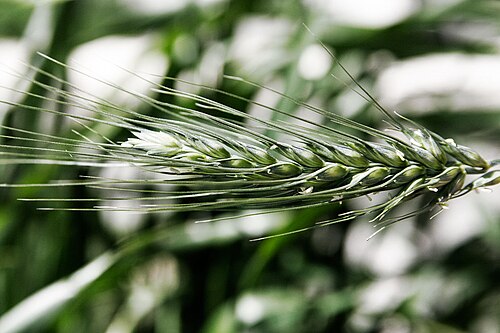
 تشريح السفاة والشعيرات على نوع من أنواع العشب الأسترالي Rytidosperma longifolium
 براعم إبطية في الورقة

في البرعم، تكون الأسطح العلوية لأوراق نبات Tetradenia riparia متجهة نحو الساق والإبط . السطح السفلي هو السطح السفلي (بعيدًا عن المحور)، والسطح العلوي هو السطح العلوي .


مخططات توضيحية للترتيب المتكئ للفلقتين والجذير في بذرة نبات الإريسيموم (المعروف سابقًا باسم الكيرانثوس )


تتميز أزهار نبات إبرة الراعي (Geranium incanum) بأنها شعاعية التناظر ، حيث تمتلك خمسة محاور تناظر، على عكس محوري التناظر الموجودين في الأزهار غير المتناظرة لمعظم أنواع جنس البيلارجونيوم (Pelargonium) ذي الصلة .

سعفة سرخس ذات وريقات مدببة

الأسدية المجنحة في زهرة نبات القطن الزغبي


رسم تخطيطي لثمرة جوز الهند. يُشار إلى الألبومين (السويداء) بالرمز Alb .


ورقة نبات روثمانيا ذاتتعرق متشابك بشكل واسع

زهرة خنثى من نبات ساندرسونيا أورانتياسا مقطوعة طولياً لإظهار الأسدية ، التي تتكون من المتوك المحيطة بالمدقة المركزية الخضراء


يقدم نوع من أنواع نبات النيا ، من عائلة Nyctaginaceae ، مثالاً على الثمرة الناضجة : حيث يبقى الكأس والقلم حول الثمرة الناضجة.
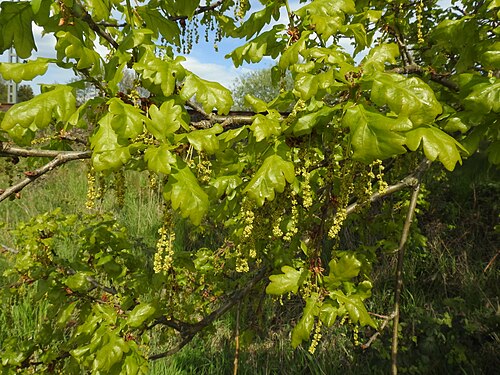
أزهار البلوط عديمة الأزهار مثل Quercus robur ، كونها تلقيحًا هوائيًا ، لا تحتاج إلى أن تكون واضحة للحيوانات الملقحة.


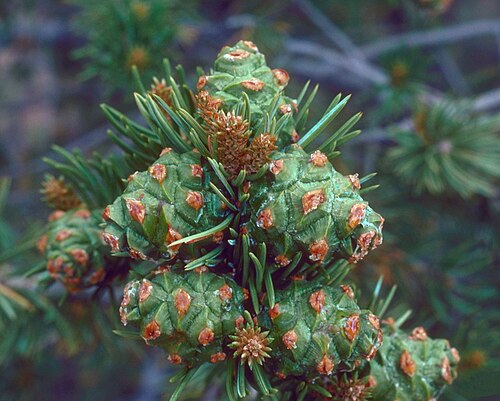
في مخاريط الصنوبر ، يستغرق النمو عامين؛ في مخاريط الصنوبر الصالحة للأكل هذه ، يكون نمو السنة الأولى، وهو الآن بني اللون، هو القمة ، بينما يكون نمو السنة الثانية، الذي لا يزال أخضر في هذه المخاريط غير الناضجة، هو النتوء .
ب
- كثمر العليق
- فاكهة تشبه التوت، وقد تكون أو لا تكون توتًا حقيقيًا. [ 22 ]
- عصوي الشكل
- يشبه القضيب؛ أطول من عرضه. قارن بالأسطواني .
- بارب
- نقطة مواجهة للخلف، كما هو الحال في صنارة الصيد .
- شائك
- وجود شوكة تشير إلى اتجاه واحد.
- باربيلات
- يمتلك شعيرات شائكة ( باربيلا ).
- نباح
- الطبقة الخارجية الواقية من الأنسجة على سيقان وجذور الأشجار والشجيرات الخشبية ؛ وتشمل جميع الأنسجة الحية وغير الحية الخارجية للكامبيوم .
- أساسي
- يقع أو يرتبط عند أو بالقرب من قاعدة (نبات أو مخطط شجرة تطورية ).
- مثبت على قاعدة
- شيء متصل بقاعدته، مثل المتك المتصل بالخيط . قارن بـ "مثبت من الظهر" .
- قاعدي
- يتطور بشكل متسلسل من القمة نحو القاعدة (أي مع اقتراب الجزء الأصغر من القاعدة)، كما هو الحال في الأزهار في النورة . كذلك، ينتقل من الأوراق إلى الجذور، كما هو الحال في الإشارات الجزيئية في النباتات.
- باثيفيل
- ورقة متخصصة تنمو عند قاعدة النبات، عادةً عندما يكون النبات غير ناضج، وتعمل على تثبيت النبات في التربة؛ وتبرز بشكل خاص في السرخس Teratophyllum . قارن بـ acrophyll .
- منقار
- نتوء طرفي بارز ومدبب، خاصة في الكربلة أو الثمرة .
- توت
- نوع من الفاكهة غير المتفتحة حيث تكون البذور مغمورة في اللب، مثل الطماطم .
- ثنائي-
- بادئة تعني "اثنان"، على سبيل المثال bisulcate ، أي ذو أخدودين أو تجاويف.
- كل سنتين
- النبات الذي يُكمل دورة حياته (أي ينبت ويتكاثر ويموت) خلال سنتين أو موسمين زراعيين. عادةً ما تُشكّل النباتات ثنائية الحول وردة قاعدية من الأوراق في السنة الأولى، ثم تُزهر وتُثمر في السنة الثانية.
- أشرم
- متشعب؛ مقطوع إلى نصفين لحوالي نصف طوله. قارن بـ "ثلاثي الفصوص" .
- ثنائي الأوراق
- (فيما يخص الورقة المركبة ) تتكون من وريقتين فقط ، عادةً ما تكونان متناظرتين، مثل ورقة نبات كولوفوسبيرموم موبان . قارن بالورقة المفصصة المترافقة ، مثل معظم أنواع نبات باوهينيا .
- ثنائي الشكل
- مغزلي الشكل مع انضغاط في المنتصف.
- صوت ملفوظ بكلتا الشفتين
- وجود شفتين، على سبيل المثال شكل البتلات في العديد من الأزهار غير المنتظمة .
- ثنائي
- 1. وجود جانبين مميزين، مثل وجهي ورقة ظهرية بطنية .
- 2. مرتبة على الجانبين المتقابلين، على سبيل المثال الأوراق على الساق ؛ قارن بين ثنائي الصفوف ومتقابل .
- 3. متناظر ثنائياً، كما في ورقة ذات مخطط متناظر.
- ثنائي الحجرات
- وجود حجرتين ، على سبيل المثال في المتوك أو المبايض .
- ذات الحدين
- يُستخدم في هذا النظام أسماءٌ مؤلفة من كلمتين لتكوين الاسم العلمي (أو مزيج من كلمتين) بصيغة لاتينية. على سبيل المثال، حيث تكون الكلمة الأولى اسم الجنس الذي ينتمي إليه النوع ، والكلمة الثانية هي الصفة النوعية التي تُطلق على هذا النوع لتمييزه عن الأنواع الأخرى في نفس الجنس.
- التسمية الثنائية
- نظام التسمية الذي يُعرَّف فيه الاسم العلمي للنوع ( وليس للتصنيف في أي رتبة أخرى) بأنه مزيج من اسمين، الأول هو اسم الجنس، والثاني يُشار إليه في علم النبات بالصفة النوعية . تجدر الإشارة إلى أن الاسمين معًا (وليس الاسم الثاني فقط) يُشكلان اسم النوع.
- ثنائي الريش
- مُرَشَّحٌ ريشيٌّ مزدوج ؛ على سبيل المثال، ورقة مركبة ذات وريقات فردية مُقسَّمة ريشيًا.
- ثنائي الريشة المنقسمة
- ورقة مقسمة إلى ريشات ذات أجزاء مقسمة بعمق.
- ثنائي الجنس
- تحمل أزهارها أعضاء تناسلية ذكرية وأنثوية؛ وعادةً ما تحتوي على أسدية ومدقات ؛ وهي مرادفة لمصطلحات الخنثى ، والمتلاصقة ، والأحادية الميل . أما الأزهار الخنثى فتوجد فقط على النباتات الأحادية المسكن . انظر أيضًا: الخنثى ، والأحادية المسكن ، ومورفولوجيا التكاثر النباتي .
- ثنائي الغمد
- (في البويضة ) مغطاة بطبقتين خارجيتين . قارن بـ unitegemic .
- ثنائي
- ثلاثية ، حيث ينقسم كل قسم إلى ثلاثة أقسام.
- ذوات الصدفتين
- يحتوي على صمامين أو أجزاء مفصلية. قارن بالصمام الثلاثي .
- شفرة
- الصفيحة أو الجزء المسطح من الورقة ، باستثناء الساق أو عنق الورقة .
- يزدهر
- مسحوق شمعي ناعم أبيض أو مزرق يوجد على أجزاء النبات، وعادة ما يكون على السيقان والأوراق والثمار. ويمكن إزالته بسهولة عن طريق الفرك.
- بول
- جذع الشجرة، وعادةً ما يكون الجزء الواقع أسفل أدنى فرع. قارن بغطاء الشجرة .
- بوستريكويد
- Arranged on a conical surface (like a snail shell); used to describe inflorescences in which the buds are arranged in an almost helical manner on the outside of a long, tapering, conical rachis.
- bract
- A modified leaf associated with a flower or inflorescence and differing in shape, size, or color from other leaves (and without an axillarybud).
- bracteate
- Possessing bracts.
- bracteole
- A small bract borne singly or in pairs on the pedicel or calyx; synonymous with bractlet.
- bracteolate
- Possessing bracteoles (bractlets).
- bracteose
- Having many or showy bracts.[23]
- bractlet
- See bracteole.
- branchlet
- A small branch.
- brevideciduous
- A plant that loses all of its leaves only briefly before growing new ones, so that it is leafless for only a short time, e.g. approximately two weeks.
- bristle
- A straight, stiff hair (smooth or with minute teeth); the upper part of an awn (when the latter is bent and has a lower, stouter, and usually twisted part, called the column).
- brochidodromous
- Pinnateleaf venation in which the secondary veins do not terminate at the leaf margin, but are joined in a succession of prominent arcs.
- brochus
- Width of one lumen of a pollen grain reticulum and half of the width of the surrounding muri (walls), hence heterobrochate and homobrochate, where the lumina are of different or similar sizes, respectively.
- bryophyte
- Informally, any plant that is a moss, hornwort, or liverwort. Formally, these plants are placed in three separate divisions: hornworts (Anthocerophyta), liverworts (Marchantiophyta), and mosses (Bryophyta).
- bulb
- A thick storage organ, usually underground, consisting of a stem and leaf bases (the inner ones fleshy).
- bulbel
- A bulb arising from another bulb. See bulblet.
- bulbil
- A small, deciduous bulb or tuber formed in the axil of a leaf or pinna; a means of vegetative propagation.
- bulblet
- A bulb arising from another bulb; a bulbel.
- bullate
- 1. Having a rounded or blister-like appearance; arched or vaulted.
- 2. (of a leaf) Having arched leaf tissue between each lateral vein, i.e. the veins appear depressed in the leaf surface.
- burl
- A deformation or knot in the branches or trunk of a tree, sometimes sought after in woodworking.[24]
- burr
- 1. A prickly fruit.
- 2. A rough or prickly propagule consisting of a seed or fruit and associated floral parts or bracts.
- buttress root
- A root growing from an above-ground stem or trunk, and providing support, e.g. commonly of Ficus macrophylla.
 The large, colorful bracts of Bougainvillea are commonly mistaken for its petals.
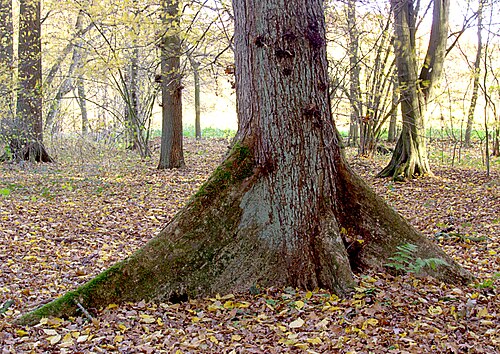 Buttress root of a mature elm

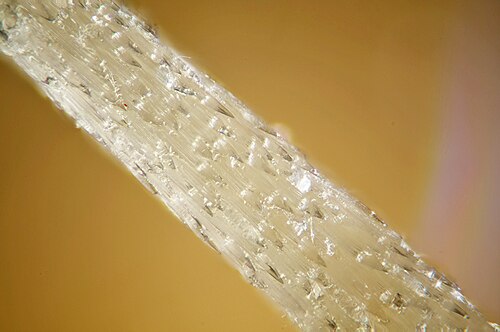
توجد الأشواك على أشواك بعض أنواع الصبار، كما هو موضح هنا، مكبرة.

ثمار نبات أولينيا فينتوزا ، بما في ذلك مقطع عرضي يُظهر البذور الصلبة في اللب.

تشير الأوراق المركبة ثنائية الأوراق لشجرة الموبان، Colophospermum mopane ، إلى الاسم الشائع "شجرة الفراشة".

مقطع عرضي لقرن من نبات رشاد أذن الفأر ( Arabidopsis thaliana) ، يوضح أنه ثنائي الحجرات ، ويتكون من كربلتين ، وهو شكليًا قرن وليس قرنًا.


بنية ورقة مركبة ثنائية التناظر
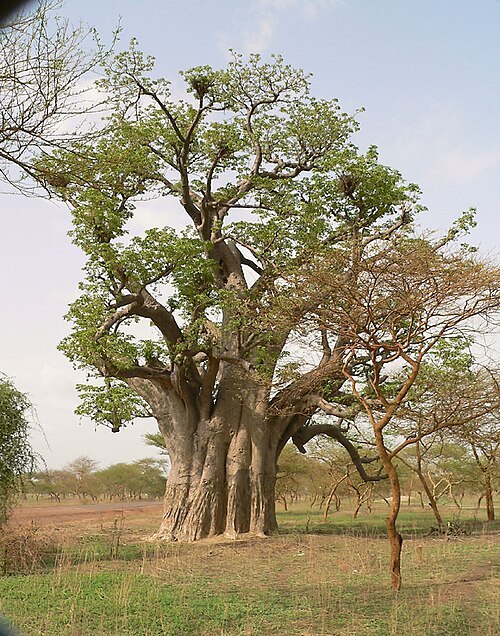
تتميز شجرة الباوباب الأفريقية هذه، Adansonia digitata ، بجذع ضخم تحت مظلة متواضعة نسبياً ، وهو أمر نموذجي لهذا النوع.
C
- متساقط
- التساقط المبكر، مثل سبلات زهور الخشخاش، التي تتساقط عندما تبدأ البتلات بالتفتح. قارن بين الثبات والزوال .
- كاسبيتوز
- مُتكتل أو شبيه بالعشب، على سبيل المثال شكل نمو بعض الأعشاب والنباتات المائية.
- الكلس
- يمتلك مهمازًا .
- كلسي
- نوع من التربة أو نوع من الصخور التي تتكون أساسًا من الأشنات، وهي غنية بكربونات الكالسيوم أو تتكون منها بشكل كبير .
- كالسيوم
- على شكل خف. [ 25 ]
- كالسيكول
- نبات ينمو في التربة الكلسية . يُعرف أيضاً باسم محب للكالسيوم ، أو نبات كلسي . عكسه : كاره للكالسيوم . [ 25 ]
- الكالوز
- متصلب؛ سميك؛ متصلب.
- التصلب
- 1. كتلة بارزة من الأنسجة
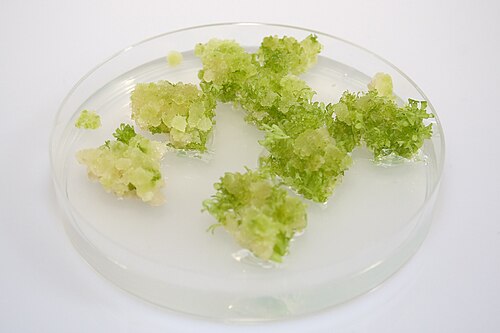
- 2. نمو الأنسجة غير المتمايزة التي تتشكل استجابة للجروح؛ ويمكن زراعتها في المختبر .
- 3. في الأوركيد، نتوءات لحمية من الشفة يمكن أن تتخذ أشكالاً مختلفة من الحليمات إلى الصفائح.
- 4. في الأعشاب، امتداد متصلب من قاعدة الزهرة (يتكون من مفصل المحور و/أو قاعدة اللمة ) ، والذي قد يستطيل أو لا يستطيل وغالبًا ما يكون مغطى بالشعر أو الشعيرات.
- كأسي الزهرة
- وجود بتلات وأسدية متصلة بالكأس .
- الكاليكوفيل
- بنية تشبه الورقة تتكون من فص الكأس أو السبلة ، وتتضخم عادةً عدة أضعاف قبل أو بعد الإزهار ، خاصةً عندما تحتفظ معظم السبلات أو فصوص الكأس الأخرى بحجمها الأصلي. وتُعد الكؤوس الورقية أكثر تطرفًا من الكأس المتضخم ، وتوجد في الفصيلة الفوية . قارن بين الأوراق الثنائية والأوراق الجناحية .
- كاليكولا
- وجود الكأس الزهري .
- الكأس
- 1. بنية على شكل كأس تتكون من قنابات تشبه الكأس الخارجي .
- 2. في بعض أنواع الفصيلة النجمية ، توجد دائرة من القنابات أسفل الغلاف الزهري .
- كاليبترا
- غطاء أو غطاء. انظر غطاء .
- الكأس
- مصطلح جامع لأجزاء الزهرة ؛ الدائرة الخارجية للزهرة، وعادة ما تكون خضراء. قارن بالتويج .
- أنبوب الكأس
- أنبوب يتكون من اندماج السبلات ( الكأس )، على الأقل عند القاعدة.
- الكامبيوم
- طبقة نسيجية توفر خلايا غير متمايزة جزئياً لنمو النبات.
- جرسية الشكل
- على شكل جرس.
- كامبتودروموس
- التعرق الريشي الذي تنحني فيه الأوردة الثانوية نحو الحواف، وفي بعض الحالات تصبح موازية لها تقريبًا، ولا تتصل مرة أخرى بالأوردة الأخرى لتشكيل حلقات.
- كامبيلوتروبوس
- عندما تكون البويضة موجهة بشكل عرضي (أي أن محورها متعامد مع ساقها) ويكون كيس الجنين منحنيًا . قارن بين amphitropus و anatropous و orthotropous .
- قنيوية
- مُخَوَّز؛ ذو أخدود طولي.
- قصبي الرائحة
- يقترب لونه من الأبيض، كما هو الحال في ورقة مغطاة بزغب أبيض أو صوف.
- مظلة
- أغصان وأوراق الشجرة؛ التاج . يشير أيضًا إلى الطبقة العليا الواقية للغابة. قارن بالجذع .
- شعري
- 1. أنبوب أو مسام أو ممر ذو مقطع عرضي داخلي ضيق.
- 2. نحيف؛ يشبه الشعر.
- رأسي
- 1. (في النورة الزهرية ) ذات رأس يشبه العقدة، مع أزهار غير معنقة ومتجمعة في عنقود كثيف.
- 2. (فيما يتعلق بالوصمة ) مثل رأس الدبوس.
- الفصل
- مجموعة كثيفة من الأزهار الجالسة أو شبه الجالسة أو الزهيرات ، على سبيل المثال رأس زهرة في عائلة الأقحوان النجمية . انظر الزهرة الكاذبة .
- كبسولة
- تتكون الثمار الجافة من اثنين أو أكثر من الكرابل المتحدة وتنفصل عند النضج (عادة عن طريق الانقسام إلى قطع أو الفتح عند القمة بواسطة الأسنان أو المسام).
- قلبي الشكل
- في الفصيلة النجمية ، يتميز هذا النوع بوجود قلم ذي حلقة من الشعيرات الكاسحة محمولة على ساق القلم أسفل فروع القلم.
- كارينا
- انظر إلى العارضة .
- القناة القصبية
- تجويف طولي في سيقان نبات ذيل الحصان (Equisetum) ونبات ذيل الحصان المنقرض (Equisetopsida )، يتزامن مع نتوء في سطح الساق.
- لحمي
- بلون الجلد، خاصة عند استخدامه لوصف بعض الزهور.
- كارنوز، كارنوس
- ذو قوام لحمي أو لبّي، خاصةً عند استخدامه على بعض الأنسجة أو الأعضاء. قارن بين الجلدي والقرنّي .
- كاروبوديوم
- جنس من النباتات المزهرة من الفصيلة الخيمية . موطنه الأصلي: من تركيا إلى إيران. لا يُخلط بينه وبين جنس كاربوبوديوم.
- خباء
- العضو التناسلي الأنثوي الأساسي في النباتات المزهرة ، ويتكون إما من ورقة بوغية واحدة أو من حجرة واحدة في مبيض مركب ، مع قلم وميسم . والمدقة مصطلح جامع لجميع الكرابل في الزهرة الواحدة .
- كاربيلاري
- عند الإشارة إلى الكرابل أو إلى التراكيب أو النتوءات المرتبطة بها، مثل الأسدية العقيمة المتصلة بالكرابل في الفصيلة النيلوفرية، كان يُشار إليها غالبًا باسم "ملحقات الكرابل ". ويُلاحظ تضارب في استخدام مصطلحات "ملحقات الكرابل" و "الكرابل الموازية " و "الأسدية العقيمة "، سواءً في الوقت الحاضر أو في الماضي، بين المؤلفين.
- كاربوديوم
- على الأكين (Cypselae)، استطالة قاعدة المتاع التي تبدو مميزة؛ منطقة الانفصال ، حيث يتم فصل الأكين عن الوعاء .
- 2. جنس كاربوديوم في عائلة الكرنبية ؛ لا ينبغي الخلط بينه وبين كاربوديوم .
- غضروفي
- صلب وقاسٍ؛ غضروفي. قارن بين القرني والجلدي .
- الجفن
- قطعة صغيرة من نسيج يشبه اللحم، عادةً ما تكون متكتلة أو ثؤلولية، تنمو على غلاف البذرة بالقرب من السرة . قارن بـ aril .
- الكاريوبسيس
- ثمرة جافة غير متفتحة ذات بذرة واحدة، حيث يكون غلاف البذرة ملتحمًا بإحكام بجدار الثمرة، كما هو الحال في معظم الأعشاب.
- شريط كاسباري
- شريط متصل من السوبرين في الجدران الخلوية الأولية الشعاعية للطبقة الداخلية في سيقان وجذور النباتات الوعائية يشكل حاجز نفاذية للانتشار السلبي للماء الخارجي والمواد المذابة في الأنسجة الوعائية.
- كاسيديوس
- على شكل غطاء الرأس أو الخوذة أو غطاء الرأس؛ يشير عمومًا إلى التشريح الزهري، على سبيل المثال في أزهار الأقونيطوم والساتيريوم وما إلى ذلك .
- الكستنائي
- لونها كستنائي، بني محمر. [ 26 ]
- أجنبي عادي
- نبات غريب يظهر دون تدخل بشري واضح، لكنه لا يُكوّن مجموعات مستدامة، أو نبات لا يستمر إلا من خلال إدخاله المتكرر. قارن بكلمة "غريب" .
- كاتافيل
- أي بنية نباتية تُشبه الورقة شكليًا، ولكن وظيفتها التمثيلية الضوئية ثانوية أو عابرة . إما أن تتساقط هذه البنى عند انتهاء وظيفتها الرئيسية، أو تُدمج في هياكل أخرى حيث تؤدي، بعد موتها، وظيفة وقائية أو داعمة.
- سلسلة
- على شكل سلسلة؛ تتكون من أجزاء أو خلايا متصلة كما لو كانت متصلة ببعضها البعض، مثل بعض الدياتومات والطحالب والبكتيريا الزرقاء مثل الأناباينا . انظر أيضًا : متصلة .
- زهرة القط
- سنبلة زهرية ، عادةً ما تكون متدلية، تتكون من أزهار صغيرة في الغالب، أحادية الجنس ، وبدون غلاف زهري واضح ، كما هو الحال في أشجار الصفصاف والحور والبلوط والكازوارينا . غالبًا ما تحتوي الأزهار الفردية على قنابات حرشفية ، ويتم تلقيحها عادةً بواسطة الرياح . تتساقط السنابل عادةً كوحدة واحدة.
- النواة المذنبة
- يتميز بوجود زائدة أو طرف ضيق يشبه الذيل، مثل طرف جهاز التنقيط . قارن بـ: مدبب ، وذو نتوء ، ومدبب .
- الجذع
- ساق النبات، وخاصةً الساق الخشبية ؛ ويُستخدم أيضًا بمعنى جذر النبات ، أو على وجه الخصوص بنية الساق القاعدية أو عضو التخزين الذي ينشأ منه النمو الجديد. قارن بالدرنة الخشبية .
- ذيلي الشكل
- يشبه الساق أو يشبه الجذع ؛ يستخدم أحيانًا بمعنى " pachycaul "، أي "ذو ساق سميكة".
- ذيلية
- تصغير لكلمة caudex . المعنى يعتمد على السياق، ويشير عادةً إلى دعامة تشبه الساق لأشياء صغيرة مثل حبوب لقاح الأوركيد. غالبًا ما تُستخدم بالتبادل مع كلمة stipe
- مسوق
- يمتلك ساقًا متطورة فوق سطح الأرض، على غرار الساقية . عكسه : عديم الساق (يفتقر إلى ساق ظاهرة).
- القرنبيط
- وجود أزهار أو ثمار تنمو مباشرة من جذع الشجرة. [ 27 ]
- ساقي
- محمول على ساق هوائية أو ساق ، كما هو الحال مع الأوراق أو الأزهار أو الثمار (عند تطبيقه على العضوين الأخيرين، يشير عادة إلى السيقان الأقدم).
- caulirosulate
- تنمو في نهاية الساق أو الجذع ، كما هو الحال مع الأوراق أو القنابات.
- خلية
- 1. الوحدة الأساسية المجهرية لبنية النبات، والتي تتكون عمومًا من حجيرات في سائل لزج محاط بجدار خلوي .
- 2. تجويف في المتك أو المبيض .
- سينانثوس
- (في الغلاف الزهري ) يفتقر إلى كل من الأسدية والمدقة ، أي زهرة لا تحتوي على الأسدية ولا على المدقة .
- مركزي
- من عضو ذي فرعين متصلين من مركزه، مثل الشعرة أو المتك .
- القرنفل
- تتميز بمظهر أو لون أو ملمس شمعي، على سبيل المثال أزهار العديد من أنواع نبات سيروبيجيا ، والثمار الشمعية لبعض أنواع نبات ميريكا .
- شائك
- يميل الرأس، أو يسقط على رأسه أو وجهه للأسفل؛ يميل، أو ينحني، أو يتقوس للأمام. يُطلق هذا الوصف على العديد من الأنواع التي تميل رؤوسها وتنحني ، مثل العديد من أنواع النرجس والدييراما . تحمل العديد من أنواع النباتات النعت المحدد " cernua ".
- متكتل
- تهجئة بديلة لكلمة caespitose ، وتعني كثيف أو يشبه العشب، على سبيل المثال شكل نمو بعض الأعشاب.
- غرفة
- تجويف المبيض .
- موجه
- غارقة تحت السطح، مما ينتج عنه قناة مستديرة.
- ورقي
- يتميز بملمس ورقي.
- الفجوات
- من الأزهار التي يتم تلقيحها عندما يكون الغلاف الزهري مفتوحًا. قارن بالزهور المغلقة التلقيح .
- نبات قزمي
- نبات متكيف للنمو في الشقوق أو التجاويف، كما هو الحال في واجهات المنحدرات. قارن بالكريمنوفيت . [ 28 ] [ 29 ]
- الكيميرا
- فرد يتكون من نسيجين أو أكثر متميزين وراثيًا، وغالبًا ما يكون ذلك نتيجة لعملية تطعيم وأحيانًا عن طريق طفرات تحدث أثناء انقسام الخلايا أو عمليات نقل الخلايا أثناء نمو البذور.
- محب للخفافيش
- يتم تلقيحها بواسطة الخفافيش .
- الكلوروفيل
- أي من مجموعة متنوعة من الأصباغ الكيميائية المختلفة الموجودة في البلاستيدات الخضراء والتي تعتبر ضرورية لعملية التمثيل الضوئي .
- البلاستيدات الخضراء
- عُضية موجودة في الخلايا النباتية تحتوي على الكلوروفيل .
- اصفرار الأوراق
- نقص غير طبيعي أو شحوب في لون عضو أخضر اللون عادةً.
- أهداب
- شعيرات صغيرة جدًا أو نتوءات تشبه الشعر محصورة إلى حد ما في حواف العضو، كما هو الحال مع الرموش؛ في الخلايا المتحركة، نتوءات دقيقة تشبه الشعر تساعد على الحركة .
- رمادي
- لونها رمادي فاتح، عادةً بسبب غطاء من الشعر القصير؛ أغمق قليلاً من اللون الرمادي الفاتح .
- circinate
- ملتفة حلزونياً مع وجود الطرف الأقرب إلى الداخل، على سبيل المثال، الالتفاف الدائري للسعف النامي لمعظم السرخسيات.
- تليف الكبد
- (في الورقة) تنتهي بمحلاق عند القمة .
- السحب الرقيقة
- انظر إلى المحلاق .
- الفرع
- فرع أو ساق يقوم بعملية التمثيل الضوئي ، غالباً ما يكون شبيهاً بالورقة وعادةً ما تكون أوراقه إما غائبة أو صغيرة جداً. قارن بـ phyllode .
- التكلبتوز
- تساقط الأغصان أو الفروع بأكملها، وليس مجرد أوراق فردية.
- فصل
- الفئة الرئيسية لتصنيف التصنيفات بين الشعبة والرتبة .
- الكلاثرات
- على شكل شبكة أو هيكل شبكي؛ مثقوب بفتحات، كما هو الحال في القفص.
- هراوة
- على شكل هراوة.
- كلافونكولا
- في الفصيلة الدفلية ، يكون الميسم متضخماً على شكل أسطوانة، حيث تمثل جوانبه وسطحه السفلي مناطق الاستقبال. وقد يكون ملتصقاً بالمتك أو لا.
- مخلب
- 1. جزء قاعدي ضيق يشبه الساق من البتلة أو الكأس أو القنابة .
- 2. في نبات الملاليوكا ، الجزء المتحد من حزمة الأسدية .
- التلقيح الذاتي
- تتميز بوجود أزهار ذاتية التلقيح لا تتفتح بالكامل، أو أزهار ذاتية التلقيح قبل التفتح. قارن بـ "كاسموغاموس" .
- سن اليأس
- فئة عامة من الفاكهة التي يمكن أن تخضع لمرحلة نضج بعد الحصاد، تسبقها أو تصاحبها زيادة في تنفس الإيثيلين.
- متسلق
- نبات ينمو بشكل منتصب إلى حد ما عن طريق الاستناد إلى هيكل آخر أو الالتفاف حوله للحصول على الدعم، أو عن طريق التشبث به بواسطة محاليق .
- التسلق
- انظر إلى المتسلق .
- منحدر
- تباين شكلي مستمر داخل النوع الواحد أو أحيانًا بين نوعين.
- نسخة مستنسخة
- نبات مشتق من التكاثر الخضري اللاجنسي لنبات أصلي، حيث يمتلك كلا النباتين تركيبات جينية متطابقة.
- الاندماج
- دمج أجزاء النبات أو نموها معًا لتشكيل وحدة واحدة.
- قوقعي الشكل
- مقعرة وشكلها يشبه الملعقة.
- قوقعي
- ملتف مثل صدفة الحلزون.
- كوينوبيوم
- مستعمرة منظمة من الطحالب تتصرف ككائن حي واحد.
- الخلايا المتعددة
- خلية واحدة ذات نوى متعددة ، تتشكل عندما لا يتبع انقسام النواة انقسام السيتوبلازم .
- الخنفساء
- أحد أنواع الأغلفة في بنية بذور ذوات الفلقة الواحدة . الكوليبتيل هو غلاف واقٍ أو غطاء ( قبعة )، مدبب الشكل تقريبًا، يغطي الريشة عند خروجها من التربة. يتحول لونه عادةً إلى الأخضر ويساهم في عملية التمثيل الضوئي حتى يحل محله النمو الرئيسي للشتلة. على النقيض من ذلك ، يبقى الكولوريزا تحت الأرض حتى يحل محله ظهور الجذور.
- كولوريزا
- أحد أنواع الأغلفة في بنية بذور ذوات الفلقة الواحدة . يربط الكولوريزا الكوليبتيل بالجذر ويحمي جذر ذوات الفلقة الواحدة أثناء الإنبات. على عكس الكوليبتيل، يرتبط الكولوريزا بالجذر ولا يخرج من التربة أثناء الإنبات. قارن بالكوليبتيل .
- الكولنشيما
- نسيج متخصص يتكون من خلايا حية ذات جدران خلوية من السليلوز والبكتين غير متساوية السماكة ، ويؤدي وظيفة داعمة في أعضاء مثل الأوراق والسيقان الصغيرة التي تتكون من أنسجة نباتية أولية.
- جامع
- شعرة غدية متعددة الخلايا تنتج عادة مادة مخاطية وتوجد على السبلات أو الأذينات أو أعناق الأوراق أو على الأجزاء القريبة من السيقان ؛ توجد عادة على النباتات من رتبة الجنطيانيات .
- العمود
- في النباتات المزهرة، طرف المحور المركزي للمخروط أو الثمرة ، على سبيل المثال في نبات الكاليتريس .
- عمود
- 1. بنية تمتد فوق المبيض وتضم القلم والأسدية ، والمعروفة أيضًا باسم الميسم ، على سبيل المثال في الأوركيد ونباتات الصقلاب .
- 2. في الأعشاب، الجزء السفلي والأكثر سمكًا والملتوي عادةً من السفاة ، وهو يختلف عن الجزء العلوي النحيل أو الشعيرة.
- عمودي
- على شكل عمود.
- غيبوبة
- 1. خصلة من الشعيرات من الغلاف أو الحبل السري في أحد طرفي بعض البذور أو كليهما، على سبيل المثال في نباتات ستروفانثوس ، أو أسكليبياس ، أو ألستونيا .
- 2. القنابات العقيمة ، على سبيل المثال في كركم ، أناناس ، أو يوكوميس .
- 3. أزهار عقيمة ، على سبيل المثال في نباتات المسكاري والليوبولديا ، في قمة بعض النورات .
- 4. خصلة من الشعيرات عند قاعدة بعض الأزهار، على سبيل المثال في نبات Pfaffia gnaphalioides .
- 5. خصلة من الشعيرات عند قمة أو قاعدة بعض السنيبلات .
- 6. خصلة شعر إبطية في النورات في بعض Poaceae ، على سبيل المثال في Eragrostis comata .
- الاسم التجاري
- اسم غالباً ما يكون بلا أساس نباتي ولا يخضع لقواعد المجلس الدولي لحماية النباتات. ينطبق هذا المصطلح عموماً على أسماء مثل أسماء العلامات التجارية، والأسماء التي تغطيها حقوق مربي النباتات، وبراءات الاختراع، والأسماء الترويجية، والتي تُستخدم غالباً لتعزيز مبيعات النبات.
- الوصلة
- الدرز أو السطح الذي تلتصق عنده رسغاتان . انظر أيضًا : الشق والدرز .
- مجتمع
- مجموعة بيئية من النباتات التي تتواجد معًا بشكل مميز.
- مُجَمَّع
- يتكون من عدة أجزاء، على سبيل المثال ورقة تتكون من عدة وريقات ، أو متاع يتكون من عدة كربلات ، أو نورة تتكون من عدة نورات أصغر.
- مركب بالميتات
- تتميز بوجود وريقات تشع من نقطة مركزية (عادةً في أعلى عنق الورقة )، مثل أصابع مفرودة تشع من راحة اليد. قارن بـ "راحية" .
- مضغوط
- مسطح طولياً، إما جانبياً (من جانب إلى آخر) أو ظهرياً (من الأمام إلى الخلف).
- سلسل
- متصلة ببعضها البعض على شكل سلسلة. انظر أيضًا: concatenate و catenate .
- متجانس اللون
- ذو لون موحد في جميع أنحائه؛ ذو لون موحد.
- نسخة مكررة
- مرتبة بحيث تُطوى جهتان من سطح مستوٍ على طول الخط الوسطي لتواجها بعضهما البعض. انظر أيضًا: ptyxis ، وaestivation ، و vernation .
- مخروط
- الأعضاء الجنسية ، غالباً ما تكون خشبية ، ومخروطية الشكل أو بيضاوية إلى كروية ، بما في ذلك الحراشف أو القنابات أو القنيبات المرتبة حول محور مركزي، الموجودة في عاريات البذور ، وخاصة الصنوبريات ؛ كما تستخدم أحياناً بشكل عامي، على الرغم من أنها غير صحيحة من الناحية النباتية، للثمار الخشبية لبعض كاسيات البذور مثل الألنس والكازوارينا .
- إزهار متحد
- النورة التي يختلف هيكلها العام اختلافًا كبيرًا عن هيكل الفروع الفردية للنورة، على سبيل المثال أعضاء الأجناس Callistemon و Grevillea و Hollandaea .
- مخروطي
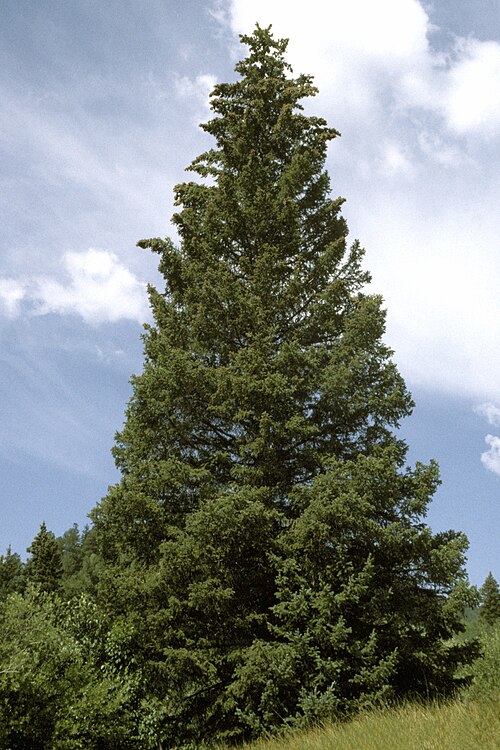
- على شكل تيجان الأشجار ، مخروطية الشكل ، تتناقص سماكتها تدريجيًا من القاعدة إلى القمة، ودائرية المقطع العرضي. توجد هذه الثآليل في العديد من الأشجار الصنوبرية مثل التنوب والصنوبر ، وهي تكيف لتجنب أضرار الثلوج الشتوية. في النصوص الشائعة ، يُطلق عليها خطأً اسم " هرمية "، وهي تختلف عنها في كونها أعرض ولها مقطع عرضي مربع . [ 30 ]
- فطري
- ملتحمة بعضو آخر (أو أعضاء) من نفس النوع، مثل البتلات في أنبوب التويج الملتحم البتلات . قارن بالالتصاق .
- رابط
- الجزء من المتك الذي يربط خلايا المتك.
- كونيفنت
- التلامس أو التقارب.
- من نفس النوع
- ينتمي إلى نفس النوع .
- متجاورة
- متجاورة، متلامسة، لكنها غير متحدة.
- تشوه
- (في السبلات أو البتلات ) نوع من أنواع التراكب الزهري حيث يتداخل جانب واحد من كل جزء مع أحد الأجزاء المجاورة، ويتداخل الجانب الآخر مع الجزء المجاور الآخر. انظر: ملتف .
- ملتوية
- مشوهة عن شكلها الطبيعي.
- ملفوف
- 1. يشير إلى ترتيب الأعضاء الزهرية أو الورقية في البرعم عندما تتداخل حافة كل عضو أو جزء مع العضو أو الجزء المجاور؛ وهو شكل من أشكال الترتيب المتداخل . انظر: التواء .
- 2. (فيما يتعلق بالأوراق ) نوع من أنواع التورم حيث تلتف ورقة واحدة داخل ورقة أخرى.
- 3. نوع من أنواع التبرعم لورقتين عند عقدة ، حيث يكون نصف كل ورقة مكشوفًا والنصف الآخر ملفوفًا داخل الورقة الأخرى.
- كوركل
- جنين نباتي ، أو ريشة ، أو ريشة بالإضافة إلى جذر .
- قلبي الشكل
- على شكل قلب، مع وجود الشق في الأسفل؛ قاعدة ورقة ، مثل الجزء المشقوق من القلب. قارن بالقلب المقلوب .
- جلدي
- جلدي؛ صلب ومتين، ولكنه مرن. قارن بالقرني .
- كورم
- قاعدة ساق لحمية منتفخة ، عادة ما تكون تحت الأرض وتعمل في تخزين احتياطيات الغذاء، مع براعم عارية أو مغطاة بحراشف رقيقة جدًا؛ نوع من أنواع الجذور .
- كورميل
- كورمة صغيرة (أو كورمة صغيرة)، تتشكل عند قاعدة كورمة أكبر نامية. [ 31 ]
- القرني
- ذو ملمس قرني؛ صلب وقاسٍ، ولكنه متين إلى حد ما. قارن بالجلدي .
- كورولا
- مصطلح جامع لبتلات الزهرة . قارن بالكأس .
- أنبوب كورولا
- أنبوب يتكون من اندماج بتلات الزهرة، على سبيل المثال Volkameria inermis .
- كورونا
- 1. في النباتات المزهرة، حلقة من التراكيب التي قد تتحد في أنبوب، تدخل داخل التويج وتشتق من التويج أو الأسدية . بوق النرجس البري هو تاج.
- 2. في الأعشاب، حلقة صلبة من الأنسجة تعلو اللمة في بعض الأنواع.
- القشرة الدماغية
- منطقة من الأنسجة تقع بين الخلايا السطحية والأسطوانة الوعائية . [ 32 ]
- قشري
- ينمو على اللحاء أو على الخشب بعد إزالة اللحاء. قارن بـ lignicolous .
- كوريمب
- نورة ذات فروع تنشأ من نقاط مختلفة ولكنها تصل إلى نفس الارتفاع تقريبًا، مما يعطي مجموعة الزهور مظهرًا مسطح القمة.
- كوستا
- العرق الوسطي هو امتداد من عنق الورقة إلى داخل نصلها، مُشكلاً بنيةً تُشبه العرق الوسطي. هذه السمة مميزة للأوراق الضلعية الكفية، وهي أوراقٌ متوسطة بين الأوراق الكفية المروحية الشكل والأوراق الريشية. انظر أيضًا: ضلع .
- كوستابالمايت
- بوجود عرق وسطي محدد، على عكس الورقة الكفية أو المروحية النموذجية، ولكن مع ترتيب الوريقات شعاعيًا كما هو الحال في الورقة الكفية.
- الفلقة
- الورقة أو الأوراق الأولية لجنين النبات والتي تتطور عند الإنبات إلى ورقة البذرة أو المجموعة الأولى من الأوراق.
- كراسبيدودروموس
- تعرق ريشي تنتهيفيه الأوردة الثانوية عند الحواف ، وغالبًا ما تكون على شكل أسنان.
- فوهة بركانية الشكل
- على شكل صحن أو فنجان ضحل؛ نصف كروي أو أكثر ضحالة.
- نبات كريمنوفيت
- نبات متكيف للنمو على واجهات المنحدرات أو الشقوق، وخاصةً التعلق بها. قارن بنباتات الشقوق . [ 28 ] [ 29 ]
- كرنات
- ذات أسنان غير حادة أو مستديرة؛ ذات حواف مسننة .
- مسنن
- مُسنّن بدقة متناهية.
- مقرمش
- مجعدة بدقة، كما هو الحال مع حواف الأوراق والبتلات.
- خلية كريستارك
- الخلية الصلبة التي تحتوي على دروز وتترسب فيها مادة اللجنين بشكل غير مركزي على جدار الخلية لتشكيل شكل الكأس، أو في المقطع العرضي ، شكل ∪.
- تاج
- انظر إلى المظلة .
- يعبر
- جعل شيء ما يتزاوج مع شيء آخر؛ عملية التهجين.
- على شكل صليب
- على شكل صليب.
- قشري
- صلب، رقيق، وهش.
- قشري
- تشكيل طبقة سطحية أو قشرة ملتصقة بإحكام.
- النباتات الخفية
- أي من "النباتات الدنيا" التي تنتج الأبواغ ولا تحتوي على أسدية أو مبايض أو بذور ؛ أي النباتات التي لا تظهر أعضاؤها التناسلية بوضوح. تشمل هذه المجموعة عادةً السرخسيات والنباتات اللاوعائية والطحالب ، وأحيانًا الفطريات (بما في ذلك الفطريات المتطفلة على الأشنات). قارن بالنباتات الزهرية .
- cucullate
- يشير مصطلح "مُغطّى" أو " مُغطّى" عادةً إلى شكل الأوراق أو البتلات، مثل نبات البيلارجونيوم كوكولاتوم . ومن المصطلحات المشتقة منه: كوكولايفورم وكوكولاريس .
- دقاق الفحم
- في الأعشاب، والسعد، والقصب، وبعض النباتات الأخرى أحادية الفلقة ، يوجد ساق هوائي يحمل النورة ، ويمتد بشكل صارم من قاعدة النبات إلى أدنى قنابة غلافية (أو قاعدة النورة).
- مزارع
- نبات يعود أصله أو اختياره في المقام الأول إلى نشاط بشري مقصود.
- صنف
- مصطلح مشتق من "الصنف المزروع"، ويشير إلى مجموعة من النباتات المزروعة التي تتميز بوضوح بصفة واحدة أو أكثر (مورفولوجية، أو فيزيولوجية، أو خلوية، أو كيميائية، أو غيرها). عند تكاثرها (جنسيًا أو لا جنسيًا)، تحتفظ هذه المجموعة بصفاتها المميزة. قد ينشأ الصنف المزروع في الزراعة أو يُستقدم من البرية. وهو نوع ذو أهمية أو قيمة في مجال البستنة . تُكتب أسماء الأصناف المزروعة بين علامتي اقتباس مفردتين، مثل "بلو كاربت" أو "ألبا". يجب أن تكون جميع الأسماء الجديدة المُعتمدة بعد 1 يناير 1959 بلغة شائعة (أي ليست باللاتينية)، بينما تُحتفظ بالأسماء المُعتمدة باللاتينية قبل هذا التاريخ بصيغتها اللاتينية.
- صفة الصنف
- الجزء المميز من الاسم الذي يُشير إلى صنف نباتي . تُسمى الأصناف النباتية بألقاب مُنمقة (انظر: ألقاب الصنف) تُضاف إما إلى الاسم العلمي أو إلى الاسم الشائع للمجموعة التصنيفية التي تنتمي إليها؛ ولا تُكتب بخط مائل، بل توضع بين علامتي اقتباس مفردتين، على سبيل المثال: Rubus nitidoides 'Merton Early'. 'Merton Early' هو لقب الصنف.
- إسفيني
- على شكل إسفين، بجوانب مستقيمة تتقارب عند القاعدة.
- قُبَّة
- بنية على شكل كأس تتكون من قنابات متحدة ، مثل كأس ثمرة البلوط . انظر الكأس .
- قبة
- على شكل قبة .
- كوبولر
- حوامل الكؤوس .
- كأسي الشكل
- شبه كروي، على شكل قبة أو قبة صغيرة.
- وسادة
- يُقال عن النباتات المدمجة والمنخفضة النمو التي توجد في البيئات الألبية أو شبه الألبية أو القطبية أو شبه القطبية حول العالم.
- نقطة التقاء
- طرف صلب ومدبب، أكثر صلابة وقوة من الطرف الصغير ، ومن هنا جاءت تسميته بالطرف المدبب .
- شائك
- ذات طرف مدبب ، كما هو الحال مع بعض الأوراق.
- بشرة
- طبقة عازلة للماء تغطي بشرة أسطح النباتات الهوائية وتتكون من البوليمرات الكيوتين و/أو الكيوتان والشموع.
- القطع
- طرف قمة هيكل الساق أو الجذر أو الورقة التي يتم قطعها من النبات وتستخدم للتكاثر الخضري اللاجنسي.
- سياثيوم
- نورة من الأزهار أحادية الجنس محاطة بقنابات غلافية ، وخاصة أزهار نبات الفربيون .
- سياثوفيل
- في نباتات الفربيون ، توجد بنية تشبه القنابة التي يستقر عليها الغلاف الزهري ، وعادةً ما توجد في أزواج، ولكن ليس دائمًا. وقد تكون أحيانًا ذات ألوان زاهية، مما قد يؤدي إلى الخلط بينها وبين البتلات .
- أسطواني
- عصوية الشكل، وطولها ضعفين إلى ثلاثة أضعاف عرضها. قارن بالعظم العصوي الشكل .
- سينارويد
- انظر إلى الكاردويد .
- السنمة
- نوع من النورات التي ينتهي فيها المحور الرئيسي وجميع الفروع الجانبية بزهرة ( قد يتفرع كل فرع جانبي بشكل متكرر).
- سيموز
- امتلاك نبتة أو نبتات.
- cypsela
- نوع من الثمار الجافة ذات البذرة الواحدة وغير المتفتحة ، تتكون من مبيض سفلي .
- زهرة واتسونيا ذات البتلات الملتحمة تنشق بين بتلتين لإظهار التكوين الملتحم لأنبوب التويج ؛ قارن بين الالتصاق الملتحم لقواعد الأسدية والبتلات المقابلة لها.


 فلقات شتلاتنبات الكويلرويتيريا . يظهر أحد النباتات الأوراق الجديدة الأولى فوق فلقاته، بينما تظهر بقية النباتات مراحل مختلفة أصغر من ظهور الفلقات.

 Mimetes cucullatus ، سميت بهذا الاسم نسبة إلىشكل أزهارها البيضاء الشبيه بالقلنسوة.
 نبات موريا بانيكولاتا له أوراق ذات قواعد إسفينية (على شكل وتد).
 أمثلة على قبيحات من الفصيلة الزائفة : A : Quercus Rubra B: Quercus trojana C: Fagus sylvatica D: Castanea sativa
 تُزرع نبتة Euphorbia milii تجارياً بسبب مظهرها الجمالي الناتج عن هياكلها ذات الألوان الزاهية الشبيهة بالقنابات والتي تسمى السياثوفيل ، والتي تقع أسفل النورة .

Dianthus chinensis has a caespitose growth habit.
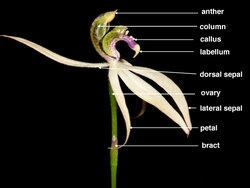
Structure of flower of an orchid in genus Praecoxanthus, with the callus labelled

Bearded callus of a floret of the grass species Chrysopogon filipes

Scanning electron micrograph of the carpopodium at the base of the achene-like fruit of Zyzyura mayana, Asteraceae

Dormant leaf buds of deciduous trees are commonly protected by imbricate cataphylls that are shed when the bud sprouts.

Male catkins of Betula pendula

The caudex of Dioscorea elephantipes grows largely above the soil surface. Many species that form caudices grow them underground.

Flowers on the trunk of Epicharis parasitica, an example of cauliflory

Some members of the Espeletia genus exhibit a growth habit that is caulirosulate.

Moehringia growing as a chasmophyte on an overhanging cliff

Chloroplasts within the cells of the leaves of the moss Bryum capillare

Not all chloroplasts are simple in shape. Chloroplasts of Spirogyra are helical within the tubular cells of their algal filaments.


إن ما يُسمى بـ"الأوراق اللحمية" للصبار، كما هو الحال في نبات الصبار الشوكي (Opuntia tomentosa )، هي في الواقع فروع ( أغصان ). أما الأوراق الحقيقية فهي الأشواك التي تنمو على هذه الفروع، والتي لا تزال لحمية في هذا الفرع الصغير.

أوراق الخريف المتساقطة لشجرة الميتاسيكويا غليبتوستروبويدس ، والتي تظهر ظاهرة التفرع مع سقوط الأفرع بأكملها، وليس مجرد أوراق فردية.


مخروط بذرة نبات Callitris columellaris يظهر العمود المركزي في مركز المخروط.

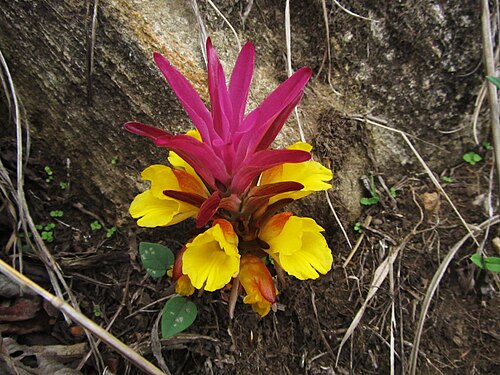
الكركم الكاذب الجبلي ذوالأوراق الزهرية الحمراء


غيبوبة فوق نبات المسكاري الأرمني ، تحمل أزهارًا عقيمة

النورة المركبة المخروطية لنبات الأيونيوم الشجري هي نورة مركبة تتكون من نورات صغيرة، بعضها مركب بدوره.

يتميز نبات كستناء كاليفورنيا ( Aesculus californica ) بورقة مركبة راحية الشكل ، حيث تشع الوريقات من نقطة مركزية.


د
- deciduous
- Dehiscing and falling seasonally, as with bark, leaves, or petals. Contrast persistent.
- declinate
- Curving downward, and then upward at the tip. Often qualified, e.g. declinate-ascendant.
- decompound
- Divided to more than one level, e.g. in bipinnate leaves, in which the leaflets of what would otherwise be a pinnate leaf are themselves pinnately divided.
- decorticate
- 1. (intr. v.) To shed the outer bark of a tree, usually seasonally as part of the natural growth cycle.
- 2. (tr. v.) To strip the peel, crust, bark, or other surface tissues from a plant or from harvested material, such as in extracting fiber from harvested Agave leaves.
- decumbent
- Having branches growing horizontally along the ground but which are turned up at the ends.
- decurrent
- Extending downward beyond the point of insertion, e.g. when the base of a leaf or a fungal gill is prolonged downward along the stem in a raised line or narrow wing.
- decussant
- A synonym of decussate; the usage decussant is questionable and occurs rarely, probably as an error. The formally correct usage is decussate.
- decussate
- Opposite with successive pairs borne at right angles to the last; generally applied to the arrangement of leaves.
- definite
- Of a constant number, e.g. twice as many stamens as petals or sepals (or less), or an inflorescence ending in a flower or an aborted floral bud, typically a cymose inflorescence. Contrast indefinite.
- deflexed
- Bent downward. Contrast inflexed.
- dehiscent
- Breaking open at maturity to release contents; refers e.g. to the opening of fruits to release seeds, of anthers to release pollen, and of sporangia to release spores. Contrast indehiscent.
- deltoid
- Shaped like the uppercase Greek letter Δ, i.e. like a more or less equilateral triangle.
- dendroid
- Tree-like; branching like a tree.
- dentate
- Toothed, especially in reference to leafmargins.
- denticulate
- Finely toothed; a diminutive form of dentate.
- deserticolous
- Inhabiting a desert.
- determinate
- Limited, usually in growth. Contrast indeterminate.
- diadelphous
- Referring to a class of adelphous structure in which the stamens or similar organs are connected in two adelphiae instead of just one.
- diaspore
- Any reproductive part of a plant adapted for dispersal and for establishing new plants; may be a disseminule such as a seed, or other parts such as specialized buds, branches, inflorescences, or fruits.
- dichasium
- A cymoseinflorescence with all branches below the terminal flower in regular opposite pairs. Compare monochasium and pleiochasium.
- dichlamydeous
- Having a perianth which is divided into a separate calyx and corolla. Compare homochlamydeous.
- dichotomous
- Forking into two equal branches. This may result from an equal division of the growing tip, or may be sympodial, in which the growing tip is aborted and replaced. Typically refers to mode of branch growth, as in Aloidendron dichotomum, but also to other organs, such as the venation patterns on leaves, the thorns of various species of Carissa (which morphologically are branches), and the thalli or hyphae of various algae and fungi.
- dicotyledon
- A flowering plant whose embryo has two or more cotyledons (seed leaves). Contrast monocotyledon.
- digitate
- With segments spreading from a common center, like the fingers of a hand. See also palmate and palmatisect. See also Leaf shape.
- digitiform
- Shaped like a finger.
- dimidiate
- Halved. Referring to phyllodes with one more or less straight edge and the other edge convex.[33]
- dimorphic
- Occurring in two different forms (with respect to shape and/or size), e.g. of stamens, fronds, or leaves. See also monomorphic (having a single form) and polymorphic (having many forms).
- dioecious
- (of vascular plants) Having male and female reproductive structures which develop only on different individuals and never on the same individual. Contrast monoecious.
- dioicous
- (of a bryophytegametophyte) Having male and female reproductive structures which develop only on different individuals and never on the same individual. Contrast monoicous.
- diploid
- Having two complete sets of chromosomes in the nucleus of a sporophyte cell, i.e. one set from each of the parental gametes. This is often expressed symbolically as 2n, where n = the number of chromosomes in the haploid gamete.
- diplostemonous
- Having stamens arranged in two whorls, with the outer whorl alternating with the petals while the inner whorl is opposite the petals. Compare obdiplostemonous and haplostemonous.
- disc
- A plate or ring of structures derived from the receptacle, and occurring between whorls of floral parts. In some groups, especially Sapindales, the nectary is in the form of a prominent disk. In daisies, the central part of the capitulum is a disk, hence flowers borne there are called disk flowers or florets.
- discoid
- Resembling a disc or plate, having both thickness and parallel faces and with a rounded margin. Also used to describe the flower head of Asteraceae where there are no ray florets but only disc florets.
- discolorous
- (of leaves) Having upper and lower surfaces of different colors.
- disjunct
- Occurring in widely separated geographic areas, distinctly separate; applies to a discontinuous range in which one or more populations are separated from other potentially interbreeding populations with sufficient distance so as to preclude gene flow between them.
- disk floret
- A floret occurring most typically in the disk of the capitulum of flowers in the family Asteraceae, and to some extent in other plants that bear a flowering head with a disk, such as Scabiosa.
- dissected
- Deeply divided; cut into many segments.
- dissepiment
- A partition or septum in a plant part, usually referring to septa between the loculi of capsules or of other fruits with multiple partitions.
- distal
- Remote from the point of origin or attachment; the free end. Contrast proximal.
- distichous
- Arranged in two opposite rows (and hence in the same plane).
- distinct
- Separate or free; not united.
- distyly
- The condition in which the flowers of a species occur in two forms that differ only by the length of the style and stamens, and flowers of only one of these forms appear on any one plant. Compare heterostyly.
- diurnal
- Of the day; occurring or opening in the daytime.
- divaricate
- Wide-spreading.
- divergent
- Spreading in different directions, generally upward.
- division
- A taxonomic rank below kingdom in the standard taxonomic hierarchy. "Division" is generally used only for plants, and is the approximate botanical equivalent of the term phylum, which is used for animals and other kingdoms.
- domatia
- Any hollow structure formed by a plant that is inhabited by animals such as ants or mites.
- dorsal
- From Latin dorsum, a ridge or the back of an animal. Partly because the term originally referred to animals rather than plants, usage in botany is arbitrary according to context and source. In general "dorsal" refers to "the rear or back or upper surface", but in botanical usage such concepts are not always clearly defined and may be contradictory. For example:
- facing away from the axis (abaxial) in a lateral organ of an erect plant
- facing away from the substrate in any part of an erect plant, for example the upper surface of a more or less horizontal leaf (adaxial) or the upper part of the crown of the plant
- facing away from the substrate in a prostrate or climbing plant or floating leaves such as those of Nymphaea.
- dorsifixed
- Attached at or by the back, e.g. anthers on a filament.
- dorsiventral
- Having structurally and visibly different upper and lower surfaces, e.g. some leaves. Compare bilateral and isobilateral.
- drip-tip
- A long, narrow, acuminate, caudate, or cuspidate extension at the tip of a leaf or leaflet. Commonly an adaptation to rainy conditions, as it promotes shedding of water by its dripping from the narrow tip. The term drip tip is not anatomically descriptive in the way that acuminate or cuspidate are, for example; rather, it is a description of the functional shape that aids dripping, regardless of the specific geometry of the shape itself.
- drupe
- A type of succulentfruit formed from one carpel; the single seed is enclosed by a stony layer of the fruit wall, e.g. in peaches and olives. Also called a kernel.
- drupelet
- A small drupe formed from one of the carpels in an apocarpous flower. Drupelets usually form a compound fruit, as in Rubus, but they may become widely separated, as in Ochna.
- druse
- A globular mass of calcium oxalate crystals, usually with the crystals radiating from an organic core.
 Dissepiment developing in tissue of carpels where they meet to form locules in the capsule of the ovary of Lilium
 Boophone disticha has conspicuously distichous leaves.
 Domatia at the bases of the thorns of Vachellia drepanolobium, the whistling thorn, with visible access holes


تقشير صحي وموسمي للحاء الخارجي لشجرة الكينا الكبيرة
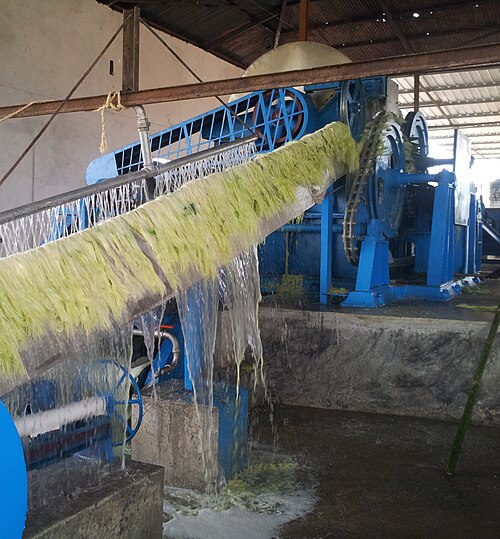
آلة تقشير تجمع الألياف من الأوراق


Denticulate leaves of Ziziphus mauritiana

Astragalus austriacus is regarded as diadelphous because it has one stamen unattached to the main adelphia (bunch).


Discolorous leaves of Brachylaena discolor differ in color between their upper and lower surfaces.

Disk florets opening in a capitulum of a cultivated Helianthus. They open progressively from the edge to the center of the disk.
E
- -eae
- A suffix added to the stem of a generic name to form the name of a tribe, e.g. Aster → Astereae.
- ebracteate
- Lacking bracts; synonymous with ebracteolate.
- ecological amplitude
- The range of environmental conditions in which an organism can survive.
- edaphic
- Of or influenced by the soil.
- eglandular
- Not having glands.
- elaiosome
- An external structure attached to the seed of many species of plants. Elaiosomes generally look fleshy and in some species they are rich in oils or other nutritious materials. Their functions vary and are not always obvious; commonly they attract ants or other animals that aid in dispersal, but they may also repel other animals from eating the seed.[34]
- elephophily
- A form of pollination whereby pollen or spores are distributed by the feet of elephants, as in Rafflesia arnoldii.
- ellipsoid
- A three-dimensional shape that is elliptical in all sections through the long axis.
- elliptical
- Planar, shaped like a flattened circle, symmetrical about both the long and the short axis, tapering equally both to the tip and the base; oval.
- emarginate
- Typically in reference to leaf margins: notched or recessed at some part of the edge, such as the apex; the recess usually is broad and shallow. The location of a leaf's emargination(s) might be one or more of apical, lateral or basal
- embryo
- The young plant contained by a seed prior to germination.
- emergent
- A plant taller than the surrounding vegetation or, among aquatic plant species, one that bears flowers and commonly leaves above the surface of the water. Aquatic examples include water lilies, reeds, and papyrus. Some pondweeds such as Stuckenia are not emergent until they flower, at which time only their flowers appear above the water surface.
- enation
- Leaf-like outgrowth from a surface.[35]
- enantiostyly
- The condition in which the gynoecium protrudes laterally, to the right (dextrostyly) or to the left (sinistrostyly) of the androecium, e.g. Senna.
- endemic
- Having a natural distribution restricted to a particular geographic region. Compare native.
- endocarp
- The innermost layer of the wall of a fruit; in a drupe, the stony layer surrounding the seed.
- endodermis
- The innermost layer of the cortex of vascular plantroots, also present in the stems of pteridophytes. The radial walls are impregnated with suberin to form a permeability barrier known as the Casparian strip.
- endosperm
- 1. (angiosperms) A nutritive tissue surrounding the embryo of the seed, usually triploid, originating from the fusion of both polar nuclei with one gamete after the fertilization of the egg.
- 2. (gymnosperms) The prothallus within the embryo sac.
- endospory
- The production of spores that germinate into a reduced multicellular gametophyte contained within the spore wall. Contrast exospory.
- ensiform
- Shaped like the blade of a sword.
- entire
- 1. Not divided.
- 2. (of a margin) Smooth and not lobed or toothed (though possibly wavy or scalloped). See also entire in Glossary of leaf morphology
- entomophily
- A form of pollination whereby pollen or spores are distributed by insects.
- epecophyte
- Species of recent appearance, usually numerous and constant in the country, but confined to artificial habitats, such as meadows and ruderal vegetation and are dependent on humans for existence.[36]
- ephemeral
- Short-lived. See also caducous.
- epicalyx
- An involucre resembling an outer calyx, e.g. as in Hibiscus. Made of small bract-like leaflets called episepals.
- epicarp
- The outer layer of the wall of a fruit, i.e. the "skin".
- epicormic
- Used to refer to buds, shoots, or flowers developing from the old wood of trees, especially after injury or fire.
- epicotyl
- The part of the plant axis or stem between the cotyledonary node and the first foliage leaves.
- epicuticular wax
- A layer of crystalline or amorphous wax deposited on the surface of the cuticle.
- epidermis
- An organ's outermost layer of cells, usually only one cell thick.
- epigynous
- Borne on the ovary; describes floral parts when attached above the level of the ovary and arising from tissue fused to the ovary wall. Compare hypogynous and perigynous.
- epilithic
- Growing on stone. Compare lithophytic, a plant growing on stone.
- epipetalous
- Of stamens that are attached to the petals.
- epipetric
- Growing on rock or stone, lithophytic, epilithic.
- epiphloeodal
- Growing on the surface of bark. Contrast endophloeodal (growing inside, not on, the bark) and epilithic (growing on rock, not bark).
- epiphyte
- A plant, alga or fungus that grows on another plant without deriving nourishment from it but using it for support.
- epiphytic
- Of an epiphyte; living on the surface of a plant. Compare epilithic, lithophytic.
- episepal
- Small bract-like leaflets that make up an extra calyx (epicalyx) located below the true calyx
- episepalous
- Of stamens that are attached to the sepals.
- epitepalous
- Of stamens that are attached to the tepals.
- epithet
- The adjectival component in a binomial scientific name, usually more specifically called a specific epithet; the final word or combination of words in a name of more than one word (other than a term denoting rank) that denominates an individual taxon. The simplest and commonest example is the second word in a two-word name of a species, such as "mirabilis" in Welwitschia mirabilis.
- epizoochory
- A type of seed dispersal that occurs when seeds or fruits physically adhere to the outside of vertebrate animal bodies.
- epruinose
- Not pruinose.
- equitant
- (of a leaf) Folded lengthwise and clasping another leaf.
- erect
- Upright, more or less perpendicular to the ground or point of attachment. Compare patent (spreading) and erecto-patent, between erect and patent.
- ericoid
- Having leaves like those of the European heaths (Erica); small and sharply pointed.
- erose
- (of a margin) Irregular as though nibbled or worn away.
- ethelochoric
- Deliberate introduction by seedlings, seeds or plants in a new habitat by humans.
- etiolation
- Weak growth due to lack of light, resulting in elongated stems and yellowish color.[37]
- even-pinnate
- Having an even number of leaflets in a compound leaf; synonymous with paripinnate.
- evergreen
- Not deciduous; having leaves all year.
- ex
- In nomenclature, indicating that the preceding author proposed the name but did not legitimately publish it, and that the succeeding author referred to the first author when legitimately publishing the name. See Author citation (botany).
- exalbuminous
- In seeds of a given species, having no endosperm, i.e. no albumen, e.g. in Fabaceae and Combretaceae.
- exocarp
- The outer layer of the pericarp, often the skin of fleshy fruits.
- exospory
- The production of spores that germinate into free-living multicellular gametophytes. Contrast endospory.
- exotesta
- The outer layer of the testa (seed coat). It is derived from the outer integument of the ovule.
- exotic
- Not native; introduced from another region or country.
- exserted
- Projected beyond, e.g. stamens beyond the corolla tube.
- exstipulate
- Lacking stipules.
- extrastaminal
- Outside the stamens or androecium, usually referring to the location of a nectary disk.
- extrorse
- (of antherlocules) Opening toward the outside of the flower. Contrast introrse and latrorse.
 Tillandsia recurvata growing as a harmless, non-parasitic epiphloedalepiphyte on a tree trunk that it shares with epiphloedal foliose lichens
 Seeds or fruit are dispersed by epizoochory when they stick to the fur of animals.
 The bases of equitant leaves enclose later leaves on the stem.
 Sections of exalbuminous seeds
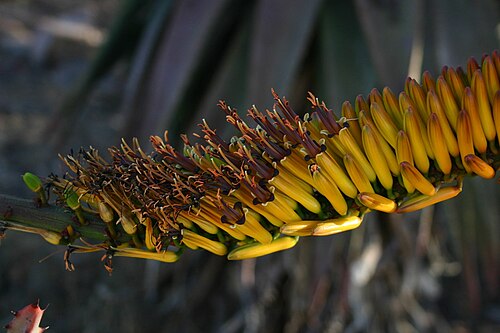 Aloe marlothii flowers with stamens and stigmata of mature flowers exserted from the mouths of the floral tubes

Plants of the genus Corydalis bear seeds with attached elaiosomes, which have various functions, commonly attracting ants. On some Corydalis species, elaiosomes that attract ants also repel mice.[34]

Ficus lyrata is an example of a doubly-emarginate leaf with lateral and apical emargination; it also might be seen as a basally emarginate.
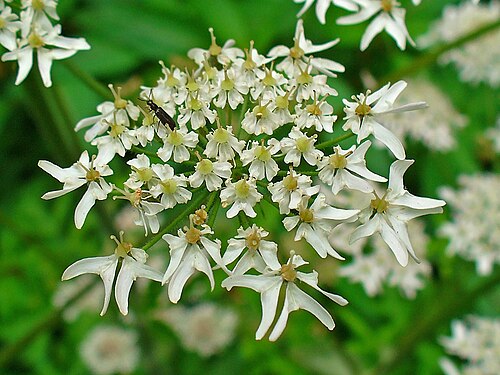
Petals of Heracleum sphondylium are variously emarginate at their tips. Flowers in the middle of the inflorescence have slightly emarginate petals, whereas flowers at the periphery are so deeply emarginate as to be almost cleft in two.

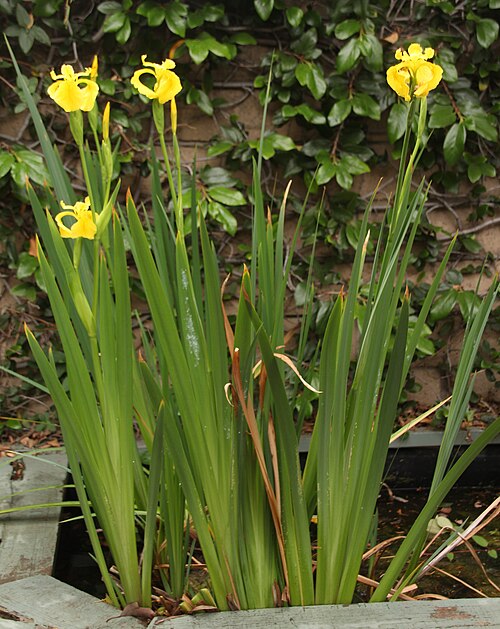
Iris pseudacorus has clearly ensiform leaves: narrow, straight-edged, sword-shaped.


F
- F1 hybrid
- A single cross; a plant breeding term for the result of a repeatable cross between two pure bred lines.
- F2 hybrid
- A plant breeding term for the result of a plant arising from a cross between two F1 hybrids; may also refer to self-pollination in a population of F1 hybrids.
- fabiform
- Shaped like a kidney bean.
- facultative
- Able to perform a particular life function, or to live generally, in more than one way.[38] Compare obligate.
- falcate
- Curved like the blade of a scythe.
- family
- A taxonomic group of one or more genera with features, ancestry, or both in common. It is the term for the principal rank between order and genus.
- farina
- Powdery, pale yellow, crystalline secretion consisting of flavonoids in Primula and other species.
- farinaceous
- Powderiness that is mealy.
- fascicle
- A cluster of flowers, leaves, needles, vascular tissue, etc., e.g. a tuft of leaves all arising from the same node.
- fasciculate
- Branching in clusters, e.g. a bundle of sticks or needles; having fascicles.
- fastigiate
- 1. In Plant morphology, the habit of a plant that consists in part, of a bundle of erect, more or less parallel branches or stems, particularly if they form or taper to a peak or point. (Latin fastigiatus, meaning "having a peak".
- 2. In palynology, the form of a pollen grain that has a fastigium, a pointed apex over a hollow between the layers of the pollen outer wall.
- faucal
- Pertaining to the fauces; located in the throat of a calyx or corolla.
- fauces
- The throat of a calyx or corolla; the conspicuously widened portion between the mouth and the apex of the tube. In Boraginaceae, the site of distinctive appendages.
- faveolate
- Honeycombed; having regular, angled pits. Compare foveolate.
- felted
- Having interlocked hairs to the extent of being matted.[28]
- female flower
- See pistillate flower.
- fenestrate
- Having translucent or transparent areas that let light through; this variously affects the behavior of animal visitors or permits photosynthesis in many arid-region plants that grow only to the soil surface. Also refers loosely to perforations, for which perforate is the more precise term.
- ferruginous
- Ruddy or rust-colored.
- fertile
- Capable of producing fruit; of flowers when they produce seed, or of anthers containing pollen.
- fertilization
- The union of male and female gametes during sexual reproduction.
- fiber
- 1. A fiber cell.
- 2. Any flexible, strong, stringy, and very elongate structure.
- fiber cell
- A type of cell that is found in sclerenchyma; it is much elongated, and dies soon after an extensive modification of its cell wall. The cell wall is usually thickly lignified but is sometimes gelatinous.
- filament
- 1. The stalk of a stamen.
- 2. Any very narrow, thread-like structure that is one or a few cells thick.
- filamentous
- Consisting of filaments or fibers; hairlike.
- filiform
- Thread-like, e.g. stamenfilaments or leaf shapes.
- fimbria
- Slender, hair-like projection; fringe.
- fimbriate
- Fringed, e.g. where the ends of a petal are split into two or more divisions.[39] Having fimbriae.
- fissure
- A split or crack, often referring to fissured bark; a line or opening of dehiscence.
- fistule
- A tube-shaped cavity.
- fistulose
- Hollow; usually applied to a tube-shaped cavity, as in a reed.
- flabellate
- Fan-shaped, e.g. a flabellate (fan-shaped) leaf.
- flaccid
- Limp; tending to wilt. Compare turgid.
- flexistyly
- Depending on the degree of maturation of the stamens, the style moves up or down (cataflexistyle or (ana-)hyperflexisyle).
- flexuous
- flexuose
- Bent alternately in different directions; zigzag.
- floccose
- Having a soft and wooly covering of hairs.
- flora
- 1. All the plants growing in a certain region or country.
- 2. An enumeration of them, generally with a guide to their identification (e.g. the Flora of North America, Flora of China, Flora of Victoria, Flora of New South Wales, and so on). In this case, flora is written with a capital F.
- floral envelope
- See perianth.
- floral leaves
- The upper leaves at the base of the flowering branches.
- floral diagram
- A graphical means to describe flower structure, usually a schematic cross-section through a young flower.
- floral formula
- A description of flower structure using numbers, letters, and various symbols.
- floral tube
- An imprecise term sometimes used as a synonym of hypanthium, corolla tube, or calyx tube.
- floret
- A small flower, usually referring to the individual true flowers clustered within an inflorescence, particularly those of the Poaceae grasses and the pseudanthia of family Asteraceae.
- flower
- The sexual reproductive structure of the angiosperms, typically with a gynoecium, androecium, perianth, and an axis.
- foliate
- 1. When describing a whole plant: leafy or having leaves (as opposed to nonfoliate).
- 2. When preceded by a number: specifying a number of leaflets, e.g. 3-foliate means "having three leaflets".
- foliicolous
- A growth habit of certain lichens, algae, and fungi that prefer to grow on the leaves of vascular plants.
- follicle
- A dry fruit formed from one carpel splitting along a single suture to which the seeds are attached, e.g. from the pod of a legume.[40]
- foliole
- A leaflet of a compoundleaf.
- foliose
- Leaf-like; flattened like a leaf.
- forb
- In American English, a term used for any non-woody flowering plant that is not a grass, sedge, or rush. Roughly equivalent to herb in British and other forms of English
- forest
- Vegetation dominated by trees with single trunks, including closely arranged trees with or without an understory of shrubs and herbs.
- forma (in common usage, form)
- A taxonomic category subordinate to species and within the taxonomic hierarchy, below variety (varietas), and usually differentiated by a minor character. Its abbreviation is "f."
- foveolate
- Having regular tiny pits. Compare faveolate.
- free
- Not united with other organs of the same type; not attached at one end.
- free central
- (of placentation) Ovules attached to a free-standing column in the center of a unilocularovary.
- frond
- A leaf of a fern, cycad, or palm.
- frutescent
- Shrub-like (fruticose) or becoming shrub-like.
- fruticose
- Shrubby; having the branching character of a shrub.
- fruit
- A seed-bearing structure, present in all angiosperms, formed from the mature ovary and sometimes associated floral parts upon fertilization.
- fugacious
- Disappearing, falling off, or withering. Compare persistent and caducous.
- funicle (funiculus)
- The stalk of an ovule.
- funnelform
- Having a form gradually widening from the base to the apex; funnel-shaped.
- furcate
- Forked, usually applied to a terminal division; with two long lobes.
- fused
- Joined together.
- fusiform
- Rod-shaped and narrowing gradually from the middle toward each end; spindle-shaped.
 The pseudanthium of Zinnia elegans is typical of many Asteraceae in that it includes two types of florets, ray florets and disk florets.
 Foveolate seeds of Physochlaina physaloides

Astragalus falcatus has conspicuously falcate pods; not many falcate anatomical structures are so markedly curved.

Rhigozum obovatum bears its leaves in well-defined fascicles.


Favolaschia calocera, the orange pore fungus, has conspicuously faveolate fruiting bodies.

Emerging leaves of Oldenburgia grandis are heavily felted.

Fenestrate leaves of Darlingtonia californica

In the wild, the leaves of Fenestraria commonly are covered in soil, except for the transparent fenestration; this permits photosynthesis while reducing damage from exposure to intense sunlight and herbivores.

Digitalis ferruginea owes its specific name to its ferruginous (rust-colored) flowers.

Calochortus fimbriatus has fimbriate flowers.

G
- galbulus
- From Latin, galbulus, the cone (megastrobilus) of the Mediterranean cypress. By modern extension, a specialist term for the cone of any species in the cypress family Cupressaceae. It includes the fleshy cones borne by junipers, which are often mistakenly called berries.
- galea
- An overhanging, helmet-shaped, structure that protects the reproductive parts from precipitation, wind or unwanted visitors.
- gall
- Abnormal outgrowth on external plant tissues, caused by various parasites, from viruses, fungi and bacteria, to other plants, insects and mites.
- gamete
- A cell or nucleus that fuses with another of the opposite sex during sexual reproduction.
- gametophore
- Specialized structures on the gametophytes of some bryophyte species, for example many species in the order Marchantiales; in such species the gametes are produced on the gametophores.
- gametophyte
- The haploid multicellular phase in the alternation of generations of plants and algae that bears gametes. In bryophytes the gametophyte is the dominant vegetative phase; in ferns and their allies it is a small free-living plant known as the prothallus; in gymnosperms and angiosperms the gametophytes are reduced to microscopic structures dependent on the sporophyte, male gametophytes contained in pollen grains and females contained within the ovules.
- gamopetalous
- with joined or fused petals
- gamophyllous
- a single perianth-whorl of united segments. Compare symphyllous (synonym), apophyllous, and polyphyllous.
- gemma
- an asexual reproductive structure found in liverworts and mosses.
- gene pool
- The complete range of genetic variation found within a population.
- genus
- A group of one or more species with features or ancestry (or both) in common. Genus is the principal category of taxa intermediate in rank between family and species in the standard nomenclatural hierarchy.
- generic name
- The name of a taxonomic genus, such as Acacia and Eucalyptus.
- genotype
- The genetic make-up of an individual.
- geophilous
- Growing or rooting in the ground.
- germination
- 1. of seeds, describing the complex sequence of physiological and structural changes that occur from resting to growth stage.
- 2. of a pollen grain; production of a pollen tube when contacting a stigma receptive to it.
- 3. of a spore of fungi/bacterium; change of state – from resting to vegetative.
- gibbous (gibbose)
- (of part of an organ) Swollen, usually with a pouch-like enlargement at the base.
- glabrescent
- Becoming glabrous, almost glabrous; glabrate.
- glabrous
- Lacking surface ornamentation such as hairs, scales or bristles; smooth.
- gland
- A secretory structure within or on the surface of a plant.
- glandular hair
- A hair tipped with a gland.
- glaucous
- Describing the external surface of a plant part that has a whitish covering, in some cases with a blueish cast. Often applied to plants with a wooly or arachnoid surface, but properly referring to pruinose surfaces, meaning those with a waxy bloom. The surfaces of the young leaves of many eucalypts provide good examples, and so do some xerophytes.
- globose
- Roughly spherical. See also subglobose.
- globulose
- Approximately spherical.
- glochid
- A tiny barbed hair or bristle, e.g. the fine defensive hairs in cactus species such as Opuntia.
- glomerule
- An inflorescence consisting of a compact cluster of sessile or subsessile flowers.
- glumes
- bracts subtending the floret(s) of a sedge, or similar plant; in grasses forming the lowermost organs of a spikelet (there are usually 2 but 1 is sometimes reduced; or rarely, both are absent).
- glutinous
- Sticky.
- graft
- 1. The artificial union of plant parts.
- 2. A plant shoot suitable for grafting; loosely, a scion, sucker, or branch.
- graft chimaera (sometimes graft hybrid)
- A taxon whose members consist of tissue from two or more different plants in intimate association originated by grafting. The addition sign "+" is used to indicate a graft-chimaera either as a part of a formula (e.g. Crataegus monogyna + Mespilus germanica) or in front of an abbreviated name (e.g. + Crataegomespilus 'Dardari'). The nomenclature of graft hybrids is governed by the International Code of Nomenclature for Cultivated Plants.
- graminaceous
- Of or relating to grass.
- graminoid
- An herbaceous plant with a grass-like morphology.
- granular
- (of a surface) Covered with small rounded protuberances.
- grass
- A plant of the family Poaceae.
- grassland
- Low vegetation dominated by grasses.
- groundcover
- 1. Dense vegetation that covers the ground.
- 2. A term applied to describe a plant that covers the soil surface so densely that it smothers all beneath it.
- group
- A formal category equivalent to or below the rank of genus which distinguishes
- an assemblage of two or more cultivars within a species or hybrid;
- plants derived from a hybrid in which one or more of the parent species is not known or is of uncertain origin; or,
- a range of cultivated plants of a species or hybrid which may exhibit variation but share one or more characters, which makes it worth distinguishing them as a unit.
- guard cell
- Each of two cells surrounding the stoma which control gas exchange between the apoplast of the plant and the external environment.
- guttate
- Having droplet-shaped spots. Compare punctate and maculate.
- guttation
- The secretion of liquid water from uninjured plant parts. See hydathode.
- guttulate
- Having or appearing to be spotted with oil droplets; of spores, having oil droplets inside.
- gymnosperm
- A seed-bearing plant with unenclosed ovules borne on the surface of a sporophyll. Gymnosperms are among the oldest clades of vascular plants, and today are represented by approximately 1,000 extant species worldwide, including, among others, conifers, Ginkgo, Gnetum and cycads. Compare angiosperm.
- gynaecium
- Alternative term for gynoecium, but with partly different etymology.
- gynobasic
- Of a style, arising near the base of the gynoecium, e.g. between the lobes of the ovary.
- gynodioecious
- Of a species, with some plants bearing only bisexual flowers and others bearing only female flowers.
- gynomonoecious
- Of a species, with bisexual flowers and female flowers on the same plant.
- gynoecium
- The collective term for the female reproductive parts of a flower or for the carpels of a flower, whether united or free. Contrast androecium. Abbreviation: G. For instance, G indicates a superior ovary; G(5) indicates having five fused carpels.
- gynophore
- A stalk supporting the gynoecium and situated above the level of insertion of the other floral parts.
- gynostegium
- A compound organ in milkweeds (Asclepiadaceae) and orchids formed by fusion of the filaments of the stamens with the style. Also known as the column.
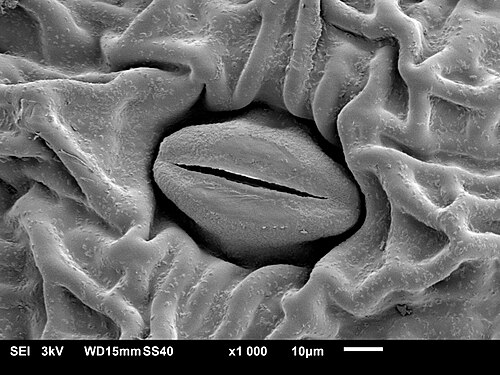 Scanning electron micrograph of a stoma on the leaf of Haemanthus. The two lip-shaped cells on either side of the pore are the guard cells.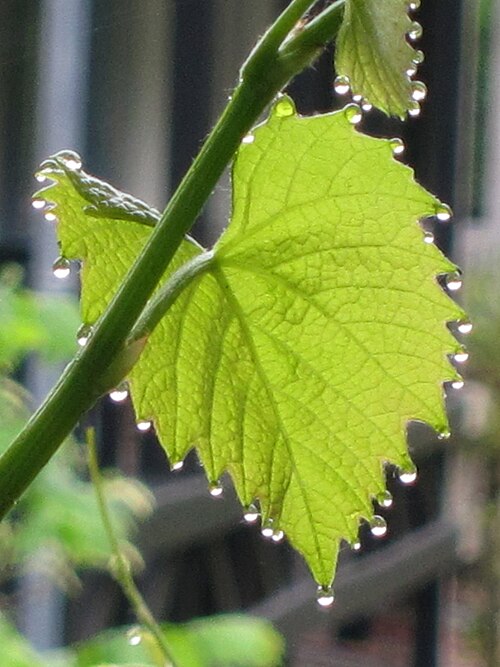
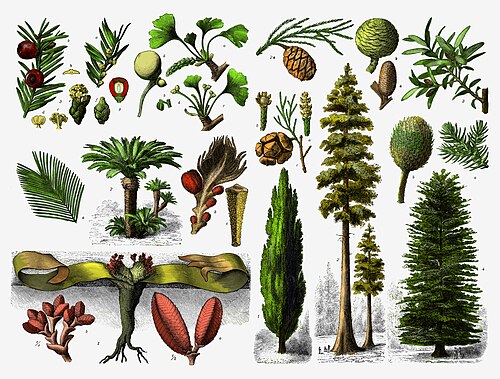

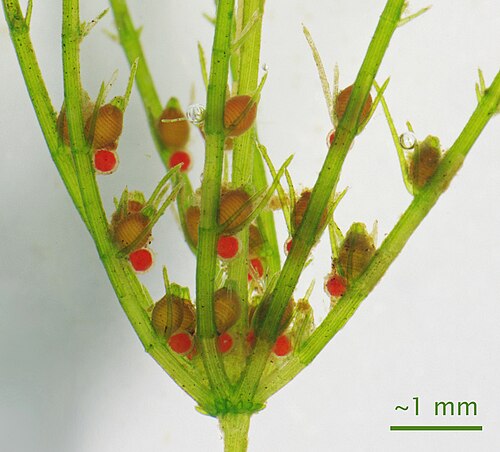
Gametophores (red male antheridia and brown female archegonia) borne on a gametophyte of a Chara species of green algae

Longitudinal section of immature male pine cone, showing male gametophytes (pollen grains) developing between the cone scales

Glandular hairs on the stem of Geranium dissectum

The leaves, buds, and young stalks of Eucalyptus macrocarpa are glaucous, covered with a thick waxy pruinosity.


Glumes of a grass species with a fairly large inflorescence
H
- habit
- The general external appearance of a plant, including size, shape, texture, and orientation.
- habitat
- The place where a plant lives; the environmental conditions of its home.
- hair
- A single elongated cell or row of cells borne on the surface of an organ.
- half-inferior ovary
- An ovary partly below and partly above the level of attachment of the other floral parts. Compare inferior ovary and superior ovary.
- halonate
- Having a transparent coating, or being of a spore's outer layer.
- halophyte
- A plant adapted to living in highly saline habitats; a plant that accumulates high concentrations of salt in its tissues.
- hand-pollination
- The controlled act of pollination that excludes the possibility of open-pollination.
- haploid
- Having one set of chromosomes, e.g. the complement of chromosomes in each of the cells of the gametophyte, the nucleus of a gamete, and the spores. This is expressed symbolically as n, where n = the gametic number of chromosomes. Compare diploid, triploid, and tetraploid.
- haplostemonous
- Having a single series of stamens equal in number to the proper number of petals, and alternating with them. Compare diplostemonous and obdiplostemonous.
- harmomegathy
- process by which pollen grains in arid environments close off their apertures to avoid losing water
- hastate
- Triangular in outline, the basal lobes pointing outward, so that the base appears truncate; may refer only to the base of a leaf with such lobes. Compare sagittate, which refers to basal lobes pointing backward.
- haustorium
- In parasitic plants, a structure developed for penetrating the host's tissues.
- head
- See capitulum, a pseudanthium.
- heathland
- Vegetation dominated by small shrubs which usually have ericoid leaves.
- helicoid
- Coiled; of a cymose inflorescence, when the branching is repeatedly on the same side (the apex is often recurved). Compare scorpioid.
- heliophilous
- Requiring or tolerating strong, direct sunlight.
- hemerochory
- A plant that has been transported voluntarily or involuntarily by humans in a territory which it could not have colonized by its own natural mechanisms of dissemination, or at least much more slowly.[36]
- hemi-legume
- A legume fruit in which the seed or seeds and one valve of the pod are dispersed as a unit. The valve catches the wind and blows away with the seeds, as in Acacia tenuifolia and Peltogyne paniculata.
- herb
- Any vascular plant that does not develop a woody stem at any point during its life cycle, e.g. a daffodil.
- herbaceous
- Not woody; usually green and soft in texture.
- herbarium
- A collection of preserved, usually pressed and dried, plant material used for identification and comparison; also a building in which such collections are stored.
- herkogamy
- A flower with parts arranged so that pollen from the anthers is unlikely to be transferred to the stigma without assistance of a pollinator.[41]
- hermaphrodite
- A synonym of bisexual.
- hesperidium
- A form of berry that occurs most familiarly in the genus Citrus. The fruit tends to be large for a berry, ranging from not much more than a centimeter in small fruited genera such as Murraya, to 15 cm or more in some varieties of Citrus. The outer rind typically is thick and tough with many oil glands, while the carpels within are packed with juicy fibers.
- heteroblastic
- Having parts, especially leaves, that are distinctly different between the juvenile and adult stages.
- heterophyllous
- Having more than one leaf type on the same plant. For example, leaves adapted to the open air and leaves adapted to being under water in Ranunculus aquatilis.[42]
- heterophylly
- A condition in which a plant has two or more types of leaves that differ in form and/or function.[43]
- heteromorphic
- Having two or more distinct morphologies (e.g. of different size and shape). Compare isomorphic.
- heterospory
- The production of spores of two different sizes (small and large) by the sporophytes of land plants. Compare homospory.
- heterostyly
- The condition of a species having flowers with different style and stamen lengths, but with all the flowers of any one plant being identical. See distyly.
- hilum
- The scar on a seed coat where it separates from its stalk (funicle).
- hip
- The fruit of a rose plant.
- hippocrepiform
- Horseshoe-shaped.
- hirsute
- Bearing coarse, rough, longish hairs. See indumentum.
- hispid
- Bearing long, erect, rigid hairs or bristles, harsh to touch.
- hoary
- Covered with a greyish to whitish layer of very short, closely interwoven hairs, giving a frosted appearance.
- holotype
- A type chosen by the author of a name. Compare lectotype.
- homochlamydeous
- Having a perianth which is not divided into a separate calyx and corolla. Contrast dichlamydeous.
- homospory
- The production of spores of only one size by the sporophytes of land plants. Compare heterospory.
- hort.
- Of gardens, an author citation used in two ways:1. as a name misapplied by gardeners
- 2. as an invalid name derived from horticultural writings of confused authorship.
- husk
- Protective outer covering of certain seeds, for example, the leafy outer covering of an ear of maize (corn), the leathery covering of the walnut, or the spiky covering of the chestnut.
- hyaline
- Translucent; usually delicately membranous and colorless.
- hybrid
- Plant produced by the crossing of parents belonging to two different named groups, e.g. genera, species, varieties, subspecies, forma and so on; i.e. the progeny resulting within and between two different plants. An F1 hybrid is the primary product of such a cross. An F2 hybrid is a plant arising from a cross between two F1 hybrids (or from the self-pollination of an F1 hybrid).
- hybrid formula
- The names of the parents of a hybrid joined by a multiplication sign, e.g. Cytisus ardonoi × C. purgans.
- hydrophily
- Form of pollination whereby pollen is distributed by the flow of waters.
- hypanthium
- Tube or cup-like structure in a flower that includes the bases of sepals, petals, and stamens, and may or may not be connected (adnate) to the ovary.
- hyper-resupinate
- In botany, describing leaves or flowers that are in the usual position but are borne on a petiole or pedicel that is twisted 360 degrees. The term is used to describe organs, such as orchid flowers, that are usually resupinate. Compare resupinate.
- hypocarpium
- Enlarged fleshy structure that forms below the fruit from the receptacle or hypanthium.
- hypocotyl
- Of an embryo or seedling, the part of the plant axis below the cotyledon and node, but above the root. It marks the transition from root to stem development.
- hypocrateriform
- Salver-shaped. Synonym of salverform. From Greek kratḗrion: a vessel.
- hypogynous
- Borne below the ovary; used to describe floral parts inserted below the ovary's level of insertion. Compare epigynous and perigynous.
- hysteranthous
- Type of growth in which new leaves appear after flowering. Also spelled histeranthous. Compare proteranthous and synanthous.

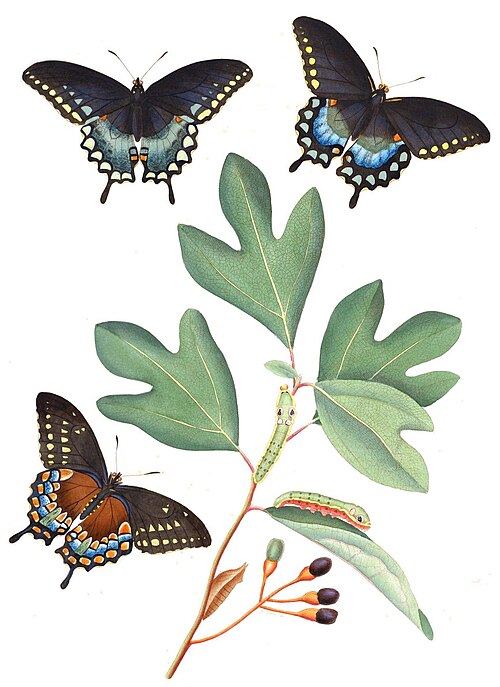 A hypocarpium forms below the fruits of Sassafras albidum.
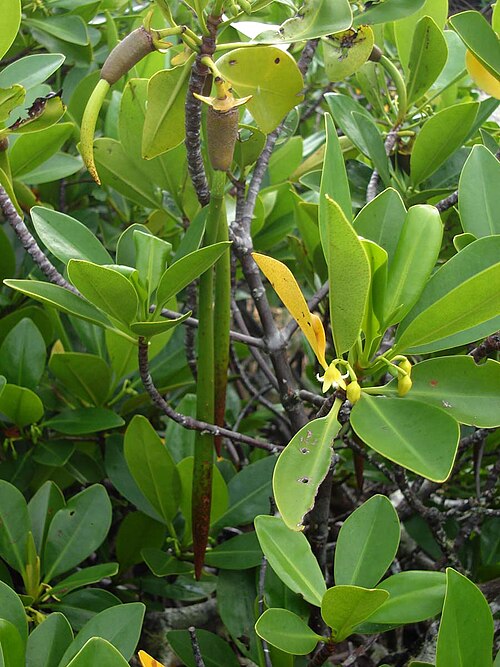 Flowers, fruit and propagule of a Rhizophora "mangle" or mangrove. The apparent root of the propagule is in fact meristematic tissue developing from the hypocotyl. The new plant develops largely from this tissue, especially if it has successfully penetrated into mud in which the new plant can establish itself.

Epidermal hairs on plant leaves

Multicellular hairs on the edge of a sepal of Veronica sublobata

Salicornia europaea, growing on a tidal mudflat inundated by salt-rich seawater twice daily, is a typical halophyte with thick, fleshy stems.


Markedly hastate leaf of Salvia canariensis

The swollen haustorium of Viscum capense renders the end of the branch stunted compared to the lower part of the branch.

The fruit of Poncirus is a typical hesperidium.

Heteroblastic growth is common in Eucalyptus species with leaves that are isobilateral in the mature tree; they generally start life with dorsiventral leaves. Some of these saplings are in the transient stage in which they have both forms of leaves, dorsiventral on lower branches, and isobilateral above.
I
- idioblast
- A cell, especially of a leaf, differing markedly from surrounding cells. They often synthesise specialized products such as crystals.
- illegitimate name (nomen illeg.)
- A name not abiding by the rules of the botanical Codes, e.g. later homonyms, cultivars that have been Latinised after 1 Jan 1959; cultivar names with more than 10 syllables or 30 letters; cultivar names that use confusing names of other plants, e.g. Camellia 'Rose'.
- imbricate
- From the Latin for "tiled". Overlapping each other; of perianth parts, edges overlapping in the bud (the convoluted arrangement is a special form of imbrication). Dormant buds of many deciduous species are imbricately covered with protective cataphylls called bud scales. Compare with subimbricates meaning lightly overlapping
- imparipinnate
- A pinnate leaf with an odd number of pinnae (terminated by a single leaflet). Compare paripinnate.
- in
- In nomenclature, where the preceding author published the name in an article or book, authored or edited by the succeeding author.
- -inae
- The suffix added to the stem of a generic name to form the name of a subtribe: for instance, Corydalinae from Corydalis + -inae.
- inbreeding
- The production of offspring between closely related parents leading to a high degree of similarity; self-fertilization is the most intense form of inbreeding.
- incertae sedis
- Of unknown taxonomic affinity; relationships obscure.
- incised
- Cut deeply and (usually) unevenly (a condition intermediate between toothed and lobed).
- included
- Enclosed, not protruding, e.g. stamens within the corolla.
- incomplete flower
- A flower which lacks one or more of its usual parts, such as carpels, sepals, petals, pistils, or stamens.
- incurved
- Bent or curved inward; of leafmargins, when curved toward the adaxial side.
- ined.
- An abbreviation of Latin inedita, an unpublished work. Used to indicate that a botanical name appeared only in a manuscript that was not published, so the name is invalid.
- indefinite
- variable in number, and as a rule numerous, e.g. more than twice as many stamens as petals or sepals, but no particular standard number of stamens. In another usage it is a synonym for the preferable term indeterminate, meaning the condition in which an inflorescence is not terminated by a flower, but continues growing until limited by physiological factors. Compare numerous. Contrast definite.
- indehiscent
- Not opening in any definite manner at maturity; usually referring to fruit. Contrast dehiscent.
- indeterminate
- usually referring to a stem or inflorescence in which there is no particular terminal bud or meristem that stops growth and ends the extension of the stem, which continues until physiological factors stop the growth. Racemes of some Xanthorrhoeaceae, such as many Aloes, and of many Iridaceae, such as Watsonias, are indeterminate. Contrast determinate.
- indigenous
- Native to the area, not introduced, and not necessarily confined to the region discussed or present throughout it (hardly distinct from ‘native' but usually applied to a smaller area). For example, the Cootamundra Wattle is native to Australia but indigenous to the Cootamundra region of southern New South Wales. Compare endemic.
- indumentum
- Collective term for a surface covering of any kind of trichomes, e.g. hairs, scales.
- induplicate
- Folded upward, or folded with the two adaxial surfaces together.
- indusium
- 1. Membrane covering the sori of some ferns.[44]
- 2. Cup enclosing the stigma in Goodeniaceae.[44]
- inferior ovary
- An ovary at least partly below the level of attachment of other floral parts. Compare superior ovary and half-inferior ovary.
- inflated
- Swollen, like a bladder.
- inflexed
- Bent sharply upward or forward. Compare deflexed.
- inflorescence
- several flowers closely grouped together to form an efficient structured unit; the grouping or arrangement of flowers on a plant.
- infraspecific
- denotes taxonomic ranks below species level, for example subspecies.
- infrageneric
- denoting taxonomic ranks below the genus level, for example, subgenera, sections, and series.
- infructescence
- the grouping or arrangement of fruits on a plant.
- infundibular (infundibuliform)
- funnel-shaped, for example in the corolla of a flower.
- inrolled
- rolled inward.
- insectivorous
- catching, and drawing nutriment from, insects.
- insertion, point of
- The point at which one organ or structure (such as a leaf) is joined to the structure which bears it (such as a stem).
- inserted
- growing out from
- integument
- in general, any covering, but especially the covering of an ovule.
- intercalary
- (e.g. of growth) occurring between the apex and the base of an organ
- intercalary meristem
- a meristem located between the apex and the base of an organ
- interjugary glands
- in pinnate leaves, glands occurring along the leaf rachis between the pinnae (occurring below the single, and often slightly larger, gland at or just below the insertion of the pinnae). Compare jugary.
- internode
- The portion of a stem between two nodes.
- interpetiolar
- (of stipules) Between the petioles of opposite leaves, e.g in Rubiaceae.
- intramarginal
- inside but close to the margin. For example, an intramarginal vein is one that parallels, and is very close to, the leaf margin.
- intrastaminal
- inside the stamens or androecium, usually referring to the location of a nectary disk.
- introrse
- of antherlocules, with opening toward the center of flower (at least in bud). Compare extrorse and latrorse.
- invalid
- Use of names not validly published according to the Code, i.e. they are not strictly 'names' in the sense of the International Code of Botanical Nomenclature.
- involucre
- A structure surrounding or supporting, usually a head of flowers. In Asteraceae, it is the group of phyllaries (bracts) surrounding the inflorescence before opening, then supporting the cup-like receptacle on which the head of flowers sits. In Euphorbiaceae it is the cuplike structure that holds the nectar glands, nectar, and head of flowers, and sits above the bract-like cyathophyll structure. Involucres occur in Marchantiophyta, Cycads, fungi, and many other groups.
- involute
- Rolled inward, for example when the margins of a leaf are rolled toward the adaxial (usually upper) surface. Compare revolute.
- iridescent
- Having a reflective colored sheen produced by structural coloration, as in the speculum of the mirror orchid Ophrys speculum.
- irregular
- Not able to be divided into two equal halves through any vertical plane. See also asymmetrical. Compare zygomorphic, actinomorphic, and regular.
- isobifacial
- (of flat structures, especially leaves) Having both surfaces similar, usually referring to cell types or to the number and distribution of stomata.
- isomerous
- Having an equal number of parts in the whorls.
- isomorphic
- with all features morphologically similar, i.e. of similar size and shape. Compare heteromorphic.
- isotomic
- Having branches of equal diameter. Compare anisotomic.
- iteroparity
- Referring to an organism, such as a plant, that potentially reproduces repeatedly instead of dying after reproducing for the first time; the opposite of semelparity
 Stamens of Calotropis gigantea are inserted at the base of the corolla.
 The intramarginal veins near the margins of this leaf are outlined in white.
 Two of these three green Asteraceaeinvolucres encase unopened flower heads, and the third supports the open colorful head of emerging flowers. The imbricate phyllaries around the heads of this Malacothrix coulteri suggest the keeled scales of a snake, giving the plant its common name: "snake's head".
 This Begonia leaf shows unusual iridescence for a plant.


Petals of Mespilus germanica are imbricate before the flower opens.

Doubly imparipinnate compound leaf of Melia azedarach

Deeply incised leaves of Pelargonium graveolens

Indefinite stamens of Hypericum

Indehiscent pods of Libidibia ferrea; unlike most Fabaceae species, the plant depends on the pods being crushed by large ungulates to disperse the seeds.


The leaves of Syagrus palms are induplicately folded, in contrast to many other palm genera with reduplicate leaves.
J
- joint
- A node or junction of two parts; articulation.
- jugary
- associated with a jugum or something yoke-like; see for example jugary gland.
- jugary gland
- A gland occurring on the rachis of a pinnate or bipinnate leaf on a jugum, the junction or attachment of pairs of pinnae or pinnules, as in some Acacia species. Compare interjugary.
- jugate
- yoke-like; describing a structure of paired items joined together as in a jugum or something yoke-like, such as some leaves and fruit.
- jugum
- applied to various yoke-like organs, usually in the sense of their being paired, such as a pair of pinnae on a rachis.
- juvenile leaves
- Leaves formed on a young plant, typically differing from the adult leaves in form.
 Jugate leaf of Bauhinia glabra
 Jugate fruit of Tabernaemontana elegans
 Eucalyptus camaldulensis has dorsiventraljuvenile leaves (left), but isobilateral adult leaves (right).

Vachellia karroo bipinnate leaf
A. Rachilla B. Pinnule C. Jugary glands D. Juga (plural of jugum) E. Base of petiole F. Petiolary gland G. RachisK
- keel
- A prominent longitudinal ridge like the keel of a boat, e.g. the structure of the corolla formed by the fusion of the lower edge of the two abaxial anterior petals of flowers in the Fabaceae.
- kernel
- See drupe.
- kettle trap
- another term for the kettle-like pitchers of any of the carnivorous pitcher plants, in which they trap their prey.
- key innovation
- A novel phenotypic trait that allows subsequent evolutionary radiation and success of a taxonomic group.
- kidney shape
- A term describing a kidney-shaped object such as a bean or a leaf; more formally, oblatelycordate, or crescent-shaped with the ends rounded.
- kingdom
- the highest generally employed category of the taxonomic hierarchy, above that of division (phylum). The Plant Kingdom includes vascular plants, bryophytes and green algae and is also known as the cladeViridiplantae.
- Klausenfrucht
- Klausen or Klausenfrucht (German) is a special type of fruit in Lamiaceae and Boraginaceae. A dry, dehiscent fruit formed from a superior ovary with axil or basal placentation, with an adherent calyx, from more than one carpel and usually breaking apart into one-seeded units by separating each carpel by false septa. One unit is a half carpel. Mostly there are four units, seeds. English terms are eremocarp, schizocarp, mericarp or nutlet.
- knee
- abrupt bend in a root or stem, commonly at a node; a cypress knee, or pneumatophore, is a type of bend or knob in the root of some plants, especially some species in the genus Taxodium, that shows as a projection of the root above ground level or mud level.

One form of the kettle traps of a pitcher plant
 Kidney-shaped leaf of Cucurbita maxima
 Typical knee at a node in a grass stem
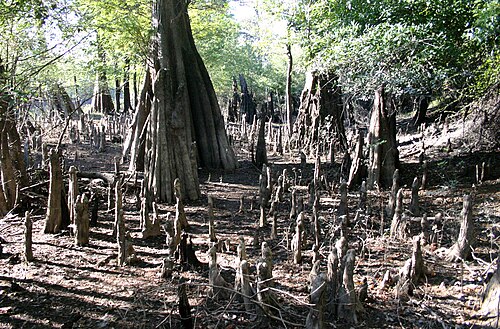 Unusually dense stand of Taxodium distichumknees around the parent tree
L
- labellum
- lip; one of three or five petals which is (usually) different from the others, e.g. in Orchidaceae, Zingiberaceae, Cannaceae and Stylidiaceae.
- labiate
- lipped; where a corolla is divided into two parts, called an upper and lower lip, the two resembling an open mouth with lips.
- lacerate
- jagged, as if torn.
- laciniate
- Of lobes – with ends irregularly divided into deeply divided, narrow, pointed segments; Of margins – deeply divided into pointed segments in an irregular manner.
- lacuna
- An empty space, hole, cavity, pit, depression, or discontinuity.
- lamella
- Thin, plate-like layer. Composed of an assemblage of many layers.
- lamina
- the blade of a leaf or the expanded upper part of a petal, sepal or bract.
- lanate
- covered in or composed of wooly hairs.
- lanceolate
- longer than broad, narrowly ovate, broadest in the lower half and tapering to the tip, like a lance or spear head; (sometimes, and incorrectly, used to mean narrowly elliptic).
- lanuginose
- covered in long hairs that cross and/or interweave with each other. More commonly the term lanate is used.[45]
- lateral
- attached to the side of an organ, e.g. leaves or branches on a stem. For more detail see dorsal.
- latex
- a milky fluid that exudes from such plants such as spurges, figs and dandelions.
- laticiferous
- latex-bearing, producing a milky juice.
- latrorse
- a type of anther dehiscence in which the anthers open laterally toward adjacent anthers. Compare introrse and extrorse.
- lauroid
- resembling Laurus, the laurel genus, particularly its leaves.
- lax
- loose, not compact.
- leaf
- an outgrowth of a stem, usually flat and green; its main function is food manufacture by photosynthesis. Abbreviation: lvs.
- leaf gap
- a parenchymatous area in the stele above (distal to) a leaf trace.
- leaf scar
- A healing layer forming on a stem where a leaf has fallen off.
- leaf sheath
- The basal portion of the petiole that wraps around the plant stem.
- leaf trace
- A vascular bundle connecting the stele to a leaf.
- leaflets
- The ultimate segments of a compoundleaf.
- legume
- 1. a fruit characteristic of the family Fabaceae, formed from one carpel and either dehiscent along both sides, or indehiscent.
- 2. a crop species in the family Fabaceae.
- 3. a plant of the family Fabaceae.
- lemma
- the lower of 2 bracts enclosing a grass flower.
- lenticel
- Typically lenticular (lens-shaped) porous tissue in bark with large intercellular spaces that allows direct exchange of gases between the internal tissues and atmosphere through the bark.
- lenticellate
- Having lenticels
- lenticular
- 1. lens-shaped.
- 2. covered in lenticels.
- lepidote
- covered with small scales.
- leprose
- powdery
- liana
- a woody climbing plant, rooted in the ground (liane is also used).
- liane
- a woody climbing plant, rooted in the ground. See also liana.
- ligneous
- having hard lignified tissues or woody parts, woody
- lignum
- Dead wood, typically in the context of a substrate for lichens.
- lignicolous
- Growing on wood tissue after bark as fallen or been stripped off (compare to corticolous).
- lignotuber
- a woody swelling of the stem below or just above the ground; contains adventitious buds from which new shoots can develop, e.g. after fire.
- ligulate
- 1. bearing a ligule.
- 2. strap-shaped.
- ligule
- 1. A small membranous appendage on the top of the sheath of grass leaves.
- 2. A minute adaxial appendage near the base of a leaf, e.g. in Selaginella.
- 3. An extended, strap-like corolla in some daisy florets.
- linea, line, British line, Paris line
- Various pre-metric units somewhat larger than 2 mm, used in botany into the 20th century. See Line (unit) and Paris line.
- linear
- Very narrow in relation to its length, with the sides mostly parallel. See Leaf shape.
- lingulate
- tongue-shaped.
- lip
- A labellum.
- lithophytic
- A plant growing on rocks; an epilithic plant.
- lobe
- Part of a leaf (or other organ), often rounded and formed by incisions to about halfway to the midrib.
- lobulate
- Having, consisting of or relating to a lobe or lobes.
- loculicidal
- (of a fruit) Dehiscing through the centers of loculi. Compare septicidal.
- locule
- A chamber or cavity containing seeds within an ovary, pollen within an anther or spores in a sporangium.
- lodicule
- One of two or three minute organs at the base of the ovary of a grass flower, representing parts of a strongly reduced perianth.
- lomentum or loment
- A pod-like indehiscent fruit that develops constrictions between the segments and at maturity breaks into one-seeded segments instead of splitting open.
- longicidal
- (of anthers) Opening lengthwise by longitudinal slits. Compare poricidal.
- lunate
- Crescent-shaped.
- lumen
- The cavity bounded by a plant cell wall.
- lyrate
- Lyre-shaped; deeply lobed, with a large terminal lobe and smaller lateral ones.
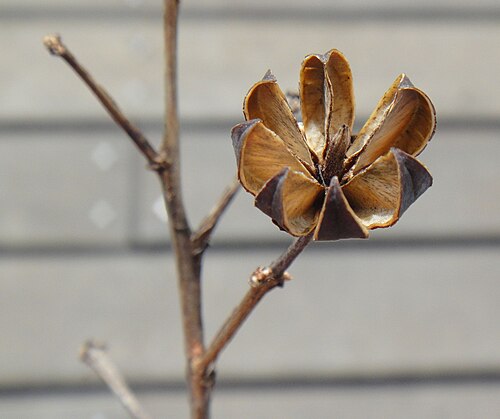 Loculicidaldehiscence of a fruit capsule. The locule walls split at the back, and the valves separate, bearing the septa on their centers.

Labiate flowers of Prunella vulgaris
Laciniate, deeply incised, leaves of Pelargonium crispum

Most Euphorbias are laticiferous and instantly exude latex when even mildly punctured.

A leaf scar on Juglans regia, showing the layer of corky protective tissue that remained after the leaf separated along the abscission zone. It also shows the leaf traces of the vascular bundles that broke off when the abscission zone failed. The axillary bud associated with the leaf shows just above the scar.
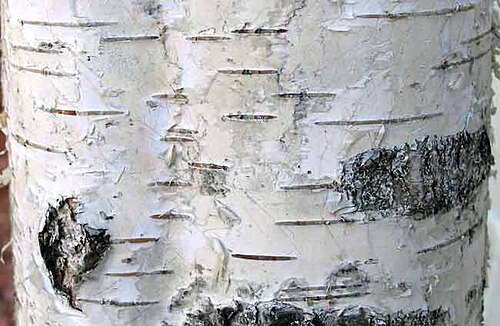
The dark horizontal lines on silver birch bark are lenticels.

Lignotubers of Lambertia formosa growing sprouts after a bush fire

Ligule between the leaf sheath and leaf of a grass
M
- maculate
- Spotted; marked with spots.
- male flower
- See staminate flower.
- mallee
- A growth habit in which several woody stems arise separately from a lignotuber; a plant with such a growth habit, e.g. many Eucalyptus species; vegetation characterized by such plants.
- mangrove
- Any shrub or small tree growing in salt or brackish water, usually characterized by pneumatophores; any tropical coastal vegetation characterized by such species.
- margin
- The edge of a structure, as in the edge of a leaf blade.
- marginal
- Occurring at or very close to a margin.
- marsh
- A waterlogged area or swamp.
- mast
- Edible fruit and nuts produced by woody species of plants (e.g. acorns and beechmast) which is consumed on the ground by wildlife species and some domestic animals.
- mealy
- Covered with coarse, floury powder.
- medulla
- pith. See also medullary rays in wood.
- megasporangium
- the larger of two kinds of sporangium produced by heterosporous plants, producing large spores that contain the female gametophytes. Compare microsporangium.
- megaspore
- the larger of two kinds of spores produced by a heterosporous plant, giving rise to the female gametophyte. Compare microspore.
- megasporophyll
- in hetersoporous plants, a modified leaf bearing one or more megasporangia. Compare microsporophyll.
- megastrobilus
- the larger of two kinds of cones or strobili produced by gymnosperms, being female and producing the seeds. Compare microstrobilus.
- membranous
- thin, translucent and flexible, seldom green.
- mericarp
- one segment of a fruit (a schizocarp) that splits at maturity into units derived from the individual carpels, or a carpel, usually 1-seeded, released by the break-up at maturity of a fruit formed from 2 or more joined carpels.
- meristem
- Any actively dividing plant tissue.
- mesic
- Moist, avoiding both extremes of drought and wet; pertaining to conditions of moderate moisture or water supply; applied to organisms (vegetation) occupying moist habitats.
- mesocarp
- The fleshy portion of the wall of a succulent fruit inside the skin and outside the stony layer (if any), surrounding the seed(s); sarcocarp.
- mesocaul
- With moderately thick twigs. Compare pachycaul.
- mesomorphic
- Soft and with little fibrous tissue, but not succulent.
- mesophyll
- 1. The parenchyma tissues between the upper and lower epidermis. They vary in function, but usually include the photosynthetic tissue of a leaf.
- 2. In ecology, the blade of a leaf or leaflet that has a surface area 4500–18225 mm2; a plant, or vegetation, that has mesophyll (sized) leaves.
- mesophyllous
- (of vegetation) Of moist habitats and having mostly large and soft leaves.
- mesophyte
- A plant thriving under intermediate environmental conditions of moderate moisture and temperature, without major seasonal fluctuations.
- micropyle
- Opening at apex of ovule.
- microsporangium
- The smaller of two kinds of sporangium produced by a heterosporous plant, producing microspores that contain the male gametophyte. Compare megasporangium.
- microspore
- The smaller of two kinds of spores produced by a heterosporous plant. Compare megaspore.
- microsporophyll
- In heterosporous plants, a modified leaf bearing one or more microsporangia. Compare megasporophyll.
- microstrobilus
- The smaller of two kinds of cones or strobilus produced by gymnosperms, being male and producing the pollen. Compare megastrobilus.
- midrib
- The central and usually most prominent vein of a leaf or leaf-like organ.
- midvein
- See midrib.
- monad
- A single individual that is free from other individuals, not united with them into a group. The term is usually used for pollen to distinguish single grains from tetrads or polyads.
- monadelphous
- A term describing stamen filaments that are fused for the greater part of their length, forming a tube around the style.
- moniliform
- Resembling a string of beads.
- monocarpic
- Flowering and setting seed only once before dying. See also semelparous.
- monochasium
- A cymose inflorescence with the branches arising singly. Compare dichasium and pleiochasium.
- monocot
- An abbreviation of monocotyledon.
- monocotyledon
- A flowering plant whose embryo contains one cotyledon (seed-leaf). Compare dicotyledon.
- monoecious
- (of vascular plants) Hermaphroditic, with all flowers bisexual, or with male and female reproductive structures in separate flowers but on the same plant, or of an inflorescence that has unisexual flowers of both sexes. Contrast dioecious.
- monoicous
- (of bryophytegametophytes) Hermaphroditic or bisexual, where both male and female reproductive structures develop on the same individual. Contrast dioicous.
- monograph
- Of a group of plants, a comprehensive treatise presenting an analysis and synthesis of taxonomic knowledge of that taxon; the fullest account possible (at the time) of a family, tribe or genus. It is generally worldwide in scope and evaluates all taxonomic treatments of that taxon including studies of its evolutionary relationships with other related taxa, and cytological, genetic, morphological, palaeobotanical and ecological studies. The term is often incorrectly applied to any systematic work devoted to a single taxon. Compare revision.
- monomorphic
- Of one type, rather than several. See also dimorphic (two types) and polymorphic (many types).
- monophyllous
- Having a single leaf.
- monopodial
- A mode of stem growth and branching in which the main axis is formed by a single dominant meristem. Contrast sympodial.
- monostromatic
- Being a single cell thick, as in the algaMonostroma.
- monothecous
- having a sole compartment or cell. Compare Dithecous.
- monotypic
- Containing only one taxon of the next lower rank, e.g. a family with only one genus, or a genus that includes only a single species.
- morphology
- The shape or form of an organism or part thereof.
- mucro
- A sharp, short point, generally at the tip of a leaf or the tip of the midrib of a compound leaf.[28]
- mucronate
- Terminating in a mucro.
- multiple fruit
- A cluster of fruits produced from more than one flower and appearing as a single fruit, often on a swollen axis, as with many species of the family Moraceae. Compare aggregate fruit.
- muricate
- Covered with short, hard protuberances.
- mutation
- In times before the nature of genetic encoding was understood, mutation was regarded as an abrupt, and sometimes heritable, variation from the norm of a population; for example a plant might unexpectedly produce "double" flowers, a novel color, or a habit of growth uncharacteristic of the species or variety. Advances in genetics and molecular biology in the mid-twentieth century, showed that biological mutations comprise and reflect changes in the nucleic acidmolecules that encode the genome of an organism or virus. The nucleic acid affected could be DNA in the chromosomes, or it could be extrachromosomal DNA (typically DNA in the mitochondria or chloroplasts). In RNA viruses a mutation would be a change to the genetic information that the RNA encodes.
- mycelium
- The "vegetative" (nonreproductive) part of a fungus, mostly composed of aggregations of hyphae. It functions in substrate decomposition and absorption of nutrients.
- mycorrhiza
- One of several types of symbiotic association between a fungus and the roots of a plant.
- mycotroph
- A plant that obtains most or all of its carbon, water, and nutrients by associating with a fungus.
 Moniliform pods on Vachellia nilotica

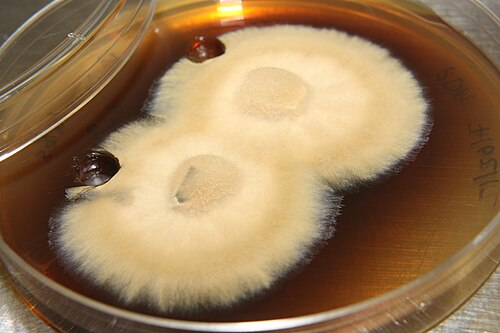 Fungal mycelium grown in culture dish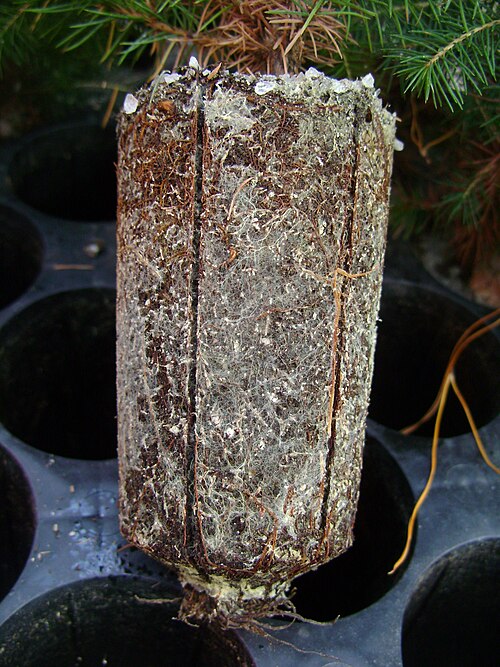

Maculate leaves

Eucalyptus socialis, showing its malleehabit, a single tree with several trunks growing from an underground lignotuber

Mast from beeches on the forest floor

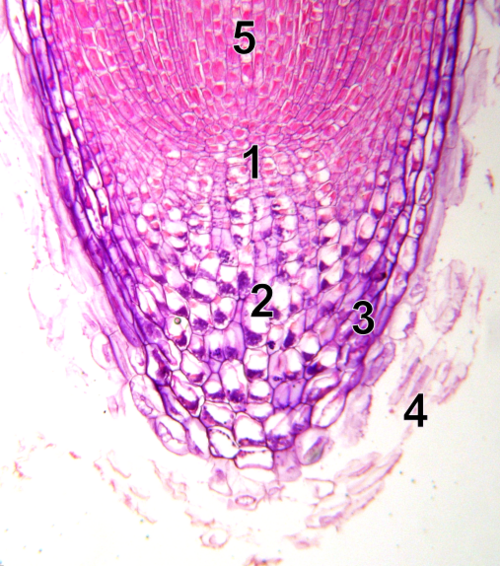
Apical meristem in root tip:
1: Meristem2: Columella showing statocytes with statoliths3: Lateral part of the tip4: Dead cells5: Elongation zone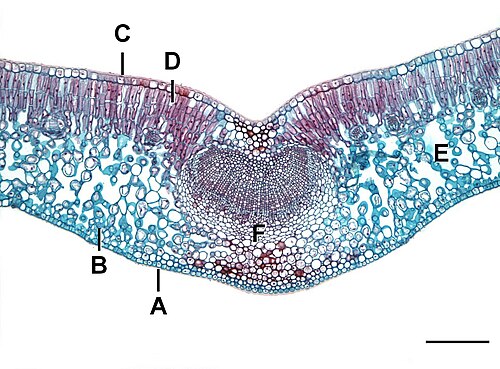
Mesophyll as seen in the cross section of a dicotyledonous leaf
A-Lower epidermisB-Lower palisade mesophyllC-Upper epidermisD-Upper palisade mesophyllE- Spongy mesophyllF-Leaf vein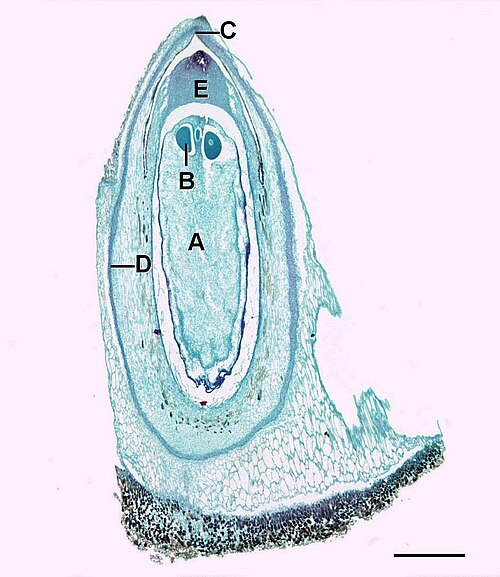
Longitudinal section of Pinus ovule
A=GametophyteB=Egg cellC=MicropyleD=IntegumentE=Megasporangium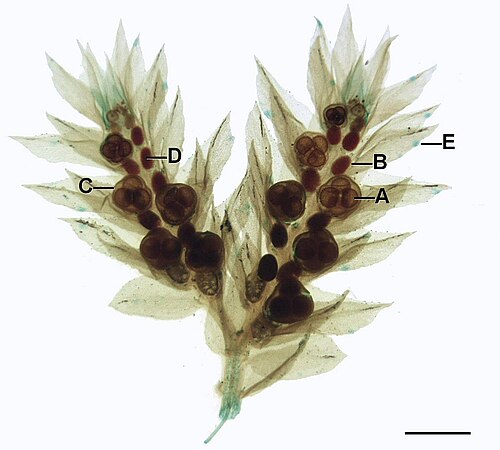
Strobilus of a Selaginella
A-MegasporeB-MicrosporangiumC-MegasporangiumD-MicrosporeE-SporophyllN
- native
- Naturally occurring in an area, but not necessarily confined to it. Compare endemic.
- natural hybrid
- A hybrid taxon produced by chance in the wild.
- naturalised
- Describing a plant, introduced from another region, that grows and reproduces readily in competition with the natural flora.
- nectar
- A usually sweet, nutrient-rich fluid produced by the flowers of many plants and collected by bees and other pollinators.
- nectary
- A specialized gland that secretes nectar.
- neophyte
- A plant that has recently been introduced to a geographic area. Contrast archaeophyte.
- nerve
- Another name for a vein.
- node
- The part of a stem from which leaves or branches arise.
- nomen conservandum
- (Latin) A conserved name, usually a name that became so much better known than the correct name, that a substitution was made.
- nomen illegitimum
- A name that is either superfluous at its time of publication because the taxon to which it was applied already has a name, or the name has already been applied to another plant (a homonym).
- nomen invalidum
- A name that is not validly published, and technically is therefore not a botanical name. Abbreviation: nom. inval. See Validly published name.
- nomen nudum
- A name not published in accordance with the International Code of Nomenclature for algae, fungi, and plants, usually without a diagnosis or description of the entity to which it applies, and without reference to either; such a name should not be used.
- nomenclature
- The naming of things; often restricted to the correct use of scientific names in taxonomy; a system that sets out provisions for the formation and use of names.
- noxious
- Of plants, containing harmful or unwholesome qualities. Applied in conjunction with 'weed' to specifically describe a plant which legislation deems harmful to the environment. Each state and territory in Australia has specific legislation governing noxious weeds.
- nucellus
- The tissue of the ovule of a seed plant that surrounds the female gametophyte. It is enclosed by integuments and is not of epidermal origin.
- numerous
- Stamens are described as numerous when there are more than twice as many as sepals or petals, especially when there is no set number of them. Compare indefinite.
- nut
- A hard, dry, indehiscent fruit containing only one seed.
- nutlet
- 1. A small nut.
- 2. One of the lobes or sections of the mature ovary of some members of the Boraginaceae, Verbenaceae, and Lamiaceae.
 Some Senna species have extrafloral nectaries that attract ants to defend them from pests.
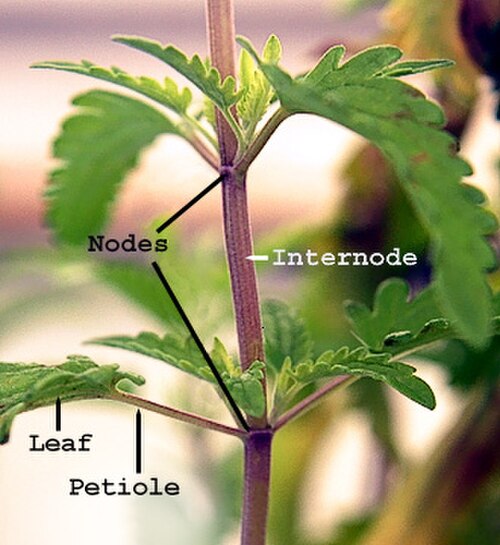 Plant stem nodes and internodes

Hoya carnosa secretes so much nectar that it falls in drops if no pollinators remove it.

The small green petals of Helleborus argutifolius act as floral nectaries. The sepals function as petals.
O
- ob-
- A prefix meaning "inversely"; usually the same shape as that described by the word stem, but attached by the narrower end. See obcordate, oblanceolate and obovate.
- obconic
- (of a fruit, hypanthium, pistil, or calyx) Shaped like an inverted cone, attached at the apex.
- obcordate
- (of a leaf blade) Broad and notched at the tip; heart-shaped but attached at the pointed end.
- obdiplostemonous
- Having stamens arranged in two whorls, and having twice as many stamens as petals, with the outer whorl being opposite the petals. Compare diplostemonous and haplostemonous.
- oblanceolate
- Having a lanceolate shape but broadest in the upper third.
- oblate
- Having a spherical shape but flattened at the poles.
- obligate
- (of parasites) Unable to survive without a host. Contrast facultative.
- oblique
- Slanting; of a leaf or stem, larger on one side of the midrib than the other, in other words asymmetrical.
- obloid
- Having a three-dimensional oblong shape, e.g. a fruit.
- oblong
- Having a length a few times greater than the width, with sides almost parallel and ends rounded.
- obovate
- (of a leaf) Having a length about 1.5 times the width, and widest above the center.
- obovoid
- Egg-shaped, with narrower portion at base; 3-dimensional object, ovate in all sections through long-axis. Compare ovoid
- obsolete
- Not evident, or at most rudimentary or vestigial.
- obtrapeziform
- trapeziform, but attached by the narrower trapezoidal base (e.g. of a leaf)
- obtuse
- Blunt or rounded; having converging edges that form an angle of more than 90°. Compare acute.
- ocrea
- A sheath formed from two stipules encircling the node in members of the Polygonaceae.
- odd-pinnate
- Having an odd number of leaflets in a compound pinnate leaf, such that there is only one terminal leaflet.
- oft.
- An abbreviation of "often". Compare usu. and s.t..
- -oideae
- A suffix added to the stem of a generic name to form the name of a subfamily, e.g. Fumaria → Fumarioideae.
- olim
- Formerly, e.g. "olim B", formerly in the Berlin herbarium (Herbarium Berolinense).
- ontogeny
- The sequence of developmental stages through which an organism passes as it grows.
- operculum (calyptra)
- A lid or cover that becomes detached at maturity, e.g. in Eucalyptus, a cap covering the bud and formed by the fusion or cohesion of perianth parts.
- opposite
- 1. Describing leaves or flowers borne at the same level but on directly opposite sides of their common axis.
- 2. Describing the occurrence of something on the same radius as something else, e.g. anthers opposite sepals. Compare alternate.
- opus utique oppressum
- Listed after the botanical name of a plant, or the name of a publication, this indicates that a publication is listed in the International Code of Nomenclature for algae, fungi, and plants as a suppressed work. Botanical names of the specified rank in the publication are considered not validly published (article 34).
- orbicular
- Flat and more or less circular.
- order
- A group of one or more families sharing common features, ancestry, or both.
- ortet
- The original single parent plant from which a clone ultimately derives.
- orthotropous
- Describes an ovule that is erect, with the micropyle directed away from the placenta; atropous. Compare amphitropous, anatropous, and campylotropous.
- oval
- See elliptical.
- ovary
- The basal portion of a carpel or group of fused carpels, enclosing the ovules.
- ovate
- Shaped like a section through the "long axis" of an egg and attached by the wider end.
- ovoid
- Egg-shaped, with wider portion at base; 3-dimensional object, ovate in all sections through long-axis. Compare obovoid
- ovule
- Loosely, the seed before fertilization; a structure in a seed plant within which one or more megaspores are formed (after fertilization it develops into a seed).
 Orbicular leaves of Dombeya rotundifolia


Open flower of Eucalyptus macrocarpa, next to a shed operculum

Opposite arrangement (phyllotaxis) of leaves
P
- pachycaul
- with a disproportionately thick trunk
- pachycladous
- with disproportionately thick stems
- palate
- An expanded lower lip of a flower that nearly or entirely blocks the opening of a flower tube, as in a snapdragon flower.[46]
- palea
- 1. The upper of two bracts enclosing a grass flower, major contributors to chaff in harvested grain.
- 2. Chaffy scales on the receptacles of many Asteraceae.
- 3. Chaffy scales on the stipe of many ferns.
- paleate
- Bearing paleae or chaffy scales, as in description of the receptacle of a capitulum of a plant in the Asteraceae.
- paleaceous
- Chaff-like in texture.
- palmate
- 1. leaf with veins radiating out from a central point (usually at the top of a petiole), resembling spread out fingers pointing away from the palm.
- 2. A compound palmate leaf has leaflets that radiate from a central point (usually at the top of a petiole).
- palmatifid
- Deeply divided into several lobes arising from more or less the same level.
- palmatisect
- Intermediate between palmate and palmatifid, i.e. the segments are not fully separated at the base; often more or less digitate.
- pandurate
- shaped like the body of a fiddle (mainly, of plant leaves)
- panicle
- A compoundraceme; an indeterminate inflorescence in which the flowers are borne on branches of the main axis or on further branches of these.
- papilionate
- Butterfly-like; having a corolla like that of a pea.
- papilla
- A small, elongated protuberance on the surface of an organ, usually an extension of one epidermal cell.
- pappus
- In daisy florets, a tuft or ring of hairs or scales borne above the ovary and outside the corolla (representing the reduced calyx); a tuft of hairs on a fruit.
- paracarpel
- Ill-defined term, variously interpreted and applied to: organs attached to carpels; staminodes close to the gynoecium; and to a pistillode in a staminate flower
- paraperigonium
- An anomalous secondary outgrowth of the perianthalmeristem with ramifyingvasculature. See also perigonium, perianth, and corona.[47]
- parasite
- An organism living on or in a different organism, from which it derives nourishment. Some plant species are parasitic. Compare saprophyte and epiphyte.
- parenchyma
- A versatile ground tissue composed of living primary cells which performs a wide variety of structural and biochemical functions in plants.
- parietal
- Attached to the marginal walls of a structure, e.g. ovules attached to placentas on the wall of the ovary. See placentation.
- paripinnate
- Having an even number of leaflets (or pinnae), i.e. terminated by a pair of pinnae as opposed to a single pinna. Compare imparipinnate.
- parthenocarpy
- The development or production of fruit without fertilization. Compare stenospermocarpy.
- patent
- Spreading; standing at 45–50° to the axis. See also erecto-patent.
- patulous
- See patent.
- pauciflor
- Having few flowers per inflorescence. Compare pluriflor and uniflor.
- pectinate
- Pinnately divided with narrow segments closely set like the teeth of a comb.
- pedate
- Having a terminal lobe or leaflet, and on either side of it an axis curving outward and backward, bearing lobes or leaflets on the outer side of the curve.
- pedicel
- The stalk of a flower; may also be applied to the stalk of a capitulum in the Asteraceae.
- peduncle
- The stalk of an inflorescence.
- peltate
- Shield-like, with the stalk attached to the lower surface and not to the margin.
- pellucid
- Transmitting light; for example, said of tiny gland dots in the leaves of e.g. Myrtaceae and Rutaceae that are visible when held in front of a light.
- pendulous
- Hanging, for example an ovule attached to a placenta on the top of the ovary. Compare suspended.
- penicillate
- Tufted like an artist's brush; with long hairs toward one end.
- penninervation
- With pinnately arranged veins.
- pentamerous
- In five parts, particularly with respect to flowers, five parts in each whorl. See also trimerous and tetramerous.
- pepo
- A type of berry formed from an inferior ovary and containing many seeds, usually large with a tough outer skin (e.g. a cucumber, pumpkin or watermelon).
- perennating
- Of an organ that survives vegetatively from season to season. A period of reduced activity between seasons is usual.
- perennial
- A plant whose life span extends over several years.
- perfect
- (of a flower) Bisexual; containing both male and female reproductive parts in the same inflorescence. Contrast imperfect.
- perfoliate
- With its base wrapped around the stem (so that the stem appears to pass through it), e.g. of leaves and bracts.
- perforate
- With many holes. Used to describe the texture of pollen exine, and also to indicate that tracheary elements have a perforation plate. See also fenestrate.
- perforation plate
- in a tracheary element, part of the cell wall that is perforated; present in vessel members but not in tracheids. Should not be confused with a pit.
- perianth
- The collective term for the calyx and corolla of a flower (generally used when the two are too similar to be easily distinguishable). Abbreviation: P; for instance, P 3+3 indicates the calyx and corolla each have 3 elements, i.e. 3 sepals + 3 petals.
- pericarp
- The wall of a fruit, developed from the ovary wall.
- periclinal
- Curved along parallel to a surface. Compare anticlinal.
- pericycle
- A cylinder of parenchyma or sclerenchyma cells that lies just inside the endodermis and is the outer most part of the stele of plants.
- perigonium
- In flowering plants, synonym of perianth.
- 2. In mosses, the leaves surrounding the antheridia, also called a splash-cup, e.g. in Polytrichum juniperinum.
- perigynium
- A sac from a modified tubular bract, or when fully closed an utricle, around the pistillate flower of sedges
- perigynous
- Borne around the ovary, i.e. of perianth segments and stamens arising from a cup-like or tubular extension of receptacle (free from the ovary but extending above its base). Compare epigynous and hypogynous.
- persistent
- Remaining attached to the plant beyond the usual time of falling, for instance sepals not falling after flowering, flower parts remaining through maturity of fruit. Compare deciduous and caducous.
- perule
- 1. The scales covering a leaf or flower bud, or a reduced scale-like leaf surrounding the bud. Buds lacking perulae are referred to as "naked".
- 2. In Camellias the final bracts and sepals become indistinguishable and are called perules.
- 3. A kind of sac formed by the adherent bases of the two lateral sepals in certain orchids.
- petal
- In a flower, one of the segments or divisions of the inner whorl of non-fertile parts surrounding the fertile organs, usually soft and conspicuously colored. Compare sepal, tepal.
- petalody
- The transformation of reproductive organs of flower into petals.
- petaloid
- Like a petal; soft in texture and colored conspicuously.
- petiolary (or petiolar)
- Associated with a petiole, as in petiolary glands.
- petiolate
- (of a leaf) Having a petiole. Contrast sessile.
- petiole
- The stalk of a leaf.
- petiolule
- The stalk of a leaflet.
- petricolous
- Rock-dwelling; living on or among rocks.
- phaneranthous
- Showy, as in showy flowers that advertise to pollinators, as opposed to aphananthous (unshowy)
- phanerogam
- Gymnosperms and angiosperms; plants producing stamens and gynoecia; literally plants with conspicuous sexual reproductive organs. Compare cryptogams.
- phenology
- The study of the timing of seasonal biological phenomena, such as flowering, leaf emergence, fruit ripening and leaf fall.
- phloem
- Specialized conducting tissue in vascular plants that transports sucrose from the leaves to other plant organs.
- photosynthesis
- Process by which energy from sunlight is used to convert carbon dioxide and water into simple sugars in cells containing chloroplasts. All plants, except certain parasites, can perform photosynthesis.
- phyllary
- Individual bract within an involucre or involucel.
- phyllid
- Leaf-like extension of the stem in Bryophytes
- phyllode
- A leaf with the blade much reduced or absent, and in which the petiole and or rachis perform the functions of the whole leaf, e.g. many acacias. Compare cladode.
- phyllopodium
- (in ferns) A short outgrowth of the stem on which the frond is borne and which remains attached to the rhizome after the frond has been shed.
- phylloplane
- the surface of a leaf, considered as a habitat for organisms.
- phyllosphere
- The above-ground surface of plants as a habitat for epiphytic microorganisms.
- phylum
- A level of classification or taxonomic rank below kingdom and above class. Traditionally, in botany the term division has been used instead of phylum.
- phytomelan
- A black, inert, organic material that forms a crust-like covering of some seeds, commonly found in Asparagales, Asteraceae, etc.
- pileate
- Having a cap, a pileus.
- pileus
- A cap or cap-shaped structure, such as the cap of mushrooms or the plumule of some monocotyledons.
- piliform
- Having the shape of a cap, a pileus.
- pilose
- covered with soft, weak, thin and clearly separated hairs, which are usually defined as long and sometimes ascending.
- pinna
- A primary segment of a compound leaf.
- pinnate
- A compound leaf with leaflets arranged on each side of a common petiole or axis; also applied to how the lateral veins are arranged in relation to the main vein.
- pinnatifid
- Pinnately lobed.
- pinnatisect
- pinnately divided almost to midrib but segments still confluent.
- pinnule or pinnula
- Usage varies:ultimate free division (or leaflets) of a compound leaf,ora pinnate subdivision of a multipinnate leaf.
- pistil
- 1. a single carpel when the carpels are free.
- 2. a group of carpels when the carpels are united by the fusion of their walls.
- pistillate flower
- a flower containing one or more pistils but no fertile stamens. Sometimes called a female flower. Contrast with staminate flower
- pistillode
- A sterile or rudimentary pistil such as may appear in a staminate flower.
- pit
- In tracheary elements, a section of the cell wall where the secondary wall is missing, and the primary wall is present. Pits generally occur in pairs and link two cells.
- pith
- The central region of a stem, inside the vascular cylinder; the spongy parenchymatous central tissue in some stems and roots.
- placenta
- The tissue within an ovary to which the ovules are attached.
- placentation
- The arrangement of ovules inside ovary; for example axile, free-central, parietal, marginal, basal, or apical.
- Plant Breeders Rights (PBR)
- These rights, governed by Plant Breeder's Rights Acts give the plant breeder legal protection over the propagation of a cultivar, and the exclusive rights to produce and to sell it, including the right to license others to produce and sell plants and reproductive material of a registered, deliberately bred variety. Compare UPOV.
- Plant Variety Rights (PVR)
- Governed by the Plant Variety Rights the registration of new varieties is now governed by Plant Breeders Rights.
- plastochron
- The time between successive leaf initiation events.
- pleiochasium
- pl. pleiochasia. An inflorescence in which several buds come out at the same time. Compare monochasium and dichasium.
- plicate
- Pleated; folded back and forth longitudinally like a fan, such as the leaves of fan palm species. The concept often appears in specific names in forms such as Kumara plicatilis and Acacia plicata. Commonly such names are not correctly appropriate, but are applied to distichous structures rather than plicate.
- -plinerved
- (of leaves) A suffix indicating that the main nerves are lateral and arise from a point distinctly above the base of the leaf. Combined with a numerical prefix to form words like 3-plinerved, 5-plinerved, and so on. Such leaves are especially characteristic of the family Melastomataceae. See for example Dissotis.
- plumose
- Like a feather; with fine hairs branching from a main axis.
- plumule
- The part of an embryo that gives rise to the shoot system of a plant. Compare radicle.
- pluriflor
- Having many flowers per inflorescence. See also pauciflor and uniflor.
- pluriovulate
- Having many ovules as in placentae, carpels, or ovaries.
- pneumatophore
- A vertical appendage, aerial at low tide, on the roots of some plants. Pneumatophore functions are unclear, but possibly related to gas exchange, or to root anchoring. Pneumatophores typically occur on mangrove roots, but some versions occur on species of conifers, such as some in the Taxodioideae.
- pod
- 1. A legume, the fruit of a leguminous plant, a dry fruit of a single carpel, splitting along two sutures.
- 2. A siliqua and silicula, the fruit of Brassicaceae, a dry fruit composed of two carpels separated by a partition.
- podocarpium
- In four genera of the coniferous family Podocarpaceae (Acmopyle, Dacrycarpus, Falcatifolium, and Podocarpus), a group of fleshy fused bracts beneath the female cone, often brightly-colored, which swell to enclose the developing seeds above and attract fruit-eating animals.[48]
- pollen
- pollen-grains, the microspores of seed plants from anthers of angiosperms or the microsporangia (of gymnosperms); .
- pollen-mass
- Sometimes = pollinium, but more loosely, any mass of pollen a plant produces, such as around the spadix and within the spathe of some Araceae.
- pollen transmitting tissue
- the tissue in the style of a flower through which the pollen tubes grow.
- pollinarium
- See pollinium. Variously applied to structures of two or more pollinia connected or joined together. Pollinaria occur in various plant taxa, notably Orchidaceae and Asclepiadoideae
- pollination
- The transfer of pollen from a male organ (such as an anther) to the receptive region of a female organ (such as a stigma).
- pollinium
- A structure of coherent pollen-grains from a single anther; pollinia commonly occur in e.g. orchids and Asclepiadoideae as woolly, sticky or waxy masses, adapted to being stuck to appropriate pollinators and carried away to another flower of the same species. Such flowers typically are adapted to stripping incoming pollinia from carrier insects, thereby avoiding pollen from unrelated species.
- polygamodioecious
- Having bisexual and male flowers on some plants and bisexual and female flowers on others. Compare androdioecious, andromonoecious, dioecious, monoecious, polygamomonoecious, and polygamous.
- polygamomonoecious
- having male, female, and bisexual flowers on the same plant. Compare androdioecious, andromonoecious, polygamodioecious, and polygamous.
- polygamous
- having bisexual and unisexual flowers on the same plant.
- polymorphic
- Of several different kinds (in respect to shape and/or size), hence polymorphism. See also monomorphic (a single type) and dimorphic (two types)
- polyphyllous
- having many leaves or perianth segments. Compare symphyllous, gamophyllous, and apophyllous.
- polyploid
- with more than two of the basic sets of chromosomes in the nucleus; any sporophyte with cells containing three or more complete sets of chromosomes. Various combinations of words or numbers with '-ploid' indicate the number of haploid sets of chromosomes, e.g. triploid = 3 sets, tetraploid = 4 sets, pentaploid = 5 sets, hexaploid = 6 sets, and so on.
- polystemonous
- having numerousstamens; the number of stamens being at least twice the number of sepals or petals, but not strictly three or four times that number.
- pome
- A fruit that has developed partly from the ovary wall but mostly from the hypanthium (e.g. an apple).
- population
- 1. All individuals of one or more species within a prescribed area.
- 2. A group of organisms of one species, occupying a defined area and usually isolated to some degree from other similar groups.
- 3. In statistics, the whole group of items or individuals under investigation.
- poricidal
- Opening by pores, as with the capsule of a poppy or the anthers in several families of plants. Compare longicidal.
- posterior
- Positioned behind or toward the rear. Contrast anterior.
- prickle
- A hard, pointed outgrowth from the surface of a plant (involving several layers of cells but not containing a vein); a sharp outgrowth from the bark, detachable without tearing wood. Compare thorn.
- primary vein
- The single vein or array of veins that is conspicuously larger than any others in a leaf. In pinnatevenation, the single primary vein can generally be found in the middle of the leaf; in palmate venation, several such veins radiate from a point at or near the base of the leaf.
- procumbent
- Spreading along the ground but not rooting at the nodes; not as close to the ground as prostrate.
- propagule
- Any structure capable of generating a new plant; includes seeds, spores, bulbils, etc.
- pro parte
- In part. In nomenclature, used to denote that the preceding taxon includes more than one currently recognized entity, and that only one of those entities is being considered.
- prophyll
- A leaf formed at the base of a shoot, usually smaller than those formed later.
- prostrate
- Lying flat on the ground; commonly rooting at nodes that touch the soil surface.
- protandrous
- Having male sex organs which mature before the female ones, e.g. a flower shedding pollen before the stigma is receptive. Compare protogynous.
- proteranthous
- With new leaves appearing before flowers. See also hysteranthous and synanthous.
- prothallus
- A gametophyte plant, usually flattened and delicate, e.g. in ferns and fern allies.
- protogynous
- Having female sex organs which mature before the male ones, e.g. a flower shedding pollen after the stigma has ceased to be receptive. Compare protandrous.
- proximal
- Near the point of origin or attachment. Compare distal.
- pruinose
- Covered with a powdery, waxy material; having a bloom.
- pseudanthium
- A type of inflorescence occurring in the Asteraceae and Euphorbiaceae, in which multiple flowers are grouped together to form a flower-like structure, commonly called a head or capitulum.
- pseudo-
- A prefix meaning "false, not genuine", e.g. a pseudo-bulb is a thickened, bulb-like internode in orchids, but not an actual bulb.
- pseudobasifixed
- (of an anther) Connected to the filament of the stamen by connective tissue which extends in a tube around the filament tip. See also basifixed and dorsifixed.
- pseudostipule
- An enlarged, persistent axillary bud scale that resembles a stipule; common in Bignoniaceae.
- pseudoverticillate
- Having the appearance of being whorled (verticillate), without actually being so.
- puberulous
- Covered with minute soft erect hairs.
- pubescent
- Downy; covered with short, soft hairs, especially erect hairs.
- pulverulent
- Having powdery or crumbly particles as if pulverized.
- pulvinate
- Having a pulvinus.
- pulvinus
- a swelling at either end of a petiole of a leaf or petiolule of a leaflet, e.g. in Fabaceae, that permits leaf movement.
- punctate
- (from Latin puncta= puncture or prick-mark) marked with an indefinite number of dots, or with similarly small items such as translucent glands or tiny hollows.
- punctiform
- Dot-like or in the shape of a prick-mark.
- pungent
- Having a sharp, hard point.
- pustule
- A blister-like swelling.
- pustulate
- Having pustules.
- pyramidal
- (of a growth habit) Shaped like an Egyptianpyramid, broad conic with a quadrate cross-section. Not found in nature, in living things only seen in deliberately shaped topiary, but the term is frequently misapplied to conical trees, especially in popular literature.[49][30]
- pyrene
- The stone of a drupe, consisting of the seed surrounded by the hardened endocarp.
- pyriform
- Pear-shaped; a term for solid shapes that are roughly conical in shape, broadest one end and narrowest at the other. As a rule the distal third of their length is the broadest, and they are narrowest near the proximal end, the base, where the stalk, if any, attaches.
- pyrophile
- Plants which need fire for their reproduction.
- pyrophyte
- Plants which have adapted to tolerate fire.


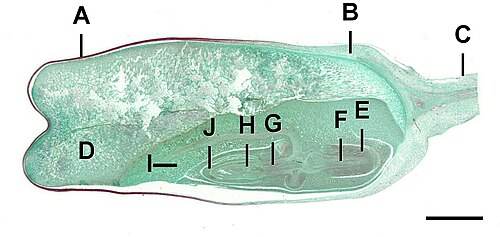 Longitudinal section of maize kernel (scale=1.4 mm):A=pericarp,B=aleurone,C=stalk,D=endosperm,E=coleorhiza,F=radicle,G=hypocotyl,H=plumule,I=scutellum,J=coleoptile
 Pneumatophores on a species of mangrove
 Pollinium of an orchid, stuck to a syrphid fly that visited one flower, and may yet deposit its burden onto another flower of the same species.
 The sharp projections on the trunk of the knobthorn, Senegalia nigrescens, are prickles rather than thorns, botanically speaking.
 Procumbent growth habit of Sagina procumbens, growing mainly along the soil surface, but without rooting
 Carpobrotus and other prostrate plants growing on sand in Sicily, striking root and binding the soil as they grow
 Floral stages of the protandrous species: Geranium incanum. The flower at first has intensely colored petals, and both androecium and gynoecium. After a day or so in bloom, it sheds the stamens and the color of the petals becomes somewhat paler.

 Punctiform glands on the undersurface of a Plectranthus leaf
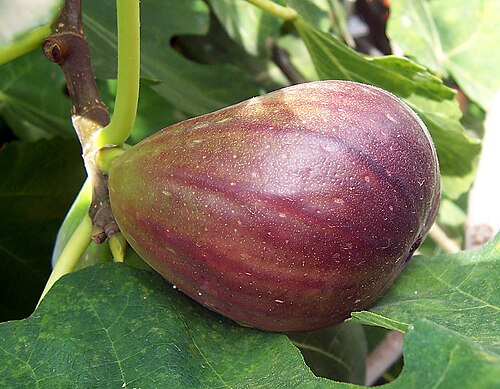

The thick trunk of Brachychiton rupestris accumulates moisture as a means of survival of droughts, and presents a marked example of a pachycaulhabit.

This Curio articulatus is pachycladous in that it has a disproportionately thick stem.
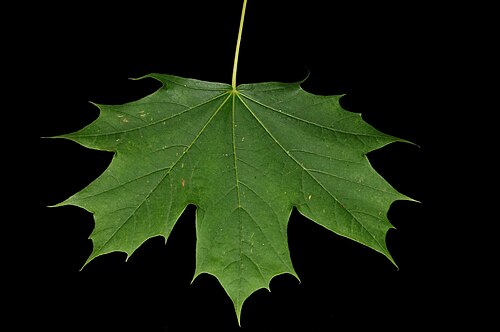
A maple (Acer platanoides) leaf has palmate venation, as its veins radiate out from a central point, like fingers from the palm of a hand.
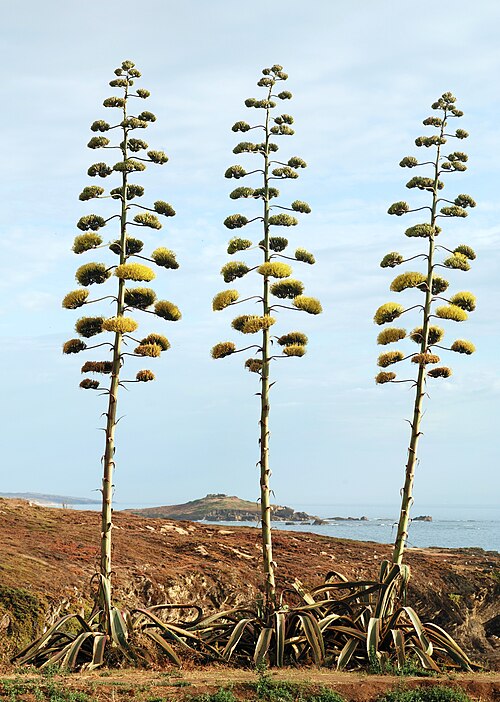

Asclepias physocarpa shedding seeds, each with its silky pappus

Doubly paripinnate leaves of Delonix regia


Stephania japonica is a vine with peltate leaves.

Perfoliate leaves of Smyrnium perfoliatum with stems passing through them

The leaves of Aponogeton madagascariensis are perforate.

The perigonium of a moss (red in this case), also called a splash-cup, surrounds the antheridia and aids in dispersal of sperm.

Liquidambar styraciflua bud emerging from its protective brown imbricatecataphyll scales, also known as perules
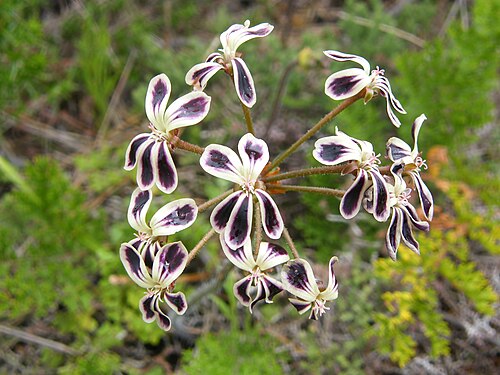
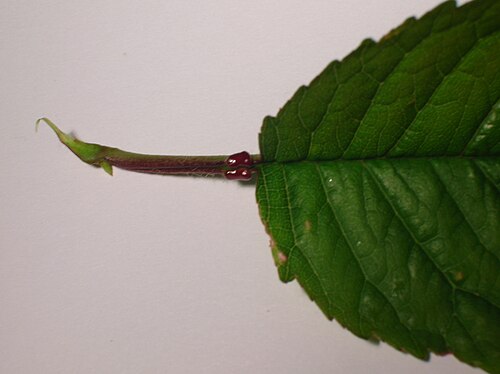
Petiolary glands on the petiole of a cherry leaf

Rock-splitting roots of the petricolous large-leaved rock fig, Ficus abutilifolia

The phaneranthoushabit of the red flowering gum, Corymbia ficifolia, can attract pollinators such as the honey eater, Anthochaera chrysoptera, from a considerable distance.

Seedlings of Acacia fasciculifera bear leaves that illustrate the ancestral function of their phyllodes as petioles.


Glandular pilose hairs on the stem of Aquilegia grata


Simple pinnate leaf of Ekebergia capensis
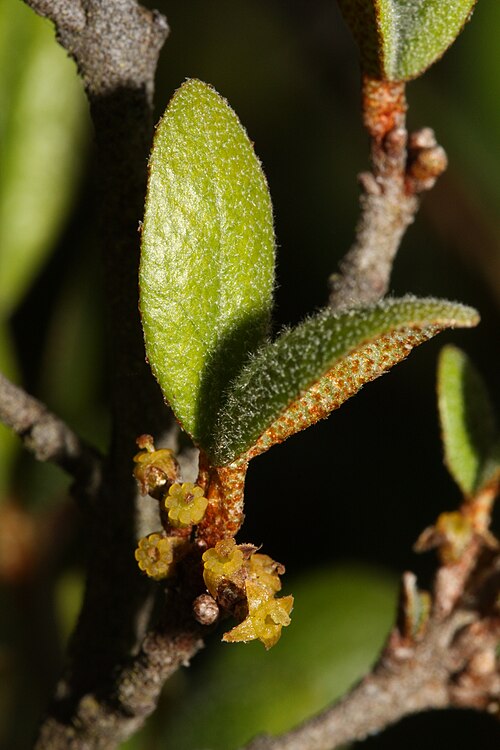
Pistillate flowers of Shepherdia canadensis.Compare staminate flower.

Electron micrographs of sections of wood of a conifer (Picea abies) show pits in the tracheid walls.
Q
- quadrate
- More or less square.

R
- raceme
- An indeterminateinflorescence in which the main axis produces a series of flowers on lateral stalks, the oldest at the base and the youngest at the top. Compare spike. Also racemiform or racemoid - having the form of a raceme.
- rachilla (rhachilla)
- 1. the axis of a grass spikelet, above the glumes; see spikelet.
- 2. the rachis of higher order in leaves that are compound more than once
- rachis
- The axis of an inflorescence or a pinnate leaf; for example ferns; secondary rachis is the axis of a pinna in a bipinnate leaf distal to and including the lowermost pedicel attachment.
- radial
- With structures radiating from a central point as spokes on a wheel (e.g. the lateral spines of a cactus).
- radiate
- (of daisies, of a capitulum) With rayfloret surrounding disc florets.
- radical
- Springing from the root; clustered at base of stem.
- radicle
- The part of an embryo giving rise to the root system of a plant. Compare plumule.
- rainforest
- A moist temperate or tropical forest dominated by broad-leaved trees that form a continuous canopy.
- ramet
- An individual member of a clone.
- ramicaul
- a single-leafed stem, as in Pleurothallis orchids.[50]
- ramiflory
- Having flowers or fruits growing directly from a tree's branches.
- ramify
- To divide or spread out into individual branches or branchlike parts.
- ray
- 1. zygomorphic (ligulate) flowers in a radiate flowerhead, that is, ray-florets/flowers, for example Asteraceae.
- 2. each of the branches of an umbel.
- recalcitrant
- (Of a seed) No longer viable after drying or freezing and thus unable to be stored for long periods.
- receptacle
- the axis of a flower, in other words, floral axis; torus; for example in Asteraceae, the floral base or receptacle is the expanded tip of the peduncle on which the flowers are inserted.
- recumbent
- bent back toward or below the horizontal.
- recurved
- bent or curved backward or downward.
- reduplicate
- folded outward, or with the two abaxial surfaces together.
- reflexed
- bent sharply back or down.
- registered name
- a cultivar name accepted by the relevant International Cultivar Registration Authority.
- registration
- 1. the act of recording a new cultivar name with an International Cultivar Registration Authority.
- 2. recording a new cultivar name with a statutory authority like the Plant Breeder's Rights Office.
- 3. recording a trademark with a trade marks office.
- regular
- See actinomorphic.
- reiteration
- upright limb
- reniform
- Kidney-shaped.
- replum
- a framework-like placenta to which the seeds attach, and which remains after each valve drops away.
- resupinate
- Describing leaves or flowers that are in an inverted position because the petiole or pedicel, respectively, is twisted 180 degrees. compare: hyper-resupinate.
- reticulate
- forming a network (or reticulum), e.g. veins that join one another at more than one point.
- retrorse
- Bent backward or downward. Compare antrorse.
- retuse
- Having a blunt (obtuse) and slightly notched apex.
- revision
- an account of a particular plant group, like an abbreviated or simplified monograph. Sometimes confined to the plants of a particular region. Similar to a monograph in clearly distinguishing the taxa and providing a means for their identification. Compare monograph.
- revolute
- rolled under (downward or backward), for example when the edges of leaves are rolled under toward the midrib. Compare involute.
- rhachis
- See rachis.
- rhizodermis
- the root epidermis, the outermost primary cell layer of the root
- rhizome
- a perennial underground stem usually growing horizontally. See also stolon. Abbreviation: rhiz.
- rhizomatous
- (adj.) having above-ground stems that are derived from below-ground stems (rhizomes). Compare arhizomatous (arhizomatic).
- rhizosphere
- the below-ground surface of plants and adjacent soil as a habitat for microorganisms.
- rhytidome
- the dead region of the bark and root that lies outside the periderm.
- rhombic
- like a rhombus: an oblique figure with four equal sides. Compare trapeziform and trullate.
- rhomboid
- a four-sided figure with opposite sides parallel but with adjacent sides an unequal length (like an oblique rectangle); see also rhombic.
- rhomboidal
- a shape, for instance of a leaf, that is roughly diamond-shaped with length equal to width.
- rimose
- with many cracks, as in the surface of a crustose areolate lichen.
- root
- a unit of a plant's axial system which is usually underground, does not bear leaves, tends to grow downward, and is typically derived from the radicle of the embryo.
- root hairs
- outgrowths of the outermost layer of cells just behind the root tips, functioning as water-absorbing organs.
- root microbiome
- the dynamic community of microorganisms associated with plant roots.
- rootstock
- 1. the part of a budded or grafted plant which supplies the root system, also simply called a stock.
- 2. plants selected to produce a root system with some specific attribute, e.g. a virus-free rootstock.
- rosette
- when parts are not whorled or opposite but appear so, due to the contractions of internodes, e.g. the petals in a double rose or a basal cluster of leaves (usually close to the ground) in some plants.
- rostellate
- possessing a beak (rostellum). Synonym of rostrate.
- rostrate
- with a beak.
- rotate
- circular and flattened; for example a corolla with a very short tube and spreading lobes (for instance some Solanaceae).
- ruderal
- a plant that colonises or occupies disturbed waste ground. See also weed.
- rudiment
- In the structure of a plant, an item that is at best hardly functional, either because it is immature and has not yet completed its development (such as a leaf still incompletely formed inside a bud), or because its role in the organism's morphology cannot be completed and therefore is futile (such as the leaf rudiment at the tip of a phyllode, that will be shed while immature, because the leaf function will be taken over by the phyllode). Compare cataphyll and vestige.
- rudimentary
- Being of the nature of a rudiment; at most barely functional because incompletely developed; begun, but far from completed, either temporarily or permanently. Compare vestigial.
- rugose
- Wrinkled, either covered with wrinkles, or crumpled like a wrinkled leaf, either as a stiffening structure, or in response to disease or insect damage.
- rugulose
- Finely wrinkled.
- ruminate
- (usually applied to endosperm) Irregularly grooved or ridged; appearing chewed, e.g. the endosperm in certain members of Myristicaceae.
- runcinate
- Sharply pinnatifid or cleft, with the segments directed downward.
- runner
- See stolon.
- rupicolous
- Rupestral, saxicolous, growing on or among rocks. Compare epilithic and lithophytic.
- rush
- A plant of the family Juncaceae or, more loosely, applied to various monocotyledons.

 The runcinate lobes of a Taraxacum officinale leaf point downward, i.e. toward the stem.

Bulbinella latifoliaracemes. The flowers are already open at the bottom; at the top, the axis is still growing and budding.
Rachis of Vachellia karroo bipinnate leaf, with components labelled as follows:
A. Rachilla (the diminutive of rachis) B. Pinnule C. Jugary glands D. Juga (plural of jugum) E. Base of petiole F. Petiolary gland G. Rachis
Radicles emerging from germinating seeds

Reniform kidney bean seeds


Typical rhizome. This one is a specimen of Iris pseudacorus.

S
- saccate
- Pouched or shaped like a sack.
- sagittate
- Shaped like the head of an arrow; narrow and pointed but gradually enlarged at the base into two straight lobes directed downward; may refer only to the base of a leaf with such lobes. Compare hastate.
- salverform
- Shaped like a salver - Trumpet-shaped; having a long, slender tube and a flat, abruptly expanded limb
- samara
- A dry, indehiscent fruit with its wall expanded into a wing, e.g. in the genus Acer.
- samphire
- A common name given to various edible coastal plants, such as Salicornia spp. (Amaranthaceae), Crithmum maritimum (Apiaceae) and Limbarda crithmoides (Asteraceae).
- sanguine
- (from Latin sanguineus) Blood-colored: crimson; the color of blood.
- saprophyte
- A plant, or loosely speaking, a fungus or similar organism, deriving its nourishment from decaying organic matter such as dead wood or humus, and usually lacking chlorophyll. Compare parasite, saprotroph, and epiphyte.
- saprotroph
- An organism deriving its nourishment from decaying organic matter. Contrast parasite and epiphyte.
- sarment
- A long, slender, prostratestolon, commonly called a runner.
- sarmentose
- Reproducing by sarments; strawberry plants are the most familiar example.
- saxicolous
- Growing on stone, like some lichens.
- scabrid
- Rough to the touch, with short hard protrusions or hairs.
- scalariform
- Ladder-like in structure or appearance.
- scale
- 1. A reduced or rudimentary leaf, for example around a dormant bud.
- 2. A flattened epidermal outgrowth, such as those commonly found on the leaves and rhizomes of ferns.
- scandent
- Climbing, by whatever means. See also: scandent in Wiktionary.
- scape
- Usages vary, e.g.: a leafless peduncle arising directly from the ground, or a stem-like flowering stalk of a plant with radical leaves.
- scapose
- Having the floral axis more or less erect with few or no leaves; consisting of a scape.
- scarious
- Dry and membranous.
- schizocarp
- A dry fruit formed from more than one carpel but breaking apart into individual carpels (mericarp) when ripe. For illustration, see mericarp
- scion
- The aerial part of a graft combination, induced by various means to unite with a compatible understock or rootstock.
- sclereid
- A cell with a thick, lignified, cell wall that is shorter than a fiber cell and dies soon after the thickening of its cell wall.
- sclerenchyma
- A strengthening or supporting tissue composed of sclereids or of a mixture of sclereids and fibers.
- sclerophyll
- A plant with hard, stiff leaves; any structure stiffened with thick-walled cells.
- scorpioid
- (of a cymose inflorescence) Branching alternately on one side and then the other. Compare helicoid.
- scrobiculate
- Having very small pits.
- scrubland
- Dense vegetation dominated by shrubs.
- scurf
- Minute, loose, membranous scales on the surface of some plant parts, such as leaves.
- secondary metabolite
- Chemicals produced by a plant that do not have a role in so-called primary functions such as growth, development, photosynthesis, reproduction, etc.
- secretory tissue
- The tissues concerned with the secretion of gums, resins, oils and other substances in plants.
- section (sectio)
- The category of supplementary taxa intermediate in rank between subgenus and series. It is a singular noun always written with a capital initial letter, in combination with the generic name.
- secund
- Having all the parts grouped on one side or turned to one side (applied especially to inflorescences).
- sedge
- A plant of the family Cyperaceae.
- seed
- A ripened ovule, consisting of a protective coat enclosing an embryo and food reserves; a propagating organ formed in the sexual reproductive cycle of gymnosperms and angiosperms (together, the seed plants).
- segment
- A part or subdivision of an organ, e.g. a petal is a segment of the corolla. A term sometimes used when the sepals and petals are indistinguishable.
- self-pollination
- (also selfing) The acceptance by stigmas of pollen from the same flower or from flowers on the same plant, which means they are self-compatible.
- semaphyll
- A structure such as a bract or sepal (if the remainder of the perianth is inconspicuous) which has become modified to attract pollinators.
- semelparity
- When a plant flowers once, then dies. Opposite of iteroparity
- semiterete
- Of a stem, more or less semicircular in cross-section: rounded on one side but flat on the other. Compare with: terete.
- senecioid
- See anthemoid.
- sensitive
- A descriptive term for stigmas that, in response to touch, close the two lobes of the stigma together, ending the receptivity of the stigma, at least for the time that the lobes are closed together. Mimulus is perhaps the best-known example.
- sensu
- In the sense of.
- sensu auct.
- (of a plant group or name) As cited by a named authority.
- sensu amplo
- (of a plant group or name) In a generous or ample sense.
- sensu lato
- (of a plant group) In a broad sense.
- sensu strictissimo
- (of a plant group) In the narrowest sense.
- sensu stricto
- (of a plant group) In a narrow sense.
- sepal
- In a flower, one of the segments or divisions of the outer whorl of non-fertile parts surrounding the fertile organs; usually green. Compare petal, tepal.
- septicidal
- (of a fruit) Dehiscing along the partitions between loculi. Compare loculicidal.
- septum
- A partition, e.g. the membranous wall separating the two valves of the pod of Brassicaceae.
- seriate
- Arranged in rows.
- sericeous
- Silky with dense appressed hairs.
- series
- The category of supplementary taxa intermediate in rank between section and species. It is often used as a plural adjective, as in "Primula subgenus Primula sect. Primula series Acaules".
- serrate
- Toothed with asymmetrical teeth pointing forward; like the cutting edge of a saw.
- serrulate
- Finely serrate.
- sessile
- Attached without a stalk, e.g. of a leaf without a petiole or a stigma, when the style is absent.
- seta
- A bristle or stiff hair (in Bryophytes, the stalk of the sporophyte). A terminal seta is an appendage to the tip of an organ, e.g. the primary rachis of a bipinnate leaf in Acacia.
- sheath
- A tubular or rolled part of an organ, e.g. the lower part of the leaf in most grasses.[51]
- sheathing
- When the rolled or tubular part of a plant contains another it is described as sheathing.[51]
- shoot
- The aerial part of a plant; a stem and all of its dependent parts (leaves, flowers, etc.).
- shrub
- A woodyperennial plant without a single main trunk, branching freely, and generally smaller than a tree.
- sigmoid
- Shaped like the letter 'S'.
- silicula or silicle
- A fruit like a siliqua, but stouter, not more than twice as long as wide.
- silique
- siliqua
- A dry, dehiscent fruit (in contrast to a silicula, more than twice as long as wide) formed from a superior ovary of two carpels, with two parietal placentas and divided into two loculi by a 'false' septum.
- silky
- Densely covered with fine, soft, straight, appressed hairs, with a lustrous sheen and satiny to the touch.
- silviculture
- The science of forestry and the cultivation of woodlands for commercial purposes and wildlife conservation.
- simple
- Undivided or unsegmented, e.g. a leaf not divided into leaflets (note, however, that a simple leaf may still be entire, toothed or lobed) or an unbranched hair or inflorescence.
- sinuate
- Having deep, wave-like depressions along the margins, but more or less flat. Compare undulate.
- sinus
- A notch or depression between two lobes or teeth in the margin of an organ.
- solitary
- Single, of flowers that grow one plant per year, one in each axil, or widely separated on the plant; not grouped in an inflorescence.
- sorus
- A cluster of sporangia. Sori typically occur in ferns, some Algae and some fungi. In many fern species the sorus is covered by a protective indusium.
- sp.
- An abbreviation of species (singular), often used when the genus is known but the species has not been determined, as in "Brassica sp." See spp..
- spp.
- An abbreviation of species (plural), often used to collectively refer to more than one species of the same genus, as in "Astragalus spp." See sp..
- spadix
- A spicate (spike-like) inflorescence with the flowers crowded densely, even solidly, around a stout, often succulentaxis. Particularly typical of the family Araceae
- spathe
- A large bract ensheathing an inflorescence. Traditionally any broad, flat blade.
- spathulate or spatulate
- Spoon-shaped; broad at the tip with a narrowed projection extending to the base.
- species
- A group, or populations of individuals, sharing common features and/or ancestry, generally the smallest group that can be readily and consistently recognized; often, a group of individuals capable of interbreeding and producing fertile offspring. The basic unit of classification, the category of taxa of the lowest principal rank in the nomenclatural hierarchy. Strict assignment to a species is not always possible, as it is subject to particular contexts, and the species concept under consideration.
- specific epithet
- Follows the name of the genus, and is the second word of a botanical binomial. The generic name and specific epithet together constitute the name of a species, i.e. the specific epithet is not the species name.
- speirochoric
- Unintentional introduction by seeds.[52] Compare agochoric.
- spica
- Another name for a spike.
- spike
- An unbranched, indeterminateinflorescence in which the flowers are without stalks. Compare raceme.
- spikelet
- A subunit of a spike inflorescence, especially in grasses, sedges, and some other monocotyledons, consisting of one to many flowers and associated bracts or glumes.
- spine
- A stiff, sharp structure formed by the modification of a plant organ that contains vascular tissue, e.g. a lateral branch or a stipule; includes thorns.
- spinescent
- Ending in a spine; modified to form a spine.
- spiral
- Of arrangement, when plant parts are arranged in a succession of curves like the thread of a screw, or coiled in a cylindrical or conical manner.
- splash-cup (sporangia)
- A cup-like structure in fungi such as Nidulariaceae and in cryptogams such as some mosses. The cups function in spore dispersal, in which the energy of raindrops falling into the cup causes the water to splash outward carrying the spores.[53]
- sporangium (sporangia)
- A structure in which spores are formed and from which the mature spores are released
- sporangiophore
- An organ bearing sporangia, e.g. the cones of Equisetum.
- spore
- A haploid propagule, produced by meiosis in diploid cells of a sporophyte that can germinate to produce a multicellular gametophyte.
- sporocarp
- A fruiting body containing spores.
- sporophyll
- In pteridophytes, a modified leaf that bears a sporangium or sporangia.
- sporophyte
- The diploid multicellular phase in the alternation of generations of plants and algae that produces the spores. Compare gametophyte.
- sport
- A naturally occurring variant of a species, not usually present in a population or group of plants; a plant that has spontaneously mutated so that it differs from its parent plant.
- spreading
- Extending horizontally, e.g. in branches. Standing out at right angles to an axis, e.g. in leaves or hairs.
- spur
- 1. a short shoot.
- 2. a conical or tubular outgrowth from the base of a perianth segment, often containing nectar.
- squamula
- A small scale.
- squamule
- A small scale.
- squamulose
- Covered with small scales (squamules).
- squarrose
- Having tips of leaves, stems, etc. radiating or projecting outward, e.g. in the moss Rhytidiadelphus squarrosus.
- s.t.
- An abbreviation for "sometimes". Compare usu. and oft..
- stalk
- The supporting structure of an organ, usually narrower in diameter than the organ itself.
- stamen
- The male organ of a flower, consisting (usually) of a stalk called the filament and a pollen-bearing head called the anther.
- staminate flower
- A flower with stamens but no pistil.
- staminode
- A sterile stamen, often rudimentary, sometimes petal-like. Commonly has a function in attracting pollinators that feed on the staminodes.
- staminophore
- A structure, around the apex of eucalypt, myrtaceae hypanthia, that supports the stamens.
- standard
- The large posterior petal of pea-flowers.
- standard specimen
- A representative specimen of a cultivar or other taxon which demonstrates how the name of that taxon should be used.
- stele
- The primary vascular system (including phloem, xylem, and ground tissue) of plant stems and roots.
- stellate
- Star-shaped.
- stem
- The plant axis, either aerial or subterranean, which bears nodes, leaves, branches, and flowers.
- stem-clasping
- See amplexicaul.
- stenospermocarpy
- The development or production of fruit that is seedless or has minute seeds because of the abortion of seed development. Compare parthenocarpy.
- sterile
- Infertile, as with a stamen that does not bear pollen or a flower that does not bear seed.
- stigma
- The pollen-receptive surface of a carpel or group of fused carpels, usually sticky; usually a point or small head at the summit of the style.
- stilt root
- A descending root growing from the trunk above ground and sometimes featuring lenticels; characteristic of e.g. Rhizophora.[54]
- stipe
- Generally a small stalk or stalk-like structure. The stalk of a frond of a fern; the stalk supporting the pileus of a mushroom; the stalk of a seaweed such as a kelp; the stalk-like support of a gynaecium, a pollinium, or a carpel
- stipella
- One of two small secondary stipules at the base of leaflets in some species.
- stipitate
- stalked; borne on a stipe; of an ovary, borne on a gynophore.
- stipulate
- Bearing stipules.
- stipule
- A small appendage at the bases of leaves in many dicotyledons.
- stock
- See rootstock.
- stolon
- A slender, prostrate or trailing stem, producing roots and sometimes erect shoots at its nodes. See also rhizome.
- stoloniferous
- Having stolons.
- stoma
- A pore or small hole in the surface of a leaf (or other aerial organ) allowing the exchange of gases between tissues and the atmosphere.
- stone cell
- a sclereid cell, such as the cells that form the tissue of nut shells and the stones of drupes.
- striate
- Striped with parallel, longitudinal lines or ridges.
- strigillose
- Minutely strigose.
- strigose
- Covered with appressed, straight, rigid, bristle-like hairs; the appressed equivalent of hispid.
- strobilus
- A cone-like structure consisting of sporophylls (e.g. conifers and club mosses) or sporangiophores (e.g. in Equisetopsida) borne close together on an axis.
- style
- An elongated part of a carpel or a group of fused carpels between the ovary and the stigma.
- stylodium
- An elongate stigma that resembles a style; a false style, e.g. commonly found in the Poaceae and Asteraceae.
- stylopodium
- A swelling on top of the ovary, at the base of the styles commonly found in flowers of the Apiaceae.
- stylulus
- The elongated apex of a free carpel which functions like the style of a syncarpousovary, allowing pollen tubes from its stigma to enter the locule of only that carpel.
- subacute
- Having a tapered but not sharply pointed form; moderately acute. See also acute.
- subcoriaceous
- Slightly leathery or coriaceous.
- subgenus
- A category of supplementary taxa intermediate between genus and section. The name of a subgenus is a singular noun, always has a capital initial letter and is used in combination with the generic name, e.g. Primula subgenus Primula.
- subglobose
- Inflated, but less than spherical. See also globose.
- suborbicular
- Nearly orbicular, flat and almost circular in outline. See also orbicular.
- subpetiolate
- (of a leaf) Having an extremely short petiole, and may appear sessile.
- subquadrangular
- Not quite square. Compare quadrangular.
- subshrub
- A small shrub which may have partially herbaceous stems, but generally a woody plant less than 1 metre (3.3 ft) high.
- subspecies
- A taxonomic category within a species, usually used for geographically isolated or morphologically distinct populations of the same species. Its taxonomic rank occurs between species and variety.
- subtend
- To stand beneath or close to, as in a bract at the base of a flower.
- subulate
- Narrow and tapering gradually to a fine point.
- succulent
- 1. Juicy or fleshy.
- 2. A plant with a fleshy habit.
- sucker
- A shoot of more or less subterranean origin; an erect shoot originating from a bud on a root or a rhizome, sometimes at some distance from the stem of the plant.
- suffruticose
- Having a woody base, but herbaceous higher up.
- suffrutex
- A subshrub or undershrub.
- sulcate
- Furrowed; grooved. May be single (monosulcate), two (bisulcate) or many (polysulcate).
- superficial
- On the surface.
- superior ovary
- An ovary borne above the level of attachment of the other floral parts, or above the base of a hypanthium. Compare inferior ovary and half-inferior ovary.
- suspended
- Of an ovule, when attached slightly below the summit of the ovary. Compare pendulous.
- suture
- A junction or seam of union. See fissure and commissure.
- sward
- Extensive, more or less even cover of a surface, e.g. a lawn grass. Compare tussock.
- sympatric
- Having more or less similar or overlapping ranges of distribution.
- sympodial
- A mode of growth in which the main axis is repeatedly terminated and replaced with a lateral branch. Examples occur in the family Combretaceae, including the genera Terminalia and Combretum. Compare monopodial.
- syconium
- A hollow infructescence containing multiple fruit, such as that of a fig.
- syn-
- A prefix meaning "with, together".
- symmetrical
- Capable of being divided into at least two equal, mirror-image halves (e.g. zygomorphic) or having rotational symmetry (e.g. regular or actinomorphic). Compare irregular and asymmetrical.
- sympetalous
- Having united (connate or fused) petals, not free (apopetalous). See also syntepalous (having fused tepals).
- symphyllous
- a single perianth-whorl of united segments. Compare gamophyllous (synonym), apophyllous, and polyphyllous.
- synangium
- A fused aggregate of sporangia, e.g. in the trilocular sporangia of the whisk fern Psilotum.
- synanthous
- A type of growth in which new leaves and flowers appear and die back at the same time. See also hysteranthous and proteranthous.
- synaptospermy
- The dispersal of diaspores as units, where each bears more than one seed, for example where each diaspore comprises an entire inflorescence, as in Brunsvigia or multi-seeded fruit as in Tribulus zeyheri. Ephemeral synaptospermy is the term for when the diaspores split into units containing fewer or single seeds each, as in most tumbleweeds. True synaptospermy is when the diaspore generally remains entire until germination, as commonly happens in species of Grielum.
- syncarpous
- (of a gynoecium) Composed of united carpels.
- synonym
- An outdated or 'alternative' name for the same taxon.
- synoecious
- A synonym of bisexual.
- syntepalous
- Having fused tepals. See also sympetalous (having fused petals).
 Suckers around the trunk of Dypsis lutescens
 Sulcate (specifically polysulcate) grooves along the stem of Scorzonera cana
 Superior ovary ovary in an Aloe species. One flower is sectioned to display the pistil and hypanthium.
 The suture along the concave curve of the pod of a Crotalaria incana, along which the seeds are attached, is where the single carpel has folded shut.


Salverform flowers of Plumbago auriculata

Trametes versicolor, the turkey tail fungus, is a saprotroph that consumes dead wood in forests. Its common name comes from the conspicuously patterned brackets, but the main body of the saprotroph consists of the largely invisible mycelium that penetrates the dead wood and digests it.


Micrograph of the scabrid undersurface of the leaf of Stipa pulcherrima.


Involucral bracts of Syncarpha species are as scarious as tissue paper, but look like live petals for years, so they are known as "Everlastings" and valued for dried arrangements.

Isolated sclereid or stone cell in plant tissue

Sclereids in gritty particles of pear tissue
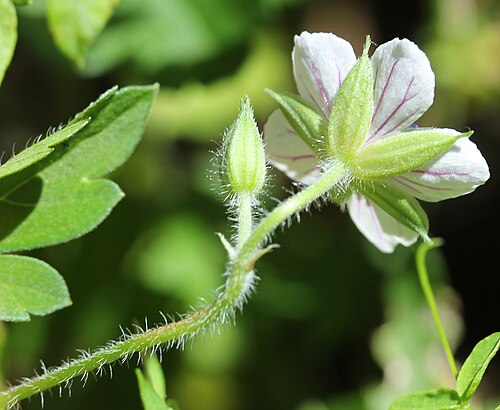
Sepals on Geranium thunbergii, five separated behind the petals of an open flower, and a connected set enclosing an unopened bud


Silky foliage of the silvertree, Leucadendron argenteum


Spadix of Amorphophallus maximus within its spathe. The female flowers are around the bottom of the spadix, the male flowers above, and the sterile top part is the major source of pollinator attractants.


Drosera spatulata leaves are markedly spathulate.

The flowering spike of this Salvia nemorosa differs from a raceme in that the flowers are practically sessile.


Spinescent leaves of Salsola australis: stiff, narrowed, and with lobes ending in spiny points

Bird nest fungi, Nidulariaceae, bear examples of splash-cups with spores that are spread by raindrops.

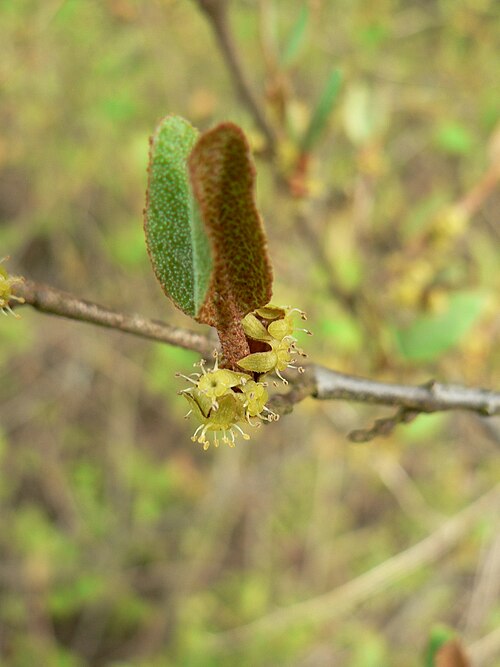
Staminate flowers of Shepherdia canadensis


The large, succulent, acaulescent, linear, cuspidate mottled leaves of a Gasteria species and the small, succulent, cordate leaves of a Crassula species contrast with the linear, herbaceous leaves of a Hypoxis species.
T
- taproot
- The primary descending root of a plant with a single dominant root axis.
- tartareous
- Having a surface that is coarse, thick, rough, and crumbling.
- taxon
- A group or category in a system of biological classification.
- taxonomy
- The study of the principles and practice of classification.
- tegmen
- The inner layer of the testa (seed coat). It develops from the inner integument of the ovule.
- tendril
- Any slender organ modified from a stem, leaf, leaflet, or stipule and used by climbing plants to cling to an object.
- tepal
- A segment of a perianth, either sepal or petal; usually used when all perianth segments are indistinguishable in appearance.
- terete
- Circular in cross-section; more or less cylindrical without grooves or ridges.
- terminal
- Situated at the tip or apex.
- ternate
- In groups of three; of leaves, arranged in whorls of three; of a single leaf, having the leaflets arranged in groups of three.
- terrestrial
- Of or on the ground; of a habitat, on land as opposed to in water (aquatic), on rocks (lithophytic), or on other plants (epiphytic).
- tessellate
- With cracks or fissures arranged in squares so as to give a chequered appearance. Usually applied to the appearance of the bark of a tree
- testa
- The seed coat.
- tetrad
- A group of four; usually used to refer to four pollen grains which remain fused together through maturity (e.g. in the Epacridaceae).[55]
- tetragonal
- Square; having four corners; four-angled, e.g. the cross-sections of stems of herbaceous Lamiaceae.
- tetramerous
- In four parts, particularly with respect to flowers; four parts in each whorl. See also trimerous and pentamerous.
- tetraploid
- Having four complete sets of chromosomes in each sporophyte cell.
- tetraspore
- The asexual spore of red algae. It is so named because each sporangium produces just four spores. See Rhodophyceae.[56]
- thalamus
- 1. A synonym for receptacle.
- 2. The inflorescence disk of members of the Asteraceae.
- 3. A calyx, as used by Carl Linnaeus.
- having a thallus-like structure; in the form of a thallus; thalloid
- thallus
- A vegetative structure that is not differentiated into stem and leaves, as in lichens, algae, thalloseliverworts, and certain vascular plants, e.g. Lemna
- theca
- One of the usually two synangia in which pollen is produced in flowering plants. It consists of two fused sporangia known as pollen sacs. The wall between the pollen sacs disintegrates before dehiscence, which is usually by a common slit.
- thorn
- A sharp, stiff point, usually a modified stem, that cannot be detached without tearing the subtending tissue; a spine. Compare prickle.
- throat
- The opening of a corolla or perianth.
- thyrse
- A branched inflorescence in which the main axis is indeterminate (racemose) and the lateral branches determinate (cymose).
- tomentellous
- Minutely tomentose.
- tomentum
- A dense covering of short, matted hairs. Tomentose is often used as a general term for bearing an indumentum, but this is not a recommended use.
- toothed
- Having a more or less regularly incised margin.
- torus
- See receptacle.
- transmitting tissue
- See pollen transmitting tissue.
- trapeziform
- 1. Like a trapezium (a four-sided figure with two parallel sides of unequal length).
- 2. Like a trapezoid (a four-sided figure, or quadrilateral, with neither pair of sides equal); sometimes used erroneously as a synonym for rhombic.
- tree
- A woody perennial plant, usually with a single distinct trunk and able to attain more than 6 metres (20 ft) tall.[57]
- triad
- A group of three.
- triangular
- Planar and with 3 sides.
- tribe
- A taxonomic grouping that ranks between genus and family.
- trichome
- In non-filamentous plants, any hair-like outgrowth from the epidermis, e.g. a hair or bristle; sometimes restricted to unbranched epidermal outgrowths.
- trichotomous
- 3-forked or branched into three. Compare dichotomous.
- trifid
- Split into three parts. See also bifid.
- trifoliate
- A compound leaf of three leaflets; for example, a clover leaf.
- trifoliolate
- See trifoliate.
- trigonous
- Triangular in cross-section and obtusely angled. Compare triquetrous.
- trimerous
- In three parts, particularly with respect to flowers; having three parts in each whorl. See also tetramerous and pentamerous.
- trinerved
- Having three nerves or veins.
- triplinerved
- (of leaves) Having three main nerves with the lateral nerves arising from the midnerve above the base of the leaf.
- triporate
- (of pollen) Having three pores.
- triquetrous
- More or less triangular in cross-section, but acutely angled (with 3 distinct longitudinal ridges). Compare trigonous.
- trivalve
- Divided into three valves. Also trivalvar. See also bivalve.
- trivial name
- The second word in the two-part scientific name of an organism. Compare specific epithet.
- trophophyll
- A vegetative, nutrient-producing leaf or microphyll whose primary function is photosynthesis. It is not specialized or modified for some other function. Compare sporophyll.
- trullate
- Ovate but angled, as with a bricklayer's trowel; inversely kite-shaped. Compare rhombic.
- truncate
- Cut off squarely; having an abruptly transverse end.
- trunk
- The upright, large and typically woody main stem of a tree.
- truss
- A compact cluster of flowers or fruits arising from one center; evident in many rhododendrons.
- tuber
- Any of many types of specialized vegetative underground storage organs. They accumulate food, water, or in protection from death by fire, drought, or other hard times. Tubers generally are well differentiated from other plant organs; for example, informally a carrot is not generally regarded as a tuber, but simply a swollen root. In this they differ from the tuber of a sweet potato, which has no special root-like function. Similarly, corms are not generally regarded as tubers, even though they are underground storage stems. Tubers store food for the plant, and also have important roles in vegetative reproduction. They generally are of two main types: stem tubers form by the swelling of an underground stem growing from a root, or from structures such as underground stolons. Stem tubers generally produce propagative buds at their stem nodes, forming a seasonal perennating organ, e.g. a potato. The main other class is the root tuber, also called tuberoid. They differ from stem tubers in features such as that, like any normal root, they do not form nodes.
- tubercle
- A small wart-like outgrowth or protuberance of tissue.
- tuberculate
- Covered in tubercles. See warty.[58]
- tuberoid
- An alternative name for underground storage organ formed by the swelling of a root; occurs in many orchids.
- tuberous
- Resembling a tuber or producing tubers.
- tubular
- Having the form of a tube or cylinder.
- tufted
- Densely fasciculate at the tip.
- tunic
- The outer covering of some bulbs and corms.
- tunicate
- (of bulbs) Consisting of concentric coats.
- turbinate
- Shaped like a spinning top or beetroot.
- turgid
- Swollen with liquid; bloated; firm. Compare flaccid.
- tussock
- A dense tuft of vegetation, usually well separated from neighbouring tussocks, for example in some grasses. Compare sward.
- two-ranked
- Having leaves arranged in two rows in the same plane, on opposite sides of the branch. See distichous.
- type
- An item (usually an herbarium specimen) to which the name of a taxon is permanently attached, i.e. a designated representative of a plant name. Important in determining the priority of names available for a particular taxon.
- type genus
- In nomenclature, a single genus on which a taxonomic family is based.
 Haworthia lockwoodii, with its leaves turgid and green after seasonal rains, store water against the coming dry period.
 Tussock grasses on mountain slopes

Leucaena leucocephalataproot exposed in a roadcut


Tendrils of Cucurbita pepo, some supporting the stem on the frame, some failing to find a point of attachment
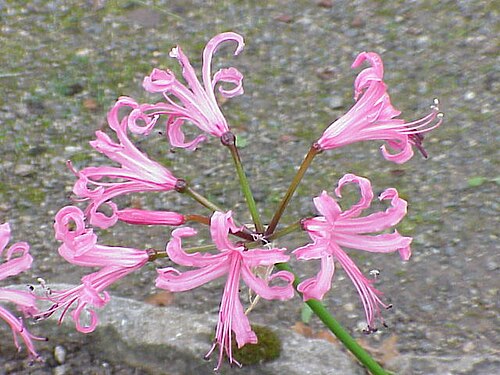
Nerine bowdenii, showing the lack of visible sepals, and the inferior ovaries. The sepals are incorporated into the corolla as tepals.

Terete raceme of Kniphofia shown together with a cross section of a peduncle. A:Inflorescence;B: Terete peduncle;C: Cross section of a terete peduncle

Gymnosporia buxifolia has true thorns, that is, modified branches. In some species such branches are complete with buds and leaves.
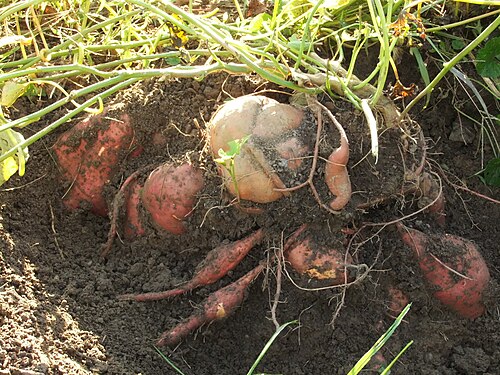
Sweet potatotubers exposed, showing them to be root tubers. Morphologically, they differ from stem tubers of potatoes, for example, in that root tubers do not have nodes that bear buds. The root tubers of some species of plants, however, can produce adventitious buds for vegetative reproduction.

Oxalis tuberosa, a stem tuber

Corms of Crocosmia bear typical tunics formed of cataphylls growing from the nodes of the corm. The illustration shows still-living cataphylls as white tissue, whereas the functional, hard, resistant tunic is brown.
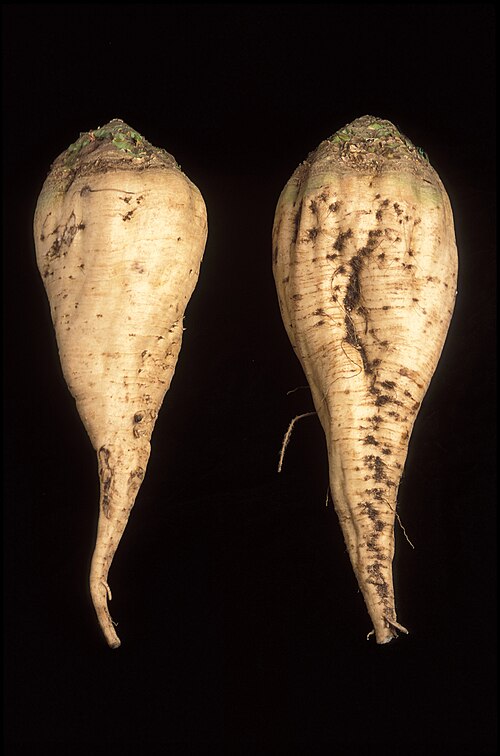
Turbinate (spinning top-shaped) roots of sugar beet
U
- umbel
- A racemose inflorescence in which all the individual flower stalks arise in a cluster at the top of the peduncle and are of about equal length; in a simple umbel, each stalk is unbranched and bears only one flower. A cymose umbel looks similar to an ordinary umbel but its flowers open centrifugally.
- umbo
- A rounded elevation, such as in the middle of the top of an umbrella or mushroom; a central boss or protuberance, such as on the scale of a cone.
- umbonate
- Having an umbo, with a conical or blunt projection arising from a flatter surface, as on the top of a mushroom or in the scale of a pine cone.
- unciform
- Hook-shaped.
- uncinate
- Having a hook at the apex.
- undershrub
- A low shrub, often with flowering branches that die off in winter. Compare subshrub.
- understory
- Plant life growing beneath the forest canopy.
- undulate
- Wavy and not flat. Compare sinuate.
- uniflor
- Having a single flower (uniflory). Compare pauciflor (few) and pluriflor (many).
- unilocular
- Having one loculus or chamber, e.g. the ovary in the families Proteaceae and Fabaceae.
- uniserial
- Arranged in a single row or series. Unbranched. Uniseriate.
- uniseriate
- Arranged in a single row or series. Unbranched. Uniserial.
- unisexual
- Of one sex; bearing only male or only female reproductive organs, dioecious, dioicous. See Sexual reproduction in plants.
- unitegmic
- (of an ovule) Covered by a single integument. See also bitegmic, having two integuments.
- urceolate
- Shaped like an urn or pitcher, with a swollen middle and narrowing top. Examples include the pitchers of many species of the pitcher plant genera Sarracenia and Nepenthes.
- usu.
- An abbreviation of usually. Compare s.t. and oft..
- utricle
- 1. A small bladder; a membranous bladder-like sac from the ovary wall with thin pericarp which becomes inflated at maturity enclosing an ovary or fruit.
- 2. In sedges, a fruit which is loosely enclosed by a modified tubular bract, see perigynium.
 Pitchers of the species Nepenthes ventricosa tend to be markedly urceolate.

Umbo in the middle of the cap of Cantharellula umbonata


V
- vallecular canal
- A resin canal coinciding with a longitudinal groove in the seeds of Asteraceae. A longitudinal cavity in the cortex of the stems of Equisetum, coinciding with a groove in the stem surface.
- valvate
- (of sepals and petals in bud) Meeting edge-to-edge but not overlapping.
- valve
- A portion of an organ that fragments or splits open, e.g. the teeth-like portions of a pericarp in a split (dehisced) capsule or pod when ripe.
- var.
- An abbreviation of varietas.
- variant
- A plant or group of plants showing some measure of difference from the characteristics associated with a particular taxon.
- variegated
- Irregularly marked with blotches or patches of another color.
- varietas
- A taxonomic rank below that of species and between the ranks of subspecies and form.
- vascular
- Referring to the conducting tissues (xylem and phloem) of vascular plants.
- vascular bundle
- A bundle of vascular tissue in the primary stems of vascular plants, consisting of specialized conducting cells for the transport of water (xylem) and assimilate (phloem).
- vasculum
- A container used by botanists for collecting field specimens.
- vein
- A strand of vascular tissue, e.g. in the leaves of vascular plants.
- veinlet
- A small vein; the ultimate (visible) division of a vein.
- velamen
- A spongy tissue covering the aerialroots of orchids and some other epiphytes.
- velutinous
- See velvety.
- velvety
- Densely covered with fine, short, soft, erect hairs.
- venation
- The arrangement of veins in a leaf.
- ventral
- From Latin venter, meaning "belly". The opposite of dorsal. Partly because the term originally referred to animals rather than plants, usage in botany is arbitrary according to context and source. In general "ventral" refers to "the belly or lower part", but in botanical usage such concepts are not always clearly defined and may be contradictory. For example:
- facing toward the axis (adaxial) in referring to a lateral organ of an erect plant
- facing toward the substrate in any part of an erect plant, for example the lower surface of a more or less horizontal leaf (abaxial)
- facing toward the substrate in a prostrate or climbing plant.
- vernation
- The arrangement of unexpanded leaves in a bud; the order in which leaves unfold from a bud.
- vernicose
- Having a shiny or polished surface as if covered in varnish and a slick or smooth texture.[59]
- vernonioid
- In the family Asteraceae, style with sweeping hairs borne on abaxial surfaces of style branches.
- verruciform
- Wart-like in form.
- verrucose
- Having warts.
- verruculose
- Minutely verrucose; minutely warty.
- versatile
- (of anthers) Swinging freely about the point of attachment to the filament.
- verticillate
- Arranged in one or more whorls, i.e. several similar parts arranged at the same point of the axis, e.g. leaf arrangement. Compare pseudoverticillate (appearing whorled or verticillate but not actually so).
- verticillaster
- A type of pseudoverticillateinflorescence, typical of the Lamiaceae, in which pseudo-whorls are formed from pairs of opposite cymes.
- vesicular
- (of hairs) Bladder-like; vesiculous, bearing such hairs.
- vessel
- A capillary tube formed from a series of open-ended cells in the water-conducting tissue of a plant.
- vestigial
- Reduced in form and function from the normal or ancestral condition.
- villosulous
- Minutely villous.
- villous
- Abounding in or covered with long, soft, straight hairs; shaggy with soft hairs.
- vine
- 1. Scandent plants climbing by means of trailing or twining stems or runners.
- 2. Such a stem or runner.[28][60]
- 3. A member of the genus Vitis.
- virgate
- Wand-shaped, twiggy, especially referring to erect, straight stems. In mycology, referring to a pileus with radiating ribs or lines.
- Viridiplantae
- A clade of autotrophic organisms that includes the green algae, Charophyta and land plants, all of which have cellulose in their cell walls, chloroplasts derived from primary endosymbiosis with cyanobacteria that contain chlorophylls a and b and lack phycobilins.
- viscid
- Sticky; coated with a thick, syrupy secretion.
- viscidium
- A sticky pad or strap coated with an adhesive secretion, forming part of the structure of the pollinium or the pollinarium of many species of plants, most notoriously orchids. In pollination the viscidium sticks the pollen burden to a visiting pollinator, that in turn is likely to visit other flowers of the same species, bearing a concentrated burden of pollen. Such flowers commonly are adapted to stripping the pollinium off incoming pollinators.
- vitta
- An oil tube in the fruit of some plants.[61]
- viviparous
- 1. Referring to seeds or fruits which germinate before being shed from the parent plant.
- 2. The development of plantlets on non-floral organs, e.g. leaves.
 In this pollinarium the viscidium is the sticky lump in the middle of the yoke-like stipe connecting the two pollinia.
 Asparagus virgatus owes its specific epithetvirgatus to the twiggy appearance of its virgate shoots.

Photomicrograph of a cross section of a vascular bundle in the stem of a typical herbaceousdicotyledon
A: PhloemB: CambiumC: XylemD: Fibrous sheath of vascular bundle


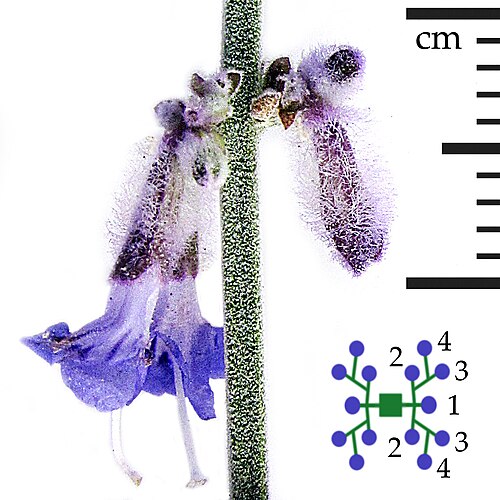
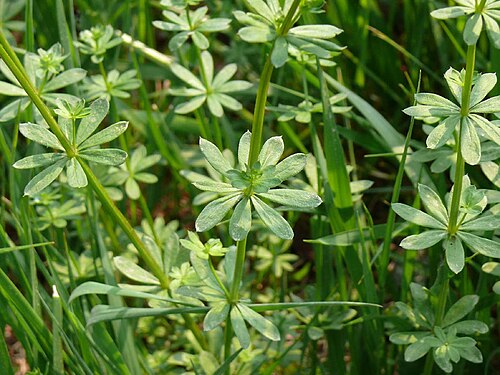
Verticillate leaves and emerging branchlets of a Galium species
W
- warty
- A surface covered with small round protuberances, especially in fruit, leaves, twigs and bark. See tuberculate.
- watershoot
- An erect, strong-growing, or epicormicshoot developing from near the base of a shrub or tree, but distinct from a sucker.
- weed
- 1. Any plant growing where it is not wanted; commonly associated with disrupted habitats. See also ruderal.
- 2. An unwanted plant which grows among agricultural crops.
- 3. A naturalised, exotic, or ecologically "out-of-balance" indigenous species outside of the agricultural or garden context, which, as a result of invasion, adversely affects the survival or regeneration of indigenous species in natural or partly natural vegetation communities.[62]
- wild
- Originating from a known wild or purely natural habitat (wilderness).
- whorl
- A ring of organs borne at the same level on an axis (e.g. leaves, bracts, or floral parts).
- wing
- 1. A membranous expansion of a fruit or seed which aids in dispersal, for instance on pine seeds.
- 2. A thin flange of tissue extending beyond the normal outline of a structure, e.g. on the column of some orchids, on stems, on petioles.
- 3. One of the two lateral petals of a flower of subfamily Faboideae of family Fabaceae, located between the adaxial standard (banner) petal and the two abaxial keel petals.
- woody
- hard and lignified; not herbaceous
- wooly
- woolly
- Very densely covered with long, more or less matted or intertwined hairs, resembling a sheep's wool.
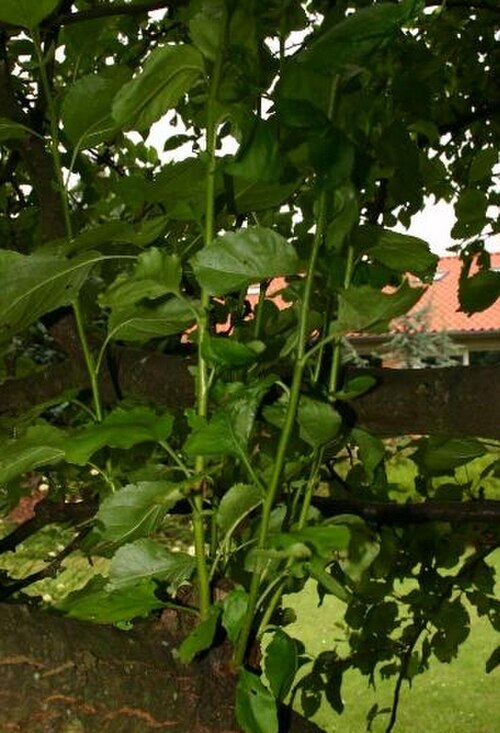
 The verticillatewhorls of leaves on Brabejum stellatifolium are unusual among trees in its native region.
 Winged seeds of Catalpa bignonioides are nearly all wing. Tufts at the tips increase aerodynamic drag, thereby improving wind dispersal.
 Leaves of some species of Citrus have winged petioles.
 Senecio haworthii leaves have an unusually dense wooly coat.
X
- xeromorph
- A plant with structural features (e.g. hard or succulent leaves) or functional adaptations that prevent water loss by evaporation; usually associated with arid habitats, but not necessarily drought-tolerant. Compare xerophyte.
- xerophyte
- A plant generally living in a dry habitat, typically showing xeromorphic or succulent adaptation; a plant able to tolerate long periods of drought. Compare xeromorph.
- xylem
- A specialized water-conducting tissue in vascular plants.
Z
- zonate
- Having light and dark circular bands or rings, typically on leaves or flowers.
- zygomorphic
- Bilaterally symmetrical; symmetrical about one vertical plane only; applies to flowers in which the perianth segments within each whorl vary in size and shape. Contrast actinomorphic and irregular.
- zygote
- A fertilized cell, the product of fusion of two gametes.
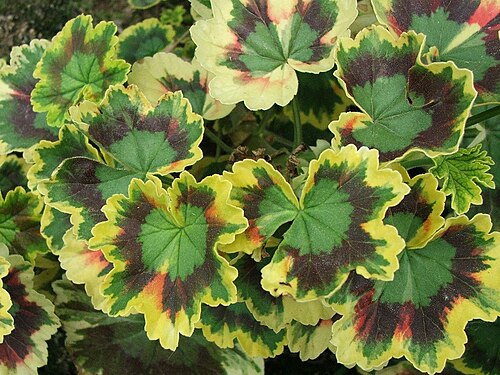 Zonate markings on the leaves of a garden variety of Pelargonium zonale
 Like most of the genus Pelargonium, and unlike most members of the genus Geranium, Pelargonium quercifolium bears flowers that are bilaterally symmetrical. Accordingly, because the yoke of an ox is bilaterally symmetrical, such flowers are said to be zygomorphic, which literally means "yoke-shaped".
See also
References
- ↑New Oxford Dictionary v1 2007, p. 2.
- 123Harris & Harris 2001, p. 3.
- ↑New Oxford Dictionary v1 2007, p. 7.
- ↑New Oxford Dictionary v1 2007, p. 8.
- ↑Shreve & Wiggins 1964, p. 738.
- ↑Shreve & Wiggins 1964, p. 355.
- ↑Shreve & Wiggins 1964, p. 351.
- ↑New Oxford Dictionary v1 2007, p. 16.
- ↑Turland et al. 2018, Article 18.
- ↑IPNI 2022.
- 12Harris & Harris 2001, p. 4.
- ↑Harris & Harris 2001, pp. 4–5.
- 123456789Harris & Harris 2001, p. 5.
- ↑Sims 1803, [p. 93].
- ↑Harris & Harris 2001, p. 6.
- ↑Cappers & Neef 2012, p. 95.
- ↑Pell & Angell 2016, p. 15.
- ↑Pell & Angell 2016, p. 16.
- ↑Pell & Angell 2016, p. 17.
- ↑Pell & Angell 2016, p. 20.
- ↑Pell & Angell 2016, p. 24.
- ↑Pell & Angell 2016, p. 27.
- ↑Pell & Angell 2016, p. 35.
- ↑Pell & Angell 2016, p. 39.
- 12Pell & Angell 2016, p. 41.
- ↑Pell & Angell 2016, p. 46.
- ↑Pell & Angell 2016, p. 47.
- 12345Jackson 1928.
- 12Jaeger 1959.
- 12Mitchell 1974, p. 391.
- ↑Pell & Angell 2016, p. 58.
- ↑Beentje 2010, p. 33.
- ↑"Glossary". Acacias of Australia. Retrieved 8 July 2025.
- 12Hanzawa, Beattie & Holmes 1985.
- ↑Pell & Angell 2016, p. 78.
- 12Schulze & Zwölfer 2012, p. 261.
- ↑Pell & Angell 2016, p. 83.
- ↑Copied definition from Wiktionary entry for faculative biology adjective. See that page's history for attribution.
- ↑Copied definition from Wiktionary entry for fimbriate biology adjective. See that page's history for attribution.
- ↑Rendle 1911.
- ↑Glover 2007, pp. 111–112.
- ↑Hickey & King 2000, p. 20, 87.
- ↑Hickey & King 2000, p. 20.
- 12Carolin & Tindale 1994, p. 23.
- ↑Beentje 2010, p. 67.
- ↑"Glossary: P". Go Botany. Native Plant Trust. Archived from the original on 28 September 2023. Retrieved 4 January 2024.
- ↑Meerow et al. 1999.
- ↑Eckenwalder 2009, pp. 648–661.
- ↑Mitchell 1972, p. 73.
- ↑Pell & Angell 2016, p. 169.
- 12Beentje 2010, p. 107.
- ↑Kucewicz, Maćkiewicz & Źróbek-Sokolnik 2010.
- ↑Brodie 1951.
- ↑Mandal & Bar 2018, p. 64.
- ↑Beach 1914a.
- ↑Beach 1914b.
- ↑Mitchell 1974, p. 15.
- ↑"tuberculate". Dictionary of botany. Retrieved 7 January 2024.
- ↑Harris & Harris 2001, p. 132.
- ↑New Oxford Dictionary v2 2007, p. 3534.
- ↑Beentje 2010, p. 129.
- ↑Carr, G.W., in Foreman & Walsh, 1993.
Bibliography
- Allaby, Michael (2012). A Dictionary of Plant Sciences. Oxford University Press. ISBN 978-0-19-960057-1– via Google Books(preview only).
- Beach, Chandler B., ed. (1914a). "Tetrad". The New Student's Reference Work. Chicago: F. E. Compton and Co.
- Beach, Chandler B., ed. (1914b). "Tetraspore". The New Student's Reference Work. Chicago: F. E. Compton and Co.
- Beentje, Henk (2010). The Kew Plant Glossary, an Illustrated Dictionary of Plant Terms. Richmond, London: Kew Publishing. ISBN 978-1-84246-422-9.
- Brodie, Harold J. (May 1951). "The splash-cup dispersal mechanism in plants". Canadian Journal of Botany. 29 (3). Ottawa, Ontario: Canadian Science Publishing: 224–234. Bibcode:1951CaJB...29..224B. doi:10.1139/b51-022.
- Cappers, René T.J.; Neef, Reinder (2012). Handbook of Plant Palaeoecology. Barkuis Publishing. ISBN 9789492444264– via Google Books(preview only).
- Carolin, Roger C.; Tindale, Mary D. (1994). Flora of the Sydney Region (4th ed.). Chatswood, NSW: Reed. ISBN 0730104001. OCLC 32821788.
- Don, George (1831). A General History of Dichlamydeous Plants...Arranged According to the Natural System. Vol. 1. London. Retrieved 15 December 2022– via Biodiversity Heritage Library.
- Eckenwalder, James E. (2009). Conifers of the World: the Complete Reference. London: Timber Press. ISBN 978-0-88192-974-4.
- Gifford, Ernest M.; Foster, Adriance S. (1989). Morphology and Evolution of Vascular Plants (3rd ed.). W. H. Freeman. ISBN 978-0-7167-1946-5.
- Glover, Beverley J. (2007). Understanding Flowers and Flowering: An Integrated Approach. Oxford: Oxford university press. ISBN 978-0-19-856596-3. OCLC 153553887. Retrieved 23 January 2026.
- Hanzawa, Frances M.; Beattie, Andrew J.; Holmes, Anne (November 1985). "Dual function of the elaiosome of Corydalis aurea (Fumariaceae): attraction of dispersal agents and repulsion of Peromyscus maniculatus, a seed predator". American Journal of Botany. 72 (11). St. Louis, Missouri: Botanical Society of America: 1707–1711. Bibcode:1985AmJB...72.1707H. doi:10.1002/j.1537-2197.1985.tb08442.x. JSTOR 2443727.
- Harris, James G.; Harris, Melinda Woolf (2001). Plant Identification Terminology: an Illustrated Glossary (2nd ed.). Spring Lake, Utah, US: Spring Lake Publishing. ISBN 0-9640221-6-8.
- Hickey, Michael; King, Clive (2000). The Cambridge Illustrated Glossary of Botanical Terms. Cambridge, England: Cambridge University Press. ISBN 978-0-521-79401-5– via Google Books.
- Hughes, Colin (2017). "About the Field Guides Project". The Virtual Field Herbarium (herbaria-old.plants.ox.ac.uk). Oxford University Herbaria. Archived from the original on 5 March 2017. Retrieved 4 March 2017.
- * "Plant Characteristics". The Virtual Field Herbarium (herbaria-old.plants.ox.ac.uk). Archived from the original on 5 March 2017. Retrieved 4 March 2017. In Hughes (2017).
- IPNI (2022). "Rosaceae Juss., Gen. Pl. [Jussieu] 334 (1789), nom. cons". International Plant Names Index (IPNI). Royal Botanic Gardens, Kew; Harvard University Herbaria & Libraries; Australian National Botanic Gardens. Retrieved 24 December 2022.
- Jackson, Benjamin Daydon (1928). A Glossary of Botanic Terms with their Derivation and Accent. New York: Hafner Publishing Co. Inc. Retrieved 15 December 2022– via Biodiversity Heritage Library.
- Jaeger, Edmund Carroll (1959). A Source-book of Biological Names and Terms. Springfield, Illinois, US: Thomas. ISBN 978-0-398-06179-1– via Internet Archive.
{{cite book}}: ISBN / Date incompatibility (help) - Kucewicz, Magdalena; Maćkiewicz, Katarzyna; Źróbek-Sokolnik, Anna (2010). "Selected aspects of tiny vetch [Vicia hirsuta (L.) Gray S.F.] seed ecology: generative reproduction and effects of seed maturity and seed storage on seed germination". Acta Agrobotanica. 63 (1). Warsaw: Polish Botanical Society: 205–212. doi:10.5586/aa.2010.023. S2CID 84871256.
- Lellinger, David B. (2002). A Modern Multilingual Glossary for Taxonomic Pteridology (Pteridologia) (in English, Spanish, French, and Portuguese). Vol. 3. American Fern Society, Inc.ISBN 978-0-933500-02-0. Retrieved 15 December 2022– via Biodiversity Heritage Library.
- Mandal, R. N.; Bar, R. (2018). Mangroves for Building Resilience to Climate Change. CRC Press. ISBN 9780429946974– via Google Books.
- Meerow, Alan W.; Fay, Michael F.; Guy, Charles L.; Li, Qin-Bao; Zaman, Faridah Q.; Chase, Mark W. (September 1999). "Systematics of Amaryllidaceae based on cladistic analysis of plastid sequence data". American Journal of Botany. 86 (9). St. Louis, Missouri: Botanical Society of America: 1325–1345. doi:10.2307/2656780. JSTOR 2656780. PMID 10487820.
- Mitchell, Alan (1972). Conifers in the British Isles. A Descriptive Handbook(PDF). Forestry Commission Booklet 33. illustrated by Christine Darter. London: Her Majesty's Stationery Office. Archived from the original(PDF) on 27 August 2016.
- Mitchell, Alan F. (1974). A Field Guide to the Trees of Britain and Northern Europe. London: Collins. ISBN 0-00-212035-6.
- Neotropikey (2017). "Glossary of Botanical Terms". www.kew.org. Royal Botanic Gardens, Kew. Archived from the original on 21 January 2017. Retrieved 18 February 2017.
- New Shorter Oxford English Dictionary on Historical Principles (A–M). Vol. 1 (6th ed.). Oxford, England: Oxford University Press. 2007. ISBN 978-0-19-920687-2. Retrieved 17 December 2022– via Internet Archive.
- New Shorter Oxford English Dictionary on Historical Principles (N–Z). Vol. 2 (6th ed.). Oxford, England: Oxford University Press. 2007. ISBN 978-0-19-920687-2. Retrieved 16 December 2022– via Internet Archive.
- NYBG (2019). "Glossary for Vascular Plants". The William & Lynda Steere Herbarium, New York Botanical Garden. Retrieved 20 September 2019.
- Pell, Susan K.; Angell, Bobbi (2016). A Botanist's Vocabulary: 1300 Terms Explained and Illustrated. Portland, Oregon, US: Timber Press. ISBN 978-1-604-69563-2.
- Rendle, Alfred Barton (1911). "Fruit". In Chisholm, Hugh (ed.). Encyclopædia Britannica. Vol. 11 (11th ed.). Cambridge University Press. pp. 257–258.
- Schulze, Ernst-Detlef; Zwölfer, Helmut, eds. (2012). Potentials and Limitations of Ecosystem Analysis, Extinction and Naturalization of Plant Species. Springer Berlin Heidelberg. ISBN 9783642716300. Retrieved 16 December 2022– via Google Books(preview only).
- Shreve, Forrest; Wiggins, Ira L. (1964). Vegetation and Flora of the Sonoran Desert. Vol. 1. Stanford, California, US: Stanford University Press. ISBN 9780804701631. OCLC 710084– via Internet Archive.
{{cite book}}: ISBN / Date incompatibility (help) - Simpson, Michael G. (August 2011). Plant Systematics. Academic Press. ISBN 978-0-08-051404-8– via Google Books(preview only).
- Sims, John (1803). Curtis's Botanical Magazine, Or, Flower-garden Displayed: In which the Most Ornamental Foreign Plants, Cultivated in the Open Ground, the Green-house, and the Stove, are Accurately Represented in Their Natural Colours ... Vol. 17. London: T. Curtis. Retrieved 15 December 2022– via Google Books.
- Stearn, William T. (1983). Botanical Latin (3rd ed.). Newton Abbot & London & North Pomfret, Vermont, US: David & Charles. ISBN 0-7153-8548-8. Retrieved 15 December 2015– via Internet Archive.
- Turland, N.J.; Wiersema, J.H.; Barrie, F.R.; Greuter, W.; Hawksworth, D.L.; Herendeen, P.S.; Knapp, S.; Kusber, W.-H.; Li, D.-Z.; Marhold, K.; May, T.W.; McNeill, J.; Monro, A.M.; Prado, J.; Price, M.J.; Smith, G.F., eds. (2018). International Code of Nomenclature for algae, fungi, and plants (Shenzhen Code) adopted by the Nineteenth International Botanical Congress Shenzhen, China, July 2017. Regnum Vegetabile. Vol. 159. Glashütten, Germany: Koeltz Botanical Books. doi:10.12705/Code.2018. hdl:10141/622572. ISBN 978-3-946583-16-5. OCLC 1043552267. Retrieved 21 December 2022.
External links
- Glossary at APweb
- A glossary of botanical terms (in English at Flora, etc.)
- Garden Web
- eFloras
- Categorical Glossary for the Flora of North America ProjectArchived 20 May 2019 at the Wayback Machine
Royal Botanical Gardens at Kew
- Standard glossary (archive)
- Stuppy, W. Glossary of Seed and Fruit Morphological Terms
Australia and New Zealand
Africa
- Herman, P. P. J. (2015). "Botanical glossary"(PDF). SANBI. Archived from the original(PDF) on 18 October 2020. Retrieved 21 May 2020.
- Plants of southern Africa (Archived 17 October 2016 at the Wayback Machine)
Categories:
- Branches of botany
- Glossaries of botany
- Lists of plants
- Plant morphology