This article needs additional citations for verification. Please help improve this article by adding citations to reliable sources. Unsourced material may be challenged and removed. Find sources: "Glossary of nautical terms" A–L – news · newspapers · books · scholar · JSTOR(June 2023) (Learn how and when to remove this message)
هذا المصطلح البحري عبارة عن قائمة أبجدية للمصطلحات والتعبيرات المرتبطة بالسفن والشحن والبحارة والملاحة على الماء (معظمها على البحر ولكن ليس بالضرورة). لا يزال بعضها حديثًا، بينما يعود تاريخ العديد منها إلى القرنين السابع عشر والتاسع عشر. اشتُقت كلمة بحري من اللاتينية nauticus ، من اليونانية nautikos ، من nautēs : "بحار"، من naus : "سفينة".
(الشراع ) تملأه الرياح على الجانب المقابل للشراع المستخدم عادة لتحريك السفينة للأمام. في السفن ذات الصواري المربعة ، يمكن إرجاع أي من الأشرعة المربعة إلى الخلف، وقد يكون الغرض من ذلك تقليل السرعة (مثل عندما تكون سفينة خطية متوقفة مع سفن أخرى)، أو الرفع، أو المساعدة في تحريك رأس السفينة عبر عين الريح عند الدوران . يمكن أن يتسبب التحول المفاجئ في الرياح أيضًا في "الوقوع في الخلف" عن غير قصد في السفينة ذات الصواري المربعة مع جميع الأشرعة للخلف. هذا موقف خطير يخاطر بأضرار جسيمة. في السفن ذات الصواري الأمامية والخلفية، يتم دعم الشراع الأمامي إما عن طريق سحبه عبر الغطاء الجوي أو عن طريق الدوران دون تحرير الغطاء. يتم استخدامه للرفع أو للمساعدة في الدوران. [1] [2] انظر أيضًا إلى الخلف والملء .
خلف
نحو المؤخرة ، بالنسبة لبعض الأشياء (على سبيل المثال "خلف قمرة القيادة"). [3]
خلف الشعاع
أبعد من العارضة؛ اتجاه نسبي أكبر من 90 درجة من القوس؛ على سبيل المثال "نقطتان خلف العارضة، الجانب الأيمن" من شأنهما أن يصفا "جسمًا مستلقيًا بزاوية 22.5 درجة باتجاه مؤخرة السفينة، كما يقاس في اتجاه عقارب الساعة من خط عمودي من الجانب الأيمن، مركز السفينة، نحو الأفق". [4]
التخلي عن السفينة
أمر بمغادرة السفينة على الفور، وعادة ما يكون ذلك في مواجهة خطر وشيك ساحق. [5] وهو أمر يصدره القبطان أو شخص مفوض في القيادة، ويجب أن يكون أمرًا شفهيًا. وعادة ما يكون الملاذ الأخير بعد فشل جميع الإجراءات المخففة الأخرى أو استحالة تنفيذها، عندما يكون تدمير السفينة أو فقدها وشيكًا، وعادة ما يتبعه أمر "بتجهيز قوارب النجاة " أو أطواف النجاة. [5] [6]
على طول العارضة
على العارضة؛ محمل نسبي بزاوية قائمة على عارضة السفينة؛ على سبيل المثال، وصف جسم يقع عند محمل 90 درجة ( يمين ) أو 270 درجة ( ميناء ) كما تم قياسه في اتجاه عقارب الساعة من مقدمة السفينة. [7]
بحار تجاري مؤهل لأداء جميع المهام الروتينية على متن السفينة، أو رتبة مبتدئة في بعض القوات البحرية.
على متن السفينة
على متن سفينة أو في داخلها. مرادف لـ "على متن السفينة". انظر أيضًا إغلاق على متن السفينة .
عن
تغيير مسار السفينة عن طريق تغيير الاتجاه . "الاستعداد" هو الأمر بالاستعداد لتغيير الاتجاه. [8]
فوق اللوحة
على سطح السفينة أو فوقه؛ في مكان واضح؛ لا يخفي أي شيء. غالبًا ما كان القراصنة يخبئون طاقمهم تحت سطح السفينة، مما يخلق انطباعًا خاطئًا بأن اللقاء مع سفينة أخرى كان مجرد مصادفة عابرة وليس هجومًا مخططًا له.
بدن فوق الماء
الجزء من هيكل السفينة فوق خط الماء ؛ الجزء المرئي من السفينة. انظر أيضًا الجزء العلوي .
راية الغائب
راية خاصة تُرفع للإشارة إلى غياب قائد السفينة أو الأدميرال أو رئيس الأركان أو الضابط الذي لا يزال علمه يرفرف (قائد فرقة أو سرب أو أسطول ).
اتجاه جسم ما بالنسبة للشمال: إما الاتجاه الحقيقي ، باستخدام الشمال الجغرافي أو الحقيقي ، أو الاتجاه المغناطيسي ، باستخدام الشمال المغناطيسي . انظر أيضًا الاتجاه والاتجاه النسبي .
سفينة أو هيكل يستخدم كمسكن، عادةً عندما يكون هناك نقص في أماكن الإقامة المتاحة على الشاطئ. يمكن استخدام سفينة عاملة، ولكن في أغلب الأحيان يتم استخدام هيكل معدّل للسكن.
ضابط بحري كبير برتبة علم. بترتيب تصاعدي للأقدمية في البحرية الملكية : أميرال خلفي، نائب أميرال، أميرال، (حتى عام 2001 تقريبًا، عندما تم إيقاف جميع الرتب البريطانية ذات الخمس نجوم) أميرال الأسطول ، والأدميرال الأعلى . في البحرية الأمريكية : أميرال خلفي (النصف السفلي)، أميرال خلفي، نائب أميرال، أميرال، و(غير مستخدم منذ الحرب العالمية الثانية ) أميرال أسطول.
1. طافية وغير متصلة بأي شكل من الأشكال بالشاطئ أو قاع البحر، ولكنها ليست قيد الإبحار . عند الإشارة إلى سفينة، فهذا يعني أن السفينة غير قابلة للسيطرة أو غير قادرة على ذلك وبالتالي تذهب إلى حيث تأخذها الرياح والتيار؛ يمكن أيضًا وصف السفينة في هذه الحالة بأنها "غير مربوطة بمراسيها" أو "خارج مكانها". [3]
2. أي معدات غير مثبتة أو مخزنة بشكل صحيح.
3. أي شخص أو شيء مفقود أو ضائع. وعند تطبيق هذا المصطلح على أحد أفراد البحرية أو مشاة البحرية، يُقال عن هذا الشخص إنه "غائب بدون إذن" (AWOL) أو، وفقًا لمصطلحات البحرية الأمريكية ومشاة البحرية الأمريكية، يكون مذنبًا بارتكاب "غياب غير مصرح به" (UA). [9]
ملاحظة مسبقة
مذكرة بقيمة أجر شهر واحد تُمنح للبحار عند توقيعه على مستندات السفينة .
نصح
انظر الإشعار.
طافيا
1. (للسفينة) عائمة بحرية (غير جانحة أو غارقة). يمكن أيضًا استخدام المصطلح بشكل أكثر عمومية لأي جسم أو شخص عائم.
2. في الخدمة، حتى لو لم تكن قيد التشغيل حاليًا ، ولكنها ليست معطلة، أو بدون طاقم، أو قيد الإصلاح، أو تحت الإنشاء (على سبيل المثال "لدى الشركة 10 سفن عائمة").
1. نحو مؤخرة السفينة أو مؤخرتها. [2] تباين للأمام .
2. الجزء من السفينة الذي يقع خلف المنطقة الوسطى من السفينة.
حاجب بعد الحاجب
على السفن الأكبر حجمًا، يوجد ممر ثانوي مُجهز في المنطقة الخلفية من منتصف السفينة . على بعض السفن العسكرية، مثل السفن البحرية الأمريكية، يصعد الأفراد المجندون أسفل E-7 على متن السفينة عند حافة السفينة الخلفية؛ ويصعد الضباط و CPO / SCPO / MCPO على متن السفينة عند حافة السفينة. [10]
هيكل مؤخرة السفينة خلف الصاري الأوسط وفوق عارضة السفينة في السفن الشراعية الكبيرة، أكبر كثيرًا من مقدمة السفينة ولكنه أقل شيوعًا. يضم الحصن الخلفي مقصورة القبطان وأحيانًا مقصورات أخرى ويعلوه سطح المؤخرة .
سطح السفينة الخلفي
الجزء من سطح السفينة الذي يقع في الجزء الخلفي من منتصف السفينة.
الاستلقاء على الأرض أو ملامستها، أو قاع مسطح مائي (سواء عن غير قصد أو عن عمد، كما هو الحال في ميناء تجفيف)، على عكس الطفو. [3]
إلى الأمام
أمام القوس.
أهو
صفة تشير إلى حالة من الفوضى غير العادية التي لا تلائم البحارة. تستخدم لوصف شيء منحرف أو غير مستقيم أو حتى مستدير ولكنه غير صحيح. [11] على سبيل المثال "يا له من عرض محزن أن نرى هذه المركبة وهي تبحر! ما زالوا يسحبون مصداتهم في الأمواج، وأشرعتهم كلها تنطلق!".
أهوي
صرخة لجذب الانتباه. تستخدم لاستدعاء قارب أو سفينة، على سبيل المثال "قارب أهوي". [3]
أهول
1. الكذب على جانب البحر.
2. ركوب العاصفة بدون أشرعة ودفة السفينة موجهة نحو الريح.
1. أي جهاز خارجي للسفينة أو الطائرة يهدف على وجه التحديد إلى مساعدة الملاحين في تحديد موقعهم أو مسارهم الآمن، أو تحذيرهم من المخاطر أو العوائق التي تعترض الملاحة.
2. أي نوع من العلامات التي تساعد المسافر في الملاحة، وخاصة فيما يتعلق بالسفر البحري أو الجوي. وتشمل هذه المساعدات عادةً المنارات والعوامات وإشارات الضباب ومنارات النهار.
سفينة حربية مصممة لمهمة أساسية وهي نشر واستعادة الطائرات أثناء وجودها في البحر، وبالتالي تعمل كقاعدة جوية بحرية. منذ عام 1918، كان المصطلح يقتصر بشكل عام على سفينة حربية ذات سطح طيران واسع مصمم لتشغيل الطائرات ذات الأجنحة الثابتة التقليدية. في لغة البحرية الأمريكية، يُطلق عليها أيضًا "السطح المسطح" أو "مزرعة الطيور".
مسودة الهواء
تيار هوائي
الحد الأقصى للارتفاع الرأسي لأي جزء من السفينة فوق سطح الماء. الخلوص المطلوب للمرور تحت الجسر. [12]
إجبار شخص أو شيء على التوقف فجأة؛ أي توقف غير متوقع ومفاجئ. [9]
الارتباط
اصطدام سفينة متحركة بجسم ثابت (غير مغمور)، مثل دعامة جسر أو دولفين أو رصيف أو رصيف ميناء أو سفينة أخرى مثبتة في رصيف أو رصيف ميناء. ويتطلب الأمر أكثر من مجرد اتصال عرضي. ويقال إن السفينة "تتصادم" مع الجسم الثابت وتعتبر مخطئة. تصادم متباين .
2. موضع في منتصف الطريق بين جانبي الميناء واليمين للسفينة أو القارب، كما في "دفة القيادة في منتصف السفينة"، عندما تكون الدفة في خط واحد مع عارضة السفينة. [13]
مجموعة متنوعة من السفن الحربية المصممة لإنزال ودعم مشاة البحرية والقوات البرية في هجوم برمائي . تتراوح السفن الحربية البرمائية في الحجم والقدرة من السفن الكبيرة العابرة للمحيطات، بعضها مزود بأسطح طيران كاملة الطول، إلى السفن الصغيرة المصممة لإنزال الأفراد والمعدات مباشرة على الشاطئ.
1. أي جسم مصمم لمنع أو إبطاء انجراف السفينة، متصل بالسفينة بواسطة خط أو سلسلة؛ وعادة ما يكون عبارة عن معدن أو خطاف أو جسم يشبه المحراث مصمم للإمساك بقاع البحر الصلب تحت المسطح المائي. انظر أيضًا مرساة البحر . [3]
2. نشر مرساة (على سبيل المثال "لقد رسوت قبالة الساحل"). [3]
كرة المرساة
شكل دائري أسود اللون يتم رفعه في الجزء الأمامي من السفينة للإشارة إلى أنها مثبتة.
دعامة المرساة
قطعة معدنية مصنوعة أو مصبوبة على سفينة تمر من خلالها سلسلة المرساة، وتستقر عليها المرساة عندما تكون مثبتة بالكامل. وتسمى أيضًا صفيحة الدعم.
عوامة المرساة
عوامة صغيرة مثبتة بخط متصل بتاج المرساة. يسمح الخط بفك المرساة من عائق، مثل صخرة أو كابل مرساة سفينة أخرى، وبالتالي منع رفع المرساة بالطريقة العادية. [13]
سلسلة المرساة
كابل المرساة أيضًا .
سلسلة تربط السفينة بالمرساة.
تفاصيل المرساة
مجموعة من الرجال الذين يتعاملون مع معدات الأرض عندما ترسو السفينة أو تنطلق.
مرساة المنزل
عندما يتم تثبيت المرساة على متن السفينة للإبحار؛ أي عندما لا يتم نشرها. تستقر المرساة عادة خارج أنبوبة الربط على الجانب الخارجي من الهيكل، عند مقدمة السفينة.
ضوء المرساة
ضوء أبيض تعرضه السفينة للإشارة إلى أنها راسية. تعرض سفينة يزيد طولها عن 150 قدمًا (46 مترًا) ضوءين من هذا القبيل. [3]
مرساة ركب
ركبت ببساطة أيضاً .
خط المرساة، الحبل، أو الكابل الذي يربط سلسلة المرساة بالسفينة.
مرساة الحارس
أيضا كيليت .
وزن منفصل على خط منفصل يتم تثبيته بشكل فضفاض على حبل المرساة بحيث يمكن أن ينزلق عليه بسهولة. يتم تصنيعه بسرعة على مسافة أطول قليلاً من مسودة القارب. يتم استخدامه لمنع حبل المرساة من الاتساخ على العارضة أو الهياكل الأخرى تحت الماء عندما يكون القارب مستقرًا على المرساة ويتحرك بشكل عشوائي أثناء المد الراكد .
ساعة المرساة
أفراد الطاقم المكلفون برعاية السفينة أثناء رسوها أو تثبيتها، والمكلفون بمهام مثل التأكد من ثبات المرساة وعدم انجراف السفينة. تحتوي معظم وحدات نظام تحديد المواقع العالمي (GPS) البحرية على إمكانية إنذار مراقبة المرساة.
رافعة المرساة
رافعة أفقية في القوس تستخدم لوزن المرساة. [2]
مرسى
أي مكان مناسب لرسو السفينة، وغالبًا ما يكون منطقة ميناء أو مرفأ.
وزن المرساة
يقال عن المرساة للإشارة إلى أنها أصبحت بعيدة عن القاع وبالتالي فإن السفينة لم تعد راسية.
أندرو
مصطلح عامي تقليدي يستخدم في الطابق السفلي للبحرية الملكية .
مصطلح يستخدمه الغواصون البحريون للإشارة إلى الزاوية بين مسار الهدف وخط الرؤية للغواصة. ويُعبر عنها إما بالجانب الأيسر أو الأيمن، وبالتالي لا تتجاوز 180 درجة. وهذا أحد الأرقام المدخلة في حاسوب بيانات الطوربيد الذي يجري جميع الحسابات اللازمة لهجوم طوربيد على الهدف. ولا ينبغي الخلط بينه وبين مضاعفة الزاوية على القوس .
إجابة
الاستجابة المتوقعة من السفينة لآليات التحكم، مثل الدوران "للإجابة" على عجلة القيادة والدفة . قد يكون "لن تجيب" هو التقرير الصادر عن ربان السفينة عندما يفشل تدوير عجلة القيادة بناءً على أمر الطيار في إحداث التغيير المتوقع في الاتجاه.
الدبابات المضادة للتدحرج
زوج من الخزانات المملوءة بالسوائل مثبتة على جانبي السفينة المتقابلين أسفل خط الماء . الخزانات مترابطة بواسطة أنابيب أو قنوات للسماح بتدفق الماء بينها وفي الأعلى بواسطة فتحات أو أنابيب هواء. يتم تحديد حجم الأنابيب بحيث يعمل تدفق السائل من جانب إلى آخر على تخفيف كمية التدحرج .
اللوائح التي تحكم القوات العسكرية والبحرية للمملكة المتحدة والولايات المتحدة؛ تُقرأ على كل شركة سفينة عند التكليف وعلى فترات محددة أثناء التكليف.
كما يطير الغراب
كما هو مُقاس بخط مستقيم بين نقطتين (قد يعبران الأرض)، بالطريقة التي يستطيع بها الغراب أو أي طائر آخر السفر بدلاً من السفينة، التي يجب أن تدور حول الأرض. انظر أيضًا الدائرة العظمى .
يُقال إنه اختصار للجنة التحقيق في أجهزة الغواصات التابعة للحلفاء، وهو نوع من أجهزة السونار التي استخدمها الحلفاء للكشف عن الغواصات أثناء الحربين العالميتين الأولى والثانية. وقد تم تطبيق المصطلح بشكل عام على المعدات الخاصة بـ "معدات تحديد المدى بالصدى تحت الماء فوق الصوتي" للغواصات والسفن الأخرى. [16]
على الشاطئ
1. على الشاطئ أو البر أو الأرض (على عكس على متن السفينة).
2. نحو الشاطئ.
3. "الركض نحو الشاطئ": الاصطدام بالشاطئ (على عكس "الجنوح"، وهو ضرب سمة مغمورة بالمياه مثل الشعاب المرجانية أو الشريط الرملي).
مقدمة مرتفعة ذات انحناء ملحوظ وتوهج تم إدخالها إلى السفن الحربية الألمانية في أواخر ثلاثينيات القرن العشرين لتحسين البقاء في البحر من خلال الحفاظ على مقدمة السفينة أكثر جفافًا والسماح بتشغيل الأسلحة بشكل أسهل.
عرضا
عرض السفن
بزاوية قائمة على مقدمة ومؤخرة أو خط وسط السفينة.
مساعد
1. محرك يتم تركيبه على سفينة شراعية لتوفير الطاقة الميكانيكية عند دخول الميناء أو في حالة وجود رياح خفيفة أو معاكسة.
2. سفينة في الخدمة البحرية ولكن مأهولة بالكامل أو في معظمها بطاقم مدني (كما هو الحال في خدمة الأسطول الملكي المساعد وخدمة البحرية الملكية المساعدة) [17]
سفينة بحرية مصممة للعمل في أي عدد من الأدوار التي تدعم السفن المقاتلة وغيرها من العمليات البحرية، بما في ذلك مجموعة واسعة من الأنشطة المتعلقة بالتموين والنقل والإصلاح وخدمات الموانئ والبحث.
أفاست
التوقف أو الكف أو الكف عن أي شيء يتم القيام به. من الكلمة الهولندية hou' vast ("التمسك")، صيغة الأمر من vasthouden ("التمسك") أو الكلمة الإيطالية basta . [9] قارن Ya basta .
أفيزو
كما كان مستشارًا سابقًا .
نوع من قوارب الإرسال أو قوارب المشورة، التي لا تزال باقية في البحرية الفرنسية بشكل خاص. وهي تعتبر معادلة للقوارب الشراعية الحديثة .
غمر
منخفض جدًا في الماء لدرجة أن الماء يغسل السطح باستمرار.
أثقل
موضع المرساة الذي يكون على بعد مسافة قليلة من ملامسة القاع.
نار محورية
إطلاق النار باتجاه أطراف السفينة؛ على عكس إطلاق النار من الجانب. وفي عصر السفن الشراعية، كان هذا يُعرف باسم "إطلاق النار المتواصل".
ايي ايي
( / ˌaɪ ˈaɪ / ) رد على أمر أو أمر يشير إلى أنه، أولاً، مسموع؛ وثانيًا، مفهوم وسيتم تنفيذه (على سبيل المثال "آه، آه، سيدي" للضباط). كما أنها الرد المناسب من قارب تم نداءه، للإشارة إلى وجود ضابط على متنه.
أسلوب من أساليب الحبال الدائمة المستخدمة في القوارب الشراعية التي تفتقر إلى دعامة خلفية. ويقال إن الصاري مدعوم مثل "حامل ثلاثي القوائم"، مع فاصل خلفي ودعامة أمامية. ويستخدم على نطاق واسع في قوارب الشراعية من ماركة هنتر وغيرها. وقد صممه وأطلق عليه لارس بيرجستروم وسفين ريدر. [ بحاجة لمصدر ]
خلف
1. لجعل الشراع يمتلئ بالرياح على الجانب الآخر، يُستخدم هذا عادةً للإبحار للأمام. يتم دعم الشراع الأمامي والخلفي إما بعدم تحريك الشراع عرضًا عند الدوران، أو بسحبه باتجاه الريح باستخدام ورقة الطقس. يتم دعم الشراع المربع عن طريق سحب الياردات حوله باستخدام الدعامات. ثم يتم إرجاع الشراع إلى الخلف. [3]
2. (باستخدام المجاديف ) الدفع ضد الماء بالمجداف في الاتجاه المعاكس للاتجاه المستخدم عادة لتحريك القارب للأمام. ويستخدم هذا لإبطاء سرعة القارب، أو للتحرك للخلف عند المناورة. [3]
العودة والملء
طريقة لإبقاء السفينة ذات الصواري المربعة تحت السيطرة أثناء الانجراف مع المد على طول قناة ضيقة. ترسو السفينة بجانب التيار، مع دعم الشراع العلوي الرئيسي والشراع العلوي الأمامي والخلفي ممتلئين: في الأساس وضعية رفع إلى الأمام. يؤدي دعم وملء هذه الأشرعة بشكل انتقائي إلى تحريك السفينة إلى الأمام أو الخلف، مما يسمح لها بالبقاء في أفضل جزء من القناة. يتم استخدام الشراع الأمامي والشراع الخلفي للمساعدة في موازنة مخطط الشراع. لا يمكن استخدام هذه الطريقة إذا كانت الرياح تسير في نفس اتجاه وسرعة المد. [18]
دعامة أو كابل يمتد من رؤوس الصاري، أو الصاري العلوي ، أو الصاري الملكي ، أو الصاري الشراعي ، إلى جانب السفينة خلف الحبال السفلية؛ يستخدم لدعم الصاري. [19]
غسيل الظهر
المياه التي تدفعها المروحة إلى الخلف ، وكذلك انحسار الأمواج.
الابتعاد عن القوارب الأخرى للحصول على هواء نقي . يستخدم هذا الأسلوب عادة في حالات البدء.
أصلع
نوع من المراكب الشراعية الاسكتلندية تم تقديمه في عام 1860، ويستخدم لصيد الأسماك. يتم بناء البالدي على شكل كارفل ، مع وضع الصاري بعيدًا للأمام وتزويده بشراع ذي مقود وأحيانًا شراع أمامي. يعتقد بعض المؤرخين أن "بالدي" هي اختصار لكلمة "جاريبالدي"، وهي إشارة إلى الجنرال الإيطالي والقومي جوزيبي جاريبالدي ، الذي كان اسمه كلمة شائعة في الوقت الذي تم فيه تقديم البالدي.
دفة التوازن
لا تكون الدفة عادة دفة واحدة، بل مجموعة من ثلاث أو أربع دفات تعمل معًا لتوجيه القارب البخاري ذي العجلات الخلفية. وتزداد فعالية دفة التوازن، التي توضع أمام عجلات المجاديف مباشرة، من خلال تدفق المياه التي تولدها المجاديف، مما يمنح هذه القوارب البخارية درجة عالية من القدرة على المناورة. [20]
دفة متوازنة
دفة ذات مساحة كبيرة أمام المحور الدوراني، مما يحرك المركز الهيدروديناميكي للدفة أقرب إلى محور الدوران ويقلل عزم الدوران المطلوب للتوجيه. [21]
مادة ثقيلة توضع في موضع منخفض في الهيكل لتوفير الاستقرار. يمكن أن تكون مادة قابلة للتحريك، مثل الحصى أو الحجارة، مثبتة بشكل دائم أو شبه دائم، أو جزءًا لا يتجزأ من الهيكل، مثل عارضة الصابورة المصنوعة من الرصاص أو الحديد الزهر (عادةً) لليخت الشراعي. انظر أيضًا في الصابورة . [3]
سفينة شراعية سريعة - شكل مبكر من السفن الشراعية القصيرة - تم بناؤها على ساحل وسط المحيط الأطلسي للولايات المتحدة، وخاصة في بالتيمور بولاية ماريلاند . كانت سفن بالتيمور القصيرة شائعة الاستخدام كسفن تجارية في كل من الولايات المتحدة والمملكة المتحدة بحلول أواخر القرن الثامن عشر، وكانت عادةً عبارة عن سفن شراعية أو سفن شراعية ذات صاريتين .
كتلة من الرمل أو التراب ترتفع عن عمق قاع البحر العام بفعل حركة الماء. توجد القضبان عادة عند مصب الأنهار أو مداخل الموانئ ويمكن أن تجعل الملاحة فوقها خطيرة للغاية في بعض حالات المد والجزر وتدفق التيار، ولكنها يمكن أن تمنح الهدوء أيضًا في المياه الساحلية من خلال العمل كحاجز للأمواج الكبيرة. انظر أيضًا اللمس والذهاب والارتماء على الأرض .
تقنية تجهيز شراع كسول مؤقتًا للسماح للقارب بالإبحار بالقرب من الريح؛ أي استخدام شراع الترس الكسول لسحب الشراع أقرب إلى خط المنتصف، مما يسمح بنقطة إبحار لا يمكن تحقيقها بخلاف ذلك. [ بحاجة لمصدر ]
1. حاوية مدرعة ثابتة تحمي مدافع السفن على متن السفن الحربية التي لا تحتوي على أبراج مدافع، وعادة ما تكون على شكل حلقة من الدروع يمكن للمدافع المثبتة على طاولة دوارة مفتوحة من الأعلى أن تطلق النار فوقها، وخاصة على السفن التي تم بناؤها خلال النصف الثاني من القرن التاسع عشر.
2. الصندوق الثابت الداخلي لبرج المدفع في السفينة الحربية، والذي يدور عليه البرج، والذي يحتوي على الرافعات للقذائف والكورديت من غرفة القذائف والمجلة، وخاصة في السفن التي بنيت بعد أواخر القرن التاسع عشر.
قارب صيد صغير ذو صاريتين أو ثلاث صاريات كان يستخدم لصيد الأسماك على سواحل إسبانيا والبرتغال وعلى نطاق أوسع في البحر الأبيض المتوسط في أواخر القرنين السابع عشر والثامن عشر. كما استخدمته البحرية الملكية البريطانية أيضًا في الغارات على الشواطئ وكقوارب إرسال في البحر الأبيض المتوسط.
ترتيب لتأجير أو استئجار سفينة، حيث لا يوفر مالك السفينة أي طاقم أو مؤن كجزء من الاتفاقية؛ بدلاً من ذلك، يكون الأشخاص الذين يستأجرون السفينة مسؤولين عن توفير طاقمها ومؤنها.
في قانون الأميرالية، يعتبر سوء السلوك الجسيم ضد مالك السفينة أو مستأجر السفينة المتوفى من قبل ربان السفينة أو طاقمها مما يؤدي إلى إتلاف السفينة أو حمولتها . يمكن أن تشمل أفعال الخيانة الفرار ، والتخريب غير القانوني ، وسرقة السفينة أو الشحنة وارتكاب أي أفعال قد لا تكون في مصلحة مالك السفينة أو مستأجر السفينة المتوفى.
نوع من السفن الحربية الكبيرة في النصف الأول من القرن العشرين، تشبه في الحجم والمظهر والتكلفة البارجة الحربية ومسلحة عادة بنفس النوع من المدافع الثقيلة، ولكنها مدرعة بشكل أخف بكثير (على نطاق الطراد) وبالتالي فهي أسرع من البارجة الحربية ولكنها أكثر عرضة للتلف.
نوع من السفن الحربية الكبيرة المدرعة الثقيلة التي ظهرت في النصف الثاني من القرن التاسع عشر والنصف الأول من القرن العشرين، وكانت مسلحة بمدافع ثقيلة العيار ومصممة لمحاربة السفن الحربية الأخرى في خط المعركة. وكانت خليفة السفن الحربية التي استخدمت في عصر السفن الشراعية .
شاطئ
أو الشاطئ
مصطلح يستخدم على نطاق واسع للإشارة إلى الأرض أو الشاطئ، وليس بالضرورة إلى الشاطئ حرفيًا . على سبيل المثال، يمكن القول إن السفينة التي تتجه نحو الشاطئ قد اتجهت نحو الشاطئ ، ويمكن القول إن الشخص أو الشيء الموجود على الأرض موجود على الشاطئ . انظر أيضًا على الشاطئ .
1. الكبش الموجود في مقدمة السفينة الحربية في العصور القديمة والوسطى.
2. الجزء البارز من القسم الأمامي من سفينة شراعية من القرن السادس عشر إلى القرن الثامن عشر، وعادة ما يكون مزخرفًا، وكان يستخدم كمنصة عمل من قبل البحارة الذين يتعاملون مع أشرعة مقدمة السفينة. كما كان يضم رؤوس الطاقم (المراحيض).
عرض السفينة عند أوسع نقطة فيها، أو نقطة على طول السفينة عند منتصف طولها.
نهايات الشعاع
جوانب السفينة. إن وصف السفينة بأنها "على أطراف عارضتها" قد يعني أن السفينة على جانبها حرفيًا وربما تكون على وشك الانقلاب؛ وفي أغلب الأحيان، تعني العبارة أن السفينة تميل بزاوية 45 درجة أو أكثر.
مدى الشعاع
الإبحار مع مرور الرياح عبر شعاع السفينة. هذه هي أسرع نقطة للإبحار في السفن المزودة بزوارق أمامية وخلفية.
شعاع البحر
بحر تتحرك فيه الأمواج بشكل عمودي على مسار السفينة. [22]
شعاع الرياح
ريح تهب بشكل عمودي على مسار السفينة.
دُبٌّ
حجر كبير مربع الشكل يستخدم مع الرمل لتنظيف الأسطح الخشبية.
تحمل
كما تحمل بعيدًا ، تحمل بعيدًا . انظر أيضًا سقوط.
تحويل أو توجيه السفينة بعيدًا عن الريح، غالبًا فيما يتعلق بالعبور. [2]
الإبحار بالقرب من اتجاه الريح قدر الإمكان (ربما حوالي 60 درجة فقط) في مسار متعرج بحيث يتم الوصول إلى اتجاه عكس الريح حيث يكون من المستحيل الإبحار مباشرة. انظر أيضًا التوجيه .
مقياس لوصف سرعة الرياح، ابتكره الأدميرال السير فرانسيس بوفورت في عام 1808، حيث يتم تصنيف الرياح حسب تأثيرات قوتها على سطح البحر أو على السفينة (في الأصل، كمية الشراع التي يمكن أن تحملها فرقاطة مجهزة بالكامل).
شهد
قطع الرياح عن السفينة الشراعية، إما بقربها من الأرض أو بوجود سفينة أخرى.
هدأ
غير قادرة على التحرك بسبب نقص الرياح، كما يقال عن السفينة الشراعية؛ مستسلمة فقط للانجراف مع التيار بدلاً من التحرك عن طريق الإدارة المتحكمة للأشرعة.
بيكيت
قطعة قصيرة من الخط عادة ما يتم ربطها في دائرة أو مع عين على كلا الطرفين.
قبل الصاري
حرفيًا، مساحة السفينة قبل الصاري الأمامي (الجزء الأمامي من مقدمة السفينة). غالبًا ما يتم استخدامها للإشارة إلى الرجال الذين تقع أماكن إقامتهم هنا: كان الضباط يقيمون عادةً في المناطق الأكثر مؤخرة من السفينة (بالقرب من سطح السفينة )، بينما عاش المتدربون على الضباط بين طرفي السفينة وأصبحوا معروفين باسم "الضباط البحريين". يُقال إن أفراد الطاقم الذين بدأوا كبحارة ثم أصبحوا ضباطًا بحريين، ثم لاحقًا، كانوا ينتقلون من "أحد طرفي السفينة إلى الطرف الآخر". انظر أيضًا hawsepiper .
ثبت
1. لتكوين خط سريع حول التركيب، وعادة ما يكون عبارة عن دبوس أو دبوس تأمين.
طبقة من الدروع المعدنية الثقيلة مطلية على أو داخل الهيكل الخارجي للسفينة الحربية، وعادة ما تكون على السفن الحربية والطرادات الحربية والطرادات وحاملات الطائرات، وعادة ما تغطي السفينة الحربية من سطحها الرئيسي إلى مسافة ما تحت خط الماء . إذا تم بناؤها داخل الهيكل، بدلاً من تشكيل الهيكل الخارجي، فسيتم تثبيت الحزام بزاوية مائلة لتحسين حماية السفينة الحربية من القذائف التي تضرب الهيكل.
شراع رئيسي مثلث الشكل ، بدون أي سارية علوية ، يتم رفعه إلى الصاري بواسطة حبل واحد متصل برأس الشراع. يسمح هذا التكوين، الذي تم تقديمه إلى أوروبا حوالي عام 1920، باستخدام صاري طويل، مما يتيح رفع الأشرعة إلى ارتفاع أعلى حيث تكون سرعة الرياح أكبر.
سفينة شراعية مزودة بصارية واحدة مزودة بشراع رئيسي من نوع برمودا وشراع أمامي واحد. تعتبر سفينة برمودا الشراعية نوعًا شائعًا جدًا من اليخوت الشراعية الحديثة.
سفينة شراعية تجارية أوروبية صغيرة ذات صاريتين، الصاري الرئيسي مزود بشراع رئيسي شبه منحرف ، والصاري الأمامي يحمل الشراع المربع التقليدي والشراع العلوي المربع . تستخدم في هولندا لحركة المرور الساحلية والقنوات وأحيانًا في بحر الشمال، ولكنها تستخدم بشكل أكثر تكرارًا في البحر الأبيض المتوسط.
1. الجزء من الهيكل الذي ترتكز عليه السفينة إذا لامست الأرض؛ الطرف الخارجي للأرضيات. "دوران البطانة" هو الجزء من الهيكل الذي يتغير من الجوانب الرأسية (تقريبًا) للهيكل إلى قاع السفينة الأكثر أفقية. [26]
2. (عادةً في صيغة الجمع: "القاع") الحجرة الموجودة في أسفل بدن السفينة أو القارب حيث تتجمع المياه ويجب ضخها خارج السفينة؛ المساحة بين ألواح الهيكل السفلي وسقف المخزن. [2]
3. إتلاف الهيكل في منطقة البالجة، عادة عن طريق الاصطدام بالأرض أو الاصطدام بعائق.
زوج من العارضتين على جانبي الهيكل، وعادة ما تكون مائلة للخارج. في اليخوت ، تسمح باستخدام مرسى تجفيف، حيث يقف القارب منتصبًا على العارضتين (وغالبًا على زعنفة ) عندما يكون المد منخفضًا.
غرقت على مرساها
سفينة تعتمد على مرساة خاصة بها بحيث يمر كابل المرساة تحت الهيكل.
الحامل الذي يتم تثبيت بوصلة السفينة عليه، عادة بالقرب من الدفة، مما يسمح للقبطان بالرجوع إليها بسهولة.
قائمة بنكل
قائمة المرضى على متن السفينة. كانت قائمة الرجال غير القادرين على أداء واجبهم تُعطى إلى الضابط أو مساعد المناوبة بواسطة جراح السفينة. وكانت القائمة تُحفظ في صندوق السفينة.
مزرعة الطيور
مصطلح عامي في البحرية الأمريكية لحاملة الطائرات.
يعض
الفعل المستخدم في الإشارة إلى الدفة ، كما في "تبدأ الدفة في العض". عندما يكون للسفينة مسار توجيه، تعمل الدفة على توجيه السفينة، أي أن لديها ما يكفي من تدفق المياه عبرها للتوجيه. يمكن ملاحظة ذلك جسديًا مع الدفة أو التوجيه بدون مساعدة من خلال الدفة التي تظهر مقاومة للانعطاف من الأمام - هذه المقاومة هي "عض" الدفة وهي الطريقة التي يشعر بها الربان لأول مرة أن السفينة قد حصلت على مسار التوجيه.
مربط الحبال
1. عمود أو زوج من الأعمدة مثبتان على مقدمة السفينة لتثبيت الحبال أو الكابلات.
2. قطعة قوية من الخشب أو الحديد مثبتة من خلال عوارض السطح وتستخدم لتأمين الحبال أو الحبال المعلقة. [2]
رؤوس البت
قمم اثنين من الأخشاب الضخمة التي تدعم الرافعة على مركب شراعي. [2]
طاقم الهندسة في السفينة، أي أفراد الطاقم الذين يعملون في غرفة محرك السفينة، وغرفة الحرائق و/أو غرفة المرجل، ويطلق عليهم هذا الاسم لأنهم عادة ما يكونون مغطين بغبار الفحم في أيام السفن البخارية التي تعمل بالفحم.
الضوء الوامض
مصباح بحث يستخدم للإشارة عن طريق الكود. عادة ما يكون مزودًا بغالق يتم التحكم فيه بواسطة زنبرك.
علم ترفعه بعض السفن البريطانية كعلامة. قبل عام 1864، كانت سفن السرب الأزرق التابع للبحرية الملكية ترفعه؛ ومنذ إلغاء إعادة تنظيم البحرية الملكية في عام 1864 لاستخدامه في البحرية، فقد رفعته بدلاً من ذلك السفن التجارية البريطانية التي يضم ضباطها وطاقمها عددًا محددًا محددًا (يختلف على مر السنين) من أفراد البحرية الملكية المتقاعدين أو الاحتياطي البحري الملكي أو يقودها ضابط من الاحتياطي البحري الملكي بحوزته أمر حكومي؛ سفن الأبحاث الملكية بموجب أمر، بغض النظر عن تزويدها بأفراد من البحرية أو الاحتياطي البحري أو البحرية التجارية ؛ أو اليخوت المسجلة في بريطانيا والتي تنتمي إلى أعضاء بعض نوادي اليخوت ، على الرغم من منع اليخوت من رفع الراية الزرقاء أثناء الحرب العالمية الأولى والحرب العالمية الثانية.
علم أزرق وأبيض (علم الحرف P ) يُرفع أمام السفن التي على وشك الإبحار. كان في السابق عبارة عن سفينة بيضاء على أرض زرقاء، ولكن في وقت لاحق أصبح مربعًا أبيض على أرض زرقاء.
عمود ذو طرف غير حاد وخطاف في نهايته، وفي بعض الأحيان يكون به حلقة في الطرف المقابل له يمكن ربط خط به. يستخدم عادة للمساعدة في إرساء القارب وفكه، حيث يستخدم خطافه لسحب القارب نحو الرصيف والطرف غير الحاد لدفعه بعيدًا عن الرصيف، وكذلك للوصول إلى الماء لمساعدة الناس على الإمساك بالعوامات أو الأشياء العائمة الأخرى أو للوصول إلى الناس في الماء.
حارس القارب
كان حارس القارب بحارًا يعرف الميناء جيدًا وكان قادرًا على العمل كطيار. كان يتولى القيادة بعد أن غادر آخر طيار للصعود على متن السفينة وأعاد قارب الطيار إلى الميناء. كان مطلوبًا منه معرفة كيفية استخدام أداة قياس الزوايا لأنه كان على بعد 300 ميل من الميناء.
مبنى مصمم خصيصًا لتخزين القوارب، ويقع عادةً في المياه المفتوحة مثل البحيرة أو النهر. تُستخدم مستودعات القوارب عادةً لتخزين القوارب الرياضية أو الترفيهية الأصغر حجمًا، وغالبًا قوارب التجديف ولكن في بعض الأحيان قوارب مثل القوارب الصغيرة أو القوارب ذات المحركات الصغيرة .
كما نداء القبطان ، مزمار القبطان ، مزمار القبطان ، صافرة القبطان أو صافرة القبطان .
أنبوب ذو نبرة عالية أو صافرة غير غشائية تستخدم على متن السفن البحرية بواسطة قائد القارب، تاريخيًا لتمرير الأوامر إلى الطاقم ولكن في العصر الحديث يقتصر استخدامها على الاحتفالات.
1. لوح قصير أو قطعة قماش ثقيلة، مثبتة في لجام من الحبال، تستخدم لرفع رجل إلى أعلى أو فوق جانب السفينة للطلاء أو القيام بأعمال مماثلة. تشتمل كراسي القبطان الحديثة على أحزمة أمان لمنع شاغلها من السقوط.
2. كرسي معدني يستخدم لنقل الأفراد من سفينة إلى سفينة في البحر أثناء الرحلة.
أنبوب القبطان
صفارة ربان السفينة
انظر نداء قائد القارب.
صانع القوارب
صانع القوارب، وخاصة تلك المصنوعة من الخشب التقليدي.
بوب
ذبابة
راية أو علم يحمل ألوان المالك ويتم تثبيته على جذع الشراع العلوي . [2]
نوع من السفن الشراعية البحرية المتخصصة المصنوعة من الخشب في أواخر القرن السابع عشر وحتى منتصف القرن التاسع عشر، والمصممة لقصف المواقع الثابتة على الأرض، ومسلحة لهذا الغرض بقذائف هاون مثبتة في المقدمة بالقرب من القوس.
قصف
مكتوبة أيضًا bombarde .
1. سفينة صغيرة ذات صاريتين كانت شائعة في البحر الأبيض المتوسط في القرنين الثامن عشر والتاسع عشر، تشبه في تصميمها المركب الشراعي الإنجليزي.
2. اسم بديل تم استخدامه في القرنين الثامن عشر والتاسع عشر للإشارة إلى سفينة القنابل.
عداء بومباي
صرصور كبير.
جاكي مرتبط
نوع من التبغ أو الكعكة الحلوة.
عظم في أسنانها
عبارة تصف مظهر سفينة تقذف موجة قوسية بارزة أثناء السفر بسرعة عالية. من نقطة مراقبة أمام السفينة، تستحضر الموجة التي ترتفع على جانبي المقدمة صورة كلب يحمل عظمة في فمه، ويقال إن السفينة بها عظمة في أسنانها .
غطاء محرك السيارة
شريط إضافي من القماش مربوط بقاعدة الشراع لزيادة مساحته في الرياح الخفيفة. [27]
إطار يرتكز عليه الذراع عندما لا يكون الشراع مرفوعًا.
المشنقة بوم
عضو عرضي مرتفع يدعم الذراع عند خفض الشراع (والذي يلغي الحاجة إلى رفع الجزء العلوي ).
بومى
أيضا منصة بومسل .
مركب شراعي مزود برافعة كيتش مع رمح (بدلاً من الشراع السفلي ) وذراع على المركب الرئيسي والسفلي . يمكن أن يشير مصطلح ذراع الرافعة أيضًا إلى المراكب الشراعية المبكرة المزودة برافعة قاطعة. [2]
أداة تحكم في الشراع تسمح بتطبيق شد للأسفل على ذراع الرافعة، مما يعاكس الشد للأعلى الذي يوفره الشراع. يضيف ذراع الرافعة عنصر تحكم إلى شكل الشراع عندما يتم إرخاء الشراع بما يكفي بحيث لا يسحب ذراع الرافعة للأسفل. يساعد شد ذراع الرافعة في التحكم في التواء العلق، وهو مكون أساسي لقوة الشراع.
بومكين
انظر إلى القروي.
الطفرات
الصواري أو الساحات الموجودة على متن السفينة في الاحتياط.
الجزء العلوي من الحذاء
المنطقة الموجودة على بدن السفينة على طول خط الماء ، وعادة ما يتم طلائها بلون متباين.
ممل
(كما في، رفع أو ابتعد ) لتولي موقف للاشتباك مع سفن العدو أو الانسحاب منها.
2. أي من جانبي مقدمة السفينة (أو مقدمة السفينة)، أي مقدمة السفينة اليسرى ومقدمة السفينة اليمنى . يوجد شيء أمام السفينة وعلى يسارها "بعيدًا عن مقدمة السفينة اليسرى"، بينما يوجد شيء أمام السفينة وعلى يمينها "بعيدًا عن مقدمة السفينة اليمنى". عندما يتم استخدام "مقدمة السفينة" بهذه الطريقة، يُطلق على مقدمة السفينة أحيانًا اسم مقدمتها ( جمع)، وهي إشارة جماعية إلى مقدمتي السفينة اليسرى ومقدمة السفينة اليمنى المرادفتين للمقدمة (مفرد).
مروحة صغيرة أو نفاثة مائية في مقدمة السفينة، تستخدم في مناورة السفن الأكبر حجمًا بسرعة بطيئة. يمكن تركيبها خارجيًا أو في نفق يمر عبر مقدمة السفينة من جانب إلى آخر.
ميزة لبعض السفن، وخاصة العبارات والسفن ذات التحميل المباشر، والتي تسمح لقوس السفينة بالتحرك لأعلى ولأسفل لتوفير الوصول إلى منحدر الشحن ومنصة التخزين بالقرب من خط الماء.
موجة القوس
الموجة التي تنشأ على جانبي مقدمة السفينة أثناء تحركها في الماء.
1. لف الشراع بسحبه نحو الصاري و/أو نحو الياردة أو الرمح الذي يوضع عليه. عندما تتحرك حركة اللف في الغالب نحو الصاري، يُطلق على ذلك "لف الشراع للداخل". إذا كان الشراع يتحرك عمومًا لأعلى نحو السارية، يُطلق على ذلك "لف الشراع لأعلى". [28]
2. خيط يستخدم لسحب حواف أو زوايا الشراع لأعلى أو للداخل، سواء استعدادًا لللف أو أثناء عملية لف الشراع. لا تحمل بعض الخيوط اسمًا أكثر تحديدًا، خاصة في الشراع الأمامي والخلفي. في حالات أخرى، يمكن اعتبار الخيوط المسننة والخيوط المسننة وخيوط العلق أنواعًا من الخيوط المسننة. [29]
شبكة برايل
نوع من الشبكات التي تحتوي على خطوط برايل على شبكة صيد صغيرة على متن قارب.
برايلر
جهاز يتكون من شبكة من أشرطة صغيرة متصلة بإطار، ويستخدم على متن سفن الصيد لتفريغ كميات كبيرة من الأسماك.
الفرامل
مقبض المضخة الذي يتم تشغيلها من خلاله.
قرد نحاسيطقس القرد النحاسي
تُستخدم هذه الكلمة في التعبير "الجو بارد بما يكفي لتجميد كرات قرد نحاسي". ومن غير المصدق عليه، غالبًا ما يُزعم أن قرد النحاس كان إطارًا يستخدم لحمل كرات المدفع، وأن انخفاض درجة الحرارة من شأنه أن يتسبب في انكماش الإطار بدرجة أكبر من الكرات الحديدية وبالتالي السماح لها بالتدحرج. راجع كلمة قرد نحاسي لمعرفة أصل الكلمة الفعلي المحتمل.
مدق نحاسي
مصطلح عامي من أوائل القرن العشرين يشير إلى مشغل راديو السفينة، وقد سُمي بهذا الاسم لأنه كان يضرب بشكل متكرر على مفتاح نحاسي في جهاز الإرسال الخاص به لبث رسالة مشفرة باستخدام شفرة مورس .
البضائع التي يجب تحميلها على متن السفينة بشكل فردي وليس في حاويات متعددة الوسائط أو بكميات كبيرة، والتي تحملها سفينة شحن عامة.
قاطع الدائرة
1. جزء ضحل من الشعاب المرجانية تتكسر فوقه الأمواج.
2. موجة متكسرة تتشكل على شكل رغوة تصطدم بالشاطئ أو بضفة بحرية أو صخرة أو شعاب مرجانية. يستخدم البحارة الأمواج المتكسرة لتحذير أنفسهم من اقتراب سفينتهم من خطر تحت الماء يهدد الملاحة أو في الليل أو أثناء فترات ضعف الرؤية، لتحذير أنفسهم من اقتراب سفينتهم من الشاطئ.
3. كاسر السفينة ، يستخدم عادة في صيغة الجمع، على سبيل المثال "ذهبت السفينة القديمة إلى كاسري السفينة".
4. برميل صغير من السائل يتم الاحتفاظ به بشكل دائم في قارب السفينة في حالة انفصاله عن السفينة أو استخدامه كقارب نجاة.
كاسر الأمواج
1. هيكل تم تشييده على الساحل كجزء من نظام الدفاع الساحلي أو لحماية المرسى من تأثيرات الطقس وانجراف الشاطئ .
2. هيكل مبني على مقدمة السفينة يهدف إلى تحويل المياه بعيدًا عن الهيكل العلوي الأمامي أو حوامل المدافع.
طوق نجاة حلقي مزود بسراويل من القماش، يشبه وظيفيًا خط البريدي ، ويستخدم لنقل الأشخاص من سفينة إلى أخرى أو لإنقاذ الأشخاص من سفينة محطمة أو غارقة عن طريق نقلهم إلى سفينة أخرى أو إلى الشاطئ.
حبل الصدر
حبل ربط يتم تثبيته في أي مكان على جانب السفينة الذي يمتد مباشرة إلى الرصيف، بحيث يكون في زاوية قائمة تقريبًا مع كليهما. [30]
ممر ضيق يمتد من كلا جانبي غرفة القيادة إلى العرض الكامل للسفينة أو ما بعده قليلاً، للسماح لموظفي الجسر برؤية كاملة للمساعدة في مناورة السفينة، كما هو الحال عند الالتحام.
2. مصطلح أمريكي يشير إلى منطقة داخلية في السفينة تُستخدم لاحتجاز السجناء (ربما أسرى الحرب في زمن الحرب) أو المتسللين ، ومعاقبة أفراد الطاقم المخالفين للقانون. وعادةً ما يشبه زنزانة سجن ذات قضبان وباب مقفل بمفصلة.
نوع من السفن الحربية الشراعية تم تقديمه في سبعينيات القرن الثامن عشر وكان له صاريان مربعان مثل السفينة الشراعية ذات الشراع المزدوج (على النقيض من السفن الشراعية الصغيرة في ذلك الوقت، والتي كانت تحتوي على ثلاثة صواري).
1. عندما تفقد سفينة شراعية أو سفينة بمحركات التحكم في الاتجاه عند السفر مع وجود أمواج متتابعة. تنحرف السفينة جانبيًا تجاه الرياح والأمواج وفي الحالات الأكثر خطورة قد تنقلب أو تتأرجح . تتضمن النصائح الخاصة بالتعامل مع الطقس العاصف استراتيجيات مختلفة لتجنب حدوث ذلك. [13] [31]
2. ظهور غير مقصود فوق سطح غواصة مغمورة بالكامل أو جزء منها ، وهو حدث خطير عندما تكون الغواصة على مقربة من قوات العدو أو بالقرب من أي سفينة قد تصطدم بها.
واسع
واسع المظهر من نقطة مراقبة أو أي شخص آخر يشاهد نشاطًا في محيط السفينة، على سبيل المثال، يمكن وصف سفينة أخرى قبالة القوس الأيمن مع جانبها المواجه لسفينة المشاهد بأنها "واسعة على القوس الأيمن" لسفينة المشاهد.
منطقة في جنوب بحر الشمال يبلغ عمقها بشكل ثابت 14 قامة (84 قدمًا؛ 26 مترًا). على خريطة بحرية مع تحديد الأعماق بالقامة، تظهر كمنطقة واسعة مع العديد من الرموز "14".
2. جميع المدافع على جانب واحد من السفينة الحربية أو مثبتة (في أبراج دوارة أو أبراج مدرعة) بحيث تكون قادرة على إطلاق النار على نفس الجانب من السفينة الحربية.
3. إطلاق النار في وقت واحد لجميع المدافع على جانب واحد من السفينة الحربية أو القدرة على إطلاق النار على نفس الجانب من السفينة الحربية.
4. وزن الجانب العريض : الوزن الإجمالي لجميع المقذوفات التي يمكن أن تطلقها السفينة في اشتباك جانبي، أو الوزن الإجمالي لجميع القذائف التي يمكن لمجموعة من السفن التي شكلت خط معركة إطلاقها بشكل جماعي على نفس الجانب.
طريق استخدمته السفن في القرن السابع عشر أثناء الإبحار شرقًا من رأس الرجاء الصالح إلى جزر الهند الشرقية الهولندية ، واستغلت الرياح الغربية القوية في جنوب المحيط الهندي المعروفة باسم " الأربعينيات الصاخبة " لتسريع الرحلة، لكنها كانت تتطلب من السفن أن تتجه شمالًا في شرق المحيط الهندي للوصول إلى جزر الهند الشرقية. وفي ظل عدم وجود وسيلة دقيقة لتحديد خط الطول في ذلك الوقت، كانت السفن التي تخطئ الاتجاه شمالًا معرضة لخطر الغرق على الساحل الغربي لأستراليا.
نوع من المراكب الشراعية تم تطويره في خليج تشيسابيك في أوائل ثمانينيات القرن التاسع عشر لجمع المحار، وتم استبداله كمركب رئيسي لجمع المحار في الخليج بالمراكب الشراعية الصغيرة في نهاية القرن التاسع عشر.
بصيلة بارزة في مقدمة السفينة أسفل خط الماء مباشرة تعمل على تعديل طريقة تدفق المياه حول الهيكل، مما يقلل من السحب وبالتالي زيادة السرعة والمدى وكفاءة الوقود والاستقرار.
جسم عائم، عادة ما يكون مثبتًا في موضع معين ويؤدي أحد الاستخدامات العديدة، ويتم التعرف عليه من خلال شكل ولون محددين لكل منها، بما في ذلك مساعدات الملاحة، وتحذيرات الخطر مثل حطام السفن المغمورة بالمياه أو الغواصين، أو لربط خطوط الربط، وأواني صيد جراد البحر ، وما إلى ذلك.
مرفوع
يتم رفعه بواسطة عوامة، وخاصة كابل تم رفعه لمنعه من الانزلاق في القاع.
القياس القديم للبناة ، والذي يُعبر عنه بـ "طن ب م" أو "طن ب م"، هو قياس حجمي لسعة الشحن المكعبة، وليس الوزن. هذا هو وزن السفينة، بناءً على عدد أطنان النبيذ التي يمكنها حملها في عنابرها. تشغل طن واحد من النبيذ سعة 252 جالونًا حوالي 100 قدم مكعب، وتزن 2240 رطلاً ( طن طويل ، أو طن إمبراطوري).
طبق من فتات البسكويت البحري ولحم الخنزير المملح المفروم، وعادة ما يكون الوجبة الأخيرة للضباط عندما تنفد مخازن الطعام الأخرى.
مؤخرة
حيث يلتقي مؤخرة أحد الألواح مع مؤخرة لوح آخر.
على العموم
" بواسطة في مواجهة الريح، بينما تعني كبيرة مع الريح. لذا، تُستخدم عبارة ""بشكل عام"" للإشارة إلى جميع المواقف المحتملة، على سبيل المثال ""تتعامل السفينة بشكل جيد بشكل عام""." [ بحاجة لمصدر ]
نوع من قوارب المتعة التي تعمل بمحرك والتي توفر الإقامة لطاقمها وركابها داخل هيكل السفينة. يبلغ طول سفينة الرحلات ذات المقصورة عادة من 7.6 إلى 13.7 مترًا (25 إلى 45 قدمًا)، وتكون قوارب المتعة التي تعمل بمحرك أكبر من تلك التي تعتبر يختًا بمحرك .
مقياس للطول أو المسافة يعادل 1 ⁄ 10 ميل بحري (608 قدم؛ 185 متر) في المملكة المتحدة و100 قامة (600 قدم؛ 183 متر) في الولايات المتحدة؛ وتستخدم بلدان أخرى مكافئات مختلفة.
نقل البضائع أو الركاب بين نقطتين في نفس البلد على طول الطرق الساحلية بواسطة سفينة مسجلة في بلد آخر. كان المصطلح في الأصل ينطبق على الشحن فقط، والآن ينطبق أيضًا على النقل التناظري عبر الطيران أو السكك الحديدية أو النقل البري .
1. السفن المحملة مربوطة بإحكام، واحدة على كل جانب من سفينة أخرى، ثم يتم تفريغها لتوفير طفو إضافي يقلل من غاطس السفينة في المنتصف.
2. منصات عائمة يتم جلبها إلى جانب السفينة لاستخدامها من قبل عمال الساحة أو الطاقم.
يستطيع
نوع من العوامات الملاحية، غالبًا ما تكون أسطوانة عمودية، ولكنها دائمًا ما تكون مربعة الشكل، ملونة باللون الأحمر في منطقة A التابعة لـ IALA (أوروبا وأفريقيا وجرينلاند ومعظم آسيا وأوقيانوسيا) أو باللون الأخضر في منطقة B التابعة لـ IALA (الأمريكتان واليابان وكوريا والفلبين). في تحديد القنوات، يكون استخدامها معاكسًا لاستخدام عوامة الراهبة .
كما يبحر قارب القناة أو سفينة شراعية القناة الشراعية .
نوع متخصص من قوارب القنوات تم تطويره في أمريكا الشمالية في أوائل القرن التاسع عشر واستُخدم في البحيرات العظمى وبحيرة شامبلين . على عكس قوارب القنوات التقليدية في ذلك العصر، والتي كانت تفتقر إلى وسيلة للدفع، كانت السفن الشراعية القناةية مزودة بمنصة شراعية تسمح لها بالإبحار من مكان إلى آخر، ولكن يمكنها خفض الصواري ورفع الألواح المركزية، مما يسمح للبغال بسحبها عبر القنوات . سمح التصميم لمشغليها بتوفير المال من خلال تقليل اعتمادهم على السحب ودفع رسوم سحب أقل. [34]
نوع من حمولات المدافع المضادة للأفراد حيث يتم وضع كرات من الرصاص أو أشياء معدنية أخرى فضفاضة داخل غلاف من الصفيح أو الحديد. عند إطلاق النار، تتفكك القذيفة، مما يؤدي إلى إطلاق الأجسام المعدنية الأصغر حجمًا بتأثير يشبه تأثير البندقية.
مؤخرة القارب
تصميم لمؤخرة اليخت بحيث تكون مدببة مثل القوس، وليس مربعة الشكل مثل العارضة .
قماش
A collective term for all of the sails on a vessel; the total area of all sails aboard her may be expressed as the area of her canvas. Care needs to be taken in understanding what may appear to be an area of canvas for a sail; a stated number may be the length of canvas that is needed off the roll, and it was made several different standard widths.
cap
A fitting or band used to connect the head of one mast to the lower portion of the mast above.[33]
Cape Horn fever
A feigned illness from which a malingerer is pretending to suffer.
Cape Horn roller
Also graybeard.
A type of large ocean wave commonly encountered in the stormy seas of the Southern Ocean south of South America's Cape Horn, often exceeding 60 feet (18.3 m) in height. The geography of the Southern Ocean, uninterrupted by continents, creates an endless fetch that is favorable for the propagation of such waves.
cap-stay
A backstay leading from a mast cap to the ship's side.[33]
One of a set of ships considered a navy's most important warships, generally possessing the heaviest firepower and armor and traditionally much larger than other naval vessels, but not formally defined. During the Age of Sail, capital ships were generally understood to be ships of the line; during the second half of the 19th century and the 20th century, they were typically battleships and battlecruisers; and since the mid-20th century, the term may also include aircraft carriers and ballistic missile submarines.
(of a vessel) To list so severely that the vessel rolls over, exposing the keel. On large vessels, this often results in the sinking of the ship. Compare turtling.
A large winch with a vertical axis used to wind in anchors or to hoist other heavy objects, and sometimes to administer flogging over. A full-sized human-powered capstan is a waist-high cylindrical machine, operated by a number of hands who each insert a horizontal capstan bar in holes in the capstan and walk in a circle.
captain
1. The person lawfully in command of a vessel. "Captain" is an informal title of respect given to the commander of a naval vessel regardless of his or her formal rank; aboard a merchant ship, the ship's captain is called her master.
1. In the United Kingdom, a Royal Navy officer, usually a captain, responsible for the day-to-day operation of a naval dockyard.
2. In the United States, a US Coast Guard officer, usually a captain, responsible for enforcement of safety, security, and marine environmental protection regulations in a commercial port.
captain's daughter
Another name for the cat o' nine tails, which in principle is only used on board on the captain's (or a court martial's) personal orders.
A cargo ship specially designed or fitted to carry large numbers of automobiles. Modern pure car carriers have a fully enclosed, box-like superstructure that extends along the entire length and across the entire breadth of the ship, enclosing the automobiles. The similar pure car/truck carrier can also accommodate trucks.
A small, highly maneuverable sailing ship with a lateen rig, used by the Portuguese in the 15th and 16th centuries to explore along the West African coast and into the Atlantic Ocean.
cardinal
Referring to the four main points of the compass: north, south, east, and west. See also bearing.
A type of merchant ship that became common just after the middle of the 19th century, configured primarily for the transportation of general cargo but also for the transportation of at least some passengers. Almost completely replaced by more specialized cargo ships during the second half of the 20th century.
Any ship or vessel that carries cargo, goods, and materials from one port to another, including general cargo ships (designed to carry break bulk cargo), bulk carriers, container ships, multipurpose vessels, and tankers. Tankers, however, although technically cargo ships, are routinely thought of as constituting a completely separate category.
cargoman
A cargo ship.
carpenter
1. In the Age of Sail, a warrant officer responsible for the hull, masts, spars, and boats of a vessel, and also for sounding the well to see if the vessel was making water.
2. A senior rating responsible for all of the woodwork aboard a vessel.
carpenter's walk
On a tall ship, a is a narrow unlit passageway or bulkhead often with a low (four-foot) ceiling that is fitted around the hull at its waterline. The carpenter's walk allowed the ship's carpenter to tour the entire waterline area of a ship to inspect it for water leaks.[35][36] Because of its dark and seldom-visited nature and location far below decks, it was also sometimes used by mutinous sailors as a secluded place to plan a rebellion against the ship's officers.[37]
A short, smoothbore, cast-iron naval cannon, used from the 1770s to the 1850s as a powerful, short-range, anti-ship and anti-crew weapon.
carry away
To suddenly break a spar, rope or other part of a ship's equipment. May be caused, for example, by overloading, stress of weather, collision or battle damage.[3][30][38]
A ship employed on humanitarian voyages, in particular to carry communications or prisoners between belligerents during wartime. A cartel flies distinctive flags, including a flag of truce, traditionally is unarmed except for a lone signaling gun, and under international law is not subject to seizure or capture during her outbound and return voyages as long as she engages in no warlike acts.
A comparison of the clinker and carvel styles of boat construction
A method of constructing a wooden hull in which planks are butted edge-to-edge on a robust frame, so giving a smooth hull surface; traditionally the planks are not attached to each other, only to the frame, and have only a caulking sealant between them to make them watertight.[27] Contrast clinker-built.
A light metal structure, usually incorporating a deck, built over the upper surface of a submarine's pressure hull to create a flat surface on which crew members can walk. A feature of submarines built prior to the mid-20th century, but not of more modern submarines.
cat
1. To prepare an anchor after raising it by lifting it with a tackle to the cathead, prior to securing (fishing) it alongside for sea. An anchor raised to the cathead is said to be catted.
A short, multi-tailed whip or flail kept by the bosun's mate to flog sailors (and soldiers in the army) who had committed infractions while at sea. When not in use, the cat was often kept in a baize bag, a possible origin for the term "cat out of the bag".[40] "Not enough room to swing a cat" also derives from this.
To create a watertight seal between structures. In traditional carvel construction, this involved hammering oakum (recycled rope fibres) or caulking cotton into the slightly tapered fine gaps between the hull or deck planks and, in older methods, covering with tar. The expansion of the fibres in water tightens up the hull, making it less prone to racking movement, as well as making the joint watertight.[26]
Navigation by the position of celestial objects, including the stars, Sun, and Moon, using tools aboard ship such as a sextant, chronometer, and compass, as well as published tables of the expected positions of celestial objects on specific dates. Celestial navigation was the primary method of navigation until the development of electronic global positioning systems such as LORAN and GPS.
ceiling
Planking attached to the inside of the frames or floors of a wooden hull. It serves to separate the cargo from the hull planking itself, but also has a structural role, contributing to the strength of the hull.. The ceiling has different names in different places; e.g. limber boards, spirketting, quickwork, etc. The lower part of the ceiling is, confusingly to a landsman, what you are standing on at the bottom of the hold of a wooden ship.[27][42]: glossary
Also center of pressure (American spelling) or centre of pressure (British spelling).
The point of origin of net aerodynamic force upon a sail, roughly located in the geometric center of the sail, though the actual position of the center of effort will vary with sail plan, sail trim, or airfoil profile, boat trim, and point of sail.
The point of origin of net hydrodynamic resistance on the submerged structure of a boat, especially a sailboat. This is the pivot point the boat turns about when unbalanced external forces are applied, similar to the center of gravity. On a perfectly balanced sailboat, the center of effort will align vertically with the center of lateral resistance. If this is not the case, the boat will be unbalanced and will exhibit either lee helm or weather helm and will be difficult to control.
Diagram of the position of a centerboard on a boat
Also centerplate (American spelling), centreplate (British spelling).
A wooden board or metal plate which can be pivoted through a fore-and-aft slot along the centerline in the hull of a sailing vessel, functioning as a retractable keel to help the boat resist leeway by moving its center of lateral resistance. Very common in dinghies, but also found in some larger boats. A daggerboard serves the same purpose but slides vertically rather than pivoting.
An imaginary line down the center of a vessel lengthwise. Any structure or anything mounted or carried on a vessel that straddles this line and is equidistant from either side of the vessel is said to be "on the centerline".
Wear on a line or sail caused by constant rubbing against another surface.
chafing gear
Material applied to a line or spar to prevent or reduce chafing. See baggywrinkle and puddening.[33]
chain locker
A space in the forward part of a ship, typically beneath the bow in front of the foremost collision bulkhead, that contains the anchor chain when the anchor is secured for sea.
Iron bars bolted to a ship's side to which the deadeyes or rigging screws of the lower figging and the back-stays are bolted.[33]
chain-wale
Also channel.
A broad, thick plank that projects horizontally from each of a ship's sides abreast a mast (distinguished as the fore, main, or mizzen channel accordingly), serving to extend the base for the shrouds, which support the mast.[33]
1. A small boat that functions as a shallop, water taxi, or gondola.
2. In Portuguese, a small boat used for cabotage, propelled by either oars or sails. Those equipped with sails have a single mast.
3. A type of whaling boat used by the Basques in the mid-16th century in what is now Newfoundland and Labrador.
change tack
Also switch tack.
To change course or heading.
channel fever
1. The impatient excitement in a ship's crew as the end of a voyage becomes imminent. Characteristics include crew members working harder to get the ship sailing faster, off-watch personnel being on deck to keep track of progress, and everyone being packed and in their shore-going clothes (ready to be paid off) the moment the vessel arrives in port.[43]
2. (obsolete usage) A crew member avoiding duties with a feigned illness, usually after leaving port.
A term used by the British East India Company from the 17th to the 19th centuries for a merchant ship it chartered to make a single, often one-way, voyage between England (later the United Kingdom) and ports east of the Cape of Good Hope, a trade over which the company held a strict monopoly. A charter ship during its single voyage was employed in much the same way as what the company called an extra ship, though the company usually hired charter ships on special terms and for much shorter periods.[44]
charthouse
A compartment from which the ship was navigated, especially in the Royal Navy.
chartplotter
An electronic instrument that places the position of the ship (from a GPS receiver) onto a digital nautical chart displayed on a monitor, thereby replacing all manual navigation functions. Chartplotters also display information collected from all shipboard electronic instruments and often directly control autopilots.
A cannon pointing forward or aft, often of longer range than other guns. Those on the bow (bow chasers) were used to fire upon a ship ahead, while those on the rear (stern chasers) were used to ward off pursuing vessels. Unlike guns pointing to the side, chasers could be brought to bear in a chase without slowing down the vessel.
A decked commercial sailing vessel engaged in the transportation of fresh fish directly from fishing grounds to ports in Brittany between the 18th century and around the third quarter of the 19th century. Three-mastedluggers replaced the vessels originally serving in this role; the luggers then were replaced successively by dundees, brigs, and schooners.
2. A line formed where the sides of a boat meet the bottom.[2] Soft chine is when the two sides join at a shallow angle, and hard chine is when they join at a steep angle.
chock
A hole or ring attached to the hull to guide a line via that point; an opening in a ship's bulwark, normally oval in shape, designed to allow mooring lines to be fastened to cleats or bits mounted to the ship's deck. See also Panama chock and Dutchman's chock.
chock-a-block
Rigging blocks that are so tight against one another that they cannot be further tightened.[2]
chop
Waves, usually created by the wind, which are smaller and shorter-lived than swell.
A timekeeping device accurate enough to be used aboard a ship to determine longitude by means of celestial navigation. The invention of the marine chronometer in the 18th century was a major technical achievement for maritime navigation.
A fortified safe room on a vessel to take shelter in the event of pirate attack. Previously, a fortified room to protect ammunition and machinery from damage.
The British Naval Ensign or flag of the British Merchant Navy, a red flag with the Union Flag in the upper left corner. Colloquially called the "red duster".
1. Strictly, a group of government ships, especially naval ships, of the same or similar design.
2. Informally, a group of private or commercial ships of the same or similar design.
3. A standard of construction for merchant vessels, including standards for specific types or specialized capabilities of some types of merchant vessels (see, for example, ice class). A ship meeting the standard is in class, while one not meeting it is out of class.
class leader
Synonym for lead ship.
classification society
Also classification organisation(American spelling) or classification organization(British spelling)
A certificate issued by a port indicating that a ship carries no infectious diseases. Also called a pratique.
clean slate
At the helm, the watchkeeper would record details of speed, distances, headings, etc. on a slate. At the beginning of a new watch the slate would be wiped clean.
A stationary device used to secure a rope aboard a vessel.[2]
clench
A method of fixing together two pieces of wood, usually overlapping planks, by driving a nail through both planks as well as a washer-like rove. The nail is then burred or riveted over to complete the fastening.
clew
One of the lower corners of a square sail, or, on a triangular sail, the corner at the end of the boom.[2]
A comparison of the clinker and carvel styles of boat construction
A method of constructing hulls that involves overlapping planks and/or plates, much like Viking longships, resulting in speed and flexibility in small boat hulls. Contrast carvel-built.
1. A sailing vessel designed primarily for speed. While the square-rigged clipper ships of the middle of the 19th century are well known, others, such as Baltimore Clippers and opium clippers could be rigged differently, often as schooners, and a small number of 19th-century clippers were built as barques.
A bend used to attach a rope to a post or bollard. Also used to finish tying off the foresail.[2]
club hauling
A maneuver by which a ship drops one of its anchors at high speed in order to turn abruptly. This was sometimes used as a means of obtaining a good firing angle on a pursuing vessel. See kedge.
A type of small, coal-fired, single-masted Scottish steamboat built between 1856 and 1939, primarily on the Forth and Clyde Canal. They operated as cargo ships on the canal and in other waters of Scotland, including the Hebrides. The name "puffer" arose because earlier vessels had a simple steam engine with no condenser, causing them to exhaust steam from their funnels in a series of "puffs."
Loading coal for use as fuel aboard a steamship. A time-consuming, laborious, and dirty process often undertaken by the entire crew, coaling was a necessity from the early days of steam in the 19th century until the early 20th century, when oil supplanted coal as the fuel of choice for steamships.
A type of open traditional fishing boat with a flat bottom and high bow which developed on the northeast coast of England.
cockbill
To angle a square-riggedyard away from the horizontal so that it is out of the way for loading or unloading, or so that the ship may lie alongside another ship without the yards touching.
A type of sailing ship, with a single mast and a single square-riggedsail first developed in the 10th century and widely used, particularly in the Baltic Sea region, in seagoing trade from the 12th through the 14th centuries. It had a distinctive hull design: the flat bottom was carvel-built and the sides were clinker-built.[45]: 225–227
A way of loading a vessel that gives military forces embarked aboard her immediate access to weapons, ammunition, and supplies needed when conducting an amphibious landing. In combat loading, cargo is stowed in such a way that unloading of equipment will match up with the personnel that are landing and in the order they land, so that they have immediate access to the gear they need for combat as soon as they land. Combat loading gives primary consideration to the ease and sequence with which troops, equipment, and supplies can be made ready for combat, sacrificing the more efficient use of cargo space that ship operators seek when loading a ship for the routine transportation of personnel and cargo.
To formally place (a naval vessel) into active service, after which the vessel is said to be in commission. Sometimes used less formally to mean placing a commercial ship into service.
1. (rank) Prior to 1997, the title used in the Royal Navy for an officer of the rank of captain who was given temporary command of a squadron. At the end of the deployment of the squadron, or in the presence of an admiral, he would revert to his de facto rank of captain.
2. (rank) A military rank used in many navies that is superior to a navy captain but below a rear admiral. Often equivalent to the rank of "flotilla admiral" or sometimes "counter admiral" in non-English-speaking navies.
3. (convoy commodore) A civilian put in charge of the good order of the merchant ships in British convoys during World War II, but with no authority over naval ships escorting the convoy.
A raised and windowed hatchway in a ship's deck, with a ladder leading below and the hooded entrance-hatch to the main cabins.
complement
1. The number of persons in a ship's crew, including officers.
2. A collective term for all of the persons in a ship's crew, including officers.
comprise
To include or contain. As applied to a naval task force, the listing of all assigned units for a single transient purpose or mission (e.g. "The task force comprises Ship A, Ship B, and Ship C"). "Comprise" means exhaustive inclusion – there are not any other parts to the task force, and each ship has a permanent squadron existence, independent of the task force.
A vessel constructed of steel and ferrocement (a type of reinforced concrete) rather than of more traditional materials, such as steel, iron, or wood.[46]
To direct a ship or submarine from a position of command. While performing this duty, an officer is said to have the conn.
conning officer
An officer on a naval vessel responsible for instructing the helmsman on the course to steer. While performing this duty, the officer is said to have the conn.
1. An armored control tower of an iron or steel warship built between the mid-19th and mid-20th centuries from which the ship was navigated in battle.
2. A tower-like structure on the dorsal (topside) surface of a submarine, serving in submarines built before the mid-20th century as a connecting structure between the bridge and pressure hull and housing instruments and controls from which the periscopes were used to direct the submarine and launch torpedo attacks. Since the mid-20th century, it has been replaced by the sail (United States usage) or fin (European and Commonwealth usage), a structure similar in appearance that no longer plays a role in directing the submarine.
Unpowered Great Lakes vessels, usually a fully loaded schooner, barge, or steamer barge, towed by a larger steamer that would often tow more than one barge. The consort system was used in the Great Lakes from the 1860s to around 1920.
When two boats are approaching each other from any angle and this angle remains the same over time (constant bearing) they are on a collision course. Because of the implication of collision, "constant bearing, decreasing range" has come to mean a problem or an obstacle which is incoming.[47]
1. A flush-decked sailing warship of the 17th, 18th, and 19th centuries having a single tier of guns, ranked next below a frigate. In the US Navy, it is referred to as a sloop-of-war.
2. A lightly armed and armored warship of the 20th and 21st centuries, smaller than a frigate and capable of transoceanic duty.
A steam-powered wooden warship protected from enemy fire by bales of cotton lining its sides, most commonly associated with some of the warships employed by the Confederate States of America during the American Civil War (1861–1865).
counter
The part of the stern above the waterline that extends beyond the rudder stock culminating in a small transom. A long counter increases the waterline length when the boat is heeled, so increasing hull speed. See also truncated counter.
counterflood
To deliberately flood compartments on the opposite side from already flooded ones. Usually done to reduce a list.
country ship
A term used by the British East India Company from the seventeenth to the nineteenth century for a merchant ship owned by local owners east of the Cape of Good Hope which traded within that area and gathered cargoes for shipment west of the Cape to England (later the United Kingdom) by the company's "chartered ships", "extra ships", and "regular ships". "Country ships" were strictly prohibited from trading west of the Cape, which would violate the company's strict monopoly on that trade.[44] Country ships were also important in the opium trade from India into China until supplanted by the faster opium clipper.[51]: 51
course
1. The direction in which a vessel is being steered, usually given in degrees.
2. The lowest square sail on a square rigged mast, except where that mast is the mizzen – in which case the name cro'jack (cross-jack) or mizzen-sail is used.[52]
cowl
1. A ship's ventilator with a bell-shaped top that can be swiveled to catch the wind and force it below.
2. A vertical projection of a ship's funnel that directs the smoke away from the bridge.
The part of a naval vessel containing the residential quarters and wardroom for chief petty officers. CPO country is off-limits to more junior enlisted personnel unless they are there on official business.
crab
A winch used for raising the leeboard, with a barrel for pulling in the staysail sheets.[2]
A ship with a crane and specialized for lifting heavy loads.
cranse iron
Also crance, crans, or cranze iron.
The metal fitting mounted at the end of a bowsprit to which the forestay (or jibstay), bobstay, and bowsprit shrouds are attached. It is also where the tack of the outermost headsail is fastened.[13]
A term used in the United States to describe military high-speed offshore rescue boats, similar in size and performance to motor torpedo boats, used to rescue pilots and aircrews of crashed aircraft.
Crazy Ivan
US Navy slang for a maneuver in which a submerged Soviet or Russian submarine suddenly turns 180 degrees or through 360 degrees to detect submarines following it.
A vessel specialized for the transportation of offshore support personnel and cargo to and from offshore installations such as oil platforms, drilling rigs, drill ships, dive ships, and wind farms. Also known as a fast support vessel or fast supply vessel.
The services rendered by specialised shipping companies to manage the human resources and manning of all types of vessels, including recruitment, deployment to vessel, scheduling, and training, as well as the ongoing management and administrative duties of seafarers, such as payroll, travel arrangements, insurance and health schemes, overall career development, and day-to-day welfare. Also known as crewing.
cringle
A loop of rope, usually at the corners of a sail, for fixing the sail to a spar. They are often reinforced with a metal eye.[2]
cro'jack
Also crossjack.
The square sail set on the lower mizzen yard of a square-rigged ship. Many full-rigged ships would not set a sail in this position, as it would be interfered with by the spanker[53]
Two horizontal struts at the upper ends of the topmasts of sailboats, used to anchor the shrouds from the topgallant mast. Lateral spreaders for the topmast shrouds (standing back stays).[2]
A masthead constructed with sides and sometimes a roof to shelter the lookouts from the weather, generally by whaling vessels. The term has also become generic for what is properly called a masthead.
A passenger ship used for pleasure voyages, where the voyage itself and the ship's amenities are part of the experience, as well as the different destinations along the way. Transportation is not the prime purpose, as cruise ships operate mostly on routes that return passengers to their originating port. A cruise ship contrasts with a passenger liner, which is a passenger ship that provides a scheduled service between published ports primarily as a mode of transportation. Large, prestigious passenger ships used for either purpose are sometimes called ocean liners.
1. From the mid-19th century to the mid-20th century, a classification for a wide variety of gun- and sometimes torpedo-armed warships, usually but not always armored, intended for independent scouting, raiding, or commerce protection; some were designed also to provide direct support to a battle fleet. Cruisers carried out functions performed previously by the cruising ships (sailing frigates and sloops-of-war) of the Age of Sail.
2. From the early to the mid-20th century, a type of armored warship with varying armament and of various sizes, but always smaller than a battleship and larger than a destroyer, capable of both direct support of a battle fleet and of independent operations, armed with guns and sometimes torpedoes.
3. After the mid-20th century, various types of warships of intermediate size armed with guided missiles and sometimes guns, intended for air defense of aircraft carriers and associated task forces or for anti-ship missile attacks against such forces; virtually indistinguishable from large destroyers since the late 20th century.
4. A yacht with one or more cabins containing the facilities for living aboard, thus capable of making voyages.
crutches
Metal Y-shaped pins used to fix oars while rowing.
A join between two lines, similar to an eye-splice, where each rope end is joined to the other a short distance along, making an opening that closes under tension.
cuntline
The "valley" between the strands of a rope or cable. Before serving a section of laid rope, e.g. to protect it from chafing, it may be "wormed" by laying yarns in the cuntlines, giving that section an even cylindrical shape.
cut and run
When wanting to make a quick escape, a ship might cut lashings to sails or cables for anchors, causing damage to the rigging, or losing an anchor, but shortening the time needed to make ready by bypassing the proper procedures.
cut of his jib
The "cut" of a sail refers to its shape. Since this would often vary between ships, it could be used both to identify a familiar vessel at a distance, and to judge the possible sailing qualities of an unknown one. During the 16th and 17th centuries, the ships of different nations used visually distinctive types of jibs that could be determined at a distance, providing an easy way to determine friend from foe.[55] Also used figuratively of people.[56]
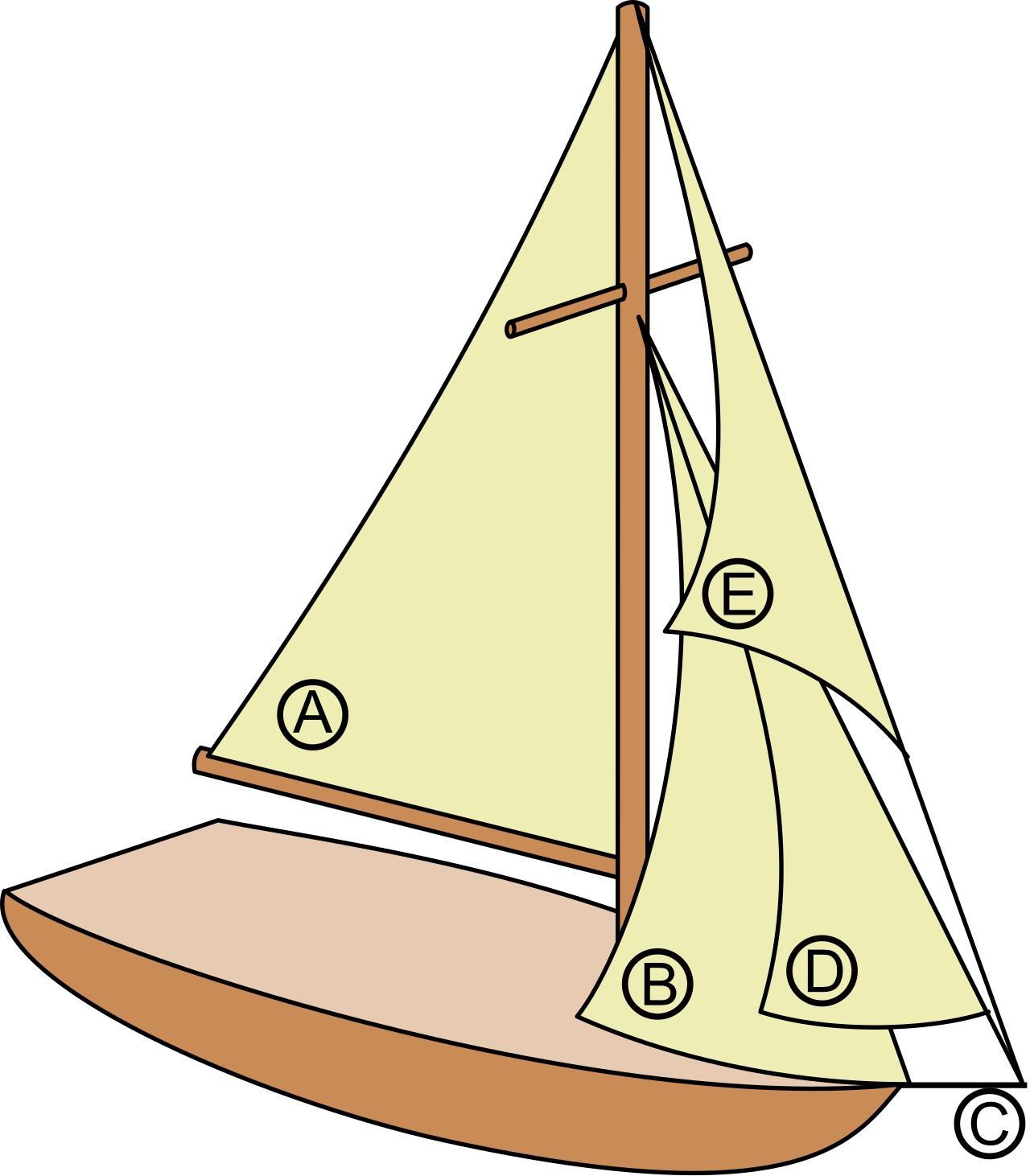
A typical cutter rigging: one mast bearing a fore-and-aft-rigged mainsail (A) and foresail (forestaysail) (B), a bowsprit (C), a jib (D), and a flying jib (E)
1. A sailing vessel defined by its rig. In European waters this is a single-masted fore and aft rig with two or more headsails In North American waters, the definition also considers whether or not the bowsprit is permanently fixed and also takes into account the position of the mast. A standing (permanently fixed) bowsprit and a forward mast position, but with two or more headsails would be classed as a sloop in the North American definition. A running bowsprit, a forestay (carrying a staysail) that is fixed to the stemhead, a jib that is set flying and a mast position that is more aft is a cutter.
2. A type of ship's boat powered by sail or oars, though more optimised for sail than many types of ship's boat.
3. A small- or medium-sized vessel used by governmental agencies or law enforcement in the exercise of official authority, such as harbor pilots' cutters, US Coast Guard cutters, and UK Border Agency cutters.
4. A type of decked sailing vessel originating in the early 18th century designed for speed. Many were used as small warships. Originally cutter referred only to a type of hull, but it came to refer to the rig, which was single-masted with both fore-and-aft and square sails. A cutter rig had very large sail areas available for use in light winds.
A surprise attack by small boats, often at night, against an anchored vessel in which the small-boat crews boarded and captured or destroyed the target vessel. Cutting out became a popular tactic in the latter part of the 18th century and saw extensive use during the Napoleonic Wars. Cutting out was still in use in the mid-19th century, in conflicts such as the Mexican-American War and American Civil War.
A type of light centerboard that is lifted vertically; sometimes in pairs, with the leeward one lowered when beating.
dan
dan-buoy
A temporary marker buoy consisting of a long pole with flag and/or light at the top and, lower down, a float and a ballast weight to make it float vertically. May be used with or without an anchor to attach it to the sea bed. In naval use often marks a swept channel created by minesweeping. In other uses may mark fishing equipment (nets or pots), an anchor, or, most commonly, is attached to a lifebuoy to throw into the sea to mark the position of a man overboard.[13][3]
A mine warfare vessel, usually a small trawler, fitted for laying dans. Danlayers served as a part of minesweeping flotillas during and immediately after World War II (1939–1945).
An unlighted fixed structure equipped with a dayboard for daytime identification.
day-blink
The moment at dawn where, from some point on the mast, a lookout can see above low-lying mist around the ship.
dayboard
The daytime identifier of an aid to navigation presenting one of several standard shapes (square, triangle, or rectangle) and colors (red, green, white, orange, yellow, or black).
day boat
1. A sailing boat without overnight accommodation, sometimes with a small cabin, used for pleasure sailing. Typically around 20 feet (6.1 m) in length[13]
2. (United States): a steamboat built for daytime service; as opposed to a night boat.
dead ahead
Exactly ahead; directly ahead; directly in front.
dead horse
Debt owed for advanced pay.[39] The "flogging a dead horse" ceremony at sea celebrated discharge of the debt.
dead in the water
Not moving (used only when a vessel is afloat and neither tied up nor anchored). The term is abbreviated to DIW by the US Navy. It is often used to indicate that a pirate or drug runner vessel has been immobilised.
A wooden block with three holes (but no pulleys) spliced to a shroud. It adjusts the tension in the standing rigging of large sailing vessels, by lacing through the holes with a lanyard to the deck. It performs the same job as a turnbuckle.[2]
A method of navigation that estimates a ship's position from the distance run measured by the log and the course steered. If corrections for factors such as tide and leeway are then made, this provides an estimated position.[57] Dead reckoning contrasts with fixing a position with astronomical navigation or satellite navigation. Some sources consider that a dead reckoning position does include adjustments for wind and tide, so care is needed in interpretation of this term.[58]
deadrise
The angle of the hull surface, relative to horizontal, as measured on either side of the keel on a line drawn towards the turn of the bilge. Without any other qualifier, it is taken at the midships cross-section of the hull. This can be expressed in degrees or sometimes as a vertical linear measure (such as inches) at a standard distance from the keel. A hull with a lot of deadrise has an obvious "V" shape to the bottom of the hull, whereas no deadrise denotes sheer sides and a flat-bottomed hull. It is usually taken to be one of several measures of the "sharpness" of a hull. It can also be referred to as the "rise of floor".[59]
deadwood
In a traditional wooden hull, blocks of timber on the top of the keel that form the shape of the hull where its section is too narrow for the method of construction employed elsewhere. It is often used forward of the sternpost.[26]
In a keel boat, the act of broaching to windward, putting the spinnaker pole into the water and causing a crash-gybe of the boom and mainsail, which sweep across the deck and plunge down into the water. During a death roll, the boat rolls from side to side, becoming gradually more unstable until either it capsizes or the skipper reacts correctly to prevent it.
The process of leaving a ship or aircraft, or removing goods from a ship or aircraft.
debunk
The process of removing fuel from a vessel. After a shipwreck, a "debunkering" operation will be performed in an effort to minimize damage and protect the environment from fuel spills.
1. The top of a ship or vessel; the surface that is removed to accommodate the seating area.
2. Any of the structures forming the approximately horizontal surfaces in the ship's general structure. Unlike flats, they are a structural part of the ship.
A gun mounted on the deck of a submarine for use in surface combat. Common on submarines of the first half of the 20th century, deck guns became obsolete as submarines became capable of sustained underwater operations after World War II.
deck hand
Also decky.
A person whose job involves aiding the deck supervisor in (un)mooring, anchoring, maintenance, and general evolutions on deck.
deck supervisor
The person in charge of all evolutions and maintenance on deck; sometimes split into two groups: forward deck supervisor and aft deck supervisor.
The underside of the deck above. The inside of the boat is normally paneled over to hide the structure, pipes, electrical wires. It can be in thin wood planks, often covered with a vinyl lining, or in thin PVC or now even in fiberglass planks.
deckhouse
A cabin that protrudes above a ship's deck.
decks awash
A situation in which the deck of the vessel is partially or wholly submerged, possibly as a result of excessive listing or a loss of buoyancy.
To formally take (a naval vessel) out of active service, after which the vessel is said to be out of commission or decommissioned. Sometimes used less formally to mean taking a commercial ship out of service.
A fee paid by a charter party to a shipowner if the time taken to load or unload a vessel exceeds the laytime – the amount of time stipulated for loading or unloading – specified in a voyage charter.
A ship that acts as a mobile or fixed base for other ships and submarines or that supports a naval base.
depth of hold
The distance between the underside of the main deck (or its supporting beams) and the top of the limber boards (the part of the ceiling that lies alongside the keelson), measured at the middle frame. It is one of the key measurements in working out the measurement tonnage in most systems.[26]
A fee paid by a shipowner to a charter party if the time taken to load or unload a vessel is less than the laytime – the amount of time stipulated for loading or unloading – specified in a voyage charter.
A type of fast and maneuverable small warship introduced in the 1890s to protect capital ships from torpedo boat attack, and since increased in size and capabilities to become a long-endurance warship intended to escort larger vessels in a fleet, convoy, or battle group and defend them against submarines, surface ships, aircraft, or missiles. Originally torpedo boat destroyer. In US Navy slang, also called a tin can or small boy.
A US Navy term for a smaller, lightly armed warship built in large numbers during World War II (and in smaller numbers thereafter), cheaper, slower, and less-well-armed than a destroyer but larger and more heavily armed than a corvette and designed to escort convoys of merchant ships or naval auxiliaries or second-line naval forces. Employed primarily for anti-submarine warfare, but also used to provide some protection against aircraft and smaller surface ships. Generally known as frigates in other navies, and designated as such in the US Navy as well by the 1970s.
A naval auxiliary ship designed to provide maintenance support to a flotilla of destroyers or other small warships. Known in British English as a destroyer depot ship.
devil seam
The devil was possibly a slang term for the garboard seam, hence "between the devil and the deep blue sea" being an allusion to keel hauling, but a more popular version seems to be the seam between the waterway and the stanchions, which would be difficult to get at, requiring a cranked caulking iron, and a restricted swing of the caulking mallet.
devil to pay
Also devil to pay, and no pitch hot.
"Paying" the devil is sealing the devil seam. It is a difficult and unpleasant job (with no resources) because of the shape of the seam (up against the stanchions) or if the devil refers to the garboard seam, it must be done with the ship slipped or careened.
A type of chain stopper often used to secure an anchor in its hawsepipe. Consists of a two-pronged hook that fits over a link of chain, a turnbuckle and a short chain fastened to a strong point.
The generic name of a number of traditional sailing vessels with one or more masts with lateen sails used in the Red Sea and Indian Ocean region, typically weighing 300 to 500 tons, with a long, thin hull. They are trading vessels primarily used to carry heavy items, like fruit, fresh water, or merchandise. Crews vary from about thirty to around twelve, depending on the size of the vessel.
diamonds
Glass prisms that were laid between the wooden deck planks to allow natural light below were referred to as diamonds due to the sparkle they gave off in the sunlight.
1. A type of small boat, often carried or towed as a ship's boat by a larger vessel.
2. A small racing yacht or recreational open sailing boat, often used for beginner training rather than sailing full-sized yachts.
3. Utility dinghies are usually rowboats or have an outboard motor, but some are rigged for sailing.
dipping the eye
Dipping the eye
A method of attaching more than one hawser to a single bollard, so that each can be lifted off without disturbing the other(s). The second hawser is passed under the first, then up through the eye of the first (hence the name), before being secured over the bollard.
A vessel ranging in size from a small boat to a large ship tasked to carry military dispatches from ship to ship, from ship to shore, or, occasionally, from shore to shore.
Also drogher, raft ship, timber drogher, or timber ship.
A barely seaworthy ship of the 19th century assembled from large timbers lashed or pegged together and designed to make a single voyage from North America to the United Kingdom and then to be disassembled so that her timbers could be sold, thus avoiding high British taxes on lumber imported as cargo. When British taxes on imported lumber fell, the construction of disposable ships ceased.
A flag flown to distinguish ships of one seagoing service of a given country from ships of the country's other seagoing service(s) when ships of more than one of the country's seagoing services fly the same ensign.
1. Especially in the late 19th and early 20th centuries, a permanent battle formation of a fleet, often smaller than a squadron, equipped and trained to operate as a tactical unit under the overall command of a higher command, such as a fleet or squadron.
2. Especially in modern usage, an administrative naval command, smaller than a squadron and often subordinate to an administrative squadron, responsible for the manning, training, supply, and maintenance of a group of ships or submarines but not for directing their operations at sea.[citation needed]
In British usage, a shore-based naval officer responsible for the efficient working of the transports and boats of the flotilla, division, or squadron under his charge.
1. In American usage, a fixed structure attached to shore to which a vessel is secured when in port, generally synonymous with pier and wharf, except that pier tends to refer to structures used for tying up commercial ships and to structures extending from shore for use in fishing, while dock refers more generally to facilities used for tying up ships or boats, including recreational craft.
2. In British usage, the body of water between two piers or wharves that accommodates vessels tied up at the piers or wharves.
A facility where ships or boats are built and repaired. Routinely used as a synonym for shipyard, although dockyard is sometimes associated more closely with a facility used for maintenance and basing activities, while shipyard sometimes is associated more closely with a facility used in construction.
dodger
A hood forward of a hatch or cockpit to protect the crew from wind and spray. Can be soft or hard.
A short watch period, generally half the usual time (e.g., a two-hour watch rather than a four-hour one). Such watches might be included in order to rotate the system over different days for fairness, or to allow both watches to eat their meals at approximately normal times.
doghouse
A slang term (in the US, mostly) for a raised portion of a ship's deck. A doghouse is usually added to improve headroom below or to shelter a hatch.
dogvane
A small weather vane, sometimes improvised with a scrap of cloth, yarn, or other light material mounted within sight of the helmsman. See tell-tale.
A structure consisting of a number of piles driven into the seabed or riverbed as a marker.
dolphin striker
A spar protruding vertically beneath a bowsprit, usually attached to the boswprit cap, used provide a mechanically advantageous run for the martingale stay, and other ropes of a ship's rigging.
A small auxiliary engine used either to start a larger engine or independently, e.g. for pumping water on steamships.[61]
donkeyman
One of a ship's engineering crew. Often a crewman responsible for maintaining a steam donkey, or any machinery other than the main engines. On some ships, the Petty Officer in charge of engineroom ratings.
A dorade box (also called a dorade vent, collector box, or simply a "ventilator") is a type of vent that permits the passage of air in and out of the cabin or engine room of a boat while keeping rain, spray, and sea wash out.
A shallow-draft, lightweight boat, about 5 to 7 metres (16 to 23 ft) long, with high sides, a flat bottom, and sharp bows. Traditionally used as fishing boats, both in coastal waters and in the open sea.
double-banked
(of the arrangement of oars on a boat) having two oarsmen seated on each thwart, each of whom operates one oar on their side of the boat. This contrasts with single-banked, where only one oarsman is seated on each thwart operating one oar on one side of the boat, with the oars alternating between port and starboard along the length of the boat. A third arrangement is to have one rower on each thwart working two oars, one on each side of the boat.[62]: 135
double-shotted
The practice of loading smoothbore cannon with two cannonballs.
doubling the angle on the bow
A technique for establishing the distance from a point on land, such as a headland that is being passed. This is a type of running bearing which requires no plotting on the chart. The ship is sailed on a constant course and speed. The distance shown on the log is noted when the relative bearing of a fixed point is taken, and the increase in that bearing is watched until it is twice the original bearing, and the log is read again. The distance travelled between the two bearings is the distance of the ship from the fixed point when the second bearing was taken. Allowances for tidal streams may or may not be allowed for, depending on the accuracy required.[63][64]
Dover cliffs
A slang term for very rough seas with large white-capped waves.
downbound
1. Travel downstream, with a following current.[65]
The entry of water through any opening into the hull or superstructure of an undamaged vessel, such as an open door or porthole, loose or open hatch, ventilator opening, etc. Downflooding can occur due to a ship's trim, if she heels or lists, or if she becomes totally or partially submerged.
One of a family of traditional paddled long boats of various designs and sizes found throughout Asia, Africa, and the Pacific islands. For competitive events, they are generally rigged with decorative Chinese dragon heads and tails. Dragon boat races are traditionally held during the annual summer solstice festival.
A type of battleship designed with an "all-big-gun" armament layout in which the ship's primary gun power resided in a primary battery of its largest guns intended for use at long range, with other gun armament limited to small weapons intended for close-range defense against torpedo boats and other small warships. Most, but not all, dreadnoughts also had steam turbine propulsion. Predominant from 1906, dreadnoughts differed from earlier steam battleships, retroactively dubbed predreadnoughts, which had only a few large guns, relied on an intermediate secondary battery used at shorter ranges for most of their offensive power, and had triple-expansion steam engines.
To string International Code of Signals flags, arranged at random, from stemhead to masthead, between mastheads (if the vessel has more than one mast), and then down to the taffrail, on a ship in harbor as a sign of celebration of a national, local, or personal anniversary, event, holiday, or occasion. When a ship is properly dressed overall, ensigns fly at each masthead unless displaced by another flag (e.g. that of a flag officer on board), in addition to the ensign flown in the usual position at the stern.
dressing down
1. Treating old sails with oil or wax to renew them.
2. A verbal reprimand.
dressing lines
Lines running from stemhead to masthead, between mastheads, and then down to the taffrail, to which flags are attached when a ship is dressed overall.
The fifth mast of a six-masted barquentine or gaff schooner. It is preceded by the jigger mast and followed by the spanker mast. The sixth mast of the only seven-masted vessel, the gaff schooner Thomas W. Lawson, was normally called the pusher-mast.
A device to slow a boat down in a storm so that it does not speed excessively down the slope of a wave and crash into the next one. It is generally constructed of heavy flexible material in the shape of a cone. See also sea anchor.
drudging
A technique of maintaining steerageway when going downstream with neither engine nor wind to sail. The vessel uses its anchor to draw itself head-to-stream, then lifts the anchor and drifts stern-first downstream, ferry gliding to maintain position within the stream. As steerage begins to reduce, the vessel anchors again and then repeats the whole procedure as required.
A narrow basin or vessel used for the construction, maintenance, and repair of ships, boats, and other watercraft that can be flooded to allow a load to be floated in, then drained to allow that load to come to rest on a dry platform.
drying harbour
Also drying mooring.
A harbour where the water wholly or partly recedes as the tide goes out, leaving any vessel moored there aground.
dunnage
1. Loose packing material used to protect a ship's cargo from damage during transport. See also fardage.
Any of several types of traditional flat-bottomed shoal-draught sailing barge, originally used for carrying cargo in the Zuyder Zee and on the rivers of the Netherlands.
Dutch built
Term of abuse implying shoddiness or (when directed at a person) stupidity or stubbornness, usually embellished with other oaths and insults tagged on fore and aft.
A condition in which a sailing vessel (especially one that sails poorly to windward) is confined between two capes or headlands by a wind blowing directly onshore.
en echelon
Diagram showing the Minas Geraes-class battleship with its central guns arranged en echelon.
An arrangement of gun turrets whereby the turret on one side of the ship is placed further aft than the one on the other side, so that both turrets can fire to either side.
One of the machinery spaces of a vessel, usually the largest one, containing the ship's prime mover (usually a diesel or steam engine or a gas or steam turbine). Larger vessels may have more than one engine room.
ensign
1. (flag) The principal flag or banner flown by a ship to indicate her nationality.
A type of aircraft carrier, smaller and slower than a fleet carrier, used by some navies in World War II to escort convoys, ferry aircraft, and provide air support for amphibious operations.
estimated position
An approximate geographical position obtained by making allowances for leeway, tide, and currents to a dead reckoning position (which is calculated from the distance run and the course steered).
A piece of ship's equipment used to produce fresh drinking water from sea water by distillation.
executive officer
The officer second in command on a warship. Also called "X.O." in the United States and "Number One" in the Royal Navy and Commonwealth navies.
extra ship
A term used by the British East India Company from the seventeenth to the nineteenth century for merchant ships it hired to make voyages for it between England (later the United Kingdom) and ports east of the Cape of Good Hope, a trade over which the company held a strict monopoly. "Extra ships" were chartered for a single round-trip voyage beginning during a single sailing season (September to April) and augmented the voyages of "regular ships", which were merchant ships under long-term charter to make repeated voyages for the company over many seasons. However, if an "extra ship" operated well and the company needed its services, the company often chartered it repeatedly over a number of seasons.[44]
extremis
Also in extremis.
The point under International Rules of the Road (Navigation Rules) at which the privileged (or stand-on) vessel on collision course with a burdened (or give-way) vessel determines it must maneuver to avoid a collision. Prior to extremis, the privileged vessel must maintain course and speed and the burdened vessel must maneuver to avoid collision.
A closed loop or eye at the end of a line, rope, cable, etc. It is made by unraveling its end and joining it to itself by intertwining it into the lay of the line. Eye splices are very strong and compact and are frequently employed in moorings and docking lines, among other uses.
A large oceangoing vessel with extensive on-board facilities for processing and freezing caught fish or whales. Some also serve as mother ships for smaller fishing or whaling vessels. Those used for processing fish are also known as fish processing vessels.
fair
1. A smooth curve, usually referring to a line of the hull with minimum localised deviations.
2. To make something flush.
3. A line is fair when it has a clear run.
4. A wind or current is fair when it offers an advantage to a boat.
fair winds and following seas
A blessing wishing the recipient a safe journey and good fortune.
1. A navigable channel (e.g. in a harbor or offshore) that is the usual course taken by vessels in the area.
2. In military and naval terms, a channel from offshore, in a river, or in a harbor that has enough depth to accommodate the draft of large vessels.
fake
A single turn of rope in a coil or on a drum. A group of fakes is known as a tier. See also fake down.[13][3][38]: 200, 286
fake down
To lay a coil of rope down so that it will run easily; that is, with rope feeding off the top of the coil and the bitter end at the bottom. Often confused with flake. See also range.[3]
Also bear down, bear away, bear off, or head down.
To change the direction of sail so as to point in a direction that is more downwind; to bring the bow leeward. This is the opposite of pointing up or heading up.
fantail
The aft end of a ship, also known as the poop deck.
fardage
Wood placed in the bottom of a ship to keep cargo dry. See also dunnage.
fashion boards
Loose boards that slide in grooves to close off a companionway or cabin entrance.[2]
fast
Fastened or held firmly (e.g. "fast aground": stuck on the seabed; or "made fast": tied securely).[2]
A small, fast, agile warship armed with anti-ship missiles, guns, or torpedoes. The fast attack craft replaced the torpedo boat during the second half of the 20th century in the role of a cheap, offensively-oriented inshore warship.
The largest type of US Navy combat logistics ship, designed to serve as a combined oiler, ammunition ship, and supply ship. The first fast combat support ship entered service in the mid-1960s.
1. A unit of length equal to 6 feet (1.8 m), roughly measured as the distance between a man's outstretched hands. Particularly used in sounding as a measurement of the depth of a body of water.
2. To measure the depth of water; to engage in sounding.
fathomer
A person engaged in sounding to determine the depth of water.
A traditional wooden sailing boat with a rig consisting of one or two lateen sails, used in protected waters of the Red Sea and eastern Mediterranean and particularly along the Nile in Egypt and Sudan, as well as in Iraq.
fend off
A command given to the crew to stop what they are now doing and to immediately manually prevent the boat from banging into the docks or other boats.
A merchant ship used to carry passengers, and sometimes vehicles and cargo, across a body of water.
ferry glide
To hold a vessel against and at an angle to the current/stream such that the vessel moves sideways over the bottom due to the effect of the current operating on the upstream side of the vessel.
the vertical space above a vessel's engine room extending into its stack, usually covered by an iron grating. Also applied to the framework around the opening itself
A sailing boat with two masts with a standard rig consisting of a main dipping lug sail and a mizzen standing lug sail. Developed in Scotland and used for commercial fishing from the 1850s until the 20th century.
fig
US Navy slang for a guided-missile frigate, especially of the Oliver Hazard Perry class, derived from its class designation ("FFG").
fight his ship
To fight his ship (or to fight her ship) is a naval term that denotes a captain taking his or her vessel into combat or directing his or her vessel in combat.
fighting top
An enlarged top designed to allow gunfire downward onto an enemy ship. A fighting top could have small guns installed in it or could serve as a platform for snipers armed with muskets or rifles.
A symbolic image, particularly a carved effigy, at the head of a traditional sailing ship or early steamer.
fin
A term used in European and Commonwealth countries for a tower-like structure on the dorsal (topside) surface of a submarine; called a sail in the United States.
fine
Narrow in appearance from the vantage point of a lookout or other person viewing activity in the vicinity of a ship, e.g. another ship off the starboard bow with her bow or stern facing the viewer's ship could be described as "fine on the starboard bow" of the viewer's ship.
fine lines
Descriptive term for a vessel with a hull shape designed for an efficient flow of water around the hull. Simply described by comparing the hull shape to a rectangular cuboid with the same length, breadth and height as the submerged part of the hull. The more that you have to carve off that cuboid to get the hull's shape, the finer the lines. More accurately this is measured as the block coefficient or the prismatic coefficient.
A ship loaded with flammable materials and explosives and sailed into an enemy port or fleet either already burning or ready to be set alight by its crew (who would then abandon it) in order to collide with and set fire to enemy ships.
The classification for the largest sailing warships of the 17th through the 19th centuries. Such vessels often had up to three masts, 850+ crew, and 100+ guns.
1. In the Royal Navy, the senior lieutenant on board; responsible to the commanding officer for the domestic affairs of the ship's company. Also known as 'Jimmy the One' or 'Number One'. Removes his cap when visiting the mess decks as a token of respect for the privacy of the crew in those quarters. Officer in charge of cables on the forecastle.
2. In the US Navy, the officer on a ship serving as the senior person in charge of all deck hands.
A sailing tactic for handling winds too strong for the sail area hoisted when reefing the sails is not feasible or possible. The headsail is set normally while the mainsail is let out until it is constantly luffing. This creates a loss of force on the main and also reduces the efficiency of the headsail while still retaining sailing control of the vessel.
fisherman's sail
On a staysailschooner, the fisherman is a quadrilateral sail set between the two masts above the main staysail. It is used in light to moderate airs.
The period after a ship is launched during which all the remaining construction of the ship is completed and she is readied for sea trials and delivery to her owners.
fixed propeller
A propeller mounted on a rigid shaft protruding from the hull of a vessel, usually driven by an inboard motor; steering must be done using a rudder. See also outboard motor and sterndrive.
The business practice of registering a merchant ship in a sovereign state different from that of the ship's owners, and flying that state's civil ensign on the ship. The practice allows the ship's owner to reduce operating costs or avoid the regulations of the owner's country.
1. A commissioned officer senior enough to be entitled to fly a flag to mark the ship or installation under their command, in English-speaking countries usually referring to the senior officers of a navy, specifically to those who hold any of the admiral ranks and in some cases to those holding the rank of commodore. In modern American usage, additionally applied to US Coast Guard and National Oceanic and Atmospheric Administration Commissioned Corps officers and general officers in the US Army, US Air Force, and US Marine Corps entitled to fly their own flags.
2. A formal rank in the mid-19th century US Navy, conveyed temporarily upon senior captains in command of squadrons of ships, soon rendered obsolete by the creation of the ranks of commodore and rear admiral.
1. A vessel used by the commanding officer of a group of naval ships. The term derives from the custom of commanders of such a group of ships, characteristically a flag officer, flying a distinguishing flag aboard the ship on which they are embarked.
2. Used more loosely, the lead ship in a fleet of naval or commercial vessels, typically the first, largest, fastest, most heavily armed, or, in terms of media coverage, best-known.
flake
To set down in folds, as in stowing a sail or to range a cable on deck so that it is clear to run. Not to be confused with fake down.[13]
A rectangular, flat-bottomed boat with square ends used to transport freight and passengers on inland waterways in the United States during the 18th and 19th centuries.
flattop
A slang term for an aircraft carrier.
fleet
1. Naval fleet: The highest operational echelon of command of ships commanded by a single person in a navy, and typically the largest type of naval formation commanded by a single person. In modern times, usually (but not necessarily) a permanent formation.
2. During the Age of Sail, a Royal Navy term for any naval command larger than a squadron in size, or commanded by a rear admiral and composed of five ships-of-the-line and any number of smaller vessels.
4. Fishing fleet: A term for an aggregate of commercial fishing vessels, commonly used either to describe all fishing vessels belonging to a single country, operating in a single region, operating out of a particular port, or engaged in particular type of fishing (e.g., the tuna fishing fleet). The term does not imply that the vessels operate as part of a single organization.
5. Informally, any grouping (based on physical proximity or sharing of a common organizational subordination) of naval or civilian vessels.
6. Of a person, to move from one location to another aboard a vessel, or to change positions within a naval organization.
7. To move up a rope – especially when drawing the blocks of a tackle part – to allow a greater advantage in hauling.
8. To cause a rope or chain to slip down the barrel of a capstan or windlass.
9. A former term for the process aboard a vessel of moving deadeyes when the shrouds become too long.
A naval force that extends a controlling influence on maritime operations without ever leaving port by forcing an opposing navy to maintain forces on station to blockade it in port and oppose it if it comes out to fight. A navy which operates its forces as a fleet in being generally seeks to avoid actual combat with an enemy fleet for fear of losing a naval battle and thereby its ability to influence events and activities at sea.[68]
flemish
To coil a line that is not in use so that it lies flat on the deck.
flettner rotor
A spinning cylinder that uses the Magnus effect to harness wind power to propel a ship.
A flat deck on an aircraft carrier used for the launch and recovery of aircraft. In the United States Navy, the term flight deck also refers to a helicopter deck on other types of ships.
flog the glass
The act of vibrating or shaking a half-hour marine sandglass — used until the early 19th century to time the length of a watch — to speed the passage of the sand in order to get off watch duty earlier.[69]
floor
Transverse structural timbers which form that part of the lower frame of a traditional wooden ship's hull that sits immediately above the keel. The frames continue upwards as pieces called futtocks. A keelson is usually fastened over the top of the floors.[70]
floorhead
Any of the upper extremities of the floor of a vessel.
1. In naval usage, a group of warships under a single commander that is smaller than a fleet but otherwise not formally defined. A flotilla often is larger than a squadron, and usually is made up of smaller vessels than those assigned to a squadron, but some flotillas are smaller than squadrons and some include larger vessels. In some navies, the term flotilla is reserved for naval formations that operate on inland bodies of water, while the terms fleet and squadron denote naval formations that operate at sea. A flotilla may be a permanent or temporary formation. In modern times, a flotilla sometimes is an administrative naval unit responsible for maintaining and supporting vessels but not for commanding their operations at sea.
2. Informally, a group of naval or civilian vessels operating together or in close proximity to one another.
flotilla holiday
A group of chartered yachts that set out together on the same route.
A warship suitable for commanding a flotilla of destroyers or other small warships, typically a small cruiser or a large destroyer, in the latter case known as a destroyer leader.
A Dutch transoceanic sailing cargo vessel, square-rigged with two or three masts that were much taller than the masts of a galleon, developed in the 16th century and widely used in the 17th and 18th centuries.
fly by night
A large sail used only for sailing downwind, requiring little attention.
Waves going in the same direction as a ship, or within 15° of the heading, at a speed slower than the ship. See overtaking sea for waves travelling faster than the ship.[22]
foo-foo band
An impromptu musical band on late 19th-century sailing vessels, made up from members of the ship's crew.[71][72]
A sailing rig consisting mainly of sails that are set along the line of the keel rather than perpendicular to it. Such sails, and the vessel itself, are said to be fore-and-aft-rigged.
fore-and-afters
Removable wooded beams running along the centre of the hold openings, beneath the hatches that they support.[2]
fore horse
A transverse wooden or iron beam afore the main mast to which the foresail sheet is attached.[2]
(pronounced /ˈfoʊksəl/) A partial deck above the upper deck and at the head of the vessel; traditionally the location of the sailors' living quarters. The name is derived from the castle fitted to bear archers in time of war.[2]
foredeck
The portion of the deck that is forward of the forward mast.
1. Having freedom of motion interfered with by collision or entanglement; entangled; the opposite of clear. For instance, a rope is foul when it does not run straight or smoothly, and an anchor is foul when it is caught on an obstruction.
2. A ship's bottom is foul when it is overgrown with marine life such as barnacles.
3. An area of water treacherous to navigation due to many shallow obstructions such as reefs, sandbars, rocks, etc.
4. A breach of racing rules.
5. Foul the range: To block another vessel from firing her guns at a target.
foulies
A slang term for oilskins, the foul-weather clothing worn by sailors.
In the British Royal Navy during the first half of the 18th century, a ship-of-the-line mounting between 46 and 60 guns.
frame
A transverse structural member that gives the hull strength and shape. Wooden frames may be sawn, bent, or laminated into shape; planking is then fastened to the frames. In traditional wooden ship building, an individual frame may be made of the following individual parts: floor, several futtocks, then a top timber as the last component closest to the deck. If the hull is built frame-first, these frame components are fastened to each other. In a planking-first construction, they may only be fastened to the hull planking.[73]
The height of a ship's hull (excluding the superstructure) above the waterline; the vertical distance from the current waterline to the lowest point on the highest continuous watertight deck. This usually varies from one part to another.
1. In the 17th century, any warship built for speed and maneuverability.
2. In the 18th and early 19th centuries, a sailing warship with a single continuous gun deck, typically used for patrolling, blockading, etc., but not in line of battle.
3. In the second half of the 19th century, a type of warship combining sail and steam propulsion, typically of ironclad timber construction, with all guns on one deck.
4. In the 20th and 21st centuries, a warship, smaller than a destroyer, originally introduced during World War II as an anti-submarine vessel but now general-purpose.
Sailing into the wind (by), but not as close-hauled as might be possible, so as to make sure the sails are kept full. This provides a margin for error to avoid being taken aback in a tricky sea (a serious risk for square-rigged vessels). Figuratively it implies getting on with the job but in a steady, relaxed way, without undue urgency or strain.
Strong westerly winds found in the Southern Hemisphere, generally between the latitudes of 50 and 60 degrees. They are stronger than the similar "Roaring Forties" to their north.
furl
To roll or gather a sail against its mast or spar.[67]
furnace
Boiler component where fuel is burned.
furring
A method of improving the stability of a wooden vessel by increasing the breadth of the hull. The planking is removed and pieces of wood are added to the outside of the frames. Then the planking is replaced. An increase in breadth of about 1 foot (300 mm) could typically be achieved on each side. This was a common remedial technique at a time before shipwrights were able to carry out mathematical stability calculations.[42]: ch 6 the Gresham Ship
A narrow, light, and fast ship with a shallow draft, powered both by oars and sail, with a single mast carrying a lateen sail; a favorite of North African corsairs during the 16th and 17th centuries.
Rope, wire, or chain links in the rigging of a traditional square-rigged ship running from the outer edges of a top downwards and inwards to a point on the mast or lower shrouds. They carry the load of the shrouds that rise from the edge of the top, preventing the top from tilting relative to the mast.[67]
futtock
The part of a ship's frame that continues the structure above the floors. These often exist as individual pieces termed first futtock, second futtock and third futtock, numbered moving away from the keel.[73]
The typical Scottish sailing barge or lighter of the 17th through 19th centuries, used mainly on inland waterways and especially on the River Clyde. A gabbart was a long, narrow, flat, single-masted vessel with a hatchway that extendied almost the full length of her deck, and some gabbarts had a mast that could be lowered to allow them to pass under bridges. Most later Scottish canal craft had their design origins in that of the gabbart.
gaff
1. (gaff rig) A spar that holds the upper edge of a four-sided fore-and-aft-mounted sail. On a hoisting gaff, the lower end is supported by gaff jaws which partly encircle the mast; it is hoisted using peak and throat halliards. A standing gaff remains aloft, its sails brailed when not in use.[67]
2. (fishing gaff) A hook on a long pole used to haul in fish.
A boat rigged with a four-sided fore-and-aft sail set abaft the mast, its head being spread by a gaff. The gaff may be standing (permanently in position) with the sail being brailed up to the gaff when not in use, or, more commonly, is hoisted using two halliards: the peak and the throat.[67]
gaff topsail
A fore-and-aft sail set above a gaff-rigged sail, with the clew sheeted to the end of the gaff.[67]
gaff vang
A line rigged to the end of a gaff and used to adjust a gaff sail's trim.
Illustration of a typical 15th-century galleon
A large, multi-decked sailing ship with a prominent, squared-off, raised stern, generally carrying three or more masts, typically lateen fore-and-aft-rigged on the rear mast and square-rigged on the mainmast and foremast. Galleons were used primarily as armed cargo carriers and sometimes as warships by European states from the 16th to the 18th centuries.
galley
1. (galley (kitchen)) The compartment of a ship where food is cooked or prepared; a ship's kitchen.
2. (galley) A type of ship propelled by oars, used especially in the Mediterranean for warfare, piracy, and trade from the 8th century BC to the 16th century AD, with some in use until the early 19th century.
3. A type of oared gunboat built by the United States in the late 18th century, akin to a brigantine but termed "galley" for administrative and funding purposes.
A meeting of two (or more) whaling ships at sea. The ships each send out a boat to the other, and the two captains meet on one ship, while the two chief mates meet on the other.[74]
gammon iron
The bow fitting that clamps the bowsprit to the stem.[67]
gangplank
Also brow.
A movable bridge used in boarding or leaving a ship at a pier.
gangway
An opening in the bulwark of a ship to allow passengers to board or leave the ship.
gantline
A rope running through a block at or near the masthead, with both ends reaching the deck. It is used solely for hoisting and lowering crew members and/or tools into the rigging for maintenance and repair work.
garbling
The illegal practice of mixing cargo with garbage.
garboard
The strake closest to the keel (from Dutch gaarboard).
garboard planks
The planks immediately on either side of the keel.
gash
Any refuse or rubbish discarded into a refuse container or dustbin, also known as "gash fanny" (South African Navy).
gasket
A rope used to secure a sail (particularly the topsail) when stowed.[2]
Any of several types of galley-like ships from the Nusantara archipelago in Southeast Asia. The term refers both to Mediterranean vessels built by local people and to native vessels with Mediterranean influence.
ghost
To sail slowly when there is apparently no wind.
ghost fleet
In the modern United States, an informal term for a reserve fleet.
A type of open boat designed primarily for propulsion under oar, but often fitted with a sailing rig for appropriate conditions. Used most often for the swift transport of one or a few people, as in a pilot gig or as a naval ship's boat. In US Navy usage, a captain's gig is reserved for use by a ship's captain and, in modern times, is a power-boat.
A fishing vessel that employs gillnetting as its means of catching fish.
gin-pole
Also jin-pole.
A pole that is attached perpendicular to a mast, to be used as a lever for raising the mast.
girt
1. Said of a vessel moored by cables to two anchors in such a way that the force of a current or tide causes her to swing against one of the cables.
2. To capsize because of forces exerted on a cable by another vessel attached to it. Tug girting specifically refers to girting that causes a tugboat to capsize because of forces placed on a cable attached to her by another vessel attached to the same cable.
give-way
In a situation where two vessels are approaching one another so as to involve a risk of collision, the vessel directed to keep out of the way of the other.
glass
1. A marine barometer. Older barometers used mercury-filled glass tubes to measure and indicate barometric pressure.
A satellite-based radionavigation system providing continuous worldwide coverage of geolocation and time information to air, marine, and land users wherever there is an unobstructed line of sight to at least four GPS satellites developed and operated by the United States Department of Defense but publicly available for use by anyone with an enabled GPS receiver.
A small, fast boat designed with a long narrow platform and a planing hull to enable it to reach high speeds. Colloquially equivalent to a "rum-runner" or a "cigarette boat".
(of a fore-and-aft-rigged vessel) Sailing directly away from the wind, with the sails set on opposite sides of the vessel (e.g. with the mainsail to port and the jib to starboard) so as to maximize the amount of canvas exposed to the wind. See also running.
Small balls of lead fired from a cannon, analogous to shotgun shot but on a larger scale; similar to canister shot but with larger individual shot. Intended specifically to injure personnel and damage rigging more than to cause structural damage.
A narrow basin, usually made of earthen berms and concrete, closed by gates or by a caisson, into which a vessel may be floated and the water pumped out, leaving the vessel supported on blocks; the classic form of drydock.
The practice of navigating a vessel along the arc of a great circle. Such routes yield the shortest possible distance between any given pair of points on the surface of the Earth.
green-to-green
A passage of two vessels moving in the opposite direction on their starboard sides, so called because the green navigation light on one of the vessels faces the green light on the other vessel.
A British term used in the 18th and 19th centuries for any whaling ship operating in the Arctic Ocean or northern waters near the Arctic.
green water
1. That portion of the ocean lying generally within a few hundred nautical miles of shore but beyond the edge of the continental shelf, and thus between "brown water" over the continental shelf and "blue water" farther out to sea.
2. A large amount of water on or passing over or across a ship's deck or superstructure after a large wave strikes her, e.g., The ship took green water over her bow during the storm.
green-water navy
A navy capable of sustained operations beyond coastal areas out to a few hundred nautical miles from shore, i.e., in "green water," but not farther into the open ocean, i.e., in "blue water." While a green-water navy can possess ships capable of operating farther out to sea than in "green water," it requires logistical support from foreign countries to sustain such longer-range operations.
gridiron
A large metal cross-frame on which vessels are placed at high water for examination, cleaning, and repairs after the tide falls.
gripe
A temporary eye in a line (rope).
griping
The tendency of a ship to turn into the wind despite the efforts of the helmsman, usually due to either the design of a ship or more commonly the incorrect distribution of weight on and within the hull.
Watered-down pusser's rum consisting of half a gill with an equal part of water, issued to all seamen over twenty (CPOs and POs were issued with neat rum). From the British Admiral Vernon who, in 1740, ordered the men's ration of rum to be watered down. He was called "Old Grogram" because he often wore a grogram coat, and the watered rum came to be called grog. Specific quantities of grog were often traded illegally as a form of currency; a sailor might repay a colleague for a favour by giving him part or all of his grog ration, ranging from "sippers" (a small amount) via "gulpers" (a larger quantity) to "grounders" (the entire tot). Additional issues of grog were made on the command "splice the mainbrace" for celebrations or as a reward for performing especially onerous duties. The Royal Navy discontinued the practice of issuing rum in 1970.
The bed of the sea; the underwater surface or sea floor to which an anchor holds.
grounding
When a ship (while afloat) touches the bed of the sea, or runs aground. A moored vessel that grounds as the tide goes out is said to "take the ground".
groundway
Also ground way.
A substantial foundation of wood or stone for the blocks on which a vessel is built, typically lying on either side of the keel of a ship under construction, which also serves to support and guide the blocks when they slide to carry the vessel into the water when she is launched.
growler
A small iceberg or ice floe barely visible above the surface of the water.
Guineaman
Another name for a slave ship, coined after the emergence of the transatlantic slave trade from Africa in the 15th century.
guards
Also paddle guards and wheel guards.
1. (on an oceangoing sidewheel steamship) Horizontal structures, usually of wood, built around the paddle boxes just above their lowest point and extending a short distance forward and aft, designed to protect them from damage and to provide additional support for the paddle shaft.[75]
2. (on an American sidewheel steamboat) Extensions of the main deck beyond the hull to the outer extremity of the paddle boxes, and tapering to the bow and stern (thus giving the deck a characteristic oval shape), to increase the available deck space for passengers, cargo, and/or machinery.[75]
1. Any vessel that makes the rounds of a fleet at anchor to see that due watch is kept at night.
2. A warship stationed at a port or harbour to act as a guard there.
3. In former times in the British Royal Navy, a ship that received men impressed for naval service, often the flagship of the admiral commanding along the coast.
4. In Soviet and Russian terminology, a guard ship (storozhevoj korabl') is a small, general-purpose patrol or escort vessel.
1. Up through the 19th century, a deck aboard a ship that was primarily used for the mounting of cannon to be fired in broadsides.
2. On smaller vessels (of frigate size or smaller) up through the 19th century, the completely covered level under the upper deck, though in such smaller ships it carried none of the ship's guns.
3. On marine seismic survey vessels, the lowest deck on the ship, which carries the seismic source arrays, consisting of air guns arranged in clusters.
4. In naval slang, to fabricate or falsify something; in modern usage, meaning especially to falsify documentation in order to avoid doing work or make present conditions seem acceptable without having made a real effort to improve them.
A type of flat-bottomed sailing barge with a single large lateen sail brailed to a heavy yard, used on rivers in Maine and New Hampshire from the mid-17th century to the early 20th century. Sometimes referred to as a gondola in period accounts.[76]
gunner's daughter
See kissing the gunner's daughter.
gunport
An opening in the side of a ship or in a turret through which a gun fires or protrudes.
A fore-and-aft sail set abaft (behind) the mast, approximately triangular in shape, with the top half of the luff (front) of the sail attached to a yard which extends the sail above the top of the mast. The yard is raised and lowered with the sail.[13] This traditional sail is popular in small boats and produces aerodynamic performance close to that of the highly developed Bermuda rig.[77]
Generally, the upper edge of the hull; more specifically, in an open (undecked) boat of timber construction, the longitudinal stringer that connects the top of the ribs.[13][78]
gurdy
A mechanical crank used to set and retrieve fishing lines.
guy
1. A rope or stay leading to the side of the vessel.[67]
To change from one tack to the other away from the wind, with the stern of the vessel turning through the wind. See also going about and wearing ship.[2]
gypsy winch
A type or component of an anchor winch. The "gypsy" or "gypsy wheel" engages the anchor chain.
Canvas sheets, slung from the deckhead in messdecks, in which seamen slept. "Lash up and stow" was a piped command to tie up hammocks and stow them (typically) in racks inboard of the ship's side so as to protect the crew from splinters from shot and provide a ready means of preventing flooding caused by damage.
hamper
Articles that normally are indispensable aboard ship but at certain times are in the way.
A ship using coal-fired boilers shoveled in by hand.
hand over fist
To climb steadily upwards, from the motion of a sailor climbing shrouds on a sailing ship (originally "hand over hand").
handsomely
With a slow even motion, as when hauling on a line "handsomely".
handy billy
A loose block and tackle with a hook or tail on each end, which can be used wherever it is needed. Usually made up of one single and one double block.
hangar deck
An enclosed deck on an aircraft carrier, usually beneath the flight deck and intended for use as a hangar in servicing and storing aircraft.
hank
A fastener attached to the luff of the headsail that attaches the headsail to the forestay. Typical designs include a bronze or plastic hook with a spring-operated gate, or a strip of cloth webbing with a snap fastener.[79]
The fees charged by the owners or operators of a harbour to those vessels using the harbour. Under British legislation, the person in charge of a vessel must report to the harbourmaster within 24 hours of arrival in a port where harbour dues are payable.[13][3]
A person in charge of a harbour, with powers including the collection of the harbour dues, instructing the masters of vessels where to moor, and overall safety within the area of the harbour, often including pilotage and navigational aids. In most countries the powers of a harbour master are laid down by legislation, and can be quite extensive.[13][3]
hard
A section of otherwise muddy shoreline suitable for mooring or hauling out.
hard-a-lee
See lee-oh.
harden in
To haul in the sheet and tighten the sails.[2]
harden up
To turn towards the wind; to sail closer to the wind.
harness cask
Also harness tub.
A large, usually round tub lashed to a vessel's deck and containing dried and salted provisions for daily use.
The shaft or hole in the side of a vessel's bow through which the anchor chain passes. "In through the hawsepipe" describes someone with experience and savvy.[39]
An informal term for an officer of a merchant ship who began their career as an unlicensed merchant seaman, and so did not attend a traditional maritime academy to earn their officer's licence. See also before the mast.
1. The forwardmost or uppermost portion of the ship.
2. The forwardmost or uppermost portion of any individual part of the ship, e.g. masthead, beakhead, stemhead, etc.
3. The top edge of a sail.[2]
4. The toilet or latrine of a vessel, which in sailing ships usually projected from the bow and therefore was located in the "head" of the vessel.
head boat
A fishing boat that takes recreational fishermen out for a fee paid individually by each person (i.e. per head). A head boat differs from a charter boat, which is a fishing boat that a party of fishermen hires for an agreed-upon period.
The farthest point above the mouth of a river that can be navigated by ships.
head rail
A curved rail that extends from the figurehead to the bow of a ship.
head rope
1. The mooring rope that goes from the bow of a vessel to a point on a jetty a distance ahead of the bows.[3]
2. Part of the bolt rope, at the head of a sail, running from the mast to the sprit.[2]
head sea
A sea in which waves are directly opposing the motion of the ship, or approaching within 15° of ahead.[22]
head-sail
1. Jibs and staysails set between the bowsprit and the fore[79]
2. Sometimes refers to the square sails on the fore-mast of a square rigged vessel.[79]
head-stays
Stays between the bowsprit and the foremost mast.
[79]
header
A change in the wind direction that forces the helmsman of a close-hauled sailboat to steer away from its current course to a less favorable one. This is the opposite of a lift.
Any sail set in front of the most forward mast. A sailing vessel may have one or more headsails. A headsail may be hanked to a stay, or may be set flying, with the luff being kept taut by the tension of the halyard. Where several headsails are set, a complex arrangement might be termed (from the front and top) flying jib, outer jib, inner jib, and (fore) staysail; less complex would be jib and staysail[80]
A combination of high winds and rough seas that may be dangerous for a ship or boat, sometimes requiring changes to a passage plan (such as a precautionary diversion to a safe harbour), heaving to, running under bare poles, or other similar survival strategies.
1. The lean caused by the wind's force on the sails of a sailing vessel.
2. The inclination or canting of a vessel to one side or the other from the vertical as she maneuvers, e.g. "The ship heeled to port as she turned to starboard".
3. The lowest or last part of something, such as the heel of the mast or the heel of the vessel.
helicopter deck
A helicopter pad on the deck of a ship. In the United States Navy, a helicopter deck is referred to as a flight deck.
A type of seagoing fishing vessel used by Dutch and Flemish herring fishermen from the 15th through the early 19th century.
highfield lever
A type of tensioning lever, usually for running backstays. Their use allows the leeward backstay to be completely slackened so that the boom can be let fully out.
A knot used to tie a rope or line to a fixed object. See also bend.[2]
hobby horsing
Harmonic pitching of a vessel forward and backward.
hog
1. A fore-and-aft structural member of the hull fitted over the keel to provide a fixing for the garboard planks.
2. A rough, flat scrubbing brush for cleaning a ship's bottom under water.
3. A semi-permanent bend in a ship's keel, especially in wooden-hulled ships, caused over time by the ship's center being more buoyant than her bow or stern.
hog frame
A heavy wooden truss fitted lengthwise along each side of a large American steamboat, secured to the hull and rising above deck just outside the superstructure, to provide support for the hull and prevent hogging. Similar in appearance and function to a truss bridge. See also king post.
1. A condition in which the hull of a vessel bends upward such that the ends of the keel are lower than the middle. Hogging can occur when the peak of a wave is amidships or during loading or unloading of a vessel and can damage her or even break her in half. Contrast sagging.
2. A permanent distortion of the hull in the same manner as above, caused over time by the bow and stern of a ship being less buoyant than the midships section. During the Age of Sail, shipwrights employed a number of different designs of braces to stiffen ships' hulls against this warping.
hogging line
A line passed under a ship from side to side to pull a collision mat into place over a leak.[81] Also a line passed under a ship from side to side used as a reference to indicate position of a frame during underwater inspections.[82]
hoist
The height of a fore-and-aft-rigged sail as measured next to the mast or stay.
The lower part of the interior of a ship's hull, especially when considered as storage space, as for cargo. In earlier use, the term referred to all interior spaces below the orlop deck; in later merchant vessels it extended up through the decks to the underside of the weather deck.
holiday
A gap in the coverage of newly applied paint, slush, tar, or another preservative.
A chunk of sandstone used to scrub a ship's decks. The name comes from both the kneeling position sailors adopt to scrub the deck (reminiscent of genuflection for prayer), and the stone itself (which resembled a Bible in shape and size).
The port at which a vessel is based. Often confused with the ship's port of registry, which is the port listed in the vessel's registration documents and lettered on her stern but which may differ from her home port. In the cruise ship industry, the term "home port" is often incorrectly used to refer to a ship's port of departure.
homeward bounder
A slang term for a sail repair, especially one done with large herringbone stitches.[2]
honey barge
Slang term for a vessel that transports sewage.
hoop
Wooden or metal hoops used to secure the topsail to the topmast so it can be speedily raised or lowered.[2]
horn
A sound signal that uses electricity or compressed air to vibrate a disc diaphragm.
Shaped ends to the chocks where the main horse is bolted.[2]
horn timber
A fore-and-aft structural member of the hull sloping up and backwards from the keel to support the counter.
horse
1. A metal bar (sometimes a shaped aluminium extrusion), running athwartships, to which a sheet is attached with a traveller that slides along the horse or is adjusted to be fixed in one position on it. Commonly used for a mainsheet, but also seen with some headsails, particularly a staysail fitted with a boom.[13]
2. Sand lying mid-channel.[2]
3. (verb) To move or adjust a sail by manual force (i.e. directly with the hands) rather than by using running rigging.
4. (verb) A term used since the end of the 17th century for the action of a strong, favorable current on a sailing vessel allowing her to make good progress despite insufficient wind for sailing; the vessel is considered to be horsed by the current, riding it in the way a human rides a horse.
A ship designated and equipped to serve primarily as a floating medical healthcare facility or hospital, usually operated by military forces such as navies for use in or near war zones, or for the support of disaster relief and other humanitarian operations.
1. In a sailing vessel, stopping her by backing some of the sails and lashing the helm to leeward. In a fore-and-aft-rigged sloop, this involves backing the headsail and allowing the mainsail to fill somewhat (the precise arrangement varies from one vessel to another). The vessel will gradually drift to leeward, with the speed of the drift depending on the vessel's design.
2. In a powered vessel, stopping her by stopping her engines.
2. An additional crewman who assists getting a vessel in and out of harbour. See also huffler (regional usage of these words varies substantially, with strongly held views on the differences).[84][83]
how's your head?
A question asked of the helmsman to report the vessel's course at that moment. The actual course may differ from the course to steer that has been ordered.
hoy
1. A cutter-rigged craft, having a pole masted with a boomless gaff mainsail and a steeved-up bowsprit. Hoys were square, swim-headed Thames estuary barges of 40 to 150 tons burthen.[85]
2. A barge making regular passages on a fixed route with mixed third-party cargoes. Also passage barge or goods barge.[2][85]
hufflers
Additional crew taken on to enter harbour or navigate in confined waters, particularly applying to Thames barges. See also hoveller.[83]
1. A ship, often an old ship or one that has become obsolete or uneconomical to operate, that has had its rigging or internal equipment removed and is incapable of going to sea, but that is still afloat and continues to serve a useful function, such as providing living, office, training, storage, or prison space.
2. (v.) To convert a ship into a hulk.
3. A ship that has been launched but not completed.
Of a vessel when only her upper parts (e.g. funnel, masts, and superstructure) are visible on the horizon but her hull remains below the horizon. Contrast hull-up.
A boat with wing-like foils mounted on struts below the hull, lifting the hull entirely out of the water at speed and therefore greatly reducing water resistance.
A fast motorboat with a hull shaped so that at speed planing forces support the boat's weight, rather than simple buoyancy. A hydroplane moving at speed thus relies on the water for lift instead of buoyancy.
A notation assigned by a ship classification society or a national government authority to denote a ship's level of strengthening and other arrangements enabling her to navigate through sea ice. In some cases, an ice class also establishes the performance requirements for a vessel operating in sea ice.
A serious hazard where cold temperatures — below about −10 °C (14 °F) — combined with high wind speed (typically force 8 or above on the Beaufort scale) result in spray blown off the sea freezing immediately upon contact with the ship. If the weight of the ice becomes too great, the ship will become top-heavy and capsize.
idlers
Members of a ship's company not required to serve watches. In general, these were specialist tradesmen such as the carpenter and the sailmaker.
in ballast
Also in ballast condition.
(of a vessel) Having only ballast, and no cargo, as a load.
An 18th- and 19th-century term originally used to refer to a naval vessel that is out of service for repair or maintenance, later coming to mean naval ships in reserve with no more than a caretaker crew.
A method of surveying the underwater parts of a ship while it is still afloat instead of having to drydock it for examination of these areas as was conventionally done.
in way of
In the vicinity of; in the area of.
inboard
1. Situated within a vessel.
2. Situated within a vessel and positioned close (or closer relative to another object) to her centerline.
3. Situated outside a vessel but nearer to her hull, e.g. "The larger boat was tied up alongside the ship inboard of the smaller boat."
4. Nearer the pier or shore, e.g. "The tanker and cargo ship were tied up at the pier alongside one another with the tanker inboard of the cargo ship."
An engine mounted within the hull of a vessel, usually driving a fixed propeller by a shaft protruding through the stern. Generally used on larger vessels. See also sterndrive and outboard motor.
A type of clip for attaching a flag to a flag halyard.
inshore
1. Near (especially in sight of) or toward the shore.
2. (of a wind) Blowing from the sea to the land.
interloper
A term used by the British East India Company in the seventeenth century for a merchant ship operating in violation of the company's monopoly over trade between England (later the United Kingdom) and ports east of the Cape of Good Hope. If caught, an "interloper" and her cargo could be confiscated, and her crew faced harsh penalties.[44]
2. (jack (flag)) A national or other official flag flown on a short jackstaff at the bow of a vessel indicating nationality or subordination to a navy or other particular seagoing service or to a government department or subnational government (such as a state or province), or to indicate membership in a yacht club. Typically, crew members spoke of the jack as if it were a member of the crew. A jack contrasts with an ensign, which is a flag with a generally similar purpose flown from the vessel's stern. Typically, vessels fly a jack while in port and an ensign while at sea (in daylight hours).
On a yacht, a deck lifeline of rope or (preferably) flat tape, running fore and aft, to which the crew can clip their harnesses for safety. Sometimes called a jackstay, though this is a misnomer as a jackline is a line rather than a stay. The line must be very strong to take the weight of all crew clipped to it.
A small vertical pole on the bow of a vessel upon which is flown its flag, or jack. The jackstaff was introduced in the 18th century.
jackstay
1. A rope, bar, or batten running along a ship's yard, to which is attached the head of a square sail.[79]
2. A stay for racing or cruising vessels used to steady the mast against the strain of the gaff.
3. A cable between two ships or from a ship to a fixed point that supports a load during transfer of personnel or materiel along the cable.
4. On a yacht, a deck lifeline of rope or (preferably) flat tape may be called a jackstay, though this is a misnomer as a jackstay is a stay rather than a line.[2]
1. A flexible hanging ladder consisting of vertical ropes or chains supporting horizontal rungs, used to allow access over the side of a ship, either to transfer between the ship and another vessel alongside it or to perform maintenance tasks along the side of the ship. Sometimes mistakenly referred to as a pilot ladder, which differs from a Jacob's ladder in its use of spreaders and in terms of specific regulations governing step size and step spacing.
2. A vertical ladder from the ratlines found on square-rigged ships, used to get around the top while climbing between the lower mast and the topmast.
jetty
A man-made pier in a marina or open water, typically made of wood or rocks and rising several feet above high tide in order to create a breakwater, shelter, channel, erosion control, or other function.
A triangular headsail at the front of a sailing vessel. The tack is attached to the bow or to a bowsprit. May be the only headsail, or one of several – in which case the jib is set forward of the fore staysail. A large jib that overlaps the mainmast is called a genoa or genny.
jib top
A high-clewed overlapping headsail for beam reaching in medium to strong winds[86]
The fourth mast on a ship, or the aftmost mast where it is smallest on vessels of less than four masts.[79]
joggle
A slender, triangular recess cut into the faying surface of a frame or steamed timber to fit over the land of clinker planking, or cut into the faying edge of a plank or rebate to avoid feather ends on a strake of planking. The feather end is cut off to produce a nib. The joggle and nib in this case is made wide enough to allow a caulking iron to enter the seam.
jollies
Traditional Royal Navy nickname for the Royal Marines.
jolly boat
A type of ship's boat used to ferry crew and stores.
Both the act of rigging a temporary mast and/or sails and the name of the resulting rig. A jury rig would be built at sea when the original rig was damaged, and then used to sail to a harbor or other safe place for permanent repairs. Also used as a general term for a temporary repair, hence "jury rudder", "jury tiller", etc.[87]
A technique for moving or turning a ship by using a kedge. The kedge anchor may be dropped while in motion to create a pivot and thus perform a sharp turn. It may also be carried away from the ship in a smaller boat, dropped, and then weighed, pulling the ship forward.
The principal central longitudinal structural member of a hull, positioned at or close to the lowest point of the hull. Where the keel protrudes below the surface of the hull, it provides hydrodynamic resistance to the lateral forces that give rise to leeway. A ballast keel of (typically) lead or cast iron may be fastened underneath the structural keel in sailing vessels to provide stability and usually also additional hydrodynamic lift and lateral resistance effects.[13] See also bilge keel.
keel draft
keel draught
Depth of water occupied by the vessel from the waterline to the underside of the keel.[21] Compare with moulded draught.
A baulk of timber or a steel girder immediately above the keel that forms the backbone of a wooden ship. A chine keelson of more modest proportions is fitted at the junction of the floors and frames.[2]
A two-masted fore-and-aft-rigged sailboat with the aft mast (the mizzen) mounted (stepped) afore the rudder.
killick
1. A small anchor.
2. A seaman promoted to the first step of the promotion ladder in the British Royal Navy. A fouled anchor is the substantive badge of non-commissioned officers, signifying that the wearer is an able seaman skilled to cope with the awkward job of dealing with a fouled killick.
kicking strap
1. A rope, tackle, or hydraulic ram running from the mast at or just above deck level to a point partway along the boom of a yacht's mainsail or mizzen. Its function is to pull the boom down, flattening the sail in strong winds, reducing twist, and preventing the boom from kicking up when running.
2. A chain rigged from rudder to quarter that is tight at anchor, stopping the rudder from kicking and reducing pressure on its gudgeons.[2]
king plank
The centerline plank of a laid deck. Its sides are often recessed, or nibbed, to take the ends of their parallel curved deck planks.
king post
1. On an American wooden-hulled steamboat, a type of mast or stanchion located along the vessel's centerline from which heavy chains (and later cables) were suspended to support the weight of the hull and provide stiffening, in much the same manner as the cables on a suspension bridge; usually used in conjunction with a hog frame.[89]
2. On a cargo ship, a strong vertical post from which a derrick or boom is suspended.
A type of seacock designed so that the water pressure from the sea keeps it closed under normal operating conditions, but can be opened from the inside of the ship, allowing seawater to enter internal fuel, water, or ballast tanks. Kingston valves can be opened to scuttle a ship.
1. A structural element connecting two parts roughly at right angles, e.g. deck beams to frames.
2. A vertical rubber fender used on pushboats or piers, sometimes shaped like a human leg bent slightly at the knee.
knighthead
1. A mitred backing timber that extends the after line of the rabbet in the stem to give extra support to the ends of the planks and the bowsprit.
2. A bollard or bitt.
3. Either of two timbers rising from the keel of a sailing ship and supporting the inner end of the bowsprit.
knock
See header.
knockdown
The condition of a sailboat being pushed abruptly over on its side, i.e. to horizontal or "on its beam ends", with the masts parallel to the water surface.
A unit of speed equivalent to 1 nautical mile (1.8520 km; 1.1508 mi) per hour. Originally the speed of a moving vessel was measured by paying out a line from the stern; the line was tied into a knot every 47 feet 3 inches (14.40 m), and the number of knots paid out in 30 seconds gave the speed through the water in nautical miles per hour. Sometimes "knots" is mistakenly stated as "knots per hour", but the latter is a measure of acceleration (i.e. "nautical miles per hour per hour") rather than of speed. Both vessel speed and wind speed are commonly reported in knots.
know the ropes
A sailor who knows the ropes can identify all the many ropes used in working a sailing vessel. On a square rigged ship, there would typically be more than 130 named ropes in the running rigging which are made fast at deck level – the majority of these are duplicated on both the port and starboard sides, so doubling that count.[90] In order to know the ropes, a sailor must first learn the ropes. There were conventions with the positioning of all the many ropes belayed at deck level on a square-rigged ship, so a newly signed-on hand would quickly know where to find a particular rope on a strange ship.
To attach a sail to a spar by passing a rope through eyelet holes and around the spar or its jackstay.[2]
ladder
On board a ship, all "stairs" are called ladders, except for literal staircases aboard passenger ships. Most "stairs" on a ship are extremely narrow and nearly vertical, hence the name.
lagan
Cargo that has been thrown overboard, sunk to the seabed, and buoyed so it can be found later.[3]
laid up
To be placed in reserve or mothballed. The latter usage in modern times refers to a specific set of procedures used by the United States Navy to preserve ships in good condition.
lakeboat
laker
Great Lakes slang for a vessel that spends all of her time on any of the five Great Lakes.
lakeshoring
Also lakeshoring trade.
A Great Lakes term for the general cargo and passenger trade between settlements on the Great Lakes during the 19th and early 20th centuries. Lakeshoring usually was conducted by schooners of 50 to 60 feet (15 to 18 m) in length, sometimes referred to as lakeshoring schooners.[91]
land lubber
A person unfamiliar with being on the sea or with the workings of a seafaring vessel.
landfall
1. Arrival at a coastline by ship.
2. In now-obsolete usage, the first land discovered after a sea voyage.
landmark
An object ashore that is visible from sea and sufficiently distinct such that it is marked on nautical charts for the purpose of fixing position while at sea.
A military rank for a naval recruit, used in the United Kingdom in the 18th century and the first half of the 19th century and in the United States in the 19th and early 20th centuries.
An obsolete term for the left side of a ship.[3] Derived from "lay-board", which provided access between a ship and a quay when ships normally docked with the left side to the wharf. Later replaced by "port side" or "port", to avoid confusion with starboard.
A triangular, sometimes quadrilateral, fore-and-aft sail set on a long yard mounted at an angle to the mast.[3]
lateral system
A system of aids to navigation in which characteristics of buoys and beacons indicate the sides of the channel or route relative to a conventional direction of buoyage (usually upstream).
A type of observation mast constructed with a hyperboloid structure using an array of thin columns at angles, crossing each other in a double-helical spiral configuration. Lattice masts were most common aboard major United States Navy warships in the early 20th century, particularly on dreadnought battleships and armored cruisers; they were largely replaced by tripod masts during the 1920s and 1930s.
launch
1. The largest ship's boat carried by a warship – usually an open boat and, in more recent times, fitted with an engine. Historically, fitted both to be rowed or sailed.[3]
2. In modern usage, a large motorboat; e.g. a harbourmaster's launch.[3]
3. An elegant power boat of traditional character with a displacement hull; e.g. a slipper launch.[13]
5. To put into the water any boat that is stored or temporarily kept out of the water; e.g. "launch the lifeboat" or "launch a dinghy".
lay
1. To come and go, used in giving orders to the crew, e.g. "lay forward" or "lay aloft", respectively indicating that the crew should move to the forward part of the ship or take up positions aloft.
2. To direct the course of a vessel.
3. (verb) To twist the strands of a rope together. (n) The direction of twist in cordage made from twisted strands
4. To travel in a direction which will reach or pass just upwind of a mark, buoy, or harbor, e.g. "We will lay the mark".
lay day
An unexpected delay time during a voyage often spent at anchor or in a harbor. It is usually caused by bad weather, equipment failure, or needed maintenance.
lay to
See also heave to.
To bring a vessel into the wind and hold her stationary. A vessel doing this is said to be laying to.
laying down
Laying the keel of a ship in a shipyard, and thereby beginning her construction. The age of a ship is often indicated by giving the date it was laid down.
The amount of time stipulated in a voyage charter for a vessel to be loaded or unloaded. If a vessel is loaded or unloaded in less than the laytime, the shipowner may be required to pay despatch to the charter party. If the loading or unloading takes longer than the laytime, the charter party may be required to pay demurrage to the shipowner.
lazaret
Also lazarette or lazaretto.
1. A small stowage locker at the aft end of a boat.
2. A ship or building used for the quarantine of sick patients.
3. An area on some merchant ships where provisions are stored.
4. In modern shipbuilding and on powerboats of all sizes, the location of the steering gear equipment for the vessel.
A network of cordage rigged to a point on the mast and to a series of points on either side of the boom that cradles and guides the sail onto the boom when the sail is lowered.
lazy line
Also slime line.
A line used for stern-to mooring attached to a floating pontoon or harbor wall which leads back to a seabed mooring.[92]
LBP
See length between perpendiculars.
leach
See leech.
lead
1. A plummet or mass of lead attached to a line, used in sounding depth at sea.
2. In former usage, to estimate velocity in knots.[citation needed]
3. The path or route of a line (cordage).
4. Main article: Lead (sea ice): Large fracture in sea ice creating a navigable waterway.
The first in a series or class of ships. The lead ship is usually, but not always, the first of her class to be completed and often, but not always, the class as a whole is known by her name. In the latter case, the lead ship is also the name ship of the class.
leadline
Also sounding line.
An instrument used in navigation to measure water depth; the line attached to a lead.
leadsman
A sailor who takes soundings with a lead, measuring the depth of the water.
A unit of length used to measure distances, normally equal to three nautical miles, but varies by nationality.
learn the ropes
To be trained in the identification and proper use of the many various ropes used on a sailing ship. An apprentice sailor, especially on a square-rigged ship, needs to know which rope of the many that are belayed at deck level does which job. A small square sail will have, at a minimum, two sheets, two clewlines, several buntlines, and two braces, and may also have a halyard. A single mast may have up to five square sails. To do his job, a sailor must be able to identify each rope from all the many options – and in the dark. Slacking or hauling the wrong one may not only be inefficient but also potentially dangerous. Once proficient in these tasks, a sailor is said to "know the ropes".
The tendency of a sailboat to turn to leeward in a strong wind when there is no change in the rudder's position. This is the opposite of weather helm and is the result of a dynamically unbalanced condition. See also center of lateral resistance.
lee side
Also leeward side or simply leeward.
The side of a ship that is sheltered from the wind; i.e. the side that is downwind, or in the direction toward which the wind is blowing. Contrast weather side or windward.
A large fan-shaped wooden board or fin mounted in pairs on the side of a boat. They can be lowered on the lee side of the ship to reduce leeway (similarly to a centerboard on a dinghy).[2]
leeboard irons
The iron bars that run from the mainmast case to the head of each leeboard, which they support.[2]
leeboard pendant
A wire connecting the fan of the leeboard to a winch on the barges quarter. They control the fall of the leeboard.[2]
leech
Also leach.
The aft or trailing edge of a fore-and-aft sail, the leeward edge of a spinnaker, or a vertical edge of a square sail. The leech is susceptible to twist, which is controlled by the boom vang, mainsheet, and, if rigged with one, the gaff vang.[2]
lee-oh
Also hard alee.
A command to come about (tack through the wind) on a sailing boat. The response by the helmsman to indicate the order has been carried out, is "helm's alee"
The amount that a ship is blown leeward by the wind. Also the amount of open free sailing space available to the lee side of a vessel before encountering hazards. See also weatherly.[2]
leg
In navigation, a segment of a voyage between two waypoints.
The length of a vessel along the waterline from the forward surface of the stem or main bow perpendicular member, to the after surface of the sternpost or main stern perpendicular member. The measure generally allows for a reasonable estimate of the vessel's carrying capacity, as it excludes the small, often unusable volume contained in her overhanging ends.
The maximum length of a vessel's hull measured parallel to the waterline, usually measured on the hull alone, and including overhanging ends that extend beyond the main bow and main stern perpendicular members. For sailing vessels, this may exclude the bowsprit and other fittings added to the hull, but sometimes bowsprits are included.
let go and haul
An order indicating that the ship is now on the desired course relative to the wind and that the sails should be trimmed (hauled) to suit.
An official warrant granted to a privateer condoning specific acts of piracy against a specific target as a redress for grievances.
liberty
A relatively short period when a sailor is allowed ashore for recreation. See also shore leave.
licensed ship
A term used by the British East India Company from the 17th to the 19th centuries for merchant ships not under charter to it which it nevertheless permitted under a license issued by the company to trade between England (later the United Kingdom) and ports east of the Cape of Good Hope, a trade over which the company otherwise held a strict monopoly. The company placed strict controls on what ports a licensed ship could visit and what kinds of trade it could engage in. A licensed ship that violated these rules became an interloper and faced harsh penalties if caught.[44]
lie to
To arrange a ship's sails so that they counteract each other. A ship in this condition or in the process of achieving this condition is said to be lying to.
An inflatable, sometimes covered raft used in the event of a vessel being abandoned or in the evacuation of an aircraft after a water landing.
lift
1. A rope that supports a spar on a sailing vessel. Examples include the topping lift on the boom of a fore and aft rigged sail, or the lifts on the yard of a square rigged sail, which can adjust the yard to the horizontal or cock-bill the yard to get it out of the way when unloading cargo or alongside another vessel. [30]
2. An enabling shift in the direction of the wind that allows a close-hauled sailing ship to point up from its current course to a more favorable one. This is the opposite of a header.
light irons
Iron bars mounted near the main shrouds that support the navigation lights.[2]
light screens
Boards on which the navigation lights are hooked and which shield the direction that the red or green light shows.[2]
A flat-bottomed barge used to transfer goods and passengers to and from moored ships, traditionally unpowered and moved and steered using "sweeps" (long oars), with their motive power provided by water currents.
The process of transferring cargo from one vessel to another in order to reduce the draft of the first vessel, typically done to allow a vessel to enter a port with limited depth or to help free a grounded vessel.
A permanently anchored vessel performing the functions of a lighthouse, typically in a location where construction of the latter is impractical. These have largely been replaced by buoys or, as construction techniques have improved, actual lighthouses.
limber board
A part of the ceiling alongside the keelson, easily removable for cleaning out the limber holes.[26]
limber hole
A channel cut in the underside of a frame, close to the keel, to allow bilge water to drain away to the pump well, rather than being trapped between each set of frames.[26]
limber strake
In traditional timber construction, the lowest permanently fastened strake of ceiling, positioned close to the keelson. It performs a structural role, usually binding together each pair of floor and first futtock.[42]: glossary
line
The correct nautical term for the majority of the cordage or "ropes" used on a vessel. An individual line will always have a more specific name (e.g. the mizzentopsail halyard) that specifies its use.
lines
hull lines
lines drawing
1. The depiction of the shape of a hull with three views: sheer plan, body plan and half breadth plan. The lines on these drawings denote the shape of the hull similarly to the contours of a map.[93]
2. A general term for the shape of a hull.
3. See fine lines.
line astern
In naval warfare, a line of battle formed behind a flagship.
liner
1. During the Age of Sail, a ship-of-the-line, or a major warship capable of taking its place in the main battle line of fighting ships.
2. Any cargo or passenger ship running scheduled service along a specific route with published ports of call, excluding ferries and other vessels engaged in short-sea trading. When referring to cargo ships, "liner" contrasts with "tramp", which refers to a ship engaged in spot-market trade that does not follow a regular schedule or make regular calls at specific ports. When referring to passenger ships, "ocean liner" refers to ships providing scheduled transportation between regular ports of call, but excludes cruise ships, which voyage for recreational purposes and not primarily as a form of transportation between ports.
A ship with severe list
The degree or angle to which a vessel leans or tilts to one side, on the roll axis, at equilibrium, i.e. with no external forces acting upon it. The term typically refers to a lean caused by flooding or improperly loaded or shifted cargo, as opposed to heeling, which is a consequence of external forces. A vessel with such a lean is said to be listing.[3] Compare loll.
lizard
A short length of rope with an eye, used to hold another rope in position.[2]
LOA
See length overall.
loaded to the gunwales
Literally, having cargo loaded as high as the ship's rail. The term is also used as an idiom meaning "extremely drunk".
In boat construction, a drafting technique used to convert a scaled drawing to full size.
loggerhead
1. A bollard mounted in the sternsheets of a whaleboat for snubbing the whale line as a harpooned whale swam away from the boat.[94]: 144
2. An iron ball attached to a long handle, used for driving caulking into seams and (occasionally) in a fight; hence the expression "at loggerheads".[citation needed]
An area of the northern North Sea which is fairly consistently 40 fathoms (240 feet; 73 metres) deep. On nautical charts with depths indicated in fathoms, it appears as a long area with many "40" notations.
long stay
The relative slackness of an anchor chain; this term means taut and extended.
1. In the Age of Sail, a double-banked open boat carried by a sailing ship, rowed by eight or ten oarsmen, two per thwart, although designed also to be rigged for sailing; more seaworthy than a cutter or dinghy and with a beam greater than that of a gig. Eventually supplanted by the whaleboat.
2. The largest, and thus the most capable, of boats carried on a ship.
3. Great Lakes slang for a vessel that spends all of her time on any of the five Great Lakes, referring to the slender appearance of such vessels.
A type of ship invented and used by the Vikings for trade, commerce, exploration, and warfare, evolving over several centuries and appearing in its complete form between the 9th and 13th centuries.
lookout
A member of the crew specifically assigned to watch surrounding waters for other vessels, land, objects in the water, hazards, threats, etc. Lookouts usually have duty stations high on a vessel's superstructure, in a specially designed top or crow's nest, or in her rigging, in order to enhance their field of view.
loose cannon
An irresponsible and reckless individual whose behavior (either intentionally or unintentionally) endangers the group he or she belongs to. The term refers to a hypothetical literal loose cannon which, weighing thousands of pounds, would crush anything and anyone in its path, and possibly even break a hole in the hull, thus endangering the seaworthiness of the whole ship.
loose-footed
A fore-and-aftmainsail that is not connected to a boom along its foot.[2]
A sailing vessel of 30 to 150 tons burthen developed around 1550 that has a junk rig with Cantonese or other Chinese-style batten sails on a Portuguese or other European-style hull. The design combines the ease of handling of a junk rig with the greater speed, cargo capacity, and ease of repair of the European-style hull.
lower deck
1. The deck of a ship immediately above the hold.
2. In British usage, those members of a ship's company who are not officers, often used in the plural (e.g. "the lower decks").
A port cut into the bottom of a masthead or top (crow's-nest) allowing easy entry and exit. It was considered "un-seamanlike" to use this method rather than going over the side from the shrouds, and few sailors would risk the scorn of their shipmates by doing so (at least if there were witnesses). In practice, it is often actually quicker and easier for a fit sailor to climb outside the masthead than through the lubber's hole.[95]
lubber's line
A line or mark inside or on a compass case or binnacle indicating the direction of the ship's head.[3]
lucky bag
1. A locker or compartment for storage of unclaimed articles.[96]
2. The fullest or roundest part of a ship's bow.[97][38]
3. To point a sailing vessel closer to the wind.[2]
luff and touch her
To bring a vessel so close to the wind that the sails shake.[8]
luff barge
Also paddy boat.
An 18th-century term for a sailing barge with a rounded bow and not a swim-head.[98]
luff perpendicular (LP)
The shortest distance between the clew and the luff, which is a perpendicular line from the luff to the clew. Commonly given as a percentage of the "J" measurement.[99]
luff up
To steer a sailing vessel more towards the direction of the wind until the pressure is eased on the sheet.
1. (of a sailing vessel) Being steered far enough to windward that the sail is no longer completely filled with wind; in such a state, the luff of a fore-and-aft sail begins to flap first.
2. Loosening a sheet so far past optimal trim that the sail no longer completely fills with wind.
3. The flapping of a sail from having no wind at all.[citation needed]
A Great Lakes ship designed to simultaneously carry her own deck load of lumber and to tow one or two barges. The barges were big old schooners stripped of their masts and running gear to carry large cargoes of lumber.
A sailing vessel with lug sails set on one, two, or more masts and perhaps lug topsails, widely used as traditional fishing boats, particularly off the coasts of France, England, and Scotland; also used as privateers and smugglers.
A four-sided fore-and-aft sail supported by a spar along the top that is fixed to the mast at a point some distance from the center of the spar. A dipping lug had to be moved to the other side of the mast when tacking (in larger vessels, by partially lowering the sail and hauling down either the peak or the throat to move the yard across). A standing lug can be used on either tack in the same position. It was common for British fishing luggers to have a dipping lug on the foremast and a standing lug on the mizzen.[100]
^ a b c d e f g h i j k l m n o p q r s t u v w x y z aa ab ac ad ae af ag ah ai aj ak al am an ao ap aq ar as at au av aw ax ay az ba bb bc bd be bf bg bh bi bj bk bl bm bn bo bp bq br bs bt bu bv bw bx by bz ca cb cc cdRenouf, David (2017). "Glossary of Barge terms". Thames Sailing Barges. Archived from the original on 2016-10-23.
^ a b c d e f g h i j k l m n o p q r s t u v w x y z aa ab ac ad ae af ag ah ai aj ak al amPalmer 1975.
^"Naval Slang Dictionary" (PDF). Archived from the original (PDF) on 2013-11-02. Retrieved 2014-02-19.
^ a bHope, Ranger (2007). "A Seaman's Dictionary" (PDF). Hope Ranger. Retrieved 2014-02-15.
^Layton, C.W.T.; Clissold, Peter; Miller, A.G.W. (1994). "Dictionary of Nautical Words and Terms: 8000 Definitions in Navigation, Seamanship, Rigging, Meteorology, Astronomy, Naval Architecture, Average, Ship Economics, Hydrography, Cargo Stowage, Marine Engineering, Ice Terminology, Buoyage, Yachting, etc" (PDF) (Revised Fourth ed.). Glasgow: Brown, Son & Ferguson, Ltd., Nautical publishers. Archived from the original (PDF) on 2014-02-27. Retrieved 2014-02-23.
^"Abeam", Hydrographic Dictionary, International Hydrographic Organization, archived from the original on 2016-10-18, retrieved 2016-10-17
^ a bA naval encyclopædia: comprising a dictionary of nautical words and phrases; biographical notices, and records of naval officers; special articles of naval art and science. Philadelphia: LR Hamersly & Co. 1881. Retrieved 2014-01-23. at Internet Archive
^ a b cCovey-Crump, Commander A., R.N. (2000). "1775 Naval Terms and Slang". H.M.S. Richmond. Retrieved 2014-02-19.{{cite web}}: CS1 maint: multiple names: authors list (link)
^"Module 1 – Basics of Shipboard life". Ready-for-Sea Modular Course & Handbook. Federation of American Scientists. Retrieved 2015-07-19.
^"ahoo". Oxford English Dictionary. Oxford University Press. Retrieved 2023-06-07.
^"Marine Safety Alert 090-14: Air Draft is Critical!" (PDF) (Press release). United States Coast Guard Inspections and Compliance Directorate. 2014-09-09. Retrieved 2015-02-15.
^ a b c d e f g h i j k l m n o p qRead, David (2014-11-11). "Glossary of Nautical Terms". Practical Boat Owner. Retrieved 2019-12-02.
^Admiralty manual of seamanship 1972, p. 242.
^"How To Come Up With A Great Boat Name". boatplanet.com. Boat Planet. Retrieved 2019-10-28.
^"World War II Naval Dictionary". U.S.S. ABBOT DD 629. Archived from the original on 2013-12-12. Retrieved 2014-02-19.
^Palmer 1975, p. 11.
^Harland 1984, pp. 199–202.
^ a b c d e fUnderhill 1955, p. 107.
^Hunter 1993. pp. 173–174.
^ a bJohn P. Comstock, ed. (1967). Principles of Naval Architecture (Revised ed.). SNAME.
^ a b c dSaunders, Harold E. (1965). "10: Definitions and nomenclature for Seakeeping". In Taggart, Robert (ed.). Hydrodynamics in ship design. Vol. 3. New York, NY: Society of Naval Architects and Marine Engineers. p. 156.
^"Nature's Submarines: How we guard our commerce against them". Scientific American Supplement. 86 (2235). Munn and Company: 280–281. 1918-11-02. doi:10.1038/scientificamerican11021918-280supp. Retrieved 2019-04-17.
^Biddlecombe 1990, p. 2.
^Bathe, Basil W.; Villiers, Alan (March 1978). The Visual Encyclopedia of Nautical Terms Under Sail. New York Crown Publishers Inc. ISBN 0-517-53317-0.{{cite book}}: CS1 maint: location missing publisher (link)ISBN 978-0-517-53317-8
^ a b c d e fSteffy 2013.
^ a b cMarch 1972, p. 359.
^Harland 1984, pp. 31–33.
^Harland 1984, pp. 31–33, 84.
^ a b c dMayne 2000.
^"Powering in Heavy Weather". Ocean Navigator. 2010-09-15. Retrieved 2019-12-02.
^"AFSC Historical Corner: Scoter, the Agency's Bristol Bay Boat". NOAA. Retrieved 2018-04-06.
^ a b c d e f g h i jUnderhill 1955, p. 108.
^ a bAnonymous, "A Brief History of Sailing Canal Schooners," Lake Champlain Maritime Museum Accessed September 10, 2023
^James McGuire (2002). Heart of Oak: A Sailor's Life in Nelson's Navy. p. 146.
^John McKay (2020). Sovereign of the Seas, 1637.
^Richard Platt (2019). Stephen Biesty's Cross-Sections Man-of-War. p. 23.
^ a b cSmyth, William Henry (1867). The Sailor's Word-Book. Glasgow: Blackie & Co.
^ a b c d e f"Origin of Navy Terminology". Naval History and Heritage Command. Retrieved 2022-03-22.
^Martin, Gary (2023-12-11). "'Let the cat out of the bag' – the meaning and origin of this phrase". Phrasefinder.
^Hancock, Jim (2004-07-20). "Anchoring Principals". www.sailmagazine.com. Retrieved 2022-04-19.
^ a b cAdams, Jonathan (2013). A maritime archaeology of ships: innovation and social change in late medieval and early modern Europe. Oxford: Oxbow Books. ISBN 9781782970453.
^Oxford English Dictionary. Oxford: Oxford University Press. 1939.
^ a b c d e"East India Company Ships – The Maritime Service 1600 to 1834". eicships.threedecks.org.
^Greenhill, Basil (1995). The archaeology of boats & ships : an introduction. Annapolis, Md.: Naval Institute Press. ISBN 1-55750-039-8.
^Trocki, Carl A. (1999). Opium, Empire, and the Global Political Economy : a study of the Asian opium trade, 1750-1950 (Kindle ed.). London: Routledge. ISBN 0-415-21500-5.
^Bennett 2005, p. 8.
^Underhill 1946, p. 12.
^Lloyd, Barbara (2003-07-05). "Briggs Cunningham, 96, Racecar Pioneer and Sailing Champ". The New York Times. Retrieved 2020-05-21.
^"Definition of cut of one's jib | Dictionary.com". www.dictionary.com.
^Jeans, Peter D (1998). Ship to Shore. Oxford, England: ABC-Clio. ISBN 1-85109-321-4.
^Anderson, Bill (1974). Navigation Exercises for Yachtsmen. London: Stanford Maritime. p. 14. ISBN 0-540-07142-0.
^Oxford English Dictionary. Oxford: Oxford University Press. Retrieved 2019-09-03.
^Gardiner, Robert (1993). "glossary". The Advent of Steam – The Merchant Steamship before 1900. London: Conway Maritime Press. ISBN 0-85177-563-2.
^McKee, Eric (1983). Working Boats of Britain, Their Shape and Purpose (1997 ed.). London: Conway Maritime Press. ISBN 0-85177-277-3.
^"Double the angle on the bow". Deckskills. Retrieved 2021-02-18.
^Read, David (2014-11-11). "D". Glossary of Nautical Terms. Practical Boat Owner. Retrieved 2021-02-18.
^"Navigational Rules: International—Inland" (PDF). United States Coast Guard. pp. 21, 31. Archived (PDF) from the original on 2019-05-03. Retrieved 2019-11-17.
^"Great Lakes/St. Lawrence Seaway System: An overview of North America's most dynamic waterway" (PDF). Saint Lawrence Seaway Development Corporation. Archived (PDF) from the original on 2019-02-21. Retrieved 2019-11-17.
^ a b c d e f g h i j k lUnderhill 1955, p. 109.
^Hattendorf, John B. "The Idea of a "Fleet in Being" in Historical Perspective," Naval War College Review (Winter 2014)
^Oxford Reference: Flog the glass
^Greenhill 1988, pp. 114–115, 236.
^"The Foo Foo Band". Arhoolie Records. Archived from the original on 2014-03-11.
^Lubbock, B. (1921): The Colonial Clippers pp. 158–59. – Via Internet Archive.
^ a bSteffy 1994, p. 271.
^Melville, Herman (1851). "53". Moby-Dick; or, The Whale. Harper and Brothers.
^ a bRidgely-Nevitt 1981. p. 371.
^"The Gundalow Company : About Us : Gundalows | Gundalow Company". 2009-11-11.
^Nichols, David L (2014). The Working Guide to Traditional Small-Boat Sails: A How-To Handbook for Owners and Builders. Halcotsville NY: Breakaway Books. ISBN 978-1-62124-017-4.
^"17: Inspection procedures". S0600-AA-PRO-170 Underwater ship husbandry manual (PDF) (Change B ed.). Naval Sea Systems Command. 2003-05-15.
^ a b cCarr 1951, p. 96.
^Stuckey 2000, p. 97.
^ a bCarr 1951, p. 55.
^"Sail Geeks Dictionary".
^Mayne 2000, p. 158.
^Blackburn, Graham (2002-11-21). The Illustrated Encyclopaedia of Ships and Boats (Hardcover). London: I.B.Tauris. p. 263. ISBN 1-86064-839-8.
^Harvey, Steven (2007). It Started with a Steamboat: An American Saga. Bloomington, IN: AuthorHouse. p. 64. ISBN 9781425967192.
^Underhill 1946, pp. 280–288.
^Karamanski, Theodore J., Schooner Passage: Sailing Ships and the Lake Michigan Frontier, Detroit: Wayne State University Press, 2000, ISBN 0-8143-2911-X, pp. 46, 47 Accessed July 8, 2021
^"Slime-line slashers". Windbag the Sailor. 2014-06-22. Retrieved 2022-04-19.
^Steffy 1994, p. 15-19, 274.
^Ansel, Willits Dyer (1978). The Whaleboat : a study of design, construction, and use from 1850 to 1970. [Mystic, Conn.]: Mystic Seaport Museum. ISBN 0-913372-39-0.
^"Encyclopedia – 4.2 -Genoas and Other Jibs". Uksailmakers. UK Sailmakers International. Retrieved 2018-08-11.
^March 1972, p. passim.
Sources
Admiralty Manual of Seamanship BR 67(1). Vol. 1 (Consolidated Edition 1972 ed.). London: Her Majesty's Stationery Office. 1972. ISBN 0-11-770973-5.
Benham, Hervey; Finch, Roger; Kershaw, Philip (1986). Down tops'l: the story of the East Coast sailing-barges (3rd ed.). London: Harrap. ISBN 0-245-54487-9.
Bennett, Jenny (2005). Sailing Rigs, an Illustrated Guide. London: Chatham Publishing. ISBN 1-86176-243-7.
Biddlecombe, George (1990) [1848]. The art of rigging: containing an explanation of terms and phrases and the progressive method of rigging expressly adapted for sailing ships. New York: Dover Publications. ISBN 0-486-26343-6. (1848 edition)
Carr, Frank (1951). Sailing Barges (Revised ed.). London: Peter Davies.
Cunliffe, Tom (2016). Hand, Reef and Steer: Traditional Sailing Skills for Classic Boats (second, Kindle ed.). London and New York: Adlard Coles Nautical. ISBN 978-1-4729-2588-6.
Greenhill, Basil (1988). The Evolution of the Wooden Ship (B T Batsford Ltd reprint ed.). Caldwell, New Jersey: The Blackburn Press. ISBN 978-1932846195.
Harland, John (1984). Seamanship in the Age of Sail: an account of the shiphandling of the sailing man-of-war 1600-1860, based on contemporary sources. London: Conway Maritime Press. ISBN 978-1-8448-6309-9.
هانتر، لويس سي. (1993) [1949]. السفن البخارية على الأنهار الغربية: تاريخ اقتصادي وتكنولوجي . نيويورك: دار دوفر للنشر، ص 173-174. رقم ISBN 0-486-27863-8.
مارش، إدغار ج. (1972). سفن الإبحار: قصة سفن صيد الرنجة في إنجلترا واسكتلندا وجزيرة مان . نيوتن أبوت: ديفيد وتشارلز (ناشرون). رقم ISBN 0-7153-4679-2.
ماين، ريتشارد (2000). لغة الإبحار . أبينجدون: روتليدج. رقم ISBN 978-1-57958-278-4.
بالمر، جوزيف (1975). قاموس جين للمصطلحات البحرية . لندن: ماكدونالد وجينز. رقم ISBN 0-356-08258-X.
ريدجلي-نيفيت، سيدريك (1981). السفن البخارية الأمريكية على المحيط الأطلسي . إيست برونزويك، نيوجيرسي: مطبعة جامعة أسوشيتد، ص 371. رقم ISBN 0-87413-140-5.
ستيفي، ج. ريتشارد (1994). بناء السفن الخشبية وتفسيرات حطام السفن (الطبعة الخامسة). كوليدج ستيشن: مطبعة جامعة تكساس إيه آند إم. رقم ISBN 9781603445207.
ستيفي، ج. ريتشارد (2013) [1994]. "قائمة مصطلحات السفن والقوارب المصورة". في كاتسامبيس، أليكسيس (المحرر). دليل أكسفورد لعلم الآثار البحرية (كتب أكسفورد اليدوية) . أكسفورد: مطبعة جامعة أكسفورد. رقم ISBN 978-0-19-537517-6.
ستوكي، بي جيه (2000). مرشدو الإبحار في قناة بريستول (الطبعة المنقحة والموسعة). بريستول: ريدكليف. رقم ISBN 1-900178-32-X.
أندرهيل، هارولد (1946). الصواري والتجهيزات، سفينة الشحن والناقلة البحرية (طبعة 1958). غلاسكو: براون، سون وفيرجسون.



.png/1280px-Bulwark2_(PSF).png)


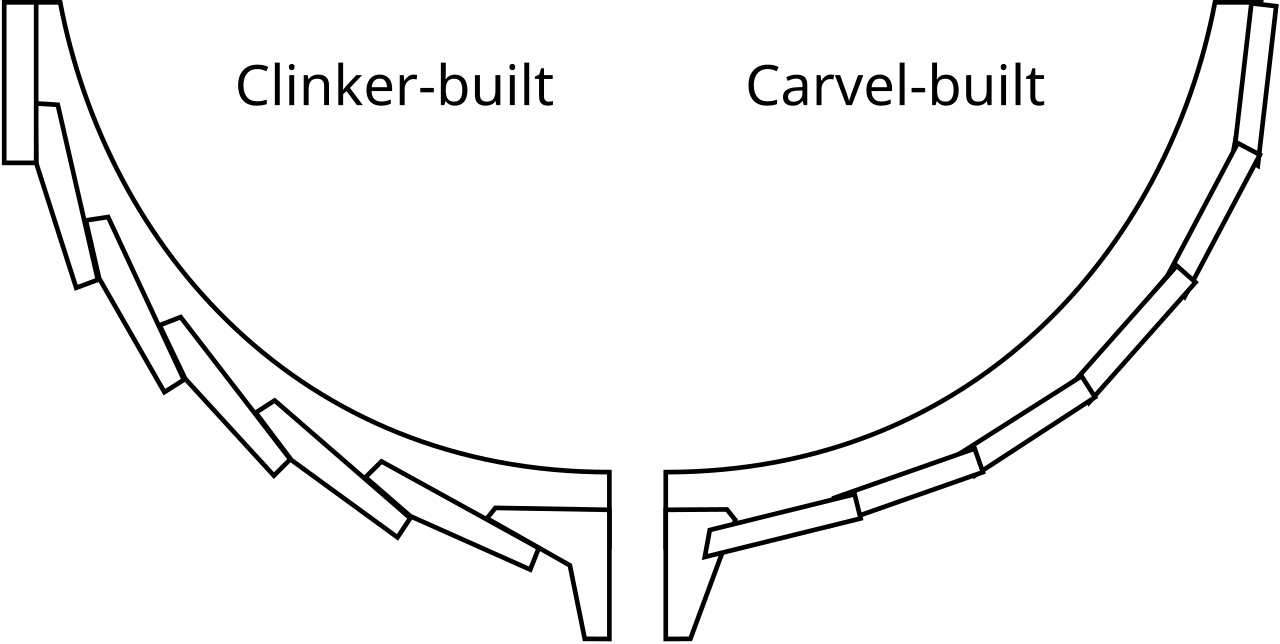
.svg/1280px-Centerboard_(PSF).svg.png)