
مسرد مصطلحات البيسبول
هذه قائمة أبجدية مختارة من المصطلحات والعبارات غير الرسمية والمتخصصة، وغيرها من المصطلحات المستخدمة في لعبة البيسبول ، إلى جانب تعريفاتها، بما في ذلك أمثلة توضيحية للعديد من المدخلات.
0–9
0
- "أوه و..." انظر إلى العدد .
1
يشير الرقم 1 في لعبة البيسبول إلى مركز الرامي، وهو اختصار لرمي الكرة إلى القاعدة الأولى، وضربة واحدة، وإشارة للكرة السريعة.
شوط 1-2-3
- شوط يواجه فيه الرامي ثلاثة ضاربين فقط، ولا يصل أي منهم إلى القاعدة بأمان. "ثلاثة صاعدين، ثلاثة هابطين".
1-2-3 لعب مزدوج
1-6-3 لعب مزدوج
- يستقبل الرامي (1) الكرة المضروبة ويرميها إلى لاعب الوسط (6) لإخراج العدّاء المتقدم إلى القاعدة الثانية. ثم يرمي لاعب الوسط الكرة إلى لاعب القاعدة الأولى (3) لإخراج الضارب.
2
يحصل الماسك (2) على نداء "اثنان!" للرميات إلى القاعدة الثانية، و"الضربة المزدوجة" تعني ضربة مزدوجة، ويشير الرقم 2 إلى الكرة المنحنية.
2-2-2 (كرتان، ضربتان، خروجان)
- انظر إلى ديوس وايلد .
مقياس 20-80
- يستخدم كشافو دوري البيسبول الرئيسي مقياسًا من 20 إلى 80 لتقييم اللاعبين: 50 هو المستوى المتوسط (مستوى دوري البيسبول الرئيسي)، و20 هو مستوى منخفض جدًا، و80 هو مستوى النخبة. ينطبق هذا على القدرة العامة والمهارات المحددة مثل سرعة الضرب أو سرعة الرمي. [ 1 ]
3
يستقبل لاعب القاعدة الأول (3) الكرات مع صيحات "ثلاثة!"، ويقبض على العدائين الذين يحاولون تسجيل ثلاثيات ("ثلاثة ضربات")، وقد يشير الرقم 3 إلى كرة منزلقة من الرامي.
3-2-3 لعب مزدوج
- يستقبل لاعب القاعدة الأولى (3) الكرة المضروبة ويرميها إلى الماسك (2)، الذي يُخرج العدّاء المتقدم من القاعدة الثالثة، ثم يرمي الكرة مرة أخرى إلى لاعب القاعدة الأولى لإخراج الضارب. يحدث هذا عادةً عندما تكون القواعد ممتلئة .
3-6 لعب مزدوج
- يستقبل لاعب القاعدة الأولى (3) الكرة المضروبة، ويخطو على القاعدة الأولى (لإخراج الضارب)، ثم يرميها إلى لاعب الوسط (6) الذي يلمس العدّاء ليخرجه. احتمال آخر هو أن يستقبل لاعب القاعدة الأولى كرة قوية مباشرة، ثم يرميها إلى لاعب الوسط، الذي يخطو بدوره على القاعدة الثانية ليخرج العدّاء الثاني.
3-6-1 لعب مزدوج
- يستقبل لاعب القاعدة الأولى (3) الكرة المضروبة ويرميها إلى لاعب الوسط (6) لإخراج العدّاء الموجود على القاعدة الثانية. ثم يرمي لاعب الوسط الكرة إلى الرامي (1) (الذي يغطي الآن القاعدة الأولى لأن لاعب القاعدة الأولى كان مشغولاً باستقبال الكرة) لإخراج الضارب.
لعبة مزدوجة 3-4-3
- يستقبل لاعب القاعدة الأولى (3) الكرة المضروبة ويرميها إلى لاعب القاعدة الثانية (4) لإخراج العدّاء الموجود عند القاعدة الثانية. ثم يرمي لاعب القاعدة الثانية الكرة مرة أخرى إلى لاعب القاعدة الأولى لإخراج الضارب.
3-6-3 لعب مزدوج
- يستقبل لاعب القاعدة الأولى (3) الكرة المضروبة ويرميها إلى لاعب الوسط (6) لإخراج العدّاء الموجود عند القاعدة الثانية. ثم يرمي لاعب الوسط الكرة مرة أخرى إلى لاعب القاعدة الأولى لإخراج الضارب.
4
- لاعب القاعدة الثاني، في اختصار تسجيل النقاط.
- تشير صيحة "أربعة!" إلى أنه يجب رمي الكرة إلى لوحة القاعدة الرئيسية.
- "الضربة الرباعية" تعني ضربة قوية.
- في سياق رمي الكرة، يعتبر الرقم 4 علامة شائعة (ولقبًا) للكرة المتغيرة.
4-6-3 لعب مزدوج
- يقوم لاعب القاعدة الثاني (4) باستقبال الكرة المضروبة ويرميها إلى لاعب الوسط القصير (6)، الذي يجبر العداء على الخروج عند القاعدة الثانية ثم يرميها إلى لاعب القاعدة الأول (3) لإخراج الضارب.
خط بطول 45 قدمًا
- يُحدد خط الـ 45 قدمًا في لعبة البيسبول المنطقة التي يجب على الضارب البقاء فيها لتجنب احتسابه خارجًا بسبب التدخل أثناء الجري إلى القاعدة الأولى.
خط بزاوية 45 درجة
- مصطلح غير رسمي يُشير إلى خط افتراضي مرسوم بزاوية 45 درجة من السطح الأمامي للكرة المطاطية إلى خط القاعدة الأولى. يُمكن استخدامه كنقطة مرجعية لتحديد ما إذا كان الرامي الأعسر قد خطا بشكل قانوني إلى القاعدة الأولى أثناء محاولته إخراج اللاعب من القاعدة الأولى. يُشترط على الرامي أن يخطو إلى القاعدة التي يرمي إليها، وعدم القيام بذلك يُعد مخالفة .
أربعة منها عريضة
- أربع رميات متتالية متعمدة خارج منطقة الضرب. لخص الواعظ رو هذه الاستراتيجية لستان موسيال قائلاً: "أرمي له أربع رميات واسعة وأحاول إخراجه من القاعدة الأولى". [ 2 ]
5
- لاعب القاعدة الثالثة، في اختصار تسجيل النقاط.
5 فتحات
- بين ساقي اللاعب (خاصةً ساقي الماسك). من مصطلح الهوكي الذي يصف كيفية تقدم القرص من فوق حارس المرمى ("عبر الفتحة الخامسة").
5.5 فتحة
- المساحة بين لاعب القاعدة الثالثة (5) ولاعب الوسط القصير (6).
- اشتهرت هذه المقولة بفضل بطل الضرب الدائم توني جوين من فريق سان دييغو بادريس، وذلك بوصفه للمكان الذي كان يحب ضرب الكرة فيه. [ 3 ]
لعبة مزدوجة 5-4-3
- يستقبل لاعب القاعدة الثالثة (5) الكرة المضروبة ويرميها إلى لاعب القاعدة الثانية (4) لإخراج العدّاء المتقدم من القاعدة الأولى. ثم يرمي لاعب القاعدة الثانية الكرة إلى لاعب القاعدة الأولى (3) لإخراج الضارب.
5-4-3 لعبة ثلاثية
- يستقبل لاعب القاعدة الثالثة (5) كرةً مضروبةً بقوة ويخطو على القاعدة الثالثة ليُخرج اللاعب R2 (6)، ثم يُمرر كرةً سريعةً إلى لاعب القاعدة الثانية (4) ليُخرج اللاعب R1 (7) عند القاعدة الثانية. وأخيرًا، يُمرر لاعب القاعدة الثانية (4) الكرة إلى لاعب القاعدة الأولى (3) ليكمل الثلاثية بإخراج الضارب (2).
لاعب ذو خمس مهارات
- لاعب ميداني (غير رامٍ) مثل ويلي مايز ، [ 4 ] ميكي مانتل ، أندريه داوسون ، [ 5 ] ديوك سنايدر ، [ 6 ] [ 7 ] فلاديمير غيريرو ، [ 8 ] وكين غريفي جونيور ، [ 6 ] [ 9 ] الذي يتفوق في:
- تحقيق معدل ضرب جيد
- الضرب بقوة
- الجري بين القواعد
- رمي
- الدفاع [ 6 ]
6
- لاعب الوسط القصير، في اختصار تسجيل النقاط.
لعبة مزدوجة 6-4-3
- يستقبل لاعب الوسط القصير (6) الكرة المضروبة ويرميها إلى لاعب القاعدة الثاني (4)، الذي يجبر العداء المتقدم من القاعدة الأولى على الخروج، ثم يرمي الكرة إلى لاعب القاعدة الأول (3) لإخراج الضارب.
7
- لاعب الجناح الأيسر، في اختصار تسجيل النقاط.
اللعب المزدوج 7-2 أو 8-2 أو 9-2
- يلتقط لاعب الملعب الخارجي كرة طائرة، ويحاول العداء الوصول إلى القاعدة الثالثة وتسجيل نقطة، لكن يتم إخراجه من قبل الماسك.
8
- لاعب الوسط، في اختصار تسجيل النقاط.
9
- لاعب الجناح الأيمن، في اختصار تسجيل النقاط.
من 9 إلى 0
- النتيجة الرسمية لمباراة تم فيها الانسحاب في دوري البيسبول الرئيسي.
كرة منحنية 12-6
- نوع من الكرات المنحنية، التي تشبه حركتها عقارب الساعة.
نادي 30-30
- اللاعبون الذين سجلوا 30 ضربة منزلية وسرقوا 30 قاعدة في موسم واحد.
نادي 40-40
- اللاعبون الذين سجلوا 40 ضربة منزلية وسرقوا 40 قاعدة في موسم واحد.
نادي 50-50
- اللاعبون الذين سجلوا 50 ضربة منزلية وسرقوا 50 قاعدة في موسم واحد.
55 قدمًا
90 قدمًا
- عندما يتقدم العداء قاعدة واحدة، فإنه "يقطع مسافة 90 قدمًا" - وهي المسافة بين القاعدتين المتتاليتين. العداء الموجود على القاعدة الثالثة يكون على بعد "90 قدمًا" من تسجيل النقاط.
أ
كرة القدم من الدرجة الأولى أو الفئة أ
- اعتبارًا من موسم 2022، تُعدّ "الفئة أ" أدنى تصنيف في دوريات البيسبول الصغرى الحديثة التابعة للرابطة الوطنية للبيسبول ، وتضمّ فئتين فرعيتين هما "الفئة أ العليا" و"الفئة أ الفردية". وكانت هناك دوريات "الفئة أ قصيرة الموسم" قبل عام 2021. وتنقسم الفئة أ العليا إلى ثلاثة دوريات: دوري الغرب الأوسط ، ودوري الشمال الغربي ، ودوري جنوب الأطلسي . كما تنقسم الفئة أ الفردية إلى ثلاثة دوريات: دوري كاليفورنيا ، ودوري كارولينا ، ودوري ولاية فلوريدا .
AA
- "Double-A" (AA) هو ثاني أعلى مستوى في دوري البيسبول الصغير (أقل من AAA)، واعتبارًا من عام 2022 يشمل الدوري الشرقي ، والدوري الجنوبي ، ودوري تكساس .
- "AA" هو أيضًا اختصار لـ American Association، وهو اسم العديد من دوريات البيسبول الاحترافية: دوري رئيسي قصير الأجل في القرن التاسع عشر، ودوري ثانوي لجزء كبير من القرن العشرين، ودوري ثانوي مستقل أصبح "دوري شريك" لدوري البيسبول الرئيسي في عام 2021.
AAA
- "الدرجة الثالثة" هي أعلى مستوى في دوري البيسبول الصغير. اعتبارًا من عام 2022، يشمل هذا المستوى الدوري الدولي ودوري ساحل المحيط الهادئ .
لاعب AAAA
- يُطلق مصطلح "لاعب من الدرجة الرابعة" (أو "لاعب من الدرجة الرابعة") على لاعب في دوريات الدرجة الثانية يحقق نجاحًا مستمرًا في دوريات الدرجة الثانية العليا ( AAA )، لكنه لا يستطيع ترجمة هذا النجاح إلى مستوى دوري الدرجة الأولى. وقد يكون سوء الإدارة سببًا في ذلك. [ 10 ] كما يُستخدم مصطلح "AAAA" بشكل غير رسمي للإشارة إلى دوريات البيسبول الأجنبية عالية الجودة وغير التابعة لأي اتحاد خارج أمريكا الشمالية، حيث تُعتبر المنافسة فيها أقل حدة من دوري البيسبول الرئيسي (MLB) ولكنها أكثر حدة من دوري الدرجة الثانية (AAA)؛ وعادةً ما يقتصر هذا المصطلح على وصف دوري البيسبول الياباني للمحترفين ( NPB) . [ 11 ] [ 12 ] [ 13 ]
على متن
- عندما يكون هناك عداء على القاعدة . عندما يكون هناك عدّاؤون بأمان على القاعدة، يكون هناك "عدّاؤون على متنها".
بارِع
- أفضل لاعب رامي أساسي في الفريق، والذي عادة ما يكون الأول في قائمة الرماة.
تقدم العداء
- يُعدّ نقل العدّاء إلى قاعدة أخرى بأمان استراتيجيةً واعيةً لدى الفرق التي تعتمد أسلوب اللعب السريع . فإذا أُقصيَ الضارب، فإنّ مشاركته في المباراة ستكون أقلّ سلبيةً إذا تمكّن من إيصال عدّاء إلى موقع التسجيل ؛ بل إنّ بعض الضاربين يُضحّون بأنفسهم عمدًا في بعض الحالات .
متقدم في العد
- مصطلح يُشير إلى ما إذا كان الضارب أو الرامي يمتلك الأفضلية في جولة الضرب. إذا رمى الرامي عددًا من الكرات الصحيحة أكثر من الكرات الخاطئة للضارب في جولة الضرب، فإن الرامي متقدم في عدد الضربات؛ وعلى العكس، إذا رمى الرامي عددًا من الكرات الخاطئة أكثر من الكرات الصحيحة، فإن الضارب متقدم.
- إذا كان الرامي متقدماً في عدد الضربات، فإن خطر إقصاء الضارب يزداد. وإذا كان الضارب متقدماً، فإن خطر منحه قاعدة مجانية يزداد.
صوب الكرة
- أحيانًا، عندما يحاول الرامي التحكم بدقة مفرطة في مسار الكرة، يُقال إنه "يُصوّب" الكرة بدلًا من رميها. وهذا يختلف عن معنى "التصويب" في حالة توجيه الرامي الكرة نحو الضارب بهدف إصابته.
البريد الجوي

- مصطلح عامي يُطلق على رمية خاطئة من لاعب ميداني، حيث ترتفع الكرة عالياً فوق اللاعب الذي كان ينوي رميها إليه. على سبيل المثال، إذا رمى لاعب القاعدة الثالثة الكرة فوق رأس لاعب القاعدة الأولى إلى المدرجات، يُقال إنه "أخطأ في الرمية". "لكن تشاندلر أخطأت في رميتها إلى القاعدة الثالثة، حيث سقطت الكرة في مقاعد البدلاء ..."
انفجار المرمر
- صاغ هذه العبارة بوب برينس، معلق فريق بيتسبرغ بايرتس، وهي عبارة عن ضربة قوية نحو الأسفل في الملعب الداخلي، مثل ضربة بالتيمور ، والتي ترتد أعلى من المعتاد بسبب صلابة أرضية ملعب فوربس بشكل استثنائي، مما يتيح للضارب الوقت الكافي للوصول إلى القاعدة الأولى بأمان.
زقاق
- يُطلق على هذه المنطقة أيضًا اسم "الفجوة" أو " ممر القوة "، وهي المساحة بين لاعبَي الملعب الأيسر والأوسط، أو بين لاعبَي الملعب الأيمن والأوسط. إذا ضرب الضارب الكرة "في الممر" بقوة كافية، تزداد فرصته في التقدم إلى ما بعد القاعدة الأولى واحتساب ضربة إضافية. عادةً ما يكون هذا المصطلح مناسبًا لوصف الضربة الأرضية أو الضربة المباشرة؛ أما الكرات العالية التي تصطدم بالجدار فلا تُوصف عادةً بهذه الطريقة.
كمين
- التأرجح (وخاصة ضرب) الكرة الأولى.
الدوري الأمريكي (AL)
- الدوري الأصغر من بين الدوريين الرئيسيين الحاليين .
سلسلة بطولة الدوري الأمريكي (ALCS)
- سلسلة مباريات التصفيات النهائية للموسم، والتي تُقام بنظام الأفضل من سبع مباريات، تُحدد فريق الدوري الأمريكي الذي سيتأهل إلى بطولة العالم . وقد أُقيمت سلسلة بطولة الدوري الأمريكي (ALCS)، على غرار نظيرتها سلسلة بطولة الدوري الوطني (NLCS) ، في عام 1969. ويحصل الفائز في سلسلة بطولة الدوري الأمريكي على راية الدوري الأمريكي ولقب بطل الدوري الأمريكي لذلك الموسم. ويلتقي الفائزان في سلسلة دوري الدرجة الأولى الأمريكي في سلسلة بطولة الدوري الأمريكي منذ عام 1995.
سلسلة دوري الدرجة الأولى الأمريكي (ALDS)
- الجولة الثانية من تصفيات الدوري. يتنافس الفائزان الأول والثاني في كل قسم، بالإضافة إلى الفائزين في سلسلتي البطاقات البرية، في سلسلتين من خمس مباريات، ويتأهل الفائزان فيهما إلى نهائي دوري البيسبول الأمريكي.
آني أوكلي
- تذكرة مجانية لحضور مباراة كرة قدم أو للوصول إلى القاعدة الأولى (تذكرة مجانية أو "قاعدة على الكرات").
استئناف اللعب
- فرصةٌ تُتاح فيها للدفاع فرصةٌ للحصول على قرارٍ لصالحهم من الحكم، وذلك بتصحيح خطأٍ ارتكبه الهجوم أو طلب رأي حكمٍ آخر. يتطلب الاستئناف من الدفاع تقديم طلبٍ شفهيٍّ إلى الحكم المختص، أو إذا كان الموقف واضحًا، فيمكن للاعب الإشارة إليه بإيماءة. يقع عبء تقديم الطلب على عاتق الدفاع؛ ولن يُعلن الحكام عن حالات الاستئناف المحتملة، مثل عدم لمس العدائين للقاعدة، أو الضرب خارج الترتيب، أو التأرجحات غير المُراقبة، إلا بعد تقديم الطلب.
دوري أريزونا الخريفي (AFL)
- دوري ثانوي قصير الموسم، يُنظّم فيه اللاعبون الواعدون من جميع أندية دوري البيسبول الرئيسي الثلاثين في ستة فرق، حيث تتاح لهم الفرصة لصقل مهاراتهم وعرضها أمام المدربين والكشافين والمسؤولين. وتُعرف هذه الفرق باسم "فرق الكشافة" و"فرق الاحتياط".
ذراع
حول القرن
- عادة لاعبي الدفاع الداخلي هي رمي الكرة لبعضهم البعض بعد تسجيل خروج لاعب ، بشرط عدم وجود لاعبين على القواعد. الهدف من هذه العادة تقليدي، وهي أيضاً وسيلة للاحتفال بالخروج. عادةً، إذا تم إخراج لاعب عند القاعدة الأولى، يرمي لاعب القاعدة الأولى الكرة إلى لاعب الوسط ، الذي يرميها بدوره إلى لاعب القاعدة الثانية ، الذي يرميها إلى لاعب القاعدة الثالثة ، الذي يعيدها إلى الرامي . تختلف أنماط الرمي من فريق لآخر، لكن لاعب القاعدة الثالثة عادةً ما يكون آخر لاعب دفاع داخلي يتلقى الكرة، بغض النظر عن النمط.
- يُجرى رمي الكرة حول مركز القاعدة الرئيسية أيضًا بعد ضربة قاضية دون وجود لاعبين على القواعد. يرمي الماسك الكرة إلى لاعب القاعدة الثالثة، الذي يرميها بدوره إلى لاعب القاعدة الثانية، الذي يرميها إلى لاعب الوسط، الذي يرميها بدوره إلى لاعب القاعدة الأولى. يفضل بعض الماسكين، مثل إيفان رودريغيز ، رمي الكرة إلى لاعب القاعدة الأولى، الذي يبدأ العملية بالعكس. يحدد بعض الماسكين لمن سيرمون الكرة بناءً على استخدام الضارب لليد اليمنى (إلى القاعدة الأولى للضارب الأيمن لأن خط الكرة إلى لاعب القاعدة الأولى غير مسدود، والعكس صحيح) أو ما إذا كان الفريق في وضعية تمركز متقدمة، حيث يكون لاعب القاعدة الثالثة قريبًا من موقع لاعب الوسط المعتاد، مما يتطلب رمية أقوى للوصول إليه.
- ومن التطبيقات الإضافية لهذا المصطلح حدوث لعبة مزدوجة 5-4-3 ، والتي تحاكي نمط رمي الكرة حول القرن.
مفتعل الحرائق
- رامي إغاثة غير فعال . عادةً ما يكون رامياً يدخل المباراة ولا يوجد أي لاعب على القاعدة، لكنه يستقبل عدة أشواط. عكس رجل الإطفاء .
رماد
- كلمة قديمة تشير إلى مضرب البيسبول، المصنوع عادةً من خشب شجرة الدردار. "يستبدل المدير الذكي عداءً سريعًا بآخر بطيء، ويرسل ضاربًا بديلًا عندما يكون اللاعب الذي أخرجه بنفس مهارة اللاعب الذي أرسله في استخدام مضرب الدردار." [ 16 ]
أسبرين
يساعد
- يُحتسب مُسجّل النقاط الرسمي مساعدةً لكل لاعب دفاعي يلتقط الكرة أو يلمسها (بعد أن يضربها الضارب) قبل إخراج اللاعب، حتى لو كان اللمس غير مقصود. على سبيل المثال، إذا اصطدمت الكرة بساق لاعب وارتدت منه إلى لاعب دفاعي آخر ، والذي لمس العدّاء، يُحتسب للاعب الأول مساعدة.
- لا يحصل لاعب الدفاع إلا على مساعدة واحدة لكل إخراج مسجل. كما يحصل على مساعدة إذا كان الإخراج سيحدث لولا خطأ ارتكبه لاعب دفاع آخر .
فريق العمل المساعد
- في دوري البيسبول الزنجي ، الفريق الذي لم يحصل على عضوية الدوري أو لم يوافق على اللعب وفقًا لجدول مباريات الدوري، ولكن المباريات التي لعبتها فرق الدوري ضد هذا الفريق ستظل تُحتسب في ترتيب الدوري.
علامة النجمة
- مصطلح عامي يُطلق على رقم قياسي في لعبة البيسبول يُثار حوله جدلٌ شعبي (أي غير رسمي) بسبب اعتقادٍ بأن صاحب الرقم القياسي قد حصل على ميزة غير عادلة. ويشير هذا المصطلح إلى أن الرقم القياسي يتطلب حاشيةً توضح هذه الميزة المزعومة، حيث تُستخدم علامة النجمة (*) كرمز شائع في الطباعة للإشارة إلى الحواشي. وقد شاع استخدامه مؤخرًا في الحالات التالية:
- يُعتقد على نطاق واسع أن صاحب الرقم القياسي قد استخدم منشطات لتحسين الأداء ، سواء ثبت ذلك أم لا. وقد استُقبل باري بوندز بانتظام بلافتات تحمل علامة نجمة خلال موسم 2007 عندما حطم رقم هانك آرون القياسي في عدد الضربات المنزلية. وتم وضع علامة نجمة على الكرة التي ضربها بوندز لتحطيم الرقم القياسي قبل إرسالها إلى قاعة مشاهير البيسبول.
- حقق صاحب الرقم القياسي لموسم واحد هذا الإنجاز خلال موسم أطول، ما أتاح له فرصًا إضافية لتحطيم الرقم القياسي. ومن الأمثلة المعروفة على ذلك تحطيم روجر ماريس لرقم بيب روث القياسي في عدد الضربات المنزلية في موسم واحد، وذلك في اليوم الأخير من موسم منتظم مكون من 162 مباراة عام 1961، بينما كان روث قد سجل الرقم القياسي السابق في موسم مكون من 154 مباراة عام 1927. ويتجلى استخدام علامة النجمة في عنوان فيلم " 61*" ، الذي يتناول سعي ماريس لتحطيم رقم روث. وقد أعلن مفوض البيسبول، فورد فريك، أنه يجب إدراج رقم ماريس القياسي بشكل منفصل عن رقم روث (على عكس الاعتقاد السائد، لم تُذكر أو تُستخدم علامة النجمة في هذه الحالة)، وهو قرار لم يُلغَ رسميًا إلا عام 1991.
- بطولة هيوستن أستروس في بطولة العالم لعام 2017 ، والتي شابتها لاحقًا مزاعم استخدام الفريق للتكنولوجيا لسرقة إشارات الخصوم طوال موسم 2017. كثيرًا ما يستخدم مشجعو الفرق المنافسة، وخاصة يانكيز ودودجرز ، علامات النجمة عند الإشارة إلى موسم فريقهم في 2017، وغالبًا ما يطلقون على الفريق اسم "نجوم هيوستن" تهكمًا.
في تلك الكرة
- أو "كرة الذرة"؛ مصطلح عامي للكرة التي تُضرب مباشرة باتجاه المدافع.
في المضرب
- يُعرَّف ظهور اللاعب في منطقة الضرب بأنه وصوله إلى القاعدة الأولى بنجاح، سواءً كان ذلك نتيجة ضربة ناجحة أو خروج غير تضحية . تُستخدم مرات الظهور في منطقة الضرب لحساب متوسط الضرب ونسبة الضربات القوية للاعب . تجدر الإشارة إلى أن ظهور اللاعب في منطقة الضرب لا يُحتسب كـ"ضربة ناجحة" إذا وصل إلى القاعدة الأولى نتيجةً لضربة خاطئة ، أو ضربة مباشرة بالكرة ، أو إذا نفّذ ضربة تضحية قصيرة أو ضربة تضحية طائرة .
- في بعض الأحيان، قد يكون الضارب موجودًا في لوحة الضرب عندما يتم إخراج اللاعب الثالث في الشوط ضد عداء القاعدة؛ في هذه الحالة، سيبدأ الضارب الشوط التالي بعدد ضربات نظيف ولن يتم احتساب ظهوره المتقطع في لوحة الضرب كضربة.
عند الحروف
- يقال إن الكرة التي تعبر اللوحة على ارتفاع حروف اسم الفريق على قميص زي الضارب هي "على مستوى الحروف" أو " على مستوى الحروف " أو "على مستوى الصدر".
التهمته
- تعبير عامي يصف حركة الكرة المضروبة التي يصعب على اللاعب الميداني التعامل معها.
أكل الكرة
- انظر: تناول الكرة
هاجم منطقة الضرب
- مصطلح عامي يُشير إلى رمي الكرة بقوة ودقة، بدلاً من محاولة خداع الضاربين لحملهم على ضرب الكرات خارج منطقة الضرب أو محاولة ضرب زوايا اللوحة. ومن العبارات المُرادفة له "الضرب بقوة في منطقة الضرب" و"تحدي الضاربين".
مزدوج أوتوماتيكي
- إذا ارتدت الكرة المضروبة داخل الملعب (مثلاً إلى المدرجات) خارج اللعب، يحق للضارب وجميع العدائين على القواعد التقدم قاعدتين فقط. يستخدم بعض المعلقين هذا المصطلح بدلاً من "الضربة المزدوجة" في قواعد الملعب ، والتي تشير إلى القواعد المطبقة في كل ملعب.
كرة أوتوماتيكية
- منذ عام 2023 في دوري البيسبول الرئيسي، يتم احتساب كرة تلقائية على الرامي إذا لم يرمِ الكرة قبل انتهاء وقت الرمي.
ضربة آلية
- تعتبر الضربة "تلقائية" عندما يقوم الرامي بضربة متقنة - عادةً عند نتيجة 3-0 - بثقة كبيرة لدرجة أن الضارب يأخذ الكرة دون أن يتأرجح.
- منذ عام 2023 في دوري البيسبول الرئيسي، يتم احتساب ضربة تلقائية على الضارب إذا لم يكن في منطقة الضرب ومنتبهًا للرامي عندما يتبقى 8 ثوانٍ على الأقل على ساعة الرمي.
بعيد
- يُشار إلى الكرة التي تقع خارج منطقة الضرب، على الجانب المقابل من اللوحة بالنسبة للضارب، بأنها "بعيدة"، على عكس الكرة التي يتم رميها بين اللوحة والضارب والتي تُعرف باسم "داخلية".
- مصطلح عامي يُستخدم للإشارة إلى الضربات الخارجة. على سبيل المثال، قد يُقال عن شوط فيه ضربتان خارج الملعب أنه "ضربتان خارج الملعب"؛ وقد يُشار إلى الضربة الخارجة بالقول "إنهاء" الضارب.
- تُسمى المباريات التي تُقام على أرض الخصم "مباريات خارج أرضه". ويُطلق على الفريق الزائر أحيانًا اسم "الفريق الضيف".
ب
كرة كسر الباب الخلفي
- الكرة المنحنية، وهي عادةً ما تكون كرة منزلقة أو كرة منحنية أو كرة سريعة مقطوعة ، تمر، بسبب حركتها الجانبية، عبر جزء صغير من منطقة الضرب على الحافة الخارجية للوحة بعد أن تبدو وكأنها ستخطئ اللوحة تمامًا. قد لا تعبر مقدمة اللوحة بل مؤخرتها فقط، وبالتالي تكون قد دخلت من "الباب الخلفي". الكرة المنزلقة هي النوع الأكثر شيوعًا، لأنها تتميز بحركة جانبية أكبر من الكرات المنحنية الأخرى (فهي تنحني للأسفل وتنزلق عبر منطقة الضرب).
حاجز خلفي
- السياج الموجود خلف قاعدة الملعب الرئيسية، مصمم لحماية المتفرجين من الكرات الضائعة أو الكرات الخاطئة.
- الماسك ، وأحيانًا "الحارس الخلفي".
متتالي
- متتالي. عندما يسجل لاعبان متتاليان ضربات قوية، يُقال إنهما سجلا ضربتين قويتين متتاليتين . أو قد يمنح الرامي ضربتين متتاليتين، وهكذا.
النسخ الاحتياطي
- عكس مصطلح "الكرة الخلفية". عادةً ما يكون خطأً، وهي رمية تبدأ من داخل منطقة القاعدة الرئيسية ثم تنحرف عائدةً فوقها. يُقال عن الرمية التي تفعل ذلك أنها "تراجعت".
ضارب الكرة السيئة
قفزة سيئة
- كرة ترتد أمام لاعب الدفاع الداخلي بطريقة غير متوقعة، غالباً نتيجة عيوب في سطح اللعب أو دوران الكرة.
شنطة
- قاعدة. كذلك، الضربة المزدوجة هي ضربة ثنائية أو ضربة ثنائية القاعدة؛ والضربة الثلاثية هي ضربة ثلاثية أو ضربة ثلاثية القاعدة؛ والضربة الرباعية هي ضربة منزلية.
الكفالة
- قد يقوم الضارب الذي يرى الكرة قادمة نحو رأسه بـ "الانسحاب" ( السقوط على الأرض ).
- عندما يتقارب لاعبان في الملعب لالتقاط كرة طائرة، قد يتراجع أحدهما لتجنب الاصطدام بالآخر.
- قد يدخل لاعب الرمي البديل إلى المباراة مع وجود لاعبين على القواعد وينقذ الرامي السابق من المأزق .
- بينما يُعد المثالان الأولان بمثابة نظيرين للقفز من طائرة بالمظلة، فإن المثال الأخير يشبه إخراج قارب على وشك الغرق، أو ربما إخراج شخص ما من السجن.
balk
- يُعتبر خطأ الرمي من أكثر قواعد البيسبول تعقيدًا. [ 19 ] يُغطّي هذا الخطأ القاعدة 6.02(أ) في قواعد البيسبول الرسمية الصادرة عن دوري البيسبول الرئيسي . [ 20 ] وبشكل عام، يُعرّف خطأ الرمي بأنه أي فعل غير قانوني من جانب الرامي عندما يكون هناك عدّاء (أو عدّائين) على القاعدة.
- يجوز للرامي الذي يتخذ وضعية رمي قانونية - وضعية الاستعداد أو وضعية التجهيز - أن يختار رمي الكرة إلى الضارب، أو أن يفصل نفسه قانونيًا عن لوحة الرامي (عن طريق التراجع للخلف بقدم الارتكاز وإسقاط يديه على جانبيه إذا كان في وضعية الاستعداد)، أو أن يقوم برمي الكرة بشكل قانوني إلى قاعدة في محاولة لإخراج العداء.
- أي حركة تُصاحب رمي الكرة تُلزم الرامي بإتمام تلك الرمية. عدم إتمام الرمية يُعد مخالفة. في حال عدم وجود لاعبين على القواعد، تُمنح الكرة للضارب. أما في حال وجود لاعبين على القواعد، فتُعتبر مخالفة.
- يُعتبر الرامي الذي يُحرك قدمه الحرة خارج حدود لوحة الرامي مُلزماً بتسليم الكرة إلى الضارب، إلا إذا كان يُجري رمية قانونية أو حركة تمويهية إلى القاعدة الثانية. وإلا تُعتبر هذه مخالفة.
- عقوبة مخالفة رمي الكرة (balk) هي منح كل عداء قاعدة واحدة، ويبقى الضارب في وضعية الضرب بنفس عدد الضربات . في دوري البيسبول الرئيسي (MLB ) (أو في الدوريات الأخرى التي تستخدم قواعد البيسبول الرسمية ) والرابطة الوطنية لرياضة الجامعات (NCAA)، تُعتبر بعض مخالفات رمي الكرة مخالفات أثناء اللعب، ما يعني أن العقوبة (إن لزم الأمر) تُطبق في نهاية اللعب. يحدث هذا عادةً عندما يُلقي الرامي الكرة دون أن يتخذ وضعية الاستعداد القانونية أولاً . يُعلن الحكم (أو الحكام) عن المخالفة، ولكن لا يزال بإمكان الضارب اختيار ضرب الكرة. إذا تقدم كل عداء (بما في ذلك الضارب ) قاعدة واحدة على الأقل في نهاية اللعب، تُتجاهل المخالفة. وإلا، تُطبق العقوبة ويعود الضارب بنفس عدد الضربات. في قواعد الاتحاد الوطني لرياضة المدارس الثانوية ( NFHS )، تُعتبر مخالفة رمي الكرة دائمًا مخالفة تُنهي اللعب.
- أكثر حالات مخالفة رمي الكرة شيوعًا هي عندما لا يتخذ الرامي وضعية الاستعداد الكاملة (إذا كان يستخدم وضعية الاستعداد ) قبل رميته؛ أو عندما يتخذ وضعية الاستعداد، ثم يبدأ حركته ويتوقف مرة أخرى (يُسمى أحيانًا "الاستعداد المزدوج")؛ أو عندما لا يخطو مباشرةً نحو القاعدة عند محاولة رمية إخراج. المعايير العامة المستخدمة لتحديد ما إذا كان الرامي قد خطا نحو القاعدة هي: أ) هل تقدم نحو القاعدة نتيجةً لخطوته؟ ب) هل خطا خطوةً قبل رميته؟ ج) (بشكلٍ أكثر تقديرًا) هل خطا نحو القاعدة أكثر من خطوته نحو الضارب في حالة الرامي الأعسر الذي يرمي إلى القاعدة الأولى؟
- على الرغم من أن الهدف الأساسي من ذلك هو حماية العداء من أي عمل خادع متعمد من قبل الرامي، إلا أن هناك سيناريوهات أخرى قد يتم فيها احتساب مخالفة الرمية الخاطئة:
- إذا سقطت الكرة عن غير قصد بينما يكون الرامي على اتصال بالمطاط ؛
- إذا قام الرامي برمي الكرة إلى قاعدة غير مشغولة، إلا إذا كانت محاولة لإخراج أو إرجاع عداء متقدم؛
- إذا قام الرامي، بعد اتخاذ وضعية رمي قانونية (أي إذا قام بضم يديه معًا كما هو مطلوب لوضعية الإعداد أو وضعية الاستعداد )، بإزالة يده من الكرة، إلا إذا كان ذلك في الواقع أثناء رمي الكرة أو رميها إلى قاعدة؛
- عدم فصل لوحة الرامي بشكل قانوني عن طريق التراجع للخلف بقدم المحور عند تغيير وضعية الرمي (من وضعية الاستعداد إلى وضعية التثبيت أو العكس)؛
- إذا وقف الرامي على لوحة الرامي أو جلس فوقها دون أن تكون الكرة بحوزته، أو قام بحركة رمي وهمية بينما لم يكن على اتصال بلوحة الرامي؛
- تقديم عرض غير قانوني، مثل عرض سريع .
- مخالفة رمية الماسك هي نوع من المخالفات في رمية الكرة، وتُحتسب عندما لا يكون الماسك داخل منطقة الماسك إذا كان الرامي يحاول منح قاعدة مجانية متعمدة، وتُفرض عليها نفس عقوبة مخالفة رمية الماسك إذا كان هناك لاعبون على القواعد. ومع ذلك، بما أنه لم يعد يُشترط على الرماة رمي أي كرة لمنح قاعدة مجانية متعمدة، فإن هذه المخالفة نادرة للغاية، على الرغم من أنها لا تزال تُعتبر مخالفة من جانب الرامي في القاعدة 6.02(أ)(12).
- هذه القائمة ليست شاملة، وقد كان الطابع الذاتي أحيانًا لما يُعتبر مانعًا موضوعًا لنقاش حاد. ولا تخضع الموانع للمراجعة. [ 21 ]
كرة
- الكرة التي لا تصيب منطقة الضرب ولا يقوم الضارب بتأرجحها . (للاطلاع على الأداة المادية المستخدمة في اللعبة، انظر كرة البيسبول ).
الكرة في اللعب
- في علم الإحصاءات الرياضية ، يُستخدم مصطلحا "الكرة في الملعب" و" متوسط الضرب على الكرات في الملعب " (BABIP) بتعريفات فنية محددة لتقييم قدرة الرامي بمعزل عن دفاع الفريق. وبناءً على هذا التعريف، لا تُعتبر ضربة الهوم رن كرة في الملعب. انظر: إحصائيات الرمي المستقلة عن الدفاع . انظر أيضًا: في الملعب .
بالتيمور تشوب
- تُضرب الكرة بقوة في الأرض قرب قاعدة البداية، فترتد عالياً فوق رأس أحد لاعبي الدفاع. [ 22 ] يمنح هذا الضارب الوقت الكافي للوصول إلى القاعدة الأولى بأمان قبل أن يتمكن من التقاط الكرة. تُعد هذه التقنية عنصراً هاماً في استراتيجية " البيسبول الداخلي " التي اعتمدها مدرب فريق بالتيمور أوريولز ، جون ماكجرو ، وقد شاعت خلال حقبة الكرة الميتة في دوري البيسبول الرئيسي ، حيث لم يكن بإمكان فرق البيسبول الاعتماد على الضربات القاضية. [ 23 ]
- لإضفاء أقصى ارتداد على ضربة بالتيمور، قام توم مورفي، المسؤول عن أرضية ملعب أوريولز، بضغط التراب بإحكام حول قاعدة المنزل، وخلطه بالطين الصلب، وترك الملعب الداخلي دون ري. [ 24 ] وكان لاعبو أوريولز السريعون مثل ماكجرو، وجو كيلي ، وستيف برودي ، وويلي كيلر ، يتدربون عليها ويتقنونها باستمرار.
- في لعبة البيسبول الحديثة، أصبحت ضربة بالتيمور أقل شيوعًا، وعادةً ما تحدث عندما يضرب اللاعب الكرة عن طريق الخطأ. وتكون النتيجة أكثر وضوحًا في بعض الأحيان على الملاعب ذات العشب الصناعي . ولا تزال هذه التقنية مستخدمة في لعبة السوفتبول . [ 25 ]
ساق الموز
- مضرب مصنوع من خشب رديء الجودة. [ 26 ] انظر أيضًا #مذكرات_صباحية
باندبوكس
- ملعب صغير الحجم يشجع على الهجوم، وخاصة الضربات القوية . ملعب صغير الحجم . (انظر: ملعب بيكر بول وملعب سيتيزنز بنك بولبارك )
انفجار
- إلغاء مباراة بسبب سوء الأحوال الجوية: "اعتقدت أننا سنتعرض لهزيمة ساحقة، لكننا لعبنا خمسة أشواط."
- أن تضرب الكرة بقوة، وخاصة لتسجيل ضربة هوم رن. " سدد أوتلي ضربة هوم رن معادلة للنتيجة."
- اللاعبون المصابون يُعتبرون مصابين، لكن قد يستمرون في اللعب. مثال: "فريق برايفز المصاب جاهز لمباراة الإياب في الأدوار الإقصائية ضد أستروس".
- المباراة المثيرة هي مباراة حماسية أو متقاربة. مثال من عنوان رياضي: "نهاية مثيرة للغاية".
- لعبة " بانغ بانغ" هي لعبة يُخرج فيها العدّاء بصعوبة بالغة، وهي قرارٌ مُتقاربٌ للغاية، وعادةً ما تكون عند القاعدة الأولى. ربما يعكس هذا صوت "بانغ" الكرة في قفاز لاعب القاعدة الأولى، والذي يتبعه مباشرةً صوت "بانغ" قدم العدّاء وهي تصطدم بالقاعدة.
- يُطلق مصطلح "ضربة داخلية " عندما يرمي الرامي الكرة من داخل منطقة الضرب، ولا يستطيع الضارب مدّ ذراعيه بما يكفي لضربها، فتصطدم الكرة بقفاز الماسك. يقول جيافوتيلا : "كان شعورًا لا يُصدق، ولن أنساه أبدًا. كان شيرزر يحاول ضربي من الداخل طوال اليوم. كان يرمي الكرة من الداخل، ولم أستطع مدّ يديّ. أعتقد أنه أخطأ في رمي الكرة فوق منطقة الضرب في تلك المرة، فتمكنت من مدّ يديّ من الداخل وضربت الكرة بقوة، فطارت خارج الملعب." [ 27 ]
عازف البانجو
- لاعب يفتقر إلى القوة. عادةً ما يُسدد هذا اللاعب ضربات قصيرة، غالبًا ما تتجاوز حدود الملعب الداخلي، وتكون نسبة ضرباته القوية منخفضة . يُقال إن التسمية مشتقة من صوت رنين المضرب عند ضرب الكرة، والذي يُشبه صوت آلة البانجو . انظر أيضًا: لاعب بانش وجودي .
افعلها باليد المجردة
- يشير هذا المصطلح إلى عندما يمسك لاعب الميدان بالكرة بيده غير المغطاة بقفازه.
برميل
- مقياس متقدم يقيس عدد مرات ضرب اللاعب للكرة بزوايا إطلاق محددة وبسرعات خروج معينة. الضربات القوية (التي تُعتبر ضربات مباشرة) أكثر احتمالاً لتحقيق ضربات ناجحة، وخاصةً الضربات التي تُسفر عن أكثر من قاعدة، مقارنةً بالضربات غير المباشرة.
انطلق بقوة
- في لعبة البيسبول الحديثة، يشير ذلك إلى ضرب الكرة بقوة باستخدام الجزء المثالي من مضرب البيسبول.
- انظر إلى النقطة المثالية .
ضربة ناجحة
- انظر إلى الضربة .
قرع القاعدة
آني لاعبة البيسبول
- فتاة تُعرف بأنها " معجبة " سهلة المنال للاعبي البيسبول. لعبت سوزان ساراندون هذا الدور بشخصية آني سافوي في الفيلم الأمريكي " بول دورهام " عام 1988.
- كانت روث آن شتاينهاجن سيئة السمعة أول من عُرفت بـ"آني البيسبول". استحوذ عليها هوس لاعب البيسبول إيدي وايتكوس، لاعب القاعدة الأول لفريق شيكاغو كابز ثم لفريق فيلادلفيا فيليز. أطلقت عليه النار في صدره، وكادت تقتله عام 1949. ألهمت هذه القصة رواية "الموهوب" التي نُشرت عام 1952 .
القواعد محملة
- وجود لاعبين على القواعد الأولى والثانية والثالثة. يُعرف هذا الوضع أيضاً بمصطلحات مثل " القواعد الممتلئة " أو " القواعد المكتظة " أو " القواعد المحشورة " أو " القواعد الممتلئة جداً ". يُتيح هذا الوضع فرصةً ذهبيةً لتسجيل النقاط لفريق الضرب ، ولكنه يُسهّل أيضاً على الدفاع تنفيذ ضربة مزدوجة . يُطلق على عملية ملء القواعد اسم " ملء القواعد" . غالباً ما يُمنح الضارب قاعدةً مجانيةً عمداً عندما يكون هناك لاعبان على القاعدتين الثانية والثالثة لتسهيل مهمة الدفاع في تسجيل أكثر من إخراج واحد.
- الوضع الوحيد الذي يكون فيه لاعبون على القاعدة الرئيسية هو عندما تكون القواعد ممتلئة .
- بما أنه لا توجد مساحة إضافية لوضع الضارب ، فإذا مُنح القاعدة الأولى نتيجةً لضربة قاعدة أو ضربة بالكرة ، فسيُسجل شوط واحد بسبب إجبار لاعب القاعدة الثالثة على الوصول إلى القاعدة الرئيسية. تاريخيًا، فقط لاعبو الدوري الرئيسي أبنر دالريمبل ، وناب لاجوي ، وميل أوت ، وبيل نيكلسون ، وباري بوندز ، وجوش هاميلتون ، وكوري سيجر هم من حصلوا على قاعدة أولى متعمدة مع امتلاء القواعد.
- عندما تُسجَّل ضربة هوم رن والقواعد ممتلئة، تُسمى ضربة جراند سلام . تُسجِّل هذه الضربة أربع نقاط، وهو أكبر عدد من النقاط يمكن تسجيله في لعبة واحدة.
الطابق السفلي
- المركز الأخير، قاع الترتيب. أيضاً في قاع الترتيب .
عداء القاعدة
- العداء (يختصر إلى "العداء") هو لاعب في الفريق المهاجم (أي الفريق الذي يضرب الكرة ) الذي وصل إلى القاعدة بأمان .
التقاط الكرة في السلة
- التقاط الكرة الطائرة بالقفاز الموضوع حول خط الخصر، بدلاً من وضع اليدين فوق الكتفين.
الخفاش
- مضرب البيسبول عبارة عن قضيب خشبي أو معدني أملس مستدير الشكل يُستخدم لضرب الكرة التي يرميها الرامي . يكون قطر المضرب أكبر عند أحد طرفيه ( طرف البرميل ) منه عند الطرف الآخر ( المقبض ). يُسمى الطرف السفلي للمقبض بالعقدة . يحاول الضارب عادةً ضرب الكرة في النقطة المثالية القريبة من منتصف طرف البرميل للمضرب، والتي تُسمى أحيانًا بالجزء السميك من المضرب أو الطرف القوي منه .
- يمكن القول أن اللاعب الذي يستخدمها لضرب الكرة - سواء كان ضاربًا أو ضاربًا أو لاعبًا - يقوم بضرب الكرة .
- قد يُقال عن لاعبٍ معروفٍ بمهارته في الضرب أنه يمتلك مضربًا جيدًا . عنوان المقال: "لاعب الوسط يجمع بين القفاز الذهبي والضرب المتقن." [ 28 ] ويمكن القول عن لاعبٍ بارعٍ في كلٍّ من الضرب والتقاط الكرة أنه يمتلك مضربًا وقفازًا جيدين. عنوان المقال "لاعب الوسط وين من جامعة ويسليان يمتلك مضربًا وقفازًا" [ 29 ] لا يعني أن وين يمتلك مضربًا وقفازًا، بل يعني أنه ماهرٌ جدًا في كلٍّ من الضرب والتقاط الكرة.
- يمكن القول إن الفريق الذي يضم العديد من الضاربين الماهرين يمتلك "مضربين" كثيرين (في إشارة إلى اللاعبين وليس الآلة الموسيقية). قال مورفي : "إنه لأمر رائع عندما نلعب جميعًا بهذا المستوى. لدينا الكثير من الضاربين في تشكيلتنا، ما يجعل من الصعب هزيمتنا إذا واصلنا الضرب". [ 30 ]
الخفافيش حول
- بحسب قاموس ديكسون للبيسبول ، يُعتبر الفريق قد "أكمل دورة الضرب" عندما يُشارك كل لاعب من لاعبيه التسعة في الضرب ، ثم يعود اللاعب الأول للضرب مرة أخرى خلال شوط واحد. [ 31 ] مع ذلك، يُعرّف موقع Dictionary.com "أكمل دورة الضرب" بأنه "مشاركة كل لاعب في التشكيلة في الضرب خلال شوط واحد". [ 32 ] وهذه ليست إحصائية رسمية. وتختلف الآراء حول ما إذا كان يجب أن يحصل تسعة لاعبين على فرصة للضرب، أو ما إذا كان يجب أن يُشارك اللاعب الأول في الضرب مرة أخرى حتى تُعتبر "دورة الضرب" قائمة. [ 33 ]
إسقاط الخفافيش
- خاصية فيزيائية للمضرب، تُعبّر عنها قيمة سالبة (عادةً) تساوي وزن المضرب بالأونصات مطروحًا منه طوله بالبوصات. على سبيل المثال، مضرب طوله 86 سم (34 بوصة) ووزنه 880 غرامًا (31 أونصة) يكون انخفاض وزنه -3. عمومًا، المضارب ذات الانخفاض الأكبر (أي الأخف وزنًا) أسهل في التأرجح، والمضارب ذات الانخفاض الأصغر (أي الأثقل وزنًا) تُنتج سرعة أكبر للكرة، مع العلم أن هذه النتائج تعتمد على مهارة الضارب.
قلب المضرب
- احتفالٌ يقوم فيه لاعب البيسبول الذي سجّل ضربة هوم رن برمي المضرب بطريقةٍ مثيرة، بدلاً من إسقاطه ببساطة أثناء الجري. هذه الممارسة مثيرة للجدل، فقد تعرّض بعض اللاعبين، مثل تيم أندرسون وخوسيه باوتيستا، لردود فعلٍ انتقامية من الفريق المنافس عندما قاموا برمي المضرب احتفالاً بضربة هوم رن ضدهم. [ 34 ]
اضرب الكرة
- ضرب الكرة بالمضرب – سواء في منطقة اللعب القانونية أو منطقة اللعب غير القانونية .
العجين
ضارب الكرة وعداء الكرة
- عندما يضرب الضارب كرةً صحيحةً لا يمسكها أحد المدافعين، يصبح هو الضارب العدّاء. يُجبر الضارب العدّاء على التقدم إلى القاعدة الأولى، ويمكن إخراجه بلمس الكرة التي يمسكها أحد المدافعين بإحكام (أو بقفاز المدافع، بشرط أن يكون ممسكًا بالكرة بإحكام داخل القفاز)، أو بلمس أحد المدافعين للقاعدة الأولى قبل أن يلمسها الضارب العدّاء، وهو ممسك بالكرة بإحكام. إذا كان هناك عدّاؤون آخرون على القواعد، فقد يُجبرون هم أيضًا على التقدم لأن الضارب أصبح عدّاءً. يُسمى هذا " اللعب الإجباري" .
عين الضارب
- منطقة ذات لون موحد، عادةً ما تكون داكنة، تقع خلف جدار الملعب المركزي ، وتُشكّل خلفية بصرية للضارب الذي ينظر إلى الرامي . تسمح هذه المنطقة للضارب برؤية الكرة المرمية بوضوح على خلفية داكنة وخالية من التشويش، وذلك جزئيًا لضمان سلامته. وهي تُشبه شاشة الرؤية في لعبة الكريكيت . وقد أصبح استخدام "عين الضارب" معيارًا في لعبة البيسبول منذ أواخر القرن التاسع عشر على الأقل.
- من الأمثلة على ما يُعرف بـ"عين الضارب" المنطقة السوداء في منتصف ملعب يانكي الأول . في السابق، كانت هناك مقاعد في ذلك القسم، ولكن بسبب عوامل التشتيت، أُزيلت المقاعد وطُليت المنطقة باللون الأسود.
صندوق الضارب
- يُحدد مربع على جانبي قاعدة الضارب ، يجب أن يقف فيه الضارب لاستئناف اللعب. لا يكفي إخراج القدم أو اليد من المربع لإيقاف اللعب (مع أن الرماة عادةً ما يحترمون رغبة الضارب في الخروج من المربع). يجب على الحكم منح الضارب وقتًا مستقطعًا قبل إيقاف اللعب.
بطارية
- يُعتبر الرامي والملتقط وحدةً واحدة، ويُطلق عليهما أيضًا اسم "اللاعبين المتكاملين " [ 35 ] أو " الزملاء المتكاملين ". وقد صاغ هنري تشادويك هذا المصطلح لأول مرة في ستينيات القرن التاسع عشر للإشارة إلى قوة نيران فريق الرماة، مستوحيًا ذلك من بطاريات المدفعية المستخدمة آنذاك في الحرب الأهلية الأمريكية . [ 36 ] لاحقًا، تطور المصطلح ليشير إلى الفعالية المشتركة للرامي والملتقط. [ 36 ]
رفاق البطارية
معدل الضرب
- معدل الضرب (BA) هو متوسط عدد الضربات الناجحة لكل محاولة ضرب (BA=H/AB). يُعتبر معدل الضرب المثالي 1.000 (أي "ألف"). أما معدل الضرب 0.300 ("ثلاثمائة") فيُعتبر ممتازًا، مما يعني أن أفضل الضاربين يفشلون في تحقيق ضربة ناجحة في 70% من محاولاتهم. حتى مستوى 0.400، وهو مستوى استثنائي ونادر (آخر مرة سُجّل في دوري البيسبول الرئيسي كانت عام 1941)، يُشير إلى "فشل" في 60% من المحاولات. لا تُحتسب قواعد الوصول إلى القاعدة (OBP) عند حساب معدل الضرب. وهذا أحد أسباب اعتبار نسبة الوصول إلى القاعدة (OBP ) مقياسًا أدق لقيمة الضارب في الملعب. في عام 1887، أُجريت تجربةٌ لإدراج قواعد الوصول إلى القاعدة كضربات ناجحة (وكمحاولات ضرب) عند حساب معدل الضرب. كانت هذه محاولة مبكرة فعلياً لحساب نسبة الوصول إلى القاعدة، لكنها اعتُبرت "حيلة تسويقية" وتم التخلي عنها بعد عام واحد. وقد وضعت هذه المحاولة كاب أنسون في وضع غير واضح فيما يتعلق بإحصائياته من حيث عدد الضربات الناجحة؛ فإسقاط عدد مرات الوصول إلى القاعدة عن طريق الكرات من إحصائياته لعام 1887، كما تفعل بعض الموسوعات، جعل عدد ضرباته الناجحة أقل من 3000 ضربة.
التدريب على الضرب
- الفترة التي تسبق المباراة عادةً، والتي يقوم فيها اللاعبون بالإحماء أو التدرب على تقنيات الضرب. يُشار إليها أحيانًا بفترة خلال المباراة عندما يُسيطر ضاربو أحد الفريقين تمامًا على الرامي، بحيث تُصبح المباراة أشبه بجلسة تدريب على الضرب. يُشار إليها بالعامية، كما يُختصر اسمها إلى BP.
معركة
- عندما يتحكم الضارب في عدد الضربات ، من خلال التحلي بالصبر ، وربما عن طريق تعمد إبعاد الكرات التي لا يستطيع ضربها بشكل جيد ، يقال إنه "يقاتل".
بازوكا
بي بي
- ضربة قوية جداً لدرجة أن لاعب الدفاع يجد صعوبة في اللحاق بها. المقصود هنا هو التعرض لإطلاق نار من بندقية هوائية .
- "BB" هو اختصار يستخدمه مسجل النقاط للإشارة إلى المشي ، أو ما يُعرف أيضًا باسم " قاعدة على الكرات ". يتم تسجيل المشي تحت عمود "BB" في سجل المباراة .
BBCOR
- اختصار لمعامل ارتداد الكرة المضروبة ، وهو معيار يجب أن تستوفيه جميع مضارب البيسبول غير الخشبية (المعدنية والمركبة ) ليتم الموافقة على استخدامها في معظم دوريات البيسبول للهواة، مثل دوريات البيسبول الجامعية الأمريكية . [ 37 ]
فاصوليا
متفوق

- عندما يصل العدّاء إلى القاعدة الأولى قبل رمية الكرة، فإنه يسبقها أو يُخرجها من الملعب . يشبه ذلك ما يُعرف بـ" الخروج بالقدم ". " يُسرع تريا تيرنر ليسبق رمية الكرة إلى القاعدة الأولى ويضيف نقطة أخرى." [ 39 ]
تبرئة المتهم
- يحدث هذا عندما يضرب الضارب الكرة على الأرض مع وجود لاعب على القاعدة الأولى وأقل من ضربتين خارجيتين. إذا كان من المحتمل أن تكون اللعبة ضربة مزدوجة ، فيمكن للضارب أن يسبق الضربة إذا وصل إلى القاعدة الأولى قبل رمية المدافع الذي سجل الإخراج عند القاعدة الثانية. يصبح قرار نتيجة اللعبة بيد المدافع.
متأخر في العد
- عكس التقدم في عدد الضربات . بالنسبة للضارب: عندما يكون عدد الضربات أكثر من عدد الكرات. بالنسبة للرامي: العكس صحيح.
- إذا كان الرامي متأخرًا في عدد الضربات، فإنه يواجه خطرًا متزايدًا بمنح الضارب قاعدة مجانية. وإذا كان الضارب متأخرًا، فإنه يواجه خطرًا متزايدًا بالضربة القاضية. "مع أنه لم يسمح إلا بثلاث ضربات، إلا أنه منح خمس قواعد مجانية ورمى وهو متأخر في عدد الضربات." [ 40 ]
حزام
- أن يضرب الكرة بقوة إلى الملعب الخارجي أو خارج الملعب، سواء كانت الكرة داخل الملعب أو خارجه. "جونز يضربها بقوة إلى اليسار ... لكنها خارج الملعب."
- الحزام الذي يرتديه اللاعب كجزء من الزي الرسمي، ويُذكر عادةً عند الإشارة إلى موقع رمية الكرة أو الكرة أثناء اللعب. "يلتقط بينارد كرة سريعة، الزاوية الخارجية عند الحزام، وتُسمى ضربة"، أو "تُضرب الكرة بقوة في الحفرة عند لاعب القاعدة القصيرة - متجهًا إلى يمينه، يلتقط أوريليا الكرة المرتدة على ارتفاع الحزام ويرميها إلى القاعدة الأولى؛ على بعد نقطتين."
مقعد
- "المقعد" هو المكان الذي يجلس فيه اللاعبون في منطقة اللاعبين الاحتياطيين عندما لا يكونون في وضعية الضرب، أو في دائرة الانتظار، أو في الملعب.
- قد يشير مصطلح "الاحتياطي" أيضًا إلى اللاعبين غير المشاركين في التشكيلة الأساسية ولكن لا يزال بإمكانهم المشاركة في المباراة. "احتياطي لاروسا يعاني من نقص في اللاعبين بسبب كثرة مهام الضرب والركض التي طُلب منه القيام بها الليلة."
مقعد البدلاء
- لاعب أو مدرب أو مدير يتمتع بموهبة إزعاج وتشتيت انتباه لاعبي وحكام الفريق المنافس من مقاعد البدلاء عبر المزاح الكلامي . يُعدّ هذا الأسلوب مفيدًا بشكل خاص ضد اللاعبين الذين لا يستمعون جيدًا . يُطلق على هذا النوع من المزاح غالبًا اسم "الاستفزاز الكلامي"، ومن ثم يُطلق على "اللاعب" من مقاعد البدلاء لقب "المُستفزّ". يُعتقد أن استفزاز لاعبي الفريق المنافس بما يكفي لإثارة قلقهم دون إغضابهم أو استفزازهم للشجار آخذ في التلاشي سريعًا في لعبة القرن الحادي والعشرين. يُسمح للاعبي دوري البيسبول الرئيسي المصابين بالتواجد على مقاعد البدلاء، لكن لا يُسمح لهم بالمشاركة في هذا الاستفزاز الكلامي. [ 41 ]
بندر
- مفاجأة غير متوقعة .
بحجم حبة الجريب فروت
- عندما يرى الضارب الكرة بوضوحٍ تامٍّ بحيث تبدو أكبر من حجمها الحقيقي، فقد يصفها بأنها "بحجم حبة جريب فروت". "بعد أن سجّل ميكي مانتل ضربة هوم رن لمسافة 565 قدمًا، قال ذات مرة: "لقد رأيت الكرة بحجم حبة جريب فروت". وخلال فترة تراجع أدائه، قال جو "داكي" ميدويك، لاعب فريق سانت لويس كاردينالز، إنه كان "يضرب مضربه وكأنه يتناول أقراص أسبرين". [ 42 ]
ذبابة كبيرة
- ضربة قاضية .
شوط كبير
- على النقيض من أسلوب اللعب السريع ، إذا كان الفريق يفكر في "شوط حاسم"، فإنه يركز على تسجيل النقاط من خلال الضربات الناجحة والضربات المنزلية فقط، بدلاً من الضربات الخفيفة أو التضحيات الأخرى. وبشكل أعم، "الشوط الحاسم" هو شوط يسجل فيه الفريق المهاجم عددًا كبيرًا من النقاط، عادةً أربع نقاط أو أكثر.
دوري الدرجة الأولى
- انظر الدوري الرئيسي [ 43 ]
تأرجح كبير
- ضربة بالمضرب تُنتج ضربة قوية. " دخل العداء البديل هيرنان بيريز بدلاً من مارتينيز ، ومنح بيريز ديركس قاعدة مجانية ، مما مهد الطريق لضربة أفيلا القوية." [ 44 ]
كبار
- انظر الدوريات الكبرى [ 45 ]
بينجل
- ضربة فردية . ضربة ناجحة تنتهي بوصول الضارب إلى القاعدة الأولى. "حاول براون تحويل الضربة الفردية إلى ضربة مزدوجة، لكنه خرج، مونتي إيرفين إلى فرانك أوستن." [ 46 ] (استخدام نادر هذه الأيام).
انفجار
- ضربة قوية ، عادةً ما تكون ضربة قوية.
المدرجات
- مقاعد المدرجات (أو باختصار، المدرجات ) هي مقاعد مكشوفة، عادةً ما تكون عبارة عن مقاعد متدرجة أو مقاعد أخرى رخيصة الثمن، تقع في الملعب الخارجي أو في أي منطقة خلف المدرج الرئيسي. يُشتق المصطلح من افتراض أن هذه المقاعد مُبيَّضة بفعل الشمس. وكلمة "مدرجات" هي اختصار للمصطلح الأصلي "ألواح التبييض". ويُطلق على المشجعين الجالسين في هذه المقاعد أحيانًا اسم " متسكعي المدرجات " أو "مخلوقات المدرجات" .
النازف
- كرة أرضية ضعيفة تُسجل كضربة ناجحة. ضربة ناجحة . "حصل دان على قاعدة مجانية ليتقدم مورا، الذي انقض على أول كرة رآها وضرب كرة ضعيفة لم تغادر الملعب الداخلي، مسجلاً غرادول." [ 47 ]
متقرح
سد الطبق

- يُقال إنّ الماسك الذي يضع قدمه أو ساقه أو جسده بالكامل بين قاعدة المنزل والعدّاء الذي يحاول تسجيل نقطة، "يحجب القاعدة". يُعدّ حجب القاعدة تكتيكًا خطيرًا، وقد يُعتبر عرقلة ( قواعد البيسبول الرسمية، القاعدة 2.00 (العرقلة) ).
منحنى بلوب
- رمية إيفوس ( انظر هناك )؛ رمية خادعة تُرمى كرمية كرة لينة بطيئة ، بمسار مقوس عالٍ وسرعة منخفضة جدًا (حوالي 40-55 ميلًا في الساعة أو أقل). تحديدًا، رمية كهذه تُرمى ظاهريًا على أنها كرة منحنية .
خطأ مربك
- الكرة الطائرة الضعيفة أو "البلوب" هي كرة ضعيفة تُضرب بشكل خاطئ وتسقط في منطقة الضرب بين لاعب الدفاع الداخلي ولاعب الدفاع الخارجي ، لتُسجل نقطة واحدة . تُعرف أيضاً باسم "الضربة الفردية الضعيفة"، أو "السمانة المحتضرة"، أو "شخير البطة".
- خطأ في التغطية. العنوان: " فريق ريد سوكس يهزم فريق وايت سوكس بعد خطأ كونتريراس ". [ 49 ]
- حركة غريبة أو مضحكة، مثل عندما يرمي الرامي الكرة إلى الماسك بعد أن يخرج الضارب من منطقة الضرب ويتم طلب وقت مستقطع - ربما تصيب الكرة رأس الماسك. [ 50 ]
ينفخ
- خسارة المباراة تعني ضياعها بعد التقدم فيها. "كنا متقدمين في النتيجة، لكننا أضعناها."
- إن رمي الكرة بسرعة كبيرة لدرجة أن الضارب لا يستطيع مواكبتها.
- يُقصد بـ"إضاعة فرصة الفوز" خسارة التقدم أو المباراة بعد دخولها في " موقف إنقاذ ". وهذا له معنى تقني في إحصائيات البيسبول .
- ضربة ناجحة، عادةً ما تكون ضربة قوية : " فوز فريق أورتيز بلو سيلز".
انفجر
- لتحقيق تقدم حاسم في المباراة، ربما بعد مباراة تنافسية للغاية أو بعد أن ظل التعادل أو تقارب النتيجة. " القراصنة يسجلون هدفًا متأخرًا ليقلبوا المباراة المتقاربة ضد ستوني بروك رأسًا على عقب ." [ 51 ]
إنقاذ فاشل
- يُحتسب خطأ إنقاذ ( BS ) على رامي الإغاثة الذي يدخل المباراة في موقف إنقاذ ولكنه يسمح بتسجيل نقطة التعادل. إذا سمح الرامي بتسجيل نقطة الفوز، يُحتسب عليه خسارة وخطأ إنقاذ. إذا استعاد فريق الرامي التقدم بعد خطأ الإنقاذ، فقد يُحتسب له الفوز أيضًا. لا يُعد خطأ الإنقاذ إحصائية معترف بها رسميًا من قبل دوري البيسبول الرئيسي، ولكنه مُعترف به من خلال جائزة روليدز لأفضل رامي إغاثة ، والتي تُخصم نقطتين من سجل رامي الإغاثة مقابل كل فرصة إنقاذ ضائعة. غالبًا ما يُستخدم هذا المصطلح في البث لوصف "سجل" رماة الإنقاذ ، على غرار سجلات الفوز والخسارة للرماة الأساسيين. على سبيل المثال: "جونز حقق 31 إنقاذًا من أصل 34" أو "جونز لديه 31 إنقاذًا وثلاثة أخطاء إنقاذ".
منفاخ هواء
- تُقارب في النطق كلمة "closer" (مُنهي المباراة). لاعبٌ يُنهي المباراة ويبدو أنه يُهدر فرصًا أكثر مما يُنقذها .
أزرق
- الحكم ، في إشارة إلى اللون الأزرق التقليدي لقميص الحكم.
- يُستخدم أحيانًا بشكل ساخر، كما هو الحال عند الشكوى من قرار، على سبيل المثال: "يا رجل، أزرق!" ومع ذلك، فإنه يُستخدم أيضًا كمصطلح محايد وغير رسمي (خاصة في المستويات الأدنى) إذا لم يكن الحكم على دراية بالفرق، أو إذا كانوا لا يعرفون اسم الحكم أو لا يتذكرونه، على سبيل المثال: "مرحبًا أزرق، هل يمكنني الحصول على بعض الوقت؟"
قنبلة
- ضربة قاضية .
انتصاب
- الخطأ الذهني هو خطأ عقلي يغير مسار اللعبة بشكل جذري.
طفل إضافي
- لاعب شاب حصل على مكافأة توقيع.
كرة بيسبول إضافية
- أشواط إضافية . اشتهر باستخدامها دون أورسيلو ، معلق فريق سان دييغو بادريس (ولاعب فريق بوسطن ريد سوكس سابقًا ) . ويُطلق عليها أيضًا اسم "الأغاني الإضافية" من قبل مايكل كاي، معلق فريق نيويورك يانكيز .
تم طرده
نهاية الشوط
- النصف الثاني أو "النصف الأخير" من الشوط ، الذي يضرب فيه الفريق المضيف، مشتق من موقعه في نتيجة المباراة . ويمكن اختصاره بشكل غير رسمي إلى "bot" (مثال: "النتيجة bot 9، مباراة متقاربة..").
لقد انهار كل شيء
- يُطلق هذا المصطلح أحيانًا على الكرة الساقطة أو الكرة المنخفضة ، مما يوحي بأن الكرة تحركت فجأة إلى الأسفل كما لو كانت تمر عبر فتحة سرية . في الوضع الأمثل، يرمي الرامي بنفس سرعة الذراع ونقطة الإطلاق المعتادة، ثم "تهبط" الكرة فجأة في اللحظة الأخيرة، تاركةً الضارب في حيرة من أمره. [ 53 ]
صندوق
- منطقة رمي الكرة . يُشير مُعلّقو البيسبول أحيانًا إلى الكرة المضروبة التي تعود عبر منطقة رمي الكرة بأنها قد اخترقت المربع ، أو يُقال إن الرامي الذي يُستبدل في المباراة قد أُخرج من المربع . في بدايات اللعبة، لم تكن هناك منطقة رمي؛ كان على الرامي أن يُطلق الكرة من داخل مربع مرسوم على الأرض. ورغم أن منطقة الرمي قد حلت محل المربع، إلا أن هذا المصطلح لا يزال مُستخدمًا.
- كذلك، هناك منطقة مخصصة للضارب ، وهي المنطقة التي يقف فيها الضارب أثناء ضرب الكرة. يجب أن يكون الضارب داخل هذه المنطقة حتى يتمكن الرامي من رمي الكرة.
نتيجة المباراة
- ملخص إحصائي للمباراة. يُعدّ سجلّ الخط نسخة مختصرة من سجلّ المربعات، وهو مُستنسخ من لوحة نتائج الملعب. يُنسب ابتكار سجلّ المربعات إلى هنري تشادويك .
بي بي
- التدريب على الضرب .
- يشير عشاق أبحاث البيسبول أحيانًا إلى كتاب "Baseball Prospectus " بالاختصار BP.
BR
- يضرب باليد اليمنى؛ يستخدم في وصف إحصائيات اللاعب، على سبيل المثال: جون دو (يمين، يمين، 6 أقدام، 172 رطلاً).
لعبة كرة جديدة تمامًا
- عندما يسجل فريقٌ ما نقاطًا تُعادل النتيجة، يُقال إن المباراة قد بدأت من جديد. وقد اشتهر هذا التعبير بفضل المعلق الرياضي الشهير لفريق لوس أنجلوس دودجرز، فين سكالي .
كرة منحنية
اكسر واحدة
- لرمي كرة منحنية .
افتح اللعبة
- عندما يتقدم فريق بفارق عدة أشواط، ربما في هجمة واحدة توسع تقدمه، يُقال إن المباراة قد "انفتحت على مصراعيها". "لقد حسم فريق سان دييغو بادريس المباراة بخمسة أشواط في الشوط الخامس، بفضل ثلاثة أخطاء ارتكبها فريق شيكاغو كابز ، الذي خسر 12 مباراة من أصل 14." [ 54 ]
يحضر
مضرب مكسور
- صفة تشير إلى حركة تبدأ عندما يكسر الضارب مضربه عند ملامسته للكرة.
قاذفات برونكس
- لقب أُطلق على فريق نيويورك يانكيز بسبب موقع ملعبهم في برونكس وتاريخهم الحافل بضاربي الكرات القوية في ملعب مناسب للضاربين.
هتافات برونكس
- هتاف ساخر من الجمهور؛ مع إطلاق صوت استهزاء .
تصفح
- لاعب كرة قدم يُقصى بالضربة القاضية بمجرد النظر، خاصةً إذا لم يحرك مضربه إطلاقاً. يستخدم هذا المصطلح بشكل أساسي من قبل المعلقين الرياضيين. مرادف للتجول في المتاجر دون رؤية .
الفرشاة الخلفية
دولار وباقي
- يُقال إن اللاعب الذي يتراوح معدل ضرباته بين 0.100 و0.199 يُحقق أداءً متوسطًا، أو بتعبير أدق، يُعادل هذا المعدل بالدولار والسنت. مثال: يُقال إن اللاعب الذي يحقق معدل ضربات 0.190 يُحقق أداءً متوسطًا. من المرجح جدًا أن يتم إنزال لاعبي المراكز في دوري البيسبول الرئيسي الذين يحققون معدل ضربات منخفضًا كهذا إلى دوري الدرجة الثالثة (AAA) لاكتساب الخبرة، أو حتى الاستغناء عنهم نهائيًا. انظر أيضًا خط ميندوزا .
حشرة على السجادة
- عبارة صاغها معلق فريق بيتسبرغ بايرتس، بوب برينس، في سبعينيات القرن الماضي. وهي عبارة عن ضربة قوية تنزلق عبر الفجوة، خاصة على العشب الصناعي.
تغيير باغز باني
- كرة متغيرة السرعة تبدو وكأنها تصل إلى قاعدة المنزل ببطء شديد لدرجة أن الضارب قد يُخطئ ثلاث مرات في ضربة واحدة. ثلاث ضربات فاشلة، ويُخرج الضارب. يُشير هذا إلى شخصية باغز باني الكرتونية، التي ظهرت وهي تستخدم هذه الكرة في فيلم الرسوم المتحركة " بيسبول باغز" . عندما تطورت كرة تريفور هوفمان المتغيرة السرعة لتصبح سلاحًا فعالًا، انبهر بها زملاؤه في فريق الرماة، تمامًا كما انبهر بها العديد من الضاربين. لقد أعجبوا بها كثيرًا لدرجة أنهم أطلقوا عليها لقبًا. أطلقوا عليها اسم "كرة باغز باني". قال آندي آشبي ، مستحضرًا صورة الشخصية الكرتونية الشهيرة: "يمكنك أن تُحاول ضربها ثلاث مرات ولن تدخل القفاز". "أقسم، حتى لو أخبرهم أنها قادمة فلن يتمكنوا من ضربها". [ 56 ]
فريق الإغاثة

- المنطقة التي يستخدمها الرماة والملتقطون للإحماء قبل الصعود إلى منصة الرامي بعد بدء اللعب. تقع هذه المنطقة عادةً على جانب الملعب على طول خط القاعدة الأيسر أو الأيمن، أو خلف سياج الملعب الخارجي . ونادرًا ما تكون ضمن حدود الملعب ، وذلك على الأرجح لتجنب أي تداخل مع اللعب. وكان الاستثناء النادر في ملعب بولو جراوندز بنيويورك، حيث كانت منطقة الإحماء تقع في ربع دائرة الملعب الخارجي في أقصى اليسار واليمين.
- فريق رماة الإغاثة (سمي بذلك لأن رماة الإغاثة يكونون في منطقة الإحماء أثناء المباريات).
- توجد نظريات مختلفة حول أصل المصطلح، والتي تمت مناقشتها بمزيد من التفصيل في المقال الرئيسي.
فريق الإغاثة من خلال اللجنة
- استراتيجية لا يُخصص فيها النادي أدوارًا محددة لرماة الإغاثة، مثل "الرامي المُنهي" أو "الرامي المُهيئ" أو "الرامي المُريح"، بل يُمكنه استخدام أي رامي إغاثة في أي وقت. في دوري البيسبول الرئيسي، تُستخدم هذه الاستراتيجية عادةً عندما يكون رامي الإنهاء الأساسي للفريق غير مُتاح.
مباراة فريق الإغاثة
- لعبة يستخدم فيها النادي رماة احتياطيين طوال المباراة بدلاً من استخدام أحد رماة البداية.
جلسة تدريبية في منطقة الإحماء
- نشاط منتظم للاعبي البيسبول الأساسيين خلال الموسم.
حشد الثيران
نتوء
- رابية الرامي. "من سيكون على منصة الرامي اليوم؟"
بانت
- الضربة الخفيفة هي ضرب الكرة بشكل متعمد وضعيف باتجاه نقطة محددة في الملعب الداخلي، وذلك بتثبيت المضرب تقريبًا، مع وضع إحدى اليدين خلف نقطة الضرب المثالية (انظر أسفل المضرب )، وترك الكرة تصطدم بها. عادةً ما تُستخدم هذه الضربة لتقدم العدائين الآخرين ، ويُشار إليها حينها بالتضحية أو ضربة التضحية أو ضربة التضحية الخفيفة . عند تنفيذها بشكل صحيح، لا يملك المدافعون أي خيار سوى إخراج الضارب عند القاعدة الأولى.
- يلجأ العداؤون السريعون أيضًا إلى التضحية بالكرة للحصول على ضربات ناجحة عندما يكون لاعبو الدفاع الداخلي متمركزين في الخلف . في مثل هذه الحالة، قد يستخدم الضاربون الذين يستخدمون اليد اليسرى التضحية بالكرة ، حيث يبدأون بالتحرك نحو القاعدة الأولى أثناء إكمال حركة التضحية. حتى أن الضارب الأسطوري ميكي مانتل كان يستخدم التضحية بالكرة من حين لآخر، مستفيدًا من سرعته الفائقة التي تبلغ 3.1 ثانية من القاعدة الرئيسية إلى القاعدة الأولى. حاليًا، يُعد رايان زيمرمان من فريق ناشيونالز مثالًا بارزًا على ذلك، فهو ضارب أيمن يستخدم التضحية بالكرة بنجاح.
دوري الهواة
- مصطلح عامي يُطلق على اللعب ذي المستوى المتدني أو غير الاحترافي. تُعرف البلدات الصغيرة التي قد تتواجد فيها فرق دوري الدرجة الثانية باسم "الأدغال" أو "المناطق النائية" . ويُشير مصطلح "بوشر" إلى شخص من "دوريات الأدغال": انظر العنوان الفرعي لكتاب رينغ لاردنر الأول، " أنت تعرفني يا آل: رسائل بوشر" .
عرض خاص لرجال الأعمال
- مباراة نهارية في يوم من أيام الأسبوع.
ألقِ القبض عليه
جزار
- لاعب ميداني ضعيف جداً.
صبي الجزار
- استراتيجية يقوم فيها الضارب أولاً بإظهار نيته في التضحية بالكرة، ثم يسحب المضرب للخلف عندما يبدأ الرامي بالرمي، ويقوم بتأرجح سريع نحو الكرة. يستخدمها عادةً الضاربون الأقل مهارة، مثل الرماة. اشتهر جريج مادكس باستخدام هذه الاستراتيجية بفعالية في بداية مسيرته مع فريقي شيكاغو كابز وأتلانتا بريفز.
قم بتحريك الجرس فوق البرج
- رمي كرة سريعة عالية باتجاه الداخل نحو الضارب، عادةً بقصد إبعاد الضارب عن منطقة الضرب أو توجيه رسالة . انظر أيضًا: رمية الارتداد ورمية الهدف .
ج
دوري الصبار
- مجموعة الفرق التي تُجري مبارياتها الاستعراضية التحضيرية للموسم الربيعي في أريزونا ، حيث ينمو الصبار بكثرة. انظر أيضًا: دوري الجريب فروت .
حامل حقائب الجولف
- تتمثل الوظيفة الوحيدة لحاملي حقائب الجولف في الدخول كبديل في الأشواط الأخيرة من مباراة غير متكافئة للعمل كبديل دفاعي لضارب قوي متقدم في السن أو للركض كبديل.
استدعاء
- قد يستدعي فريق من فرق الدوري الرئيسي لاعبًا من فرق الدرجة الثانية خلال الموسم لينضم إلى قائمته، غالبًا ليحل محل لاعب أُعيد إلى فرق الدرجة الثانية أو وُضع على قائمة المصابين . يُقال إن اللاعبين الذين سبق لهم اللعب في الدوري الرئيسي (وأُعيدوا إلى فرق الدرجة الثانية) قد تم استدعاؤهم بدلًا من استدعائهم. بعد 31 أغسطس، قد يتم استدعاء عدد من لاعبي فرق الدرجة الثانية للانضمام إلى القائمة الموسعة .
مدفع
- ذراع قوية. وأيضًا، مسدس .
- أن يرمي بقوة. المعلق بعد لقطة يلتقط فيها لاعب الوسط كرة أرضية ويرميها بقوة إلى القاعدة الأولى: "غيلين يرمي بقوة ويخرجه."
علبة ذرة
- كرة عالية سهلة الإمساك تُضرب إلى الملعب الخارجي. يُقال إن هذا المصطلح نشأ في القرن التاسع عشر، ويرتبط بطريقة كان يستخدمها البقالون قديمًا لإنزال المعلبات من الرفوف العالية. فباستخدام عصا ذات خطاف في نهايتها، كان البقال يميل العلبة لتسقط في مئزره ليسهل التقاطها. إحدى النظريات التي تفسر استخدام الذرة كمعلبة في هذا المصطلح هي أن علبة الذرة كانت تُعتبر أسهل "التقاطًا" نظرًا لكونها الخضار الأكثر مبيعًا في المتجر، وبالتالي كانت تُخزن بكثرة على الرفوف السفلية. نظرية أخرى تقول إن الذرة تشير إلى عادة تسمية الملعب الخارجي في بدايات لعبة البيسبول بـ"حقل الذرة"، خاصة في بدايات البيسبول للهواة حيث ربما كان الملعب الخارجي حقلًا زراعيًا. كان ريد باربر يستخدم هذا المصطلح بكثرة، بينما كان بوب برينس ، معلق فريق بيتسبرغ بايرتس، يُفضل استخدام صيغة أخرى هي "علبة رقم 8 من دجاج بانتام الذهبي" . استُخدمت هذه العبارة أيضًا من قِبل مُعلّق فريق يانكيز، فيل ريزوتو ، ومُعلّق فريق ريد سوكس، ثم وايت سوكس، كين "ذا هوك" هاريلسون ، ومُعلّق فريق بلو جايز ومديره السابق، باك مارتينيز، كما ظهرت في لعبة الفيديو الشهيرة " تريبل بلاي 2000 ". كما تُستخدم هذه العبارة للإشارة إلى شيء غير مُثير للتحدي. وفي سياق غير رسمي، قد تُستخدم عبارة "علبة ذرة" لوصف حماس خفيف، أو تقدير شخصي، أو إدراك لأهمية أمر ما.
الكابتن هوك
- مديرٌ يُخرج الرامي من المباراة عند أول إشارةٍ للمتاعب. ولعلّ سباركي أندرسون خير مثالٍ على هذا النمط في دوري البيسبول الرئيسي. انظر: هوك .
تقطيع
- عندما يُنهي الرامي المباراة بسرعة بثلاث أو أربع رميات لا يُصيبها الضارب إلا بصعوبة، يُمكن القول إن الرامي قد "ألحق هزيمة ساحقة بالضارب" - كما لو كان طاهياً يُقطّع ديكاً رومياً. العنوان: "كيف هزم بوهرل فريق تامبا باي برمية واحدة بسرعة 90 ميلاً في الساعة." [ 58 ]
إيداع نقدي
- لإخراج لاعب موجود بالفعل على القاعدة. "ثم سجلت لورين روربيك هدفًا لكلا اللاعبين بضربة قوية فوق سياج الملعب الأيسر لتتعادل النتيجة 7-7 مع تبقي شوطين على نهاية المباراة." [ 59 ]
مقعد الطائر
- وضعٌ مرغوبٌ فيه أو مُبشّر. شاع استخدامه بفضل ريد باربر ، المُذيع المخضرم لفريق بروكلين دودجرز . كتب جيمس ثوربر في قصته القصيرة التي تحمل نفس العنوان: "الجلوس في مقعد الطائر" يعني الجلوس في وضعٍ مريح، مثل لاعب بيسبول لديه ثلاث كرات ولم يُسجّل عليه أي ضربة. يُقال إن طائر القط يبحث عن أعلى نقطة في الشجرة ليُغني أغنيته، لذا فإن من يجلس في مقعد الطائر يكون في مكانةٍ عالية.
اللحاق بكرة سريعة
تدخل الماسك
- يُعتبر تدخل الماسك مخالفةً عندما يعيق الماسك جسديًا فرصة الضارب في ضرب الكرة. في لعبة البيسبول الاحترافية، يستمر اللعب، وبعد توقف اللعب المتواصل، يُعلن الحكم عن توقف مؤقت. العقوبة هي منح الضارب القاعدة الأولى؛ ويُمنح أي عداء يحاول سرقة القاعدة تلك القاعدة، ولا يتقدم أي عداء آخر إلا إذا أُجبر على ذلك. يملك مدرب الفريق المهاجم خيار الاحتفاظ بنتيجة اللعبة. لن يُمنحه الحكام هذا الخيار، ويجب عليه إعلانه صراحةً قبل استئناف اللعب بعد منح القواعد. يُحتسب خطأ على الماسك. هذا أحد أنواع مخالفات التدخل العديدة .
تم ضبطه وهو ينظر
- مصطلح يُستخدم عندما يتم احتساب الضربة الثالثة على الضارب دون أن يحاول الضارب ضرب الكرة. [ 61 ]
تم ضبطه وهو نائم
- يُطلق على العدّاء الذي يُخرج من الملعب لعدم انتباهه لما يفعله لاعبو الدفاع لقب "العدّاء الغافل". غالباً ما يتضمن ذلك حركة تسلل يقوم فيها لاعب الدفاع الداخلي بالتسلل خلف العدّاء واستلام الكرة من الرامي، أو في حالات أقل، من الماسك.
قبو
- المركز الأخير، قاع الترتيب. الفريق الذي يقضي وقتاً طويلاً في المركز الأخير، خاصةً على مدى سنوات، غالباً ما يُطلق عليه لقب " ساكن القبو" . مرادف: الطابق السفلي .
خلاطة أسمنت
- كرة بيسبول تُرمى بقصد الخروج من منطقة الضرب، لكنها تفشل في ذلك وتستقر داخلها؛ كرة سريعة بطيئة غير مقصودة ذات دوران جانبي يشبه دوران خلاطة إسمنت ثابتة المحور. لا يتحول دوران خلاطة الإسمنت إلى حركة جانبية أو رأسية، مما ينتج عنه كرة مستقيمة يسهل ضربها.
قطع مركزي
- من موقع bronxpinstripes.com : مصطلح يستخدمه الجزارون للإشارة إلى أفضل قطعة لحم بقري. وفي لغة البيسبول، يُطلق عليها اسم "كرة سريعة في منتصف الملعب".
الكرسي
- فيما يخصّ الضارب تحديدًا: الجلوس على مقاعد البدلاء، بدلًا من الوصول إلى القاعدة أو البقاء في منطقة الضرب. كما في عبارة "أجلسه على الكرسي". هذا التعبير هو تشجيع للرامي على إخراج الضارب بالضربة القاضية، وإعادته إلى مقاعد البدلاء، وبالتالي "إجلاسه على الكرسي" - أي إجباره على الجلوس.
تحدّى الضارب
- عندما يكون الرامي هجوميًا ويرمي كرات دقيقة، ربما أفضل كراته السريعة، يُمكن القول إنه "يتحدى الضارب". يشبه ذلك استهداف منطقة الضرب أو مهاجمتها . قال مي: "يمتلك جاريد مهارات رائعة. الشيء الوحيد الذي أود رؤيته يفعله هو رمي المزيد من الكرات الدقيقة وتحدي الضاربين. لديه قدرة كبيرة، وعندما يتقدم في عدد الضربات، يصبح من الصعب جدًا على الضاربين ضرب الكرة ضده." [ 62 ]
غيّر مستوى النظر
- يُغيّر الرامي مستوى نظر الضارب برمي الكرات على ارتفاعات مختلفة في منطقة الضرب. يهدف هذا إلى إرباك الضارب أو جعله غير مرتاح. "يُعدّ تغيير مستوى نظر الضارب أمرًا بالغ الأهمية، لأنه مع تقدّمك في اللعبة، سيصعب عليك إجبار الضارب على تحريك قدميه في منطقة الضرب - حتى مع الرمي من الداخل - لذا فإن الخيار التالي هو تحريك نظر الضارب." [ 63 ]
تغيير التكتيك
- التغيير السريع هو رمية تُشبه الكرة السريعة ، ولكن بسرعة أقل، وهو اختصار لتغيير السرعة . من أنواع هذه الرمية التغيير الدائري ، حيث تُشكّل دائرة باستخدام الإبهام والسبابة على الثلث الأخير من الكرة. هذا يجعل الكرة تنحرف للداخل وللأسفل باتجاه الضارب الأيمن من الرامي الأيمن، مما يؤدي غالبًا إلى ضربات أرضية. كما يُمكن استخدام التغيير المستقيم ، الذي اشتهر به بيدرو مارتينيز . تتطلب هذه الطريقة استخدام جميع الأصابع في مسك الكرة، مما يزيد الاحتكاك، وبالتالي يُبطئ الكرة بشكل كبير.
تكلفة
- عندما يركض لاعب الدفاع الداخلي نحو الكرة الأرضية بدلاً من انتظار وصولها إليه.
- يقال إن النقاط تُحتسب على الرامي الذي سمح في البداية للعداء الذي سجل النقاط بالوصول إلى القاعدة.
الهجوم على التل
- يشير مصطلح "الهجوم على رابية الرامي" إلى قيام الضارب بالاعتداء على الرامي بعد إصابته بالكرة، أو في بعض الحالات بعد نجاته بأعجوبة من الإصابة. لم يُسجّل أول حادثة هجوم من قبل لاعب محترف على رابية الرامي، لكن من المؤكد أن هذه الممارسة تعود إلى بدايات اللعبة. غالبًا ما يكون الهجوم على رابية الرامي سببًا رئيسيًا في اندلاع شجار جماعي ، وغالبًا ما يؤدي إلى طرد الضارب من المباراة .
يطارد
- المطاردة (أو السعي وراء) تعني التأرجح على كرة خارج منطقة الضرب .
- يُقال إنّ الرامي الذي يُستبدل من المباراة من قِبل المدير بسبب كثرة النقاط التي سمح بتسجيلها ضده، قد طُرد من المباراة أو من الملعب من قِبل ضاربي الفريق الخصم. " طُرد بيتيت من المباراة في الشوط السابع بعد ضربة فردية ناجحة من ويلي تافيراس وضربة ثلاثية ناجحة من كازو ماتسوي ." [ 64 ]
- يمكن القول إن اللاعب أو المدرب الذي يطرده الحكم من المباراة قد طُرد. " طُرد مارتن من قبل الحكم لي وير في المباراة الرابعة من سلسلة 1976 ، بعد سبع سنوات من طرد ويفر من قبل شاغ كروفورد في المباراة الرابعة عام 1969." [ 65 ]
ثرثرة
- التحدي اللفظي أو الاستفزاز بهدف تشتيت انتباه لاعب الفريق الخصم. يشارك المشجعون واللاعبون على حد سواء في هذه المناوشات. "Heybattabattabatta" مثال على المناوشات الشائعة في لعبة البيسبول.
وادي تشافيز
- لقب ملعب دودجر . تم بناء الملعب في أواخر الخمسينيات من القرن الماضي في حي سكني سابق يسمى وادي تشافيز.
تشغيل رخيص
- نقطةٌ تُسجّل بالصدفة أو بجهدٍ قليلٍ من الفريق المهاجم. العنوان: "نقطةٌ سهلةٌ لفريق رايز". القصة: " كان كارل كروفورد محظوظًا بتلك الضربة الخاطفة على طول الخط؛ لم تكن رمية جيمي موير سيئة ". [ 66 ]
تحقق من العداء
- عندما ينظر الرامي أو لاعب الدفاع الداخلي الذي يلتقط الكرة في اتجاه العداء الموجود على القاعدة ، فإن ذلك يجعله لا يتقدم بالقدر الذي كان سيتقدم به لولا ذلك.
تأرجح مُدقّق
- يُوقف الضارب تأرجحه قبل أن يعبر المضرب مقدمة لوحة القاعدة الرئيسية. إذا لم يتمكن من إيقافه في الوقت المناسب، يُعلن الحكم ضربةً لأنه تأرجح نحو الكرة. غالبًا ما تكون رؤية الحكم للتأرجح محجوبة. إذا أعلن الحكم الكرة، يُمكن للاعب دفاعي، مثل الماسك أو الرامي، أن يطلب من حكم القاعدة الرئيسية أن يسأل حكمًا آخر عما إذا كان الضارب قد تأرجح نحو الكرة. في هذه الحالة، يقبل حكم القاعدة الرئيسية دائمًا قرار الحكم الآخر. "باختصار، سيطر فريق تايجرز على مجريات المباراة بأكملها، وإلا لما كان لديهم هذا العدد من التأرجحات الموقوفة، أو هذا العدد من الضربات التي حاولوا إقناع الحكام بأنها كرات." [ 67 ]
جبنة الشيدر
- انظر الجبن .
الجبن
- الكرة السريعة ، وخاصةً تلك التي يصعب ضربها. تُسمى الكرة السريعة المرتفعة في منطقة الضرب " الجبنة العالية" ، بينما تُسمى الكرة المنخفضة في المنطقة "الجبنة عند الركبتين". يشير مصطلح "الجبنة السهلة" إلى الحركة السلسة التي يبدو عليها الرامي وهو يرمي الكرة السريعة بسرعة عالية جدًا. [ 68 ]
موسيقى تشين
- رمية عالية وضيقة ، موجهة للأعلى وللداخل، تهدف إلى إبعاد الضارب عن قاعدة المنزل لتجنب إصابته في الذقن. تُعرف أيضاً بالرمية الخلفية أو الرمية المقصودة .
ضربة صينية منزلية
- مصطلح قديم يُطلق على ضربة الهوم رن، وهي غالبًا كرة عالية بالكاد تتجاوز السياج في الجزء الأقرب من الملعب الخارجي إلى قاعدة الرامي. كان يُستخدم بكثرة للإشارة إلى مثل هذه الضربات في ملعب بولو جراوندز ، الملعب السابق لفريق نيويورك جاينتس ، والذي اشتهر بخطوطه الجانبية القصيرة. وقد تراجع استخدامه منذ هدم ذلك الملعب، بل وتراجع أكثر بعد أن أصبح يُنظر إليه على أنه مسيء عرقيًا. [ 69 ]
- يُستخدم هذا المصطلح بمعنى ثانوي، وهو يشير إلى كرة عالية بعيدة، عادةً ما تكون كرة تطير للخلف من قاعدة البداية. ويبدو أن هذا الاستخدام يقتصر على مباريات البيسبول غير الرسمية في نيو إنجلاند ، حيث يُحتمل أنه تطور من ما يُسمى بـ"ضربة تشاني القاضية"، وهي خطأ خلفي ارتكبه لاعب يحمل نفس الاسم، والذي فاز في النهاية بالمباراة لفريقه الضارب عندما لم يتمكن من العثور على الكرة، وهي آخر كرة متاحة. ثم قرر الحكم أن الفريق الآخر لم يُوفر العدد الكافي من الكرات، وبالتالي خسر المباراة. [ 69 ]
تشينكر
- خطأ فادح ؛ سمانة تحتضر ؛ ينزف .
ساطور
- يشير مصطلح "الكرة المرتدة" إلى الكرة المضروبة التي تصطدم مباشرةً بالأرض الصلبة أمام قاعدة البيت، مما يؤدي إلى ارتدادها عالياً نحو الملعب الداخلي. يستطيع الضاربون السريعون تحويل هذه الكرات إلى ضربات ناجحة. كما يُطلق هذا المصطلح على الكرة المضروبة التي ترتد عدة مرات قبل أن يلتقطها أحد لاعبي الملعب الداخلي أو تصل إلى الملعب الخارجي. كان المعلق الرياضي السابق لفريق أتلانتا بريفز، سكيب كاري، يُطلق مازحاً على الكرات المرتدة إلى القاعدة الثالثة عندما كان الفريق في وضعية الدفاع اسم "كرة مرتدة إلى تشيبر"، في إشارة إلى لاعب القاعدة الثالثة المخضرم في فريق بريفز، تشيبر جونز .
اختنق

- يُحكم الضارب قبضته على المضرب عن طريق تحريك يديه من طرف المقبض لأعلى، مما يمنحه مزيدًا من التحكم. يقلل هذا من قوة الضربة ويزيد من التحكم. قبل أن يُسجل لويس غونزاليس الضربة الحاسمة التي منحت فريقه الفوز في سلسلة بطولة العالم عام 2001 ، أحكم قبضته على المضرب. [ 70 ] وهكذا نجح في تحقيق الفوز، ولم يتردد في اللحظة الحاسمة.
تشاك
- يُطلق على الرامي أحيانًا لقب "الرامي القوي" أو "الرامي الماهر". في سان فرانسيسكو، يُطلق على المشجعين أحيانًا لقب " رماة البطاريات" ، في إشارة إلى عدة حوادث قام فيها العديد من المشجعين برمي البطاريات على أرض الملعب. تعود هذه الحوادث إلى أوائل الألفية الثانية على الأقل في سان فرانسيسكو، على الرغم من وجود حادثة واحدة سابقة على الأقل تورط فيها مشجعو فريق فيليز. [ 71 ]
دائرة
- دائرة الانتظار ، والمعروفة رسميًا باسم مربع الضارب التالي .
صيد السيرك
- التقاطة رائعة، عادة ما تحدث عندما يضطر لاعب الميدان إلى القفز أو القيام بحركات بهلوانية ليقوم بها، مما يشبه بهلوان السيرك في هذه العملية.
ضربة نظيفة
- عندما يضرب لاعب البيسبول الكرة عبر الملعب الداخلي دون أن يلمسها أي لاعب ميداني، يُقال إنه حقق "ضربة نظيفة". وبالمثل، إذا ضرب لاعب البيسبول الكرة فوق رأس لاعب ميداني خارجي، فقد تكون ضربته "نظيفة". "كان تريس يعشق الضرب، وكان يشعر دائمًا بإثارة كبيرة عندما يحقق ضربة "نظيفة" تمر فوق رأس لاعب ميداني خارجي." [ 72 ]
شوط نظيف
- عندما لا يسمح الرامي بأي ضربات أو مشيات أو أشواط، ولا يرتكب الدفاع أي خطأ، قال كوبر : "أريد أن أرى أشواطًا نظيفة. هذا هو الوقت الذي يجب أن نراها فيه - أشواطًا دقيقة ونظيفة. ومع ذلك، نضرب لاعبين يحاولون التضحية بالكرة، ونمنحهم مشيات في أربع رميات ... هذا ليس من فعل الأطفال الصغار. هذا أمر سخيف. لا يهمني من يفعل ذلك. لا ينبغي أن يحدث هذا. علينا أن نصلح الوضع. أود أن أرى بعض الأشواط النظيفة عاجلاً أم آجلاً. يجب أن نرمي الضربة الأولى، والضربة الثانية، وأن نرمي بعض الرميات. نحن في كل مكان. نحن لسنا قريبين حتى من منطقة الضرب." [ 73 ]
ضارب الكرة الأخير
- الضارب الرابع في التشكيلة، عادةً ما يكون ضاربًا قويًا . تكمن الاستراتيجية في وضع عدد من العدائين على القواعد ليتمكن الضارب الرابع من تسجيل النقاط . نظريًا، إذا ملأ الضاربون الثلاثة الأوائل القواعد ، فمن المفترض أن يقوم الضارب الرابع بـ"تنظيف" القواعد بضربة رباعية .
إخلاء القواعد
- يُقال عن الضارب الذي يُوصل جميع العدائين إلى القاعدة الرئيسية دون أن يُسجل هو نفسه أنه "يُفرغ القواعد". "أثارت الضربة الثلاثية التي حققها ديكيتو، والتي أفرغت القواعد، حماس جماهير فريق فالكونز." [ 74 ]
تسلق السلم
- تكتيك يقوم فيه الرامي برمي سلسلة من الكرات خارج منطقة الضرب ، كل كرة أعلى من سابقتها، في محاولة لجعل الضارب يتأرجح على كرة " في عينيه ".
- عندما يقوم لاعب الدفاع بقفزة عالية بشكل غير عادي لالتقاط كرة عالية مباشرة ، كما لو أنه تسلق سلمًا غير مرئي ليتمكن من التقاطها.
عيادة
- أداءٌ مهيمن من شخصٍ واحد أو فريق. "قدّم ديفيد برايس أداءً استثنائياً، حيث سجّل ضرباتٍ ساحقة من الجانب."
أقرب
- رامي الإغاثة هو رامي يُستخدم باستمرار لإنهاء المباراة بإخراج اللاعبين الأخيرين. غالبًا ما يكون رماة الإغاثة من بين أقوى الرماة ، وأحيانًا من أكثرهم تقلبًا. أو قد يتخصصون في رمية يصعب ضربها، مثل الرمية المنقسمة أو الرمية السريعة المقطوعة .
أغلق الكتاب
- يمكن اعتبار سجل الرامي المستبدل نهائيًا عند اكتمال إحصائياته في المباراة. إذا دخل رامي بديل المباراة ولديه عداء أو أكثر ممن ورثهم ، ونجح هؤلاء العداؤون في تسجيل النقاط، فإنهم سيؤثرون على إحصائيات الرامي الذي سمح لهم بالوصول إلى القاعدة (مثل معدل النقاط المكتسبة ). بمجرد أن يسجل جميع العدائين الذين رُبطوا برامي معين نقاطًا أو يُخرَجون، أو عند تحقيق الإخراج الثالث في الشوط، لا يمكن تغيير إحصائياته (باستثناء وضعه كرامي مسجل ) ويُعتبر سجله نهائيًا.
حبل الغسيل
- انظر " رمي حبل الغسيل ".
النادي
- غرفة تبديل ملابس الفريق ، والتي قد تشمل أيضاً مرافق لتناول الطعام والترفيه والتدريب، خاصةً على أعلى المستويات الاحترافية. كما يُستخدم مصطلح "النادي" بكثرة في رياضة الغولف وسباق الخيل الأصيل.
القابض
- الأداء الجيد تحت الضغط عندما يكون الأداء الجيد بالغ الأهمية. قد يشير هذا المصطلح إلى مثل هذه الحالة (التواجد في موقف حرج ) أو إلى لاعب ( ضارب ماهر في اللحظات الحاسمة ، أو من "يستطيع الضرب في اللحظات الحاسمة")؛ أو إلى ضربات محددة ("كانت تلك ضربة حاسمة"). يعتقد معظم مشجعي البيسبول أن الضرب الحاسم موجود، ولكن هناك اختلاف كبير بين خبراء الإحصاء حول ما إذا كان الضرب الحاسم مهارة محددة أم مجرد شيء يفعله الضاربون الجيدون بشكل عام. مرادف قديم لكلمة "حاسم" هو " الضغط" ، كما في كتاب كريستي ماثيوسون ، " الرمي في موقف حرج" .
قذف القضيب
- كرة سريعة سهلة التصويب، تُرمى على مستوى الحزام، وعادةً ما تكون في منتصف منطقة الضرب. وكما وصفها بوب ماكلور، مدرب رماة فريق ريد سوكس السابق: "عندما ترمي كرة سريعة عالية فوق الحزام مباشرةً، في منتصف منطقة الضرب، فأنت تأمل ألا يتأرجحوا. في كثير من الأحيان، تُضرب هذه الكرة خارج الملعب." [ 75 ]
طوق
- رمزٌ لعدم تحقيق أي ضربة في المباراة، يُشير إليه تشابهه مع الصفر، بالإضافة إلى دلالة "الانهيار"؛ ارتداء الياقة : "إذا لم يُحقق رايت ضربة هنا، فسيكون عليه ارتداء ياقة 0 من 5 في ذلك اليوم." أيضًا، أخذ الياقة : " أخذ كاميرون مايبين الياقة في أول ظهور له في الدوري الرئيسي، حيث تم إقصاؤه مرتين." [ 76 ] أيضًا، قصر بوب ستار (معلق رياضي) الذي كان معلقًا في دوري البيسبول الرئيسي لمدة 25 عامًا (1972-1997) استخدامه لمصطلح "يرتدي الياقة" على اللاعبين الذين تم إقصاؤهم 4 مرات في المباراة .
العائد
- كرة أرضية أو ضربة مباشرة تعود إلى الرامي .
يأمر
- المهارة المتقدمة للرامي هي قدرته على توجيه الكرة بدقة إلى المكان الذي يريده. قارن ذلك بالتحكم، الذي يقتصر على القدرة على رمي الكرات بدقة؛ فالتحكم هو القدرة على إصابة نقاط محددة داخل أو خارج منطقة الضرب . انظر أيضًا: الموقع .
لعبة كاملة
- المباراة الكاملة (يرمز لها بـ CG) هي قيام الرامي برمي الكرة طوال المباراة بمفرده، دون الاستعانة برامي بديل. يمكن أن تنتهي المباراة الكاملة بفوز أو خسارة. ويمكن منح الرامي لقب المباراة الكاملة حتى لو رمى أقل من (أو أكثر من) تسعة أشواط، طالما أنه رمى الكرة طوال المباراة.
مباراة كاملة بدون تسجيل أي نقاط
- يحدث الإقصاء الكامل للمباراة (CGSO) عندما يقوم الرامي برمي الكرة طوال المباراة ولا يسمح للفريق الآخر بتسجيل أي نقاط.
ضارب الكرة
- لاعب ضارب لا يُضرب كثيرًا، وبالتالي، عادةً ما يكون قادرًا على ضرب الكرة وإدخالها في اللعب . هذا لا يعني بالضرورة أنه لاعب ضعيف في الضرب . قد يكون لديه قوة ضرب، ولكن عادةً ما تكون ضرباته ثنائية أو ثلاثية أكثر من الضربات المنزلية. بيت روز ، وتوني جوين ، وويد بوجز أمثلة ممتازة على هذا النوع من اللاعبين.
رامي الكرة الماهر في التقاط الكرة
- انظر إلى الملعب للتواصل .
اللعب الاحتكاكي
- عندما يُطلب من العدّاء الموجود على القاعدة الثالثة من قِبَل المدرب محاولة تسجيل نقطة فور سماعه صوت مضرب الكرة، دون انتظار معرفة نوع الضربة (كرة صحيحة أو خاطئة، كرة عالية أو أرضية)، يُقال له في هذه الحالة "الركض فورًا". يحدث هذا عادةً عندما تكون المباراة متقاربة أو عندما تكون القواعد ممتلئة. وبشكل عام، "يركض عدّاؤو القواعد فورًا عندما يكون هناك ضربتان خارجيتان، لأنه لا يوجد ما يخسرونه إذا تم التقاط الكرة أو إخراج الضارب". [ 77 ]
فنان التحكم
ملف تعريف الارتباط
- رمية يسهل ضربها. وعلى العكس، في حالة كون الرمية الأولى ضربة صحيحة والثانية كرة خاطئة، فقد تكون الثانية نتيجة خطأ من الرامي في تحديد مكان الرمية؛ فيرد الرامي برمي كرة خاطئة لاستعادة السيطرة. [ 78 ]
كوبرزتاون
- يُستخدم مصطلح " قاعة المشاهير" كنايةً عن قاعة المشاهير ، الواقعة في كوبرزتاون، نيويورك. ويُقصد باللاعب أو المدرب "الذي في طريقه إلى كوبرزتاون" من يُعتقد أنه مُرشّحٌ للانضمام إلى قاعة المشاهير.
مضرب محشو بالفلين
- مضرب بيسبول مُعدّل، يُضاف إليه الفلين (أو ربما المطاط أو أي مادة مرنة أخرى) في قلب جسمه الخشبي. ورغم أن تعديل المضرب بهذه الطريقة قد يُساعد على زيادة سرعة الكرة أو التحكم بها بجعلها أخف وزنًا، إلا أنه، خلافًا للاعتقاد الشائع، لا يُضفي مزيدًا من الطاقة على الكرة المضروبة. [ 79 ] يُمكن للاعب تحقيق تأثير مماثل بتقريب قبضته من المضرب أو باستخدام مضرب أقصر. يُعاقب اللاعب الذي يُضبط وهو يُعدّل مضربه بشكل غير قانوني بالإيقاف أو عقوبات أخرى. آخر حالة من هذا القبيل في دوري البيسبول الرئيسي كانت للاعب سامي سوسا . [ 80 ]
الزوايا
- عندما يكون العداؤون "في الزوايا"، فإنهم يكونون في القاعدة الأولى والقاعدة الثالثة في ملعب البيسبول، ولا يوجد عداء في القاعدة الثانية.
- "زوايا القاعدة" هي الحواف الداخلية والخارجية لقاعدة الرامي. بعض الرماة يركزون على الزوايا أو يكتفون بالرميات الخفيفة عليها. بينما يتقن آخرون " رسم الزوايا بدقة ".
لاعب الزاوية الخارجي
- يُعتبر لاعب الجناح الأيسر ولاعب الجناح الأيمن من لاعبي الزاوية في الملعب الخارجي.
مساعد المدرب
- لاعب خط الدفاع الداخلي في الزاوية ، أو لاعب خط الدفاع الداخلي الذي يلعب في القاعدة الثالثة أو الأولى.
عدد
- عدد الكرات والضربات التي يحصل عليها الضارب في دوره الحالي. يُعلن عادةً كرقمين، مثل "3-0" (تُنطق "ثلاثة وصفر")، حيث يُمثل الرقم الأول عدد الكرات والثاني عدد الضربات. يُشار إلى العد 3-2 - وهو الحد الأقصى لعدد الكرات والضربات في دور معين - بالعد الكامل . يُسمى العد 1-1 أو 2-2 بالعد المتعادل ، مع العلم أن الرامي يُعتبر في وضع أفضل في حالة العد 2-2 لأنه لا يزال بإمكانه رمي كرة أخرى دون عواقب، بينما تعني الضربة الإضافية خروج الضارب. يُقال إن الضارب متقدم في العد (والرامي متأخر) إذا كان العد 1-0، أو 2-0، أو 2-1، أو 3-0، أو 3-1. ويُقال إن الضارب متأخر في العد (والرامي متقدم) إذا كان العد 0-1، أو 0-2، أو 1-2.
ابن عم
- رامي يسهل على ضارب معين ضرب الكرة ضده. [ 81 ]
تغطية قاعدة
- من مهام لاعبي الدفاع الداخلي تغطية القواعد. أي الوقوف بجانب القاعدة تحسباً لاستلام الكرة من لاعب آخر، ثم محاولة إيقاف العدّاء المتجه نحوها. في حالة الإجبار على اللعب أو طلب إعادة النظر ، يقف اللاعب الذي يغطي القاعدة بقدم واحدة عليها عند استلامه الكرة.
- عندما يتجه لاعب الدفاع نحو قاعدة ليست مركزه ( عادةً لأن لاعب الدفاع المسؤول عن تلك القاعدة غير متاح لالتقاط الكرة هناك لانشغاله بالتقاط الكرة المضروبة ). مثال شائع على ذلك هو عندما يلتقط لاعب القاعدة الأولى كرة أرضية مضروبة ، لكنه بعيد جدًا عن القاعدة بحيث لا يستطيع إخراج العدّاء . في هذه الحالة، يركض الرامي لتغطية القاعدة الأولى واستلام الكرة من لاعب القاعدة الأولى (وتُسجل اللعبة على أنها "3-1"، أي من لاعب القاعدة الأولى إلى الرامي).
صوت فرقعة المضرب
- صوت ضرب المضرب للكرة. يُستخدم هذا المصطلح في لعبة البيسبول بمعنى "فورًا، دون تردد". على سبيل المثال، قد يبدأ عداء القاعدة بالركض "فور سماع صوت المضرب"، بدلًا من انتظار معرفة وجهة الكرة.
- كثيرًا ما يستخدم لاعبو الدفاع الخارجي صوت اصطدام المضرب بالكرة كدليل على مدى بُعدها. وكما كتب الفيزيائي روبرت أدير : "عندما تُضرب كرة البيسبول مباشرةً باتجاه لاعب الدفاع الخارجي، لا يستطيع تقدير زاوية الصعود والمسافة التي ستقطعها الكرة بسرعة. فإذا انتظر حتى تتضح مساراتها، يكون قد انتظر وقتًا طويلًا جدًا ولن يتمكن من الوصول إلى الكرات التي كان من الممكن الإمساك بها. وإذا انطلق بسرعة، لكنه أخطأ في تقدير مسار الكرة بحيث كانت خطوته الأولى خاطئة (للداخل في حالة كرة عالية أو للخلف في حالة كرة منخفضة)، فإن وقت الاستجابة يقلل بشكل كبير من نطاقه، وسيفوته مرة أخرى الكرات التي كان من الممكن الإمساك بها. ولمساعدته في تقدير المسافة، يستمع لاعب الدفاع الخارجي الخبير إلى صوت المضرب الخشبي وهو يضرب الكرة. فإذا سمع صوت "طقطقة"، يركض للخارج، وإذا سمع صوت "خبطة"، يركض للداخل." [ 82 ]
- وبالمثل، مع مضارب الحديد، يتعين على لاعبي الدفاع الخارجي أن يتعلموا التمييز بين صوت "الرنين" وصوت "الضربة".
علبة مقرمشات
- ملعب بيسبول صغير يُعتبر مناسبًا للضاربين الأقوياء وغير مناسب للرماة. ملعب صغير مُصغّر . (انظر: ملعب بيكر بول )
كراكرجاك
- لاعب أو فريق يتمتع بالقوة والمهارة الاستثنائية.
ماهر
- مصطلح آخر يُطلق على الرامي الماهر . يُستخدم غالبًا كجزء من مصطلح "الرامي الأعسر الماهر"، وهو مصطلح عام يُطلق على الرماة الماهرين الذين يستخدمون اليد اليسرى. ومن الأمثلة على الرماة الماهرين الذين يستخدمون اليد اليمنى، لاعب قاعة المشاهير جريج مادكس .
كرنك
يتحطم
- أسلوب دفاعي ضدّ الرمية القصيرة ، حيث يندفع لاعبا القاعدة الأولى والثالثة نحو الضارب لالتقاط الكرة، بينما يغطي لاعب القاعدة الثانية القاعدة الأولى، ويغطي لاعب الوسط القاعدة الثانية أو الثالثة، بحسب اتجاه العدّاء المتقدم. وقد يُشير هذا المصطلح أيضاً، بشكلٍ عام، إلى حركة أيّ لاعب من لاعبي الدفاع الداخلي يندفع نحو الضارب عند محاولة الرمية القصيرة.
رقم ملتوٍ
- يُطلق مصطلح "رقم غير الصفر أو الواحد" على الرقم الظاهري للرقم الحقيقي. ويُقال إن الفريق الذي يُسجل نقطتين أو أكثر في شوط واحد "يُسجل رقمًا غير طبيعي" على لوحة النتائج أو على الرامي (الرماة) .
مخلوق
- ضربة قوية تكاد تكون ضائعة بمجرد ضربها. يُطلق عليها هذا الاسم لأنها تُربك الرامي وكأنها شيءٌ غريب.
متقاطع
- عندما يطلب الماسك من الرامي رمي نوع معين من الكرات (مثل الكرة السريعة)، لكن الرامي يرمي نوعًا آخر (مثل الكرة المنحنية)، يكون الماسك قد أخطأ في رميته. قد يؤدي هذا إلى خطأ في استلام الكرة ، مما يسمح للعداء الموجود على القاعدة بالتقدم. " حدث خطأ ما بين نيدو والرامي كيدر مونتيرو . رمى مونتيرو كرة منخفضة في الرمية الأولى، وكان نيدو يتوقع كرة أضعف." [ 84 ]
- عندما يتم إعداد الضارب ليتوقع نوعًا معينًا من الرمية ولكنه يتلقى بدلاً من ذلك نوعًا مختلفًا، فقد يتعرض للخداع، مما قد يؤدي إلى ضربة ضعيفة أو تأرجح فاشل.
ازدحم على الضارب
- عندما يرمي الرامي الكرة باتجاه الجزء الداخلي من اللوحة، فقد يحاول "تضييق الخناق على الضارب" من خلال جعل من الصعب عليه مد ذراعيه والحصول على تأرجح كامل للكرة.
ازدحم الطبق
- عندما يقف الضارب بالقرب الشديد من لوحة القاعدة ، مغطياً أحياناً جزءاً من منطقة الضرب ، فإن هذا يثير غضب الرماة ، وإذا تكرر الأمر، فقد يؤدي إلى رمية ارتدادية أو حتى كرة قوية جداً باتجاه الضارب لإخلاء لوحة القاعدة. "أدرك تماماً أنه عندما تقترب من لوحة القاعدة، ستتلقى رمية سريعة عالية." [ 85 ]
سحق الكرة
- قد يُقال عن لاعب البيسبول الذي يضرب الكرة بقوة هائلة ولمسافة بعيدة أنه سحقها، كما لو أنه دمرها أو على الأقل غيّر شكلها. ومن التعبيرات المشابهة: " سحق الكرة" أو "هرس الكرة" . في الواقع، يُوصف لاعب الضرب القوي أحيانًا بأنه " هاشر ". مثال توضيحي: "على الرغم من أن اللاعب البالغ من العمر 25 عامًا قد أبهر الجميع بتسجيله ضربتين منزليتين في خمس مباريات، إلا أنه أقرب إلى لاعب الضرب الماهر منه إلى "هاشر".
- تشمل أنواع التلف الأخرى للكرة البيسبول إخراج الحشوة من الكرة وإزالة غطاء جلد الحصان عنها .
اضرب الكرة
فنجان قهوة
- فترة قصيرة يقضيها لاعب من دوري الدرجة الثانية في دوري الدرجة الأولى . الفكرة هي أن اللاعب كان هناك لفترة وجيزة جدًا. ويمكن استخدام هذا المصطلح أيضًا لوصف إقامة قصيرة جدًا (أقل من موسم) مع أحد أندية دوري الدرجة الأولى.
كرة منحنية
- الكرة التي تنحرف أو تنحرف عن مسارها المستقيم أو المتوقع نحو قاعدة المنزل . وتسمى أيضاً ببساطة "كرة منحنية".
يقطع
- تأرجح المضرب.
- يتم استبعاده من القائمة أو من الفريق.
قطع الكرة
- الكرة السريعة المقطوعة أو القاطعة هي كرة سريعة ذات حركة جانبية . تشبه الكرة السريعة المقطوعة الكرة المنزلقة ، لكنها تتميز بسرعتها أكثر من حركتها الجانبية.
قلل من تأرجحه
- عندما يُقلل الضارب من مدى تأرجحه، سواءً بتقريب قبضته من المضرب أو بمجرد بدء تأرجحه من مسافة أقرب خلف رأسه، فإنه "يُقصر تأرجحه"، مما يُساعده على تحريك المضرب بسرعة أكبر. "أرجح غيريرو المضرب بقوة شديدة خلال ليلة الثلاثاء التي لم يُسجل فيها أي ضربة ناجحة من أصل خمس محاولات، حتى بدا وكأنه على وشك الخروج من حذائه الرياضي. لذلك، اقترح هاتشر يوم الأربعاء أن يُوسع غيريرو وقفته قليلاً، وهي حركة تُجبر الضاربين على تقصير تأرجحهم قليلاً." [ 87 ]
اقطع الكرة
- عندما تُضرب الكرة في الفراغ بين لاعبي الدفاع الخارجي، غالبًا ما يضطر اللاعب إلى الاختيار بين الركض نحو السياج لالتقاط الكرة أو استعادتها، أو الركض نحوها ومحاولة التقاطها قبل أن تتجاوزه وتصل إلى السياج. في الحالة الأخيرة، يُقال إنه "يقطع مسار الكرة" لأنه يحاول تقصير مسارها. "عندما انحرف غرانديرسون نحو يسار وسط الملعب بعد ضربة كارلوس بينيا القوية في الشوط الخامس، لم يكن متجهًا في ذلك الاتجاه لالتقاط الكرة، بل كان يستعد لالتقاطها وهي ترتد. قال غرانديرسون بعد خسارة فريقه تايجرز أمام رايز بنتيجة 11-7 ظهر يوم الاثنين: "كنت في الواقع أتخذ وضعية لقطع مسار الكرة. لم أعتقد أنني سأحظى بفرصة لالتقاطها." [ 88 ]
قطع
- تكتيك دفاعي يتمثل في تحرك لاعب ميداني إلى موقع بين لاعب الدفاع الخارجي الذي استقبل الكرة المضروبة والقاعدة التي يمكن عندها تنفيذ اللعبة . يُطلق على هذا اللاعب اسم "لاعب القطع" أو " لاعب القطع ". يزيد هذا التكتيك من دقة التمريرات لمسافات طويلة ويقلل الوقت اللازم لإيصال الكرة إلى مكان محدد. كما يمنح لاعب القطع خيار إخراج العداء المتأخر الذي يحاول التقدم على الكرة إذا اعتقد أنه من المستحيل تنفيذ اللعبة عند القاعدة الرئيسية. يُعتبر تفويت لاعب القطع خطأً من جانب لاعب الدفاع الخارجي (وإن لم يُحتسب خطأً) لأنه قد يسمح للعداء بالتقدم أو تسجيل نقطة.
رجل يقطع الطريق
- لاعب ميداني يقوم بـ" قطع " رمية طويلة إلى هدف مهم. غالبًا ما يكون لاعب القاعدة القصيرة أو الثانية أو الأولى هو "اللاعب القاطع" للرمية الطويلة من الملعب الخارجي إلى القاعدة الثالثة أو لوحة القاعدة الرئيسية . "اضرب اللاعب القاطع" عبارة شائعة من المدربين .
دورة
- انظر إلى الضربة لمعرفة الدورة .
د
قاطعة زهور الأقحوان
- مصطلح قديم يُطلق على الكرة الأرضية التي تُضرب بقوة، وتكون قريبة بما يكفي من العشب بحيث يمكن نظرياً أن تقطع قمم أي زهور أقحوان قد تنمو في الملعب.
الرقص
- الحركة غير المنتظمة للكرة المفصلية المتقنة الرمي . "نأمل ألا تتأرجح كرته المفصلية، وأن تبقى معلقة قليلاً، وإلا سنكون في ورطة."
الظلامي
- رمية يصعب رؤيتها، ناهيك عن ضربها. "ارمِ له الكرة الداكنة" هي عبارة تشجيعية للرامي، تُقال عادةً عند وجود ضربتين، لرمي كرة صحيحة تتجاوز الضارب.
الذراع الميتة
- عندما يبدو أن راميًا فعالًا أو مهيمنًا عادةً ما يكون غير قادر على رمي الكرة بنفس القوة المعتادة، يُقال إنه يعاني من "ضعف في الذراع". "إذا كنت قد شاهدت سرعة رميات كارلوس زامبرانو هذا الشهر، فستعرف أن هناك خطبًا ما. المشكلة، كما قال رامٍ فريق شيكاغو كابز يوم السبت، هي أنه يمر بمرحلة "ضعف في الذراع". [ 89 ]
الكرة الميتة
- تُعتبر الكرة "ميتة" (أي يتوقف اللعب) بعد خروجها من الملعب، وفي حالات تدخل المشجعين أو اللاعبين ، أو تدخل الحكم مع الماسك، وفي عدة حالات أخرى محددة . عندما تكون الكرة "ميتة"، لا يجوز لأي عداء التقدم إلى ما بعد القواعد المخصصة له، ولا يجوز إخراج أي عداء. تعود الكرة إلى اللعب عندما يُشير الحكم باستئناف اللعب.
عصر الكرة الميتة
- في الفترة ما بين عامي 1903 و1918، قبيل عصر الكرة الحية ، كان تركيب كرة البيسبول ، إلى جانب قواعد أخرى، يحدّ من الهجوم، وكانت استراتيجية الضرب الأساسية هي اللعب الداخلي . وكان تسجيل ضربة هوم رن فوق السياج إنجازًا بارزًا.
ضارب قوي في اتجاه السحب الميت
- الضارب الموجه نحو جهة السحب هو لاعب يضرب الكرة عادةً إلى نفس الجهة التي يضرب منها. أي أن الضارب الأيمن الذي يضرب من الجانب الأيسر من لوحة القاعدة، سيضرب الكرة إلى الملعب الأيسر. يُطلق على الضاربين الذين نادرًا ما يفعلون أي شيء آخر غير سحب الكرة اسم " الضارب الموجه نحو جهة السحب". ومن الأمثلة المعاصرة على هذا النوع من الضاربين جيسون جيامبي .
أحمر ميت
- إذا كان الضارب "يجلس/يبدو وجهه أحمر تمامًا" على الكرة، فهذا يعني أنه كان يبحث عن كرة (عادةً كرة سريعة)، وتلقاها، وعادةً ما يسجل ضربة قوية أو ضربة ناجحة.
اتفاق
- رمية الكرة ، وهي عبارة شائعة الاستخدام من قبل المعلقين الرياضيين أثناء قيام الرامي برمي الكرة، على سبيل المثال، "سميث يمرر الكرة إلى جونز".
- تقديم عرض فعال، على سبيل المثال، "سميث يقدم أداءً رائعاً الليلة".
حُسم الأمر في الضربة الأخيرة
- تُعتبر مباريات الفريق "محسومة في الضربة الأخيرة" تلك التي يسجل فيها الفريق الفائز نقطة التقدم أو الفوز في آخر شوط هجومي له. في هذه الحالة، "الضربة الأخيرة" هي الوقت الذي يقضيه الفريق في منطقة الضرب، ويشمل ذلك ثلاث ضربات إخراج (لا يُخلط بينها وبين ضربة فردية). انظر أيضًا: الضربة الحاسمة .
في عمق العد
مدافع
- انظر إلى لاعب الميدان .
تصنيف الكفاءة الدفاعية
- مفهوم إحصائي متقدم : معدل تحويل الكرات التي يتم لعبها إلى إخراجات بواسطة دفاع الفريق. [ 91 ] يُستخدم مفهوم مشابه في تحليل الرياضات الجماعية الأخرى، بما في ذلك كرة السلة وكرة القدم الأمريكية. ويُحسب على النحو التالي في البيسبول: 1-(((H+ROE)-HR)/(PA-(SO+HBP+HR))) حيث: H = عدد الضربات المسموح بها، ROE = عدد مرات وصول الفريق الخصم إلى القاعدة بسبب الخطأ، HR = عدد الضربات المنزلية المسموح بها، PA = عدد مرات ظهور الفريق الخصم في القاعدة، SO = عدد ضربات الإخراج التي نفذها رامي الفريق، وHBP = عدد مرات إصابة الرامي بالكرة.
اللامبالاة الدفاعية
يسلم
- التسليم هو الرمي . المعلق: "كوفاكس يُسلّم ... الضربة الثالثة!!! "
- تُشير كلمة " التسليم " إلى زوايا رمي الكرة الأساسية لدى الرماة ، مثل الرمية العلوية والرمية الجانبية. وهذا يختلف عن لعبة الكريكيت، حيث يُشبه مصطلح " التسليم " نوع الرمية في لعبة البيسبول.
مخصص للتعيين
عملية تسمح بإزالة لاعب من قائمة فريقه المكونة من 40 لاعباً.
الضارب المعين
- الضارب المُعيّن (DH) هو لاعبٌ يُشارك بشكلٍ دائم في الضرب بدلاً من لاعبٍ دفاعي (عادةً الرامي)، ودوره الوحيد في اللعبة هو الضرب. وقد استخدم الدوري الأمريكي الضارب المُعيّن منذ عام 1973، بينما لم يعتمد الدوري الوطني هذا الدور بشكلٍ دائم حتى عام 2022.
شيطان
- الكرة المنحنية ، لأن إشارة الماسك عادة ما تتم عن طريق مد الإصبعين الأولين.
- لعبة مزدوجة .
- من أوراق اللعب ، حيث تُسمى البطاقة رقم "2" تقليديًا " الاثنان ".
ديوس وايلد
- عندما يظهر عدد كبير من الرقم "2" على لوحة النتائج في وقت واحد: لاعبان على القواعد ، ضربتان خارجيتان ، كرتان ، وضربتان على الضارب . مشتق من عبارة البوكر " الرقم 2 هو الرقم الجامح ". كثيراً ما يستخدمها المعلق الرياضي الشهير فين سكالي .
DFA
- اختصار لعبارة " مخصص للتعيين" .
DH
الاتصال بمسافة طويلة
تم الاتصال
في إشارة إلى الكرة السريعة. "لقد اختار تلك الكرة."
الماس
- تخطيط القواعد الأربع في الملعب الداخلي . إنه في الواقع مربع طول ضلعه 90 قدمًا (27 مترًا)، ولكن من المدرجات يبدو وكأنه متوازي أضلاع أو "معين".
الموت
- تُعتبر الكرة الطائرة ميتة إذا قطعت مسافة أقصر من المتوقع من قاعدة المنزل بسبب الرياح أو عوامل ديناميكية هوائية أخرى. لا ينبغي الخلط بينها وبين الكرة الميتة .
استخرجها
- التقاط الكرة على الأرض أو بالقرب منها. عادةً ما يكون ذلك من قبل لاعب القاعدة الأولى الذي يستقبل رمية منخفضة من لاعب آخر في الملعب الداخلي . بمعنى "إخراجها من التراب".
- الركض بقوة نحو القاعدة الأولى في محاولة للتغلب على الكرة الأرضية القريبة.
تضرر (للأعلى)
- مصاب؛ غالباً ما يستخدم للإشارة إلى الإصابات الطفيفة المستمرة.
دينجر
- ضربة قاضية .
نوبة اقتلاع
- التعثر أو السقوط في الملعب الخارجي أو على قواعد الملعب. ويُطلق على فشل محاولة الإنقاذ أيضاً اسم "السقوط المدوي".
قائمة المحظورين
- وسيلةٌ تُمكّن فرق دوري البيسبول الرئيسي من استبعاد اللاعبين المصابين مؤقتًا من قوائمها النشطة ، ليتم استدعاء لاعب آخر كبديل خلال هذه الفترة. وقد استُبدل مصطلح "قائمة المصابين" بمصطلح "قائمة المعاقين" قبل موسم 2019 من دوري البيسبول الرئيسي.
طبق
- يقف الضارب (الضارب) بعيدًا عن اللوحة الرئيسية [لوحة المنزل].
- قاعدة المنزل . " يستقر الماسك خلف القاعدة."
- رمية ، وخاصةً رمية جيدة. "ها هي الرمية (الرمية)"، أو "إنه يرميها بشكل جيد (رمية جيدة) الليلة" .
الغوص فوق الطبق
- عندما يميل الضارب نحو لوحة القاعدة ليسهل عليه ضرب الكرة الواقعة خارج منطقة الضرب، يُقال إنه "يندفع فوق اللوحة" أو "يندفع نحو الكرة". ولحماية منطقة الضرب، قد يرد الرامي برمي الكرة من الداخل، ربما برمية مُوجّهة . "الآن ، يمتلك جلافين سلاحًا مُعادلًا بفضل رميته القاطعة. يستطيع توجيهها بدقة إلى أيدي الرماة الذين يستخدمون اليد اليمنى ليمنعهم من الاندفاع فوق اللوحة دون عقاب عند رميته الغاطسة والمتغيرة." [ 93 ]
DL
- قائمة المحظورين . تُستخدم أحيانًا كفعل، كما في "تم حظر وود أمس".
التلاعب بالكرة
- وضع مادة غريبة على الكرة أو تغييرها بأي شكل من الأشكال لإضفاء دوران غير طبيعي على رميتها. أمثلة: وضع الفازلين أو اللعاب ( كرة اللعاب )، أو خدشها بورق الصنفرة أو مبرد الأظافر ( كرة الصنفرة )، أو فركها بقوة لإضفاء لمعة عليها (كرة اللمعان ). أصبحت جميع هذه الممارسات غير قانونية بدءًا من موسم 1920، مما ساهم في إنهاء عصر الكرة الميتة . ( قواعد البيسبول الرسمية، القاعدة 8.02(أ) ). عمليًا، توجد بعض الغموض حول ما يُسمح للرامي فعله قانونيًا. [ 94 ]
- وقد شهدت دوريات البيسبول الكبرى عدداً من الحالات الشهيرة للتلاعب بمضارب البيسبول. انظر: مضرب البيسبول المحشو بالفلين .
دونغ
- ضربة قاضية .
نقطة
- مصطلح عامي يُطلق على قيام الرامي بضرب الضارب بالكرة (الرمية المنخفضة)، سواءً كان ذلك عن قصد أو عن غير قصد. إذا "أحرج" لاعبٌ الرامي (كأن يستغرق وقتًا طويلاً للدوران حول القواعد أو يُبالغ في الاحتفال بعد تسجيله ضربة قوية)، أو إذا أصيب لاعبٌ مهم في الفريق بالكرة، أو إذا خالف لاعبٌ أحد القواعد غير المكتوبة في لعبة البيسبول ، فإنه يتوقع أن يُصاب اللاعب المخالف في المرة القادمة التي يكون فيها في وضعية الضرب، وذلك كنوع من الترهيب أو تصحيح المخالفة المُتصوَّرة. من بين "القواعد غير المكتوبة" أن تكون رمية الرامي للضارب أسفل مستوى صدره لتقليل خطر الإصابة، حيث أن الرمية العالية تُعرِّض اليدين أو حتى الرأس لخطر الإصابة. تُعرف الرمية العالية بـ"استهداف الرأس" أو "مُلامسة البرج"، وهي تُعرِّض الرامي لخطر العنف من الفريق الآخر.
- عندما يقوم الرامي برمي الكرات بدقة على زوايا منطقة الضرب، يقال إنه يضع النقاط على الزوايا.
مزدوج
- ضربة ناجحة يصل فيها الضارب إلى القاعدة الثانية بأمان قبل إعادة الكرة إلى الملعب الداخلي. وتُعرف أيضاً بالضربة التي تُحرز قاعدتين .
القابض المزدوج
- عندما يقوم لاعب الدفاع - عادةً لاعب القاعدة الداخلية أو الماسك - بسحب ذراعه للخلف مرتين قبل الرمي، يُقال إنه "يُمسك بالكرة مرتين". غالبًا ما يؤدي هذا التردد إلى تأخر الرمية، مما يسمح للعدائين بالتقدم إلى القاعدة التالية. المصطلح مُستعار من طريقة تغيير التروس في السيارة.
ركنت السيارة بشكل مزدوج
- لاعب بيسبول يُحرز الكثير من الضربات القاضية السريعة. هذا يعني ضمناً أنه أوقف سيارته بشكل غير قانوني ويحاول العودة إليها لتجنب المخالفة، ولهذا السبب يحرص على إحراز الضربات القاضية بسرعة.
اللعب المزدوج
- حركة دفاعية يتم فيها إخراج لاعبين من الهجوم نتيجةً لحركة متواصلة تُسفر عن إخراج لاعبين. ومن الأمثلة الشائعة على ذلك حركة 6-4-3 المزدوجة.
- يتألف تشكيل الدفاع المزدوج (أو تشكيل الدفاع المزدوج) في الفريق من لاعب الوسط القصير ولاعب القاعدة الثانية، لأن هذين اللاعبين هما اللاعبان الرئيسيان في الدفاع المزدوج 6-4-3 أو 4-6-3. ويُطلق عليهما أحيانًا اسم "زميلي الإسقاط" لأنهما يلعبان على جانبي القاعدة الثانية (المعروفة أيضًا باسم الإسقاط الثاني).
"Roll a bump" هو مصطلح عامي شائع في الساحل الشرقي للإشارة إلى تنفيذ حركة "1-6-3" المزدوجة أو حركة "1-4-3" المزدوجة.
عمق لعب مزدوج
- تكتيك دفاعي يضع لاعبي الوسط في وضعية أفضل للاستعداد للعب المزدوج على حساب التمركز لضربة باتجاه القاعدة الثالثة .
سرقة مزدوجة
- يحاول عدّاءان سرقة قاعدة في وقت واحد. ويُلاحظ هذا عادةً عندما يحاول عدّاءان على القاعدتين الأولى والثانية سرقة القاعدتين الثانية والثالثة. مثال شائع آخر هو عندما يسرق عدّاء على القاعدة الأولى القاعدة الثانية، مما يُغري الماسك برمي الكرة إلى القاعدة الثانية ليتمكن العدّاء على القاعدة الثالثة من سرقة القاعدة الرئيسية.
مفتاح مزدوج
- التبديل المزدوج هو نوع من تبديل اللاعبين يسمح للمدرب بإجراء تبديل في مركز الرامي وتبديل دفاعي (في الدفاع) مع تحسين تشكيلة الفريق الهجومية (في الضرب) في الوقت نفسه. يُستخدم هذا الأسلوب بفعالية عندما يحتاج الرامي إلى الاستبدال أثناء دفاع فريقه، ويحين دوره في الضرب في المحاولة الهجومية التالية. بدلاً من استبدال الرامي برامي آخر، يتم استبدال لاعب ميداني (لاعب ضرب مؤخرًا في المحاولة الهجومية الأخيرة لفريقه) برامي جديد، ويتم استبدال الرامي السابق بلاعب قادر على شغل مركز اللاعب الميداني السابق. ثم يتبادل اللاعبان البديلان أدوارهما الدفاعية الطبيعية مع الحفاظ على ترتيب الضرب للاعبين الذين تم استبدالهم، بحيث عندما يحين دور الفريق في الضرب، يكون اللاعب الميداني البديل هو من يضرب في دور الرامي السابق، ولا يضطر الرامي الجديد إلى الضرب حتى يحين دور اللاعب الميداني السابق مرة أخرى. يتم استخدام التبديل المزدوج بشكل أساسي من قبل الدوريات التي لا تستخدم الضاربين المعينين ، مثل الدوري المركزي الياباني ، أو الدوري الوطني قبل عام 2022.
ضعف الكمية
- عندما يصبح العدّاء ثاني لاعب يُخرج في لعبة مزدوجة ، يُقال إنه قد أُخرج مرتين (أو أُخرج مرتين). قد يكون هذا ضاربًا ضرب الكرة في لعبة مزدوجة، أو عدّاءً أُخرج من القاعدة عندما يمسك أحد المدافعين الكرة ويرميها خلف العدّاء إلى مدافع آخر يلمس القاعدة لإكمال اللعبة المزدوجة (ومن هنا جاء مصطلح "إخراج العدّاء مرتين").
- يمكن وصف الفريق الذي يفوز بمباراتين متتاليتين بأنه قد ضاعف من فوزه على خصمه: " رويالز يضاعفون بلو جايز ". [ 95 ] ويشير هذا أيضًا إلى الفوز بفارق ضعف عدد أشواط الخصم بالضبط، مثل نتيجة 8-4 أو 6-3.
مباراة مزدوجة
- عندما يلعب الفريقان نفساهما مباراتين في نفس اليوم، وعندما تُقام المباراتان في وقت متأخر من اليوم، يُطلق عليهما اسم "مباراة مزدوجة ليلية". أما عندما تُقام مباراة واحدة بعد الظهر وأخرى في المساء (عادةً برسوم دخول منفصلة)، فيُطلق عليها اسم "مباراة مزدوجة نهارية ليلية". ويمكن أيضاً تسمية المباراة المزدوجة بـ"مباراة مزدوجة ثنائية". في دوريات البيسبول الصغرى والجامعية، غالباً ما تُحدد مباريات اليوم المزدوج بسبعة أشواط بدلاً من التسعة أشواط المعتادة في المباراة الرسمية .
- وفقًا لقاموس ديكسون، يُعتقد أن المصطلح مشتق من مصطلح السكك الحديدية الذي يشير إلى استخدام محركين متصلين (يُطلق عليهما "محرك مزدوج") لسحب قطار طويل بشكل استثنائي.
ضارب مزدوج
- لاعب يجيد التسديد بين الخطوط .
"تحت"
- تم إخراج اللاعب. "خروج واحد" تعني أنه تم إخراج لاعب واحد في الشوط (باقي لاعبان في الشوط). "لاعب واحد متقدم ولاعب واحد خارج" تعني أن أول لاعب في الشوط قد تم إخراجه. "لاعبان خارجان" تعني أنه تم إخراج لاعبين في الشوط (باقي لاعب واحد). "لاعبان متقدمان ولاعبان خارجان": تم إخراج أول لاعبين في الشوط. "ثلاثة متقدمين، ثلاثة خارجين": تم إخراج لاعبي الفريق بالترتيب.
على طول الخط
- يشير مصطلح "في الملعب بالقرب من خطوط الرمي " غالبًا إلى موقع الكرات المضروبة .
في المنتصف
- يشير مصطلح "فوق منتصف قاعدة الرامي" غالبًا إلى موقع رمي الكرة. ويُشار إليه أيضًا بمصطلحات أخرى مثل " أسفل الأنبوب" و "أسفل الطريق السريع" و" أسفل الشارع الرئيسي" و " أسفل برودواي" ، وفي أتلانتا يُطلق عليه " أسفل شارع بيتش تري" . وهو يختلف تمامًا عن مصطلح " أعلى المنتصف" .
في المرحلة الأخيرة
- عندما يقترب فريق من نهاية الموسم ساعيًا للفوز بالبطولة، فإنه يكون قد وصل إلى المرحلة الأخيرة. ربما يكون هذا مستوحى من سباقات الخيل أو السيارات، حيث يخرج المتسابقون من المنعطف الأخير للمضمار ويتجهون نحو خط النهاية. " قدم فريق ديترويت هجومًا كافيًا لفيستر ، الذي كان أداؤه رائعًا في المراحل الأخيرة بعد أن ضمه فريق تايجرز في صفقة تبادل مع سياتل قبل الموعد النهائي في 31 يوليو بقليل." [ 96 ]
مجموعة DP
- مصطلح عامي يُطلق على ثنائي لاعب الوسط (لاعب القاعدة القصيرة ولاعب القاعدة الثانية) باعتبارهما المنفذين الرئيسيين للضربات المزدوجة . ويُشار إليهما أحيانًا باسم " زميلي الضربة المزدوجة". وبشكل عام، لا يُطلق هذا المصطلح إلا على أفضل ثنائيات لاعبي الوسط.
ضربة سحب
- الضربة الخفيفة هي ضربة يقوم بها لاعب أعسر، حيث يضع الكرة بعيدًا عن متناول الرامي باتجاه الجانب الأيمن من الملعب الداخلي، على أمل الوصول إلى القاعدة الأولى بأمان. غالبًا ما تتضمن هذه الضربة عنصر المفاجأة لاستغلال سرعة الضارب وحقيقة أن لاعبي القاعدة الأولى والثانية متمركزان في الخلف. قد يخطو الضارب خطوة نحو القاعدة الأولى أثناء ضرب الكرة، مما يوحي بأنه يسحب الكرة معه أثناء ركضه نحوها.
يرسم
- يُقال أحيانًا عن الضارب الذي تُحتسب له كرات خاطئة أنه "حصل على كرة" أو "حصل على قاعدة مجانية". " حصل بوندز على الكرة الأولى والثانية - وسط صيحات استهجان مدوية على فاندنهورك - قبل أن تُحتسب عليه الضربة الأولى. ثم، انطلقت الكرة السريعة بسرعة 96 ميلاً في الساعة - في ضربة قُدّرت بمسافة 420 قدمًا." [ 97 ]
رسم في
- When the outfield plays closer to the infield to prevent fly balls from dropping between them and the infielders, they are said to be "drawn in". This typically happens when the game is close in the final inning, and with less than two outs, and the defensive team wants to prevent the offense from getting base hits that might score the winning run (while conceding that a long fly ball might score a run even if the ball is caught in the outfield).
- The infield may also be drawn in if there is a runner on third base with less than two outs, so that the infielders may field a ground ball and attempt to throw out the runner at the plate.
- A single infielder, typically the third baseman or the first baseman may also play "in" when it's anticipated that a batter may attempt to make a sacrifice bunt.
dribbler
drilled
drive
- A line drive (noun).
- To hit a line drive (verb). "Magglio drove the ball to center."
- To make hits that produce RBIs. "Tejada drove him home from second." "Ramirez drove in three."
drop
drop ball
- A sinkerball. Also known as a dropper or el droppo.
- Some extreme 12-to-6curveballs are also referred to as "drop balls", since they start high and dive as they reach the plate.
drop off the table
- A pitched ball, usually a curveball, that breaks extremely sharply.
dropped third strike
- A dropped third strike occurs when the catcher fails to cleanly catch a pitch which is a third strike (either because the batter swings and misses it or because the umpire calls it). The pitch is considered not cleanly caught if the ball touches the dirt before being caught, or if the ball is dropped after being caught. On a dropped third strike, the strike is called (and a pitcher gets credited with a strike-out), but the umpire indicates verbally that the ball was not caught, and does not call the batter out. If first base is not occupied at the time (or, with two outs, even with first base occupied), the batter can then attempt to reach first base prior to being tagged or thrown out. Given this rule, it is possible for a pitcher to record more than three strike-outs in an inning.
duck snort
- A softly hit ball that goes over the infielders and lands in the outfield for a hit. Originally called a "duck fart", the term was popularized by White Sox announcer Hawk Harrelson to make it more family friendly.[101]
ducks on the pond
- Runners on second or third base, but especially when the bases are loaded. "His batting average is .350 when there are ducks on the pond."
due
- A batter is said to be "due" when he's been in a hitting slump, but he usually hits for a fair or better average. Example: "The batter is 0-for-3 today, he's due for a hit." This is a baseball version of the gambler's fallacy.

dugout
- The dugout is where a team's bench is located. With the exception of relief pitchers in the bullpen, active players who are not on the field watch the play from the dugout. A dugout is the area being slightly depressed below field level, as is common in professional baseball. There is typically a boundary, often painted yellow, defining the edges of the dugout, to help the umpire make certain calls, such as whether an overthrown ball is considered to be "in the bench" or not. The rule book still uses the term bench, as there is no requirement that it be "dug out" or necessarily below field level. The original benches typically were at field level, with or without a little roof for shade. As ballpark design progressed, box seats were built closer to the field, lowering the height of the grandstand railing, and compelling the dugout approach to bench construction.
dump
- A player who bunts the ball may be said to dump a bunt. "Polanco dumped a bunt down the third base line." See also lay down. A right handed hitter dumps a bunt to third and pushes the bunt to first. A left handed hitter drags the ball to first and pushes the bunt to third
duster, dust-off pitch
- A pitch, often a brush-back, thrown so far inside that the batter drops to the ground ("hits the dust") to avoid it. Somewhat contradictorily, on the same play the pitcher may be said to have "dusted off" the batter.
dying quail
- A batted ball that drops in front of the outfielders for a hit, often unexpectedly (like a shot bird). Also known as a blooper, a li'l looper, a chinker, a bleeder, or a gork.
E
ERA
- See earned run average.
early innings
- The first three innings of a regulation nine-inning game.
earned run
- Any run for which the pitcher is held accountable (i.e., the run did not score as a result of a fielding error or a passed ball). Primarily used to calculate the earned run average. In determining earned runs, an error charged to a pitcher is treated exactly like an error charged to any other fielder. Some pitchers, notably Ed Lynch, referred to earned runs as "earnies".
earned run average
- In baseball statistics, earned run average is the mean of earned runs given up by a pitcher per nine innings pitched. It is determined by dividing the number of earned runs allowed by the number of innings pitched and multiplying by nine. Runs resulting from defensive errors are recorded as unearned runs and omitted from ERA calculations.
earnie
- An earned run. "The unlucky loser was Carson Wheeler, who gave up six earnies in one plus innings of work."[102]
easy out
- A reminder to the defensive team that when there are two outs only one more is needed to end the inning, and therefore they should get the easiest out possible. "Let's go D, two away, get the easy out." An easy out is also a weak-hitting batter, usually at the bottom of the order.
eat the ball
- The action of fielding a batted ball (usually cleanly or almost so) but holding on to it rather than attempting to make a throw to a base to retire a runner. This is usually done because the fielder believes there is little chance of retiring the runner and that it would be preferable to allow the runner to reach one base unchallenged rather than risk committing an error that might allow the runner to advance additional bases. The phrase is usually used only to describe the action of an infielder, catcher, or pitcher. "Gordon's game-tying chopper over the mound left a charging Castro with little choice but to eat the ball."[103] Also used in the past tense. "Third baseman Isaac Paredes ate the ball, knowing he had no chance to throw out the speedy center fielder."[104]
Eephus
- A very slow pitch with a high arcing trajectory. Invented by 1930s Pittsburgh Pirates hurler Rip Sewell, it is a part of Phillies pitcher Jose Contreras' repertoire; thrown very rarely to fool a hitter's timing. It is best used sparingly, because it can be very easy to hit without the element of surprise. Ted Williams hit the only home run off Sewell's eephus, coming in the 1946 All-Star Game.[105]
eject
- A player or coach who is disqualified from the game by an umpire for unsportsmanlike conduct. Synonyms include: tossed, thrown out, banished, chased, given the thumb, given the (ol') heave-ho, kicked out, booted, run, sent to the clubhouse.
elephant ear(s)
- When the lining of a player's pockets are sticking out of the pockets.
emergency hack
- A late and often awkward defensive swing at a pitch that usually appears to be a ball but breaks late into the strike zone.
emergency starter
- When a pitcher who is normally a reliever or in the minor leagues is called on to start the game on short notice because the originally scheduled starter is injured or ill. Illustration: "With Chan Ho Park sidelined indefinitely by what was diagnosed as anemia, Mike Thompson is expected to get the call yet again as the emergency starter, arriving via Portland, where he has spent the past 10 days with the Triple-A Beavers."[106]
emery ball
- A baseball that has been scuffed by an emery board. A method for a pitcher to doctor the ball; illegal since 1920. Also known as a scuff ball.
erase
- A runner who is already safely on a base is "erased" by being thrown out.
error
- An error is a fielder's misplay which allows a batter or baserunner to reach one or more additional bases when, in the judgment of the official scorer, that advance could have been prevented by ordinary effort. An error is also charged when a fielder fails to catch a foul fly ball that could have been caught with ordinary effort. The term error can also refer to the play in which an error was committed. Because the pitcher and catcher handle the ball so much, some misplays by them are called a "wild pitch" or a "passed ball", and are not counted as errors.
- SYNONYMS: bobble, blooper, muff, miscue, flub, kick or boot ("Lopez kicked the grounder"; "Johnson booted it".)
even count
- 1-1 or 2-2. See count.
everyday player
- A position player, as opposed to a pitcher who may play only every few days. Sometimes a talented prospect who is a good pitcher but an outstanding hitter will be encouraged to focus on playing another position and thereby become an everyday player to take advantage of his hitting.
- A position player who's a regular in the starting line-up in virtually every game, as opposed to either:
- a platoon player who plays only against pitchers of the opposite hand.
- a substitute who begins most games on the bench or only occasionally starts games to spell the regular starting player at his position. Sometimes these players are referred to as bench players or role players. They may also take on pinch hitting or pinch running assignments.
Evil Empire
- A common nickname for the New York Yankees due to its wealth and winning by far the most championships. This nickname is used especially by fans of the Boston Red Sox and by fans of other teams to a lesser extent. Even some Yankees fans have been known to call themselves and their team the "Evil Empire" as a badge of honor.
excuse me swing
- When a batter inadvertently hits the ball during a check swing. Contrast with swinging bunt.
exit velocity
- The speed at which the ball leaves the bat after being hit by a batter.
expand the strike zone
- When a pitcher gets ahead in the count, he "expands the strike zone" because the hitter is more likely to swing at a pitch that is at the edge or out of the strike zone or in some other location where he can't hit it. "Ideally, a pitcher is going to try and get ahead in the count and when this happens the pitcher has effectively 'expanded the strike zone' since the batter is now on the defensive and will be more prone to chase pitches outside the strike zone."[107]
expanded roster
- A Major League term for the larger roster of players that can be used under specific circumstances, such as when gaining an extra player on days of a double header or the previous (before 2019) controversial practice when major league rosters could expand from 25 to up to 40 players on September 1.
extend the arms
- When a batter is able to hit a pitch that is at a comfortable distance from his body, he is said to have "extended his arms", which allows a full swing and hitting the ball harder. "J. D. Martinez has hit two homers in three career at-bats off Allen, who was trying to protect a 2–1 lead against the middle of Detroit's vaunted lineup. 'I was just overthrowing it', Allen said. 'I just didn't make pitches when I had to. One pitch –J. D. Martinez got extended on a fastball and hit it very hard.'"[108]
extra bases
- Any bases gained by a batter beyond first base on a hit. So doubles count for one "extra base", triples for two, and home runs for three. These kinds of hits are referred to as "extra base hits" and improve a batter's slugging percentage.
extra innings
- Additional innings needed to determine a winner if a game is tied after the regulation number of innings (nine at the college/professional level, seven at high school level, six in Little League). Also known as bonus baseball or free baseball because paying spectators are witnessing more action than normal. It is sometimes, but not commonly, referred to as "overtime" as a play on other team sports.
extra frames
- See extra innings. Also see frame.
extra out
eyewash
- Baseball slang for the concept of "fake hustle" or "working hard for the appearance of working hard".[110]
F
fall classic
The World Series—the championship series of Major League Baseball, in which the champion of the American League faces off against the champion of the National League. Typically, this series takes place in October, so playing in October is the goal of any major league team. Reggie Jackson's moniker "Mr. October" indicates that he played with great distinction in the World Series for the Yankees. Another Yankee, Derek Jeter, picked up the nickname "Mr. November" after he hit a walk-off home run in Game 4 of the 2001 World Series just after midnight local time on November 1. By comparison, Yankees owner George Steinbrenner's dubbing another of his players (Dave Winfield) "Mr. May" expressed his disappointment with that player's performance in the Fall Classic.
The one time the Fall Classic was actually played in the summer was 1918, when the season was curtailed due to World War I and the Series was played in early September.
The first time the Fall Classic extended in to November was in 2001. Jeter's walk-off homer was the first plate appearance in the month of November in MLB history; the 2001 season had been delayed for several days following 9/11, eventually pushing the start of the World Series into the last week of October – and the end of the Series in to November. The 2009, 2010, 2015–17 and 2025 World Series would subsequently have games in November.
fall off the table
A pitch is said to "fall off the table" when it starts in the strike zone or appears hittable to the batter and ends low or in the dirt. This term is mainly used for change ups and split-fingered fastballs, and occasionally for an overhand curveball.
fan
To "fan" a batter is to strike him out, especially a swingingstrike three.
fan interference
When a fan or any person not associated with one of the teams alters play in progress (in the judgment of an umpire), it is fan interference. The ball becomes dead, and the umpire will award any bases or charge any outs that, in his judgment, would have occurred without the interference. This is one of several types of interference calls in baseball.
If a fan touches a ball that is out of the field of play, such as a pop fly into the stands, it is not considered to be fan interference even if a defensive player might have fielded the ball successfully. So the infamous case in Game 6 of the NLCS in which a Chicago Cubs fan, Steve Bartman, attempted to catch a ball in foul territory thereby possibly preventing Cubs left fielder Moisés Alou from making a circus catch, was not a case of fan interference.
fancy Dan
A fielder who puts an extra flourish on his movements while making a play in hopes of gaining the approval of the spectators.[111]Wilbert Robinson was manager when Al López started out as a catcher in the majors. Robinson watched Lopez' style and finally hollered, "Tell that punk he got two hands to catch with! Never mind the Fancy Dan stuff." Lopez went on to eventually surpass Robinson's record of games behind the plate.
farm team
A farm team is a team or club whose role it is to provide experience and training for young players, with an expectation that successful players will move to the big leagues at some point. Each Major League Baseball team's organization has a farm system of affiliated farm teams at different minor league baseball levels.
fastball
A pitch that is thrown more for high velocity than for movement; it is the most common type of pitch. Also known as smoke, a bullet, a heater (the heat generated by the ball can be felt), the express (as opposed to the local, an offspeed pitch), or a hummer (the ball cannot be seen, only heard).
fastball count
A count in which the pitcher would be ordinarily expected to throw a fastball, such as 3–1, 3–2, or 2–1, as fast ball are usually easiest to locate in the strike zone. Occasionally a pitcher will pull the string by throwing an off-speed pitch.
fastball happy
When a pitcher relies too much on his fastball, perhaps because his other pitches are not working well for him during that game, he is said to be "fastball happy". This can get a pitcher into trouble if the batters can anticipate that the next pitch will be a fastball. "Andy is at his best when he trusts his breaking stuff and doesn't try to overpower guys. When he gets fastball happy he gets knocked around."[112]
fat pitch
A pitch that is located exactly where the hitter is expecting it. The ball may look bigger than it actually is, and the batter may hit it a long way.
feed
To throw the ball carefully to another fielder in a way that allows him to make an out. A first-baseman who has just fielded a ground ball will "feed the ball" to the pitcher who is running over from the mound to make the force out at first base. An infielder who has fielded a ground-ball will feed the ball to the player covering second base so the latter can step on the base and quickly throw to first base to complete a double play.
fencebuster
A slugger.
field
- A baseball field or baseball diamond upon which the game of baseball is played.
- A ballfield, ballpark, or stadium (e.g., Dodger Stadium, Wrigley Field, Hubert H. Humphrey Metrodome).
- To field the ball is to capture or make a play on a ground ball or to catch a fly ball.
- To take the field means the defensive players are going to their positions, while the other team is on the offense or at bat. "The Reds have taken the field, and Jose Reyes is leading off for the Mets."
fielder
Any defensive player (the offense being batters and runners). Often, defensive players are distinguished as either pitchers or position players. Position players are further divided into infielders and outfielders.
field manager
The head coach of a team is called the manager (more formally, the field manager). He controls team strategy on the field. He sets the line-up and starting pitcher before each game as well as making substitutions throughout the game. In modern baseball the field manager is normally subordinate to the team's general manager (or GM), who among other things is responsible for personnel decisions, including hiring and firing the field manager. However, the term manager used without qualification almost always refers to the field manager.
fielder's choice
A fielder's choice (FC) is the act of a fielder, upon fielding a batted ball, choosing to try to putout a baserunner and allow the batter-runner to advance to first base. Despite reaching first base safely after hitting the ball, the batter is not credited with a hit but would be charged with an at-bat.
figger filbert
An old-fashioned and more colorful way of saying "numbers nut" or stathead, for a fan with a near-obsessive interest in the statistics or "figures" of the game. The first "figger filbert" was probably Ernest Lanigan, who was the first historian of the Baseball Hall of Fame and prior to that was one of the first, if not the first, to publish an encyclopedia of baseball stats, in the 1920s.[113] Later statistical analysts were often called sabermetricians.
fight off a pitch
When a batter has two strikes on him and gets a pitch he cannot hit cleanly, he may be said to "fight off the pitch" by fouling it off. "Langerhans fought off one 3-2 pitch, then drove the next one to the gap in left-center to bring home the tying and winning runs."[114]
filthy
A compliment for a pitcher, especially one who specializes in breaking balls with a lot of movement. Also for a particularly impressive breaking ball, especially one thrown for a third strike. Synonymous with "nasty". Bert Blyleven was an example of a pitcher with an absolutely filthy curveball.
find a hole
To get a base hit by hitting the ball between infielders. "The 13th groundball that Zachry allowed found a hole."[115]
find his bat
When a batter has been in a slump perhaps for no evident reason, but then starts getting hits, he may be said to have "found his bat". "With the Tigers having found their bats for a night, they reset the series and put themselves in position to all but lock up the AL Central."[116]
find his swing
When a batter has experienced a slump, he may take extra practice or instruction to "find his swing". Perhaps he has a hitch in his swing, or his batting stance has changed. Having "lost his swing", now he must "find it". This phrase is also used in golf.
find the seats
As if a ball leaving the bat is in search of a place to land, a ball that "finds the seats" is one that leaves the field of play and reaches the stands. It may either be a home run or a foul ball (out of the reach of the fielders).
fireballer
A pitcher who throws extremely high-velocity fastballs, in excess of 95 miles per hour. A flamethrower.
fireman
A team's top relief pitcher who is often brought in to end an offensiverally and "put out the fire". The term has been attributed to New York Daily News cartoonist Bruce Stark, who in the 1970s first depicted relievers for the New York Mets and Yankees as firemen coming in to save their teams from danger.[117]
fireplug
A player, often of smaller physical stature, who is characterized by high-energy, an extroverted personality, and strong team spirit – sometimes contrasting with their assumed playing ability. While this archetype implies a limited physical capability, Hall of Famer Joe Morgan often defied the stereotype by combining intense work ethic with elite athletic production. Despite his smaller stature, Morgan became one of the premier all-around players in his era, demonstrating high offensive utility by hitting for power and average, maximizing base-running opportunities, and generating runs. He was a relentless fireplug, gaining a reputation as a highly intelligent and resilient defensive second basemen who was respected by his peers and opposing players.[118]
first-ball hitter
A hitter who likes to hit the first pitch in an at bat, especially if the hitter often gets a hit on the first pitch.
fisted
When a batter swings at a pitch that is inside and the ball hits the bat close to his fists (hands). "Following the top half of the first, the Bulls offense struck early when junior leftfielder Junior Carlin fisted a pitch back up the middle on a 1–0 count."[119]
five and dive
A derogatory term referring to a starting pitcher who is unable to go beyond five innings before wearing out. In the current era in which managers are increasingly aware of the risk of injury to pitchers who have high pitch counts, and in which relief pitching has become a critical part of the game, starters achieve fewer and fewer complete games. Headline: "Vasquez Disputes Five-and-Dive Label".[120]
five o'clock hitter
A hitter who hits really well during batting practice, but not so well during games. These were formerly known as "ten o'clock hitters" or "two-o'clock hitters" back when there were no night games.
five-tool player
See 5-tool player.
FL or F.L.
Abbreviation for Federal League, a major league that existed from 1914 to 1915. This would be the last "third Major League" to come into existence.
flag down
To catch or knock down a line drive, as if flagging down a moving vehicle. "Cowens twice went to the warning track in the outfield to flag down drives by Milwaukee hitters."[121]
flamethrower
A fireballer.
flare
A fly ball hit a short distance into the outfield. "Pudge hit a flare just out of the shortstop's reach."
flashing the leather
Making an outstanding or difficult defensive play. A player who regularly makes difficult defensive plays may be described as a "leather flasher". See leather.
flip
- The act of a fielder's softly tossing the ball to a teammate covering a base when the two are so close that making a regular overhand throw would waste time and/or unnecessarily risk an inaccurate throw.
- A game played in the bullpen by relief pitchers. There are multiple rules and strategies that can be used.
floater
A knuckleball. A pitch that may appear to the batter to float or bob up and down on its way to the plate.
fluke hit
A base hit that results from a weakly batted ball or one that takes an odd bounce.
flutterball
A knuckleball, a floater.
fly ball
A ball hit high in the air. See also pop fly, infield fly, and ground ball.
fly ball pitcher
A pitcher who tends to induce more fly balls than ground balls. Those pitchers are disadvantageous in that they allow more home runs than any other pitcher.
fly out
- An out that results from an outfielder catching a fly ball.
- A batter whose fly ball is caught in the outfield is said to "fly out". "Rodriguez flew out to center fielder Suzuki." (Past tense "flied" is acceptable.)
folded
Synonymous with "buckled" where a pitcher throws a breaking ball (typically a curveball) that starts inside, appearing to the batter that it may hit him, causing him to duck, but which breaks into the zone. It refers to the folding of the knees as the batter attempts to move out of the way.
force play
- Any play where a runner is forced to advance because the batter has become a runner after hitting a fair ball not caught. Any runner put out is considered to have been forced out for the purpose of determining whether a run has scored, if that runner is put out before reaching the base to which he is forced to advance. No run may score on a play where the third out is the result of a force play, whether that runner is tagged or a fielder with secure possession of the ball touches the base to which the runner is forced to advance.
- The term "force out" is generally used to refer to any time a runner is put out because a fielder with secure possession of the ball touches the base to which the runner is forced to advance on a force play before the runner reaches the base.
- The term "force out" is also used to refer to a runner who is put out when a fielder with secure possession of the ball touches the base which a runner is forced to retouch after a batted ball is caught in flight by a fielder.
forkball
A type of split-fingerfastball or splitter in which the fingers are spread out as far as possible. The ball drops sharply and typically out of the strike zone, maybe even into the dirt.
foul ball
A batted ball that settles into foul territory.
foul lines

Two straight lines drawn on the ground from home plate to the outfield fence to indicate the boundary between fair territory and foul territory. These are called either the left-field foul line and the right-field foul line, or the third-base foul line and first-base foul line, respectively. The foul poles on the outfield walls are vertical extensions of the foul lines.
Despite their names, both the foul lines and the foul poles are in fair territory. Any fly ball that strikes the foul line (including the foul pole) beyond first or third base is a fair ball (and in the case of the foul pole, a home run).
Note that while the foul lines in baseball are in fair territory, just like the side- and end-lines of a tennis court, in basketball or American football the sidelines are considered out of bounds. In other words, hitting the ball "on the line" is good for the offensive player in baseball and tennis, but stepping on the line is bad for the offensive player in basketball and American football. The situation is slightly different in association football (soccer): the sideline and the goal line are inbounds, and the ball is out of play when it has wholly crossed the side line (touch line) or the goal line, whether on the ground or in the air.
foul off
- Purposely batting a pitchfoul with two strikes in order to keep the plate appearance going, in part to tire the pitcher and in part to get another, different pitch that might be easier to hit. Luke Appling was said to be the king of "fouling them off". Such a hitter might also be said to be battling or working the pitcher.
- The act of hitting a foul ball.
foul pole
A pole located on each foul line on the outfield fence or wall. The left-field foul pole and right-field foul pole are used by umpires to determine whether a batted ball is a home run or a foul ball. The foul pole is a vertical extension of the foul line. The term "foul pole" is actually a misnomer, because the "foul pole" (like the foul line) is in fair territory and a fly ball that hits the foul pole is considered to be a fair ball (and a home run).
foul tip
A batted ball that is hit sharply and directly from the bat to the catcher's mitt and legally caught by the catcher. It is not a foul tip, as most announcers and journalists mistakenly use the term, if the ball is not caught by the catcher. In this case, it is simply a foul ball. It is also not considered a foul tip if it rebounds off something, like the ground, catcher's mask, the batter, etc. after being struck by the bat but before touching the catcher's mitt. A foul tip is considered in play, not a foul ball, and also counts as a strike, including the third strike (and is also considered a strikeout for the pitcher). It is signalled by the umpire putting his right hand flat in the air and brushing his left hand against it (imitating the ball glancing off the bat) and then using his standard strike call. If the out is not the third out then the ball is alive and in play (unlike on a foul) and runners are in jeopardy if they are trying to advance.
four-bagger
four-fingered salute
An intentional base on balls, from the manager's signal to direct the pitcher to issue one, or to direct the umpire to award the batter first base.
four-seam fastball
A standard fastball, which does not necessarily break though a good one will have movement as well as velocity and location that makes it difficult to hit. The batter sees the four parallel seams spin toward him. A four-seamer. See two-seamer.
frame
- As a noun, a frame is half an inning (either the top or the bottom). Announcer: "Two hits, and two runs scored so far in this frame." Also a bowling term, as suggested by the resemblance of an inning-by-inning scoreboard to a bowling scoresheet.
- As a verb, framing [a pitch] refers to the positioning and/or movement of the catcher's mitt and body when he catches a pitch and the effect this has on the umpire calling a pitch a strike. The boundaries of the strike zone are clearly defined in the rules; however, with many major-league pitches traveling well in excess of 90 mph (140 km/h), or with "moving" pitches such as the curveball and the knuckleball, it is often difficult for an umpire to judge whether a ball went through the strike zone based solely on watching the ball, particularly at the boundaries of the strike zone. Consequently, umpires sometimes unofficially use the catcher's position and/or movement to help judge whether a pitch is a strike. Framing is a catcher's attempt to use this to his team's advantage. For example, on a pitch near the boundary of the strike zone, a catcher might move his mitt a short, subtle distance toward the strike zone within a split second after catching the ball, with the hope that the umpire will call a strike even if it did not go through the strike zone. Conversely, a pitch near the top of the strike zone might be called a ball if the catcher has to rise from his crouched position to catch it, even if it did go through the defined strike zone. Sabermetricians have developed metrics for how well catchers perform in framing pitches.[122]
free baseball
Slang for extra innings. The fans get to see extra innings "for free".
free foot
The pitcher's foot which is not required to be in contact with the pitcher's plate. This foot will correspond with the pitcher's glove hand.
free pass
A base on balls. "Free" because the batter does not have to hit the ball to get on base. Also referred to as a "free ticket" and an Annie Oakley.
freeze the hitter
To throw a strike that is so unexpected or in such a location that the batter doesn't swing at it. "As Cashman spoke, Pettitte fired a strike on the corner, which froze the hitter."[123] "But the right-hander reached in her bag of tricks and threw a tantalizing changeup that froze the hitter for the final out."[124]
friendly confines
A nickname for Wrigley Field, home of the Chicago Cubs.
frozen rope
A hard-hit line drive. Also a strong throw from the outfield.
full count
A count of 3 balls and 2 strikes; another strike will result in a strikeout, while another ball will result in a walk. At that point, only a foul ball will extend the plate appearance.
full house
- Three of a kind (three balls), and two of a kind (two strikes): a full count. From the term used in poker. Sometimes called full boat. Instead of holding up fingers indicating the count, the umpire may hold up closed fists, implying "full".
- Capacity crowd; all seats filled in the stadium. From the theatrical term.
fungo
A fly ball hit for fielders to practice catching. It is not part of the game, but is accomplished by a batter tossing the ball a short distance up in the air and then batting it himself.
fungo bat
A lightweight bat with a long, skinny barrel used to hit fungoes. It is not a legal or safe bat to use in a game or even in practice with a live pitcher, because it is too light.
G
gamer
- A player who plays particularly hard (especially with a willingness to sacrifice his body for the play) and is prone to making the right play at the right time, often in big games. Also used to refer to an excellent piece of equipment, such as a glove or mitt.
gap
- The space between outfielders. Also alley. A ball hit in the gap is sometimes called a flapper or a gapper. "When they need a gapper, he hits a gapper. When they need a homer, he hits a homer."[125]
gap hitter
- Hits with power up the alleys and tends to get a lot of doubles. A doubles hitter.
gas
gascan
- A pitcher who gives up runs in bunches or in untimely situations. Named as such because he'd be pouring gas over a fire.
gate receipts
- The gross ticket prices paid by all the customers who passed through the entrance gates for a game or a series. Also referred to simply as "the gate". "There's a big gate awaiting the champions ..."[126]
GEDP
- Abbreviation for game ending double play.
general manager
- The general manager (GM) runs the organization of a baseball team (personnel, finance, and operations). Normally distinct from the field manager and the club owner.
gem
get a good piece of it
- When swinging a round bat at a round ball, the batter hopes to hit the ball solidly in the center. When he does, he's said to "get a good piece of the ball". "'When you hit in the middle of the order, those are the situations you want', said Cabrera, who leads the major leagues with 116 RBIs. 'He threw me a fastball, and I got a good piece of it.'"[128]
getaway day
- getaway day (or getaway game) refers to the last game of a regular season series (usually on a Wednesday, Thursday, or Sunday afternoon) that sees the visiting team leave town ("get away") in the evening after its conclusion, either for the next stop on their road trip or for home. May also refer to the last day of a team's home stand. "MLB's new labor deal requires earlier start times on getaway days."[129]
getaway day lineup
- A starting lineup for a getaway day that features backup players. Usually assembled by a manager to prioritize starters' rest over chances of winning the game; considerations such as the team's standing in the pennant race may prevent such a decision. "The San Francisco Giants completed a four-game sweep of the Colorado Rockies, even with a getaway day lineup taking the field."[130][131]
get on one's horse
- When a fielder (usually an outfielder) runs extremely fast towards a hard hit ball in an effort to catch it.
get good wood
get off the schneid
GIDP
- Statistical abbreviation for grounded into double play.
glove
- A baseball glove or mitt is a large padded leather glove that players on the defensive team wear to assist them in catching and fielding. Different positions require different shapes and sizes of gloves. The term "mitt" is officially reserved to describe the catcher's mitt and the first-baseman's mitt. By rule, fielders other than the first-baseman and the catcher can wear only conventional gloves (with individual finger slots), not mitts. There is no rule requiring fielders to wear a glove or mitt, but the nature of the game makes it necessary. A fielder may have to catch a ball bare-handed, if he loses his glove in pursuit of a ball or finds himself at the wrong angle to use it.
- Most batters nowadays wear leather batting gloves to improve their grip and provide a small amount of padding. Base-stealing artists, especially those who practice the head-first hands-first slide, wear specialized sliding gloves.
- Players generally keep batting and sliding gloves in their pants pockets when not in use, and their fielding gloves in the dugout. At one time, players would leave their fielding gloves on the field; later they carried them in their pants pockets. This illustrates (1) how much larger and baggier uniforms were and (2) how much smaller the gloves were. The adage "two hands while you're learning" was a necessity in the early years, when gloves simply absorbed shock. The glove has since evolved into a much more effective "trap", and one-hand catches are now the norm.
- Jokes used in movies and cartoons notwithstanding, the rules forbid throwing the glove to "catch", slow down, or even touch a batted ball. When the umpire calls it, the batter is awarded an automatic triple (meaning all runners ahead of him are allowed to score freely); it is also a live ball, and the batter-runner can try for home. Similarly, it is against the rules to use one's cap as a glove, as "All the Way Mae" (Madonna) did in A League of Their Own. Note that it is only against the rules to actually touch the ball with a thrown glove or other equipment; there is no penalty if the ball is not touched.
- A player who is very skilled at defense is said to have a good glove.
GM
- An abbreviation for general manager.
go-ahead run
- The run which puts a team which was behind or tied into the lead. Used particularly with runners on base (e.g., "The Phillies have Jimmy Rollins and Shane Victorino on base down 4–2; Victorino represents the tying run and Chase Utley is the go-ahead run at the plate.").
go deep
- To hit a home run. "Richie Sexson and Kenji Johjima also went deep for the Mariners."[132]
- A starting pitcher who pitches past the 6th inning is said to "go deep into the game". "Against the White Sox on Thursday, Morrow's command wasn't there. He walked six batters in 5+2⁄3 innings, and despite coming one out shy of recording a quality start, he didn't prove yet he's able to pitch deep into games."[133]
go down in order
- When the defending team allows no opponent on base in a half-inning, thereby retiring the side facing the minimum three batters, the batting team is said to have gone down in order, the defending team is said to have retired it in order.
go quietly
- When a team fails to mount a strong offense, such as going 1–2–3 in an inning, it may be said to have "gone quietly". "Outside of a walk to Mantle after Tresh's clout and a ninth-inning single by Pepitone, the Yankees went quietly the rest of the way."[134]
- A player who retires without a lot of fanfare or complaining may be said to "go quietly".
go the distance
- See go the route.
go the route
- A pitcher who throws a complete game "goes the route".
go yard
going bridge
- One more way to say "hit a home run".
gold glove
- The major league player chosen as the best in his league at fielding his position is given a Gold Glove Award.
golden sombrero
- One who strikes out four times in one game is said to have gotten a "golden sombrero". Three strike outs is called the "hat trick", while the rare five strike outs is called the "platinum sombrero." Only eight times has a player struck out six times in a game; this is called the "horn" (named by Mike Flanagan after Sam Horn who did this in 1991), "double-platinum sombrero," or "titanium sombrero." If it ever happens, Flanagan said a seven-strikeout game shall be called "Horn-A-Plenty."
golfing
- Swinging at an obviously low pitch, particularly one in the dirt. Also used to describe actual contact with a pitch low in the zone.
gone
- A home run. Announcer: "That ball is gone."
- Conversely, a batter who has just been struck out, especially by a power pitcher, as in "He gone!"
- An announcer may simply announce "one gone" or "two gone" to indicate how many outs have been made in the inning; likewise "one away" and "two away".
Good afternoon, good evening, and good night
- Striking out on three consecutive pitches. A common call from the pitcher's team announcers when it happens.
good eye
- A hitter who has excellent awareness of the strike zone, and is able to lay off pitches that are barely out of the strike zone, is said to have a "good eye", "Ortiz and Ramirez are a constant threat, whether it's swinging the bats or taking pitches", Cleveland third baseman Casey Blake said. "They have a couple of the best swings in the game and a couple of the best eyes in the game ..."[135]
good hit, no field
- Said to have been the world's shortest scouting report, and often quoted in reference to sluggers such as Dick Stuart and Dave Kingman, who were notoriously poor fielders.
good piece of hitting
A situation where a batter puts the ball in play in a way that maximizes the result for his team. "Good pieces of hitting" tend to result in runs scoring and draining several pitches out of an opposing pitcher, especially in situations where the pitcher's team was looking for a decent amount of length.
good take
- An accolade given to a batter who does not swing at a pitch that is close to, but not in, the strike zone; most often said to a batter with two strikes (who is naturally tempted).
Goodbye Mr. Spalding!
- Exclamation by a broadcaster when a batter hits a home run. First uttered by an unknown broadcaster in the film The Natural. Spalding is a major manufacturer of baseballs.
goose egg
- When a team has zero on the scoreboard.
gopher ball
- A gopher ball (or gopher pitch) is a pitch that leads to a home run, one the batter will "go for". Illustration from an on-line chat: "He was always that guy who'd go in and throw the gopher pitch in the first inning and he'd be two down." A game in which several home runs are hit by both teams may also be described as "gopher ball".
got a piece of it
- When a batter hits a foul ball or foul tip, perhaps surviving a two strike count and remaining at bat, a broadcaster may say "He got a piece of it."
got him
- Short for "got him out".
got to him early
When a team's batters gets several hits and runs off of the opposing starting pitcher in early innings the batters are said to "get to him early".
got under the ball
When a hitter swings slightly under the center of the pitched ball, thereby leading to a high fly ball out instead of a home run, he's said to "get under the ball".
grab some pine
- Go sit on the bench, used as a taunt after a strikeout. Popularized by Giants sportscaster Mike Krukow.
grand slam
- Home run hit with the #bases loaded. A "grand salami" or a "grand ol' ding dong".
grandstand play
- Showing off for the fans in the grandstands. Also called grandstanding. Not only players, but managers, owners, and politicians often play to the crowd to raise their public image. An example: "Tellem weighed in with a thoughtful back-page article in this Sunday's New York Times regarding the recent Congressional and mainstream media grandstanding over steroids."[136]
granny
- A grand slam. "Torii Hunter's game-winning grand slam was his 10th career granny and third career walk-off homer."[137]
Grapefruit League
- The group of Major League teams that conduct Spring Training in Florida, where grapefruit trees grow in abundance.
great seats
- A sarcastic term for seats high in the bleachers, a long way from the playing field. The phrase was popularized by Bob Uecker in a series of TV commercials.
green light
- Permission from the manager for a batter or runner to be aggressive. Examples include permission for the batter to swing away on a 3–0 count or for a runner to steal a base. An example: "Instead of the bunt sign, Tigers manager Jim Leyland gave Rodríguez the green light and he hit a three-run homer off Riske to give the Tigers a 3–2 win over Kansas City on Sunday."[138]
green monster
- The Green Monster is a popular nickname for the 37.2 feet (11.3 m) high left field wall at Fenway Park, home to the Boston Red Sox baseball team. The wall is 310 feet (94.5 m) from home plate and is a popular target for right-handed hitters. The seats on top of the Monster, installed for the 2003 season, are among the most coveted seats at Fenway.
- The Red Sox have spring training at JetBlue Park at Fenway South (informally, JetBlue Park) in Fort Myers, Florida. JetBlue is an exact copy of Fenway, including a full-sized Green Monster.
- The Red Sox' mascot is "Wally, the Green Monster".
groove a pitch
ground ball
ground ball with eyes
- A ground ball that barely gets between two infielders for a base hit, seeming to "see" the only spot where it would be unfieldable. Also seeing-eye grounder, or seeing-eye single.
ground ball pitcher
- A pitcher who tends to induce more ground balls than fly balls. Often a manager will bring a ground ball pitcher in as a relief pitcher when there are men on base and less than two outs, hoping the next batter hits a grounder into a double play.
ground-rule double
- Under standard ground rules, there are conditions under which a batter is awarded second base automatically. If a ball hit in fair territory bounces over a wall or fence (or gets caught in the ivy at Wrigley Field) without being touched by a fielder, it will likely be declared a double. If a ball hit into fair territory is touched by a fan, the batter is awarded an extra base.
ground rules
- Rules specific to a particular ballpark (or grounds) due to unique features of the park and where the standard baseball rules may be inadequate.[140]
guess hitter
- A hitter who primarily guesses what type of pitch is coming and where it will be located as their approach to hitting rather than just looking for a fastball and then reacting to off speed pitches.
gun
- A strong arm. Also, a cannon.
- To throw hard. Announcer (following a grounder and throw to first): "Guillen guns and gets him."
gun down
gyroball
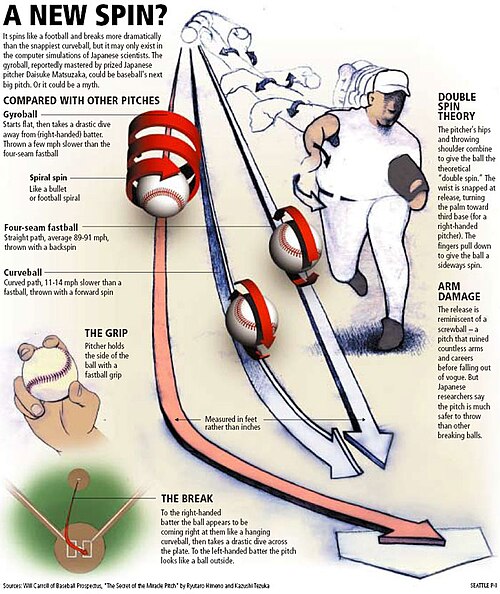
- A type of curveball with a severe break. Boston Red Sox pitcher Daisuke Matsuzaka is said to throw a gyroball. It was designed by a couple of Japanese scientists to reduce arm fatigue in pitchers. The result was a way to throw the ball with an extreme break. Whether such a special pitch really exists remains the subject of great controversy among experts of various pedigrees.[142]
H
hack
- To swing awkwardly at the ball. "As his son stood in the batter's box and hacked away, Wolpert came up with the idea of opening his own batting cage in Manhattan."[143] Sometimes said of an aggressive hitter who would swing at any pitch within reach, whether high, low, inside, or outside. "An unrepentant free swinger who hacked at anything in the same area code as the strike zone, Puckett drew just 23 walks that year."[144]
Hall of Fame
- The Baseball Hall of Fame in Cooperstown, New York. Abbreviated HOF. In popular usage, the terms "Hall of Fame broadcaster" and "Hall of Fame writer" are often used to describe recipients of two annual awards, respectively the Ford C. Frick Award and J. G. Taylor Spink Award. Recipients of these awards are recognized in dedicated Hall exhibits, but are not considered actual Hall of Fame members.
Hall of Very Good
- A tongue-in-cheek expression used to refer to players who had successful careers, but whose stats and/or overall performance are not good enough to put them into consideration for the Hall of Fame. Example of players said to be in the "Hall of Very Good" are Chris Carpenter,[145]Lee Smith (who eventually earned Hall of Fame induction), and Mark McGwire.[146]
hammer
- To hit the ball hard, typically for extra bases. "Aaron hammered that pitch."
- The nickname of Henry Aaron—Hank "The Hammer" Aaron—second all-time in Major League career home runs.
- A curve ball, usually of the 12 to 6 variety.
handcuff
- A hard-hit ground ball that bounces directly at an infielder is difficult for him to get his hands on –he appears to have been handcuffed.
- A pitch thrown high and inside "handcuffs" a batter because he can't get his hands far enough away from his body to swing the bat.
handle
- Often it's said of a player who has not fielded a batted ball cleanly that he "couldn't find the handle on it". This suggests the fanciful notion that a baseball would be easier to hold onto if it had a handle.
hang
- A breaking ball that does not "break", or change direction, and so is easy to hit. A hanging curveball.
- A pitcher may be hung with aloss if he is responsible for his team falling behind in runs and the team never recovers the lead.
- A runner may be hung up if he is caught in a rundown.
- A runner may be hung out to dry if he gets picked off at first base, or if a hitter misses a hit-and-run sign and the runner is easily tagged out at second base. A player may be hung out to dry if his team treats him in an unexpected or disappointing way. (Story: "The Mets got what they needed from pitcher Al Leiter yesterday. Unfortunately, Leiter was hung out to dry again, done in by his team's anemic offense.")
- A team may hang a (number) on the opposing pitcher or his team by scoring that many runs. May use a literal number or an informal term such as a crooked number or a snowman.
happy
- When a pitcher uses a particular type of pitch so much that he becomes less effective, he's sometimes said to be "happy" with the pitch – fastball happy or curveball happy, for example. "This article is a response, in part, to a Boston Globe sports rumor asserting that Josh Beckett has become 'Curveball Happy' and has changed his release point."[147]
hard hands
- A tendency to mishandle fielded balls. Also stone fingers. Contrast soft hands.
hardball
hat trick
- To strike out three times. Used jokingly, as the same term means to score three times in hockey and other sports. This term is also used to indicate someone who has hit three home runs in a game.
HBP
head of lettuce
- When a player breaks their bat after hitting the pitch, and the main portion of the bat (the barrel) lands within the infield, the broken portion can splinter into many pieces. (If the barrel lands either in foul territory or outside the established infield, the event is not a head of lettuce.) The term pays homage to other food-related baseball terms such as "can of corn", "high cheese", "in a pickle", etc. The original use of the term dates to 2006 when Joshua Githens first noted the likeness to striking a head of lettuce with the bat. "That bat exploded like a head of lettuce!"
headhunter
heart of the plate
- Middle of home plate. "Looking to go up the ladder, Hughes instead missed right over the heart of the plate just below belt high with a 95-mph fastball. As good hitters do, Vladimir Guerrero made him pay with a single up the middle."[148]
heat
- Also heater. A fastball.
heavy hitter
- A power hitter. A player who hits a lot of home runs or other extra-base hits. A batter with a high slugging percentage. A slugger. A term shared with the sport of boxing, referring to a fighter who scores a large number of knockouts.
help his own cause
herky-jerky
- A pitcher with an unusual or awkward wind-up or motion, as if he's not in full control of his legs and arms, may be said to have a herky-jerky motion.
hesitation pitch
- A pitcher who pauses in his wind-up, perhaps at the top of the wind-up, may be said to have a hesitation pitch. If this is part of his regular motion, it may be effective in throwing off the timing of the batter. If it's an occasional motion and used when there are runners on base, the pitcher is at risk of being called for a balk.
hidden ball trick
- A very rare feat in which a fielder has the ball and hides it from a runner, tricking him into believing some other fielder has it or that it has gotten away from them. (There is no rule against such deception except that once the pitcher toes or stands astride the rubber, he must have the ball in his possession or else a balk will be called.) Any baserunner so victimized will be ribbed endlessly by his teammates for having been caught napping.
high and tight
- A locationpitch thrown above the strike zone and close to the batter.
high cheese
- A fastball thrown high in the strike zone.
high hard one
- A fastball thrown high in, or above the strike zone.
high heat
- A strike thrown high in the strike zone.
high let it fly; low let it go
- An adage about batting against a knuckleball pitcher. Fluttering knuckleballs are notoriously hard to hit, especially low in the strike zone.
hill
- The pitcher's mound.
hit
- The act of safely reaching first base after batting the ball into fair territory. Abbreviated as H, this meaning is synonymous with base hit. See also single, double, triple, home run, extra-base hit, error, fielder's choice.
- The act of contacting the ball with the bat. "The batter hit the ball right at the second baseman."
- When a batter is touched by a pitch. See hit by pitch
- The term sacrifice hit is used by scorekeepers to indicate a sacrifice bunt. It is typically an out, not a base hit (unless the batter beats the throw to first without benefit of an error).
hit a bullet
- To hit the ball very hard, typically a line drive.
hit and run
- An offensive tactic whereby a baserunner (usually on first base) starts running as if to steal and the batter is obligated to swing at the pitch to try to drive the ball behind the runner to right field. Contrast this to a run and hit, where the runner steals, and the batter (who would normally take on a straight steal) may swing at the pitch.
hit away
- After a batter has attempted but failed to lay down a bunt, or in a situation in which he might ordinarily be expected to bunt, he may instead make a normal swing at the ball on the next pitch. In such a case he is said to "hit away" or "swing away". "Smoltz swung away, fouling it off for strike one. Knowing that the bunt had been given away on the first pitch, Braves manager Bobby Cox took off the bunt sign this time."[149]
hit behind the runner
- An offensive tactic where the batter intentionally puts the ball in play to the right side (the first base side) with a runner on second. The intent is to advance the baserunner to third, where a sacrifice fly by the next hitter can score a run.
hit by pitch
- When a pitch touches a batter in the batter's box, the batter advances to first base. If the pitch hits him while he is swinging (striking) he is not awarded a base, and if the umpire feels he made no effort to avoid getting hit he simply calls a ball.
- Colloquially, a batter who is hit by a pitch has been plunked, drilled, nailed, plugged, or beaned.
hit 'em where they ain't
- Said to be the (grammatically casual) response of turn-of-the-20th-century player Willie Keeler to the question, "What's the secret to hitting?" in which "'em" or "them" are the batted balls, and "they" are the fielders.
hit for average
- Contrary to what might be literally implied, a player who "hits for average" is one who achieves a high batting average.
hit for the cycle
hit it where the grass don't grow
- Hit the ball into the stands for a home run.
hit on Christmas Day
- When a player seems to have a natural aptitude to get hits in all situations. "Magglio can hit Christmas Day", Tigers manager Jim Leyland said. "It's an old saying, and he's one of those guys who can. There's nothing fancy. He sees it, hits it and does it pretty damned good."[151]
hit parade
- A rapid succession of hits within the same inning or a high total of hits throughout a game.
hit the ball on the screws
- To hit the ball even center with measured force, often resulting in a loud crack of the bat. A slumpingbatter might be comforted by "hitting the ball on the screws" when not getting a hit. The phrase derives from golf, referring to a well executed shot. Back when "woods" were actually made of wood, manufacturers screwed a plastic insert into the club face as a safeguard against premature wear. When a golfer hit a good shot he would say, "I hit it on the screws."[152] Another source is the fact that early baseball bats usually cracked lengthwise into two pieces; many were repaired using glue and two screws. (Such repairs are now illegal.)
hit the deck
- When a batter drops or dives to the ground to avoid being hit by a pitch. "The third kind of pitch is the one that is coming right at your head. This one you don't even have time to think about. Some part of you sees the ball as it leaves the pitcher's hand, and something about the fact that the ball is coming straight toward your eye makes it almost disappear into a blind spot. You hit the deck before you even know you've done it."[153]
hit the dirt
- To slide. Sometimes used also as equivalent to hit the deck.
hitch in his swing
- When a batter does not swing the bat in a single motion – perhaps he lifts the bat or moves his hands or hesitates before swinging – he may be said to have a "hitch in his swing". Having a hitch may slow down how quickly or powerfully he swings at the pitch. "All winter, Green worked on eliminating a hitch from his swing. He did it by setting up a video camera at a batting cage near his home in Irvine, California, taping swing after swing, and comparing it with video from his days with the Los Angeles Dodgers."[154]
hitter
a person who hits a ball with a bat in baseball.
hitter's count
- When a batter is way ahead in the count (3–0, 3–1) he's likely to anticipate that the next pitch will be thrown for a strike. See count.
hitter's park
- A baseball park in which hitters tend to perform better than average. This may be a result of several factors, including the dimensions of the park (distance to the outfield fences, size of foul territory behind the plate and down the lines), prevailing winds, temperature and relative humidity, and altitude. Whether a park is a hitter's park or a pitcher's park (in which hitters perform worse than average) is determined statistically by measuring Park Factors, which involves comparing how well hitters perform in a given park compared with how they perform in all other parks. This measure is regularly reported and updated for Major League Baseball parks by ESPN.com.[155] Baseball Reference [156] and other baseball research organizations also report park factors for major league parks. Baseball Prospectus [157] and other baseball researchers calculate park factors for minor league parks to help in adjusting the statistics of baseball prospects.
- Whether a park is a hitter's park or pitcher's park may change from day to day. For example, when the wind is blowing "out" at Wrigley Field, it is typically rendered a "hitter's park", and a double-digit score for one or both teams is not unusual.
- On the other hand, some are hitter's parks, any and all other factors notwithstanding. Atlanta–Fulton County Stadium, Braves home field from 1966 to 1996, was known as The Launching Pad.
hitterish
- A physical and/or mental state where a player is seeing pitches well and his timing is on, so that observers or the player himself feel he has a good chance at getting a hit. Often used by players and sportscasters. "It's like Charley Lau used to tell us, used to tell me: 'You look very hitterish up there. You look hitterish, you look like you're going to hit the ball hard'", Brett said in camp.[158]
hold
- A hold (abbreviated as H) is awarded to a relief pitcher if he enters in a save situation, records at least one out, and leaves the game without having relinquished that lead. To receive a hold, the pitcher must not finish the game (thus becoming the closing pitcher) or be the winning pitcher.
- Unlike saves, more than one pitcher can earn a hold in a game. It is also not necessary for the pitcher's team to win the game in order to achieve a hold; they merely have to be in the lead at the time the pitcher exits.
- The hold was invented in 1986 to give credit to non-closer relief pitchers. Holds are most often accredited to setup pitchers, as they usually pitch between the starter and the closer. Holds are not an official Major League Baseball statistic, but are recognized by MLB in its rules.
hold the runner on

- When a runner is on first base, the first baseman might choose to stand very close to first base rather than assume a position behind first base and more part-way toward second base (a position better suited to field ground balls hit to the right side of the diamond). When he does this he's said to "hold the runner on (first)" because he's in a position to take a throw from the pitcher and thereby discourage the runner from taking a big lead-off.
hold up on a swing
- When a batter begins to swing the bat at a pitch but stops swinging before the bat makes contact with the ball or the bat passes the front of the plate, he may be said to "hold up on his swing".
hole
- One of the nine places in the batting lineup. The leadoff hitter in the first inning is the player in the "one hole". In the four hole, the cleanup hitter is hoping to get to the plate in that inning.
- Also see #in the hole.
hole in his glove
- A tendency to drop fly balls, usually after they hit (and seem to go through) the fielder's glove.
hole in his swing
hole in the lineup
- A team that has one or more weak hitters in its 9-person batting order has a "hole in the lineup" that opposition teams can take advantage of. "There are no holes in that lineup, so to say you're going to pitch around one batter might not be the best thing."[160] "If the team that Shapiro has constructed is going to overtake the Boston Red Sox, the New York Yankees or any of the other contenders in the American League, it can't afford another season with a hole in the middle of the lineup that Hafner was from May through the playoffs last season."[161]
home
- Home plate. For a runner to reach home safely is to score a run. Getting a runner who is on base home is the goal of any batter.
home cooking
- When a player for the home team gets a favorable or generous call from the official scorer, the players may refer to the scorer's call as "home cooking". For example, the scorer may credit a batter for a base hit on a batted ball that a fielder bobbled briefly and then failed to make a putout.
- "Home cooking" is sometimes used synonymously with home field advantage. The reference may be to the home team having the advantage of living at home, not just to being able to play in its own stadium.
home advantage/home field advantage
- Teams playing home games have a small advantage over visiting teams. In recent decades, home teams have tended to win about 53.5% of their games.[162] Because teams play the same number of games at home as they do away during the regular season, this advantage tends to even out. In play-off series, however, teams hope to gain from home-field advantage by having the first game of the series played in their home stadium.
home game/home team
- A game played at the home stadium or ballpark of a baseball club. When the Yankees play in Yankee Stadium, they're playing a home game. The team hosting the game is referred to as the home team. In rare instances, the home team plays in a stadium not their own. In 2005, the Houston Astros played a "home" series against the Chicago Cubs at Miller Park in Milwaukee, home of the Brewers, because their home stadium, Minute Maid Park, was rendered temporarily unusable because of Hurricane Rita. In 2010, the Toronto Blue Jays played a "home" series against the Philadelphia Phillies at the Phillies' home park, Citizens Bank Park, because of security concerns due to the G-20 summit being held in Toronto. Despite being in Philadelphia, the Blue Jays wore their home white uniforms and batted last. Also, despite Citizens Bank Park being a National League field, the designated hitter was used in the series.
home half
- The second (bottom) half of an inning, in which the home team is at bat.
home plate
- See also plate.
home run
- A home run (or homer) is a base hit in which the batter is able to circle all the bases, ending at home plate and scoring a run himself.
home run derby
- A batting competition in which the object is to hit the most home runs.[163] The 1960 television series Home Run Derby featured such a competition.[164] The term can also be used to refer to a game during which many home runs are hit.[165] The term was first used in the 1920s to refer to the race ("derby") between batters to lead their league in home runs for the season.[166]
- Since 1985, Major League Baseball has hosted an annual Home Run Derby,[167] and the Chinese Professional Baseball League (CPBL) has done so since 1992. At least one minor league, the Southern League, has also held a home run derby.[168] In 2007, the Israel Baseball League played seven-inning games, and if the teams were tied at the end of the seventh inning the tie was broken by use of a home run derby.[169] A number of amusement parks, entertainment centers and batting cages offer a home run derby type competition.[163] Since 2022, a three-player home run derby shootout is used to determine the winner of the All-Star Game in case of a tie.
home run trot
- When a batter, realizing the ball he just hit is about become a home run, slows from a run to a celebratory trot. "Well, I've been saying it all year, and it finally happened tonight: David Ortiz became the first player in the 2010 season to take more than 30-seconds to trot around the bases after a home run. With four of the top five slowest home run trots of the year already - all four of which were clocked in at 28.95 seconds or slower - it seemed inevitable that he would be the first to break the half-minute barrier."[170]
- Sometimes a player mistakenly slows down, however, when the wind or a superb play by an outfielder, turns a home run into a double or single off the outfield wall, or to a long out, or to another odd outcome, as the following case illustrates:
Unfortunately for his personal power totals, Milledge was bamboozled into believing his liner in the fourth inning against the Chicago Cubs on Thursday night had cleared the left-field fence at PNC Park for his first career grand slam. Dead certain he had gone deep, Milledge raised his fist rounding first base, put his head down and went into a trot. Cool. Double-dog certain because the fireworks guy at PNC set off the pyrotechnics that explode every time a Bucs player goes deep. Music also began to blare. What a glorious moment for the Bucs! ... only, the ball had not cleared the fence. It hit the top and stayed in the field of play. As Bucs announcer Bob Walk said, "Uh oh, uh oh, uh oh, uh oh—we got a problem here." Milledge was not quite midway between second and third base when he realized the Cubs had him in a rundown. And, yeah, um, he was tagged out. Score that a two-run double and a big ol' base-running blunder.[171]
home stand
- A series of home games. See also road trip.
home team
- The "home team" is the one in whose stadium the game is played against the "visiting team". The home team has the advantage of batting in the second or bottom half of the inning. In case a game is played at a neutral site, the "home" team is usually determined by coin toss.
homer
- A home run.
- A derisive term for a dedicated, almost delusional, fan. Especially used for a broadcaster, in any sport, whose team "can do no wrong"; for example, they might argue a bad strike call, but say nothing about one against the opponent. Johnny Most of the Boston Celtics and Hawk Harrelson of the Chicago White Sox were notorious "homers." In a somewhat more humorous example, Bert Wilson used to say, "I don't care who wins, as long as it's the Cubs!" A common "homer" saying is, "My two favorite teams are (my team) and whoever's playing (my team's rival)."
hook
- When a manager leaves the dugout with the obvious intention of replacing the pitcher with a reliever, he may be said to be carrying a hook. "Here comes Sparky, and he's got the hook." Such a usage may have come from the large hooks that were sometimes used in Vaudeville to yank unsuccessful acts off the stage if they were reluctant to leave on their own. When he was manager of the Cincinnati Reds, Sparky Anderson's heavy reliance on relief pitching earned him the nickname "Captain Hook", a reference both to the standard usage and to the Peter Pan villain.
- A pitcher is said to be "on the hook" when he leaves the game with his team behind because of runs that he gave up—a hook on which he may be hung with the loss.
- A curveball.
hook foul
- When the batterpulls the balldown the line, starting fair but ending foul, resulting in a foul ball. See also slice foul.
hopper
- A batted ball that takes several bounces in the infield, or a single "high hop" after it hits the ground just in front of home plate. Also see "short hop".
horsehide
- The ball (a baseball) used in the game of baseball.
- The leather cover on the baseball (which is now usually made of cowhide, not horsehide). A slugger may be said to "knock the horsehide off the ball". Horsehide was the cover of choice for decades, as it was less prone to stretching than cowhide. This was necessary in part because in the early days, they tried to play the entire game with a single ball, or as few as possible. That became moot in the 1920s, but horsehide continued to be used until the 1980s or so, when horsehide became prohibitively expensive and cowhide was finally adopted as the standard cover for a baseball.
hose
- A strong arm, said typically of an outfielder. To "be hosed" is to be thrown out on the bases, typically from the outfield.
hot
- A batter who is having a hitting streak or a team having a winning streak is said to be "hot". "'Today was pretty impressive', Scioscia said. 'Hitters, they have their times. When they're hot, they're hot. You can't do anything about it.'"[172]
hot box
hot corner
- The area around third base and the third baseman, so called because right-handed batters tend to hit line drives down the third base line. The third baseman is sometimes called a "cornerman".
hot stove league
- An old fashioned term for a "Winter league" with no games, just speculation, gossip, and story-telling during the months between the end of the World Series and the beginning of Spring training, presumably conducted while sitting around a hot stove. One of Norman Rockwell's well-known baseball paintings is a literal illustration of this term.
house by the side of the road
- A batter who strikes out looking. The term was made popular by legendary Detroit Tigers radio broadcaster Ernie Harwell, who would often say, "He stood there like the house by the side of the road, and watched the ball go by."[173] The phrase originates from the title of a poem by Sam Walter Foss.
howitzer
- A very strong arm. A cannon. A gun. Usually applied to an outfielder. Named after the Howitzer artillery piece. Headline: "Roberto Clemente: A Howitzer for an Arm, An Ocean for a Heart".[174]
human rain delay
- A human rain delay is a derisive term for a player who is very deliberate in his play, such as a pitcher who takes a long time between pitches or a batter who constantly steps out of the batter's box. "The Seattle Mariners will announce a new manager today—Mike Hargrove. Hargrove bears a great nickname—'The Human Rain Delay'. The name stems from the fact that, as a player, Hargrove would take about 15 minutes for every plate appearance. He would step out of the batter's box, fidget with his gloves, his helmet, his pants. He drove the pitcher nuts, but that was his plan."[175]
humpback liner
- A ball hit deep in the infield on a trajectory between those of fly balls and line drives.
hurler
- A pitcher.
hustle double
I
ice cream cone
- See: snow cone.
I have it. You get it.
- A fielding play, usually where a lofty fly ball is to land equidistant between two fielders. Both are unsure who should catch it, usually resulting in last-second leaps or dives. Often neither does, in which case the one who had the better chance is charged with an error.
immaculate inning
- A half-inning in which the pitcher strikes out all three batters he faces with exactly nine pitches.
in the batter's eyes
- A high fastball, usually at or near the batter's eye level. Above the strike zone, so a ball, and hard to hit, but also hard to lay off.
infield fly rule
- The umpire calls the batterout when the batter hits a fly ball that can be caught with ordinary effort by an infielder in fair territory, and (c) there are runners on first and second, or on first, second, and third. The infield fly rule is not in effect for a bunt or a line drive.
- The definition specifies that a ball need not be caught by an infielder, only that an infielder could have caught the ball using "ordinary effort." The ball does not need to remain in the infield for the infield fly rule to be invoked. The definition specifically states that no arbitrary marking, such as the infield cutout, may be used to determine whether a batted ball is an infield fly.
- The catcher and the pitcher are considered infielders for the purpose of the infield fly rule.
- The batter is automatically called out in this situation whether or not an infielder attempts to catch the fly ball, assuming it stays fair. The rule states that the umpire is supposed to announce, "Infield fly, if fair." If the ball will be almost certainly fair, the umpire will likely yell, "Infield fly, batter's out!" or just "Batter's out!"
- This rule is intended to prevent the fielder from intentionally allowing the ball to drop and getting force outs on the runners on base. :*The rule is a little mystifying to casual fans of the game, but it has been a fundamental rule since 1895, allegedly to prevent the notoriously tricky Baltimore Orioles from intentionally dropping the ball.
- The simplest way to think about it is this: If there is a potential force out at third with fewer than two outs, the infield fly rule is in effect.
infielder
- First baseman, second baseman and third baseman, plus the shortstop, so called because they are positioned on the infield dirt. The pitcher and catcher are typically not considered infielders, but instead as the battery. However, for purposes of implementing the Infield Fly Rule, the catcher, pitcher, and any player stationed in the infield when the pitch is delivered are included as infielders.
inherited runner
- The runner or runners on base when a relief pitcher enters the game. Since a previous pitcher has allowed these runners to reach base (or was simply pitching when the runners reached base, such as in the case of a fielding error), any inherited runners who score when the relief pitcher is pitching are charged to the previous pitcher's runs allowed and/or earned runs allowed total, depending on how each runner reached base. Modern box scores list how many runners each relief pitcher inherits (if any), and how many of those inherited runners the relief pitcher allows to score, called inherited runs allowed (IRA).
in jeopardy
- In general, a baserunner is in jeopardy at any time the ball is live and the baserunner is not touching a base, except in the cases of overrunning first base on a fair ball or advancing to an awarded base, e.g., on a base on balls or hit by pitch. A baserunner who is in jeopardy may be putout by a fielder at any time.[176]
injured list
- Major league teams may remove injured players from their active roster temporarily by placing them on the injured list. Another player can then be called up as a replacement during this time.
inning
- An inning consists of two halves. In each half, one team bats until three outs are made. A full inning consists of six outs, three for each team; and a regulation game consists of nine innings. The first half-inning is called the top half of the inning; the second half-inning, the bottom half. The break between the top and bottom halves is called the middle of the inning. The visiting team is on offense during the top half of the inning, the home team is on offense during the bottom half. Sometimes the bottom half is also referred to as the home half.
innings eater
- A pitcher who may or may not be a starter or a closer but who can be relied on to pitch several innings either to keep his team in contention or sometimes when the game is no longer close, is an "innings eater". Headline: "Appetites never diminish for 'innings-eating' pitchers".
The success of most pitchers is based on statistics such as won-loss record, ERA or saves, but the unsung "innings eater" is judged by how many innings he pitches and the impact his work has on the rest of the staff. "I don't have a whole lot of goals going into the season. I don't shoot for a certain ERA or a certain strikeout number or certain number of wins," says Blanton, entering his second full season. "I try to go out and get a quality start every time, six innings or more, and not miss any starts. I feel if I can do that, I'll get my 200 innings in a year and everything else falls into place with that."[177]
inside baseball
- An offensive strategy that focuses on teamwork and good execution. It usually centers on tactics that keep the ball in the infield: walks, base hits, bunts, and stolen bases. This was the primary offensive strategy during the dead-ball era. Inside baseball is also a common metaphor in American politics to describe background machinations. The equivalent modern term is small ball.
inside pitching
- A tactic used by pitchers which involves throwing a pitch close to the batter to make it more difficult to swing their bat, and result in making less solid contact.
inside the ball
- Proper mechanics of a baseball swing, in which the hitter rotates his body while keeping his hands and the bat close to his body, with the bat coming across the plate after the body has almost fully rotated 90 degrees from his initial stance. Sometimes the phrase used is that the hitter "keeps his hands inside the baseball", and sometimes that the hitter himself "keeps inside the ball" – never mind the connotation of a player's literally being inside a baseball. "He's staying inside the ball so good, man", Dunn said. "For big guys like us, that's a hard thing to do. You always want to get the head [of the bat] out. His right hand is staying inside, so good. That's why he's able to hit the ball to left, to center, to right. He's in a good place right now."[178]
inside-out swing
- When the batter swings at a pitch with his hands ahead of the end of the bat. For a right-handed hitter, this often leads to balls being hit toward the right side of the diamond. One of the most famous "inside-out" hitters is Derek Jeter: "While Jeter became known over his two decades for rising to the occasion and delighting fans with his heroics, he was above all a technician, slashing at pitches with his trademark inside-out swing."[179]
inside-the-park home run
- A play where a hitter scores a home run without hitting the ball out of play.
insurance run
- A run scored by a team already in the lead. These surplus runs do not affect the game outcome but serve as "insurance" against the team giving up runs later.
intentional pass/intentional walk
- Additional terms for the intentional base on balls.
interference
- Interference is an infraction where a person illegally changes the course of play from what is expected. Interference might be committed by players on the offense, players not currently in the game, catchers, umpires, or fans; each type of interference is covered differently by the rules.
interleague play
- Regular-season games between teams in different major leagues, which allow natural rivals and crosstown rivals to play each other more often, not just in play-offs.
Internet baseball awards
- While Major League Baseball calls on the Baseball Writers' Association of America (BBWA) to name the most valuable player, rookie of the year, and Cy Young Award winner each year, since 1997 Baseball Prospectus has conducted an on-line poll to make Internet Baseball Awards in those categories as well as manager of the year.[180]
interstate
- A batting average below .200. A player with a batting average of .195 is said to be on I-95, a reference to the numbering on the Interstate Highway System. See also the Mendoza Line.
in the books
- The game is over. Long-time New York Mets radio broadcaster Howie Rose (first on WFAN, now on WOR) ends every Mets win with the catchphrase, "Put it in the books!" (Rose's memoir is entitled Put It In The Book!)
in the hole
- The spaces between the first baseman and second baseman and between the shortstop and the third baseman, one of the usual places where a ground ball must go for a hit. "Ozzie went deep in the hole" but, despite Ozzie's best effort, the ball "found a hole" through the infield and into the outfield. See also up the middle and down the line.
- Due up to bat after the on-deckbatter. Probably derived from boating, where it was originally "in the hold", the place prior to being "on deck". "In the hole" is a corruption of the original nautical term made popular by people who did not understand the original origin. Today, the corruption has become universal.[181]
- An unfavorable count. A pitcher would be "in the hole" 3-0 and a batter would be "in the hole" 0-2.
in the (his) kitchen
- Pitching in on the hitter's hands.
in play
- A game is in play when the umpire declares "play ball" at the beginning of the game or after a time-out.
- Any batted ball is "in play" until either the play ends, the umpire calls the ball foul, or there is fan interference or some other event that leads to a dead ball. A ball hit into foul territory but in the air is in play (a fielder may attempt to catch it for an out and runners may attempt to advance after such a catch), but only before it hits the ground or the fence.
- In sabermetrics, a special definition of "ball in play" is the calculation of "batting average on balls in play" (BABIP), which excludes home runs even though they are fair balls.
- Also see play.
IO (in and out)
- Infield and outfield practice. "Everyone take your positions for a quick IO"
J
J-run
- The run the pitcher takes from the mound to first base in order to cover for the first baseman who has just fielded the ball.
jack
- A home run or to hit a home run. "Hitting a jack" or "Jacking one out of here".
jake
- Half-hearted or lazy effort by a player, i.e. "He jaked that play."
jam
- To pitch far enough inside that the batter is unable to extend while swinging. "The pitcher jammed the batter." The batter was "handcuffed" or "shackled" by the pitch.
- When runners are in scoring position with less than two outs and good hitters coming up. "The pitcher is in a jam."
- The "bases are jammed" (or loaded or full) when there are runners on all three.
janitor throw
- When an outfielder, 'cleaning' a pitcher's mess by throwing a runner out, spins or falls down after a strong throw.
jelly legs
- A batter's legs are "made out of jelly" when he departs from a good stance. "His curve ball ... it jelly-legs you." - Phillies First Baseman Jim Thome, referring to Barry Zito's curve.[182]
jerk
- To "pull" the ball towards left field if you bat right handed or "pull" the ball towards right field if you're batting left handed. Opposite of jerk would be push or hitting an "oppo", meaning going towards the opposite field.
- To hit the ball hard, typically used to refer to pulling the ball over the fence for a home run. "Derrek Lee jerked one of his patented doubles into the left-field corner to lead off the fourth against Minnesota lefty Johan Santana, the reigning Cy Young winner."[183]
Judy
- A Punch and Judy hitter who hits with little power.
juiced
- "Bases juiced" means #bases loaded.
- A player who is said to be juiced is thought to be taking performance-enhancing drugs. "It is now assumed, of course, that Bonds may well have been juiced on steroids at the time; the previous year he had set the all-time single-season record of 73 home runs, and his musculature was almost freakishly swollen."[184]
- A baseball that is juiced has been modified in some way that makes it travel farther when hit. "Spectacular increases in home runs have often raised the question: Has the ball been juiced up to travel farther, in order to increase the number of home runs?"[185]
jump
- A fielder is said to get a good jump on the ball when he anticipates or reacts quickly to a batted ball and is thereby able to make a good play by fielding or catching it.[186] Also see crack of the bat.
- A baserunner gets a good jump when he is able to leave the base well before the pitch reaches the plate. "Upsetting the timing of the baserunner can effectively prevent him from getting a good jump ... Base runners often read a pitcher's look and get their jump, or start, based on the pattern the pitcher establishes."[187]
- To move to another team or league despite existing contractual obligations.[188]
Junior Circuit
- The American League, so-called because it is the younger of the two major leagues. The American League was founded in 1901, while the National League – the Senior Circuit – was founded in 1876.
junk
- breaking balls and knuckleballs, pitches that are hard to hit due to movement rather than velocity. "I couldn't believe he threw me a fastball because he had me down 1-2", Thames said. "He's usually a junk pitcher and he tried to sneak a fastball past me, and he left it up."[189] See also: Eephus pitch
junkball pitcher
- A pitcher who throws predominantly junk, usually due to a weak (or slow) fastball. A junkballer, junkman or a junk artist: "Like all junk artists, Trujillo will have to prove himself at the higher levels before getting a shot at a major league job."[190][191] Pitcher Randy Jones earned the nickname "Junkman" for his mastery of this style of pitching. See also: Eephus pitch
K
K
- The traditional abbreviation for a strikeout. A backwards K is often used to denote a called strikeout. Invented by Henry Chadwick by taking the "most prominent" letter and reinforcing it with an inferred knockout, the connotation still exists when an announcer says the pitcher "punched out" the batter, a play on words that also refers to punching a time clock and to the motion a home plate umpire usually makes on a called third strike.
keep off the boards
- Also singular, "keep off the board". Keep a team from scoring, and hence off the scoreboard. "Wainwright has kept runs off the board at a better rate than Lester."[192] "After loading the bases with one down in the fourth, the Gators were kept off the board by Barham."[193]
keep the hitter honest
- A pitcher needs to mix up his pitches and thereby "keep the hitter honest" by making it difficult for the hitter to anticipate the type, speed, and location of the next pitch. Sometimes this means throwing a brushback pitch to keep the batter from leaning over the plate to reach a pitch on the outer part of the plate. "Partially with Boston in mind, Wang focused this spring on expanding his repertoire to keep hitters honest and move them off the plate."[194]
keep the line moving
- A reference to a series of batters getting on base safely and advancing runners on base, alluding to an assembly line. "Beltran's popout tore apart a rally that had shaken the Hall of Fame-bound Rivera, molding a game out of what moments before had been a five-run rout. Instead, Beltran couldn't keep the line moving, leaving an eager David Wright awaiting on deck."[195] The 2015 Kansas City Royals were one of the most notable examples of "keeping the line moving" during their postseason run, which led to a World Series title.[196][197]
keystone
- Second base.
- Together the shortstop and second baseman – the fielders nearest second base, often combining on double plays – are sometimes referred to as the keystone combination.
kicked
- A player who makes an error fielding a ground ball may be said to have "kicked the ball" or "kicked it".
kill
- A batter who hits the ball very far may be said to have "killed the ball".
- A pitcher who stifles a rally by the opposing team may be said to have "killed the rally".
knee-buckler
- A breaking ball (usually a curveball) that breaks very sharply, so much so that it freezes the hitter. It starts out directly at the batter (knees buckling out of fear) and then drops into the strike zone.
knock
- Knock in: To score an RBI. "Kenny Lofton knocked in the go-ahead run with a 10th-inning single Thursday afternoon as the Cleveland Indians beat Detroit."[198]
- A hit: as in "a two-base knock".
- Knocks: Hard hits or extra-base hits, not necessarily producing RBIs or referring to a specific type of hit. "Curtis had some solid knocks today."
- Knocked around: A pitcher who gives up a lot of hits and gets removed from the game is said to have been knocked around or knocked out of the box or knocked out of the game. Example headline: "Toronto 7, Detroit 4: Phil Coke knocked around; Tigers' bats don't respond".[199]
- Knock down: an infielder who stops a line drive from getting through the infield "knocks it down", perhaps then picking up the ball and throwing the runner out.
- Knock off: to knock off an opponent is to win the game. "Hawaiʻi knocks off Santa Clara."[200]
- Knock the cover off the ball: to hit a baseball extremely hard. See also tore the cover off the ball.
knuckleball
- A pitch thrown with no spin, traditionally thrown with the knuckles, but also with the fingertips. It tends to flutter and move suddenly and erratically on its way to the plate. Also refers to a batted ball that flutters "like a knuckleball". SYNONYMS: knuckler, flutterball, butterfly ball, floater, bug.
L
lace
- To reach base by hitting a ball between infielders. "McCann laced it through the shift on the right side of the infield."
Lady Godiva
- A pitch delivered with nothing on it. A nod to the legend of Lady Godiva riding naked on horseback.[201]
LAIM
- An acronym for League Average Inning Muncher. A LAIM is generally a starting pitcher who can provide around 200 innings over the course of a season with an ERA (Earned Run Average) near the league average. A LAIM is counted on to consume innings, keeping his team in the game but not necessarily shutting down the opposition. The term was coined by baseball blogger Travis Nelson, but is used by other writers as well.[202]
large sausage
- A slang term for a grand slam home run. It is a takeoff from the term "grand salami" which some people use to refer to a grand slam.
laser show
- A batting performance with a high number of base hits, particularly line drives. Also, the nickname of Boston Red Sox second baseman Dustin Pedroia.
late innings
- The seventh, eighth and ninth innings of a regulation nine-inning game.
laugher
- A game in which one team gets a large lead, perhaps early in the game, and it appears the other team has no chance at all of catching up. With nothing to worry about, the manager and team can relax. An easy win; a romp; a blowout.
launch
- To hit a long fly ball, as if launching a rocket. "Orso, who recently signed with Alabama Southern to play college baseball next season, launched several rocket shots and by far hit the furthest home runs of anyone in the competition ..."[203]
- It is also said that a pitcher "launches" the ball when he throws a wild pitch that gets away from the catcher, and that a fielder "launches" the ball when he throws it wildly out-of-reach of the intended receiver.
launch angle
- The angle, with respect to the ground at home plate, at which a batted ball leaves the bat.[204]
launch pad
- A term for a ballpark in which many home runs are hit. The Atlanta Braves' former home of Atlanta–Fulton County Stadium became known as "The Launching Pad" for this reason.
Lawrence Welk
- A (rare) 1-2-3 double play ("... an a one, an a two, an a ...").
lay down
lay off
- If a batter decides not to swing at a pitch, especially if he deliberately avoids swinging at certain types of pitches, he may be said to "lay off" a pitch. Pitchers tempt hitters to swing at pitches they cannot hit; batters try to lay off such pitches. "Batters can't seem to lay off his slider, just as his parents can't seem to lay off his carrot cake—they're nearly addicted to it."[205]
lead
- When a baserunner steps off a base before a pitch is thrown in order to reduce the distance to the next base he takes a lead.
- The player who is first in the batting order for a given team in any given inning is said to lead off the inning.
leadoff hitter
- The first batter listed on a team's lineup card (in the 1-hole or the "leadoff spot" on the line-up card). When the announcers read the starting line-up they might say, "Leading off, and playing short-stop, is Sammy Speedyrunner. Batting second, playing second base, Carlos Contacthitter. Batting third, in the pitcher's spot, is designated hitter Burt "Biggie" Brokenleg. Batting clean-up, playing left field, Thor Thunderbat ..."
- The first batter in an inning (who could be in any hole on a team's line-up card). If that batter gets a single, or a home run, or a walk, the announcer would say he has a "leadoff single", a "leadoff home run", or a "leadoff walk" respectively.
leaning
- A baserunner is said to be "caught leaning" or "leaning the wrong way" when he is picked off a base while shifting his weight toward the next base.
leather
- Referring to a fielder's glove, a player with good leather is a good defensive player (typically an infielder).
- Flashing the leather means making an outstanding defensive play.
- A leather player refers to a player who is outstanding on defense but only average or even less on offense. Ron Karkovice is one example of a "leather player".
left-handed bat
- Although baseball bats are symmetrical in shape, and thus there is no such thing as a left-handed baseball bat (or a right-handed baseball bat), in colloquial language a hitter who bats left-handed may be referred to as a "left-handed bat" or "left-hand bat". Headline: "Giants look to acquire left-handed bat".[206]
left-handed hitter
- Also "left-hand hitter". A batter who, paradoxically, bats from the right-side of the plate. Typically, an individual who is left-handed in most activities, including throwing a baseball, stands in the right-hand batter's box, the one closest to first base.
left-handed specialist
- A left-handed relief pitcher specializing in getting one out, often in critical situations. See also LOOGY.
left on base
- A baserunner is said to have been left on base (abbreviated LOB) or stranded when the half-inning ends and he has not scored or been put out.[207] This includes a batter-runner who has hit into a fielder's choice, causing another runner to be put out as the third out. It also includes runners on base at the end of a game, as when the home team scores a winning run in the ninth or a subsequent inning. Thus, a batter who hits a single in the bottom of the tenth inning in a tied game with the bases loaded drives in one run and leaves three on base (himself and the runners who were at first and second).[208]
- Team LOB totals are commonly reported in a baseball box score. It counts only those left standing on the bases when the third out of each inning occurs. Team LOB is used in "proving" a box score. The number of a team's plate appearances is to equal the sum of that team's runs, that team's LOB, and the opposing team's putouts. In other words, every batter who completes a plate appearance is accounted for as a run scored, putout, or LOB.[208]
- Individual LOB totals are sometimes reported in baseball box scores. This is a more recent statistic that is computed for each player who is at bat at least once in a game and is calculated on how many baserunners were "left on base" when the player was at-bat and caused an out, no matter how many outs there were at the time. Note that "at bat" does not include other plate appearances such as sacrifice bunts or flies made by the batter, third outs caused by pickoffs or caught stealing, or games ended with the winning run scoring on a successful steal, etc. Two common misconceptions of the individual LOB are that the individual LOB is the number of times the player was left on base as a baserunner (this is a "runner's LOB" and is not usually recorded), or that the individual LOB applies only when the at-bat player caused the third out. Note that the total of the individual LOBs for all players on a team will usually exceed the team LOB.
- A related statistic is "left on base in scoring position", which includes only those LOB where the runner was occupying second or third base. Yet another related statistic is "left on base in scoring position with less than two out". The intent of these statistics is to measure the tendency of a team or player to waste opportunities to score.
leg out
letter high
- A letter-high pitch is one that crosses the plate at the height of the letters on the batter's chest. Also see at the letters. Equivalent term: "chest high". "Dietrich fouled off a couple of pitches before Porcelloput him away with a letter-high fastball at 94."[210]
leverage situation
- A moment in a game with a potentially high impact on win probability. Such events are given a leverage index.[211]
lift
- To remove a player from the lineup in the middle of a game. "Casey was lifted for a pinch runner."
lights-out
- A pitcher who so dominates the hitters that the game is effectively over once he takes the mound—so they can turn out the lights and go home. The pitcher retires the batters in order without allowing a single run. "Putz pitched lights-out baseball once he took over the job for good from Guardado."[212]
Linda Ronstadt
- A fastball the pitcher delivers with such velocity that the hitter has no time to respond—it "blew by you." A pun on the song title "Blue Bayou," originally recorded in 1961 by Roy Orbison but popularized through Linda Ronstadt's 1977 cover version.[201]
line drive
- Also known as a liner, a line drive is a batted ball that is hit hard in the air and has a low arc. See also rope.
- A line drive may also be said to be "hit on a line".
- A batter may be said to have "lined out" if the liner was caught by a fielder.
- Line drives can be dangerous to baseball players and spectators. For example, on July 22, 2007, Tulsa Drillers first base coach Mike Coolbaugh was killed in a line drive accident at an away game with the Arkansas Travelers. Though the ball hit his neck, his death was the impetus for base coaches to start wearing helmets.[213] In a 2021 minor league game, pitcher Tyler Zombro was hit in the head by a 104-mile-per-hour (167 km/h) line drive, fracturing his skull and causing him to have a seizure.[214]
lineup
- The batting order, which also lists each player's defensive position. An announcer reading the starting lineup for a game will typically begin something like this: "Batting first, playing second base ..."
lineup card

- A form kept by each manager listing the starting players and all other players who are on the active roster and available to play in the game. Typically this form will be taped to the wall inside the dugout for the manager and coaches to consult when they need to make substitutions during a game. Before the game starts the manager hands a lineup card to the home plate umpire. This lineup will change throughout the game as starting players are removed and substitutes inserted.
Little League home run
live arm
- A strong arm, usually describing a pitcher who has a great deal of velocity on his pitches. "That pitcher has a live arm."
Live-ball era
- The time since 1919 or 1920 when several rule changes moved teams to adopt offensive strategies that favored power hitting over the inside game that was common in the dead-ball era.
live on the corners
- A pitcher who "lives on the corners" throws most of his pitches on the inside or outside edges of home plate. He's not inclined to try to overwhelm the hitter with hard pitches down the center of the plate. Many of his pitches will appear to barely nibble the plate.
lively fastball/life on the ball
- A fastball that seems to be not just fast but also hard to hit because it may have some movement on it or it may appear to speed up as it gets closer to the plate. "'His fastball has got more life to it', Jays catcher Rod Barajas said. 'It's finishing. What I mean by that is the last 10 feet [to home plate], it seems that it picks up speed.' According to Barajas, that has particularly helped Ryan against right-handed hitters. "They end up being late, because that last 10 feet, it seems like it picks up a couple miles per hour," Barajas said.[215]
load the bases
- A succession of plays that results in having runners on all three bases. See also bases loaded or bases full.
LOB
- Abbreviation for left on base.
locate
lock him up
- To sign a player to a long-term contract, thereby keeping him off the free-agent market. "Come on Uncle Drayton, you have to lock this guy up for a few years. He is one of the best in the league and along with Berkman, is the new face of the Astros."[216]
- To throw a pitch that keeps the hitter from making any effective swing. For example, when a left-handed pitcher throws a roundhouse curve or an inside fastball to a left-handed hitter, the hitter may appear to freeze in place. "We had him 0-2. We were trying to go in with a fastball, hopefully lock him up."[217] Also see "freeze the hitter".
lollipop
- A soft, straight pitch with a lot of arc.
long ball
- A home run. A team is said to "win by the long ball" after a walk-off home run or the team hits several home runs to win. Headline: "Phillies Use the Longball To Take Game 1 from the Dodgers".[218]
long ones
- Home runs. "He ravaged Pacific Coast League pitching for seven more long ones before being recalled by the Reds later the same month."[219]
long out
- A ball that is hit deep into the outfield (and caught) is a "long out".
long reliever
- A type of relief pitcher. Long relievers enter early in a game (generally before the 5th inning) when the starting pitcher cannot continue, whether due to ineffective pitching, lack of endurance, rain delay, or injury.
long strike
- A foul ball which finishes particularly close to being fair, often where a fair ball would have been a home run. So named as despite the good effort of the hitter, the result is a strike against him if the count before the pitch was less than two strikes.
LOOGY
- A mildly derogatory nickname for a left-handed specialist. An acronym for "Lefty One Out GuY", a left-handed pitcher who may be brought into the game to pitch against just one or two left-handed batters to take extreme advantage of platoon effects. An example is Javier López, who was a key component of the Giants' World Series winning bullpen in the 2010s. In 2020, MLB instituted a new rule that any pitcher who enters the game in the middle of an inning must face at least three batters or finish the inning before he can be replaced, unless he is injured.[220] This rule intends to reduce the length of a game by limiting pitching changes, but also reduces the benefit of a LOOGY on the roster, since most of the time he would also have to face a right-handed hitter, who is much more likely to get a hit off him.
look the runner back
- When there is a runner on first base, a pitcher who has already gone into the stretch may step off the rubber and either threaten a throw toward first base or just stare at the runner to encourage him to step back toward first. In either case he's said to "look the runner back" to first (rather than throwing over to first in an effort to pick the runner off).
- When there is a runner on second or third base (but not first) with fewer than two outs, an infielder fielding a sharp ground ball briefly stares at the runner to discourage him from trying to advance. The fielder then throws to first to force out the batter.
looper
- A softly hit Texas leaguer that drops in between the infielders and outfielders. Also blooper. A fielder may make a superior defensive play, however, and turn a looper into an out. "Sacramento's Lloyd Turner ended the fourth with a sprinting, sliding snag of Alvin Colina's looping liner to left that sent the stands into a frenzy."[221]
Lord Charles
- A slang term for a "12-to-6" curveball. Similar to Uncle Charlie.
lose a hitter
- When a pitcher gives up a walk, especially when he gets ahead in the count or has a full count but gives up a walk, he is said to have "lost the hitter".
losing record
- During the regular season, the team lost more games than it won. For a modern Major League team, this means a team lost at least 82 games out of 162 games played in what is called the losing season.
losing streak
- A series of consecutive losses.
loss
lost his swing
- See find his swing.
lost the ball in the sun
- When a player attempting to catch a fly ball is temporarily blinded by the glare of the sun in his eyes, he may "lose the flyball in the sun".
loud out
- When a batter hits a long fly ball that is caught in the outfield, perhaps when a crowd reacts loudly thinking it will be a homer, the announcer may say the batter made a "loud out". "Home runs are already overrated. A home run in one park is a loud out in another."[222] "Long, loud out as Garciaparra takes Green to the warning track. But the former Dodger makes the catch easily and we're in the bottom of the third."[223]
lumber
- A baseball bat. Sometimes used in reference to a powerful offensive showing, "The Yankees busted out the lumber tonight with a 10–0 victory." Also timber.
M
Maddux
- Colloquial term for a game in which the pitcher throws a complete gameshutout, on 99 or fewer pitches. Named after Hall of Fame pitcher Greg Maddux, who threw 13 such shutouts in his career.
Magic number
- A number that indicates how close a front-running team is to clinching a division or season title. It represents the total of additional wins by the front-running team or additional losses by the rival team after which it is mathematically impossible for the rival team to capture the title.[224]
magic words
- Specific words directed towards an umpire that are almost certain to cause immediate ejection from the game.
major league
- A top-level league in organized or professional baseball.[225]
make a statement
- When a player does something to catch the attention or make an impression on the other team, he may be said to "make a statement". Perhaps he makes a spectacular fielding play, hits a home run, slides hard into second base, or throws a brushback pitch. This phrase is also used in other sports when a team seeks to show up or to demonstrate its power against an opponent. "There were a lot of times where we could have given up, but no one gave up. We made a statement here tonight".[226]
make the pitcher work
- When an offensive team tries to make the opposing pitcher throw a lot of pitches and tire them out by working the count, or taking pitches or fouling off pitches, it is said to be making the pitcher work. "We've got a lot of good hitters up and down this lineup, but the key is to make the pitchers work", Laird said. "Tonight we made Saunders work. Then we got to their bullpen and were able to string some key hits together."[227]
make-up call
- When an umpire makes a bad call on a pitch, he may implicitly acknowledge it on a later pitch by making another bad call to "make up" for the first. For example, say an umpire mistakenly calls a strike on a pitch that is out of the strike zone; he may later call a ball on a pitch that is in the strike zone so the hitter gets back what was initially taken away. Umpires typically, and understandably, deny there is any such thing as a "make-up call".
make-up game
- When a game is canceled because of a rainout or some other reason, a make-up game is usually scheduled later in the season. Late in the regular season if the outcome of that game would not affect which teams would reach the play-offs, then the game might not be made up.
manager
- See field manager. Different from the general manager.
Manfred man
- The runner placed on second base to start all extra innings beginning in the 2020 season. The rule change was put in place during the COVID-19 pandemic in order to prevent marathon games. The name is a reference to Rob Manfred, the Commissioner of Baseball at the time the rule was implemented, and is a pun on the name of Manfred Mann (musician).
manufacturing runs
- Producing runs one at a time, piece by piece, component by component by means of patience at the plate, contact hitting, advancing runners, taking advantage of errors, alert baserunning including stealing a base or advancing on an out or a mistake by a fielder. In other words: small ball.[228]
masher
- A home run hitter. See crush the ball.
matchsticks
- A string of ones on the scoreboard, indicating successive innings in which exactly one run was scored. Also referred to as a picket fence.
"May I help you?"
- Typically a good-natured jab at the batter by his own teammates when he watches several good pitches without swinging. It is a reference to when a retail clerk asks a customer if they may help them find something, and the customer replies that they are "just looking."
- It is similar to the term "window shopping," but can be used at any point during the at-bat.
meat
- On the barrel (fat end) of the bat, but not the very end, is the "meat" of the bat where a hitter tries to make contact with the ball.
- The "meat (of the order)" is the middle of the lineup, usually the strongest hitters.
- A rookie, popularized by the baseball movie, Bull Durham; implies more brawn than brain.
- An easy out, typically evident during a strikeout.
- A baserunner easily thrown out at a base.
- Throwing hand, typically meaning a pitcher's. "Glavine started to reach for the ball with his meat hand but then thought better of it."
meatball
Mendoza Line
- A batting average of .200. Named for Mario Mendoza, a notoriously poor hitter but decent shortstop who managed to have a 9-year major league career from 1974 to 1982 with a lifetime batting average of .215.[230]
men in blue

- The umpires.
mercy rule
- See run rule.
metal bat swing
- A long swing that does not protect the inside part of the plate. Generally used to describe college players adjusting to professional ball and wooden bats.
middle infielders
- The second baseman and shortstop.
middle innings
- The fourth, fifth and sixth innings of a regulation nine-inning game.
middle of the inning
- The time between the top half and bottom half of an inning when the visiting team takes the field and the home team prepares to bat. No gameplay occurs during this period and television and radio broadcasts typically run advertisements. See also seventh-inning stretch.
middle of the order hitter
- A batter who hits with power and who thus may be suited to be in the third, fourth, or fifth slot in the batting order. "With the oblique strain injury to catcher and middle-of-the-order hitter Tyler Stephenson, Trevino slots into the bottom of the order."[231]
middle reliever
- A relief pitcher who is brought in typically during the middle-innings (4, 5, and 6). Since they are typically in the game because the starting pitcher allowed the opponents a lot of runs, the middle reliever is expected to hold down the opponents' scoring for an inning or two in hopes that their own team can close the gap.
midnight
- Used during the early days of racial integration to refer to any African-American player.
miscue
miss some bats
- A pitcher who excels at getting batters to swing but miss is said to "miss some bats". A relief pitcher who is good at missing bats may be brought into a game when the other team already has runners in scoring position.
miss some spots
- A pitcher who does not have good command of their pitches and is not able to throw the ball where they intend to is said to "miss some spots". "Angels Manager Mike Scioscia agreed. 'He missed some spots on a couple of hitters', Scioscia said, 'and they didn't miss their pitches'."[233]
mistake
- A "mistake" is poor execution, as distinguished from an error. It could be throwing to the wrong base, missing the cut-off, running into an obvious out, or throwing a pitch into the batter's "hot zone" instead of where the catcher set up for it.
- There may be such a thing as a mistake hitter (a mediocre hitter who occasionally gets a pitch he can drive), but a "mistake pitcher" does not last long in the big leagues.
- When asked how the mighty Yankees lost the 1960 World Series, Yogi Berra remarked, "We made too many wrong mistakes."
mitt
- "Mitt" (derived from "mitten") can refer to any type of baseball glove, though the term is officially reserved to describe the catcher's mitt and the first-baseman's mitt. Those mitts (like a mitten) have a slot for the thumb and a single sheath covering all the fingers, rather than the individual finger slots that gloves have. By rule, mitts are allowed to be worn only by the catcher and the first baseman. See the entry on glove.
mix up pitches
- To be successful, most pitchers have to use a variety of pitches, and to mix them up tactically (not randomly) to keep hitters off balance. "Jackson was overwhelming. 'I was just trying to come out and be aggressive and mix my pitches up', he said. 'I've seen them in the past and I know what they can do. You have to mix it up to keep them honest'."[234]
MLB
- Commonly-used abbreviation for Major League Baseball, the organization that operates the two North American major professional baseball leagues, the American League and the National League.
money pitch
- A pitcher's best pitch, or the one he throws at the most critical time. They are said to earn their pay – their money – with that pitch. Headline: "The Outlawed Spitball Was My Money Pitch".[235]
money player
- A man who is good in the clutch. Someone you can count on (or bet on) when it really matters. Sometimes the term used is simply "money", as in "Alex has really been money these last few games".
moneyball
- An often misused term. It refers to Michael Lewis's 2002 book. "Moneyball player" most often refers to one who has a high on-base percentage, and does not steal a lot of bases. However, the essence of the book is about running an organization effectively by identifying inefficiencies and finding undervalued assets in a given market. As an example, the so-called Moneyball teams have shifted their focus to defense and speed instead of OBP which is no longer undervalued. "Moneyball" is often seen as the antithesis of "smallball", where teams take chances on the basepaths in an attempt to "manufacture" runs. In more traditional baseball circles, evoking Moneyball to describe a player or team can be a term of derision.
moonshot
- A home run that is hit very high. When the Brooklyn Dodgers relocated to Los Angeles and played in the L.A. Coliseum, Wally Moon took advantage of the short distance to the left-field fence—251 feet (77 m) from home plate down the left-field line, compared to 440 feet (130 m) to the right-field fence[236]—to hit high home runs.[237][238] The ball had to be hit high in order to clear the 42-foot-high (13 m) fence. For comparison, Fenway Park's famous Green Monster is 37 feet (11 m) tall. Dodgers broadcaster Jerry Doggett seems to have coined the phrase in 1959,[239] and the rest of the media picked it up.[237]
mop up
- A mop-up pitcher or "mop-up man" is usually the bullpen's least effective reliever who comes in after the outcome of the game is almost certain. Sometimes other position players also come in to mop up in the last inning in order to gain playing experience as well as give the regulars a rest. "La Russa said Hancock's final outing was typical of a reliever whose role frequently called for mop-up duty."[240] See also: long reliever.
morning journal
- A bat made from low-quality wood, its effectiveness similar to hitting the ball with a rolled-up morning newspaper.[241]
motor
- A player who gets an extra-base hit, or who is on base when a teammate gets one, is sometimes said to "motor" for an additional base – to continue running without hesitation. "This allowed Loehrke to score, and then a miscue by Ranger right fielder Drew Orbergfell allowed Lounsbury to motor to third base".[242]
- "Pinch runner Brandon Varnell used his blazing speed to motor down the third base line on the fielding error by Memorial reliever Garrett Hill and slide head first into home plate to tie the game at 5-5".[243]
mound
- The pitcher's mound is a raised section in the middle of the diamond where the pitcher stands when throwing the pitch. In Major League Baseball, a regulation mound is 18 feet (5.5 m) in diameter, with the center 59 feet (18 m) from the rear point of home plate, on the line between home plate and second base. The front edge of the pitcher's plate or rubber is 18 inches (46 cm) behind the center of the mound, making it 60 feet 6 inches (18.44 m) from the rear point of home plate. Six inches (15.2 cm) in front of the pitcher's rubber the mound begins to slope downward. The top of the rubber is to be no higher than 10 inches (25 cm) above home plate. From 1903 through 1968 this height limit was set at 15 inches, but was often slightly higher, especially for teams that emphasized pitching, such as the Los Angeles Dodgers, who were reputed to have the highest mound in the majors.
mound visit


- Mound visits or mound meetings occur when the pitching team's coaches, manager or players (most often the catcher) go out to the mound between pitches to consult with the pitcher, generally to discuss strategy. Each team is limited to one mound visit per inning (excluding visits to attend to an injury); a pitching change must be made on any subsequent visit. In 2016, Major League Baseball limited the amount of time allowed for individual mound visits to 30 seconds. In 2018, MLB limited the number of mound visits per team to six per nine-inning game, with one additional mound visit for each extra inning. This was reduced to five per nine-inning game in 2020.[244]
moundsman
- A pitcher.
movement
- Deviations from the expected flight of a pitch that make the ball harder to hit. Can be used to refer to both fastballs and breaking balls.
mow 'em down
- A pitcher who dominates the opposing hitters, allowing few if any to get on base, is said to have "mowed them down" as if they were just so much hay being cut down by a mower.
muff
- To fail to field a ball cleanly, often resulting in an error or only one out on a double play, typically on an easy play. "He muffed it. The ball went right through his legs." Also, to bobble.
murderer's row
- Murderers' Row was the nickname given to the New York Yankees of the late 1920s, in particular the 1927 team. The term was actually coined in 1918 by a sportswriter to describe the pre-Babe Ruth lineup, with quality hitters such as Frank "Home Run" Baker and Wally Pipp who led the A.L. in home runs. In subsequent years, any lineup with a series of power hitters who represent a daunting challenge to pitchers might be dubbed by the press as a "murderer's row".
mustard
- Refers to a high amount of velocity on a throw or pitch. A player may be exhorted to "put some (extra) mustard on it", with "it" usually referring to a pitcher's fastball or fielder's throw.
MVP
- Abbreviation for Most Valuable Player. At the end of every season, the Baseball Writers' Association of America chooses an MVP from each Major League. Typically an MVP is also chosen for each major play-off series, the World Series, and the All-Star Game.
N
NA
- (NABBP) - the 1857-1870 first governing body of baseball, the National Association of Base Ball Players
- (NA) - the 1871-1875 first professional league (in any sport), the National Association of Professional Base Ball Players
- (NAPBL) - the 1901–2021 trade association of minor leagues, the National Association of Professional Baseball Leagues—officially renamed Minor League Baseball in 1999.[245] Replaced in 2021.
nail-biter
- A close game. Nervous fans may be biting their nails.
nailed
- Hit by a pitch, drilled, plunked.
- The last pitches or last play of a winning game nail down the win or put the nails in the coffin of the opposing team.
- To throw a runner out: "Watch Pirates CF Oneil Cruz nail runner at home plate".[246]
nails
- A relief pitcher who is as "tough as nails" or very effective at nailing down a win is sometimes said to be "nails". "He has been nails so far, notching four saves already".[247] "This guy has been nails for us," Cardinals manager Tony La Russa said.[248]
- Phillies and Mets center fielder Lenny Dykstra was known as "Nails" for his all-out style of play.[249]
neighborhood play
- An informal rule that used to apply to double plays. As long as the defensive player covering second base was in the "neighborhood" of second base when he caught the ball and threw it on to first base, the runner would be called out. The rule was designed to compensate for runners who slid into second too hard, making it dangerous for the defensive player. In recent years, umpires have required the defensive player to have a foot actually on second base, not just in the neighborhood, and have penalized runners who slide toward the defensive players too aggressively, so neighborhood plays are rarely seen today.
next batter's box
- The official name of either of the two on-deck circles. Each team has its own circular area, five feet (1.5 m) in diameter, which is designated for unencumbered use by the on-deck batter (the next batter due to bat after the current batter); the on-deck batter may wish to stretch, run in place, or take practice swings immediately prior to taking his turn in the batter's box (which actually is rectangular in shape). Especially during finals and semifinals, each circle is typically painted with the corresponding team logo. The location of the next batter's box is specifically defined in MLB rules, and the most common method to locate it was granted a patent.[250]
nibble
- When a pitcher focuses on pitching just at the left or right edges of home plate rather than throwing a pitch over the heart of the plate where a batter can get the meat of the bat on the ball, he's said to nibble at the edges. Tigers manager Jim Leyland praised Scherzer for his aggressiveness against such a powerful lineup: "The one thing you can't do against the Yankees is get behind in the count. If you do, they'll just sit on pitches and hit a lot of them hard. Max went after them. He understood he couldn't nibble around the edges of the plate, and he did a heckuva job."[251]
nickel curve
- A slider. Also used to mean an average or possibly "hanging" slider. Hitters look at the spin on a ball when it is released by the pitcher, so the "dot" (circle which is created from the pitcher's rotation on the ball that the batter sees to identify a pitch as a slider out of the pitcher's hand) is said to be "nickel sized". Also, it could be used to mean a pitch with more lateral movement (closer to a slurve than to a slider) rather than velocity.
nightcap
- The second game of a doubleheader.
NL or N.L.
- Abbreviation for National League, the older of the two major leagues.
NLCS or N.L.C.S.
- Abbreviation for National League Championship Series: the final, best 4 out of 7, playoff series to determine the National League champion. The winners of the National League Division Series play in this series. The winner of the NLCS is the winner of the National League pennant and advances to the World Series against the pennant winner from the American League.
NLDS or N.L.D.S.
- Abbreviation for National League Division Series: the first round of the league playoffs, to determine which two teams advance to the National League Championship Series (NLCS). This round pits the winners of each of the three league divisions plus the winner of the wild-card slot (the team that wins the most games in the regular season without winning a division) in two pairings, each of which plays a best three out of five series to determine who advances to the NLCS.
no decision
- Any starting pitcher who earns neither a win (W) nor a loss (L) is said to have a "no decision", which has no special meaning in official baseball statistics; however, it has become conventional to note whether he made a quality start.
no-doubter
- A home run whose landing destination in the stands is in no doubt from the moment it leaves the barrel of the bat. A no-doubter will be seen/heard to "leap" off the bat, usually having a launch angle between 20 and 40 degrees and high exit velocity.
no-hitter
- A game in which one team does not get any hits, a rare feat for a pitcher, especially at the major league level. Also colloquially called a "no-no". If no batter reaches base safely by any means (walk, error, etc.) the pitcher is said to have pitched a perfect game, which is much rarer than a "normal" no-hitter.
- It is a superstition that when a pitcher is working on a no-hitter (or perfect game), his teammates stay far away from him (sometimes even a whole bench length) and will not say anything to anyone about the no-hitter. Some play-by-play on-air announcers will also avoid mentioning the no-hitter until either an opposing batter gets a hit or the no-hitter is completed; others however will mention one in progress and are sometimes blamed for "jinxing" no-hitters.[252]
no man's land
- The area of the outfield between the middle infielders and outfielders, where a fly ball can fall for a hit (a Texas leaguer).
- A baserunner caught in a pickle is said to be in "no man's land".
- The portion of a ballpark's spectator area, usually the front row of seats, where a fielder may legally reach into to catch a fly ball, while a spectator or other personnel may legally touch same fly ball even if it interferes with the fielder's attempt to catch it. A ball touched by a spectator in this manner is not spectator interference.
no room at the inn
- Sometimes said by a play-by-play announcer when the bases are loaded, i.e., there is no open base. Usually means that intentionally walking and pitching around the batter are poor strategies for the fielding team, as a walk will score a run for the batting team. Also "no place/nowhere to put [the batter]".
no-no
northpaw
- A right-handed pitcher. See southpaw.
NRI
- A Non-Roster Invitee (NRI) is a player invited to Spring training who is not yet on a Major League team's 40-man roster. He may be a young prospect, a veteran who has been released from or retired from a previous contract with a team, perhaps someone who left baseball after an injury. If he performs well, he has a chance to be placed on the roster and assigned to a minor league team or even join the major league team.
nubber
- A batted ball that travels slowly and not very far, typically because the ball is hit with the very end of the bat.
O
obstruction
- When a fielder illegally hinders a baserunner. He does not need to "get out of the way" while he is fielding the ball or actually has it (and can tag).
OBP
- See on-base percentage.
O-fer
- A batter who goes hitless in a game, as in 0 for 4 (spoken as oh fur). Also wears the collar or "takes the collar."
official game
- A game that can be considered complete. If more than half the game has been played before being ended, or "called", by an umpire, it is considered official and all records from the game are computed in the players' and teams' statistics. For a nine-inning game, five innings need to be played, or 4+1⁄2 if the home team is winning. An incomplete game can be either suspended or replayed from the first inning.
official scorer
- The official scorer is a person appointed by the league to record the events on the field and to send this official record to the league offices.[254] The official scorer never goes on the field during a game (but typically watches from the press box). The official scorer's judgments do not affect the progress or outcome of the game but they do affect game and player statistics. For example, only umpires call balls and strikes, whether a batted ball is fair or foul, whether a hit is a home run, and whether runners are safe or out. But it is the official scorer who determines whether a pitch that got by the catcher is a wild pitch or a passed ball, and whether a batted ball is a hit or an error (or a combination of the two); likewise whose errors, put-outs and assists are whose.
off day
- A day when a player performs below his normal level, whether due to illness, bad luck, or other factors. "Bonderman had an off-day and didn't have good command of his breaking pitches."
- A day when a team does not have a game scheduled. During the regular season, Major League Baseball teams almost always have games scheduled on Fridays, Saturdays, and Sundays, and they may need to travel between series. Off-days tend to occur on Mondays and Thursdays.
off-speed pitch
off the hook
off the trademark
- When a player hits the ball off the middle of the bat, where the manufacturer's trademark is usually placed, resulting in a weakly hit ball. Usually the result of a pitcher jamming the hitter.
OFP
- Overall Future Potential (OFP) is a scouting assessment of a young player's potential as a future major leaguer, scored from 20 to 80. The criteria are different for pitchers and position players. See also 5-tool player.[255]
ol' number one
- A fastball. From the sign the catcher gives for that pitch.
Olympic rings
- When a batterstrikes out five times in a game. This same dubious achievement is also called a platinum sombrero.[256]
on a line
- When an outfielder throws the ball directly to an infielder or the catcher without relaying it or bouncing it, he's said to "throw the ball on a line". Usually used when a strong throw beats the runner and gets him out. "Jack Barry, however, made a running stab to grab the ball and threw on a line to McInnis for an out."[257]
on-base percentage (OBP)
- Percentage of plate appearances where a batter reaches base for any reason other than an error or a fielder's choice.
on deck
- The next batter due to bat after the current batter. The area designated for the on-deck batter is a circle five feet (1.5 m) in diameter, officially called the "next batter's box" and commonly called the "on-deck circle". Ironically, the on-deck batter rarely stands in the on-deck circle.
one-game wonder
- A player who appears in just one major league game, plays respectably, and then is demoted either to the bench or back to the minors.
one-hitter
- A game in which one team was limited to one hit, a great feat for a pitcher. Batters may have reached base via walks, errors, or being hit by a pitch. See also no-hitter and perfect game.
one-hop the wall
- When a batted ball bounces once on the playing surface before hitting or going over the outfield wall.
one-two-three inning
- Side retired in order. Three up, three down.
on his horse
- Running at full speed, especially in reference to an outfielder tracking down a fly ball.
on the black
- The edge of home plate, derived from its black border, which is buried if the plate is properly installed.
- A pitch that just nicks the edge of the zone for a called strike.
on the board
- A team is "on the board" (the scoreboard) when it has scored one or more runs. "After being shut out for six innings, the Sox are finally on the board." White Sox announcer Hawk Harrelson also uses the phrase as part of his home run call: "You can put it on the booooard ... YES!"
on the farm
- When a player is playing in the minor leagues, he is said to be spending time "on the farm". It refers to a team's farm system.
on the interstate
- A player batting between .100 and .199 is said to be "on the interstate". The term refers to the fact that a batting average in the .100s can resemble an interstate name (e.g., .195 looks like I-95, especially on older scoreboards). A hit to put an average above .199 gets a batter "off the interstate." A batter whose average is below .100 is sometimes said to be "off the map". See also Mendoza line. Players in the majors who spend too much time "on the interstate" will most likely be demoted to Triple-A.
on the ropes
- When a pitcher appears to be tired or lost command of his pitches, he may be said to be "on the ropes" and about to be replaced by another pitcher. The term likely derives from the sport of boxing, in which a fighter who is being beaten up or dominated by his opponent may lean against the ropes to keep from falling to the mat.
on the rug
- A player is said to be "on the rug" while playing a ball in the outfield on artificial turf.
on the throw
- A defensive attempt to put out a baserunner attempting to reach more bases than the type of hit would typically allow, such as a runner on first attempting to advance to third on a single.
- Also refers to the successful advance of a baserunner while such a play is being attempted on his teammate. See also:fielder's choice.
- A batter who safely reaches first base but is tagged out attempting to reach a subsequent base on the same play is credited with a hit for the number of bases he safely reached, but is said to be out on the throw.
- Example: With Abel on first base, Baker hits a base hit to center field. Abel easily reaches second and tries to advance to third, but the throw from the outfield is in time and he is tagged out by the third baseman. Meanwhile, Baker has safely reached second base. Abel is out at third base on the throw. Baker has a single and advanced to second on the throw. The next batter, Charlie, hits a double to the center field wall, allowing Baker to score from second. Charlie safely rounds first and second base and attempts for third, but the throw from center field is in time and Charlie is tagged out at third base. Charlie is credited with an RBIdouble, but is out at third base on the throw.
opener
opening day
- The first day of regular-season play in Major League Baseball and other professional leagues.
opposite field hit
- A hit to the "opposite" side of the field from the direction of a player's natural swing, i.e., a left-handed batter who hits to left field or a right-handed batter who hits to right field. Also known as going the other way. See pull hitter.
OPS (On-base Plus Slugging)
- A term recently invented by statheads to measure of a batter's ability to produce runs. Obtained by adding slugging percentage and on-base percentage.
ordinary effort
- Defined in MLB Rule 2 as "the effort that a fielder of average skill at a position in that league or classification of leagues should exhibit on a play, with due consideration given to the condition of the field and weather conditions." A defensive player's ordinary effort is considered by the official scorer in making certain judgment calls, such as hit vs. error or wild pitch vs. passed ball.
out
- One of the fundamental ways the defensive team stops the offensive team from scoring. It occurs when a batter or baserunner is retired from play, meaning they are no longer eligible to continue their turn at bat or advance on the bases. Each team is allowed three outs per half-inning, after which the teams switch roles.
- Some common ways an out can happen:
- Strikeout: The batter accumulates three strikes without putting the ball in play.
- Flyout: A fielder catches a batted ball before it hits the ground.
- Groundout: A fielder throws the ball to first base before the batter gets there.
- Tag out: A runner is tagged with the ball while not on a base.
- Force out: A runner is forced to advance, and a fielder touches the base before the runner arrives.
- Interference or rule violations: Such as batting out of turn or using an illegal bat.
out pitch
outfielder
- An outfielder is a player whose position is either left field, center field, or right field. See position.
outside corner
- The location of a strike that travels over the far edge of home plate from the batter.
overpower the hitter
- To throw a pitch that is so fast the batter cannot catch up to it with his swing. "And eight runs were more than enough offense to back Wolfe, as he continually overpowered hitters with his blazing fastball. Santa Clara hitters just couldn't catch up to it."[259]
overshift
- A baseball vernacular term synonymous with "shift", either an infield or outfield shift. The fielders shift to occupy the areas a particular batter is thought to typically hit.
overthrow
- When a fielder throws the ball so high that it sails over the head and out of reach of his target. "Sean Halton struck out, but the catcher couldn't hold onto the pitch, and then overthrew first base, which allowed both Martin and Greene to score."[260]
- If a thrown ball goes over the head or wide of the infielder and sails off the field of play into the dugout or the stands, the umpire will rule an overthrow and allow the runner to advance one base.
- A pitcher who throws the ball too hard to control it well is said to be "overthrowing the ball". "Gardenhire said Crain, demoted to Class AAA Rochester earlier this season, is pitching with more confidence and, most importantly, he's not trying to overthrow the ball."[261]
P
paint
- To throw pitches at the edges of the strike zone. A pitcher who can "paint" consistently may be said to paint theblack or paint thecorner.
pair of shoes
- A batter who strikes out looking. "He was left standing there like nothing but a pair of shoes."
paper doll cutter
- A hard hit line drive that is hit so "square" and powerfully, that it has little or no spin. (Like a knuckleball) This results in the ball suddenly and sharply cutting left or right as it speeds past defenders. It is said that if such a hit were to strike a defensive player or runner, they would be left "cutting paper dolls" for the rest of their lives.
parachute
- A fly ball, perhaps driven into a strong wind, that appears to drop straight down into the fielder's glove.
park
- To hit (a home run) "out of the park"; reference to the parking lot may be inferred.
park effects
- See hitter's park.
passed ball
- A catcher is charged with a passed ball (abbreviated PB) when he fails to hold or control a legally pitched ball which, in the opinion of the official scorer, should have been held or controlled with ordinary effort, and which permits a runner or runners to advance at least one base; and/or permits the batter to advance to first base, if it's a third strike (with first base unoccupied and/or two outs). A run that scores because of a passed ball is not scored as an earned run. Neither a passed ball nor a wild pitch is charged as an error. It is a separately kept statistic.
paste
- To hit the ball hard. Often used in the past tense: "He pasted the ball."
patient hitter
- Doesn't do a lot of first-pitch swinging, swinging at pitches out of the strike zone, or even swinging at strikes he can't hit because of their location and/or type. Generally gets a lot of walks.
patrol
- An outfielder may be said to be "patrolling the outfield" (like a good soldier or police officer patrolling his assigned territory),
- A catcher who keeps runners from stealing bases is said to be good at "patrolling the basepaths".
payback
- If after the pitcher from one team tries to bean or otherwise hit a batter, the opposing pitcher retaliates by trying to hit a batter from the first pitcher's team, it's a "payback". Such retaliation often happens when it is one of a team's stars who is the initial target; in such a case the opposing pitcher is likely to target the star player on the other team when he gets his first opportunity. Umpires may issue a warning if they think a pitch is intentionally thrown at a batter, and if such an attempt happens again by either team's pitcher, the pitcher is likely to be ejected from the game.
payoff game
- The decisive one in a series, e.g. the third of five (if one team has already won two) or the fifth (if both have won two).
payoff pitch
- A pitch thrown with a full count. The implication is that much effort has gone into reaching this point (this is at least the sixth pitch of the at-bat), and the pitch will either pay off for the pitcher (a strikeout) or the batter (a hit or a walk). However, a foul ball can extend the at-bat. The term is most often used when a hit will score a run and a strikeout will end the inning.
PCL
- A AAAminor league that formerly had "open" classification (between AAA and major league) from 1952 to 1957, now operating as under Triple-A classification in the Western United States
pea
- A pitch thrown at high speed. ""It was one of those lucky days when a player can hit a pea."[262]
pearl
- A brand new baseball that has been rubbed down with ball mud, causing the ball to no longer be bright white and instead is a pearl white color.
pearod
- A hard line drive batted back at the pitcher. "Then first pitch to Troy Tulowitzki ...a pearod to left center, walk-off base hit, thanks for coming."[263]
PECOTA
- A system for forecasting pitcher and hitter performance developed by Nate Silver of Baseball Prospectus. A player's "PECOTA" may be the forecasted range of his performance on a variety of indicators for the current or future seasons.
peeking
- When the batter tries to see the catcher's signals to the pitcher.
peg
- To throw the ball to one of the bases. "The fielder pegged the ball to first."
pen
- The bullpen.
pennant race
- The competition to win the regular season championship in a baseball league. To win the pennant or flag, a major league baseball team must first win enough of the 162 games in the regular season to reach the playoffs. Then it must win the league division series (LDS) and the league championship series (LCS). See American League Division Series (ALDS), American League Championship Series (ALCS), National League Division Series (NLDS), and National League Championship Series (NLCS).
pepper
- A common pre-game exercise, where one player bunts to a nearby group of fielders; they throw it back as quickly as possible.
percentage points
- If Team A is in first place by less than half a game over Team B, Team B is said to be "within percentage points" of Team A.
perfect game
- A special type of no-hitter where each batter is retired consecutively, allowing no baserunners via walks, errors, or any other means. In short, "27 up, 27 down". A perfect game could involve multiple pitchers with one pitcher relieving another, but in the major league they are defined as being thrown by a single pitcher.
perfect inning
- An inning in which a pitcher allows no runners to reach base.
permanently ineligible
- Major League Baseball's designation for someone who is banned from MLB or affiliated minor league clubs, for misconduct. Permanently ineligible players are also ineligible for induction into the Hall of Fame. Banned individuals may be reinstated at the discretion of the Commissioner of Baseball.
PFP
- A commonly used acronym for Pitchers' Fielding Practice. A session in which pitchers practice fielding bunts and other ground balls, throwing to a base, and covering first base and home plate.
phantom ballplayer
- Someone who is incorrectly listed in source materials as playing in a Major League Baseball game, although they did not actually play.
phantom tag
- an erroneous call by an umpire in which a baserunner is ruled as having been tagged out when in fact the fielder never legally tagged the runner.
pick it clean
- To field a sharply hit ground ball without bobbling it.
pick me up
- Having made a mistake or failed an attempt, a player may ask a teammate, "Pick me up." Said in praise by a pitcher, "The guys picked me up with a lot of runs today."
pick up the pitch
- A batter's ability to detect what kind of pitch is being thrown.
picket fence
- A series of 1's on the scoreboard, resembling a picket fence.
pickle
- A rundown.
pickoff
- A quick throw from the pitcher (or sometimes the catcher) to a fieldercovering a base when the ball has not been hit into play.
pill
- The baseball.
pimping
- Acting ostentatiously or showboating to gain the attention or approval of the fans. See grandstand play.
pinch hitter
- A substitutebatter, brought in during a critical situation ("a pinch").
pinch runner
- A substitutebaserunner, brought in during a critical situation ("a pinch").
pine tar
- Pine tar, which is notoriously sticky, improves a batter's grip on the bat. See Pine Tar Incident.
pink hat
- A fan of a team who is perceived to be merely "jumping on the bandwagon" as opposed to a more loyal, knowledgeable fan (of either gender).[264]
pinpoint control
- A pitcher who is able to throw the ball to a precise spot in the strike zone has "pinpoint control". See control pitcher.
pitch
- A baseball delivered by the pitcher from the pitcher's mound to the batter as defined by the Official Rules of Baseball, Rule 2.00 (Pitch) and Rule 8.01.
pitch around
- To repeatedly miss the strike zone hoping the batter will "chase one". Also, deliberately walking him.
pitch count
- How many times a pitcher has thrown thus far (this game).
pitch to
- The opposite of pitching around, i.e. throwing every pitch into the strike zone.
pitch to contact
- A pitcher who doesn't try to strike out batters but instead tries to get them to hit the ball weakly, especially on the ground, is said to pitch to contact.
pitch tracking
- The use of technology and analytics to evaluate pitching, including information such as pitch velocity, spin rate, and break (curve).[265]
pitcher
pitcher of record
pitcher's best friend
- Nickname for a double play.
pitchers' duel
- A very low-scoring game in which both starting pitchers allow few batters to reach base.
pitcher's mound
- The mound, or colloquially the hill or the bump.
pitcher's park
- A park in which pitchers tend to perform better than they perform on average in all other parks; inverse of hitter's park. See park factor.
- When the wind is blowing "in" at Wrigley Field, it is typically rendered a "pitcher's park", and a low score for one or both teams is not unusual. Under those circumstances, no-hitters also become possible at a park many fans normally think of as a "hitter's park".
- Because of its large foul area (recently shrunk to add more seating), symmetrical outfield walls, and small "corners" near the foul poles, Dodger Stadium is traditionally known as a pitcher's park, especially at night, when fly balls tend to die more quickly than they do during the day.
pitcher's plate
- Official term for the rubber.
pitcher's pitch
- The pitch the pitcher wants hit because he knows it will still most likely result in an out.[266]
pitcher's spot
- In games where the designated hitter rule is not in effect, or in DH rule games where a team has forfeited its DH, this term refers to the pitcher's turn in the batting order; its usage usually implies there is some possibility that the pitcher will not actually take his turn batting and instead will be replaced by a pinch hitter and by rule a relief pitcher.
pitching from behind
- When a pitcher frequently falls behind in the count, he finds himself pitching from behind.
pitchout
- A defensive tactic used to pick off a baserunner, typically employed when the defense thinks a stolen base play is planned. The pitch is thrown outside and the catcher catches it while standing, and can quickly throw to a base.
pivot foot
- The pivot foot is the foot which remains in contact with the pitcher's plate from the moment he intentionally engages the plate and during the pitcher's delivery motion. It will be the same foot as the throwing arm, e.g., a right-handed pitcher's pivot foot will be his right foot. To legally disengage from the pitcher's plate after intentionally coming in contact to take a legal pitching position, the pitcher is required to step backwards with his pivot foot. Failure to do so with runners on base is a balk.
pivot man
- Generally refers to the second baseman. A second baseman often has to turn or pivot on one foot in order to complete a double play. A short-stop also sometimes pivots to complete such a play.
PL or P.L.
- Abbreviation for Players' League, a one-year (1890) major league.
place hitter
- A batter who has skill in controlling where he hits the ball.
plate
- As a noun, plate usually connotes home plate. There is also a pitcher's plate, but it is more commonly referred to as the rubber.
- As a verb, plate means to score a run. "In the fourth our defense continued to hold and we managed to plate a couple runs in the bottom half of the inning to tie the game at 3."[267]
plate appearance
- Any turn at bat is considered a plate appearance for computing stats such as on-base percentage, and for determining whether a batter has enough of them (minimum 3.1 X number of scheduled games) to qualify for the batting average championship. Plate appearances consist of standard at-bats plus situations where there is no at-bat charged, such as a base on balls or a sacrifice. However, if the batter is standing in the batter's box and the third out is made elsewhere (for example, by a caught-stealing or by an appeal play), then it does not count as an appearance, because that same batter will lead off the next inning.
plate discipline
- A batter shows "plate discipline" by not swinging at pitches that are out of the strike zone, nor at pitches that are in the strike zone but not where he knows he can hit it. Such a batter might be described as a patient hitter.
platinum sombrero
- When a batter strikes out five times in one game. Also called Olympic Rings.
platoon
- The practice of assigning two players to the same defensive position during a season, normally to complement a batter who hits well against left-handed pitchers with one who hits well against righties. Individual players may also find themselves marked as a platoon player, based on their hitting against righties vs. against lefties. Casey Stengel brought some attention to the system by using it frequently during his New York Yankees' run of five consecutive World Series champions during 1949–1953.
- "Platooning" sometimes refers to the in-game strategic replacement of batters in the line-up based on the handedness of a newly inserted relief pitcher, or conversely the strategic insertion of a relief pitcher to face a batter of the same hand. This is the logic behind having a LOOGY on the roster, for example. The LOOGY is to pitching what a pinch-hitter is to batting: put into the line-up for short-term strategic advantage.
platter
play
- Any small sequence of events during a game, never lasting long enough to contain more than one pitch, during which at least one offensive player could advance, or score a run, or tag up, etc., or could be put out. This includes, for example, a popfoul, during which it is possible for the batter to be put out, but advancing is not possible and neither is scoring. This term, "play", is mentioned (appears) in the article about the definition of an error.
- Where the action is focused at a given time, in particular where a runner is about to reach a base or reach home, and the defense is attempting to get him out. An announcer might declare "There's a play at home", for example, if a runner is attempting to score and the catcher is about to receive a throw and attempt to tag the runner out.
- Also see in play.
play by the book
player to be named later
- A "player to be named later" (PTBNL) is a mystery player in a baseball trade. The teams agree on a future date to decide who the PTBNL will be. This can be a minor leaguer, a cash payment, or even someone already on the trading team's roster.
players' manager
- A manager who is close to his players and whom the players consider a peer and a friend. The knock on players' managers is that they tend to not be disciplinarians and find it hard to make a tough decision in the team's best interest. Thus the term is not always complimentary, and many managers find they must maintain some aloofness in order to be effective. Joe Torre is often referred to as a player's manager; his approach can be effective with mature players who take their responsibilities seriously. Casey Stengel used to say the secret to managing was "to keep the guys who are neutral about you away from the guys that hate your guts."
playing back
- The usual position depth taken by infielders when they're not anticipating a bunt or setting up for a double play.
playing in
- When the infield is shallower than normal in order to attempt to throw out a runner on third-base on a ground ball. This does not allow the infielders to cover as much ground however, and can turn a routine ground ball into a base hit.
playoffs
- All the series played after the end of the 162-game regular season. This includes the American League Division Series, National League Division Series, American League Championship Series, National League Championship Series, and the World Series.
- Any short set or series of games played after the regular season to determine a division or league champion. Also called the "post-season". Technically speaking, if a one-game playoff is required to determine who wins the regular season or the wild card (and thereby qualifies for the post-season) is counted as part of the regular season.
plunked
plus
- The plus sign (+) is an indicator that a starting pitcher began an inning and faced at least one hitter without recording an out. In the box score, the pitcher is said to have pitched x+ innings, where x is the number of innings completed in the game. For example, if the starter gives up two walks to lead off the sixth inning and is pulled for a reliever, "5+" innings is recorded in the box score.
plus pitch
- A pitch that is better than above average when compared to the rest of the league. Often the strikeout pitch.
plus plus pitch
- A pitch that is among the best of its type in the league and is essentially unhittable when thrown well. Often a breaking pitch.
plus player
- A player with above-average major league skills. A term from baseball scouting and player evaluation. See also 5-tool player.
poke
- A hit. Referring to an extra-base hit or home run, a fan or announcer might exclaim, "That was quite a poke." A reporter might record a line drive as "Cameron pokes a shot into left field."[268]
pop
- A batter with "pop" has exceptional bat speed and power. "Reggie popped one" implies that Reggie hit a home run. Example in baseball writing: "Ian Kinsler Proves He Has Pop to Center".[269]
- A pop-up is a batted ball that is hit very high and stays in the infield. Called a pop-foul when it falls or is caught in foul territory. Example: "Rondini popped it foul out of play" implies that Rondini hit a pop-up or pop-foul that went into the stands where a defender couldn't reach it.
- Brendan C. Boyd and Fred C. Harris, in their impish commentary in The Great American Baseball Card Flipping, Trading and Bubble Gum Book, discussed a player who was known for hitting sky-high popups and said that "he could have played his career in a stovepipe".[270]
portsider
position
- One of the nine defensive positions on a baseball team, consisting of (in scorekeepers' numerical order): (1) pitcher, (2) catcher, (3) first baseman, (4) second baseman, (5) third baseman, (6) shortstop, (7) left fielder, (8) center fielder, (9) right fielder. Positions 3 through 6 are called infield positions. Positions 7, 8, and 9 are outfield positions. The pitcher and catcher are the battery. For purposes of the infield fly rule the pitcher and catcher are counted as infielders, and such a broader definition of infielders is commonly used, if only to differentiate them from outfielders. Players in positions 2 through 9—all positions except the pitcher—are position players.
- A defensive player also positions himself differently—sets up in a different location on the field while playing his position—depending on who is pitching, who is at bat, whether runners are on base, the number of outs, and the score of the game.
position player
- Any defensive player other than the pitcher.
post-season
- The playoffs.
pound the batter inside
- To pitch the ball over the inside of the plate, in on his hands, typically with a fastball.
pound the strike zone
powder river
- A fastball with extreme velocity.
power alleys
- Either of the two areas in the outfield between the outfielders, i.e. left-center field and right-center field. The furthest dimensions may not be marked on the wall.
power hitter
- A powerful batter who hits many home runs and extra base hits, but who may not have a high batting average, due to an "all or nothing" hitting approach. Dave Kingman is perhaps the best example of an "all power, low batting average" slugger. See slugger and slugging percentage.
power outage
- When a batter with a high slugging average suddenly appears to have lost that ability, he is "having a power outage".
power pitcher
- A pitcher who relies heavily on his fastball. Control pitchers and contact pitchers rely more on variety and location than velocity.
power stroke
- A hitter with a good power stroke is one who typically gets extra bases.
power surge
- When a batter with a low slugging percentage suddenly appears to have gained that ability, he is "having a power surge".
pow wow
- A meeting on the mound between a coach and players to discuss strategy. See tea party.
prep
- A prep player is a draft prospect who is still in high school, e.g. "Nationals select prep right-hander Lucas Giolito 16th overall."[271]
pro ball
- Used to refer to both major and minor leagues, especially on trading cards. For example, "Complete Professional Record" would include major and minor league seasons while "Complete Major League Record" would not. (Minor league players consider it an insult if asked when they'll "get to the pros".)
probable pitcher
- A pitcher who is scheduled to start the next game or one of the next few games is often described as a "probable pitcher".
productive out
- When a batter makes an out but advances one or more runners in the process, he has made a productive out. In contrast, a strikeout or other out in which no runners advance is unproductive. Popularized by sportswriter Buster Olney and Elias Sports Bureau beginning in 2004.[272]
projectable
- A scouting term for a young player with excellent tools who appears likely to develop into a productive or more powerful player in the future.
protested game
- A manager may protest a game if he believes an umpire's decision is in violation of the official rules. An umpire's judgment call (i.e., balls and strikes, safe or out, fair or foul) may not be protested.
pull
- To pull the ball is to hit it toward the side of the field usually associated with a full swing: a right-handed hitter pulls it left and a left-handed hitter pulls it right.
- To pull a hitter is to substitute a pinch hitter.
- To pull a pitcher is to relieve him. See hook.
- To pull the string is to throw a changeup, inducing the hitter to swing early in anticipation of a fastball, thereby creating the impression of having pulled the ball back, like a yo-yo.
Punch and Judy
- A "Punch and Judy hitter" has very little power.
punch out
- A strikeout. Named such because the umpire will typically make a punching-like signal on the third strike, especially if the batter does not swing at the pitch.
purpose pitch
- A brushback, intended to make the batter move away from home plate. A batter targeted by such a pitch is sometimes said to get a close shave. 1950s pitcher Sal Maglie was called "the Barber" due to his frequent use of such pitches. A sportswriting wag once stated that its "purpose" was "to separate the head from the shoulders".
push
put a charge on the ball
- To hit the ball very hard, typically for a home run.
put a hurt
- To hit the ball extremely hard.
- To beat another team, especially by a decisive score.
put away
- A fielder who catches a fly ball, or who tags a runner may be said to "put away" his opponent. Similarly, a pitcher may "put away" a batter by striking him out.
- A team may "put away" its opponent by making a decisive play or out, or by breaking open the game and gaining a substantial lead.
Q
qualifier
- A qualifier is a batter or pitcher that has played enough to be eligible for a percentage-based league leaderboard. In Major League Baseball (MLB), batters become eligible for the league leaderboards in batting average, on-base percentage, slugging percentage, and on-base plus slugging percentage once they've taken at least 3.1 plate appearances per game played by their team, extrapolated to a total of 502 plate appearances for a standard 162-game season. MLB pitchers become eligible for league leaderboards in earned run average (ERA), walks plus hits per inning pitched (WHIP), and batting average against once their innings pitched is greater than or equal to the number of games their team has played, setting a minimum of 162 innings pitched for a 162-game season. Players must be qualifiers in order to win a batting title or an ERA title.[273]
quality at bat
- An at bat in which the batter is productive, whether that involves advancing a runner with a sacrifice bunt (or even a ground ball out), getting on base, or just making the pitcher throw a lot. Thus a quality at bat is not measured simply by the standard batting statistics such as batting average, on-base percentage, or slugging average. Minnesota Twins catcher Joe Mauer: "Seeing a lot of pitches, fighting bad pitches off – basically, just waiting for a pitch you can handle. Whether you're a power guy, or more of a slap hitter guy, if you find a pitch you're comfortable in handling, that's a quality at-bat. If you get on base or drive a ball up the gap, you pretty much know you had a good plate appearance. But it's mostly about making sure you get your pitch."[274]
quality start
- When a starter pitches at least six complete innings and allows three or fewer earned runs –even in a loss. A pitcher can perform well yet not be involved in the win–loss "decision". This statistic was developed by sportswriter John Lowe to capture an aspect of pitcher performance that is not part of the standard statistics collected by Major League Baseball.[275] It is catching on among baseball players and management, but also has some skeptics. Former Houston Astros manager Jimy Williams was said to hate this statistic. "Quality start?" he would harumph. "Quality means you win."[276]
quick pitch
- An illegal pitch where the ball is thrown before the batter is reasonably set in the batter's box. (Official Rules of Baseball, Rule 6.02(a)(5))[277] If there is no one on base, the pitch is called a ball, but if there are any number of runners on base, it is ruled a balk. The ruling of a quick pitch is a judgement call by the umpire(s).
quiet bats
- When a pitcher prevents the opposing hitters from getting a lot of hits, or big hits, he's said to have "quieted some bats". "Iowa's starting pitcher, Jarred Hippen, was able to quiet the Spartans' bats the rest of the way to seal the victory."[278] Headline: "Miscues, Quiet Bats, Cost D-Backs".[279]
quiet swing
- A batter who holds his head, hands, and bat very still while awaiting the pitch may be said to have a quiet swing. "Hideki Matsui's quiet swing and stance are a big part of the reason why he is able to hit for both power and average."[280]
R
rabbit ears
- Indicates a participant in the game who hears things perhaps too well for their own good. A player who becomes nervous or chokes when opposing players or fans yell at or razz them is said to have rabbit ears. Also, an umpire who picks up on every complaint hurled at them from the dugouts is described this way.
rag arm
- A player, typically a pitcher, with a weak arm. "I hope the Cubs did not give up an actual Major League player for this rag-arm home-run machine."
railroad
- To run into and knock over the catcher when running home from third base, or to run into a first-baseman when running from home to first. In either case, neither the catcher nor the first baseman may be able to duck out of the way because he must play the ball and stay in position in order to make an out.[281]
rain delay
- Rain delay refers to situations when a game starts late due to rain or is temporarily suspended due to rain. A game that is suspended after it has begun may be resumed either the same day or at a later date. A game that never begins, or that is canceled after it begins, due to rain is a rainout and in most cases will be rescheduled for a later date – a make-up date. In the event of a non-tie game past the 5th inning with heavy inclement weather, the game may be called with the winner being the team that was ahead at the end of the last completed inning (except during the MLB postseason).
rainbow
rainout
- A rainout refers to a game that is canceled or stopped in progress due to rain. Generally, Major League Baseball teams will continue play in light to moderate rain but will suspend play if it is raining heavily or if there is standing water on the field. Games can also be delayed or canceled for other forms of inclement weather, or if the field is found to be unfit for play. If a game is rained out before play begins, a make-up game is rescheduled for a later date. If a game is called after play begins but before 4½ innings have been completed (if the home team is ahead) or five innings have been completed (if the visitors are ahead or the game is tied), the game is not an official game. The umpire declares "No Game", the game is played in its entirety at a later date, and statistics compiled during the game are not counted. Games that are stopped after they become official games count in the standings (unless the game is tied, in which case it is replayed from the beginning), and statistics compiled during the game are counted. In the MLB postseason, however, games that are called before 4+1⁄2 innings have been completed are treated as suspended games, and fans are usually given a rain check to attend another game.
rake
- To hit the ball really hard, and all over the park. When you're raking, you're hitting very well. "Mike Gosling allowed one run on five hits over 6+1⁄3 innings and Alex Terry raked Pawtucket pitching for 14 hits as the Bats defeated the Red Sox, 7–1, in an International League game Wednesday."[282]
rally
- To come back from a deficit. This typically occurs in the final innings of a game.
rally cap
- A cap worn backwards, sideways, or inside-out by fans or players to bring a rally. Said to have originated by fans of the New York Mets during the 1985 baseball season, when the Mets captured several dramatic come-from-behind victories, and spread to the players themselves some time during the 1986 season. It rose to national awareness during the 1986 World Series. The Mets were down three games to two and losing the deciding game to the Red Sox, when in the seventh inning, television cameras showed some of the New York Mets players in the dugout wearing their caps inside-out. The team rallied to win the game and the series.
range
- A fielder's ability to move from his position to field a ball in play.
reach or reached
- A batter becoming a baserunner by attaining first base without becoming out.
reach on error
- A batter receives a reached on error (ROE) when he reaches base because of a defensive fielding error, meaning he wouldn't have otherwise reached. Reaching base on an error does not count as a hit, nor does it count as a time on base for purposes of on-base percentage. However, there is still significant debate as to whether ROEs are undervalued in the statistical world, as certain players have a tendency to reach base via error more than others.[283]
RBI
RBI situation
receiver
regular season
- The 162-game schedule that all Major League Baseball teams usually complete. However, if a special one-game playoff is required to determine which team goes to the league division championship series (the ALDS or the NLDS), this 163rd game is also counted as part of the regular season. All team and player statistics from this game are also counted as regular season statistics. For example, if a pitcher wins his 20th game in the 163rd game played in the one-game playoff, he would be a "20 game winner" for the season. Similarly, a batter's performance in that extra game might determine whether he wins the title for best batting average or most home runs in the season.
- On occasion, teams do not complete every game of the regular season, as when playing a make-up game and the outcome of that game could not possibly help either team reach the playoffs.
regulation game
- A standard baseball game lasts nine innings, although some leagues (such as high school baseball) use seven-inning games. The team with the most runs at the end of the game wins. If the home team is ahead after eight-and-a-half innings have been played, it is declared the winner, and the last half-inning is not played. If the home team is trailing or tied in the last inning and they score to take the lead, the game ends as soon as the winning run touches home plate; however, if the last batter hits a home run to win the game, he and any runners on base are all permitted to score.
- If both teams have scored the same number of runs at the end of a regular-length game, a tie is avoided by the addition of extra innings.[284] As many innings as necessary are played until one team has the lead at the end of an inning. Thus, the home team always has a chance to respond if the visiting team scores in the top half of the inning; this gives the home team a small tactical advantage. In theory, a baseball game could go on forever; in practice, however, they eventually end (although see Longest professional baseball game).
rehab assignment
- When a Major League player recovering from injury or illness plays a short stint with one of the team's minor-league affiliates before coming off the disabled list. The particular affiliate may be chosen based on its proximity to the club's home town rather than the level of play. A rehab assignment does not carry the same stigma as being sent down to the minors for poor performance.
relay
- A defensive technique where the ball is thrown by an outfielder to an infielder who then throws to the final target. This is done because accurate throws are more difficult over long distances and the ball loses a considerable amount of speed the farther it must be thrown. Also cut-off. Also the second throw during a double play. As in "They were only able to get the lead runner because the relay was not in time."
relief pitcher
- A relief pitcher or reliever is a pitcher brought in the game as a substitute for (i.e., "to relieve") another pitcher.
reliever
- A relief pitcher or reliever is a baseball or softball pitcher who enters the game after the starting pitcher is removed due to injury, ineffectiveness, ejection from the game or fatigue.
replacement-level player
- A player of common skills available for minimum cost to a Major League Baseball team. A team of replacement-level players would be expected to win a baseline minimum number of games, typically 40–50, per 162-game season.
replacement player
- A player who is not a member of the Major League Baseball Players Association but plays during strikes or lockouts.
restricted list
- A roster designation for players who are not available, either because of a player's own action (such as declining to play or getting arrested)[285] or when "unusual circumstances exist."[286] Placing a player on the restricted list allows a team to remove the player from both its roster and its payroll indefinitely, while retaining its rights to the player.[286]
retire the batter
- To get the batter out.
retire the runner
- To throw the runner out at a base..
retire the side
- See side retired.
rhubarb
- An argument or fight in a baseball game. Hence, Rhubarb, a novel by H. Allen Smith. The term was popularized by famed baseball broadcaster Red Barber.
ribbie, ribeye
- Slang for a run batted in (RBI).
rifle
- A very strong arm. A cannon, a bazooka, a gun. Also used as a verb, "He rifled the ball home to catch the runner."
- A batter can also be said to rifle a ball when he hits a hard line drive. "Griffey rifles the ball ... foul, just outside first base."
right-handed bat
- A baseball bat is symmetrical, thus there is no such thing as a right-handed or left-handed one. A player who bats right-handed may be referred to as a "right-handed bat" or "right-hand bat". Headline: "Can That Right Handed Bat Play Third Base?"[287]
right-handed hitter
- Also "right-hand hitter". A batter who, paradoxically, bats from the left-side of home plate.
ring him up
- A strikeout. The phrase is drawn by analogy from cashiers, and from the "cha-ching" motion of a plate umpire. "Outside corner, ring him up, strike three called!"
rip
- To hit a hard line drive, as in "He ripped a single through the right side."
- A hard swing that misses the ball: "Reyes took a good rip at that pitch."
RISP
- Acronym for Runners In Scoring Position. See Runner In Scoring Position.
RLSP
- Acronym for Runners Left in Scoring Position, typically seen in the box score of a game. This is the sum of the number of runners left occupying second and third bases (scoring position) when the batting side has been retired.
road game
- A game played away from a baseball club's home stadium. When a team plays away from home, it's on a "road trip" and is the "visiting team" at the home stadium of another team.
road trip
- A series of road games or away games occurs on a road trip, a term derived from the days when teams indeed traveled from one town to another by roadway or railroad.
robbed
- When a fielder makes a spectacular play that denies a hit or a home run, the batter may be said to have "been robbed" by him. Headline: "A-Rod robbed of HR, Joba will join rotation".[288]
- If an umpire has made a questionable call, the losing team or fans may complain they "were robbed". "Braves Robbed of a Win ... was Beltran Out at 3rd in the 9th?"[289]
rocking chair
- The position occupied by the third base umpire, likely because the third base umpire does not generally have to make as many calls as the other umpires.[290]
ROOGY
- A slightly derogatory acronym for a right-handed relief specialist. "Righty One Out GuY".
rookie
- Conventionally, rookie is a term for athletes in their first year of play in their sport. In Major League Baseball, special rules apply for eligibility for the Rookie of the Year award in each league. To be eligible, a player must have accumulated:
- Fewer than 130 at bats (for hitters) and 50 innings (for pitchers) during the MLB regular season, or
- Fewer than 45 days on the active rosters of MLB clubs (excluding time on the disabled list or any time after rosters are expanded on September 1).
roll a pair
- Reference to someone's saying the next play will be a double play. Also, "roll it".
room service
- A ball hit directly to a fielder such that he hardly has to move to get it, or a pitch that is easy to hit.[291]
rooster tail
- A ball rolling on wet grass, kicking up water behind it.
rope
- A hard line drive. Also see frozen rope. Sometimes used as a verb, "He roped one up the middle."
roster
- The official list of players who are eligible to play in a given game and to be included on the lineup card for that game. Major League Baseball limits the regular-season active roster to 25 players during most of the season, but additional players may be on the disabled list, and the roster can be expanded to as many as 40 active players after August 31st by bringing up players on the 40-man roster.
rotation
- A starting pitcher in professional baseball usually rests three or four days after pitching a game before pitching another. Therefore, most professional baseball teams have four or five starting pitchers on their roster. These pitchers, and the sequence in which they pitch, are known as "the rotation" or "starting rotation". In modern baseball, a five-man rotation is most common.
- Often a manager identifies pitchers by their order in the rotation, "number 1", "number 2", etc. "Discussions over whether Jason Schmidt or Brad Penny is more deserving to occupy the No. 2 spot in the starting rotation behind Derek Lowe can cease, as least temporarily."[292]
roughed up
- An offense has "roughed up" the opposing pitcher when it hits his pitches hard and scores several runs. Headline: "Bauer roughed up in loss to Reds."[293]
roundhouse curveball
- A curveball that instead of breaking sharply makes a more gradual loop. "One Boston writer in the late-'40s summed up Joe Dobson's roundhouse curveball this way: 'It started out somewhere around the dugout and would end up clipping the outside corner of the plate. There are curveballs, and there are curveballs.'"[294]
round-tripper
- A home run. The analogy is to a commuter who buys a round-trip ticket from home plate to second base and back.
rubber
- The rubber, formally the pitching plate, is a white rubber strip the front of which is exactly sixty feet six inches (18.4 m) from the rear point of home plate. A pitcher will push off the rubber with his foot in order to gain velocity toward home plate when pitching.
rubber arm
- A pitcher is said to have a "rubber arm" if he can throw many pitches without tiring. Relief pitchers who have the ability to pitch consecutive days with the same effectiveness tend to be known as "rubber arms". Examples of these include Justin Verlander and Aroldis Chapman.
rubber game
- Also referred to as a "rubber match", a term used for the last game of a series or match when the two teams have evenly split the previous games. See also rubber bridge / best-of-three playoff.
run
- A player who advances around all the bases to score is credited with a run; the team with the most runs wins the game.
- A manager "runs his players" when he calls on them to steal bases and to be generally aggressive in trying to advance extra bases when the ball is in play.
- A player or coach may be "run" by an umpire by being ejected from a game.
run on contact
- See contact play.
run rule
- Also known as a mercy rule or run-ahead rule, a run rule is a rule used in some leagues that automatically concludes a game in which one team is ahead by a certain number of runs after a certain number of innings.
rundown
- A play in which a runner is stranded between two bases, and runs back and forth to try to avoid fielders with the ball. The fielders (usually basemen) toss the ball back and forth, to prevent the runner from getting to a base, and typically close in on him and tag him. Also called a hotbox or a pickle. Sometimes used as a baserunning strategy by a trailing runner, to distract the fielders and allow a leading runner to advance.
rung up
- Being ejected from the game. Also, slang for having struck out looking.
runners at the corners
- runners on 1st and 3rd, with 2nd base open.
runners in scoring position
- Runners on 2nd or 3rd base are said to be in scoring position, i.e., a typical base hit should allow them to reach home. Batting average with runners in scoring position (RISP) is used as an approximation of clutch hitting. Game announcers are apt to put up and comment on the latter statistic during a broadcast to set the stage for an at bat.
Ruthian
- Having the qualities of Babe Ruth, typically describing the flight of a long home run.
S
sabermetrics
- Sabermetrics is the analysis of baseball through objective evidence, especially baseball statistics. The term is derived from the SABR – the Society for American Baseball Research. The term was coined by Bill James, an enthusiastic proponent and its most notable figure.
sack
- Synonymous with bag—1st, 2nd, or 3rd base.
- A player who plays a particular base might be called a sacker. Most often this is the second sacker (second baseman). Together the second sacker and the short-stop may be referred to as sackmates because they often coordinate or share the coverage or play at second base. See double play.
sacrifice bunt
- A sacrifice bunt (also called a sacrifice hit or simply a "sacrifice") is the act of deliberately bunting the ball in a manner that allows a runner on base to advance to another base, while the batter is himself put out. If the sacrifice is successful, the batter is not charged with an at bat (AB). But he is credited with an SAC or S or SH.
sacrifice fly
- When a batter hits a fly ball to the outfield which is caught for an out, but a runner scores from 3rd base after tagging up or touching the bag following the catch. The batter is credited with an RBI and is not charged with an at bat. Also referred to as "sac fly", abbreviated as SF.
safety
- A base hit or "base knock". Getting "safely on (first) base" after hitting the ball without the interposition of a fielding error.
safety squeeze
- A squeeze play in which the runner on third waits for the batter to lay down a successful bunt before breaking for home. Contrast this with the suicide squeeze.
salad
- An easily handled pitch.
salami
- A grand slam.
Sally League
- The South Atlantic League ("SAL"), a Class A minor baseball league with teams located mainly in the southeastern United States.
sandwich round
- A round of drafts that occurs between the first and second rounds, and again between the second and the third, comprising solely compensatory drafts granted to teams that failed to sign their first or second round draft picks of the year before.
save
- In baseball statistics, save (abbreviated SV, or sometimes, S) is the successful maintenance of a lead by a relief pitcher, usually the closer, until the end of the game. A save is credited to a pitcher who fulfills the following three conditions:
- The pitcher is the last pitcher in a game won by his team;
- The pitcher is not the winning pitcher (For instance, if a starting pitcher throws a complete game win or, alternatively, if the pitcher gets a blown save and then his team scores a winning run while he is the pitcher of record, sometimes known as a "vulture win".);
- The pitcher fulfills at least one of the following three conditions:
- He comes into the game with a lead of no more than three runs.
- He comes into the game with the potential tying run being either on base, at bat, or on deck.
- He pitches effectively for at least three innings after entering the game with a lead and finishes the game.
- If the pitcher surrenders the lead at any point, he cannot get a save, even if his team comes back to win. No more than one save may be credited in each game.
- If a relief pitcher satisfies all the criteria for a save, except he does not finish the game, he will often be credited with a hold.
- The final criterion in the third rule can be contentious, as "effectively" is subject to the judgment of the official scorer.
- That criterion can also lead to a save being awarded even when a lead is not in jeopardy. For example, on August 22, 2007, the Texas Rangers beat the Baltimore Orioles by a 30–3 score. The winning pitcher, Kason Gabbard, pitched six innings, and left the game with a 14–3 lead. The Rangers' relief pitcher, Wes Littleton, pitched three scoreless innings, while his team went on to score another 16 runs, including six runs in the 9th inning. Although his team held a lead of more than 10 runs during the entire time he pitched, Littleton pitched effectively, thus was awarded a save.[295]
- Generally, a save situation is when a pitcher enters the game in the seventh inning or later with a lead of three runs or fewer, or with the potential tying run in the on-deck circle. Most of the time, the saving pitcher pitches one or more innings. Also called a save opportunity.
saw off
- When a pitcher gets a batter to hit the ball on the handle, and the batter hits the ball weakly or even breaks his bat, the pitcher may be said to have sawed off the bat. "If the bat handles are getting "sawed off" in players' hands or shattering into splinters, it's because players are ordering bats too thin to withstand the impact of a 90 mile-per-hour fast ball."[296]
scoring position
- A runner on 2nd or 3rd base is in scoring position, as he is presumed to have a good chance to score on a base hit to the outfield.
scratch hit
screaming line drive
- Also a screamer. A line drive that is hit extremely hard, perhaps hard enough to knock the glove out of the hand of a fielder or to be so hard that the pitcher cannot get out of the way before he is hit by the ball. "I distinctly remember watching the game where Jon Matlack was hit in the head by a screaming line drive off the bat of Marty Perez and it bounced off his head. I also remember watching the night Cal Ripken hit a screamer right into Andy Pettitte's mouth. Both were a nauseating sight but this one must have been much worse. Baseball can be a dangerous game for the players and also the spectators."[297]
screwball
- A pitch that curves to the same side as the side from which it was thrown. For a right-hand pitcher, the ball would break to the pitcher's right—it would break "in" to a right-hand hitter. SYNONYMS: reverse curve, fadeaway, fader, screwgie, scroogie, reverse curveball.
seal the win
- To finish off the opposing team and end the game. "Red Sox closer Jonathan Papelbon nearly blew the game with a walk and an error, so he had plenty to celebrate when he then whiffed the dangerous Tampa Bay trio of Carlos Peña, B. J. Upton and Carl Crawford to seal the win".[298] See also nailed and shuts the door.
seamer
- two-seamer – a "two seam fastball" where the ball is held by the pitcher such that, when thrown, its rotation shows only two seams per revolution
- four-seamer – like a two-seamer, but the rotation shows four seams per revolution.
season
- The period from the first to the last scheduled game of a year. Typically, the major league baseball season runs from about April 1 until the end of October, including the "regular season" 162 games that each team plays and the play-offs, including the World Series. Baseball team and player records are also kept on a "seasonal" basis. "Sandy Koufax ended his career with four of the best seasons in history".[299]
- The post-season, including divisional and league series plus the World Series, is sometimes called the "Second Season."
seasoning
- The time-period when a struggling major-league player is temporarily sent down to the minors (most likely AAA) in the hope that the player can improve his skills enough to return to the major-league club. This can also refer more broadly to the time that a team keeps a young up-and-coming player in the minor-leagues, so as to give the player time to continue to develop their skills, before they are brought up to the major leagues.
secondary pitch
- Any non-fastball pitch type.
secondary lead
- The distance a baserunner strays from the base after the pitch is thrown when he is not attempting to steal. The aim of the secondary lead is for the runner to get as far as possible off the base in the event the ball is hit while still being able to return safely to the base if the ball is not hit.[300]
seed
- Any hit that is hit so hard it barely has an arc on it. See rip. Also refers to any thrown ball with the same characteristic, typically in the infield.
seeing-eye ball
- A batted ground ball that just eludes capture by an infielder, just out of infielder's range, as if it could "see" where it needed to go. Less commonly used for a ball that takes an unusual lateral bounce to elude an infielder. Sometimes called a seeing-eye single. See ground ball with eyes.
send a runner
- If a coach signals for a runner to attempt to steal a base, he is "sending" a runner. Similarly, a third-base coach who signals to a runner who is approaching third base that he should turn toward home plate and attempt to score, the coach is "sending" the runner home.[301]
senior circuit
- The National League, so-called because it is the older of the two major leagues, founded in 1876. As opposed to the Junior Circuit, the American League, which was founded in 1901.
sent down
- A major league player may be sent down or demoted to a minor league team either before or during the season. When this occurs during the season, another player is usually called up or promoted from the minor leagues or placed on the active roster after being removed from the disabled list.
sent to the showers
- When a pitcher is removed from the lineup, he is sometimes said to be "sent to the showers" because his work for the day is done. Theoretically it is possible for him to be removed as pitcher and kept in the lineup as a designated hitter or even as a position player. But this is a very rare occurrence in the professional game, and is more frequent in the amateur game, especially in NCAA competition.
series
- A set of games between two teams. During the regular season, teams typically play 3- or 4-game series against one another, with all the games in each series played in the same park. The set of all games played between two teams during the regular season is referred to as the seasonseries. For games played between teams in a single league, the regular season series includes an equal number of games in the home parks of each team. Its purpose is to minimize travel costs and disruptions in the very long major league baseball season.
- In the playoffs, series involve games played in the home stadiums of both teams. Teams hope to gain from having a home field advantage by playing the first game(s) in their own ballpark.
serve
- To throw a pitch that gets hit hard, typically for a home run (as if the pitcher had intentionally "served up" an easy one).
set position
- The posture a pitcher takes immediately before pitching. His hands are together in front of him and he is holding the ball in his pitching hand. His rear foot is on the rubber.
set the table
- To get runners on base ahead of the power hitters in the lineup.
setup man
- A relief pitcher who is consistently used immediately before the closer.
seventh-inning stretch
- The period between the top and bottom of the seventh inning, when the fans present traditionally stand up to stretch their legs. A sing-along of the song "Take Me Out to the Ball Game" has become part of this tradition, a practice most associated with Chicago broadcaster Harry Caray. Since the September 11, 2001 attacks in the United States, "God Bless America" is sometimes played in addition to, or in lieu of, "Take Me Out to the Ball Game" in remembrance of those who lost their lives in the attacks, especially at home games of the New York Yankees and New York Mets. This occurs on Opening Day, Memorial Day, July 4, Labor Day, September 11th, Sundays and during the All-Star Game, and post-season including the World Series. In Milwaukee, fans often sing "Roll Out the Barrel" after the traditional song, while Boston fans sing "Sweet Caroline" and Baltimore fans sing along to "Thank God I'm a Country Boy". At Kaufmann Stadium, Royals fans sing "Friends in Low Places". "OK Blue Jays" is sung at Toronto Blue Jays home games.
shade
- A player (usually an outfielder) who positions himself slightly away from his normal spot in the field based on a prediction of where the batter might hit the ball he is said to "shade" toward right or left.
shag
- Catching fly balls in the outfield when not involved in actual baseball games. "While the other pitchers looked bored just shagging flies, he was busting a few dance moves to the music coming over the loudspeakers."[302]
shake off
- A player, typically a pitcher, who has a bad game or series, may be said to be trying to shake off the experience and regain his usual performance level. Detroit News headline: "Miner Tries to Shake Off Poor Start".
- A pitcher who disagrees with the catcher's call for the next pitch may shake off the sign by shaking his head "no", thereby telling the catcher to call for a different pitch. If the pitcher shakes off several signs in a row, the catcher may call time out and walk to the mound to talk to the pitcher.
shell
- A pitcher who is giving up numerous hits, especially extra-base hits, is said to be getting shelled – as if under siege by enemy artillery.
shift
- Where all infielders and/or outfielders position themselves clockwise or counter-clockwise from their usual position. This is to anticipate a batted ball from a batter who tends to hit to one side of the field. Also shade. In the case of some batters, especially with left-handed batters and the bases empty, managers have been known to shift fielders from the left side to the right side of the diamond. The most extreme case was the famous "Ted Williams shift" (also once called the "Lou Boudreau shift"). Cleveland Indians manager Boudreau moved six of seven fielders (including himself, the shortstop) to the right of second base, leaving just the leftfielder playing shallow, and daring Teddy Ballgame to single to left rather than trying to "hit it where they ain't" somewhere on the right side. Williams saw it as a challenge, a game within The Game, and seldom hit the ball to left on purpose in that circumstance.
shine ball
- One way for a pitcher to doctor the ball is to rub one area of the ball hard to affect the ball's flight toward the plate.
shoestring catch
- When a fielder, usually an outfielder, catches a ball just before it hits the ground ("off his shoetops"), and remains running while doing so.
short hop
- A ball that bounces immediately in front of an infielder. If the batter is a fast runner, an infielder may intentionally "short hop the ball" (take the ball on the short hop) to hasten his throw to first base. Balls may be short-hopped to turn a double play, but it may backfire sometimes. For example, Carlos Guillén had a ground ball that bounced to him, and he short hopped it; however, it went off his glove and went high in the air.
short porch
- When one of the outfield walls is closer to home plate than normal, the stadium may be said to have a short porch. For example, Yankee Stadium has long had a short porch in right field.
short reliever
- A relief pitcher who pitches two innings or less, late in the game, often to a few batters in one inning.[303]
short rest
- When a pitcher starts games with just a three- or four-day break, instead of the typical five between starts, he is said to have had a short rest. "The big story Tuesday night, by a long shot, was Dallas Keuchel pitching six shutout innings. In the Bronx. On short rest".[304]
shorten his swing
- See "cut down on his swing".
shorten the game
- A team that has a strong staff of relief pitchers is sometimes said to have the ability to shorten games: "The Tigers will be fearsome postseason opponents because of their bullpen's ability to shorten games."[305] If the team gets ahead in the first six innings, its bullpen can be counted on to hold the lead; thus the opponent needs to grab an early lead to still have a chance in the last few innings to win the game.
shot
- A home run, as in "Ryan Howard's 2-run shot gives him 39 home runs for the year."
the show
- The major leagues. Particularly "in the Show". Or in "the Bigs" (big leagues, major leagues).
show bunt
- When a batter changes his stance so that he appears ready to bunt the ball, he's said to "show bunt". Sometimes this move is intended to make the infielders creep in toward home plate, but the hitter swings away instead. And sometimes it's intended to cause the pitcher to change his pitch. See also butcher boy.
show me
- An easy-to-hit ball thrown by a pitcher to a batter who has fouled off many balls in that particular at-bat, so risking an excessive pitch count. While the likelihood of an extra-base hit is high, there is also a chance that the batter will strike out or put the ball in play where it can be fielded. Either way, a show-me pitch usually finishes the at-bat quickly.
- Also used to describe a specific pitch in a pitcher's repertoire that is weaker than their other offerings, particularly one that is rarely thrown. "Mahle's slider has always been more show-me pitch than put-away weapon."[306]
shutdown inning
- When a pitcher allows zero runs immediately after his team has scored.
shutout
- According to the Dickson dictionary, the term derives from horseracing, in which a bettor arrives at the window too late to place a bet, due to the race already having started, so the bettor is said to be "shut out" (this specific usage was referenced in the film The Sting).
- A team shuts out its opponent when it prevents them from scoring any runs in a given game.
- "Santana shut out the Royals with a 3-hitter" means that the Royals went scoreless as Santana pitched a complete-game shutout. The pitcher or pitchers on the winning team thus get statistical credit for an individual shutout or a combined-to-pitch-shutout, respectively.
shuts the door
- When a pitcher, generally the closer, finishes the ballgame with a save or makes the last out (or fails to do so): "No one from the Brandeis bullpen was able to shut the door in the top of the ninth in Tuesday's game." Also used more generally to refer to a victory: "Edwin Díaz shuts the door and closes the game for the Mets."[307]
side retired
- When the third out of an inning is called, the "side is retired" and the other team takes its turn at bat. A pitcher or a defensive team can be said to have "retired the side". The goal of any pitcher is to face just three batters and make three outs: to "retire the side in order", have a "one-two-three inning", or have "three up, three down".
sidearmer
- A pitcher who throws with a sidearm motion, i.e., not a standard overhanded delivery.
sign
- Non-verbal gestures used by catchers and coaches to communicate team strategy:
- A catcher is said to call the game by sending signs to the pitcher calling for a particular pitch. After he moves into his crouch, the catcher gives the sign by placing his non-glove hand between his legs and using his fist, fingers, wags, or taps against his inner thigh to tell the pitcher what type of pitch to throw (fastball, curve, etc.) as well as the location. A pitcher may shake off (shake his head "no" to) the initial sign or nod in agreement when he receives the sign that he wants before going into his windup. If there is a runner on second base, a catcher may change the location of his glove (from his knee to the ground, for example) to signal the pitcher that he is using an alternate set of signs so that the runner won't be able to steal the sign.
- A coach sends signs to players on the field, typically using a sequence of hand movements. He may send signs to offensive players, including batters and runners, about what to do on the next pitch—for example, to sacrifice bunt, to take or to swing away at the next pitch; to steal a base; or to execute a hit-and-run. He may send signs to the catcher to call for a pitchout or to intentionally walk the batter.
single
- A one-base hit.
sinker
sitting on a pitch
- A batter who is waiting for a particular type of pitch before swinging at it. He may be sitting in wait for, say, a curveball or a change-up, or a pitch thrown in a certain location, and he won't swing at anything else even if it's down the middle of the plate. Sometimes hitters who know a pitcher's pattern of pitches, or what type of pitch he likes to throw in a given count, sit on that particular pitch. This approach stems from the advice Rogers Hornsby gave to Ted Williams, telling him that the secret to hitting was simply to "wait for a good pitch to hit".
situational hitting
- When a batter changes his strategy depending on the game situation: the inning, number of outs, number of men on base, or the score. He may not swing for the fences or even try to get a base hit, but instead make a sacrifice bunt or try to get a sacrifice fly or make contact with the ball in some other way.
skids
- A team that is on the skids is having a losing streak, perhaps a severe one that threatens to ruin their chances at the playoffs or to drop them into the cellar. Headline: "Yankees Remain on the Skids".[308] Also used in the singular, skid, for a losing streak or hitless streak: "Peralta's single in the fourth ended an 0-for-26 skid."[309]
skip
sky
- Used as a verb: to hit a fly ball. "Sizemore skies one. . . . Caught by the right fielder."
skyscraper
- A very high fly ball. Sometimes referred to as a "rainmaker" because it is so high it may touch the clouds.
slap hitter
- A hitter who sacrifices power for batting average, trying to make contact with the ball and "hit it where they ain't". Prime examples: Willie Keeler, Ty Cobb, Tony Gwynn, Pete Rose, Rod Carew, and Ichiro Suzuki.
slash line
- A representation of multiple baseball statistics separated by the slash, for example .330/.420/.505. Sometimes referred to as a "triple slash", to differentiate it from a quad slash, below. The typical data represented are batting average (AVG) / on-base percentage (OBP) / slugging percentage (SLG).[310] "Slash" is also used as a verb, meaning to effect a given slash line, such as "he slashed .308/.438/.496". Less commonly, a slash line may contain four statistics ("quad slash line"); the first three being as noted and the fourth being on-base plus slugging (OPS).[311]
slice foul
- When a fly ball or line drive starts out over fair territory, then curves into foul territory due to aerodynamic force caused by spinning of the ball, imparted by the bat. A slice curves away from the batter (i.e.: it curves to the right for a right-handed batter and to the left for a left-handed batter).
slide
- When a runner drops to the ground when running toward a base to avoid a tag. Players also sometimes slide head-first into first base. If former St. Louis Cardinals pitcher and Hall of Famer Dizzy Dean had seen something like that, he'd probably have said the player never should have "slud into first".
- A team having a losing streak is in a slide or on the skids.
slider
- A relatively fast pitch with a slight curve in the opposite direction of the throwing arm.
slug
- Shorthand for slugging percentage.
- A slugfest is an exceptionally high scoring game, perhaps with double digits for both teams; the opposite of a slugfest is a pitchers' duel.
slump
- An extended period when player or team is not performing well or up to expectations; a dry spell or drought.
slurve
- A cross between a slider and a curveball.
small ball
- A strategy by which teams attempt to score runs using station-to-station, bunting and sacrifice plays; usually used in a situation where one run will either tie or win the game; manufacturing runs; close kin to inside baseball. "It's important for us to think small ball and hit behind runners, and also score with base hits, doubles, sacrifices—there are many ways to score", Alex Rodriguez said. "Later on, when it counts the most, it's hard only to score by home runs".[312]
smoke
- To smoke a batter is to throw a smoker (an inside fastball) for a called strike.
- A pitcher who throws smoke throws the ball so hard the batter sees only its (imaginary) vapor trail.
snap throw
- A throw made by the catcher to either first or third base after a pitch in an attempt to pick off the runner.
snicker
- A type of foul ball in which the batter grazes ("snicks") the ball with the bat. The ball continues toward the catcher, with a slightly modified trajectory, making it a difficult catch.
snow cone
- A catch made with the ball barely caught in the tip of a glove's webbing. Sometimes referred to as an "ice cream cone".
snowman
- An 8-run inning as it appears on the scoreboard, like two large balls of snow stacked on top of one another.
- May also be used as a nickname for a teammate wearing the number 8.
soft hands
- A fielder's ability to cradle the ball well in his glove. Contrast hard hands. "I was teaching the players to field the ball out front and 'give in' with the ball and bring it up to a throwing position. The analogy I used was to pretend the ball is an egg and give in with it. I consider this to be 'soft' hands."[313]
soft toss
- When a coach or teammate from a position adjacent the hitter throws a ball under-hand to allow the hitter to practice hitting into a net or fence.
soft tosser
solo home run
- A home run hit when there are no runners on base, so the batter circles the bases solo.
sophomore jinx
- The tendency for players to follow a good rookie season with a less-spectacular one. (This term is used outside the realm of baseball as well.) Two of the most notorious examples are Joe Charboneau and Mark Fidrych. The statistical term for the sophomore jinx is "regression to the mean".
southpaw
- Left-hander, especially a pitcher. Most baseball stadiums are built so that home plate is in the west and the outfield is in the east, so that when the sun sets it is not in the batter's eye. Because of this, a left-handed pitcher's arm is always facing south when he faces the plate. Thus he has a "southpaw".
spank
- To hit the ball, typically a line drive to the opposite field.
- To win a game handily or decisively. Headline: "Tigers Spank KC 13-1. Did the Royals Wave the White Flag?"[315]
sparkplug
Spider Tack
- A sticky paste product designed for strongman competitions that has been illegally used by some pitchers to enhance their grip on the ball. Illegal grip enhancers have been used by spitball pitchers before, but Spider Tack specifically made headlines during the 2021 sticky stuff controversy.[317]
speed merchant
- A fast player, often collecting stolen bases, bunt singles and/or infield hits.
spike
- A runner can "spike" an infielder by sliding into him and causing an injury with the spikes of his shoes.
spitter
- A spitball pitch in which the ball has been altered by the application of spit, petroleum jelly, or some other foreign substance.
split-finger
- A fastball that breaks sharply toward the ground just before reaching the plate due to the pitcher's grip; his first two fingers are spread apart to put a downward spin on the ball. Also called a forkball, splitter or Mr. Splitee.
splits
- A player's splits are his performance statistics broken down or split into categories such as batting average against right-handed vs. left-handed pitchers, in home games vs. away games, or in day games vs. night games. When statistics are split in such a way they may reveal patterns that allow a manager to use (perhaps to platoon) a player strategically where he can be most effective. Sabermetricians may use such splits to investigate patterns that explain overall performance, including topics such as whether a pitcher may have doctored the ball during home games.[318]
spoil a pitch
- When a pitcher throws a strike over the plate that at first seems good enough to strike the batter out but the batter fouls it off, the batter may be said to "spoil the pitch". The usage is similar to that of "fighting off a pitch".
spot starter
- A pitcher who starts an occasional game (perhaps only one game) who is not a regular starter in the rotation. This is a pitcher who is already on a team's roster and usually works as a relief pitcher. In contrast to a spot starter, who is already on the roster, an emergency starter is typically a player who is brought up from the minor leagues on very short notice because a regular starter is injured. Sometimes, however, even a player who is already on the roster may be referred to as an emergency starter if his starting role arises because the regularly scheduled starter has been injured.
- In recent years, the term "spot starter" has more commonly been used to describe a pitcher called up from the minors specifically to make one start before being optioned back down to the minors immediately following the game, particularly when the pitcher in question is the extra player added to the active roster for a scheduled doubleheader.
spray hitter
- A batter who hits line drives to all fields. Not a pull hitter.
spring training
- In Major League Baseball, spring training consists of work-outs and exhibition games that precede the regular season. It serves the purpose of both auditioning players for final roster spots and giving players practice prior to competitive play. The managers and coaches use spring training to set their opening-day 25-man roster.
square around
- When a batter turns his stance from being sideways to the pitcher's mound to facing the pitcher's mound. This is typically done when a batter prepares to bunt a ball, in particular when he intends to do a sacrifice bunt. "Whether you square around or pivot, you want to make sure you are in a comfortable and athletic position to bunt the ball. Your knees should be bent and your bat should be held out in front of your body. The barrel of the bat should be at the same height as your eyes and at the top of the strike zone".[319]
square up
- To get a good swing at the ball and hit it hard near the center of the ball. "It makes a big difference because you work hard to square a ball up, but they catch it or make a good play", Pierre said. "It takes the wind out of you a little bit and it makes him (Verlander) probably feel better, too".[320]
squeeze play
- A tactic used to attempt to score a runner from third on a bunt. There are two types of squeeze plays: suicide squeeze and safety squeeze. In a suicide squeeze, the runner takes off towards home plate as soon as the pitcher begins his throw toward home plate. In a safety squeeze, the runner waits until the batter makes contact with the ball before committing himself to try to reach home.
squeeze the zone
- When an umpire calls balls and strikes as if the strike zone is smaller than usual, he's said to "squeeze the zone".
squibber
- A nubber. A batted ball that is either off the end of the bat or from a very late swing, which puts side spin on it as it rolls (typically toward the first or third baseman).
staff
- The pitching staff of a given team.
stand-up double or triple (or standing/standing up)
An extra-base hit in which the runner reaches base easily without needing to slide, i.e. remains standing up as he touches the bag. Also referred to simply as "standing" if a runner crosses home plate in this manner; e.g. "the runner from third base scores standing (up)."
stance
- When a hitter steps into the batter's box, he typically stands a few inches from home plate with one shoulder facing the pitcher's mound. His particular manner of bending his knees or holding his bat is referred to as the batter's stance or hitting stance.[321]
- A catcher typically crouches or squats behind home plate, holding his glove up as a target for the pitcher. This is referred to as a catcher's stance.[322]
- A pitcher's stance or pitching position involves how and where he stands on the mound, how his back foot toes the rubber, his windup, and his delivery.
stanza
starting pitcher
- The "starter" is the first pitcher in the game for each team. (For a less frequently used strategy to start the game, see opener.)
starting rotation
- Another term for rotation (the planned order of a team's starting pitchers).
station
- A player's assigned defensive position.
station-to-station
- Oddly enough, this term can mean completely different things. It can be referred to as a close relative of inside baseball, where hit-and-runs and base-stealing are frequent. It can also mean its exact opposite, where a team takes fewer chances of getting thrown out on the bases by cutting down on steal attempts and taking the extra base on a hit; therefore, the team will maximize the number of runs scored on a homer.
stathead
- Statheads use statistical methods to analyze baseball game strategy as well as player and team performance. They use the tools of sabermetrics to analyze baseball.
stats
- Short for "statistics", the numbers generated by the game: runs, hits, errors, strikeouts, batting average, earned run average, fielding average, etc. Most of the numbers used by players and fans are not true mathematical statistics, but the term is in common usage.
stayed alive
- When a batter who already has two strikes swings at but fouls off a pitch, he may be said to have "stayed alive". He (or his at bat) will live to see another pitch.[324] Similarly, when a team that is facing elimination from the playoffs wins a game, it may be said to have "stayed alive" to play another game.[325]
steady diet
steaks
steal
- See stolen base.
stealing signs
- When a team that is at bat tries to see the sign the catcher is giving to the pitcher (indicating what type of pitch to throw), the team is said to be stealing signs. This may be done by a runner who is on base (typically second base) watching the catcher's signs to the pitcher and giving a signal of some kind to the batter. (To prevent this, the pitcher and catcher may change their signs when there is a runner on second base.) Sometimes a first-base or third-base coach might see a catcher's signs if the catcher isn't careful. In unusual cases, the signs may be read through binoculars by somebody sitting in the stands, perhaps in center field, and sending a signal to the hitter in some way.
- When a hitter is suspected of peeking to see how a catcher is setting up behind the plate as a clue to what pitch might be coming or what the intended location is, then the pitcher will usually send the hitter a message: stick it in his ear.
stepping in the bucket
- A phrase for an "open" batting stance, in which the hitter's leading foot is aligned away from the plate (toward left field for a right-handed batter). The stance reduces power in the swing and slows the hitter's exit toward first base; however, many players believe it allows them to see the pitch better, and more naturally drive the ball to the opposite field.
stick it in his ear
- "Stick it in his ear!" is a cry that may come from fans in the stands, appealing to the home team pitcher to be aggressive (throw the ball at the opposing batter). The line is attributed originally, however, to Leo Durocher.
stick it in his pocket
- Said of an infielder who secures a batted or thrown ball, but chooses to hold the ball rather than throwing to try for an out. For example, a shortstop might range in the hole to field a ground ball, but then elect to "stick it in his pocket" rather than attempting to throw to first base to put out the batter-runner, whether to avoid the possibility of a throwing error, to prevent another runner on base from advancing on the throw or, most often, because the ball was hit slowly enough that, by the time it's fielded, the runner(s) have already advanced so far that a throw and catch for a force-out is unlikely.
sticky stuff
- Layman's term for illegal grip-enhancing substances used by pitchers such as pine tar, petroleum jelly, human saliva, and some resin-based products.
sticks
- Slang term for encouraging a team to have a productive offensive half of the inning. Ex. "Let's get on the sticks."
- A term used when encouraging a player wearing uniform number 11. Ex. "You got this, sticks."
stolen base
- In baseball, a stolen base (or "steal") occurs when a baserunner successfully advances to the next base while the pitcher is delivering the ball to home plate. In baseball statistics, stolen bases are denoted by SB. If the catcher thwarts the stolen base by throwing the runner out, the event is recorded as caught stealing (CS). Also see uncontested steal.
stole first
- A batter who reaches first base following an uncaught third strike has (unofficially) "stolen" it.
stone fingers
- A fielder who misplays easy ground balls. Also see hard hands and tin glove.
stopper
stranded
- Another term for left on base.
streak
- A series of consecutive wins (a winning streak) or losses (a losing streak). Also, a string, especially if referring to a series of wins.
- A series of games in which a batter gets a hit (hitting streak) or fails to get a hit (hitless streak), or accomplishes some other feat of interest (e.g., gets a stolen base or hits a home run).
stretch
- A stretch in baseball pitching means starting sideways, raising your arms high, then throwing the ball. Pitchers often do this with runners on base to keep an eye on them.
- For other uses of the word "stretch", see stretch a hit, stretch run, down the stretch, and seventh inning stretch.
stretch a hit
- To stretch a hit is to take an additional base on a hit, typically by aggressive running.
stretch the lineup
- To stretch the lineup is to have strong hitters after the 3rd, 4th, and 5th places in the batting order, which are normally where the power hitters are found. "Victor goes out there every day and shows you why he is a professional hitter – he's never afraid to just take a base hit when that's what there for him", Leyland said. "Carlos lets us stretch our lineup with another professional hitter, and also a switch-hitter".[329]
stretch run
- The last part of the regular baseball season when teams are competing to reach the playoffs or championship. Perhaps derived from the term "home stretch" in horse racing or car racing when the horse (or car) comes out of the final turn and is racing toward the finish line. Headline: "Stretch runs in big leagues may be most interesting."[330]
strike
- The term strike is used in several ways, both to describe the act of swinging at a pitch, the ruling of a legal pitch, and in the current count on the batter.
- A strike as part of the playing action is defined as:
- A pitch which the batter strikes at a pitch and misses.
- A pitch which the batter does not strike at, and any part of the ball passes through any part of the strike zone.
- Is a foul ball by the batter with fewer than two strikes.
- Is bunted foul with any number of strikes.
- Touches the batter as he strikes at it.
- Touches the batter in flight in the strike zone.
- Is a foul tip.
- When used to describe the current count, it will be the second number listed. E.g, 1-2 means the count is one ball and two strikes; 2-0 means the count is two balls and no strikes.
- Pitches which tend to cross the strike zone may be collectively referred to as "strikes", regardless of any actual calls by the umpire; a pitcher who is consistently throwing balls that cross the strike zone is said to be "throwing strikes". This usage generally does not apply to individual pitches, which are referred to as strikes only if called as such by the umpire.
- By analogy, a particularly hard, accurate throw by a fielder to put out a baserunner is sometimes referred to as throwing a strike. Ex., "Rick Ankiel just threw a strike to third base from 250 feet away."[331]
strike out
- Of a pitcher, the throwing of three strikes in one plate appearance. This normally retires the batter, and counts as one out. However, it is possible for the hitter to strike out and still reach base, if the catcher drops the strikeout pitch.
- Of a hitter, with a count of two strikes, to make a third strike by swinging at and missing a pitch, swinging at a pitch and tipping a foul ball directly into the catcher's mitt which is subsequently caught, taking a called strike, or bunting a ball foul.
strikeout looking
- "strikeout looking" or "struck out looking" means the batter did not swing at a pitch the umpire judged a strike, resulting in an out. Some scorecards show it with a backwards "K". Sports commentators have also been known to use the slang term "just browsing" when showing a batter that's "struck out looking" on SportsCenter or other related shows.
strikeout pitch
- The last pitch of a strikeout; the third strike.
- The type of pitch (specific to each pitcher) that he or she prefers to use as the last pitch of a strikeout. This is almost always a breaking pitch – a pitch that moves out of the strike zone, increasing the chance that the batter will swing and miss.[332]
strikeout pitcher
- A pitcher who strikes out hitters a lot.
strike 'em out/throw 'em out
- A double play in which a batter strikes out and the catcher then immediately throws out a baserunner trying to steal. Sometimes this is called strikeout/double-play. Usually scored 2-6 or 2-4 for an out at second.
strike out the side
- A pitcher is said to have "struck out the side" when he retires all three batters in one inning by striking them out.
- "All three" may mean that only three batters came to the plate (and struck out), but the phrase also refers to the act of recording all three outs of an inning via the strikeout while other batters reached base.
strike zone
- An area above home plate with these constraints:[333]
- The upper limit: A line drawn halfway between the top of the batter's shoulders to the top of the batter's uniform pants.
- The lower limit: A line drawn at the hollow beneath the kneecap.
- In Official Baseball Rules, NCAA,[334] and other derivatives, the strike zone is established when the batter is prepared to strike at the ball. In NFHS rules, the strike zone is established when the batter takes a "normal batting stance."[335]
string
- A series of consecutive wins. A winning streak.
- Any other series of consecutive events, such as strike-outs or scoreless innings.
struck out swinging
- A batter called out on strikes when swinging at the third strike is said to have "struck out swinging". Usually labeled with the traditional forward "K" on scorecards.
struck out bunting
- A batter called out on strikes when the third strike resulted from a bunted ball that came to rest in foul territory.
stuff
- A pitcher's "stuff" is how hard their pitches are to hit, combining movement (breaking balls) or speed (fastballs). This is separate from location, another key aspect of pitching.
submarine
subway series
- When two teams from the same city or metropolitan area play a series of games, they are presumed to be so near to one another that they could take the subway to play at their opponent's stadium. Mets vs. Yankees would be (and is) called a subway series; a Cubs vs. White Sox series would be an "L" series; and a series between the Oakland A's and the San Francisco Giants would be (and was) the "BART" series. However, a series between the Los Angeles Dodgers and the Los Angeles Angels would not be a subway series, because there is no subway or other rail service between Dodger Stadium and Angel Stadium of Anaheim (not even the fabled but fanciful line between "Anaheim, Azusa and Cuc ... amonga").[336] Instead such a series is referred to as a freeway series.
Sunday Funday
- After winning a weekend series in college baseball, the team will party Sunday night. This is because college teams play five nights a week and have no free time to party except on Sundays, because they can rest on their required Monday off day.
suicide squeeze
- A squeeze play in which the runner on third breaks for home on the pitch, so that, if the batter does not lay down a bunt, then the runner is an easy out (unless he steals home). Contrast this with the safety squeeze.
summer classic
- The Major League Baseball All-Star Game, also known as the Midsummer Classic. These annual games, typically played in July, pit the all-stars of the National League against the all-stars of the American League, a concept designed to acknowledge and showcase the achievements of the best players in each league.
sweep
- To win all the games in a series between two teams, whether during the regular 162-game season or during the league championships or World Series. During the regular season, pairs of teams typically square off in several 3- or 4-game series at the home parks of each team. It is also thus possible for one team to sweep a 3- or 4-game series, the "home series" (all the games a team plays at its home field against another given team), the "road series", or the "season series" between two teams. ("Sweep" was also used to mean winning both games of a doubleheader. Sweeps are also used for a college baseball team who wins all three games of a weekend series.)
sweeper
- A pitch very similar to a slider, but with more horizontal movement.
sweet spot
- The meat of the bat.[337] "Batters know from experience that there is a sweet spot on the bat, about 17 centimetres (6.7 in) from the end of the barrel, where the shock of the impact, felt by the hands, is reduced to such an extent that the batter is almost unaware of the collision. At other impact points, the impact is usually felt as a sting or jarring of the hands and forearm, particularly if the impact occurs at a point well removed from the sweet spot".[338][339] " 'I was ready for a fastball early in the count, because I knew he would go to his other stuff later", Santiago said. "I got one, and I just wanted to hit it on the sweet spot' ".[340]
swing
- When a batter is following his coach's advice to not bunt (never mind those runners), he is said to "swing away".
- "Swing for the downs" means swing mightily – all or nothing.
- Attempting a home run is to "swing for the fences".
- "Swing from the heels" means swinging very hard, hoping for an extra base hit.
- A "swingman" is a pitcher with relatively good stamina who can function as either a long reliever or a starter, e.g. Justin Masterson during his time with the Red Sox.[341]
switch hitter
- A switch hitter can hit from either side of the plate, i.e. bats both left-handed and right-handed.
sword
- A half-hearted partial swing at a pitch that catches the batter by surprise, which he is unable to successfully check. Typically this will be a breaking ball with a lot of horizontal movement out of the strike zone when the batter is looking for a fastball.
T
tablesetter
- a player placed high in the batting order for his tendency to hit for average and steal bases is said to "set the table" for the power hitters behind him in the lineup.
- an unexpected event early in a ball game, such as a defensive error or a hit batsmen, can be called a "tablesetter" for the outcome of the game.
tag
- A tag out. A runner is out if, while in jeopardy, a fielder touches him with a live ball or the hand or glove holding a live ball.
- To hit the ball hard, typically for an extra-base hit.
tag up
- When a batter hits a ball that is caught before touching the ground (he is out) every runner must retreat back to the base he just left. Once he has touched that base (tagged up), he may legally advance again. If he fails to tag up he can be called out on appeal.
tailgate
- A catcher's butt. In the phrase "he didn't keep his tailgate down" an announcer means a pitched ball was very low or even hit the dirt and went between the catcher's legs.
take a pitch
- When a batter decides not to swing at a pitch, he "takes the pitch." He may do this following the instruction of a coach who has given him a take sign.
take sign
- The signal from a coach for the batter to not swing at the next pitch—to "take" it. Sometimes when a new pitcher or a reliever comes in, batters are given a general instruction to take the first pitch. Most often, they are told to take a pitch when the count is 3–0.
take something off the pitch
- To throw an off-speed pitch or to throw a given pitch slower than the pitcher usually throws it.
take the bat out of his hands
- To issue an intentional walk. By doing so, a pitcher reduces the potential damage from allowing the batter to swing at and hit a pitch. "Buck Showalter took the bat out of Barry Bonds' hands with an unheard-of strategy – a bases-loaded intentional walk. Amazingly, the Arizona Diamondbacks manager got away with it."[342]
take the crown
- To win the championship, i.e. remove the current champions from the throne.
take the field
- When the defensive players arrive at their positions at the beginning of a half-inning, they have "taken the field". (The pitcher "takes the hill".)
take-out slide
- A slide performed for the purpose of hampering the play of the defense. A runner from first to second base will often try to "take out" the fielder at the base to disrupt his throw to first base and "break up the double play". Although the runner is supposed to stay within the base-paths, as long as he touches second base he has a lot of leeway to use his body. Runners in this situation usually need to slide in order to avoid being hit by the throw from second to first; but whether they do a "take-out slide" or come into the base with their spikes high in the air depends as much on their personal disposition as it does the situation. The title of a biography of Ty Cobb—"The Tiger Wore Spikes"—says something about how he ran the basepaths.[343]
- Before the 2015 season, "runners were given a good deal of leeway when sliding into a base in an attempt to break up a double play." After some infielders were injured on rough plays during that season, notably when Chase Utley slid into Ruben Tejada during the National League Divisional playoffs and broke his leg, Major League Baseball instituted the "bona-fide slide" rule.[344] The runner must make contact with the ground before reaching the base, he must be able to reach the base with a hand or foot, he must be able to remain on the base at the completion of the slide (except at home plate) and he must not change his path for the purpose of initiating contact with a fielder.
tap
- To hit a slow or easy ground ball, typically to the pitcher: "Martinez tapped it back to the mound." A ball hit in this way is a tapper.
tape measure home run
- An especially long home run. The term originated from a 1953 game in which Mickey Mantle hit a ball out of Griffith Stadium in Washington, D.C. The distance the ball flew was measured and the next day a picture of Mantle with a tape measure was published in the newspaper. A play-by-play announcer may also call a long home run a tape measure job. Although fans have always been interested in how far home runs may travel and in comparing the great home runs of the great and not-so-great home run hitters, the science of measuring home runs remains inexact.[345][346]
tater
- A home run. The term started to appear in the 1970s, specifically as "long tater". (The ball itself has been known as a "potato" or "tater" for generations.)
tattoo
- To hit the ball very hard, figuratively to put a tattoo from the bat's trademark on the ball.
tax evader
- A deep fly ball which has a chance to become a base hit or home run. Said of Brett Lawrie's inside-the-park home run on 25 June 2016 when the ball was still in the air with its fate not yet certain.
TB
tea party
- Conference on the mound, involving more players than just the pitcher and catcher, and sometimes coaches and managers. Also a pow wow.
tee off
- Easily hittable pitches are likened to stationary baseballs sitting on batting tees (or possibly golf tees, since this term is also part of the lexicon of golf), and therefore batters hitting such pitches are said to be 'teeing off'.
telegraph
terminator
- A pitcher's "out pitch" (usually his best pitch); the one upon which he relies. Made famous by the movie Major League II.
Texas Leaguer
- A Texas Leaguer (or Texas League single) is a weakly hit fly ball that drops in for a single between an infielder and an outfielder. This is now more commonly referred to as a flare, blooper, or "bloop single". It is most colorfully called a 'gork shot' or a 'duck snort.' See blooper.
- Outfielder Ollie Pickering is credited with giving baseball the term "Texas Leaguer," a pejorative slang for a weak pop fly that lands unimpressively between an infielder and an outfielder for a base hit. According to the April 21, 1906, edition of The Sporting Life,[347] John McCloskey, founder of the Texas League and then-manager of the Houston Mudcats – who would later go onto manage the St. Louis Cardinals – signed 22-year-old Pickering to play center field on the morning of May 21, 1892. That afternoon, Pickering turned in one of the most remarkable performances in the history of the Texas League, stringing together seven consecutive singles in one game, each a soft, looping fly ball that fell in no-man's land between either the first baseman and right fielder or the third baseman and left fielder. News of Pickering's feat spread quickly throughout the nation and the term "Texas Leaguer" became ingrained in the baseball lexicon. Pickering's seven consecutive singles in a game still stands as a Texas League record.[348] Pickering would go on to play and manage for 30 years, with major league stops as an outfielder for the Louisville Colonels, Philadelphia A's, Cleveland Blues (now Guardians), St. Louis Browns and Washington Senators.
third of an inning
- A concept in statistics to account for when a pitcher retires only one or two of the [at least] three batters in a full inning, e.g. 3.1 and 5.2 (for convenience in print; those represent 3+1⁄3 and 5+2⁄3 respectively).
three-bagger or three-base hit
- A triple.
three true outcomes
- The three ways a plate appearance can end without fielders coming into play: walks, home runs, and strikeouts. Baseball Prospectus coined the term in homage to Rob Deer, who excelled at producing all three outcomes. A player whose at bats frequently end in one of the three true outcomes is known as a three outcome hitter. The statistical result of the three true outcomes on a player's slash line is a low batting average, as well as an unusually high on-base percentage relative to the batting average. Prior to the advent of sabermetrics, players with a high percentage of their plate appearances ending in one of the three true outcomes were underrated, as general managers often overestimate the harm in striking out relative to other ways of getting out, and underestimate the value of a walk.
three up, three down
- To face just three batters in an inning. Having a "three up, three down inning" is the goal of any pitcher. Unlike in a 1-2-3 inning, batters are permitted to reach base so long as only three batters are faced by the pitcher. For instance, a single, then a strikeout, then a double play is a three up three down inning, but not a 1-2-3 inning. See also: side retired, 1-2-3 inning.
through the wickets
- When a batted ball passes through the legs of a player on the field (most commonly an infielder) it's often said, "That one went right through the wickets." The term refers to the metal arches (called wickets) used in the game of croquet through which balls are hit. Letting the ball through his legs makes a baseball player look (and feel) inept, and the official scorekeeper typically records the play as an error.
throw a clothesline
- When a fielder throws the ball so hard it appears to hardly arc at all, he has "thrown a clothesline". Akin to a line drive being described as a rope or frozen rope.
throw him the chair
- Striking out a batter, causing him to sit down in the dugout.[349]
thrower
- A pitcher who throws the ball hard in the direction of home plate but without much accuracy or command. Distinguished from a "pitcher", who may or may not throw the ball as hard but who has command and is likely to be more successful in getting batters out.
throwing seeds/throwing the pill/throwing BBs
- When a pitcher's fastball is so good it seems as though the baseball is the size of a seed (or pill or BB), and just about as hittable.
tie him up
- Getting a pitch in on the hitter's hands, making it impossible for him to swing.
tilt
time play
- A run can be scored on the same play as the third out, but only if the third out is not a force out, and is not made by the batter before reaching first base. In order for the run to count, the runner must reach home plate before the third out is made elsewhere on the field, so the play is known as a "time play".[351]
tin glove
- A poor fielding (defensive) player is often said to have a "tin glove", as if his baseball mitt was made of inflexible metal. This is a sarcastic reference to the gold glove awarded for defensive excellence.
tipping
- When a pitcher inadvertently signals what type pitch is next, he is said to be "tipping" or "telegraphing" them. It may be something in his position on the rubber, his body lean, how he holds or moves his glove when going into the stretch, whether he moves his index finger outside his glove, or some aspect of his pitching motion. Akin to what is called a tell in poker: a habit, behavior, or physical reaction that gives other players more information about your hand.
- Coaches as well as players on the bench make a habit of watching everything an opposing pitcher is doing, looking for information that will allow them to forecast what kind of pitch is coming. When pitchers go through a bad spell, they may become paranoid that they're tipping their pitches to the opposing batters. A pitcher and coaches are likely to spend a lot of time studying film of the games to learn what the pitcher might be doing that tips his pitches.
- Pitchers will try to hide their grip even while delivering the ball. Rick Sutcliffe used to wind up in such a way that his body concealed the ball from the batter almost until the moment of release. In contrast, relief ace Dennis Eckersley, playing a psychological game, would hold the ball up in such a way that he purposely showed off the type of grip he had on it, essentially "daring" the batter to hit it.
toe the slab
- To take the mound; to pitch. Sometimes expressed as "toe the rubber". Literally, to put the toe of his shoe on the rubber.
took the ball out of the catcher's glove
- When a batter swings a bit late, perhaps hitting the ball to the opposite field, a broadcaster may say he "took the ball out of the catcher's glove" (just before the catcher was able to catch it).
took the collar
- Went hitless. See collar.
tomahawk
- To hit a high pitch, perhaps one that's out of the strike zone, so that the batter may appear to be swinging downwards as if his bat is a tomahawk. "Things started well for the Blue Jays in their first at-bat when Stairs tomahawked a Matsuzaka pitch on one bounce into the stands behind Fenway Park's famed Pesky's Pole for a ground-rule double."[352]
- Kirby Puckett when asked by broadcaster Jim Kaat about his walk-off home run which won Game Six of the 1991 World Series, "I just tomahawked that ball, Kitty!"
Tommy John surgery
- A type of reconstructive elbow surgery with estimated recovery time 14-18 months. Pitcher Tommy John was the first professional athlete to successfully undergo it.
tools
- See 5-tool player.
tools of ignorance
- A catcher's gear.
Different sources have credited Muddy Ruel and Bill Dickey with coining the phrase.
toolsy
- A player with many tools who hasn't matured yet.
TOOTBLAN
top of the inning
- The first half of an inning during which the visiting team bats; derived from its position in the line score.
top of the order batter
- A batter who has speed and a propensity to get on base, and who thus may be suited to be the lead-off or second hitter in the line-up. "I think Brett Jackson looks a lot more like a top of the order guy right now than a middle of the order guy, and he seems like a viable leadoff hitter based on his performance as a professional."
top-step pitcher
- When a pitcher has reached a point where he's at risk of being pulled and replaced by another pitcher, the manager may be standing at the "top step" of the dugout, ready to go immediately to the mound after the next pitch.
tore the cover off the ball
- Hit the ball so hard that the batter figuratively tore the cover off the ball. Also used in Ernest Thayer's famous "Casey at the Bat":
"But Flynn let drive a single, to the wonderment of all,
And Blake, the much despised, tore the cover off the ball ..."[355]
tossed
total bases
- The sum of the number of bases advanced by a batter/runner on his own safe hits over a specified period of time, where a single = 1, a double = 2, a triple = 3, and a home run = 4. The quotient of total bases divided by at-bats is slugging average, a measure of hitting power.
touch all the bases
touched up
- A pitcher who gives up several hits may be said to have been "touched up".
touchdown
- A seven-run difference, derived from six points for a touchdown plus the extra point in American football. For example, a team ahead 10–3 is said to be "up by a touchdown".
TR
- Throws right; used in describing a player's statistics, e.g. John Doe (TR, BR, 6', 172 lbs.)
track down
- To field a ball, typically a ground ball that a fielder has to travel some distance to stop or a fly ball that an outfielder has to run far to catch. "Mike Cameron, Milwaukee Brewers, can track down flies with the best centerfielders in baseball today."[356]
trap
- When a fielder attempts to catch a batted baseball in the air but the ball hits the ground just before it enters the fielder's glove, the fielder is said to have "trapped the ball". Sometimes it is difficult for the umpire to tell whether the ball was caught for an out or instead trapped. "Any outfielder worth his salt always makes the catch of the sinking line drive by rolling over and raising his glove triumphantly. It does not matter if he trapped the ball. It does not matter that the replay shows he trapped the ball. What is important is the success of the deception at that moment so that the umpire calls the batter out."[357]
triple
- A three-base hit.
triple crown
- A batter who (at season's end) leads the league in three major categories: home runs, runs batted in, and batting average.
- A pitcher who (at season's end) leads the league in three major categories: earned run average, wins, and strikeouts.
triple play
- When three outs are made on one play. This is rare. While a typical game may have several double plays, a typical season has only a few triple plays. This is primarily because the circumstances are rather specific—that there be at least two runners, and no outs, and that typically one of these circumstances occurs: (1) the batter hits a sharp grounder to the third baseman, who touches the base, throws to second base to get the second out, and the second baseman or shortstop relays the ball to first quickly enough to get the batter-runner for the third out (also called a 5-4-3 or 5-6-3 triple play, respectively); OR (2) the runners are off on the pitch, in a hit-and-run play, but an infielder catches the ball on a line-drive out, and relays to the appropriate bases in time to get two other runners before they can retreat to their bases. The latter situation can also yield an extremely rare unassisted triple play, of which 14 have occurred in the entire history of major league baseball. A second baseman or shortstop will catch the ball, his momentum will carry him to second base to make the second out, and he will run and touch the runner from first before the runner can fully regain his momentum and turn around back to first.
turn two
- To execute a double play.
twin bill
- A doubleheader.
twin killing
- A double play.
- Winning both ends of a doubleheader.
twirler
- An old fashioned term for a pitcher. In the early years, pitchers would often twirl their arms in a circle one or more times before delivering the ball, literally using a "windup", in the belief it would reduce stress on their arms. The terms "twirler" and "twirling" faded along with that motion. The modern term "hurler" is effectively the substitute term.
two away or two down
- When there are two outs in the inning.
two-bagger or two-base hit
- A double.
two-seam fastball
- A fastball held in such a way that it breaks slightly downward, and most often away from the pitcher's arm, as it crosses the plate. A sinker. A two-seamer. Due to the grip, generally with or along the two straight seams, as opposed to a four seamer, which is gripped across the horseshoe, the batter sees only one pair of seams spinning instead of two.
two-sport player
- Many college athletes play two sports, but it is rare for someone to play two major league professional sports well or simultaneously. Sometimes players have brief major league trial periods in two professional sports but quickly drop one of them. Some "two-sport" players who played multiple major league baseball seasons have been Jim Thorpe, Brian Jordan, Gene Conley, Bo Jackson, Danny Ainge, Ron Reed, Deion Sanders and Mark Hendrickson. Although Michael Jordan tried to become a major league baseball player after his first retirement from the National Basketball Association, he didn't make the big leagues and did not try to play both baseball and basketball at the same time.
two-way player
- A term borrowed from American football to describe either a player who can pitch and hit well, or a player who can pitch and play another defensive position well. The most famous Major League ballplayer who was truly a two-way player was Babe Ruth. He started his career as an outstanding pitcher and later played in the outfield—and was one of the greatest home run hitters of all time. A modern example of a true two-way player is Shohei Ohtani, the first MLB player since Ruth to perform at a superstar level as both a hitter and pitcher.
- The term is sometimes used to describe a player who is good at both offense and defense: "Manager Jim Leyland said during the season that he believes Inge has the potential to become one of the league's best two-way players."
U
UA or U.A.
- Abbreviation for Union Association, a one-year (1884) major league.
Uecker seats
- Spectator seating offering a very poor view of the playing field, usually located in a stadium's upper decks. Named for longtime Milwaukee Brewers announcer Bob Uecker, in reference to one of his Miller Lite TV ads from the 1980s in which he is removed from the box seats and, after musing that he "must be in the front row," learns that his tickets actually put him in the back row of the right field upper deck.
ugly finder
- A foul ball hit into a dugout, presumably to "find" someone who is ugly or to render him that way if he fails to dodge the ball.
ukulele hitter
- A weak hitter – banjo hitter, Punch and Judy hitter. "Wolff: Ukulele Hitter Makes Hall of Fame as Broadcaster".[358]
ultimate grand slam
- A grand slam by a member of the home team when they are exactly three runs behind in the bottom of the final inning, thus overcoming a 3-run deficit and winning the game with one swing. See also walk-off home run.
umpire
- "The ump" is in charge of a game, as are members of his crew ("refs" in most other sports).
unassisted play
- When a fielder single-handedly executes a play which is more often completed by multiple fielders. For example, with a runner on first base, a ground ball is hit to the shortstop who then steps on second base, completing a force out. Unassisted double plays are rare, and unassisted triple plays are extremely rare.
Uncle Charlie
- A curveball.
uncontested steal, undefended steal
- If a base runner successfully advances to the next base while the pitcher is delivering the ball to home plate but the catcher does not attempt to throw him out, then the steal may be scored as an uncontested or undefended steal. In the game's statistics, the runner would not be credited with a stolen base. Also called defensive indifference. See also stolen base, fielder's choice.
up
- The player at bat or on his way there.
- "Batter up!": Start the inning (says an umpire).
- Three up, three down: Three batters came to the plate and all three are out.
- A team in the lead is "up" by some number of runs.
- Called up, a player has been promoted from the minors to the majors.
up and in
- Same as high and tight.
up in the zone
- A pitch to the upper part of the strike zone. "When Miller throws his fastball up in the zone, opponents are hitting .079 (6-for-76) and have missed on 36 percent of swings (league average is .232). When his fastball is down or in the middle of the strike zone, opponents hit .270 with a miss rate of 15 percent."[359]
up the middle
- (adverb) Said of a ball batted through the middle of the infield, i.e. over or near second base and toward or into the outfield.
upper decker
uppercut
- When a batter's swing moves upward as the bat moves forward. "The looping or uppercut swing is most common when the hitter 'loads up his swing' in order to hit with more power."[360]
upstairs
- A high pitch, usually above the strike zone.
up the elevator shaft
- A high pop-up directly over the batter.
up the middle
- The area near an imaginary line from home plate through the pitcher's mound and second base into center field. General managers typically build teams "up the middle", i.e. strength at catcher, second base, shortstop, and center field.
utility
- A player (usually a bench player) who can play several different positions.
V
visit
- A team (and their fans) in another team's home stadium are "visiting" as "the visitors".
- A conference with a pitcher is referred to as a "visit to the mound".
VORP
- Value Over Replacement Player, Keith Woolner's method of evaluating baseball players. VORP ranks players by comparing their run production (for batters) to that of an imaginary "replacement-level" player that teams can acquire for the league-minimum salary.[361]
vulture
- A reliever who records wins in late innings by being the pitcher of record in the midst of a comeback.[362]
- A relief pitcher who blows a save, depriving the team's starting pitcher of a win, but then becomes the winning pitcher after his own team retakes the lead, especially if the game is won by the home team in the final inning (i.e. after the pitcher's last appearance on the mound in the game).
W
waiting for the express and caught the local
- A batter caught looking at an off-speed pitch for strike three, when the game situation called for (or the batter was expecting) a fastball.
wallop
- A home run. Also used as a verb: "Albert Pujols walloped that pitch."
walk
walk-off
- A home team immediately wins the game when they score a run to take the lead in the bottom of the last inning.
warning track
- The dirt and finely-ground gravel area along the fence, intended to help prevent fielders from running into it.
warning track power
- The lack of "home run power" when a batter can only hit a fly ball that is caught at the warning track, just missing a home run.
waste a pitch
- When a pitcher gets ahead in the count he may deliberately throw the ball outside the strike zone, hoping the batter will chase it. "Waste a pitch", the opposite of attack the strike zone, is the counterpart to a batter's "taking" a 3-0 pitch.
- The phrase is sometimes applied also to hitters who deliberately foul off a strike to get good wood.
watering the grass
- Hitting several soft singles over the infield to all parts of the shallow outfield in a game, e.g., "Smitty is watering the grass today."
wave
- To swing and miss a pitch, usually with a tentative swing.
- When an umpire signals to a runner to take a base on an overthrow into the dug-out or in case of a ground rule double or a balk, he waves the runner to the next base.
- When a third-base coach signals to a runner advancing toward the base to continue toward home plate he is said to wave the runner home.
- "Doing the wave" in the stands.
wearing a pitch
- When a batter allows a pitch to hit them, or knowingly drops their elbow or shoulder into the pitch to be awarded first base.
- Sometimes if a player jumps out of the way of a pitch you may hear his teammates telling him to, "wear it!" from the dugout.
web gem
- An outstanding defensive play. Refers to the webbing of a glove. Popularized by Baseball Tonight on ESPN.
went deep
- Hit a home run. See go deep.
went fishing
- When a batter reaches across the plate trying to hit an outside pitch (and misses) he "went fishing" for it.
wheelhouse
wheel play
- Upon a bunt to the left side of the infield, the third-baseman runs toward home to field the bunt, and the shortstop runs to third base to cover. The infielders thus rotate like a wheel. "Lohse's bunt was a bad one, in the air over the head of Beltré, but it required Andrus to make an outstanding pick, stopping in his tracks as he was headed to cover third on the wheel play and then throwing to first."[365]
wheels
- Legs. A player who runs the bases fast "has wheels".
whiff
- A swinging strike (referring to the bat whiffing through the air without contacting the ball).
whiffout
- A swinging third strike.
whip
whitewash
- A shutout.
wild card
wild in the strike zone
wild pitch
- A wild pitch (abbreviated WP) is charged to a pitcher when, in the opinion of the official scorer, a pitch is too high, too low, or too wide of home plate for the catcher to catch the ball with ordinary effort, and which allows one or more runners to advance; or allows the batter to advance to first base, if it is a third strike with first base unoccupied. Neither a passed ball nor a wild pitch is charged as an error. It is a separate statistic.
win
window shopping
- Caught looking for strike three.
- It is typically used as a friendly taunt for a batter who shows no interested in swinging at any pitch. See also "May I help you?"
windup
- In baseball, there are two legal pitching positions: the windup, and the set. The choice of pitching position may be tactical, as the windup has a generally slower execution than the set and is thus at greater risk of allowing a stolen base. However, some pitchers, particularly relief pitchers, are more comfortable pitching from the set position, and thus use it regardless of the situation.
winning record
- A team that has won 82 games this year is having a winning season, because now they can lose the rest and still not have a total of that many losses.
winning streak
- A series of consecutive wins.
winter leagues
- Leagues with their seasons held during the off-season of Major League Baseball include: Arizona Fall League, Australian Baseball League, Dominican Winter Baseball League, Mexican Pacific League, Panamanian Professional Baseball League, Puerto Rico Baseball League, Venezuelan Professional Baseball League, Nicaraguan Professional Baseball League, and Colombian Professional Baseball League. Defunct winter leagues include the Cuban League and California Winter League.
wire-to-wire
- A phrase borrowed from horse racing. It refers to a team's leading a game from the first inning to the end of the game, or leading their division (or league) from the first two or three weeks of the season to the end of the season. Also sometimes used to refer to a pitcher's throwing a complete game, especially a shut-out.
wood
- The bat. See get good wood.
woody
- A pitch that the batter is able to get good wood on.
work the count
- When a batter is patient and tries to get ahead in the count, or to get a pitch that he can hit hard, he's said to "work the count" or to "work the pitcher". Tigers Manager Jim Leyland: "We tell our hitters to be aggressive all the time, and at the same time we tell them, 'Work the pitcher.'"
worm burner
- A hard hit ground ball that "burns" the ground. A daisy cutter.
worm killer
- A pitch, usually an off speed or breaking ball, that hits the ground before it reaches home plate.
wrapped around the foul pole
- When a batted ball that goes for a home run passes just inside the foul pole while curving toward foul territory, it is sometimes described as having "wrapped around" the pole. (The ball may actually land in foul territory, but if it passed inside the pole it is still fair. This however was not the case before 1931.)
WW
- Scoresheet notation for "wasn't watching", used by non-official scorekeepers when their attention has been distracted from the play on field. Supposedly used frequently by former New York Yankees broadcaster Phil Rizzuto.
Y
yabo
- A big home run, usually hit by a hoss player. The term was made colloquially popular in the mid-2010s by commentator Dan Katz aka "Barstool Bigcat", host of the "Pardon My Take" podcast.
yacker/yakker
- A curveball with a big break.
yank
- To pull a fair ball down the foul line. "Damian Miller then yanked a double just inside the third-base bag and down the line, scoring both runners."[367]
yard
- The baseball field. A home run has "left the yard", and whoever hit it went yard. "Doing yardwork" is hitting many home runs or otherwise exhibiting power.
yellow hammer
- A sharp-breaking curveball. Named after the yellowhammer, a bird that dives steeply to catch prey.
yips
- A condition in which a player, usually a pitcher, loses control over the direction of his throws. "Rick Ankiel was transitioned to a position player due to developing a case of the yips on the mound."
Z
zeroes
- A no-hitter or perfect game, so called because the line score shown on the scoreboard is 0–0–0, though it is subjective when referring to a no-hitter and perfect games, because the opposing team can make errors. However, it will normally show as 0–0–0 (no runs, no hits, no errors) on the scoreboard.
- A pitcher on a scoreless streak is said to be "throwing zeroes."
zinger
- A hard-hit line drive base hit
zip
- Speed. A pitcher with a good fastball is said to have zip on the ball.
zone
- The strike zone.
- A pitcher is said to be "in the zone" not only by throwing strikes but by maintaining his focus and throwing pitches that get batters out. "You hear about pitchers being in the zone and stuff like that, and that's what I was doing. I was zoned in. I was throwing the right pitch every time, and until the kid got the hit, I honestly didn't even realize."[368]
See also
External links
- "Baseball" Category in the Wiktionary
References
- ↑"Explaining The 20-80 Baseball Scouting Scale". Baseball America. April 8, 2020. Archived from the original on September 8, 2023. Retrieved September 7, 2023.
- ↑"Stan Musial Quotes". Baseball Almanac. Archived from the original on 2013-11-02. Retrieved 2013-10-30.
- ↑Hoff, Rick (July 30, 2007). "Gwynn credits success to one number: 5.5". San Diego Union Tribune. Archived from the original on July 9, 2023. Retrieved July 9, 2023.
- ↑"Willie Mays Baseball Stats and player history. | The Baseball Page". June 22, 2011. Archived from the original on June 22, 2011.
- ↑"Andre Dawson | The BASEBALL Page". Retrieved 2012-10-02.
{{cite web}}: CS1 maint: deprecated archival service (link) - ↑"Duke Snider | The BASEBALL Page". Retrieved 2012-10-02.
{{cite web}}: CS1 maint: deprecated archival service (link) - ↑"Vladimir Guerrero". Baseball Hall of Fame. Archived from the original on 2018-07-30. Retrieved 2018-08-11.
- ↑Kevin Acee (June 2001). "Majors' Five-Tool Players Who Are They? - skills of baseball players". Baseball Digest. Archived from the original on 2015-09-24. Retrieved 2023-01-21.
- ↑Davenport, Clay (2006). ""Is There Such a Thing as a Quadruple-A Player?"". In Keri, Jonah (ed.). Baseball Between the Numbers. Basic Books. pp. 242–252.
- ↑"For Players and Agents RE: Playing Baseball in Japan". japanball.com. Archived from the original on September 10, 2012. Retrieved December 20, 2012.
- ↑Clemmons, Anna Katherine (2011-01-07). "Matt Murton thrives in Japanese setting". ESPN. Archived from the original on 2011-01-10. Retrieved December 20, 2012.
- ↑Lykos, Deana M. (June 2008). "Why are the Japanese Leagues Considered AAAA Baseball?"(PDF). Asian Baseball Committee Journal. 6 (2): 1–3. Archived from the original(PDF) on February 20, 2020.
- ↑Glassey, Conor (2009-07-10). "Royals Trade Two Young Arms to Seattle for Shortstop Betancourt". Baseball America. GrindMedia, LLC. Archived from the original on 2013-10-04. Retrieved 2013-10-03.
- ↑"Trade Bait: Morrow in Toronto". The Baseball Opinion. 2009-12-24. Archived from the original on 2011-07-16. Retrieved 2013-10-03.
- ↑"Scientific Baseball Has Changed The Old Game". The New York Times. 1911-04-30. Archived from the original on 2013-10-04. Retrieved 2013-10-03.
- ↑Britt, Robert Roy (2005-12-15). "Baseball Science: Better Hitters See Ball as Bigger". Live Science. TechMediaNetwork. Archived from the original on 2013-10-02. Retrieved 2013-10-03.
- ↑Witt, Jessica K.; Profitt, Dennis R. (December 2005). "See the Ball, Hit the Ball: Apparent Ball Size is Correlated With Batting Average". Psychological Science. 16 (12). SAGE Publications: 937–938. doi:10.1111/j.1467-9280.2005.01640.x. PMID 16313656. S2CID 41053164.
- ↑"What is a balk?". MLB.com. Retrieved 2026-07-04.
- ↑"Official Baseball Rules"(PDF). Office of the Commissioner of Baseball. 2024 – via MLB.com.
- ↑"2024 Instant Replay Reviewable Play Card". 2024 – via Baseball Rules Academy.
- ↑"Baseball Basics: Lingo". Major League Baseball. Archived from the original on 2023-11-21. Retrieved 2023-01-21.
- ↑"McGraw, John". Baseball Hall of Fame. Archived from the original on 2011-07-12. Retrieved 2023-01-21.
- ↑"Many at home with cheating". tribunedigital-baltimoresun. 13 December 2005. Archived from the original on 2015-10-23. Retrieved 2023-01-21.
- ↑Michel, Casey. "The Most Exciting Play in Baseball Has Found Safe Haven In...Softball?". Bleacher Report. Archived from the original on 2014-03-29. Retrieved 2023-01-21.
- ↑Dickson, Paul (2011). The Dickson Baseball Dictionary (3rd ed.). W. W. Norton & Company. p. 54. ISBN 978-0-393-07349-2. Retrieved March 7, 2021.
- ↑"Johnny Giavotella's career day keys Royals past Tigers". ESPN. 7 August 2011. Archived from the original on 4 March 2016. Retrieved 21 January 2023.
- ↑"Shortstop mixes golden glove with solid bat - Baseball and Softball Preview". theorion.com. Archived from the original on April 15, 2008. Retrieved October 27, 2008.
- ↑"Wesleyan shortstop Winn has bat and glove". AJC.com. Archived from the original on December 2, 2008. Retrieved October 27, 2008.
- ↑"Justin Verlander, Tigers salvage split of doubleheader with Rangers", ESPN.com, April 21, 2012Associated PressArchived March 5, 2016, at the Wayback Machine.
- ↑Dickson, Paul (2011). The Dickson Baseball Dictionary (3rd ed.). W. W. Norton & Company. p. 82. ISBN 978-0-393-07349-2. Retrieved April 21, 2015.
- ↑"Batted around - Define Batted around at Dictionary.com". Dictionary.com. Archived from the original on April 19, 2014. Retrieved April 21, 2015.
- ↑Diamond, Jared (April 20, 2015). "MLB: Here's a Perplexing Question to Bat Around". Wall Street Journal. Archived from the original on April 21, 2015. Retrieved August 9, 2015.
- ↑Zeegers, Madilyn (May 9, 2019). "Why MLB Players Love and Hate Bat Flipping". Sportscasting. Endgame 360 Inc. Archived from the original on October 3, 2020. Retrieved January 9, 2020.
- ↑"Battery (baseball)". Encyclopædia Britannica. Archived from the original on June 8, 2008. Retrieved November 11, 2008.
- 12Gruver, Edward. "Koufax". Baseball Library. Archived from the original on July 20, 2008. Retrieved November 11, 2008.
- ↑Farnum, Amy (February 24, 2011). "Opinions mixed on BBCOR impact". NCAA.com. Archived from the original on September 30, 2017. Retrieved September 29, 2017.
- ↑Chicago Sun-Times, July 10, 2000Archived January 2, 2008, at the Wayback Machine.
- ↑"Alec Bohm and Trea Turner get it done in extras to beat the Cubs". NBC Sports Philadelphia. Retrieved 2025-07-14.
- ↑"Probable Pitchers". San Diego Padres. Archived from the original on 2021-06-13. Retrieved 2023-01-21.
- ↑"Divisions Of The Code: Rule 3.17"(PDF). Major League Baseball. Archived(PDF) from the original on February 5, 2009. Retrieved November 20, 2019.
- ↑Robert Roy Britt, "Baseball Science: Better Hitters See Ball as Bigger", Live Science, December 15, 2005.Archived July 5, 2008, at the Wayback Machine
- ↑Dickson 2009, p. 105.
- ↑"Alex Avila's 3-run homer rallies Tigers in 9th". ESPN. Associated Press. August 5, 2013.
- ↑Dickson 2009, p. 106.
- ↑Lester, Larry (January 2001). Black Baseball's National Showcase. University of Nebraska Press. ISBN 0-8032-8000-9.
- ↑Hillsdale High SchoolArchived November 8, 2007, at the Wayback Machine
- ↑Olney, Buster (2001-03-23). "BASEBALL; No Adventures as Knoblauch Starts Over in Left". The New York Times.
- ↑"Chicago White Sox vs Boston Red Sox - Recap". ESPN.com. Archived from the original on 2016-03-03. Retrieved 2023-01-21.
- ↑"Really Bad Pitch Funny Baseball Bloopers Videos". Guzer Funny Videos and Games. Archived from the original on 2012-09-02. Retrieved 2023-01-21.
- ↑"Pirates Score Late To Blow Open Close Game Against Stony Brook". East Carolina Pirates. Archived from the original on 2011-07-10. Retrieved 2023-01-21.
- ↑Corcoran, Cliff (2016-10-22). "The Cubs' loss in 2003 NLCS is still not Steve Bartman's fault". Sports Illustrated. Retrieved 2025-07-14.
- ↑Josh Kalk, "Anatomy of a Pitch: Curveball", The Hardball Times, May 14, 2008.
- ↑"Cubs sliding, Padres rising". USA Today. Associated Press. 2006-05-12.
{{cite web}}: CS1 maint: deprecated archival service (link) - ↑David Shulman, "Baseball's Bright Lexicon", American Speech 26, No. 1 (February 1951): 29-34.
- ↑John Schlegel, "'I needed ... an equalizer': When Hoffman throws his changeup, that's all, folks", MLB.com, March 4, 2005Archived June 13, 2021, at the Wayback Machine.
- 12Miller, Sam (October 4, 2018). "A brief history of bullpenning". ESPN.com. Archived from the original on October 4, 2018. Retrieved October 4, 2018.
- ↑"How Buehrle carved up Tampa Bay with just one 90-m.p.h. pitch". DailyHerald.com Blogs. Archived from the original on 2020-08-01. Retrieved 2019-11-20.
- ↑"Softball Sweeps Aggies to Open Series". Newman University. April 16, 2011. Archived from the original on April 6, 2023.
- ↑Cafardo, Nick (November 8, 2007). "Waiting on Lowell". The Boston Globe. Archived from the original on March 4, 2016. Retrieved January 21, 2023.
- ↑"Caught looking". Open-site.org.
{{cite web}}: CS1 maint: deprecated archival service (link) - ↑Joe Mehling, "Toledo stifled by YSU, lose 7 of last 8 games", The Independent CollegianArchived 2011-10-08 at the Wayback Machine. [retrieved 2 July 2011]
- ↑"How pitchers can make hitters make adjustments", StevenEllis.com [retrieved 2 July 2011]
- ↑Ryan Thorburg, "Rockies Play Hardball vs. Yanks", DailyCamera.com, June 21, 2007.Archived July 21, 2009, at the Wayback Machine
- ↑George Voss, "Umpire Confrontations", Baseball Digest, January 2002.Archived 2011-08-09 at the Wayback Machine
- ↑"A cheap run for the Rays... | NJ.com". 26 October 2008. Archived from the original on 2012-10-06. Retrieved 2009-08-12.
- ↑Tom Gage, "Tigers' arms stymie Red Sox in series opener", Detroit News, Archived October 13, 2013.
- ↑"What the heck is the Eck talking about?". 30 August 2018.
- 12Dickson, Paul (2011). Skip McAfee (ed.). The Dickson Baseball Dictionary (3d ed.). New York: W.W. Norton & Co. pp. 182–84. ISBN 978-0-393-07349-2. Retrieved April 22, 2014.
- ↑Brown Jr., Thomas J. "November 4, 2001: Luis Gonzalez's walk-off single lifts Diamondbacks to Game 7 win over Yankees". Society for American Baseball Research. Retrieved 2025-07-14.
- ↑Sullivan, Jeff (2011-03-11). "J.D. Drew, Phillies Fans, And A Lesson In Battery-Throwing". SB Nation. Archived from the original on 2020-06-04. Retrieved 2020-05-30.
- ↑"Tristram Speaker". Deadball.com. Archived from the original on 2006-06-16. Retrieved 2019-11-20.
- ↑Alyson Footer, "Cooper Unhappy with Fundamentals", MLB.com, March 25, 2008Archived February 14, 2012, at the Wayback Machine.
- ↑Jon Perez, "Falcon's Sweep Masters", Saipan Tribune, July 1, 2007Archived September 27, 2007, at the Wayback Machine
- ↑David, Laurila (9 November 2011). "Q&A: Bob McClure on Banny, Simba & Deception". Archived from the original on 8 April 2012. Retrieved 31 May 2012.
- ↑Colton, Glenn. "Week That Was". USA Today. Rotoworld.com. Archived from the original on 2011-07-17.
- ↑James Click, "What if Ricky Henderson Had Pete Incaviglia's Legs", in Jonah Keri, Ed., Baseball Between the Numbers (New York: Basic Books, 2006), p. 117.
- ↑Sal Baxamusa, "The Memory Remains", The Hardball Times, September 27, 2006Archived August 19, 2013, at the Wayback Machine.
- ↑Robert K. Adair, The Physics of Baseball (New York: HarperCollins, 2002), pp.136-139.
- ↑At the time of the Sosa incident, a list of well-known cases of doctoring the bat was published by ESPN.com Archived 2023-02-13 at the Wayback Machine.
- ↑"Cousin Baseball Dictionary". Baseball Almanac. Retrieved 2025-07-14.
- ↑Robert K. Adair (June 2001). "The Crack-of-the-Bat: The Acoustics of the Bat Hitting the Ball". Acoustical Society of America, 141st Meeting, Lay Language Papers. Archived from the original on 2006-12-12. Retrieved 2006-11-21.
- ↑Heartland Pinstripes: Wild WinArchived 2007-07-29 at the Wayback Machine
- ↑McCosky, Chris (2025-04-22). "The Detroit News Subscription Offers, Specials, and Discounts". The Detroit News. Retrieved 2025-07-14.
{{cite web}}: CS1 maint: deprecated archival service (link) - ↑"Sports Talk - Tampa Bay Sports Blog: Orioles show lack of class vs. Rays Sunday". Archived from the original on 2010-01-19. Retrieved 2009-09-21.
- ↑Jack Magruder, "Team USA Wins Revenge Game", BaseballAmerica.com, November 17, 2005Archived March 3, 2016, at the Wayback Machine.
- ↑Mike DiGiovanna, "Angels' Guerrero makes adjustments to his swing", Los Angeles Times, April 24, 2008
- ↑"Granderson gets a knuckler". Facebook. 2009-08-31. Archived from the original on 2021-03-08. Retrieved 2019-11-20.
- ↑Carrie Muskat, "Zambrano enduring 'dead arm' phase – Cubs righty lightening workload to stretch out, strengthen arm", MLB.com, August 30, 2008Archived September 1, 2008, at the Wayback Machine.
- ↑"Tigers vs. Twins - Game Recap - September 20, 2009 - ESPN". ESPN.com. Archived from the original on February 13, 2023. Retrieved January 21, 2023.
- ↑See Baseball ProspectusglossaryArchived 2016-10-24 at the Wayback Machine for details.
- ↑Ian Browne, "Sox Sluggers Dial Long Distance", MLB.com (July 14, 2004)Archived 2005-11-17 at the Wayback Machine
- ↑"CNNSI.com - Inside Game - Tom Verducci - Inside Baseball - SI's Tom Verducci: Glavine travels the Hall-way - Wednesday May 10, 2000 11:13 AM". Archived from the original on 2012-10-24. Retrieved 2009-05-31.
- ↑Daniel Engber, "How To Throw the Goopball: The physics of baseball's most popular illegal pitches", Slate (October 23, 2006).Archived 2011-09-08 at the Wayback Machine
- ↑"Royals double up Blue Jays". Archived from the original on 2012-11-04. Retrieved 2023-01-21.
- ↑"Tigers cut Rangers' ALCS lead to 2-1 as Miguel Cabrera backs Doug Fister", ESPN.com, October 12, 2011Archived June 3, 2016, at the Wayback Machine [retrieved October 12, 2011].
- ↑Suzuki, Toshio (2007-07-28). "754 down, one more to go for Bonds". oregonlive. Associated Press. Retrieved 2025-07-14.
- ↑Perconte, Jack (7 December 2015). "Baseball Terms {How well do You Know the Language of Baseball}". BaseballCoaching.tips. Retrieved May 28, 2016.
Swinging bunt, dribbler, squibber, nubber, tapper – a very weakly hit ground ball
- ↑Kornacki, Steve (September 12, 2009). "Tigers drop fourth in a row in loss to Blue Jays; Nate Robertson leaves with injury". mlive. Archived from the original on February 13, 2023. Retrieved January 21, 2023.
- ↑"Dodgers vs. Nationals - Game Recap - September 24, 2009 - ESPN". ESPN.com. Archived from the original on February 13, 2023. Retrieved January 21, 2023.
- ↑Landers, Chris (2016-06-14). "The origin stories behind 11 uniquely strange baseball terms". MLB.com. Retrieved 2025-07-14.
- ↑"Rose-colored glasses". Rose-colored glasses. Archived from the original on 2023-02-13. Retrieved 2023-01-21.
- ↑"After late rally, Tigers can't get winning relief". MLB.com. Retrieved 2025-07-14.
- ↑Schaeffer, Steve (May 28, 2025). "Rookies' night as Avans, Clarke tally first MLB hits for A's". MLB.com. Retrieved 2025-07-14.
- ↑"Rip Sewell, 'Eephus Ball' Pitcher For Pittsburgh Pirates, Dies at 82". The New York Times. Associated Press. 1989-09-05. ISSN 0362-4331. Retrieved 2025-07-14.
- ↑"The Official Site of The San Diego Padres: News: Thompson gets emergency start". Archived from the original on 2012-02-05. Retrieved 2023-01-21.
- ↑David Appelman, "Expanding the Strike Zone", The Baseball Analysts, December 7, 2006Archived October 6, 2011, at the Wayback Machine. [retrieved September 23, 2011]
- ↑Associated Press, "J. D. Martinez belts 3-run homer in ninth as Tigers edge Indians", ESPN.com, September 3, 2014.
- ↑"Tigers vs. Indians - Game Recap - September 23, 2009 - ESPN". ESPN.com. Archived from the original on February 13, 2023. Retrieved January 21, 2023.
- ↑Adler, Lindsey (30 April 2020). "'Nice way to say bulls—t': An appreciation of 'eyewash,' baseball's most usable term". The Athletic. Archived from the original on 2023-12-17. Retrieved 2024-04-14.
- ↑"Take Me Out to the Holosuite". Star Trek: Deep Space Nine. Archived from the original on 2016-08-11. Retrieved 2019-01-19.
- ↑"Baseball Toaster: Bronx Banter: SUNDAY SERVICE". bronxbanter.baseballtoaster.com. Archived from the original on 2023-02-13. Retrieved 2023-01-21.
- ↑Thorn, John (2024-07-01). "PIONEERS: Ernie Lanigan". MLB.com. Retrieved 2025-07-14.
- ↑"Langerhans' 2-out, 2-run single in 10th drops N.Y. 5 games back in playoffs". NBC Sports. Associated Press. September 7, 2005.
{{cite web}}: CS1 maint: deprecated archival service (link) - ↑Jim Baker, "Prospectus Matchups: Learning to Cheer Correctly"Archived 2016-06-29 at the Wayback Machine, BaseballProspectus.com (June 27, 2008).
- ↑Joe Sheehan, "Prospectus Today: Selection Bias"Archived 2010-02-25 at the Wayback Machine, BaseballProspectus.com, September 30, 2009.
- ↑David Pinto, "Evolving the Save Rule"Archived 2011-08-07 at the Wayback Machine, BaseballProspectus.com, August 8, 2007.
- ↑"Baseball must die". Salon Books. 30 April 1999. Archived from the original on 3 February 2008. Retrieved 21 January 2023.
- ↑"Koscso goes 5-for-5 in Game 1 Loss to Eastern Illinois". USF Athletics. 14 March 2010. Archived from the original on 13 February 2023. Retrieved 21 January 2023.
- ↑Joe Cowley in Chicago Sun-Times, July 29, 2006.
- ↑"Busby hurls Royals to no-hit, 2 to 0 win over Brewers". Danville Register and Bee. Associated Press. 1974-06-20. p. 33. Retrieved 2025-07-14.
- ↑For example, see Ben Lindbergh, "Overthinking It: This Week in Catcher Framing"Archived 2018-12-15 at the Wayback Machine, Baseball Prospectus.com, April 12, 2013.
- ↑CANOE – SLAM! Sports – Columnists – Elliott: An edge in pitching experience
- ↑"Pride of Taunton - Taunton, MA - The Taunton Gazette".
{{cite web}}: CS1 maint: deprecated archival service (link) - ↑Zwerneman, Brent (2001-07-08). "Seattle's Suzuki giving baseball burst of energy". The Indianapolis Star. San Antonio Express-News. p. 3. Retrieved 2025-07-14.
- ↑David Shulman, "Baseball's Bright Lexicon", American Speech 26, No. 1 (February 1951): 29–34.
- ↑"Mulder shakes off injury to pitch gem". Archived from the original on 2012-03-30. Retrieved 2009-08-19.
- ↑"Orioles vs. Tigers - Game Recap - September 12, 2010 - ESPN". ESPN.com. Archived from the original on February 13, 2023. Retrieved January 21, 2023.
- ↑"MLB's new labor deal requires earlier start times on getaway days,"Archived 2023-02-13 at the Wayback Machine from ESPN.com, 12/16/2016
- ↑"Even with getaway day lineup, Giants complete Colorado sweep,"Archived 2022-05-20 at the Wayback Machine from San Francisco Examiner, 7/17/2019
- ↑"MLB Handicapping: Getaway Day,"Archived 2023-02-13 at the Wayback Machine from Doc's Sports Service, 5/1/2009 (accessed 7/18/2021)
- ↑"North County Times - Pro Sports - M's go deep four times to trip Twins". Archived from the original on 2007-09-29. Retrieved 2007-08-24.
- ↑Zach Schonbrun, "Morrow hopes to go deep vs. Rays", Mariners.com, September 9, 2009Archived June 16, 2016, at the Wayback Machine.
- ↑"Sporting News: Baseball History of the World Series". Archived from the original on 2009-06-29. Retrieved 2008-08-21.
- ↑Mike DiGiovanna, "Boston's Big Two Get on Very Well", Los Angeles Times, October 13, 2007.
- ↑"Futility Infielder • AROUND THE BASES". Archived from the original on July 26, 2011.
- ↑"ESPN - Indians vs. Angels - Recap - April 07, 2008". Archived from the original on 2008-11-04. Retrieved 2010-10-07.
- ↑"Detroit Tigers, Sean Casey, Todd Jones, Magglio Ordonez, Major League Baseball, Kansas City Royals – CBSSports.com". Archived from the original on 2007-09-05. Retrieved 2023-01-21.
- ↑Dan Caesar, "Pitch to Puhols is Fox Fodder", STLouis Today.com (October 22, 2006)Archived October 11, 2007, at the Wayback Machine.
- ↑"Major League Baseball posts a list of ground rules for each ballpark". Archived from the original on 2023-03-31. Retrieved 2023-01-21.
- ↑Cecilia Tan, "Why I Like Baseball: An Online Journal", Feb. 3, 2001Deprecated link archived 2006-10-29 at archive.today.
- ↑See Jeff Passan, "Searching for Baseball's Bigfoot", Yahoo Sports (March 13, 2006)Archived 2017-02-12 at the Wayback Machine; Lucas Hanft, "In Search of the Magical Mystery Pitch", Boston Globe (August 27, 2006) ; and David Scheinin, "Thrown for a Loop: Matsuzaka's Mystery Pitch, the Gyroball, Is an Enigma Wrapped in Horsehide", Washington Post (December 23, 2006).
- ↑"Getting Started: Batter up!". CNN. 30 July 2001. Archived from the original on 13 February 2023. Retrieved 21 January 2023.
- ↑"BaseballBiography.com". Baseballbiography.com. Archived from the original on 2023-02-04. Retrieved 2023-01-21.
- ↑Calcaterra, Craig (November 20, 2013). "Chris Carpenter retires". Archived from the original on February 13, 2023. Retrieved January 21, 2023.
- ↑Rymer, Zachary D. "Creating MLB's All-Time Hall of 'Very Good' Team". Bleacher Report. Archived from the original on 2023-02-13. Retrieved 2023-01-21.
- ↑Darryl Johnson, "Analyzing the Struggles of Josh Beckett: It's Not the Curveball", Bleacherreport.com, May 5, 2009 .
- ↑"Yahoo". mlb.fanhouse.com. Archived from the original on 2020-11-06. Retrieved 2023-01-21.
- ↑"Baseball Articles". Diamond Mind Baseball. 11 November 2015. Archived from the original on 13 February 2023. Retrieved 21 January 2023.
- ↑"Players who have hit for the cycle". MLB.com. Archived from the original on 2018-01-23. Retrieved 2023-01-21.
- ↑Steve Kornacki, "Tigers manager Jim Leyland says Magglio Ordonez could hit on Christmas Day", MLive, June 16, 2010Archived June 16, 2016, at the Wayback Machine. [retrieved 17 June 2010]
- ↑"Golf dictionary, phrases, words, terms and their real meanings". Archived from the original on 2007-08-06. Retrieved 2007-07-05.
- ↑Celia Tan, "Why I Like Baseball, An Online Journal"Deprecated link archived 2006-10-29 at archive.today, August 18, 2004.
- ↑Pat Borzi, "Baseball: With a Little Help, a Hitter Tries to Find his Swing", International Herald Tribune, March 6, 2007Archived March 13, 2007, at the Wayback Machine.
- ↑"2020 MLB Park Factors - Runs - Major League Baseball". ESPN.com. 2015-01-21. Archived from the original on 2007-08-26. Retrieved 2020-05-30.
- ↑"Park Adjustments". Baseball-Reference.com. Archived from the original on 2019-11-28. Retrieved 2019-11-20.
- ↑Graham, Nathan (2004-07-30). "Park Factor Review: A Look at All Parks, Majors to A-Ball - Baseball ProspectusBaseball Prospectus". Baseballprospectus.com. Archived from the original on 2018-12-15. Retrieved 2019-11-20.
- ↑Zimmer, Benjamin. "Feeling hitterish with Diz and the Babe". Archived from the original on 26 May 2011. Retrieved 31 May 2011.
- ↑Buster Olney, "Howard Became a Star After Fixing a Hole in His Swing", ESPN.com, March 28, 2007 .
- ↑Billy Witz, "It has Gotten Late Early for the Usually Pesky Angels", New York Times, October 22, 2009.
- ↑"The Hole in the Middle of the Indians Line-Up - Blogcritics Sports". Archived from the original on 2011-10-27. Retrieved 2009-10-23.
- ↑Cyril Marong, "Historical Trends in Home-Field Advantage".
- 12Marsh, Carole (2012). The Baseball Mystery Teacher's Guide. Gallopade International. pp. 5, 28. ISBN 978-0-635-08090-5.
- ↑Perry, Dayn (July 15, 2013). "VIDEO: The original 'Home Run Derby'". CBSSports.com. Archived from the original on August 21, 2013. Retrieved June 25, 2014.
- ↑"Pirates Slow Down Dodgers In Bid To Overtake Giants". The Daily Notes. Canonsburg, Pennsylvania. UPI. September 14, 1959. p. 6. Retrieved April 3, 2022– via newspapers.com.
- ↑"The Home Run Derby". The Pantagraph. Bloomington, Illinois. June 19, 2022. p. 9. Archived from the original on April 3, 2022. Retrieved April 3, 2022– via newspapers.com.
- ↑"Topics: Home Run Derby". ESPN.com. December 5, 2012. Archived from the original on June 17, 2014. Retrieved June 25, 2014.
- ↑"MLB Team News". scout.com. Archived from the original on 2019-12-15. Retrieved 2023-01-21.
- ↑Nate Silver, "L'Chayim to the IBL", BaseballProspectus/Unfiltered July 2, 2007.
- ↑Larry Granillo, "David Ortiz's Record-Slow Home Run Trot", Wezen-ball.com, 24 May 2010Archived 25 December 2013 at the Wayback Machine. [retrieved 16 April 2011]
- ↑David Brown, "Fireworks send Lastings Milledge into an ill-fated home-run trot", Big League Stew, 7 May 2010Archived 11 June 2016 at the Wayback Machine. [retrieved 16 April 2011]
- ↑Kevin Baxter, "Botton Line Says: Angels Lose", Los Angeles Times, April 8, 2008.
- ↑"TheGoal.com". www.thegoal.com. Archived from the original on 2020-08-01. Retrieved 2023-01-21.
- ↑Skeptic, The Green. "Roberto Clemente: A Howitzer for an Arm, An Ocean for a Heart". Archived from the original on 2023-02-13. Retrieved 2023-01-21.
- ↑"Things I Love And Hate, Part Two: The Human Rain Delay". Archived from the original on 2023-02-13. Retrieved 2023-01-21.
- ↑Anthopoulos, Alex; Antonetti, Chris; Daniels, Jon; Dipoto, Jerry; Finley, Joe; Gorman, Brian; Hill, Michael; Mozeliak, John; Stearns, David; Gaski, Mike; Mifsud, Paul V. (2021). Official Baseball Rules: 2021 Edition(PDF) (2021 ed.). Triumph Books. p. 149. ISBN 978-1-62937-893-0. Archived(PDF) from the original on 27 September 2022. Retrieved 12 October 2022.
- ↑Mel Antonen, "Appetites never diminish for 'innings-eating pitchers'", USA Today, 3 April 2006Archived 2010-06-29 at the Wayback Machine. [retrieved 2 July 2011]
- ↑Brian MacPherson, "Hard work is paying off handsomely for David Ortiz", Providence JournalArchived 2012-05-04 at the Wayback Machine, May 1, 2012
- ↑Jonah Keri, "Good-bye, Mr. November: Taking Stock of Derek Jeter's Divisive Legacy", Grantland, September 24, 2014Archived January 27, 2023, at the Wayback Machine.
- ↑Baseball Prospectus awardsArchived 2017-07-05 at the Wayback Machine and Internet Baseball AwardsArchived 2011-09-27 at the Wayback Machine
- ↑"Hole Baseball Dictionary". Baseball Almanac. Retrieved 2025-07-14.
- ↑"Barry Zito Quotes". www.baseball-almanac.com. Archived from the original on 2018-03-31. Retrieved 2019-04-05.
- ↑Rogers, Phil (2005-07-13). "American beauty". Chicago Tribune. Archived from the original on 2023-04-05. Retrieved 2019-04-05.
- ↑Robinson, Eugene (2007-12-18). "Fans on the Juice". The Washington Post. Archived from the original on 2016-06-25. Retrieved 2019-04-05.
- ↑Sowell, Thomas (2001-12-30). "Was the ball juiced?". Townhall. Archived from the original on 2020-08-01. Retrieved 2019-04-05.
- ↑See Allan R. Andrews, "A Good Jump on the Ball: Algorithm in the Outfield", The American Reporter (8 October 1998)Archived 6 June 2011 at the Wayback Machine.
- ↑Jack Stallings and Bob Bennett, Eds., Baseball Strategies: Your Guide to the Game within the Game, American Baseball Coaches Association, 2003, p. 125.
- ↑Heiner, S. Philip (May 1977). "Post-Merger Blues: Intra-League Contract Jumping S. Phillip Heiner". William & Mary Law Review: 741–742. Archived from the original on 2023-02-13. Retrieved 2023-01-21.
- ↑"Granderson's homer, Thames' slam power Tigers' win". ESPN.com. 2007-07-07. Archived from the original on 2020-11-29. Retrieved 2019-04-05.
- ↑John Sickels Baseball Newsletter (June 15, 2001)Archived April 6, 2023, at the Wayback Machine.
- ↑Dickson 2009, p. 476.
- ↑"Social Media". MLB.com. Archived from the original on 2023-01-19. Retrieved 2023-01-21.
- ↑"Baseball Falls Short Against VMI in Season Opener, 5-3 - GatorZone.com". Archived from the original on 2012-03-22. Retrieved 2009-10-01.
- ↑"Wang overpowers Sox with two-hitter | MLB.com: News". Archived from the original on 2012-11-03. Retrieved 2009-08-04.
- ↑Anthony DiComo, "Knack in Clutch Spots Eludes Mets", MLB.com, June 16, 2007Archived February 29, 2012, at the Wayback Machine.
- ↑Flanagan, Jeffrey (November 2015). "KC makes 'keep the line moving' a way of life". mlb.com. Major League Baseball. Archived from the original on 2 November 2015. Retrieved 2 November 2015.
- ↑Kerkhoff, Blair. "For Royals, keeping the line moving starts with Alcides Escobar and Ben Zobrist". Kansas City Star. Archived from the original on 2 November 2015. Retrieved 2 November 2015.
- ↑"MLB: Cleveland 3, Detroit 1 (10 inn.)". UPI.com. Retrieved 2025-07-14.
- ↑Detroit Free Press, May 7, 2011.
- ↑"Hawaiʻi knocks off Santa Clara". Archived from the original on 2011-07-08. Retrieved 2023-01-21.
- 12"'Dickson's Baseball Dictionary' A Labor Of Love,"Archived 2023-02-13 at the Wayback Machine from NPR.org, 3/9/2009
- ↑"Flashes of Adequacy". www.boyofsummer.net. Archived from the original on 2023-01-31. Retrieved 2023-01-21.
- ↑"Local Sluggers Show Off in AA Home Run Derby". Scout.com. Archived from the original on 2011-07-16. Retrieved 2007-10-07.
- ↑Verducci, Tom (March 21, 2018). "Countdown to Liftoff: How Joey Gallo and Josh Donaldson Embody Baseball's New Era". Sports Illustrated. Archived from the original on November 27, 2020. Retrieved December 10, 2020.
- ↑Candace Buckner, "T-Bone appétit: Pitcher has good fall-back plan", Kansas City Star, June 21, 2007Archived June 26, 2007, at the Wayback Machine.
- ↑Gordon Edes, Yahoo!Sports, July 4, 2011Archived October 26, 2012, at the Wayback Machine.
- ↑"Left On Base (LOB) | Glossary". MLB.com. Retrieved 2025-07-14.
- 12"Official baseball rules: 2025 edition"(PDF). MLB.com. pp. 111–112.
- ↑Gonzales, Mark (2005-04-09). "'El Duque' dynamite in Sox debut". Chicago Tribune. Retrieved 2025-07-14.
- ↑"High School: Everyone Roasts at East Coast". Baseball America. Archived from the original on 2009-03-05. Retrieved 2023-01-21.
- ↑"Leverage Index (LI)". mlb.com. Retrieved 6 May 2026.
- ↑Adam LaRoche, Akinori Otsuka, Albert Pujols, Major League BaseballCBS SportsArchived 2007-06-12 at the Wayback Machine
- ↑"Coolbaugh's death prompts MLB to adopt helmets for base coaches". ESPN. Associated Press. 8 November 2007. Archived from the original on 10 January 2015. Retrieved 14 September 2014.
- ↑"Pitcher Tyler Zombro's remarkable recovery after being hit by a line drive". ESPN.com. August 26, 2021. Archived from the original on April 5, 2023. Retrieved April 21, 2022.
- ↑David Singh, "With extra lively fastball, Ryan dominant", MLB.com, June 29, 2008Archived November 2, 2012, at the Wayback Machine.
- ↑"Astros". Houston Chronicle. Archived from the original on 2008-04-16. Retrieved 2023-01-21.
- ↑Ric Gano, "Cubs Win, Lose Soriano", AP (June 12, 2008).
- ↑Schnee, Rick. "Field Of Dreams: Phillies Use The Longball To Take Game 1 From The Dodgers". bleacherreport.com. Archived from the original on 2011-05-21. Retrieved 2023-01-21.
- ↑Rick Swaine, "Bob Thurman", The Baseball Biography ProjectArchived 2007-06-12 at the Wayback Machine.
- ↑"Three-batter Minimum | Glossary". MLB.com. Retrieved 2025-07-14.
- ↑Josh Terrell, "Windsor Wins Fourth Straight; Cats Top Sox", Rivercats.com, May 18, 2007.
- ↑Carlton, John G. "No innovations in baseball?". St. Louis Post-Dispatch. Archived from the original on 2008-08-30.
- ↑Robinson, James G. (4 October 2006). "FINAL: Mets 6 - Dodgers 5". The New York Times. Archived from the original on 17 October 2021. Retrieved 21 January 2023.
- ↑"What Is A "Magic Number" And How Is It Calculated? - Baseball Biography". Baseballbiography.com. Archived from the original on 2022-11-08. Retrieved 2023-01-21.
- ↑Dickson 2009, p. 527.
- ↑"'We made a statement'". Retrieved 2008-10-27.
{{cite web}}: CS1 maint: deprecated archival service (link) - ↑"Tigers vs. Angels - Game Recap - April 22, 2009 - ESPN". ESPN.com. Archived from the original on April 5, 2023. Retrieved January 21, 2023.
- ↑According to Bill James, this term came into the language of baseball in the mid-1970s. James has tried to formalize its meaning for statistical analysis: a run is "a manufactured run if it is at least one-half created by the offense doing something other than playing station-to-station baseball." See The Bill James Handbook 2007 (Skokie, IL: ACTA Sports, 2006), p. 315.
- ↑Jeff Sullivan, "Here's What Happens When a Pitcher Throws a Meatball", FiveThirtyEight, August 13, 2014 .
- ↑"Mario Mendoza Stats". Baseball-Reference.com. Archived from the original on 2022-11-28. Retrieved 2023-01-21.
- ↑"Every team's Opening Day lineup as they're announced". MLB.com. March 27, 2025. Retrieved 2025-07-14.
- ↑"miscue". Archived from the original on 2023-01-30. Retrieved 2023-01-21– via The Free Dictionary.
- ↑Kevin Baxter, "Bottom Line Says: Angels Lose", Los Angeles Times, April 7, 2008 .
- ↑"Tigers shut out Orioles as Jackson allows two hits in eight innings", ESPN.com, May 31, 2009Archived June 3, 2016, at the Wayback Machine.
- ↑"The Outlawed Spitball Was My Money Pitch", Sports Illustrated, July 4, 1955Archived November 4, 2012, at the Wayback Machine.
- ↑Steve Marble (February 10, 2018). "Former Dodgers slugger Wally Moon, whose 'Moon shots' helped team reach three World Series, dies at 87". Los Angeles Times. Archived from the original on April 5, 2023. Retrieved January 21, 2023.
- 12Chris Landers (July 13, 2017). "Discover the mysterious origins of some of baseball's most well-known terms". MLB.com. Archived from the original on March 2, 2019. Retrieved January 21, 2023.
- ↑Steve Springer (March 23, 2008). "Dodgers' Moon found success in Coliseum". Los Angeles Times. Archived from the original on May 22, 2011. Retrieved January 21, 2023.
- ↑Dickson, Paul (2011). The Dickson Baseball Dictionary (Third ed.). W. W. Norton & Company. p. 554. ISBN 978-0-393-07349-2.
- ↑"FOXNews.com - Cardinals Relief Pitcher Josh Hancock Killed in Car Accident - Local News | News Articles | National News". Fox News. Archived from the original on 2012-10-18. Retrieved 2023-01-21.
- ↑Dickson, Paul (2011). The Dickson Baseball Dictionary (3rd ed.). W. W. Norton & Company. p. 554. ISBN 978-0-393-07349-2. Retrieved March 7, 2021.
- ↑CCNY Athletics, April 20, 2011Archived March 10, 2016, at the Wayback Machine.
- ↑Tim Ritter, "'Whatever It Takes': Rawlings, Washausen spark 5th inning rally to keep Zebras alive", Claremore Daily Progress, May 6, 2011Archived August 9, 2011, at the Wayback Machine.
- ↑"What is a Mound Visit? | Glossary". MLB.com. Major League Baseball. Archived from the original on 21 January 2021. Retrieved 25 January 2021.
- ↑"The Official Site of Minor League Baseball". Archived from the original on 2005-08-28. Retrieved 2005-07-20.
- ↑Giannotto, Mark. "Watch Pirates CF Oneil Cruz nail runner at home plate with 105.2 mph throw". USA TODAY. Retrieved 2025-07-14.
- ↑Hung, Ethan (2025-04-14). "The Reds Dominant Start in the Pitching Staff". Last Word On Baseball. Retrieved 2025-07-14.
- ↑"MLB - Detroit Tigers/St. Louis Cardinals Preview Wednesday October 25, 2006 - Yahoo! Sports". Archived from the original on June 11, 2016. Retrieved January 21, 2023.
- ↑Epstein, Dan (2016-06-28). "Sex, Drugs, Nails: Talking to Lenny Dykstra About His Wild, Reckless Ride Through Life". VICE. Retrieved 2025-07-14.
- ↑"Tool for layout of baseball diamonds (Du-Ber) - US Patent 4160324 Description". Archived from the original on 2011-06-12. Retrieved 2009-11-03.
- ↑John Perrotto, "On the Beat: Scherzer's WARP Drive", BaseballProspectus.com, May 9, 2011Archived August 23, 2016, at the Wayback Machine.
- ↑See Larry Stone, "Ten great moments in baseball superstition history", Seattle Times (Nov. 30, 2005).Archived 2006-12-07 at the Wayback Machine
- ↑Tom Verducci, "Start of Something Good: Verlander's No-No May Foreshadow Future Greatness", SportsIllustrated.com, June 19, 2007Archived October 20, 2012, at the Wayback Machine.
- ↑Before 1980 this person was typically a local sportswriter; beginning in 1980 the League hired "independent contractors" for the job. For an informative article, see David Vincent, "The Official Scorer", The Baseball AnalystsArchived 2006-10-31 at the Wayback Machine, Aug. 18, 2005. On more recent changes see also David Laurila, "Scoring the Hits and Errors – Official Scorers in the Post-Season", BaseballProspectus.comArchived 2007-10-11 at the Wayback Machine, October 10, 2007.
- ↑McDaniel, Kiley (2014-09-04). "Scouting Explained: The 20-80 Scouting Scale". FanGraphs. Retrieved 2025-07-14.
- ↑Dickson, Paul (2009). The Dickson Baseball Dictionary (3 ed.). New York: W. W. Norton. p. 597. ISBN 978-0-393-06681-4. Retrieved 2025-04-04.
- ↑Richard Adler, Mack, McGraw and the 1913 Baseball Season (2008), p. 258.
- ↑Allan Steele (2008-06-29). "Angels Notebook: Rodriguez embraces change as out pitch | Sports | Baseball | PE.com | Southern California News | News for Inland Southern California". The Press-Enterprise. Archived from the original on 2011-05-20. Retrieved 2010-06-29.
- ↑Palo Alto Daily News
- ↑KOZE-Sports.com (2008-03-15). "LCSC sweeps Corban to stretch win streak to 14". Koze-sports.com. Archived from the original on 2012-02-27. Retrieved 2010-06-29.
- ↑"Twins' Justin Morneau returns to Minnesota to see specialist about dizziness: First baseman to see specialist about dizziness | LexisNexis | Professional Journal archives from". AllBusiness.com. 2009-08-21. Retrieved 2011-12-06.
- ↑""Kid" Elberfeld: Fast little shortstop tells of his best and poorest plays". Evening star. 1904-02-03. p. 9. Retrieved 2025-07-14.
- ↑"Ted Green: Why did Joe Torre use James McDonald?". Los Angeles Times. 2009-08-26. Retrieved 2025-07-10.
- ↑"Why is this pink hat so hated?". Boston.com. 26 June 2008. Retrieved 2025-07-14.
- ↑Verducci, Tom (March 28, 2019). "From Trackman to Edgertronic to Rapsodo, the Tech Boom Is Fundamentally Altering Baseball". Sports Illustrated. Retrieved August 8, 2021.
- ↑"Baseball Instruction: Hitting: How To Prepare To Hit". Qcbaseball.com. Archived from the original on 2012-03-05. Retrieved 2012-03-18.
- ↑"Mark's (Mostly) Softball Blog". Rollingthunda.com. Archived from the original on 2012-04-07. Retrieved 2012-03-18.
- ↑"MLB Baseball Glog – CBSSports.com". Cbs.sportsline.com. Retrieved 2012-03-18.
- ↑Randy Jennings, "Ian Kinsler proves he has pop to center", ESPN Texas Rangers Report, September 2, 2011
- ↑Brendan C. Boyd and Fred C. Harris, Great American Baseball Card Flipping, Trading and Bubble Gum Book (Boston: Little, Brown, 1973).
- ↑"Nationals select prep right-hander Lucas Giolito 16th overall in 2012 First-Year Player Draft"Archived 2013-02-06 at the Wayback Machine MASN, June 4, 2012
- ↑Olney, Buster (2004-04-29). "Smallball vs. Moneyball". ESPN.com. Retrieved 2025-07-14.
- ↑"9.22 Minimum Standards for Individual Championships". Baseball Rules Academy. Archived from the original on 3 February 2023. Retrieved 30 October 2022.
- ↑David Laurila, "Prospectus Q & A: Joe Mauer", Baseballprospectus.comArchived 2011-08-07 at the Wayback Machine, July 9, 2007.
- ↑Rob Neyer, "Quality Start Still a Good Measure of Quality", ESPN.com, April 13, 2006.
- ↑"Lopez@Large: 'Quality start' defined ... It's simple: You win". Archived from the original on 2010-07-10. Retrieved 2023-01-21.
- ↑"Official Baseball Rules 2024"(PDF). Retrieved 2025-01-10.
- ↑Lansing State Journal, 3 April 2010.
- ↑MLB.com, 22 August 2006Archived 10 June 2011 at the Wayback Machine.
- ↑Hideki Matsui - An Exceptional Athlete, A Decent GuyArchived 2006-05-01 at the Wayback Machine
- ↑"Should Major League Baseball ban "railroading"?". Suunews. 2011-06-03. Archived from the original on March 4, 2016. Retrieved 2019-11-20.
- ↑Louisville 7, Pawtucket 1 – Boston.com
- ↑"Reached On Error (ROE)". MLB.com. Archived from the original on January 11, 2026. Retrieved July 10, 2026.
- ↑As an exception, the Israel Baseball League played 7-inning games, and if the teams are tied at the end of the 7th inning the tie is broken by use of a home run derby. See Nate Silver, "L'Chayim to the IBL", BaseballProspectus/Unfiltered July 2, 2007.
- ↑Meoli, Jon (July 3, 2018). "Colby Rasmus tells Orioles he'd like to 'go home and discontinue playing,' is placed on restricted list". Baltimore Sun. Archived from the original on August 25, 2018. Retrieved August 24, 2018.
- 12The Official Professional Baseball Rules Book(PDF). New York City: Office of the Commissioner of Baseball. 2019. pp. 93–96. Archived from the original(PDF) on November 8, 2021. Retrieved April 16, 2021– via mlbpa.org.
- ↑Eric Seidman, "Can That Right Handed Bat Play Third Base?" BrotherGlove, July 18, 2011Archived February 28, 2012, at the Wayback Machine.
- ↑"Homepage". NBC Sports. August 23, 2015. Retrieved November 20, 2019.
{{cite web}}: CS1 maint: deprecated archival service (link) - ↑"Braves Robbed of a Win…was Beltran Out at 3rd in the 9th?". Archived from the original on 2012-03-12. Retrieved 2009-09-24.
- ↑"Rocking Chair Baseball Dictionary". Baseball Almanac. Retrieved 2025-07-14.
- ↑Tyler Kepner, "Yanks Enjoy Room-Service Pitching", The New York Times, May 11, 2002Archived April 5, 2023, at the Wayback Machine.
- ↑Henson, Steve (2007-03-02). "Wolf gets the No. 2 spot ahead of Schmidt, Penny". Los Angeles Times.
- ↑"Bauer roughed up in loss to Reds". Fox Sports. Associated Press. Retrieved 2025-07-14.
- ↑"Baseball Historian – Part of the Sports Historian Network". Archived from the original on December 30, 2008.
- ↑"Rangers vs. Orioles - Box Score - August 22, 2007 - ESPN". ESPN.com. Archived from the original on April 5, 2023. Retrieved January 21, 2023.
- ↑"Math & Baseball Most Difficult Act in All of Sports". Archived from the original on 2010-04-19. Retrieved 2009-09-24.
- ↑"Yahoo". Yahoo. Archived from the original on 2001-07-13. Retrieved 2023-01-21.
- ↑"Bay, Papelbon's late-inning heroics lift Sox". EagleTribune.com. North Andover, MA. Retrieved 2010-02-23.
{{cite web}}: CS1 maint: deprecated archival service (link) - ↑"Pedro Martinez retires. Is he the best pitcher ever?". Archived from the original on 2011-05-31. Retrieved 2011-05-29.
- ↑"Secondary Lead Baseball Dictionary | Baseball Almanac". www.baseball-almanac.com. Retrieved 2025-11-09.
- ↑See this usage of "send" in Silver, Nate (October 30, 2014). "Send Alex Gordon!". FiveThirtyEight. Archived from the original on October 24, 2017.
- ↑"2001: Diary of a Season - RedSoxDiehard.com". www.redsoxdiehard.com. Archived from the original on 2023-04-05. Retrieved 2023-01-21.
- ↑Dickson 2009, pp. 771, 772.
- ↑Rob Neyer, "Don't Kill the Umpire", Just a Bit Outside, October 6, 2015Archived September 14, 2016, at the Wayback Machine.
- ↑Matt Crossman, "Zumaya Gives Boost to Tigers' Playoff Hopes", SportingNews.com (September 14, 2006).
- ↑Clemens, Ben (September 8, 2022). "Post-Trade Deadline Pitch Mix Changes: Starters". Fangraphs. Archived from the original on April 1, 2023. Retrieved April 1, 2023.
- ↑MLB (2025-05-24). FINAL 3 OUTS: Cue the trumpets! Edwin Díaz shuts the door and closes the game for the Mets!. Retrieved 2025-07-14– via YouTube.
- ↑Boston Globe, June 27, 2007 .
- ↑"Tigers vs. Indians - Game Recap - September 24, 2009 - ESPN". ESPN.com. Archived from the original on April 5, 2023. Retrieved January 21, 2023.
- ↑"What is a "slash line"?". December 11, 2009. Archived from the original on April 5, 2023. Retrieved January 21, 2023.
- ↑"Twins 2024 Position Analysis: Left Field". twinsdaily.com. March 1, 2024. Retrieved July 1, 2024.
- ↑Ben Shpigel, "Yanks Feast on Mets Pitching, Belting 4 Homers Off Capuano", The New York Times, 22 May 2011.
- ↑"Baseball Corner – Baseball & Softball Equipment, Apparel, and Accessories". Archived from the original on 2023-04-05. Retrieved 2023-01-21.
- ↑"Mets, Cards, Tigers Score Game 2 Playoff Wins". Fox News. December 1, 2011. Archived from the original on October 19, 2012. Retrieved January 21, 2023.
- ↑"Tigers spank KC 13-1. Did the Royals wave the white flag?". Baseball Digest. Retrieved 2 February 2022.
{{cite web}}: CS1 maint: deprecated archival service (link) - ↑Zoilo Versalles
- ↑Sawchik, Travis (3 June 2021). "Baseball's dirty little secret is out. We decided to experiment". theScore. Retrieved 5 February 2022.
- ↑A recent example is in the analysis of Detroit Tigers pitcher Kenny Rogers' home- and away-game stats to see whether they are consistent with the suspicion that he may be doctoring the ball in home games. See Nate Silver, "Comforts of home; Rogers better at Comerica, but is the success legit?" SportsIllustrated.com (October 23, 2006)Archived 2012-10-20 at the Wayback Machine.
- ↑QCBaseball.com, "Baseball Instruction – Bunting, Sacrifice"Archived 2014-08-10 at the Wayback Machine. [retrieved 3 September 2011]
- ↑Mark Gonzales, "Sox Drop Opener of Crucial Series 8-1", Chicago Tribune, September 2, 2011Archived September 3, 2011, at the Wayback Machine.
- ↑See "Hitting Stance", at QCBaseball.comArchived 2013-04-30 at the Wayback Machine.
- ↑See "Catcher's Stance" at Baseball-Catcher.comArchived 2022-12-08 at the Wayback Machine.
- ↑"Offensive Explosion Leads Baseball Past Arch-Rival LSU, 16-9 :: Every Green Wave starter posts at least two hits as Tulane scores most runs against the Tigers since 1951". Archived from the original on 2008-01-09. Retrieved 2023-01-21.
- ↑Garro, Adrian (2017-07-23). "Ronald Torreyes threw his bat at the ball to stay alive, then drove in the tying run on the next pitch". MLB.com. Retrieved 2025-07-14.
- ↑Nightengale, Bob. "Mets stay alive, crush Dodgers in Game 5 to send NLCS back to Los Angeles: Highlights". USA Today. Retrieved 2025-07-14.
- ↑Philly.com, March 8, 2010. [Retrieved July 26, 2010].
- 12"Stopper". Baseball Almanac. Retrieved 2024-07-03.
- ↑"Definition of STOPPER". Merriam Webster. 2024-06-23. Retrieved 2024-07-03.
- ↑"Carlos Guillén, Victor Martinez (4 RBIs) lead Tigers in romp", ESPN.com, July 30, 2011Archived March 4, 2016, at the Wayback Machine.
- ↑Rice, Grantland (1949-08-14). "Grantland Rice says... Stretch runs in big leagues may be most interesting". The Pittsburgh Press. p. 35. Retrieved 2025-07-14.
- ↑"Rick Ankiel Gunning Guys Out". YouTube. 23 February 2019.
- ↑"Glossary of Pitches | SportsMogul.com". Archived from the original on 2017-04-24. Retrieved 2023-01-21.
- ↑"Strike Zone". Major League Baseball.
- ↑"NCAA 2-75 Strike Zone".
- ↑"Rule 2 - Section 35 - Strike Zone".
- ↑See "Jack Benny's Anaheim – April 2001", City of Anaheim history.Archived 2007-04-19 at the Wayback Machine
- ↑For a study of "sweet spots" on different types of baseball bat, see Daniel A. Russell, "Acoustics of Baseball Bats"Archived 2010-05-28 at the Wayback Machine.
- ↑"The physics of baseball". www.physics.usyd.edu.au.
- ↑Also see Brad Christopherson and Sam Preston, "Exploration into the Mechanics of a Baseball bat".
- ↑"Rays vs. Tigers - Game Recap - June 13, 2011 - ESPN". ESPN.com. Archived from the original on August 18, 2020.
- ↑"Red Sox's rotation could be as good as it gets". ESPN.com. January 15, 2010.
- ↑"Walk on the wild side pays off for Showalter", Chicago Sun Times, May 30, 1998.
- ↑John Dennis McCallum, The Tiger Wore Spikes: An Informal Biography of Ty Cobb, Barnes: 1956. (ASIN B0006AUHWK).
- ↑"Slide Rule | Glossary". MLB.com.
- ↑"William J. Jenkinson. 1996. "Long Distance Home Runs."". Baseball-almanac.com. Retrieved August 31, 2011.
- ↑"HitTracker—How Far It Really Went". Hittrackeronline.com. June 3, 2011. Retrieved August 31, 2011.
- ↑"Texas Leaguers". Sporting Life. April 21, 1906. Retrieved October 27, 2019.
- ↑"Texas League Individual Records". Texasleague.com. May 21, 1892. Archived from the original on September 27, 2019. Retrieved October 27, 2019.
- ↑"Chair Baseball Dictionary". Baseball Almanac. Retrieved 2025-07-14.
- ↑"Harvey, Mets beat Phillies in key NL East tilt", USA Today, September 6, 2008.
- ↑"Rule review: 'Time plays' can be confusing", USA Today, May 28, 2010.
- ↑"Jays dig deep hole, can't get out of it". Canada.com. September 3, 2007. Retrieved August 31, 2011.
- ↑Scott Allen (July 31, 2014). "Bryce Harper leads the Nationals in TOOTBLANs this season". The Washington Post. Retrieved October 2, 2014.
- ↑"Appreciating TOOTBLAN & other new baseball lingo". FOX Sports. 2015-06-29. Retrieved 2019-12-18.
- ↑"Casey at the Bat by Ernest Thayer on Baseball Almanac". Baseball-almanac.com. Retrieved August 31, 2011.
- ↑"The Baseball Rap". Tcoletribalrugs.com. November 17, 2005. Archived from the original on February 12, 2006. Retrieved August 31, 2011.
- ↑"Instant Replay: The End of Major League Baseball as We Know It", in Paul Soglin: Waxing America.com, June 14, 2008. [Retrieved July 19, 2010].
- ↑Richard Sandomir, "Wolff: Ukulele Hitter Makes Hall of Fame as Broadcaster", The New York Times, July 31, 1995.
- ↑William Cohen, "Shelby Miller hard to hit up in the zone", ESPN, June 17, 2013.
- ↑BatSpeed.com_Baseball and Softball Swing Hitting Mechanics
- ↑For accessible summaries, see Rob Neyer, "The World According to VORP", ESPN.com (February 2, 2007) and Derek Jacques, "Prospectus Toolbox: Value Over Replacement Player", BaseballProspectus.com (May 15, 2007).
- ↑"Dunn's 10 wins an unexpected boost for Marlins". ESPN. Associated Press. August 15, 2014. Retrieved August 18, 2014.
Mike Dunn's formula is simple. Come in, pitch well, and hope the Miami Marlins offense finds a way to win games late. It's working. Miami's leader in wins this season isn't one of their highly touted young starters, but rather a left-handed reliever who has never made a Major League start in his six-year career. Dunn picked up his 10th win of the season Thursday night, throwing two perfect innings as Miami rallied to top Arizona 5-4 to enhance its chances in the National League wild-card chase. His bullpen cohorts say he "vultures" wins. Nobody is complaining.
- ↑Dickson, Paul (1873). The new Dickson Baseball Dictionary. New York: D. Appleton and Company. p. 533. Cited first 1959 by Bill Rigney; Etymology attributed to Peter Tamony who suggested that batters "wheel" at the ball ("take good, level 'roundhouse' swings")
- ↑Rigney, Bill – Orlando Cepeda's slump. San Francisco Chronicle, May 11, 1959
- ↑Jay Jaffe, "World Series Prospectus – Game Six: The Crazy Train Keeps Rolling", BaseballProspectus.com, October 28, 2011.
- ↑Jenkins, Lee (July 23, 2005). "BASEBALL; Zambrano Is Too Wild in Strike Zone". The New York Times. Retrieved May 8, 2010.
- ↑JS Online: Some late-night delivery
- ↑John Brebbia – in "Brebbia Shining On The Mound", OrleansFirebirds.wordpress.com, July 13, 2011.
Sources
- Dickson, Paul (2009). The Dickson Baseball Dictionary (3rd ed.). New York: W.W. Norton & Company. ISBN 978-0-393-06681-4.
- Baseball-related lists
- Baseball terminology
- Baseball culture
- Glossaries of sports