
إيراسموس
ديسيديريوس إيراسموس روتيروداموس ( بالهولندية : [ ˌdeːziˈdeːrijʏs eːˈrɑsmʏs ] ؛ 28 أكتوبر حوالي 1466 - 12 يوليو 1536 ) ، المعروف في الإنجليزية باسم إيراسموس روتردام أو ببساطة إيراسموس ، كان إنسانيًا هولنديًا ، ولاهوتيًا كاثوليكيًا ، وعالمًا لغويًا وتربويًا رائدًا . كان ، من خلال كتاباته وترجماته ، أحد أكثر علماء عصر النهضة الشمالية تأثيرًا وشخصية بارزة في الثقافة الغربية . [ 1 ] [ 2 ]
كان إيراسموس شخصية بارزة في الدراسات الكلاسيكية لعصر النهضة ، وقد كتب بأسلوب لاتيني عفوي، غزير، ودقيق، ولكنه طبيعي . [ ملاحظة 1 ] وبصفته كاهنًا كاثوليكيًا طوّر أساليب إنسانية لدراسة النصوص، فقد أعدّ طبعات علمية لاتينية ويونانية رائدة للعهد الجديد وكتابات آباء الكنيسة ، مع شروح وتعليقات كان لها تأثير فوري وحيوي في كل من الإصلاح البروتستانتي والإصلاح الكاثوليكي . كما ألّف أيضًا كتبًا مثل "في حرية الإرادة" ، و "مديح الحماقة" ، و"شكوى السلام" ، و" دليل الفارس المسيحي" ، و" في الأدب عند الأطفال" ، و"كوبيا: أسس الأسلوب الغزير"، والعديد من الأعمال الأكاديمية والشعبية والتربوية الأخرى.
عاش إيراسموس في خضمّ الإصلاحات الدينية الأوروبية المتنامية ، وكان كثير الترحال. أثّر في دائرة واسعة من الأصدقاء والعلماء والمراسلين، بمن فيهم ملوك وباباوات. طوّر لاهوتًا إنسانيًا مستوحى من الكتاب المقدس، دعا فيه إلى ضرورة الوئام السلمي والتسامح الرعوي في المسائل التي لا تُثير اهتمامًا، دينيًا ومدنيًا . ظلّ عضوًا في الكنيسة الكاثوليكية طوال حياته، ملتزمًا بإصلاحها من الداخل، لكنه واجه معارضة شديدة من بعض علماء اللاهوت الجامعيين. روّج لما اعتبره المذهب التقليدي للتآزر ، الذي رفضه بعض المصلحين البارزين، مثل مارتن لوثر وجون كالفن، لصالح مذهب التوحيد . خيّب نهجه الوسطي المؤثر آمال أنصار كلا المعسكرين، بل وأثار غضبهم. [ ملاحظة 2 ]
أعمال
كان إيراسموس الكاتب الأكثر شهرةً، والأكثر طباعةً، وربما الأكثر تأثيرًا في أوائل القرن السادس عشر، إذ قُرئت أعماله في جميع دول الغرب وتُرجمت مرارًا. وبحلول ثلاثينيات القرن السادس عشر، شكلت كتاباته ما بين 10 و20% من مبيعات الكتب في أوروبا. [ 4 ] : 343 "لا شك أنه كان الكاتب الأكثر قراءةً في عصره." [ 5 ] : 608 وشملت منشوراته اللاتينية واليونانية الغزيرة ترجمات، وشروحًا، ورسائل، وكتبًا مدرسية، ومسرحيات لتلاميذ المدارس، وشروحًا، وقصائد، وتراتيل، وهجاءً، وخطبًا، وأدعية. وكان عدد كبير من أعماله اللاحقة بمثابة دفاع عن أعماله السابقة ضد هجمات خصومه اللاهوتيين والأدبيين من الكاثوليك والبروتستانت.
يضم فهرس أعمال إيراسموس (2023) [ 6 ] 444 مدخلاً (120 صفحة)، معظمها من النصف الثاني من حياته. وقد اعتاد كتابة الكتب في أنواع أدبية كلاسيكية محددة، ولكل منها أسلوبها البلاغي الخاص: الشكوى، والخطبة اللاذعة، والحوار، والمدح، والرسالة، والتعليق، والطقوس الدينية، والخطبة، وما إلى ذلك. وقد وُصفت رسالته إلى أولريش فون هوتن حول منزل توماس مور بأنها "أول سيرة ذاتية حقيقية بالمعنى الحديث الحقيقي". [ 7 ]
كان إيراسموس كاتبًا نهمًا منذ صغره. كان يكتب أو يرد على ما يصل إلى أربعين رسالة يوميًا، [ 8 ] وكان يستيقظ عادةً باكرًا ويكتبها بخط يده. لم يكن يعمل بعد العشاء. كانت طريقته في الكتابة (الموصى بها في كتابيه " De copia" و "De ratione studii ") [ 9 ] هي تدوين ملاحظات على كل ما يقرأه، مصنفةً حسب الموضوع: وكان يحمل هذه الملاحظات في صناديق ترافقه. عند تأليف كتاب جديد، كان يستعرض المواضيع ويشطب الملاحظات الشائعة كلما استخدمها. سمحت له هذه القائمة من ملاحظات البحث بتأليف كتب بسرعة، وإن كانت تدور حول نفس المواضيع. مع اقتراب نهاية حياته، ومع تراجع براعته، استعان بسكرتيرات أو كاتبات يقمن بتجميع أو نسخ كتاباته، وإعادة كتابتها، وفي العقد الأخير من حياته، سجلن إملاءاته؛ وكانت الرسائل عادةً بخط يده، إلا في المناسبات الرسمية. طوال معظم حياته المهنية، كان يكتب واقفًا على مكتب، كما هو موضح في لوحة دورر .
طبعات العهد الجديد

في النصف الثاني من حياته، عمل إيراسموس على دراسات العهد الجديد في مشروع شهد في النهاية توسيع تعليقاته التفصيلية المقصودة على العهد الجديد (على غرار عمل لورينزو فالا ) مع نسخة منقحة من الفولجاتا، وترجمته اللاتينية الجديدة الخاصة به، ونص يوناني مصاحب، ومقالات تبرر نهجه، وشروح مطولة للعهد الجديد بأكمله باستثناء سفر الرؤيا .
خضعت هذه الأعمال لمراجعات وطبعات متعددة، وشارك فيها تدريجيًا العديد من كبار العلماء، كما تضمنت قراءات متنوعة تبناها المصلحون البروتستانت والكاثوليك. وسارع ناشرون آخرون، مثل دار ألدين برس في البندقية، التي كانت من أوائل المتعاونين مع إيراسموس، إلى إصدار طبعاتهم الخاصة، بعضها مع تصحيحاتهم الخاصة، وبعضها الآخر بدون الشروح، أو النصوص اللاتينية، أو اليونانية. ويبدو أنه طُبع ما يصل إلى 300 ألف نسخة من مختلف الطبعات خلال حياة إيراسموس. [ 10 ]
شكلت هذه المجموعة من الأعمال الأساس لغالبية ترجمات النص البروتستانتي المقبول للعهد الجديد في القرنين السادس عشر والتاسع عشر، بما في ذلك ترجمات مارتن لوثر وويليام تيندال ونسخة الملك جيمس . [ 11 ]
نفى إيراسموس أنه كان يُعدّ طبعة نقدية، قائلاً: "بالتأكيد لم أتولَّ هذه المهمة [مراجعة العهد الجديد] لأضع معيارًا لا يمكن الانحراف عنه، بل لأُسهم إسهامًا جوهريًا في تصحيح الكتب المقدسة وفهمها." [ 12 ] : 385 وكتب لاحقًا إلى العديد من أصدقائه ونقاده من البروتستانت والكاثوليك، ولا سيما إلى صديقه البابا أدريان، قائلاً: "(بصراحة تامة) لو كنت أعلم أن جيلًا كهذا سيظهر، لما كتبت بعض ما كتبته أصلًا، أو لكنت كتبته بشكل مختلف." [ 12 ] : 384
كتابات بارزة
كتب إيراسموس في المقام الأول لجمهور مثقف. ووفقًا لسيرة حياته التي كتبتها إريكا روميل، "انشغل إيراسموس ككاتب بثلاثة مجالات: فنون اللغة، والتعليم، والدراسات الكتابية. [...] شكلت جميع أعماله نماذج للأسلوب. [...] وقد كان رائدًا في مبادئ النقد النصي." [ 13 ]
إلى جانب كتبه ذات الاهتمامات الإنسانية، [ 6 ] كتب باستفاضة في المواضيع الرعوية: "للمسيحيين في مختلف مراحل حياتهم: [...]للشباب، وللأزواج، وللأرامل"، وللمحتضرين، ورجال الدين، واللاهوتيين، والرهبان، والأمراء، والمتناولين للأسرار المقدسة، إلخ. [ 14 ] : 58
يُعرف بإصداراته العلمية الواسعة للعهد الجديد باللغتين اللاتينية واليونانية، والأعمال الكاملة للعديد من آباء الكنيسة من خلال دار نشر/طباعة فروبن في بازل . وقد ساهمت طبعاته لأعمال علماء الأخلاق والبلاغة اليونانيين والرومان، مثل بلوتارخ وأوفيد وبطليموس ولوسيان وسينيكا وشيشرون ، في إعادة تقديم فكرهم الأوسع إلى الغرب. ومن بين الكتب الأخرى البارزة التي حررها أو نشرها بنفسه، كتاب لورينزو فالا " شروح العهد الجديد" وكتاب توماس مور " النقوش " [ 15 ] وكتاب " يوتوبيا" الذي ساهم فيه بقصيدة. [ 16 ]
الأعمال الوحيدة التي لا تزال تحظى بشعبية واسعة في العصر الحديث هي أعماله الساخرة وشبه الساخرة: " مديح الحماقة" ، و"يوليوس المطرود من الجنة" ، و "شكوى السلام" . مع ذلك، لا تزال أعماله الأخرى، مثل آلاف الرسائل التي كتبها، مصدراً بالغ الأهمية للمعلومات بالنسبة للمؤرخين في مختلف التخصصات.
الحياة والمهنة
يمكن تقسيم سنوات إيراسموس الـ 69 إلى أرباع. [ ملاحظة 3 ]
- أولاً، كانت طفولته في هولندا في العصور الوسطى ، والتي انتهت به يتيماً وفقيراً؛
- ثانياً، سنوات كفاحه كقسيس ( نوع من شبه الرهبان)، وكاتب، وكاهن، وطالب جامعي فاشل ومريض، وشاعر طموح، ومدرس خصوصي؛
- ثالثًا، سنوات عصر النهضة العليا المزدهرة ولكن المتنقلة التي شهدت تركيزًا متزايدًا وإنتاجية أدبية عالية بعد اتصاله عام 1499 بدائرة إصلاحية إنجليزية، ولا سيما جون كوليت وتوماس مور ، ثم مع الراهب الفرنسي الفرنسي الراديكالي جان فيترييه (أو فوارييه)، [ ملاحظة 4 ] ولاحقًا مع أكاديمية ألدين الجديدة الناطقة باليونانية في البندقية؛ وانخراطه مع كبار المثقفين ورجال الدين ذوي التوجه الإصلاحي في الغرب؛
- رابعاً، سنوات الإصلاح الأكثر استقراراً من الناحية المالية التي قضاها أولاً في بازل ثم كلاجئ ديني كاثوليكي في فرايبورغ : باعتباره مؤثراً رئيسياً في الفكر الأوروبي من خلال مشاريع العهد الجديد ومعارضته العامة المتزايدة لجوانب اللوثرية ، في مراسلات مباشرة مع الملوك والباباوات.
وقت مبكر من الحياة
يُذكر أن ديسيديريوس إيراسموس وُلد في روتردام في السابع والعشرين أو الثامن والعشرين من أكتوبر (عشية عيد سمعان ويهوذا) [ 19 ] في أواخر ستينيات القرن الخامس عشر. وقد سُمّي [ ملاحظة 5 ] تيمنًا بإيراسموس الفورميائي ، الذي كان والد إيراسموس، جيرارد (جيراردوس هيلي) [ 20 ]، يُفضّله شخصيًا. [ 21 ] [ 22 ] وعلى الرغم من ارتباطه الوثيق بروتردام، إلا أنه لم يعش فيها سوى أربع سنوات، ولم يعد إليها بعد ذلك.
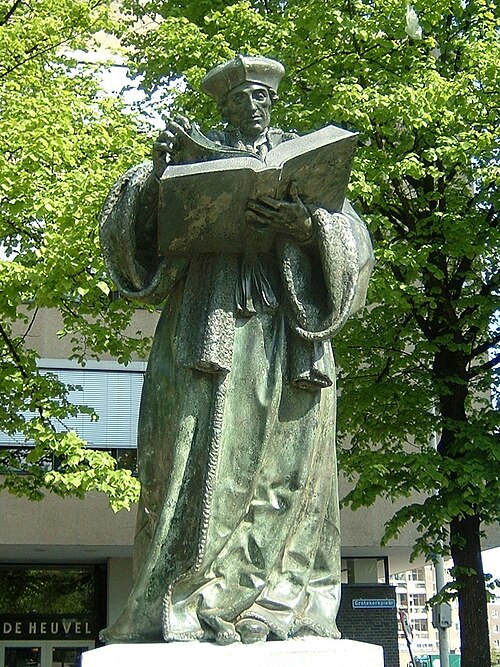
لا يُعرف تاريخ ميلاد إيراسموس على وجه اليقين: ففي أواخر حياته، كان يحسب عمره كما لو أنه وُلد عام 1466، لكن عمره الذي يتذكره في الأحداث الكبرى غالبًا ما يشير إلى عام 1469. [ 23 ] [ 24 ] : 8 (تُشير هذه المقالة حاليًا إلى عام 1466 كعام ميلاده. [ 25 ] [ 26 ] ولتجاوز هذا التضارب، تُذكر الأعمار أولًا بناءً على عام 1469، ثم بين قوسين بناءً على عام 1466: على سبيل المثال، "20 (أو 23)"). علاوة على ذلك، يجب استخلاص العديد من تفاصيل حياته المبكرة من رواية خيالية كتبها بضمير الغائب عام 1516 (ونُشرت عام 1529) في رسالة إلى سكرتير بابوي وهمي، لامبرتوس غرونيوس ("السيد غرانت"). [ 27 ]
لم يكن بإمكان والديه الزواج رسميًا: كان والده، جيرارد، كاهنًا كاثوليكيًا [ 28 ]، وربما أمضى ما يصل إلى ست سنوات في خمسينيات أو ستينيات القرن الخامس عشر في إيطاليا ناسخًا وباحثًا. [ 29 ] : 196 أما والدته، مارغريتا روجيريوس (الاسم اللاتيني للقب الهولندي روتجرز)، [ 30 ] ابنة طبيب من زيفنبرجن . وربما كانت مدبرة منزل جيرارد. [ 28 ] [ 31 ] على الرغم من ولادته خارج إطار الزواج، فقد حظي إيراسموس برعاية والديه، ووفرا له بيئة منزلية دافئة وأفضل تعليم، حتى وفاتهما المبكرة بمرض الطاعون الدبلي عام 1483. ربما وُلد شقيقه الوحيد، بيتر، عام 1463، ويشير بعض المؤرخين إلى أن مارغريت كانت أرملة وأن بيتر كان أخًا غير شقيق لإيراسموس؛ بينما كان إيراسموس يناديه بأخيه. [ 24 ]
يروي إيراسموس قصته الخاصة، في كتاب "مختصر حياة إيراسموس" الذي يُحتمل تزويره عام 1524 ، على النحو التالي: كان والداه مخطوبين، لكن زواجهما الرسمي مُنع من قِبل أقاربه (يُفترض أن أرملة شابة أو أم عزباء لديها طفل لم تكن تُعتبر زواجًا مناسبًا)؛ ذهب والده إلى إيطاليا لدراسة اللاتينية واليونانية، وأضلّ الأقارب جيرارد مُخبرين إياه بوفاة مارغريتا، وعند سماعه الخبر، التحق جيرارد بالكهنوت بدافع عاطفي، ليكتشف عند عودته أن مارغريتا على قيد الحياة؛ ويُشكك العديد من الباحثين في هذه الرواية. [ 32 ]
في عام 1471 أصبح والده نائب كاهن بلدة فوردن الصغيرة (حيث ربما يكون إيراسموس الشاب قد التحق بالمدرسة العامية المحلية ليتعلم القراءة والكتابة) وفي عام 1476 تمت ترقيته إلى نائب كاهن غودا . [ 20 ]
تلقى إيراسموس أعلى مستوى تعليمي متاح لشاب من عامة الشعب في عصره، وذلك من خلال سلسلة من المدارس الخاصة، أو الرهبانية، أو شبه الرهبانية. في عام 1476، عندما كان في السادسة (أو التاسعة) من عمره، انتقلت عائلته إلى غودا، وبدأ دراسته في مدرسة بيتر فينكل، [ 20 ] الذي أصبح فيما بعد وصيًا عليه (وربما بدد ميراث إيراسموس وبيتر). ويشير المؤرخون الذين يؤرخون ميلاده في عام 1466 إلى أن إيراسموس كان في أوتريخت في مدرسة الجوقة في تلك الفترة. [ 33 ]
في عام ١٤٧٨، في سن التاسعة (أو الثانية عشرة)، أُرسل هو وشقيقه الأكبر بيتر إلى إحدى أفضل مدارس اللغة اللاتينية في هولندا، والواقعة في ديفينتر ، والتي كانت تابعة لرهبان كنيسة القديس ليبوين . [ ٢٥ ] [ ملاحظة ٦ ] وكان من بين طلابها السابقين البارزين توماس أ كيمبيس . ومع اقتراب نهاية فترة دراسته هناك، قام مدير المدرسة الجديد، ألكسندر هيجيوس ، وهو أحد مراسلي الخطيب الرائد رودولفوس أغريكولا ، بتجديد المنهج الدراسي . ولأول مرة في أوروبا شمال جبال الألب، تم تدريس اللغة اليونانية في مستوى أدنى من مستوى الجامعة [ ٣٥ ] ، وهناك بدأ بتعلمها. [ ٣٦ ] انتهى تعليمه هناك عندما ضرب الطاعون المدينة حوالي عام ١٤٨٣، [ ٣٧ ] وتوفيت والدته، التي كانت قد انتقلت لتوفير مأوى لأبنائها، متأثرة بالعدوى، ثم توفي والده. بعد وفاة والديه، بالإضافة إلى 20 من زملائه في المدرسة، [ 24 ] عاد إلى وطنه (روتردام؟) [ 20 ] حيث تكفلت به بيرث دي هايدن، [ 24 ] : 13 أرملة حنونة. [ 24 ]

في عام ١٤٨٤، في سن الرابعة عشرة (أو السابعة عشرة) تقريبًا، التحق هو وشقيقه بمدرسة ثانوية أو معهد ديني أقل تكلفة [ ٣٨ ] في مدينة سيرتوخنبوس، يديره إخوة الحياة المشتركة : [ ٢٤ ] : ١٠-١١ [ ملاحظة ٧ ]. يسخر إيراسموس في رسالته إلى غرونيوس (انظر أعلاه) منهم بوصفهم "الإخوة المُختارين" [ ٢٧ ] الذين ينتقون ويصنفون الصبية للرهبنة. تعرّف هناك على حركة "التفاني الحديث" وكتاب الإخوة الشهير "اقتداء المسيح"، لكنه استاء من القواعد القاسية والأساليب الصارمة للرهبان والمعلمين. [ ٢٥ ] اتفق الشقيقان على مقاومة رجال الدين والالتحاق بالجامعة؛ [ ٢٤ ] : ١٣ كان إيراسموس يتوق للدراسة في إيطاليا، مهد اللغة اللاتينية، والحصول على شهادة من إحدى الجامعات الإيطالية. [ 23 ] : 804 بدلاً من ذلك، غادر بيتر إلى دير الرهبنة الأوغسطينية في شتاين ، مما جعل إيراسموس يشعر بالخيانة. [ 24 ] : 13 في ذلك الوقت تقريبًا، كتب بحزن إلى صديقته إليزابيث دي هايدن: "أنا تائه، تائه، وسط مياه باردة." [ 24 ] عانى من حمى الربع لأكثر من عام. في النهاية، انتقل إيراسموس إلى الدير نفسه كطالب مبتدئ في عام 1487 أو قبله، [ 20 ] في سن السادسة عشرة (أو التاسعة عشرة) تقريبًا. [ 39 ]
خبرة في النذور والرسامة الكهنوتية
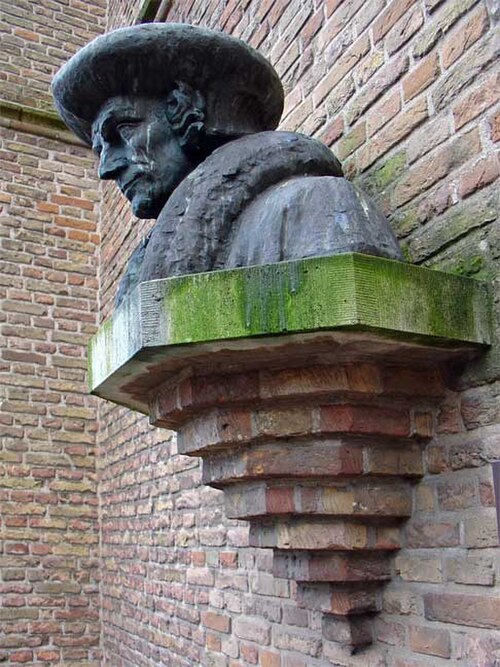
أجبر الفقر [ 4 ] : 343 اليتيم المراهق المريض المولع بالكتب، إيراسموس، على دخول الحياة الرهبانية، حيث التحق بفترة الابتداء عام 1487 [ 40 ] : xiv–xv في دير شتاين الريفي ، بالقرب من غودا، جنوب هولندا . استعارت جماعة فصل صهيون [ ملاحظة 8 ] قواعدها إلى حد كبير من جماعة ويندشيم الرهبانية الأكبر ، التي كانت لها صلات تاريخية مع جماعة إخوة الحياة المشتركة ، وكذلك مع اللاهوتيين الرعويين والصوفيين البارزين [41]: الفصل 1 واللاهوتيين ما بعد المدرسيين المناهضين للتأمل، جان جيرسون [ 42 ] : 315 وغابرييل بيل : وهي مواقف ارتبطت أيضًا بإيراسموس . [ 43 ] : 46–48 . في الفترة ما بين 1488 و1490، تعرضت المنطقة المحيطة للنهب الشديد على يد الجيوش التي كانت تخوض حرب الخلافة التي قادها السيد فرانسيس، ثم عانت من مجاعة. [ 23 ] : 759 أعلن إيراسموس نذوره كقسيس نظامي في دير القديس أوغسطين [ ملاحظة 9 ] هناك في أواخر عام 1488 عن عمر يناهز 19 عامًا (أو 22 عامًا). [ 40 ] : xiv–xv
كتب المؤرخ الأب أيدن جاسكيه لاحقًا: "مع ذلك، يبدو أن أمرًا واحدًا واضح تمامًا؛ لم يكن لديه أبدًا أي دعوة للحياة الرهبانية. تاريخه اللاحق بأكمله يُظهر ذلك بشكل لا لبس فيه." [ 8 ] ولكن وفقًا لأحد كُتّاب سيرته الكاثوليك، فقد شهد إيراسموس صحوة روحية في الدير. [ 47 ]
كانت بعض التجاوزات في الأديرة من بين الأهداف الرئيسية لدعواته اللاحقة لإصلاح الكنيسة الغربية من الداخل، ولا سيما التجنيد القسري أو المخادع للأولاد غير الناضجين (يصفهم السرد الخيالي في رسالته إلى غرونيوس بأنهم "ضحايا دومينيك وفرانسيس وبنديكت"). شعر إيراسموس أنه ينتمي إلى هذه الفئة، إذ انضم "طواعيةً ولكن ليس بحرية"، ولذلك اعتبر نفسه، إن لم يكن ملزمًا أخلاقيًا بنذوره، فهو بالتأكيد ملزم قانونيًا واجتماعيًا وشرفيًا بالوفاء بها، مع سعيه في الوقت نفسه لاكتشاف دعوته الحقيقية. [ 44 ] : 439
أثناء وجوده في شتاين، كوّن إيراسموس، البالغ من العمر 18 (أو 21) عامًا، ما أسماه "تعلقًا عاطفيًا" ( باللاتينية : fervidos amores ) مع زميله الكاهن سيرفاتيوس روجيريوس، [ ملاحظة 10 ] وكتب سلسلة من رسائل الحب [ ملاحظة 11 ] [ 50 ] وصف فيها روجيريوس بأنه "نصف روحي"، [ ملاحظة 12 ] وكتب: "لم يكن طمعًا في مكافأة أو رغبة في أي معروف أن أغازلكما بإصرار وتفانٍ. فما هو إذن؟ أنكما تحبان من يحبكما." [ 53 ] [ ملاحظة 13 ] تتناقض هذه المراسلات مع الموقف المنعزل والمتحفظ الذي كان يتبناه عادةً في حياته اللاحقة، على الرغم من قدرته على تكوين صداقات عميقة مع الرجال والحفاظ عليها، [ ملاحظة 14 ] كما هو الحال مع مور ، وكوليت، وأمونيو. [ ملاحظة 15 ] لم تُذكر أي تلميحات أو اتهامات جنسية لإيراسموس خلال حياته. وتُشيد أعماله بشكل ملحوظ بالرغبة الجنسية المعتدلة في الزواج بين الرجل والمرأة. [ 55 ]
رُسِمَ كاهنًا كاثوليكيًا إما في 25 أبريل 1492، [ 4 ] : 343 أو في 25 أبريل 1495، في سن 25 (أو 28). [ ملاحظة 17 ] على أي حال، لم يعمل ككاهن جوقة لفترة طويلة، [ 58 ] على الرغم من أن مؤلفاته العديدة حول الاعتراف والتوبة تشير إلى خبرة في منحهما.
فك الارتباط
في عام ١٤٩٣، رتب له رئيس ديره مغادرة دير شتاين [ ٥٩ ] والانتقال إلى برابانت، [ ملاحظة ١٨ ] لتولي منصب السكرتير اللاتيني لأسقف كامبراي الطموح ، هنري من بيرغن، نظرًا لمهارته الكبيرة في اللغة اللاتينية وسمعته كأديب. [ ٦١ ] [ ملاحظة ١٩ ] بعد ذلك، ذهب إلى باريس لدراسة اللاهوت. وقد أتاحت له مكانته ككاهن وعالم لاتيني وطالب، بالإضافة إلى اعتياده على السفر، قدرًا من الاستقلال عن شؤون دير شتاين الكهنوتية.
منذ عام 1500، تجنّب إيراسموس العودة إلى دير شتاين، بل وأصرّ على أن النظام الغذائي وساعات العمل ستودي بحياته، [ ملاحظة 20 ] مع أنه أقام مع جماعات أوغسطينية أخرى وفي أديرة تابعة لرهبانيات أخرى خلال أسفاره. وقد تبادل روغيروس، الذي أصبح رئيسًا لدير شتاين عام 1504، الرسائل مع إيراسموس على مرّ السنين، حيث طالب روغيروس إيراسموس بالعودة بعد إتمام دراسته. ومع ذلك، انتهى المطاف بمكتبة الدير [ ملاحظة 21 ] بامتلاكها أكبر مجموعة من منشورات إيراسموس في منطقة غودا. [ 64 ]
في عام 1505، منح البابا يوليوس الثاني إيراسموس إعفاءً [ 65 ] من نذر الفقر، ما سمح له بتولي بعض المناصب الكنسية ، ومن سيطرة رهبانيته وعاداتها ، مع أنه ظل كاهنًا، ورسميًا، عضوًا في الرهبنة الأوغسطينية النظامية [ ملاحظة 22 ] لبقية حياته. [ 44 ] وفي عام 1517، منح البابا ليو العاشر إعفاءات قانونية لإيراسموس بسبب عيوب نسبه [ ملاحظة 23 ] ، وأكد الإعفاء السابق، ما سمح للرجل البالغ من العمر 48 (أو 51) عامًا بالاستقلال [ 65 ] ، ولكنه ظل، بصفته عضوًا في الرهبنة، قادرًا على تولي منصب رئيس دير أو رئيس دير. [ 44 ] في الواقع، في عام 1535، قدّم البابا بولس الثالث، الذي كان قد تولى منصبه آنذاك ، رسالةً لم تُستخدم قط، عيّنه فيها رئيسًا لرهبان "ديڤينتر" (أي رهبان فصل الحياة المشتركة شبه الرهباني ، الذين قاوموا طويلًا ألقابًا مثل رئيس، [ 34 ] و/أو ربما رهبان كنيسة غروت أو ليبوينوسكيرك ): [ 67 ] وقد يكون هذا مرتبطًا أيضًا بنيته العودة إلى البلدان المنخفضة. في عام 1525، منح البابا كليمنت السابع ، لأسباب صحية، إعفاءً من تناول اللحوم ومنتجات الألبان في الصوم الكبير وفي أيام الصيام. [ 68 ] : 410
في عام 1530، كتب فرديناند الأول ، الذي كان آنذاك أرشيدوق النمسا وملك الرومان، إلى مجلس مدينة فرايبورغ لإزالة العقبات التي تحول دون قيام إيراسموس بكتابة وصية، وأصدر شارل الخامس براءات اختراع تمنحه سلطة التصرف في ممتلكاته بموجب وصية. [ 69 ]
رحلات
مدن ومسارات برنامج إيراسموس | |||||||||||||||||||||||||||||||||||||||||||||||||||||||||||||||||||||||||||||||||||||||||||||||||||||||||||||||||||||||||||||||||||||||||||||||||||||||||||||||||
|---|---|---|---|---|---|---|---|---|---|---|---|---|---|---|---|---|---|---|---|---|---|---|---|---|---|---|---|---|---|---|---|---|---|---|---|---|---|---|---|---|---|---|---|---|---|---|---|---|---|---|---|---|---|---|---|---|---|---|---|---|---|---|---|---|---|---|---|---|---|---|---|---|---|---|---|---|---|---|---|---|---|---|---|---|---|---|---|---|---|---|---|---|---|---|---|---|---|---|---|---|---|---|---|---|---|---|---|---|---|---|---|---|---|---|---|---|---|---|---|---|---|---|---|---|---|---|---|---|---|---|---|---|---|---|---|---|---|---|---|---|---|---|---|---|---|---|---|---|---|---|---|---|---|---|---|---|---|---|---|---|---|
| |||||||||||||||||||||||||||||||||||||||||||||||||||||||||||||||||||||||||||||||||||||||||||||||||||||||||||||||||||||||||||||||||||||||||||||||||||||||||||||||||
| |||||||||||||||||||||||||||||||||||||||||||||||||||||||||||||||||||||||||||||||||||||||||||||||||||||||||||||||||||||||||||||||||||||||||||||||||||||||||||||||||



















































سافر إيراسموس على نطاق واسع وبشكل منتظم، لأسباب تتعلق بالفقر، و"الهروب" [ 70 ] : 154 من منصبه الكنسي في شتاين (إلى كامبراي )، والتعليم (إلى باريس وتورينو )، والهروب من وباء مرض التعرق (إلى أورليان )، والعمل (إلى إنجلترا)، والبحث في المكتبات عن المخطوطات، والكتابة ( برابانت )، وتقديم المشورة الملكية ( كولونيا )، والرعاية والتدريس والمرافقة (شمال إيطاليا)، وبناء العلاقات ( روما )، ومتابعة طباعة الكتب شخصيًا (باريس، البندقية ، لوفان ، بازل )، وتجنب اضطهاد المتعصبين الدينيين (إلى فرايبورغ ). كان يستمتع بركوب الخيل. [ 71 ]
باريس
في عام ١٤٩٥، وبموافقة الأسقف هنري ومنحة دراسية، التحق إيراسموس بجامعة باريس في كلية مونتايغو ، مركز الحماس الإصلاحي، [ ملاحظة ٢٤ ] تحت إشراف الزاهد يان ستاندونك ، الذي اشتكى من صرامة مناهجه. [ ٧٢ ] كانت الجامعة آنذاك المقر الرئيسي للعلوم المدرسية، لكنها بدأت تتأثر بالفعل بالنزعة الإنسانية في عصر النهضة . [ ٧٣ ] فعلى سبيل المثال، أصبح إيراسموس صديقًا حميمًا للإنساني الإيطالي بوبليو فاوستو أندريليني ، الشاعر و"أستاذ العلوم الإنسانية" في باريس، وجزءًا من "الرابطة البلاغية-النحوية-الشعرية" المزدهرة هناك. [ ٥١ ]
تدهورت صحته في السنة الأولى. بعد عودته إلى بيرغن وستين للتعافي، عاد إيراسموس إلى باريس، واستأجر غرفة في النزل الإنجليزي (الذي تسامح مالكه مع تأخره أو دفعه الجزئي) حيث قام بتدريس نزلاء أثرياء، ولا سيما توماس غراي (ماركيز دورست المستقبلي، وجد الليدي جين غراي ). [ 74 ]
خلال هذه الفترة، نما لدى إيراسموس نفور شديد من الفلسفة الأرسطية والمدرسية ، سواء كانت حصرية أو مفرطة [ 75 ] ، وبدأ العمل كمدرس/مرافق للأرستقراطيين الإنجليز والاسكتلنديين الزائرين، وكان أهمهم في حياته ويليام بلونت، البارون الرابع لمونتجوي . ولا يوجد أي سجل لتخرجه.
الزيارة الأولى إلى إنجلترا (1499-1500)
أقام إيراسموس في إنجلترا ثلاث مرات على الأقل. [ ملاحظة 25 ] وبين هذه الفترات، أمضى فترات في الدراسة في باريس وأورليان ولوفان ومدن أخرى.
في عام ١٤٩٩، دُعي إلى إنجلترا من قِبل بلونت، الذي عرض عليه مرافقته في رحلته. [ ٧٧ ] : ٦-٧ كانت الأشهر الستة التي قضاها في إنجلترا مثمرة، إذ كوّن خلالها صداقات متينة مع قادة الفكر الإنجليزي في عهد الملك هنري الثامن . وأفاد بأنه اكتسب مهارات جديدة مهمة لمستقبله، منها: أن أصبح "فارسًا أفضل، ورجل بلاط مقبولًا". [ ٧٨ ]
خلال زيارته الأولى لإنجلترا عام 1499، أقام لمدة شهرين في جامعة أكسفورد ، في كلية سانت ماري ، وهي كلية الرهبان الأوغسطينيين، حيث صادق كبار علماء اليونان توماس ليناكر وويليام غروسين وويليام ليلي .
أُعجب إيراسموس بشكل خاص بتعاليم الكتاب المقدس التي قدمها الإنساني جون كوليت ، الذي اتبع أسلوبًا وعظيًا أقرب إلى آباء الكنيسة منه إلى اللاهوتيين المدرسيين . وبفضل تأثير كوليت، تحولت اهتماماته فجأة نحو اللاهوت الإنجيلي والآبائي [ 77 ] : 6-7 وفقه اللغة الكتابية، وهو ما شغل النصف الثاني من حياته. [ 79 ] : 11 ومن السمات المميزة الأخرى لفكر كوليت التي ربما أثرت في إيراسموس نزعته السلمية، [ 80 ] ونزعته الإصلاحية، [ 81 ] ومعاداته للمدرسة اللاهوتية، وتقديره الرعوي لسر الاعتراف. [ 82 ] : 94 وقد دفع هذا إيراسموس، عند عودته من إنجلترا إلى باريس، إلى دراسة اللغة اليونانية دراسة مكثفة، مما مكنه من دراسة التفسير الآبائي ونصوص العهد الجديد على مستوى أعمق. [ 83 ] : 518
أصبح إيراسموس صديقًا حميمًا لتوماس مور ، وهو طالب قانون شاب كان يفكر في أن يصبح راهبًا، والذي تأثر فكره (على سبيل المثال، حول الضمير والإنصاف) باللاهوتي الفرنسي جان جيرسون من القرن الرابع عشر ، [ 84 ] [ 85 ] وقد تم تطوير فكره من قبل راعيه القوي الكاردينال جون مورتون (توفي عام 1500) الذي اشتهر بمحاولته إصلاح الأديرة الإنجليزية. [ 86 ]
غادر إيراسموس لندن ومعه مبلغ كبير من المال من أصدقائه الكرماء، ليتمكن من إكمال دراسته. إلا أنه تلقى نصيحة قانونية سيئة من أصدقائه: فقد صادر مسؤولو الجمارك الإنجليز كل الذهب والفضة، ولم يتبق له شيء سوى حمى ليلية استمرت لعدة أشهر.
فرنسا وبرابانت
- جان فيترييه (أو فورييه)
- جاكوب/جيمس بات
- بوبليو فاوستو أندريليني
- جوس باد
- لويس دي بيركين
- روبرت فيشر
- ريتشارد ويتفورد
- غيوم بوديه
- توماس غراي
- هيكتور بويس
- روبرت غاغوين
- كريستوفر فيشر
المعارضون : نويل بيدا (أو بيدير)
الرعاة : الأسقف هنري من بيرغن، وتوماس غراي ، وسيدة فيربعد رحلته الأولى إلى إنجلترا، عاد إيراسموس أولًا إلى فقره في باريس، حيث بدأ بتأليف كتاب "أداجيو" لطلابه، ثم إلى أورليان هربًا من الطاعون، ثم إلى حياة شبه رهبانية، ودراسات علمية وكتابة في فرنسا، ولا سيما في دير القديس برتان البندكتي في سان أومير (1501، 1502) حيث كتب النسخة الأولية من كتاب "إنتشيريديون" ( دليل الفارس المسيحي ). وكان من بين المؤثرات الخاصة عليه لقاؤه عام 1501 مع جان (جيهان) فيترييه، وهو راهب فرنسيسكاني متشدد عزز أفكار إيراسموس ضد المبالغة في تمجيد الرهبنة، [ 82 ] : 94، 95 والطقوس [ ملاحظة 26 ] والصيام [ ملاحظة 27 ] في تجربة أشبه بالتحول، [ 29 ] : 213، 219 وقدمه إلى أوريجانوس . [ 88 ]
في عام ١٥٠٢، ذهب إيراسموس إلى برابانت، ثم التحق بجامعة لوفان. وفي عام ١٥٠٤، استعان به قادة "الولايات الإقليمية" في برابانت لإلقاء إحدى خطاباته العامة القليلة، وهي قصيدة مدح رسمية مطولة لفيليب "الوسيم" ، دوق بورغندي وملك قشتالة لاحقًا: كان النصف الأول منها عبارة عن مديح مبالغ فيه تقليدي، أما النصف الثاني فكان معالجة قوية لمآسي الحرب، وضرورة الحياد والمصالحة (مع الجارتين فرنسا وإنجلترا)، [ ٨٩ ] وفضائل الحكام المسالمين: أن الشجاعة الحقيقية في القائد لا تكمن في شن الحرب بل في كبح جماح الجشع، إلخ. [ ٩٠ ] : ١١٩ نُشرت هذه القصيدة لاحقًا بعنوان "بانجيريكوس" . ثم عاد إيراسموس إلى باريس في عام ١٥٠٤.
الزيارة الثانية إلى إنجلترا (1505-1506)

في زيارته الثانية، أمضى إيراسموس أكثر من عام في منزل توماس مور ، المتزوج حديثًا ، والذي أصبح الآن محاميًا وعضوًا في البرلمان، حيث صقل مهاراته في الترجمة. [ 76 ]
فضّل إيراسموس حياة الباحث المستقل، وبذل جهدًا واعيًا لتجنب أي إجراءات أو روابط رسمية قد تُقيّد حريته الشخصية. [ 77 ] : 8 في إنجلترا، عُرضت على إيراسموس مناصب مرموقة، لكنه رفضها جميعًا، إلى أن عرض عليه الملك هنري السابع بنفسه دعمه. [ 77 ] : 8 كان يميل إلى ذلك، لكنه في النهاية لم يقبل، وتمنى البقاء في إيطاليا. [ 77 ] : 8
إيطاليا
في عام 1506، تمكن من مرافقة أبناء الطبيب الشخصي للملك الإنجليزي وتعليمهم عبر إيطاليا إلى بولونيا. [ 77 ] : 8
كان اكتشافه أثناء رحلته إلى دير بارك لملاحظات لورينزو فالا على العهد الجديد حدثًا رئيسيًا في حياته المهنية، ودفع إيراسموس إلى دراسة العهد الجديد باستخدام علم اللغة . [ 91 ]
في عام ١٥٠٦، مروا بتورينو، ورتب إيراسموس للحصول على درجة دكتوراه في اللاهوت المقدس ( Sacra Theologia ، وهي أعلى درجة لاهوتية، تمنح حق التدريس في أي مكان) [ ٩٢ ] : ٦٣٨ من جامعة تورينو [ ٧٧ ] : ٨ per saltum [ ٩٣ ] في سن ٣٧ (أو ٤٠). مكث إيراسموس يُدرّس في بولونيا لمدة عام؛ [ ملاحظة ٢٨ ] في الشتاء، كان إيراسموس حاضرًا عندما دخل البابا يوليوس الثاني منتصرًا إلى بولونيا التي حاصرها سابقًا. [ ٧٧ ] : ٨

سافر إيراسموس إلى البندقية، حيث عمل على نسخة موسعة من كتابه "أداجيا" في مطبعة ألدين التابعة للطابع الشهير ألدوس مانوتيوس ، الذي نصحه بشأن المخطوطات التي يجب نشرها، [ 95 ] وكان عضوًا فخريًا في "الأكاديمية الجديدة" الناطقة باليونانية في ألدين ( باليونانية : Neakadêmia (Νεακαδημία) ). [ 77 ] : 8-9. تعلّم من ألدوس أسلوب العمل المباشر الذي جعله منتجًا في فروبن: إجراء تعديلات في اللحظات الأخيرة، ومراجعة وتصحيح النسخ المطبوعة فور جفاف الحبر. كتب ألدوس أن إيراسموس كان قادرًا على إنجاز ضعف العمل الذي ينجزه أي شخص آخر قابله في نفس الوقت. [ 8 ]
في عام ١٥٠٧، ووفقًا لرسائله، درس اللغة اليونانية المتقدمة في بادوا على يد الفيلسوف الطبيعي الفينيسي جوليو كاميلو . [ ٩٦ ] وجد عملًا في تدريس ومرافقة النبيل الاسكتلندي ألكسندر ستيوارت ، رئيس أساقفة سانت أندروز البالغ من العمر ٢٤ عامًا، عبر بادوا وفلورنسا وسيينا. [ ملاحظة ٢٩ ] وصل إيراسموس إلى روما عام ١٥٠٩، وزارها ثلاث مرات وسعى إلى التعرف على بعض أمناء المكتبات والكرادلة البارزين، لكن علاقته بالعلماء الإيطاليين كانت أقل نشاطًا؛ ومن بين صداقاته الثانوية البارزة علاقته بالكاردينال جيوفاني دي لورينزو دي ميديشي الذي أصبح فيما بعد البابا ليو العاشر وأحد أبرز الداعمين لبرنامج إيراسموس في الدراسات الكتابية. [ ٩٨ ]
في عام ١٥٠٩، أغرى ويليام وارهام، رئيس أساقفة كانتربري، واللورد ماونتجوي، إيراسموس بالعودة إلى إنجلترا، التي كان يُؤمل أن يحكمها ملك حكيم ورحيم ( هنري الثامن ) تلقى تعليمه على يد الإنسانيين. أرسل وارهام وماونتجوي لإيراسموس ١٠ جنيهات إسترلينية لتغطية نفقات رحلته. [ ٩٩ ] وفي رحلته عبر جبال الألب مرورًا بممر سبلوجن، ثم نزولًا في نهر الراين باتجاه إنجلترا، بدأ إيراسموس بتأليف قصيدته "مديح الحماقة" . [ ١٠٠ ]
الزيارة الثالثة إلى إنجلترا (1510-1515)

في عام ١٥١٠، وصل إيراسموس إلى منزل مور الصاخب، ولزم الفراش للتعافي من مرضه المتكرر، وكتب كتاب "مديح الحماقة" الذي حقق مبيعات هائلة. كان مور آنذاك نائب عمدة مدينة لندن . توفيت زوجته جين عن عمر يناهز ٢١ عامًا في عام ١٥١١، وسرعان ما تزوج مور مرة أخرى .
بعد استقباله الحافل في إيطاليا، عاد إيراسموس مفلسًا وعاطلًا عن العمل، [ ملاحظة 30 ] وعلاقاته متوترة مع أصدقائه السابقين ومحسنيه في القارة الأوروبية، وندم على مغادرة إيطاليا، رغم فزعه من الحروب البابوية. يُلاحظ انقطاع في مراسلاته الغزيرة عادةً: ما يُعرف بـ"سنتيه الضائعتين"، ربما بسبب رقابته الذاتية على آرائه الخطيرة أو الساخطة؛ [ ملاحظة 15 ] وقد تقاسم السكن مع صديقه أندريا أمونيو (السكرتير اللاتيني لمونتجوي، وفي العام التالي لهنري الثامن، والذي كان يقيم في منزل توماس مور الكبير والمضياف، لكنه لم ينسجم مع زوجته الجديدة [ 104 ] ) في مجمع رهبان أوستن بلندن ، ثم غادر بعد خلاف مع الرهبان حول الإيجار تسبب في توتر العلاقات. [ ملاحظة 31 ]
ساعد صديقه جون كوليت بتأليف كتب مدرسية في اللغة اليونانية وتأمين أعضاء هيئة تدريس لمدرسة سانت بول التي تم إنشاؤها حديثًا [ 106 ] ، وكان على اتصال به عندما ألقى كوليت خطبته الشهيرة في عام 1512 في اجتماع المجمع الكنسي، والتي دعا فيها إلى إصلاح الشؤون الكنسية. [ 107 ] : 230-250. وبتحريض من كوليت، بدأ إيراسموس العمل على كتاب "دي كوبيا" .
في عام ١٥١١، رتب جون فيشر ، مستشار جامعة كامبريدج ، تعيين إيراسموس أستاذاً للاهوت في جامعة كامبريدج (أو إلحاقه ببرنامج دراسي للتحضير لهذا المنصب) ، إلا أن المؤرخين يختلفون حول ما إذا كان قد قُبل فعلاً في هذا المنصب أو ما إذا كان قد بدأ دراسته فعلياً. [ ١٠٨ ] درس إيراسموس اللغة اليونانية ودرّسها، كما أجرى أبحاثاً وألقى محاضرات حول جيروم . [ ٧٦ ] [ ملاحظة ٣٢ ]
أقام إيراسموس في كلية كوينز بشكل رئيسي أثناء تدريسه في الجامعة، [ 110 ] بين عامي 1511 و1515. [ ملاحظة 33 ] كانت غرف إيراسموس تقع في الدرج " I " في المحكمة القديمة. [ 112 ] على الرغم من النقص المزمن في المال، فقد نجح في إتقان اللغة اليونانية من خلال دراسة مكثفة ليلًا ونهارًا لمدة ثلاث سنوات، على يد توماس ليناكر ، وكان يتوسل باستمرار في رسائله إلى أصدقائه أن يرسلوا له الكتب والمال للمعلمين. [ 113 ]
عانى إيراسموس من اعتلال صحته، وكان مهتمًا بشكل خاص بالتدفئة، والهواء النقي، والتهوية، والتيارات الهوائية، والطعام الطازج، والنبيذ غير الفاسد: فقد اشتكى من تيارات الهواء في المباني الإنجليزية. [ 114 ] كما اشتكى من أن كلية كوينز لم تتمكن من تزويده بكمية كافية من النبيذ الجيد [ 115 ] (كان النبيذ دواءً شائعًا في عصر النهضة لعلاج حصى المرارة، التي كان إيراسموس يعاني منها). [ 116 ] ولأن كلية كوينز كانت مؤسسة ذات توجه إنساني غير عادي في القرن السادس عشر، لا تزال مكتبة كوينز القديمة تضم العديد من الطبعات الأولى لمنشورات إيراسموس، والتي تم الحصول على الكثير منها خلال تلك الفترة عن طريق الوصايا أو الشراء، بما في ذلك ترجمة إيراسموس للعهد الجديد، الموقعة من قبل صديقه والمصلح الديني البولندي يان لاسكي . [ 117 ]
في ذلك الوقت، كان مور قاضياً في محكمة الإنصاف للفقراء ( رئيس الطلبات ) ومستشاراً خاصاً .
بسبب قلقه من تفشي الطاعون في كامبريدج، وإصابته بحصى المرارة، وتخوفه من اندلاع الحرب والتضخم، غادر إيراسموس كامبريدج ثم إنجلترا. [ 118 ] : 158
فلاندرز وبرابانت
أدى إقامته في لوفين، حيث كان يُحاضر في الجامعة ، إلى تعريض إيراسموس لانتقادات لاذعة من قِبل الزهاد والأكاديميين ورجال الدين المُعادين لمبادئ الإصلاح الأدبي والديني التي كرّس حياته لها. [ 120 ] وفي عام 1514، في طريقه إلى بازل، تعرّف على هيرمانوس بوشيوس وأولريش فون هوتن ويوهان رويخلين الذين عرّفوه على اللغة العبرية في ماينز. [ 121 ] وفي عام 1514، سقط عن حصانه وأصيب في ظهره.

ربما قام إيراسموس بعدة زيارات قصيرة أخرى إلى إنجلترا أو الأراضي الإنجليزية أثناء إقامته في برابانت. [ 76 ] ولحسن حظ إيراسموس، تم تعيين مور وتونستال في بروكسل أو أنتويرب في مهام حكومية حوالي عام 1516، مور لمدة ستة أشهر، وتونستال لفترة أطول. ومن بين دائرتهم بيتر جيليس من أنتويرب، الذي كتب توماس مور في منزله كتابه "يوتوبيا " (1516) بتشجيع من إيراسموس، [ ملاحظة 34 ] حيث قام إيراسموس بتحريره وربما حتى ساهم ببعض أجزائه. [ 124 ] وكان صديقه القديم من كامبريدج، ريتشارد سامبسون ، نائبًا عامًا يدير أبرشية تورناي المجاورة ، التي كانت مؤخرًا تحت السيطرة الإنجليزية ويحكمها تلميذه السابق ويليام بلونت . [ 125 ]
في عام 1516، قبل إيراسموس منصبًا فخريًا كمستشار لتشارلز الخامس مع راتب سنوي قدره 200 غيلدر (أكثر من 100000 دولار أمريكي )، نادرًا ما كان يُدفع، [ 126 ] وقام بتدريس شقيق تشارلز، الإمبراطور الروماني المقدس المستقبلي فرديناند من هابسبورغ .
في عام 1516، نشر إيراسموس الطبعة الأولى من العهد الجديد اللاتيني اليوناني مع التعليقات، وأعماله الكاملة عن جيروم، وكتاب " تربية أمير مسيحي " ( Institutio principis Christiani ) لتشارلز وفرديناند.
In 1517, he supported the foundation at the university of the Collegium Trilingue for the study of Hebrew, Latin, and Greek[127]:s1.14.14—after the model of Cisneros' College of the Three Languages at the University of Alcalá—financed by his late friend Hieronymus van Busleyden's will.[128] On being asked by Jean Le Sauvage, former Chancellor of Brabant and now Chancellor of Burgundy, Erasmus wrote The Complaint of Peace.
In 1517, his great friend Ammonio died in England of the Sweating Sickness. In 1518, Erasmus was diagnosed with the plague; despite the danger, he was taken in and cared for in the home of his Flemish friend and publisher Dirk Martens in Antwerp for a month and recovered.[129]
By 1518, he reported to Paulus Bombasius that his income was over 300 ducats[note 35] per year (over US$150,000) without including patronage.[131]:350 By 1522 he reported his annual income as 400 gold florins[132]:50 (over US$200,000).

In 1520 he was present at the Field of the Cloth of Gold with Guillaume Budé, probably his last meetings with Thomas More[133] and William Warham. His friend Richard Pace gave the main sermon to the kings.[134] His friends and former students and old correspondents were the incoming political elite, and he had risen with them.[note 36]
Following the Edict of Worms, which Martin Luther refused to accept, Erasmus came under attack from the theological faculty because of his neutral stance in the conflict. He subsequently took up residence in the house known as De Swaene in Anderlecht, where he wrote his famous 21 letters and numerous biblical studies. On 28 October, he left Anderlecht in order to avoid the ongoing theological disputes.[136][137]
بازل (1521–1529)

منذ عام 1514، كان إيراسموس يسافر بانتظام إلى بازل لتنسيق طباعة كتبه مع فروبن . وقد نشأت بينه وبين الناشر الكبير في بازل ، يوهان فروبن، علاقة متينة ، ثم مع ابنه هيرونيموس فروبن (ابن إيراسموس بالمعمودية )، اللذين نشرا معًا أكثر من 200 عمل مع إيراسموس، [ 139 ] بالتعاون مع مصححين وباحثين بارعين حققوا مسيرة مهنية لامعة. [ 138 ]
أُثير اهتمامه الأولي بعملية فروبن باكتشافه طبعة الطباعة الكبيرة لكتاب أداجيوروم تشيلياديس تريس ( أداجيا ) (1513). [ 140 ] تميز عمل فروبن باستخدامه الخط الروماني الجديد (بدلاً من الخط القوطي ) وخطوط إيطالية ويونانية شبيهة بخطوط ألدين، بالإضافة إلى تصميمات أنيقة باستخدام الحدود والأحرف الكبيرة المزخرفة؛ [ 138 ] : 59 قام هانز هولباين الأصغر بنقش العديد من الأحرف الكبيرة الخشبية لطبعات إيراسموس. أشرف على طباعة العديد من كتبه صديقه الألزاسي، العالم اليوناني بياتوس رينانوس . [ ملاحظة 37 ]
في عام ١٥٢١، استقر في بازل. [ ١٤٢ ] كان قد سئم من الجدال والعداء في لوفان، وخشي من الانجرار أكثر إلى الجدل اللوثري. [ ١٤٣ ] وافق على أن يكون المشرف الأدبي على مطبعة فروبن، حيث كان يكتب الإهداءات والمقدمات [ ٨ ] مقابل راتب سنوي وحصة من الأرباح. [ ١٠٩ ] وبصرف النظر عن فريق إنتاج فروبن، كان لديه منزله الخاص [ ملاحظة ٣٨ ] مع مدبرة منزل قوية، وإسطبل خيول، وما يصل إلى ثمانية نزلاء أو خدم بأجر، كانوا يعملون كمساعدين ومصححين وكتّاب ورفقاء طعام ورسل دوليين ومقدمي رعاية. [ ١٤٥ ] كان من عادته الجلوس أحيانًا بجوار نافذة في الطابق الأرضي، ليسهل عليه رؤية المتجولين من الإنسانيين والتحدث معهم. [ ١٤٦ ]
بالتعاون مع فروبن وفريقه، اتسع نطاق وطموح مشروع إيراسموس للتعليقات ، وهو مشروع بحثي طويل الأمد لإيراسموس حول الملاحظات اللغوية للعهد الجديد على غرار تعليقات فالا ، ليشمل أيضًا نسخة لاتينية منقحة بشكل طفيف من الفولجاتا، ثم النص اليوناني، ثم العديد من المقالات المفيدة حول المنهجية، ثم نسخة منقحة للغاية من الفولجاتا - وكلها مجمعة في كتابه Novum testamentum omne وتم قرصنتها بشكل فردي في جميع أنحاء أوروبا - ثم أخيرًا شروحاته الموسعة .
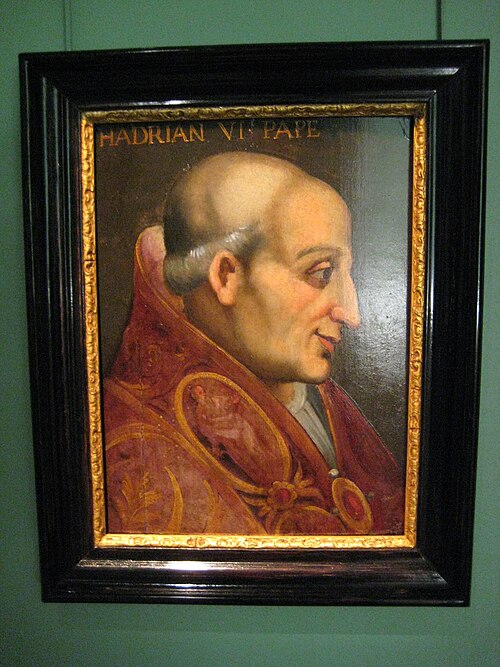
في عام ١٥٢٢، أصبح مواطن إيراسموس، أستاذه السابق (حوالي ١٥٠٢) وصديقه من جامعة لوفان، البابا أدريان السادس بشكل غير متوقع ، [ ملاحظة ٣٩ ] بعد أن شغل منصب الوصي (أو كبير مفتشي التفتيش) على إسبانيا لمدة ست سنوات. ومثل إيراسموس ولوثر، تأثر أدريان السادس بجماعة الإخوة في الحياة المشتركة. حاول استمالة إيراسموس إلى روما. إلا أن إصلاحاته للمجمع الروماني ، التي كان يأمل أن تُرضي اعتراضات العديد من اللوثريين، أُعيقت (جزئيًا بسبب ضائقة مالية كانت تعاني منها الكرسي الرسولي)، على الرغم من إعادة صياغتها في مجمع ترينت، وتوفي عام ١٥٢٣. [ ١٤٩ ]
مع ازدياد حدة ردود الفعل الشعبية والقومية تجاه لوثر، بدأت الاضطرابات الاجتماعية التي كان إيراسموس يخشاها والتي نأى لوثر بنفسه عنها بالظهور، بما في ذلك حرب الفلاحين الألمان (1524-1525)، وانتفاضات المعمدانيين في ألمانيا والأراضي المنخفضة، وتحطيم الأيقونات، وتطرف الفلاحين في جميع أنحاء أوروبا. وإذا كانت هذه هي نتائج الإصلاح، فقد كان إيراسموس ممتنًا لأنه لم يتدخل فيه. ومع ذلك، فقد اتُهم بمرارة متزايدة بأنه كان سببًا في بدء هذه "المأساة" برمتها (كما وصفها إيراسموس). [ 150 ]
في عام ١٥٢٣، قدّم الدعم المالي لكورنيليوس غرافيوس ، السكرتير اللاتيني السابق لأنتويرب، الذي كان يعاني من الفقر والعار، وذلك بعد إطلاق سراحه من محاكم التفتيش التي أُنشئت حديثًا. [ ١٥١ ] : ٥٥٨. في عام ١٥٢٥، كان يان دي باكر (بيستوريوس) ، وهو طالب سابق لإيراسموس خدم في كنيسة والد إيراسموس السابقة في فوردن، أول كاهن يُعدم بتهمة الهرطقة في هولندا. وفي عام ١٥٢٩، أُحرق مترجمه الفرنسي وصديقه لويس دي بيركين في باريس، بعد إدانته من قبل لاهوتيي السوربون بتهمة الهرطقة المعادية لروما .
فرايبورغ (1529-1535)
- دامياو دي جويس • أندريه دي ريزندي • خوان دي فالديس • ألفونسو دي فالديس • خوان دي فيرجارا • خوان لويس فيفيس • ميغيل دي إيجويا • ألونسو رويز دي فيرويس • بيدرو دي ليرما • فرانسيسكو دي إنزيناس •
- المؤيدون : الملك تشارلز الأول • أدريان فلورينز بويينز • سيسنيروس
- الخصوم : ستونيكا • سيبولفيدا • خوان دي أوروبيسا
في أعقاب أعمال شغب مفاجئة وعنيفة ومحطمة للأيقونات في أوائل عام 1529 [ 152 ] بقيادة مساعده السابق أوكولامباديوس ، والتي تم فيها عزل أعضاء المجلس الكاثوليك المنتخبين، تبنت مدينة بازل الإصلاح بشكل نهائي - حيث حظرت القداس الكاثوليكي في 1 أبريل 1529. [ 153 ] [ 154 ]
غادر إيراسموس، برفقة كهنة كاثوليك آخرين من بازل، بمن فيهم الأسقف أوغسطين ماير ، بازل في 13 أبريل 1529 [ ملاحظة 40 ] ، وتوجهوا على متن سفينة إلى مدينة فرايبورغ إم برايسغاو الجامعية الكاثوليكية ، ليكونوا تحت حماية تلميذه السابق، الأرشيدوق فرديناند النمساوي . [ 29 ] : 210 كتب إيراسموس إلى توماس مور، بأسلوب مؤثر نوعًا ما، واصفًا حالته الصحية الهشة آنذاك: "فضّلتُ المخاطرة بحياتي على أن أبدو موافقًا على برنامج كهذا. كان هناك بعض الأمل في العودة إلى الاعتدال." [ 155 ]
في ربيع أوائل عام 1530، لزم إيراسموس الفراش لثلاثة أشهر بسبب عدوى مؤلمة للغاية، يُرجح أنها داء الجمرة، والتي، على غير عادته، جعلته عاجزًا عن العمل. [ 156 ] : 411 رفض حضور مجمع أوغسبورغ الذي دعاه إليه كل من أسقف أوغسبورغ والمندوب البابوي كامبيجيو، وأعرب عن شكوكه، لأسباب غير لاهوتية، لكامبيجيو وملانكتون، في إمكانية المصالحة آنذاك: كتب إلى كامبيجيو: "لا أرى مخرجًا من هذه المأساة العظيمة إلا إذا ظهر الله فجأة كحلٍّ إلهيٍّ من آلةٍ ما، وغيّر قلوب الناس"؛ [ 156 ] : 331 وفي وقت لاحق، كتب: "ما يزعجني ليس تعاليمهم، وخاصة تعاليم لوثر، بقدر ما يزعجني هو أنني أرى، تحت ذريعة الإنجيل، فئة من الناس تظهر أجدها بغيضة من كل النواحي". [ 156 ] : 367

أقام لمدة عامين في الطابق العلوي من منزل الحوت ، [ 157 ] ثم بعد نزاع آخر على الإيجار [ ملاحظة 41 ] اشترى منزلًا خاصًا به وقام بتجديده، حيث استقبل فيه علماء/مساعدين كضيوف على المائدة [ 90 ] : 442 مثل صديق كورنيليوس غرافيوس دامياو دي غويس ، وبعضهم هربوا من الاضطهاد.
على الرغم من تزايد ضعفه [ ملاحظة 42 ]، واصل إيراسموس العمل بإنتاجية، ولا سيما على عمله الرئيسي الجديد ، وهو دليله في الوعظ بسفر الجامعة ، وكتابه الصغير عن الاستعداد للموت. وقد عمل نزيله لمدة خمسة أشهر، العالم/الدبلوماسي البرتغالي دامياو دي غويس [ 151 ] ، على جهوده في الضغط من أجل قضية شعب سامي في السويد والكنيسة الإثيوبية، وحفز [ 159 ] : 82 وعي إيراسموس المتزايد بالبعثات التبشيرية الخارجية. [ ملاحظة 43 ]
لا توجد رسائل باقية بين مور وإيراسموس منذ بداية فترة مور كمستشار للورد وحتى استقالته (1529-1532)، أي تقريبًا في نفس اليوم. كتب إيراسموس عدة أعمال مهمة غير سياسية برعاية توماس بولين ، ومن بينها : كتابه "Ennaratio triplex in Psalmum XXII" أو "التعليق الثلاثي على المزمور 23 " (1529)؛ وكتابه التعليمي الذي ردّ به على لوثر بعنوان "Explanatio Symboli" أو "شرحٌ بليغٌ وإلهي" أو "إعلان عقيدة الجماعة" (1533)، والذي نفدت طبعته في ثلاث ساعات في معرض فرانكفورت للكتاب؛ وكتابه "Praeparatio ad mortem" أو "الاستعداد للموت" (1534)، والذي يُعدّ من أشهر أعمال إيراسموس وأكثرها استغلالًا. [ 161 ] [ ملاحظة 44 ]
مصائر الأصدقاء


في ثلاثينيات القرن السادس عشر، ازدادت حياة أتباع إيراسموس الإسبان خطورةً عندما فقد حاميه، المفتش العام للمحاكمات ألونسو مانريك دي لارا، حظوته لدى البلاط الملكي، وخسر نفوذه داخل منظمته لصالح الرهبان اللاهوتيين. وفي عام ١٥٣٢، ألقت محاكم التفتيش الإسبانية القبض على صديق إيراسموس، المتحول خوان دي فيرغارا ( سكرتير سيسنيروس اللاتيني الذي عمل على كتاب " اللغات المتعددة الكومبلوتنسية " ونشر نقد ستونيكا لإيراسموس)، واضطر رئيس أساقفة طليطلة الإنساني ألونسو الثالث فونسيكا ، وهو أيضًا من مراسلي إيراسموس، إلى طلب فدية لإطلاق سراحه، وكان فونسيكا قد أنقذ إغناطيوس دي لويولا منهم سابقًا. [ ١٦٢ ] : ٨٠
شهدت التسلسل الهرمي الكاثوليكي تغييراً جيلياً. ففي عام 1530، توفي الأسقف الفرنسي الإصلاحي غيوم بريكونيه . وفي عام 1532، توفي مرشده المحبوب، رئيس الأساقفة الإنجليزي وارام، عن عمر يناهز التسعين عاماً، [ ملاحظة 45 ] وكذلك الكاردينال الإصلاحي جايلز من فيتربو والأسقف السويسري هوغو فون هوهنلاندنبرغ . وفي عام 1534، توفي حاميه غير الموثوق به، البابا كليمنت السابع (المعروف بـ"كليمنت القاسي" [ 163 ] : 72 )، وتوفي حليفه الإيطالي الكاردينال كايتان (الذي كان يُنظر إليه على نطاق واسع على أنه البابا التالي)، وتقاعد حليفه القديم الكاردينال كامبيجيو .
مع ازدياد عدد أصدقائه الذين توفوا (في عام 1533، صديقه بيتر جيليس ؛ وفي عام 1534، ويليام بلونت ؛ وفي أوائل عام 1536، كاثرين أراغون وريتشارد بيس )؛ ومع تجدد هجمات لوثر وبعض اللوثريين وبعض اللاهوتيين الكاثوليك ذوي النفوذ على إيراسموس، أصبحت رسائله تركز بشكل متزايد على مخاوفه بشأن وضع الصداقات والسلامة، إذ كان يفكر في الانتقال من فرايبورغ الهادئة رغم وضعه الصحي. [ ملاحظة 46 ]
في عام ١٥٣٥، أُعدم أصدقاء إيراسموس ، توماس مور والأسقف جون فيشر والراهب البريجيتي ريتشارد رينولدز [ ملاحظة ٤٧ ] ، بتهمة الخيانة الموالية لروما على يد هنري الثامن ، الذي كان إيراسموس (مع مور) قد التقى به لأول مرة في صغره وتبادلوا الرسائل مرات عديدة على مر السنين. على الرغم من مرضه، كتب إيراسموس أول سيرة ذاتية لمور (وفيشر)، وهي سيرة قصيرة مجهولة المؤلف بعنوان "إكسبوزيتيو فيديليس" ، والتي نشرها فروبن بتحريض من دي غويس. [ ١٥١ ] وقد وصفهم بأنهم "شهداء جدد" للمسيحية قُتلوا على يد "هيرودس آخر". [ ١٦٥ ] : ١٢٤
بعد عصر إيراسموس، لقي العديد من مترجميه مصائر مماثلة على أيدي طائفيين وحكام مستبدين من الأنجليكان والكاثوليك والإصلاحيين، بمن فيهم مارغريت بول ، وويليام تيندال ، ومايكل سيرفيتوس . وفر آخرون، مثل خوان دي فالديس ، سكرتير شارل الخامس لشؤون اللاتينية ، إلى مناطق محايدة.
توفي صديق إيراسموس وزميله الأسقف كوثبرت تونستال في السجن في عهد إليزابيث الأولى لرفضه قسم الولاء . أما مراسل إيراسموس، الأسقف ستيفن غاردينر ، الذي عرفه إيراسموس منذ أيام دراسته في باريس وكامبريدج، [ 166 ] فقد سُجن لاحقًا في برج لندن لمدة خمس سنوات في عهد إدوارد السادس بتهمة عرقلة البروتستانتية. [ ملاحظة 48 ] حوكم دامياو دي غويس أمام محاكم التفتيش البرتغالية في سن الثانية والسبعين، [ 151 ] واحتُجز بمعزل شبه تام عن العالم الخارجي ، ثم نُفي إلى دير، وربما قُتل بعد إطلاق سراحه. [ 168 ] توفي كاتبه جيلبرت كوزين في السجن عن عمر يناهز السادسة والستين، بعد فترة وجيزة من اعتقاله بأمر شخصي من البابا بيوس الخامس . [ 145 ]
الموت في بازل

عندما بدأت قوته تضعف، قرر أخيرًا قبول دعوة الملكة ماري ملكة المجر، وصية عرش هولندا (شقيقة تلميذه السابق الأرشيدوق فرديناند الأول والإمبراطور شارل الخامس)، للانتقال من فرايبورغ إلى برابانت الكاثوليكية . في عام 1535، عاد إلى مجمع فروبن في بازل البروتستانتية استعدادًا لذلك ( بعد وفاة أوكولامباديوس ، وأصبح بإمكانه ممارسة الشعائر الكاثوليكية سرًا). شهد نشر آخر أعماله الرئيسية، ولا سيما سفر الجامعة ، على الرغم من ازدياد ضعفه.
في الثاني عشر من يوليو عام ١٥٣٦، توفي إثر إصابته بالزحار . [ ١٦٩ ] "توفي أشهر علماء عصره في رغد العيش، محاطًا بأصدقاء مرموقين ومسؤولين" (بمن فيهم بونيفاسيوس أمرباخ ، وهيرونيموس فروبن ، ونيكولاس إبيسكوبيوس). [ ١٧٠ ] ويبدو أن كلماته الأخيرة، كما سجلها صديقه وكاتب سيرته بياتوس رينانوس ، كانت "يا رب، ضع حدًا لهذا" ( باللاتينية : domine fac finem ، وهي نفس الكلمات الأخيرة لملانكتون) [ ١٧١ ] ثم "يا إلهي" ( بالهولندية : Lieve God ). [ ١٧٢ ]
لقد ظلّ وفيًا للكاثوليكية الرومانية، [ 173 ] لكنّ مؤرخي سيرته اختلفوا حول ما إذا كان ينبغي اعتباره من الداخل أم من الخارج. [ ملاحظة 49 ] ربما لم يتلقَّ أو لم تُتح له الفرصة لتلقّي الطقوس الأخيرة للكنيسة الكاثوليكية؛ [ ملاحظة 50 ] لا تذكر التقارير المعاصرة عن وفاته ما إذا كان قد طلب كاهنًا كاثوليكيًا أم لا، [ ملاحظة 51 ] أو ما إذا كان هناك أي كاهن كاثوليكي موجود سرًا أو على انفراد في بازل.
دُفن في بازل مينستر (الكاتدرائية السابقة) بمراسم مهيبة. وقد سمحت سلطات المدينة البروتستانتية، بشكلٍ لافت، بأن تكون جنازته قداسًا جنائزيًا كاثوليكيًا مسكونيًا . [ 177 ]
حصل إيراسموس على تراخيص (من فرديناند، أرشيدوق النمسا، ومن الإمبراطور شارل الخامس عام 1530) لكتابة وصيته بدلاً من أن تعود ثروته إلى رهبانيته (مجلس صهيون)، أو إلى الدولة، وكان قد باع مسبقاً معظم مكتبته الشخصية التي تضم ما يقارب 500 كتاب إلى الإنساني البولندي يان لاسكي. [ 178 ] [ 179 ] وبصفته وريثه أو منفذاً لوصيته، عيّن بونيفاسيوس أمرباخ لتقديم منح دراسية للطلاب المحليين والمحتاجين. [ 180 ] وكان من بين المستفيدين في نهاية المطاف الإنساني البروتستانتي الفقير سيباستيان كاستيليو ، الذي فرّ من جنيف إلى بازل، والذي ترجم لاحقاً الكتاب المقدس إلى اللاتينية والفرنسية، وعمل على رأب الصدع والانقسام في المسيحية الغربية بين فروعها الكاثوليكية والمعمدانية والبروتستانتية. [ 181 ] بالإضافة إلى تلك الـ 5000 فلورين، [ ملاحظة 52 ] كان الأصدقاء يحتفظون منذ فترة طويلة بما يصل إلى 2000 فلورين في برابانت، وقد عُيّن غوكلينيوس لإدارة تلك المؤسسة الخيرية. [ ملاحظة 53 ]
الأفكار والآراء
كثيراً ما يربط كتّاب السير، مثل يوهان هويزينغا ، بين العديد من قناعات إيراسموس وسيرته الذاتية المبكرة: تقديره لحالة الزواج والزيجات المناسبة، ودعمه لزواج الكهنة، واهتمامه بتحسين فرص زواج النساء، ومعارضته للقواعد غير المراعية (ولا سيما قواعد النظام الغذائي المؤسسي)، ورغبته في جعل التعليم جذاباً للمشاركين، واهتمامه باللغات الكلاسيكية، ورعبه من الفقر واليأس الروحي، ونفوره من الرهبان الذين يتسولون في حين يمكنهم الدراسة أو العمل، وعدم رغبته في الخضوع للسيطرة المباشرة للسلطات، وعلمانيته، وضرورة أن يتصرف أصحاب السلطة بما يحقق مصلحة من هم تحت رعايتهم، وتقديره للرحمة والسلام، وغضبه من الحرب غير الضرورية، وخاصة بين الأمراء الجشعين، وإدراكه لفنائه، وحكمته في تجنب الخطر، [ ملاحظة 54 ] إلخ.
أكثر من أي شخصية أخرى من عصر النهضة، كان الإنساني القادم من البلدان المنخفضة ملتزمًا بهدف بناء بديل للحضارة القروسطية... وكقاعدة عامة، كانت العناصر القديمة أساسية بالنسبة له، بينما كان يميل إلى تجاهل معظم الظواهر "الحديثة" (أي القروسطية) باعتبارها زائدة عن الحاجة أو ضارة.
— إشتفان بيجتشي، إيراسموس والعصور الوسطى [ 183 ] : 12
طريقة التفكير
كان لإيراسموس أسلوب تفكير مميز، كما يشير أحد المؤرخين الكاثوليك: أسلوب واسع الأفق، سريع البديهة، ومثير للدهشة في سخريته، مصحوبًا بـ"التزام عميق ودائم بازدهار الإنسان". [ 184 ] "في جميع المجالات، كانت نظرته رعوية في جوهرها". [ 29 ] : 225 لقد كان "مثاليًا لا يُرجى شفاؤه". [ ملاحظة 55 ]
وُصف إيراسموس بأنه مفكر رائد أكثر منه مفكر متسق أو منهجي، [ 185 ] وكان يميل بشكل ملحوظ إلى تجنب التوسع من الخاص إلى العام، ومع ذلك ينبغي أخذه على محمل الجد باعتباره لاهوتيًا رعويًا [ ملاحظة 56 ] وبلاغيًا، ذا منهج لغوي وتاريخي - بدلاً من المنهج الميتافيزيقي - في تفسير الكتاب المقدس [ 187 ] [ ملاحظة 57 ] ، ومهتمًا بالمعاني الحرفية والمجازية . [ 29 ] : 145 علّق اللاهوتي الفرنسي لويس بوييه قائلاً: "كان إيراسموس من أولئك الذين لا يستفيدون من التفسير حيث يشتبهون في وجود سوء فهم." [ 188 ]
كتب أحد اللاهوتيين عن "استعداد إيراسموس التام لعدم إرضاء أحد سوى نفسه". [ 189 ] وقد وُصف بأنه معتدل، حكيم، وبنّاء حتى عند انتقاده أو سخريته من التطرف؛ [ 190 ] [ ملاحظة 58 ] ولكنه كان شديد الحساسية تجاه الافتراءات المتعلقة بالخروج عن العقيدة. [ ملاحظة 59 ]
أسلوب التعبير
المفارقة
كثيراً ما كتب إيراسموس بأسلوب ساخر للغاية، [ 184 ] وخاصة في رسائله، [ ملاحظة 60 ] مما يجعلها عرضة لتفسيرات مختلفة عند أخذها حرفياً بدلاً من أخذها بشكل ساخر.
- ادّعى أولريش فون هوتن أن إيراسموس كان لوثريًا سرًا؛ فعاتبه إيراسموس قائلًا إن فون هوتن لم يدرك السخرية في رسائله العلنية بما فيه الكفاية. [ 146 ] : 27
- ينفي الباحث المعارض جيه دبليو ويليامز أن رسالة إيراسموس إلى أمونيوس، "اجعل مصالحك الخاصة معيارك في كل شيء"، كانت على سبيل المزاح، كما يدعي أولئك الأكثر تعاطفاً مع إيراسموس. [ 192 ]
- إن اقتباس إيراسموس الموجز عن اضطهاد رويخلين، "إذا كان من المسيحية كراهية اليهود، فنحن جميعًا مسيحيون هنا بكثرة"، يأخذه ثيودور دونكلغرون [ 193 ] : 320 وهاري إس. ماي [ 194 ] حرفيًا على أنه موافقة على هذه الكراهية؛ أما الرأي البديل فهو أنه كان ساخرًا ومتحديًا.
كثيراً ما كتب عن مواضيع مثيرة للجدل مستخدماً الحوار لتجنب التصريحات المباشرة التي تُنسب إليه بوضوح. [ ملاحظة 61 ] بالنسبة لمارتن لوثر، كان كالثعبان، [ 195 ] مراوغاً، متجنباً، ومن المستحيل الإمساك به.
وفرة
تؤيد نظرية إيراسموس الأدبية حول "الوفرة" مخزونًا كبيرًا من الأمثال والتشبيهات والاستعارات والرموز الغنية، مما يؤدي إلى تواصل مضغوط للأفكار المعقدة (بين أولئك الذين تلقوا تعليمهم في هذا المخزون) ولكن بعضها، بالنسبة للحساسيات الحديثة، قد يعزز الصور النمطية بدلاً من أن يستغلها .
- أرست مجموعة أمثال إيراسموس المطولة، المعروفة باسم "الأداجيا" ، مفرداتٍ استخدمها هو ومعاصروه على نطاق واسع وبشكلٍ معتاد: فبحسب الفيلسوف هاينز كيمرلي، [ 196 ] من الضروري معرفة تفسيرات الأمثال المختلفة الواردة في " الأداجيا " لإيراسموس لفهم العديد من المقاطع في مناظرة إيراسموس ولوثر المكتوبة حول حرية الإرادة فهمًا وافيًا (انظر أدناه). [ 197 ]
- عندما كتب إيراسموس عن "اليهودية"، لم يكن يشير في أغلب الأحيان (وإن لم يكن دائماً) إلى اليهود: [ ملاحظة 62 ] بل كان يشير إلى المسيحيين الكاثوليك في عصره، وخاصة في نمط الحياة الرهباني، الذين روّجوا عن طريق الخطأ للطقوس الخارجية المفرطة على حساب التقوى الداخلية، قياساً على يهودية الهيكل الثاني .
- "لا أسمي اليهودية كفراً يهودياً، بل هي أحكام تتعلق بأمور خارجية، مثل الطعام والصيام والملابس، والتي تشبه إلى حد ما طقوس اليهود." [ 199 ]
- ربما كان رد إيراسموس على اتهام الرهبان الإسبان بـ"التهويد" حادًا وجريئًا بشكل خاص، نظرًا للدور البارز الذي لعبه بعض الرهبان مع محاكم التفتيش الإسبانية في الاضطهاد المميت لبعض المتحولين إلى المسيحية . [ ملاحظة 63 ]
يحدد تيرينس ج. مارتن "نمطًا إيراسميًا" مفاده أن الاختلاف المفترض (من قبل القارئ) (للأتراك، واللابلانديين، والهنود، والأمريكيين الأصليين، [ ملاحظة 64 ] واليهود، وحتى النساء والزنادقة) "يوفر خلفية يمكن من خلالها كشف إخفاقات الثقافة المسيحية وانتقادها". [ 201 ]
- في رسالةٍ كتبها إيراسموس إلى جون فيشر عام 1518 ، قال: "لا يمكن لمكر الأمراء ووقاحة الكوريا الرومانية أن تستمر إلى هذا الحد؛ ويبدو أن حال عامة الشعب سيصبح قريباً على نحوٍ يجعل طغيان السلطان العثماني أكثر احتمالاً." [ 131 ] : 70
- في كتاب "الحرب التركية" ، يجسد إيراسموس فكرة أنه ينبغي علينا "قتل التركي، لا الإنسان. [...] إذا أردنا حقًا أن نرفع الأتراك عن أعناقنا، فعلينا أولاً أن نطرد من قلوبنا سلالةً أكثر بغضًا من الأتراك: الطمع، والطموح، والتوق إلى السلطة، والرضا عن النفس، والكفر، والإسراف، وحب المتعة، والخداع، والغضب، والكراهية، والحسد." [ ملاحظة 65 ]
السلمية
كان السلام والتسامح وصنع السلام، في جميع المجالات من المنزلية إلى الدينية إلى السياسية، من السمات المركزية المميزة لكتابات إيراسموس عن الحياة المسيحية ولاهوته الصوفي: [ 202 ] "خلاصة ديننا هي السلام والوحدة" [ ملاحظة 66 ] عند ميلاد يسوع "لم تُنشد الملائكة أمجاد الحرب، ولا أغنية النصر، بل ترنيمة السلام": [ 205 ]
لقد انتصر (المسيح) باللطف، وانتصر بالرحمة، وانتصر بالحق ذاته. [...] منذ القدم، كان يُدعى إله القوات، رب الجنود؛ أما نحن فنُدعى إله السلام.
لم يكن إيراسموس داعيًا للسلام المطلق ، بل روّج للسلام السياسي والسلمية الدينية . [ 207 ] ومن أبرز كتاباته في السلمية: " في الوئام" ، و"في الحرب مع الأتراك" ، و"تربية أمير مسيحي" ، و "في استعادة وئام الكنيسة" ، و "شكوى السلام" . وقد رأى إيراسموس في علم الكنيسة لصنع السلام أن للسلطات الكنسية [ ملاحظة 68 ] تفويضًا إلهيًا لتسوية النزاعات الدينية، [ ملاحظة 69 ] بطريقة شاملة قدر الإمكان، [ ملاحظة 70 ] بما في ذلك من خلال تطوير العقيدة بأقل قدر ممكن من التعقيد . وكان من الأهمية بمكان أن يتربى الأمراء على الحكمة، نظرًا لسهولة انزلاق الحكام الجدد إلى الحروب بدافع المغامرة أو الاندفاع: يقول إيراسموس بوضوح: "ما يُعد خطأً في الآخرين يُعد جريمة في الأمير". [ 209 ] : 420
في كتاب "شكوى السلام" ، تُصرّ السيدة السلام على أن السلام هو جوهر الحياة المسيحية وأساس فهم المسيح:
«أُعطيكم سلامي، أترك لكم سلامي» (يوحنا ١٤: ٢٧). أتسمعون ماذا يترك لشعبه؟ ليس خيولًا، ولا حراسًا، ولا إمبراطورية، ولا ثروات – لا شيء من هذا. فماذا إذًا؟ إنه يُعطي السلام، ويترك السلام – سلامًا مع الأصدقاء، وسلامًا مع الأعداء.
— شكوى السلام [ 210 ]
وصفه أحد المؤرخين بأنه "رائد تعليم السلام وثقافة السلام في القرن السادس عشر". [ ملاحظة 71 ]
يعكس تركيز إيراسموس على صنع السلام اهتمامًا نموذجيًا للروحانية العلمانية في العصور الوسطى ، كما يقول المؤرخ جون بوسّي (كما لخصه إيمون دافي): "كانت المسيحية في العصور الوسطى مهتمة بشكل أساسي بإرساء السلام والحفاظ عليه في عالم عنيف. لم تكن "المسيحية" في أوروبا في العصور الوسطى تشير إلى أيديولوجية أو مؤسسة، بل إلى جماعة من المؤمنين كان مثالهم الديني - الذي كانوا يطمحون إليه باستمرار وإن نادرًا ما تحقق - هو السلام والمحبة المتبادلة." [ 211 ]
حرب
كتب المؤرخون أن "الإشارات إلى الصراع تتكرر كخيط أحمر في كتابات إيراسموس". [ 17 ] : 34 كان لدى إيراسموس نظرة بسيطة لدولة عصر النهضة، حيث كان يُحدد مصير الحرب في نهاية المطاف من قبل أفراد: حكام ذوو سيادة (مثل البابا، الإمبراطور، الملك، الدوق، إلخ) بطموحات مشوهة؛ [ 212 ] لذا كان توجيه الحكام نحو السلمية بين المسيحيين وصفة عملية أساسية للسلام، الأمر الذي تطلب بدوره منهجًا جديدًا لتعليم الأمراء لا يشجع على النزعة العسكرية المتغطرسة. [ 213 ] : 58 [ ملاحظة 72 ]
لقد عايش إيراسموس الحرب في طفولته، وكان قلقًا بشكل خاص بشأن الحروب بين الملوك المسيحيين، الذين ينبغي أن يكونوا إخوة لا أن يبدأوا الحروب؛ وهو موضوع تناوله في كتابه " تربية أمير مسيحي" . أطول حكمة في كتابه " الأمثال " [ 209 ] هي الحكمة رقم 3001: "الحرب حلوة لمن لم يذقها قط" ( Dulce bellum inexpertis من اليونانية لبيندار ). [ ملاحظة 73 ]
روّج لـ" ميدان قماش الذهب" وحضره ، [ 215 ] وتعلّقت مراسلاته الواسعة النطاق في كثير من الأحيان بقضايا صنع السلام. [ ملاحظة 74 ] ورأى دورًا محوريًا للكنيسة في صنع السلام عن طريق التحكيم [ 217 ] والوساطة، [ 17 ] : 50، وكان منصب البابا ضروريًا لكبح جماح الأمراء والأساقفة المستبدين. [ 8 ] : 195
شكك في الجدوى العملية لنظرية الحرب العادلة ومساوئها [ ملاحظة 75 ] ، وحصرها في الإجراءات الدفاعية الممكنة التي تحظى بدعم شعبي، مؤكدًا أنه "لا ينبغي خوض الحرب إلا كملاذ أخير لا مفر منه". [ 218 ] ينبغي النظر في سياسة الاسترضاء. [ 212 ] ينبغي تحمل الهزيمة بدلًا من القتال حتى النهاية. في كتابه " الأمثال "، يناقش (الترجمة الشائعة) مقولة "سلام غير عادل خير من حرب عادلة"، وهي مقولة مستوحاة من شيشرون وجون كوليت : "سلام غير عادل خير من حرب عادلة". لا يمكن تبرير التوسع. [ ملاحظة 76 ] يجب أن تُسبب الضرائب المفروضة لتمويل الحرب أقل قدر ممكن من المشقة على الفقراء. [ 132 ] : 20
كان يكره الفتنة باعتبارها، في كثير من الأحيان، ذريعة أو سبباً للقمع.
انتقد إيراسموس بشدة نزعة أمراء أوروبا البارزين في عصره، بمن فيهم بعض أمراء الكنيسة، إلى الحرب. [ ملاحظة 77 ] ووصف هؤلاء الأمراء بالفساد والجشع. واعتقد إيراسموس أن هؤلاء الأمراء "يتواطؤون في لعبة هدفها استنزاف الدولة وقمعها". [ 127 ] : s1.7.4 وأضاف: "عندما يعتزم الأمراء استنزاف دولة ما، يتحدثون عن حرب عادلة؛ وعندما يتحدون لتحقيق هذا الهدف، يسمونه سلامًا". [ 78 ] وتحدث إيراسموس بصراحة أكبر عن هذا الموضوع في رسائل أرسلها إلى أصدقائه مثل توماس مور ، وبياتوس رينانوس ، وأدريانوس بارلاندوس : وكان الإمبراطور ماكسيميليان الأول هدفًا رئيسيًا لانتقاداته ، حيث اتهمه إيراسموس بمنع هولندا من توقيع معاهدة سلام مع غيلدرز [ 220 ] ، بالإضافة إلى مخططات أخرى لإشعال الحروب بهدف استنزاف أموال رعاياه. [ ملاحظة 78 ]
كان من بين أساليبه إرسال ونشر رسائل تهنئة وتمجيد للأمراء الذين، رغم كونهم في موقع قوة، تفاوضوا على السلام مع جيرانهم، مثل الملك سيغيسموند الأول ملك بولندا عام 1527. [ 159 ] : 75
عارض إيراسموس "باستمرار وثبات" الفكرة المطروحة عن "ملك عالمي" مسيحي ذي إمبراطورية مترامية الأطراف، يُفترض أنه قادر على هزيمة القوات العثمانية: فمثل هذه العالمية "لا تحمل أي وعد بتقليل الصراعات مقارنةً بالتعددية السياسية القائمة"؛ بل دعت إلى الوئام بين الأمراء، سواء كانوا دنيويين أو روحيين. [ 17 ] : 44، 45 فالأمراء الروحيون، من خلال تحكيمهم ووساطتهم، "لا يهددون التعددية السياسية، بل يعملون كمدافعين عنها". [ 17 ] : 50
التسامح الديني بين المسيحيين
أشار إيراسموس في مقدمة كتابه " في حرية الإرادة" إلى نزعته السلمية باعتبارها "ميلاً فطرياً خفياً" يجعله يُفضّل آراء المتشككين على الآراء المتعصبة، مع أنه ميّز بوضوح بين ما هو غير متفق عليه وبين ما هو صريح في العهد الجديد أو ما هو منصوص عليه صراحةً في تعاليم الكنيسة . [ 221 ] يتطلب التوافق الوحدة والإجماع: كان إيراسموس مناهضاً للطائفية [ ملاحظة 79 ] وغير طائفي. [ 222 ] لاتباع قانون المحبة، يجب أن تكون عقولنا متواضعة وودودة عند طرح أي آراء: وصف الخلاف بأنه "أرضي، وحشي، شيطاني" [ 223 ] : 739 ، وسبب كافٍ لرفض معلم أو أتباعه. في رأي ميلانكتون، كان إيراسموس يُعلّم المحبة، لا الإيمان. [ 171 ] : 10 تناقضت مركزية الوئام المسيحي في لاهوت إيراسموس مع إصرار مارتن لوثر ، وعلى سبيل المثال، البيوريتانيين الإنجليز اللاحقين ، على أن الحقيقة (البروتستانتية) ستخلق بطبيعة الحال الخلاف والمعارضة. [ 224 ] : 219

أرست بعض مؤلفات إيراسموس أسسًا للتسامح الديني تجاه الآراء الشخصية والوحدة المسيحية . فعلى سبيل المثال، في كتابه "De libero arbitrio "، وفي معرض معارضته لآراء معينة لمارتن لوثر، أشار إيراسموس إلى ضرورة تحلي المتناظرين الدينيين بالاعتدال في لغتهم، "لأن بهذه الطريقة يمكن إدراك الحقيقة، التي غالبًا ما تضيع وسط كثرة الجدال، بشكل أكثر وضوحًا". ويكتب غاري ريمر: "كما فعل شيشرون ، يخلص إيراسموس إلى أن الحقيقة تتحقق من خلال علاقة أكثر انسجامًا بين المتناظرين". [ 225 ]
في رسالة إلى الكاردينال لورينزو كامبيجيو ، سعى إيراسموس دبلوماسياً إلى التسامح قائلاً: "إذا أمكن التسامح مع هذه الطوائف في ظل شروط معينة (كما يدّعي البوهيميون)، فسيكون ذلك، كما أعترف، مصيبة عظيمة، لكنها أهون من الحرب." [ 90 ] : 447 لكن ينبغي على أولئك الذين يميلون إلى الانضمام إلى الطوائف (المناهضة للبابوية) أن يُظهروا نفس التفاني في تجنب الصراع وإراقة الدماء.
لعلّ من المناسب أحيانًا التسامح مع الحكام الظالمين. فنحن مدينون ببعض الاحترام لذكرى من نعتبرهم قد شغلوا مناصبهم. ولألقابهم مكانةٌ في قلوبنا. ولا ينبغي لنا السعي لإصلاح الأمور إذا كان هناك احتمالٌ حقيقيٌّ بأن يكون العلاج أسوأ من الداء.
– إيراسموس، سيليني السيبياديس (1517)
الهرطقة والفتنة
كان إيراسموس قد شارك سراً في المحاولات المبكرة لحماية لوثر والمتعاطفين معه من تهم الهرطقة . [ ملاحظة 2 ] كتب إيراسموس كتاب "Inquisitio de fide" ليقول إن اللوثريين (عام 1523) لم يكونوا زنادقة رسمياً: لقد عارض استعداد بعض اللاهوتيين للصراخ بالهرطقة بسرعة من أجل فرض آرائهم في الجامعات وفي محاكم التفتيش.
بالنسبة لإيراسموس، كان لا بد أن ينطوي الهرطقة المعاقب عليها على التحريض العلني والخطير والمثير للفتنة ضد العقائد الأساسية المتعلقة بالمسيح (أي التجديف)، مع الحقد والانحطاط والعناد. [ ملاحظة 80 ] وكما هو الحال مع القديس ثيودور الستوديتي ، [ 228 ] كان إيراسموس ضد عقوبة الإعدام لمجرد الهرطقة الخاصة أو السلمية أو الاختلاف في الآراء غير الأساسية: "من الأفضل شفاء المريض من قتله". [ 229 ] وقال إن الكنيسة ملزمة بحماية المؤمنين وهداية الهراطقة أو شفائهم؛ واستشهد بمثل يسوع عن القمح والزوان . [ 29 ] : 200
تضمنت نزعة إيراسموس السلمية كراهية خاصة للفتنة، التي تسببت في الحروب:
كان من واجب قادة هذه الحركة الإصلاحية، إن كان المسيح غايتهم، أن يمتنعوا ليس فقط عن الرذيلة، بل عن كل ما يُشبه الشر؛ وألا يُعرقلوا نشر الإنجيل ولو بأدنى عثرة، وأن يتجنبوا حتى الممارسات التي وإن كانت جائزةً إلا أنها غير مُجدية. وكان عليهم قبل كل شيء أن يحذروا من كل فتنة.
— رسالة إلى مارتن بوسر [ 174 ] : 245
أجاز إيراسموس عقوبة الإعدام بحقّ المحرّضين العنيفين لمنع إراقة الدماء والحرب، إذ أقرّ بحقّ الدولة في إعدام من يُشكّلون خطرًا ضروريًا على النظام العام، سواء أكانوا زنادقة أم أرثوذكس، لكنه أشار (على سبيل المثال، إلى ناتاليس بيدا ) إلى أن أوغسطين كان ضدّ إعدام حتى الدوناتيين العنيفين . ويذكر يوهانس ترابمان أن تأييد إيراسموس لقمع المعمدانيين ينبع من رفضهم الانصياع لأوامر القضاة والعنف الإجرامي الذي رافق ثورة مونستر ، وليس بسبب آرائهم الهرطقية حول المعمودية. [ 227 ] وعلى الرغم من هذه التنازلات لسلطة الدولة، فقد أشار إيراسموس إلى إمكانية الطعن في الاضطهاد الديني باعتباره غير مُجدٍ (غير فعّال). [ 230 ] : 385
الغرباء
ركزت معظم كتاباته السياسية على السلام داخل العالم المسيحي، مع تركيز شبه كامل على أوروبا. ففي عام 1516، كتب إيراسموس: "من واجب الأمير المسيحي ألا يعتبر أحدًا غريبًا إلا إذا كان غير مؤمن، وحتى هؤلاء لا ينبغي له أن يلحق بهم أي أذى"، وهو ما يستلزم عدم مهاجمة الغرباء، وعدم الاستيلاء على ثرواتهم، وعدم إخضاعهم للحكم السياسي، وعدم إجبارهم على اعتناق المسيحية، والوفاء بالوعود التي قطعها لهم. [ 17 ] : 50، 51
وكما كان سائداً في عصره، [ 231 ] اعتبر إيراسموس الديانتين اليهودية والإسلامية هرطقتين مسيحيتين (وبالتالي منافستين للمسيحية الأرثوذكسية) بدلاً من كونهما ديانتين منفصلتين، مستخدماً مصطلح " نصف مسيحي" الشامل للإشارة إلى الأخيرة. [ ملاحظة 81 ]
ومع ذلك، هناك تباين واسع في الآراء الأكاديمية حول مدى وطبيعة التحيز المعادي للسامية والمسلمين في كتاباته: فقد وجد المؤرخ ناثان رون أن كتاباته قاسية وعنصرية في دلالاتها، مع ازدراء وعداء للإسلام. [ 233 ]
الأتراك
في العقد الأخير من حياته، انخرط إيراسموس في النقاش السياسي العام حول الحرب مع الإمبراطورية العثمانية ، التي كانت آنذاك تغزو أوروبا الغربية ، لا سيما في كتابه " في الحرب ضد الأتراك " (1530)، واصفًا إياها بأنها "متهورة ومبذرة" [ 234 ] كما كان البابا ليو العاشر قد دعا في العقود السابقة إلى شن هجوم بحملة صليبية جديدة. [ 235 ] أعاد إيراسموس صياغة خطاب لوثر القائل بأن الأتراك الغزاة يمثلون عقاب الله للمسيحية المنحطة، لكن دون نزعة لوثر القدرية: لم يكتفِ إيراسموس باتهام القادة الغربيين بالنفاق الذي يهدد المملكة، بل أعاد صياغة حلٍّ سبق أن أقره مجمع لاتران الخامس : إصلاحات أخلاقية مناهضة للتوسع من قبل قادة أوروبا المنقسمين كخطوة سياسية توحيدية ضرورية قبل أي حرب عدوانية ضد التهديد العثماني، وهي إصلاحات قد تمنع، إن كانت صادقة، كلاً من الاقتتال الداخلي والحرب الخارجية. [ 159 ] [ ملاحظة 82 ]
اليهود
أدرك إيراسموس ودافع عن التأثيرات الهلنستية القوية، بدلاً من التأثيرات العبرية الحصرية، على الأوساط الفكرية ليسوع وبولس والكنيسة الأولى: "ليت الكنيسة المسيحية لم تُعطِ كل هذه الأهمية للعهد القديم!" [ ملاحظة 83 ] ربما كان الكتاب اليهودي الوحيد الذي نشره هو ترجمته غير الدقيقة لكتاب "في سيادة العقل " الذي يعود إلى القرن الأول الميلادي ، والمعروف باسم " سفر المكابيين الرابع" . [ 238 ]
اعتبرت نزعة إيراسموس المناهضة للطقوس بشكل شامل مناقشات الكنيسة الأولى حول الختان والطعام والأيام الخاصة مظاهر للتعصب الثقافي من قبل المسيحيين اليهود الأوائل في أنطاكية. [ ملاحظة 84 ]
بينما انجذب العديد من الإنسانيين، من بيكو ديلا ميراندولا إلى يوهانس رويخلين ، إلى التصوف اليهودي، نفر منه إيراسموس قائلاً: "أراهم أمةً مليئةً بالخرافات المملة، ينشرون ضبابًا على كل شيء، التلمود، والقبالة، والرباعي المقدس، وبوابات النور، مجرد كلام. أفضل أن يكون المسيح مختلطًا بسكوتس على أن يكون مختلطًا بتلك الخرافات." [ 131 ] : 347
في شرحه لرسالة بولس إلى أهل روما ، عبّر إيراسموس، كما فعل بولس، عن "السر" الذي مفاده أنه في آخر الزمان، "سيعود جميع بني إسرائيل إلى الخلاص" وسيقبلون المسيح مسيحهم، "مع أن بعضهم قد ارتدّ عنه الآن". [ 239 ]
وقد حدد العديد من الباحثين حالات يبدو فيها أن تعليقات إيراسموس تتجاوز معاداة اليهودية اللاهوتية إلى الشتائم أو الموافقة على سياسات معادية للسامية معينة ، على الرغم من وجود بعض الجدل.
العبيد
فيما يتعلق بموضوع العبودية، تناول إيراسموس هذا الموضوع بشكل عابر ضمن سياق الحديث عن الاستبداد: لم يكن مسموحًا للمسيحيين أن يكونوا طغاة، وهو ما كان يتطلبه امتلاك العبيد، ولكن الأهم من ذلك، لم يكن مسموحًا لهم أن يكونوا سادة على مسيحيين آخرين. [ 240 ] كان لدى إيراسموس حجج متفرقة أخرى ضد العبودية: على سبيل المثال، أنه لم يكن من المشروع استعباد الأشخاص الذين تم أسرهم في حرب ظالمة؛ لكن هذا الموضوع لم يكن يشغله. ومع ذلك، فإن اعتقاده بأن "الطبيعة خلقت جميع الناس أحرارًا" (وأن العبودية فُرضت) كان بمثابة رفض لتصنيف أرسطو للعبيد الطبيعيين. [ 200 ]
سياسة
روّج إيراسموس لفكرة أن الأمير يحكم بموافقة شعبه، لا سيما في كتابه " تربية الأمير المسيحي" (وعبر مور، في كتاب "يوتوبيا " الذي اقترح "جمهورية تفتقر تمامًا إلى السيادة" [ 241 ] ). ربما تأثر إيراسموس بالعادة البرابانتية المتمثلة في إبلاغ الحاكم الجديد رسميًا بواجباته واستقباله: [ 70 ] كان الدخول المبهج بمثابة عقد. لا ينبغي أن تكون الملكية مطلقة، بل يجب "مراقبتها وتخفيفها بمزيج من الأرستقراطية والديمقراطية لمنعها من الانزلاق إلى الاستبداد". [ 25 ] تنطبق الاعتبارات نفسها على أمراء الكنيسة.
يقارن إيراسموس بين الأمير المسيحي والطاغية، الذي لا يحظى بمحبة الشعب، ويحيط به المتملقون، ولا يتوقع ولاءً ولا سلامًا. ولعلّ فكرة قدرة الشعب على عزل الطاغية كانت ضمنية في آراء إيراسموس؛ إلا أن تبني هذا الرأي صراحةً كان من شأنه أن يعرّض الناس لتهم التحريض أو الخيانة العظمى. وقد اقتصر إيراسموس في نقاشاته السياسية عادةً على ما يمكن صياغته كإيمان شخصي وأخلاق بين المسيحيين، وهو ما كان من صميم اختصاصه كدكتور في اللاهوت.
أنتج طبعة لاتينية من كتاب بلوتارخ "كيف تخبر المتملق من صديق " ( Πῶς ἄν τις διακρίνειε τὸν κόлακα τοῦ φίлου ) مع إهداء تمهيدي لهنري الثامن ، بشكل فكاهي في مدح هنري أثناء إثارة القلق الخطير.
الإصلاح الديني
الإصلاح الشخصي
الموقف الصحيح تجاه الأسرار المقدسة
عبّر إيراسموس عن جزء كبير من برنامجه الإصلاحي من خلال الموقف الصحيح تجاه الأسرار المقدسة وتداعياتها: [ 242 ] ولا سيما فيما يتعلق بسرّي المعمودية والزواج اللذين لم يحظيا بالتقدير الكافي (انظر كتاب " في مؤسسة الزواج المسيحي ")، واللذين يُنظر إليهما كدعوات أكثر من كونهما حدثين؛ [ ملاحظة 85 ] وكذلك فيما يتعلق بسرّ الإفخارستيا الغامض، والاعتراف العملي، والطقوس الأخيرة الخطيرة (كما ورد في كتاب " في الاستعداد للموت ")، [ ملاحظة 86 ] والكهنوت الرعوي (انظر سفر الجامعة ). [ 245 ] وقد لاحظ المؤرخون أن إشادة إيراسموس بفوائد قراءة الكتاب المقدس بتأنٍّ وتأملٍ تأتي في سياق الأسرار المقدسة. [ ملاحظة 87 ]

كان اختبار الإصلاح الديني هو عقيدة الأسرار المقدسة، وكان جوهر هذه المسألة هو الالتزام بسرّ القربان المقدس . انتاب إيراسموس قلقٌ من أن دعاة الأسرار المقدسة ، وعلى رأسهم أوكولامباديوس البازلي، كانوا يدّعون أن إيراسموس يحمل آراءً مشابهة لآرائهم، في محاولةٍ لضمه إلى حركتهم الانشقاقية و"الخاطئة". عندما مُنعت القداس نهائيًا في بازل عام ١٥٢٩، غادر إيراسموس المدينة على الفور، كما فعل رجال الدين الكاثوليك الآخرون المطرودون.
في عام ١٥٣٠، نشر إيراسموس طبعة جديدة من الرسالة الأرثوذكسية لألجيروس ضد الهرطقي بيرينجار التوري في القرن الحادي عشر. وأضاف إليها إهداءً يؤكد فيه إيمانه بحقيقة جسد المسيح بعد التقديس في القربان المقدس، وهو ما يُعرف عادةً بالاستحالة الجوهرية . ويبدو أن إيراسموس كان يشك في أن الصياغة المدرسية للاستحالة الجوهرية قد بالغت في استخدام اللغة، [ ٢٤٧ ] إلا أنه أشار إلى أنه حتى لو لم تكن الاستحالة الجوهرية صحيحة، كما بدأ بعض البروتستانت يدّعون، فلا ينبغي أن يكون ذلك سببًا لمنع أصحاب الآراء التقليدية من عبادة الله في القربان المقدس ، لأن ألوهية الله حاضرة في كل مكان. [ ٢٤٨ ]
بشكل عام، فإن التغيير الحقيقي المعجز الذي أثار اهتمام إيراسموس، المؤلف، أكثر من تغيير الخبز نفسه، هو التحول الذي يطرأ على المتناول المتواضع. [ 249 ] : 211 كتب إيراسموس العديد من الكتب والكتيبات الرعوية البارزة حول الأسرار المقدسة، وكان ينظر دائمًا إلى جوهرها بدلًا من طقوسها أو أشكالها: [ ملاحظة 88 ]
- حول الزواج والاختيارات الموفقة،
- التحضير للاعتراف والحاجة إلى التشجيع الرعوي من قبل الكهنة (الذين كانت مهمتهم الأساسية هي الرعاية، وليس مجرد التكريس/الغفران)، [ 250 ] : 73
- الاستعداد للموت والحاجة إلى تخفيف الخوف،
- تدريب ومساعدة الكهنة في أداء واجبات الوعظ تحت إشراف الأساقفة،
- المعمودية وضرورة أن يلتزم المؤمنون بنذور المعمودية التي قطعوها نيابة عنهم.
الإصلاح الكاثوليكي
الإصلاحات المؤسسية

بدأت حركة الإصلاح البروتستانتي في العام الذي تلى نشر طبعته الرائدة للعهد الجديد باللغتين اللاتينية واليونانية (1516). وقد باتت الخلافات بين النزعات الإصلاحية والرجعية في الكنيسة ، التي انبثقت منها البروتستانتية لاحقاً، واضحةً لدرجة أن العديد من المثقفين ورجال الدين لم يستطيعوا التهرب من دعوة المشاركة في هذا النقاش.
بحسب المؤرخ سي. سكوت ديكسون، لم يكتفِ إيراسموس بانتقاد إخفاقات الكنيسة، بل شكّك أيضاً في العديد من تعاليمها الأساسية. [ ملاحظة 89 ] مع ذلك، ووفقاً لسيرة إريكا روميل، "كان إيراسموس يهدف إلى تصحيح التجاوزات لا إلى ابتكار عقائدي أو تغيير مؤسسي". [ ملاحظة 90 ]
بحسب تفسير اللاهوتي لويس بوييه، [ 188 ] كان هدف إيراسموس "إصلاح الكنيسة من الداخل من خلال تجديد اللاهوت الكتابي، استنادًا إلى دراسة لغوية لنص العهد الجديد، ومدعومًا بمعرفة آباء الكنيسة، التي جُدِّدت بدورها بالأساليب نفسها. وكان الهدف النهائي من كل ذلك هو تغذية [...] الإصلاح الأخلاقي والروحي بالدرجة الأولى". [ ملاحظة 91 ]
في أوج شهرته الأدبية، طُلب من إيراسموس أن ينحاز إلى أحد الجانبين، لكن التحزب العلني كان غريباً عن معتقداته وطبيعته وعاداته. فعلى الرغم من كل انتقاداته للفساد والتجاوزات التي ارتكبها رجال الدين داخل الكنيسة الغربية ، [ ملاحظة 92 ] فقد انحاز في البداية بشكل قاطع لا إلى لوثر ولا إلى مناهضي اللوثرية علنًا (مع أنه كان يضغط سرًا بجد ضد التطرف من كلا الطرفين)، لكنه في النهاية نبذ حركات الإصلاح البروتستانتية المنشقة وفروعها الأكثر تطرفًا . [ 173 ]
لقد صرحت مراراً وتكراراً، في عدد لا يحصى من الرسائل والكتيبات والبيانات الشخصية، أنني لا أرغب في التورط مع أي من الطرفين.
— إيراسموس، سبونجيا (1523)
سخر العالم من كتابه الساخر " مديح الحماقة" ، لكن قليلين تدخلوا في أنشطته. كان يعتقد أن عمله قد لاقى استحسانًا لدى أفضل العقول في العالم الديني والقوى المهيمنة. اختار إيراسموس الكتابة باللاتينية (واليونانية)، لغتي العلماء. لم يحظَ بشعبية واسعة بين غير المتعلمين؛ إذ لم تصل انتقاداته إلا إلى جمهور صغير من النخبة. [ 254 ]
كما اشتهر إيراسموس بكشفه عن العديد من الوثائق التاريخية الهامة ذات الأهمية اللاهوتية والسياسية باعتبارها مزورة أو منسوبة بشكل خاطئ: بما في ذلك ديونيسيوس الأريوباغي الزائف ، وكتاب Gravi de pugna المنسوب إلى القديس أوغسطين ، وكتاب Ad Herennium المنسوب إلى شيشرون، و(عن طريق إعادة طباعة عمل لورينزو فالا ) [ 255 ] هبة قسطنطين .
مناهضة التضامن الأخوي
انطلاقًا من تجاربه الشخصية، توصل إيراسموس إلى قناعة بأن الحياة الرهبانية ومؤسساتها لم تعد تخدم الغاية الروحية أو الاجتماعية الإيجابية التي كانت تخدمها في السابق: [ 34 ] : 669 في كتابه "المختصر" (Enchiridion) ، عبّر عن رأيه المثير للجدل قائلًا: "الرهبنة ليست تقوى". [ ملاحظة 93 ] في ذلك الوقت، كان من الأفضل أن يعيش المرء "راهبًا في العالم" بدلًا من العيش في الدير. [ ملاحظة 94 ]
تتضمن العديد من مؤلفاته خطابات لاذعة ضد ما اعتبره فسادًا واستغلالًا للسلطة في الأديرة، لا سيما ضد الرهبان المتسولين (الفرنسيسكان والدومينيكان). وكانت هذه الرهبانيات تُشرف عادةً على برامج اللاهوت المدرسي في الجامعة، ومن صفوفها انبثق أشد أعدائه خطورة. وكلما ازداد هجوم البعض عليه، ازداد غضبه مما اعتبره نفوذهم السياسي وانتهازيتهم المادية.
ألاستور، روح شريرة: "إنهم نوع معين من الحيوانات يرتدون ملابس سوداء وبيضاء، ومعاطف رمادية اللون، وأزياء أخرى متنوعة، يحومون دائمًا حول بلاط الأمراء، ويغرسون في آذانهم باستمرار حب الحرب، ويحثون النبلاء وعامة الشعب عليها، ويخطبون عليهم في خطبهم، بأنها حرب عادلة ومقدسة ودينية. [...]"
شارون: "[...] ما الذي يستفيدونه من ذلك؟"
ألاستور: "لأنهم يجنون من الموتى أكثر مما يجنون من الأحياء. فهناك وصايا، ومراسم جنائزية، وقرارات بابوية، وغيرها الكثير من الأمور التي لا طائل منها. وفي النهاية، يفضلون العيش في معسكر على العيش في زنزاناتهم. فالحرب تُخرّج الكثير من الأساقفة الذين لم يكونوا جديرين بأي شيء في زمن السلم."
– ايراسموس، “شارون”، الندوات
استنكر الخرافات (مثل الاعتقاد بأن من يُدفن مرتدياً زيّ الرهبان الفرنسيسكان سيذهب مباشرة إلى الجنة)، [ ملاحظة 95 ] والجريمة، [ 256 ] والأطفال المبتدئين. ودعا إلى إصلاحات عديدة، منها حظر قبول الرهبان حتى بلوغهم سن الثلاثين؛ وإغلاق الأديرة الفاسدة والصغيرة؛ واحترام الأساقفة؛ وفرض العمل بدلاً من التسول (مما يعكس ممارسة رهبانيته الأوغسطينية )؛ والتقليل من أهمية ساعات الرهبنة والصيام والطقوس؛ واتباع نهج أقل خداعاً تجاه الحجاج والمستأجرين السذج.
ومع ذلك، لم يكن مؤيداً للإغلاق السريع للأديرة، ولا لإغلاق الأديرة الإصلاحية الكبيرة التي تضم مكتبات مهمة: ففي وصفه لرحلته إلى والسينغهام، أشار إلى أن الأموال التي تُجمع من الحجاج كانت تُستخدم عادةً لدعم دور إيواء الفقراء وكبار السن. [ 257 ]
أثّرت هذه الأفكار بشكلٍ واسع على جيله من الإنسانيين، الكاثوليك والبروتستانت على حدٍ سواء، [ 258 ] : 152 ، وقد اعتبر البروتستانت لاحقًا الهجمات المبالغ فيها في كتابه شبه الساخر " مديح الحماقة" تقارير موضوعية عن فساد شبه شامل. [ 259 ] علاوة على ذلك، "لا ينبغي تذكّر ما يُقال على كأس من النبيذ وتدوينه كبيان جدي للمعتقد"، مثل اقتراحه بتزويج جميع الرهبان من جميع الراهبات أو إرسالهم جميعًا لمحاربة الأتراك واستعمار جزر جديدة. [ 8 ]
كان يعتقد أن النذر الوحيد الضروري للمسيحيين يجب أن يكون نذر المعمودية، وأن النذور الأخرى مثل نذور المشاورات الإنجيلية ، على الرغم من كونها جديرة بالإعجاب في النية والمضمون، أصبحت الآن في الغالب غير منتجة.
ومع ذلك، أشاد إيراسموس مرارًا وتكرارًا بالنصائح الإنجيلية لجميع المؤمنين، ولم يكن ذلك مجرد كلام: فعلى سبيل المثال، كانت أولى مقولات أداجيا التي رسخت سمعته هي "بين الأصدقاء كل شيء مشترك"، حيث ربط الملكية المشتركة (كما هو الحال في أسلوب الفقر الذي تتبعه رهبانيته) بتعاليم الفلاسفة الكلاسيكيين والمسيح. [ 260 ]
كانت معارضته الكاثوليكية الرئيسية من علماء الرهبانيات المتسولة. زعم أن " القديس فرنسيس جاءني مؤخرًا في المنام وشكرني على تأديبهم". [ 261 ] بعد وفاته، شكك بعض علماء الرهبانيات المتسولة في إيراسموس ووصفوه بالمبالغة وقلة المعرفة. كتب عنه أحد علماء الرهبانيات البندكتية في القرن العشرين قائلًا: "كله شراع بلا دفة". [ 148 ] : 357
كما حظي إيراسموس بدعم كبير وتواصل مع الرهبان ذوي التوجه الإصلاحي، بمن فيهم الرهبان الفرنسيسكان مثل جان فيترييه والكاردينال سيسنيروس ، والرهبان الدومينيكان مثل الكاردينال كايتان ، الرئيس السابق لرهبنة الوعاظ .
الإصلاح البروتستانتي
بنى المصلحون الأوائل لاهوتهم على تحليلات إيراسموس اللغوية لآيات محددة في العهد الجديد: التوبة بدلاً من التكفير (أساس الأطروحة الأولى من أطروحات لوثر الخمس والتسعين )، والتبرير بالنسب، والنعمة كمحاباة أو رحمة، والإيمان كثقة رجاء، [ 262 ] والتحول البشري بدلاً من الإصلاح، والجماعة بدلاً من الكنيسة، والسر بدلاً من السر المقدس، إلخ. من وجهة نظر إيراسموس، فقد ذهبوا بعيدًا جدًا، وقللوا من شأن التقاليد المقدسة مثل تفسيرات الآباء، وأثاروا إراقة الدماء بشكل غير مسؤول.
كان إيراسموس واحداً من كثيرين استاؤوا من بيع صكوك الغفران لتمويل مشاريع البابا ليو العاشر. وكان رأيه، الذي ورد في رسالة عام 1518 إلى جون كوليت ، سياسياً أكثر منه لاهوتياً: "لقد تخلت الكوريا الرومانية عن أي شعور بالخجل. ما الذي يمكن أن يكون أكثر وقاحة من هذه الصكوك المستمرة؟ والآن يتخذون الحرب ضد الأتراك ذريعة، بينما هدفهم الحقيقي هو طرد الإسبان من نابولي." [ 131 ]
تزايد الخلاف مع لوثر

لقد أثر إيراسموس ولوثر على بعضهما البعض بشكل كبير. كان لدى كل منهما شكوك تجاه الآخر منذ البداية (إيراسموس بشأن شخصية لوثر المتهورة والعدائية، ولوثر بشأن تركيز إيراسموس على الأخلاق بدلاً من النعمة) لكنهما اتفقا استراتيجياً على عدم التحدث بسلبية عن الآخر في العلن.
أشار إيراسموس إلى انتقادات لوثر للفساد في الكنيسة، فوصفه للبابا ليو العاشر بأنه "بوق قوي لحقيقة الإنجيل"، مُقرًا في الوقت نفسه بأن "من الواضح أن العديد من الإصلاحات التي دعا إليها لوثر" (مثلًا، بشأن بيع صكوك الغفران) "ضرورية للغاية". [ 4 ] : 344. مع ذلك، منع إيراسموس ناشره فروبن سرًا من التعامل مع مؤلفات لوثر [ 138 ] : 64 ، وحاول إبقاء حركة الإصلاح مُركزة على القضايا المؤسسية بدلًا من اللاهوتية، ومع ذلك، فقد راسل السلطات سرًا لمنع اضطهاد لوثر. وكما قال أحد المؤرخين: "في تلك الفترة المبكرة، كان أكثر اهتمامًا بمصير لوثر من لاهوته". [ 263 ]
في عام 1520، كتب إيراسموس أنه "ينبغي الرد على لوثر لا سحقه". [ 264 ] ومع ذلك، فإن نشر كتاب لوثر " حول أسر الكنيسة البابلي" (أكتوبر 1520)، [ 153 ] الذي رفض إلى حد كبير تعاليم الكنيسة بشأن الأسرار المقدسة، [ 250 ] : 82 وما تلاه من نزعة عدائية قد استنزف تعاطف إيراسموس والعديد من الإنسانيين، لا سيما مع تحول المسيحيين إلى أنصار ولجوء هؤلاء الأنصار إلى العنف.
كان لوثر يأمل في تعاون إيراسموس في عملٍ بدا وكأنه نتاجٌ طبيعيٌّ لعمله الخاص، [ ملاحظة 96 ] وأشاد بعلمه الغزير. في مراسلاتهما الأولى، أعرب لوثر عن إعجابه الشديد بكل ما قدمه إيراسموس في سبيل المسيحية السليمة والمعقولة، وحثّه على الانضمام إلى الحركة اللوثرية. رفض إيراسموس الالتزام، متذرعًا بحجته المعتادة "صغر الهدف"، ومؤكدًا أن ذلك سيُعرّض قضية الأدب السليم للخطر [ ملاحظة 97 ] [ 265 ] التي اعتبرها أحد أهدافه في الحياة. فقط كباحثٍ مستقلٍّ يمكنه أن يأمل في التأثير على إصلاح الدين. عندما رفض إيراسموس دعمه، غضب لوثر "الصريح" من أن إيراسموس يتهرب من المسؤولية إما لجبنه أو لانعدام هدفه.
مع ذلك، ربما لم يكن أي تردد من جانب إيراسموس نابعًا من نقص في الشجاعة أو القناعة، بل من قلقه إزاء تصاعد الفوضى والعنف في حركة الإصلاح. وقد كتب إلى فيليب ميلانكتون عام 1524:
لا أعرف شيئًا عن كنيستكم؛ على أقل تقدير، تضمّ أناسًا أخشى أن يُقلبوا النظام برمّته، ويُجبروا الأمراء على استخدام القوة لكبح جماح الأخيار والأشرار على حدّ سواء. الإنجيل، كلمة الله، الإيمان، المسيح، والروح القدس - هذه الكلمات لا تفارق ألسنتهم؛ انظروا إلى حياتهم، وستجدونهم يتحدثون لغةً أخرى تمامًا. [ 266 ]
حاول إيراسموس تقديم تمييزات مختلفة لتجنب اتهامات اللوثرية: فعلى سبيل المثال، رداً على الادعاء بأنه شدد على الإيمان على حساب الإحسان، كتب: "[تفسيراتي] لا تقدم أدنى دعم للهرطقة اللوثرية، لأن مقترحاتي [الإيمان وحده يكفي دون استحقاقات] تتحدث عن أولئك الذين تطهروا بالمعمودية، بينما يتحدث لوثر عن الأعمال الصالحة للبالغين بعد المعمودية." [ 267 ] : 341
يشير اللاهوتي الكاثوليكي جورج شانترين إلى أنه بينما يقتبس لوثر من لوقا 11:21 "من ليس معي فهو عليّ"، يأخذ إيراسموس مرقس 9:40 "لأن من ليس ضدنا فهو معنا". [ 268 ] : 86
على الرغم من أنه سعى إلى البقاء متساهلاً في الخلافات العقائدية، إلا أن كل جانب اتهمه بالانحياز إلى الآخر، ربما بسبب نفوذه المتصور وما اعتبروه حياداً زائفاً، [ ملاحظة 98 ] والذي اعتبره هو تسوية لصنع السلام :
أكره الخلاف لأنه يتعارض مع تعاليم المسيح ومع طبيعة الإنسان الفطرية. وأشك في إمكانية قمع أي من طرفي النزاع دون خسائر فادحة.
نزاع حول حرية الإرادة
بحلول عام ١٥٢٣، وبعد اقتراحٍ ورد في رسالةٍ من هنري الثامن، اقتنع إيراسموس بأن أفكار لوثر حول الضرورة/الإرادة الحرة تُشكّل موضوع خلافٍ جوهري يستحقّ النقاش العام، فوضع استراتيجيةً مع أصدقائه ومراسليه [ ٩٠ ] : ٣٨٤ حول كيفية الردّ باعتدالٍ مناسب [ ٢٦٩ ] دون تفاقم الوضع للجميع، ولا سيما بالنسبة لأجندة الإصلاح الإنساني. وفي نهاية المطاف، اختار حملةً تضمنت "حوارًا" سلميًا بعنوان " محاكم التفتيش في الإيمان " ، وخطبةً نموذجيةً إيجابيةً إنجيليةً بعنوان "في رحمة الله التي لا تُقاس" ، و"خطبةً نقديةً لاذعةً" بعنوان "في الإرادة الحرة ".
أدى نشر كتابه الموجز " في حرية الإرادة" إلى إثارة ما يُعرف بـ"أعظم جدل في تلك الحقبة"، [ 270 ] والذي لا تزال تداعياته قائمة حتى اليوم. [ 271 ] وقد تجاوزا النقاش حول الإصلاحات التي اتفقا عليها بشكل عام، وانخرطا بدلاً من ذلك في مناقشة السلطة والتبريرات الكتابية للتآزر مقابل التوحيد فيما يتعلق بالخلاص.
رد لوثر بكتاب " في عبودية الإرادة" ( De servo arbitrio ) (1525).
ردّ إيراسموس على هذا في كتابه المطوّل "هايبراسبيستس" المكوّن من مجلدين، وفي مؤلفات أخرى تجاهلها لوثر. فإلى جانب ما اعتبره إيراسموس قصورًا أخلاقيًا لدى أتباع المُصلحين - وهو مؤشر مهم بالنسبة له - كان يخشى أيضًا أي تغيير في العقيدة، مستشهدًا بتاريخ الكنيسة العريق كحصن منيع ضدّ البدع. وقد طرح الأمر على لوثر بصراحة تامة.
إننا نتعامل مع هذا: هل يعقل أن ينحرف عقل سليم عن الرأي الذي سلمه العديد من الرجال المشهورين بالقداسة والمعجزات، وينحرف عن قرارات الكنيسة، ويسلم أرواحنا إلى إيمان شخص مثلك ظهر للتو مع عدد قليل من الأتباع، على الرغم من أن قادة رعيتك لا يتفقون معك ولا فيما بينهم - بل حتى أنك لا تتفق مع نفسك، لأنك في هذا الادعاء نفسه [ 272 ] تقول شيئًا في البداية وشيئًا آخر لاحقًا، متراجعًا عما قلته من قبل.
ويواصل إيراسموس توبيخه للوثر - ومما لا شك فيه أنه انزعج من فكرة أنه "لا يوجد تفسير نقي للكتاب المقدس في أي مكان آخر سوى في فيتنبرغ" [ 274 ] - ويتطرق إلى نقطة مهمة أخرى في هذا الجدل:
تشترطون ألا نطلب أو نقبل إلا الكتاب المقدس، ولكنكم تفعلون ذلك بطريقة تجعلنا نسمح لكم بأن تكونوا المفسرين الوحيدين له، متجاهلين جميع المفسرين الآخرين. وهكذا سيكون النصر حليفكم إن سمحنا لكم بأن تكونوا لا مجرد وكلاء على الكتاب المقدس، بل سيده.
"الإنجيليون الزائفون"
في عام 1529، كتب إيراسموس "رسالة ضد أولئك الذين يتباهون زورا بأنهم إنجيليون" إلى جيراردوس جيلدنهوير (أسقف أوتريخت السابق، الذي تلقى تعليمه أيضًا في ديفينتر).
تنددون بمرارة بترف الكهنة، وطموح الأساقفة، واستبداد البابا، وثرثرة السفسطائيين؛ وبصلواتنا وصيامنا وقداساتنا؛ ولا تكتفون بتقليص التجاوزات التي قد تكون في هذه الأمور، بل يجب عليكم إلغاؤها تمامًا. [ 276 ]
هنا يشكو إيراسموس من مذاهب وأخلاق المصلحين، مطبقاً نفس النقد الذي وجهه إلى المناظرات المدرسية العامة:
انظر حولك في هذا الجيل «الإنجيلي»، [ 277 ] ولاحظ إن كان بينهم من هو أقل انغماسًا في الترف والشهوة والطمع من أولئك الذين تكرههم بشدة. أرني شخصًا واحدًا اهتدى بفضل هذا الإنجيل من السكر إلى الرصانة، ومن الغضب والعاطفة إلى الوداعة، ومن الطمع إلى الكرم، ومن الشتائم إلى الكلام الطيب، ومن الفجور إلى الحياء. سأريك كثيرين ممن ازدادوا سوءًا باتباعهم له. [...] لقد أُلغيت صلوات الكنيسة الرسمية، ولكن الآن هناك كثيرون لا يصلّون أبدًا. [...]
لم أدخل قط إلى محافلهم، لكنني رأيتهم أحياناً عائدين من خطبهم، ووجوههم جميعاً تشع غضباً ووحشيةً عجيبة، كما لو كانوا مسكونين بروح شريرة. [...]
من ذا الذي رأى في اجتماعاتهم أحدًا منهم يذرف الدموع، أو يضرب صدره، أو يندم على ذنوبه؟ [...] أُلغي الاعتراف للكاهن، ولكن قليلون هم الذين يعترفون الآن لله. [...] لقد هربوا من اليهودية ليصبحوا أبيقوريين.
آخر
بحسب المؤرخ كريستوفر أوكر، كان المصلحون الأوائل "بحاجة إلى أدوات تسمح لتفريقهم اللاهوتي بأن يبدو بديهيًا في اللاهوت النصي؛ [...] وقد وفر إيراسموس هذه الأدوات"، لكن هذا التمييز المتحيز، الذي يذكر إيراسموس بتجاوزات الفلسفة المدرسية الحديثة، "كان تحديدًا ما كرهه إيراسموس في لوثر" و"المجادلين البروتستانت". [ 190 ]
كتب إيراسموس كتباً ضد جوانب من تعاليم وتأثيرات أو تهديدات العديد من المصلحين الآخرين: [ 279 ]
- أولريش فون هوتن : الإسفنج المضاد للأسبرجين هوتيني (1523)
- مارتن بوسر : الرد على الأخوة السفلى من ألمانيا إلى الرسالة الاعتذارية incerto autoreproditam (1530)
- هاينريش إيبندورف : التحذير من الرفض والعرقلة (1530)
ومع ذلك، حافظ إيراسموس على علاقات ودية مع البروتستانت الآخرين، ولا سيما ميلانكتون السلمي وألبريشت دورر .
اتُّهم إيراسموس ، كما يُزعم، بأنه من قِبَل رهبان لاهوتيين مُعادين، [ ملاحظة 99 ] مُحمِّلاً إياه مسؤولية مارتن لوثر والإصلاح الديني: "وضع إيراسموس البيضة، وفقسها لوثر". وقد رفض إيراسموس هذا الاتهام بذكاء، مُدَّعياً أن لوثر "فقس طائراً مختلفاً تماماً". [ 280 ] وعلَّق بيتر كانيسيوس ، أحد قراء إيراسموس ، قائلاً: "بالتأكيد لم يكن هناك نقص في البيض الذي فقسه لوثر". [ 281 ] [ ملاحظة 100 ]
فلسفة

يُثير إيراسموس إشكالية في تاريخ الفلسفة: فهل يُمكن اعتباره فيلسوفًا أصلًا؟ [ ملاحظة 101 ] (كما يشكك البعض في كونه لاهوتيًا أيضًا [ 29 ] : 205 ). اعتبر إيراسموس نفسه خطيبًا (والخطابة هي فن الجدال للوصول إلى الحقيقة الأرجح في المسائل التي لا يُمكن للمنطق أن يُقدّم فيها يقينًا) [ 284 ] أو نحويًا لا فيلسوفًا. [ 285 ] : 66 وقد تأثر بشكل خاص بالكاتب الساخر والخطيب لوسيان . [ 286 ] حوّلت كتابات إيراسموس "الثقافة الفكرية من الجدال المنطقي حول الأشياء إلى الخلافات حول النصوص والسياقات والكلمات". [ 287 ]
كلاسيكي
استعان إيراسموس، بأسلوب توفيقي، بعبارات وأفكار ومواضيع من العديد من الفلاسفة الكلاسيكيين لإثراء مناقشاته حول المواضيع المسيحية: [ ملاحظة 102 ] وقد صنّف الأكاديميون جوانب من فكره على أنها أفلاطونية (الازدواجية)، [ 289 ] وساخرة ( الزهد )، [ 290 ] [ 291 ] ورواقية ( اللاإرادية )، [ 292 ] وأبيقورية ( السكينة ، [ 293 ] اللذة كفضيلة)، [ 294 ] وواقعية /لا إرادية، [ 295 ] وإيسقراطية (البلاغة، والتربية السياسية، والتوفيقية). [ 296 ] : 19 ومع ذلك، تُعتبر نسخته المسيحية من الأبيقورية من ابتكاره الخاص. [ 297 ]
كان إيراسموس متعاطفًا مع نوع من الشكوكية المعرفية ( الشيشرونية [ 298 ] وليس الديكارتية ) [ 299 ] : 50 الشك : [ ملاحظة 103 ]
المتشكك ليس شخصًا لا يهتم بمعرفة ما هو صحيح أو خاطئ ... بل هو شخص لا يتخذ قرارًا نهائيًا بسهولة أو يقاتل حتى الموت من أجل رأيه، بل يقبل على أنه محتمل ما يقبله شخص آخر على أنه مؤكد ... أستبعد صراحة من الشك كل ما ورد في الكتاب المقدس أو كل ما تم نقله إلينا من سلطة الكنيسة.
— إيراسموس [ 301 ]
لاحظ المؤرخ كيرك إيساري أن إيراسموس، منذ بداياته وحتى آخر أعماله، "كان ينتقد الرواقيين باستمرار، واصفًا إياهم بأنهم غير مسيحيين تحديدًا في موقفهم المتشدد ودعوتهم إلى اللامبالاة ": فالعاطفة الدافئة والقلب المتوقد جزءان لا يتجزآن من صدق الإنسان؛ [ 302 ] : 17 ومع ذلك، يرى المؤرخ روس ديلي أن استنكار إيراسموس للعواطف "المنحرفة" الأخرى غير اللطيفة له جذور رواقية. [ 292 ]
بعد ترجمة روفينوس لتعليق أوريجانوس على رسالة بولس إلى أهل روما ، كتب إيراسموس من منظور الطبيعة الثلاثية للإنسان، حيث تُعتبر النفس ( animus ) مركز الإرادة الحرة: إن اختيار الروح ( spiritus ) على الجسد/الشهوة ( carnis ) المتصارعة يخلق نظامًا صحيحًا. [ 303 ]
الجسد ماديٌّ محض، والروح إلهيةٌ محض، أما النفس ... فتتأرجح بينهما بحسب مقاومتها لشهوات الجسد أو استسلامها لها. الروح تجعلنا آلهة، والجسد يجعلنا وحوشًا، أما النفس فتجعلنا بشرًا.
— إيراسموس
كما أوضح إيراسموس أن العقل ( الروح ) يجب أن يكون حاكماً على الجسد ( الجسم ) والروح، وهو ما استخدمه لتقديم تشبيهات سياسية: فالحكم الصحيح (من قبل الأمير = العقل) ينتج السلام في الجسد والجسم السياسي. [ 303 ]
بحسب اللاهوتي جورج فان كوتين ، كان إيراسموس أول باحث حديث "يلاحظ أوجه التشابه بين ندوة أفلاطون وإنجيل يوحنا"، أولاً في كتاب "المختصر " ثم في كتاب "الأداجيا "، متقدماً بذلك على اهتمام الباحثين الآخرين بهذا الموضوع بأربعمائة عام. [ 304 ] [ 305 ]
معاداة المنهج المدرسي

لم يكن لدى إيراسموس أي ذرة ميتافيزيقية في جسده النحيل، ولم يكن لديه أي إحساس حقيقي بالاهتمامات الفلسفية للاهوت المدرسي.
— لويس دبليو. سبيتز [ 306 ] : 70
كان يتجنب عادةً الفلسفة الميتافيزيقية والمعرفية والمنطقية كما وردت عند أرسطو : [ ملاحظة 104 ] وخاصةً المناهج والأساليب المنهجية لعلماء المدارس ما بعد الأكويني ( المدرسيين ) [ ملاحظة 105 ] وما اعتبره أرسطية باردة وغير منتجة : [ ملاحظة 106 ] "ما علاقة أرسطو بالمسيح؟" [ 309 ] [ ملاحظة 107 ]
بإمكانهم التعامل مع أي نص من النصوص المقدسة كما لو كان قطعة من الشمع، وتشكيله بالشكل الذي يناسب اهتماماتهم.
— مديح الحماقة [ 310 ] : 75
رأى إيراسموس أن على الأكاديميين تجنب الانقسامات الفلسفية باعتبارها إساءةً للوئام المسيحي، من أجل "جعل العالم بأسره مسيحيًا". [ 311 ] : 851 "ينجذب الناس إلى التقوى بألف وسيلة". [ 190 ] بل حذر إيراسموس من أن الفلسفة المدرسية قد تُشتت انتباه المشاركين عن تركيزهم الصحيح على الأخلاق المباشرة، [ 312 ] [ ملاحظة 108 ] ما لم تُستخدم باعتدال، [ ملاحظة 109 ] وبـ"استبعاد الأفلاطونيين من شروحهم، فإنهم يخنقون جمال الوحي". [ ملاحظة 110 ] "إنهم مجرد ثرثارين مُنتفخين بأرسطو، وسجق محشو بكم هائل من التعريفات النظرية والاستنتاجات والمقترحات". [ 315 ] عموماً، كان دونس سكوتس ، أو مؤيدوه غير الملهمين، يظهرون بصورة أسوأ من توما الأكويني، ومع ذلك، وعلى الرغم من تعليقاته اللاذعة، فقد ادعى إيراسموس أنه لم يرفض أيًا من علماء اللاهوت في العصور الوسطى رفضًا قاطعًا، بل كان يدعو فقط إلى العودة إلى الينابيع العذبة. [ 190 ]
مع ذلك، علّق مؤرخ الكنيسة البروتستانتية إرنست كولز على تقارب فكر إيراسموس مع فكر توما الأكويني ، على الرغم من تشكيك إيراسموس في النزعة الأرسطية الجامحة [ 18 ] : 9 ، وكرهه المنهجي لمجموعات الجمل المنفصلة للاقتباس. في نهاية المطاف، امتلك إيراسموس شخصيًا كتاب الأكويني " الخلاصة اللاهوتية" ، و" السلسلة الذهبية" ، وشرحه لرسائل بولس. [ 42 ]
فلسفة المسيح
كل شيء في العالم الوثني الذي تم إنجازه بشجاعة، وقيل ببراعة، وفُكِّر فيه بذكاء، ونُقل باجتهاد، كان المسيح قد أعده لمجتمعه.
— إراسموس، الأنطبارباري [ 18 ] : 9
(لا ينبغي الخلط بينه وبين كتاب "الفلسفة المسيحية" للمعاصر الإيطالي كريسوستوم جافيلي . )
تناول إيراسموس الفلاسفة الكلاسيكيين من منظور لاهوتي وبلاغي: تكمن قيمتهم في كيفية استشرافهم وتفسيرهم وتوسيعهم لتعاليم المسيح الفريدة (وخاصة موعظة الجبل [ 29 ] : 117 ): فلسفة المسيح . [ 316 ] [ ملاحظة 111 ]
يُمكن العثور على جزء كبير من تعاليم المسيح لدى بعض الفلاسفة، ولا سيما سقراط وديوجين وإبيكتيتوس. لكن المسيح شرحها بشكل أكثر شمولاً، وقدّم أمثلة أفضل عليها ...
— إيراسموس، باراكليسيس
في الواقع، قال إن المسيح كان "أبو الفلسفة" ( أنتي باربييري ). [ ملاحظة 112 ] وقد وُجهت انتقادات لنهجه المميز الذي يجمع بين يسوع المتأثر بالثقافة اليونانية، والذي ركزت تعاليمه على العلاقات الشخصية أكثر من الحقائق الروحية المجردة، على سبيل المثال من خلال رأي مفاده أن "إيراسموس لم يبحث إلا عما هو إنساني في موعظة الجبل، تمامًا كما وجد ما هو مسيحي في الفلسفة الأخلاقية للرواقيين". [ 319 ]
في أعمال مثل كتابه Enchiridion و The Education of a Christian Prince و Colloquies ، طور إيراسموس فكرته عن فلسفة المسيح ، وهي حياة تُعاش وفقًا لتعاليم يسوع التي تُعتبر فلسفة روحية وأخلاقية واجتماعية وسياسية وقانونية [ 317 ] : [ ملاحظة 113 ]
لقد أسس المسيح، المعلم السماوي، شعبًا جديدًا على الأرض ... هؤلاء الناس، الذين يتمتعون بعيون نقية لا تعرف الغش، لا يعرفون الحقد ولا الحسد؛ وقد خصوا أنفسهم طواعية، ويسعون إلى حياة الملائكة في الجسد، فلا يعرفون الشهوة الفاسقة؛ ولا يعرفون الطلاق، إذ لا يوجد شر لا يتحملونه أو يتجهون نحوه؛ ولا يستخدمون الأيمان، لأنهم لا يشكّون في أحد ولا يخدعونه؛ ولا يعرفون جشع المال، لأن كنزهم في السماء، ولا يتوقون إلى المجد الزائف، لأنهم ينسبون كل شيء إلى مجد المسيح... هذه هي تعاليم مؤسسنا الجديدة، التي لم تُقدّمها أي مدرسة فلسفية من قبل.
— إيراسموس، منهج اللاهوت الحقيقي
في ملخص الفيلسوف إتيان جيلسون: "الهدف الدقيق الذي يسعى إليه هو رفض الفلسفة اليونانية خارج المسيحية، والتي أدخلت إليها العصور الوسطى الفلسفة اليونانية مع خطر إفساد هذه الحكمة المسيحية." [ 321 ]
كان من الضروري حصر "الفلسفة" المفيدة في (أو إعادة تعريفها على أنها) عملية وأخلاقية:
يجب أن تدرك أن "الفيلسوف" لا يعني بالضرورة شخصًا بارعًا في الجدل أو العلوم، بل يعني شخصًا يرفض المظاهر الخادعة ويسعى بلا هوادة إلى الحق والخير ويتبعهما. أن تكون فيلسوفًا هو في جوهره نفس أن تكون مسيحيًا؛ الفرق الوحيد هو المصطلحات.
— إيراسموس، مناهضة باربييري
اللاهوت
ثلاث سمات مميزة رئيسية للروحانية التي اقترحها إيراسموس هي التكيف ، والتكرار، وسكوبوس كريستي . [ ملاحظة 114 ]
يرى المؤرخ الأدبي تشيستر تشابين أن نزعة إيراسموس الفكرية كانت "نحو تلطيف حذر للرؤية [الكاثوليكية] التقليدية". [ ملاحظة 115 ]
إقامة
وصف المؤرخ مانفريد هوفمان مفهوم التكيف بأنه "المفهوم الأكثر أهمية في تأويل إيراسموس ". [ ملاحظة 116 ]
بالنسبة لإيراسموس، فإن التكيف مفهوم عالمي: [ ملاحظة 70 ] يجب على البشر أن يتكيفوا مع بعضهم البعض، وأن يتكيفوا مع الكنيسة والعكس صحيح ، وأن يتخذوا كنموذج لهم كيف تكيف المسيح مع التلاميذ في تفاعلاته معهم، وكيف تكيف مع البشر في تجسده ؛ وهو ما يعكس بدوره التكيف المتبادل الأبدي داخل الثالوث . والآلية الأساسية للتوافق هي اللغة، [ 325 ] التي تتوسط بين الواقع والتجريد، والتي تسمح بحل النزاعات بجميع أنواعها ونقل الإنجيل: [ 324 ] في عهده الجديد، ترجم إيراسموس بشكل ملحوظ الكلمة اليونانية logos في يوحنا 1:1 "في البدء كان الكلمة" إلى "في البدء كان الكلام": [ 326 ] مستخدمًا الكلمة اللاتينية sermo (خطاب، محادثة، لغة) وليس verbum (كلمة) مؤكدًا على التواصل الديناميكي والشخصي بدلاً من المبدأ الثابت: [ ملاحظة 117 ] "المسيح متجسدًا كخطاب الله البليغ": [ 232 ] "يُدعى الكلام [sermo]، لأنه من خلاله أراد الله، الذي لا يمكن فهم طبيعته بأي منطق، أن يُعرف لنا." [ 299 ] : 45
كان بولس [ ملاحظة 118 ] ، [ ملاحظة 119 ] ذلك " الحرباء " [ 230 ] : 385 (أو "الحبار الزلق" [ 328 ] )، والمسيح، الذي كان "أكثر تغيراً من بروتيوس نفسه". [ 230 ] : 386
اقتداءً ببولس وكوينتيليان ( apte diecere ) وغريغوريوس الكبير في كتابه "الرعاية الرعوية" ، كتب إيراسموس أن على الخطيب أو الواعظ أو المعلم "تكييف خطابه مع خصائص جمهوره"؛ مما جعل الرعاية الرعوية "فن الفنون". [ 14 ] : 64 وكتب إيراسموس أن معظم أعماله الأصلية، من الهجاء إلى إعادة الصياغة، كانت في جوهرها تدور حول نفس المواضيع ولكن بأسلوب يناسب جماهير مختلفة.
في هذا السياق، يمكن اعتبار قدرة إيراسموس على التواصل الودي مع كل من توماس مور وتوماس بولين ، [ 161 ] ومع كل من فيليب ميلانكتون والبابا أدريان السادس ، نتاجًا لفلسفته اللاهوتية ، لا مجرد نفاق أو تملق للرعاة المحتملين. وبالمثل ، يُظهر ذلك الأساس اللاهوتي لنزعته السلمية ، ونظرته إلى السلطات الكنسية - من الكهنة مثله إلى المجامع الكنسية - باعتبارها وسطاء سلام ضروريين.
الانعكاس
ويرى إيراسموس أنه بالإضافة إلى استيعاب المسيح للبشر في تجسده، فقد استوعبهم أيضاً من خلال نوع من التلميح في النص: [ 329 ] إذ إننا، بعد أن عرفنا القيامة، نكتشف أن المسيح يتجلى في الأناجيل بطريقة تمكننا من معرفته بشكل أفضل من خلال قراءته [ ملاحظة 120 ] مقارنةً بمن سمعوه يتكلم؛ [ ملاحظة 121 ] وهذا من شأنه أن يغيرنا أو قد يغيرنا. [ ملاحظة 122 ]
بما أن الأناجيل تُصبح في الواقع أشبه بالأسرار المقدسة، [ 331 ] [ ملاحظة 123 ] فإن قراءتها عند إيراسموس تُصبح شكلاً من أشكال الصلاة [ ملاحظة 87 ] التي تُفسد بأخذ جمل منفردة بمعزل عن سياقها واستخدامها كقياسات منطقية. [ ملاحظة 124 ] وبدلاً من ذلك، يُصبح تعلم فهم السياق والأنواع الأدبية والتعبير الأدبي في العهد الجديد تمريناً روحياً أكثر منه أكاديمياً. [ 324 ] وقد أُطلق على منهج إيراسموس اسم اللاهوت البلاغي ( theologia rhetorica ). [ 252 ] : 32 [ ملاحظة 125 ]
سكوبس كريستي
سكوبس هي نقطة مرجعية موحدة، وهدف للتنقل، أو مبدأ تنظيم المواضيع. [ ملاحظة 126 ] وفقًا لمساعده الذي تحول إلى عدو، أوكولامباديوس، كانت قاعدة إيراسموس هي "لا يُطلب شيء في الرسائل المقدسة إلا المسيح". [ 337 ] : 269
ما يُقدّمه إيراسموس [...] هو نصيحةٌ بالتريث في التأملات الميتافيزيقية، وتأكيدٌ على سعة وحي كلمة الله الأزلية، ودعوةٌ إلى التفكير في المسيح المتجسد باعتباره الخطاب البليغ لله. لكن الدافع الأساسي [...] هو تأكيد التجسد الكامل للمسيح في الوجود الإنساني [...] من أجل تغيير حياة الإنسان. وبناءً على ذلك، فإنّ حجر الزاوية الأخلاقي لتأملات إيراسموس حول المسيح يتمحور حول مسؤولية الاقتداء بمحبة المسيح للآخرين، وبالتالي تعزيز السلام في الحياة الشخصية والاجتماعية.
— تيرينس ج. مارتن، علم المسيح عند إيراسموس [ 232 ]
بحسب هوفمان، يرى إيراسموس أن "المسيح هو محور كل شيء": "البؤرة التي يتقاطع فيها بُعدا الواقع، البشري والإلهي"، ولذا فهو نفسه المبدأ التأويلي للكتاب المقدس: "الوسط هو الوسيلة، والوسيط هو المُوَسِّط، والمُوَسِّط هو المُصالح". [ 324 ] : 9 في كتاب إيراسموس المُبكر "المُختصر " [ ملاحظة 127 ] ، قدّم هذا المحور بمصطلحات العصور الوسطى النموذجية لصعود الوجود إلى الله (عموديًا)، لكن منذ منتصف العقد الثاني من القرن السادس عشر، انتقل إلى تشبيه دوران الكواكب حول المسيح المركز (أفقيًا) أو الملاحة الكولومبية نحو وجهة. [ 29 ] : 135
من نتائج ذلك أن تفسير الكتاب المقدس يجب أن يبدأ بتعاليم يسوع وتفاعلاته في الأناجيل ، [ 338 ] : 78، مع اعتبار موعظة الجبل نقطة انطلاق، [ ملاحظة 128 ] [ 223 ] ، وربما مع وضع التطويبات والصلاة الربانية في مقدمة الترتيب. وهذا يُعلي من شأن صنع السلام، والرحمة، والوداعة، [ ملاحظة 129 ] ونقاء القلب، والتوق إلى البر، والتواضع الروحي، وما إلى ذلك، باعتبارها جوهر المسيحية والتقوى واللاهوت الصحيح الذي لا يُدحض. [ ملاحظة 130 ]
تُقدّم موعظة الجبل البديهيات التي يجب أن تُبنى عليها كل لاهوت مشروع، بالإضافة إلى الأخلاق التي تحكم الخطاب اللاهوتي، وقواعد التحقق من صحة المنتجات اللاهوتية؛ أما فلسفة المسيح لإيراسموس فتتناول التعليم الأساسي والأول ليسوع في الإنجيل الأول كمنهجية لاهوتية. [ ملاحظة 131 ]
فعلى سبيل المثال، يُعدّ "صنع السلام" موضوعًا محتملاً في أي لاهوت مسيحي؛ لكن بالنسبة لإيراسموس، انطلاقًا من التطويبات، يجب أن يكون نقطة انطلاق ومرجعًا ونهاية عند مناقشة جميع المفاهيم اللاهوتية الأخرى، مثل سلطة الكنيسة، والثالوث، وما إلى ذلك. علاوة على ذلك، يجب أن يُمارس اللاهوت المسيحي بطريقة سلمية ولأغراض سلمية فقط؛ وأي لاهوت يُروّج للانقسام والحرب هو بالتالي مُعادٍ للمسيحية. [ ملاحظة 132 ]
اللاهوت الصوفي
كان مفهوم "حماقة الصليب" [ 29 ] : 119 (الذي استكشفه كتاب "مديح الحماقة ") مفهومًا مهمًا آخر لدى إيراسموس: [ ملاحظة 133 ] وهو الرأي القائل بأن الحقيقة تنتمي إلى العالم المفعم بالحيوية، وربما النشوة، [ 29 ] : 140 عالم ما هو أحمق وغريب وغير متوقع [ 341 ] وحتى منفر لنا ظاهريًا، بدلاً من العوالم الباردة التي غالبًا ما تولدها الحجج الفلسفية المعقدة والجدلية والقياسية المدرسية ؛ [ ملاحظة 134 ] وقد أدى هذا إلى عدم اهتمام عميق لدى إيراسموس بالعقلانية المفرطة، [ ملاحظة 135 ] والتركيز بدلاً من ذلك على الاهتمامات الأخلاقية اللفظية والبلاغية والصوفية والرعوية والشخصية/السياسية.
الكتابات اللاهوتية
أشار العديد من الباحثين إلى أن إيراسموس كتب بصفته مبشرًا لا عالم لاهوت أكاديميًا. [ ملاحظة 136 ] حتى أن "اللاهوت كان يُفترض أن يكون خطابًا تحويليًا، يُهدي الناس إلى المسيح". [ 299 ] : 49 لم يتصور إيراسموس المسيحية كنظام فكري في جوهره:
ومع ذلك، كان هؤلاء الآباء القدماء هم من فندوا اليهود والوثنيين على حد سواء [...]؛ لقد فندوهم (أقول)، ولكن بحياتهم ومعجزاتهم، لا بالكلمات والقياسات المنطقية؛ وكان الأشخاص الذين اهتدوا على أيديهم أناسًا صادقين وحسني النية، يفهمون المنطق السليم أفضل من أي تظاهر أو تظاهر بالمنطق [...]
— إيراسموس، مديح الحماقة [ 344 ]
وعلق المؤرخ ويليام مكويج قائلاً: "لم أقرأ له قط عملاً واحداً في أي موضوع لم يكن في جوهره قطعة من الأدب الإنجيلي." [ 343 ]
يمكننا تمييز أربعة مسارات عمل مختلفة، متوازية ومتكاملة. أولاً، التأسيس والتفسير النقدي للنصوص الكتابية ؛ وإلى جانب ذلك، طبعات المفسرين الآبائيين العظام ؛ ثم، الأعمال التفسيرية بالمعنى الدقيق للكلمة، والتي تثمر فيها هاتان الدراستان الأساسيتان؛ وأخيراً، الأعمال المنهجية ، التي تشكل في مرحلتها الأولى نوعاً من التمهيد للدراسات الأخرى المختلفة، ولكنها - بدورها - تغذت وتوسعت بها مع مرور الوقت.
— لويس بوييه [ 188 ] : 498
إلى جانب هذه الأعمال البرنامجية، أنتج إيراسموس أيضًا عددًا من الصلوات والخطب والمقالات والقداسات والقصائد لمحسنين محددين ومناسبات معينة، وغالبًا ما كانت تتناول مواضيع يتفق عليها إيراسموس مع محسنه. وقد تأثر فكره بشكل خاص بأوريجانوس . [ ملاحظة 137 ]
كثيراً ما وضع لنفسه تحدي صياغة نسخ إيجابية ومعتدلة وغير خرافية من الممارسات الكاثوليكية المعاصرة التي قد تكون أكثر قبولاً لدى كل من الكاثوليك المستائين والبروتستانت ذوي النوايا الحسنة: المواقف الأفضل تجاه الأسرار المقدسة والقديسين ومريم العذراء وصكوك الغفران والتماثيل والجهل بالكتاب المقدس والتفسير الخيالي للكتاب المقدس والصلاة والصيام الغذائي والطقوس الخارجية والسلطة والنذور والطاعة والخضوع لروما، إلخ. على سبيل المثال، في قصيدته " Paian in Honour of the Virgin Mary " (1503)، فصّل إيراسموس فكرته القائلة بأن التجسد قد تم التلميح إليه على نطاق واسع، مما قد يؤثر على لاهوت مصير غير المعمدين البعيدين والنعمة، ومكانة الفلسفة الكلاسيكية: [ 346 ]
أنتِ بلا شكّ المرأة ذات الشهرة الواسعة: السماء والأرض وتعاقب العصور كلها تجتمع بشكل فريد للاحتفاء بكِ في تناغم موسيقي. [...]
خلال قرون العصر السابق، تحدثت عنك عرافات الأمم بألغاز مبهمة. وألمحت إليك النبوءات المصرية، وحامل أبولو الثلاثي، وكتب العرافات. وتنبأت أفواه الشعراء المتعلمين بقدومك في نبوءات لم يفهموها. [...]
يُسبّحك العهدان القديم والجديد، ككروبين متجاورين بأصوات متفقة، مرارًا وتكرارًا. [...]
وهكذا تنافس الكتّاب دينياً في إعلان قدومك، فمن جهة الأنبياء المُلهمون، ومن جهة أخرى آباء الكنيسة البليغون، وكلاهما ممتلئان بنفس الروح، حيث تنبأ الأولون بقدومك في نبوءات بهيجة قبل ولادتك، وأفاض الآخرون عليك بالثناء والدعاء عندما ظهرت.
— إيراسموس، ترنيمة في تكريم العذراء مريم (1503) [ 346 ]
الإرث والتقييمات

منذ نشأة المسيحية، ربما لم يكن هناك سوى رجلين آخرين - القديس أوغسطين وفولتير - يمكن مقارنة تأثيرهما بتأثير إيراسموس.
— دبليو إس ليلي، أنماط عصر النهضة [ 347 ]
لُقِّب إيراسموس لاحقًا بـ"أمير الإنسانيين" [ 348 ] ، ووُصف بأنه "قمة مجد الإنسانيين المسيحيين " [ 349 ] . كما وُصف بأنه "أبرز خطباء ومربي عصر النهضة" [ 350 ] .
بحلول سبعينيات القرن السادس عشر، "كان الجميع قد استوعبوا إيراسموس بدرجة أو بأخرى".
— كريستوف أوكر [ 190 ] : 157–184
مع ذلك، فقد تعرض في بعض الأحيان لانتقادات لاذعة، وقُمعت أعماله، وحُجبت خبرته، وأُسيء فهم كتاباته، وشُوهت أفكاره، وهُمّش إرثه. لم تُحاكمه الكنيسة الكاثوليكية قط وتُعلنه هرطقيًا، لا في حياته ولا بعده : فقد برّأته محاكمة شبه سرية في بلد الوليد بإسبانيا عام 1527، وحظي برعاية وحماية الباباوات والأساقفة . وفي عام 1531، انتقدت كلية اللاهوت المرموقة بجامعة باريس أكثر من مئة فكرة زعمت أنها من كتاباته، إلا أنه أنكر دقة تفسيراتها ومنطق استنتاجاتها. [ 351 ]
شخصي
صحة
كان إيراسموس رجلاً عليلاً، وكثيراً ما كان يعمل من فراش مرضه. في سن المراهقة، أصيب بحمى الكوارتان ، وهي نوع غير مميت من الملاريا، والتي تكررت معه مرات عديدة طوال حياته، وعزا نجاته إلى شفاعة القديسة جينيفيف . [ 352 ] عانى من مشاكل في الهضم، إذ لم يكن يتحمل السمك والبيرة وبعض أنواع النبيذ، والتي كانت تُشكل النظام الغذائي المعتاد لأفراد الرهبانيات، وتوفي في النهاية إثر إصابته بالزحار.
أُصيب بالمرض في كامبريدج، ربما بمرض التعرق الإنجليزي . كما عانى من حصى الكلى خلال فترة إقامته في البندقية، وفي أواخر حياته، أُصيب بالنقرس [ 353 ]. وفي عام 1514، سقط من على حصانه وأصيب في ظهره.
في عام ١٥٢٨، عانى من نوبات متكررة من حصى الكلى، "كاد أن يودي بحياته". [ ٣٥٤ ] وفي عام ١٥٢٩، تأخر رحيله عن بازل بسبب إصابته بنزلة برد وحمى. [ ٣٥٥ ] وفي عام ١٥٣٠، أثناء سفره، أصيب بمرض كاد أن يودي بحياته، حيث شخصه العديد من الأطباء على أنه الطاعون (الذي أودى بحياة والديه)، بينما شخصه آخرون على أنه ليس الطاعون. [ ٣٥٦ ]
تم تشخيص العديد من الأمراض في الهياكل العظمية التي يُزعم أنها تعود إليه، بما في ذلك التهاب المفاصل العظمي البثري، [ 357 ] والزهري أو داء اليوز . كما شخّص أطباء آخرون، استنادًا إلى وصفه المكتوب، أمراضًا مثل التهاب المفاصل الروماتويدي، والروماتيزم المعوي، [ 358 ] والتهاب الفقار. [ 359 ]
ملابس

قبل أن يحصل إيراسموس على إذنيه البابويين عامي 1505 و1517 بارتداء الزي الكهنوتي، كان يرتدي نسخًا من الزي المحلي لرهبانيته ، رهبان القديس أوغسطين النظاميين ، فصل سيون، والذي كان يختلف باختلاف المنطقة والدير، إلا في حالة السفر: بشكل عام، كان يرتدي جبة بيضاء أو ربما سوداء مع رداء جوقة من الكتان والدانتيل للمناسبات الليتورجية، أو مع وشاح أبيض ( يوضع على الكتف الأيسر)، أو عباءة ، وربما مع رداء أسود غير متماثل من القماش أو جلد الغنم ( باللاتينية : cacullae ) أو عباءة سوداء طويلة. [ 361 ]
ابتداءً من عام 1505، وبالتأكيد بعد عام 1517، كان يرتدي زيّ كاهن عالم. [ 77 ] : 20-21 وكان يفضل الملابس الدافئة والناعمة: فبحسب أحد المصادر، كان يحرص على حشو ملابسه بالفرو ليحميه من البرد، وكان زيه يتضمن طوقًا من الفرو يغطي عادةً مؤخرة رقبته. [ 77 ] : 20-21
تظهر جميع صور إيراسموس وهو يرتدي قبعة صوفية خاصة بالعلماء. [ 362 ]
خاتم التوقيع والشعار الشخصي

اختار إيراسموس إله الحدود الروماني تيرمينوس رمزًا شخصيًا له [ 363 ] : 78-79، وكان يرتدي خاتمًا عليه رسمٌ لهرم نصف بشري ظن أنه يجسد تيرمينوس، منحوتًا على حجر العقيق الأحمر . [ 363 ] : 78-79. أُهدي إليه هذا الرسام في روما من قِبل تلميذه ألكسندر ستيوارت ، وكان في الواقع يجسد الإله اليوناني ديونيسوس . [ 363 ] : 78-79. كما ظهر الخاتم في لوحة رسمها له الرسام الفلمنكي كوينتين ماتسيس . [ 363 ] : 78-79

أصبح الشعار جزءًا من وسم إيراسموس في فروبن، وهو موجود على شاهد قبره. [ 365 ] : 215 في أوائل ثلاثينيات القرن السادس عشر، صوّر هانز هولباين الأصغر إيراسموس على أنه تيرمينوس. [ 364 ]
كان خاتم الألماس الذي يرتديه إيراسموس في لوحة هولباين الشهيرة هدية من صديقه ومراسله القديم، الكاردينال لورينزو كامبيجيو ، كـ"تذكار لصداقتنا" (" amicitiae nostrae noμνημόσυνον "). [ 366 ]

اختار إيراسموس شعار "Concedo Nulli " ("لا أتنازل لأحد") شعارًا شخصيًا له. [ 364 ] وظهر على وجه الميدالية، التي صممها كوينتين ماتسيس، تمثال نصفي لنهاية العالم. وتضمنت الشعارات على الميداليات، على طول محيطها، عبارات مثل "تظهر صورة أفضل لإيراسموس في كتاباته"، [ 367 ] و"تأمل نهاية حياة طويلة"، بالإضافة إلى قول هوراس "الموت هو الحد النهائي للأشياء"، [ 365 ] : 215، الذي يُعيد صياغة الشعار كتذكير بالموت . وقد ظهرت ادعاءات غير متناسبة مع العصر بأن شعاره كان إشارة إيجابية إلى قول لوثر " ها أنا ذا "، وهو ما نفاه إيراسموس. [ 368 ]
التمثيلات المرئية


كان إيراسموس يهدي في كثير من الأحيان صوراً شخصية وميداليات تحمل صورته إلى أصدقائه ورعاته.
- Hans Holbein painted him at least three times and perhaps as many as seven, some of the Holbein portraits of Erasmus surviving only in copies by other artists. Holbein's three profile portraits – two (nearly identical) profile portraits and one three-quarters-view portrait – were all painted in the same year, 1523. Erasmus used the Holbein portraits as gifts for his friends in England, such as William Warham, the Archbishop of Canterbury. (Writing in a letter to Warham regarding the gift portrait, Erasmus quipped that "he might have something of Erasmus should God call him from this place.") Erasmus spoke favourably of Holbein as an artist and person but was later critical, accusing him of sponging off various patrons whom Erasmus had recommended, for purposes more of monetary gain than artistic endeavour. There were scores of copies of these portraits made in Erasmus's time. Holbein's 1532 profile woodcut was particularly lauded by those who knew Erasmus.[122]:129
- Albrecht Dürer also produced portraits of Erasmus, whom he met three times, in the form of an engraving of 1526 and a preliminary charcoal sketch. Concerning the former Erasmus was unimpressed, declaring it an unfavorable likeness of him, perhaps because around 1525 he was suffering severely from kidney stones.[122]:129 Nevertheless, Erasmus and Dürer maintained a close friendship, with Dürer going so far as to solicit Erasmus's support for the Lutheran cause, which Erasmus politely declined. Erasmus wrote a glowing encomium about the artist, likening him to famous Greek painter of antiquity Apelles. Erasmus was deeply affected by his death in 1528.
- Quentin Matsys produced the earliest known portraits of Erasmus, including an oil painting from life in 1517[369] (which had to be delayed as Erasmus's pain distorted his face)[122]:131 and a medal in 1519.[363]:78
- In 1622, Hendrick de Keyser cast a statue of Erasmus in (gilt) bronze replacing an earlier stone version from 1557, itself replacing a wooden one of 1549, possibly a gift from the City of Basel. This was set up in the public square in Rotterdam, and today may be found outside the St. Lawrence Church. It is the oldest bronze statue in the Netherlands.[370]
- In 1790, Georg Wilhelm Göbel struck commemorative medals.'
- Canterbury Cathedral, England has a statue of Erasmus on the North Face, placed in 1870.
- The Whitechapel Gallery in London has a weathervane depicting Erasmus riding back-to-front on a horse, by Rodney Graham in 2009.[371]
Interest in developments of visual arts or artists is notably absent in Erasmus's writing, despite moving in circles where he shared friends and patron with famous artists: for example, in Venice Erasmus's friend Giulio Camillo worked with Titian. Erasmus was personal friends of Hans Holbein and Albrecht Dürer.

In literature and media
- Renaissance composer Benedictus Appenzeller wrote a five-part motet Plangite Pierides (Lament on the Death of Erasmus)[373] over a cantus firmusCecidit corona capitis nostri (Lam. 5:16), score available Open Source.[374] Appenzeller was part of the court of dowager Queen Mary of Hungary, whose invitation in 1535 of haven in Brabant Erasmus had contingently accepted the year before his death. It has been recorded several times: by Konrad Ruhland with Capella Antiqua München and by Jordi Savall with La Capella Reial De Catalunya
- The Savall recording Erasmus – Praise of Folly is a program of 16th century music, notably la folia, and recitation of famous excerpts from Erasmus, Luther, etc. and released in multiple European languages.
- Erasmus is a character in the comic Act III, scene 1, of the Elizabethan play Sir Thomas More, though not in the passages attributed to Shakespeare.[note 138]
- In the play, More is just about to be made Lord Chancellor; visiting famous poet Erasmus is meeting him for the first time; judge More plays a merry trick ("I'll see if great Erasmus can distinguish merit and outward ceremony") by disguising a rough servant as himself; he pretends to be the porter and speaks Latin to Erasmus outside; Erasmus launches into a Latin speech directed to the fake More, but repeatedly questions that this could, in fact, be More; More reveals himself; they bond over mirth and love of poetry:
More: Thus you see,My loving learned friends, how far respectWaits often on the ceremonious trainOf base illiterate wealth, whilst men of schools,Shrouded in poverty, are counted fools.Pardon, thou reverent German, I have mixedSo slight a jest to the fair entertainmentOf thy most worthy self;...Erasmus: Study should be the saddest time of life.The rest a sport exempt from thought of strife.[375]
- In the play, More is just about to be made Lord Chancellor; visiting famous poet Erasmus is meeting him for the first time; judge More plays a merry trick ("I'll see if great Erasmus can distinguish merit and outward ceremony") by disguising a rough servant as himself; he pretends to be the porter and speaks Latin to Erasmus outside; Erasmus launches into a Latin speech directed to the fake More, but repeatedly questions that this could, in fact, be More; More reveals himself; they bond over mirth and love of poetry:
- Actor Ken Bones portrays Erasmus in David Starkey's 2009 documentary series Henry VIII: The Mind of a Tyrant
Name used
- The European Erasmus Programme of exchange students within the European Union is named after him.
- The original Erasmus Programme scholarships enable European students to spend up to a year of their university courses in a university in another European country, commemorating Erasmus's impulse to travel.
- The European Union cites the successor Erasmus+ programme as a "key achievement": "Almost 640,000 people studied, trained or volunteered abroad in 2020."[376]
- The parallel Erasmus Mundus project is aimed at attracting non-European students to study in Europe.
- The Erasmus Prize is one of Europe's foremost recognitions for culture, society or social science. It was won by Wikipedia in 2015.
- The Erasmus Lectures are an annual lecture on religious subjects, given by prominent Christian (mainly Catholic) and Jewish intellectuals,[377] most notably by Joseph Ratzinger in 1988.[378]
- A peer-reviewed annual scholarly journal Erasmus Studies has been produced since 1981.[379]
- Rotterdam has the Erasmus University Rotterdam:
- It has the Erasmus Institute for Philosophy and Economics (EIPE),[380] which produces the Erasmus Journal of Philosophy and Economics[381]
- Erasmus University College is an "international, interdisciplinary Bachelor of Science programme in Liberal Arts and Sciences."[382]
- From 1997 to 2008, the American University of Notre Dame had an Erasmus Institute.[383]
- The Erasmus Building in Luxembourg was completed in 1988 as the first addition to the headquarters of the Court of Justice of the European Union (CJEU).[384] The building houses the chambers of the judges of the CJEU's General Court and three courtrooms.[384] It is next to the Thomas More Building.
- Rotterdam has an Erasmus Bridge.
- Queens' College, Cambridge, has an Erasmus Tower,[385] Erasmus Building[386] and an Erasmus Room.[387] Until the early 20th century, Queens' College used to have a corkscrew that was purported to be "Erasmus's corkscrew", which was a third of a metre long; as of 1987, the college still had what it calls "Erasmus's chair".[388]
- Several schools, faculties and universities in the Netherlands and Belgium are named after him, as is Erasmus Hall in Brooklyn, New York, US.
Exhumation
In 1928, the site of Erasmus's grave was dug up, and a body identified in the bones and examined.[77]:20–21 In 1974, remains were dug up in a slightly different location, accompanied by an Erasmus medal. Both remains have been claimed to be Erasmus'. However, it is possible neither is.[389] The first bones were taller than expected and syphilitic; the second fitted the reported size and age but were accidentally smashed during photography.[368]
Notes
- ↑"Erasmus charged the reading world with a style which, though far from correct [Ciceronian] Latin, is the most delightful which the Renaissance has left us. [...] Erasmus's Latin was a living and spoken tongue." Encyclopedia Britannica[3]
- 12Erasmus was criticised for initially being unwilling to take sides publicly, or to see some aspects of truth or pride in both sides, on many issues. He preferred to participate in controversies he generated himself, rather than the controversies of others. He invoked a story from Cassiodorus, where the monk Saint Telemachus entered the arena of the Roman stadium to separate fighting gladiators, but was stoned by the crowd.[226]
- ↑Vollerthun and Richardson suggest three phases, grouping the first two-quarters for their purposes.[17]:31
- ↑Colet and Vitrier were "two of the deepest influences on his life."[18]:11
- ↑Erasmus was his baptismal name, given after Erasmus of Formiae. Desiderius was an adopted additional name, which he used from 1496. The Roterodamus was a scholarly name meaning "from Rotterdam", though the Latin toponymic adjective would be Roterdamensis.
- ↑This school was not run by the Brethren of the Common Life, but one of the teachers was a brother.[34]
- ↑Painter Hieronymous Bosch lived nearby, on the marketplace, at this time.
- ↑Canons regular of St Augustine, Chapter of Sion (or Syon), Emmaus house, Stein (or Steyn).
- ↑This is a non-mendicant order of clerics which followed the looser Rule of St Augustine, who do not withdraw from the world, and who take a vow of Stability binding them to a House in addition to the usual Poverty (common life, simplicity), Chastity and Obedience. Erasmus described the Canons Regular as "an order midway between monks and (secular priests) [...] amphibians, like the beaver [...] and the crocodile". Also "for the so-called Canons formerly were not monks, and now they are an intermediate class: monks where it is an advantage to be so; not monks where it is not".[44] The kind of world-involved, devout, scholarly, loyal, humanistic, non-monkish, non-mendicant, non-ceremonial, voluntaristic religious order without notions of spiritual perfection that may have suited Erasmus better arose soon after his death, perhaps in response to the ethos Erasmus shared: notably the Jesuits, Oratorians[45]:52 and subsequent congregations such as the Redemptorists. For the Ursalines, Barnabites, etc. "these associations were not conceived by their founders as 'religious orders', but as spiritual companies mostly composed of both lay and religious folk ... Similarly to the teachings of humanists like Erasmus and of the devotio moderna, these ... associations did not emphasise the institutional aspect of religious life."[46]
- ↑Diarmaid MacCulloch has a footnote "There has been much modern embarrassment and obfuscation on Erasmus and Rogerus, but see the sensible comment in J. Huizinga, Erasmus of Rotterdam (London, 1952), pp. 11–12, and from Geoffrey Nutuall, Journal of Ecclesiastical History 26 (1975), 403" [48]:95 In Huizinga's view: "Out of the letters to Servatius there rises the picture of an Erasmus whom we shall never find again—a young man of more than feminine sensitiveness; of a languishing need for sentimental friendship. [...]This exuberant friendship accords quite well with the times and the person. [...] Sentimental friendships were as much in vogue in secular circles during the fifteenth century as towards the end of the eighteenth century. Each court had its pairs of friends, who dressed alike, and shared room, bed, and heart. Nor was this cult of fervent friendship restricted to the sphere of aristocratic life. It was among the specific characteristics of the devotio moderna."
- ↑ However, note that such crushes or bromances may not have been scandalous at the time: the CistercianAelred of Rievaulx's influential book On Spiritual Friendship put intense adolescent and early-adult friendships between monks as natural and useful steps towards "spiritual friendships", following Augustine. The correct direction of passionate love was also a feature of the spirituality of the Victorine canons regular, notably in Richard of St Victor's On the Four Degrees of Violent Love[49] Huizinga (p.12) notes "To observe one another with sympathy, to watch and note each other's inner life, was a customary and approved occupation among the Brethren of the Common Life and the Windesheim monks."
- ↑Erasmus used similar expressions in letters to other friends at the time.[24]:17 D. F. S. Thomson found two other similar contemporary examples of humanist monks using similar florid idiom in their letters.[51] Historian Julian Haseldine has noted that medieval monks used charged expressions of friendship with the same emotional content regardless of how well-known the person was to them: so this language was sometimes "instrumental" rather than "affective." However, in this case we have Erasmus's own attestation of the genuine rather than formal fondness.[52]:19
- ↑Erasmus editor Harry Vredeveld argues that the letters are "surely expressions of true friendship", citing what Erasmus wrote in his Letter to Grunnius about an earlier teenage infatuation with a "Cantellius": "It is not uncommon at [that] age to conceive passionate attachments [fervidos amores] for some of your companions". However, he allows "That these same letters, which run the gamut of love's emotions, are undoubtedly also literary exercises—rhetorical progymnasmata—is by no means a contradiction of this."[40]:xv
- ↑But also a capacity to feel betrayal sharply, as with his brother Peter, "Cantellius", Aleander, and Dorp.
- 12The biographer J.J. Mangan commented of his time living with Andrea Ammonio in England "to some extent Erasmus thereby realized the dream of his youth, which was to live together with some choice literary spirit with whom he might share his thoughts and aspiration".[54]
- ↑The position of Latin Secretary to some great churchman or prince had a long and distinguished history: Jerome had been the Latin Secretary for Pope Damasus I.[57] The position was important but not lucrative, unless a stepping-stone to other offices.
- ↑25 was the minimum age under canon law to be ordained a priest. However, Gouda church records do not support the 1492 year given by his first biographer, and 1495 has been suggested as more plausible.[20] A man whose biological parents had never married could only become a priest by first joining a religious order or by receiving a papal dispensation, and could not hold a benefice without a dispensation.
- ↑Also in Cambrai diocese at the time may have been Europe's foremost composer, the priest Josquin des Prez.[60] Erasmus wrote little about music, however he did in 1497 write a notable elergy for the composer Johannes OckeghemErgone conticuit, In Johannem Okegi, Musicorum principem, Naenia, who had been born and ordained in the Cambrai diocese, which was later set to music by Cambrai composer Johannes Lupi.[33]
- ↑This was his entry to the European network of Latin secretaries, who were usually humanists, and so to their career path: a promising secretary could be appointed tutor to some aristocratic boy, when that boy reached power they were frequent kept on as a trusted counselor, and finally moved over to some dignified administrative role.[62]
- ↑Erasmus suffered severe food intolerances, including to fish, beer and many wines, which formed much of the diet of Northern European monks, and caused his antipathy to fasts. "My heart is Catholic, but my stomach is Lutheran." (Epistles)
- ↑The canonry burnt down in 1549 and the canons moved to Gouda.[63]
- ↑Dispensed from his obligations "by the constitutions and ordinances, also by statutes and customs of the monastery of Stein in Holland",[54] Erasmus continued to report occasionally to the prior, who disputed the validity of the 1505 dispensation.
- ↑Undispensed illegitimacy had various effects under canon law: if a man's biological parents had never married, he could not be ordained a secular priest, unless he became a canon or regular monk, or to hold benefices; but any or all of these disabilities could be removed by a papal dispensation.[66] This canon law, in effect since the Council of Poitiers (1078), was intended to prevent kings appointing their illegitimate children as abbots and bishops. In practice, dispensations were frequently given: Erasmus's student, the teenage Alexander Stewart was the illegitimate child of the Scottish king and, by papal dispensation, Archbishop of St Andrews.
- ↑Subsequent students included Ignatius of Loyola, Noël Béda, Jean Calvin, and John Knox.
- ↑Some of these visits were interrupted by trips back to Europe.
- ↑According to theologian Thomas Scheck, "In the fuller context of the Ratio the 'ceremonies' Erasmus criticizes are not the liturgical rites of the Church, but the special devotions and prescriptions added to them, particularly those related to food and clothing, which became binding in particular religious orders and more generally, under threat of excommunication and even eternal punishment."[87]
- ↑"We find in the New Testament that fasting was observed by Christians and praised by the apostles, but I do not remember reading that it was prescribed with certain rites. These things are not mentioned so that any ceremonies that the church has instituted concerning clothing, fasting or similar matters should be despised, but to show that Christ and his apostles were more concerned with things pertaining to salvation."[87]
- ↑He made friends with aristocrat Mark Laurin, future Dean of Bruges.[94]:185
- ↑He movingly remembers later how Alexander would play the monochord, recorder or lute in the afternoon after studies.[97]
- ↑Even in good times, Erasmus had a "frequent inability to understand the details of his own finances" which caused him disappointment and suspicion.[102] His finances as late as 1530 have been described as "bewilderingly complicated" with multiple small income sources being managed with varying degrees of promptness by different associates in different countries.[103]:2404
- ↑Erasmus claimed the blind poet laureate friar Bernard André, the former tutor of Prince Arthur, had promised to cover the rent.[105] It may also show the practical difficulty of being dispensed from wearing the habit of his order without being entirely dispensed from his vow of poverty: indeed, Erasmus had said his order of Augustinian Canons regular were priests when that suited and monks when that suited.[24]
- ↑He wrote to Servatius Rogerus, the prior at Stein, to justify his jobs: "I do not aim at becoming rich, so long as I possess just enough means to provide for my health and free time for my studies and to ensure that I am a burden to none."[109]
- ↑It is reported that the commission of theologians Henry VIII assembled to identify the errors of Luther was made up of three of Erasmus's former students: Henry Bullock, Humphrey Walkden and John Watson.[111]
- ↑Historians have speculated that Erasmus passed on to More an early version of Bartholome de las Casas' Memoria which More used for Utopia, due to 33 specific similarities of ideas, and that the fictional character Raphael Hythloday is de las Casas.[123]:45 Coincidentally, de las Casas' nemesis Sepúlveda, arguing for the natural slavery of American Indians, had previously been Erasmus's opponent as well, initially supporting the anti-decadence of Erasmus's Ciceronians but then finding heresy in his translations and works. Another theory is that Raphael Hythloday is Erasmus himself.[70]
- ↑Italian gold florins and Venetian gold ducats, Dutch silver guilders had similar values. However, there is no single modern equivalent exchange rate.[130]
- ↑By 1524, his disciples included, in his words, "the (Holy Roman) Emperor, the Kings of England, France, and Denmark, Prince Ferdinand of Germany, the Cardinal of England, the Archbishop of Canterbury, and more princes, more bishops, more learned and honourable men than I can name, not only in England, Flanders, France, and Germany, but even in Poland and Hungary..."[135]
- ↑ Rhenanus shared many humanist contacts from Paris and Strassburg: a former student of Andrelini, friend of the Amerbach family, colleague of Sebastian Brant etc. He had learned printing in Paris with Robert Estienne. He was a mentor of Martin Bucer, who further developed several of Erasmus's ideas.[141]
- ↑Froben had bought Erasmus his own house "Zur alten Treu" in 1521 and fitted it with Erasmus's required fireplace.[144]
- ↑Adrian's election was engineered by reformer Cardinal Thomas Cajetan,[147] the leading Thomist of his age, who had become a friendly correspondent of Erasmus and had moved to bibliocentrism, progressively producing his own commentaries on the New Testament and most of the Old. Erasmus was initially sceptical of Cajetan, blaming him for taking a too-hard line against Luther; however, he was won over in 1521 after reading Cajetan's works on the Eucharist, Confession and invocation of the saints.[148]:357 In 1530, Cajetan proposed that concessions be made to Germany to allow communion under both kinds and married clergy, in full sympathy with Erasmus's spirit of mediation.
- ↑Prominent reformers like Oecolampadius urged him to stay. However, Campion, Erasmus and Switzerland, op. cit., p. 26, says that Œcolampadius wanted to drive Erasmus from the city.
- ↑He spent the first two years in Freiburg as a guest of the city in the unfinished mansion Haus zum Walfisch and was indignant when an attempt was made to charge back-rent: he paid this rent, and that of another refugee from Basel in his house, his fellow Augustinian Canon Bishop Augustin Mair, the humanist preacher who had led the efforts in Basel to resist Œcolampadius.[90]:449
- ↑His arthritic gout[158] kept him housebound and unable to write: "Even on Easter Day I said mass in my bedroom." Letter to Nicolaus Olahus (1534)
- ↑De Góis then proceeded to Padua, meeting with the humanist cardinals Bembo and Sadeleto, and with Ignatius of Loyola. He had previously dined with Luther and Melanchthon, and met Bucer.[160]
- ↑The last was released at the time of Henry VIII and Anne Bolyn's wedding; Erasmus appended a statement that indicated he opposed the marriage. Erasmus outlived Anne and her brother by two months.
- ↑Erasmus writing a moving letter to William Blount's teenaged son Charles about Warham: "I wrote this in sorrow and grief, my mind totally devastated… We had made a vow to die together; he had promised a common grave…I am held back here half-alive, still owing the debt from the vow I had made, which …I will soon pay. …Instead, even time, which is supposed to cure even the most grievous sorrows, merely makes this wound more and more painful. What more can I say? I feel that I am being called. I will be glad to die here together with that incomparable and irrevocable patron of mine, provided I am allowed, by the mercy of Christ, to live there together with him."[87]:86
- ↑"I am so weary of this region[...]I feel that there is a conspiracy to kill me[...]Many hope for war." Letter to Erasmus Schets (1534)
- ↑In the Expositio Fidelis, Erasmus recounts "Included with the Carthusians was the Brigittine monk Reynolds, a man of angelic features and angelic character and possessed of sound judgment, as I discovered through the conversations I had with him when I was in England in the company of Cardinal Campeggi."[164]:611
- ↑During which he occupied himself copying out quotations from Erasmus's Adagesetc and formally complaining about the protestantised English translation of Erasmus's Paraphrases of the New Testament.[167]
- ↑Contrast the "outsider" interpretation of Huizinga "He tried to remain in the fold of the old [Roman] Church, after having damaged it seriously, and renounced the [Protestant] Reformation, and to a certain extent even Humanism, after having furthered both with all his strength."[174]:190 with the "insider" interpretation of Francis Aidan Gasquet "He was a reformer in the best sense, as so many far-seeing and spiritual-minded churchmen of those days were. He desired to better and beautify and perfect the system he found in vogue, and he had the courage of his convictions to point out what he thought stood in need of change and improvement, but he was no iconoclast; he had no desire to pull down or root up or destroy under the plea of improvement. That he remained to the last the friend of Popes and bishops and other orthodox churchmen, is the best evidence, over and above his own words, that his real sentiments were not misunderstood by men who had the interests of the Church at heart, and who looked upon him as true and loyal, if perhaps a somewhat eccentric and caustic son of Holy Church. Even in his last sickness he received from the Pope proof of his esteem, for he was given a benefice of considerable value."[8]:200
- ↑This assertion is contradicted by Gonzalo Ponce de Leon speaking in 1595 at the Roman Congregation of the Index on the (mostly successful) de-prohibition of Erasmus's works said that he died "as a Catholic having received the sacraments."[175]
- ↑According to historian Jan van Herwaarden, it is consistent with Erasmus's view that outward signs were not important; what mattered is the believer's direct relationship with God. However, van Herwaarden states that "he did not dismiss the rites and sacraments out of hand but asserted a dying person could achieve a state of salvation without the priestly rites, provided their faith and spirit were attuned to God" (i.e., maintaining being in a State of Grace) noting Erasmus's stipulation that this was "as the (Catholic) Church believes."[176]
- ↑'After the payment of all outstanding claims, the sum in the hands of Bonifacius and the two Basel executors amounted to 5,000 florins. This sum was invested in a loan to the duchy of Württemberg that yielded an annual income of 250 florins. The greater part of this sum became a fund to provide scholarships for students at the University of Basel (in theology, law, and medicine); the rest went into a fund devoted to the assistance of the poor."[164] In modern terms, 5000 florins could be between US$500,000 and US$5,000,000; 250 florins could be between $25,000 and $250,000
- ↑With the unusual condition that no funds be given to residents of Germany.[182]
- ↑His earliest work, De contemptu mundi, recommended that a friend become a monk for reason of spiritual safety: he who loves danger will perish in it.[34]:665
- ↑According to historian István Bejczy "Erasmus preferred, like many an incurable idealist, to project his optimistic expectations into the future: the effects of Christian humanism in the field of piety were only somewhat postponed through the opposition of monks and theologians on the one hand and Protestant troublemakers on the other, but history would definitely bring improvement on all fronts—partly as the outcome of a natural process but mainly because God would have it so and even used his detractors to this end. One day Christian civilisation would gather in all fruits of history."[183]
- ↑Historian Kirk Essary comments "Reading the work (Exomologesis), one is reminded that Erasmus remains underrated for his psychological insights in general and that he is perhaps overlooked as a pastoral theologian."[186]
- ↑For Erasmus, "dogmatics do not exist for themselves; they take on meaning only when they issue, on the one hand, in the exegesis of scripture and, on the other, in moral action" according to Manfred Hoffmann's Erkenntnis und Verwirklichung der wahren Theologie nach Erasmus von Rotterdam (1972).[29]:137
- ↑However, "his wit can be gentle; it can break out into bitterness. In controversy, resentments and anxieties can get loose, countermanding the Christian imperative of love to which he was devoted and which runs as a leitmotiv through all his writings." Mansfield[29]:230
- ↑"So thin- skinned that a fly would draw blood". Albert Pio, quoted in Encyclopedia Britannica.[3]
- 12His mode of expression made him "slippery like a snake", according to Luther.[191]
- ↑"[...] of all Renaissance writers, Erasmus is the one who prefers the dialogue, with its avoidance of dogmatism, it balance and swing of debate, its insistence of friendship and communication."[18]:7
- ↑For Markish, Erasmus's "theological opposition to a form of religious thought which he identified with Judaism was not translated into crude prejudice against actual Jews", to the extent that Erasmus could be described as 'a-semitic' rather than 'anti-semitic'.[198]
- ↑Historian Kevin Ingram suggests "The conversos also clearly reveled in Erasmus's comparison, in the Enchiridion, of Old-Christians mired in ceremonial practice to Pharisees who had forgotten the true message of Judaism, a statement they used as a counter-punch against Old-Christian accusations of converso Judaizing. The conversos conveniently ignored the anti-semitic aspect of Erasmus's statement."[162]:71
- ↑ "Erasmus discussed Amerindians and their way of life only as a tool, an analogy or parable, for those issues that consistently preoccupied his mind, namely the mores of the Christian Church."[200]
- ↑Erasmus, De bello Turcico, cited by Ron, Nathan, The Non-Cosmopolitan Erasmus: An Examination of his Turkophobic/Islamophobic Rhetoric, op. cit. p 99: Ron takes this as an affirmation by Erasmus of the low nature of Turks; the alternative view would take it as a negative foil (applying the model of the parable of The Mote and the Beam) where the prejudice is appropriated to subvert it.
- ↑Summa nostrae religionis pax est et unanimitas. Erasmus continued: "This can hardly remain the case unless we define as few matters as possible and leave each individual's judgement free on many questions."[203] Note that the use of summa is perhaps also a backhanded reference to the scholasticsumma, which he upbraided for their moral and spiritual uselessness.[204]
- ↑"Latin: Vicit mansuetudine, vicit beneficentia". R. Sider translates vicit as "he prevailed".[206]:570
- ↑Bruce Mansfield summarises historian Georg Gebhart's view: "While recognizing the teaching authority, but not the primacy, of Councils, Erasmus adopted a moderaTe Papalism, papal authority itself being essentially pastoral."[29]:132
- ↑This was not a naive or far-fetched role: historian Timothy Martin notes that in France around year 1000 "The influence of the Church, which was led by local bishops, who were often members of the region's nobility, became pivotal in restraining the rampant fighting between knights and the pillaging of Church lands and the peasantry. Several examples show that it was the bishop, backed by abbots and sacred relics, preaching a warning of eternal damnation for violators, that most often compelled the local warlords and knights into submission."[208]
- 12"This sense of our restricted capacity to handle truth is a basic corollary of his humanism and it provides the grounds for his appeal for toleration. ... Erasmus is less concerned about errors in doctrine than about the mental intransigence with which they may be upheld or opposed. This is not to say that he is indifferent to error, but priority goes to the preservation of a community, the body of Christ".[226]
- ↑If any single individual in the modern world can be credited with "the invention of peace", the honour belongs to Erasmus rather than Kant whose essay on perpetual peace was published nearly three centuries later.[124]
- ↑One of the first princely curricula to be influenced was that of the teenage Prince Henry, later Henry VIII.[213]
- ↑"The argument of Bellum is governed by three favourite themes that recur in other works of Erasmus. First, war is naturally wrong [...] Second, Christianity forbids war [...] Third, 'just cause' in war will be claimed by both sides and will be next to impossible to determine fairly: hence, the traditional criteria of the just war are nonfunctional."[214]
- ↑"Desiderius Erasmus, Thomas More and John Colet [...] between them in the first three decades of the sixteenth century, ushered in not only humanism – an ethically sanctioned guide for practical, humanitarian ways of living in society – but also the formation of a group that might be called a 'peace movement'."[216]
- ↑"I do not deny that I wrote some harsh things in order to deter the Christians from the madness of war, because I saw that these wars, which we witnessed for too many years, are the source of the biggest part of evils which damage Christendom. Therefore, it was necessary to come forward not only against these deeds, which are clearly criminal, but also against other actions, which are almost impossible to do without committing many crimes." Apology against Albert Pío[207]:11
- ↑"Erasmus and Vives ruled out conquests and annexation of territories."[200]
- ↑Erasmus was not out of step with opinion within the church: Archbishop Bernard II Zinni of Split speaking at the Fifth Council of the Lateran (1512) denounced princes as the most guilty of ambition, luxury and a desire for domination. Bernard proposed that reformation must primarily involve ending war and schism.[219]
- ↑James D. Tracy notes that mistrust of the Habsburg government in the general population (partially due to the fact Maximilian and his grandson Charles V were absentee rulers, the secret nature of diplomacy and other circumstances) was widespread, but it is notable that intellectuals like Erasmus and Barlandus also accepted the allegations.[127]:94,95
- ↑"I have made my support of the church sufficiently clear [...] The only thing in which I take pride is that I have never committed myself to any sect." Erasmus, Letter to Georgius Agricola (1534)
- ↑Historian Johannes Trapman notes "But who are in fact heretics? According to Erasmus not somebody who doubts a minor doctrinal point or even errs in some article. [...] For the protection of the commonwealth [...] heretics who are not only blasphemous but also seditious deserve the death penalty."[227]:23 Erasmus commended that the punishment of the early church for heresy was excommunication.
- ↑"... in large part half-Christian and perhaps nearer to true Christianity than most of our own folk." Letter to Paul Volz[232]:32
- ↑The idea that European peace and order was a precondition for successful crusades has a longer history: Pope Urban II at the Council of Clermont in 1095 called for the re-enacting of the Truce of God for domestic peace.[236]:111–112
- ↑"If only the Christian church did not attach so much importance to the Old Testament! It is a thing of shadows, given us for a time." Ep 798 p. 305.[237] For Erasmus, "the relative importance we should ascribe to the different books of the Bible" accorded to how much "they bring us more or less directly to knowledge of (Christ)", which gave priority to the New Testament and the Gospels in particular.[188] "To Erasmus, Judaism was obsolete. To Reuchlin, something of Judaism remained of continuing value to Christianity."[193]
- ↑"The Jews" (i.e. the earliest Jewish Christians in Antioch) "because of a certain human tendency, desire(d) to force their own rites upon everyone, clearly in order under this pretext to enhance their own importance. For each one wishes that the things which he himself has taught should appear as outstanding." Erasmus, Paraphrase of Romans and Galatians[189]:321
- ↑ In marriage, Erasmus's two significant innovations, according to historian Nathan Ron, were that "matrimony can and should be a joyous bond, and that this goal can be achieved by a relationship between spouses based on mutuality, conversation, and persuasion."[243]:4:43
- ↑According to historian Thomas Tentler, few Christians from his century gave as much emphasis as Erasmus to a pious attitude to death: the terrors of death are "closely connected to guilt from sin and fear of punishment" the antidote to which is first "trust in Christ and His ability to forgive sins", avoiding (Lutheran) boastful pride, then a loving, undespairing life lived with appropriate penitence. The priests' focus in the Last Rites should be comfort and hope.[244]
- 12"It is because Christ is in the pages of the bible that we meet him as a living person. As we read these pages we absorb his presence, we become one with him." Robert Sider.[246]
- ↑On confession "he differed from Luther and Wycliffe as much as he differed from mainstream conservative theology in deferring any question of how the sacrament worked in favour of its creating a moral development in the penitent."[250]:54
- ↑Erasmus had been criticizing the Catholic church for years before the reformers emerged, and not just pointing up its failings but questioning many of its basic teachings. He was the author of a series of publications, including a Greek edition of the New Testament (1516), which laid the foundations for a model of Christianity that called for a pared-down, internalized style of religiosity focused on Scripture rather than the elaborate, and incessant, outward rituals of the medieval church. Erasmus was not a forerunner in the sense that he conceived or defended ideas that later made up the substance of the Reformation thought. [...] It is enough that some of his ideas merged with the later Reformation message.[251]
- ↑"Unlike Luther, he accepted papal primacy and the teaching authority of the church and did not discount human tradition. The reforms proposed by Erasmus were in the social rather than the doctrinal realm. His principal aim was to foster piety and to deepen spirituality." [252]:37
- ↑"Rigorously scientific biblical study must sustain an effort to renew the interior life, and the interior life must itself be at once the agent and the beneficiary of a renewal of the whole of Christian society." This went beyond the devotio moderna, which "was a spirituality of teachers"m
- ↑Writer Gregory Wolfe notes however "For Erasmus, the narrative of decline is a form of despair, a failure to believe that the tradition can and will generate new life."[253]
- ↑monachatus non-est pietas, "Being a monk is not piety", but he adds "but a way of life that may be useful or not useful according to each man's physical make-up and disposition".[252]:36
- ↑DeMolen claims: "It is important to recall that Erasmus remained a member of the Austin Canons all his life. His lifestyle harmonized with the spirit of the Austin Canons even though he lived outside their monastic walls."[44] Erasmus represents the anti-Observantist wing of the canons regular who believed that the charism of their orders required them to be more externally focussed (on pastoral, missionary, scholarly, charitable and sacramental works) and correspondingly de-focussed on monastic severity and ceremonialism.
- ↑See the colloquy Exequiae Seriphicae[163]
- ↑"In the first years of the Reformation many thought that Luther was only carrying out the program of Erasmus, and this was the opinion of those strict Catholics who from the outset of the great conflict included Erasmus in their attacks on Luther." Catholic Encyclopedia
- ↑An expression Erasmus coined. Bonae connotes more than just good, but also moral, honest and brave literature. Such sound learning encompassed both sacred literature (Latin: sacrae litterae), namely patristic writings and sacred scriptures (Latin: sacrae scripturae), and profane literature (Latin: prophanae litterae) by classical pagan authors.[108]
- ↑Future cardinal Aleander, his former friend and roommate at the Aldine Press, wrote "The poison of Erasmus has a much more dangerous effect than that of Luther". Catholic Encyclopedia
- ↑Namely Egmondanus, the Louvain Carmelite Nicolaas Baechem.[190]
- ↑Another commentator: "Erasmus laid the egg that Luther broke."[282]
- ↑For Craig R. Thompson, Erasmus cannot be called philosopher in the technical sense, since he disdained formal logic and metaphysics and cared only for moral philosophy. Similarly, John Monfasani reminds us that Erasmus never claimed to be a philosopher, was not trained as a philosopher, and wrote no explicit works of philosophy, although he repeatedly engaged in controversies that crossed the boundary from philosophy to theology. His relation to philosophy bears further scrutiny.[283]
- ↑According to historian Jamie Gianoutsos, Erasmus was not cherry-picking, in the way of St Augustine's 'spoiling the Egyptians', i.e., acquiring what is valuable from the pagan heritage for the benefit of Christianity. "Erasmus, in contrast, had expressed reserve and even cautious criticism for Augustine's views while betraying great enthusiasm for St Jerome and his metaphor of the freeman who marries the captive slave to obtain her freedom. Christianity [...] had wed itself to the classical heritage to enhance and liberate it (i.e., that heritage) from its pagan ethos".[288]
- ↑Historian Fritz Caspari quipped that Machiavelli "appears as a sceptic whose premise is the badness of man", while Erasmus is a sceptic whose general premise is "man is or can be made good".[300]
- ↑In the Adagia, Erasmus quotes Aristotle 304 times, "making extensive use of the moral, philosophical, political, and rhetorical writings as well as those on natural philosophy, while completely shunning the logical works that formed the basis for scholastic philosophy".[307]
- ↑"However learned the works of those men may be, however 'subtle' and, if it please them, however 'seraphic', it must still be admitted that the Gospels and Epistles are the supreme authority." Erasmus, Paraclesis, cited by Sider.[246]
- ↑Erasmus followed the tradition of proto-humanist Petrarch, summarised as: "Aristotle was spiritually deficient, because although he could define virtue, his words lacked the power to motivate men to lead virtuous lives. It was not possible to know God adequately in this life, but it was possible to love him, which made virtue far more important than knowledge."[308]:39
- ↑A narrowing of Tertullian's "What has Athens to do with Jerusalem?"
- ↑"For I am ready to swear that Epimenides came to life again in Scotus." Erasmus to Thomas Grey Nichols, ep. 59; Allen, ep 64
- ↑"Like Jean Gerson before him, he recommended that (scholastic method) be practised with greater moderation and that it be complemented by the new philological and patristic knowledge that was becoming available."[313]:26
- ↑"I find that in comparison with the Fathers of the Church our present-day theologians are a pathetic group. Most of them lack the elegance, the charm of language, and the style of the Fathers. Content with Aristotle, they treat the mysteries of revelation in the tangled fashion of the logician. Excluding the Platonists from their commentaries, they strangle the beauty of revelation." Enchiridion, Erasmus, cited by L. Markos[314]
- ↑A Lutheran view: "Philosophia christiana as taught by Erasmus has never been factual reality; wherever it was philosophia, it was not christiana; wherever it was christiana, it was not philosophia." Karl Barth[317]:1559
- ↑Similar to John Wycliffe's statement "the greatest philosopher is none other than Christ."[318]
- ↑Philosopher Étienne Gilson has noted "Confronted with the same failure of philosophy to rise above the order of formal logic, John of Salisbury between 1150 and 1180, Nicolas of Autrecourt and Petrach in 1360, Erasmus of Rotterdam around 1490, spontaneously conceived a similar method to save Christian faith", i.e. a sceptical-about-scholasticism ad-fontes religious moralism promoting peace and charity.[320]:102–107
- ↑Accommodation and scopus christi were ideas significant later, in Calvin's theology.[322]:231,131
- ↑For example, "It is likely that Erasmus rejected the traditional view of Hell as a place of real, material fire. But although he probably conceived of it as a place of mental rather than physical torment, ... Erasmus does not appear to reject the eternality of Hell."[323]
- ↑Furthermore, "the role allegory plays in Erasmus' exegesis is analogous to the crucial place accommodation obtains in his theology".[324]:7)
- ↑"Just as the Word of God is the image of the Father, so too, human speech is a certain image of the human mind, which is the most wondrous and powerful thing man has."[327]:27
- ↑"The saintly versatility with which Christ and Paul accommodate their message to their imperfect hearers is one of the highest expressions of their charity, which desires the salvation of all men."[268]
- ↑Erasmus quoted "I have become all things to all men, that I might by all means save some." (Cor. 9:22, RSV).[14]:55
- ↑Not a novel idea: see Duns Scotus' "For as there is no place in which it is more proper to seek Thee than in Thy words, so is there no place where Thou art more clearly discovered than in Thy words. For therein Thou abidest, and thither Thou leadest all who seek and love Thee."[330]:ch2
- ↑Mansfield[29]:166 summarises Robert Kleinhan that "In contrast to contemporary theologies which centred on grace (Luther) or church and sacraments (the Council of Trent), Erasmus' theology 'stressed the acquisition of peace through the virtue obtainable by union with Christ through meditation upon the documents of the early church's witness to him.'"
- ↑For Erica Rummel "In content, Erasmian theology is characterized by a twin emphasis on inner piety and on the word as mediator between God and the believer."[252]
- ↑Margaret O'Rourke Boyle sees it as "The text was real presence."[299]:49 However, this may go too far: "The Christian Faith does not recognize either inlibration or inverbation".[332]
- ↑"Erasmus insists in the Ratio that in the process of interpreting a passage from Scripture it is essential to consider not only what was said but also by whom and to whom it was said, with which words, at what time, on what occasion, and what preceded and followed it."[14]:65 In this regard, monk Thomas Merton commented that Erasmus saw the scriptures as books of prophecy not philosophy.[333]:137 Nevertheless, for preaching and exegesis "‘Reasoning [from syllogisms] clearly comes into play when there is no Scripture that clearly defines the matter in question, and the divine will is inferred instead by reasoning from the comparison of several scriptural passages."[334]
- ↑This was a fine-grained extension of the medieval theory of modus procedendi, associated with Alexander of Hales and Bonaventure, that each biblical book requires a different mode of proceeding as history, law, lyric, etc.[335]
- ↑Scopus comes from Origen and was also picked up by Melanchthon.[336]
- ↑"Erasmus is so thoroughly, radically Christ-centered in his understanding of both Christian faith and practice that if we overlook or downplay this key aspect of his character and vision, we not only do him a grave disservice but we almost completely misunderstand him."[314]:82
- ↑According to philosopher John Smith "The core of his theological thought he traced back to Christ's Sermon on the Mount, rather than Paul."[339]
- ↑Historical theologian Carl Meyer writes "Because the Scriptures are the genuine oracles of God, welling forth from the deepest recesses of the divine mind, Erasmus said they should be approached with reverence. Humility and veneration are needed to find the secret chambers of eternal wisdom. 'Stoop to enter', Erasmus warned, 'else you might bump your head and bounce back!'"[223]:738
- ↑According to historian Emily Alianello, "Throughout Ecclesiastes, Erasmus seeks to orient his theories of preaching around 'the simplicity of Christ's teaching and example'. Consequently, preaching is not for engaging in controversy, but for bringing salvation, moving the congregation to a moral life and building community through concord."[340]:71
- ↑I.e., Erasmus's method is that Jesus' primary teachings are not things you (whether lay person or theologian) interpret in the light of everything else (particularly some novel, post-patristic theological schema, even if ostensibly biblically coherent), but what you base your interpretation of everything else on.
- ↑This is quite contrary to Luther's privileging of his scheme of justification, its associated verses of Romans and Galatians, and his prizing of vehement assertions and insults. Erica Rummel notes "The similarities between his and Luther's thought were of course superficial."[252]:36
- ↑As with many of his individual works, reading The Praise of Folly in isolation from his other works may give an idea of Erasmus's priorities different to that given by broader reading, even though he sometimes claimed to be re-presenting essentially the same thoughts in different genres.
- ↑This was a long-recognized tendency: indeed Aquinas wrote in the Preface to his Summa Theologiae that "students in this science have not seldom been hampered by what they have found written by other authors, partly on account of the multiplication of useless questions, articles, and arguments"[342]
- ↑"Erasmus saw the scholastic exercise, in its high intellectualism, as fundamentally wrong-headed."[29]:148
- ↑Historian William McCuaig wrote "I will however defend the view that for the historian evangelism is the category to which Erasmus should rightly be assigned."[343] Historian Hilmar Pabel wrote "an essential aspect of Erasmus' life's work [was] ... his participation in the responsibility of the bishops and all pastors to win souls for Christ."[14]:54
- ↑"Without denying the presence of theological mistakes in Origen's corpus, Erasmus felt that an irenic attitude toward Origen was more helpful to the Church than one of censorious criticism. Erasmus believed that Origen had seen further into the mind of St Paul than Augustine had done."[345]
- ↑However, Shakespeare's soliloqy introduction to this scene against aggrandizement gives the comedy a serious intent.
References
- ↑Tracy, James D."Desiderius Erasmus Biography & Facts". Encyclopædia Britannica. Archived from the original on 29 May 2018. Retrieved 29 May 2018.
- ↑Sauer, J. (1909). Desiderius Erasmus. In The Catholic Encyclopedia. New York: Robert Appleton Company. Retrieved 10 August 2019 – via New Advent. Archived 13 June 2010 at the Wayback Machine.
- 12"Erasmus". Encyclopædia Britannica (9th ed.) – via Wikisource.
- 12345Galli, Mark; Olsen, Ted (2000). 131 Christians Everyone Should Know. Nashville: Holman Reference.
- ↑Nellen, Henk; Bloemendal, Jan (2016). "Erasmus's Biblical Project: Some Thoughts and Observations on Its Scope, Its Impact in the Sixteenth Century and Reception in the Seventeenth and Eighteenth Centuries". Church History and Religious Culture. 96 (4): 595–635. doi:10.1163/18712428-09604006. ISSN 1871-241X. JSTOR 26382868.
- 12Tello, Joan (2023). "Catalogue of the Works of Erasmus of Rotterdam". In MacPhail, Eric (ed.). A Companion to Erasmus. Leiden and Boston: Brill. pp. 225–344. doi:10.1163/9789004539686_014. ISBN 978-90-04-53968-6.
- ↑Smith, David R (September 2005). "Portrait and Counter-Portrait in Holbein's The Family of Sir Thomas More". The Art Bulletin. 87 (3): 484–506. doi:10.1080/00043079.2005.10786256. S2CID 191473158.
- 12345678Gasquet, Francis Aidan (1900). "Erasmus". The Eve of the Reformation: Studies in the Religious Life and Thought of the English people in the Period Preceding the Rejection of the Roman jurisdiction by Henry VIII– via Project Gutenberg.
- ↑Moss, Ann (14 March 1996). Printed Commonplace-Books and the Structuring of Renaissance Thought. doi:10.1093/acprof:oso/9780198159087.003.0006.
- ↑Faludy, George (1970). Erasmus of Rotterdam. New York: Stein & Day. pp. 165–166.
- ↑Scrivener, Frederick Henry Ambrose (1884). The Authorized Edition of the English Bible, 1611, its subsequent reprints and modern representatives. Cambridge: Cambridge University Press. p. 60 – via the Internet Archive.
- 12Erasmus, Desiderius (31 December 2019). Sider, Robert D. (ed.). The New Testament Scholarship of Erasmus: An introduction with Erasmus' Preface and Ancillary Writings. doi:10.3138/9781487510206. ISBN 978-1-4875-1020-6.
- ↑Rummel, Erika (2 November 2022). "Erasmus: Christ's humanist by Christian History Institute". Christian History. 145 (145): 7–8. Archived from the original on 17 July 2023. Retrieved 17 July 2023– via Issuu.
- 12345Pabel, Hilmar M. (1995). "Promoting the Business of the Gospel: Erasmus' Contribution to Pastoral Ministry". Erasmus of Rotterdam Society Yearbook. 15 (1): 53–70. doi:10.1163/187492795X00053.
- ↑Grace, Damian (1985). "Thomas More's Epigrammata : political theory in a poetic idiom". Parergon. 3 (1): 115–129. doi:10.1353/pgn.1985.0005.
- ↑Vermeir, Maarten (2016). "The Prince of Utopia, Thomas More's Utopia and the Low Countries". Morus-Utopia e Renascimento. 11 (2): 371–378 – via academia.edu.
- 123456Vollerthun, Ursula; Richardson, James L. (31 August 2017). The Idea of International Society: Erasmus, Vitoria, Gentili and Grotius. doi:10.1017/9781108264945.005.
- 1234Erasmus, Desiderius (1978). Thompson, Craig R. (ed.). Literary and Educational Writings, 1 and 2: Antibarbari / Parabolae, De copia / De ratione studii. Collected Works of Erasmus. Vol. 23–24. University of Toronto Press. doi:10.3138/9781442676695. ISBN 0-8020-5395-5. JSTOR 10.3138/9781442676695.
- ↑Olin, John (23 October 2020). "Introduction: Erasmus, a Biographical Sketch". Christian Humanism and the Reformation: 1–38. doi:10.1515/9780823295289-004. ISBN 978-0-8232-9528-9.
- 123456Goudriaan, Koen (6 September 2019). "New Evidence on Erasmus' Youth". Erasmus Studies. 39 (2): 184–216. doi:10.1163/18749275-03902002. hdl:1871.1/2eb41bd4-6929-41be-a984-94747300015a. S2CID 203519815.
- ↑Avarucci, Giuseppe (1983). "Due codici scritti da 'Gerardus Helye' padre di Erasmo". Italia Medioevale e Umanistica (in Italian). 26: 215–55, esp. 238–39.
- ↑Huizinga, Erasmus, pp. 4 and 6 (Dutch-language version)
- 123Vredeveld, Harry (Winter 1993). "The Ages of Erasmus and the Year of his Birth". Renaissance Quarterly. Vol. 46, no. 4. pp. 754–809. JSTOR 3039022.
- 1234567891011DeMolen, Richard L. (1976). "Erasmus as Adolescent: "Shipwrecked am I, and lost, 'mid waters chill'": Erasmus to Sister Elisabeth". Bibliothèque d'Humanisme et Renaissance. 38 (1): 7–25. ISSN 0006-1999. JSTOR 20675524.
- 1234Nauert, Charles. "Desiderius Erasmus". Winter 2009 Edition. Stanford Encyclopedia of Philosophy. Archived from the original on 19 July 2023. Retrieved 10 February 2012.
- ↑Gleason, John B. (Spring 1979). "The Birth Dates of John Colet and Erasmus of Rotterdam: Fresh Documentary Evidence". Renaissance Quarterly. Vol. 32, no. 1. The University of Chicago Press on behalf of the Renaissance Society of America. pp. 73–76. JSTOR 2859872.
- 123Erasmus, Desiderius; Nichols, Francis Norgan (1901–1918). The Epistles of Erasmus: from his earliest letters to his fifty-first year arranged in order of time. London: Longmans, Green – via the Internet Archive.
- 12Cornelius Augustijn, Erasmus: His life, work and influence, University of Toronto, 1991
- 12345678910111213141516Mansfield, Bruce (6 May 2003). "Erasmus in the Twentieth Century: Interpretations 1920-2000". Erasmus in the Twentieth Century. University of Toronto Press. doi:10.3138/9781442674554. ISBN 978-1-4426-7455-4.
- ↑"Catholic Encyclopedia". Archived from the original on 1 May 2023. Retrieved 1 May 2023.
- ↑The 19th-century novel The Cloister and the Hearth, by Charles Reade, is an account of the lives of Erasmus's parents.
- ↑Grendler, Paul F. (1983). "In Praise of Erasmus". The Wilson Quarterly. 7 (2): 88–101. ISSN 0363-3276. JSTOR 40256471.
- 12Miller, Clement A. (1966). "Erasmus on Music". The Musical Quarterly. 52 (3): 332–349. doi:10.1093/mq/LII.3.332. ISSN 0027-4631. JSTOR 3085961.
- 1234Post, Regnerus Richardus (1968). The Modern Devotion: Confrontation with Reformation and Humanism. Brill Archive. doi:10.1163/9789004477155_019.
- ↑"Alexander Hegius". Encyclopædia Britannica. Archived from the original on 1 May 2023. Retrieved 1 May 2023.
- ↑Peter Nissen: Geloven in de Lage landen; scharniermomenten in de geschiedenis van het Christendom. Davidsfonds/Leuven, 2004.
- ↑Roosen, Joris (2020). The Black Death and recurring plague during the late Middle Ages in the County of Hainaut: Differential impact and diverging recovery(PDF). p. 174. ISBN 978-94-6416-146-5. Archived(PDF) from the original on 20 July 2023. Retrieved 20 July 2023.
- ↑Cartwright, Mark (28 October 2020). "Desiderius Erasmus". World History Encyclopedia. Archived from the original on 14 January 2024. Retrieved 13 December 2023.
- ↑Juhász, Gergely (1 January 2019). "The Making of Erasmus's New Testament and Its English Connections". Sparks and Lustrous Words: Literary Walks, Cultural Pilgrimages. Archived from the original on 9 September 2023. Retrieved 23 May 2024.
Poverty stricken, suffering from quartan fever, and pressurized by his guardians
- 123Harry Vredeveld, ed. (1993). Collected Works of Erasmus: Poems. Translated by Miller, Clarence H. University of Toronto Press. ISBN 978-0-8020-2867-9– via Google Books.
- ↑Harmless, William (19 December 2007). Mystics. doi:10.1093/acprof:oso/9780195300383.003.0001.
- 12Gulik, Egbertus van; Grayson, J. C.; McConica, James; Trapman, J. (2018). Erasmus and his books. Toronto; Buffalo; London: University of Toronto Press. ISBN 978-0-8020-3876-0.
- ↑De Lang, Marijke H. (1991). "Jean Gerson's Harmony of the Gospels (1420)". Nederlands Archief voor Kerkgeschiedenis / Dutch Review of Church History. 71 (1): 37–49. doi:10.1163/002820391X00023. ISSN 0028-2030. JSTOR 24009392.
- 12345Demolen, Richard L. (1973). "Erasmus' Commitment to the Canons Regular of St. Augustine". Renaissance Quarterly. 26 (4): 437–443. doi:10.2307/2859495. JSTOR 2859495. S2CID 163219853.
- ↑Danyluk, Katharine (10 September 2018). Imitations of Christ: Ignatius of Loyola, Philip Neri and the influence of the Devotio Moderna (masters). University of Wales Trinity Saint David. Archived from the original on 5 January 2024. Retrieved 5 January 2024.
- ↑Mazzonis, Querciolo (2018). "Reforming Christianity in early sixteenth-century Italy: the Barnabites, the Somaschans, the Ursulines, and the hospitals for the incurables". Archivium Hibernicum. 71: 244–272. ISSN 0044-8745. JSTOR 48564991.
- ↑Molen, Richard L. de (1987). The spirituality of Erasmus of Rotterdam. Nieuwkoop: De Graaf. ISBN 978-90-6004-392-9.
- ↑MacCulloch, Diarmaid (2003). Reformation: A History.
- ↑Kraebel, Andrew (2011). "Richard of St. Victor, On the Four Degrees of Violent Love". Victorine Texts in Translation. 2.
- ↑Forrest Tyler Stevens, "Erasmus's 'Tigress': The Language of Friendship, Pleasure, and the Renaissance Letter". Queering the Renaissance, Duke University Press, 1994
- 12Thomson, D. F. S. (1969). "Erasmus as a poet in the context of northern humanism". De Gulden Passer (in Dutch). 47: 187–210.
- ↑Haseldine, Julian (2006). "Medieval Male Friendship Networks". The Monastic Review Bulletin (12).
- ↑Collected Works of Erasmus, vol. 1, p. 12 (Toronto: University of Toronto Press, 1974)
- 12Quoted in J. K. Sowards, The Two Lost Years of Erasmus: Summary, Review, and Speculation, Studies in the Renaissance, Vol. 9 (1962), p. 174.
- ↑Erasmus, Desiderius (23 May 2009). Collected Works of Erasmus: Paraphrases on the Epistles to the Corinthians, Ephesians, Philippans, Colossians, and Thessalonians, Volume 43. University of Toronto Press. ISBN 978-1-4426-9177-3. Archived from the original on 11 August 2023. Retrieved 7 August 2023– via Google Books.
- ↑Sutton, Anne F.; Visser-Fuchs, Livia (1997). Richard III's books: ideals and reality in the life and library of a medieval prince. Stroud: Sutton publ. ISBN 0-7509-1406-8.:376
- ↑Kuhner, John Byron (2017). "The Vatican's Latinist". The New Criterion. 25 (7). Archived from the original on 6 June 2017. Retrieved 3 March 2024.
- ↑Erasmus, Desiderius (1989). Collected Works of Erasmus: Spiritualia. University of Toronto Press. ISBN 978-0-8020-2656-9– via Google Books.
- ↑"Desiderius Erasmus, Dutch Renaissance humanist, Catholic priest and theologian (1466–1536)". Encyclopædia Britannica (10th ed.). 1902. Archived from the original on 13 December 2023. Retrieved 13 December 2023– via 1902encyclopedia.com.
- ↑Kostrzewski, Brett Andrew (2023). Josquin des Prez and forms of the motet, ca. 1500. hdl:2144/47081.
- ↑Janin, Hunt (2014). The University in Medieval Life, 1179–1499 (illustrated ed.). McFarland. p. 159. ISBN 978-0-7864-5201-9– via Google Books.Extract of page 159.
- ↑Allen, Grace (24 October 2019). "Mirrors for secretaries: the tradition of advice literature and the presence of classical political theory in Italian secretarial treatises". Laboratoire Italien (23). doi:10.4000/laboratoireitalien.3742.
- ↑Klein, Jan Willem; Simoni, Anna E. C. (1994). "Once more the manuscripts of Stein monastery and the copyists of the Erasmiana manuscripts". Quaerendo. 24 (1): 39–46. doi:10.1163/157006994X00117.
- ↑Klein, Jan Willem (21 June 2018). "Copyist B of the Erasmiana Manuscripts in Gouda Identified". Quaerendo. 48 (2): 95–105. doi:10.1163/15700690-12341402. S2CID 165911603.
- 12Allen, P. S. (1910). "A Dispensation of Julius II for Erasmus". The English Historical Review. XXV (XCVII): 123–125. doi:10.1093/ehr/XXV.XCVII.123.
- ↑Clarke, Peter (2005). "New sources for the history of the religious life: the registers of the Apostolic Penitentiary". Monastic Research Bulletin. 11.
- ↑Starnes, D. T. (1929). "A Heroic Poem on the Death of Sir Thomas More—by D. Erasmus of Rotterdam". Studies in English (9): 69–81. ISSN 2158-7957. JSTOR 20779398.
- ↑Erasmus, Desiderius (1974). The Correspondence of Erasmus: Letters 2204–2356 (August 1529 – July 1530). University of Toronto Press. ISBN 978-1-4426-6833-1.
- ↑Erasmus, Desiderius (2015). Estes, James M. (ed.). The Correspondence of Erasmus: Letters 2204 to 2356, August 1529–July 1530. Collected Works of Erasmus. Vol. 16. Translated by Dalzell, Alexander. University of Toronto Press. pp. 312–315. ISBN 978-1-4426-4749-7.
- 123Vermeir, Maarten M. K. (June 2012). "Brabantia: decoding the main characters of Utopia". Moreana. 49 (Number 187- (1–2): 151–182. doi:10.3366/more.2012.49.1-2.9.
- ↑"Philip Schaff: History of the Christian Church, Volume VII. Modern Christianity. The German Reformation – Christian Classics Ethereal Library". ccel.org. Archived from the original on 21 June 2023. Retrieved 2 December 2023.
- ↑Andrews, Edward D.; Lightfoot, J.B.; Kenyon, Frederic G. (2022). The Revisions of the English Holy Bible: Misunderstandings and Misconceptions about the English Bible Translations. Christian Publishing House. ISBN 979-8-3521-2418-5.
- ↑Lundberg, Christa (16 February 2022). Apostolic theology and humanism at the University of Paris, 1490–1540 (Thesis). Apollo – University of Cambridge Repository. doi:10.17863/CAM.81488.
- ↑Savage, Howard J. (1922). "The First Visit of Erasmus to England". PMLA. 37 (1): 94–112. doi:10.2307/457209. ISSN 0030-8129. JSTOR 457209.
- ↑Ptaszyński, Maciej (8 October 2021). "Theologians and Their Bellies: The Erasmian Epithet Theologaster during the Reformation". Erasmus Studies. 41 (2): 200–229. doi:10.1163/18749275-04102001. ISSN 1874-9275. S2CID 240246657.
- 1234Baker House, Simon. "Erasmus circle in England". Oxford Dictionary of National Biography (online ed.). Oxford University Press. doi:10.1093/ref:odnb/96813. Retrieved 20 July 2023.(Subscription, Wikipedia Library access or UK public library membership required.)
- 123456789101112Treu, Erwin (1959). Die Bildnisse des Erasmus von Rotterdam (in German). Gute Schriften Basel.
- 12Jebb, Richard Claverhouse (1890). Erasmus. Cambridge. Retrieved 22 November 2025.
- ↑Rummel, Erika (1986). Erasmus' "Annotations" on the New Testament: from philologist to theologian. Toronto: University of Toronto press.
- ↑Adams, Robert Pardee (1937). Pacifism in the English Renaissance, 1497–1530: John Colet, Erasmus, Thomas More and J. L. Vives. University of Chicago.
- ↑Harper-Bill, Christopher (1988). "Dean Colet's Convocation Sermon and the Pre-Reformation Church in England". History. 73 (238): 191–210. doi:10.1111/j.1468-229X.1988.tb02151.x. ISSN 0018-2648. JSTOR 24413851.
- 12Tracy, James D. (1972). Erasmus, the Growth of a Mind. Librairie Droz. ISBN 978-2-600-03041-0. Archived from the original on 28 November 2023. Retrieved 26 November 2023– via Google Books.
- ↑Giese, Rachel (1934). "Erasmus' Greek Studies". The Classical Journal. 29 (7): 517–526. ISSN 0009-8353. JSTOR 3290377.
- ↑Suzanne, Hélène (December 2014). "Conscience in the Early Renaissance: the case of Erasmus, Luther and Thomas More". Moreana. 51 (3–4 (197–198)): 231–244. doi:10.3366/more.2014.51.3-4.13. ISSN 0047-8105.
- ↑Masur-Matusevich, Yelena (2023). Le père du siècle: the early modern reception of Jean Gerson (1363-1429) theological authority between Middle Ages and early modern era. Turnhout: Brepols. ISBN 978-2-503-60225-7.
- ↑Gairdner, James (1909). "Archbishop Morton and St. Albans". The English Historical Review. 24 (93): 91–96. doi:10.1093/ehr/XXIV.XCIII.91. ISSN 0013-8266. JSTOR 550277.
- 123Scheck, Thomas P. (June 2022). "Mark Vessey (ed.), Erasmus on Literature: His Ratio or 'System' of 1518/1519 (Review)". Moreana. 59 (1): 141–148. doi:10.3366/more.2022.0119. S2CID 248601520.
- ↑"Erasmus". Encyclopædia Britannica. 23 October 2023. Archived from the original on 26 April 2019. Retrieved 22 April 2023.
- ↑Tinelli, Elisa (January 2018). "Erasmus' Panegyricus ad Philippum Austriae ducem (1504)". In Roskam, Geert; Schorn, Stefan (eds.). Concepts of ideal rulership from antiquity to the Renaissance. Lectio. Vol. 7. Turnhout, Belgium: Brepols. pp. 445–464. doi:10.1484/M.LECTIO-EB.5.116073. ISBN 978-2-503-58077-7.
- 12345Emerton, Ephraim (1899). Desiderius Erasmus of Rotterdam. G. P. Putnam's Sons – via Project Gutenberg.
- ↑Anderson, Marvin (1969). "Erasmus the Exegete". Concordia Theeological Monthly. 40 (11): 722–46.
- ↑van Herwaarden, Jan (1 January 2003). Between Saint James and Erasmus: Studies in Late-Medieval Religious Life – Devotion and Pilgrimage in the Netherlands. doi:10.1163/9789004473676_024. S2CID 239956783.
- ↑Grendler, Paul F. (23 August 2024). "How to Get a Degree in Fifteen Days: Erasmus' Doctorate of Theology from the University of Turin". Renaissance Education Between Religion and Politics (1st ed.). Routledge. doi:10.4324/9781003553908. ISBN 978-1-003-55390-8.
- ↑"CHAPTER XXIII: II. Students". Humanistica Lovaniensia. 13: 116–218. 1955. ISSN 0774-2908. JSTOR 23973448.
- ↑Murray, Stuart (2009). The library: an illustrated history. Chicago: ALA Editions
- ↑H.M. Allen (1937). Opus Epistolarum Des. Erasmi Roterdami. Oxford University Press. Ep. 3032: 219–22; 2682: 8–13.
- ↑Shire, Helena M., Stewart Style 1513–1542, Tuckwell, (1996), 126–27, quoting Phillips, M. M., The Adages of Erasmus Cambridge (1964), 305–307.
- ↑Pope Leo X in Ch 2, Tracy, James (1997). Erasmus of the Low Countries. University of California Press. Retrieved 22 May 2025.
- ↑Massing, Fatal Discord (2018), p. 159
- ↑Massing, Fatal Discord (2018), p. 160
- ↑Bayne, Ronald (1900). . Dictionary of National Biography. Vol. 61. pp. 125–127.
- ↑"The Correspondence of Erasmus". University of Toronto Press. Archived from the original on 17 January 2024. Retrieved 23 May 2024.
- ↑Erasmus, Desiderius (2016). Estes, James M. (ed.). The correspondence of Erasmus. Letters 2357 to 2471 August 1530 – March 1531. Translated by Fantazzi, Charles. Toronto, Buffalo, London: University of Toronto Press. ISBN 978-1-4426-4878-4.
- ↑Baker-Smith, Dominic (19 March 2014). "Thomas More". Stanford Encyclopedia of Philosophy.
- ↑Roth, F. (1965). "A History of the English Austin Friars (continuation)". Augustiniana. 15: 624. ISSN 0004-8003. JSTOR 44992025.
- ↑"History and Archives". St. Paul's School. Archived from the original on 16 January 2019. Retrieved 16 January 2019.
- ↑Seebohm, Frederic (1869). The Oxford Reformers. John Colet, Erasmus and Thomas More (3rd ed.). Longmans, Green and Co. Archived from the original on 17 December 2023. Retrieved 17 December 2023.
- 12van Kooten, George; Payne, Matthew; Rex, Richard; Bloemendal, Jan (6 March 2024). "Erasmus' Cambridge Years (1511–1514): The Execution of Erasmus' Christian Humanist Programme, His Epitaph for Lady Margaret's Tomb in Westminster Abbey (1512), and His Failed Attempt to Obtain the Lady Margaret's Professorship in the Face of Scholastic Opposition". Erasmus Studies. 44 (1): 33–102. doi:10.1163/18749275-04401002.
- 12Cheng-Davies, Tania (1 May 2023). "Erasmian Perspectives on Copyright: Justifying a Right to Research". Joint PIJIP/TLS Research Paper Series. Archived from the original on 7 January 2024. Retrieved 7 January 2024.
- ↑Askin, Lindsey (12 July 2013). "Erasmus and Queens' College, Cambridge". Queens' Old Library Books Blog. Archived from the original on 19 July 2023. Retrieved 8 March 2014.
- ↑Schofield, John (2003). The lost Reformation: Why Lutheranism failed in England during the reigns of Henry VIII and Edward VI (PhD thesis). Newcastle University. p. 28. hdl:10443/596.
- ↑"Erasmus, Desiderius (ERSS465D)". A Cambridge Alumni Database. University of Cambridge.
- ↑Huizinga, Dutch edition, pp. 52–53.
- ↑"Erasmus, Life in 16th Century England". World Civilizations. Archived from the original on 4 April 2023. Retrieved 3 December 2023.
- ↑Froud, J. A. (1896). Life and Letters of Erasmus. Scribner and Sons. p. 112.
Beer does not suit me either, and the wine is horrible.
- ↑
- Seltman, Charles (1957). Wine In The Ancient World– via the Internet Archive.
- Taylor, Fred M. (February 2021). "Thomas Linacre: Humanist, Physician, Priest". The Linacre Quarterly. 88 (1): 9–13. doi:10.1177/0024363920968427. PMC 7804502. PMID 33487740.
- Herbert, Amanda (23 January 2018). "Bibulous Erasmus". The Recipes Project. doi:10.58079/td2u. Archived from the original on 22 June 2023. Retrieved 22 June 2023.
- ↑"Old Library Collections". Queens' Rare Book and Special Collections. Queens' College, Cambridge. Archived from the original on 13 December 2013. Retrieved 8 March 2014.
- ↑Ogden, C.K. (1916). "Desiderius Erasmus and his significance for the Reformation". The Open Court. 1916 (3).
- ↑"Bruges Friends". Humanistica Lovaniensia. 16: 85–428. 1961. ISSN 0774-2908. JSTOR 23973159.
- ↑Rummel, Erika (1990). "Erasmus and the Louvain Theologians – a Strategy of Defense". Nederlands Archief voor Kerkgeschiedenis / Dutch Review of Church History. 70 (1): 2–12. doi:10.1163/002820390X00024. ISSN 0028-2030. JSTOR 24009249.
- ↑Seidel Menchi, S. (ed.). "Opera Omnia Desiderii Erasmi – Erasmus, Opera Omnia". Brill. pp. 50–51. Retrieved 21 December 2022.
- 1234Kaminska, Barbara A. (27 October 2020). "But for the Voice, the Likeness is Alive": Portraits of Erasmus of Rotterdam and Their Reception among Renaissance Humanists. in Borusowski, Piotr (2020). Ingenium et labor. Studia ofiarowane Profesorowi Antoniemu Ziembie z okazji 60. urodzin. UNIWERSYTET WARSZAWSKI.
- ↑Varacalli, Thomas (1 January 2016). "The Thomism of Bartolomé de Las Casas and the Indians of the New World". LSU Doctoral Dissertations. doi:10.31390/gradschool_dissertations.1664. Archived from the original on 12 January 2024. Retrieved 12 January 2024.
- 12Dungen, Peter van den (30 November 2009). "Erasmus: The 16th Century's Pioneer of Peace Education and a Culture of Peace". Journal of East Asia and International Law. 2 (2): 5. doi:10.14330/jeail.2009.2.2.05. hdl:10454/5003. Retrieved 28 July 2023.
- ↑"William Blount (4º B. Mountjoy)". Tudor Place.
- ↑De Landtsheer, Jeanine (1 January 2013). "On Good Government: Erasmus's Institutio Principis Christiani versus Lipsius's Politica". The Reception of Erasmus in the Early Modern Period: 179–208. doi:10.1163/9789004255630_009. ISBN 978-90-04-25563-0.
- 123Tracy, James D. (1 January 1996). Erasmus of the Low Countries. University of California Press. ISBN 978-0-520-08745-3. Retrieved 4 August 2023– via Google Books.
- ↑"500 years Collegium Trilingue". expo.bib.kuleuven.be.
- ↑Feys, Xander (6 March 2024). "Mourning an Oenophile: A Forgotten Mock Epitaph for Dirk Martens by Erasmus". Erasmus Studies. 44 (1): 103–113. doi:10.1163/18749275-04401001.
- ↑"Measuring Worth – Purchasing Power of the Pound".
- 1234Erasmus, Desiderius (31 December 1979). The Correspondence of Erasmus: Letters 594–841 (1517–1518). doi:10.3138/9781442681019. ISBN 978-1-4426-8101-9.
- 12Ron, Nathan (2021). Erasmus: intellectual of the 16th century. Palgrave Macmillan. ISBN 978-3-030-79859-8.
- ↑Sowards, J. K. (1982). "Erasmus and the Education of Women". The Sixteenth Century Journal. 13 (4): 77–89. doi:10.2307/2540011. ISSN 0361-0160. JSTOR 2540011. S2CID 166057335.
- ↑"Field of the Cloth of Gold 1520". The British Monarchy. 25 March 2024.
- ↑Quoted in Trevor-Roper, Hugh (30 July 2020). "Erasmus". Pro Europa. Archived from the original on 29 December 2023. Retrieved 29 December 2023.
- ↑Mattelaer, Eugeen; van de Moortel, Remi; Thomassen, Huib; vanden Berghe, Yvan (1966). "Chronologisch overzicht van het leven van Erasmus". Vlaanderen. Kunsttijdschrift (89). Retrieved 5 April 2026– via Digitale Bibliotheek voor de Nederlandse Letteren.
- ↑"Erasmus House, Anderlecht". 14 February 2016. Archived from the original on 30 April 2023. Retrieved 30 April 2023.
- 1234Serikoff, Nicolaj (2004). "The Concept of Scholar-Publisher in Renaissance: Johannes Froben". Journal of the Washington Academy of Sciences. 90 (1): 53–69. ISSN 0043-0439. JSTOR 24530877.
- ↑Müller, Christian (2006). Hans Holbein the Younger: The Basel Years, 1515–1532. Prestel. p. 296. ISBN 978-3-7913-3580-3– via Google Books.
- ↑Bloch Eileen M. (April 1965). "Erasmus and the Froben Press". Library Quarterly 35: 109–120.
- ↑Schirrmacher, Thomas (2017). Advocate of love – Martin Bucer as theologian and pastor: achieving unity through listening to the scriptures and to each other: Martin Bucer's theological and practical agenda as a challenge to evangelicals today (2nd ed.). Bonn: Verlag für Kultur und Wissenschaft. ISBN 978-3-86269-058-9.
- ↑"Portrait of Erasmus of Rotterdam (Hans Holbein the Younger)". print. British Museum. Archived from the original on 17 July 2023. Retrieved 17 July 2023. Quoting G. Bartrum, German Renaissance Prints 1490–1550, BM exh. cat. 1995, no. 238.
- ↑Erasmus, Desiderius (31 December 1989). The Correspondence of Erasmus: Letters 1252–1355 (1522–1523). doi:10.3138/9781442680944. ISBN 978-1-4426-8094-4.
- ↑"Altbasel – Erasmus in Basel". altbasel.ch. Archived from the original on 8 January 2024. Retrieved 8 January 2024.
- 12Blair, Ann (13 March 2019). "Erasmus and His Amanuenses". Erasmus Studies. 39 (1): 22–49. doi:10.1163/18749275-03901011. S2CID 171933331.
- 12Introductory Note in Tracey, James (31 December 2010). "The Sponge of Erasmus against the Aspersions of Hutten/ Spongia adversus aspergines Hutteni". Controversies. University of Toronto Press: 1–146. doi:10.3138/9781442660076-002. ISBN 978-1-4426-6007-6.
- ↑Pastor, Ludwig (1923). The History of the Popes, from the Close of the Middle Ages.
- 12Seaver, William (1959). "Cardinal Cajetan Renaissance Man"(PDF). Dominicana. 44 (4). Archived(PDF) from the original on 13 May 2024. Retrieved 4 May 2024.
- ↑Geurts, Twan (17 October 2022). "Pope Adrian VI, the 'Barbarian From the North' Who Wanted to Reform the Vatican". The Low Countries. Archived from the original on 12 January 2024. Retrieved 23 May 2024.
- ↑Letter to Alberto Pío, 1525, in e.g., Froude, James Anthony (1894). Life and Letters of Erasmus(PDF). New York: Charles Scribner's Sons. p. 322 – via Wikimedia Commons.
When the Lutheran tragedy (Latin: Lutheranae tragoediae) opened, and all the world applauded, I advised my friends to stand aloof. I thought it would end in bloodshed.
- 1234Hirsch, Elisabeth Feist (1951). "The Friendship of Erasmus and Damiâo De Goes". Proceedings of the American Philosophical Society. 95 (5): 556–568. ISSN 0003-049X. JSTOR 3143242.
- ↑Rublack, Ulinka (2017). Reformation Europe (2 ed.). Cambridge University Press. p. 96. doi:10.1017/9781139087728.005. ISBN 978-1-107-60354-7.
In a few hours, they cleansed churches of idolatry by smashing statues, rood-screens, lights, altar paintings – everything they could lay their hands on, including Hans Holbein the Younger's work. [...] the hang-man lit nine fires in front of the Minster [...] It was, [a witness] lamented, as though these objects 'had been public heretics'. [...] Nowhere else was the destruction by Christian activists so unexpected, violent, swift and complete.
- 12"Erasmus – Dutch Humanist, Protestant Challenge". Encyclopædia Britannica (Online ed.). Chicago: Encyclopædia Britannica, Inc.ISSN 1085-9721. OCLC 33663660. Archived from the original on 21 June 2023. Retrieved 21 June 2023.
- ↑Schaff, Philip. The Reformation in Basel. Oecolampadius. History of the Christian Church, Volume VIII: Modern Christianity. The Swiss Reformation. Archived from the original on 21 June 2023. Retrieved 21 June 2023.
- ↑2211 / To Thomas More, Freiburg, 5 September 1529, "Letters 2803 to 2939. Part 2". The Correspondence of Erasmus: 151–302. 31 December 2020. doi:10.3138/9781487532833-005. ISBN 978-1-4875-3283-3. S2CID 240975375.
- 123"Letters 2803 to 2939. Part 2". The Correspondence of Erasmus: 151–302. 31 December 2020. doi:10.3138/9781487532833-005. ISBN 978-1-4875-3283-3. S2CID 240975375.
- ↑Wilson, Derek (1996). Hans Holbein: Portrait of an Unknown Man. Phoenix Giant. pp. 161–162. ISBN 978-0297 815617– via Google Books.
- ↑"Erasmus' Illnesses in His Final Years (1533–6)". The Correspondence of Erasmus: 335–339. 31 December 2020. doi:10.3138/9781487532833-007. ISBN 978-1-4875-3283-3. S2CID 240920541.
- 123van Herwaarden, Jan (2012). "Erasmus and the Non-Christian World". Erasmus of Rotterdam Society Yearbook. 32 (1): 69–83. doi:10.1163/18749275-00000006.
- ↑Bell, Aubrey F. G. (1941). "Damião de Goes, a Portuguese Humanist". Hispanic Review. 9 (2): 243–251. doi:10.2307/470220. ISSN 0018-2176. JSTOR 470220.
- 12Mackay, Lauren (2019). The life and career of Thomas Boleyn (1477–1539): courtier, ambassador, and statesman (Thesis). University of Newcastle. hdl:1959.13/1397919.
- 12Ingram, Kevin (2006). Secret lives, public lies: the conversos and socio-religious non-conformism in the Spanish Golden Age (Thesis). University of California San Diego. Archived from the original on 4 January 2024. Retrieved 4 January 2024.
- 12Bietenholz, Peter G. (1966). History and Biography in the Work of Erasmus of Rotterdam. Geneva: Librairie Droz.
- 12Erasmus, Desiderius (31 December 2021). Estes, James M.; Dalzell, Alexander (eds.). The Correspondence of Erasmus: Letters 2940 to 3141, Volume 21. doi:10.3138/9781487536695. ISBN 978-1-4875-3669-5.
- ↑Pollnitz, Aysha (2015). "Erasmus' Christian prince and Henry VIII's royal supremacy". Princely Education in Early Modern Britain. Cambridge University Press. pp. 106–138. doi:10.1017/CBO9781139600415.004. ISBN 978-1-107-03952-0.
- ↑Allen, Amanda (1 January 2014). Flesh, Blood, and Puffed-Up Livers: The Theological, Political, and Social Contexts behind the 1550–1551 Written Eucharistic Debate between Thomas Cranmer and Stephen Gardiner. doi:10.31390/gradschool_dissertations.401. Archived from the original on 29 March 2024. Retrieved 23 May 2024.
- ↑"(Prison) Note(book)s Toward a History of Boredom". JHI Blog. Archived from the original on 18 January 2024. Retrieved 23 May 2024.
- ↑Ruth, Jeffrey S. "Lisbon in the Renaissance: Author Damiao de Gois". italicapress.com.
- ↑Herbermann, Charles, ed. (1913). . Catholic Encyclopedia. New York: Robert Appleton Company.
- ↑"Erasmus and His Books (Publisher's material)". University of Toronto Press. Archived from the original on 30 April 2024. Retrieved 30 April 2024.
- 12Kusukawa, Sachiko (2003). "Nineteenth-Annual Bainton Lecture". Erasmus of Rotterdam Society Yearbook. 23 (1): 1–24. doi:10.1163/187492703X00036.
- ↑Huizinga, Dutch edition, p. 202.
- 12Hoffmann, Manfred (Summer 1989). "Faith and Piety in Erasmus's Thought". Sixteenth Century Journal. 20 (2). Truman State University Press: 241–258. doi:10.2307/2540661. JSTOR 2540661. S2CID 166213471.
- 12Huizinga, Johan (1957) [1924]. Erasmus and the Age of Reformation. Translated by Hopman, F.; Flower, Barbara. Harper & Row – via Project Gutenberg.
- ↑Menchi, Silvana Seidel (2000). "Sixteenth-Annual Bainton Lecture". Erasmus of Rotterdam Society Yearbook. 20 (1): 30. doi:10.1163/187492700X00048.
- ↑Van Herwaarden, Jan (2003). Between Saint James and Erasmus: Studies in Late Medieval Religious Life. Leiden: Brill. pp. 529–530. ISBN 978-90-04-12984-9.
- ↑Campion, Edmund (2003). "Erasmus and Switzerland". Swiss American Historical Society. 39 (3). Archived from the original on 21 June 2023. Retrieved 21 June 2023.
- ↑Żantuan, Konstanty (1965). "Erasmus and the Cracow Humanists: The Purchase of His Library by Łaski". The Polish Review. 10 (2): 3–36. ISSN 0032-2970. JSTOR 25776600.
- ↑Vale, Malcolm (6 November 2020). "Erasmus and his Books, by Egbertus van Gulik, tr. J.C. Grayson, ed. James K. McConica and Johannes Trapman". The English Historical Review. 135 (575): 1016–1018. doi:10.1093/ehr/ceaa149.
- ↑Kerr, Fergus (2005). "Comment: Erasmus". New Blackfriars. 86 (1003): 257–258. doi:10.1111/j.0028-4289.2005.00081.x. ISSN 0028-4289. JSTOR 43250928.
He left a small fortune, in trusts for the benefit of the aged and infirm, the education of young men of promise, and as marriage portions for deserving young women – nothing, however, for Masses for the repose of his soul.
- ↑Guggisbert, Hans (2003). Sebastian Castellio, 1515–1563; Humanist and Defender of Religious Toleration in a Confessional Age; Translated and Edited by Bruce Gordon. Hants England; Burlington, Vermont, USA: Ashgate Publishing Limited. ISBN 0-7546-3019-6.
- ↑van Peteghem, P. P. J. L. (1988). "Erasmus' Last Will, the Holy Roman Empire and the Low Countries". In Sperna Weiland, Jan (ed.). Erasmus of Rotterdam: The Man and the Scholar. Proceedings of the Symposium Held at the Erasmus University, Rotterdam, 9–11 November 1986 (1st ed.). Boston: BRILL. ISBN 9789004618633.
- 12Bejczy, István (2001). Erasmus and the Middle Ages: the historical consciousness of a Christian humanist. Leiden Boston: Brill. ISBN 978-90-04-12218-5.
- 12Terrence J. Martin, Truth and Irony, quoted in Moore, Michael (2019). "Truth and Irony: Philosophical Meditations on Erasmus (Review)". Erasmus Studies. 39 (1). doi:10.1163/18749275-03901009. S2CID 171963677. Archived from the original on 30 December 2023. Retrieved 22 June 2023.
- ↑Tracy, James (1987). "Two Erasmuses and Two Luthers: Erasmus' strategy in defense of De libero arbitrio". Archiv für Reformationsgeschichte. 78 (jg): 57. doi:10.14315/arg-1987-jg03. S2CID 171005154.
- ↑Essary, Kirk (2016). "Collected Works of Erasmus, written by Frederick J. McGinness (ed.), Michael J. Heath and James L.P. Butrica (transl.), Frederick J. McGinness and Michael J. Heath (annotat.), and Alexander Dalzell (contrib. ed.)". Erasmus Studies. 36 (1): 64–66. doi:10.1163/18749275-03601005.
- ↑Trinkaus, Charles (1976). "Erasmus, Augustine and the Nominalists". Archiv für Reformationsgeschichte – Archive for Reformation History. 67 (jg): 5–32. doi:10.14315/arg-1976-jg01. S2CID 163790714.
- 1234Bouyer, Louis (1969). "Erasmus in Relation to the Medieval Biblical Tradition". The Cambridge History of the Bible. Vol. 2: The West from the Fathers to the Reformation. pp. 492–506. doi:10.1017/CHOL9780521042550.011. ISBN 978-1-139-05550-5.
- 12Chester, Stephen (April 2008). "When the Old Was New: Reformation Perspectives on Galatians 2:16". The Expository Times. 119 (7): 320–329. doi:10.1177/0014524608091090. S2CID 144925414.
- 123456Ocker, Christopher (22 September 2022). The Hybrid Reformation: A Social, Cultural, and Intellectual History of Contending Forces. doi:10.1017/9781108775434.011.
- ↑Visser, Arnoud (2017). "Irreverent Reading: Martin Luther as Annotator of Erasmus". The Sixteenth Century Journal. 48 (1): 87–109. doi:10.1086/SCJ4801005. hdl:1874/348917. S2CID 31540853.
- ↑Williams, W. J. (1927). "Erasmus the Man". Studies: An Irish Quarterly Review. 16 (64): 595–604. ISSN 0039-3495. JSTOR 30094064.
- 12Dunkelgrün, Theodor (16 November 2017). "The Christian Study of Judaism in Early Modern Europe". The Cambridge History of Judaism: 316–348. doi:10.1017/9781139017169.014. ISBN 978-1-139-01716-9.
- ↑May, Harry S.; ה', מאי (1973). "Erasmus and the Jews – a Psychohistoric Reëvaluation" ארסמוס והיהודים – מחקר פסיכו-היסטורי. Proceedings of the World Congress of Jewish Studiesדברי הקונגרס העולמי למדעי היהדות. 1–2: 85–93. ISSN 0333-9068. JSTOR 23529114.
- ↑Wolfe, Gregory (1 March 2012). "Erasmus is an Eel: Renaissance Humanist Hero". Comment Magazine.
- ↑Mosima, Pius (2016). "Remembering Professor Heinz Kimmerle". Journal of World Philosophies. doi:10.2979/jourworlphil.1.1.16.
- ↑Kimmerle, Heinz (8 April 2024). "The Arguments of Erasmus in His Debate with Luther about Free Will". Scriptura, Geist, Wirkung: 97–108. doi:10.1515/9783111315348-006. ISBN 978-3-11-131534-8.
- ↑"Erasmus of Rotterdam". Jewish Virtual Library. AICE. Archived from the original on 15 July 2023. Retrieved 15 July 2023.
- ↑Erasmus, Declarationes ad censuras Lutetiae, 1532.
- 123Ron, Nathan (2019). "Erasmus' and las Casas' Conception of Barbarian Peoples". Erasmus and the "Other". pp. 77–96. doi:10.1007/978-3-030-24929-8_6. ISBN 978-3-030-24928-1.
- ↑Martin, Terence J. (25 January 2023). "Erasmus and the Other". A Companion to Erasmus. pp. 181–200. doi:10.1163/9789004539686_012. ISBN 978-90-04-53968-6.
- ↑Dart, Ron. "Erasmus: Then and Now". Clarion: Journal for Religion, Peace and Justice. Archived from the original on 30 November 2023. Retrieved 28 November 2023.
- ↑Erasmus (1523). Letter to Carondelet: The Preface to His Edition of St. Hilary.
- ↑Surtz, Edward L. (1950). "'Oxford Reformers' and Scholasticism". Studies in Philology. 47 (4): 547–556. JSTOR 4172947.
- ↑Erasmus (1813). "The Complaint of Peace, p57". Archived from the original on 15 July 2023. Retrieved 19 June 2023– via Google Books.
- ↑Sider, Robert D. (31 December 2019). "A System or Method of Arriving by a Short Cut at True Theology by Desiderius Erasmus of Rotterdam". The New Testament Scholarship of Erasmus: 479–713. doi:10.3138/9781487510206-020. ISBN 978-1-4875-1020-6. S2CID 198585078.
- 12Ron, Nathan (2014). "The Christian Peace of Erasmus". The European Legacy. 19 (1): 27–42. doi:10.1080/10848770.2013.859793. S2CID 143485311. Archived from the original on 19 June 2023. Retrieved 19 June 2023.
- ↑Martin, Timothy (1 June 2018). "Miter and Sword: Fighting Norman Bishops and Clergy". Culminating Projects in History.
- 12Dungen, Peter van den (30 November 2009). "Erasmus: The 16th Century's Pioneer of Peace Education and a Culture of Peace". Journal of East Asia and International Law. 2 (2): 5–5. doi:10.14330/jeail.2009.2.2.05.
- ↑Erasmus. The Complaint of Peace. Archived from the original on 7 May 2023. Retrieved 19 June 2023– via Wikisource.
- ↑Duffy, Eamon (1 November 2016). "The End of Christendom". First Things. Retrieved 27 November 2023.
- 12Fernandez, Jose A. (April 1973). "Erasmus on the Just War". Journal of the History of Ideas. 34 (2): 209–226. doi:10.2307/2708726. JSTOR 2708726.
- 12Pollnitz, Aysha (2015). "'Thys boke is myne': how humanism changed the English royal schoolroom, 1422–1509". Princely Education in Early Modern Britain. Cambridge University Press. pp. 16–65. doi:10.1017/CBO9781139600415.002. ISBN 978-1-107-03952-0.
- ↑Cahill, Lisa Sowle (2019). Blessed Are the Peacemakers: Pacifism, Just War, and Peacebuilding. 1517 Media. ISBN 978-1-5064-3165-9. JSTOR j.ctv9b2ww5.11.
- ↑"The Field of Cloth of Gold". Hampton Court Palace. Retrieved 2 December 2023.
- ↑White, R. S. (2008). Pacifism and English Literature. doi:10.1057/9780230583641. ISBN 978-1-349-36295-0.
- ↑Xheraj, Blerina (4 December 2020). "Erasmus, Jus Canonicum and Arbitration". The Social and Psychological Underpinnings of Commercial Arbitration in Europe. University of Leicester. Archived from the original on 19 June 2023. Retrieved 19 June 2023.
- ↑Dallmayr, Fred R. (2006). "A War Against the Turks? Erasmus on War and Peace". Asian Journal of Social Science. 34 (1): 67–85. doi:10.1163/156853106776150225. JSTOR 23654400.
- ↑Minnich, Nelson H. (1969). "Concepts of Reform Proposed at the Fifth Lateran Council". Archivum Historiae Pontificiae. 7: 163–251. ISSN 0066-6785. JSTOR 23563707.
- ↑Tracy, James D. (23 October 2018). Holland Under Habsburg Rule, 1506–1566: The Formation of a Body Politic. Univ of California Press. pp. 68–70. ISBN 978-0-520-30403-1. Retrieved 4 August 2023– via Google Books.
- ↑Yoder, Klaus C. (17 May 2016). Adiaphora and the Apocalypse: Protestant Moral Rhetoric of Ritual at the End of History (1990–2003). p. 2.
- ↑Kieffer, Amanda (2006). "Ad Fontes: Desiderius Erasmus' Call for a Return to the Sources of a Unified and Simple Christian Faith". The Kabod. 3 (1). Retrieved 16 December 2023.
- 123Meyer, Carl (1 December 1969). "Erasmus on the Study of Scriptures". Concordia Theological Monthly. 40 (1). Archived from the original on 25 December 2023. Retrieved 25 December 2023.
- ↑Dodds, Gregory D. (2009). Exploiting Erasmus: The Erasmian Legacy and Religious Change in Early Modern England. University of Toronto Press. doi:10.3138/9781442688056. ISBN 978-0-8020-9900-6. JSTOR 10.3138/9781442688056.
- ↑Remer, Gary, Humanism and the Rhetoric of Toleration (University Park: University of Pennsylvania Press 1996), p. 95 ISBN 0-271-02811-4
- 12Baker-Smith, Dominic (2006). "Affectivity and Irenicism". Erasmus of Rotterdam Society Yearbook. 26 (1): 29–42. doi:10.1163/187492706X00051.
- 12Trapman, Johannes (2013). "Erasmus and Heresy". Bibliothèque d'Humanisme et Renaissance. 75 (1): 12. JSTOR 24329313.
- ↑Αποστολική Διακονία της Εκκλησίας της Ελλάδος. Apostolic Ministry of the Church of Greece.
- ↑Froude, James Anthony (1894). Life and letters of Erasmus: lectures delivered at Oxford 1893–4. London: Longmans, Green & Co. p. 359 – via the Internet Archive.
- 123Remer, Gary (1989). "Rhetoric and the Erasmian Defence of Religious Toleration". History of Political Thought. 10 (3): 377–403. ISSN 0143-781X. JSTOR 44797141.
- ↑Howell, Rob (2003). "Islam as a Heresy: Christendom's Ideological View of Islam". Fairmount Folio: Journal of History. 5.
- 123Martin, Terence J. (12 January 2024). The Christology of Erasmus: Christ, Humanity, and Peace. CUA Press. ISBN 978-0-8132-3802-9. Archived from the original on 19 April 2024. Retrieved 23 May 2024.
- ↑Ron, Nathan (2019). "Erasmus' attitude to towards Islam in the light of Nicholas of Cusa's De pace fidei and Cribiatio alkorani"(PDF). Revista Española de Filosofía Medieval. 26 (1): 113–136. doi:10.21071/refime.v26i1.11846. S2CID 200062225. Archived(PDF) from the original on 15 July 2023. Retrieved 15 July 2023. Reviewed: Renaissance QuarterlyArchived 29 July 2023 at the Wayback Machine
- ↑Withnell, Stephen (25 April 2019). "A terrible pope but a patron of genius". Catholic Herald. Archived from the original on 27 April 2024. Retrieved 27 April 2024.
- ↑Ron, Nathan (1 January 2020). "The Non-Cosmopolitan Erasmus: An Examination of his Turkophobic/Islamophobic Rhetoric". Akademik Tarih ve Düşünce Dergisi (Academic Journal of History and Idea): 97–98.
... the goal of De bello Turcico was to warn Christians and the Church of moral deterioration and to exhort them to change their ways. ... Erasmus' objection to crusades was by no means an overall opposition to fighting the Turks. Rather, Erasmus harshly condemned embezzlement and corrupt fundraising, and the Church's involvement in such nefarious activities, and regarded them as inseparable from waging a crusade.
- ↑Bainton, Roland H. (1979) [1st ed. 1960]. Christian attitudes towards war and peace: a historical survey and critical re-evaluation. New York: Abingdon Press. ISBN 0-687-07027-9. OCLC 963644630.
- ↑Rummel, Erika (1989). "Review of Opera Omnia. vo. V-2. Opera Omnia vol. V-3. Opera Omnia. II-4". Renaissance Quarterly. 42 (2): 304–308. doi:10.2307/2861633. ISSN 0034-4338. JSTOR 2861633. S2CID 164160751.
- ↑"842 / To Helias Marcaeus – 863 / From Jakob Spiegel". The Correspondence of Erasmus: 2–105. 31 December 1982. doi:10.3138/9781442681026-004. ISBN 978-1-4426-8102-6.
- ↑Cohen, Jeremy (15 August 2022). "3. The Latin West: From Augustine to Luther and Calvin". The Salvation of Israel: 50–70. doi:10.1515/9781501764769-005.
- ↑Kute, David (26 December 2019). "Erasmus and the Ideal Ruler".
- ↑Mayer, T. F. (1991). "Tournai and Tyranny: Imperial Kingship and Critical Humanism". The Historical Journal. 34 (2): 257–277. doi:10.1017/S0018246X00014138. ISSN 0018-246X. JSTOR 2639498.
- ↑Payne, John B. (1970). Erasmus: His Theology of the Sacraments. Knox.
- ↑Ron, Nathan (28 July 2021). "Erasmus on the Education and Nature of Women". Erasmus: intellectual of the 16th century. Cham: Palgrave Macmillan. pp. 37–47. ISBN 978-3-030-79859-8.
- ↑Tentler, Thomas N. (1965). "Forgiveness and Consolation in the Religious Thought of Erasmus". Studies in the Renaissance. 12: 110–133. doi:10.2307/2857071. ISSN 0081-8658. JSTOR 2857071.
- ↑Tylenda, Joseph N. (December 1971). "Book Review: Erasmus: His Theology of the Sacraments". Theological Studies. 32 (4): 694–696. doi:10.1177/004056397103200415. S2CID 170334683.
- 12Sider, Robert D., ed. (2020). Erasmus on the New Testament. Erasmus Studies. University of Toronto Press. doi:10.3138/9781487533250. ISBN 978-1-4875-3325-0. S2CID 241298542.
- ↑"Praise of Folly | work by Erasmus". Encyclopædia Britannica.
- ↑"Erasmus of the Low Countries". publishing.cdlib.org.
- ↑Williams, David (15 November 2022). "Sacramental Reading: Foxe's Book of Actes and Milton's Fifth Gospel". The Communion of the Book: 157–228. doi:10.1515/9780228015857-009. ISBN 978-0-2280-1585-7.
- 123Marquis, Todd A. (February 2016). From penance to repentance: themes of forgiveness in the early English reformation (Thesis). University of Warwick.
- ↑Dixon, C. Scott (2012). Contesting the Reformation. Wiley-Blackwell. p. 60. ISBN 978-1-4051-1323-6– via Google Books.
- 12345Rummel, Erika (2004). "The theology of Erasmus". The Cambridge Companion to Reformation Theology. Cambridge Companions to Religion. Cambridge University Press. pp. 28–38. doi:10.1017/CCOL0521772249.005. ISBN 978-0-521-77224-2. Archived from the original on 10 November 2023. Retrieved 10 November 2023.
- ↑Wolfe, Gregory. "The Erasmus Option". Image Journal (94). Archived from the original on 19 January 2024. Retrieved 19 January 2024.
- ↑Wallace, Peter G. (2004). European History in Perspective: The Long European Reformation. New York: Palgrave Macmillan. p. 70. ISBN 978-0-333-64451-5.
- ↑Levine, Joseph M. (1973). "Reginald Pecock and Lorenzo Valla on the Donation of Constantine". Studies in the Renaissance. 20: 118–143. doi:10.2307/2857015. ISSN 0081-8658. JSTOR 2857015.
- ↑Lusset, Elizabeth (2012). "'Non monachus, sed demoniacus': Crime in Medieval Religious Communities in Western Europe, 12th–15th Centuries"(PDF). The Monasric Research Bulletin (18). Archived(PDF) from the original on 13 December 2023. Retrieved 13 December 2023.
- ↑A Religious Pilgrimage, Seery, Stephenia. "The Colloquies of Erasmus". Claremont Graduate University.
- ↑Knowles, Dom David (27 September 1979). "Ch XI – Erasmus". The Religious Orders in England. doi:10.1017/CBO9780511560668.012.
- ↑Dodds, Gregory D. (2013). "An Accidental Historian: Erasmus and the English History of the Reformation". Church History. 82 (2): 273–292. doi:10.1017/S0009640713000024. ISSN 0009-6407. JSTOR 24532952.
- ↑Willinsky, John. "Make Haste Slowly: Aldus and Erasmus, Printers and Scholars". Aldus. Simon Fraser University.
- ↑Letter to Charles Utenhove (1523)
- ↑Green, Lowell C. (1974). "The Influence of Erasmus upon Melanchthon, Luther and the Formula of Concord in the Doctrine of Justification". Church History. 43 (2): 183–200. doi:10.2307/3163951. ISSN 0009-6407. JSTOR 3163951. S2CID 170458328.
- ↑Kleinhans, Robert G. (1970). "Luther and Erasmus, Another Perspective". Church History. 39 (4): 459–469. doi:10.2307/3162926. ISSN 0009-6407. JSTOR 3162926. S2CID 162208956.
- ↑Letter to Louis Marlianus, 25 March 1520
- ↑Cummings, Brian (1 January 2013). "Erasmus and the Invention of Literature". Erasmus of Rotterdam Society Yearbook. 33 (1): 22–54. doi:10.1163/18749275-13330103.
- ↑"Letter of 6 September 1524". Collected Works of Erasmus. Vol. 10. University of Toronto Press. 1992. p. 380. ISBN 0-8020-5976-7– via Google Books.
- ↑Sider, Robert D. (31 December 2019). "XI. The Last Years and Final Revisions (1529–36)". The New Testament Scholarship of Erasmus: 314–382. doi:10.3138/9781487510206-014. ISBN 978-1-4875-1020-6.
- 12Kinney, Daniel (February 1983). "Georges Chantraine, S. J., Erasme et Luther: Libre et serf arbitre, etude Historique et Theologique. Paris: Éditions Lethielleux / Presses Universitaires de Namur, 1981. XLV + 503 pp. in-8°. 270 Fr". Moreana (book review). 20 (77): 85–88. doi:10.3366/more.1983.20.1.22.
- ↑Alfsvåg, Knut (October 1995). The Identity of Theology (Dissertation)(PDF). pp. 6, 7.
- ↑Costello, Gabriel J. (2018). "Erasmus, Luther and the Free Will Debate: Influencing the Philosophy of Management 500 Years on-whether we realise it or not!". Conference: Philosophy of Management Conference University of Greenwich. Retrieved 24 October 2023.
- ↑Massing, 2022 (publisher's abstract)
- ↑A reference to Luther's Assertio omnium articulorum per bullam Leonis X. novissimam damnatorum (Assertion of all the Articles condemned by the Bull of Leo X, 1520), WA VII.
- ↑Collected Works of Erasmus, Controversies: De Libero Arbitrio / Hyperaspistes I, Peter Macardle, Clarence H. Miller, trans., Charles Trinkhaus, ed., University of Toronto Press, 1999, ISBN 978-0-8020-4317-7 Vol. 76, p. 203
- ↑Bejczy, István Pieter (2001). Erasmus and the Middle Ages: The Historical Consciousness of a Christian Humanist. Brill. p. 172. ISBN 90-04-12218-4– via Google Books.
- ↑Hyperaspistes, Book I, Collected Works of Erasmus, Vol. 76, pp. 204–05.
- ↑The Reformers on the Reformation (foreign), London, Burns & Oates, 1881, pp. 13–14. See also Erasmus, Preserved Smith, 1923, Harper & Brothers, pp. 391–92.
- ↑Circumspice populum istum Euangelicum... Latin text in Erasmus, Opera Omnia (1706), vol. 10, 1578BC.
- ↑Manfred Hoffmann, ed. (2010). Controversies. University of Toronto Press. doi:10.3138/9781442660076. ISBN 978-1-4426-6007-6.
- ↑Regier, Willis (1 January 2011). "Review of Erasmus, Controversies: Collected Works of Erasmus, vol. 78, trans. Peter Matheson, Peter McCardle, Garth Tissol, and James Tracy". Bryn Mawr Review of Comparative Literature. 9 (2). ISSN 1523-5734. Archived from the original on 6 August 2023. Retrieved 6 August 2023.
- ↑Reynolds, Terrence M. (1977). "Was Erasmus Responsible for Luther? A Study of the Relationship of the Two Reformers and Their Clash Over the Question of the Will". Concordia Theological Journal. p. 2. Archived 26 March 2023 at the Wayback Machine. Reynolds references Arthur Robert Pennington (1875), The Life and Character of Erasmus, p. 219.
- ↑Pabel, Himer M. (2013). "Praise and Blame: Peter Canisius's ambivalent assessment of Erasmus". In Enenkel, Karl Alfred Engelbert (ed.). The reception of Erasmus in the early modern period. p. 139. doi:10.1163/9789004255630_007. ISBN 978-90-04-25563-0.
- ↑Midmore, Brian (7 February 2007). "The differences between Erasmus and Luther in their approach to reform". Archived from the original on 7 February 2007. Retrieved 3 December 2023.
- ↑MacPhail, Eric. "Desiderius Erasmus (1468?–1536)". Internet Encyclopedia of Philosophy. Archived from the original on 17 August 2010. Retrieved 28 July 2023.
- ↑Nauert, Charles. "Desiderius Erasmus". plato.stanford.edu.
Humanists regarded it (rhetoric) as a practical way to investigate questions on which dialectical argumentation based on logic had proved unable to produce certitude. Rhetoric was the procedure to be used in pursuit of conclusions that could not be proved beyond doubt but were the most probable choice among the alternatives explored.
- ↑Traninger, Anita (25 January 2023). "Erasmus and the Philosophers". A Companion to Erasmus. pp. 45–67. doi:10.1163/9789004539686_005. ISBN 978-90-04-53968-6.
- ↑Bacchi, Elisa (2019). "Hercules, Silenus and the Fly: Lucian's Rhetorical Paradoxes in Erasmus' Ethics". Philosophical Readings Online Journal of Philosophy. CI (2). Archived from the original on 1 November 2023. Retrieved 20 October 2023.
According to Erasmus, Lucian's laughter is the most appropriate instrument to guide pupils towards moral seriousness because it is the denial of every peremptory and dogmatic point of view and, therefore, the image of a joyful pietas ('true religion ought to be the most cheerful thing in the world'; De recta pronuntiatione, CWE 26, 385). By teaching the relativity of communicative situations and the variability of temperaments, the laughter resulting from the art of rhetoric comes to resemble the most sincere content of Christian morality, based on tolerance and loving persuasion.
- ↑Ocker, Christopher (2017). "Review: Collected Works of Erasmus, vol. 73: Controversies: Apologia de 'In Principio Erat Sermo', Apologia de Loco 'Omnes quidem', De Esu Carnium, De Delectu Ciborum Scholia, Responsio ad Collationes, edited by Drysdall, Denis L.". Erasmus Studies. 37 (2): 229–231. doi:10.1163/18749275-03702007.
- ↑Gianoutsos, Jamie A. (4 May 2019). "Sapientia and Stultitia in John Colet's Commentary on First Corinthians". Reformation & Renaissance Review. 21 (2): 109–125. doi:10.1080/14622459.2019.1612979. S2CID 182939353.
- ↑Baker-Smith, Dominic (1994). "Uses of Plato by Erasmus and More". Platonism and the English Imagination. pp. 86–99. doi:10.1017/CBO9780511553806.010. ISBN 978-0-521-40308-5. p. 92:
Erasmus does not engage with Plato as a philosopher, at least not in any rigorous sense, but rather as a rhetorician of spiritual experience, the instigator of a metaphorical system which coheres effectively with Pauline Christianity.
- ↑Laursen, J. C. (2016). "Erasmus and Christian Cynicism as Cultural Context for Toleration"(PDF). Theological Foundations of Modern Constitutional Theory. Nantes Institute for Advanced Study. Retrieved 8 August 2023.
- ↑Roberts, Hugh (1 January 2006). "Dogs' Tales: Representations of Ancient Cynicism in French Renaissance Texts". Faux Titre Online. 279. doi:10.1163/9789401202985_006. S2CID 243905013.
- 12Dealy, Ross (2017). The Stoic Origins of Erasmus' Philosophy of Christ. University of Toronto Press. ISBN 978-1-4875-0061-0. JSTOR 10.3138/j.ctt1kgqwzz.
- ↑Monfasani, John (2012). "Twenty-fifth Annual Margaret Mann Phillips Lecture: Erasmus and the Philosophers". Erasmus of Rotterdam Society Yearbook. 32 (1): 47–68. doi:10.1163/18749275-00000005. Abstract:
Despite a lack of formal philosophical training and an antipathy to medieval scholasticism, Erasmus possessed not only a certain familiarity with Thomas Aquinas, but also close knowledge of Plato and Aristotle. Erasmus' interest in some Platonic motifs is well known. But the most consistent philosophical theme in Erasmus' writings from his earliest to his latest was that of the Epicurean goal of peace of mind, ataraxia. Erasmus, in fact, combined Christianity with a nuanced Epicurean morality. This Epicureanism, when combined in turn with a commitment to the consensus Ecclesiae as well as with an allergy to dogmatic formulations and an appreciation of the Greek Fathers, ultimately rendered Erasmus alien to Luther and Protestantism though they agreed on much.
- ↑Leushuis, Reinier (2015). "The Paradox of Christian Epicureanism in Dialogue: Erasmus' Colloquy The Epicurean". Erasmus Studies. 35 (2): 113–136. doi:10.1163/18749275-03502003.
- ↑Olson, Roger E. (26 December 2010). "A Much Neglected Basic Choice in Theology". Archived from the original on 19 January 2024. Retrieved 2 December 2023.
- ↑Innerd, W. L. (1969). The contribution of Isocrates to Western educational thought (Masters). Durham University. Archived from the original on 13 April 2021. Retrieved 21 December 2023.
- ↑Linkels, Nicole (2013). "Philosophy and Religion in service of the Philosophia Christi"(PDF). Erasmus Student Journal of Philosophy (5): 48. Retrieved 19 July 2023.
- ↑Thorsrud, Harald. "Cicero: Academic Skepticism". Internet Encyclopedia of Philosophy. Archived from the original on 13 March 2024. Retrieved 21 April 2024.
- 1234Boyle, Marjorie O'rourke (25 November 1999). "Evangelism and Erasmus". The Cambridge History of Literary Criticism: 44–52. doi:10.1017/CHOL9780521300087.005. ISBN 978-1-139-05363-1.
- ↑Caspari, Fritz (1947). "Erasmus on the Social Functions of Christian Humanism". Journal of the History of Ideas. 8 (1): 78–106. doi:10.2307/2707442. ISSN 0022-5037. JSTOR 2707442.
- ↑Rummel, Erika; MacPhail, Eric (2021). "Desiderius Erasmus". The Stanford Encyclopedia of Philosophy. Metaphysics Research Lab, Stanford University. Archived from the original on 11 December 2017. Retrieved 25 August 2023.
- ↑Essary, Kirk (2016). "Fiery Heart and Fiery Tongue: Emotion in Erasmus' Ecclesiastes". Erasmus Studies. 36 (1): 5–34. doi:10.1163/18749275-03601014.
- 12Marsh, David (1976). "Erasmus on the Antithesis of Body and Soul". Journal of the History of Ideas. 37 (4): 673–688. doi:10.2307/2709030. ISSN 0022-5037. JSTOR 2709030.
- ↑van Kooten, George. "Three Symposia"(PDF). Faculty of Divinity. University of Cambridge. Archived(PDF) from the original on 11 August 2023. Retrieved 5 August 2023.
- ↑Attridge, Harold W. (2013). "Plato, Plutarch, and John: Three Symposia about Love". Beyond the Gnostic Gospels: Studies Building on the Work of Elaine Pagels. By Townsend, Philippa; Denzey Lewis, Nicola; Jenott, Lance; Iricinschi, Eduard. Studies and Texts in Antiquity and Christianity. Vol. 82. Tübingen: Mohr Siebec.
- ↑Spitz, Lewis W. (1967). "Desiderius Erasmus". Reformers in Profile: [essays]– via the Internet Archive.
- ↑Mann Phillips, Margaret (1964). The 'Adages' of Erasmus. A Study with Translations. Cambridge University Press. Cited by Traninger, Anita (25 January 2023). "Erasmus and the Philosophers". A Companion to Erasmus. pp. 45–67. doi:10.1163/9789004539686_005. ISBN 978-90-04-53968-6.
- ↑Hitchcock, James. "The Age of Reformations by James Hitchcock". Touchstone: A Journal of Mere Christianity.
- ↑"Letter to Dorp". The Erasmus Reader. University of Toronto Press. 1990. pp. 169–194. ISBN 978-0-8020-6806-4. JSTOR 10.3138/j.ctt1287x95.12.
- ↑Foote, George (1894). Flowers of Freethought(PDF).
- ↑Collected works of Erasmus: an introduction with Erasmus' prefaces and ancillary writings. Toronto, Buffalo (New Jersey), London: University of Toronto Press. 2019. ISBN 978-0-8020-9222-9.
- ↑Rice, Eugene F. (1950). "Erasmus and the Religious Tradition, 1495–1499". Journal of the History of Ideas. 11 (4): 387–411. doi:10.2307/2707589. ISSN 0022-5037. JSTOR 2707589.
Philosophy is felt to be a veil of pretense over an unethical reality ... pious disquisitions cannot excuse immorality.
- ↑Scheck, Thomas P. (2016). "Erasmus's Program for Theological Renewal". Erasmus's Life of Origen. Catholic University of America Press. pp. 1–42. doi:10.2307/j.ctt19rmcgd.7. ISBN 978-0-8132-2801-3. JSTOR j.ctt19rmcgd.7.
- 12Markos, Louis A. (April 2007). "The Enchiridion of Erasmus". Theology Today. 64 (1): 86. doi:10.1177/004057360706400109. S2CID 171469828.
- ↑Erasmus, The Sileni of Alcibiades (1517)
- ↑Erasmus (1516). Paraclesis(PDF). Archived(PDF) from the original on 11 August 2023. Retrieved 11 August 2023.
Why don't we all reflect: this must be a marvelous and new philosophy since, in order to reveal it to mortals, he who was God became man.
- 12Wolf, Erik (1 January 1978). "Religion and Right in the Philosophia Christriana of Erasmus from Rotterdam". UC Law Journal. 29 (6): 1535. ISSN 0017-8322.
- ↑Lahey, Stephen Edmund (1 May 2009). John Wyclif. doi:10.1093/acprof:oso/9780195183313.003.0005.
- ↑Dorn, Walter L. (1925). "A New Life of Erasmus". The Journal of Religion. 5 (1): 97–100. doi:10.1086/480487. ISSN 0022-4189. JSTOR 1195426.
- ↑Gilson, Etienne (1999) [1st pub. Charles Scribner's Sons 1937]. The Unity of Philosophical Experience. Ignatius Press. ISBN 978-0-89870-748-9.
- ↑Gilson, Étienne (1990). Medieval Essays– via the Internet Archive.
- ↑Coetsee, Albert J.; van der Walt, Sarel; Muller, D. Francois; Huijgen, Arnold; van den Brink, Gijsbert; van Alten, H. H.; van den Broeke, Leon; Kotzé, Manitza; Kruger, P. Paul; Potgieter, Raymond M.; Fick, Rikus; Dreyer, Wim (17 November 2023). The Belgic Confession. doi:10.4102/aosis.2023.BK448. ISBN 978-1-77995-289-9.
- ↑Chapin, Chester (1973). "Alexander Pope: Erasmian Catholic". Eighteenth-Century Studies. 6 (4): 411–430. doi:10.2307/3031577. ISSN 0013-2586. JSTOR 3031577.
- 1234Hoffmann, Manfred (July 1991). "Erasmus on Language and Interpretation". Moreana. 28 (2–3): 1–20. doi:10.3366/more.1991.28.2-3.4.
- ↑Hoffmann, Manfred (1994). Rhetoric and Theology(PDF). University of Toronto. ISBN 978-0-8020-0579-3. Archived(PDF) from the original on 23 February 2024. Retrieved 23 February 2024. p. 6:
We see Erasmus' hermeneutic as governed by the idea of language as mediation [...] The dynamics of mediation, central as it is in Erasmus' hermeneutic, informed all aspects of his world view.
- ↑Jarrott, C. A. L. (1964). "Erasmus' "In Principio Erat Sermo": A Controversial Translation". Studies in Philology. 61 (1): 35–40. JSTOR 4173446.
- ↑Vance, Jacob (11 September 2014). Secrets: Humanism, Mysticism, and Evangelism in Erasmus of Rotterdam, Bishop Guillaume Briçonnet, and Marguerite de Navarre. doi:10.1163/9789004281257_003.
- ↑Moore, Michael Edward (13 March 2019). "Truth and Irony: Philosophical Meditations on Erasmus, by Terence J. Martin (Review)". Erasmus Studies. 39 (1): 107–113. doi:10.1163/18749275-03901009. S2CID 171963677.
- ↑Leushuis, Reinier (3 July 2017). "Emotion and Imitation: The Jesus Figure in Erasmus's Gospel Paraphrases". Reformation. 22 (2): 82–101. doi:10.1080/13574175.2017.1387967. S2CID 171463846. p. 93:
The gospel text for Erasmus, and many others, possessed 'the capacity to transform our inner self by the presence of God as incarnated in the text' (or 'inverbation').
- ↑Ward, Timothy (15 August 2002). "The Development and Decline of the Sufficiency of Scripture". Word and Supplement. Oxford Academic. pp. 20–74. doi:10.1093/acprof:oso/9780199244386.003.0002. ISBN 978-0-19-924438-6.
- ↑Williams, David (20 January 2024). The Communion of the Book. McGill-Queens University Press. ISBN 978-0-2280-1469-0.
- ↑Koch, Kurt. "Bible Engagement in the Catholic Church Tradition. Conference on the occasion of the annual retreat of the Board of Management of the American Bible Society in Rome". Dicastery for Promoting Christian Unity. Archived from the original on 3 March 2024. Retrieved 3 March 2024.
- ↑O'Connell, Patrick F. (January 2020). "If Not for Luther? Thomas Merton and Erasmus". Merton Annual. 33: 125–146.
- ↑Ettenhuber, Katrin (1 June 2023). "Erasmus among the Dialecticians: Copia and Its Discontents: 2022 Erasmus Birthday Lecture". Erasmus Studies. 43 (1): 5–27. doi:10.1163/18749275-04301001.
- ↑Kraebel, Andrew (2020). "Interpretive Theories and Traditions". Biblical Commentary and Translation in Later Medieval England: Experiments in Interpretation. Cambridge studies in medieval literature. Vol. 109. pp. 21–53. doi:10.1017/9781108761437.002. ISBN 978-1-108-76143-7.
- ↑Saarinen, Risto (2017). "Luther and the Reading of Scripture". Remembering the Reformation: Martin Luther and Catholic Theology. 1517 Media. pp. 193–210. doi:10.2307/j.ctt1ggjhg1.15. ISBN 978-1-5064-2337-1. JSTOR j.ctt1ggjhg1.15.
- ↑Fudge, Thomas (1 January 1997). "Icarus of Basel? Oecolampadius and the Early Swiss Reformation". Journal of Religious History. 21 (3): 268–284. doi:10.1111/1467-9809.00039.
- ↑Marius, Richard (1998). "Martin Luther's Erasmus, and How he got that Way: Eleventh-Annual Margaret Mann Phillips Lecture". Erasmus of Rotterdam Society Yearbook. 18 (1): 70–88. doi:10.1163/187492798X00069.
- ↑Smith, John H. (15 October 2011). Dialogues between Faith and Reason: The Death and Return of God in Modern German Thought. doi:10.7591/9780801463273-003.
- ↑Alianello, Emily (2019). Understanding and Presence: The Literary Achievement of the Early Modern Sermon (Thesis). Catholic University of America. hdl:1961/cuislandora:213631.
- ↑Chaudhury, Sarbani (2014). "Radical Carnivalisation of Religion in Erasmus's The Praise Of Folly"(PDF). English Literature. doi:10.14277/2420-823X/3p. Archived(PDF) from the original on 30 December 2023. Retrieved 20 December 2023.
- ↑Aquinas, Thomas. "Summa Theologiae, Prologue & Ia Q. 2". Aquinas 101. Thomistic Institute. Archived from the original on 23 April 2024. Retrieved 23 April 2024.
- 12Mccuaig, William (1994). "(Review) The Collected Works of Erasmus, vol 44". The Medieval Review. 44 (9). Archived from the original on 25 April 2024. Retrieved 25 April 2024.
- ↑Erasmus. In Praise of Folly– via Project Gutenberg.
- ↑Scheck, Thomas P. (17 February 2022). "The Influence of Origen on Erasmus". In Heine, Ronald E.; Torjesen, Karen Jo (eds.). The Oxford Handbook of Origen. pp. 483–504. doi:10.1093/oxfordhb/9780199684038.013.28. ISBN 978-0-19-968403-8.
- 12Franceschini, Chiara (1 January 2014). "Erasmus and Faustus of Riez's De gratia". Rivista di Storia del Cristianesimo. XI (2): 367–390. Retrieved 23 March 2024.
- ↑Kloss, Waldemar (1907). "Erasmus's Place in the History of Philosophy". The Monist. 17 (1): 84–101. doi:10.5840/monist190717138. ISSN 0026-9662. JSTOR 27900019.
- ↑Norcross, George (1989). "Erasmus - Prince of the Humanists". Annual Report of the American Historical Association.
- ↑Latourette, Kenneth Scott. A History of Christianity. New York City: Harper & Brothers, 1953, p. 661.
- ↑Laytam, Miles J.J. (2007). The Medium was the Message: Classical Rhetoric and the Materiality of Language from Empedocles to Shakespeare(PDF). English Dept, University of York. p. 81. Retrieved 26 July 2023.
- ↑Rabil, Albert (July 2013). "Desiderius Erasmus. Controversies: Clarifications Concerning the Censures Published at Paris in the Name of the Theology Faculty There. Ed. Clarence H. Miller. Collected Works of Erasmus 82. Toronto: University of Toronto Press, 2012. (review)". Renaissance Quarterly. 66 (2): 589–591. doi:10.1086/671593.
- ↑Krivatsy, Peter (1973). "Erasmus' Medical Milieu". Bulletin of the History of Medicine. 47 (2): 113–154. ISSN 0007-5140. JSTOR 44447526. PMID 4584234.
- ↑Benedek, Thomas G. (1983). "The Gout of Desiderius Erasmus and Willibald Pirckheimer: Medical Autobiography and Its Literary Reflections". Bulletin of the History of Medicine. 57 (4): 526–544. ISSN 0007-5140. JSTOR 44443063. PMID 6365217.
- ↑Boyle, Marjorie O'Rourke (1978). "Erasmus' Prescription for Henry VIII: Logotherapy". Renaissance Quarterly. 31 (2): 161–172. doi:10.2307/2860126. ISSN 0034-4338. JSTOR 2860126. PMID 11620600.
- ↑Carrington, Laurel (2013). "Desiderius Erasmus. The Correspondence of Erasmus: Letters 2082 to 2203, 1529. Ed. James Estes. Trans. Alexander Dalzell. Collected Works of Erasmus 15. Toronto: University of Toronto Press, 2012. xxii + 404 pp. $175. ISBN 978-1-4426-4203-4". Renaissance Quarterly. 66 (1): 180–181. doi:10.1086/670414.
- ↑"Erasmus' Illness in 1530". The Correspondence of Erasmus. 17 March 2015. pp. 409–412. doi:10.3138/9781442668331-008. ISBN 978-1-4426-6833-1.
- ↑Dequeker, J. (1 July 1991). "Art, history, and rheumatism: the case of Erasmus of Rotterdam 1466–1536 suffering from pustulotic arthro-osteitis". Annals of the Rheumatic Diseases. 50 (7): 517–521. doi:10.1136/ard.50.7.517. PMC 1004472. PMID 1877862.
- ↑Appelboom, T.; Rouffin, C.; Vanherweghem, J. L.; Vanden Branden, J. P.; Ehrlich, G. (December 1986). "Can a diagnosis be made in retrospect? The case of Desiderius Erasmus". The Journal of Rheumatology. 13 (6): 1181–1184. ISSN 0315-162X. PMID 3550075.
- ↑Appelboom, T. (1 June 2004). "Art and history: a large research avenue for rheumatologists". Rheumatology. 43 (6): 803–805. doi:10.1093/rheumatology/keg474. PMID 12923286.
- ↑"Four canons with Sts Augustine and Jerome by an open grave, with the Visitation". Rijksmuseum.
- ↑Shoes, Boots, Leggings, and Cloaks: The Augustinian Canons and Dress in Later Medieval England
- ↑
- Kruseman, Geeske M. (25 August 2018). "Some Uses of Experiment for Understanding Early Knitting and Erasmus' Bonnet". EXARC Journal (3). ISSN 2212-8956.
- Malcolm-Davies, Jane; Kruseman, Geeske (1 January 2016). "Erasmus' bonnet". Kostuum.
- 12345Stein, Wilhelm (1929). Holbein der Jüngere (in German). Berlin: Julius Bard Verlag.
- 123"Terminus, the Device of Erasmus". Cleveland Museum of Art. 31 October 2018. Retrieved 9 January 2022.
- 12Panofsky, Erwin (1969). "Erasmus and the Visual Arts". Journal of the Warburg and Courtauld Institutes. 32: 200–227. doi:10.2307/750613. ISSN 0075-4390. JSTOR 750613. S2CID 192267401.
- ↑Bomford, Kate (2004). "Friendship and immortality: Holbein's "Ambassadors" revisited". Renaissance Studies. 18 (4): 544–581. doi:10.1111/j.1477-4658.2004.00077.x. ISSN 0269-1213. JSTOR 24413498.
- ↑Papy, Jan. Erasmus, Europe and Cosmopolitanism: the Humanist Image and Message in his Letters.
- 12Petneházi, Gábor (6 December 2024). "Immortal Mortality: Erasmus, Terminus and the Two Missing Skulls". Terminus. 26 (2 (71)): 125–140. doi:10.4467/20843844TE.24.009.20386.
- ↑"Quinten Massys (1465/6-1530) – Desiderius Erasmus (1466–1536)". rct.uk. Retrieved 15 January 2022.
- ↑Giltaij, Jeroen (12 May 2015). "Erasmus". Sculpture International Rotterdam. Retrieved 7 March 2024.
- ↑"Whitechapel: gallery art, street art". SilverTiger. 16 October 2011.
- ↑Cryns, Frederik (2 December 2023). "晩年の家康に最も愛されたヨーロッパ人・三浦按針とは...将軍にも忖度しない態度を貫いた男の生涯 NHK大河では出番が少ないが日本の歴史に大きく影響した"[Miura Anjin, the European beloved by Ieyasu in his later years... The life of a man who maintained an unyielding attitude toward the Shogun] (in Japanese). PRESIDENT Online. pp. 1–6. Retrieved 6 November 2025.
- ↑"D-Hs MS Hans. III, 4 (III) – DIAMM". diamm.ac.uk.
- ↑"Plangite Pierides (Benedictus Appenzeller) – ChoralWiki". cpdl.org.
- ↑Shakespeare, William. "Sir Thomas More: Act 3, Scene 1". playshakespeare.com.
- ↑"Achievements and benefits, European Union". european-union.europa.eu. European Union. Retrieved 25 April 2024.
- ↑"Erasmus Lectures". First Things. Retrieved 1 October 2023.
- ↑Ratzinger, Joseph (26 April 2008). "Biblical Interpretation in Crisis". First Things.
- ↑"Erasmus Studies". Brill.
- ↑"Erasmus School of Philosophy". eur.nl.
- ↑"Erasmus Journal for Philosophy and Economics". ejpe.org.
- ↑"Erasmus University College". eur.nl. Erasmus University Rotterdam.
- ↑"No more Erasmus, but NDIAS and NDCEC continue". Irish Rover. 19 September 2010.
- 12"Erasmus Building". Europa (web portal). Retrieved 1 October 2023.
- ↑"Erasmus' Tower, Queen's College, Cambridge". Victoria and Albert Museum. 5 January 1854.
- ↑"Erasmus Building history". University of Cambridge.
- ↑"The Erasmus Room". queensconferences.com. Queens' College.
- ↑John Twigg, A History of Queens' College, Cambridge 1448–1986 (Woodbridge, Suff.: Boydell Press, 1987).
- ↑Gleason, John B. (1 January 1990). "The Allegation of Erasmus' Syphilis and the Question of His Burial Site". Erasmus Studies. 10 (1): 122–139. doi:10.1163/187492790X00085. ISSN 1874-9275. Retrieved 19 July 2023.
Further reading
Biographies
- Augustijn, Cornelis (1995). Erasmus: his life, works, and influence (Reprinted in paperback ed.). Toronto: Univ. of Toronto Press. ISBN 0-8020-7177-5.
- Barker, William (2022). Erasmus of Rotterdam: The Spirit of a Scholar. Reaktion Books
- Bentley-Taylor, David (2002). My dear Erasmus: the forgotten reformer. Fearn: Focus. ISBN 978-1-85792-695-8.
- Christ-von Wedel, Christine (2013). Erasmus of Rotterdam: Advocate of a New Christianity. Toronto: University of Toronto Press
- Dickens, A. G.; Jones, Whitney R. D. (2000). Erasmus: the reformer. London: Methuen. ISBN 0-413-75330-1.
- Emerton, Ephraim (1899). Desiderius Erasmus of Rotterdam. New York: G.P. Putnam's Sons. OCLC 312661.
- Froude, James Anthony (1894). Life and Letters of Erasmus: lectures delivered at Oxford 1893-4. Scribner's Sons.
- Halkin, Leon E. (1994). Erasmus: A Critical Biography. Wiley. ISBN 978-0-631-19388-3.
- Huizinga, Johan; Flower, Barbara (1952). Erasmus and the Age of Reformation, with a Selection from the Letters of Erasmus. Harper Collins. in series, Harper Torchbacks, and also in The Cloister Library. New York: Harper & Row, 1957. xiv, 266 pp
- Dutch original by Huizinga (1924)
- Jardine, Lisa (1993). Erasmus, Man of Letters: The Construction of Charisma in Print. Princeton University Press. ISBN 0-691-05700-1.
- Jebb, Richard Claverhouse (1897). Erasmus. Cambridge University Press.
- Pennington, Arthur Robert (1875). The Life and Character of Erasmus, pp. 219.
- Rummel, Erika (2004). Erasmus. London: Continuum. ISBN 978-0-8264-9155-8.
- Tracy, James D. (1997). Erasmus of the Low Countries. Berkeley – Los Angeles – London: University of California Press
- Zweig, Stefan (1937). Erasmus of Rotterdam. Translated by Eden and Cedar Paul. Garden City Publishing Co., Inc
Topics
- Contemporaries of Erasmus: a biographical register of the Renaissance and Reformation; volumes 1 – 3, A – Z (Paperback, [Nachdr. der 3-bändigen Ausg. 1985 - 1987] ed.). Toronto: Univ. of Toronto Press. 2003. ISBN 978-0-8020-8577-1.
- Bietenholz, Peter G. (2009). Encounters with a Radical Erasmus. Erasmus' Work as a Source of Radical Thought in Early Modern Europe. Toronto: University of Toronto Press
- Dart, Ron (2017). Erasmus: Wild Bird.
- Dodds, Gregory D. (2010). Exploiting Erasmus: The Erasmian Legacy and Religious Change in Early Modern England. Toronto: University of Toronto Press
- Furey, Constance M. (2009). Erasmus, Contarini, and the Religious Republic of Letters. Cambridge and New York: Cambridge University Press
- Gulik, Egbertus van (2018). Erasmus and His Books. Toronto: University of Toronto Press
- Payne, John B. (1970). Erasmus, His Theology of the Sacraments, Research in Theology
- Martin, Terence J. (2016). Truth and Irony – Philosophical Meditations on Erasmus. Catholic University of America Press
- MacPhail, Eric (ed) (2023). A Companion to Erasmus. Leiden and Boston: Brill
- Massing, Michael (2022). Fatal Discord – Erasmus, Luther, and the Fight for the Western Mind. HarperCollins
- McDonald, Grantley (2016). Biblical Criticism in Early Modern Europe: Erasmus, the Johannine Comma, and Trinitarian Debate. Cambridge and New York: Cambridge University Press
- Ron, Nathan (2019). Erasmus and the "Other": On Turks, Jews, and Indigenous Peoples. Palgrave Macmillan Cham
- Ron, Nathan (2021). Erasmus: Intellectual of the 16th Century. Palgrave Macmillan Cham
- Quinones, Ricardo J. (2010). Erasmus and Voltaire: Why They Still Matter. University of Toronto Press, 240 pp. Draws parallels between the two thinkers as voices of moderation with relevance today.
- Winters, Adam. (2005). Erasmus' Doctrine of Free Will. Jackson, TN: Union University Press.
Non-English
- Bataillon, Marcel (1937) Erasme et l'Espagne, Librairie Droz (1998) ISBN 978-2-600-00510-4
- Erasmo y España: Estudios Sobre la Historia Espiritual del Siglo XVI (1950), Fondo de Cultura Económica (1997) ISBN 978-968-16-1069-2
- Bataillon, Marcel (1977) Erasmo y el erasmismo, Barcelona, Crítica
- Garcia-Villoslada, Ricardo (1965) 'Loyola y Erasmo, Taurus Ediciones, Madrid, Spain.
- Lorenzo Cortesi (2012) Esortazione alla filosofia. La Paraclesis di Erasmo da Rotterdam, Ravenna, SBC Edizioni, ISBN 978-88-6347-271-4
- Pep Mayolas (2014) Erasme i la construcció catalana d'Espanya, Barcelona, Llibres de l'Índex
Primary sources
- Collected Works of Erasmus (U of Toronto Press, 1974–2023). 84/86 volumes published as of mid 2023; see U. Toronto Press, in English translation
- The Correspondence of Erasmus (U of Toronto Press, 1975–2023), 21/21 volumes down to 1536 are published
- Rabil, Albert (2001). "Erasmus: Recent Critical Editions and Translations". Renaissance Quarterly. 54 (1): 246–251. doi:10.2307/1262226. ISSN 0034-4338. JSTOR 1262226. S2CID 163450283. Discusses both the Toronto translation and the entirely separate Latin edition published in Amsterdam since 1969
- Brodersen, Kai (2026). Josephus / Erasmus: Über die Herrschaft der Vernunft (4. Makkabäerbuch). Zweisprachige Ausgabe. KDV Speyer. ISBN 978-3-911973-11-3.
External links
- "Desiderius Erasmus" entry in the Stanford Encyclopedia of Philosophy
- Fieser, James; Dowden, Bradley (eds.). "Desiderius Erasmus". Internet Encyclopedia of Philosophy. ISSN 2161-0002. OCLC 37741658.
- "Desiderius Erasmus" entry in Catholic Encyclopedia, 1909 by Joseph Sauer
- Works by Erasmus at Project Gutenberg
- Works by or about Erasmus at the Internet Archive
Non-English
- Index of Erasmus's Opera Omnia (Latin)
- Opera (Latin Library)
- Literature by and about Erasmus in the German National Library catalogue
- Works by and about Erasmus in the Deutsche Digitale Bibliothek (German Digital Library)
- Publications by and about Erasmus in the catalogue Helveticat of the Swiss National Library
Media
- Works by Erasmus at LibriVox (public domain audiobooks)

- Desiderius Erasmus: "War is sweet to those who have no experience of it ..." – Protest against Violence and War (Publication series: Exhibitions on the History of Nonviolent Resistance, No. 1, Editors: Christian Bartolf, Dominique Miething). Berlin: Freie Universität Berlin, 2022. PDF
Video
- In Our Time podcast from BBC Radio 4 with Melvyn Bragg, and guests Diarmaid MacCulloch, Eamon Duffy, and Jill Kraye.
- Cornel WestFolly Presto Gifford Lecture
- William Barker, et al.Erasmus of Rotterdam: the Spirit of a Scholar discussion with book author
- Ron Dart Erasmus: Wild Bird discussion by book author
- Ron Dart Western Intellectual Tradition 311 (14) "Erasmus: Christian Humanist/Literary Primate of 16th century", university online lecture
- Ron Dart Western Peace Traditions 10: Fatal Discord: Bernard-Abelard & Luther-Erasmus and "The Grey Archway", university online lecture
- Ron Dart Introduction to Ron Dart's "Erasmus: Hermeneutical Generosity and the Owl", university course introduction
- Dr David Franks, Great Conversation: Erasmus Introduction, introductory lecture
- Dr Liam (History Bro OS), The Renaissance Guide to Friendship: Erasmus' 3 Big Ideas, inspirational commentary
- Sporen van Erasmus (Traces of Erasmus), documentary TV series, 5 episodes ("Sporen van Erasmus". www.ngnprodukties.nl. NGN produkties Amsterdam.)
- Desiderius Erasmus
- 1460s births
- 1536 deaths
- 15th-century letter writers
- 15th-century Roman Catholic theologians
- 16th-century Christian biblical scholars
- 16th-century Dutch philosophers
- 16th-century Dutch Roman Catholic priests
- 16th-century letter writers
- 16th-century Dutch Roman Catholic theologians
- 16th-century writers in Latin
- Academic staff of the Old University of Leuven
- Alumni of Queens' College, Cambridge
- Augustinian canons
- Burials at Basel Münster
- Catholic philosophers
- Christian humanists
- Counter-Reformation
- Critics of the Catholic Church
- Deaths from dysentery
- Dutch educators
- Dutch essayists
- Dutch expatriates in England
- Dutch expatriates in France
- Dutch political philosophers
- Dutch Renaissance humanists
- Dutch rhetoricians
- Dutch satirists
- Former members of Catholic religious institutes
- Greek–Latin translators
- Historians of the Catholic Church
- Lady Margaret's Professors of Divinity
- Letter writers in Latin
- Natural law ethicists
- Old University of Leuven alumni
- Paremiologists
- People from Gouda, South Holland
- Philosophers from the Habsburg Netherlands
- Proto-Protestants
- Proverb scholars
- علماء الكتاب المقدس الكاثوليك الرومان
- كهنة كاثوليك رومان من هولندا الهابسبورغية
- مترجمو الكتاب المقدس إلى اللاتينية
- خريجو جامعة باريس
- خريجو جامعة تورينو
- كتاب من روتردام