
تاريخ الأمريكيين من أصل مكسيكي


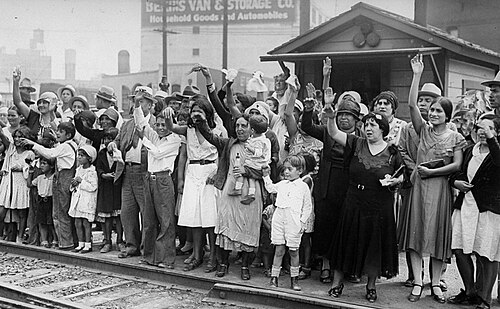

يبدأ تاريخ الأمريكيين من أصل مكسيكي في الغالب في أعقاب ضم شمال المكسيك عام 1848، عندما حصل ما يقرب من 80,000 مواطن مكسيكي - ممن يقطنون ما يُعرف اليوم بكاليفورنيا ونيفادا ويوتا وأريزونا وكولورادو ونيو مكسيكو - على الجنسية الأمريكية. [ 1 ] [ 2 ] وقد زادت الهجرة واسعة النطاق من عدد السكان المكسيكيين في الولايات المتحدة خلال العقد الثاني من القرن العشرين، حيث فرّ اللاجئون من الدمار الاقتصادي والعنف الناجم عن الثورة المكسيكية والحرب الأهلية . [ 3 ] [ 4 ] وحتى منتصف القرن العشرين، كان معظم الأمريكيين من أصل مكسيكي يعيشون على بُعد بضع مئات من الأميال من الحدود، على الرغم من أن بعضهم استقر على طول خطوط السكك الحديدية من الجنوب الغربي إلى الغرب الأوسط. [ 5 ]
في النصف الثاني من القرن العشرين، انتشر الأمريكيون من أصل مكسيكي في جميع أنحاء الولايات المتحدة، وخاصة في الغرب الأوسط والجنوب الشرقي، [ 6 ] [ 7 ] على الرغم من أن أكبر تجمعاتهم السكانية لا تزال في كاليفورنيا وتكساس. [ 8 ] خلال هذه الفترة، ناضل الأمريكيون من أصل مكسيكي من أجل حقوق التصويت، والمساواة في التعليم والتوظيف، والمساواة العرقية، والتقدم الاقتصادي والاجتماعي. [ 9 ]
الفترة الإسبانية

بدأ دخول الإسبان إلى ما يُعرف اليوم بجنوب غرب الولايات المتحدة عام 1540، عندما سار فرانسيسكو فاسكيز دي كورونادو ، برفقة 230 جنديًا إسبانيًا و800 من السكان الأصليين المكسيكيين وثلاث نساء، إلى وادي ريو غراندي . [ 10 ] بعد ذلك بوقت قصير، قاد خوان رودريغيز كابريلو أول رحلة استكشافية إلى كاليفورنيا العليا عام 1542، حيث نزل في سانتا باربرا الحالية. [ 11 ] تشير بعض التقارير إلى أن المستكشف ماركوس دي نيزا دخل أريزونا عام 1539، لكن الباحثين شككوا في استكشافه الأسطوري لمدن الذهب السبع . [ 12 ]
لم يبدأ الاستعمار الإسباني الشامل لجنوب غرب الولايات المتحدة إلا في عام 1598، عندما اختارت الحكومة الإسبانية، تحت ضغط الكنيسة الكاثوليكية لتنصير شعوب كواهويلتيكان في وادي ريو غراندي، خوان أونات لعبور نهر ريو غراندي وإنشاء مستوطنة دائمة في سان خوان بويبلو، بالقرب من مدينة إسبانيولا الحالية . [ 13 ] انتشرت شائعات عن وجود خامات ذهب وفضة مخفية في نيو مكسيكو قبل استيطان أونات، لكن لم يُعثر على أي منها في المنطقة. [ 14 ] وظل التركيز منصبًا على التنصير الديني.
أُقيمت أولى البعثات الإسبانية في تكساس في ثمانينيات القرن السابع عشر الميلادي حول سان أنجيلو وإل باسو وبريسيديو الحالية ، بالقرب من مستوطنات نيو مكسيكو. إلا أنه في أوائل ثمانينيات القرن نفسه، نشب صراع في نيو مكسيكو، حيث ثار شعب بويبلو ضد الاستعمار الإسباني. [ 15 ] ومع ذلك، استمر الاستعمار الإسباني، وفي عام 1690، بنى ألونسو دي ليون بعثات جديدة في شرق تكساس بعد أن اكتشف الإسبان توغل الفرنسيين في المنطقة. [ 16 ] وفي أريزونا ، أسس المبشر اليسوعي الإيطالي الأب أوزيبيو فرانسيسكو كينو أولى المستوطنات الإسبانية عام 1691. [ 17 ] أما في كاليفورنيا ، فلم تُنشأ أول مستوطنة إسبانية دائمة إلا عام 1769، عندما أسس الأب جونيبرو سيرا وجنوده الإسبان حصن سان دييغو . [ 18 ] شكل هذا بداية نظام البعثات التبشيرية ، وهي حقبة اشتهرت بوحشيتها تجاه الشعوب الأصلية. [ 19 ]
انتهت الفترة الإسبانية في عام 1821 بتوقيع معاهدة قرطبة ، التي أنهت رسمياً حرب الاستقلال المكسيكية . [ 20 ]
الفترة المكسيكية
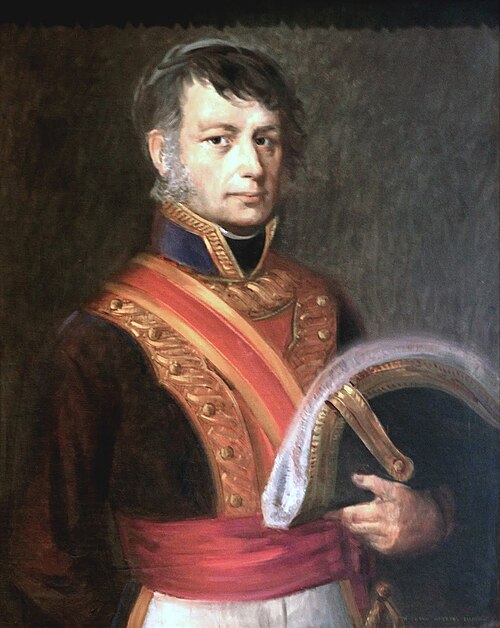
امتدت الفترة المكسيكية في جنوب غرب الولايات المتحدة من عام 1821 حتى عام 1848. واجهت الجمهورية المكسيكية الأولى (1824-1835) صعوبات في الحفاظ على سيطرتها على المنطقة. [ 21 ] ونظرًا لقلة سكانها وبعدها عن المركز الاقتصادي والسياسي في مدينة مكسيكو، أصبحت المناطق الشمالية من كاليفورنيا العليا ، وسانتا فيه دي نويفو مكسيكو ، وتكساس حرة في التبادل الاقتصادي مع التجار الأمريكيين، وهي ممارسة كانت محظورة في ظل الإمبراطورية الإسبانية . وقد أدت هذه الحرية الجديدة إلى نشوء روابط اقتصادية واجتماعية متينة بين النخب الاقتصادية في تكساس وكاليفورنيا العليا والولايات المتحدة. [ 22 ]
ضمن دستور المكسيك لعام 1824 المساواة بين جميع المكسيكيين بغض النظر عن العرق. وكان لهذا الدستور آثار بالغة الأهمية في كاليفورنيا العليا. ففي عام 1824، نظم شعب تشوماش في سانتا باربرا ثورة ضد نظام البعثات التبشيرية ، احتجاجًا على الظروف اللاإنسانية التي استمروا في معاناتها تحت حكم اليسوعيين. [ 23 ] في الوقت نفسه، حثت نخبة الولاية، بمن فيهم عائلات فاليخوس وألفارادو وبيرالتاس، على علمنة أراضي البعثات التبشيرية بالكامل . أدركت هذه العائلات الزراعية أنه في حال علمنة البعثات، سيتم توزيع الأراضي الشاسعة التي تملكها الكنائس من خلال منح الأراضي من قبل الحكومة الإقليمية. [ 24 ] في نهاية المطاف، رضخت الحكومة المكسيكية، وتم إلغاء نظام البعثات التبشيرية بموجب قانون العلمنة لعام 1833 . [ ٢٥ ] ونتيجةً لذلك، وُزِّعت الأراضي الشاسعة التابعة للبعثات التبشيرية عبر منحٍ لأثرى عائلات الولاية، بما في ذلك عائلات فاليخوس، وألفارادو، وبيرالتاس، وكاريوس، ودي لا غيراس، وبيكوس. [ ٢٦ ] أما الوافدون الجدد إلى كاليفورنيا، فبدلاً من أن يُحرَّروا، أصبحوا عمالاً في المزارع التي أنشأها الكاليفورنيون. وقد شُبِّهت هذه المزارع بالمزارع الكبيرة ، وكثيراً ما كان يُعامَل العمال الأصليون فيها "بشكل أسوأ من العبيد". [ ٢٧ ]

خلال هذه الفترة، تدفق رجال الأعمال الأنجلو-أمريكيون على كاليفورنيا وتكساس. [ 28 ] وقد رُحِّب بهؤلاء المهاجرين في المنطقة، وكان الزواج المختلط بين الرجال الأمريكيين والنساء المكسيكيات ممارسة شائعة، إذ كان وسيلة لضمان ولاءات الشركات من خلال الروابط الأسرية. [ 29 ] ومع ذلك، تحول التدفق المستمر للأمريكيين إلى الأراضي الشمالية إلى مشكلة متفاقمة للحكومة المكسيكية. ففي عام 1835، أي بعد أقل من 14 عامًا على استقلال المكسيك عن إسبانيا، ثار مُلاك المزارع الأمريكيون في تكساس ضد المكسيك وأعلنوا قيام جمهورية تكساس . [ 30 ] قاد الرئيس المكسيكي سانتا آنا جيشًا لقمع المتمردين ، ولكن بعد انتصارات أولية في ألامو وغولياد ، استسلم جيش سانتا آنا في 21 أبريل 1836. [ 31 ] لم تعترف الحكومة المكسيكية بجمهورية تكساس كدولة ذات سيادة، ورفضت الاعتراف بالمعاهدات التي وقعها سانتا آنا، لأنه كان رهينة عند توقيعها. [ 32 ] في جمهورية تكساس الجديدة، واجه سكان تكساس من أصل مكسيكي تمييزًا شديدًا في التعليم والاقتصاد. [ 33 ] في الوقت نفسه، كافحت المكسيك للحفاظ على استقرارها السياسي في أعقاب التمرد في تكساس. في الواقع، شهدت البلاد ثمانية عشر إدارة رئاسية بين عامي 1836 و1845. [ 34 ]
في عام ١٨٤٥، اقترح الرئيس الأمريكي المنتخب حديثًا، جيمس ك. بولك ، على المكسيك شراء ألتا كاليفورنيا وسانتا فيه دي نويفو مكسيكو، مدركًا حالة عدم الاستقرار المستمرة في المكسيك، ومتشوقًا لتوسيع رقعة الولايات المتحدة حتى المحيط الهادئ. [ ٣٥ ] رفضت الحكومة المكسيكية العرض رفضًا قاطعًا. ردّ بولك بنقل القوات الأمريكية، بقيادة زاكاري تايلور ، إلى قطاع نويسي لاستفزاز الجيش المكسيكي ودفعه لمهاجمة الولايات المتحدة، بهدف حثّ الكونغرس على إعلان الحرب. [ ٣٦ ] أقام تايلور معسكرًا في منطقة حدودية متنازع عليها، ورفض المغادرة، حتى بعد تحذيرات متكررة من الحكومة المكسيكية. [ ٣٧ ] بعد عدة مناوشات في المنطقة المتنازع عليها، أعلن الكونغرس الأمريكي الحرب في ١٣ مايو ١٨٤٦. [ ٣٨ ]
الحرب المكسيكية الأمريكية
الصراعات والمعارك

أثبتت الحرب المكسيكية الأمريكية ( 1846-1848) أنها من أهم الأحداث المؤثرة على الأمريكيين من أصل مكسيكي في تاريخ الولايات المتحدة. ففي عام 1846، دخل الجنرال الأمريكي ستيفن دبليو كيرني ولاية نيو مكسيكو، حيث لم يواجه مقاومة تُذكر من سكان سانتا فيه المكسيكيين. [ 39 ] وعيّن كيرني نخبة من سكان نيو مكسيكو المحليين على رأس الحكومة العسكرية المؤقتة ، مما ساهم إلى حد كبير في تهدئة سكان المنطقة. [ 40 ] وفي أول خطاب علني له أمام السكان، أعلن كيرني عن المساواة الوشيكة التي سيفرضها النظام الأمريكي، قائلاً: " القوي والضعيف ، الغني والفقير ، متساوون أمام القانون... سأحمي حقوق الجميع بالمساواة" . [ 40 ]
في البداية، قبلت نيو مكسيكو الاحتلال العسكري الأمريكي دون مقاومة، ولكن في غضون عام من ضم كيرني للإقليم، اندلعت انتفاضة واسعة النطاق. [ 41 ] قاد بابلو مونتويا، من سكان نيو مكسيكو، وتوماس روميرو، من سكان تاوس بويبلو، ثورة تاوس عام 1847 ، والتي أسفرت عن إعدام تشارلز بنت ، وشريف تاوس ستيفن لي، والقاضي كورنيليو فيجيل، وصهر بنت بابلو جاراميلو، والمحامي جيه دبليو ليال، وفتى صغير يُدعى نارسيسو بوبيان. [ 42 ] تحرك الجيش الأمريكي بسرعة لقمع الثورة، وانتهى القتال في نيو مكسيكو بعد هزائم نيو مكسيكو اللاحقة في معركة ريد ريفر كانيون ، ومعركة لاس فيغاس ، ومعركة سيينيغا كريك .
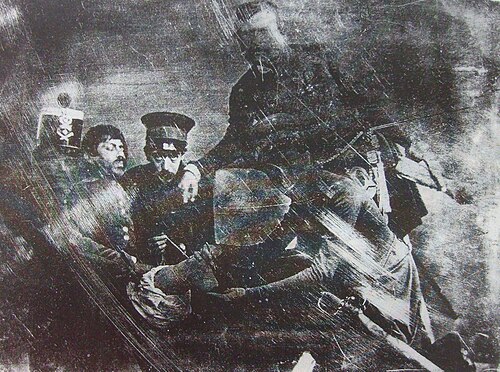
في كاليفورنيا، خاض السكان أيضًا معارك ضد الجيش الأمريكي. ففي عام ١٨٤٧، شنّ الكاليفورنيون معارك في جميع أنحاء جنوب كاليفورنيا ضد الغزو الأمريكي ، بما في ذلك معركة لوس أنجلوس ومعركة سان باسكوال (سان دييغو الحالية). وفرضت البحرية الأمريكية، اعتقادًا منها بأن قطع الإمدادات عن الكاليفورنيين سيضمن هزيمتهم، حصارًا على طول ساحل المحيط الهادئ وخليج المكسيك. ونتيجةً لهذه الإجراءات، تمكن أسطول المحيط الهادئ التابع للبحرية من السيطرة على مونتيري وسان فرانسيسكو وسان دييغو، مما ضمن فعليًا النصر للولايات المتحدة في كاليفورنيا. [ ٤٣ ] انتهت الحرب في ٨ سبتمبر ١٨٤٧، عندما سيطر وينفيلد سكوت على مدينة مكسيكو في معركة مدينة مكسيكو . وسرعان ما دخلت الولايات المتحدة والمكسيك في مفاوضات بشأن شروط الاستسلام. [ ٤٤ ]
معاهدة غوادالوبي هيدالغو
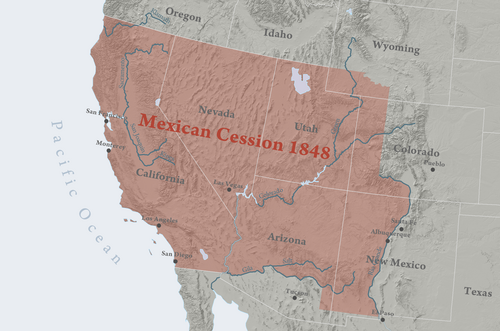
في الرابع من يوليو/تموز عام ١٨٤٨، صادقت الولايات المتحدة والمكسيك على معاهدة غوادالوبي هيدالغو ، التي أنهت الحرب رسميًا. [ ٤٥ ] وبموجب شروط الهزيمة، تنازلت المكسيك أيضًا عن أكثر من ٥٢٥ ألف ميل مربع من أراضيها. [ ٤٦ ] ضمنت المعاهدة الجنسية الكاملة لجميع المواطنين المكسيكيين السابقين الذين طلبوا ذلك، بالإضافة إلى الجنسية الأمريكية الرسمية لجميع من بقوا في الأراضي الأمريكية لمدة عام كامل بعد توقيع المعاهدة. [ ٤٧ ] تضمن النص الكامل للمعاهدة أيضًا المادة العاشرة، وهي بند كان من شأنه أن يضمن حقوق جميع حاملي منح الأراضي المكسيكية. [ ٤٨ ] خشية أن تمنح المادة العاشرة سكان تكساس من أصل مكسيكي (تيجانوس) حماية مفرطة على أراضيهم، حذفها الكونغرس الأمريكي سرًا من النسخة النهائية، مدعيًا أنها "زائدة عن الحاجة". [ ٤٠ ] ضمن قانون المعاهدة "للمواطنين الموقعين على المعاهدة" حقوقًا كاملة في أراضيهم إذا تمكنوا من إثبات ملكيتهم، لكن إثبات الملكية كان صعبًا. [ ٤٩ ]
علاوة على ذلك، وُقِّعت المعاهدة دون أي ضمانات قانونية رسمية تُؤكد معاملة جميع المواطنين المكسيكيين كمواطنين بموجب القانون الأمريكي. فبموجب دستور عام ١٨٢٤، نال جميع المكسيكيين، بغض النظر عن عرقهم، اعترافًا بمواطنتهم، إلا أن الولايات المتحدة، بموجب قانون التجنيس لعام ١٧٩٠ ، لم تعترف إلا بـ"البيض" كأشخاص مؤهلين للحصول على الجنسية عن طريق التجنيس . [ ٥٠ ] وبذلك، صنّفت المعاهدة المكسيكيين قانونيًا على أنهم "بيض" لمنحهم الجنسية الأمريكية، إلا أن هذا التصنيف اقتصر على النخبة المكسيكية الإسبانية، والمستيزو، والشعوب الأصلية المندمجة. [ ٥١ ] وبدون حماية قانونية صريحة، خضع جميع السكان الأصليين الأمريكيين غير المندمجين والمستقلين في الأراضي الجديدة لسوابق قضائية أمريكية سابقة تتعلق بقبائل "الهنود الحمر". [ ٥٢ ]
الفترة الأمريكية المبكرة


اتسمت فترة الاستيطان الأمريكي المبكر في جنوب غرب الولايات المتحدة بالعنف وفقدان الأراضي. وبموجب معاهدة غوادالوبي هيدالغو، مُنح جميع المكسيكيين حقوق المواطنة الرسمية كمواطنين أمريكيين، إلا أن استياءً واسع النطاق ظهر بين الأمريكيين من أصل مكسيكي. [ 53 ] وعلى الرغم من تعهدات المعاهدة بمنح المواطنة الكاملة والمتساوية، فقد انتشر التمييز والعنف بشكل فوري وواسع النطاق. [ 54 ]
إدراكًا للاستياء المحتمل الذي سيواجهه المكسيكيون السابقون كمواطنين أمريكيين، أصدر الرئيس المكسيكي خوسيه خواكين دي هيريرا خطة لإعادة التوطين في أغسطس 1848، وعدت بموارد اقتصادية وأراضٍ لأي مكسيكي سابق يعود إلى المكسيك. [ 55 ] عيّنت اللجنة ثلاثة مفوضين لاستقطاب العائدين. شجع الأب رامون أورتيز إي مييرا ، مفوض نيو مكسيكو، على إعادة التوطين من خلال انتقاده للوضع المتدني لـ"مواطني المعاهدة". [ 55 ] لاقت هذه الحجج صدىً قويًا لدى المكسيكيين السابقين، حيث عاد 25% من سكان المكسيكيين الأمريكيين في البلاد بعد الحرب. [ 55 ]
ومع ذلك، ورغم ضمان الولايات المتحدة لحق المكسيكيين السابقين في العودة إلى المكسيك، فقد وضعت حججًا قانونية لفرض قيود رسمية على حركة إعادة التوطين هذه. [ 55 ] بل إن وزير الحرب الأمريكي جورج دبليو كروفورد زعم أن العودة إلى الوطن محظورة. ولأن نيو مكسيكو كانت بمثابة المنطقة العازلة الرئيسية بين المستوطنين الأمريكيين وجماعات السكان الأصليين، فقد اعتقدت الولايات المتحدة أن من مصلحتها بقاء مواطني المعاهدة في الولايات المتحدة للحفاظ على وجود "حضاري" في المنطقة وحماية أراضيهم من توغل السكان الأصليين. [ 40 ]
مجتمع

في عام 1850، أحصى تعداد الولايات المتحدة حوالي 80,000 مواطن مكسيكي من حاملي معاهدات المكسيك يعيشون في كاليفورنيا وتكساس ونيو مكسيكو. [ 56 ] كانت نيو مكسيكو أكبر أراضي الولايات المتحدة آنذاك، حيث بلغ عدد سكانها حوالي 61,547 نسمة، 95% منهم تقريبًا مواطنون مكسيكيون سابقون. [ 57 ] سكنت غالبية سكان نيو مكسيكو في مجتمعات ريفية يقل عدد سكانها عن 1,000 نسمة. ووفقًا لتعداد عام 1850، كانت المهن الثلاث الأكثر شيوعًا بين سكان نيو مكسيكو هي الزراعة والعمل والخدمة. [ 57 ]
في جنوب تكساس ، عاش سكان تكساس من أصل مكسيكي (تيجانوس) في مجتمع ثلاثي الطبقات. في القمة، كانت النخبة المالكة للأراضي، التي امتلكت مزارع شاسعة، مُنحت العديد منها من قِبل الإمبراطورية الاستعمارية الإسبانية وحُوّلت إلى مزارع كبيرة (هاسيندا ). [ 58 ] حافظت هذه النخبة على هيمنتها الاقتصادية من خلال تربية الماشية. [ 58 ] احتل صغار ملاك الأراضي المرتبة الثانية في السلم الاقتصادي والاجتماعي لجنوب تكساس. [ 58 ] عاش هؤلاء الملاك في منازل طينية من غرفة واحدة، وقضوا معظم وقتهم في رعاية خيولهم وماشيتهم. [ 58 ] أخيرًا، كان في جنوب تكساس طبقة ثالثة دنيا تتألف أساسًا من البيون (الفيون )، ورعاة البقر (الفاكيروس) ، وسائقي العربات. كان للبيون مكانة أعلى من العبيد في تكساس قبل الحرب الأهلية، ولكنها أدنى من مكانة الأحرار. [ 58 ] عمل البيون بتوجيه من الباترون (أصحاب الأراضي) - زراعة المحاصيل وحصادها، ورعي الماعز، وحفر الآبار، والقيام بأي نوع من الأعمال اليدوية اللازمة. كانوا يعيشون في أكواخ صغيرة من غرفة واحدة تُسمى " جاكاليس "، ذات جدران من الطين أو أي مادة أخرى متوفرة وأسقف من القش. [ 58 ] اعتقد المهاجرون الأنجلو إلى تكساس أن أكواخ "الجاكاليس" دليل على طبيعة سكان تكساس "غير البشرية" و"البدائية". [ 59 ]

في كاليفورنيا، كان معظم الكاليفورنيين المولودين في البلاد يعيشون في مجتمعات زراعية ورعوية صغيرة في الجنوب. وكانت أكبر مدينتين في عام 1850 هما لوس أنجلوس ، التي بلغ عدد سكانها 3500 نسمة، وسانتا باربرا ، التي بلغ عدد سكانها 1185 نسمة. [ 60 ] ورغم أن نخبة الكاليفورنيين، مثل بابلو دي لا غيرا ولويس ماريا بيرالتا ، تمتعوا بنفوذ سياسي واقتصادي في الولاية، إلا أنهم لم يمثلوا سوى 3% من السكان في عام 1850. [ 61 ] وكانت الغالبية العظمى من الكاليفورنيين الذين يملكون أراضي زراعية يعتمدون على زراعة الكفاف، ويعتمدون في معيشتهم على قطع أراضيهم الصغيرة. وفي المناطق الساحلية الجنوبية، كانت ملكية الأعمال التجارية والعمل اليدوي من المهن الشائعة بين عامة الكاليفورنيين. أما بالنسبة للشعوب الأصلية في كاليفورنيا ، فقد كانت عواقب فشل معاهدة غوادالوبي هيدالغو في ضمان المواطنة الكاملة والحماية القانونية وخيمة. تعرضوا لإبادة جماعية ممنهجة ، مولتها ولاية كاليفورنيا. [ 62 ] أسفرت إبادة كاليفورنيا عن مقتل حوالي 90% من سكان كاليفورنيا الأصليين خلال الفترة الأمريكية المبكرة، مما مهد الطريق للاستعمار الأنجلو-أمريكي على نطاق واسع. [ 63 ]
حكومة

بمرور الوقت، تدهور الوضع الاجتماعي والاقتصادي والقانوني للمكسيكيين ذوي الأصول الإسبانية، ويعود ذلك في معظمه إلى حرمانهم من الحقوق السياسية وفقدانهم لأراضيهم على نطاق واسع. وقد ساهم في تسهيل هاتين العمليتين إلغاء الحقوق السياسية واللغوية وحقوق الملكية. وفي غضون عقدين من الزمن، سيطر الأمريكيون سيطرة كاملة على أجهزة السلطة السياسية في جميع أنحاء جنوب غرب الولايات المتحدة.
أدى خوسيه مانويل غاليغوس اليمين الدستورية في الكونغرس عام 1853 كأول ممثل إقليمي لولاية نيو مكسيكو. كان يتحدث الإسبانية فقط، وهو ما لم يُشكل عائقًا خلال فترتيه الأوليين. ولكن بعد فوزه في انتخابات إعادة انتخابه عام 1856، طعن منافسه ثنائي اللغة، ميغيل أ. أوتيرو ، في نتائج الانتخابات. [ 64 ] ادعى أوتيرو أن عدم إتقان غاليغوس للغة الإنجليزية يُقصيه من منصبه. دافع غاليغوس عن نفسه بحماس باللغة الإسبانية في قاعة مجلس النواب، مُعربًا عن "خيبة أمله" من "سخرية" زملائه. [ 65 ] ومع ذلك، نجح أوتيرو في مسعاه، وحلّ محل غاليغو كممثل إقليمي لولاية نيو مكسيكو. [ 66 ]
قدّم جون سي. فريمونت ، أول سيناتور أمريكي عن ولاية كاليفورنيا ، تشريعًا يُخوّل الحكومة الفيدرالية التحكيم في تسويات مطالبات الأراضي. [ 67 ] بعد حذف المادة العاشرة من معاهدة غوادالوبي هيدالغو، جُرّد مواطنو المعاهدة من أي حماية رسمية لحقوقهم في الأراضي. [ 68 ] بعد اكتشاف الذهب في مطحنة سوتر في كولوما، كاليفورنيا عام 1848، تدفقت هجرة جماعية على الولاية، مما أشعل فتيل حمى الذهب . وبحلول عام 1852، ازداد عدد سكان كاليفورنيا من 8000 نسمة عام 1848 إلى 260000 نسمة. [ 69 ] كان معظم هؤلاء المنقبين عن الذهب بلا أراضٍ، وادّعوا ملكيتهم لأراضي كاليفورنيا. أنشأ قانون أراضي كاليفورنيا لعام 1851 ، المعروف أيضًا باسم قانون غوين، نسبةً إلى السيناتور ويليام إم. غوين ، لجنةً يعيّنها الرئيس لتسوية المطالبات المتنازع عليها بين ملاك الأراضي والمنقبين الأنجلو-أمريكيين. [ 70 ] خلال حمى الذهب في كاليفورنيا، كان المكسيكيون من سونورا والتشيليون من أوائل الوافدين، وكانوا أيضًا من بين الأكثر خبرة في التعدين. تعلم العديد من عمال المناجم الأنجلو-أمريكيين أساسيات التعدين من التشيليين والسونوريين. [ 71 ] كان المكسيكيون والتشيليون والبيروفيون يميلون إلى التجمع معًا. ولأن التشيليين غالبًا ما كانوا يتولون مناصب قيادية في مجموعات التعدين الناطقة بالإسبانية، فقد استخدم الأنجلو-أمريكيون مصطلح "تشيلي" كمصطلح شامل لأي شخص يتحدث الإسبانية في حمى الذهب. [ 72 ] مع بدء تطبيق القوانين المعادية للأجانب (مثل ضريبة عمال المناجم الأجانب ) بشكل انتقائي ضد المكسيكيين والتشيليين، مالت هذه الجنسيات إلى التضامن. [ 73 ]
أرض

في سنوات ما بعد الحرب في كاليفورنيا، برزت الأرض كسلعة بالغة الأهمية والطلب. أنشأ قانون أراضي كاليفورنيا لعام ١٨٥١ لجنةً لتحديد مدى صحة منح الأراضي الإسبانية والمكسيكية. [ ٧٤ ] ولإثبات ملكية الأرض، كان على الملاك تقديم دليل على المنحة الأصلية، بالإضافة إلى إثبات قيامهم بإجراء تحسينات "هيكلية ورعوية" عليها. [ ٤٠ ] وإذا لم يتمكنوا من ذلك، كان بإمكان المستوطنين الأنجلو-أمريكيين المطالبة بالملكية إذا كانوا قد "حسّنوا الأرض"، وهو ادعاء مثير للجدل يصعب دحضه في كثير من الأحيان. [ 75 ] إضافةً إلى ذلك، ولأن العديد من منح الأراضي الإسبانية والمكسيكية الأولية كانت غامضة، إذ اقتصرت على وصف الحدود الطبيعية للملكية، فقد كان من الصعب على سكان كاليفورنيا إثبات النزاعات حول حدود المزارع. [ 76 ] كما كان لا بد من ترجمة جميع الوثائق المقدمة لدعم أي مطالبة إلى اللغة الإنجليزية. اكتسبت بعض الشركات، مثل شركة هاليك، بيتشي وبيلينغز ، سمعةً طيبةً كـ"أصدقاء للمكسيكيين" لمساعدتها سكان كاليفورنيا في التعامل مع النظام القضائي الأمريكي الجديد، لكن معظم محامي الأراضي استغلوا الوضع لصالحهم، فأطالوا أمد القضايا وفرضوا رسومًا باهظة مقابل خدماتهم. [ 77 ]

في معظم الحالات، كانت قضايا المطالبات بالأراضي باهظة التكاليف لدرجة يصعب معها على معظم سكان كاليفورنيا تحمل تكاليف التقاضي. ورغم أن أغلب القضايا حُكم فيها لصالحهم في نهاية المطاف، إلا أن متوسط فترة الانتظار لحل القضية بلغ سبعة عشر عامًا. [ 78 ] خلال تلك الفترة، اضطرت معظم عائلات كاليفورنيا إلى بيع أجزاء من ممتلكاتها لتسديد أتعاب محاميها. [ 79 ] إضافةً إلى ذلك، كانت جميع جلسات لجنة الأراضي تُعقد في سان فرانسيسكو، مما شكّل عائقًا إضافيًا ومكلفًا أمام ملاك الأراضي في جنوب كاليفورنيا. [ 80 ] وبشكل عام، واجه ملاك الأراضي من أصل مكسيكي أمريكي صعوبات بالغة في إثبات ملكيتهم لأراضيهم، وهو ما يرى البعض أنه كان الهدف من هذا النظام المعقد. [ 77 ] كتب ماريانو غوادالوبي فاليخو : "يتطلب الأمر الكثير من العمل والمال الذي لا أملكه للعثور على [شهود محتملين]، ثم دفع تكاليف توثيق الإفادات وترجمتها إلى الإنجليزية لكل شاهد." [ 40 ]
مع ذلك، حاول بعض سكان كاليفورنيا استغلال نفوذهم وسلطتهم لمكافحة التمييز القانوني. فقد استغل بابلو دي لا غيرا ، وهو مالك أراضٍ في سانتا باربرا، نفوذه السياسي كعضو في مجلس الشيوخ ثم نائب حاكم الولاية ، لينتقد علنًا النظام القانوني الأمريكي الذي كان يعامل المكسيكيين على أنهم "عرق مهزوم ودوني". [ 40 ] اشتكى دي لا غيرا من أن شهادة البيض كانت تُؤخذ على محمل الجد في النظام القضائي أكثر من شهادة المكسيكيين؛ وقال: "لقد تم التباهي بشكل مخزٍ بالتمييز بين شهادة البيض وشهادتنا". [ 40 ] حتى أن دي لا غيرا اضطر للنضال من أجل الحفاظ على حقه في تولي منصب سياسي؛ فقد قضت القضية التاريخية " الشعب ضد دي لا غيرا" بأنه على الرغم من الاتهامات المخالفة، يحق لدي لا غيرا تولي منصب سياسي في الولايات المتحدة. [ 81 ] ومع ذلك، هيمن البيض على المشهد السياسي والاقتصادي في كاليفورنيا، إذ لم تحتفظ أي عائلة مكسيكية بثروتها في الفترة الأمريكية المبكرة. [ 82 ]

في تكساس ، لم تخضع منح الأراضي قط للجنة تشريعية اتحادية. ولأن تكساس نالت صفة الولاية عام ١٨٤٥، فقد احتفظت بسيادتها على كامل مناطقها الحدودية، وبالتالي ادّعت إعفاءها من معاهدة غوادالوبي هيدالغو. [ ٨٣ ] وهكذا، تولّت حكومة ولاية تكساس مسألة منح الأراضي بنفسها، عندما عيّن الحاكم بيتر إتش. بيل ويليام إتش. بورلاند وجيمس ميلر لتحديد مدى صحة حيازات الأراضي الإسبانية والمكسيكية في الولاية. [ ٨٤ ] وفي أول جلسة استماع لها في مقاطعة ويب ، واجهت لجنة بورلاند-ميلر معارضة شديدة من ملاك الأراضي المكسيكيين الأمريكيين المحليين، الذين زعموا أن اللجنة أُنشئت للاستيلاء على ممتلكات سكان تكساس من أصل مكسيكي وسلبهم حقوقهم كاملة. [ ٨٥ ] إلا أن ميلر وبورلاند تمكّنا من كسب تأييد النخبة من ملاك الأراضي في منطقة لاريدو ، من خلال إجراء عملية "نزيهة"، أسفرت عن احتفاظ جميع عائلات سكان تكساس من أصل مكسيكي بحيازاتهم من الأراضي. [ 86 ] أما في بقية أنحاء الولاية، فقد كانت اللجنة أقل تأييدًا لمطالبات التكسانيين بملكية الأراضي. ففي مناطق جنوب غرب تكساس، لم تعترف اللجنة إلا بأقل من نصف منح الأراضي، وكان العديد من الأراضي التي اعتُرف بها مملوكًا بالفعل لتكساسيين من أصول أنجلو-ساكسونية. [ 85 ]
عنف
إضافةً إلى استخدام المناورات القانونية للاستيلاء على السيطرة الاقتصادية والسياسية، لجأ المستوطنون الأمريكيون أيضًا إلى العنف الجسدي كوسيلة للسيطرة على السكان المكسيكيين الأمريكيين الخاضعين لهم. ففي كاليفورنيا، طُرد المكسيكيون الأمريكيون من منازلهم، وأُجبروا على مغادرة مخيمات التعدين في المناطق الغنية بالذهب، ومُنعوا من الإدلاء بشهادتهم في المحكمة، وفُصلوا تدريجيًا في أحياء معزولة . [ 87 ] وقد قاوم رجالٌ مثل تيبورسيو فاسكيز هذا العنف، إذ لجأوا إلى قطاع الطرق لمقاومة هيمنة الأمريكيين البيض. [ 88 ] وكطريقة لإبقاء المكسيكيين تحت سيطرة المستوطنين الأمريكيين، لجأ المستوطنون الأمريكيون إلى الإعدام خارج نطاق القانون بحق المكسيكيين. فبين عامي 1848 و1860، أُعدم ما لا يقل عن 163 مكسيكيًا خارج نطاق القانون في كاليفورنيا وحدها. [ 89 ]
بين عامي 1848 و1879، تعرض الأمريكيون من أصل مكسيكي في جميع أنحاء الولايات المتحدة لعمليات إعدام خارج نطاق القانون بمعدل غير مسبوق بلغ 473 لكل 100,000 نسمة. لم تكن معظم هذه العمليات تجسيدًا لما يُعرف بـ" العدالة الحدودية "، فمن بين 597 ضحية، لم يُقتل سوى 64 شخصًا في مناطق تفتقر إلى نظام قضائي رسمي. [ 89 ] حُرم غالبية ضحايا الإعدام خارج نطاق القانون من حقهم في المحاكمة، بينما أُدين آخرون في محاكمات جائرة. لم يكن للأمريكيين من أصل مكسيكي أي سبيل للعدالة في بدايات التاريخ الأمريكي. ونتيجة لذلك، اعتُبر العديد من أبطال تلك الفترة خارجين عن القانون: لصوصًا، وقطاع طرق ، ومقاتلين من أجل الحرية. [ 90 ]
في تكساس، قاوم الأمريكيون من أصل مكسيكي عنف المستوطنين الأمريكيين. أشعل خوان كورتينا فتيل حرب كورتينا الأولى عام ١٨٥٩ عندما أطلق النار على روبرت شيرز، قائد شرطة بلدة براونزفيل ، بسبب معاملته الوحشية لموظفي كورتينا السابقين. [ ٩١ ] شنّ كورتينا غارة على البلدة واحتلها بفرقة من الرجال المسلحين. وظلّت المدينة تحت سيطرتهم لعدة أشهر، إلى أن تعرّضوا لهجوم مشترك بين قوات تكساس رينجرز والجيش الأمريكي، بقيادة جون فورد وصموئيل هاينتزلمان . دارت المعركة الحاسمة في مارس ١٨٦٠، حيث هُزم كورتينا. [ ٩٢ ]
أواخر القرن التاسع عشر
الحرب الأهلية
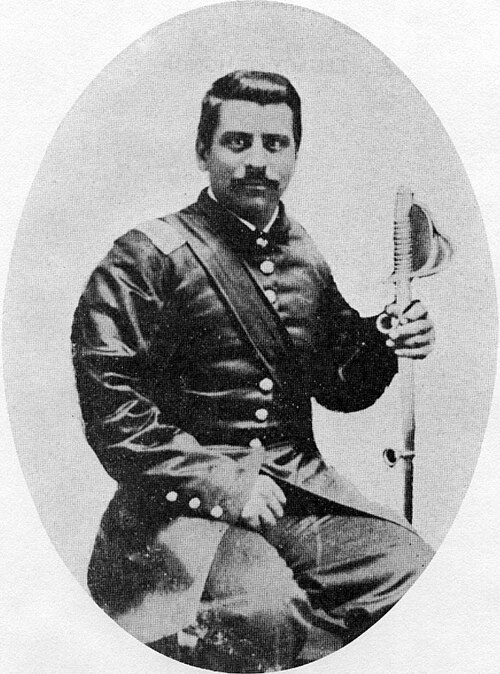
لعب الأمريكيون من أصل مكسيكي دورًا محوريًا في الحرب الأهلية الأمريكية (1861-1865). انفصلت تكساس ، التي كانت موطنًا لجزء كبير من السكان الأمريكيين من أصل مكسيكي في البلاد، عن الاتحاد وانضمت إلى الولايات الكونفدرالية الأمريكية في فبراير 1861. وفي منطقتي أريزونا ونيو مكسيكو ، تبنت العديد من العائلات الأمريكية من أصل مكسيكي من النخبة آراءً متعاطفة مع الكونفدرالية. [ 93 ] وفي نيو مكسيكو، دعمت عائلات المزارعين الأمريكيين من أصل مكسيكي الأثرياء علنًا مالكي العبيد في الجنوب، ربما بسبب اعتمادهم هم أنفسهم على العمل القسري للسكان الأصليين. [ 93 ]
في جميع أنحاء البلاد، شعر الأمريكيون من أصل مكسيكي بالاستياء تجاه الولايات المتحدة بسبب التمييز العرقي الذي تعرضوا له بعد الحرب المكسيكية الأمريكية. نتج عن ذلك تباينٌ في الدعم والمعارضة للولايات المتحدة. ففي نيو مكسيكو وكاليفورنيا ، انقسم الدعم بين الأمريكيين من أصل مكسيكي. [ 93 ] أيد العديد من ملاك الأراضي الأثرياء في جنوب نيو مكسيكو الكونفدرالية، بينما قاتل معظم سكان شمال نيو مكسيكو في صفوف جيش الاتحاد . [ 93 ] وفي كاليفورنيا، كان دعم الاتحاد أقوى في شمال كاليفورنيا ، بينما مال العديد من الأمريكيين من أصل مكسيكي في جنوب كاليفورنيا إلى الكونفدرالية. ومع ذلك، بقيت كاليفورنيا ضمن الاتحاد. [ 93 ]

لكن الكونفدراليين اعتقدوا أن فتح طريق إلى كاليفورنيا سيدعم قضيتهم. في صيف عام 1861، قاد جون ر. بايلور الكونفدراليين إلى ميسيلا وأعلن الجزء الجنوبي من نيو مكسيكو إقليم أريزونا الكونفدرالي . [ 94 ] ثم زحف إلى توسان وأعلن جنوب أريزونا المنطقة الثانية من إقليم أريزونا. [ 95 ] ردًا على هذا العدوان، عيّن الرئيس أبراهام لينكولن هنري كونلي - وهو سياسي أنجلو تزوج من عائلة مكسيكية أمريكية - حاكمًا لإقليم نيو مكسيكو. [ 96 ] مما بثّ الثقة في نفوس سكان نيو مكسيكو، وسرعان ما امتلأ جيش الاتحاد بالأمريكيين من أصل مكسيكي. قاد وحدات نيو مكسيكو ، المعروفة باسم متطوعي نيو مكسيكو، العميد دييغو أرتشوليتا ، والمقدم مانويل تشافيز ، والمقدم فرانسيسكو بيريا ، والعقيد خوسيه غوادالوبي غاليغوس ، وج. فرانسيسكو تشافيز ، والنقيب. رافائيل تشاكون. [ 97 ] تمكن هذا الجيش المكسيكي الأمريكي الضخم من تدمير سيطرة الكونفدرالية على نيو مكسيكو بحلول 28 مارس 1862، عندما دمر المقدم مانويل تشافيز وقواته قطار إمداد الكونفدرالية في ممر غلوريتا ، مما أجبر جنود الكونفدرالية على الانسحاب من ساحة المعركة. [ 98 ] تُعرف معركة ممر غلوريتا غالبًا باسم "غيتيسبيرغ الغرب"، وقد أنهت فعليًا محاولات الكونفدرالية للسيطرة على غرب الولايات المتحدة. [ 99 ] مع استسلام الكونفدرالية للإقليم، تولى المكسيكيون الأمريكيون من كاليفورنيا مسؤولية تطهير جميع مؤيدي الكونفدرالية، بمن فيهم الإمبرياليون الفرنسيون الذين دخلوا الولايات المتحدة خلال حكم ماكسيميليان في المكسيك . [ 93 ]

باعتبارها آخر معاقل الكونفدرالية في الجنوب الغربي، لعبت تكساس دورًا محوريًا في معارك الحرب الأهلية. وكان ملاك المزارع الأثرياء من أصول مكسيكية، مثل سانتوس بينافيدس ، من أشد مؤيدي الكونفدرالية في تكساس. [ 100 ] ومع ذلك، قاتل العديد من أبناء الطبقة العاملة من أصول مكسيكية في صفوف جيش الاتحاد، إذ لم يكن لديهم أي رغبة في العيش في نظام اجتماعي قائم على العمل القسري . [ 93 ]
حارب بعض سكان تكساس من أصل مكسيكي، مثل أنطونيو أوتشوا، ضد الكونفدرالية التكساسية منذ انفصالها. في عام 1861، سار أوتشوا ومجموعة من أربعين رجلاً إلى محكمة مقاطعة زاباتا ، ساعين لمنع مسؤولي المدينة من أداء قسم الولاء للكونفدرالية. [ 101 ] تعرض أوتشوا ورجاله لهجوم فوري من القوات الكونفدرالية، ما أجبرهم على الفرار إلى المكسيك. هناك، التقوا بخوان كورتينا ، الذي أُجبر على مغادرة تكساس في نهاية حرب كورتينا الأولى، وجنّدوه . [ 93 ] شنّ أوتشوا وكورتينا معًا عدة هجمات عسكرية واقتصادية في جنوب تكساس ، مستهدفين خطوط الإمداد، بل واغتالوا قاضيًا كونفدراليًا في المقاطعة. [ 102 ] بعد كل هجوم، كانوا يفرون عائدين إلى بر الأمان في المكسيك، وينتظرون لفترة وجيزة، ثم يعودون إلى تكساس لشنّ هجومهم التالي. استمر هذا الوضع حتى أُعدم أوتشوا على يد شقيق سانتوس بينافيدس. [ 93 ]
دارت رحى المعركة الأخيرة في الحرب الأهلية الأمريكية في تكساس. فبعد شهر من استسلام روبرت إي. لي في أبوماتوكس في أبريل 1865، زحفت قوات الاتحاد نحو براونزفيل . [ 103 ] وردّ الكونفدراليون من أصل تكساني قرب مصب نهر ريو غراندي وهاجموا جنود الاتحاد. [ 104 ] ورغم انتصار الكونفدراليين في هذا النصر الأخير، إلا أنهم كانوا الخاسرين الأكبر في الحرب. وقُدّر عدد اللاتينيين الذين شاركوا في الحرب الأهلية بنحو 20,000 . [ 105 ]
عصر إعادة الإعمار

على الرغم من المساهمات الكبيرة للأمريكيين من أصل مكسيكي في الحرب الأهلية الأمريكية، واجه المجتمع عودةً للتمييز خلال فترة إعادة الإعمار . في سبعينيات القرن التاسع عشر، شهدت منطقة نيو مكسيكو تدفقًا هائلًا للمستوطنين الأنجلو-أمريكيين ومضاربي الأراضي . [ 106 ] خشيةً من استيلاءٍ على الأراضي على غرار حمى الذهب، رفعت الهيئة التشريعية للمنطقة التماسًا إلى الكونغرس للمطالبة بحماية السكان. [ 40 ] في مذكرتهم المقدمة إلى الكونغرس عام 1872 ، طالب مشرعو نيو مكسيكو بتغيير قوانين الأراضي الفيدرالية، التي كانت تنص على أنه في حالة النزاع، يجب على مالكي الأرض تقديم دليل على منحهم الأصلي للأرض باللغتين الإنجليزية والإسبانية. جادل المشرعون بأن هذا يشكل عبئًا لا داعي له على سكان نيو مكسيكو، نظرًا لأن "قلة قليلة منهم تفهم اللغة الإنجليزية". [ 40 ] مع ازدياد الهجرة خلال العقد، أصدرت الهيئة التشريعية المزيد من المذكرات، مؤكدةً على ضرورة إنشاء مجلس مفوضين لتسوية النزاعات على الأراضي. [ 40 ]

في تكساس، أدت النزاعات بين سكان تكساس من أصل مكسيكي (تيجانوس) والأمريكيين البيض إلى صراع عنصري علني. اندلعت حروب السلخ، المعروفة أيضًا باسم حرب كورتينا الثانية ، في سبعينيات القرن التاسع عشر. [ 107 ] بعد الحرب الأهلية، وجد مربو الماشية في تكساس أنفسهم أمام فائض هائل من الماشية، مما أدى إلى انخفاض حاد في سعر لحم البقر. ومع ذلك، ظل سعر جلود الأبقار مرتفعًا نسبيًا. وبسبب ارتفاع سعر الجلود، سرعان ما نشأت نزاعات حول الماشية المتمردة ، التي كانت تُترك في تلك الفترة ترعى في المراعي المفتوحة . نتج عن هذه النزاعات "غارات سلخ"، حيث كان الشبان المكسيكيون يجمعون قطعان الماشية المتنازع عليها ويسلخونها جميعًا دفعة واحدة. ردًا على ذلك، نظم الأمريكيون البيض في جنوب تكساس " لجان يقظة "، والتي سرعان ما اكتسبت سمعة سيئة بسبب أساليبها العنيفة. [ 108 ] في كوربوس كريستي ، داهمت لجنة اليقظة الأنجلو-ساكسونية مزارع التيخانو، حيث قتلوا كل ذكر مكسيكي، وأحرقوا جميع مبانيهم، وأجبروا أي ناجٍ على عبور الحدود إلى المكسيك. [ 109 ] فرض لياندر إتش. ماكنيللي ، وهو حارس تكساس وعضو سابق في الكونفدرالية، عقوبات على التيخانو الذين اعتقد أنهم مسؤولون عن "المداهمات"، منهيًا بذلك رسميًا الحرب العرقية. [ 110 ]

في غرب تكساس ، تصاعدت التوترات العرقية العنيفة بحلول عام ١٨٧٧. في سبتمبر من ذلك العام، سعى قاضي مقاطعة سان إليزاريو، تشارلز هوارد، إلى فرض رسوم على المكسيكيين والتكساسيين من أصل مكسيكي (تيجانوس) والتكساسيين من أصل مكسيكي (تيغواس) عند استخراجهم الملح من مناجم الملح المحلية . [ ١١١ ] أثارت هذه الرسوم غضب السكان، إذ كانت مناجم الملح تُعتبر موردًا عامًا لأجيال عديدة. [ ١١٢ ] بعد أن ألقى هوارد القبض على اثنين من السكان لمحاولتهما جمع الملح دون دفع الرسوم، ثار السكان ضده. عُرفت هذه الثورة باسم حرب ملح سان إليزاريو ، وأسفرت عن مقتل هوارد وأربعة أمريكيين بيض آخرين. [ ١١٣ ] ردًا على ذلك، استعان سكان سان إليزاريو البيض بقوات تكساس رينجرز، الذين قاموا، بالتعاون مع الجيش الأمريكي، بقمع التمرد وإعادة ترسيخ النفوذ الأنجلو-أمريكي في المنطقة. [ ١١٤ ]
في الجنوب، واصل ريتشارد كينغ تعزيز سيطرته على مزرعة كينغ في أواخر سبعينيات القرن التاسع عشر، مستخدمًا في الغالب أساليب عنيفة وقسرية ضد جيرانه من ملاك المزارع من أصول تكساسية. [ 115 ] في عام 1878، اشتكى أحد المعلقين في إحدى الصحف من أن جيران كينغ "يختفون بشكل غامض بينما تمتد أراضيه على أراضٍ شاسعة". [ 116 ] مع ذلك، لم يكن كينغ يعمل بمفرده. فمع ازدياد ثروته، ازداد نفوذه السياسي، وأصبح توحيد أراضي المزارع في تكساس ممكنًا بفضل فرقة تكساس رينجرز. اتخذت هذه الفرقة في تلك الفترة إجراءات عنيفة ضد ملاك المزارع من أصول تكساسية لإجبارهم على بيع أراضيهم. في الواقع، عُرفت فرقة تكساس رينجرز شعبيًا في أواخر سبعينيات القرن التاسع عشر باسم " لوس ريتشيس دي لا كينينا" ، في إشارة إلى الاعتقاد السائد بأنهم كانوا بمثابة قوة الأمن الخاصة بكينغ. [ 117 ]
العصر الذهبي

شهدت ثمانينيات القرن التاسع عشر تحولاتٍ جوهرية بالنسبة للأمريكيين من أصل مكسيكي، تميزت بشكل خاص بظهور خط سكة حديد ساوثرن باسيفيك . في إل باسو ، وصل خط ساوثرن باسيفيك إلى المدينة عام ١٨٨١، مما أدى إلى انطلاق ثورة اقتصادية وصناعية فورية، حيث ظهرت صناعات جديدة في التعدين والصهر والبناء. [ ١١٨ ] [ ١١٩ ] امتدت آثار هذا الازدهار الاقتصادي إلى جميع أنحاء جنوب غرب الولايات المتحدة وشمال المكسيك ، وجلب معه مهاجرين جدد من داخل البلاد وخارجها إلى المنطقة. [ ١٢٠ ] بالإضافة إلى المكسيكيين الذين دخلوا الولايات المتحدة من المكسيك، قدم عمال صينيون من سان فرانسيسكو ، وفرّ أمريكيون من أصل أفريقي من الجنوب الأمريكي الذي كان يخضع لقوانين جيم كرو العنصرية، وجاء أمريكيون من أصل أوروبي من الساحل الشرقي . ساهم تدفق رؤوس الأموال الجديدة والعمالة المهاجرة إلى المنطقة في تحويل تكساس من أرض قاحلة إلى مركز للتجارة الدولية، وبرزت إل باسو كمركز اقتصادي رئيسي في المنطقة ومستودع تجاري دولي. [ ١٢١ ] ومع ذلك، استمر العنف العنصري. [ 122 ] كتبت ماري جاك، وهي سائحة بريطانية قضت عامين في وسط تكساس في ثمانينيات القرن التاسع عشر، أن قتل سكان تكساس من أصل مكسيكي "كان يحمل معه نوعًا من الحصانة"، حيث بدا أن المكسيكيين "يُعاملون كالكلاب، أو ربما ليس معاملة حسنة". [ 123 ]
سرعان ما تعقدت الهجرة إلى الولايات المتحدة في تلك الفترة بسبب القيود العنصرية. ولأول مرة في تاريخها، منعت الولايات المتحدة مجموعة كاملة من أصول صينية من الهجرة عندما أصدرت قانون استبعاد الصينيين عام 1882. [ 124 ] تسبب هذا في صعوبات على الحدود المكسيكية الأمريكية ، حيث استبعد القانون رسميًا المكسيكيين من أصل صيني من دخول الولايات المتحدة أيضًا. [ 125 ] وظّفت مصلحة الجمارك الأمريكية "مفتشين صينيين" لتفتيش المهاجرين في منافذ الدخول في الجنوب الغربي. [ 126 ] وبينما كانت السياسة الأمريكية الرسمية تقضي بترحيل جميع المهاجرين الصينيين إلى الصين ، عُدّلت سياسات الهجرة تعديلًا طفيفًا للمكسيكيين الصينيين، الذين رُحِّلوا إلى المكسيك بدلًا من ذلك، إذا كانوا يحملون الجنسية المكسيكية، أو عاشوا معظم حياتهم في المكسيك، أو كانوا متزوجين من مواطنين مكسيكيين. [ 127 ] تطورت قوة "التفتيش الصيني" هذه لتصبح دوريات الحدود الأمريكية . [ 128 ]
مع ذلك، لم تُتجاهل هذه الإهانات المستمرة التي عانى منها المكسيكيون والأمريكيون من أصل مكسيكي تمامًا. ففي عام ١٨٨٥، نشرت ماريا رويز دي بورتون ، وهي أمريكية من أصل مكسيكي من كاليفورنيا، روايتها "المستوطن والدون" ، التي تدور أحداثها في مقاطعة سان دييغو في سبعينيات القرن التاسع عشر ، حيث اصطدمت عائلة أمارو الخيالية مع " الإسكواتاس" ، وهم أمريكيون من أصل أنجلو قاموا "بتحسين" مزرعة عائلة أمارو من أجل الحصول على حق قانوني في الأرض. [ ١٢٩ ] تُعتبر ماريا رويز دي بورتون أول كاتبة أمريكية من أصل مكسيكي في الولايات المتحدة، وقد تأثرت بتجاربها الشخصية في كاليفورنيا بعد الحرب المكسيكية الأمريكية. [ ١٣٠ ] قبل نشر روايتها، كتبت إلى ابنة عمها: "لا يُمكن إنكار أن لدى سكان كاليفورنيا سببًا للشكوى. لا بد أن الأمريكيين يعلمون ذلك؛ فحريتهم المزعومة ومساواتهم في الحقوق تبدو وكأنها تتوقف عندما تصطدم بكاليفورني ... والآن علينا أن نتوسل من أجل ما كان لنا الحق في المطالبة به." [ ١٣١ ]
تزامن نشر رواية بيرتون مع العديد من التطورات المهمة الأخرى في كاليفورنيا بالنسبة للأمريكيين من أصل مكسيكي. شهد ذلك العقد التفكيك الرسمي لاستخدام اللغة الإسبانية في الوثائق الحكومية الرسمية، [ 132 ] وفي نفس الوقت تقريبًا ظهرت ممارسة قمع الناخبين التي سادت خلال العصر الذهبي لحرمان الأمريكيين من أصل أفريقي من حقهم في المشاركة في وظائف الحكومة. [ 133 ]
بالنسبة للأمريكيين من أصل مكسيكي عمومًا، مثّل العصر الذهبي فترةً من التغيرات الاقتصادية المفاجئة، والحرمان السياسي، والنزوح الديموغرافي. ورغم وجود أعداد كبيرة من العمال المهاجرين الذين دخلوا الجنوب الغربي من المكسيك خلال هذه الفترة عبر خطوط السكك الحديدية، إلا أن هذه الأعداد تضاءلت أمام موجة الهجرة الهائلة للأمريكيين البيض غربًا من نيويورك وغيرها من الموانئ. وبينما شهدت ثمانينيات القرن التاسع عشر تغييرات جذرية، برزت السنوات اللاحقة كفترة تصاعد للعداء العنصري.
صعود خوان كرو

شهدت تسعينيات القرن التاسع عشر بالنسبة للأمريكيين من أصل مكسيكي اضطرابات اجتماعية متجددة، بما في ذلك صراعات ذات طابع عنصري. في إل باسو ، التي شهدت تدفقًا هائلًا للمهاجرين الأمريكيين البيض إلى المنطقة بعد اكتمال خط سكة حديد ساوثرن باسيفيك، تراجعت حدة العداء العنصري بشكل ملحوظ. [ 134 ] أصبح الزواج المختلط، الذي كان مسموحًا به ضمنيًا في بعض أجزاء تكساس، جريمةً تستهدفها السلطات التكساسية بشكل متزايد. [ 135 ] في إل باسو، تم تشويه صورة الأمريكيين من أصل مكسيكي ووصفهم بالجهل، وبالتالي عدم أهليتهم للتصويت. كما وصفهم البيض في تكساس مرارًا وتكرارًا بأنهم "أجانب"، على الرغم من جنسيتهم الأمريكية. [ 134 ] زعمت إحدى صحف إل باسو أن المكسيكيين "أجانب يدّعون الجنسية الأمريكية لكنهم يجهلون الأمور الأمريكية جهلًا تامًا". [ 134 ]

في تسعينيات القرن التاسع عشر، استمر صناعتا السكك الحديدية والتعدين في التوسع. احتاجت هاتان الصناعتان إلى أعداد هائلة من العمالة لشغل الوظائف الجديدة، والتي شغلها في الغالب مهاجرون من المكسيك. [ 136 ] كان المهاجرون الذين دخلوا الولايات المتحدة يأتون من مناطق نائية في المكسيك، باحثين عن مخرج من قسوة عهد بورفيريو دي جانيرو المتزايدة . [ 137 ] ربط خط سكة حديد تكساس المكسيكي الولايات المتحدة والمكسيك عام 1883، مما أتاح نظام نقل عابر للحدود متكامل بشكل متزايد بين البلدين. [ 138 ] في غضون ذلك، بالنسبة للعائلات المكسيكية الأمريكية الميسورة التي استمرت في خوض دعاوى قضائية تتعلق بمطالبات الأراضي المتنازع عليها، قدمت الحكومة الفيدرالية أخيرًا بعض الدعم لهم عام 1891. أُنشئت محكمة المطالبات الخاصة بالأراضي لتسوية النزاعات، ووفرت مترجمًا فوريًا ممولًا فيدراليًا للمحكمة. [ 139 ] خضعت مقاطعة نيو مكسيكو، التي كانت تحث على إنشاء مثل هذه اللجنة لسنوات، لاختصاص المحكمة، إلى جانب كولورادو وأريزونا. وعلى الرغم من أن المحكمة أقرت بعض منح الأراضي في نيو مكسيكو، إلا أن العديد منها لم يتم إقراره. [ 40 ]

في تكساس، أشعلت التفاوتات الاقتصادية والسياسية الهائلة شرارة عودة الصراع العرقي. في سبتمبر/أيلول 1891، قاد كاتارينو إيراسمو غارزا جيشًا مؤلفًا من مئات من سكان تكساس من أصل مكسيكي (تيجانوس) عبر نهر ريو غراندي ذهابًا وإيابًا في ثورة ضد كل من المكسيك والولايات المتحدة، عُرفت باسم ثورة غارزا . [ 140 ] اتخذ الجيش، المعروف باسم الغارزيستاس، شعار " أحرار الحدود " (libres fronterizos) الذي طُرز على قبعاتهم، وكان حركة متعددة الطبقات، تضم مهنيين من الطبقة المتوسطة الدنيا، ومزارعين فقراء، ورعاة ماشية بلا أرض، وملاك أراضٍ أثرياء، من بينهم مكسيكيون وأمريكيون من أصل مكسيكي (بالإضافة إلى عدد قليل من الأمريكيين البيض الذين تزوجوا من عائلات مكسيكية). [ 140 ] كان الرد العسكري على ثورة غارزا دمويًا للغاية، وشكّل سابقة لشرطة تكساس والجيش الأمريكي على حد سواء في الحروب الداخلية. [ 140 ]
قاد عملية القمع النقيب جون غريغوري بورك من الجيش الأمريكي ، الذي قال: "إن أرخص شيء يمكن فعله هو إطلاق النار عليهم أينما وجدوا وهم يتسللون حاملين أسلحة في أيديهم، وحرق بعض المزارع التي وفرت لهم المأوى". [ 141 ]
قاد بورك، الذي كان يمتلك خبرة خمسة عشر عامًا في أريزونا خلال حروب الأباتشي ، جيوشه لتدمير جميع مجتمعات التيخانو التي يُعتقد أنها تدعم غارزا. [ 141 ] أحرق الجيش الأمريكي المزارع، وهدد العائلات بالإعدام دون محاكمة، وفتش المنازل دون أوامر قضائية، وسرق الأسلحة والخيول والأموال من عائلات التيخانو. [ 141 ] قُدمت شكاوى إلى مسؤولي الولاية والمسؤولين الفيدراليين، لكن تم تجاهل هذه الفظائع. قُمعت ثورة غارزا بحلول عام 1893، وعندها أُجبر كاتارينو غارزا على المنفى، مع آخر أنصاره المتفرقين. [ 141 ]

في نيو مكسيكو، قامت عصابة سانتا فيه ، وهي مجموعة من المحامين الأنجلو-ساكسونيين النافذين ومضاربي الأراضي ، بتجريد آلاف الأمريكيين من أصل مكسيكي من أراضيهم التي كانوا يستخدمونها للزراعة الجماعية . [ 142 ] قامت العصابة بتسييج الأراضي لمنع أي شخص من الوصول إليها. رفعت جماعة تُدعى " لاس غوراس بلانكاس" دعوى قضائية ضد العصابة، مطالبةً بحق المجتمع في الوصول إلى منحة أراضي لاس فيغاس، لكن القاضي انحاز إلى جانب العصابة. [ 143 ] توعدت "لاس غوراس بلانكاس " بالانتقام العسكري. في عام 1890، بدأت حملتها للعدالة الأهلية، حيث قامت بقطع الأسوار الجديدة، وتدمير المعدات الزراعية، وحرق المباني في جميع أنحاء مقاطعات سان ميغيل وسانتا فيه ومورا . [ 144 ]
بلغ عدد أعضاء جماعة غوراس بلانكاس ما بين 700 و1500 عضو في أوج قوتها. [ 145 ] وقد أعلنوا أنفسهم مدافعين عن "حقوق جميع الناس عمومًا، [وخاصة] الفقراء". [ 145 ] وصفهم حاكم الإقليم ، ليبارون برادفورد برينس، بأنهم "حشد" عنيف، [ 145 ] وكلف المسؤولين بقمعهم. وُجهت اتهامات إلى 48 من أعضاء غوراس بلانكاس، لكن لم يُدان أي منهم. [ 146 ]
في ولاية أريزونا، اندلع العنف العنصري في عام 1896 مع انتفاضة الياكي ، عندما قاتلت مجموعة من ثوار الياكي والبيما والمكسيكيين ضد جيوش الولايات المتحدة والمكسيك في محاولة مبكرة للإطاحة بالرئيس بورفيريو دياز الذي كان يزداد استبدادًا . [ 147 ]
القرن العشرين

في العقد الأول من القرن العشرين، ازداد عدد الأمريكيين من أصل مكسيكي بشكل ملحوظ. وقد تم إنجاز أول خط سكة حديد يربط مدينة مكسيكو بالحدود المكسيكية الأمريكية، مما سهّل حركة المكسيكيين عبره. [ 148 ] ازدادت الهجرة بشكل خاص بعد ركود اقتصادي حاد ضرب المكسيك عام 1906، ثم كساد اقتصادي من عام 1908 إلى عام 1909. [ 149 ] [ 150 ] قوبل المهاجرون من أصول مختلطة (المستيزو) بالعداء في الولايات المتحدة، حيث بدأ الأمريكيون البيض في الجنوب الغربي بالتحذير من مخاطر الهجرة غير البيضاء. [ 134 ] ومع ازدياد عدد المهاجرين المكسيكيين، ظهرت منشورات معادية للأجانب ، زعمت أن سوء الأحوال المعيشية في مجتمعات المهاجرين يدل على عيوب في الشخصية المكسيكية، وليس على تقصير السكان الأصليين في مساعدة المهاجرين. [ 134 ]
السياسة الداخلية

واجه الأمريكيون من أصل مكسيكي المولودون في الولايات المتحدة تمييزًا قانونيًا، بما في ذلك إجبارهم على الالتحاق بمدارس منفصلة حيث تعرضوا لنقص حاد في الخدمات وسوء المعاملة، [ 151 ] [ 152 ] وحالات انتحار غامضة وغير مفسرة في السجون، وعمليات إعدام خارج نطاق القانون. [ 153 ]
في عام ١٩٠٣، بالقرب من أوكسنارد، كاليفورنيا ، أضربت مجموعة من العمال الزراعيين الأمريكيين من أصول مكسيكية ويابانية للمطالبة بأجور وظروف عمل أفضل. [ ١٥٤ ] وكان هذا أحد أوائل الإضرابات المنظمة المسجلة للأمريكيين من أصول مكسيكية في تاريخ الولايات المتحدة. [ ١٥٤ ] أثار المضربون غضب المجتمع الأبيض المحيط. قُتل عامل يُدعى لويس فاسكيز بالرصاص، وأُصيب أربعة آخرون. [ ١٥٥ ] ورغم أن المضربين تمكنوا من استغلال التغطية الإعلامية لحادثة إطلاق النار لتحقيق بعض مطالبهم، إلا أن صموئيل غومبرز والاتحاد الأمريكي للعمل رفضا منح المضربين ميثاقًا نقابيًا رسميًا بسبب تكوينهم العرقي. [ ١٥٦ ]
في كليفتون، أريزونا ، عام ١٩٠٤، داهمت عصابات من الرجال البيض منازل عائلات مكسيكية أمريكية لاختطاف أطفالهم، في محاولة لإنقاذهم مما زُعم أنه "معاناة" ناجمة عن تربيتهم في بيوت مكسيكية. [ ١٥٧ ] وفي عام ١٩٠٦، رفضت المحكمة العليا النظر في قضية تتعلق بمعاقبة الخاطفين، مما سمح ضمنيًا بتبني الأطفال قانونيًا وتربيتهم من قبل هؤلاء الخاطفين. [ ١٥٨ ]
من مطلع القرن العشرين وحتى ثلاثينياته، لجأ الأمريكيون من أصل مكسيكي إلى النظام القضائي لتأكيد حقوقهم كمواطنين والدفاع عنها بشتى الطرق. وواجهوا تحدياتٍ تتعلق بملكية الأراضي وحقوق الملكية نتيجةً للممارسات التمييزية والتحيز العنصري. وكثيراً ما لجأوا إلى المحاكم لمكافحة نزع ملكية الأراضي، وعمليات الإخلاء غير القانونية، وقوانين الملكية التمييزية. [ 159 ] ومن خلال الإجراءات القانونية، سعوا إلى تأكيد حقوق ملكيتهم وحماية مصالحهم العقارية. [ 160 ]
انخرط الأمريكيون من أصل مكسيكي أيضًا في معارك قانونية للتصدي للتمييز العنصري والمطالبة بحقوقهم المدنية. فقد رفعوا دعاوى قضائية ضد الممارسات التمييزية في الأماكن العامة، ووسائل النقل، وحقوق التصويت. [ 159 ] وقد أسهمت هذه الجهود القانونية في تعزيز الحقوق المدنية للأمريكيين من أصل مكسيكي ومواجهة العنصرية الممنهجة. في كتابه " غرب الجنس: نشأة أمريكا المكسيكية، 1900-1930 "، يقدم المؤلف بابلو ميتشل رؤى ثاقبة حول كيفية تفاعل الأمريكيين من أصل مكسيكي مع النظام القانوني للاعتراف بحقوقهم كمواطنين والمطالبة بها. [ 159 ]
العلاقات الدولية

في تلك السنوات التي سبقت مطلع القرن العشرين، كثّفت المكسيك حملتها ضد شعب الياكي في سونورا ، الذين كانوا يناضلون ضد برامج الاستيعاب القسري التي فرضتها حكومة بورفيريو. [ 161 ] أطلقت الحكومة الفيدرالية المكسيكية برنامجًا لإعادة التوطين القسري ، حيث قامت بترحيل متمردي الياكي للعمل كعمالة قسرية في مزارع الهينيكين في يوكاتان . [ 161 ] ردًا على ذلك، فرّ العديد من الياكي المكسيكيين إلى الولايات المتحدة. تفاوض الجيش الأمريكي، بقيادة الكابتن هاري سي. ويلر ، مع الحكومة المكسيكية لترحيل أي ياكي يُعثر عليه في أريزونا إلى المكسيك. [ 134 ] ذهبت وزارة التجارة والعمل الأمريكية إلى أبعد من ذلك، وأمرت باحتجاز وترحيل جميع الياكي الذين دخلوا الولايات المتحدة بدون وثائق. تم ترحيل ما بين 10,000 و15,000 من الياكي إلى المكسيك، حيث واجهوا القتل والإعدام خارج نطاق القانون والاستعباد على يد حكومة بورفيريو . [ 161 ]
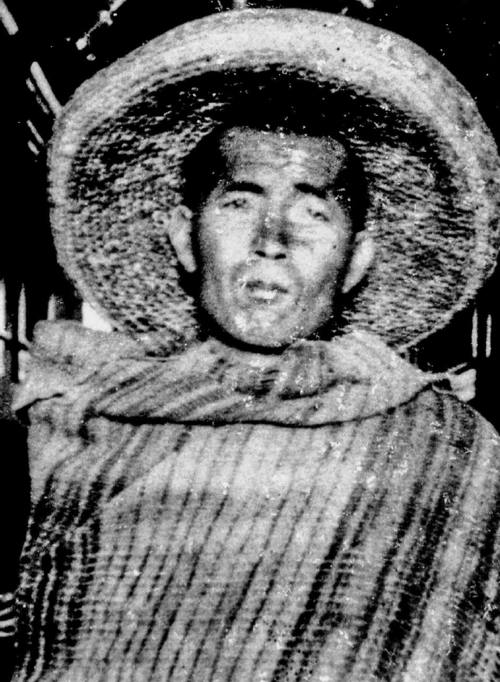
في النصف الثاني من العقد، عمل مسؤولو الهجرة الأمريكيون على تشديد اللوائح على الحدود المكسيكية الأمريكية. ومع ازدياد الهجرة من المكسيك إلى الولايات المتحدة مع مطلع القرن، ضغط دعاة العداء للمهاجرين لزيادة القيود المفروضة على الصحة العامة والإنفاق الحكومي على المهاجرين المحتملين. [ 134 ] كما خلقت المشاعر المعادية للصينيين حالة من الهستيريا في المدن الحدودية الأمريكية. ونظرًا لعدم قدرتهم على التمييز بين المكسيكيين الأصليين والمستيزو والمكسيكيين من أصل صيني ، ازداد قلق مسؤولي الهجرة الأمريكيين بشأن المكسيكيين الصينيين الذين دخلوا الولايات المتحدة مرتدين ملابس مكسيكية "تقليدية" ويتحدثون الإسبانية. [ 162 ]
في عام ١٩٠٥، أكد تي إف شمكر، رئيس مكتب الهجرة في إل باسو ، أن ما بين ١٥٠ و٢٠٠ مكسيكي صيني كانوا محتجزين في خواريز . [ ١٦٣ ] وبحلول عام ١٩٠٧، تبنى مسؤولو الهجرة الأمريكيون سياسات أكثر صرامة لمنع دخول المكسيكيين الصينيين إلى الولايات المتحدة؛ ومع ذلك، كتب أحد مفتشي الهجرة، ماركوس براون: "كم هو صعب تحديد ما إذا كان هؤلاء صينيين أم مكسيكيين؟" [ ١٣٤ ] في الفترة التي سبقت الثورة المكسيكية ، ازداد عدد المهاجرين القادمين إلى الولايات المتحدة من المكسيك بشكل كبير، بما في ذلك عدد المكسيكيين الصينيين. في عام ١٩٠٩، كتبت صحيفة إل باسو تايمز : "هناك مئة من "السماويين" حيث كان هناك واحد فقط قبل عشرين عامًا ... كل قطار يحمل اثني عشر أو اثنين إلى خواريز، جميعهم عازمون على عبور الحدود، وفي غضون بضع سنوات، تم إنزال المئات منهم من القطارات على الجانب الأمريكي." [ 134 ]
عشرينيات القرن العشرين
الثورة المكسيكية

اندلعت الثورة المكسيكية (1910-1920) نتيجةً لتزايد السخط الشعبي على دكتاتورية بورفيريو دياز الوحشية التي استمرت 31 عامًا . وأدى تصاعد المقاومة ضد دياز إلى صراع على السلطة بين النخب المتنافسة، مما أتاح الفرصة لانتفاضة زراعية. [ 164 ] تحدى مالك الأراضي الثري فرانسيسكو إي. ماديرو دياز في الانتخابات الرئاسية عام 1910، وبعد تزوير النتائج، ثار بموجب خطة سان لويس بوتوسي . [ 165 ]
اندلع نزاع مسلح في شمال المكسيك، بقيادة ماديرو وباسكوال أوروزكو وبانشو فيا ، وبدعم من شرائح من الطبقة الوسطى والفلاحين والعمال المنظمين، [ 166 ] أُجبر دياز على التنحي. وبموجب معاهدة سيوداد خواريز ، استقال دياز ونُفي. أُجريت انتخابات جديدة عام 1911، وانتُخب ماديرو، وتولى منصبه في نوفمبر. ثم تصاعدت معارضة نظامه من المحافظين، الذين رأوا فيه ضعفًا، ومن المقاتلين الثوريين السابقين، الذين رأوا فيه تشددًا مفرطًا.
في فترةٍ عُرفت باسم " الأيام العشرة المأساوية" في فبراير 1913، أُجبر ماديرو ونائبه بينو سواريز على الاستقالة ثم اغتيلوا. وتولى نظام الجنرال فيكتوريانو هويرتا، المُناهض للثورة، السلطة بدعمٍ من الولايات المتحدة وسفيرها هنري لين ويلسون ، [ 167 ] ومصالح رجال الأعمال، وأنصار النظام القديم. وبقي هويرتا في السلطة حتى يوليو 1914، حين أُجبر على التنحي على يد تحالفٍ من قوى ثورية إقليمية مختلفة، من بينها قوات بانشو فيا وإيميليانو زاباتا . وشكّل مالك الأراضي الثري فينستيانو كارانزا الفصيل السياسي "الدستوري"، ولعب، مع القوات العسكرية بقيادة ألفارو أوبريغون ، دورًا هامًا في هزيمة هويرتا. [ 168 ] وعندما فشلت محاولة الثوار للتوصل إلى اتفاق سياسي، انزلقت المكسيك إلى حربٍ أهلية (1914-1915). انتصر كارانزا في عام 1915، وهزم الفيلسيين وأجبر زاباتا على العودة إلى حرب العصابات . [ 169 ] اغتيل زاباتا في عام 1919 على يد عملاء الرئيس كارانزا. ويعتبر العديد من الباحثين إصدار الدستور المكسيكي لعام 1917 بمثابة نهاية الصراع المسلح.

بالنسبة للولايات المتحدة، كانت للثورة عواقب وخيمة، إذ أدى العنف الناجم عن الصراع إلى نزوح ما بين 600 ألف ومليون لاجئ إلى الولايات المتحدة. [ 170 ] وعلى طول الحدود، خشي سكان المدن الأمريكية من أن يُلهم الحماس الثوري لإعادة توزيع الأراضي الفقراء والطبقات العاملة في الولايات المتحدة للانتفاض ضد ملكية الأنجلو-أمريكيين للأراضي وهيمنتهم. [ 141 ] وقدّم حاكم تكساس طلبًا رسميًا لإرسال قوات أمريكية لحراسة الحدود ومنع دخول الأفكار الثورية إلى الولايات المتحدة. [ 141 ]
تحوّلت الحدود فعلياً إلى منطقة عسكرية . استُخدمت الأسلاك الشائكة والأضواء الكاشفة والدبابات والمدافع الرشاشة والطائرات لمراقبة السكان المكسيكيين والحفاظ على "النظام" في المناطق الحدودية. [ 171 ] تمركز حوالي 6500 جندي أمريكي في إل باسو ، حيث صدرت إليهم الأوامر بمنع أنصار فيستا من دخول المدينة ومراقبة اللاجئين المكسيكيين والأمريكيين من أصل مكسيكي فيها. كتب القنصل الأمريكي جورج كاروثرز: "يمتلك جزء كبير من السكان المكسيكيين في إل باسو أسلحة ... مما سيخلق وضعاً خطيراً هنا ... هناك احتمال أن يبدأوا شيئاً خطيراً." [ 172 ] في يناير 1916، أخذ الأمريكيون البيض زمام الأمور بأيديهم وأشعلوا " أعمال شغب عرقية " في حي تشيهواهيتا ذي الأغلبية المكسيكية ، [ 173 ] وهاجموا كل لاجئ مكسيكي وأمريكي من أصل مكسيكي وجدوه في الشوارع. [ 174 ]

بينما لا يزال المؤرخون المكسيكيون الأمريكيون يناقشون التداعيات طويلة الأمد للثورة المكسيكية، كان من أبرز آثارها الدائمة التهجير الجماعي لمجتمعات بأكملها من المكسيك إلى الولايات المتحدة. [ 134 ] فرّ الرجال والنساء والأطفال سيرًا على الأقدام، وسافروا بالعربات والخيول، وبالسكك الحديدية لدخول الولايات المتحدة كلاجئين. [ 138 ] في أعقاب حملة بانشو فيا ، وصف تقرير صحفي "مئات" اللاجئين الفارين إلى الولايات المتحدة في يوم واحد: "تبع القوات مئات اللاجئين. ركبت عائلات المورمون الميسورة عربات زراعية مريحة أو سيارات صغيرة. ركب بعض المكسيكيين العربات، والخيول، والبغال، والحمير، وشاحنات القوات الاستكشافية، بينما سار المئات منهم، إلى جانب السكان الصينيين من المنطقة التي تم إخلاؤها، عبر الغبار الكثيف الذي أحدثته أقدام مئات الجنود." [ 175 ]
العلاج في الولايات المتحدة

كانت الحياة في الولايات المتحدة صعبة وعنيفة بالنسبة للاجئين المكسيكيين والأمريكيين من أصل مكسيكي في النصف الثاني من العصر التقدمي . اعتقد الإصلاحيون في ذلك العصر أن غير البيض "بدائيون" وأقل كفاءة بيولوجيًا. [ 176 ] دعت لجنة ديلينغهام ، المتأثرة بعلم تحسين النسل، إلى تخفيضات جذرية في عدد المهاجرين إلى الولايات المتحدة، [ 177 ] بينما زعم أكاديميون مثل تشارلز دافنبورت أن "العيوب" العرقية هي أصل العنف والفقر. [ 178 ] كان لهذه النزعة القومية النخبوية ترجمة مباشرة على أرض الواقع، حيث مُنع لاجئو الثورة المكسيكية بانتظام من الحصول على المساعدات الإنسانية. في إحدى الحوادث عام 1914، عبر لاجئون فارون من عنف الثورة إلى غرب تكساس؛ ردًا على ذلك، اعتقل سكان تكساس البيض اللاجئين وسجنوهم في فورت بليس . [ 141 ]
استقر معظم اللاجئين المكسيكيين، الذين بلغ عددهم مئات الآلاف والذين فروا إلى الولايات المتحدة خلال الثورة، في كاليفورنيا وجنوب غرب الولايات المتحدة. وفي لوس أنجلوس ، سكن العديد من اللاجئين الذين أعيد توطينهم في منطقة شرق لوس أنجلوس، وهي منطقة ذات أغلبية مكسيكية أمريكية . [ 179 ] كانت موارد الولاية والموارد المحلية محدودة، واستُهدف اللاجئون المكسيكيون والأمريكيون من أصل مكسيكي تحديدًا بالاستبعاد من برامج الرعاية الاجتماعية. [ 180 ] تُرك المكسيكيون لسدّ النقص الموجود مسبقًا في سوق العمل الأمريكي، وأُنشئت مستوطنات ، أو أحياء ذات أغلبية مكسيكية، في شيكاغو ومدينة كانساس ومدينة سولت ليك ، حيث كانت شركات السكك الحديدية أحد المصادر الرئيسية للتوظيف. [ 181 ]
جذبت قطاعات الصلب والسيارات المكسيكيين والأمريكيين من أصل مكسيكي إلى ديترويت وسان فرانسيسكو ومينيابوليس، بالإضافة إلى الزراعة في أوريغون وتكساس وجنوب كاليفورنيا . ولتوفير شعور بالانتماء لدى المكسيكيين من الطبقة المتوسطة في مجتمعاتهم الجديدة، أنشأت قنصليات الحكومة المكسيكية في المدن الكبرى شبكة من المجالس الوطنية واللجان الفخرية للاحتفال بالأعياد الوطنية المكسيكية والتعبير عن الدعم للثورة. وقد لاقت المجالس الوطنية رواجًا كبيرًا، وكانت شكلًا مبكرًا من أشكال التنظيم المجتمعي للجالية المكسيكية في الولايات المتحدة. [ 182 ]

واجه الأمريكيون من أصل مكسيكي شكلاً أشدّ قسوة من التمييز خلال العصر التقدمي. ففي هذه الفترة، سنّت عشرات الولايات قوانين تحسين النسل ، مُحدّدةً معايير قانونية للتعقيم الإجباري . [ 183 ] وفي كاليفورنيا، بدأ دعاة تحسين النسل في مؤسسات عامة مثل مستشفى سونوما الحكومي ومدرسة ويتير الحكومية برامج التعقيم في عشرينيات القرن العشرين. [ 184 ] كان هؤلاء الأطباء يعتقدون أن "الاستعدادات" للفقر والجريمة والمرض العقلي والإعاقة والعنف وراثية، وبالتالي، فإن أي شخص يُشخّص بأنه "مجنون" أو " ضعيف العقل " أو "مصاب بالصرع" غير لائق "للتكاثر". [ 185 ] ولذلك، سيتم تعقيمهم بشكل دائم لحلّ العلل الاجتماعية في البلاد. وقد تأثرت توصيات التعقيم الجراحي بشدة بالتحيزات المتعلقة بتحسين النسل فيما يخصّ القصور البيولوجي للفقراء وغير البيض. [ 186 ]
نتيجةً لذلك، تعرض الرجال والنساء والأطفال من أصل مكسيكي في كاليفورنيا لعمليات تعقيم غير متناسبة. عانى العديد من المكسيكيين المهاجرين إلى الولايات المتحدة خلال رحلتهم عبر الحدود، أملاً في إيجاد الاستقرار وفرص أفضل في هذه البيئة الجديدة. مع ذلك، يُصوّر هذا التاريخ بداية الهجرة المكسيكية وكيف استمرت أحداث جديدة في التكرار، سواءً تأثرت بقضايا حكومية أم لا. [ 187 ] تشير بعض التقديرات إلى أن احتمالية تعرض الأمريكيين من أصل مكسيكي للتعقيم الدائم كانت أعلى بنسبة تتراوح بين 40 و60% من نظرائهم البيض. [ 188 ] كما سنّت النخب في العصر التقدمي قوانين صارمة مناهضة للاختلاط العرقي ، بالإضافة إلى قوانين تحظر على الأفراد "العاديين" الزواج من أشخاص ذوي معدلات ذكاء منخفضة، بهدف "إنجاب" أمة أكثر صحة. [ 180 ] شكلت قوانين تحسين النسل في كاليفورنيا أساسًا لتحسين النسل النازي . [ 189 ] [ 190 ]
لا ماتانزا دي تكساس
شهدت منتصف العقد الثاني من القرن العشرين واحدة من أكثر الفترات عنفًا للأمريكيين من أصل مكسيكي في تاريخ تكساس. ففي صيف عام ١٩١٥، تم اكتشاف بيان يُنسب إلى مُثيري الفتنة المكسيكيين، بعنوان "خطة سان دييغو" . [ ١٩١ ] سعت الخطة إلى الإطاحة بالسيطرة الأمريكية على كامل المناطق الحدودية من خلال "جيش تحرير عرقي وشعبي" جامع، يضم المكسيكيين والأمريكيين من أصل مكسيكي، والأمريكيين من أصل أفريقي ، والأمريكيين من أصل ياباني . [ ١٩٢ ]
دعت الخطة إلى طرد الأنجلو-أمريكيين وإعدام جميع الرجال البيض الأمريكيين الذين تزيد أعمارهم عن ستة عشر عامًا. [ 193 ] كما دعت الخطة إلى حرق الجسور وإخراج القطارات عن مسارها بهدف تعطيل البنية التحتية الفيدرالية والولائية والمحلية. بدأت الخطوات الأولى للخطة من خلال هجمات مُستهدفة على مزارع بارزة. [ 194 ] في 8 أغسطس 1915، داهم نحو ستين رجلاً من الأقليات العرقية مقر لوس نورياس التابع لشرطة تكساس رينجرز في مزرعة كينغ . [ 195 ] كان الرد على هذه المداهمة واكتشاف الخطة سريعًا وعنيفًا. شنّت شرطة تكساس رينجرز حملة مطاردة عشوائية، فقتلت كل رجل مكسيكي أو أمريكي من أصل مكسيكي عثرت عليه. [ 196 ] كتب أحد أفراد الشرطة أن القوات أظهرت "عنصرًا متطرفًا متوحشًا" ضد المكسيكيين. [ 141 ] تشير التقديرات إلى مقتل ما لا يقل عن 102 شخص في أعقاب هذا الحادث الأول. [ 197 ]

أشعل هذا الحدث موجة عنف اجتاحت جنوب تكساس، وصفها البعض بأنها "مذبحة دموية" عُرفت باسم " لا هورا دي سانغري " (جزء من فترة أوسع تُسمى " لا ماتانزا "). [ 198 ] وقدّر القاضي التكساسي جيمس ويلز أن ضباط الشرطة وأفراد العصابات في تكساس أعدموا ما بين 250 و300 رجل في مقاطعتي هيدالغو وكاميرون وحدهما خلال صيفَي 1915 و1916. [ 141 ] ومارس عنفٌ خارج عن القانون على يد عصابات من البيض، وشرطة الولاية، ونواب محليين في جميع أنحاء تكساس، وتتراوح تقديرات عدد القتلى بين 300 وعدة آلاف. [ 199 ] وكثيراً ما تواطأت الشرطة مع عصابات العصابات، وتعرض الأمريكيون من أصل مكسيكي للتعذيب والشنق وإطلاق النار والضرب والحرق أحياءً. [ 200 ]
كان معظم الضحايا المعروفين من الرجال البالغين، على الرغم من مقتل عدد قليل من النساء وبعض الأطفال على يد عصابات البيض. [ 141 ] غالبًا ما كانت عمليات الإعدام تُنفذ في مناطق ريفية معزولة بعيدة عن الأنظار. نادرًا ما كان يُقبض على المهاجمين، ورفضت هيئات المحلفين الكبرى توجيه الاتهام للمتهمين، كما في حالة مذبحة بورفينير . [ 201 ] لم يكن أمام الأمريكيين من أصل مكسيكي خيار سوى تنظيم حياتهم لتجنب سلطات إنفاذ القانون أو المجتمع الأمريكي الأبيض. [ 141 ]
سياسات الهجرة

ازدادت حدة النزعة القومية التي كانت تتنامى في الولايات المتحدة لعقود عديدة في أعقاب الثورة المكسيكية. ففي يناير/كانون الثاني 1917، أصدرت الولايات المتحدة قانون الهجرة لعام 1917. وقد حدّ هذا التشريع بشدة من الهجرة إلى الولايات المتحدة، وشكّل نقطة تحول رئيسية في سياسة الهجرة الأمريكية. فرض القانون شرطًا لمحو الأمية ، ورفع "ضريبة الرأس" إلى ثمانية دولارات (وهو مبلغ كبير في ذلك الوقت)، وأضاف فئات محظورة جديدة (بما في ذلك الأشخاص المصابين بأمراض عقلية ، بالإضافة إلى " المغايرين جنسيًا "، أي جميع أفراد مجتمع الميم )، [ 202 ] ووسّع نطاق قانون استبعاد الصينيين ليشمل منع جميع المهاجرين الآسيويين (باستثناء القادمين من اليابان والفلبين). [ 203 ] وقد شكّل هذا القانون عبئًا على المهاجرين المكسيكيين، حيث طُبّقت شروط محو الأمية وضرائب الرأس والفئات المحظورة بصرامة. [ 204 ]
في عام ١٩١٧، طبّقت دائرة الصحة العامة الأمريكية فحوصات طبية مُتطفّلة على الحدود (حيث كان يُجرّد الرجال والفتيان من ملابسهم ويُفحصون بحثًا عن "عيوب" تشريحية - بما في ذلك كبر حجم الثدي أو صغر حجم الأعضاء التناسلية - ويُرشّون بمواد كيميائية "لتطهيرهم"). [ ٢٠٥ ] أثارت هذه الإجراءات غضبًا واسعًا، ما أدى إلى اندلاع أعمال شغب باث عام ١٩١٧. [ ٢٠٦ ] وسرعان ما نجحت المصالح الزراعية في كاليفورنيا وتكساس في الضغط على وزير العمل ويليام ب. ويلسون لإصدار استثناءات للعمال الزراعيين. [ ١٣٤ ] أما بالنسبة لجميع المهاجرين الآخرين من المكسيك، فقد بقيت هذه البروتوكولات سارية.
مع تطبيق هذه السياسات الجديدة، تشجع دعاة الكراهية للمكسيكيين في جميع أنحاء الولايات المتحدة على ممارسة العنف ضدهم. وفي حادثة شنيعة وشهيرة في بيسبي، أريزونا ، تم ترحيل أكثر من ألف عامل مكسيكي وأمريكي من أصل مكسيكي قسرًا على يد جيش قوامه أكثر من ألفي شرطي، في حادثة عُرفت باسم ترحيل بيسبي . [ 207 ] وكان هؤلاء العمال، الذين يعملون في منجم نحاس قريب، قد تم تنظيمهم من قبل نقابة عمال الصناعة في العالم في 26 يونيو 1917. [ 208 ] وردًا على ذلك، قام الشريف هاري ويلر وجيشه من رجال الشرطة بتجميع واعتقال أكثر من ألف رجل في 12 يوليو 1917، واقتادوهم إلى قطار كان ينتظرهم. [ 209 ] نقل القطار الرجال إلى كولومبوس، نيو مكسيكو ، حيث تركهم في الصحراء بلا طعام أو ماء. [ 210 ]
الحرب العالمية الأولى

استمر انخراط الولايات المتحدة في الحرب العالمية الأولى من 6 أبريل 1917 حتى نهايتها في 11 نوفمبر 1918. وخلال هذه الفترة، قاتل ما يقارب 200,000 أمريكي من أصول لاتينية في صفوف الجيش الأمريكي. [ 211 ] وكان معظم هؤلاء الجنود من أصول مكسيكية. [ 211 ] وقد عانى العديد منهم من التمييز في الخدمة، حتى أن بعضهم أخفى أصوله المكسيكية تجنبًا للمعاملة المتحيزة. [ 212 ] وعلى عكس الجنود الأمريكيين من أصول أفريقية ، لم يخدم الأمريكيون من أصول مكسيكية في وحدات منفصلة عنصريًا خلال الحرب العالمية الأولى. [ 213 ] ورغم مضايقة الجنود الأمريكيين البيض للجنود الأمريكيين من أصول مكسيكية بسبب لكنتهم العامية، أثبت هؤلاء الجنود حسمهم في العديد من المعارك الرئيسية، بما في ذلك معركة سان مييل وهجوم ميوز-أرغون . [ 213 ]
حصل ديفيد ب. باركلي ، وهو أمريكي من أصل مكسيكي من لاريدو ، على وسام الشرف بعد وفاته لشجاعته في الاستطلاع خلف خطوط العدو في فرنسا. كما حصل مارسيلينو سيرنا ، الذي هاجر إلى الولايات المتحدة من المكسيك في شبابه، على وسام الصليب للخدمة المتميزة . خلال الحرب، دمر سيرنا بمفرده موقعًا لمدفع رشاش ألماني في إحدى المعارك. [ 214 ] وبعد أسبوعين، قضى على 26 جنديًا من العدو، وأسر 26 آخرين، ونجح في منع زملائه الجنود الأمريكيين من إعدام الأسرى. [ 214 ] عاد سيرنا إلى الولايات المتحدة كأكثر جندي حائز على الأوسمة من ولاية تكساس . [ 215 ]
عشرينيات القرن العشرين
صعود جماعة كو كلوكس كلان


في السنوات التي أعقبت الحرب العالمية الأولى، استمرّ مدّ النزعة القومية المتطرفة في النمو خلال عشرينيات القرن العشرين. وكانت جماعة كو كلوكس كلان الثانية منظمة جديدة مُصممة على غرار جماعة كو كلوكس كلان الأصلية التي ظهرت في ستينيات القرن التاسع عشر. وكانت هذه الجماعة معادية للكاثوليكية والمهاجرين [ 216 ] [ 217 ] ، وتُعلّم أن جميع المكسيكيين والأمريكيين من أصل مكسيكي هم "أجانب دون البشر". [ 218 ] وشنت جماعة كو كلوكس كلان حملة عنف واسعة النطاق في جميع أنحاء جنوب غرب الولايات المتحدة. [ 218 ]
كان لمنظمة كو كلوكس كلان حضور قوي في تكساس وكاليفورنيا. [ 219 ] [ 220 ] وكان للمنظمة أتباع في المجتمعات الريفية في كلتا الولايتين، [ 221 ] [ 222 ] كما سيطرت على نفوذ سياسي كبير في المدن الكبرى. [ 223 ] [ 224 ] في دالاس ، حيث سيطرت كو كلوكس كلان على سياسة المدينة، سعت إلى إغلاق الحدود مع المكسيك تمامًا. [ 225 ] في سان دييغو ، كان يقود كو كلوكس كلان العديد من نخبة المدينة. ووفقًا لإرنستو غلارزا ، الناشط العمالي والأستاذ الجامعي، "كان يُنظر إلى المكسيكيين على أنهم يشكلون خطرًا على القيم الأمريكية التقليدية. [حتى رجال الدين] غالبًا ما تجاهلوا انتهاكات الكلان تجاه اللاتينيين". [ 224 ]
مارست جماعة كو كلوكس كلان في جنوب كاليفورنيا عمليات إعدام خارج نطاق القانون وتعذيب وسحل وقتل للمكسيكيين والأمريكيين من أصل مكسيكي بشكل منتظم. وقد صرّحت مرسيدس أكاسان غارسيا، وهي لاجئة من الثورة الأمريكية كانت تعمل خادمة في سان دييغو في عشرينيات القرن الماضي، قائلةً: "بما أنهم كانوا مهاجرين غير شرعيين رثّي المظهر، لم يهتم أحد بهويتهم ولم يُتخذ أي إجراء حيال ذلك". [ 224 ] كما تمتعت جماعة كو كلوكس كلان بنفوذ سياسي هائل في لوس أنجلوس ، وفي عام 1928، انتُخب جون كلينتون بورتر، أحد كبار أعضائها، عمدةً للمدينة. [ 226 ]
كانت كولورادو منطقة أخرى شهدت نشاطًا مكثفًا لمنظمة كو كلوكس كلان. خلال الحرب العالمية الأولى ، سعت شركات كولورادو إلى سدّ النقص في الأيدي العاملة الذي خلّفه الجنود من خلال تجنيد لاجئي الثورة المكسيكية (الذين وصلوا إلى الولايات المتحدة بأعداد كبيرة خلال العقد الثاني من القرن العشرين). [ 227 ] ومع دفع شركات التوظيف مبالغ طائلة لنقل أعداد كبيرة من اللاجئين إلى كولورادو، ازداد غضب السكان البيض من وجود "الأجانب المتطرفين". [ 227 ] وخلال موجة الخوف الأحمر الأولى عام 1920، انضم عدد كبير من سكان كولورادو البيض إلى منظمات معادية للأجانب ومنظمات "أمريكية مئة بالمئة". [ 228 ] وعلى الرغم من هذه المشاعر، واصلت الشركات تجنيد المكسيكيين. في عام 1921، استغل جون جالين لوك المشاعر المعادية للمكسيكيين المتصاعدة ونظّم منظمة كو كلوكس كلان في كولورادو. [ 229 ] وبحلول عام 1925، برزت منظمة كو كلوكس كلان كقوة سياسية مهيمنة في كولورادو، حيث خاضت حملات انتخابية تركز على القانون والنظام ومعاداة المكسيكيين. تعمدت جماعة كو كلوكس كلان تنظيم مسيرات في المدن التي تضم أحياء مكسيكية كبيرة. [ 227 ]
قانون جونسون-ريد

في السنوات التي أعقبت الحرب العالمية الأولى، أغلقت الولايات المتحدة أبوابها تقريبًا أمام الهجرة من بقية دول العالم. في عام 1921، أقرّ الكونغرس قانون الحصص الطارئة لعام 1921 ، الذي حدد مستويات الهجرة بنسبة 3% من عدد الأشخاص المولودين في الخارج من كل جنسية المقيمين في الولايات المتحدة ، وفقًا لتعداد الولايات المتحدة لعام 1910. [ 230 ] كان الهدف من هذا القانون هو تخصيص معظم حصص الهجرة لدول شمال غرب أوروبا، التي حصلت على أكبر عدد من إجمالي الحصص البالغ عددها 350,000 حصة. [ 231 ]
إلا أن دعاة تقييد الهجرة لم يرضوا بذلك، فاستجاب عضو مجلس النواب الأمريكي ألبرت جونسون والسيناتور ديفيد ريد بالضغط من أجل فرض حصص أكثر صرامة. [ 232 ] وقد خفّض قانون جونسون-ريد الناتج الحصة من 3% إلى 2%، وغيّر قاعدة التعداد السكاني من عام 1910 إلى عام 1890، ما يعني أن المهاجرين كانوا من غرب وشمال أوروبا فقط. [ 233 ]
أما بالنسبة للمكسيكيين، فقد كان تأثير القانون معقدًا، إذ اقتصر نظام الحصص على الدول خارج نصف الكرة الغربي ، ما يعني عدم وجود قيود على الهجرة من أي دولة في أمريكا اللاتينية. [ 234 ] أثار غياب الحصص المخصصة للمكسيكيين جدلًا واسعًا بين الحركة القومية الأمريكية، التي استشاطت غضبًا من الأعداد الكبيرة للمهاجرين المكسيكيين الذين دخلوا البلاد، بمن فيهم الآلاف خلال حرب كريستيرو (1926-1929). [ 235 ] ورأى دعاة تقييد الهجرة، الذين سعوا إلى الحد من عدد غير البيض في الولايات المتحدة، أن الهجرة من المكسيك، حتى لو كانت لسدّ النقص في الأيدي العاملة، تُشكّل خطرًا على البلاد. [ 236 ] وتساءلت إحدى المقالات في صحيفة "ذا ساترداي إيفنينغ بوست" : "إلى متى سنؤجل إخضاع الأمريكيين الأصليين المكسيكيين لقانون الحصص الذي وضعناه لأوروبا؟" [ 237 ]
ذهب عضو الكونغرس عن شرق تكساس، جون سي. بوكس ، إلى حدّ القول بأن المكسيكيين سيؤدون إلى "تهجين" المجتمع الأمريكي الأبيض. [ 238 ] ومع ذلك، كانت الهوية العرقية المكسيكية مثيرة للجدل بشكل عام، ما دفع المشرعين إلى تجنب المضي قدمًا في فرض قيود إضافية. كتب وزير العمل الأمريكي ، جيمس ديفيس : "إن الشعب المكسيكي ذو أصول مختلطة، ومعرفة الأفراد بتكوينهم العرقي محدودة للغاية، لدرجة أنه يستحيل على أكثر علماء الإثنولوجيا أو الأنثروبولوجيا علمًا وخبرة تصنيفهم أو تحديد أصولهم العرقية. وبالتالي، فإن محاولة استبعادهم من الدخول أو الحصول على الجنسية بسبب وضعهم العرقي أمر شبه مستحيل عمليًا." [ 239 ] ومع ذلك، ووفقًا لعلماء تلك الفترة، كان معظم الأمريكيين في ذلك الوقت يعتقدون أن التراث العرقي للمكسيكيين "غير نقي". [ 163 ]

على الرغم من أن الهجرة المكسيكية لم تخضع قط لحصص محددة، فقد لجأ مسؤولو الهجرة الأمريكيون إلى إجراءات متزايدة الصرامة للحد من دخولهم. بالنسبة للعمال الموسميين الذين كانوا يعيشون في المكسيك ويعملون في الولايات المتحدة، تم تنظيم عمليات تعقيم أسبوعية، وأصبح تجديد شهادات الحجر الصحي والاستحمام إلزاميًا أسبوعيًا. [ 240 ] ثم، في عام 1924، وافق الكونجرس الأمريكي على إنشاء دوريات الحدود ، بقيادة رئيس مفتشي الشؤون الصينية السابق، كليفورد آلان بيركنز. [ 241 ] [ 242 ]
بدأت دوريات الحدود بمقرها الرئيسي في إل باسو، وتشرف على ثلاثة مكاتب إقليمية في لوس أنجلوس وإل باسو وسان أنطونيو. وابتداءً من عشرينيات القرن العشرين، أصبحت ضوابط التأشيرات والترحيل آليات منتظمة لتنظيم الهجرة المكسيكية. [ 243 ] وفي عام 1929، أقرّ الكونغرس قانون الأجانب لعام 1929 ، المعروف بقانون بليز، والذي حوّل دخول الولايات المتحدة بدون وثائق إلى جنحة، وإعادة الدخول إلى جناية. [ 244 ] وحتى ذلك الحين، كانت انتهاكات الهجرة تُعتبر في الغالب مسائل مدنية. [ 245 ]

المكسيكيون في هوليوود
في عشرينيات القرن العشرين، برز الفنانون المكسيكيون في الثقافة الشعبية الأمريكية. وُلدت دولوريس ديل ريو ، الممثلة والمغنية والراقصة، ونشأت في المكسيك. [ 246 ] بدأت مسيرتها السينمائية في هوليوود فور وصولها تقريبًا. شاركت في سلسلة من الأفلام الصامتة الناجحة ، منها "القيامة" (1927)، و"رامونا" (1928)، و "إيفانجلين" (1929). كانت تُختار عادةً لأدوار البطولة الرومانسية بين ممثلين بيض غير لاتينيين. ويُعتبر على نطاق واسع أول نجمة لاتينية بارزة في هوليوود . [ 247 ] [ 248 ] [ 249 ]

في عشرينيات القرن العشرين، بلغت ممثلة مكسيكية أخرى ذروة نجومية هوليوود. التحقت لوبي فيليز بالمدرسة الثانوية في سان أنطونيو، تكساس ، في سن المراهقة، لكنها عادت إلى المكسيك بعد أن فقدت عائلتها منزلها خلال الثورة المكسيكية. [ 250 ] عانت العائلة من ضائقة مالية في تلك السنوات، فانتقلت فيليز إلى مكسيكو سيتي للعمل في متجر "فال" متعدد الأقسام، الذي كان يُعتبر آنذاك رمزًا للطبقة العليا في ظل الرأسمالية العالمية الحديثة. كانت انطلاقتها الحقيقية عندما شاركت في عرض موسيقي شهير في مسرح "ريفيستا" بالمدينة. [ 250 ] بعد انتقالها إلى الولايات المتحدة، ظهرت لأول مرة في فيلم قصير عام 1927. وبحلول نهاية العقد، كانت تمثل في أفلام صامتة طويلة ، وتطورت إلى أدوار البطولة في أفلام "الغاوتشو " (1927)، و" سيدة الأرصفة" (1928)، و" أغنية الذئب " (1929). تنوعت أدوار فيليز، على الرغم من أنها غالبًا ما جسدت شخصيات نسائية "غريبة" و"أجنبية". [ 251 ]

رغم وجود نجمتين مكسيكيتين في هوليوود خلال عشرينيات القرن الماضي (إلى جانب النجم رامون نوفارو )، إلا أن الجدل ظل قائماً حول الصور النمطية التي تُصوّر اللاتينيين في الأفلام. في تلك الفترة، كانت أمريكا اللاتينية أكبر سوق تصدير لهوليوود. [ 252 ] في المكسيك، كان ما يقارب 80% من الأفلام المعروضة في الولايات المتحدة. ومع ذلك، غالباً ما كان يُصوّر المكسيكيون وغيرهم من اللاتينيين على الشاشة على أنهم كسالى، أو همجيون، أو منحطون أخلاقياً، أو أغبياء. [ 253 ] كان الأمريكيون من أصل مكسيكي، الذين يواجهون بالفعل تمييزاً واسعاً في جوانب أخرى من حياتهم اليومية، قلقين من أن هذه الصور النمطية تُساهم في المعاملة المتحيزة التي يتلقونها في الولايات المتحدة. انتقدت الصحف الناطقة بالإسبانية تصوير أفلام هوليوود "الغريسر" للاتينيين، بل ودعت الحكومة المكسيكية إلى اتخاذ موقف ضد هوليوود. [ 254 ] أطلقت الحكومة المكسيكية حملة تأثير، لكن نجاحها كان محدوداً. بحسب أحد المؤرخين، "استخدمت الجالية المكسيكية المهاجرة في لوس أنجلوس المناقشات حول السينما لانتقاد الأيديولوجيات العرقية والسياسية الأمريكية." [ 255 ]
قضايا العمل

في عشرينيات القرن العشرين، لبّى المكسيكيون الطلب المتزايد على العمالة الرخيصة على الساحل الغربي. وواصل اللاجئون المكسيكيون الهجرة إلى مناطق خارج الجنوب الغربي؛ حيث تم تجنيدهم للعمل في مصانع الصلب في شيكاغو خلال إضراب عام 1919، ومرة أخرى عام 1923. [ 256 ] ووجد الكثيرون عملاً في خطوط تجميع مصانع السيارات في ديترويت ، وفي مصانع اللحوم في شيكاغو ومدينة كانساس . [ 257 ]
عمل العديد منهم أيضًا كعمال زراعيين في الوديان الزراعية بالولايات الحدودية، مثل توسان في أريزونا، ووادي ريو غراندي في تكساس، وخاصة وادي إمبريال في كاليفورنيا. استعان الأمريكيون البيض بالمكسيكيين والأمريكيين من أصل مكسيكي للعمل في الاقتصاد الزراعي للمنطقة على مدار العام. كان للعمال الزراعيين المكسيكيين، إلى جانب الأمريكيين من أصول أفريقية ، والفلبينيين ، واليابانيين ، وحتى الأمريكيين من أصول أرمنية ، والبنجابيين ، وسكان هاواي الأصليين ، والأمريكيين الأصليين، دورٌ محوري في جعل كاليفورنيا الولاية الزراعية الأولى في البلاد. في هذا التحول نحو الهيمنة الزراعية، اعتمدت كاليفورنيا على العمالة الرخيصة للمكسيكيين والأمريكيين من أصل مكسيكي في مجموعة واسعة من المجالات. بحلول منتصف عشرينيات القرن الماضي، كانت مزارع القطن في كاليفورنيا أكبر بخمس مرات تقريبًا من المزارع في الجنوب العميق . هذا يعني أنهم كانوا بحاجة إلى أعداد كبيرة من العمال اليدويين، بالإضافة إلى الفنيين، حيث تبنى مزارعو كاليفورنيا الجرارات وآلات الحصاد بمعدلات أسرع من أي منطقة أخرى. [ 258 ] كانت قدرة العمال المكسيكيين على التكيف مع الزراعة الصناعية أمرًا بالغ الأهمية لنجاح الولاية. مع ذلك، حتى مع النمو السريع لنقابات العمال في عشرينيات القرن الماضي لحماية العمال، كانت بعض المنظمات الرئيسية، مثل اتحاد العمل الأمريكي ، معادية للمكسيكيين بشكل سافر. [ 259 ] عندما سعى المكسيكيون إلى تحسين ظروف عملهم، واجهوا في كثير من الأحيان عنفًا صريحًا. [ 260 ]

شهدت ولاية كولورادو بعضًا من أشهر النزاعات العمالية في ذلك العقد. ففي عام ١٩٢٧، شارك عمال مناجم الفحم من أصل مكسيكي أمريكي في إضراب دموي ، رافعين راية عمال الصناعة في العالم. وتولى الأمريكيون من أصل مكسيكي في الجزء الجنوبي الشرقي من الولاية، وخاصة من مناطق والسنبرغ وبويبلو وترينيداد ، أدوارًا قيادية في إضراب عام ١٩٢٧ ، مطالبين بظروف عمل أفضل وأكثر أمانًا. وردّ بعض أصحاب المناجم في أجزاء أخرى من الولاية على العمال المضربين برفض توظيف أي مكسيكي أو أمريكي من أصل مكسيكي في مناجمهم. [ ٢٦١ ] وفي والسنبرغ وترينيداد، لجأ أصحاب المناجم إلى إجراءات أكثر تطرفًا لإخماد الاحتجاجات، حيث استأجروا مسلحين لمهاجمة مقر عمال الصناعة في العالم (IWW) في ترينيداد وفروعهم في والسنبرغ. في والسنبرغ، استخدم الرجال مدفعًا رشاشًا لمهاجمة مقرّ منظمة عمال العالم (IWW)، ما أسفر في نهاية المطاف عن مقتل اثنين من المضربين النقابيين، سالاستينو مارتينيز (15 عامًا) وكليمنتز تشافيز (41 عامًا)، في 12 يناير 1928. [ 262 ] دعت جوزفين روش ، رئيسة شركة روكي ماونتن للوقود ، عمال المناجم المتحدين في أمريكا إلى تنظيم مناجمها نقابيًا، وذلك لتلبية بعض مطالب المضربين دون إثارة غضب أصحاب المناجم الآخرين، الذين ظلوا معارضين بشدة لمنظمة عمال العالم. [ 263 ]
رابطة مواطني أمريكا اللاتينية المتحدين والنشاط المدني
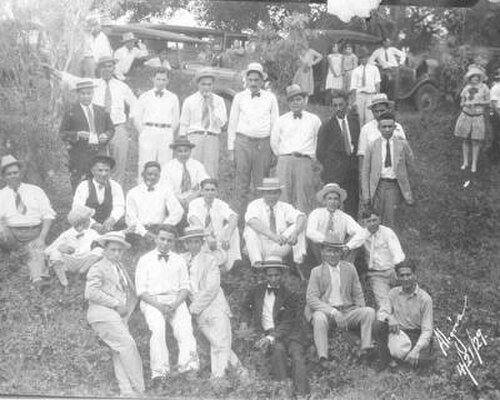
في عام ١٩٢٩، تأسست رابطة مواطني أمريكا اللاتينية المتحدين (LULAC) في كوربوس كريستي، تكساس، من خلال اندماج عدة منظمات أمريكية مكسيكية أصغر حجمًا. [ ٢٦٤ ] وكانت من أوائل المنظمات السياسية الأمريكية المكسيكية الرئيسية في البلاد، وقد تشكلت إلى حد كبير بفضل جهود قدامى المحاربين الأمريكيين المكسيكيين في الحرب العالمية الأولى الذين شعروا بالإحباط من استمرار التمييز الذي واجهه الأمريكيون المكسيكيون في الولايات المتحدة. [ ٢٦٥ ] شغل بن غارزا منصب أول رئيس للمنظمة. [ ٢٦٦ ]
سرعان ما تطورت رابطة مواطني أمريكا اللاتينية المتحدين (LULAC) لتصبح منظمة مؤثرة في مجال الحقوق المدنية للطبقة المتوسطة، ولها فروع في جميع أنحاء جنوب غرب الولايات المتحدة. وكان أعضاء المنظمة يميلون إلى تصوير أنفسهم كأمريكيين "بيض" وطنيين، واقتصرت العضوية على المواطنين الأمريكيين الناطقين باللغة الإنجليزية فقط. [ 267 ] ومثل الرابطة الوطنية للنهوض بالملونين (NAACP) في ذلك الوقت، اعتقدت LULAC أن قيادة من "النخبة المتعلمة" من الأمريكيين المكسيكيين ستوجه المجتمع ككل نحو مكانة سياسية واقتصادية أعلى في الولايات المتحدة. ومع ذلك، ركزت المنظمة في الغالب على قضايا مثل تسجيل الناخبين وحملات جمع التبرعات لضريبة الاقتراع ، وشنّت حملات قانونية شرسة ضد القوانين والممارسات العنصرية التمييزية. [ 268 ]
الكساد الكبير
فقر

بدأ الكساد الكبير في الولايات المتحدة بعد انخفاض حاد في أسعار الأسهم بدأ حوالي 4 سبتمبر 1929، ولا سيما مع انهيار سوق الأسهم في 29 أكتوبر 1929 (المعروف باسم الثلاثاء الأسود ). كان للكساد تأثير كبير على ما يقرب من مليون ونصف المليون مكسيكي وأمريكي من أصل مكسيكي كانوا يعيشون في الولايات المتحدة بحلول عام 1930. [ 269 ] وكان العمل الزراعي من أوائل ضحايا الكساد. [ 163 ]
مع تزايد البطالة بين الأمريكيين البيض، استشاطوا غضبًا من توظيف المزارعين في الجنوب الغربي للعمال المكسيكيين والأمريكيين من أصل مكسيكي. فشنّوا حملات ضغط على المسؤولين الحكوميين وأصحاب العمل للمطالبة بتوظيف "المواطنين" فقط. [ 163 ] وقد تكللت هذه الحملات بالنجاح، وسرعان ما قامت شركات البناء والمتاجر والمصانع والمغاسل بفصل موظفيها المكسيكيين لصالح الأمريكيين البيض. [ 163 ] بل إن إدارة هوفر ألقت باللوم صراحةً على المكسيكيين في حرمان "المواطنين الأمريكيين" من الوظائف. [ 270 ]

عندما انتُخب فرانكلين ديلانو روزفلت رئيسًا للولايات المتحدة عام ١٩٣٢، كان هناك أملٌ في أن يُقدّم العون للمجتمعات المكسيكية الأمريكية المُعذّبة في جميع أنحاء الولايات المتحدة. إلا أن هذا لم يتحقق. فبينما لم يمنع أي برنامج من برامج الصفقة الجديدة صراحةً الأفراد بسبب عرقهم أو وضعهم كمهاجرين من تلقّي المساعدة، استُخدم الوضع المهني لاستبعاد الأمريكيين من أصل مكسيكي من الحصول على مساعدات الإغاثة من الكساد الكبير. [ ٢٧١ ]
على سبيل المثال، منع قانون الضمان الاجتماعي لعام 1935 العمال الزراعيين والعاملين في المنازل من الحصول على استحقاقات الضمان الاجتماعي والتأمين ضد البطالة، مما أدى فعلياً إلى استبعاد العديد من الأمريكيين من أصول أفريقية ومكسيكية من شبكة الأمان الاجتماعي المبكرة هذه. [ 272 ] وعلى المستوى المحلي، لم يحصل سوى عدد قليل من العمال المهاجرين المكسيكيين على أي إغاثة، نظراً لأن قيود الإقامة غالباً ما كانت تشترط على المتقدم أن يكون قد أقام في المقاطعة لفترة زمنية محددة، وهو ما استبعد العمال المهاجرين. [ 271 ]

في ظل غياب الدعم الفيدرالي أو المحلي، تبنّت العديد من العائلات المكسيكية الأمريكية العاطلة عن العمل حياة الترحال، متنقلةً عبر الطرق السريعة بحثًا عن عمل. [ 273 ] وجد بعضهم مساكن مؤقتة في معسكرات العمل التابعة لإدارة أمن المزارع الأمريكية (FSA)، حيث حصلت العائلات المكسيكية الأمريكية أخيرًا على الأدوية والغذاء والسكن. ونظرًا لانتشار ثقافة شيطنة المكسيكيين في الولايات المتحدة، والتي أدت إلى عنف مُستهدف ضد المجتمعات المكسيكية الأمريكية، اضطرت إدارة أمن المزارع إلى إنشاء معسكرات منفصلة خاصة بهم "لتوفير ملاذات آمنة من الهجمات العنيفة" من قِبل الأمريكيين البيض. [ 273 ]
جمعت هذه المعسكرات المنفصلة عائلات مكسيكية أمريكية من مختلف المجتمعات، مما أتاح لهم فرصة التنظيم ومناقشة العديد من القضايا الرئيسية في ذلك الوقت، بما في ذلك ظروف العمل القاسية في القطاع الزراعي. [ 273 ] وكانت الروابط الأسرية التي نشأت في هذه المعسكرات عاملاً قوياً في حركات العمال الزراعيين لاحقاً في القرن. [ 273 ] ومع ذلك، فبينما قدمت معسكرات العمل التابعة لإدارة أمن المزارع (FSA) بعض الراحة لبعض العائلات المكسيكية الأمريكية، فقد عانت عائلات أخرى كثيرة من تجربة مختلفة تماماً خلال فترة الكساد الكبير. ففي العديد من المدن، عندما كانت تتقدم عائلة مكسيكية أو مكسيكية أمريكية بطلب للحصول على المساعدة، كانت تُرسل إلى "مكاتب مكسيكية" مخصصة، حيث تُناقش مسألة العودة إلى الوطن . [ 274 ] [ 275 ]
العودة إلى الوطن


بالنسبة لمئات الآلاف من المكسيكيين والأمريكيين من أصل مكسيكي، كانت حياتهم في الولايات المتحدة خلال فترة الكساد الكبير لا تُطاق؛ فقدوا وظائفهم، وحُرموا إلى حد كبير من المساعدات الفيدرالية أو المحلية بسبب أصولهم العرقية، وواجهوا حملات تشويه في السياسة والإعلام بتهمة "سرقة وظائف الأمريكيين الحقيقيين". [ 276 ] إضافةً إلى هذه العوامل، بدأ مسؤولو الولايات والمقاطعات في جميع أنحاء الولايات المتحدة بتهديد العائلات المكسيكية والأمريكية من أصل مكسيكي التي كانت تسعى للحصول على مساعدات حكومية بالترحيل. [ 277 ]
أطلقت الحكومة المكسيكية برنامجًا لاستمالة المكسيكيين من أصول عرقية مختلفة للعودة إلى البلاد، واعدةً إياهم بمنحهم أراضي مجانية عند عودتهم. [ 235 ] وقد دفعت هذه العوامل مجتمعةً - الفقر المدقع، والخوف من تهديدات المسؤولين الحكوميين الأمريكيين، ووعود الحكومة المكسيكية - الكثيرين إلى مغادرة الولايات المتحدة في فترة عُرفت باسم " العودة المكسيكية إلى الوطن" . [ 278 ]
رغم أن عمليات إعادة المهاجرين هذه كانت تُجرى غالبًا تحت وطأة التهديد بالترحيل، إلا أنها اعتُبرت "طوعية"، ولذا لا توجد سوى سجلات اتحادية قليلة تُحدد عدد المكسيكيين الذين غادروا البلاد خلال فترة الكساد الكبير. [ 279 ] ومع ذلك، أفادت دائرة الهجرة والتجنيس في عام 1931 أن "نسبة كبيرة" من السكان المكسيكيين في البلاد كانوا يغادرونها، وتشير بعض التقديرات إلى أن حوالي 200,000 مكسيكي غادروا الولايات المتحدة بين نوفمبر 1929 وديسمبر 1931 فقط. [ 279 ] وبينما غادر عدد كبير منهم إلى المكسيك طواعية، تعرض عدد كبير آخر لضغوط صريحة للمغادرة من خلال برامج إعادة المهاجرين على مستوى الولايات والمحليات. [ 280 ] وقد استجابت هذه البرامج للآثار الوخيمة للكساد الكبير على المجتمعات المكسيكية والمكسيكية الأمريكية من خلال تشجيع الترحيل. [ 281 ]
يرى بعض الباحثين أن العدد غير المسبوق من عمليات الترحيل والإعادة إلى الوطن بين عامي 1929 و1933 كان جزءًا من "سياسة صريحة لإدارة هوفر"، [ 282 ] وأن مناخ الخوف المصطنع كان يهدف إلى إجبار المكسيكيين على العودة إلى أوطانهم طواعية. [ 283 ] [ 284 ] في الواقع، تعاون العاملون في مجال الرعاية الاجتماعية المحليون بانتظام مع مسؤولي الهجرة لتوفير أسماء المكسيكيين من أصول عرقية الذين يسعون للحصول على مساعدات مالية بسبب الكساد الاقتصادي، وذلك بهدف إعادتهم إلى أوطانهم. [ 279 ]
خلال فترة الترحيل، تعاونت الحكومات المحلية والفيدرالية في حملات تفتيش واسعة النطاق ومداهمات شبه عسكرية في الأحياء ذات الأغلبية المكسيكية للعثور على المهاجرين غير الشرعيين وترويع الآخرين في المجتمع لإجبارهم على العودة. [ 281 ] بالإضافة إلى مسؤولي الرعاية الاجتماعية، عملت منظمات الإغاثة الخيرية مع حكومات الولايات والحكومات المحلية لتوفير أسماء العائلات المكسيكية والأمريكية المكسيكية التي تطلب المساعدة. كما قدمت الجمعيات الخيرية أحيانًا أموالًا لتغطية تكاليف تذاكر السفر ذهابًا فقط إلى المكسيك. [ 285 ] في المجمل، رحّلت دائرة الهجرة والتجنيس رسميًا حوالي 82,000 مكسيكي بين عامي 1929 و1935، بينما اعتُبرت عودة 320,000 شخص آخرين "طوعية". من بين إجمالي عدد الأشخاص الذين غادروا الولايات المتحدة خلال عملية الترحيل المكسيكي، كان حوالي نصفهم مواطنين أمريكيين. [ 282 ]
العمل في عهد الصفقة الجديدة

خلال حقبة الصفقة الجديدة ، حققت النقابات العمالية الأمريكية المكسيكية تقدماً ملحوظاً في التنظيم؛ ومع ذلك، فقد واجهت في كثير من الأحيان عنفاً صريحاً. في سبتمبر 1933، قاد الاتحاد الصناعي لعمال التعليب والزراعة إضراباً ضخماً لجامعي القطن في وادي سان جواكين ، كاليفورنيا. وصف أحد الكتاب المعاصرين لاحقاً حشد المضربين بأنه "جيش من ذوي البشرة السمراء". [ 286 ] رداً على ذلك، شنّ المزارعون حرباً شاملة لتجنب دفع أجور أعلى للمضربين. [ 287 ]
بدأوا بحملة دعائية، زاعمين أن الإضراب مُحرَّض من قِبَل "خطر شيوعي" يساري متطرف، [ 288 ] بدلاً من العمال أنفسهم الذين كانوا يناضلون ضد الأجور المتدنية المتأصلة وظروف العمل المروعة. [ 289 ] بعد ذلك، أنشأ أصحاب المزارع ميليشيات مسلحة. [ 286 ] إحداها، جمعية حماية المزارعين في بيكسلي ، كان لديها 600 عضو مسجل. [ 286 ] ثم هاجم أصحاب المزارع أصحاب الأعمال المحليين في المدينة، مهددين بعواقب وخيمة لأي شركة تبيع الطعام للمضربين. بعد ذلك، طرد المزارعون جميع جامعي القطن المضربين وعائلاتهم من منازلهم، التي كانت عادةً أكواخًا في مزارع القطن. [ 286 ]
عندما استمر المضربون في رفضهم الإضراب، بدأت تظهر أنباء عن وفيات غامضة في حقول القطن. أرسلت القنصلية المكسيكية مندوبًا إلى مقاطعة تولاري "لحماية مصالح المكسيكيين". [ 286 ] ومع ذلك، لم يمنع هذا مسؤولي الرعاية الاجتماعية المحليين من حرمان عائلات المضربين من المساعدات الغذائية خلال فترة الإضراب. [ 286 ] وسرعان ما تدخلت قوات إنفاذ القانون للحفاظ على "القانون والنظام"، حيث قامت بتجنيد عدد كبير من السكان المحليين البيض ومنحتهم "سلطة مطلقة". [ 286 ] ثم تعرض المضربون المكسيكيون الأمريكيون لهجوم علني، وقُتل ثلاثة منهم، ولكن أُطلق سراح قتلتهم بعد إسقاط جميع التهم الموجهة إليهم. [ 290 ] في هذه الأثناء، استمر مسؤولو الإغاثة المحليون والفيدراليون في حرمان المضربين من أي مساعدات غذائية، وسرعان ما بدأ العشرات من أطفال المضربين يموتون بسبب سوء التغذية. [ 286 ] تدخلت الحكومة الفيدرالية الأمريكية أخيرًا، وشكلت لجنة تحكيم . وبحلول نهاية أكتوبر 1933، تم التوصل إلى حل وسط وانتهى الإضراب نهائيًا. [ 286 ]
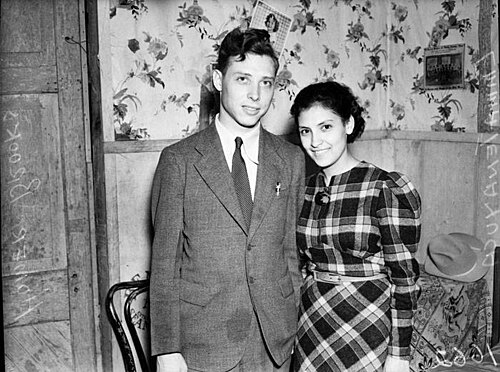
حظي إضراب سان جواكين للقطن عام 1933 بتغطية إعلامية وطنية واسعة آنذاك، وكان معظمها مؤيدًا لأصحاب المزارع. مع ذلك، حقق نشطاء العمل من أصول لاتينية أمريكية تقدمًا ملحوظًا في ثلاثينيات القرن العشرين. أصبحت لويزا مورينو ، وهي مهاجرة من غواتيمالا ، أول امرأة لاتينية في تاريخ الولايات المتحدة تشغل منصبًا نقابيًا وطنيًا عندما أصبحت نائبة رئيس اتحاد عمال التعليب والزراعة والتعبئة والتغليف والصناعات المتحالفة في أمريكا . [ 291 ] في ذلك الوقت، كان الاتحاد سابع أكبر فرع لمؤتمر المنظمات الصناعية . [ 292 ] ومن بين قادة العمل البارزين الآخرين خلال فترة الكساد الكبير، إيما تينايوكا، البالغة من العمر 21 عامًا ، [ 293 ] والتي كان لها دور محوري في أحد أشهر الصراعات في تاريخ العمل في تكساس، وهو إضراب عمال تقشير الجوز في سان أنطونيو عام 1938 في شركة ساوثرن بيكان شيلينغ. [ 294 ] [ 295 ] خلال الإضراب، احتجّ ما يقارب 12,000 عامل في أكثر من 130 مصنعًا على خفض الأجور بمقدار سنت واحد لكل رطل من جوز البقان المقشر، وعلى ظروف العمل اللاإنسانية، وذلك بالتوقف عن العمل. [ 293 ] تعرّضت العاملات المكسيكيات والشيكانيات اللواتي شاركن في الاعتصام للضرب بالهراوات والغاز المسيل للدموع والاعتقال والسجن. نُشرت صورة تينايوكا في مجلة تايم ، حيث وُصفت بأنها "في طليعة معظم الاضطرابات المدنية". [ 296 ]
سياسات الكساد
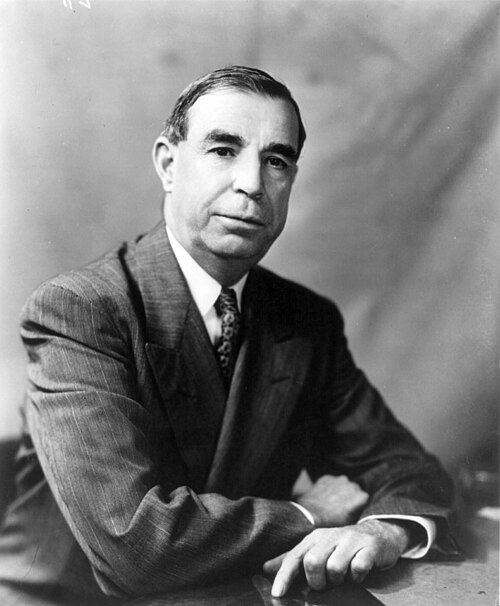
على الرغم من المشاعر المعادية للمكسيكيين التي سادت البلاد خلال فترة الكساد الكبير، شهدت تلك الحقبة أيضًا انتخاب أول أعضاء مجلس الشيوخ من أصل مكسيكي في تاريخ الولايات المتحدة. انتُخب السيناتور أوكتافيانو لارازولو لعضوية مجلس الشيوخ الأمريكي عام ١٩٢٨، لكنه توفي في منصبه بعد ثلاثة أشهر. [ ٢٩٧ ] شغل السيناتور دينيس تشافيز منصبًا في مجلس النواب الأمريكي من عام ١٩٣١ إلى عام ١٩٣٥، إلى أن عُيّن لفترة كاملة في مجلس الشيوخ الأمريكي عام ١٩٣٤. عند أداء تشافيز اليمين الدستورية، يُزعم أن ستة من أعضاء مجلس الشيوخ وقفوا فجأة، وأداروا ظهورهم له، وغادروا القاعة غاضبين. [ ٢٩٨ ]
خلال فترة ولايته، كان السيناتور تشافيز من أبرز مؤيدي برنامج الصفقة الجديدة ، وقد نجح جزئيًا على الأقل في تأمين مزايا لسكان نيو مكسيكو. وما عُرف في نيو مكسيكو باسم "الصفقة الجديدة اللاتينية" كان امتدادًا نادرًا لمزايا الصفقة الجديدة ليشمل الأمريكيين من أصل مكسيكي. [ 299 ] في الولاية، ساهمت برامج التعليم الممولة حديثًا في تحسين معدلات الإلمام بالقراءة والكتابة، وأعادت البرامج المهنية إحياء إنتاج الحرف اليدوية الإسبانية مثل أعمال سانتيرو الفنية والمنسوجات والأثاث. [ 298 ] وقد درّب عملاء إدارة تقدم الأعمال (WPA) سكان نيو مكسيكو على كيفية تسويق منتجاتهم للسياح. [ 298 ] لاحقًا، اشتهر السيناتور تشافيز بدفاعه عن الحقوق المدنية، حيث ناضل من أجل توسيع مفهوم المواطنة الأمريكية. [ 300 ]
في عام ١٩٣٥، أيّد قاضٍ فيدرالي في نيويورك قرار مسؤول الهجرة برفض طلبات تجنيس ثلاثة مكسيكيين بحجة أنهم ليسوا بيضًا، بل أفراد "من أصول هندية وإسبانية". [ ٣٠١ ] وظلّ شرط البياض، الذي كان مطلوبًا للحصول على الجنسية بالتجنس منذ عام ١٧٩٠، قائمًا حتى عام ١٩٤٠. [ ٣٠٢ ] ولو تمّ تأييد حكم عام ١٩٣٥، لكان ذلك قد جعل غالبية المكسيكيين غير مؤهلين للحصول على الجنسية. [ ٣٠٣ ] وكان الرئيس روزفلت - الذي استبدل مؤخرًا سياسات التدخل الأمريكية، مثل " ملحق روزفلت" ، بنهجه الدبلوماسي الخاص بسياسة حسن الجوار - قلقًا من أن حرمان المكسيكيين من فرصة التجنيس سيضر بالعلاقات المكسيكية الأمريكية. [ ٣٠٤ ] [ ٣٠٥ ] لذا حثّ وزارة الخارجية على "تهدئة الجدل"، وضغط على القاضي لإلغاء القرار. [ 305 ] أصدرت وزارة العمل توجيهات لمسؤولي الحدود التابعين لها تنص على أنه "في جميع الحالات المستقبلية، يجب تصنيف المهاجرين [المكسيكيين] على أنهم 'بيض ' " . [ 306 ]

في أبريل/نيسان 1938، نظمت لويزا مورينو ومجموعة من الناشطين العماليين الأمريكيين من أصل مكسيكي، بمن فيهم جوزفينا فييرو وإدواردو كيفيدو وبيرت كورونا ، المؤتمر التأسيسي لمؤتمر شعوب الكلام الإسباني في لوس أنجلوس، وهي منظمة تهدف إلى تعزيز أجندة واسعة النطاق لتمكين الطبقة العاملة والحقوق المدنية ووحدة اللاتينيين. [ 307 ] كما أقرّ المنظمون في دستورهم التأسيسي حق المكسيكيين في العيش والعمل في الولايات المتحدة دون خوف من الترحيل القسري. [ 308 ]
لم تُشجع منظمة "إل كونغريسو" قط على الاندماج ، [ 309 ] في تناقضٍ صريح مع منظمات أخرى مثل "لولك" (التي ركزت على إنهاء الفصل العنصري في العمل والإسكان والتعليم وجميع المرافق العامة). [ 310 ] [ 311 ] تميزت "إل كونغريسو" بمواقفها المبكرة الداعمة لحقوق المهاجرين، على الرغم من ثقافة التشويه المنتشرة خلال فترة إعادة المكسيكيين إلى وطنهم. في الواقع، تحدث مورينو أمام اللجنة الأمريكية لحماية المولودين في الخارج ، منتقدًا استغلال العمال المكسيكيين، قائلاً: "[المكسيكيون يجعلون] أرضًا قاحلة خصبة لمحاصيل جديدة وثروات أكبر. هؤلاء الناس ليسوا غرباء، لقد ساهموا بصبرهم وتضحياتهم وشبابهم وعملهم في الجنوب الغربي." [ 131 ]
حقبة الحرب العالمية الثانية
الحرب العالمية الثانية

دخلت الولايات المتحدة الحرب العالمية الثانية ضد دول المحور في 7 ديسمبر 1941 بعد الهجوم على بيرل هاربر . خدم مئات الآلاف من الرجال اللاتينيين في الجيش الأمريكي خلال الحرب، منهم حوالي 500 ألف من الأمريكيين المكسيكيين. [ 312 ] [ 313 ] على عكس نظرائهم الأمريكيين من أصل أفريقي، الذين خدموا في الغالب في وحدات منفصلة ، خدم معظم الجنود الأمريكيين المكسيكيين في وحدات مختلطة خلال الحرب العالمية الثانية، [ 314 ] مع أن الأبحاث الحديثة كشفت عن وحدة واحدة على الأقل مؤلفة بالكامل من أمريكيين مكسيكيين. [ 315 ] [ 316 ]
كانت غالبية المجندين الأمريكيين من أصل مكسيكي في الحرب العالمية الثانية من الجيل الثاني من الأمريكيين الذين نشأوا في ظل الهستيريا المعادية للمكسيكيين خلال فترة الكساد الكبير. ولذلك، كان انتقالهم إلى دور "الجندي الأمريكي" مفاجئًا في بعض الأحيان. يتذكر الجندي أرماندو فلوريس من كوربوس كريستي، تكساس ، الصدمة التي شعر بها عندما نُودي لأول مرة بلقب "الجندي الأمريكي"، لأنه، كما روى لاحقًا، "لم يسبق لأحد أن وصفني بالأمريكي من قبل!" [ 313 ]
بحسب بعض الباحثين، بذلت الحكومة الأمريكية جهودًا خلال الحرب لمعالجة بعض القضايا الداخلية التي تواجه الجالية المكسيكية الأمريكية. [ 317 ] وكانت هذه الجهود جزءًا من حملة شاملة لكسب تأييد شعبي واسع للمجهود الحربي. [ 317 ] ولعلّه ليس من المستغرب أن هذا الشعور الجديد بالاندماج الاجتماعي في زمن الحرب قد خلق إحساسًا قويًا بالفخر الوطني لدى الجالية المكسيكية الأمريكية. [ 313 ] في امتداد شارعين فقط في سيلفيس، إلينوي ، تطوّع 45 شابًا ورجلًا مكسيكيًا أمريكيًا للقتال؛ وقد أُطلق عليه في الصحافة اسم "شارع الأبطال". [ 318 ]

خلال الحرب، اكتسب الجنود الأمريكيون من أصل مكسيكي شهرةً واسعةً لشجاعتهم. وقد نال ما لا يقل عن أحد عشر أمريكيًا من أصل مكسيكي وسام الشرف خلال الحرب. [ 313 ] أحدهم، جو بي. مارتينيز ، الذي كان يعمل في حصاد البنجر قبل الحرب، قاد هجومًا استراتيجيًا بالغ الأهمية على جبل مغطى بالثلوج في جزيرة أتو . [ 319 ] استشهد خلال العملية، وأصبح أول مجند يحصل على وسام الشرف بعد وفاته. [ 320 ] أما سيلفستر هيريرا ، فقد شرح هجومه الفردي على موقع نازيّ قائلاً: "أنا أمريكي من أصل مكسيكي، ولدينا تقاليد. من المفترض أن نكون رجالًا." [ 313 ]
لعلّ أشهر جندي أمريكي من أصل مكسيكي هو غاي غابالدون ، شابٌّ يبلغ من العمر 18 عامًا من شرق لوس أنجلوس ، تبنّته عائلة أمريكية من أصل ياباني في الثانية عشرة من عمره. عندما أُرسلت عائلته إلى معسكر اعتقال ، انضم غابالدون إلى مشاة البحرية الأمريكية . [ 321 ] أُرسل إلى مسرح عمليات المحيط الهادئ وشارك في معركة سايبان . في معركة سايبان ، قتل غابالدون 33 مقاتلاً من العدو، ثمّ، مستخدمًا قدرته على التحدث باللغة اليابانية بطلاقة، أقنع الجنود المتبقين المحاصرين بالاستسلام. [ 322 ] استسلم الجنود اليابانيون البالغ عددهم 800 جندي سلميًا، [ 323 ] وحصل غابالدون على لقب "عازف الناي الساحر لسايبان". [ 324 ] على الرغم من ترشيحه لنيل وسام الشرف، مُنح غابالدون بدلًا من ذلك وسام النجمة الفضية . [ 325 ] استُوحِيَ فيلم " من الجحيم إلى الأبدية" الذي أُنتج عام 1960 من قصة غابالدون وحياته. [ 326 ]
عمل المرأة في زمن الحرب
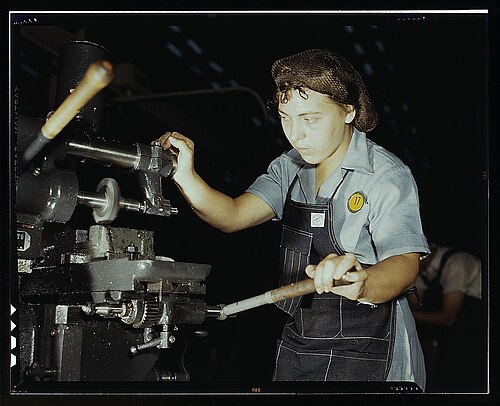
لعبت النساء دورًا بالغ الأهمية خلال الحرب العالمية الثانية، حيث انضممن إلى القوى العاملة الصناعية بأعداد قياسية لشغل وظائف التصنيع الحيوية التي خلّفها الجنود المغادرون. [ 327 ] [ 328 ] بالإضافة إلى ذلك، انضمت أعداد لا حصر لها من النساء الأمريكيات من أصل مكسيكي إلى فيلق الجيش النسائي ، ووحدات WAVES ، ووحدات مساعدة أخرى نسائية بالكامل في الجيش. [ 324 ] تشير التقديرات إلى أن آلاف الأمريكيين من أصل مكسيكي وجدوا وظائف في الصناعات الدفاعية خلال الحرب، على الرغم من أنهم ما زالوا يواجهون في كثير من الأحيان تحيزًا ضد المكسيكيين في سوق العمل، وذلك على الرغم من الأمر التنفيذي رقم 8802 الصادر عن فرانكلين روزفلت عام 1941 ، والذي حظر التمييز في التوظيف في الصناعات الدفاعية. [ 313 ] [ 329 ] ومع ذلك، فإن الطلب المتزايد على العمالة خلال الحرب تغلب في نهاية المطاف على تردد أصحاب العمل في توظيف الأمريكيين من أصل مكسيكي. وسرعان ما انضمت آلاف النساء الأمريكيات من أصل مكسيكي في جميع أنحاء البلاد إلى القوى العاملة كعاملات أساسيات في المصانع. [ 330 ]

إلى جانب جهودهن في سوق العمل الرسمي، قدمت النساء المكسيكيات الأمريكيات إسهامات مادية ومعنوية كبيرة من خلال تأسيس منظمات مجتمعية خلال الحرب. هدفت هذه المنظمات إلى دعم القوات الأمريكية في الخارج، وخاصة الجنود المكسيكيين الأمريكيين الشباب من الأحياء المحلية. [ 331 ] تضمنت بعض المشاريع المجتمعية تعاونًا بين الأحياء المكسيكية الأمريكية والأحياء ذات الأغلبية البيضاء، إلا أن الغالبية العظمى من أنشطة الجبهة الداخلية للمكسيكيين الأمريكيين نُظمت بشكل منفصل عن أنشطة المجتمع الأبيض. [ 332 ]
سعت إحدى هذه المنظمات، وهي جمعية الأمهات والزوجات الإسبانيات الأمريكيات في توكسون، أريزونا ، إلى لفّ الضمادات، وجمع التبرعات لمركز للمحاربين القدامى بعد انتهاء الحرب، وكتابة الرسائل لمساعدة الشباب على التغلب على "معركتهم الداخلية مع الوحدة". [ 331 ] وبلغ عدد أعضاء المنظمة ذروته عند 300 عضو خلال الحرب. [ 333 ] ونظمت منظمات أخرى، مثل "لينادوريس ديل موندو" في فينيكس ، مهرجانات زمن الحرب وجمعت المطاط لدعم المجهود الحربي، لكنها سعت أيضًا إلى مكافحة العنصرية والتمييز المستشريين اللذين عانى منهما المجتمع. [ 332 ]
جريمة قتل في بحيرة سليبي لاجون

في أواخر عام ١٩٤٢، أرسل حاكم كاليفورنيا كولبرت أولسون ، الذي كان يواجه معركة إعادة انتخاب صعبة ضد الحاكم المستقبلي إيرل وارين ، مذكرةً إلى أجهزة إنفاذ القانون في مقاطعة لوس أنجلوس ، يأمرها فيها بشن حملة شرسة ضد عصابات الشباب في المدينة. [ ٣٣٤ ] وبموجب هذه الأوامر، قرر مكتب المدعي العام لمقاطعة لوس أنجلوس استخدام وفاة خوسيه غاياردو دياز، الشاب الأمريكي من أصل مكسيكي، في ٢ أغسطس ١٩٤٢، كقضية اختبارية لإطلاق حرب جديدة ضد جنوح الأحداث ، وذلك بتحويل التحقيق إلى حدث إعلامي كبير. [ ٣٣٤ ]
في الأسابيع التي تلت وفاة دياز، شنت شرطة لوس أنجلوس حملات مداهمة واسعة النطاق في الأحياء المكسيكية والأمريكية الأفريقية، واعتقلت أكثر من 600 شاب وشابة لاحتجازهم واستجوابهم. [ 335 ] أشادت صحافة لوس أنجلوس بالضباط الذين قاموا بالاعتقال ووصفتهم بالأبطال. [ 334 ] ونتيجةً لاستجواباتهم التي اتسمت في كثير من الأحيان بالوحشية للمراهقين، أعلنت الشرطة أنها عثرت على القتلة: اثنان وعشرون شخصًا يُزعم انتمائهم لعصابة شارع 38، بالإضافة إلى امرأتين متواطئتين. [ 336 ] اتسم الخطاب العام في كاليفورنيا حول اعتقال هؤلاء الشباب بالعنصرية الشديدة، وبرزت نقاشات حادة حول ما إذا كان المكسيكيون والأمريكيون من أصل مكسيكي "قادرين ثقافيًا وسياسيًا وفكريًا وبيولوجيًا على العيش في مجتمع أبيض متحضر وديمقراطي". [ 334 ]

اشتهرت المحاكمة الجنائية الناتجة، قضية الشعب ضد زامورا (1942)، بانتهاكها الصارخ للإجراءات القانونية الواجبة . من بين أربعة وعشرين شابًا متهمًا، وُجهت إلى سبعة عشر منهم تهمة القتل، وخضعوا للمحاكمة. [ 337 ] كانت قاعة المحكمة صغيرة، ولم يُسمح للمتهمين أثناء المحاكمة بالجلوس بالقرب من محاميهم أو التواصل معهم. [ 338 ] كما مُنع أي من المتهمين من تغيير ملابسه طوال فترة المحاكمة، بأمر من القاضي تشارلز دبليو فريك، بناءً على طلب المدعي العام. [ 339 ] وسمح القاضي فريك أيضًا لرئيس مكتب العلاقات الخارجية في مكتب شرطة مقاطعة لوس أنجلوس ، إي. دوران آيرز، بالإدلاء بشهادته كـ"شاهد خبير" بأن المكسيكيين كمجتمع لديهم "نزعة دموية" و"استعداد بيولوجي" للجريمة والقتل، مستشهدًا بالتضحية البشرية المزعومة التي مارسها أسلافهم الأزتيك . [ 340 ]
بعد إدانة القاضي فريك في يناير، سُجن الشبان المكسيكيون الأمريكيون. استشاط المجتمع المكسيكي الأمريكي غضبًا، وطعن العديد من المحامين في قرارات القاضي فريك. [ 341 ] أشار الصحفي الشهير كاري ماكويليامز إلى أنه قبل بضعة أشهر، احتُجز أكثر من 120 ألف أمريكي من أصل ياباني في معسكرات اعتقال ، وجادل بوجود روابط مشتركة بين اعتقال الأمريكيين من أصل ياباني وردود الفعل المعادية للمكسيكيين على قضية سليب لاغون. [ 342 ] في أكتوبر 1944، قررت محكمة الاستئناف بالولاية بالإجماع أن الأدلة غير كافية لتأييد حكم الإدانة. [ 336 ] نقضت المحكمة إدانات 12 من المتهمين، وانتقدت فريك مباشرةً لانحيازه وسوء إدارته للقضية. [ 343 ]
أعمال شغب بدلات الزوت


في أربعينيات القرن العشرين، نشأ الشباب الأمريكيون من أصل مكسيكي منغمسين تمامًا في الثقافة الشعبية الأمريكية، بما في ذلك الأفلام والموسيقى ووسائل الإعلام الأخرى. وعندما بلغوا سن الرشد، خالف هؤلاء الشباب توقعات آبائهم والمجتمع السائد على حد سواء، مستخدمين الثقافة والموضة لتقويض معايير الفصل العنصري الأمريكي وهيمنة البيض . [ 344 ] طوّر هؤلاء المراهقون موسيقاهم ولغتهم وملابسهم الخاصة. بالنسبة للفتيان، الذين يُطلق عليهم اسم "باتشوكوس" ، كان أسلوبهم يتمثل في ارتداء معطف طويل لافت للنظر، وبدلة زوت مع بنطال فضفاض ضيق، وقبعة بورك باي، وسلسلة مفاتيح طويلة، وأحذية ذات نعال سميكة. [ 345 ] [ 346 ] كان الهدف من هذا الأسلوب هو رفض سياسة الاستيعاب الأمريكية وجهود الحرب الرامية إلى ترشيد استهلاك المواد كالأقمشة. [ 347 ] في الوقت نفسه، كانت الفتيات، اللواتي يُطلق عليهن اسم "باتشوكاس "، يرتدين سترات سوداء فضفاضة، وتنانير ضيقة، وجوارب شبكية، مع وضع مكياج كثيف. بالنسبة لشعب الباتشوكا، كانت المشاركة في الحركة وسيلةً لتحدي المفاهيم التقليدية للجمال الأنثوي والجنسانية بشكلٍ علني، لا سيما في الثقافة المكسيكية التقليدية. [ 348 ] [ 349 ] [ 350 ] [ 351 ] وفي كلتا الحالتين، اعتُبر مرتدي بدلات الزوت غير أمريكيين. [ 352 ]
أثارت هذه المشاعر مشاكل في لوس أنجلوس، حيث أُنشئت قاعدة بحرية جديدة في تشافيز رافين ، وهو حيّ معزول يقطنه الأمريكيون من أصل مكسيكي في لوس أنجلوس. [ 353 ] وقد أدّى ذلك إلى وجود أكثر من 50,000 جندي في حيّ ذي أغلبية مكسيكية، وكان معظمهم من البيض ومن مناطق ذات كثافة سكانية منخفضة من الأمريكيين من أصل مكسيكي. [ 354 ] وكان البحارة - الذين كانوا يمرّون بشكل متكرر عبر حيّ تشافيز رافين في طريقهم إلى الحانات في وسط مدينة لوس أنجلوس - يضايقون الشباب الذين يرتدون بدلات الزوت بسبب سلوكهم الذي بدا غير محترم. [ 355 ] [ 356 ] ومع ازدياد حدة التوتر في الأجواء المعادية للمكسيكيين المحيطة بمحاكمة جريمة قتل سليبي لاغون خلال عام 1943، أصبحت الاعتداءات الطفيفة التي يشنها بحارة البحرية على الفتيان الأمريكيين من أصل مكسيكي حدثًا شبه يومي. [ 356 ]
في يونيو/حزيران 1943، انفجرت هذه التوترات في واحدة من أسوأ أعمال الشغب العنصرية في تاريخ المدينة. بعد أن رفع صبي أمريكي من أصل مكسيكي يده بطريقة اعتبرها أحد البحارة "تهديدًا"، هاجمه الرجل وأصدقاؤه. [ 356 ] أشعل هذا الحادث اشتباكًا في الشارع، انتهى سريعًا بعد أن كُسر أنف البحار الذي اعتدى عليه. [ 357 ] في تلك الليلة، اقتحم مئات البحارة الحي واعتدوا على كل صبي أمريكي من أصل مكسيكي وجدوه. [ 358 ] على مدى الأيام العشرة التالية، اقتحم بحارة البحرية وادي تشافيز، ووسط مدينة لوس أنجلوس، وحتى شرق لوس أنجلوس ، وجروا وضربوا وجردوا كل صبي يرتدي بدلة زوت من ملابسه في الأماكن العامة - بعضهم لم يتجاوز عمره 12 أو 13 عامًا. [ 359 ] هللت صحافة لوس أنجلوس للهجمات العنصرية، بل ونشرت أدلة حول كيفية "نزع بدلة الزوت" عن مرتديها. [ 360 ] ردّت شرطة لوس أنجلوس بالانضمام إلى البحارة، واعتقلت المئات من مرتدي بدلات الزوت، من الفتيان والفتيات المراهقين، ووجهت إليهم تهمة "الإخلال بالنظام العام". [ 361 ] ألقى نشطاء تقدميون في ذلك الوقت، مثل كاري ماكويليامز، باللوم في أعمال الشغب على ويليام راندولف هيرست لترويجه "شبه الفاشي" لـ"الهستيريا المعادية للمكسيكيين" خلال محاكمة جريمة قتل سليبي لاغون. [ 362 ] مع ذلك، ركّز الباحثون على النسيج الاجتماعي المعقد السائد في لوس أنجلوس آنذاك، وفسّروا أعمال الشغب كمثال على "الانقسامات الاجتماعية" داخل الولايات المتحدة في حقبة الفصل العنصري. [ 363 ]
النشاط ما بعد الحرب

انتهت الحرب العالمية الثانية رسميًا في 2 سبتمبر 1945 بعد القصف الذري لهيروشيما وناغازاكي ، واستسلام اليابان النهائي لقوات الحلفاء . كان التأقلم مع الحياة المدنية صعبًا على ملايين المحاربين العائدين. وواجه الأمريكيون من أصول أفريقية ولاتينية، على وجه الخصوص، صعوبة بالغة في الانتقال من كونهم أبطال حرب ومحررين في أوروبا، إلى مواطنين من الدرجة الثانية في الولايات المتحدة التي كانت تعاني من التمييز العنصري. سعى الأمريكيون من أصول أفريقية إلى معالجة بعض هذه التناقضات من خلال حملة النصر المزدوج (Double V) ؛ [ 364 ] في الوقت نفسه، بدأ الأمريكيون من أصول مكسيكية نضالهم الخاص من أجل الحقوق المدنية في وطنهم. يكتب المؤرخ توماس أ. غولييلمو : "لم تزد التضحية والخدمة الوطنية إلا من تصميم المكسيكيين والأمريكيين من أصول مكسيكية على نيل حقوق المواطنة الكاملة". [ 365 ] تحدى الأمريكيون من أصول مكسيكية العائدون التمييز والفصل العنصري بطرق عديدة، منها الجلوس في أقسام مخصصة للبيض فقط في مسارح المدينة، والمطالبة بالخدمة في المطاعم المخصصة للبيض، ومحاولة دخول المسابح العامة المخصصة للبيض فقط. [ 366 ] في إحدى الحوادث الشهيرة، حصل ماكاريو غارسيا على وسام الشرف في حفل أقيم بالبيت الأبيض ، وبعد أقل من شهر، مُنع من دخول مقهى أواسيس في ريتشموند، تكساس، بسبب أصله العرقي. [ 367 ] رفض غارسيا مغادرة المقهى، فاستُدعيت الشرطة، وأُلقي القبض عليه ووُجهت إليه تهمة "الاعتداء الجسيم". [ 368 ] في أريزونا، أطلق الحاكم اسم سيلفستر هيريرا ، الحائز على وسام الشرف، على يوم 14 أغسطس/آب 1945. إلا أن التغطية الإعلامية للحدث شابتها مطالبة الحاكم الشركات في فينيكس بإزالة اللافتات التي تمنع دخول المكسيكيين. [ 369 ]

أضرّ التمييز ضدّ المحاربين الأمريكيين من أصل مكسيكي العائدين بآفاق المجتمع الأمريكي المكسيكي بأكمله. فبينما ساهمت المزايا الطبية والمالية والتعليمية التي وفّرها قانون مزايا المحاربين القدامى (GI Bill) في انتشال ملايين العائلات الأمريكية الأنجلو-ساكسونية إلى الطبقة المتوسطة الأمريكية المتنامية، كان تطبيق مزايا القانون على المحاربين الأمريكيين من أصل أفريقي ومكسيكي غير متكافئ. [ 370 ] ونتيجةً لذلك، لم يحقق المجتمع الأمريكي المكسيكي المساواة الاقتصادية والسياسية الكاملة في فترة ما بعد الحرب. [ 317 ] [ 331 ] إلا أن قانون مزايا المحاربين القدامى لم يكن مجرد قانون إقصائي، بل انطوى على العديد من أوجه القصور الهامة التي أدّت إلى نتائجه التمييزية. [ 371 ] فقد قدّم القانون ضمانات قروض، لكنّ قلّة من البنوك التزمت بهذه الضمانات للمحاربين القدامى من غير البيض، وبالنسبة لتلك التي التزمت، فإنّ الشروط العنصرية التقييدية تعني أنّ المحاربين الأمريكيين من أصل أفريقي ومكسيكي لم يكونوا قادرين على العيش إلا في الأحياء المحظورة ، حيث ظلت قيمة العقارات منخفضة في كثير من الأحيان. [ 372 ] [ 373 ] علاوة على ذلك، اشتكى العديد من المحاربين القدامى الأمريكيين من أصل مكسيكي من تأخر صرف الرسوم الدراسية بشكل متكرر، مما أجبرهم على ترك برامج التدريب المهني والجامعية، وكانت التقارير عن "العنصرية الصريحة داخل إدارة شؤون المحاربين القدامى " شائعة. [ 371 ] وقد وجد باحثون معاصرون أن قانون مزايا المحاربين القدامى "لم يُحدث تغييرًا جذريًا في الوضع الوظيفي لجميع المكسيكيين ... وكان تأثيره المباشر على الارتقاء الاجتماعي بين الأسر ... غير متسق". [ 374 ]
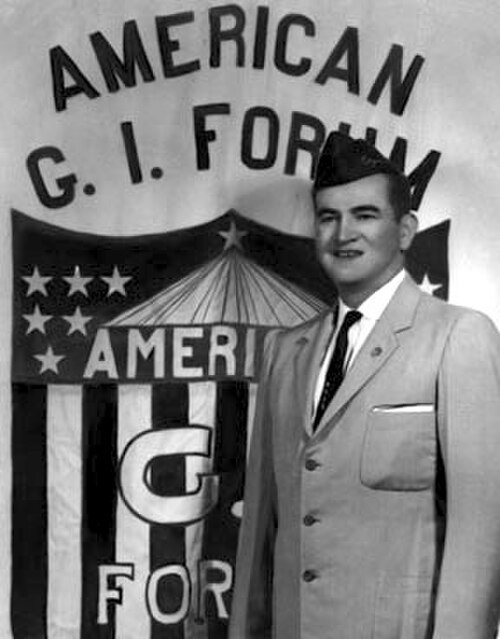
Some of these issues were challenged directly. In 1948, the Corpus Christi physician, Hector P. Garcia, founded the American GI Forum in order to demand equal rights to GI Benefits, medical care, burial rights, desegregated education, and other civil rights.[375] In a famous early instance of the Forum's civil rights advocacy, Garcia took up the case of Private Felix Longoria of Three Rivers, Texas. Longoria had died in combat in 1945, but his remains weren't shipped home for several years.[376] When they finally arrived, his widow Beatrice went to the local funeral home to plan a wake in his honor.[377] The funeral home director refused to allow the family to use the chapel, because of their race.[378] The director told the media at the time that he would never allow Mexican Americans to use his facilities, saying, "We just never made it a practice to let them use the chapel and we don't want to start now."[379] When Garcia found out about the situation, he was outraged and immediately sent letters of protest to the media, elected politicians, and government officials. One of these letters was sent to Texas' junior senator, Lyndon B. Johnson, who arranged for Longoria to receive full honors and burial at Arlington National Cemetery.[380] The Longoria incident pushed the American G.I. Forum to the forefront of the postwar Mexican American civil rights strategy.[313] The Forum, alongside LULAC and El Congreso, greatly expanded their operations after World War II and began their fights to end segregation.[381]
Court cases

In the 1940s, there were two major court cases involving the civil rights of Mexican Americans. The first, Mendez v. Westminster (1947), involved Gonzalo Méndez, a naturalized U.S. citizen born in Mexico, and his Puerto Rican wife Felicitas, who joined four Mexican American families to sue four Orange County school districts.[382] The families challenged the common California practices of drawing school boundaries around majority-Mexican American neighborhoods and of placing Mexicans who lived in majority-white communities into segregated Spanish "remedial" schools.[383][384] During the trial, the Orange County superintendents justified school segregation because the Mexican American children had inferior "personal hygiene", "scholastic ability", and "economic outlook".[382] On the plaintiff's side, the constitutionality of educational segregation was questioned on the basis of the Fourteenth Amendment, and social scientists were brought in as expert witnesses to dispute the supposed educational benefits of segregated schools.[385] In 1946, Judge Paul McCormick ruled that school segregation was a "clear denial" of the Equal Protection Clause, and the next year, McCormick's decision was upheld by the U.S. Court of Appeals.[386] The Méndez case was significant for several reasons, including: the support of NAACP counsel Thurgood Marshall;[387] the plaintiffs' revolutionary use of social scientific research as a basis for law;[388] the legal precedent marking educational segregation as unconstitutional;[389] and the case's influence for the Anderson Bill (1947), which repealed California school segregation.[390]

The second major civil rights court victory for Mexican Americans also occurred in California. Andrea Pérez, who was Mexican American, and Sylvester Davis, who was African American, had met and developed a friendship immediately before he was drafted to fight in World War II. When he returned, they resumed their relationship, fell in love, and married.[391] At the time, California's anti-miscegenation code barred interracial marriage.[392] Pérez and Davis hired the civil rights attorney Dan Marshall to represent them in challenging the ban.[393] When the Los Angeles County clerk denied them a marriage license, Pérez formally filed suit. In 1948, the California Supreme Court ruled in favor of the couple, becoming the first state in the country to overturn a ban on interracial marriage.[394] The decision in part relied on arguments based on the inability of the law to account for Mexican mestizaje.[395] The court, noting Pérez' "in-between" racial status, ruled that blanket bans on interracial marriage were "too vague and uncertain" since they did not consider people who were of "mixed ancestry".[395] Also, the court held county clerks and other government employees could not realistically be expected to successfully ascertain the racial makeup of each marriage applicant. Finally, Judge Roger Traynor's majority opinion found that the law also violated the equal protection clause of the Fourteenth Amendment.[396]Earl Warren was then the governor of California, and he oversaw the legal implementation of the ruling in the state. Nineteen years later, he served as chief justice in Loving v. Virginia (1967), the U.S. Supreme Court case that struck down all remaining state bans on interracial marriage.[391]
Mid-20th century
Korean War

In June 1950, the United States entered the Korean War as part of a United Nations-led coalition supporting South Korea.[397] Thousands of Mexican Americans served in the conflict from its beginning, many of them inspired to join the war effort because of the service of their fathers and older brothers in World War II.[398] Staff Sgt. Joe Campos, from Miami, Arizona became one of the first soldiers missing in action of the war after his plane was shot down on June 28, 1950 over the Yellow Sea. A few days later, Florentino Gonzales, from Chicago, was part of the first group of prisoners of war.[399] One Mexican American soldier, Jesus Rodriguez, later remembered how his harsh upbringing in the United States prepared him for the Korean War.[400][401] He stated, "I used to pray a lot. Another thing that helped me was that I was street smart from before going into the service. On the streets I learned how to fight ... Something else that helped me survive Korea was that going hungry wasn't new to me and didn't hurt me."[402] Ten Mexican Americans were awarded the Medal of Honor for their valor in the Korean War;[402] they included: Joe R. Baldonado, Victor H. Espinoza, Eduardo C. Gomez, Edward Gómez, Ambrosio Guillen, Rodolfo P. Hernandez, Benito Martinez, Eugene Arnold Obregon, Mike C. Pena, and Joseph C. Rodriguez.[403] Finally, Gen. Richard E. Cavazos, born in Kingsville, Texas, became the first Mexican American four-star general and head of the U.S. Army Forces Command.[404]
Bracero program

In 1951, the U.S. government passed Public Law 78, a law which formalized the Bracero Program, a temporary work exchange program with Mexico.[405] First begun as a scheme to fill wartime labor shortages during World War II, Congress decided to formalize the program for a number of reasons: first, new concerns were raised about domestic labor gaps during the Korean War; second, political concerns were raised about a potential rise in undocumented immigration if Mexican laborers were not offered a legal pathway to work in the U.S.; third, agricultural employers' associations lobbied hard for the program since they benefited the most from its subsidizations.[406] Estimates place the annual number of laborers entering the U.S. in the 1950s at around 300,000,[407] and a significant number of these Braceros were indigenous Mexicans, who hardly spoke Spanish.[408] Domestically, the program was controversial. The U.S. Department of Labor official overseeing the program called it "legalized slavery",[409] and some Mexican Americans believed the program suppressed their own wages.[410]Dolores Huerta, a prominent labor organizer, first began her work as an organizer with the Stockton Community Service Organization (CSO) in the 1950s, where she organized voter registration drives, and pressed for barrio improvements.[411][412] She was a vehement opposer of the Bracero program and was a key actor lobbying for its termination.[413]
Operation Wetback

In 1951, the Truman administration's Commission on Migratory Labor released a scathing and xenophobic report blaming the Southwest's social ills on undocumented immigration. The report stated, "The magnitude [of undocumented migration] ... has reached entirely new levels in the past 7 years ... In its newly achieved proportions, it is virtually an invasion."[414] This report, and an August 1953 tour of Southern California, influenced Attorney General Herbert Brownell, Jr. to push Congress to sanction the employers of undocumented workers.[415] This did not become law. Nevertheless, the new Eisenhower administration moved forward with planning a mass deportation operation. On June 9, 1954, the INS Commissioner Joseph Swing announced Operation Wetback, a campaign to deport all undocumented people from the United States. Extensive media coverage during the period exaggerated the Border Patrol's menace and strength, and extensively reported displays of strength as part of a broader PR campaign against undocumented migration.[415] While 1.1 million INS apprehensions occurred that year, estimates place the number of deportations resulting directly from Operation Wetback at around 33,000 people,[416] with perhaps another 60,000 who voluntarily repatriated.[415] Mexican American organizations, such as LULAC and the American G.I. Forum - as well as the broader Mexican American middle-class – were largely supportive of the campaign surrounding Operation Wetback, believing that unauthorized Mexican immigration had "materially retarded" the acceptance and assimilation of Mexican Americans into American culture.[417]
Law and politics

Electorally, Mexican Americans made small but important strides in the 1950s. In Los Angeles, Edward R. Roybal served as the only Mexican American member on the Los Angeles City Council. During his time on council, he took a series of important positions, including: fighting against an ordinance which required communists to register with the police;[418] opposing the tearing down of the Mexican American neighborhood of Chavez Ravine to build Dodger Stadium;[419] and pushing for the establishment of a Fair Employment Practices Commission for the city.[420] In 1954, he also ran for Lieutenant Governor, but he lost to the incumbent Goodwin Knight (R) by more than ten points.[421] Despite these gains in political visibility, however, Mexican American Angelenos also experienced several high-profile incidents of police brutality in the early 1950s, including Bloody Christmas.[422][423]
In the courts, Mexican Americans continued to challenge the legal infrastructure of American segregation. Throughout the Southwest, Mexican Americans were often deliberately excluded from serving as jurors in cases involving Mexican American defendants.[424] In 1954, Pete Hernandez, an agricultural worker, was convicted by an all-Anglo jury in Jackson County, Texas for murder. Hernandez's pro bono legal team, including Gustavo C. García, appealed the ruling, arguing that he was being discriminated against because there were no Mexicans in the jury that convicted him. They argued that Hernandez had the right to be tried by a jury of his peers under the 14th Amendment. The State of Texas denied their claim, but they appealed to the United States Supreme Court through a writ of certiorari.[425] The legal team included García, Carlos Cadena and John J. Herrera of the League of United Latin American Citizens, and James DeAnda and Cris Alderete of the G. I. Forum, both activist groups for civil rights for Mexican Americans. These were the first Mexican-American lawyers to represent a defendant before the U.S. Supreme Court, which heard their arguments on January 11, 1954. Chief JusticeEarl Warren and the Supreme Court unanimously ruled in favor of Hernandez, and required he be retried by a jury composed of his peers.
Chicano Movement
1960s


In the 1960s, a sub-group of Mexican American student organizations developed ideologies of Chicano nationalism and the Chicano movement, highlighting American discrimination against Mexican Americans and emphasizing the overarching failures of a culturally pluralistic society.[426] Calling themselves La Raza, Chicano activists sought to affirm Mexican Americans' racial distinctiveness and working-class status, create a pro-barrio movement, and assert that "brown is beautiful."[426] Urging against both ethnic assimilation and the mistreatment of low-wage workers, the Chicano Movement was the first large-scale mobilization of Mexican American activism in United States history.[427]
The Chicano movement blossomed in the 1960s. The movement had roots in the civil rights struggles that had preceded it, adding to it the cultural and generational politics of the era.
In 1963, in Crystal City, Texas the mainly Mexican-American migrant community together with the support of the Teamsters Union and the Political Association of Spanish-Speaking Organizations (PASSO), an outgrowth of the Viva Kennedy clubs of 1960, encouraged Mexican-American men and women to pay their poll tax and choose their own candidates. Led by Teamsters business agent and cannery employee, Juan Cornejo, five Mexican-Americans, despite intimidation by the Texas Rangers, won the support of their community young and old alike who thanks to the protection provided by the Teamsters and PASSO mobilized for electoral victory. This "revolt" was covered nationwide and reported in the New York Times and the Wall Street Journal. This election led Americans outside of the Southwest to take note of America's other minority community as a political force.
The early proponents of the movement — Rodolfo Gonzales in Denver, Colorado and Reies Tijerina in New Mexico — adopted a historical account of the preceding hundred and twenty-five years that obscured much of Mexican-American history. Gonzales and Tijerina embraced a form of nationalism that was based on the failure of the United States government to live up to the promises that it had made in the Treaty of Guadalupe Hidalgo.[428]
The Immigration and Nationality Act of 1965 set strict quotas on the number of persons who could legally enter the U.S. from Latin American nations, and most new Mexican migration to the U.S. in the 1960s was temporary and short-term. Seasonal migration between the United States and Mexico became illegal in 1965. Nevertheless, the numbers involved with seasonal agriculture kept growing, often forced to resort to undocumented migration. They made money in the U.S. but returned to the villages to spend it, tend to the family business, and participate in extended kinship rituals such as baptisms, weddings, and funerals.
The most significant union struggle involving Mexican-Americans was the United Farm Workers' long strike and boycott aimed at grape growers in the San Joaquin and Coachella Valleys in the late 1960s, followed by campaigns to organize lettuce workers in California and Arizona, farm workers in Texas, and orange grove workers in Florida.
The most prominent civil rights organization in the Mexican-American community is the Mexican American Legal Defense and Educational Fund (MALDEF), founded in 1968. Although modeled after the NAACP Legal Defense and Educational Fund, MALDEF has also taken on many of the functions of other organizations, including political advocacy and training of local leaders.
Instead, when the movement dealt with practical problems most activists focused on the most immediate issues confronting Mexican-Americans: unequal educational and employment opportunities, political disenfranchisement, and police brutality. In the heady days of the late 1960s, when the student movement was active around the globe, the Chicano movement brought about more or less spontaneous actions, such as the mass walkouts by high school students in Denver and East Los Angeles in 1968.
The movement was particularly strong at the college level, where activists formed MEChA, el Movimiento Estudiantil Chicano de Aztlán, which promoted Chicano Studies programs and a generalized nationalist agenda. The student movement produced a generation of future political leaders, including Richard Alatorre and Cruz Bustamante in California.
1970s
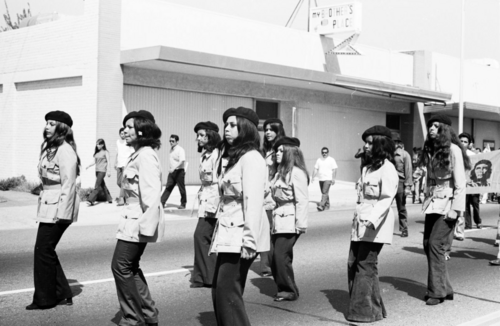
Some women who worked within the Chicano movement felt that participants were more worried about other issues, such as immigration than solving problems that affected women. This led Chicanas to form the Comisión Femenil Mexicana Nacional in 1970. The National Chicano Moratorium March was also held in Los Angeles in 1970.
La Raza Unida Party campaigns in the early 1970s had the practical effect of defeating Mexican-American Democratic candidates, embittering many activists against the party and the form of nationalism it represented.
As a result of the Voting Rights Act, followed up by intensive political organizing, Mexican-Americans were able to achieve a new degree of political power and representation in Texas and elsewhere in the Southwest. The La Raza Unida Party, headed by José Ángel Gutiérrez of Crystal City, Texas made startling progress in the poorest regions in the Rio Grande Valley with its base of operations at Crystal City, Texas in the early 1970s, spreading for a while to Colorado, Wisconsin, California, Michigan, Oregon, Kansas, Illinois and several other states. The party faded in the mid-1970s and held on only in Crystal City, Texas before collapsing in the early 1980s. Veterans from the party, such as Willie Velasquez, became active in Democratic politics and in organizing projects such as the Southwest Voter Registration Education Project, which boosted the electoral fortunes of Mexican-American candidates throughout the Southwest.
While the UFW suffered severe setbacks in California in 1973 and never established a strong union presence in other states, its struggle propelled César Chávez and Dolores Huerta into national prominence, while providing the foot soldiers who helped increase the visibility of Mexican-Americans within the Democratic Party in California and elect a number of Mexican-American candidates in the 1970s and 1980s.
By the late 1970s, tactics had forced growers to recognize the UFW as the bargaining agent for 50,000 field workers in California and Florida.
Reagan era
Since the 1980s, Mexican migration has increased dramatically. The Immigration Reform and Control Act of 1986 granted amnesty to illegal immigrants who had resided in the U.S. before 1982 while imposing penalties on employers who hired illegal immigrants. Several factors led to an increase in Mexican immigration to the U.S. The Latin American debt crisis of the 1980s led to high rates of unemployment in Mexico and destroyed the savings of a large portion of the middle-class.
In the 1980s, the first Mexican-American was elected to the Los Angeles City Council in over twenty years. A landmark lawsuit was also filed by the American Civil Liberties Union and the Mexican American Legal Defense and Educational Fund, which argued "the Los Angeles Supervisors in 1981 adopted a plan that fragmented the Latino population into three districts, thus dividing their political power." The outcome of this litigation permitted a Mexican-American to win election to the Los Angeles County Board of Supervisors, the first Mexican American to join that body in more than a century. Ben Fernandez an American politician, financial consultant and special ambassador ran for President of the United States three times, seriously in 1980 and with more perfunctory campaigns in 1984 and 1988, making him America's first major-party presidential contender of Latin American origin.[429] Fernandez was born in Kansas to Mexican parents who were illegal immigrants. At the same time and for similar reasons, neoliberal politician like Henry Cisneros, the mayor of San Antonio, Texas who was a serious contender for the 1984 Democratic Party vice-presidential nomination; Federico Pena the mayor of Denver, Colorado; and Toney Anaya, former governor of New Mexico, emerged as the new voices of Mexican Americans political leadership.
1990s
National politics

In the final two years of the Bush administration, Congress made several important adjustments to U.S. immigration law. The Immigration Act of 1990 made marrying to evade immigration laws, voting in federal elections as a non-citizen, and "falsely claiming citizenship" to attain employment criminal violations which would lead to incarceration and deportation.[245] The bill also created the temporary protected status (TPS visa), lifted the English testing process for naturalization for permanent residents over 55, and eliminated exclusion of homosexuals as "sexual deviants".[430][431][432]
During the Clinton administration, several cabinet-level Mexican Americans served under President Bill Clinton. These included Henry Cisneros (Department of Housing and Urban Development), Federico Peña (Department of Transportation and Department of Energy), and Bill Richardson (U.S. Ambassador to the United Nations and Department of Energy).[433] Clinton was widely praised for his overall cabinet selections, which were significantly more diverse than prior administrations.[434] During his presidency, however, Clinton's legacy with both Mexico and the Mexican American community was more mixed. His passage of the 1994 Crime Bill is recognized as disproportionately targeting and incarcerating young Mexican American and African American men.[435] Further, his policy of pushing Washington Consensus policies on Mexico led to the 1994 Mexican Peso Crisis,[436] which decimated the Mexican working class and increased migration to the United States. Finally, his signing of the NAFTA is recognized for its harmful effect on both nation's working classes, and the expansion of maquiladoras in states like Baja California, Chihuahua, and Coahuila.[437][438]
Gang culture


In the 1990s, Chicano youth gang involvement continued to rise across the country, as the result of both the expansion of cocaine markets and widespread socioeconomic changes in the United States.[439]Manufacturing jobs had been decreasing across the U.S. for over twenty years, and as the American economy turned increasingly turned toward the technological and service industries, unemployment rates among young men of color soared in urban areas.[439] Unable to find work in this changing economy, drug markets became the only source of survival for these displaced workers, as the rising prices for crack cocaine became a way for desperate youth to make money.[439] Over time, however, drug markets were monopolized by organized gangs, which actively recruited increasingly younger African American and Chicano youth.[440] Traditional American pathways away from a "gangster lifestyle", such as marriage, family, and stable employment, were largely unavailable to these youth, and in many black, Chicano, and immigrant communities, gang influence emerged as "a dominant informal control and socialization force".[439]
Chicano youth gang activity in the 1990s rose notably in Los Angeles and Chicago, two of the cities with the nation's highest numbers of Mexican Americans,[441] but gang activity rose in almost every U.S. city, including throughout Texas.[442] The political response to gangs such as the Mexican Mafia and 38th Street was a dramatic escalation of the Reagan administration's war on drugs. Racialized fears of black and brown "superpredators" resulted in tough-on-crime policies in the 1990s, culminating in the infamous Violent Crime Control and Law Enforcement Act of 1994.[443] The law provided local funding to hire over 100,000 new police officers; created grant programs to incentivize drug-related arrests; gave states funds to build massive new prison facilities; and disproportionately criminalized crack cocaine over cocaine.[444][445] Some have argued this bill led directly to the U.S.' rise of mass incarceration.[446]
The ramifications of police militarization were extremely severe, particularly in cities like Los Angeles. In the late-80s, LAPD had responded to gang violence with a series of extremely violent community raids, including Operation Hammer, which was organized under the Community Resources Against Street Hoodlums (CRASH).[447] In the 1990s, as many as 2,000 people a year were killed in Los Angeles County due to gang violence.[448] In September 1993, a mass meeting in Elysian Park organized by La Eme was called to put an end to "violence between Mexicans", however such truces were not usually long-lasting.[449] So, after the passage of the 1994 Crime Bill, the LAPD responded by ramping up its anti-gang tactics, including home and apartment raids, street sweeps, and civil gang injunctions.[450][451]
Union campaigns
In the late 1980s and early 1990s, the Service Employees International Union (SEIU) initiated a series of "Justice for Janitors" campaigns to unionize U.S. janitors.[452] At a march in Los Angeles on June 15, 1990, the striking janitors – many of whom were undocumented Mexican and Central American immigrants – were attacked by the Los Angeles Police Department.[453] The police at first claimed they were acting in "self defense", but TV news footage aired later showed the police violently beating unarmed and peaceful strikers.[454] 60 strikers were jailed, 38 were hospitalized, and two women miscarried.[454][455] One striker told reporters, "What they did to us today in front of the TV cameras is the way the police treat us every day", and another woman stated, "I wasn't robbing a bank or selling drugs, I'm simply asking for an increase in pay, but the police beat us as if we were garbage."[454] Public outrage followed coverage of the event, and the janitors won the union, which doubled their pay and earned them benefits. The strike also inspired janitors in other parts of the country, including Houston, where jailed strikers were held on $20 million dollar bail for "civil disobedience".[454][456] Outrage over the incident in Houston was global, with workers across the U.S. striking in support, and allies in Europe occupying buildings in protest.[454] The Houston strike was successful, and pushed pension fund trustees to develop "responsible contractor" procedures.[454][457] The 2000 film Bread and Roses was based on the Los Angeles campaign.[458] In the mid-90s, the Industrial Workers of the World (IWW) also sought to organize Mexican workers, including troqueros and taxi drivers in LA.[459]
Los Angeles uprising


The 1992 Los Angeles uprising was an uprising against police brutality that occurred in Los Angeles County in April and May 1992.[460] Unrest began in South Central Los Angeles on April 29, after a trial jury acquitted four officers of the Los Angeles Police Department (LAPD) for usage of excessive force in the arrest and beating of Rodney King, which had been videotaped and widely viewed in TVbroadcasts. Though much of the media coverage surrounding the events focused on constructing either a "black vs. white" or a "black vs. Asian" narrative (due to the tensions caused by the murder of Latasha Harlins),[461] the majority of people arrested during the uprising were Latino.[462] Analysis of charges in the riot's peak days showed 51% of defendants were Latino and 36% were black, and, of the 58 total people killed during the riots, more than one-third were Latino.[463][464]Stanford University professor Joan Petersilia stated about the uprising, "This was clearly not a black riot. It was a minority riot."[465]
The majority of the Latino residents of South Central Los Angeles in the early 1990s were recent Mexican immigrants and Central Americans.[464] As a result, when the city's Latino leadership met during the uprising to discuss resolution strategies, the disconnect between LA's Mexican-American establishment and South LA's recent migrant community was more fully understood.[464]Los Angeles County's only Latino supervisor, Gloria Molina, told The New York Times that in the days when Los Angeles was burning, she received multiple calls from Mexican American constituents urging her to denounce South Central's Mexican population. Molina stated, "They would say, 'Well, Gloria, it wasn't us doing the looting and the burning. It was those immigrants.'"[464] Molina went further and stated, "They wanted me to denounce them. But I say, let's not let that divide us."[464]
Even white journalists, such as the Los Angeles Times reporter Jack Miles, noted the tension between the South and East LA Latino communities.[466] He wrote, the "law-abiding Mexican-American community" of East Los Angeles resented being associated with the Latinos of South Los Angeles, and that the incident marked the beginning of a Mexican American "anti-immigrant stance".[466] In the years after the uprising, some journalists focused on the long-term interracial scars left by the racial uprising,[467] while others focused on the multiple intra-ethnic meanings the uprising held for Latino communities in Los Angeles.[468] Historians have also explained some of the reasons why there was so much Latino participation, including: the brutality that Latinos also experienced from the LAPD; the near-constant threat of deportation; and the neoliberal defunding of inner-city municipal services.[469]
Proposition 187

Proposition 187 (also known as the Save Our State (SOS) initiative) was a 1994 ballot initiative to establish a state-run citizenship screening system and prohibit undocumented immigrants from using non-emergency health care, public schooling, and other services in the State of California.[470] The bill was widely opposed by the state's Latino communities, though some Mexican Americans did express support for the measure.[471] In the lead-up to the November vote, there were widespread "No on 187" protests throughout California, as activists urged that a full denial of basic rights to undocumented people would be detrimental to the state.[472] In October 1994, an estimated seventy thousand people marched in Los Angeles to protest Prop. 187 in one of the largest protests in U.S. history.[473] The political atmosphere in California at the time, however, was extremely xenophobic,[474] and coverage of the protest focused on the large number of Latino, Mexican, and Mexican American participants and especially expressed outrage at the presence of Mexican flags at the protest.[475] Proposition 187 passed with 58% of the vote.[476] Shortly after the proposition's passage, U.S. District Court Judge Mariana R. Pfaelzer in Los Angeles ruled that preventing undocumented children from attending K-12 schools was unconstitutional and prevented the implementation of most of the measure's other provisions.[477] Proposition 187, though overturned, significantly eroded Mexican American and Latino support for the California Republican Party.[478] In many ways, however, its basic tenets shaped the future of American debates regarding the rights of undocumented people in the U.S.[479] Culturally, the measure also had a strong impact on the community. In Selenidad (2009), the poet Deborah Paredez connected the collective trauma of the 1995 death of Selena to the community's response to the measure's initial passage, writing, "Selena's death galvanized Latino efforts to publicly mourn collective tragedies (such as approved anti-Latino legislation in California, Proposition 187 and Proposition 229) and to envision a brighter future."[480]
Early 2000s
The foreign-born population of the U.S. increased by 11.3 million people in the 1990s, and Mexican immigrants accounted for 43% of that growth.[481] The region with the fastest-growing immigrant population was the Southeast, where many Mexicans who found work in construction, agriculture, textile mills, and chicken processing plants. The Latino populations of Georgia, North and South Carolina, and Arkansas increased by 300% to 400% in the 1990s.[482]
A major focus of Chicano activists in the 21st century has been to advance the representation of Chicanos in all American mainstream media.[483] Criticism of the American mainstream news media and U.S. educational institutions by Chicano activists has been particularly harsh in recent years subsequent to the massive displays of support for immigrant rights such as that seen during La Gran Marcha[484] (The Great March) on March 25, 2006 in Los Angeles. As of today, this self-proclaimed "largest march in U.S. history" which was primarily organized by Mexican American organizations, Chicano activists, and fueled through a large network of active Internet users, L.A. Spanish language television, and Spanish language news radio coverage, is still virtually ignored by American mainstream (English language) news media and all textbooks of the American educational system.
After the increased border security following 9/11 in 2001, the back-and-forth pattern became dangerous. Many people kept coming north, but stayed in the U.S., and sent money home every month. Locked into the American economy year-round, millions of these undocumented workers moved out of season agricultural jobs into year-round jobs in restaurants, hotels, construction, landscaping and semiskilled factory work, such as meatpacking. Most paid federal social security taxes into imaginary accounts (and thus were not eligible for benefits.) Few had high enough incomes to pay federal or state income taxes, but all paid local and state sales taxes on their purchases as well as local property taxes (via their rent payments to landlords). By 2007 there were 12 million or so undocumented workers in the U.S.

In 2005, Antonio Villaraigosa was elected mayor of Los Angeles, the first Latino in 130 years to hold the seat. Eric Garcetti became the second consecutive Mexican American mayor.
Mexican-Americans tend to vote Democratic (in 1960, the John F. Kennedy presidential campaign boosted the Mexican American vote to over 80% for Kennedy). However, Mexican Americans in recent decades had a low turnout on election day. In 1984, 37 percent of Latino Americans voted for Ronald Reagan and George W. Bush targeted Latinos and won 35% of their votes in 2000, and 40% in 2004 and the fact that his brother Jeb Bush is married to a Mexican woman (Columba Bush).
Voters have elected a number of governors of Mexican descent in the Southwest, include Ezequiel Cabeza De Baca, Octaviano Ambrosio Larrazolo, Jerry Apodaca, Toney Anaya, Bill Richardson, and Raúl Héctor Castro in Arizona. Cruz Bustamante was the first Democratic lieutenant governor of California in 130 years from his election in 1999 to 2007, but Bustamante lost the gubernatorial election to Austrian-born actor Arnold Schwarzenegger, who went on to be state governor. Romualdo Pacheco served as 12th governor of California and remains the only Latino governor in the state's history as part of the United States.
2010s
Obama era
Electoral politics
Mexican Americans made significant electoral strides during the Obama Era. In 2010, the Republican Brian Sandoval was elected governor of Nevada; he was the first Latino to ever do so.[485] That same year, the Republican Susana Martinez became the first woman and Latina to be elected as governor of New Mexico and was the first Republican Latina governor in U.S. history.[486] Also in 2010, Joseph García was elected the first Latino lieutenant governor of Colorado in the state's history.[487][488]
During the 2012 United States presidential election, President Obama ran against the former-governor of Massachusetts Mitt Romney. During the campaign, Romney sparked outrage amongst many Mexican and Mexican American officials when he suggested the economic disparities between the United States and Mexico were the result of the "hand of providence".[489]Latinos voted overwhelmingly for President Obama's re-election in 2012, when he earned as much as 71% of the community's vote.[490] In response to their overwhelming defeat, Reince Priebus, the chair of the Republican National Committee, ordered an "autopsy report" to assess deficiencies and paths forward for the party.[491] The report called for greater inclusion of Mexican Americans, Latinos, and other minority groups, stating, "If Hispanic Americans hear that the GOP doesn't want them in the United States, they won't pay attention to our next sentence. It doesn't matter what we say about education, jobs or the economy; if Hispanics think that we do not want them here, they will close their ears to our policies."[492] The report, however, was largely ignored by the GOP in the years ahead.[493]
Immigration

In the 2010s, nativism in the United States increased, particularly in border states like Arizona. In 2010, the Arizona State Legislature proposed and passed the Support Our Law Enforcement and Safe Neighborhoods Act (SB 1070). Critics of the bill argued it was a fundmantally racist law designed to legalize racial profiling.[494] In Arizona v. United States (2012), the Supreme Court overturned three provisions of the bill, including: requiring "legal" immigrants to carry registration documents at all time; allowing state police to arrest any individual for suspicion of being undocumented; and making it a crime for undocumented people to search for or hold jobs in the state.[495][496][497] Despite its overturning, the bill had negative social effects on the Mexican and Mexican American communities, particularly for children and youth.[498][499][500] In the same year Arizona passed SB1070, it also passed Arizona House Bill 2281, effectively barring Mexican American Studies (history and literature) from being taught in the state's public schools.[501][502]

On June 15, 2012, President Barack Obama announced an executive branch memorandum known as Deferred Action for Childhood Arrivals (DACA).[503] This change to immigration policy allowed eligible undocumented individuals brought to the country as children to receive a renewable two-year period of deferred action from deportation and become eligible for a work permit in the U.S. (without providing a path to citizenship for recipients).[504]U.S. Citizenship and Immigration Services (USCIS) began accepting applications for the program on August 15, 2012, and in less than one year, over half a million people applied to the DACA program.[505] The next year, in 2013, a bi-partisan group of eight United States Senators—known as the Gang of Eight—wrote the first draft of the Border Security, Economic Opportunity, and Immigration Modernization Act of 2013.[506] The bill would have provided a path to citizenship for millions of undocumented Americans.[507] It passed the Senate with a strong majority—68–32, with 14 Republicans joining all Democrats; however, the United States House of Representatives under Speaker John Boehner did not act on the bill, and it expired at the end of the 113th Congress.[508]
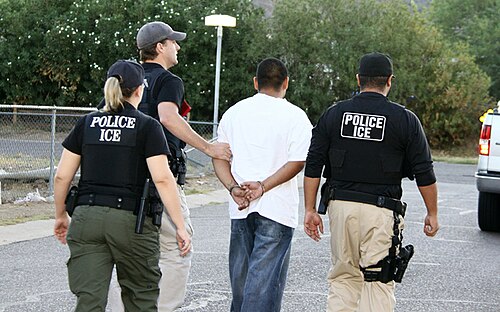
During his time in office, President Obama was known in the Mexican American community as the "Deporter in Chief".[509] Between 2009 and 2015, his administration removed more than 2.5 million people from the country, though some analysts claimed these numbers were "misleading" due to the way they were calculated.[510][511] During his time in office, the Department of Homeland Security initiated two policies which represented a major shift from prior administrations. First, DHS began placing undocumented border crossers through formal removal proceedings; second, it made non-citizens "with criminal records" the agency's top deportation target.[512] Thus, when faced with criticism for his administration's record high deportation numbers, President Obama responded by saying, "The statistics are actually a little deceptive ... we've been apprehending folks at the borders and sending them back. That is counted as a deportation even though they may have only been held for a day or 48 hours."[513] Nevertheless, Obama faced significant criticism for his failure to pass immigration reform and for the detrimental effects of deportation on families' lives.[514][515]
Gentrification

One of the most serious issues facing urban Mexican Americans in the 2010s was residential displacement through gentrification. In San Francisco at this time, the predominantly Latino neighborhood, the Mission District, during the rapid expansion of Silicon Valley, created a housing shortage, which incentivized investors to buy properties in historically low-income neighborhoods (like the Mission) in order to renovate them and sell them at higher rates to tech workers.[516][517] As a result, many of the neighborhoods' taquerias, bakeries, bars, and auto mechanic shops were replaced with luxury condominiums, organic ice cream stores, international art galleries, and upscale cafes.[518] Significant resistance to the Mission's gentrification emerged, including the "restorative economics" of La Cocina Community Kitchen, the resistance art projects of the Clarion Alley Mural Project, the San Francisco tech bus protests, and the "radically inclusive" social services provided by the Dolores Street Community Services Shelter.[519]

In Los Angeles, gentrification affected the traditionally Mexican American neighborhoods of Echo Park, Highland Park, and large swaths of East Los Angeles, particularly the neighborhood of Boyle Heights. As white, college-educated young people increasingly moved to Los Angeles in the 2010s, they wanted to live in "hip", "urban", "edgy" and importantly, affordable, neighborhoods.[520] Their presence increasingly pushed rent up and made the neighborhoods unaffordable to long-time residents.[521] In Boyle Heights, this process was sped up by the arrival of a subway station, called Mariachi Plaza station, which made the neighborhood even more desirable to young white gentrifiers wanting easy access to the rest of Los Angeles.[522] In 2016, significant controversy arose when the message "Fuck White Art" was spray-painted on the entrance to the Nicodim Gallery in Boyle Heights, especially when the LAPD classified the graffiti as a "hate crime".[523] Modern commentators compared gentrification to the urban renewal projects of the 20th century and connected urban displacement to American capitalism, racism, and colonization.[524][525]

Gentrification affected many major urban Mexican American populations in the country, including in cities like San Diego, Albuquerque, and Chicago.[526] In the historically Mexican American neighborhood of Pilsen in Chicago, working class families experienced high levels of displacement due to rising rents and property taxes.[527] Pilsen (which had grown as a Mexican American enclave in the 1960s and 1970s when expansions to the University of Illinois at Chicago's campus forced them into the neighborhood)[528] became a "tourist attraction" in the 2010s, where sanitized versions of "Latinoness" were marketed to developers and new potential residents.[529] The result was the opening of new businesses catered primarily to upscale non-resident visitors and recent arrivals. Pilsen's primary tool to resist gentrification was a grassroots effort to designate the neighborhood a historic landmark.[530]
LGBT rights

LGBTQ+ rights made significant strides in the 2010s. Between 2010 and 2019, public support for marriage equality rose by over 19 points, and 2011 marked the first time in U.S. history that more people supported same-sex marriage than opposed it.[531] In 2011, President Obama formally ended the policy of "Don't ask, don't tell", allowing openly identified gay men and lesbians to serve in the U.S. military.[532] In 2015, the U.S. Supreme Court ruled in Obergefell v. Hodges that same-sex marriage was a constitutionally protected right under the 14th Amendment.[533] Around the time of the Supreme Court's ruling, Latino support for marriage equality was amongst the highest of any ethnic group.[534]
Despite these significant strides, however, the Mexican American and Latino LGBT communities continued to struggle with many challenges. In the aftermath of the Great Recession, an approximately 4.2 million youth experienced homelessness in the U.S., of which 700,000 were unaccompanied minors.[535] Of these 4.2 million, estimates range that between eleven and forty percent were LGBTQ, many of whom were Mexican American or Latino.[536][537]Transgender equality also remained a major issue for many Mexican Americans. In the 2010s, black and Latino transgender women experienced homicide rates widely disproportionate to their percentage of the overall population.[538][539] The failure of the Obama administration or mainstream LGBT organizations to address any of these difficulties created outrage amongst the LGBT Mexican American and Latinx communities. In 2015, the activist Bamby Salcedo disrupted the opening session of the National LGBTQ Task Force's annual conference to protest the white LGBT community's continued ignorance regarding violence against transgender women of color.[540][541] In the 2010s, LGBT Mexican and Latino ICE detainees also experienced alarmingly high rates of sexual abuse in U.S. immigration detention centers.[542][543] The undocumented activist Jennicet Gutiérrez interrupted a speech by President Obama during a White House LGBT celebration dinner in 2015 to protest violent detention center conditions for LGBT Latinos.[544]
"Build that wall!"

From the start of Donald Trump's campaign for president, he faced accusations of racism and discrimination against Mexicans and Mexican Americans. In his announcement speech in August 2015, Trump said the United States had become a "dumping ground" for unwanted people from other countries and received pushback in particular for his statement: "When Mexico sends its people, they're not sending their best. They're bringing drugs. They're bringing crime. They're rapists. And some, I assume, are good people."[545] The comment was interpreted by many to imply that immigrants from Mexico had been "sent" to the U.S., and that many could be generalized as "criminals and rapists".[546][547] In June 2016, Trump was again accused of racism when he said he would be unable to receive a fair hearing from the Mexican American judge Gonzalo Curiel because, "The judge, who happens to be, we believe, Mexican ... [has] an absolute conflict ... I'm building a wall. It's an inherent conflict of interest."[548][549][550] The border wall was one of the central themes of Trump's 2016 campaign, with many of his rallies featuring the chant, "Build that wall!"[551] Numerous commentators noted the racial and nativist connotations underlying the campaign pledge to build a wall.[552] Studies conducted during the 2016 presidential election showed negative online discourse surrounding Latinos was so severe that it negatively affected the community's mental well-being.[553] Nevertheless, Trump won at least 18% of the Latino vote in 2016.[554][555]

While in office, the Trump administration unleashed a series of controversial policies affecting Latinos. On May 7, 2018, Jeff Sessions, then Trump's attorney general, announced a new "zero tolerance" policy at the U.S.-Mexico border, meaning any person apprehended crossing the border without documentation would be charged criminally and any children accompanying them would be held separately.[556] Though the policy was ended by executive order within a month, more than 500 children remained separated from their parents more than two years later.[557] During the 2018 midterm elections, Trump politicized the Central Americanrefugee crisis, claiming "terrorists" and "gang members" were secretly hiding alongside women and children in order to gain entry into the United States.[558] After the midterm elections, the Trump administration adopted the "Remain in Mexico" program, which essentially sought to shut down asylum entry into the country.[559] The policy resulted in a humanitarian crisis, as tens of thousands of refugees were forced to live in makeshift tent encampments in Mexico while they awaited an asylum hearing.[560][561] Trump's efforts on the border resulted in the erection of over 53 miles of new border wall and the renovation of over 400 miles of existing border walls;[562] this wall construction sparked outrage for its impact on indigenous communities.[563] During the Trump years, Immigration and Customs Enforcement also collaborated with other U.S. law enforcement agencies, such as the U.S. Marshals, to conduct large "crime raids", during which hundreds of people were arrested and deported if found to be undocumented.[564] In fact, in 2019, ICE conducted the largest single-state immigration raid in U.S. history.[565]
Trump protests

The 2010s saw levels of mass protest unseen in the United States since the Civil Rights movement of the 1960s. In 2017, the Day without Immigrants protested President Donald Trump's plans to build a border wall and to potentially deport millions of undocumented immigrants.[566] In 2018, protests against Trump's family separation policy occurred in over 700 cities and towns in the United States, many under the title, "Families Belong Together".[567][568] Also in response to the Trump's family separation policies, widespread calls emerged to shut down U.S. Immigration and Customs Enforcement (ICE),[569] usually expressed under the slogan "Abolish ICE".[570] In 2019, as the Trump administration sought to end the DACA program, the United States Supreme Court agreed to hear their case.[571]DHS v. University of California created significant controversy, and major protests in support of "Dreamers" occurred across the country.[572][573] Major American corporations also voiced their support for the DACA program,[574] and the Supreme Court ultimately upheld the program.[575] Mexicans Americans were also involved with many of the major social movements during the Trump presidency, including the movement for Black Lives Matter and racial justice,[576] the Women's March (the Chicana activist Carmen Perez was one of four national co-chairs of the 2017 March),[577] and gun control movements like March For Our Lives.[578] According to some scholars, the intense activist energy during the Trump presidency motivated young Mexican Americans to adopt a political identity of "neo-Chicanismo", defined by ethnic pride, cultural heritage and expression, and protecting immigrants' rights.[579][580] This younger activist generation also actively adopted gender neutral language, such as the terms "Chicanx" and "Xicanx" as a way to push back against gender bias in politics, society, and activism.

El Paso shooting
In the 2010s, the amount of white nationalistdomestic terrorism increased dramatically.[581] There was a large surge in white supremacist and other hate group membership during the Obama administration,[582] and the United States saw a record number of hate crimes committed during the first Trump administration.[583] In 2019, one of the largest mass shootings against Latino Americans occurred at a Walmart store in El Paso, Texas when a white terrorist, Patrick Crusius, murdered 23 people and injured 23 others.[584][585] Crusius was mostly radicalized online, an increasingly common trend in the U.S.[586][587] Shortly before the attack, he posted his "manifesto" to the online message board 8chan, where he wrote about a "Latino invasion of Texas", claiming "white people were being replaced by foreigners."[588] He faces 90 federal charges, and he will receive the death penalty if found guilty.[589]
2020s
Politics
In 2020, former House Representative and Secretary of Housing and Urban DevelopmentJulian Castro became the first serious Mexican American candidate for president since Ben Fernandez ran in the 1980 Republican primaries.[590] Castro dropped out of the race on January 6, 2020, after polling far behind other candidates,[591] and he announced his support for Joe Biden on June 2, 2020.[592] During the 2020 general election, some experts were surprised at the strength of Donald Trump's support amongst Mexican Americans in areas like the Rio Grande Valley, which increased by 10% from 2016.[593][594] In January 2021, Democrat Alex Padilla became the first Latino California senator.[595][596]
Police violence

In the 2020s, Mexican Americans and other Latinos joined calls for racial justice and an end to police brutality in the United States.[597][598][599] Analysis of fatal U.S. police shootings in October 2020 showed that in the prior five years, Native Americans, black Americans, and Latinos were the three ethnic groups killed by police at the highest rates in the country, respectively.[600] Activists within the community, however, expressed frustration that in the years leading up to the 2020–21 United States racial unrest, police killings of Latino boys and men had largely been met with sustained national indifference.[601][602][603][604] Nationally, over 900 Latinos were killed by the police in just the five years leading up to 2020.[605][606]
COVID-19
The COVID-19 pandemic disproportionately impacted the Mexican American and Latino communities. Latinos were dying three times as much as the non-Latino white population.[607] In 2020, approximately 1 in 1,150 Latinos in the U.S. died from COVID-19.[608][609] Because many Mexican Americans and Latinos disproportionately work in the service-sector, and were thus considered part of the "essential" workforce, they had to bear a major part of the pandemic's force.[610][611] Complications from COVID-19 were especially dire for Latinos without health insurance.[612] Many Mexican Americans and Latinos began relying on food banks and unemployment insurance to keep their families alive.[613][614]
See also
Notes
- ↑"Treaty of Guadalupe Hidalgo". University of Houston, Digital History. University of Houston. Retrieved August 18, 2020.
- ↑Baca, Herman. "The little-known treaty of Guadalupe Hidalgo and 5 years of conquest"(PDF). The San Diego Union-Tribune. University of California, San Diego. Retrieved August 18, 2020.
- ↑Steinhauer, Jason (March 11, 2015). "The History of Mexican Immigration to the U.S. in the Early 20th Century". Insights: Scholarly Works at the John W. Kluge Center. Library of Congress. Retrieved August 18, 2020.
- ↑"The Mexican Revolution 1910-1917". UT Liberal Arts Instruction Technology Services. University of Texas, Austin. Retrieved August 18, 2020.
- ↑Garcilazo, Jeffrey Marcos (February 16, 2016). Traqueros: Mexican Railroad Workers in the United States, 1870 to 1930 (2 ed.). University of North Texas Press. ISBN 978-1574416275. Retrieved August 18, 2020.
- ↑Anderson, Lydia R. "Hispanics in the Midwest"(PDF). Center for Family and Demographic Research. Bowling Green State University. Retrieved August 18, 2020.
- ↑Kochhar, Rakesh; Suro, Roberto; Tafoya, Sonya (July 26, 2005). "The New Latino South: The Context and Consequences of Rapid Population Growth". Pew Research Center: Hispanic Trends. Pew Research Center. Retrieved August 18, 2020.
- ↑Lopez, Mark Hugo (September 8, 2016). "Ranking the Latino population in the states". Pew Research Center. Retrieved August 18, 2020.
- ↑"Chicano/Latino Movements History and Geography". Mapping American Social Movements. University of Washington. Retrieved August 18, 2020.
- ↑de Otermín, Antonio (November 20, 2008). A Forgotten Kingdom: The Spanish Frontier in Colorado and New Mexico, 1540-1821. National Park Service. Retrieved August 18, 2020.
- ↑"Spanish California". California as I Saw It: First-Person Narratives of California's Early Years, 1849 to 1900. Library of Congress. Retrieved August 18, 2020.
- ↑Weber, David (January 1, 1990). Myth and the History of the Hispanic Southwest (1 ed.). University of New Mexico Press. ISBN 978-0826311948. Retrieved August 18, 2020.
- ↑"Colonial New Mexico"(PDF). City of Albuquerque. Retrieved August 18, 2020.
- ↑"Spanish New Mexico". National Museum of American History. Smithsonian Institution. June 12, 2017. Retrieved August 18, 2020.
- ↑Gutiérrez, Ramón A. (January 1, 1991). When Jesus Came, the Corn Mothers Went Away (1 ed.). Palo Alto: Stanford University Press. ISBN 978-0804718325. Retrieved August 19, 2020.
- ↑Whitehurst, Katie. "Spanish Colonial". Texas PBS. PBS. Retrieved August 18, 2020.
- ↑"Conquistadors and Spanish Colonial Period"(PDF). Department of Emergency and Military Affairs. Government of Arizona. Archived from the original(PDF) on December 28, 2016. Retrieved August 18, 2020.
- ↑"San Diego Mission Church (San Diego de Alcala)". Early History of the California Coast. National Park Service. Retrieved August 18, 2020.
{{cite web}}: CS1 maint: deprecated archival service (link) - ↑Castañeda, Antonia I. "Sexual Violence in the Politics and Policies of Conquest: Amerindian Women and the Spanish Conquest of Alta California". UC Berkeley Law School. University of California, Berkeley. Archived from the original on February 25, 2021. Retrieved August 18, 2020.
- ↑Miguel-Stearns, Teresa M. (June 6, 2014). Sources of State Practice in International Law (2 ed.). Brill - Nijhoff. p. 371. ISBN 978-9004178861. Retrieved August 18, 2020.
- ↑"Mexican California". California as I Saw It: First-Person Narratives of California's Early Years, 1849 to 1900. Library of Congress. Retrieved August 19, 2020.
- ↑Camarillo, Albert (February 1, 1996). Chicanos in a Changing Society: from Mexican Pueblos to American Barrios in Santa Barbara and Southern California, 1848-1930 (1 ed.). Cambridge: Harvard University Press. ISBN 978-0674113978. Retrieved August 19, 2020.
- ↑Sandos, James A (July 1985). "Levantamiento!: The 1824 Chumash Uprising Reconsidered". Southern California Quarterly. 67 (2): 109–133. doi:10.2307/41171145. JSTOR 41171145.
- ↑Hollenbaugh Aviña, Rose (November 1, 1976). Spanish and Mexican Land Grants in California. Ayer Company Publishing. ISBN 978-0405094835.
- ↑Manuel P., Servín (June 1965). "The Secularization of the California Missions: A Reappraisal". Southern California Quarterly. 47 (2): 133–149. doi:10.2307/41169919. JSTOR 41169919.
- ↑"Secularization and the Rancho Era, 1834-1846"(PDF). Ohlone/Costanoan Indians of the San Francisco Peninsula and their Neighbors, Yesterday and Today. National Park Service. Retrieved August 19, 2020.
- ↑Almaguer, Tomás (December 30, 2008). Racial Fault Lines: The Historical Origins of White Supremacy in California (1 ed.). Berkeley: University of California Press. ISBN 978-0520257863. Retrieved August 19, 2020.
- ↑Hackel, Steven W. Land, and, Labor, and Production: The Colonial Economy of Spanish and Mexican California. University of California Press.
- ↑Casas, Maria Raquel (March 28, 2009). Married to A Daughter of the Land: Spanish-Mexican Women and Interethnic Marriage in California, 1820-1880 (1 ed.). University of Nevada Press. ISBN 978-0874177787. Retrieved August 19, 2020.
- ↑"Texas Declaration of Independence". The Republic of Texas - The Texas Revolution. Texas State Library and Archives Commission. Retrieved August 19, 2020.
- ↑"The Republic of Texas - The Texas Revolution". The Battle of San Jacinto. Texas State Library and Archives Commission. Retrieved August 19, 2020.
- ↑"The Treaties of Velasco". The Republic of Texas - The Texas Revolution. Texas State Library and Archives Commission. Retrieved August 19, 2020.
- ↑"Tejano Voices and the Demand for Inclusion". Texans' Struggle for Freedom and Equality. Texas State Library and Archives Commission. Retrieved August 19, 2020.
- ↑Costeloe, Michael P. (August 21, 2008). The Central Republic in Mexico, 1835-1846: 'Hombres de Bien' in the Age of Santa Anna (1 ed.). London: Cambridge University Press. ISBN 978-0521530644. Retrieved August 19, 2020.
- ↑"The Mexican American War". American Experience. PBS. Retrieved August 19, 2020.
- ↑"Mexican American War". American Experience. PBS. Retrieved August 19, 2020.
- ↑"Zachary Taylor". A Continent Divided: The U.S.-Mexico War. The University of Texas Arlington. Retrieved August 19, 2020.
- ↑"The Senate Votes for War against Mexico". United States Senate. Retrieved August 19, 2020.
- ↑Hollon, Cory S. (Winter 2015). "'A Leap in the Dark': The Campaign to Conquer New Mexico and California, 1846–1847". Army History. 94 (94): 6–26. JSTOR 26300360.
- 123456789101112Lozano, Rosina (April 24, 2018). An American Language: The History of Spanish in the United States (1 ed.). Berkeley: University of California Press. ISBN 978-0520297074. Retrieved August 20, 2020.
- ↑Gonzalez, Albert (November 2, 2015). "The 1847 Revolt: The Beginning of Modern Taos". University of New Mexico, Taos. Archived from the original on December 12, 2021. Retrieved August 20, 2020.
- ↑Beyreis, David C. (Spring 2019). "Dangerous Alliances in the New Mexico Borderlands: Charles Bent and the Limits of Family Networks". Journal of the Early Republic. 39 (1): 57–80. doi:10.1353/jer.2019.0005. S2CID 151104726.
- ↑"Mexican-American War". Naval History and Command Center. United States Navy. Retrieved August 20, 2020.
- ↑"Mexican American War: Timeline of Major Events". University of Michigan. Retrieved August 20, 2020.
- ↑"Treaty of Guadalupe Hidalgo". The Avalon Project: Documents in Law, History, and Diplomacy. Yale Law School. Retrieved August 20, 2020.
- ↑"The Annexation of Texas, the Mexican-American War, and the Treaty of Guadalupe-Hidalgo, 1845–1848". Office of the Historian. United States Department of State. Retrieved August 20, 2020.
- ↑"Treaty of Guadalupe Hidalgo". Digital History. University of Houston. Retrieved August 20, 2020.
- ↑"The Treaty of Guadalupe Hidalgo". Hispanic Reading Room. Library of Congress. Retrieved August 20, 2020.
- ↑Hornbeck, David (October 1979). "The Patenting of California's Private Land Claims, 1851-1885". Geographical Review. 69 (4): 434–448. Bibcode:1979GeoRv..69..434H. doi:10.2307/214806. JSTOR 214806. Retrieved August 20, 2020.
- ↑Smith, Marian L. (August 15, 2016). "Race, Nationality, and Reality". Prologue. National Archives. Retrieved August 20, 2020.
- ↑Montoya, Margaret E. "Latinos and the Law". American Latino Theme Study: Law. National Park Service. Retrieved August 20, 2020.
- ↑Klein, Christine A. (Spring 1996). "Treaties of Conquest: Property Rights, Indian Treaties, and the Treaty of Guadalupe Hidalgo". New Mexico Law Review. 26 (2). Retrieved August 20, 2020.
- ↑Weber, David (March 1, 2004). Foreigners in Their Native Land: Historical Roots of the Mexican Americans (2 ed.). Albuquerque: University of New Mexico Press. ISBN 978-0826335104. Retrieved August 25, 2020.
- ↑Gómez, Laura E. "Off-White in an Age of White Supremacy: Mexican Elites and the Rights of Indians and Blacks in Nineteenth-Century New Mexico"(PDF). Law Center. University of Houston. Retrieved August 25, 2020.
- 1234Hernandez, Jose Angel. "The Decree of 19 August 1848: The First Repatriation Commissions and Postwar Settlements along the US-Mexico Borderlands". The Center for Mexican American Studies. University of Houston. Retrieved August 25, 2020.
- ↑Nostrand, Richard L. (September 1975). "Mexican Americans Circa 1850". Annals of the Association of American Geographers. 65 (3): 378–390. doi:10.1111/j.1467-8306.1975.tb01046.x. JSTOR 2561888. Retrieved August 25, 2020.
- 12"New Mexico"(PDF). U.S. Census Library. United States Census. Retrieved August 25, 2020.
- 123456Campbell, Randolph B. (March 15, 2017). Gone to Texas: A History of the Lone Star State (3 ed.). Cambridge: Oxford University Press. pp. 190–191. ISBN 978-0190642396. Retrieved August 24, 2020.
- ↑De León, Arnoldo (January 1, 1983). They Called Them Greasers: Anglo Attitudes toward Mexicans in Texas, 1821–1900 (1 ed.). University of Texas Press. ISBN 978-0292780545. Retrieved August 24, 2020.
- ↑"California"(PDF). Census of 1850: California. United States Census. Retrieved August 26, 2020.
- ↑Monroy, Douglas (May 25, 1993). Thrown Among Strangers: The Making of Mexican Culture in Frontier California (1 ed.). Berkeley: University of California Press. ISBN 978-0520082755. Retrieved August 24, 2020.
- ↑Field, Margaret A. "Genocide and the Indians of California, 1769-1873". Scholarworks. University of Massachusetts, Boston. Retrieved August 25, 2020.
- ↑Madley, Benjamin (May 24, 2016). An American Genocide: The United States and the California Indian Catastrophe, 1846-1873 (1 ed.). New Haven: Yale University Press. ISBN 978-0300181364. Retrieved August 25, 2020.
- ↑"Miguel Antonio Otero". History, Art, and Archives. United States House of Representatives. Retrieved August 26, 2020.
- ↑"José Manuel Gallegos". History, Art, and Archives. United States House of Representatives. Retrieved August 26, 2020.
- ↑"José Manuel Gallegos". Hispanic Americans in Congress, 1822-1995. Library of Congress. Retrieved August 26, 2020.
- ↑Gates, Paul W. (Spring 1974). "The Frémont-Jones Scramble for California Land Claims". Southern California Quarterly. 56 (1): 13–44. doi:10.2307/41170514. JSTOR 41170514. Retrieved August 26, 2020.
- ↑Rodríguez, Roberto; Gonzales, Patrisia. "The Treaty of Guadalupe Hidalgo Still Relevant Today". DePaul University Libraries. DePaul University. Retrieved August 26, 2020.
- ↑"California Population by Ethnic Groups, 1790-1880". Myth and Reality: The California Gold Rush and Its Legacy. Museum of California. Retrieved August 26, 2020.
- ↑Gates, Paul (December 1971). "California Land Act of 1851". California Historical Quarterly. 50 (4). University of California Press: 395–430. doi:10.2307/25157352. JSTOR 25157352. Retrieved August 26, 2020.
- ↑Herrera Canales, Inés (2015). "Trabajadores y técnicas mineras andinas en las fiebres del oro del mundo en el siglo XIX". Nuevo Mundo (in Spanish). doi:10.4000/nuevomundo.67746.
- ↑Nasatir, Abraham P. (1974). "Chileans in California during the Gold Rush Period and the Establishment of the Chilean Consulate". California Historical Quarterly. 53 (1): 52–70. doi:10.2307/25157486. JSTOR 25157486.
- ↑Purcell, Fernando (2009). "Becoming Dark: The Chilean Experience in California, 1848-1870". In Cobas, José A.; Duany, Jorge; Feagin, Joe R. (eds.). How the United States Racializes Latinos: White Hegemony and Its Consequences. doi:10.4324/9781315634104-4 (inactive December 23, 2025).
{{cite book}}: CS1 maint: DOI inactive as of December 2025 (link) - ↑"California Land Act of 1851"(PDF). 31st Congress of the United States. Library of Congress. Retrieved August 26, 2020.
- ↑Pisani, Donald J. (Autumn 1994). "Squatter Law in California, 1850-1858". Western Historical Quarterly. 25 (3): 277–310. doi:10.2307/971109. JSTOR 971109. Retrieved August 26, 2020.
- ↑Vaught, David (Spring 2004). "A Tale of Three Land Grants on the Northern California Borderlands". Agricultural History. 78 (2): 140–154. doi:10.1525/ah.2004.78.2.140. JSTOR 3744897. S2CID 143254378. Retrieved August 26, 2020.
- 12Pitt, Leonard; Gutierrez, Ramon A. (1999). Decline of the Californios: A Social History of the Spanish-Speaking Californias, 1846-1890 (1 ed.). Berkeley: University of California Press. ISBN 978-0520219588. Retrieved August 25, 2020.
- ↑Hornbeck, David (October 1979). "The Patenting of California's Private Land Claims, 1851-1885". Geographical Review. 69 (4): 434–448. Bibcode:1979GeoRv..69..434H. doi:10.2307/214806. JSTOR 214806. Retrieved August 26, 2020.
- ↑Lopes, Adrian; Libecap, Gary B.; Leuck, Dean. "A Legacy of History: 19th Century Land Demarcation and Agriculture in California"(PDF). Department of Economics. University of Pittsburgh. Archived from the original(PDF) on February 25, 2021. Retrieved August 26, 2020.
- ↑Olmsted, Nancy J. "Mexican Land Claims—The U.S. Land Commission and The Burden of Proof, 1851-1854". San Francisco's Digital Archive. Found SF. Retrieved August 26, 2020.
- ↑"The Public Land Commission". Digital History. University of Houston. Retrieved August 26, 2020.
- ↑Suárez, Camille Alexandrite. "How California Was Won: Race, Citizenship, And The Colonial Roots Of California, 1846 – 1879". Scholarly Commons. University of Pennsylvania. Retrieved August 26, 2020.
- ↑Richerson, Rose (2014). "Spanish and Mexican Land Grants and Heirs' Rights to Unclaimed Mineral Estates in Texas". Texas A&M Journal of Property Law. 2 (1). Retrieved August 26, 2020.
- ↑de la Teja, Jesús F.; Greaser, Galen D. (April 1992). "Quieting Title to Spanish and Mexican Land Grants in the Trans-Nueces: The Bourland and Miller Commission, 1850-1852". The Southwestern Historical Quarterly. 95 (4): 445–464. JSTOR 30242000. Retrieved August 26, 2020.
- 12Montejano, David (September 1, 1987). Anglos and Mexicans in the Making of Texas, 1836-1986 (1 ed.). University of Texas Press. ISBN 978-0292775961. - Read online atGoogle Books. Access date: August 26, 2020
- ↑Alonzo, Armando C. "Mexican-American Land Grant Adjudication". Texas State Historical Association. Retrieved August 26, 2020.
- ↑Camarillo, Albert (January 1, 1984). Chicanos in California: A History of Mexican Americans in California (1 ed.). Boyd & Fraser Publishing Co. ISBN 978-0878351282. Retrieved August 26, 2020.
- ↑Boessenecker, John (July 17, 2014). Bandido: The Life and Times of Tiburcio Vasquez (1 ed.). University of Oklahoma Press. ISBN 978-0806146812. Retrieved August 26, 2020.
- 12Carrigan, William D.; Webb, Clive (Winter 2003). "The Lynching of Persons of Mexican Origin or Descent in the United States, 1848 to 1928". Journal of Social History. 37 (2): 411–438. doi:10.1353/jsh.2003.0169. JSTOR 3790404. S2CID 143851795. Retrieved August 25, 2020.
- ↑Paredes, Américo (June 1, 1958). 'With His Pistol in His Hand:' A Border Ballad and Its Hero (1 ed.). University of Texas Press. ISBN 978-0292701281. Retrieved August 25, 2020.
{{cite book}}: ISBN / Date incompatibility (help) - ↑"Latinos: Juan Cortina"(PDF). Smithsonian Repository. Smithsonian Institution. Retrieved August 26, 2020.
- ↑"Juan Nepomuceno Cortina and the 'First Cortina War'". Rio Grande Valley Civil War Trail. University of Texas, Rio Grande Valley. Retrieved August 26, 2020.
- 123456789"Hispanics and the Civil War". National Park Service. U.S. Department of the Interior. Retrieved September 3, 2020.
- ↑Finch, L. Boyd (Spring 1992). "Arizona in Exile: Confederate Schemes to Recapture the Far Southwest". The Journal of Arizona History. 33 (1): 57–84. JSTOR 41695920. Retrieved September 3, 2020.
- ↑Finch, Boyd (Autumn 1969). "Sherod Hunter and the Confederates in Arizona". The Journal of Arizona History. 10 (3): 137–206. JSTOR 41695524. Retrieved September 3, 2020.
- ↑Dziurzynski Cox, Karen. "Establishment of New Mexico's American Identity: A Survey of Governance and Events highlighting The Kearny Code, the first American Rule of Law and the Civil War Battles in New Mexico"(PDF). James Madison Memorial Fellowship Foundation. Ashland University. Archived from the original(PDF) on January 19, 2019. Retrieved September 3, 2020.
- ↑Hannigan, Isabel. "'Overrun All This Country...' Two New Mexican Lives Through the Nineteenth Century". OhioLINK. Oberlin College. Archived from the original on October 7, 2021. Retrieved September 3, 2020.
- ↑"The Gettysburg of the West: The Battle of Glorieta Pass (1862)". United States Army Combined Arms Center. United States Army. Retrieved September 3, 2020.
- ↑"Battle of Glorieta Pass: Action at Apache Canyon". United States National Guard. Retrieved September 3, 2020.
- ↑"Col. Santos Benavides". University of Texas, Rio Grande Valley. Retrieved September 3, 2020.
- ↑"Confrontation at Carrizo". University of Texas, Rio Grande Valley. Retrieved September 3, 2020.
- ↑"Second Battle of El Clareño and Hanging of Zapata County Judge". University of Texas, Rio Grande Valley. Retrieved September 3, 2020.
- ↑Stephen, J. "The Battle of Palmito Ranch (May 12-13, 1865)". New Mexico State University. Retrieved September 3, 2020.
- ↑"The Battle of Palmito Ranch". The History Engine. University of Richmond. Archived from the original on August 12, 2020. Retrieved September 3, 2020.
- ↑"Civil War". Hispanics in the U.S. Army. United States Army. Archived from the original on September 18, 2015. Retrieved September 3, 2020.
- ↑Correia, David (Winter 2008). "Land Grant Speculation in New Mexico During the Territorial Period". Natural Resources Journal. 48 (4). Retrieved September 12, 2020.
- ↑Collins, Michael L. (April 12, 2018). A Crooked River: Rustlers, Rangers, and Regulars on the Lower Rio Grande, 1861–1877 (1 ed.). University of Oklahoma Press. ISBN 978-0806160085. Retrieved September 12, 2020.
- ↑Jennings, N. A. "A Little Standing Army in Himself". History Matters. George Mason University. Retrieved September 12, 2020.
- ↑Weber, John William. "The Shadow of the Revolution: South Texas, the Mexican Revolution, and the Evolution of Modern American Labor Relations". Theses, Dissertations, & Master Projects. College of William & Mary. Retrieved September 12, 2020.
- ↑Callahan, Manuel. "Mexican Border Troubles: Social War, Settler Colonialism and the Production of Frontier Discourses, 1848-1880". The University of Texas at Austin August. Retrieved September 12, 2020.
- ↑Comar, Scott C. "The Tigua Indians of Ysleta del Sur: A Borderlands Community". Open Access Theses & Dissertations. University of Texas at El Paso. Retrieved September 12, 2020.
- ↑Stuart, Andrew. "Tracing the Salt Road, Where West Texas Geology, History Meet". Nature Notes. Marfa Public Radio. Retrieved September 12, 2020.
- ↑Sonnichsen, C.L. "Salt War of San Elizario". Handbook of Texas. Texas State Historical Association. Retrieved September 12, 2020.
- ↑"The El Paso Salt War". Guadalupe Mountains National Park. National Park Service. Archived from the original on March 4, 2015. Retrieved September 12, 2020.
- ↑Matthews, Matt M. (2007). The US Army on the Mexican Border: A Historical Perspective(PDF) (1 ed.). Fort Leavenworth: Combat Studies Institute Press. p. 60. ISBN 978-0-16-078903-8. Archived(PDF) from the original on November 15, 2020. Retrieved September 12, 2020.
- ↑Davis, Steven L. (October 15, 2009). J. Frank Dobie (1 ed.). University of Texas Press. p. 13. ISBN 978-0292721142. Retrieved September 12, 2020.
- ↑Solis, Gabriel Daniel (January 18, 2012). "El Corrido de Ricardo Aldape Guerra: Form, History, and Resistance". Cultural Dynamics. 23 (3): 173–196. doi:10.1177/0921374011430567. S2CID 145344043. Retrieved September 12, 2020.
- ↑Agredano, Hector. "Rails to Revolution: Railroads, Railroad Workers and the Geographies of the Mexican Revolution". El Paso and Ciudad Juárez: Border Boomtowns. City University of New York. Retrieved September 21, 2020.
- ↑Labodda, Marsha. "Southern Pacific Company (Rio Grande Division)". Historical Sketch. University of Texas at El Paso. Retrieved September 21, 2020.
- ↑Kupsky, Gregory. "Responses to Immigration". ehistory. Ohio State University. Archived from the original on October 29, 2020. Retrieved September 21, 2020.
- ↑Hodges, Gladys Arlene. "El Paso, Texas and Ciudad Juarez, Chihuahua, 1880-1930". University of Texas at El Paso. Retrieved September 21, 2020.
- ↑Carrigan, William D.; Webb, Clive (May 21, 2013). Forgotten Dead: Mob Violence against Mexicans in the United States, 1848-1928 (1 ed.). New York: Oxford University Press. ISBN 978-0195320350. Retrieved September 21, 2020.
- ↑Jaques, Mary J. (1890). Texas Ranch Life. Independent Publishers. ISBN 978-1519055460.
{{cite book}}: ISBN / Date incompatibility (help) - ↑"Chinese Exclusion Act (1882)". Our Documents. The U.S. National Archives and Records Administration. Retrieved September 21, 2020.
- ↑Chao Romero, Robert (January 1, 2012). The Chinese in Mexico, 1882-1940 (2 ed.). Tucson: University of Arizona Press. ISBN 9780816514601. Retrieved September 21, 2020.
- ↑"Chinese Immigration and the Chinese in the United States". National Archives: Chinese Heritage. The U.S. National Archives and Records Administration. August 15, 2016. Retrieved September 21, 2020.
- ↑Delgado, Grace (March 7, 2012). Making the Chinese Mexican: Global Migration, Localism, and Exclusion in the U.S.-Mexico Borderlands (1 ed.). Palo Alto: Stanford University Press. ISBN 978-0816514601. Retrieved September 21, 2020.
- ↑"Border Patrol History". U.S. Customs and Border Protection. U.S. Department of Homeland Security. Retrieved December 12, 2020.
- ↑Railton, Ben (August 15, 2017). "Why We Should All Read The Squatter and the Don". American Writers Museum. Retrieved September 21, 2020.
- ↑Contreras, Alicia. "María Amparo Ruiz de Burton". Oxford Bibliographies. Oxford University Press. Retrieved September 21, 2020.
- 12Ruiz, Vicki L. (December 2006). "Nuestra América: Latino History as United States History"(PDF). The Journal of American History: 660. Retrieved September 21, 2020.
- ↑Baron, Dennis. "California must ban language discrimination". The Web of Language. University of Illinois. Retrieved September 21, 2020.
- ↑Perman, Michael (2001). Struggle for Mastery: Disfranchisement in the South, 1888-1908 (1 ed.). Raleigh: University of North Carolina Press. ISBN 9780807849095. Retrieved September 21, 2020.
- 1234567891011Lim, Julian (December 18, 2017). Porous Borders: Multiracial Migrations and the Law in the U.S.-Mexico Borderlands (1 ed.). Chapel Hill: University of North Carolina Press. ISBN 978-1469635491. Retrieved October 3, 2020.
- ↑Robinson II, Charles (July 2004). "Legislated Love in the Lone Star State: Texas and Miscegenation". The Southwestern Historical Quarterly. 108 (1): 65–87. JSTOR 30239495. Retrieved October 3, 2020.
- ↑Garcilazo, Jeffrey Marcos (February 16, 2016). Traqueros: Mexican Railroad Workers in the United States, 1870-1930 (1 ed.). University of North Texas Press. ISBN 978-1574416275. Retrieved October 3, 2020.
- ↑Spener, David. "Mexican Migration to the United States, 1882-1992: A Long Twentieth Century of Coyotaje"(PDF). The Center for Comparative Immigration Studies. University of California, San Diego. Retrieved October 3, 2020.
- 12Cardoso, Lawrence A. (June 1, 1980). Mexican Emigration to the United States, 1897-1931: Socio-Economic Patterns (1 ed.). Tucson: The University of Arizona Press. ISBN 978-0816506781. Retrieved October 3, 2020.
- ↑"Court of Private Land Claims, 1891-1904". History of the Federal Judiciary. Federal Judicial Center. Retrieved October 3, 2020.
- 123Young, Elliott (July 26, 2004). Catarino Garza's Revolution on the Texas-Mexico Border (1 ed.). Duke University Press. ISBN 978-0822333203. Retrieved October 3, 2020.
- 1234567891011Muñoz Martinez, Monica (September 3, 2018). The Injustice Never Leaves You: Anti-Mexican Violence in Texas (1 ed.). Cambridge: Harvard University Press. ISBN 978-0674976436. Retrieved October 3, 2020.
- ↑Caffey, David L. (March 15, 2014). Chasing the Santa Fe Ring: Power and Privilege in Territorial New Mexico (1 ed.). Santa Fe: University of New Mexico Press. ISBN 978-0826354426. Retrieved October 3, 2020.
- ↑Correia, David (Fall 2010). "'Retribution Will Be Their Reward': New Mexico's Las Gorras Blancas and the Fight for the Las Vegas Land Grant Commons"(PDF). Radical History Review. 108 (1): 49–72. doi:10.1215/01636545-2010-003. Retrieved October 3, 2020.
- ↑Larson, Robert W. (May 1975). "The White Caps of New Mexico: A Study of Ethnic Militancy in the Southwest". Pacific Historical Review. 44 (2): 171–185. doi:10.2307/3638001. JSTOR 3638001. Retrieved October 3, 2020.
- 123Wishart, David J."Gorras Blancas". Encyclopedia of the Great Plains. University of Nebraska - Lincoln. Retrieved October 3, 2020.
- ↑"Las Gorras Blancas: Millitant Resistance". Central New Mexico Community College. Retrieved October 3, 2020.
- ↑Herrera, Jose Maria. "Aguirre, Lauro (1857–1925)". Texas State Historical Association. Retrieved October 3, 2020.
- ↑Agredano, Hector (September 2019). Rails to Revolution: Railroads, Railroad Workers and the Geographies of the Mexican Revolution (Dissertation ed.). New York, NY: City University of New York. Retrieved November 21, 2020.
- ↑Anderson, Rodney D. (February 1, 1974). "Mexican Workers and the Politics of Revolution, 1906-1911". Hispanic American Historical Review. 54 (1): 94–113. doi:10.1215/00182168-54.1.94. Retrieved November 21, 2020.
- ↑Cahill, Kevin J. (Summer 1998). "The U.S. Bank Panic of 1907 and the Mexican Depression of 1908-1909". The Historian. 60 (4): 795–812. doi:10.1111/j.1540-6563.1998.tb01416.x. JSTOR 24452185. Retrieved November 21, 2020.
- ↑Powers, Jeanne M. (October 2008). "Forgotten History: Mexican American School Segregation in Arizona from 1900–1951". Equity & Excellence in Education. 41 (4): 467–481. doi:10.1080/10665680802400253. S2CID 143690066. Retrieved October 10, 2020.
- ↑Gonzalez, Gilbert G. (April 5, 2013). Chicano Education in the Era of Segregation (1 ed.). Denton: University of North Texas Press. ISBN 978-1574415018. Retrieved December 12, 2020.
- ↑Villanueva Jr., Nicholas (June 15, 2017). The Lynching of Mexicans in the Texas Borderlands (1 ed.). Santa Fe: University of New Mexico Press. ISBN 978-0826358387. Retrieved November 21, 2020.
- 12Kim, Eugene. "The Oxnard Strike of 1903". History 32. Dartmouth University. Archived from the original on October 7, 2020. Retrieved November 20, 2020.
- ↑"A History of Mexican Americans in California". Five Views: An Ethnic Historic Site Survey for California. National Park Service. Retrieved November 21, 2020.
- ↑Ramirez, Raymond. "The Oxnard Sugar Beet Strike of 1903". Asian Pacific American Labor History. University of California, Los Angeles. Archived from the original on November 7, 2002. Retrieved November 21, 2020.
- ↑Gordon, Linda (2001). The Great Arizona Orphan Abduction (1 ed.). Cambridge: Harvard University Press. ISBN 978-0674005358. Retrieved November 21, 2020.
- ↑Brophy, Anthony Blake (1972). Foundlings on the Frontier: Racial and Religious Conflict in Arizona Territory, 1904-1905 (1 ed.). Tucson: University of Arizona Press. ISBN 978-0816503193.
- 123Mitchell, Pablo (2012). West of sex: making Mexican America; 1900 - 1930. American history. Chicago: Univ. of Chicago Press. ISBN 978-0-226-53269-1.
- ↑Estrada, Leobardo F.; García, F. Chris; Macías, Reynaldo Flores; Maldonado, Lionel (1981). "Chicanos in the United States: A History of Exploitation and Resistance". Daedalus. 110 (2): 103–131. ISSN 0011-5266. JSTOR 20024726.
- 123Hu-DeHart, Evelyn (November 1, 2016). Yaqui Resistance and Survival: The Struggle for Land and Autonomy, 1821–1910 (1 ed.). Madison: University of Wisconsin Press. ISBN 978-0299311049. Retrieved November 21, 2020.
- ↑Lee, Erika (June 2002). "Enforcing the Borders: Chinese Exclusion along the U.S. Borders with Canada and Mexico, 1882-1924". The Journal of American History. 89 (1): 54–86. doi:10.2307/2700784. JSTOR 2700784. Retrieved November 20, 2020.
- 12345Lim, Julian (August 2013). The Future Immense: Race and Immigration in the Multiracial U.S.-Mexico Border, 1880-1936(PDF) (Dissertation ed.). Ithaca, NY: Graduate School of Cornell University. Retrieved November 20, 2020.
- ↑Tutino, John (1986). From Insurrection to Revolution: Social Bases of Agrarian Violence, 1750–1940 (1 ed.). Princeton University Press. p. 327. ISBN 978-0691022949. Retrieved November 29, 2020.
- ↑Friedrich Katz, The Secret War in Mexico: Europe, the United States and the Mexican Revolution. Chicago: University of Chicago Press, 1981, p. 35.
- ↑Katz, The Secret War in Mexico p. 35.
- ↑Tuñon Pablos, "Mexican Revolution: February 1913 – October 1915", p. 855
- ↑McLynn, Frank (2001). "The Revolt Against Huerta". Villa and Zapata: A History of the Mexican Revolution. United States: Carroll & Graf Publishers. ISBN 0-7867-1088-8.
- ↑McLynn, Frank (2001). "Villa at His Zenith; The End of Huerta; The Convention of Aguascalientes". Villa and Zapata: A History of the Mexican Revolution. United States: Carroll & Graf Publishers. ISBN 0-7867-1088-8.
- ↑"A Growing Community". Immigration and Relocation in U.S. History. Library of Congress. Retrieved November 29, 2020.
- ↑Contreras, Russell (April 5, 2018). "Why U.S. militarization of border isn't new". PBS. Retrieved November 29, 2020.
- ↑Levario, Miguel (March 2, 2015). Militarizing the Border: When Mexicans Became the Enemy (1 ed.). Texas A&M University Press. p. 82. ISBN 978-1623493028. Retrieved November 29, 2020.
- ↑Levario, Miguel A. "El Paso Race Riot of 1916". Handbook of Texas. Texas Historical Association. Retrieved November 29, 2020.
- ↑Darrah, Jason T. "Anglos, Mexicans, and the San Ysabel Massacre: A Study of Changing Ethnic Relations in El Paso, Texas, 1910-1916"(PDF). Texas Tech University. Retrieved November 29, 2020.
- ↑Lim, Julian (August 2013). "Immigration, Asylum, and Citizenship: A More Holistic Approach". California Law Review. 101 (4): 1013–1077. JSTOR 23784324. Retrieved November 29, 2020.
- ↑Hovenkamp, Herbert J. "The Progressives: Racism and Public Law". Penn Law: Legal Scholarship Repository. University of Pennsylvania Carey Law School. Retrieved November 29, 2020.
- ↑Benton-Cohen, Katherine (May 7, 2018). Inventing the Immigration Problem: The Dillingham Commission and Its Legacy (1 ed.). Cambridge: Harvard University Press. ISBN 978-0674976443. Retrieved November 29, 2020.
- ↑"Davenport, Charles". Eugenics Archive. Social Sciences and Humanities Research Council of Canada. Retrieved November 29, 2020.
- ↑Sánchez, George J. (March 23, 1995). Becoming Mexican American: Ethnicity, Culture, and Identity in Chicano Los Angeles, 1900-1945 (1 ed.). New York: Oxford University Press. ISBN 978-0195096484. Retrieved November 27, 2020.
- 12Stern, Alexandra Minna; Lira, Natalie (2014). "Mexican Americans and Eugenic Sterilization: Resisting Reproductive Injustice in California, 1920–1950". Aztlán: A Journal of Chicano Studies. 39 (2): 9–34. doi:10.1525/azt.2014.39.2.9. Retrieved November 27, 2020.
- ↑Cardoso, Lawrence A. (1980). Mexican Emigration to the United States, 1897–1931 (1 ed.). Tucson: University of Arizona Press. doi:10.2307/j.ctvss3xzr. ISBN 9780816506781. JSTOR j.ctvss3xzr. S2CID 242575639. Retrieved November 29, 2020.
- ↑Rosales, Francisco A. (January 1, 1997). Chicano! The History of the Mexican American Civil Rights Movement (2 ed.). Houston: Arte Publico Press. p. 78. ISBN 978-1558852013. Retrieved November 27, 2020.
- ↑Kaelber, Lutz. "Eugenics: Compulsory Sterilization in 50 American States". 2012 Social Science History Association. University of Vermont. Retrieved November 27, 2020.
- ↑"Latinx Sterilization and Eugenics Programs". Eugenics in California. Dartmouth University. Retrieved November 29, 2020.
- ↑Gutiérrez, Elena R. (February 1, 2008). Fertile Matters: The Politics of Mexican-Origin Women's Reproduction (1 ed.). Austin: University of Texas Press. ISBN 978-0292716827. Retrieved November 29, 2020.
- ↑Chavez-Garcia, Miroslava (February 21, 2012). States of Delinquency: Race and Science in the Making of California's Juvenile Justice System (1 ed.). Berkeley: University of California Press. ISBN 978-0520271722. Retrieved November 29, 2020.
- ↑Garza, James A. "The Long History of Mexican Immigration to the Rural Midwest." Journal of the West, vol. 45, no. 4, Fall 2006, pp. 57–64. EBSCOhost
- ↑Lira, Natalie; Novak, Nicole; O'Connor, Kate; Harlow, Siobán; Kardia, Sharon; Alexandra, Minna Stern (April 2018). "Disproportionate Sterilization of Latinos Under California's Eugenic Sterilization Program". American Journal of Public Health. 108 (5): 611–613. doi:10.2105/AJPH.2018.304369. PMC 5888070. PMID 29565671.
- ↑Black, Edwin. "Eugenics and the Nazis: The California connection". SF Gate. Retrieved November 29, 2020.
- ↑Kuhl, Stefan (1994). The Nazi Connection: Eugenics, American Racism, and German National Socialism (1 ed.). New York: Oxford University Press. pp. 39–44. ISBN 978-0195149784. Retrieved November 30, 2020.
- ↑"The Plan of San Diego". Digital History. University of Houston. Retrieved November 29, 2020.
- ↑Coerver, Don M. "Plan of San Diego". Handbook of Texas. Texas State Historical Association. Retrieved November 29, 2020.
- ↑M. Hager, William (1963). "The Plan of San Diego Unrest on the Texas Border in 1915". Journal of the Southwest. 5 (4): 327–336. JSTOR 40167788. Retrieved November 29, 2020.
- ↑Harris III, Charles; Sadler, Louis R. (July 1, 2013). The Plan de San Diego: Tejano Rebellion, Mexican Intrigue (1 ed.). Lincoln: University of Nebraska Press. ISBN 978-0803264779. Retrieved November 29, 2020.
- ↑Johnson, Benjamin Heber (August 29, 2005). Revolution in Texas: How a Forgotten Rebellion and Its Bloody Suppression Turned Mexicans Into Americans (1 ed.). New Haven, CT: Yale University Press. ISBN 978-0300109702. Retrieved December 13, 2020.
- ↑Truett, Samuel; Young, Elliot (2004). Continental Crossroads: Remapping U.S.-Mexico Borderlands History (1 ed.). Durham: Duke University Press. ISBN 978-0-8223-8632-2. Retrieved November 29, 2020.
- ↑Harris III, Charles H.; Sadler, Louis R. (1978). "The Plan of San Diego and the Mexican-United States War Crisis of 1916: A Reexamination". Hispanic American Historical Review. 58 (3): 391. doi:10.1215/00182168-58.3.381. Retrieved November 29, 2020.
- ↑Álvarez, Maira Elizabeth. "Creating an Archive: Froneriza Authors Writing Histories, Documenting U.S.-Mexico Border Militarization"(PDF). Department of Hispanic Studies. University of Houston. Retrieved November 29, 2020.
- ↑"The History of Racial Violence on the Borderlands". Refusing to Forget. Retrieved November 29, 2020.
- ↑"Testimony of Monica Muñoz Martinez"(PDF). Committee on The Judiciary Subcommittee on The Immigration and Citizenship. United States House of Representatives. Retrieved November 29, 2020.
- ↑Carrigan, William D.; Webb, Clive (February 20, 2015). "When Americans Lynched Mexicans". The New York Times. Retrieved November 29, 2020.
- ↑Sears, Clare (December 26, 2014). Arresting Dress: Cross-Dressing, Law, and Fascination in Nineteenth-Century San Francisco (1 ed.). Durham: Duke University Press. ISBN 978-0822357582. Retrieved November 29, 2020.
- ↑Boissoneault, Lorraine. "Literacy Tests and Asian Exclusion Were the Hallmarks of the 1917 Immigration Act". Smithsonian. Smithsonian Institution. Retrieved November 29, 2020.
- ↑"The Mexican Revolution 1910-1917". College of Liberal Arts. University of Texas at Austin. Retrieved November 29, 2020.
- ↑Canaday, Margot (July 25, 2011). The Straight State: Sexuality and Citizenship in Twentieth-Century America (1 ed.). Princeton University Press. ISBN 978-0691149936. Retrieved November 29, 2020.
- ↑Burnett, John (January 28, 2006). "The Bath Riots: Indignity Along the Mexican Border". NPR. Retrieved November 29, 2020.
- ↑"Bisbee Deportation". Digital Arizona Library. Arizona State Library, Archives & Records. Retrieved November 29, 2020.
- ↑"An Overview of the Bisbee Deportation of 1917"(PDF). Arizona Geographic Alliance. Arizona State University. Retrieved November 29, 2020.
- ↑"Remembering the Bisbee Deportations of 1917". Special Collections at the University of Arizona Libraries. University of Arizona. Retrieved November 29, 2020.
- ↑Wills, Matthew (August 17, 2018). "The Bisbee Deportations". Retrieved November 29, 2020.
- 12"Res. 253 (110th): Hispanic American Heroes Resolution". GovTrack. United States House of Representatives. Retrieved November 23, 2020.
- ↑MacDonald, Victoria-María; Taylor, Emma (October 9, 2018). "Towards a History of Mexican American Participation in World War I". U.S. National Archives. Retrieved November 23, 2020.
- 12Ramírez, José A. (October 5, 2009). To the Line of Fire! Mexican Texans and World War I (1 ed.). College Station: Texas A&M University Press. ISBN 978-1603441360. Retrieved November 23, 2020.
- 12Duarte, Rolando. "Serna, Marcelino (1896–1992)". Texas State Historical Association: Handbook of Texas. Retrieved November 23, 2020.
- ↑Blanco, César (September 10, 2020). "Pvt. Marcelino Serna deserves Medal of Honor for heroics during World War I". El Paso Times. Retrieved November 23, 2020.
- ↑Dimick, Kristin. "The Ku Klux Klan and the Anti-Catholic School Bills of Washington and Oregon". The Seattle Civil Rights and Labor History Project. University of Washington. Retrieved December 12, 2020.
- ↑"Immigration Restriction and the KKK". Clash of Cultures in the 1910s and 1920s. Oregon State University. Retrieved December 12, 2020.
- 12Sánchez, Juan O. (July 31, 2018). The Ku Klux Klan's Campaign Against Hispanics, 1921-1925: Rhetoric, Violence and Response in the American Southwest (1 ed.). Jefferson, NC: McFarland. ISBN 978-1476671130. Retrieved December 12, 2020.
- ↑Bernstein, Patricia (January 20, 2017). Ten Dollars to Hate: The Texas Man Who Fought the Klan (1 ed.). College Station: Texas A&M University Press. ISBN 978-1623495299. Retrieved December 16, 2020.
- ↑Rhomberg, Chris (Winter 1998). "White Nativism and Urban Politics: The 1920s Ku Klux Klan in Oakland, California". Journal of American Ethnic History. 17 (2): 39–55. JSTOR 27502269. Retrieved December 16, 2020.
- ↑Kuehler Walters, Katherine (May 2018). The 1920s Texas Ku Klux Klan Revisited: White Supremacy And Structural Power In A Rural County(PDF) (Dissertation ed.). College Station: Texas A&M University. Retrieved December 16, 2020.
- ↑Bringhurst, Newell G. (Winter 2000). "The Ku Klux Klan in a Central California Community: Tulare County During the 1920s and 1930s". Southern California Quarterly. 82 (4): 365–396. doi:10.2307/41172036. JSTOR 41172036. Retrieved December 16, 2020.
- ↑Young, Robin (November 6, 2019). "In The 1920s, 1 In 3 Eligible Men In Dallas Were KKK Members". WBUR. National Public Radio. Retrieved December 16, 2020.
- 123Griswold del Castillo, Richard; Larralde, Carlos M. (Summer 2000). "San Diego's Ku Klux Klan 1920-1980". The Journal of San Diego History. 46 (2). Retrieved December 16, 2020.
- ↑Philips, Michael (January 2, 2006). White Metropolis: Race, Ethnicity, and Religion in Dallas, 1841-2001 (1 ed.). Austin: University of Texas Press. ISBN 978-0292712744. Retrieved December 16, 2020.
- ↑Stevenson, Brenda Elaine (September 1, 2015). The Contested Murder of Latasha Harlins: Justice, Gender, and the Origins of the LA Riots (1 ed.). New York: Oxford University Press. p. 186. ISBN 978-0190231019. Retrieved December 16, 2020.
- 123Bowley, Nicoli R. "'Ten Dollars to Hate Somebody:' Hispanic Communities and the Ku Klux Klan in Colorado, 1917-1925". CU Scholars. University of Colorado Boulder. Retrieved December 16, 2020.
- ↑Coben, Stanley (March 1964). "A Study in Nativism: The American Red Scare of 1919-20". Political Science Quarterly. 79 (1): 52–75. doi:10.2307/2146574. JSTOR 2146574. Retrieved December 16, 2020.
- ↑Goldberg, Robert Alan (March 1, 1982). Hooded Empire: The Ku Klux Klan in Colorado (1 ed.). Urbana, IL: University of Illinois Press. ISBN 978-0252008481.
- ↑"Closing the Door on Immigration". National Park Service. Department of the Interior. Retrieved December 22, 2020.
- ↑""Emergency" Quota Law of May 19, 1921 (42 Statutes-at-Large 5)". Summary of 1920s Quota Laws. SUNY Ulster. Retrieved December 22, 2020.
- ↑Allerfeldt, Kristofer (January 2010). "'And We Got Here First': Albert Johnson, National Origins and Self-Interest in the Immigration Debate of the 1920s". Journal of Contemporary History. 45 (1): 7–26. doi:10.1177/0022009409348019. JSTOR 40542903. S2CID 143764832. Retrieved December 22, 2020.
- ↑"The Immigration Act of 1924 (The Johnson-Reed Act)". Office of the Historian. U.S. Department of State. Retrieved December 22, 2020.
- ↑"Immigration Restriction Act of 1924". Digital History. University of Houston. Retrieved December 22, 2020.
- 12Hoffman, Abraham (January 1, 1974). Unwanted Mexican Americans in the Great Depression: Repatriation Pressures, 1929-1939. Tucson: University of Arizona Press. ISBN 978-0816503667. Retrieved December 22, 2020.
- ↑Lytle Hernández, Kelly (April 10, 2017). City of Inmates: Conquest, Rebellion, and the Rise of Human Caging in Los Angeles, 1771–1965 (1 ed.). Chapel Hill: The University of North Carolina Press. p. 134. ISBN 978-1469631189. Retrieved December 22, 2020.
- ↑Ngai, Mae (April 27, 2014). Impossible Subjects: Illegal Aliens and the Making of Modern America (2 ed.). Princeton, NJ: Princeton University Press. p. 52. ISBN 978-0691160825. Retrieved December 20, 2020.
- ↑Box, John. "Immigration Restriction (1928)". Digital History. University of Houston. Retrieved December 22, 2020.
- ↑Molina, Natalia (May 2010). "'In a Race All Their Own': The Quest to Make Mexicans Ineligible for U.S. Citizenship". Pacific Historical Review. 79 (2): 167–201. doi:10.1525/phr.2010.79.2.167. JSTOR 10.1525/phr.2010.79.2.167. Retrieved December 22, 2020.
- ↑Stern, Alexandra Minna (February 1999). "Buildings, Boundaries, and Blood: Medicalization and Nation-Building on the U.S.-Mexico Border, 1910-1930". The Hispanic American Historical Review. 79 (1): 41–81. doi:10.1215/00182168-79.1.41. JSTOR 2518217. PMID 21162338. Retrieved December 22, 2020.
- ↑Perkins, Clifford A. (Summer 1976). "Reminiscences of a Chinese Inspector". The Journal of Arizona History. 17 (2): 181–200. JSTOR 41859448. Retrieved December 22, 2020.
- ↑"1924: Border Patrol Established". U.S. Customs and Border Protection. Department of Homeland Security. Retrieved December 22, 2020.
- ↑Ngai, Mae M. (Spring 2003). "The Strange Career of the Illegal Alien: Immigration Restriction and Deportation Policy in the United States, 1921-1965". Law and History Review. 21 (1): 69–107. doi:10.2307/3595069. JSTOR 3595069. S2CID 145344500. Retrieved December 22, 2020.
- ↑"Sess. II. Ch. 690. 1929"(PDF). Seventieth Congress of the United States. Library of Congress. Retrieved December 20, 2020.
- 12Inda, Jonathan Xavier; Stumpf, Juliet (March 27, 2013). Governing Immigration Through Crime (1 ed.). Palo Alto: Stanford University Press. p. 63. ISBN 978-0804785419. Retrieved December 22, 2020.
- ↑Hall, Linda B. (December 18, 2015). Dolores del Río: Beauty in Light and Shade (1 ed.). Palo Alto: Stanford University Press. ISBN 978-0804799461. Retrieved December 13, 2020.
- ↑Hall, Linda B. (January 9, 2013). Dolores del Río: Beauty in Light and Shade. Stanford University Press. p. 3. ISBN 978-0-8047-8621-8.
- ↑Mulcahey, Martin (December 29, 2011). "The First Latina to Conquer Hollywood". Film International. Archived from the original on June 25, 2014. Retrieved July 19, 2016.
- ↑The Face of Deco: Dolores Del RioArchived 2016-01-07 at the Wayback Machine, Screendeco.wordpress.com, May 18, 2012.
- 12Rawson, Kristy A. (2012). A Trans-American Dream: Lupe Vélez and the Performance of Transculturation(PDF) (Dissertation ed.). Ann Arbor: The University of Michigan. Retrieved December 18, 2020.
- ↑Sturtevant, Victoria (Spring 2005). "Spitfire: Lupe Vélez and the Ambivalent Pleasures of Ethnic Masquerade". Velvet Light Trap. 55: 19–32. doi:10.1353/vlt.2005.0008. S2CID 193164391. Retrieved December 22, 2020.
- ↑Hershfield, Joanne; Torres San Martín, Patricia. "Writing the History of Latin American Women Working in the Silent Film Industry". Women Film Pioneers Project. Columbia University. Retrieved December 18, 2020.
- ↑Blakemore, Erin (May 8, 2017). "Mexican-Americans Have Always Battled Movie Stereotypes". ITHAKA. Retrieved December 18, 2020.
- ↑Serna, Laura Isabel (March 28, 2014). Making Cinelandia: American Films and Mexican Film Culture Before the Golden Age (1st ed.). Durham, NC: Duke University Press. ISBN 978-0822356530. Retrieved December 18, 2020.
- ↑Serna, Laura I. (Fall 2006). "'As a Mexican I Feel It's My Duty:' Citizenship, Censorship, and the Campaign against Derogatory Films in Mexico, 1922-1930". The Americas. 63 (2): 225–244. doi:10.1353/tam.2006.0173. JSTOR 4491219. S2CID 144489656. Retrieved December 22, 2020.
- ↑Aristide Zoldberg, A Nation by Design, Pg. 256
- ↑Vargas, Zaragosa. "Latino Workers in the 19th Century". The Making of America. National Park Service. Archived from the original on October 13, 2014. Retrieved December 16, 2020.
- ↑Olmstead, Alan L.; Rhode, Paul W. "A History of California Agriculture"(PDF). The Giannini Foundation of Agricultural Economics. University of California. Retrieved December 16, 2020.
- ↑Levenstein, Harvey A. (May 1968). "The AFL and Mexican Immigration in the 1920s: An Experiment in Labor Diplomacy". The Hispanic American Historical Review. 48 (2): 206–219. doi:10.2307/2510743. JSTOR 2510743. Retrieved December 20, 2020.
- ↑"Mexicans in the United States in the 1920s". Stanford History Education Group. Stanford University. Retrieved December 20, 2020.
- ↑Phil Goodstein, Slaughter in Serene: the Columbine Coal Strike Reader, 2005, page 110.
- ↑"Industrial Workers of the World Photograph Collection: Colorado Mine Strike, 1927-1928". University of Washington Libraries. University of Washington. Retrieved December 16, 2020.
- ↑"Josephine Roche". University of Colorado Libraries. University of Colorado Boulder. Retrieved December 17, 2020.
- ↑Konicek, Malcolm. "The Origins and Contributions of LULAC". South Texas Stories. Texas A&M University Corpus Christi. Retrieved December 22, 2020.
- ↑Márquez, Benjamin (April 1, 1993). LULAC: The Evolution of a Mexican American Political Organization (1 ed.). Austin: University of Texas Press. ISBN 978-0292751545. Retrieved December 18, 2020.
- ↑"LULAC History - All for One and One for All". League of United Latin American Citizens. Retrieved December 18, 2020.
- ↑Marquez, Benjamin (Summer 1989). "The Politics of Race and Assimilation: The League of United Latin American Citizens 1929-40". The Western Political Quarterly. 42 (2): 355–375. doi:10.2307/448359. JSTOR 448359. Retrieved December 22, 2020.
- ↑Gutiérrez, David Gregory (March 27, 1995). Walls and Mirrors: Mexican Americans, Mexican Immigrants, and the Politics of Ethnicity (1 ed.). Berkeley: University of California Press. p. 78. ISBN 978-0520202191. Retrieved December 22, 2020.
- ↑Haverluk, Terrence (1997). "The Changing Geography of U.S. Hispanics, 1850-1990". Journal of Geography. 96 (3): 138. Bibcode:1997JGeog..96..134H. doi:10.1080/00221349708978775. PMID 12178550. Retrieved December 26, 2020.
- ↑Gerber, David; Kraut, Allen (May 19, 2009). American Immigration and Ethnicity (Revised ed.). Camden: Palgrave Macmillan. ISBN 978-0312293505. Retrieved December 25, 2020.
- 12Davis, Tadeo (June 2017). "Mexican Communities in the Great Depression". School of Social Service Administration. The University of Chicago. Retrieved December 25, 2020.
- ↑Fox, C. (2016). "Unauthorized Welfare: The Origins of Immigrant Status Restrictions in American Social Policy". Journal of American History. 102 (4): 1051–1074. doi:10.1093/jahist/jav758. Retrieved December 25, 2020.
- 1234"Depression and the Struggle for Survival". Immigration and Relocation in U.S. History. United States Library of Congress. Retrieved December 24, 2020.
- ↑Humphrey, N. (1941). "Mexican repatriation from Michigan public assistance in historical perspective". Social Service Review. 15 (3): 497–513. doi:10.1086/633598. S2CID 143781039.
- ↑Hoffman, Abraham (Spring 1973). "Stimulus to Repatriation: The 1931 Federal Deportation Drive and the Los Angeles Mexican Community". Pacific Historical Review. 42 (2): 205–219. doi:10.2307/3638467. JSTOR 3638467. Retrieved December 25, 2020.
- ↑Howard, Lisa (June 13, 2018). "Research Shows Deporting Immigrants Hurts Local Economies". Office of Research. University of California, Davis. Retrieved December 26, 2020.
- ↑"Repatriation During the Great Depression". Digital History. University of Houston. Retrieved December 26, 2020.
- ↑Lytle Hernandez, Kelly (July 2, 2019). "Mexican Repatriation". UCLA Historiography Project. UCLA Center X. Archived from the original on December 12, 2021. Retrieved December 26, 2020.
- 123"INS Records for 1930s Mexican Repatriations". U.S. Citizenship and Immigration Service. U.S. Department of Homeland Security. July 29, 2020. Retrieved December 26, 2020.
- ↑Alanís Enciso, Fernando Saúl (September 11, 2017). They Should Stay There: The Story of Mexican Migration and Repatriation during the Great Depression (1 ed.). Chapel Hill: University of North Carolina Press. ISBN 978-1469634265. Retrieved December 26, 2020.
- 12Balderrama, Francisco E.; Rodriguez, Raymond (May 31, 2006). Decade of Betrayal: Mexican Repatriation in the 1930s (1 ed.). Santa Fe: University of New Mexico Press. ISBN 978-0826339737. Retrieved December 26, 2020.
- 12Gratton, Brian; Merchant, Emily (Winter 2013). "Immigration, Repatriation, and Deportation: The Mexican-Origin Population in the United States, 1920–1950". The International Migration Review. 47 (4): 944–975. doi:10.1111/imre.12054. hdl:2027.42/102163. JSTOR 24542812. S2CID 143477568. Retrieved December 26, 2020.
- ↑Gross, Terry; Balderrama, Francisco (September 10, 2015). "America's Forgotten History Of Mexican-American 'Repatriation'". Fresh Air. NPR. Retrieved December 26, 2020.
- ↑Wagner, Alex (March 6, 2017). "America's Forgotten History of Illegal Deportations". The Atlantic. Retrieved December 26, 2020.
- ↑Sanchez, George J. (January 10, 1995). Becoming Mexican American (1 ed.). New York: Oxford University Press. p. 212. ISBN 9780199762231. Retrieved December 26, 2020.
- 123456789Barry, Raymond P. (1938). Monographs Prepared for a Documentary History of Migratory Farm Labor, 1938 (1 ed.). Oakland, CA: Federal Writers Project. Retrieved December 25, 2020.
- ↑Chacon, Ramon (1979). "The 1933 San Joaquin Valley Cotton Strike: Strikebreaking Activities in California Agriculture". NACCS Annual Conference Proceedings. 3. Retrieved December 25, 2020.
- ↑McDonald, Frank C. "Labor Activism". Digital History. University of Houston. Retrieved December 25, 2020.
- ↑Rivera, Alicia Judith. "Solidarity in the San Joaquin Valley, California cotton strike of 1933". College of Social Sciences. California State University, Fresno. Retrieved December 25, 2020.
- ↑Bronfenbrenner, Kate. "California Farmworkers' Strikes of 1933"(PDF). eCommons. Cornell University. Retrieved December 25, 2020.
- ↑Ruiz, Vicki (February 2004). "Una Mujer Sin Fronteras". Pacific Historical Review. 73 (1): 1–20. doi:10.1525/phr.2004.73.1.1. JSTOR 10.1525/phr.2004.73.1.1. Retrieved December 26, 2020.
- ↑Ruiz, Vicki (August 1987). Cannery Women, Cannery Lives Mexican Women, Unionization, and the California Food Processing Industry, 1930-1950 (1 ed.). Santa Fe: University of New Mexico Press. p. XVIII. ISBN 9780826324696. Retrieved December 26, 2020.
- 12"These Latinas were pioneers for workers' rights in the United States". Time. Archived from the original on December 21, 2020. Retrieved December 21, 2020.
- ↑"Emma Tenayuca Biography". Americans Who Tell the Truth. Archived from the original on January 1, 2012. Retrieved June 16, 2012.
- ↑Croxdale, Richard (June 15, 2010). "Pecan-Shellers' Strike". Texas Handbook Online. Texas State Historical Association. Retrieved December 17, 2015.
- ↑"National Affairs: Labor". Time. February 28, 1938. Retrieved December 21, 2020.
- ↑"Octaviano Larrazolo: A Featured Biography". United States Senate. Retrieved January 6, 2021.
- 123Morgan, Brandon. "Dennis Chávez & The Hispanic New Deal". The History of New Mexico. Central New Mexico Community College. Retrieved December 26, 2020.
- ↑Forrest, Suzanne (1998). The Preservation of the Village: New Mexico's Hispanics and the New Deal (1 ed.). Santa Fe: University of New Mexico. ISBN 9780826319739. Retrieved December 31, 2020.
- ↑"Dennis Chavez: A Featured Biography". United States Senate. Retrieved December 26, 2020.
- ↑Lukens, Patrick D. (January 1, 2012). A Quiet Victory for Latino Rights: FDR and the Controversy Over "Whiteness" (1 ed.). Tucson: University of Arizona Press. p. 121. ISBN 978-0816529025. Retrieved December 26, 2020.
- ↑Coulson, Doug (2015). "British Imperialism, the Indian Independence Movement, and the Racial Eligibility Provisions of the Naturalization Act: United States v. Thind Revisited". Georgetown Journal of Law & Modern Critical Race Perspectives (7): 2. SSRN 2610266.
- ↑Molina, Natalia (May 2010). "'In a Race All Their Own': The Quest to Make Mexicans Ineligible for U.S. Citizenship". Pacific Historical Review. 79 (2): 167–201. doi:10.1525/phr.2010.79.2.167. JSTOR 10.1525/phr.2010.79.2.167. Retrieved December 26, 2020.
- ↑"Good Neighbor Policy, 1933". Office of the Historian. U.S. Department of State. Retrieved December 26, 2020.
- 12Fox, Cybelle; Bloemraad, Irene. "Beyond 'White by Law': Explaining the Gulf in Citizenship Acquisition between Mexican and European Immigrants, 1930"(PDF). Beyond 'White by Law'. University of California, Berkeley. Retrieved December 26, 2020.
- ↑Fox, Cybelle (April 29, 2012). Three Worlds of Relief: Race, Immigration, and the American Welfare State from the Progressive Era to the New Deal (1 ed.). Princeton, NJ: Princeton University Press. ISBN 9781400842582. Retrieved December 26, 2020.
- ↑Oropeza, Lorena (April 25, 2005). Raza Si, Guerra No: Chicano Protest and Patriotism During the Viet Nam War Era (1 ed.). Berkeley: University of California Press. p. 22. ISBN 9780520937994. Retrieved December 26, 2020.
- ↑Larralde, Carlos M. "El Congreso in San Diego: An Endeavor for Civil Rights"(PDF). San Diego History. San Diego History Center. Retrieved December 26, 2020.
- ↑Welky, David (January 24, 2012). America Between the Wars, 1919-1941 (1 ed.). Hoboken, NJ: Wiley. p. 169. ISBN 9781444338966. Retrieved December 26, 2020.
- ↑Danver, Steven L. (April 25, 2013). Encyclopedia of Politics of the American West (1 ed.). Newbury Park: Sage Publications. p. 239. ISBN 9781452276069. Retrieved December 26, 2020.
- ↑Sánchez Korrol, Virginia; Ruiz, Vicki (May 3, 2006). Latinas in the United States (1 ed.). Bloomington: Indiana University Press. p. 5. ISBN 9780253111692. Retrieved December 26, 2020.
- ↑Mendoza, Alex (2011). "'I Know No Other Country': Tejanos and the American Wars of the Twentieth Century, 1917-1972"(PDF). Military History of the West. 41 (1): 31–59. Retrieved December 28, 2020.
- 1234567Oropeza, Lorena. "Latinos in World War II: Fighting on Two Fronts". National Park Service. U.S. Department of the Interior. Retrieved December 28, 2020.
- ↑Arredondo, Niko (2014). "The Forgotten Soldiers: Mexican-American Soldiers of WWII and the Creation of the G.I. Forum". The Undergraduate Historical Journal at UC Merced. University of California. doi:10.5070/H311022630. Retrieved December 28, 2020.
- ↑Gutierrez, Dave (April 30, 2019). Patriots from the Barrio: The Story of Company E, 141st Infantry: The Only All Mexican American Army Unit in World War II (1 ed.). Yardley, PA: Westholme Publishing. ISBN 978-1594163289.
- ↑"Hispanics in the U.S. Army". United States Army. United States Armed Forces. Archived from the original on September 18, 2015. Retrieved December 28, 2020.
- 123Griswold del Castillo, Richard (April 1, 2008). World War II and Mexican American Civil Rights (1 ed.). College Station: University of Texas Press. ISBN 978-0292717398. Retrieved December 28, 2020.
- ↑Simpson, Rita. "Hero Street U.S.A."Iowa Women's Archives. The University of Iowa. Retrieved December 28, 2020.
- ↑Cloe, John Haile (2017). Attu Island: The Forgotten Battle(PDF) (1 ed.). Washington D.C.: National Park Service. ISBN 9780996583732. Retrieved December 29, 2020.
- ↑"Private Is Honored For Leading in Attu; Colorado Farm Worker Gets Congressional Medal Posthumously". The New York Times. The New York Times. November 12, 1943. Retrieved December 29, 2020.
- ↑Gabaldon, Guy (January 1, 1990). Saipan: Suicide Island (1 ed.). Guy Gabaldon. ISBN 978-0972893114.
- ↑Stewart, Jocelyn Y. (September 6, 2006). "Guy Gabaldon, 80; WWII Hero Captured 1,000 Japanese on Saipan". Los Angeles Times. Retrieved December 29, 2020.
- ↑"Latino and Native Americans". Fighting for Democracy. PBS. Archived from the original on November 27, 2020. Retrieved December 28, 2020.
- 12"World War II Mexican Americans in World War II". Zoot Suit Discovery Guide. Pomona College. Retrieved December 28, 2020.
- ↑Goldstein, Richard (September 4, 2006). "Guy Gabaldon, 80, Hero of Battle of Saipan, Dies". The New York Times. Retrieved December 29, 2020.
- ↑Joshi, Ruchika (March 22, 1926). "Guy Gabaldon". Voces Oral History Center. University of Texas at Austin. Retrieved December 29, 2020.
- ↑"Women in the Work Force during World War II". U.S. National Archives. August 15, 2016. Retrieved December 28, 2020.
- ↑"Women & World War II". Camp Hale. Metropolitan State University Denver. Retrieved December 28, 2020.
- ↑"Executive Order 8802: Prohibition of Discrimination in the Defense Industry". U.S. National Archives. August 15, 2016. Retrieved December 31, 2020.
- ↑Santillán, Richard (1989). "Rosita the Riveter: Midwest Mexican American Women During World War II, 1941-1945". Perspectives in Mexican American Studies. 2. hdl:10150/623019. Retrieved December 28, 2020.
- 123Ramirez, Bridgette C. "Latinx Women on the Home Front". Narratives of World War II in the Pacific. Texas A&M University-Corpus Christi. Retrieved December 28, 2020.
- 12Marín, Christine (Spring 1987). "Mexican Americans on the Home Front: Community Organizations in Arizona During World War II"(PDF). Perspectives in Mexican American Studies. 4: 75–92. Retrieved December 28, 2020.
- ↑
- Julie A. Campbell, "Madres Y Esposas: Tucson's Spanish-American Mothers and Wives Association", Journal of Arizona History 1990 31(2): 161-182
- Orozco, Cynthia E. (January 16, 1998). "Regionalism, Politics, and Gender in Southwest History: The League of United Latin American Citizens' Expansion into New Mexico from Texas, 1929-1945". The Western Historical Quarterly. 29 (4): 459–483. doi:10.2307/970404. JSTOR 970404.
- 1234Obregón Pagán, Eduardo (July 21, 2004). "the+Mexican+problem"+and+debate+whether+Mexican+citizens+and+their+American-born+children+were+culturally,+politically,+intellectually,+and+biologically+capable+of+living+within+a+white,+civilized,+democratic+society.&pg=PA3 Murder at the Sleepy Lagoon: Zoot Suits, Race, and Riot in Wartime L.A. (1 ed.). Chapel Hill: University of North Carolina Press. p. 3. ISBN 9780807862094. Retrieved December 28, 2020.
- ↑Weitz, Mark A. (October 29, 2010). The Sleepy Lagoon Murder Case: Race Discrimination and Mexican-American Rights (1 ed.). Topeka: University Press of Kansas. ISBN 9780700617470.
- 12"Sleepy Lagoon Trial: The Sleepy Lagoon Murder Trial of 1942". Zoot Suit Discovery Guide. Pomona College. Retrieved December 28, 2020.
- ↑People v. Zammora, vol. 66, 1944, p. 166, retrieved April 9, 2018
- ↑"Sleepy Lagoon and the Sailor Riots of 1943 (a.k.a. Zoot Suit Riots)". La Noche Triste. California State University, Los Angeles. October 22, 2013. Retrieved December 29, 2020.
- ↑McLellan March, Dennis (March 7, 2008). "Defendant in notorious '42 Sleepy Lagoon murder case was unjustly convicted". Los Angeles Times. Retrieved December 29, 2020.
- ↑Stacy, Lee (2002). Mexico and the United States, Volume 1. Marshall Cavendish. p. 185. ISBN 978-0-7614-7402-9.
- ↑Larralde, Carlos (Summer 2010). "Josefina Fierro and the Sleepy Lagoon Crusade, 1942-1945". Southern California Quarterly. 92 (2): 117–160. doi:10.2307/41172517. JSTOR 41172517.
- ↑"Conference: 'The Sleepy Lagoon Case, Constitutional Rights, and the Struggle for Democracy'". ucla.edu. January 8, 2013.
- ↑Eduardo Obregón Pagán, Murder at the Sleepy Lagoon: Zoot Suits, Race, and Riot in Wartime LA (Univ of North Carolina Press, 2003) p 207-8
- ↑Obregón Pagán. Murder at the Sleepy Lagoon: Zoot Suits, Race, and Riot in Wartime L.A. p. 19.
- ↑"L.A. in the Zoot Suit Era". Zoot Suit Discovery Guide. Pomona College. Archived from the original on June 17, 2020. Retrieved December 29, 2020.
- ↑Perez, Gilberto. "Pachuco: Subculture and Sociology". Grinnell College. Retrieved December 29, 2020.
- ↑Becker, Lauren (January 2014). "The Myth Still Lives: Pachuco Subculture and Symbolic Styles of Resistance". Scripps Senior Theses. Scripps College. Retrieved December 29, 2020.
- ↑Pagán, Eduardo (2000). "Los Angeles Geopolitics and The Zoot Suit Riot, 1943". Social Science History. 1: 223–256. doi:10.1017/S0145553200010129. S2CID 145233558.
- ↑Payette, William (June 11, 1943). "Hobble Skirts Hide Razors: Zoot Suitors Run for Cover But their 'Cholitas' Carry On". The Washington Post.
- ↑Escobedo, Elizabeth (2015). From Coveralls to Zoot Suits: The Lives of Mexican American Women on the World War II Home Front. Chapel Hill, NC: University of North Carolina Press. pp. 11, 24, 37.
- ↑Ramirez, Catherine (2006). "Saying 'Nothin': Pachucas and the Languages of Resistance". Frontiers: A Journal of Women Studies. 27 (3): 1–33. doi:10.1353/fro.2006.a209989. JSTOR 4137381.
- ↑Coroian, George. "Zoot Suit Riots". American History. Britannica Encyclopedia. Retrieved December 28, 2020.
- ↑Franco, Antonio. "Threads of the Zoot Suit Riots: How the initial explanations for the riots hold up today". Digital Commons. Chapman University. Retrieved December 28, 2020.
- ↑Obregón Pagán, Eduardo (Spring 2000). "Los Angeles Geopolitics and the Zoot Suit Riot, 1943". Social Science History. 24 (1): 223–256. doi:10.1017/S0145553200010129. JSTOR 1171657. S2CID 145233558. Retrieved December 29, 2020.
- ↑Addis, Cameron. "World War II, 1942-43". History Hub. Austin Community College. Retrieved December 29, 2020.
- 123"Zoot Suit Riots: Los Angeles Erupts in Violence". American Experience. PBS. Retrieved December 29, 2020.
- ↑"City, Navy Clamp Lid on Zoot Suit Warfare". Los Angeles Times. June 9, 1943. Archived from the original on April 21, 2017. Retrieved December 29, 2020– via Zoot Suit Discovery Guide of Pomona College.
- ↑Mazón, Mauricio (January 1, 1988). The Zoot-Suit Riots: The Psychology of Symbolic Annihilation (1 ed.). Austin: University of Texas Press. ISBN 978-0292798038.
- ↑"The Zoot Suit Riots". Digital History. University of Houston. Retrieved December 29, 2020.
- ↑"The Zoot Suit Riots". University of Florida. Retrieved December 29, 2020.
- ↑Ramírez, Catherine S. (January 16, 2009). The Woman in the Zoot Suit: Gender, Nationalism, and the Cultural Politics of Memory (1 ed.). Durham, NC: Duke University Press. ISBN 9780822388647. Retrieved December 29, 2020.
- ↑Kirsch, Jonathan (November 30, 2003). "When music, fashion and politics clashed". Los Angeles Times. Retrieved December 29, 2020.
- ↑Obregón Pagán. Murder at the Sleepy Lagoon: Zoot Suits, Race, and Riot in Wartime L.A. p. 8.
- ↑"Double V Campaign"(PDF). U.S. History in Context. Ohio State University. Retrieved December 29, 2020.
- ↑Guglielmo, Thomas A. (Spring 2006). "Fighting for Caucasian Rights: Mexicans, Mexican Americans, and the Transnational Struggle for Civil Rights in World War II Texas". The Journal of American History. 94 (2): 1212–1237. doi:10.2307/4485889. JSTOR 4485889.
- ↑Garcia, Matt; Cianci Salvatore, Susan (2009). Civil Rights in America: Racial Desegregation of Public Accommodations(PDF) (Revised ed.). Washington D.C.: National Park Service. Archived from the original(PDF) on April 9, 2017. Retrieved December 29, 2020.
- ↑Olivas, Michael A. "The 'Trial of the Century' that Never Was: Staff Sgt. Macario Garcia, the Congressional Medal of Honor, and the Oasis Café"(PDF). Indiana Law Journal. Indiana University Maurer School of Law. Retrieved December 29, 2020.
- ↑Cepeda, Esther J. "El Movimiento". Humanities. National Endowment for the Humanities. Retrieved December 29, 2020.
- ↑"Acculturation and the Roots of Social Change: 1940-1956"(PDF). Hispanic Historic Property Survey. City of Phoenix. Retrieved December 29, 2020.
- ↑Munsey, C. "But not all Americans benefited equally". Monitor on Psychology. American Psychological Association. Retrieved December 29, 2020.
- 12Rosales, Steven (2011). "Fighting the Peace at Home: Mexican American Veterans and the 1944 GI Bill of Rights". Pacific Historical Review. 80 (4): 597–627. doi:10.1525/phr.2011.80.4.597. JSTOR 10.1525/phr.2011.80.4.597. Retrieved December 30, 2020.
- ↑Woods II, Louis Lee (Summer 2013). "Almost 'No Negro Veteran ... Could Get A Loan': African Americans, The GI Bill, and The NAACP Campaign Against Residential Segregation, 1917–1960". The Journal of African American History. 98 (3): 392–417. doi:10.5323/jafriamerhist.98.3.0392. JSTOR 10.5323/jafriamerhist.98.3.0392. S2CID 224836171. Retrieved December 29, 2020.
- ↑Martinez Govea, Vicenta (August 7, 2020). "America's Finest Housing Crisis: Racialized Housing & Suburban Development". Mcnair Summer Research Program. University of San Diego. Retrieved December 29, 2020.
- ↑Dennis Valdés, "The Mexican American Dream and World War II: A View from the Midwest", in Rivas-Rodríguez, ed., Mexican Americans & World War II.
- ↑Allsup, Vernon Carl (October 1, 1982). American G.I. Forum: Origins and Evolution (1 ed.). Austin: University of Texas Press. ISBN 978-0292703629.
- ↑"Felix Longoria". Digital History. University of Houston. Retrieved December 30, 2020.
- ↑"'The Longoria Affair'". The Denver Post. November 9, 2010. Retrieved December 30, 2020.
- ↑Martin, Mitchell; Valadez, John. "Documentary Recounts Anti-Mexican Racism In The South". National Public Radio. Retrieved December 30, 2020.
- ↑Hart, Lianne (May 31, 2004). "WWII Dispute Again Divides Town". Los Angeles Times. Retrieved December 30, 2020.
- ↑Saavedra, Rebecca. "The Longoria Incident". Hispanic Center of Excellence. The University of Texas Medical Branch. Retrieved December 30, 2020.
- ↑Cynthia E. Orozco, "Regionalism, Politics, and Gender in Southwest History: The League of United Latin American Citizens' Expansion into New Mexico from Texas, 1929-1945", Western Historical Quarterly (1998) 29#4 pp. 459-483
- 12Macías, Francisco (May 16, 2014). "Before Brown v. Board of Education There Was Méndez v. Westminster". Law Librarians of Congress. U.S. Library of Congress. Retrieved December 29, 2020.
- ↑"Mendez v. Westminster School District". Teaching With Documents. U.S. National Archives. October 17, 2019. Retrieved December 30, 2020.
- ↑Viera, Mariana (October 12, 2018). "How Méndez vs. Westminster Helped End Segregated Schools for Latinx Children in 1940s California". Teen Vogue. Retrieved December 30, 2020.
- ↑Rosenberg, Jeremy (April 2013). "'No Dogs or Mexicans Allowed': Mendez v. Westminster and its Legacy". KCET. Public Broadcasting Service. Retrieved December 30, 2020.
- ↑"Background - Mendez v. Westminster Re-Enactment". Administrative Office of the U.S. Courts. Federal Judiciary. Retrieved December 30, 2020.
- ↑Sadlier, Sarah. "Méndez V. Westminster: The Harbinger Of Brown V. Board"(PDF). eCommons. Cornell University. Retrieved December 30, 2020.
- ↑"U.S. Court House & Post Office: Los Angeles, California". National Park Service. U.S. Department of the Interior. Archived from the original on March 8, 2015. Retrieved January 1, 2021.
- ↑Moreno, Maria. "Before Brown v. Board of Education There Was 8-Year-Old Sylvia Mendez". Office for Institutional Equity. Duke University. Retrieved January 1, 2021.
- ↑"Westminster School / Seventeenth Street School". A History of Mexican Americans in California. National Park Service. Retrieved December 29, 2020.
- 12Noble Maillard, Kevin; Cuison Villazor, Rose (June 7, 2012). Loving V. Virginia in a Post-Racial World: Rethinking Race, Sex, and Marriage (1 ed.). New York: Cambridge University Press. pp. 73–88. ISBN 9780521198585. Retrieved December 30, 2020.
- ↑Mangrum, Erik. "Before Loving". American Experience. PBS. Retrieved December 30, 2020.
- ↑Leslie, Christopher R. (November 2014). "Justice Alito's Dissent in Loving v. Virginia". Boston College Law Review. 55 (5). Retrieved December 30, 2020.
- ↑Lenhardt, R.A. (August 2008). "Beyond Analogy: Perez v. Sharp, Antimiscegenation Law, and the Fight for Same-Sex Marriage". California Law Review. 96 (4). Retrieved December 29, 2020.
- 12Orenstein, Dara (Summer 2005). "Void for Vagueness:Mexicans and the Collapse of Miscegenation Law in California". Pacific Historical Review. 74 (3): 367–408. doi:10.1525/phr.2005.74.3.367. Retrieved December 29, 2020.
- ↑Carbado, Devon W.; Moran, Rachel F. (March 21, 2011). "The Story of Perez V. Sharp: Forgotten Lessons on Race, Law, and Marriage". Fordham Law Legal Studies Research Paper. Retrieved December 30, 2020.
- ↑"US Enters the Korean Conflict". Social Education. U.S. National Archives. August 15, 2016. Retrieved December 29, 2020.
- ↑Rosales, Steven (April 18, 2017). Soldados Razos at War: Chicano Politics, Identity, and Masculinity in the U.S. Military from World War II to Vietnam (1 ed.). Tucson: University of Arizona Press. p. 74. ISBN 9780816532445. Retrieved December 29, 2020.
- ↑Figueroa, Bruno; Barcena, Martha (June 22, 2020). "Mexicans: Forgotten soldiers of 1950-53 Korean War". The Korea Times. Retrieved December 30, 2020.
- ↑"Jesus Rodriguez". Korean War Veterans Digital Memorial. Korean War Legacy Foundation. Retrieved December 30, 2020.
- ↑Carpenter, Eric (May 28, 2008). "Korean War hero shares story". Orange County Register. Retrieved December 30, 2020.
- 12Bárcena, Martha; Figueroa, Bruno (June 25, 2020). "On the 70th anniversary of the Korean War, it's time to finally recognize contributions of Mexicans". The Dallas Morning News. Retrieved December 30, 2020.
- ↑Aguirre, Frederick P.; Martinez Aguire, Linda (January 1, 2007). Freedom Is Not Free: Mexican Americans in the Korean War(PDF) (1 ed.). Orange, CA: Latino Advocates for Education. Archived from the original(PDF) on April 4, 2021. Retrieved December 30, 2020.
- ↑Morgan, Matthew J. "Hispanic Heritage Month". Davis-Monthan Air Force Base. United States Air Force. Archived from the original on March 2, 2021. Retrieved December 30, 2020.
- ↑"The Bracero Program: A Historical Investigation"(PDF). National Museum of American History. Smithsonian Institution. Retrieved December 30, 2020.
- ↑Vigil, Ralph H. "Bracero Program". Encyclopedia of the Great Plain. University of Nebraska–Lincoln. Retrieved December 30, 2020.
- ↑Koestler, Fred L. "Bracero Program". Handbook of Texas. Texas State Historical Association. Retrieved December 30, 2020.
- ↑Loza, Mireya (September 2, 2016). Defiant Braceros: How Migrant Workers Fought for Racial, Sexual, and Political Freedom (1 ed.). Chapel Hill: University of North Carolina Press. ISBN 9781469629773. Retrieved December 30, 2020.
- ↑Lynn Stephen (2007). Transborder Lives: Indigenous Oaxacans in Mexico, California, and Oregon. Duke U.P. p. 72. ISBN 978-0822389965.
- ↑"About the Bracero Program". Bracero History Archive. Center for History and New Media. Retrieved December 30, 2020.
- ↑"Dolores Huerta". Dolores Huerto Foundation. Retrieved December 30, 2020.
- ↑"History of the UFW". Texas Liberal Arts. University of Texas at Austin. Retrieved December 30, 2020.
- ↑Davis, Jennifer (October 3, 2018). "Viva la Causa!". Law Librarians of Congress. U.S. Library of Congress. Retrieved December 30, 2020.
- ↑Long, Erven J. (Summer 1951). "The President's Commission on Migratory Labor in American Agriculture". Land Economics. 27 (3): 249–251. Bibcode:1951LandE..27..249L. doi:10.2307/3159381. JSTOR 3159381. Retrieved December 30, 2020.
- 123"Depression, War, and Civil Rights". History, Arts, and Archive. United States House of Representatives. Retrieved December 30, 2020.
- ↑Lytle Hernandez, Kelly (2010). Migra! A History of the U.S. Border Patrol. University of California Press. p. 173. ISBN 9780520257696. Retrieved December 30, 2020.
- ↑Lytle Hernandez, Kelly (2010). Migra! A History of the U.S. Border Patrol. University of California Press. p. 174 and 193. ISBN 9780520257696. Retrieved December 30, 2020.
- ↑"Preview unavailable - ProQuest". www.proquest.com. ProQuest 166109712.
- ↑"Preview unavailable - ProQuest". www.proquest.com. ProQuest 167107367.
- ↑"Preview unavailable - ProQuest". www.proquest.com. ProQuest 167179593.
- ↑"Our Campaigns - CA Lt. Governor Race - Nov 02, 1954". www.ourcampaigns.com.
- ↑Hobson, Emily (July 2014). The Rising Tide of Color: Race, State Violence, and Radical Movements Across the Pacific (1 ed.). Seattle: University of Washington Press. p. 194. ISBN 9780295805030. Retrieved March 10, 2021.
- ↑Escobar, Edward J. (June 2015). "The Unintended Consequences of the Carceral State: Chicana/o Political Mobilization in Post–World War II America". Journal of American History. 102 (1): 174–184. doi:10.1093/jahist/jav312.
- ↑Hernandez v. the State of Texas from the Handbook of Texas Online
- ↑Hernandez v. Texas,346U.S. 811(1953).
- 12García, Ignacio M. (September 1, 1997). Chicanismo: The Forging of a Militant Ethos among Mexican Americans (3 ed.). Tucson: University of Arizona Press. ISBN 978-0816517886. Retrieved August 18, 2020.
- ↑"Chicano Movement". Educating Change: Latina Activism and the Struggle for Educational Equality. Brown University. Retrieved August 18, 2020.
- ↑"A History of Mexican Americans in California". www.lasculturas.com. Archived from the original on September 27, 2007.
- ↑UPI (November 30, 1978). "Presidential race gets second entry". Lodi News-Sentinel. Retrieved December 6, 2012.
- ↑"S.358 - 101st Congress (1989-1990): Immigration Act of 1990". November 29, 1990.
- ↑"The Immigration Act of 1990". Boundless. Archived from the original on March 4, 2016. Retrieved September 30, 2014.
- ↑Davis, Tracy. "Opening the Doors of Immigration: Sexual Orientation and Asylum in the United States". Washington College of Law. Archived from the original on August 22, 2002. Retrieved September 29, 2014.
- ↑Varela, Julio Ricardo (November 3, 2015). "Latinos in the US Cabinet: A Report Card". Latino USA. National Public Radio. Retrieved January 8, 2021.
- ↑Locin, Mitchel (December 25, 1992). "Clinton Finishes Cabinet of Diversity". Chicago Tribune. Retrieved January 8, 2021.
- ↑Groenke, Gabriela. "Law and Society: The Criminalization of Latinx in the United States". The Graduate Center. City University of New York. Retrieved January 8, 2021.
- ↑Guíllen, Arturo. "Mexico, an example of the anti-development policies of the Washington Consensus"(PDF). Scientific Electronic Library Online. SciELO Brasil. Retrieved January 8, 2021.
- ↑Ebner, Nina; Crossa, Mateo. "Maquiladoras and the Exploitation of Migrants on the Border". The North American Congress on Latin America. Retrieved January 8, 2021.
- ↑Cypher, James (October 5, 2011). "Mexico Since NAFTA: Elite Delusions and the Reality of Decline". New Labor Forum. City University of New York. Retrieved January 8, 2021.
- 1234"The Youth Gangs, Drugs, and Violence Connection"(PDF). Office of Juvenile Justice and Delinquency Prevention. U.S. Department of Justice. Retrieved January 5, 2021.
- ↑Vigil, James Diego (Summer 1996). "Street Baptism: Chicano Gang Initiation". Human Organization. 55 (2): 149–153. doi:10.17730/humo.55.2.3358547x86552mg4 (inactive December 23, 2025). JSTOR 44127157. Retrieved January 7, 2021.
{{cite journal}}: CS1 maint: DOI inactive as of December 2025 (link) - ↑"Youth Gang Homicides in the 1990's"(PDF). Office of Juvenile Justice and Juvenile Delinquency. U.S. Department of Justice. Retrieved January 5, 2021.
- ↑Pierce, Ellise (October 1992). "the Other Gang Wars". D Magazine. Retrieved January 6, 2021.
- ↑Rodriguez, Joseph (March 18, 2017). "The Gangs of L.A."The New York Times. Retrieved January 5, 2021.
- ↑"Violent Crime Control and Law Enforcement Act of 1994". National Criminal Justice Reference Service. U.S. Department of Justice. Retrieved January 7, 2021.
- ↑Lopez, German (June 20, 2019). "The controversial 1994 crime law that Joe Biden helped write, explained". VOX. Retrieved January 7, 2021.
- ↑"The War on Drugs and Mass Incarceration". Georgetown University Law Library. Georgetown University. Retrieved January 7, 2021.
- ↑Mitchell, John L. (March 14, 2001). "The Raid That Still Haunts L.A."Los Angeles Times. Retrieved January 7, 2021.
- ↑Becerra, Hector (May 12, 2016). "When childhood innocence and gang violence lived side by side in Boyle Heights". Los Angeles Times. Retrieved January 5, 2021.
- ↑Hayden, Tom (May 1, 2004). Street Wars: Gangs and the Future of Violence (1 ed.). New York: The New Press. ISBN 978-1565848764.
- ↑"Gangs in Los Angeles"(PDF). Justice Policy Institute. Archived from the original(PDF) on September 4, 2020. Retrieved January 5, 2021.
- ↑Grogger, Jeffrey. "The Effects Of Civil Gang Injunctions On Reported Violent Crime: Evidence From Los Angeles County". Journal of Law and Economics. The University of Chicago. Retrieved January 7, 2021.
- ↑Musynske, Gavin. "Los Angleles Justice for Janitors campaign for economic justice at Century City, 1989-1990". Global Nonviolent Action Database. Swarthmore University. Retrieved January 7, 2021.
- ↑"Justice for Janitors". UCLA Labor Center. University of California, Los Angeles. Archived from the original on February 2, 2021. Retrieved January 7, 2021.
- 123456Lerner, Stephen; Shaffer, Jono (June 16, 2015). "25 Years Later: Lessons From the Organizers of Justice for Janitors". The Nation. Retrieved January 7, 2021.
- ↑Chávez, Citlalli (June 16, 2015). "Justice for Janitors Day Marks 25th Anniversary in L.A."KCET. Public Broadcasting Services. Retrieved January 7, 2021.
- ↑Carter, Elizabeth. "The Influence of Janitors on Fair Labor". Country Club Janitorial. Archived from the original on March 28, 2022. Retrieved January 7, 2021.
- ↑Sonn, Paul K.; Gebreselassie, Tsedeye. "The Road To Responsible Contracting: Lessons from States and Cities for Ensuring That Federal Contracting Delivers Good Jobs and Quality Services"(PDF). National Employment Law Project. Retrieved January 7, 2021.
- ↑Loach, Ken. "Bread And Roses - Trailer". Ken Loach Films. Archived from the original on May 6, 2012. Retrieved January 7, 2021.
- ↑"Are The Truckers Independent Contractors?". Industrial Workers of the World. Retrieved January 7, 2021.
- ↑Danver, Steven L., ed. (2011). "Los Angeles Uprising (1992)". Revolts, Protests, Demonstrations, and Rebellions in American History: An Encyclopedia, Volume 3. Santa Barbara, Calif.: ABC-CLIO. pp. 1095–1100. ISBN 978-1-59884-222-7.
- ↑Garcia, Sid (March 17, 2016). "South L.A. vigil recalls Latasha Harlins shooting that fueled 1992 LA riots". ABC News. Retrieved March 30, 2021.
- ↑Sastry, Anjali; Grigsby Bates, Karen (April 26, 2017). "When LA Erupted In Anger: A Look Back At The Rodney King Riots". WSKG. National Public Radio. Retrieved January 5, 2021.
- ↑Lieberman, Paul (June 18, 1992). "51% of Riot Arrests Were Latino, Study Says : Unrest: RAND analysis of court cases finds they were mostly young men. The figures are open to many interpretations, experts note". Los Angeles Times. Retrieved January 5, 2021.
- 12345Newman, Maria (May 11, 1992). "After the Riots: Riots Put Focus on Hispanic Growth and Problems in South-Central Area". The New York Times. Archived from the original on November 22, 2020. Retrieved January 5, 2021.
- ↑Wang, Oliver (May 17, 2012). "The Essential L.A. Riots Mixtape". KCET. Public Broadcasting Service. Retrieved January 7, 2021.
- 12Miles, Jack (October 1992). "Blacks vs. Browns". The Atlantic. Archived from the original on December 7, 2020. Retrieved January 5, 2021.
- ↑Cannon, Lou. "Scars Remain Five Years After Los Angeles Riots". The Washington Post. Retrieved January 5, 2021.
- ↑Berestein Rojas, Leslie (April 25, 2012). "'It wasn't just about Rodney King': Perspectives on the riots, 20 years later". SCPR. National Public Radio. Retrieved January 7, 2021.
- ↑Reft, Ryan (June 2, 2020). "Policing a Global City: Multiculturalism, Immigration and the 1992 Uprising". KCET. Public Broadcasting Service. Retrieved January 7, 2021.
- ↑Denkmann, Libby. "California's Prop 187 Vote Damaged GOP Relations With Immigrants". WSKG. National Public Radio. Retrieved January 7, 2021.
- ↑Newton, Lina Y. (Spring 2000). "Why Some Latinos Supported Proposition 187: Testing Economic Threat and Cultural Identity Hypotheses". Social Science Quarterly. 81 (1): 180–193. JSTOR 42864375. Retrieved January 7, 2021.
- ↑Hinojosa Ojeda, Raul. "Manifest Destiny's Last Stand? Prop 187 and the Future of North American Labor and Civil Rights"(PDF). UCLA North American Integration and Development Center. University of California, Los Angeles. Archived from the original(PDF) on April 15, 2021. Retrieved January 8, 2021.
- ↑Lopez, Robert J.; McDonnell, Patrick J. (October 17, 1994). "L.A. March Against Prop. 187 Draws 70,000 : Immigration: Protesters condemn Wilson for backing initiative that they say promotes 'racism, scapegoating.'". Los Angeles Times. Retrieved January 8, 2021.
- ↑Alvarez, R. Michael; Butterfield, Tara L. (Spring 2000). "The Resurgence of Nativism in California? The Case of Proposition 187 and Illegal Immigration". Social Science Quarterly. 81 (1): 167–179. JSTOR 42864374. Retrieved January 8, 2021.
- ↑Gutiérrez, David G. (Fall 1999). "Migration, Emergent Ethnicity, and the 'Third Space': The Shifting Politics of Nationalism in Greater Mexico". The Journal of American History. 86 (2): 481–517. doi:10.2307/2567042. JSTOR 2567042. Retrieved January 8, 2021.
- ↑Lustig, Jeff; Walker, Dick. "No Way Out: Immigrants and the New California". Campus Coalition for Human Rights and Social Justice. University of California, Berkeley. Archived from the original on May 13, 2018. Retrieved January 8, 2021.
- ↑"California: Proposition 187 Unconstitutional". Migration News. University of California, Davis. Retrieved January 8, 2021.
- ↑Monogan III, James E. (2012). Immigration Politics and Partisan Realignment. Pennsylvania State University. CiteSeerX 10.1.1.675.3121.
- ↑Silva, Andrea. "How California's Prop. 187 is still shaping immigration policy — 25 years after it passed". The Washington Post. Retrieved January 8, 2021.
- ↑Paredez, Deborah (July 22, 2009). Selenidad: Selena, Latinos, and the Performance of Memory (1 ed.). Durham: Duke University Press. p. 9. ISBN 9780822390893. Retrieved March 11, 2021.
- ↑"MEXICAN IMMIGRANTS IN SOUTH CAROLINA: A PROFILE"(PDF). Sph.sc.edu. Archived from the original(PDF) on February 6, 2007. Retrieved January 16, 2018.
- ↑"US Census Bureau: Page has moved". Census.gov. Retrieved January 16, 2018.
- ↑"The Chicano Movement Today: El Poder de Hoy" Archived 2012-04-25 at the Wayback Machine - Xcano Media, Los Angeles
- ↑"GranMarcha.org" - Commemorative site for La Gran Marcha, March 25, 2006,
- ↑"Brian Edward Sandoval – Republican"(PDF). Office of the Attorney General. State of Nevada. Retrieved January 15, 2021.
- ↑Newton-Small, Jay. "Meet the First Hispanic Republican Female Governor". Time. Archived from the original on December 22, 2022. Retrieved January 15, 2021.
- ↑Moore, John (November 2, 2010). "Hickenlooper wins easily – The Denver Post". Denver Post. Retrieved April 7, 2020.
- ↑Bartels, Lynn (August 5, 2010). "Hickenlooper taps CSU-Pueblo's president as gubernatorial running mate; choice hailed". Denver Post. Retrieved January 15, 2021.
- ↑Amira, Dan (July 30, 2012). "Mitt Romney Insults Whole New International Populace". New York. Retrieved January 15, 2021.
- ↑Santos, Fernanda (November 8, 2012). "A Record Latino Turnout, Solidly Backing Obama". The New York Times. Retrieved January 15, 2021.
- ↑Walshe, Shushannah. "RNC Completes 'Autopsy' on 2012 Loss, Calls for Inclusion Not Policy Change". ABC News. Retrieved January 15, 2021.
- ↑Franke-Ruta, Garance (March 18, 2013). "What You Need to Read in the RNC Election-Autopsy Report". The Atlantic. Retrieved January 15, 2021.
- ↑Stanage, Niall (January 14, 2016). "GOP front-runners defy 'autopsy' of party defeats". The Hill. Retrieved January 15, 2021.
- ↑Newman, Paige (Spring 2017). "Arizona's Anti-Immigration Law and the Pervasiveness of Racial Profiling". Georgetown Immigration Law Journal. 31 (3). Retrieved January 11, 2021.
- ↑Barnes, Robert (June 25, 2012). "Supreme Court Rejects Much of Arizona Immigration Law". The Washington Post.
- ↑Tom Cohen and Bill Mears (June 26, 2012). "Supreme Court mostly rejects Arizona immigration law; gov says 'heart' remains". CNN. Retrieved June 26, 2012.
- ↑"At a glance: Supreme Court decision on Arizona's immigration law". CNN. Retrieved June 26, 2012.
- ↑Lopez, Tomas. "Left Back: The Impact of SB 1070 on Arizona's Youth"(PDF). James E. Rogers College of Law. The University of Arizona. Retrieved January 11, 2021.
- ↑Santos, Carlos; Menjívar, Cecilia (Spring 2013). "Effects of SB 1070 on Children". Latino Politics and Arizona's Immigration Law SB 1070. pp. 79–92. doi:10.1007/978-1-4614-0296-1_6. ISBN 978-1-4614-0295-4. Retrieved January 11, 2021.
- ↑Harvey-Mendoza, Elizabeth; Williams, David R.; Umaña-Taylor, Adriana J.; Toomey, Russell B. (Fall 2014). "Impact of Arizona's SB 1070 Immigration Law on Utilization of Health Care and Public Assistance Among Mexican-Origin Adolescent Mothers and Their Mother Figures"(PDF). American Journal of Public Health. 104 (1): S28-34. doi:10.2105/AJPH.2013.301655. PMC 3924594. PMID 24354823. Retrieved January 11, 2021.
- ↑Santa Cruz, Nicole (May 12, 2010). "Arizona bill targeting ethnic studies signed into law". Los Angeles Times. Retrieved November 14, 2014.
- ↑Palos, Ari Luis. "Precious Knowledge". Independent Lens. Public Broadcasting Service. Retrieved January 11, 2021.
- ↑"Remarks by the President on Immigration". Office of the Press Secretary. The White House. June 15, 2012. Retrieved January 12, 2021.
- ↑Young (Fall 2006). "To Dream or Not to Dream: A Cost-Benefit Analysis of the Development, Relief, and Education for Alien Minors (Dream) Act". Cornell Journal of Law and Public Policy. 16 (1): 8, 9. Retrieved February 12, 2018.
The DREAM Act is a bipartisan Congressional effort to allow certain undocumented students who were brought into the U.S. as a child the opportunity to attend college and eventually to become permanent residents and citizens of the United States.
- ↑Prchal Svajlenka, Nicole; Singer, Audrey (August 14, 2013). "Immigration Facts: Deferred Action for Childhood Arrivals". Brookings Institution. Retrieved January 12, 2021.
- ↑Cox, Ramsey (April 17, 2013). "Schumer introduces comprehensive immigration reform bill". The Hill. Retrieved July 22, 2013.
- ↑"8 U.S. Code § 1101 - Definitions". Cornell Law School, Legal Information Institute. Retrieved November 2, 2017.
- ↑David Nakamura & Ed O'Keefe, Timeline: The rise and fall of immigration reform, Washington Post (June 26, 2014).
- ↑Tau, Byron (December 10, 2014). "Univision Anchor to Obama: 'You Destroyed Many Families'". The Wall Street Journal. Retrieved January 12, 2021.
- ↑Marshall, Serena. "Obama Has Deported More People Than Any Other President". ABC News. Retrieved January 12, 2021.
- ↑Bennett, Brian (April 2, 2014). "High deportation figures are misleading". Los Angeles Times. Retrieved January 12, 2021.
- ↑Chishti, Muzaffar; Pierce, Sara; Bolter, Jessica (January 25, 2017). "The Obama Record on Deportations: Deporter in Chief or Not?". Migration Policy Institute. Retrieved January 12, 2021.
- ↑Silverleib, Alan (October 19, 2011). "Obama's deportation record: inside the numbers". CNN. Retrieved January 12, 2021.
- ↑"Obama Leaves Office As 'Deporter-In-Chief'". WSKG. National Public Radio. January 20, 2017. Retrieved January 12, 2021.
- ↑Enriquez, Laura E. (2015). "Multigenerational Punishment: Shared Experiences of Undocumented Immigration Status Within Mixed-Status Families". Journal of Marriage and Family. 77 (4): 939–953. doi:10.1111/jomf.12196. S2CID 142561195. Retrieved January 12, 2021.
- ↑Pogash, Carol (May 22, 2015). "Gentrification Spreads an Upheaval in San Francisco's Mission District". The New York Times. Retrieved January 9, 2021.
- ↑McElroy, Erin. "The Racial Contours of YIMBY/NIMBY Bay Area Gentrification"(PDF). eScholarship. Berkeley Planning Journal. Retrieved January 14, 2021.
- ↑Phillips, Lucy (April 20, 2012). Revitalized Streets of San Francisco: A Study of Redevelopment and Gentrification in SoMa and the Mission (Thesis).
- ↑Duren, Derrick. "Unpacking Gentrification Trends in SF Mission District". Othering and Belonging Institute. University of California, Berkeley. Retrieved January 9, 2021.
- ↑Nazaryan, Alexander (May 21, 2017). "The 'Artwashing' of America: The Battle for the Soul of Los Angeles Against Gentrification". Newsweek. Retrieved January 15, 2021.
- ↑Delgadillo, Natalie (March 2017). "The Neighborhood That Went to War Against Gentrifiers". Bloomberg. Retrieved January 15, 2021.
- ↑Sager, Rebekah (November 14, 2017). "Gentrification in L.A.'s Boyle Heights Leaves Some Latinos Threatened, Others Hopeful". NBC. Retrieved January 9, 2021.
- ↑Neuendorf, Henri (November 4, 2016). "Police Investigate LA Gallery Vandalism as Hate Crime". Artnet News. Retrieved January 14, 2021.
- ↑Miranda, Kimberly Ivette. "Latinas for Housing Justice: The Fight for Rent Control in Unincorporated East Los Angeles". eScholarship. UCLA. Retrieved January 15, 2021.
- ↑Estrada, Gilbert (September 14, 2017). "The Historical Roots of Gentrification in Boyle Heights". KCET. Public Broadcasting Service. Retrieved January 9, 2021.
- ↑Wiltse-Ahmad, Alyssa (March 18, 2019). "Study: Gentrification And Cultural Displacement Most Intense In America's Largest Cities, And Absent From Many Others". NCRC. Retrieved January 14, 2021.
- ↑Ballasteros, Carlos (November 29, 2019). "Pilsen schools hollow out as neighborhood gentrifies". Chicago Sun-Times. Retrieved January 9, 2021.
- ↑Agrelo, Justin (December 18, 2018). "Looking at gentrification in Pilsen". SJNN. Northwestern University. Retrieved January 15, 2021.
- ↑Fan, Yuxin. "The Identity of Pilsen—Spanish Language Presence, Cultural Appropriation, and Gentrification". English Language Institute. University of Chicago. Retrieved January 9, 2021.
- ↑Rotenberk, Lori (June 20, 2019). "Can Historic Preservation Cool Down a Hot Neighborhood?". Bloomberg. Retrieved January 15, 2021.
- ↑Cauterucci, Christina (December 17, 2019). "The Decade When the Fight for LGBTQ Rights Went Mainstream". Slate. Retrieved January 10, 2021.
- ↑Slack, Megan (September 20, 2012). "The End of Don't Ask, Don't Tell". Obama White House Archives. The White House. Retrieved January 10, 2021.
- ↑"Obergefell v. Hodges". Legal Information Institute. Cornell University Law School. Retrieved January 10, 2021.
- ↑Bencosme, Melanie (June 8, 2015). "Majority of Latinos Favor Same-Sex Marriage; Public Support Rises". NBC News. Retrieved January 10, 2021.
- ↑"Youth Homelessness Overview". Children and Families Program. National Conference on State Legislatures. Retrieved January 10, 2021.
- ↑Shelton, Jama; Santa Maria, Diane; Barman-Adhikari, Anamika; Hsu, Hsun-Ta; Narendorf, Sarah (2018). "Homelessness and Housing Experiences among LGBTQ Young Adults in Seven U.S. Cities". Youth Homelessness. 20 (3): 9–34. JSTOR 26524870. Retrieved January 10, 2021.
- ↑Gibbard Kline, Megan. "Centering Youth of Color and LGBTQ Young People in Efforts to End Homelessness". United States Interagency Council on Homelessness. U.S. Presidential Council on Homelessness. Retrieved January 9, 2021.
- ↑Dinno, Alexis (Fall 2017). "Homicide Rates of Transgender Individuals in the United States: 2010–2014". American Journal of Public Health. 107 (9): 1441–1447. doi:10.2105/AJPH.2017.303878. PMC 5551594. PMID 28727530.
- ↑Trotta, Daniel (October 20, 2016). "'Walking while trans' can be a death sentence in the U.S."Reuters. Retrieved January 10, 2021.
- ↑"Bamby Salcedo Leads #TransLivesMatter Demo at Creating Change". Frontiers Media. February 6, 2015. Archived from the original on April 1, 2015. Retrieved April 23, 2015.
- ↑"Activists Rally for Trans Women and Against Police Killing". National LGBTQ Task Force. February 6, 2015. Archived from the original on December 12, 2021. Retrieved March 4, 2021.
- ↑Hananel, Sam (May 30, 2018). "LGBT Immigrants in Detention Centers at Severe Risk of Sexual Abuse, CAP Analysis Says". Center for American Progress. Retrieved January 10, 2021.
- ↑Moore, Robert (September 25, 2019). "Rights groups allege ICE, private detention firms, provide poor care to LGBTQ migrants and those with HIV". The Seattle Times. Retrieved January 10, 2021.
- ↑Stack, Liam (June 25, 2015). "Activist Removed After Heckling Obama at L.G.B.T. Event at White House". The New York Times. Retrieved January 9, 2021.
- ↑"Here's Donald Trump's Presidential Announcement Speech". Time. Archived from the original on May 19, 2020. Retrieved January 13, 2021.
- ↑Hee Lee, Michelle Ye. "Donald Trump's false comments connecting Mexican immigrants and crime". The Washington Post. Retrieved January 13, 2021.
- ↑"'Drug dealers, criminals, rapists': What Trump thinks of Mexicans". BBC News. British Broadcasting Corporation. Retrieved January 13, 2021.
- ↑Contreras, Russell (June 18, 2016). "Trump's 'Mexican' label against judge brings up word's history". PBS Newshours. Public Broadcasting Service. Retrieved January 13, 2021.
- ↑Kendall, Brent (June 2, 2016). "Trump Says Judge's Mexican Heritage Presents 'Absolute Conflict'". The Wall Street Journal. Retrieved January 13, 2021.
- ↑Wolf, Z. Byron (February 27, 2018). "Trump's attacks on Judge Curiel are still jarring to read". CNN. Retrieved January 13, 2021.
- ↑"'Build that wall!' Donald Trump Chants After Major Endorsement". NewsNOW. Fox News. May 25, 2016. Archived from the original on December 12, 2021. Retrieved January 13, 2021.
- ↑Varela, Julio Ricardo (December 28, 2018). "Trump's border wall was never just about security. It's meant to remind all Latinos that we're unwelcome". NBC News. Retrieved January 13, 2021.
- ↑Hswen, Yulin (Fall 2020). "Online negative sentiment towards Mexicans and Hispanics and impact on mental well-being: A time-series analysis of social media data during the 2016 United States presidential election". Heliyon. 6 (9) e04910. Bibcode:2020Heliy...604910H. doi:10.1016/j.heliyon.2020.e04910. PMC 7519357. PMID 33005781.
- ↑Barreto, Matt; Schaller, Thomas; Segura, Gary (2017). "Latinos and the 2016 Election". In Sabato, Larry; Kondik, Kyle; Skelley, Geoffrey (eds.). Trumped: The 2016 Election That Broke All the Rules. Lanham, Maryland: Rowman & Littlefield. pp. 123–35. ISBN 9781442279407.
- ↑Skelley, Geoffrey (March 23, 2017). "Another Look Back at 2016: Comparing the exit poll and the Cooperative Congressional Election Study". Sabato's Crystal Ball. Retrieved March 8, 2018.
- ↑
- Davis, Julie Hirschfeld; Shear, Michael D. (June 16, 2018). "How Trump Came to Enforce a Practice of Separating Migrant Families". The New York Times. Retrieved June 19, 2018.
exceptions were generally made for adults who were traveling with minor children
{{cite news}}: CS1 maint: deprecated archival service (link) - Scherer, Michael; Dawsey, Josh (June 15, 2018). "Trump cites as a negotiating tool his policy of separating immigrant children from their parents". The Washington Post. Retrieved June 17, 2018.
{{cite news}}: CS1 maint: deprecated archival service (link)*Rucker, Philip; Dawsey, Josh; Kim, Seung Min (June 18, 2018). "Trump defiant as crisis grows over family separation at the border". The Washington Post. Retrieved June 19, 2018.{{cite news}}: CS1 maint: deprecated archival service (link) - Mindock, Clark (June 22, 2018). "UN says Trump separation of migrant children from parents 'may amount to torture'". The Independent. Archived from the original on May 14, 2019.
- Davis, Julie Hirschfeld; Shear, Michael D. (June 16, 2018). "How Trump Came to Enforce a Practice of Separating Migrant Families". The New York Times. Retrieved June 19, 2018.
- ↑Dickerson, Caitlin (October 21, 2020). "Parents of 545 Children Separated at the Border Cannot Be Found". The New York Times. Retrieved January 13, 2021.
- ↑Haberman, Maggie; Landler, Mark (November 14, 2018). "A Week After the Midterms, Trump Seems to Forget the Caravan". The New York Times. Retrieved January 13, 2021.
- ↑Narea, Nicole (November 5, 2019). "The demise of America's asylum system under Trump, explained". Vox. Retrieved January 13, 2021.
- ↑Narea, Nicole (December 20, 2019). "The abandoned asylum seekers on the US-Mexico border". Vox. Retrieved January 13, 2021.
- ↑Silva, Daniella. "Trapped in Tijuana: Migrants face a long, dangerous wait to claim asylum". NBC News. Retrieved January 13, 2021.
- ↑Aguilera, Jasmine. "At President Trump's Last Visit to the Border Wall, Here's What to Know About Its Legacy". Time. Retrieved January 13, 2021.
- ↑Armus, Teo. "'You don't control the border': Indigenous groups protesting wall construction clash with federal agents". The Washington Post. Retrieved January 13, 2021.
- ↑Nystrom, Brittney (March 6, 2018). "This Is What Immigration Enforcement Looks Like Under President Trump". ACLU. Retrieved March 12, 2021.
- ↑Hauslohner, Abigail. "ICE agents raid Miss. work sites, arrest 680 people in largest single-state immigration enforcement action in U.S. history". Washington Post. Archived from the original on January 28, 2021. Retrieved March 12, 2021.
- ↑Esmeralda Bermudez (February 16, 2017). "In Los Angeles, 'A Day Without Immigrants' resonates". Los Angeles Times.
- ↑"Protesters flood U.S. cities to fight Trump immigration policy". Retrieved July 1, 2018.
- ↑Yoon-Hendricks, Alexandra; Greenberg, Zoe (June 30, 2018). "Protests Across U.S. Call for End to Migrant Family Separations". The New York Times. Retrieved July 1, 2018.
- ↑Krieg, Gregory (June 30, 2018). "The movement to 'Abolish ICE' is heating up -- and going mainstream". CNN.
- ↑Shah, Silky (October 14, 2020). "Why America still needs to abolish ICE". NBC News. Retrieved January 14, 2021.
- ↑Williams, Pete (June 28, 2019). "Supreme Court agrees to hear DACA case in win for Trump administration". NBC News. Retrieved January 14, 2021.
- ↑Coleman, Justin; Lancaster, Jordan (November 12, 2019). "DACA arguments draw large protests at Supreme Court". The Hill. Retrieved January 14, 2021.
- ↑Milano, Brett (November 12, 2019). "Hundreds rally to defend DACA". The Harvard Gazette. Harvard University. Retrieved January 14, 2021.
- ↑Bernal, Rafael (October 4, 2019). "More than 140 businesses call on Supreme Court to protect DACA". The Hill. Retrieved January 14, 2021.
- ↑Totenberg, Nina (June 18, 2020). "Supreme Court Rules For DREAMers, Against Trump". WSKG. National Public Radio. Retrieved January 14, 2021.
- ↑Fountains, Aaron (July 25, 2017). "How African American Activists are Influencing Latinos". Black Perspectives. African American Intellectual History Society. Retrieved January 14, 2021.
- ↑"Carmen Perez-Jordan". National Museum of African American History and Culture. Smithsonian Institution. Retrieved January 14, 2021.
- ↑Ruiz, Stefany. "The Powerful Reasons These Young People Of Color Joined The March For Our Lives". mitú. Retrieved January 14, 2021.
- ↑Romero, Dennis (July 15, 2018). "A Chicano renaissance? A new Mexican-American generation embraces the term". NBC News. Retrieved January 14, 2021.
- ↑Aguirre, Abby (March 9, 2017). "Latinas in Los Angeles". Vogue. Retrieved January 14, 2021.
- ↑Davis, Linsey. "Homegrown Hate: The War Among Us". ABC News. Retrieved January 13, 2021.
- ↑Severson, Kim (March 8, 2012). "Number of U.S. Hate Groups Is Rising, Report Says". The New York Times. Retrieved January 13, 2021.
- ↑Singh, Arjun. "The FBI recorded a surge of hate crimes last year. But it undercounted — by a lot". The Washington Post. Retrieved January 13, 2021.
- ↑"El Paso Shooting Victim Dies Months Later, Death Toll Now 23". The New York Times. April 26, 2020. Retrieved April 26, 2020.
- ↑Chavez, Nicole (August 4, 2019). "Police believe the El Paso shooter targeted Latinos. These are the victims' stories". CNN. Retrieved January 13, 2021.
- ↑Ailworth, Erin (August 9, 2019). "Lost in Life, El Paso Suspect Found a Dark World Online". The Wall Street Journal. Retrieved January 13, 2021.
- ↑Bergengruen, Vera; Hennigan, W.J. "'We Are Being Eaten From Within.' Why America Is Losing the Battle Against White Nationalist Terrorism". Time. Retrieved January 13, 2021.
- ↑Arango, Tim; Benner, Katie (August 4, 2019). "Minutes Before El Paso Killing, Hate-Filled Manifesto Appears Online". The New York Times. Retrieved January 13, 2021.
- ↑Corchado, Alfredo (February 6, 2020). "El Paso shooter faces 90 federal counts, including hate crime charges that could bring death penalty". The Dallas Morning News. Retrieved January 13, 2021.
- ↑Cadava, Geraldo (November 22, 2015). "Marco Rubio, meet 'Boxcar Ben' Fernandez, America's first Latino presidential candidate". Los Angeles Times. Archived from the original on January 3, 2021. Retrieved December 30, 2020.
- ↑Medina, Jennifer; Stevens, Matt (January 2, 2020). "Julián Castro Ends Presidential Run: 'It Simply Isn't Our Time'". The New York Times. Archived from the original on March 25, 2021. Retrieved December 30, 2020.
- ↑Svitek, Patrick (June 2, 2020). "Julián Castro makes his support for Joe Biden official". The Texas Tribune. Retrieved December 30, 2020.
- ↑Byler, David. "Trump shocked the world with his Latino support. Here's how it happened". The Washington Post. Archived from the original on February 12, 2021. Retrieved December 30, 2020.
- ↑Hennessy-Fiske, Molly (November 12, 2020). "'We've only started': How Latino support for Trump grew in Texas borderlands". Los Angeles Times. Archived from the original on March 3, 2021. Retrieved December 30, 2020.
- ↑"Kamala Harris Swears In New Democratic Senators". Los Angeles Times. Archived from the original on January 18, 2021. Retrieved January 22, 2021.
- ↑Willon, Phil (December 22, 2020). "Alex Padilla to become California's first Latino U.S. senator, replacing Kamala Harris". Los Angeles Times. Archived from the original on March 31, 2021. Retrieved December 30, 2020.
- ↑Gamboa, Suzanne (June 4, 2020). "'We are tired of it': Latinos denounce police violence as they protest George Floyd death". NBC News. Retrieved April 10, 2021.
- ↑Silva, Christianna. "Joaquin Castro Calls Police Violence A Major, If Underreported, Problem For Latinos". NPR.org. Retrieved April 10, 2021.
- ↑Koran, Mario (June 12, 2020). "'We're suffering the same abuses': Latinos hear their stories echoed in police brutality protests". The Guardian. Archived from the original on March 30, 2021. Retrieved April 10, 2021.
- ↑Belli, Brita (October 27, 2020). "Racial disparity in police shootings unchanged over 5 years". Yale News. Yale University. Retrieved April 10, 2021.
- ↑Domínguez, Arturo (July 17, 2020). "Say Their Names: Latino Lives Lost to Police Brutality". Latino Rebels. Retrieved April 10, 2021.
- ↑Santa Cruz, Nicole (July 18, 2015). "Why the deaths of Latinos at the hands of police haven't drawn as much attention". Los Angeles Times. Retrieved April 7, 2021.
- ↑Downs, Kenya (July 14, 2016). "Why aren't more people talking about Latinos killed by police?". PBS. Retrieved April 10, 2021.
- ↑Mejia, Brittny (July 20, 2020). "Latinos hope George Floyd protests bring focus on police violence in their community". Los Angeles Times. Retrieved April 7, 2021.
- ↑Arce, Julissa. "It's Long Past Time We Recognized All the Latinos Killed at the Hands of Police". Time. Retrieved April 7, 2021.
- ↑"Police killings tracker". Los Angeles Times. Retrieved April 7, 2021.
- ↑Gamboa, Suzanne (December 28, 2020). "'Hellish': Covid deaths have struck younger Latinos. Here's the economic, social fallout". NBC News. Retrieved December 30, 2020.
- ↑"The Color of Coronavirus: COVID-19 Deaths by Race and Ethnicity in the U.S."APM Research Lab. Retrieved December 30, 2020.
- ↑Gamboa, Suzanne (September 30, 2020). "Coronavirus is causing the 'historic decimation' of Latinos, medical expert says". NBC News. Retrieved December 30, 2020.
- ↑Andrei, Mary Anne; Honig, Esther (August 13, 2020). "How The Family Members Of Meat Plant Workers In Nebraska Became Advocates Amid Pandemic". Latino USA. NPR. Retrieved December 30, 2020.
- ↑Branson-Potts, Hailey; Campa, Andrew J.; Reyes-Velarde, Alejandra; Stiles, Matt (May 17, 2020). "The price of being 'essential': Latino service workers bear brunt of coronavirus". Los Angeles Times. Retrieved December 30, 2020.
- ↑Hayes-Bautista, David E.; Hsu, Paul. "Uninsured Working Latinos and COVID19: Essential Businesses at Risk"(PDF). Center for the Study of Latino Health and Culture. UCLA Health. Retrieved December 30, 2020.
- ↑Block, Deborah (December 15, 2020). "US Food Banks Overwhelmed with Demand During Pandemic". Voice of America. Retrieved December 30, 2020.
- ↑Klein, Aaron; Shiro, Ariel Gelrud (October 2020). "The COVID-19 recession hit Latino workers hard. Here's what we need to do". Brookings Institution. Retrieved December 30, 2020.
Further reading
External links
- The Study of the Spanish-Speaking People of TexasArchived 2005-11-26 at the Wayback Machine - University of Texas at Austin collection of more than 900 images taken by Russell Lee between April and July 1949 in Corpus Christi, San Angelo, San Antonio, and El Paso.
- Chicano! History of the Mexican American Civil Rights Movement - State University of New York at Albany history of the Chicano Movement.
- Mexican America - Smithsonian Institution National Museum of American History images of its object collection relating to the history of Mexicans in the United States.
- UCLA Chicano Studies Research Center - UCLA Chicano Studies Research Center
- University of Washington - University of Washington Chicano/Latino Movements History and Geography
- SJSU Chicano history timelineSan Jose State University timeline of Mexican American literature, history, and culture
- History of Mexican Americans
- Latin American studies
- History of the Southwestern United States