
فن الآرت نوفو
الفن الحديث ( / ˌɑː r ( t ) nuː ˈ v oʊ / AR (T ) noo- VOH ; الفرنسية : [ aʁ nuvo ]الفن الحديث (Art Nouveau ؛وتعني حرفيًا"الفن الجديد"أسلوبعالميفي الفن والعمارة والفنونالتطبيقية، وخاصةالفنون الزخرفية. غالبًا ما استُلهم من الأشكال الطبيعية، مثل المنحنيات المتعرجة للنباتات والزهور. [ 1 ] ومن سمات الفن الحديث الأخرى الإحساس بالديناميكية والحركة، والذي غالبًا ما يُستمد من عدم التناظر أوالخطوط الانسيابية، واستخدام المواد الحديثة، ولا سيما الحديد والزجاج والسيراميك، ولاحقًا الخرسانة، لخلق أشكال غير مألوفة ومساحات مفتوحة أكبر. [ 2 ] وقد شاع هذا الأسلوب بين عامي 1890 و1910 خلال"العصر الجميل" (Belle Époque)، [ 3 ] وكان بمثابة رد فعل على النزعةالأكاديميةوالانتقائيةوالتاريخيةعمارةوفنونالزخرفة في القرن التاسع عشر.
كان أحد الأهداف الرئيسية لفن الآرت نوفو هو كسر التمييز التقليدي بين الفنون الجميلة (وخاصة الرسم والنحت) والفنون التطبيقية. وقد شاع استخدامه في التصميم الداخلي، والفنون التخطيطية، والأثاث، وفن الزجاج، والمنسوجات، والخزف، والمجوهرات، والأعمال المعدنية. استجاب هذا الأسلوب لنظريات رواد القرن التاسع عشر، مثل المهندس المعماري الفرنسي يوجين إيمانويل فيوليه لو دوك (1814-1879) والناقد الفني البريطاني جون راسكن (1819-1900). وفي بريطانيا، تأثر بويليام موريس وحركة الفنون والحرف . سعى المهندسون المعماريون والمصممون الألمان إلى ابتكار عمل فني متكامل ( Gesamtkunstwerk ) يرتقي بالروحانية، ويوحد العمارة والأثاث والفنون في التصميم الداخلي بأسلوب موحد، بهدف الارتقاء بمستوى معيشة السكان وإلهامهم. [ 2 ]
ظهرت أولى منازل وديكورات فن الآرت نوفو في بروكسل خلال تسعينيات القرن التاسع عشر، في العمارة والتصميم الداخلي لمنازل صممها بول هانكار ، وهنري فان دي فيلدي ، وخاصة فيكتور هورتا ، الذي اكتمل بناء فندق تاسل الخاص به عام ١٨٩٣. [ ٤ ] [ ٥ ] [ ٦ ] وسرعان ما انتقل هذا النمط إلى باريس، حيث تبناه هيكتور غيمار ، الذي شاهد أعمال هورتا في بروكسل وطبقه على مداخل مترو باريس الجديد . وبلغ ذروته في معرض باريس الدولي عام ١٩٠٠ ، الذي قدم أعمال فن الآرت نوفو لفنانين مثل لويس تيفاني . كما ظهر في الفنون التخطيطية في ملصقات ألفونس موشا ، وفي الأواني الزجاجية لرينيه لاليك وإميل غالي .
انطلق فن الآرت نوفو من بريطانيا وبلجيكا وفرنسا إلى بقية أنحاء أوروبا، متخذاً أسماءً وخصائص مختلفة في كل بلد (انظر قسم التسمية أدناه). وغالباً ما ظهر ليس فقط في العواصم، بل أيضاً في المدن سريعة النمو التي سعت إلى ترسيخ هوياتها الفنية ( تورينو وباليرمو في إيطاليا؛ غلاسكو في اسكتلندا؛ ميونيخ ودارمشتات في ألمانيا؛ برشلونة في كاتالونيا ، إسبانيا)، فضلاً عن مراكز حركات الاستقلال ( هلسنكي في فنلندا، التي كانت آنذاك جزءاً من الإمبراطورية الروسية).
بحلول عام ١٩١٤، ومع بداية الحرب العالمية الأولى ، كان فن الآرت نوفو قد استُنفد إلى حد كبير. وفي عشرينيات القرن العشرين، حل محله فن الآرت ديكو ثم الحداثة كأسلوب معماري وفني زخرفي مهيمن . [ ٧ ] بدأ أسلوب الآرت نوفو يحظى باهتمام نقدي أكبر في أواخر ستينيات القرن العشرين، مع معرض كبير لأعمال هيكتور غيمار في متحف الفن الحديث عام ١٩٧٠. [ ٨ ]
تسمية
استُخدم مصطلح "الفن الحديث" لأول مرة في ثمانينيات القرن التاسع عشر في المجلة البلجيكية "الفن الحديث" لوصف أعمال مجموعة " لي فان" ، وهم عشرون رسامًا ونحاتًا سعوا إلى الإصلاح من خلال الفن. وقد شاع استخدام هذا الاسم بفضل " ميزون دو لارت نوفو " (بيت الفن الجديد)، وهو معرض فني افتتحه تاجر الأعمال الفنية الفرنسي الألماني سيغفريد بينغ في باريس عام ١٨٩٥. في بريطانيا، شاع استخدام المصطلح الفرنسي " الفن الحديث" ، بينما في فرنسا، كان يُطلق عليه غالبًا مصطلح " الأسلوب الحديث" (المشابه للمصطلح البريطاني " الأسلوب الحديث ")، أو "أسلوب ١٩٠٠" . [ ٩ ] وفي فرنسا أيضًا، كان يُطلق عليه أحيانًا "أسلوب جول فيرن" (نسبةً إلى الروائي جول فيرن )، أو "أسلوب المترو" (نسبةً إلى مداخل مترو الأنفاق الحديدية والزجاجية التي صممها هيكتور غيمار )، أو "فن العصر الجميل" ، أو "فن نهاية القرن" . [ ١٠ ]
يُعرف فن الآرت نوفو بأسماء مختلفة في لغات متعددة: يوجندستيل في الألمانية، ستايل ليبرتي في الإيطالية، مودرنيزم في الكاتالونية، ويُعرف أيضاً باسم الأسلوب الحديث في الإنجليزية. غالباً ما يرتبط هذا الأسلوب، وإن لم يكن مطابقاً تماماً، بأساليب ظهرت في العديد من الدول الأوروبية وغيرها في نفس الفترة تقريباً. وقد استُخدمت أسماؤها المحلية في بلدانها لوصف الحركة الفنية برمتها.
- في النمسا والدول المجاورة التي كانت آنذاك جزءًا من الإمبراطورية النمساوية المجرية ، كان يطلق عليه اسم Wiener Jugendstil (أسلوب شباب فيينا)، أو Secessionsstil (أسلوب الانفصال)، نسبة إلى فناني انفصال فيينا ( بالهنغارية : szecesszió ، بالتشيكية : secese ، بالسلوفاكية : secesia ، بالبولندية : secesja ).
- في بلجيكا، أطلق عليه منتقدوه أحياناً اسم ستايل كوب دو فويه (ستايل كوب دو فويه) (ستايل ضربة السوط)، أو بالينغ ستايل (ستايل ثعبان البحر)، أو ستايل نوي (ستايل نوي) (ستايل نوي). [ 10 ]
- في بريطانيا ، إلى جانب فن الآرت نوفو، كان يُعرف باسم الأسلوب الحديث ، أو بسبب أعمال مدرسة غلاسكو ، باسم أسلوب غلاسكو .
- في الدنمارك، يُعرف باسم Skønvirke (أي "عمل الجمال").
- في ألمانيا والدول الاسكندنافية، كان يُطلق عليه اسم "ريفورمستيل " (أسلوب الإصلاح)، أو "يوجندستيل " (أسلوب الشباب)، نسبةً إلى مجلة الفنون الألمانية الشهيرة " يوجند" ، [ 10 ] وكذلك "ويلنستيل " (أسلوب الموجة)، أو " ليليينستيل " (أسلوب الزنبق). [ 9 ] يُطلق عليه الآن اسم "يوجند" في فنلندا والسويد والنرويج؛ و "يوجند" في إستونيا ؛ و "يوجندستيلز" في لاتفيا . في فنلندا، كان يُطلق عليه أيضًا اسم "أسلوب كاليفالا ".
- في إيطاليا، كان يُطلق عليه غالبًا اسم " ستايل ليبرتي " (أسلوب الحرية)، نسبةً إلى آرثر لاسنبي ليبرتي ، مؤسس شركة ليبرتي وشركاه في لندن ، والذي لاقت تصاميمه النسيجية رواجًا كبيرًا. كما كان يُطلق عليه أحيانًا اسم "ستايل فلوريالي " (الأسلوب الزهري) أو " آرتي نوفا " (الفن الجديد؛ وهو مصطلح لم يعد مستخدمًا). [ 10 ]
- في اليابان، شيرو-أوما . [ 11 ]
- في هولندا، jugendstil ، Nieuwe Kunst ("الفن الجديد")، Nieuwe Stijl ("النمط الجديد")، [ 9 ] [ 12 ] vermicellistijl، slaoliestijl، [ 13 ] Berlagestijl أو Binnenhuisstijl .
- في بولندا، Secesja ('الانفصال'). [ 14 ]
- في البرتغال، Arte nova ("الفن الجديد").
- في رومانيا ، Arta 1900 ("فن 1900") أو Arta Nouă ("الفن الجديد") أو Noul Stil ("النمط الجديد"). [ 15 ]
- في إسبانيا، الحداثة ، الحداثة (باللغة الكاتالونية) والفن الشاب (Arte joven).
- في سويسرا، يُطلق على هذا النمط اسم "نمط شجرة التنوب" (style sapin ). [ 9 ]
- في الولايات المتحدة، وبسبب ارتباطها بلويس كومفورت تيفاني ، كانت تُعرف أحيانًا باسم أسلوب تيفاني . [ 2 ] [ 12 ] [ 9 ] [ 16 ]
- استُخدم مصطلح "الحداثة" في الإمبراطورية الروسية آنذاك ، ولا يزال يُستخدم في الدول التي خلفتها حالياً مثل أذربيجان وكازاخستان وروسيا وأوكرانيا ، بينما يُطلق عليه اسم " موديرناس" في ليتوانيا . أما في مجال الرسم، فقد استُخدم أيضاً اسم حركة "مير إسكوستفا " (عالم الفن).
تاريخ
الأصول

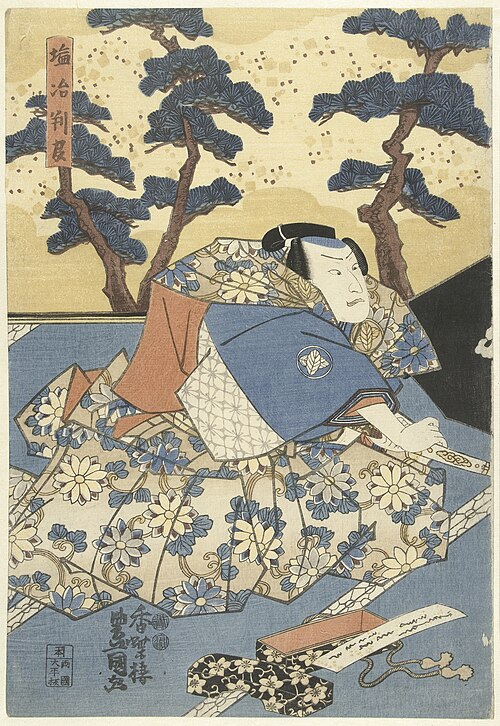 طباعة خشبية يابانية للفنان أوتاغاوا كونيسادا (خمسينيات القرن التاسع عشر)
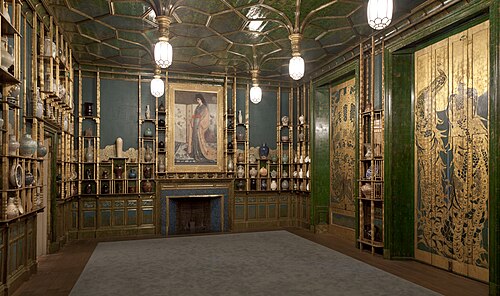 غرفة الطاووس للفنان جيمس ماكنيل ويسلر (1876-1877)، معروضة الآن في معرض فرير للفنون ، واشنطن العاصمة.
 كرسي من تصميم آرثر ماكموردو (1882-1883)
 تصميم ويليام موريس للأقمشة المطبوعة (1883)
 تصميم ورق جدران بجعة، قصب، وسوسن من تصميم والتر كرين (1883)
استمدت الحركة الفنية الجديدة جذورها من بريطانيا، وتحديدًا من التصاميم الزهرية لويليام موريس ، ومن حركة الفنون والحرف التي أسسها تلاميذه. ومن النماذج الأولية لهذا الأسلوب " البيت الأحمر" بتصميماته الداخلية من تصميم موريس وهندسته المعمارية من تصميم فيليب ويب (1859)، وغرفة الطاووس الفخمة من تصميم جيمس أبوت ماكنيل ويسلر . كما تأثرت الحركة الجديدة بشدة بفناني ما قبل الرافائيلية ، بمن فيهم دانتي غابرييل روسيتي وإدوارد بيرن جونز ، وخاصةً بفناني الغرافيك البريطانيين في ثمانينيات القرن التاسع عشر، مثل سيلوين إيمج ، وهيوود سومنر ، ووالتر كرين ، وألفريد جيلبرت ، وبالأخص أوبري بيردسلي . [ 17 ] ويُعتبر الكرسي الذي صممه آرثر ماكموردو رائدًا لتصميم فن الآرت نوفو. [ 18 ]
في فرنسا، تأثرت هذه الحركة بالمنظر المعماري والمؤرخ أوجين فيوليه لو دوك ، الذي أعلن عدوًا لأسلوب الفنون الجميلة المعماري التاريخي ، والذي استمد نظرياته حول العقلانية من دراسته للفن في العصور الوسطى :
- ينبغي أن تحدد الدالة الشكل. [ 19 ]
- وحدة الفنون وإلغاء أي تمييز بين الفنون الرئيسية (العمارة) والفنون الثانوية (الفنون الزخرفية). [ 20 ]
- يُعد منطق الطبيعة النموذج الذي يجب استخدامه في الهندسة المعمارية. [ 21 ]
- ينبغي أن تتكيف الهندسة المعمارية مع بيئة الإنسان واحتياجاته.
- استخدام التقنيات والمواد الحديثة. [ 22 ]
كان فيوليه لو دوك نفسه رائدًا لفن الآرت نوفو: ففي عام 1851، أنشأ في كاتدرائية نوتردام في باريس سلسلة من اللوحات الجدارية التي تميز هذا الأسلوب. [ 23 ] أُزيلت هذه اللوحات عام 1945 لاعتبارها غير أكاديمية. وفي قصر روكيتاياد بمنطقة بوردو ، تُعدّ زخارفه الداخلية التي تعود إلى عام 1865 أيضًا من رواد فن الآرت نوفو. في كتابه " حوارات حول العمارة" الصادر عام 1872 ، كتب: "استخدموا الوسائل والمعرفة التي منحنا إياها عصرنا، دون التقيد بالتقاليد التي لم تعد صالحة اليوم، وبهذه الطريقة يمكننا تدشين عمارة جديدة. لكل وظيفة مادتها، ولكل مادة شكلها وزخرفتها." [ 24 ] أثّر هذا الكتاب في جيل من المعماريين، من بينهم لويس سوليفان ، وفيكتور هورتا ، وهيكتور غيمار ، وأنطوني غاودي . [ 25 ]
لعب الرسامون الفرنسيون موريس دينيس ، وبيير بونار ، وإدوارد فويار دورًا هامًا في دمج الرسم الفني مع الزخرفة. كتب دينيس عام ١٨٩١: "أعتقد أن اللوحة يجب أن تُزيّن قبل كل شيء. اختيار المواضيع أو المشاهد ليس مهمًا. إنما من خلال قيمة الألوان، والسطح الملون، وتناغم الخطوط، أستطيع الوصول إلى الروح وإيقاظ المشاعر." [ ٢٦ ] وقد مارس هؤلاء الرسامون الرسم التقليدي والزخرفي على الشاشات، والزجاج، وغيرها من الوسائط. [ ٢٧ ]
كان للتأثير الياباني دورٌ هامٌ آخر في هذا الأسلوب الجديد . تمثلت هذه الظاهرة في موجة من الحماس لفن الطباعة الخشبية اليابانية ، ولا سيما أعمال هيروشيغي وهوكوساي وأوتاغاوا كونيسادا ، التي استُوردت إلى أوروبا بدءًا من سبعينيات القرن التاسع عشر. أسس سيغفريد بينغ، صاحب المشاريع الطموحة، مجلة شهرية بعنوان " اليابان الفنية" (Le Japon artistic) عام ١٨٨٨، ونشر فيها ستة وثلاثين عددًا قبل توقفها عام ١٨٩١. وقد أثرت هذه المجلة في كلٍ من هواة جمع الأعمال الفنية والفنانين، بمن فيهم غوستاف كليمت . ظهرت السمات المميزة للمطبوعات اليابانية في فنون الرسم على طراز الفن الحديث، وفي الخزف، والمجوهرات، والأثاث. ومنذ بداية عام ١٨٦٠، برز تأثيرٌ شرقيٌّ قويٌّ بشكلٍ مفاجئ. وفي عام ١٨٦٢، أصبح بإمكان عشاق الفن من لندن وباريس اقتناء أعمال فنية يابانية ، إذ شاركت اليابان في ذلك العام لأول مرة كعارضة في المعرض الدولي بلندن. في عام ١٨٦٢ أيضًا، افتُتح متجر "لا بورت شينواز" في باريس، تحديدًا في شارع ريفولي ، حيث كان يُباع فيه فن الأوكيو-إي الياباني وغيره من التحف من الشرق الأقصى. وفي عام ١٨٦٧، صدر كتاب "أمثلة على الزخارف الصينية" لأوين جونز ، وفي عام ١٨٧٠ صدر كتاب "الفنون والصناعات في اليابان" لـ ر. ألكوك، وبعد ذلك بعامين، نشر أو. إتش. موسر وتي. دبليو. كاتلر كتبًا عن الفن الياباني. وكان بعض فناني فن الآرت نوفو، مثل فيكتور هورتا ، يمتلكون مجموعات من فنون الشرق الأقصى، وخاصة الفن الياباني. [ ١١ ]
أتاحت التقنيات الحديثة في الطباعة والنشر لفن الآرت نوفو الوصول سريعًا إلى جمهور عالمي. ولعبت المجلات الفنية، المزينة بالصور الفوتوغرافية والمطبوعات الحجرية الملونة ، دورًا أساسيًا في نشر هذا الأسلوب الجديد. وساهمت مجلات "ذا ستوديو" في إنجلترا، و "آرت إيه إيدي" و "آرت إيه ديكوراسيون" في فرنسا، و " يوجند " في ألمانيا، في انتشار هذا الأسلوب بسرعة في جميع أنحاء أوروبا. وحقق أوبري بيردسلي في إنجلترا، وأوجين غراسيه ، وهنري دي تولوز لوتريك ، وفيليكس فالوتون، شهرة عالمية كرسامين. [ 28 ] ومع ملصقات جول شيريه للراقصة لوي فولر عام 1893، وملصقات ألفونس موشا للممثلة سارة برنارد عام 1895، لم يعد الملصق مجرد إعلان، بل أصبح شكلًا فنيًا. وقد خصصت سارة برنارد عددًا كبيرًا من ملصقاتها لبيعها لهواة جمع الأعمال الفنية. [ 29 ]
التطور – بروكسل (1893–1898)
 منزل هانكار من تصميم بول هانكار (1893)
 واجهة فندق تاسل من تصميم فيكتور هورتا (1892-1893)
 درج فندق تاسل
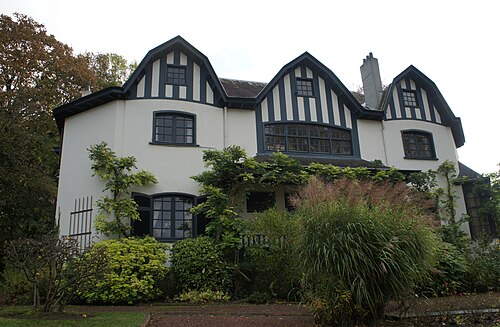 فيلا بلومينويرف لهنري فان دي فيلدي (1895)
 كرسي فان دي فيلدي لفيلا Bloemenwerf (1895)
 ملصق للمعرض الدولي من تصميم بريفات ليفمونت (1897)
بُنيت أولى منازل المدينة على طراز فن الآرت نوفو، وهما منزل هانكار من تصميم بول هانكار (1893) وفندق تاسل من تصميم فيكتور هورتا (1892-1893)، [ 4 ] [ 5 ] في بروكسل في وقت متزامن تقريبًا . كانت متشابهة في أصالتها، لكنها اختلفت اختلافًا كبيرًا في تصميمها ومظهرها.
كان فيكتور هورتا من بين أكثر معماريي فن الآرت نوفو تأثيرًا، ويُعدّ فندق تاسل (1892-1893) في بروكسل أحد أبرز معالم هذا الطراز. [ 30 ] [ 31 ] تلقى هورتا تدريبه المعماري كمساعد لألفونس بالات ، مهندس الملك ليوبولد الثاني ، حيث تولى بناء البيوت الزجاجية الملكية الضخمة المصنوعة من الحديد والزجاج في لايكن . [ 32 ] كان معجبًا بشدة بفيوليه لو دوك ، الذي تلاقت أفكاره معه تمامًا. [ 33 ] [ 34 ] في عامي 1892-1893، وظّف هذه الخبرة في مجال مختلف تمامًا. فقد صمّم منزل العالم والأستاذ إميل تاسل على قطعة أرض ضيقة وعميقة. كان العنصر المركزي في المنزل هو الدرج، الذي لم يكن محاطًا بجدران، بل كان مفتوحًا، ومزينًا بدرابزين حديدي مزخرف، ويقع أسفل نافذة سقفية عالية. كانت الأرضيات مدعومة بأعمدة حديدية رفيعة تشبه جذوع الأشجار. وزُيّنت الأرضيات والجدران الفسيفسائية بزخارف عربية دقيقة على شكل نباتات وأزهار، والتي أصبحت السمة المميزة لهذا الطراز. [ 35 ] [ 36 ] وفي فترة وجيزة، بنى هورتا ثلاثة منازل أخرى في المدينة، جميعها ذات تصميمات داخلية مفتوحة، وجميعها مزودة بمناور لتوفير أقصى قدر من الإضاءة الداخلية: فندق سولفاي ، وفندق فان إيتفيلد ( لإدموند فان إيتفيلد )، ودار وورشة هورتا . وتُعدّ هذه المنازل الأربعة الآن جزءًا من موقع تراث عالمي لليونسكو . [ 5 ]
كان بول هانكار أيضًا من رواد فن الآرت نوفو المبكر. وُلد في فراميري ، في هينو ، وهو ابن نحات حجري ماهر، ودرس النحت الزخرفي والزخرفة في الأكاديمية الملكية للفنون الجميلة في بروكسل من عام 1873 إلى عام 1884، بينما كان يعمل نحاتًا زخرفيًا. من عام 1879 إلى عام 1894، عمل في مرسم المهندس المعماري هندريك بيايرت ، وهو أحد رواد العمارة الانتقائية والكلاسيكية الجديدة . ومن خلال بيايرت، أصبح هانكار أيضًا من مُعجبي فيوليه لو دوك. [ 37 ] في عام 1893، صمم هانكار وبنى منزل هانكار، وهو مقر إقامته الخاص في بروكسل. بهدف خلق توليفة بين الفنون الجميلة والفنون الزخرفية، جمع بين النحات رينيه جانسينز والرسام ألبرت سيامبرلاني لتزيين الداخل والخارج بفن السغرافيتي ، أو الجداريات. تميزت الواجهة والشرفات بزخارف حديدية وخطوط متعرجة بأنماط زهرية منمقة، والتي أصبحت سمة بارزة في فن الآرت نوفو. وبناءً على هذا النموذج، بنى عدة منازل لأصدقائه الفنانين. كما صمم سلسلة من نوافذ العرض الزجاجية المبتكرة لمحلات بروكسل ومطاعمها ومعارضها الفنية، فيما وصفه أحد النقاد المحليين بأنه "هذيان حقيقي للإبداع". [ 38 ] توفي عام 1901، في الوقت الذي بدأ فيه هذا الفن يحظى بالتقدير. [ 39 ]
كان هنري فان دي فيلدي ، المولود في أنتويرب ، شخصيةً مؤسسةً أخرى في نشأة فن الآرت نوفو. شملت تصاميم فان دي فيلدي التصميم الداخلي لمنزله في بروكسل، فيلا بلومنويرف (1895). [ 40 ] [ 41 ] استُلهم التصميم الخارجي للمنزل من البيت الأحمر ، منزل الكاتب والمنظّر ويليام موريس ، مؤسس حركة الفنون والحرف . بعد أن تلقى تدريباً كرسام، اتجه فان دي فيلدي إلى الرسم التوضيحي، ثم إلى تصميم الأثاث، وأخيراً إلى الهندسة المعمارية. بالنسبة لفيلا بلومنويرف، ابتكر المنسوجات وورق الجدران والأواني الفضية والمجوهرات، وحتى الملابس، التي تتناسب مع طراز المنزل. [ 42 ] انتقل فان دي فيلدي إلى باريس، حيث صمم الأثاث والديكور لتاجر الأعمال الفنية الألماني الفرنسي سيغفريد بينغ ، الذي أطلق اسم هذا الطراز على معرضه في باريس. كان أيضاً من أوائل منظّري فن الآرت نوفو، حيث طالب باستخدام خطوط ديناميكية، غالباً ما تكون متقابلة. كتب فان دي فيلدي: "الخط قوة كباقي القوى الأولية. فالعديد من الخطوط المتضادة تُشكل قوةً تُضاهي قوة عدة قوى". في عام ١٩٠٦، غادر بلجيكا متوجهًا إلى فايمار (ألمانيا)، حيث أسس المدرسة الدوقية الكبرى للفنون والحرف، التي مُنع فيها تدريس الأساليب التاريخية. ولعب دورًا هامًا في اتحاد الحرف الألماني (Werkbund ) قبل عودته إلى بلجيكا. [ ٤٣ ]
تزامن ظهور فن العمارة الحديثة في بروكسل مع موجة من الفنون الزخرفية على هذا النمط الجديد. ومن بين الفنانين البارزين غوستاف ستراوفن ، الذي استخدم الحديد المطاوع لإضفاء تأثيرات باروكية على واجهات بروكسل؛ ومصمم الأثاث غوستاف سيرورييه-بوفي ، المعروف بكراسيه المبتكرة للغاية وأثاثه المعدني المفصلي؛ ومصمم المجوهرات فيليب وولفرز ، الذي صنع مجوهرات على شكل اليعسوب والفراشات والبجع والثعابين. [ 44 ]
لفت المعرض الدولي في بروكسل الذي أقيم عام 1897 الانتباه الدولي إلى هذا الأسلوب؛ وشارك هورتا وهانكار وفان دي فيلدي وسيرورير-بوفي، من بين آخرين، في تصميم المعرض، وقام هنري بريفات-ليفمونت بتصميم ملصق المعرض.
باريس – ميزون دو لارت نوفو (1895) وقلعة بيرانجر (1895–1898)
 دعا سيغفريد بينغ الفنانين لعرض أعمالهم الحديثة في دار الفن الحديث الجديدة (1895).
 معرض ميزون دي لارت نوفو لسيغفريد بينج (1895)
 ملصق لفيليكس فالوتون لـ Maison de l'Art Nouveau الجديد (1896)
 بوابة قلعة بيرانجر من تصميم هيكتور غيمار (1895-1898)
 ممر قلعة بيرانجيه، مع لوحات جدارية من تصميم ألكسندر بيجوت
 تفاصيل الدرج الرئيسي في قلعة بيرانجر
لعب تاجر الأعمال الفنية والناشر الفرنسي الألماني سيغفريد بينغ دورًا محوريًا في الترويج لهذا الأسلوب الفني. ففي عام ١٨٩١، أسس مجلةً متخصصةً في الفن الياباني، ساهمت في نشر الفن الياباني في أوروبا. وفي عام ١٨٩٢، نظم معرضًا ضم أعمال سبعة فنانين، من بينهم بيير بونار ، وفيليكس فالوتون ، وإدوارد فويار ، وتولوز لوتريك ، وأوجين غراسيه ، وشمل المعرض لوحاتٍ حديثةً وأعمالًا زخرفية. عُرض هذا المعرض في الجمعية الوطنية للفنون الجميلة عام ١٨٩٥. وفي العام نفسه، افتتح بينغ معرضًا جديدًا في ٢٢ شارع بروفانس في باريس، أطلق عليه اسم "ميزون دو لارت نوفو" ، مخصصًا للأعمال الجديدة في الفنون الجميلة والزخرفية. وقد صمم ديكور المعرض وأثاثه المهندس المعماري البلجيكي هنري فان دي فيلدي ، أحد رواد فن الآرت نوفو. عرضت دار الفن الحديث لوحاتٍ لجورج سورا ، وبول سينياك، وتولوز لوتريك، وزجاجًا من تصميم لويس كومفورت تيفاني وإميل غالي ، ومجوهرات من تصميم رينيه لاليك ، وملصقات من تصميم أوبري بيردسلي . لم تكن الأعمال المعروضة هناك متجانسة في أسلوبها على الإطلاق. كتب بينغ عام ١٩٠٢: "لم يكن الفن الحديث، عند نشأته، يطمح بأي حال من الأحوال إلى أن يصبح مصطلحًا عامًا. لقد كان ببساطة اسم دارٍ افتُتحت لتكون ملتقىً لجميع الفنانين الشباب المتحمسين الذين يتوقون إلى إظهار حداثة توجهاتهم الفنية." [ ٤٥ ]
سرعان ما لفت هذا الطراز الأنظار في فرنسا المجاورة. فبعد زيارة فندق تاسل في هورتا، شيّد هيكتور غيمار قلعة بيرانجيه ، التي كانت من أوائل مباني باريس التي بُنيت على الطراز الجديد، بين عامي 1895 و1898. [ ملاحظة 1 ] وكان الباريسيون يشكون من رتابة تصميم الشوارع الرئيسية التي بناها جورج أوجين هوسمان في عهد نابليون الثالث . تميزت قلعة بيرانجيه بمزيج فريد من الطراز القوطي الجديد وفن الآرت نوفو، بخطوطها المنحنية الحادة وأشكالها الطبيعية. وقد صرّح غيمار، الذي كان بارعًا في الترويج لأعماله، قائلاً: "ما يجب تجنبه بأي ثمن هو... التوازي والتناظر. فالطبيعة هي أعظم بناة على الإطلاق، وهي لا تُشيّد شيئًا متوازٍ ولا شيئًا متناظرًا." [ 47 ]
رحّب الباريسيون بأسلوب غيمار الأصيل والخلاب؛ واختيرت قلعة بيرانجيه كواحدة من أفضل الواجهات الجديدة في باريس، مما أطلق مسيرة غيمار المهنية. وتم تكليف غيمار بتصميم مداخل نظام مترو باريس الجديد ، الأمر الذي لفت انتباه ملايين الزوار إلى أسلوبه خلال معرض باريس العالمي عام 1900. [ 10 ]
معرض باريس العالمي (1900)
 المدخل الرئيسي لمعرض باريس 1900 العالمي
 جناح بيغو، الذي يعرض أعمال فنان الخزف ألكسندر بيغو
 مدخل الجناح النمساوي، مع معروضات صممها جوزيف هوفمان
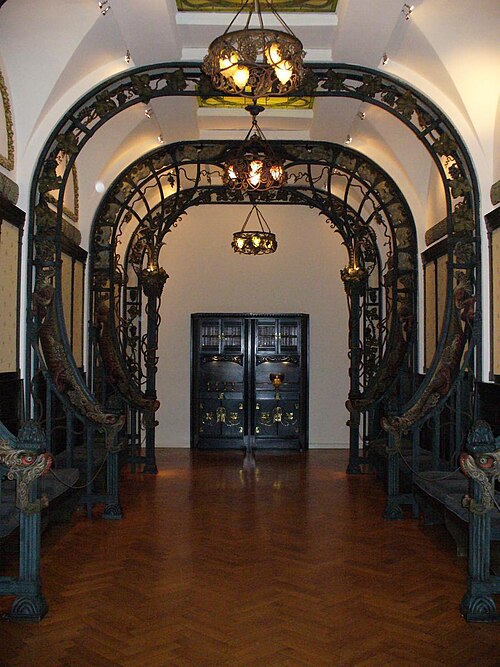 الجناح الألماني، من تصميم برونو موهرينغ
 الجناح الفنلندي، من تصميم أرماس ليندغرين وإيلي سارينن
 قائمة طعام من تصميم ألفونس موتشا لمطعم الجناح البوسني
 رواق جناح سيفر للخزف ، الموجود الآن في ساحة فيليكس ديسرويل
شكّل معرض باريس العالمي عام 1900 ذروة فن الآرت نوفو. فبين شهري أبريل ونوفمبر من ذلك العام، استقطب المعرض ما يقارب خمسين مليون زائر من مختلف أنحاء العالم، وعرض فيه روائع العمارة والتصميم والأواني الزجاجية والأثاث والتحف الفنية التي تميز هذا الطراز. وغالباً ما مزجت عمارة المعرض بين طرازي الآرت نوفو والفنون الجميلة : فقد تميزت قاعة العرض الرئيسية، القصر الكبير، بواجهة على طراز الفنون الجميلة لا تمت بصلة إلى روعة الدرج وقاعة العرض الداخلية المصممة على طراز الآرت نوفو.
قدّم المصممون الفرنسيون أعمالاً خاصة للمعرض: كريستال ومجوهرات لاليك ؛ ومجوهرات هنري فيفر وجورج فوكيه ؛ وزجاج دوم ؛ وبورسلين من إنتاج مصنع سيفر الوطني ؛ وخزف ألكسندر بيغو ؛ ومصابيح ومزهريات زجاجية منحوتة من تصميم إميل غاليه ؛ وأثاث من تصميم إدوارد كولونا ولويس ماجوريل ؛ والعديد من شركات الفنون والحرف البارزة الأخرى. وفي معرض باريس عام 1900، قدّم سيغفريد بينغ جناحاً بعنوان "آرت نوفو بينغ" ، ضمّ ستة تصاميم داخلية مختلفة مزينة بالكامل بهذا الطراز. [ 48 ] [ 49 ]
كان المعرض أول منصة عرض دولية لمصممي وفناني فن الآرت نوفو من جميع أنحاء أوروبا وخارجها. ومن بين الفائزين والمشاركين ألفونس موخا ، الذي رسم جداريات لجناح البوسنة والهرسك وصمم قائمة طعام مطعم الجناح؛ والمصممان برونو بول وبرونو موهرينغ من برلين؛ وكارلو بوغاتي من تورينو ؛ وبرنهاردت بانكوك من بافاريا ؛ والمهندس المعماري والمصمم الروسي فيودور شيشتل ؛ ولويس كومفورت تيفاني ( تيفاني وشركاه ) من الولايات المتحدة. [ 50 ] وكان المهندس المعماري النمساوي أوتو فاغنر عضوًا في لجنة التحكيم، وقدم نموذجًا لحمام على طراز الآرت نوفو في شقته الخاصة في فيينا، والذي يتميز بحوض استحمام زجاجي. [ 51 ] وصمم جوزيف هوفمان جناح فيينا في معرض باريس، مسلطًا الضوء على تصاميم حركة انفصال فيينا . [ 52 ] نال إيلييل سارينين شهرة عالمية لأول مرة بفضل تصميمه المبتكر لجناح فنلندا. [ 53 ]
رغم أن معرض باريس كان الأكبر بلا منازع، إلا أن معارض أخرى ساهمت بشكل كبير في نشر هذا النمط المعماري. فقد مثّل معرض برشلونة العالمي عام 1888 بداية أسلوب الحداثة في إسبانيا، حيث ضمّ بعض مباني لويس دومينيك إي مونتانير . أما معرض تورينو الدولي للفن الزخرفي الحديث عام 1902، فقد عرض أعمال مصممين من مختلف أنحاء أوروبا، من بينهم البلجيكي فيكتور هورتا والنمساوي جوزيف ماريا أولبريش ، إلى جانب فنانين إيطاليين محليين مثل كارلو بوغاتي ، وغاليليو تشيني ، ويوجينيو كوارتي . [ 54 ]
اختلافات محلية
فن الآرت نوفو في فرنسا

![مدخل مبنى لافيروت، مع منحوتات خزفية للفنان جان بابتيست لاريفيه [fr]](https://file.arabipedia.wiki/wikipedia/commons/thumb/4/47/XDSC_7288-29-av-Rapp-paris-7.jpg/500px-XDSC_7288-29-av-Rapp-paris-7.jpg) مدخل مبنى لافيروت، مع منحوتات خزفية للفنان جان بابتيست لاريفيه
مدخل مبنى لافيروت، مع منحوتات خزفية للفنان جان بابتيست لاريفيه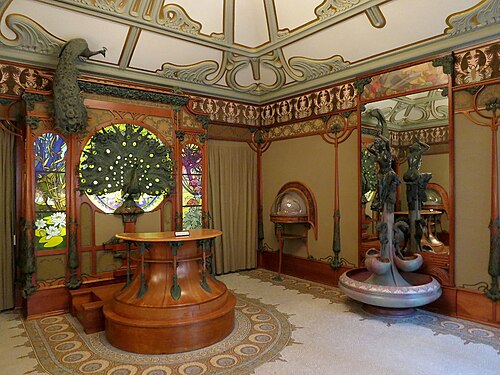 متجر مجوهرات جورج فوكيه في 6 شارع رويال ، باريس، من تصميم ألفونس موشا ، وهو موجود الآن في متحف كارنافاليه (1901).
 مبنى ألفريد واجون في 24، ساحة إتيان بيرنيه ، باريس (1905)

بعد معرض عام 1900، أصبحت باريس عاصمة فن الآرت نوفو. وقد بنى جول لافيروت أفخم المساكن على هذا الطراز ، حيث غطى واجهاتها بالكامل بزخارف خزفية منحوتة. ويُعد مبنى لافيروت ، الكائن في 29 شارع راب (1901)، المثال الأبرز على ذلك. تميزت مباني المكاتب والمتاجر الكبرى بساحات داخلية مرتفعة مغطاة بقباب من الزجاج الملون وزخارف خزفية. وقد لاقى هذا الطراز رواجًا كبيرًا في المطاعم والمقاهي، ومنها مطعم ماكسيم في 3 شارع رويال ، ومطعم لو تران بلو في محطة غار دو ليون (1900 ). [ 55 ]
جذبت مكانة باريس الفنانين الأجانب إلى المدينة. وكان الفنان السويسري المولد أوجين غراسيه من أوائل مبدعي ملصقات فن الآرت نوفو الفرنسي. ساهم في تزيين ملهى لو شات نوار عام 1885، وصمم ملصقاته الأولى لأعياد باريس ، بالإضافة إلى ملصق شهير لسارة برنارد عام 1890. وفي باريس، درّس في مدرسة غيران للفنون ( المدرسة العادية لتعليم الرسم )، حيث كان من بين طلابه أوغوستو جياكوميتي وبول بيرتون . [ 56 ] [ 57 ] صمم الفنان السويسري ثيوفيل-ألكسندر شتاينلين ملصقًا لكاباريه لو شات نوار الباريسي عام 1896. وصل الفنان التشيكي ألفونس موخا (1860-1939) إلى باريس عام 1888، وفي عام 1895، صمم ملصقًا للممثلة سارة برنارد في مسرحية جيزموندا لفيكتوريان ساردو في مسرح النهضة . أدى نجاح هذا الملصق إلى توقيع عقد لإنتاج ملصقات لست مسرحيات أخرى لبرنهاردت.
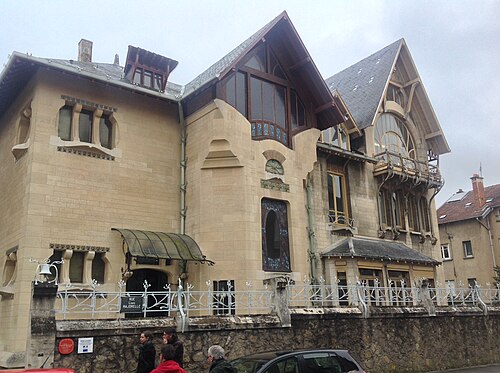
أصبحت مدينة نانسي في لورين العاصمة الفرنسية الأخرى للأسلوب الجديد. في عام ١٩٠١، تأسس التحالف الإقليمي للصناعات الفنية ، المعروف أيضًا باسم مدرسة نانسي ، بهدف تغيير التسلسل الهرمي الذي كان يضع الرسم والنحت فوق الفنون الزخرفية. من بين أبرز الفنانين العاملين هناك، صانعو المزهريات والمصابيح الزجاجية إميل غالي ، والأخوان دوم في تصميم الزجاج، والمصمم لويس ماجوريل ، الذي ابتكر أثاثًا بأشكال نباتية وزهرية أنيقة. جلب المهندس المعماري هنري سوفاج هذا الأسلوب المعماري الجديد إلى نانسي من خلال فيلا ماجوريل التي صممها عام ١٩٠٢.
 طقم شاي من صنع بابست وفاليز ، وجيرمان بابست ، ولوسيان فاليز ، مصنوع من الفضة المطلية جزئياً بالذهب والعاج والعقيق ( حوالي 1889 ).
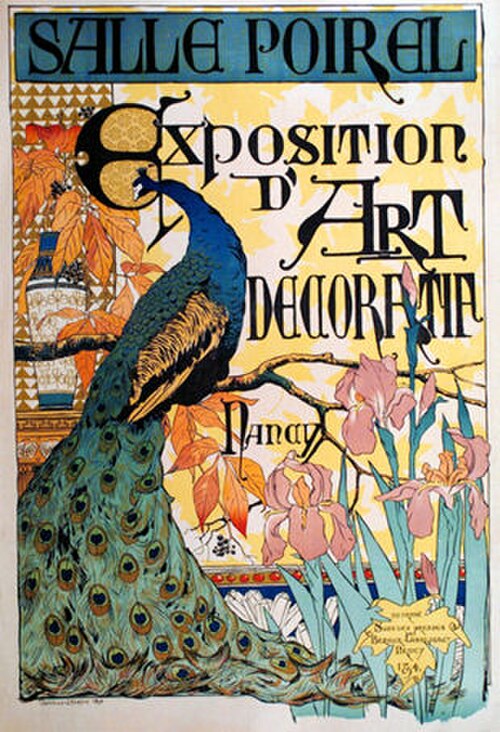 ملصق لكاميل مارتن لـ L'Exposition d'art Decoratif في غاليري بواريل في نانسي (1894)
 أبواب مزينة بزجاج ملون لمتجر فرانسوا فايكسلير في نانسي (1901)، الزجاج من تصميم جاك غروبر ، والأبواب من تصميم إميل أندريه وأوجين فالين
 أثاث غرفة النوم في فيلا ماجوريل (1901-1902)، وهو موجود الآن في متحف الفنون الجميلة في نانسي
انتشر الأسلوب الفرنسي على نطاق واسع من خلال المجلات الجديدة، بما في ذلك The Studio و Arts et Idées و Art et Décoration ، التي جعلت صورها ومطبوعاتها الحجرية الملونة هذا الأسلوب معروفًا للمصممين والعملاء الأثرياء في جميع أنحاء العالم.
في فرنسا، بلغ أسلوب الفن الحديث ذروته عام ١٩٠٠، ثم تراجع سريعًا حتى اختفى تقريبًا بحلول عام ١٩٠٥. كان الفن الحديث أسلوبًا فاخرًا، يتطلب حرفيين مهرة ذوي أجور عالية، ولم يكن من السهل أو الرخيص إنتاجه بكميات كبيرة. من بين المنتجات القليلة التي أمكن إنتاجها بكميات كبيرة زجاجة العطر، ولا تزال تُصنع بهذا الأسلوب حتى اليوم.
فن الآرت نوفو في بلجيكا
 فندق فان إيتفيلد في بروكسل من تصميم فيكتور هورتا (1895–1901)
 تفاصيل الحديقة الشتوية لفندق فان إيتفيلد
 كرسي هنري فان دي فيلدي (1896)
 فيليب ولفرز ، ريش باون ("ريش الطاووس")، مشبك الحزام (1898)
 سرير ومرآة من تصميم غوستاف سيرورييه-بوفي (1898-1899)، معروضة الآن في متحف أورسيه ، باريس
 منزل سانت سير في بروكسل من تصميم غوستاف ستراوفن (1901-1903)
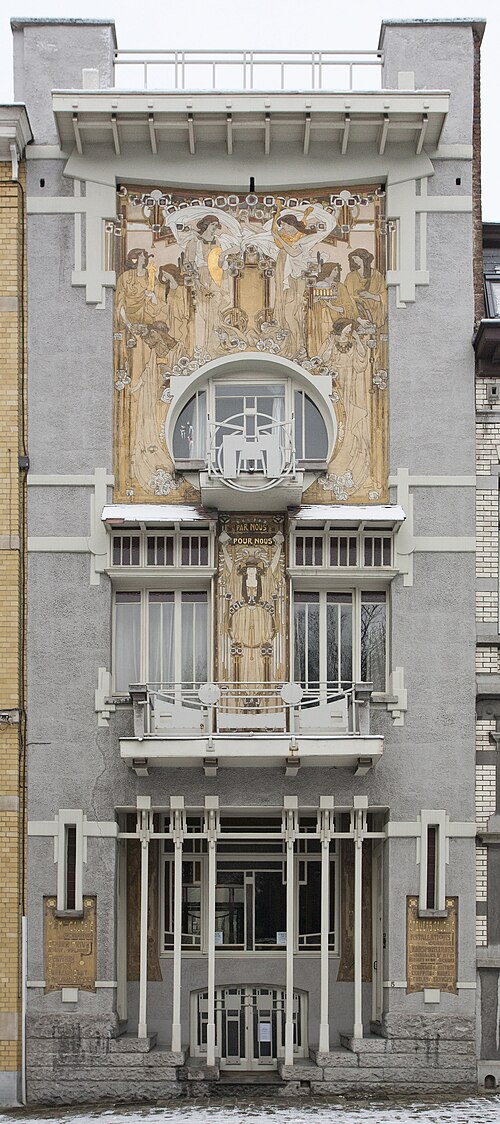 منزل المهندس المعماري بول كوشي في بروكسل، ويتميز بتقنية الحفر على الجدران (1905).
كانت بلجيكا مركزًا مبكرًا لفن الآرت نوفو، ويعود الفضل في ذلك إلى حد كبير إلى عمارة فيكتور هورتا ، الذي صمم أحد أوائل منازل الآرت نوفو، وهو فندق تاسل عام 1893، وثلاثة منازل أخرى بتصاميم متنوعة من نفس الطراز. وهي الآن مواقع مُدرجة على قائمة التراث العالمي لليونسكو . كان لهورتا تأثير كبير على أعمال هيكتور غيمار الشاب ، الذي زار فندق تاسل أثناء بنائه، وأعلن لاحقًا أن هورتا هو "مُخترع" فن الآرت نوفو. [ 58 ] لم تكن ابتكارات هورتا في الواجهة، بل في التصميم الداخلي، حيث استخدم وفرة من الحديد والزجاج لفتح المساحات وإغراق الغرف بالضوء، وزينها بأعمدة ودرابزينات من الحديد المطاوع بأشكال نباتية منحنية، والتي انعكست على الأرضيات والجدران، بالإضافة إلى الأثاث والسجاد الذي صممه هورتا. [ 59 ]
كان بول هانكار رائدًا آخر لفن الآرت نوفو في بروكسل. اكتمل بناء منزله عام ١٨٩٣، وهو نفس عام بناء فندق تاسل لهورتا، وتميز بواجهاته المزينة برسومات جدارية بتقنية السغرافيتو . تأثر هانكار بكل من فيوليه لو دوك وأفكار حركة الفنون والحرف الإنجليزية . تمثلت فكرته في الجمع بين الفنون الزخرفية والفنون الجميلة في وحدة متكاملة. كلف النحات ألفريد كريك والرسام أدولف كريسبان بتزيين واجهات المنازل بأعمالهما. كان أبرز مثال على ذلك المنزل والاستوديو الذي بناه للفنان ألبرت تشامبرلاني في ٤٨ شارع ديفاكز / ديفاكزسترات في بروكسل، حيث ابتكر واجهة زاخرة برسومات جدارية بتقنية السغرافيتو تضم شخصيات وزخارف مرسومة، معيدًا بذلك إحياء فن العمارة الزخرفية لعصر الكواتروتشينتو ، أو إيطاليا في القرن الخامس عشر. [ 32 ] توفي هانكار عام 1901، عندما كان عمله قد بدأ يحظى بالتقدير. [ 60 ]
بدأ غوستاف ستراوفن مسيرته المهنية كمساعد مصمم يعمل مع هورتا، قبل أن يؤسس مكتبه الخاص في سن الحادية والعشرين، حيث صمم بعضًا من أكثر مباني فن الآرت نوفو فخامةً في بروكسل. يُعد منزل سان سير، الكائن في 11 ساحة أمبيوريكس ، أشهر أعماله . يبلغ عرض المنزل 4 أمتار فقط ، ولكنه يتميز بارتفاع استثنائي بفضل ابتكاراته المعمارية المتقنة. وهو مغطى بالكامل بالطوب متعدد الألوان وشبكة من الأشكال النباتية المتشابكة المصنوعة من الحديد المطاوع ، بأسلوب يجمع بين فن الآرت نوفو والباروك. [ 61 ]
من بين فناني فن الآرت نوفو البارزين الآخرين من بلجيكا، المهندس المعماري والمصمم هنري فان دي فيلدي ، على الرغم من أن الجزء الأكبر من مسيرته المهنية قضاه في ألمانيا؛ حيث كان له تأثير كبير على زخرفة فن الآرت نوفو . ومن بينهم أيضًا المصمم غوستاف سيرورييه-بوفي ، وفنان الغرافيك فرناند خنوبف . [ 5 ] [ 62 ] [ 63 ] استغل المصممون البلجيكيون وفرة العاج المستورد من الكونغو البلجيكية ؛ وكانت المنحوتات المختلطة، التي تجمع بين الحجر والمعدن والعاج، من إبداع فنانين مثل فيليب وولفرز ، رائجة. [ 64 ]
نيوي كونست في هولندا
 ملصق لزيت سلطة ديلفت من تصميم يان توروب (1893)
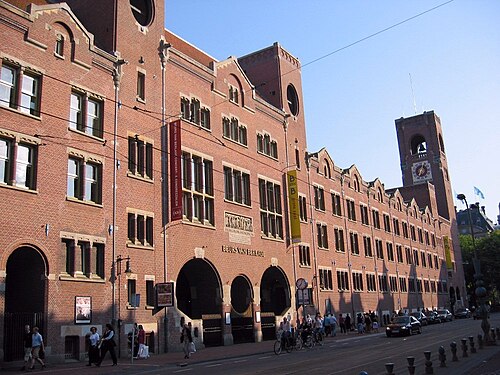 بورصة أمستردام للسلع بقلم هندريك بيتروس بيرلاج (1896–1903)
 خزانة/مكتب من تصميم بيرلاج (1898)
 مزهرية بتصميم زهري تجريدي من تصميم ثيو كولينبراندر (1898)
 مزهرية من الخزف صممها ج. جوريان كوك وزينها دبليو آر ستيركن (1901)
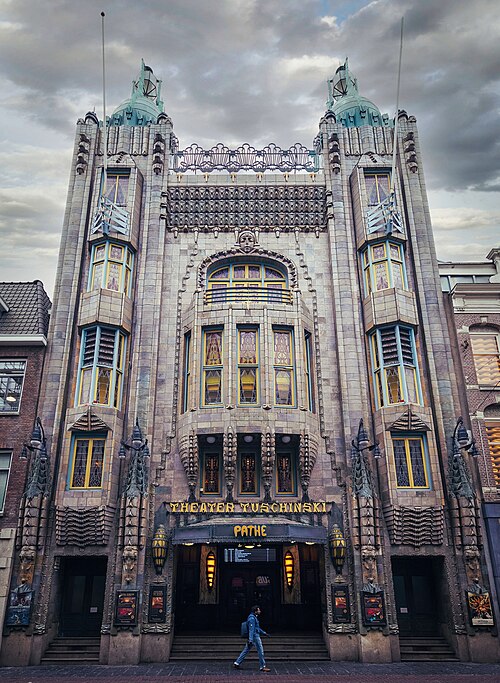

في هولندا، عُرف هذا الأسلوب باسم "نيوي ستايل " (الأسلوب الجديد) أو "نيوي كونست " (الفن الجديد)، واتخذ منحىً مختلفًا عن الأسلوب البلجيكي ذي الطابع الزهري والمنحنيات. وقد تأثر بالأشكال الهندسية والمنمقة لأسلوب "يوجندستيل" الألماني وحركة "فيينا سيسيشن" النمساوية . [ 64 ] كما تأثر أيضًا بالفن والأخشاب المستوردة من جزر الهند الشرقية الهولندية ( إندونيسيا حاليًا )، ولا سيما تصاميم المنسوجات والباتيك من جاوة .
كان هندريك بيتروس بيرلاج أهم معماري ومصمم أثاث في هذا الأسلوب ، إذ ندد بالأساليب التاريخية ودعا إلى عمارة وظيفية بحتة. كتب: "من الضروري محاربة فن الوهم، وإدراك الزيف، من أجل الوصول إلى الجوهر لا الوهم". [ 65 ] ومثل فيكتور هورتا وغودي ، كان معجبًا بنظريات فيوليه لو دوك المعمارية . [ 65 ] صُمم أثاثه ليكون وظيفيًا بحتًا، وليحترم الأشكال الطبيعية للخشب، بدلًا من ثنيه أو ليّه كما لو كان معدنًا. واستشهد بالأثاث المصري، وفضل الكراسي ذات الزوايا القائمة. كان أول أعماله المعمارية وأشهرها بورصة بيرلاج (1896-1903)، بورصة أمستردام للسلع، التي بناها وفقًا لمبادئ البنائية . كان كل شيء وظيفيًا، بما في ذلك صفوف المسامير التي زينت جدران القاعة الرئيسية. كثيراً ما كان يضيف أبراجاً شاهقة إلى مبانيه لجعلها أكثر بروزاً، وهي ممارسة استخدمها معماريون آخرون من فن الآرت نوفو في تلك الفترة، بمن فيهم جوزيف ماريا أولبريش في فيينا وإيلييل سارينين في فنلندا. [ 66 ]
وتشمل المباني الأخرى التي تحمل هذا الطراز فندق أمريكان (1898-1900)، من تصميم دبليو كرومهاوت وإتش جي جانسن؛ وأستوريا (1904-1905) من تصميم هيرمان هندريك باندرز وجيريت فان أركيل في أمستردام ؛ ومحطة السكك الحديدية في هارلم (1906-1908)، ومبنى المكاتب السابق لشركة هولاند أمريكا لاينز (1917) في روتردام ، والذي أصبح الآن فندق نيويورك .
ومن بين الفنانين والرسامين البارزين في هذا الأسلوب جان توروب ، الذي مالت أعماله نحو التصوف والرمزية ، حتى في ملصقاته لزيت السلطة . كما أظهرت ألوانهم وتصاميمهم أحيانًا تأثير فن مسقط رأسه، جاوة. [ 66 ]
ومن الشخصيات المهمة في صناعة الخزف الهولندي يوريان كوك وثيو كولينبراندر . وقد استخدموا أنماطًا زهرية ملونة وزخارف فن الآرت نوفو التقليدية، إلى جانب أشكال غير عادية من الفخار وألوان داكنة وفاتحة متناقضة، مستوحاة من زخرفة الباتيك في جاوة. [ 67 ]
الأسلوب الحديث ومدرسة غلاسكو في بريطانيا
 تصميم الغلاف من قبل آرثر ماكموردو لكتاب عن كريستوفر رين (1883)
 مشبك حزام من تصميم أرشيبالد نوكس لمتجر ليبرتي (1899)
 مبنى حانة من تصميم جيمس هوي كريجي في 59 شارع دمبارتون، غلاسكو (1899-1900)
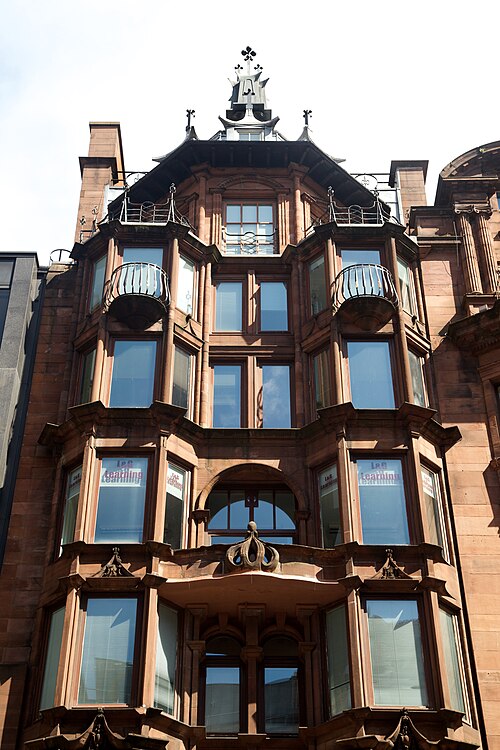 مبنى هاتراك من تصميم جيمس سالمون في 142a، 144 شارع سانت فنسنت ، غلاسكو (1899-1902)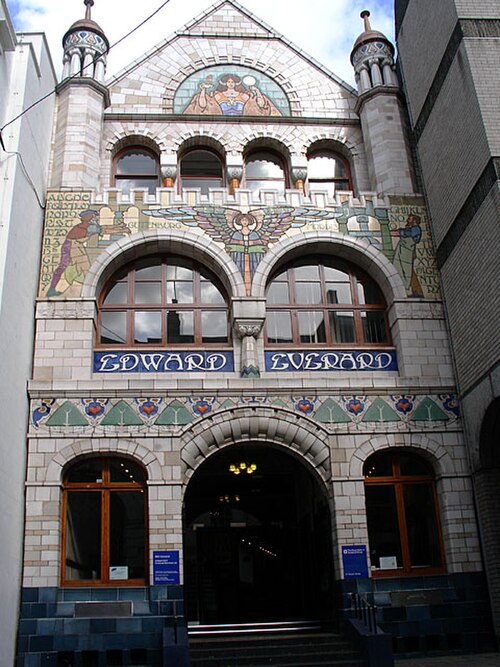
 ملكة مايو بقلم مارغريت ماكدونالد ماكينتوش (1900) [ 68 ]
نشأت حركة الفن الحديث في بريطانيا، ضمن حركة الفنون والحرف التي بدأت في ستينيات القرن التاسع عشر وحظيت باعتراف دولي بحلول ثمانينياته. دعت هذه الحركة إلى تحسين فنون الزخرفة، واستلهمت من الحرف اليدوية والتصميم في العصور الوسطى، ومن الطبيعة. [ 70 ] ومن الأمثلة المبكرة البارزة على الأسلوب الحديث تصميم آرثر ماكموردو لغلاف مقالته عن كنائس المدن للسير كريستوفر رين ، الذي نُشر عام 1883، وكذلك كرسيه المصنوع من خشب الماهوجني من العام نفسه. [ 71 ]
ومن بين المبتكرين البارزين الآخرين في بريطانيا مصممو الغرافيك أوبري بيردسلي، الذين تميزت رسوماتهم بالخطوط المنحنية التي أصبحت السمة الأكثر شهرة لهذا الأسلوب. كما يمكن الاستشهاد بأعمال الحديد المطاوع ذات التصميم الانسيابي من ثمانينيات القرن التاسع عشر، أو بعض تصاميم المنسوجات الزهرية المسطحة، والتي استلهمت معظمها من أنماط تصميم القرن التاسع عشر. ومن بين فناني الغرافيك البريطانيين الآخرين الذين كان لهم دور هام في هذا الأسلوب والتر كرين وتشارلز آشبي . [ 72 ]
لعب متجر ليبرتي في لندن دورًا هامًا، من خلال تصاميمه الزهرية الملونة والمنمقة للأقمشة، وتصاميم الفضة والقصدير والمجوهرات التي صممها أرشيبالد نوكس ، وهو من جزيرة مان (من أصل اسكتلندي) . وقد انفصلت تصاميمه للمجوهرات، من حيث المواد والأشكال، تمامًا عن التقاليد التاريخية لتصميم المجوهرات.
كانت غلاسكو ، مركز فن الآرت نوفو في بريطانيا، أهم مركز له، بفضل إبداعات تشارلز ريني ماكينتوش ومدرسة غلاسكو ، التي استلهمت أعمالها من العمارة البارونية الاسكتلندية والتصميم الياباني. [ 73 ] ابتداءً من عام 1895، عرض ماكينتوش تصاميمه في معارض دولية في لندن وفيينا وتورينو؛ وقد أثرت تصاميمه بشكل خاص على أسلوب الانفصال في فيينا. شملت إبداعاته المعمارية مبنى غلاسكو هيرالد (1894) ومكتبة مدرسة غلاسكو للفنون (1897). كما رسّخ مكانته كمصمم أثاث وديكور، حيث عمل عن كثب مع زوجته، الرسامة والمصممة مارغريت ماكدونالد ماكينتوش . وقد ابتكرا معًا تصاميم لافتة جمعت بين الخطوط الهندسية المستقيمة والزخارف الزهرية المنحنية بلطف، ولا سيما رمز هذا الأسلوب، وردة غلاسكو. [ 74 ]
قدّم ليون-فيكتور سولون إسهامًا هامًا في فن الخزف على طراز الآرت نوفو بصفته مديرًا فنيًا في شركة مينتونز. تخصص في اللوحات والمزهريات ذات الأنابيب المبطنة التي سُوِّقت تحت اسم "الأواني الانفصالية" (يُفترض أنها سُمِّيت نسبةً إلى الحركة الفنية الفيينية ). [ 75 ] كما قدّم تصاميم على طراز الآرت نوفو لعملاء آخرين، وتصاميم نسيجية لصناعة حرير ليك [ 76 ] ، وتجليد الكتب (وتحديدًا الأغلفة الداخلية ) لمجلّد الكتب جي تي باجولي في نيوكاسل أندر لايم.
ربما كان جورج سكيبر أنشط معماريي فن الآرت نوفو في إنجلترا. يتميز مبنى إدوارد إيفرارد في بريستول، الذي شُيّد بين عامي 1900 و1901 ليضم مطبعة إدوارد إيفرارد ، بواجهة على طراز الآرت نوفو. وتُصوّر الشخصيات يوهانس غوتنبرغ وويليام موريس ، وكلاهما من الشخصيات البارزة في مجال الطباعة. يرمز الشكل المجنح إلى "روح النور"، بينما يرمز الشكل الذي يحمل مصباحًا ومرآة إلى النور والحقيقة.
فن الآرت نوفو في ألمانيا

 منزل إرنست لودفيج في مستعمرة دارمشتات للفنانين من تصميم جوزيف ماريا أولبريش (1900)، ويضم الآن متحف مستعمرة دارمشتات
 محطة مكسيكوبلاتز في برلين من تصميم غوستاف هارت وألفريد ليسر (1902-1904)
 مجمع سبا Sprudelhof في باد ناوهايم (1905–1911)
 Hackesche Höfe في برلين بقلم إندل (1906)
 برج الزفاف في مستعمرة الفنانين في دارمشتات (1908)
 باب مدخل Großes Haus Glückert في مستعمرة الفنانين في دارمشتات
 واجهة مستودع ترام سابق ، أصبح الآن مبنى مكاتب، في بون
يُعرف فن الآرت نوفو الألماني باسمه الألماني، يوجندستيل ، أو "أسلوب الشباب". وقد استُمدّ الاسم من المجلة الفنية يوجند (الشباب)، التي كانت تُنشر في ميونيخ. أسس المجلة جورج هيرث عام ١٨٩٦ ، وظلّ رئيس تحريرها حتى وفاته عام ١٩١٦. واستمرت المجلة في الصدور حتى عام ١٩٤٠. خلال أوائل القرن العشرين، اقتصر استخدام مصطلح يوجندستيل على الفنون التخطيطية فقط. [ ٧٧ ] وكان يشير تحديدًا إلى أشكال الطباعة والتصميم الجرافيكي الموجودة في المجلات الألمانية مثل يوجند ، وبان ، وسيمبليسيسيموس . لاحقًا، استُخدم مصطلح يوجندستيل لوصف نسخ أخرى من فن الآرت نوفو في ألمانيا وهولندا. وقد استعارت عدة لغات في دول البلطيق ودول الشمال هذا المصطلح من الألمانية لوصف فن الآرت نوفو (انظر قسم التسمية ). [ ١٢ ] [ ٧٨ ]
في عام 1892، اختار جورج هيرث اسم "انفصال ميونخ" لرابطة الفنانين التشكيليين في ميونخ . كما استوحت " انفصال فيينا" ، التي تأسست عام 1897، و " انفصال برلين " اسميهما من مجموعة ميونخ.
كانت مجلات "يوجند" و "سيمبليسيسيموس" ، الصادرة في ميونيخ، ومجلة "بان" ، الصادرة في برلين، من أبرز الداعمين لأسلوب "يوجندستيل" . جمع فن "يوجندستيل" بين المنحنيات المتعرجة والخطوط الهندسية، واستُخدم في أغلفة الروايات والإعلانات وملصقات المعارض . وكثيراً ما ابتكر المصممون أنماطاً أصلية للخطوط تتناغم مع الصورة، مثل خط "أرنولد بوكلين" عام ١٩٠٤.
كان أوتو إيكمان أحد أبرز الفنانين الألمان المرتبطين بكلٍ من حركة الشباب (Die Jugend) وحركة بان (Pan) . كان حيوانه المفضل هو البجعة، وكان تأثيره بالغًا لدرجة أن البجعة أصبحت رمزًا للحركة بأكملها. ومن المصممين البارزين الآخرين في هذا الأسلوب ريتشارد ريمرشميد ، الذي صنع الأثاث والفخار وغيرها من الأشياء الزخرفية بأسلوب هندسي بسيط يشير إلى فن الآرت ديكو. [ 80 ] أما الفنان السويسري هيرمان أوبريست ، المقيم في ميونيخ، فقد جسّد نقش " كوب دو فويه" أو "السوط"، وهو عبارة عن منحنى مزدوج شديد التنميط يوحي بالحركة، مستوحى من ساق زهرة بخور مريم .
 غلاف مجلة بان بريشة جوزيف ساتلر (1895)
 نسيج البجعات الخمس من تصميم أوتو إيكمان (1896-1897)
 ملصق لانفصال ميونخ من تصميم فرانز شتوك (1898-1900)
 مقبض باب على طراز فن الآرت نوفو في برلين ( حوالي عام 1900 )
 كرسي من تصميم ريتشارد ريميرشميد (1902)
 طقم غرفة طعام وأطباق على طراز فن الآرت نوفو من تصميم بيتر بيرنز (1900-1901)
 إبريق من الخزف الحجري من صنع ريتشارد ريمرشميد (1902)
 طبق من البيوتر على طراز فن الآرت نوفو من تصميم شركة WMF ، رقم التصميم 232 ( حوالي عام 1906 )
تأسست مستعمرة دارمشتات للفنانين عام ١٨٩٩ على يد إرنست لودفيغ ، دوق هيسن الأكبر . وكان المهندس المعماري الذي بنى منزل الدوق الأكبر، بالإضافة إلى أكبر مبنى في المستعمرة (برج الزفاف)، هو جوزيف ماريا أولبريش ، أحد مؤسسي حركة انفصال فيينا . ومن بين الفنانين البارزين الآخرين في المستعمرة بيتر بيرنز وهانز كريستيانسن . كما كلف إرنست لودفيغ بإعادة بناء مجمع المنتجعات الصحية في باد ناوهايم في بداية القرن. وشُيّد مجمع سبرودلهوف الجديد كليًا بين عامي ١٩٠٥ و١٩١١ تحت إشراف فيلهلم جوست ، وحقق أحد الأهداف الرئيسية لأسلوب الفن الحديث (يوجندستيل): وهو دمج جميع الفنون. [ ٨١ ] ومن بين أفراد العائلة الحاكمة الذين كلفوا ببناء مبنى على طراز الفن الحديث الأميرة إليزابيث من هيسن والراين . أسست دير مارفو-مارينسكي في موسكو عام 1908، ويُعتبر مبنى الكاثوليكون التابع له تحفة فنية من فن الآرت نوفو. [ 82 ]
كان اتحاد الحرفيين الألمان (Deutscher Werkbund ) اتحادًا بارزًا آخر في الإمبراطورية الألمانية ، وقد تأسس عام 1907 في ميونيخ بتحريض من هيرمان موثيسيوس على يد فنانين من مستعمرة دارمشتات، من بينهم جوزيف ماريا أولبريش وبيتر بيرنز ؛ وجوزيف هوفمان ، أحد مؤسسي حركة انفصال فيينا ؛ بالإضافة إلى ورشة فيينا (التي أسسها هوفمان)، وريتشارد ريمرشميد ، وبرونو بول ، وفنانين وشركات أخرى. [ 83 ] وانضم البلجيكي هنري فان دي فيلدي لاحقًا إلى الحركة. [ ملاحظة 2 ] وكانت المدرسة الدوقية الكبرى للفنون والحرف ، التي أسسها في فايمار ، سلفًا لمدرسة باوهاوس ، إحدى أكثر التيارات تأثيرًا في العمارة الحديثة . [ 85 ]
في برلين، تم اختيار طراز "يوجندستيل" لبناء العديد من محطات السكك الحديدية. أبرزها محطة " بولوشتراسه " التي صممها برونو موهرينغ (1900-1902)، ومن الأمثلة الأخرى محطات "مكسيكوبلاتز " (1902-1904)، و "بوتانيشر غارتن" (1908-1909)، و "فروناو" (1908-1910)، و "فيتنبرغبلاتز" (1911-1913)، و "بانكو" (1912-1914). ومن المعالم البارزة الأخرى في برلين مبنى "هاكيشه هوف" (1906) الذي استخدم الطوب المزجج متعدد الألوان في واجهة الفناء.
كان فن الآرت نوفو في ستراسبورغ (التي كانت آنذاك جزءًا من الإمبراطورية الألمانية كعاصمة لرايخسلاند إلساس لورين ) علامة تجارية محددة، حيث جمع بين تأثيرات نانسي وبروكسل ، مع تأثيرات دارمشتات وفيينا ، لإنشاء توليفة محلية تعكس تاريخ المدينة بين الممالك الجرمانية والفرنسية .
الانفصال في النمسا-المجر
انفصال فيينا
 تصميم الأزهار من تصميم ألويس لودفيج على واجهة منزل مايوليكا في فيينا من تصميم أوتو فاغنر (1898).
 محطة Karlsplatz Stadtbahn في فيينا بواسطة فاغنر (1899)
 كنيسة القديس ليوبولد في فيينا من تصميم فاغنر (1903-1907)
 داخل كنيسة القديس ليوبولد، مع لوحة المذبح من تصميم ليوبولد فورستنر
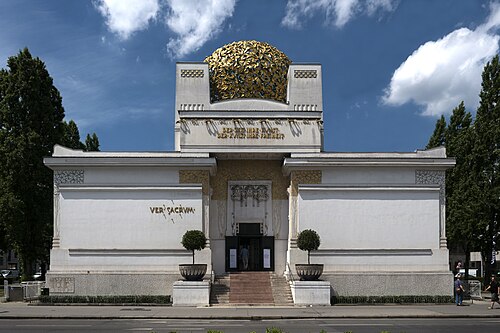
أصبحت فيينا مركزًا لنمطٍ مميز من فن الآرت نوفو، عُرف باسم انفصال فيينا . استمدت الحركة اسمها من انفصال ميونيخ الذي تأسس عام ١٨٩٢. تأسس انفصال فيينا في أبريل ١٨٩٧ على يد مجموعة من الفنانين، من بينهم غوستاف كليمت ، وكولومان موزر ، وجوزيف هوفمان ، وجوزيف ماريا أولبريش ، وماكس كورزويل ، وإرنست ستور ، وغيرهم. [ ٧٩ ] أصبح الرسام كليمت رئيسًا للمجموعة. اعترضوا على التوجه المحافظ نحو التاريخية الذي تبنّته "فيينا كونستلرهاوس" ، النقابة الرسمية للفنانين. أسس الانفصال مجلة " فير ساكروم" للترويج لأعمالهم في جميع الوسائط. [ ٨٧ ] صمّم المهندس المعماري جوزيف أولبريش مبنى الانفصال ذي القبة على الطراز الجديد، والذي أصبح بمثابة معرضٍ لأعمال غوستاف كليمت وفناني الانفصال الآخرين.
أصبح كليمت أشهر رسامي حركة الانفصال، حيث طمس في كثير من الأحيان الحدود بين الرسم الفني والرسم الزخرفي. أما كولومان موزر، فكان فناناً متعدد المواهب في هذا الأسلوب؛ وشملت أعماله رسومات المجلات، والهندسة المعمارية، والفضيات، والخزف، والبورسلين، والمنسوجات، والنوافذ الزجاجية الملونة، والأثاث.

 امرأة ترتدي فستانًا أصفر، رسمها ماكس كرزويل (1899)
 مزهرية ليوهان لويتز ويتوي ( ج. 1900 )
 كرسي بذراعين من تصميم كولومان موزر ( حوالي عام 1900 )
 ملصق لمعرض الانفصال الرابع عشر، من تصميم ألفريد رولر (1902)
 لوحة القبلة للفنان غوستاف كليمت (1907-1908)
كان أوتو فاغنر أبرز معماريي حركة انفصال فيينا ، [ 88 ] وقد انضم إلى الحركة بعد فترة وجيزة من انطلاقها ليقتدي بتلميذيه هوفمان وأولبريش. شملت مشاريعه الرئيسية العديد من محطات شبكة السكك الحديدية الحضرية ( شتاتبان )، ومباني لينكه فينزيل (التي تضم منزل مايوليكا، ومنزل الميداليات، والمنزل في كوستلرغاس). تُعد محطة كارلسبلاتز الآن قاعة عرض تابعة لمتحف فيينا . أما كنيسة شتاينهوف التابعة لمستشفى شتاينهوف للأمراض النفسية (1904-1907) فهي مثال فريد ومتقن الصنع على فن العمارة الدينية لحركة الانفصال، بواجهة خارجية تقليدية مقببة، وتصميم داخلي أنيق وعصري باللونين الذهبي والأبيض، مضاء بوفرة من الزجاج الملون الحديث.
في عام 1899، انتقل جوزيف ماريا أولبريش إلى مستعمرة دارمشتات للفنانين ، وفي عام 1903 أسس كولومان موزر وجوزيف هوفمان ورشة فيينا ، وهي مدرسة تدريبية وورشة عمل للمصممين والحرفيين المتخصصين في الأثاث والسجاد والمنسوجات والأشياء الزخرفية. [ 89 ] في عام 1905، انفصل كولومان موزر وغوستاف كليمت عن حركة انفصال فيينا، وفي وقت لاحق من عام 1907، غادر كولومان موزر ورشة فيينا أيضًا، بينما انضم مؤسسها الآخر جوزيف هوفمان إلى الاتحاد الألماني للأعمال الفنية . [ 83 ] استمر غوستاف كليمت وجوزيف هوفمان في التعاون، ونظما معرض كونستشاو في عام 1908 في فيينا ، وقاما ببناء قصر ستوكلي في بروكسل (1905-1911) الذي بشّر بقدوم العمارة الحداثية . [ 90 ] [ 91 ] تم تصنيفها كموقع للتراث العالمي من قبل اليونسكو في يونيو 2009. [ 92 ]
الانفصال المجري

 متحف بودابست الجيولوجي من تصميم ليشنر (1898-1899)
 تفاصيل واجهة سيفرابالوتا في كيكسكيميت (1902)
![فسيفساء على واجهة مبنى Török Bank [الاب] في بودابست بقلم ميكسا روث (1906)](https://file.arabipedia.wiki/wikipedia/commons/thumb/f/f1/Budapest%2C_Szervita_t%C3%A9r_3.jpg/500px-Budapest%2C_Szervita_t%C3%A9r_3.jpg)
 نقش بارز على واجهة قصر جريشام في بودابست، رسم جيزا ماروتي (1906)
 قصر النسر الأسود في أوراديا، التي تقع اليوم في رومانيا، والتي كانت في ذلك الوقت جزءًا من الإمبراطورية النمساوية المجرية، من تصميم مارسيل كومور وديزسو جاكاب (1907-1908).

 منزل سبيتزر في بودابست
ابتكر المهندس المعماري أودون ليشنر ، رائد حركة "الانفصال" ( Szecesszió ) في العمارة المجرية، مبانيَ مثّلت نقلةً نوعيةً في هذا المجال، إذ شكّلت تحولًا من الطراز التاريخي إلى الحداثة. [ 94 ] تمحورت فكرته عن الطراز المعماري المجري حول استخدام الخزف المعماري والزخارف الشرقية. استخدم في أعماله حجر البيغورغانيت، الذي بدأ إنتاجه عام 1886 في مصنع زولناي للخزف . [ 94 ] استُخدم هذا الحجر في بناء مبانٍ مجرية بارزة ذات طرازات أخرى، مثل مبنى البرلمان المجري وكنيسة ماتياس .
تشمل أعمال أودون ليشنر [ 95 ] متحف الفنون التطبيقية (1893-1896)، ومن المباني الأخرى ذات السمات المميزة المماثلة المتحف الجيولوجي (1896-1899) ومبنى بنك الادخار البريدي (1899-1902)، وجميعها في بودابست . مع ذلك، ونظرًا لمعارضة المؤسسة المعمارية المجرية لنجاح ليشنر، سرعان ما عجز عن الحصول على مشاريع جديدة تضاهي مبانيه السابقة. [ 94 ] لكن ليشنر كان مصدر إلهام ومعلمًا للجيل اللاحق من المعماريين الذين لعبوا الدور الرئيسي في نشر هذا الأسلوب الجديد. [ ٩٤ ] في إطار عملية التمجر، كُلِّف تلاميذه ببناء العديد من المباني في ضواحي المملكة، فعلى سبيل المثال، كُلِّف مارسيل كومور وديزسو جاكاب ببناء الكنيس (١٩٠١-١٩٠٣) ومبنى البلدية (١٩٠٨-١٩١٠) في سابادكا ( سوبوتيكا حاليًا ، صربيا )، ومبنى المحافظة (١٩٠٥-١٩٠٧) وقصر الثقافة (١٩١١-١٩١٣) في ماروشفاشارهيلي ( تارغو موريش حاليًا ، رومانيا ). وفي وقت لاحق، بنى ليشنر بنفسه الكنيسة الزرقاء في بوزوني ( براتيسلافا حاليًا ، سلوفاكيا ) في الفترة من ١٩٠٩ إلى ١٩١٣.
كان كارولي كوس مهندسًا معماريًا بارزًا آخر، وهو من أتباع جون راسكن وويليام موريس . اتخذ كوس من الحركة الرومانسية الوطنية الفنلندية نموذجًا له، ومن العمارة المحلية في ترانسيلفانيا مصدر إلهام. [ 96 ] تشمل أبرز مبانيه الكنيسة الكاثوليكية الرومانية في زيبيجيني (1908-1909)، وأجنحة حديقة حيوان بودابست البلدية (1909-1912)، ومتحف سيكلي الوطني في سيبسيسينتجيورجي (الآن سفانتو جورجي ، رومانيا، 1911-1912).
 لوحة فسيفساء بعنوان " باكس " للفنانة ميكسا روث ، والتي حازت على الميدالية الفضية في معرض باريس العالمي عام 1900.
 خزانة أودون فاراجو، من بودابست (1901)
 نافذة بزخارف نباتية من فيلا ألبار في بودابست، بقلم ميكسا روث (1903)
كانت حركة "الانفصال" في الفنون هي مستعمرة غودولو الفنية، التي أسسها ألادار كوروسفوي-كريش ، وهو أيضاً من أتباع جون راسكين وويليام موريس ، وأستاذ في المدرسة الملكية للفنون التطبيقية في بودابست عام 1901. [ 97 ] شارك فنانوها في العديد من المشاريع، بما في ذلك أكاديمية فرانز ليست للموسيقى في بودابست. [ 98 ]
شريكة في مستعمرة جودولو للفنون، [ 99 ] شاركت ميكسا روث أيضًا في عشرات من مشاريع Szecesszió، بما في ذلك مباني بودابست بما في ذلك قصر جريشام (الزجاج الملون، 1906) وبنك توروك (الفسيفساء، 1906) كما أنشأت الفسيفساء والزجاج الملون لقصر الثقافة (1911-1913) في ماروسفاساريلي.
يُعدّ أودون فاراغو من أبرز مصممي الأثاث، إذ جمع بين العمارة الشعبية التقليدية والعمارة الشرقية وفن الآرت نوفو العالمي بأسلوبٍ بالغ الجمال. أما بال هورتي ، وهو مصمم مجري آخر، فقد تميّز بأسلوبٍ أكثر بساطةً وعملية، حيث استخدم خشب البلوط في صناعة أثاثه مع زخارف دقيقة من خشب الأبنوس والنحاس.
الانفصال في بوهيميا ومورافيا وسلوفاكيا

 البيت الثقافي في سكاليكا بقلم دوشان يوركوفيتش (1905)

 لوحات جدارية في دار البلدية بريشة ألفونس موتشا
 نافذة زجاجية ملونة في كاتدرائية القديس فيتوس في براغ من تصميم موخا
 نقش خزفي بارز لمسرح فيولا في براغ من تصميم لاديسلاف شالون
 مبنى بلدية براغ الجديد من تصميم بوليفكا (1908-1911)
تُعدّ أبرز مباني عصر الانفصال في براغ أمثلةً على الفن الشامل ، إذ تتميز بعمارتها ومنحوتاتها ولوحاتها الفريدة. [ 100 ] صُممت محطة القطار الرئيسية (1901-1909) على يد جوزيف فانتا ، وتضم لوحاتٍ للفنان فاتسلاف يانشا ومنحوتاتٍ للفنانين لاديسلاف شالون وستانيسلاف سوشاردا، إلى جانب أعمال فنانين آخرين. أما دار البلدية (1904-1912) فقد صممها أوزفالد بوليفكا وأنتونين بالشانيك، ورسمها الفنان التشيكي ألفونس موخا ، وتضم منحوتاتٍ للفنانين جوزيف ماراتكا ولاديسلاف شالون . وقد تعاون بوليفكا وماراتكا وشالون في الوقت نفسه مع ستانيسلاف سوشاردا في بناء مبنى البلدية الجديد (1908-1911) ، وفي وقت لاحق، رسم موخا نوافذ الزجاج الملون في كاتدرائية القديس فيتوس بأسلوبه المميز.
كان يان كوتيرا ، الذي درس في فيينا على يد أوتو فاغنر، أهم معماري تشيكي في تلك الفترة . ومن أشهر أعماله منزل بيتركا في ساحة وينسيسلاس رقم 12 في براغ (1899-1900)، والبيت الوطني في بروستيوف (1905-1907)، ومتحف شرق بوهيميا في هراديك كرالوف (1909-1912). وقد وُلد العديد من معماريي فيينا البارزين في مورافيا أو سيليزيا النمساوية ، مثل جوزيف هوفمان ، وهوبيرت جيسنر ، وجوزيف ماريا أولبريش ، وليوبولد باور .
كان أسلوب الجمع بين عناصر العمارة المجرية (Szecesszió) والعناصر المعمارية الوطنية سمة مميزة للمهندس المعماري السلوفاكي دوسان يوركوفيتش . ومن أبرز أعماله دار الثقافة في ساكولكا ( سكاليكا حاليًا في سلوفاكيا ، 1905)، ومباني المنتجع الصحي في لوهاكوفيتسه (جمهورية التشيك حاليًا) في الفترة 1901-1903، و35 مقبرة حرب بالقرب من نوفي زميغرود في غاليسيا (بولندا حاليًا)، والتي تأثر معظمها بشدة بالفن الشعبي والنجارة المحلية لشعب ليمكو ( الروسين ) (1915-1917).
الانفصال في غاليسيا

 قصر الفنون في كراكوف من تصميم Mączyński (1898–1901) الواجهة الشرقية
 منزل تحت الكرة الأرضية في كراكوف بقلم Mączyński و Tadeusz Stryjeński (1904–05)
 صورة داخلية للمنزل تحت الكرة الأرضية في كراكوف، بعدسة جوزيف ميهوفر
 محطة سكة حديد لفيف بقلم Władysław Sadłowski (1899–1904)
 بيت الضفدع في بيلسكو بياوا بواسطة إيمانويل روست (1903)
 كاتدرائية القديس نيكولاس في بيلسكو بياوا، رسم ليوبولد باور (1909–10)
 Vita somnium breve ، زجاج ملون من تصميم ميهوفر (1895)، في المتحف الوطني في كراكوف
 أبولو (نظام كوبرنيكوس) ، زجاج ملون من تصميم ستانيسواف ويسبيانسكي ، دار الجمعية الطبية في كراكوف (1905)
 الطاووس. صورة لـ Zofia Borucińska بواسطة Kazimierz Stabrowski (1908)
 نافذة زجاجية ملونة "إيريس"، كراكوف ، فندق بوليرا، 30 شارع سزبيتالنا ( حوالي 1900 )
كانت كراكوف ولفيف وبيلسكو - بيالا أهم مراكز حركة الانفصال المعماري في غاليسيا . ويُعدّ قصر الفنون (1898-1901) في كراكوف، الذي صمّمه فرانسيسك ماتشينسكي متأثرًا بقاعة الانفصال في فيينا، أبرز مثال على هذا الطراز . ومن الأعمال المهمة الأخرى التي صمّمها ماتشينسكي في كراكوف بالتعاون مع تاديوش ستريينسكي : " البيت تحت الكرة الأرضية" (1904-1905) والمسرح القديم (1903-1906). أما أبرز مصممي الديكور الداخلي فهما ستانيسواف ويسبيانسكي وجوزيف ميهوفر ، اللذان صمّما العديد من نوافذ الزجاج الملون والديكورات الداخلية للمباني. ومن أهم أعمال الأول نوافذ الزجاج الملون في الكنيسة الفرنسيسكانية وفي مقر جمعية كراكوف الطبية (1905)، بينما يُعدّ عمل الثاني من أهم أعماله في تصميم الديكور الداخلي لـ" البيت تحت الكرة الأرضية" .
كان فلاديسلاف سادلوفسكي ، الذي درس في فيينا وتأثر بأوتو فاغنر ، أهم معماري في لفيف . صمم محطة قطار لفيف (1899-1904)، وقاعة لفيف الفيلهارمونية (1905-1908)، والمدرسة الصناعية (1907-1908). ومن المعماريين البارزين الآخرين، الذين استلهموا أيضاً من فاغنر، إيفان ليفينسكي .
One of the most famous buildings in Bielsko-Biała is the so-called Frog House by Emanuel Rost (1903). Other important examples of Secession were designed by Vienesse architects: Max Fabiani, the author of the house at 1 Barlickiego Street (1900) as well as Leopold Bauer, who designed the house at 51 Stojałowskiego Street (1903) and the rebuilding of the Saint Nicholas' Cathedral (1909–10).
Secession in Slovenia, Bosnia, Croatia and Trieste

 Grand Hotel Union in Ljubljana by Vancaš (1902–03)
 Hauptmann Building in Ljubljana by Ciril Metod Koch (1904)
 Bartoli House in Trieste by Max Fabiani (1906)
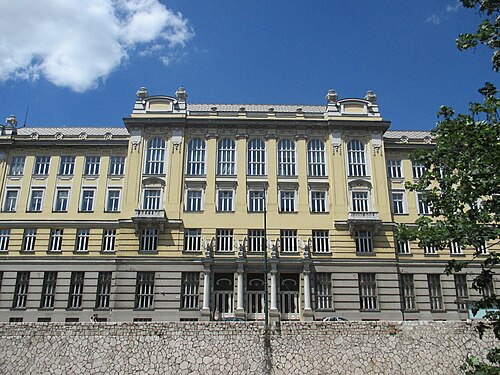 Central Post Office in Sarajevo by Vancaš (1907–1913)
 Croatian State Archives in Zagreb by Rudolf Lubinski (1911–1913)
The most prolific Slovenian Secession architect was Ciril Metod Koch.[101] He studied at Otto Wagner's classes in Vienna and worked in the Laybach (now Ljubljana, Slovenia) City Council from 1894 to 1923. After the earthquake in Laybach in 1895, he designed many secular buildings in Secession style that he adopted from 1900 to 1910:[101] Pogačnik House (1901), Čuden Building (1901), The Farmers Loan Bank (1906–07), renovated Hauptmann Building in Secession style in 1904. The highlight of his career was the Loan Bank in Radmannsdorf (now Radovljica) in 1906.[101]
Other important Slovene architect, who was active also in Bosnia, was Josip Vancaš, the authot of such works like Grand Hotel Union (1902–1903) or City Savings Bank in Ljubljana (1902–1903) as well as the Ješua D. Salom Mansion (1901) and the Central Post Office in Sarajevo (1907–1913). Also Jože Plečnik and Max Fabiani, both important Vienna Secession architects, were born in Slovenia. The latter designed some buildings in Slovenia and Trieste, like the Bartoli House in Trieste (1906).
In Croatia, the most important examples of Secession include the Kallina House in Zagreb by Vjekoslav Bastl (1903–1904) and the Croatian State Archives in Zagreb by Rudolf Lubinski (1911–1913).
Arta 1900 or Art Nouveau in Romania
 Minerva publisher headquarter on Bulevardul Regina Elisabeta in Bucharest, unknown architect (c.1900, destroyed by WW2 bombardments)
 Frieze of Strada Constantin F. Robescu no. 1 in Bucharest, unknown architect (c.1900)
 Door of Piața Mihail Kogălniceanu no. 7 in Bucharest, unknown architect (c.1900)
 Mixed with Beaux-Arts architecture - Romulus Porescu House (Strada Doctor Paleologu no. 12) in Bucharest by Dimitrie Maimarolu (1905)[102]
 Mixed with Beaux-Arts architecture - Former Al. Assan shop (Strada Lipscani no. 72–74) in Bucharest, unknown architect (before 1906)[103]
 Mixed with Beaux-Arts architecture - Mița the Cyclist House in Bucharest by Nicolae C. Mihăescu (1908), mix of Beaux Arts and Art Nouveau[104]
Art Nouveau appeared in Romania during the same years as in Western Europe (early 1890s until the outbreak of World War I in 1914), but here few of the buildings are in this style, the Beaux-Arts style being predominant. The most famous is the Constanța Casino. Most of the Romanian examples of Art Nouveau architecture are actually mixes of Beaux Arts and Art Nouveau, like the Romulus Porescu House or house no. 61 on Strada Vasile Lascăr, both in Bucharest.[105] This is similar to what was happening in France, where eclecticism was more popular, pure Art Nouveau buildings and structures being relatively rare. Despite most houses from the reign of Carol I being Beaux-Arts, some of them have Art Nouveau stoves inside, since the style of the exterior did not always dictate that of the stove or the entire interior.
 Young woman by Ștefan Luchian, drawing for the cover of Ileana magazine (1900)
 Spring, decorative panel by Luchian (1901)
 Woman with Lyre (Allegory of Music) by Nicolae Vermont (1903)
 The Water Fairy by Elena Alexandrina Bednarik (1908)
 Stove in the Mița the Cyclist House (Strada Biserica Amzei no. 9), Bucharest, possibly designed by Nicolae C. Mihăescu (1908)[104]
One of the most notable Art Nouveau painters from Romania was Ștefan Luchian, who quickly took over the innovative and decorative directions of Art Nouveau for a short period of time. This period coincided with the founding of the Ileana Society in 1897, of which he was a founding member, a society that organized an exhibition at the Union Hotel titled The Exhibition of Independent Artists (1898) and published the Ileana Magazine.[106]
Transylvania has examples of both Art Nouveau and Romanian Revival buildings, the former being from the Austro-Hungarian era. Most of them can be found in Oradea, nicknamed the "Art Nouveau capital of Romania",[107] but also in Timișoara, Târgu Mureș and Sibiu.[108][109][110]
Stile Liberty in Italy

 Poster for the 1902 Turin Exposition by Leonardo Bistolfi
 Cobra chair and desk by Carlo Bugatti (1902), in the Brooklyn Museum, New York City
 Entrance of Casa Guazzoni in Milan by Giovanni Battista Bossi (1904–1906)
Art Nouveau in Italy was known as arte nuova, stile floreale, stile moderno and especially stile Liberty. Liberty style took its name from Arthur Lasenby Liberty and the store he founded in 1874 in London, Liberty department store, which specialised in importing ornaments, textiles and art objects from Japan and the Far East, and whose colourful textiles which were particularly popular in Italy. Notable Italian designers in the style included Galileo Chini, whose ceramics were often inspired both by majolica patterns. He was later known as a painter and a theatrical scenery designer; he designed the sets for two celebrated Puccini operas Gianni Schicchi and Turandot.[111][112][12]
Liberty style architecture varied greatly, and often followed historical styles, particularly the Baroque. Façades were often drenched with decoration and sculpture. Examples of the Liberty style include the Villino Florio (1899–1902) by Ernesto Basile in Palermo; the Palazzo Castiglioni in Milan by Giuseppe Sommaruga (1901–1903); Milan, and the Casa Guazzoni (1904–05) in Milan by Giovanni Battista Bossi (1904–06).[113]
Colorful frescoes, painted or in ceramics, and sculpture, both in the interior and exterior, were a popular feature of Liberty style. They drew upon both classical and floral themes. as in the baths of Acque della Salute, and in the Casa Guazzoni in Milan.
The most important figure in Liberty style design was Carlo Bugatti, the son of an architect and decorator, as well as the father of the Liberty sculptor Rembrandt Bugatti, and of the automobile designer Ettore Bugatti. He studied at the Milanese Academy of Brera, and later the Académie des Beaux-Arts in Paris. His work was distinguished by its exoticism and eccentricity, included silverware, textiles, ceramics, and musical instruments, but he is best remembered for his innovative furniture designs, shown first in the 1888 Milan Fine Arts Fair. His furniture often featured a keyhole design, and had unusual coverings, including parchment and silk, and inlays of bone and ivory. It also sometimes had surprising organic shapes, copied after snails and cobras.[114]
Art Nouveau and Secession in Serbia
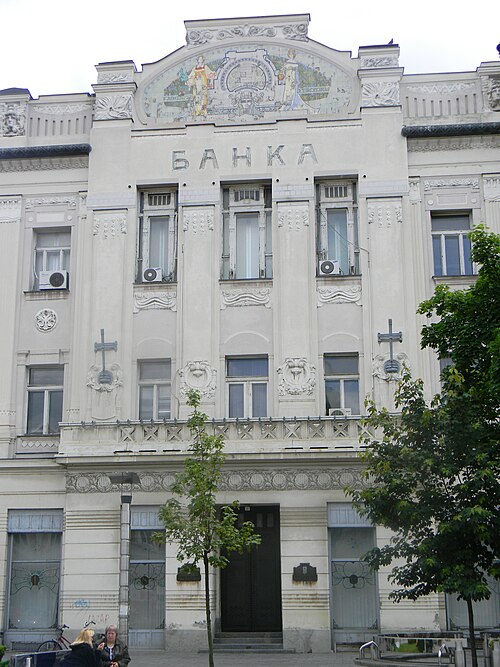 Pučka Bank in Pančevo by Albert Kálmán Kőrössy and Ullmann Gyula (1868)
 Iodine Spa in Novi Sad (1897)
 Subotica Synagogue by Marcell Komor and Dezső Jakab (1901)
 Raichle's Palace in Subotica (1904)
 Karađorđević Bridge (previously named Franz Josef Bridge) in Zrenjanin (1904)
 Novi Sad Synagogue by Lipót Baumhorn (1905)
 Building of Merchant Stamenković in Belgrade by Nikola Nestorović and Andra Stevanović (1907)
 Hotel Moskva in Belgrade by Jovan Ilkić (1908)
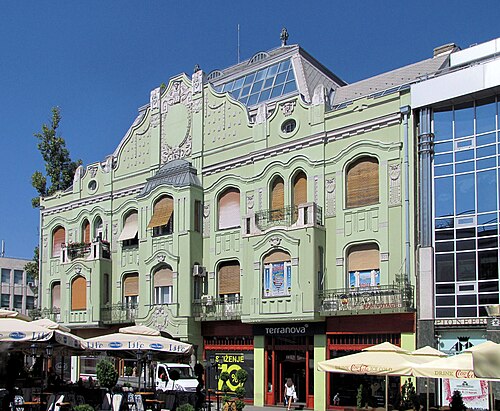 Menrat's Palace in Novi Sad by Lipót Baumhorn (1908)
 Subotica City Hall by Dezső Jakab (1910)
 Mika Alas's House in Belgrade by Petar Bajalović (1910)
Due to the close proximity to Austria–Hungary and Vojvodina being part of the empire until 1918, both the Vienna Secession and Hungarian Szecesszió were prevalent movements in what is today's northern Serbia, as well as the Capital of Belgrade.[115] Famous Austrian and Hungarian architects would design many buildings in Subotica, Novi Sad, Palić, Zrenjanin, Vrbas, Senta, and Kikinda. Art Nouveau heritage in Belgrade, Pančevo, Aranđelovac, and Vrnjačka Banja are a mixture of French, German, Austrian, Hungarian, and local Serbian movements. From the curvy floral beauty of the Subotica's Synagogue to the Morava-style inspired rosettes on Belgrade's telegraph building, Art Nouveau architecture takes various shapes in present-day Serbia.
In the early 1900s, north of the Sava and the Danube, resurgent Hungarian national sentiment infused the buildings in Subotica and Senta with local floral ethnic motifs, while in the tiny Kingdom of Serbia, national romantics like Branko Tanezević and Dragutin Inkiostiri-Medenjak (both born in the Austro-Hungarian Empire), translated Serbia's traditional motifs into marvellous buildings. Other architects, like Milan Antonović and Nikola Nestorović brought the then-fashionable sinuous lines and natural motifs to the homes and businesses of their wealthy patrons, so they could show off their worldliness and keeping up with the trends in Paris, Munich and Vienna.[116]
Modernismo and Modernisme in Spain

 Sagrada Família basilica in Barcelona by Gaudí (1883–)
 Hospital de Sant Pau by Lluis Domenech i Montaner (1901–1930)

 Casa de les Punxes in Barcelona by Josep Puig i Cadafalch (1905)
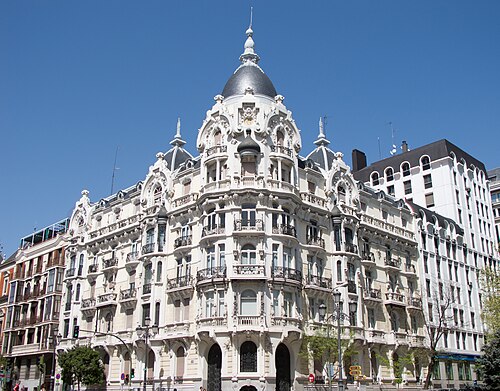 Casa Gallardo in Madrid by Federico Arias Rey (1911–1914)
![Sanctuary of Maria Magdalena [ca] in Novelda, Valencian Community (1918–1946)](https://file.arabipedia.wiki/wikipedia/commons/thumb/2/28/Santuario_Novelda.jpg/500px-Santuario_Novelda.jpg)
A highly original variant of the style emerged in Barcelona, Catalonia, at about the same time that the Art Nouveau style appeared in Belgium and France. It was called Modernisme in Catalan and Modernismo in Spanish. Its most famous creator was Antoni Gaudí. Gaudí used floral and organic forms in a very novel way in Palau Güell (1886–1890).[118][119] He integrated crafts as ceramics, stained glass, wrought ironworkforging and carpentry into his architecture. In his Güell Pavilions (1884–1887) and then Parc Güell (1900–1914) he also used a new technique called trencadís, which used waste ceramic pieces. His designs from about 1903, the Casa Batlló (1904–1906) and Casa Milà (1906–1912),[117] are most closely related to the stylistic elements of Art Nouveau.[120] Later structures such as Sagrada Família combined Art Nouveau elements with revivalist Neo-Gothic.[120]Casa Batlló, Casa Milà, Güell Pavilions, and Parc Güell were results of his collaboration with Josep Maria Jujol, who himself created houses in Sant Joan Despí (1913–1926), several churches near Tarragona (1918 and 1926) and the sinuous Casa Planells (1924) in Barcelona.
Besides the dominating presence of Gaudí, Lluís Domènech i Montaner also used Art Nouveau in Barcelona in buildings such as the Castell dels Tres Dragons (1888), Casa Lleó Morera, Palau de la Música Catalana (1905) and Hospital de Sant Pau (1901–1930).[120] The two latter buildings have been listed by UNESCO as World Cultural Heritage.[121]
Another major modernista was Josep Puig i Cadafalch, who designed the Casa Martí and its Els Quatre Gats café, the Casimir Casaramona textile factory (now the CaixaFòrum art museum), Casa Macaya, Casa Amatller, the Palau del Baró de Quadras (housing Casa Àsia for 10 years until 2013) and the Casa de les Punxes ('House of Spikes').
A distinctive Art Nouveau movement was also in the Valencian Community. Some of the notable architects were Demetrio Ribes Marco, Vicente Pascual Pastor, Timoteo Briet Montaud, and José María Manuel Cortina Pérez. Valencian Art Nouveau defining characteristics are a notable use of ceramics in decoration, both in the façade and in ornamentation, and also the use of Valencian regional motives.
Another remarkable variant is the Madrilenian Art Nouveau or Modernismo madrileño, with such notable buildings as the Longoria Palace, the Casino de Madrid or the Cementerio de la Almudena, among others. Renowned modernistas from Madrid were architects José López Sallaberry, Fernando Arbós y Tremanti and Francisco Andrés Octavio.

![Sculpture of polychrome terracota by Lambert Escaler [ca] (1902)](https://file.arabipedia.wiki/wikipedia/commons/thumb/c/c1/El_Pet%C3%B3_Perdut._Lambert_Escaler_i_Mil%C3%A0.JPG/500px-El_Pet%C3%B3_Perdut._Lambert_Escaler_i_Mil%C3%A0.JPG) Sculpture of polychrome terracota by Lambert Escaler (1902)
Sculpture of polychrome terracota by Lambert Escaler (1902)![Furniture by Gaspar Homar [ca] (1903)](https://file.arabipedia.wiki/wikipedia/commons/thumb/b/b6/140_La_sardana%2C_plaf%C3%B3_de_marqueteria_de_Gaspar_Homar.jpg/500px-140_La_sardana%2C_plaf%C3%B3_de_marqueteria_de_Gaspar_Homar.jpg) Furniture by Gaspar Homar (1903)
Furniture by Gaspar Homar (1903)
 Stained glass ceiling of Palau de la Música Catalana by Antoni Rigalt (1905–1908)
 Window of the Palace of the Valencian Regional Exposition, in Valencia (1908)
The Modernisme movement left a wide art heritage including drawings, paintings, sculptures, glass and metal work, mosaics, ceramics, and furniture. A part of it can be found in Museu Nacional d'Art de Catalunya.
Inspired by a Paris café called Le Chat Noir, where he had previously worked, Pere Romeu i Borràs decided to open a café in Barcelona that was named Els Quatre Gats (Four Cats in Catalan).[122] The café became a central meeting point for Barcelona's most prominent figures of Modernisme, such as Pablo Picasso and Ramon Casas i Carbó who helped to promote the movement by his posters and postcards. For the café he created a picture called Ramon Casas and Pere Romeu on a Tandem that was replaced with his another composition entitled Ramon Casas and Pere Romeu in an Automobile in 1901, symbolizing the new century.
Antoni Gaudí designed furniture for many of the houses he built; one example is an armchair called the for the Battle House. He influenced another notable Catalan furniture designer, Gaspar Homar (1870–1953) who often combined marquetry and mosaics with his furnishings.[123]
Arte Nova in Portugal
 Museum-Residence Dr. Anastácio Gonçalves in Lisbon (1904–05)
 Livraria Lello bookstore in Porto (1906)
 Atrium of Major Pessoa Residence
 Details of Almirante Reis, 2-2K building in Lisbon (1908)
 Ceramic tile of Cooperativa Agrícola in Aveiro (1913)
The Art Nouveau variant in Aveiro (Portugal) was called Arte Nova, and its principal characteristic feature was ostentation: the style was used by bourgeoisie who wanted to express their wealth on the façades while leaving the interiors conservative.[125] Another distinctive feature of Arte Nova was the use of locally produced tiles with Art Nouveau motifs.[125]
The most influential artist of Arte Nova was Francisco Augusto da Silva Rocha.[125] Though he was not trained as an architect, he designed many buildings in Aveiro and in other cities in Portugal.[126][125] One of them, the Major Pessoa residence, has both an Art Nouveau façade and interior, and now hosts the Museum of Arte Nova.[125]
There are other examples of Arte Nova in other cities of Portugal.[127][128] Some of them are the Museum-Residence Dr. Anastácio Gonçalves by Manuel Joaquim Norte Júnior (1904–1905) in Lisbon, Café Majestic by João Queiroz (1921) and Livraria Lello bookstore by Xavier Esteves (1906), both in Porto.
Jugendstil in the Nordic countries
Finland


 By the River of Tuonela in the Finnish National Romantic Style by Akseli Gallen-Kallela (1903)
 Chair by Eliel Saarinen (1907–1908)
 Statues at Helsinki Central railway station by Emil Wikström (1919)
Art Nouveau was popular in the Nordic countries, where it was usually known as Jugendstil, and was often combined with the National Romantic Style of each country. The Nordic country with the largest number of Jugendstil buildings is the Grand Duchy of Finland, then a part of Russian Empire.[129] The Jugendstil period coincided with Golden Age of Finnish Art and national awakening. After Paris Exposition in 1900 the leading Finnish artist was Akseli Gallen-Kallela.[130] He is known for his illustrations of the Kalevala, the Finnish national epic, as well as for painting numerous Judendstil buildings in the Duchy.
The architects of the Finnish pavilion at the Exposition were Herman Gesellius, Armas Lindgren, and Eliel Saarinen. They worked together from 1896 to 1905 and created many notable buildings in Helsinki including Pohjola Insurance building (1899–1901) and National Museum of Finland (1905–1910)[131] as well as their joint residence Hvitträsk in Kirkkonummi (1902). Architects were inspired by Nordic legends and nature, rough granite façade thus became a symbol for belonging to the Finnish nation.[132] After the firm dissolved, Saarinen designed the Helsinki Railway Station (1905–1914) in clearer forms, influenced by American architecture.[132] The sculptor who worked with Saarinen in construction of National Museum of Finland and Helsinki Railway Station was Emil Wikström.
Another architect who created several notable works in Finland was Lars Sonck. His major Jugendstil works include Tampere Cathedral (1902–1907), Ainola, the home of Jean Sibelius (1903), Headquarters of the Helsinki Telephone Association (1903–1907) and Kallio Church in Helsinki (1908–1912). Also, Magnus Schjerfbeck, brother of Helene Schjerfbeck, made tuberculosissanatorium known as Nummela Sanatorium in 1903 using the Jugendstil style.[133][134][135]
Norway
 Viking-Art Nouveau chair by Lars Kinsarvik (1900)
 Art Nouveau Centre in Ålesund (1905–1907)
 Graphic design by Gerhard Munthe (1914)
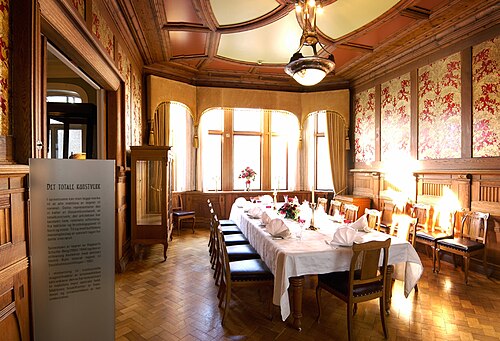 Interior of Art Nouveau Centre in Ålesund
 Ornaments of a door in Art Nouveau Centre in Ålesund
 Art Nouveau building in Tønsberg
Norway also was aspiring independence (from Sweden) and local Art Nouveau was connected with a revival inspired by Viking folk art and crafts. Notable designers included Lars Kisarvik, who designed chairs with traditional Viking and Celtic patterns, and Gerhard Munthe, who designed a chair with a stylised dragon-head emblem from ancient Viking ships, as well as a wide variety of posters, paintings and graphics.[136]
The Norwegian town of Ålesund is regarded as the main centre of Art Nouveau in Scandinavia because it was completely reconstructed after a fire of 23 January 1904.[137] About 350 buildings were built between 1904 and 1907 under an urban plan designed by the engineer Frederik Næsser. The merger of unity and variety gave birth to a style known as Ål Stil. Buildings of the style have linear decor and echoes of both Jugendstil and vernacular elements, e.g. towers of stave churches or the crested roofs.[137] One of the buildings, Swan Pharmacy, now hosts the Art Nouveau Centre.
Sweden and Denmark
 Vase with blackberry, painting by Per Algot Eriksson, and silver by E. Lefebvre, in the Bröhan Museum, Berlin
 Cup and saucer from the 'iris' service (1897), in the Los Angeles County Museum of Art
 Inkwell and stamp box, by Jens Dahl-Jensen (c.1900), in the Hessisches Landesmuseum Darmstadt, Germany
 Great Hall of City Library of Aarhus by Karl Hansen Reistrup
 Altar of Engelbrektskyrkan in Stockholm (1914)
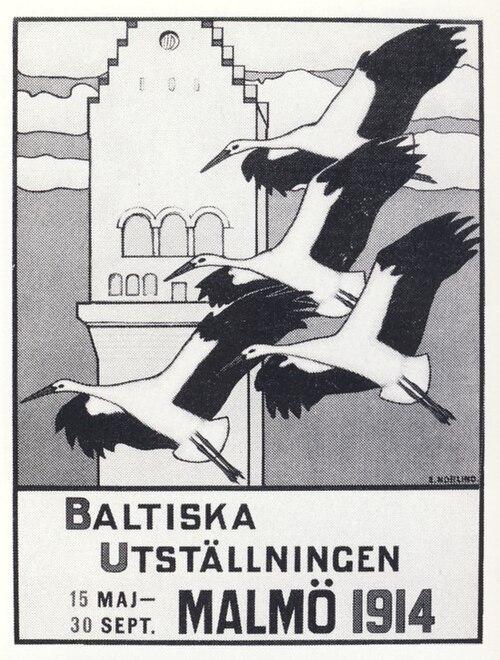 Poster for the Baltic Exhibition in Malmö (1914)
Jugendstil masterpieces of other Nordic countries include Engelbrektskyrkan (1914) and Royal Dramatic Theatre (1901–1908) in Stockholm, Sweden[138] and former City Library (now Danish National Business Archives) in Aarhus, Denmark (1898–1901).[139] The architect of the latter is Hack Kampmann, then a proponent of National Romantic Style who also created Custom House, Theatre and Villa Kampen in Aarhus. Denmark's most notable Art Nouveau designer was the silversmith Georg Jensen. The Baltic Exhibition in Malmö 1914 can be seen as the last major manifestation of the Jugendstil in Sweden.[140]
Modern in Russia
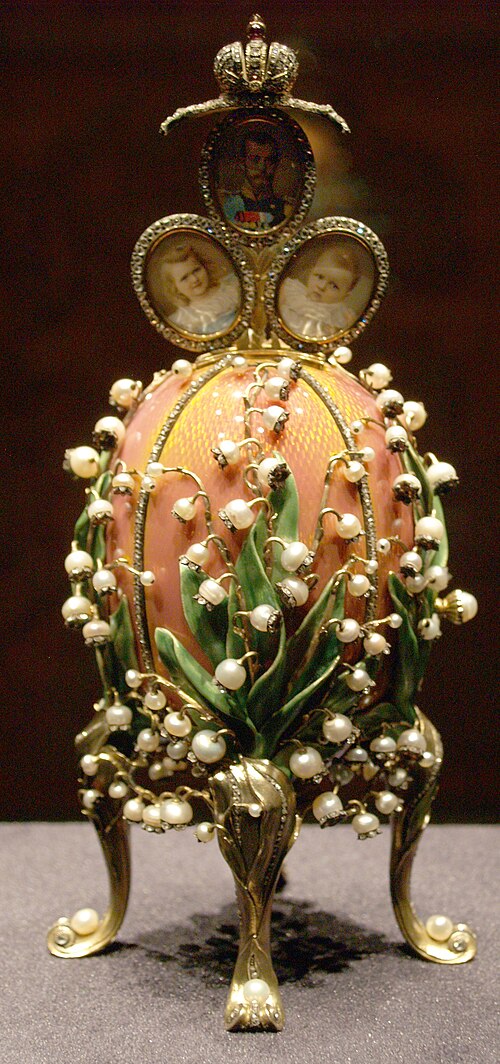 An Art Nouveau Fabergé egg[nb 3] (1898)
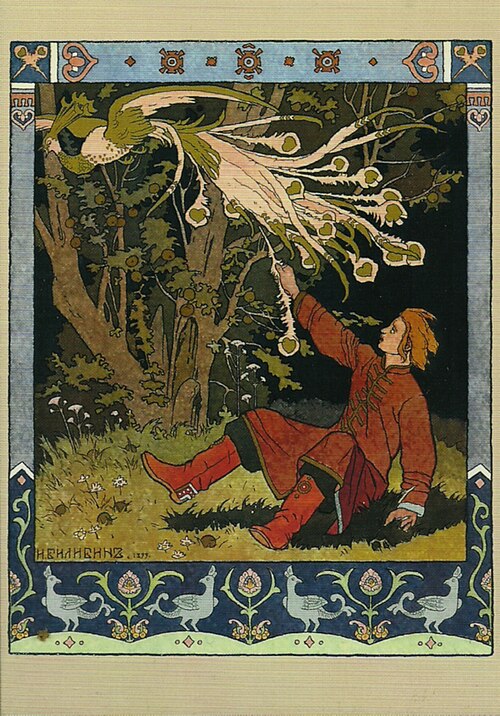 Illustration of the Firebird by Ivan Bilibin (1899)
 Chairs by Sergey Malyutin (c.1900), Talashkino Art Colony
 Ceramic fireplace on Russian folklore theme by Mikhail Vrubel (1908)
 Program design for Afternoon of a Faun by Bakst for Ballets Russes (1912)
Модерн ('Modern') was a very colourful Russian variation of Art Nouveau which appeared in Moscow and Saint Petersburg in 1898 with the publication of a new art journal, Мир искусства (Mir Iskusstva, 'The World of Art'), by Russian artists Alexandre Benois and Léon Bakst, and chief editor Sergei Diaghilev. The magazine organized exhibitions of leading Russian artists, including Mikhail Vrubel, Konstantin Somov, Isaac Levitan, and the book illustrator Ivan Bilibin. The World of Art style made less use of the vegetal and floral forms of French Art Nouveau; it drew heavily upon the bright colours and exotic designs of Russian folklore and fairy tales. The most influential contribution of the Mir Iskusstva was the creation of a new ballet company, the Ballets Russes, headed by Diaghilev, with costumes and sets designed by Bakst and Benois. The new ballet company premiered in Paris in 1909, and performed there every year through 1913. The exotic and colourful sets designed by Benois and Bakst had a major impact on French art and design. The costume and set designs were reproduced in the leading Paris magazines, L'Illustration, La Vie parisienne and Gazette du bon ton, and the Russian style became known in Paris as à la Bakst. The company was stranded in Paris first by the outbreak of World War I, and then by the Russian Revolution in 1917, and ironically never performed in Russia.[141]
Of Russian architects, the most prominent in the pure Art Nouveau style was Fyodor Schechtel. The most famous example is the Ryabushinsky House in Moscow. It was built by a Russian businessman and newspaper owner, and then, after the Russian Revolution, became the residence of the writer Maxim Gorky, and is now the Gorky Museum. Its main staircase, made of a polished aggregate of concrete, marble and granite, has flowing, curling lines like the waves of the sea, and is illuminated by a lamp in the form of a floating jellyfish. The interior also features doors, windows and ceiling decorated with colorful frescoes of mosaic.[142] Schechtel, who is also considered a major figure in Russian symbolism, designed several other landmark buildings in Moscow, including the rebuilding of the Moscow Yaroslavsky railway station, in a more traditional Moscow revival style.[142]

 Ryabushinsky House in Moscow by Fyodor Schechtel (1900)
 Main staircase of Ryabushinsky House in Moscow by Schechtel (1900)
 Holy Spirit Church in Talashkino by Malyutin (1903–1906)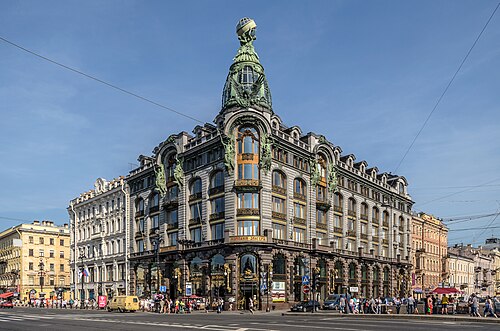

 Pertsova House in Moscow by Malyutin (1905–1907)
 Dining room of the Grand Hotel Europe in Saint Petersburg (1910)
Other Russian architects of the period created Russian Revival architecture, which drew from historic Russian architecture. These buildings were created mostly in wood, and referred to the Architecture of Kievan Rus'. One example is the Teremok House in Talashkino (1901–1902) by Sergey Malyutin, and Pertsova House (also known as Pertsov House) in Moscow (1905–1907). He also was a member of Mir iskusstva movement. The Saint Petersburg architect Nikolai Vasilyev built in a range of styles before emigrating in 1923. This building is most notable for stone carvings made by Sergei Vashkov inspired by the carvings of Cathedral of Saint Demetrius in Vladimir and Saint George Cathedral in Yuryev-Polsky of the 12th and 13th centuries. Another example of this Russian Revival architecture is the Marfo-Mariinsky Convent (1908–1912), an updated Russian Orthodox Church by Alexey Shchusev, who later, ironically, designed Lenin's Mausoleum in Moscow.
Several art colonies in Russia in this period were built in the Russian Revival style. The two best-known colonies were Abramtsevo, funded by Savva Mamontov, and Talashkino, Smolensk Governorate, funded by Princess Maria Tenisheva.
Ukrainian Modern architecture
 Zemstvo Building in Poltava by Vasyl Krychevskyi (1903–1908)
 Dnister credit society building in Lviv by Ivan Levynskyi (1905–06)
 Building on Pankivska Street, 8 in Kyiv by Mykola Shekhonin (1909–1914)
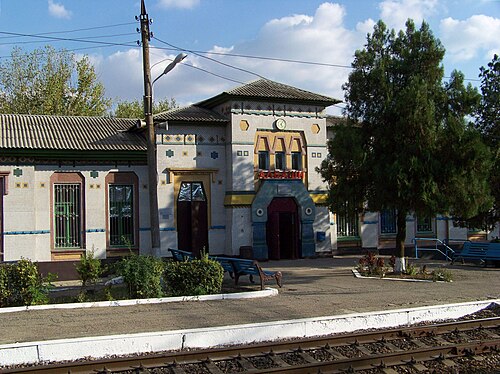 Albashy railway station in Krasnodar Krai, Southern Russia (historic Kuban region) by Serhiy Tymoshenko (1910)
 Khrennikov House (now Hotel Ukraine) in Dnipro by P. Fetisov and L. Khoinovskyi (1910–1913), detail
 Zemstvo school in Kizlivka, Poltava Oblast by Opanas Slastion (1912)
Early 20th-century architecture in Ukrainian lands (southwestern part of the Russian Empire, Eastern Galicia, Bukovina and Transcarpathia in Austria-Hungary) developed under the influence of Ukrainian folk architecture, as well as trends of European Art Nouveau, such as Zakopane Style. Ukrainian "modern" architecture first came to prominence in Poltava Governorate, where its most active promoters were Vasyl Krychevskyi and Opanas Slastion. In the late 1900s and early 1910s, a number of buildings in what was then known simply as "Ukrainian style" were constructed in Kyiv, Kharkiv, Odesa, Katerynoslav and a number of other places in the Russian Empire. In Western Ukraine, which was at that time part of Austria-Hungary, the local Ukrainian style was influenced by Hutsul architecture, as well as Western European trends and influences from Great Ukraine.[143]
Jūgendstils (Art Nouveau in Riga)
 Façade of house at Elizabetes ielā, 10b, by Mikhail Eisenstein (1903)
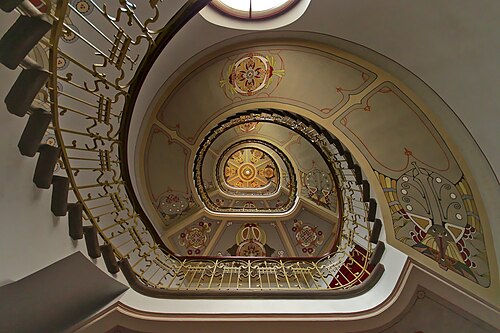 Stairway in Pēkšēns House by Konstantīns Pēkšēns (1903), now hosting Riga Jūgendstils museum
 National Romantic decoration on a house built by Pēkšēns (1908)
 Ministry of Education, built by Edgar Friesendorf (1911)
Riga, the present-day capital of Latvia, was at the time one of the major cities of the Russian Empire. Art Nouveau architecture in Riga nevertheless developed according to its own dynamics, and the style became overwhelmingly popular in the city. Soon after the Latvian Ethnographic Exhibition in 1896 and the Industrial and Handicrafts Exhibition in 1901, Art Nouveau became the dominant style in the city.[144] Thus Art Nouveau architecture accounts for one-third of all the buildings in the centre of Riga, making it the city with the highest concentration of such buildings anywhere in the world. The quantity and quality of Art Nouveau architecture was among the criteria for including Riga in UNESCO World Cultural Heritage.[145]
There were different variations of Art Nouveau architecture in Riga:
- in Eclectic Art Nouveau, floral and other nature-inspired elements of decoration were most popular. Examples of that variation are works of Mikhail Eisenstein,
- in Perpendicular Art Nouveau, geometrical ornaments were integrated into the vertical compositions of the façades. Several department stores were built in this style, and it is sometimes also referred to as "department store style" or Warenhausstil in German,
- National Romantic Art Nouveau was inspired by local folk art, monumental volumes and the use of natural building materials.
Some later Neo-Classical buildings also contained Art Nouveau details.
Style Sapin in La Chaux-de-Fonds, Switzerland
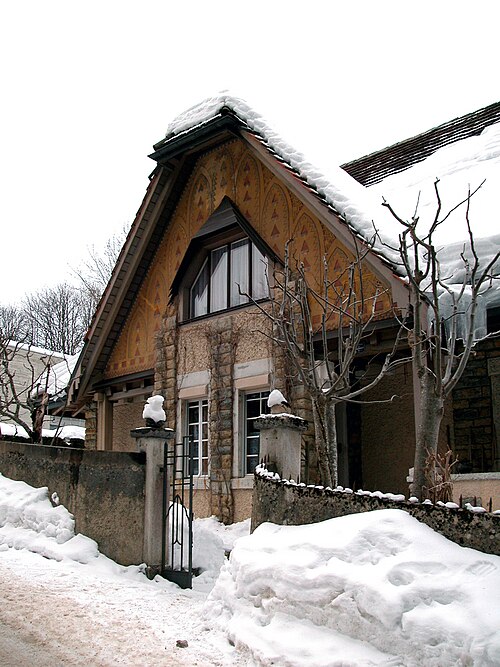 Villa Fallet with fir-inspired decoration by Le Corbusier (1904–05)
 Crematorium (1908–1910), interior, with stylised fir tree design on ceiling. The symbolist murals by L'Epplattenier were added later.
 Crematorium, with stylised sapin or pine cone detail
 Crematorium, with pine cone detail
A variation called Style Sapin ('Fir-tree Style') emerged in La Chaux-de-Fonds in the Canton of Neuchâtel in Switzerland. The style was launched by the painter and artist Charles l’Eplattenier and was inspired especially by the sapin, 'fir tree', and other plants and wildlife of the Jura Mountains. One of his major works was the crematorium in the town, which featured triangular tree forms, pine cones, and other natural themes from the region. The style also blended in the more geometric stylistic elements of Jugendstil and Vienna Secession.[146]
Another notable building in the style is the Villa FalletLa Chaux-de-Fonds, a chalet designed and built in 1905 by a student of L'Eplattenier, the eighteen-year-old Le Corbusier. The form of the house was a traditional Swiss chalet, but the decoration of the façade included triangular trees and other natural features. Le Corbusier built two more chalets in the area, including the Villa Stotzer, in a more traditional chalet style.[147][146][148][149]
Tiffany Style and Louis Sullivan in the United States

 Glass vase by Louis Comfort Tiffany (1893–1896), now in the Cincinnati Art Museum
 Century Magazine, poster by Louis John Rhead (1894)
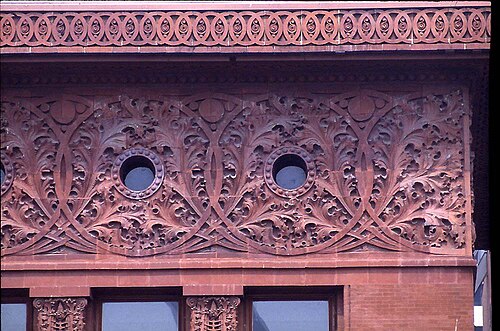
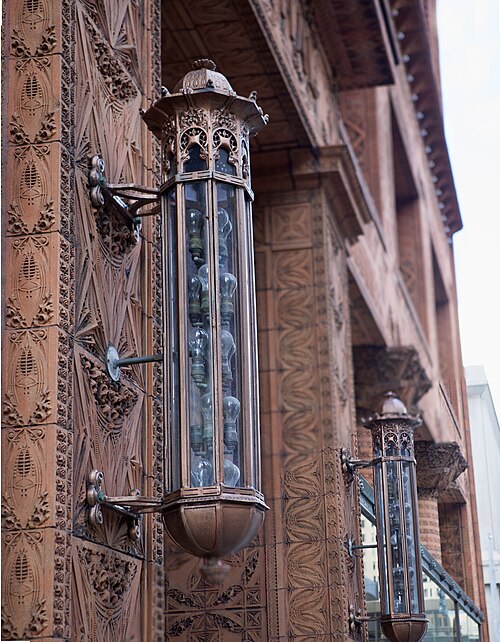 Detail of the Prudential (Guaranty) Building in Buffalo, N.Y., by Sullivan (1896)
 South State Street entrance to the Carson, Pirie, Scott and Company Store in Chicago, Illinois, by Sullivan (1899)
 The Flight of Souls window by Tiffany won a gold medal at the 1900 Paris Exposition
 Wisteria lamp by Tiffany (c.1902), in the Virginia Museum of Fine Arts
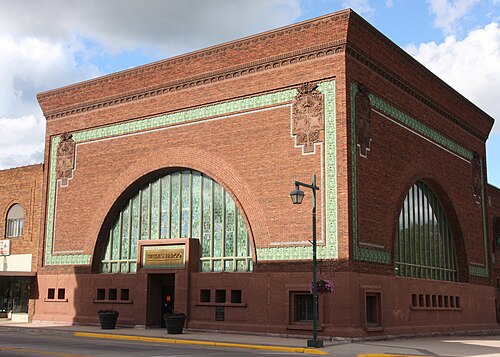 National Farmer's Bank of Owatonna by Sullivan (1907–08)
 Tiffany window in his house at Oyster Bay, N.Y. (1908)
In the United States, the firm of Louis Comfort Tiffany played a central role in American Art Nouveau. Born in 1848, he studied at the National Academy of Design in New York City, began working with glass at the age of 24, entered the family business started by his father, and in 1885 set up his own enterprise devoted to fine glass, and developed new techniques for its colouring. In 1893, he began making glass vases and bowls, again developing new techniques that allowed more original shapes and colouring, and began experimenting with decorative window glass. Layers of glass were printed, marbled and superimposed, giving an exceptional richness and variety of colour in 1895 his new works were featured in the Art Nouveau gallery of Siegfried Bing, giving him a new European clientele. After the death of his father in 1902, he took over the entire Tiffany enterprise, but still devoted much of his time to designing and manufacturing glass art objects. At the urging of Thomas Edison, he began to manufacture electric lamps with multicoloured glass shades in structures of bronze and iron, or decorated with mosaics, produced in numerous series and editions, each made with the care of a piece of jewellery. A team of designers and craftsmen worked on each product. The Tiffany lamp in particular became one of the icons of the Art Nouveau, but Tiffany's craftsmen designed and made extraordinary windows, vases, and other glass art. Tiffany's glass also had great success at the 1900 Exposition Universelle in Paris; his stained glass window called the Flight of Souls won a gold medal.[150] The Columbian Exposition was an important venue for Tiffany; a chapel he designed was shown at the Pavilion of Art and Industry. The Tiffany Chapel, along with one of the windows of Tiffany's home in New York, are now on display at the Charles Hosmer Morse Museum of American Art in Winter Park, Florida.
Another important figure in American Art Nouveau was the architect Louis Sullivan. Sullivan was a leading pioneer of American modern architecture. He was the founder of the Chicago School, the architect of some of the first skyscrapers, and the teacher of Frank Lloyd Wright. His most famous saying was "Form follows function." While the form of his buildings was shaped by their function, his decoration was an example of American Art Nouveau. At the 1893 World's Columbian Exposition in Chicago, most famous for the neoclassical architecture of its renowned White City, he designed a spectacular Art Nouveau entrance for the very functional Transportation Building.[151][152]
While the architecture of his Carson, Pirie, Scott and Company Building (1899) (now the Sullivan Center) was strikingly modern and functional, he surrounded the windows with stylised floral decoration. He invented equally original decoration for the National Farmer's Bank of Owatonna, Minnesota (1907–1908) and the Merchants' National Bank in Grinell, Iowa. He invented a specifically American variety of Art Nouveau, declaring that decorative forms should oscillate, surge, mix and derive without end. He created works of great precision which sometimes combined Gothic with Art Nouveau themes.[153]
Also worth noting are the Uhl brothers from Toledo, Ohio, who set new standards in metal furniture production with their designs for the Toledo Metal Furniture Co.
Art Nouveau in Argentina
 Entrance of Casa de los lirios in Buenos Aires by Eduardo Rodríguez Ortega (1905)
 No Hi Ha Somnis Impossibles building in Buenos Aires by Eduardo Rodriguez Ortega (1907)
 Stained glass and sculptures by Ercole Pasina in Calise House in Buenos Aires (1911)
 Galería Güemes in Buenos Aires by Francesco Gianotti (1914)
 Confitería del Molino in Buenos Aires by Francesco Gianotti (1916)
![Metal work, ceramics and statues at the façade of Club Español building [es] in Rosario (1912)](https://file.arabipedia.wiki/wikipedia/commons/thumb/8/86/Club_Espa%C3%B1ol_Rosario_2.jpg/500px-Club_Espa%C3%B1ol_Rosario_2.jpg) Metal work, ceramics and statues at the façade of Club Español building in Rosario (1912)
Metal work, ceramics and statues at the façade of Club Español building in Rosario (1912) Palacio Cabanellas in Rosario by Francesc Roca i Simó (1916)
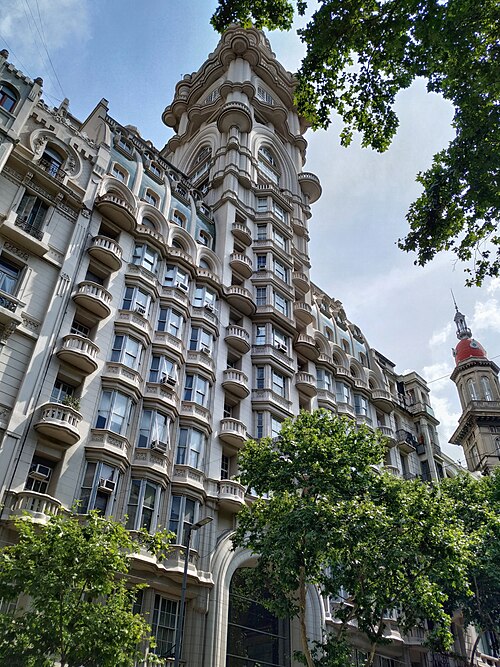 Palacio Barolo in Buenos Aires by Mario Palanti (1923)
Flooded with European immigrants, Argentina welcomed all artistic and architectural European styles, including Art Nouveau. There was an environment of huge investments and flexible rules for construction, which encouraged young architects from Europe to come and grow their portfolio to later go back to Europe. As a result of this, Argentina became the country outside of Europe with most art nouveau buildings.[154] Cities with the most notable Art Nouveau heritage in Argentina are Buenos Aires, Rosario and Mar del Plata.[155]
Paris was a prototype for Buenos Aires with the construction of large boulevards and avenues in the 19th century.[154] The local style along with French influence was also following Italian Liberty as many architects (Virginio Colombo, Francisco Gianotti, Mario Palanti) were Italians. In works of Julián García Núñez Catalan influence can be noted as he completed his studies in Barcelona in 1900 as well as in the work of Eduardo Rodríguez Ortega.[154] The influence of Vienna Secession can be found at Paso y Viamonte building, Club Español, Regimiento de Granaderos a Caballo and the Savoy hotel.[154]
Some local features are the adaptation to the previously existent "chorizo house" format of buildings, which implied a relatively narrow façade for an actually deep building inside of the block, with multiple patios or holes for air and light; as well as the characteristic "cut corners" on every block that was a requirement by law in Buenos Aires since the end of the 1800s; material availability was also different than in Europe, and buildings will often be covered of a "simil piedra París" which was an imitation of the Parisian stone made by mixing cement with sand and different minerals.
The introduction of Art Nouveau in Rosario is connected to Francisco Roca Simó who trained in Barcelona.[156] His Club Español building (1912) features one of the largest stained glass windows in Latin America produced (as well as tiling and ceramics) by the local firm Buxadera, Fornells y Cía.[157] The sculptor of the building is Diego Masana from Barcelona.[157]
Belgian influence on Argentinian Art Nouveau is represented by the Villa Ortiz Basualdo, now hosting the Juan Carlos Castagnino Municipal Museum of Art in Mar del Plata where the furniture, interiors, and lighting are by Gustave Serrurier-Bovy.
Art Nouveau in the rest of the world
 Théâtre municipal in Tunis, Tunisia (1902)
 Art Nouveau/Neoclassical Palacio de Bellas Artes (Palace of Fine Arts) in Mexico City, Mexico (1904–1934)
 An Allegorical Wedding: Sketch for a carpet (Triptych from right to left): Exile, Marriage and Redemption by Ephraim Moses Lilien (1906)
 Goerke-Haus in Lüderitz, Namibia (1909–1910)
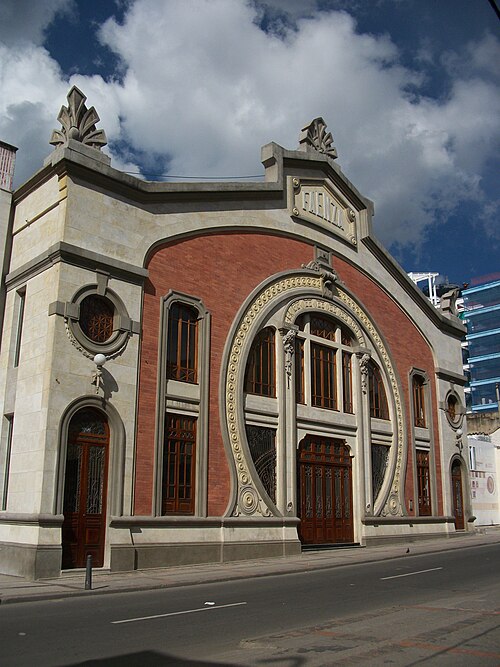 Faenza Theatre in Bogotá, Colombia (1924)
As in Argentina, Art Nouveau in other countries was mostly influenced by foreign artists:
- Spaniards were behind Art Nouveau projects in Havana, Cuba, they were even not qualified enough to be called architects.[160] Spaniards were not directly involved in works in Ponce, Puerto Rico but were an inspiration and a subject of study for local architects in the development of local styles such as Ponce Creole,[161]
- French were behind Art Nouveau in Tunisia (that was a French protectorate then),
- Germans were behind Jugendstil heritage of Lüderitz, Namibia;[162]Qingdao, China,
- Italians were behind Art Nouveau in Valparaíso, Chile;[163]Montevideo, Uruguay; Rio de Janeiro, Brazil,[164]
- Russians were behind Art Nouveau heritage of Harbin, China,[165]
- Art Nouveau Heritage in Lima consists of work of Italians Masperi brothers, French architect Claude Sahut and British masters of stained glass[166]
- Palacio de Bellas Artes in Mexico City was a result of the cooperation of Italians (architect Adamo Boari and sculptor Leonardo Bistolfi), local architect Federico Mariscal, Hungarian artists Aladár Körösfői-Kriesch, Géza Maróti and Miksa Róth, Catalan sculptor Agustí Querol Subirats and French master Edgar Brandt.[167]
Art Nouveau motifs can also be found in French Colonial artchitechture throughout French Indochina.
A notable art movement called Bezalel school appeared in the Palestine region in dating to the late Ottoman and British Mandate periods. It has been described as "a fusion of oriental art and Jugendstil."[168] Several artists associated with the Bezalel school were noted for their Art Nouveau style, including Ze'ev Raban, Ephraim Moses Lilien and Abel Pann.[169]
Characteristics, decoration and motifs

 Coup de Fouet or whiplash motif, depicting the stems of cyclamen flowers – Wall tapestry, by Hermann Obrist (1895)
 Functional elements transformed into ornament – Pins on the jointings of a balcony of the Castel Béranger (Rue Jean-de-La-Fontaine no. 14, Paris, by Hector Guimard (1895–1898)
 Windows not aligned horizontally, while still looking harmonious – Castel Béranger
 Depiction of the woman as a creature of the night, fused with the natural world – Breast ornament, by René Lalique (1898–1900), Kunstgewerbemuseum Berlin
 Decorative stylised lettering – Grave of the Caillat Family in Père Lachaise Cemetery, Paris, by Guimard (1899)[170]
 Flat colours and visible outline, inspired by Japanese art – Jane Avril, by Henri de Toulouse-Lautrec (1899), multiple exemplars in different locations
 Faded earthy colours – Poster for Pippermint, by Jules Chéret (1899), Bibliothèque nationale de France, Paris
 Floral patterns – Lamp with Wisteria design, by Louis Comfort Tiffany (1899–1900), Virginia Museum of Fine Arts, Richmond, US
 Inspiration taken from folklore and local tradition – Chair, by Lars Kinsarvik (before 1900), Musée d'Orsay, Paris
 Organic shapes – Carafe, unknown designer (c.1900), in a temporary exhibition in the Municipal House, Prague
 Flowers and plants (in this case poppies and sunflowers) – Mantel clock, by Louis Chalon, E. Colin & Cie. (c.1900), Hessisches Landesmuseum Darmstadt, Germany
 Horseshoe arches, present in both windows and doors, inspired by moon gates (a traditional architectural element in Chinese gardens) – Window of Strada Jules Michelet no. 21 in Bucharest, unknown architect (c.1900)
 Asymmetry (not just objects, but also buildings) – Inkwell, by Maurice Bouval (c.1900), Musée d'Orsay
 Gesamtkunstwerk (literally 'total artwork'), which refers to everything being designed to fit together, from carpets to wallpaper, and from room compartmentation to light fixtures – Design for a house of an art lover, by Charles Rennie Mackintosh and Margaret Macdonald Mackintosh (1901)
 Combinations of rectangular shapes, straight or almost straight lines, with sinuous organic shapes (like ovals that are asymmetric horizontally) - door handle of the House of Paul Verdussen (Avenue Brugmann no. 211) in Brussels, by Paul Hamesse (1901)
 Sinous oblate arches – Windows of the Fernand Dubois House (Avenue Brugmann no. 80) in Brussels, by Horta (1901–1903)
 Insects – Libelle ('Dragonfly'), pendant made of gold, opal, enamel, rubies and diamonds by Philippe Wolfers (1902)
 Sinuous onion-shaped tops – Félix Potin Building (Rue de Rennes no. 140–140bis) in Paris, by Paul Auscher (1904)
 Exotic materials and decoration – Mahogany and amourette wood cabinet with water lily decoration of gilded bronze, by Louis Majorelle (1905–1908), Fin-de-Siècle Museum, Brussels
 Geometric lines (a key feature of the Vienna Secession and the Glasgow School) – Stoclet Palace in Brussels, by Josef Hoffmann (1905–1911)
 Ethereal scenes (used especially in reliefs on buildings and objects, and in posters) – Façade of Rue Perrée no. 18 in Paris, by Raymond Barbaud and Édouard Bauhain (1908)
 Highly stylised plant motifs, nearly abstract – Balcony of the Hôtel Guimard (Avenue Mozart no. 122) in Paris, by Guimard (1909)
 Peacocks and motifs inspired by their feathers (and sometimes other animals) – Relief above the door of Rue Octave-Feuillet no. 19 in Paris, by Maurice Du Bois d’Auberville (1910)
 Nymphs – Relief on the Fanny and Isac Popper House (Strada Sfinților no. 1), Bucharest, by Alfred Popper (1914)[171]
Early Art Nouveau, particularly in Belgium and France, was characterized by undulating, curving forms inspired by lilies, vines, flower stems and other natural forms, used in particular in the interiors of Victor Horta and the decoration of Louis Majorelle and Émile Gallé.[172] It also drew upon patterns based on butterflies and dragonflies, borrowed from Japanese art, which were popular in Europe at the time.[172]
Early Art Nouveau also often featured more stylised forms expressing movement, such as the coup de fouet or "whiplash" line, depicted in the cyclamen plants drawn by designer Hermann Obrist in 1894. A description published in Pan magazine of Hermann Obrist's wall hanging Cyclamen (1894), compared it to the "sudden violent curves generated by the crack of a whip,"[173] The term "whiplash", though it was originally used to ridicule the style, is frequently applied to the characteristic curves employed by Art Nouveau artists.[173] Such decorative undulating and flowing lines in a syncopated rhythm and asymmetrical shape, are often found in the architecture, painting, sculpture, and other forms of Art Nouveau design.[173]
Other floral forms were popular, inspired by lilies, wisteria and other flowers, particularly in the lamps of Louis Comfort Tiffany and the glass objects made by the artists of the School of Nancy and Émile Gallé. Other curving and undulating forms borrowed from nature included butterflies, peacocks, swans, and water lilies. Many designs depicted women's hair intertwined with stems of lilies, irises and other flowers.[174] Stylised floral forms were particularly used by Victor Horta in carpets, balustrades, windows, and furniture. They were also used extensively by Hector Guimard for balustrades, and, most famously, for the lamps and railings at the entrances of the Paris Metro. Guimard explained: "That which must be avoided in everything that is continuous is the parallel and symmetry. Nature is the greatest builder and nature makes nothing that is parallel and nothing that is symmetrical."[175]
Earlier Art Nouveau furniture, such as that made by Louis Majorelle and Henry van de Velde, was characterized by the use of exotic and expensive materials, including mahogany with inlays of precious woods and trim, and curving forms without right angles. It gave a sensation of lightness.
In the second phase of Art Nouveau, following 1900, the decoration became purer and the lines were more stylised. The curving lines and forms evolved into polygons and then into cubes and other geometric forms. These geometric forms were used with particular effect in the architecture and furniture of Joseph Maria Olbrich, Otto Wagner, Koloman Moser and Josef Hoffmann, especially the Stoclet Palace in Brussels, which announced the arrival of Art Deco and modernism.[90][91][92]
Another characteristic of Art Nouveau architecture was the use of light, by opening up of interior spaces, by the removal of walls, and the extensive use of skylights to bring a maximum amount of light into the interior. Victor Horta's residence-studio and other houses built by him had extensive skylights, supported on curving iron frames. In the Hotel Tassel he removed the traditional walls around the stairway, so that the stairs became a central element of the interior design.
Relationship with contemporary styles and movements
 Mix of Art Nouveau and Rococo Revival – Jardinière, with a shape that is similar to that of Rococo examples (c.1900), private collection
 Mix of Art Nouveau and Gothic Revival – Rue Gustave-Lemaire no. 51 in Dunkirk, France, with pointed arched-dormer windows and balcony loggia, unknown architect, decorated with sculptures by Maurice Ringot (1903–1910)[176]
 Mix of Art Nouveau and Egyptian Revival – Round corner window of the Romulus Porescu House (Strada Doctor Paleologu no. 12) in Bucharest, decorated with lotus flowers, a motif used frequently in Ancient Egyptian art, designed by Dimitrie Maimarolu (1905)[177]
 Mix of Art Nouveau and Beaux Arts architecture – Entrance of Rue Georges-Berger no. 10 in Paris, with a structure, proportions and materials used widely in Beaux Arts architecture, by Jacques Hermant (1906)
 Mix of Art Nouveau and Neoclassicism – Laurel wreath, a motif taken from Greco-Roman antiquity, on a façade of the Czech Technical University (Trojanova no. 11) in Prague, designed by František Schlaffer (1907)
As an art style, Art Nouveau has affinities with the Pre-Raphaelites and the Symbolist styles, and artists like Aubrey Beardsley, Alphonse Mucha, Edward Burne-Jones, Gustav Klimt and Jan Toorop could be classed in more than one of these styles. Unlike Symbolist painting, however, Art Nouveau has a distinctive appearance; and, unlike the artisan-oriented Arts and Crafts movement, Art Nouveau artists readily used new materials, machined surfaces, and abstraction in the service of pure design.
Art Nouveau did not eschew the use of machines, as the Arts and Crafts movement did. For sculpture, the principal materials employed were glass and wrought iron, resulting in sculptural qualities even in architecture. Ceramics were also employed in creating editions of sculptures by artists such as Auguste Rodin.[178] though his sculpture is not considered Art Nouveau.
Art Nouveau architecture made use of many technological innovations of the late 19th century, especially the use of exposed iron and large, irregularly shaped pieces of glass for architecture.
Art Nouveau tendencies were also absorbed into local styles. In Denmark, for example, it was one aspect of Skønvirke ('Aesthetic work'), which itself more closely relates to the Arts and Crafts style.[179][180] Likewise, artists adopted many of the floral and organic motifs of Art Nouveau into the Młoda Polska ('Young Poland') style in Poland.[181]Młoda Polska, however, was also inclusive of other artistic styles and encompassed a broader approach to art, literature, and lifestyle.[182]
Architecturally, Art Nouveau has affinities with styles that, although modern, exist outside the modernist tradition established by architects like Walter Gropius and Le Corbusier. It is particularly closely related to Expressionist architecture, which shares its preference for organic shapes, but grew out of an intellectual dissatisfaction with Art Nouveau's approach to ornamentation. As opposed to Art Nouveau's focus on plants and vegetal motifs, Expressionism takes inspiration from things like caves, mountains, lightning, crystal, and rock formations.[183] Another style conceived as a reaction to Art Nouveau was Art Deco, which rejected organic surfaces altogether in preference for a rectilinear style derived from the contemporary artistic avant-garde.
Genres
Art Nouveau is represented in painting and sculpture, but it is most prominent in architecture and the decorative arts. It was well-suited to the graphic arts, especially the poster, interior design, metal and glass art, jewellery, furniture design, ceramics and textiles.
Posters and graphic art
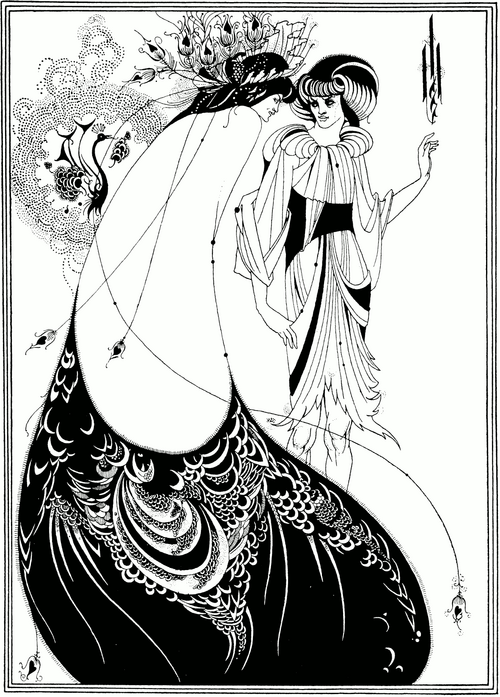 The Peacock Skirt, by Aubrey Beardsley (1892)
 Divan Japonais lithograph by Henri de Toulouse-Lautrec (1892–93)
 Poster for Grafton Galleries by Eugène Grasset (1893)
 Poster for The Chap-Book by Will H. Bradley (1895)
 Poster for Rayon d'Or by Jean de Paléologue ("Pal") (1895)
 Biscuits Lefèvre-Utile by Alphonse Mucha (1896)
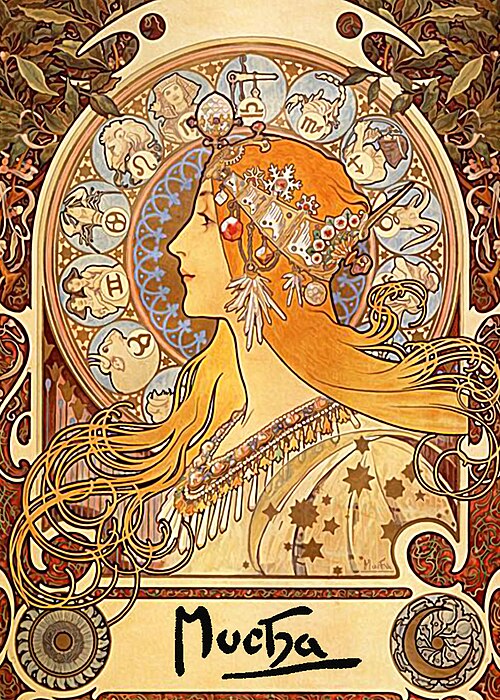 Zodiac Calendar by Mucha (1896)
 Motocycles Comiot by Théophile-Alexandre Steinlen from Les Maîtres de l'affiche (1899)
 Mir iskusstva cover by Maria Yakunchikova (1899)
 Ver Sacrum illustration by Koloman Moser (1899)
 Illustration from Ver Sacrum by Moser (1900)
 Festival poster by Ludwig Hohlwein (1910)
The graphic arts flourished in the Art Nouveau period, thanks to new technologies of printing, particularly colour lithography, which allowed the mass production of colour posters. Art was no longer confined to galleries, museums and salons; it could be found on Paris walls, and in illustrated art magazines, which circulated throughout Europe and to the United States. The most popular theme of Art Nouveau posters was women; women symbolizing glamour, modernity and beauty, often surrounded by flowers.
In Britain, the leading graphic artist in the Art Nouveau style was Aubrey Beardsley (1872–1898). He began with engraved book illustrations for Le Morte d'Arthur, then black and white illustrations for Salome by Oscar Wilde (1893), which brought him fame. In the same year, he began engraving illustrations and posters for the art magazine The Studio, which helped publicize European artists such as Fernand Khnopff in Britain. The curving lines and intricate floral patterns attracted as much attention as the text.[184]
The Swiss-French artist Eugène Grasset (1845–1917) was one of the first creators of French Art Nouveau posters. He helped decorate the cabaret Le Chat noir in 1885 and made his first posters for the Fêtes de Paris. He made a celebrated poster of Sarah Bernhardt in 1890, and a wide variety of book illustrations. The artist-designers Jules Chéret, Georges de Feure and the painter Henri de Toulouse-Lautrec all made posters for Paris theaters, cafés, dance halls cabarets. The Czech artist Alphonse Mucha (1860–1939) arrived in Paris in 1888, and in 1895 made a poster for actress Sarah Bernhardt in the play Gismonda by Victorien Sardou. The success of this poster led to a contract to produce posters for six more plays by Bernhardt. Over the next four years, he also designed sets, costumes, and even jewellery for the actress.[185][186] Based on the success of his theater posters, Mucha made posters for a variety of products, ranging from cigarettes and soap to beer biscuits, all featuring an idealized female figure with an hourglass figure. He went on to design products, from jewellery to biscuit boxes, in his distinctive style.[187]
In Vienna, the most prolific designer of graphics and posters was Koloman Moser (1868–1918), who actively participated in the Secession movement with Gustav Klimt and Josef Hoffmann, and made illustrations and covers for the magazine of the movement, Ver Sacrum, as well as paintings, furniture and decoration.[188]
Painting
 Le Corsage rayé by Édouard Vuillard (1895), National Gallery of Art
 Women at the Spring by Paul Sérusier (1898), Musée d'Orsay
 Beethoven Frieze in the Sezessionshaus in Vienna by Gustav Klimt (1902)
 Sgraffito by Paul Cauchie on his residence and studio, Brussels (1905)
 Detail of the frieze by Klimt in the Stoclet Palace, Brussels (1905–1911)
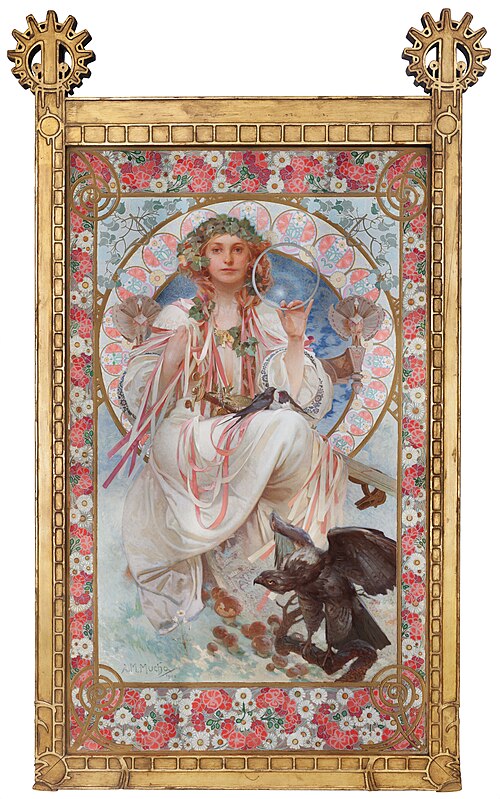 Slavia by Alphonse Mucha (1908)
Painting was another domain of Art Nouveau, though most painters associated with Art Nouveau are primarily described as members of other movements, particularly Post-Impressionism and symbolism. Alphonse Mucha was famous for his Art Nouveau posters, which frustrated him. According to his son and biographer, Jiří Mucha, he did not think much of Art Nouveau. "What is it, Art Nouveau? he asked. "... Art can never be new."[189] He took the greatest pride in his work as a history painter. His Art Nouveau-inspired painting Slava is a portrait of the daughter of his patron in Slavic costume, which was modelled after his theatrical posters.[189]
The painters most closely associated with Art Nouveau were Les Nabis, post-impressionist artists who were active in Paris from 1888 until 1900. One of their stated goals was to break down the barrier between the fine arts and the decorative arts. They painted not only canvases, but also decorative screens and panels. Many of their works were influenced by the aesthetics of Japanese prints. The members included Pierre Bonnard, Maurice Denis, Paul Ranson, Édouard Vuillard, Ker-Xavier Roussel, Félix Vallotton, and Paul Sérusier.[190]
The Austrian painter Gustav Klimt was an exponent of Art Nouveau painting, and more specifically a representative of the Modernist movement of the Viennese Secession. Klimt painted canvases and murals in an ornate personal style, which he also expressed through handicrafts, such as those found in the Viennese Secession Gallery. Klimt found one of his most recurring sources of inspiration in the female nude. His works are sensual, with a naturalistic, individual, organic style, inspired by nature following the decorative style of Gaudí.
The Catalan modernist painters (Ramón Casas, Santiago Rusiñol, Aleix Clapés, Joaquim Sunyer, Hermenegildo Anglada Camarasa, Juan Brull, Ricard Canals, Javier Gosé, Josep Maria Sert, Miguel Utrillo, etc.), closely connected with the avant-garde in Paris, and hugely influenced by Antoni Gaudí, had in the Els Quatre Gats tavern their meeting place. Pablo Picasso came out of the group.
Disciples of Anglada Camarasa were the Argentines Gregorio López Naguil, Tito Cittadini and Raúl Mazza who were responsible for carrying art nouveau painting to South America
In Belgium, Fernand Khnopff worked in both painting and graphic design. Wall murals by Gustav Klimt were integrated into decorative scheme of Josef Hoffmann for the Stoclet Palace (1905–1911). The Klimt mural for the dining room at the Stoclet Palace is considered a masterpiece of late Art Nouveau.
One subject did appear both in traditional painting and Art Nouveau; the American dancer Loie Fuller, was portrayed by French and Austrian painters and poster artists.[45]
One particular style that became popular in the Art Nouveau period, especially in Brussels, was sgraffito, a technique invented in the Renaissance of applying layers of tinted plaster to make murals on the façades of houses. This was used in particular by Belgian architect Paul Hankar for the houses he built for two artist friends, Paul Cauchie and Albert Ciamberlani.
Glass art
 Par une telle nuit cup by Émile Gallé (1894)
 Au Nouveau Cirque, Papa Chrysanthème by Henri de Toulouse-Lautrec and Louis Comfort Tiffany (c.1894), stained glass, Musée d'Orsay, Paris
 Blown glass with flower design by Karl Koepping (1896)
 Daum vase (1900)
 Daum lamp (1900)
 Lily lamp by Tiffany (1900–1910)
 Rose de France cup by Gallé (1901)
 Window for the House of an Art Lover, by Margaret Macdonald Mackintosh (1901)
 Lampe aux ombelles by Gallé (c.1902)
 Architecture stained glass window by John La Farge (1903)
 Stained glass window Veranda de la Salle by Jacques Grüber in Nancy, France (1904)
 Iridescent vase by Tiffany (1904)
 Glass designed by Otto Prutscher (1909)
 Jack-in-the-pulpit vase by Tiffany (c.1913)[191]
Glass art was a medium in which Art Nouveau found new and varied ways of expression. Intense amount of experimentation went on, particularly in France, to find new effects of transparency and opacity: in engraving win cameo, double layers, and acid engraving, a technique that permitted production in series. The city of Nancy became an important centre for the French glass industry, and the workshops of Émile Gallé and the Daum studio, led by Auguste and Antonin Daum, were located there. They worked with many notable designers, including Ernest Bussière, Henri Bergé, and Amalric Walter. They developed a new method of incrusting glass by pressing fragments of different coloured glass into the unfinished piece. They often collaborated with the furniture designer Louis Majorelle, whose home and workshops were in Nancy. Another feature of Art Nouveau was the use of stained glass windows with that style of floral themes in residential salons, particularly in the Art Nouveau houses in Nancy. Many were the work of Jacques Grüber, who made windows for the Villa Majorelle and other houses.[192]
In Belgium, the leading firm was the glass factory of Val Saint Lambert, which created vases in organic and floral forms, many of them designed by Philippe Wolfers. Wolfers was noted particularly for creating works of symbolist glass, often with metal decoration attached. In Bohemia, then a region of the Austro-Hungarian Empire noted for crystal manufacture, the companies J. & L. Lobmeyr and Joh. Loetz Witwe also experimented with new colouring techniques, producing more vivid and richer colours. In Germany, experimentation was led by Karl Köpping, who used blown glass to create extremely delicate glasses in the form of flowers; so delicate that few survive today.[193]
In Vienna, the glass designs of the Secession movement were much more geometrical than those of France or Belgium; Otto Prutscher was the most rigorous glass designer of the movement.[193] In Britain, a number of floral stained glass designs were created by Margaret Macdonald Mackintosh for the architectural display called The House of an Art Lover.
In the United States, Louis Comfort Tiffany and his designers became particularly famous for their lamps, whose glass shades used common floral themes intricately pieced together. Tiffany lamps gained popularity after the World's Columbian Exposition in Chicago in 1893, where Tiffany displayed his lamps in a Byzantine-like chapel. Tiffany experimented extensively with the processes of colouring glass, patenting in 1894 the process Favrile glass, which used metallic oxides to colour the interior of the molten glass, giving it an iridescent effect. His workshops produced several different series of the Tiffany lamp in different floral designs, along with stained glass windows, screens, vases and a range of decorative objects. His works were first imported to Germany, then to France by Siegfried Bing, and then became one of the decorative sensations of the 1900 Exposition. An American rival to Tiffany, Steuben Glass, was founded in 1903 in Corning, N.Y., by Frederick Carder, who, like Tiffany, used the Fevrile process to create surfaces with iridescent colours. Another notable American glass artist was John La Farge, who created intricate and colourful stained glass windows on both religious and purely decorative themes.[193]
Examples of stained glass windows in churches can be found in the Art Nouveau religious buildings article.
Metal art
 Tulip candelabra by Fernand Dubois (1899)
 Cast iron Baluster by George Grant Elmslie (1899–1904)
 Chocolate pot with a molinet (stirring rod) by Lucien Bonvallet made of silver, ivory and palmwood (c.1900)
 Teapot by Alphonse Debain made of gilt silver and ivory (1900)
 Paris Métro balustrade plaque by Guimard (1900)

 Light fixture by Victor Horta (1903)
 Lamp by German architect Friedrich Adler (1903–04)
 Lamp by Ernst Riegel made of silver and malachite (1905)
 Gate of Villa Knopf in Strasbourg, France (1905)
 Bat goblet by Henri Husson made of embossed and hammered copper, gold and silver applications (c.1909)
 Door detail of Hauptstraße no. 11 in Berlin (unknown date)
The 19th-century architectural theorist Viollet-le-Duc had advocated showing, rather than concealing the iron frameworks of modern buildings, but Art Nouveau architects Victor Horta and Hector Guimard went a step further: they added iron decoration in curves inspired by floral and vegetal forms both in the interiors and exteriors of their buildings. They took the form of stairway railings in the interior, light fixtures, and other details in the interior, and balconies and other ornaments on the exterior. These became some of the most distinctive features of Art Nouveau architecture. The use of metal decoration in vegetal forms soon also appeared in silverware, lamps, and other decorative items.[194]
In the United States, the designer George Grant Elmslie made extremely intricate cast iron designs for the balustrades and other interior decoration of the buildings of Chicago architect Louis Sullivan.
While French and American designers used floral and vegetal forms, Joseph Maria Olbrich and the other Secession artists designed teapots and other metal objects in a more geometric and sober style.[195]
Jewellery
 Dragonfly Lady brooch by René Lalique, made of gold, enamel, chrysoprase, moonstone, and diamonds (1897–98)
 Carved horn decorated with pearls, by Louis Aucoc (c.1900)
 Translucent enamel flowers with small diamonds in the veins, by Aucoc (c.1900)
 Flora brooch by Aucoc (c.1900)
 A corsage ornament by Philippe Wolfers (1900)
 Brooch with woman by Lalique
 Necklace by Charles Robert Ashbee (1901)
 Niké brooch by Wolfers (1902), collection King Baudouin Foundation, depot: KMKG-MRAH
 Brooch of horn with enamel, gold and aquamarine by Paul Follot (1904–1909)
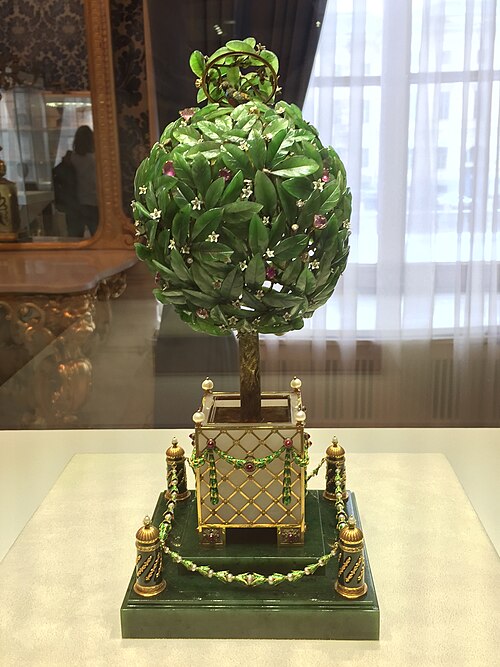 Bay TreeFabergé egg (1911)
Art Nouveau jewellery's characteristics include subtle curves and lines. Its design often features natural objects including flowers, animals or birds. The female body is also popular often appearing on cameos. It frequently included long necklaces made of pearls or sterling-silver chains punctuated by glass beads or ending in a silver or gold pendant, itself often designed as an ornament to hold a single, faceted jewel of amethyst, peridot, or citrine.[196]
Art Nouveau jewellery is distinguished by its extensive use of detailed, symbolic motifs that embody the movement's deep connection to nature and mythology. Predominant motifs include the ethereal forms of dragonflies and peacocks, which symbolise transformation and beauty, and the detailed depictions of plants and flowers, highlighting nature's cyclicality and growth. Intricately designed insects like butterflies and scarabs, often rendered with meticulous enamelling, add a layer of mysticism, symbolising rebirth and protection. This style also frequently featured sinuous figures of women, suggesting sensuality and the connection to the earth. More ominous figures such as snakes and mythical creatures like Medusas and chimeras were used to evoke the darker aspects of the natural and mythical worlds. The use of these motifs was not merely for embellishment; each was imbued with meanings, reflecting Art Nouveau's philosophy of integrating art, nature, and spiritual symbolism.[197]
The Art Nouveau period brought a notable stylistic revolution to the jewellery industry, led largely by the major firms in Paris. For the previous two centuries, the emphasis in fine jewellery had been creating dramatic settings for diamonds. During the reign of Art Nouveau, diamonds usually played a supporting role. Jewellers experimented with a wide variety of other stones, including agate, garnet, opal, moonstone, aquamarine and other semi-precious stones, and with a wide variety of new techniques, among others enamelling, and new materials, including horn, moulded glass, and ivory. These materials allowed them to create organic forms and intricate details, highlighting the era's departure from traditional jewellery design towards more artistic and expressive creations. Techniques like plique-à-jour enamelling were employed to achieve translucent effects akin to stained glass, adding depth and luminosity to their pieces.
Early notable Paris jewellers in the Art Nouveau style included Louis Aucoc, whose family jewellery firm dated to 1821. The most famous designer of the Art Nouveau period, René Lalique, served his apprenticeship in the Aucoc studio from 1874 to 1876. Lalique became a central figure of Art Nouveau jewellery and glass, using nature, from dragonflies to grasses, as his models. Artists from outside of the traditional world of jewellery, such as Paul Follot, best known as a furniture designer, experimented with jewellery designs. Other notable French Art Nouveau jewellery designers included Jules Brateau and Georges Henry. In the United States, the most famous designer was Louis Comfort Tiffany, whose work was shown at the shop of Siegfried Bing and also at the 1900 Paris Exposition. Siegfried Bing's Paris gallery, Maison de l'Art Nouveau, played a pivotal role in promoting Art Nouveau jewellery. By showcasing works from avant-garde jewellers like René Lalique, Henri Vever, and Edward Colonna, Bing elevated jewellery to the status of fine art and fostered international appreciation for the style.
In Britain, the most prominent figure was the Liberty & Co. & Cymric designer Archibald Knox, who made a variety of Art Nouveau pieces, including silver belt buckles. C. R. Ashbee designed pendants in the shapes of peacocks. The versatile Glasgow designer Charles Rennie Mackintosh also made jewellery, using traditional Celtic symbols. In Germany, the centre for Jugendstil jewellery was the city of Pforzheim, where most of the German firms, including Theodor Fahrner, were located. They quickly produced works to meet the demand for the new style.[196]
Architecture and ornamentation


 Whiplash motifs at Vitebsky railway station in Saint Petersburg by Sima Mihash and Stanislav Brzozowski (1904)
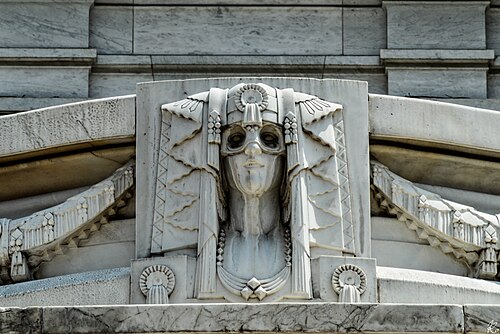 One of the mascarons made by Adamo Boari in the façade of the Palacio de Bellas Artes in Mexico City (1904–1934)
 Asymmetric façade with curved lines of De Beck building in Brussels by Gustave Strauven (1905)
 Irises and mascaron at the façade of Schichtel building in Strasbourg, France, by Aloys Walter (1905–06)
 Relief on the façade of the Fanny and Isac Popper House (Strada Sfinților no. 1) in Bucharest, designed by Alfred Popper (1914)[171]
Art Nouveau architecture was a reaction against the eclectic styles that dominated European architecture in the second half of the 19th century. It was expressed through decoration: either ornamental (based on flowers and plants, e.g. thistles,[198] irises,[199] cyclamens, orchids, water lilies etc.) or sculptural (see the respective section below). While faces of people (or mascarons) are referred to ornament, the use of people in different forms of sculpture (statues and reliefs: see the respective section below) was also common in some forms of Art Nouveau. Before Vienna Secession, Jugendstil and the various forms of the National romantic style façades were asymmetrical, and often decorated with polychrome ceramic tiles. The decoration usually suggested movement; there was no distinction between the structure and the ornament.[200] A curling or "whiplash" motif, based on the forms of plants and flowers, was widely used in the early Art Nouveau, but decoration became more abstract and symmetrical in Vienna Secession and other later versions of the style, as in the Stoclet Palace in Brussels (1905–1911).[201]
The style first appeared in Brussels' Hankar House by Paul Hankar (1893) and Hôtel Tassel (1892–93) of Victor Horta. The Hôtel Tassel was visited by Hector Guimard, who used the same style in his first major work, the Castel Béranger (1897–98). Horta and Guimard also designed the furniture and the interior decoration, down to the doorknobs and carpeting. In 1899, based on the fame of the Castel Béranger, Guimard received a commission to design the entrances of the stations of the new Paris Métro, which opened in 1900. Though few of the originals survived, these became the symbol of the Art Nouveau movement in Paris.
In Paris, the architectural style was also a reaction to the strict regulations imposed on building façades by Georges-Eugène Haussmann, the prefect of Paris under Napoleon III. Bow windows were finally allowed in 1903, and Art Nouveau architects went to the opposite extreme, most notably in the houses of Jules Lavirotte, which were essentially large works of sculpture, completely covered with decoration. An important neighbourhood of Art Nouveau houses appeared in the French city of Nancy, around the Villa Majorelle (1901–02), the residence of the furniture designer Louis Majorelle. It was designed by Henri Sauvage as a showcase for Majorelle's furniture designs.[200]
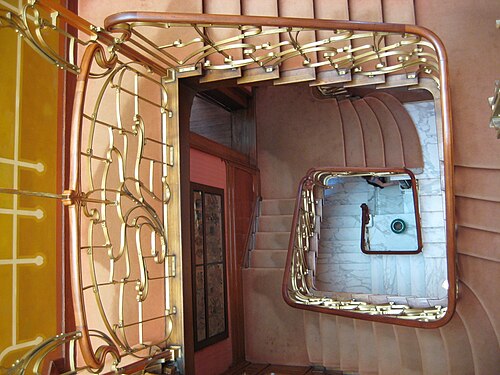

 Interior of Palau de la Música Catalana in Barcelona (1905–1909)
 Detail of the Stoclet Palace in Brussels (1905–1911)
Many Art Nouveau buildings were included in UNESCO World Cultural Heritage list as a part of their city centres (in Bern, Budapest, Lviv, Paris, Porto, Prague, Riga, Saint Petersburg, Strasbourg (Neustadt), Vienna). Along with them, there were buildings that were included in the list as separate objects:
 Belgium: the works of Victor Horta (Hôtel Tassel, Hôtel Solvay, Hôtel van Eetvelde, Maison and Atelier Horta)[5] and the Stoclet Palace by Josef Hoffmann in Brussels;[92]
 Spain: the works of Lluís Domènech i Montaner[121] (Palau de la Música Catalana and Hospital de Sant Pau in Barcelona), and the works of Antoni Gaudí[202] (Park Güell, Palau Güell, Sagrada Família, Casa Batlló, Casa Milá, Casa Vicens in Barcelona; Colònia Güell in Santa Coloma de Cervelló).
Sculpture
 High-relief of swans and statues in the interior of Aarhus Theatre, Denmark, by Karl Hansen Reistrup (1897–1900)
 Dancer with a Scarf, made for the Manufacture nationale de Sèvres, France, by Agathon Léonard (1898)
![Bust decorating the balconies of 29 avenue Rapp, Paris, by Alexandre Bigot and Jean-Baptiste Larrivé [fr] (1901)](https://file.arabipedia.wiki/wikipedia/commons/thumb/1/19/Bigot_-_Lavirotte_-_Larriv%C3%A9_-_Bust%2C_attic_element_with_green-glaze.jpg/500px-Bigot_-_Lavirotte_-_Larriv%C3%A9_-_Bust%2C_attic_element_with_green-glaze.jpg) Bust decorating the balconies of 29 avenue Rapp, Paris, by Alexandre Bigot and Jean-Baptiste Larrivé (1901)
Bust decorating the balconies of 29 avenue Rapp, Paris, by Alexandre Bigot and Jean-Baptiste Larrivé (1901)
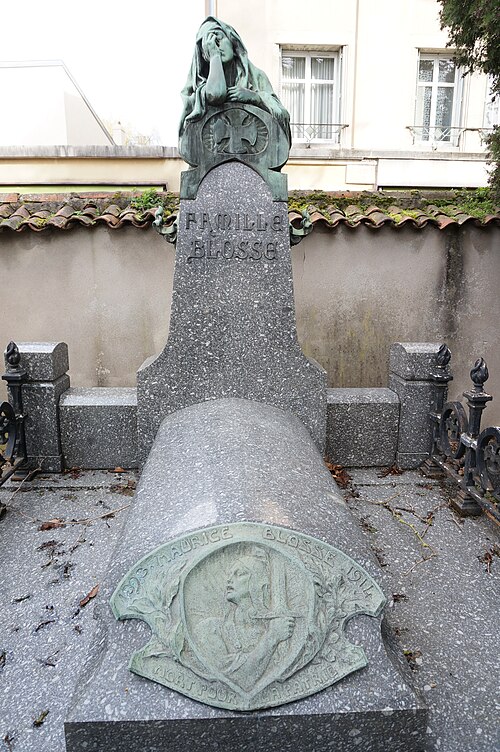 Sculpture in Nancy, France, by Ernest Bussière
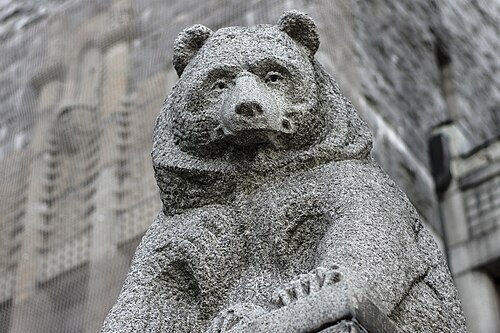 Bear statue at the National Museum of Finland in Helsinki by Emil Wikström (1905–1910)
 Bas-relief in Sprudelhof, Bad Nauheim, Germany, by Heinrich Jobst (1905–1911)
 Monument to Siege of Zaragoza by Agustí Querol Subirats (1908)
 Ceramic relief and statue in Hradec Králové, Czech Republic, by Stanislav Sucharda (1909–1912)

Sculpture was another form of expression for Art Nouveau artists, crossing with ceramics sometimes. The porcelain figurine Dancer with a Scarf by Agathon Léonard won recognition both in ceramics and in sculpture at the Paris Exposition in 1900. Sculptors of other countries also created ceramic sculptures: Bohemian Stanislav Sucharda and Ladislav Šaloun, Belgian Charles Van der Stappen and Catalan Lambert Escaler, who created statues of polychrome terracotta. Another notable sculptor of that time was Agustí Querol Subirats from Catalonia who created statues in Spain, Mexico, Argentina, and Cuba.[203]
In architectural sculpture not only statues but also reliefs were used. Art Nouveau architects and sculptors found inspiration in animal motifs (butterflies,[204] peacocks,[205] swans,[206] owls,[207] bats,[208] dragons,[209] bears[210]). Atlantes,[211]caryatids,[212]putti,[213] and gargoyles[214] were also used.
Furniture
 Chair by Rupert Carabin (1895)
 Chair by Henry van de Velde (1896)
 Chair by Charles Rennie Mackintosh (1897–1900)
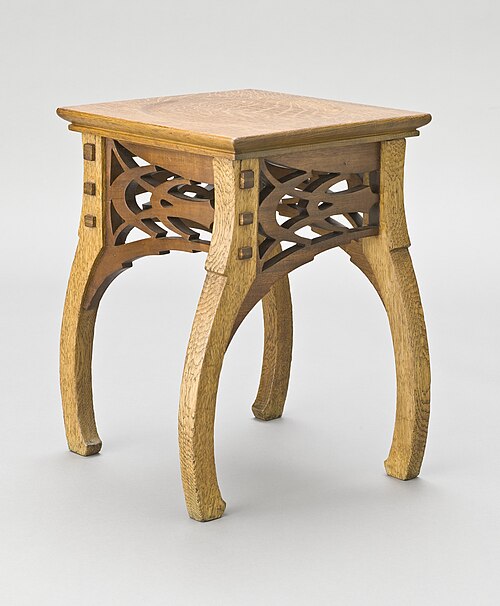 Stool by Paul Hankar (1898)
 Chair by Charles Rohlfs (1898–99)
 Wardrobe by Richard Riemerschmid (1902)
 Snail chair and other furniture by Carlo Bugatti (1902)
 Furniture from Turin by Victor Horta (1902), in the collection of the King Baudouin Foundation
 Furniture set by Horta from the Hôtel Aubecq in Brussels (1902–1904)
 Chair by Gaspar Homar (1903)
 Dining room by Eugène Vallin (1903)
 A bedroom by Louis Majorelle (1903–04)
 Dawn and Dusk bed by Émile Gallé (1904)
 Adjustable armchair Model 670 Sitting Machine designed by Josef Hoffmann (1904–1906)
 French Art Nouveau. Metal stool made in Lyon (1910)
 TOLEDO UHL steel chair "SODA FOUNTAIN" from 1910, Ohio
Furniture design in the Art Nouveau period was closely associated with the architecture of the buildings; the architects often designed the furniture, carpets, light fixtures, doorknobs, and other decorative details. The furniture was often complex and expensive; a fine finish, usually polished or varnished, was regarded as essential, and continental designs were usually very complex, with curving shapes that were expensive to make. It also had the drawback that the owner of the home could not change the furniture or add pieces in a different style without disrupting the entire effect of the room. For this reason, when Art Nouveau architecture went out of style, the style of furniture also largely disappeared.
In France, the centre for furniture design and manufacture was in Nancy, where two major designers, Émile Gallé and Louis Majorelle had their studios and workshops, and where the Alliance des industries d'art (later called the School of Nancy) had been founded in 1901. Both designers based on their structure and ornamentation on forms taken from nature, including flowers and insects, such as the dragonfly, a popular motif in Art Nouveau design. Gallé was particularly known for his use of marquetry in relief, in the form of landscapes or poetic themes. Majorelle was known for his use of exotic and expensive woods, and for attaching bronze sculpted in vegetal themes to his pieces of furniture. Both designers used machines for the first phases of manufacture, but all the pieces were finished by hand. Other notable furniture designers of the Nancy School included Eugène Vallin and Émile André; both were architects by training, and both designed furniture that resembled the furniture from Belgian designers such as Horta and Van de Velde, which had less decoration and followed more closely the curving plants and flowers.
Other notable French designers included Henri Bellery-Desfontaines, who took his inspiration from the neo-Gothic styles of Viollet-le-Duc; and Georges de Feure, Eugène Gaillard, and Édouard Colonna, who worked together with art dealer Siegfried Bing to revitalize the French furniture industry with new themes. Their work was known for "abstract naturalism", its unity of straight and curved lines, and its rococo influence. The furniture of de Feure at the Bing pavilion won a gold medal at the 1900 Paris Exposition. The most unusual and picturesque French designer was François-Rupert Carabin, a sculptor by training, whose furniture featured sculpted nude female forms and symbolic animals, particularly cats, who combined Art Nouveau elements with Symbolism. Other influential Paris furniture designers were Charles Plumet, and Alexandre Charpentier.[215] In many ways the old vocabulary and techniques of classic French 18th-century Rococo furniture were re-interpreted in a new style.[10]
In Belgium, the pioneer architects of the Art Nouveau movement, Victor Horta and Henry van de Velde, designed furniture for their houses, using vigorous curving lines and a minimum of decoration. The Belgian designer Gustave Serrurier-Bovy added more decoration, applying brass strips in curving forms. In the Netherlands, where the style was called Nieuwe Kunst or New Art, H. P. Berlage, Carel Adolph Lion Cachet and Theodor Nieuwenhuis followed a different course, that of the English Arts and Crafts movement, with more geometric rational forms.
In Britain, the furniture of Charles Rennie Mackintosh was purely Arts and Crafts, austere and geometrical, with long straight lines and right angles and a minimum of decoration.[216] Continental designs were much more elaborate, often using curved shapes both in the basic shapes of the piece, and in applied decorative motifs. In Germany, the furniture of Peter Behrens and the Jugendstil was largely rationalist, with geometric straight lines and some decoration attached to the surface. Their goal was exactly the opposite of French Art Nouveau; simplicity of structure and simplicity of materials, for furniture that could be inexpensive and easily mass-manufactured. The same was true for the furniture of designers of the Wiener Werkstätte in Vienna, led by Otto Wagner, Josef Hoffmann, Josef Maria Olbrich and Koloman Moser. The furniture was geometric and had a minimum of decoration, though in style it often followed national historic precedent, particularly the Biedemeier style.[217]
Italian and Spanish furniture design went off in their own direction. Carlo Bugatti in Italy designed the extraordinary Snail Chair, wood covered with painted parchment and copper, for the Turin International Exposition of 1902. In Spain, following the lead of Antoni Gaudí and the Modernismo movement, the furniture designer Gaspar Homar designed works that were inspired by natural forms with touches of Catalan historic styles.[136]
In the United States, furniture design was more often inspired by the Arts and Crafts movement, or by historic American models, than by the Art Nouveau. One designer who did introduce Art Nouveau themes was Charles Rohlfs in Buffalo, N.Y., whose designs for American white oak furniture were influenced by motifs of Celtic art and Gothic art, with touches of Art Nouveau in the metal trim applied to the pieces.[136]
Ceramics

 Faience or earthenware vase with two feet, with mountain night scene on the back and a floral daylight scene with butterfly on the front, by Gallé (1884–85), Cooper Hewitt, Smithsonian Design Museum, New York City
 Hand-painted tile panel on the façade of the Grande Maison de Blanc in Brussels, designed by Privat Livemont and made by the Boch Frères Kéramis (1897–98)[218]
 Amphora with elm-leaf and blackberry, manufactured by Stellmacher & Kessner (c.1900), Museum of Applied Arts, Budapest
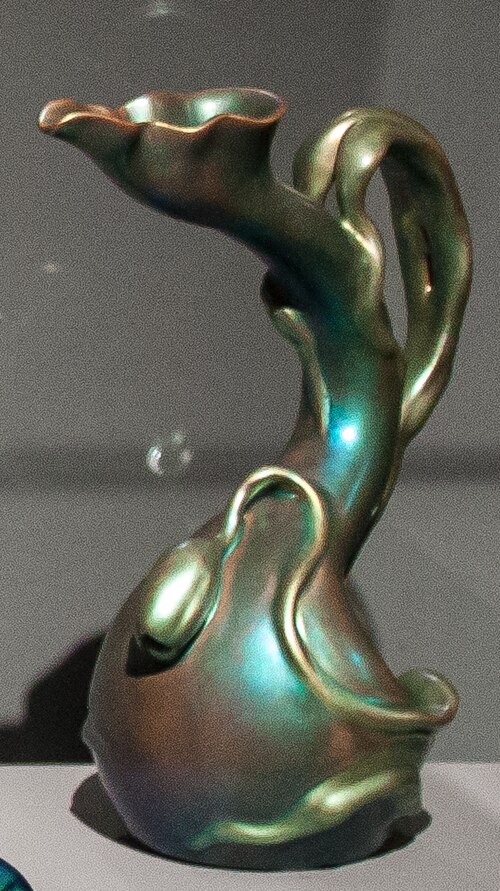 Vase, by József Rippl-Rónai (1900), in the Museum of Applied Arts, Budapest
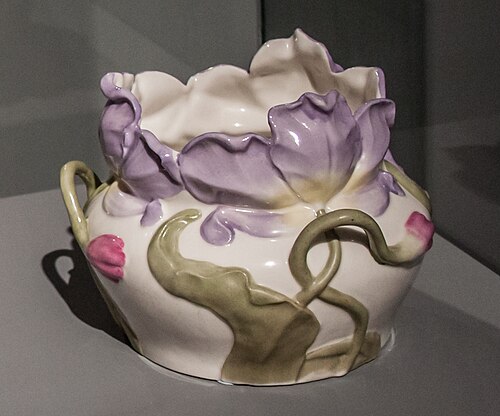 Vase with vines and snails, by Pál Horti (1900), Museum of Applied Arts, Budapest
 Ceramic façade decoration of Lavirotte Building (Avenue Rapp no. 29) in Paris, designed by Jules Lavirotte and decorated with sculpture and ceramic tiles made by the ceramics manufacturer Alexandre Bigot (1901)
 The Scarf Dance, by Agathon Léonard (1901–02), Art Institute of Chicago, US
 Tiles in the hallway of Allée de la Robertsau no. 56 in Strasbourg, France, designed by Frantz Lütke and Heinrich Backes (1902)[219]
 Vase, by Edmond Lachenal (1902), Museum of Decorative Arts, Paris
 Mosaics of the Schmidl Mausoleum in Budapest by the Zsolnay factory and Miksa Róth (1902–03)
 Mistletoe vase, by Artus Van Briggle for Van Briggle Pottery (1904), Metropolitan Museum of Art
 Fireplace mantel, attributed to Émile Müller (c.1904), Museum of Decorative Arts, Paris
 Facade of Avenue Charles-de-Gaulle no. 43, Nevers, France, by Georges-Théodore Renaud (architect) and Alexandre Bigot (ceramist) (1905)[220]
 Polychrome tiled stove in the Mița the Cyclist House (Strada Biserica Amzei no. 9) in Bucharest, by Nicolae C. Mihăescu (1908)[221]
 Panel on the façade of Genval railway station in Rixensart, Belgium, designed by architect G. De Lulle (1910)
Ceramic art, including faience, was another flourishing domain for Art Nouveau artists, in the English-speaking countries falling under the wider art pottery movement. The last part of the 19th century saw many technological innovations in the manufacture of ceramics, particularly the development of high temperature (grand feu) ceramics with crystallised and matte glazes. At the same time, several lost techniques, such as sang de boeuf glaze, were rediscovered. Art Nouveau ceramics were also influenced by traditional and modern Japanese and Chinese ceramics, whose vegetal and floral motifs fitted well with the Art Nouveau style. In France, artists also rediscovered the traditional stoneware (grés) methods and reinvented them with new motifs.[222]
Émile Gallé, in Nancy, created earthenware works in natural earth colors with naturalistic themes of plants and insects. Ceramics also found an important new use in architecture: Art Nouveau architects, Jules Lavirotte and Hector Guimard among them, began to decorate the façades of buildings with architectural ceramics, many of them made by the firm of Alexandre Bigot, giving them a distinct Art Nouveau sculptural look.[222]
One of the pioneer French Art Nouveau ceramists was Ernest Chaplet, whose career in ceramics spanned thirty years. He began producing stoneware influenced by Japanese and Chinese prototypes. Beginning in 1886, he worked with painter Paul Gauguin on stoneware designs with applied figures, multiple handles, painted and partially glazed, and collaborated with sculptors Félix Bracquemond, Jules Dalou and Auguste Rodin. His works were acclaimed at the 1900 Exposition.
The major national ceramics firms had an important place at the 1900 Paris Exposition: the Manufacture nationale de Sèvres outside Paris; Nymphenburg, Meissen, Villeroy & Boch in Germany, and Doulton in Britain. Other leading French ceramists included Taxile Doat, Pierre-Adrien Dalpayrat, Edmond Lachenal, Albert Dammouse and Auguste Delaherche.[223]
In France, Art Nouveau ceramics sometimes crossed the line into sculpture. The porcelain figurine Dancer with a Scarf by Agathon Léonard, made for the Manufacture nationale de Sèvres, won recognition in both categories at the 1900 Paris Exposition.
The Zsolnay factory in Pécs, Hungary, was founded by Miklós Zsolnay (1800–1880) in 1853 and led by his son, Vilmos Zsolnay (1828–1900) with chief designer Tádé Sikorski (1852–1940) to produce stoneware and other ceramics. In 1893, Zsolnay introduced porcelain pieces made of eosin. He led the factory to worldwide recognition by demonstrating its innovative products at world fairs and international exhibitions, including the 1873 World Fair in Vienna, then at the 1878 World Fair in Paris, where Zsolnay received a Grand Prix. Frost-resisting Zsolnay building decorations were used in numerous buildings, specifically during the Art Nouveau movement.[224]
Ceramic tiles were also a distinctive feature of Portuguese Arte Nova that continued the long azulejo tradition of the country.
Mosaics
 Maiolica mural of Abramtsevo Colony, Russia (1870s–1890s)
 Majolica fireplace, house of Bazhanov, Abramtsevo Colony, by Mikhail Vrubel (1898)
 Mosaics of Fox and Anchor pub in London by William James Neatby (1898)
![Mosaics designed by Oskar Graf for Merkel’sches Schwimmbad [de] in Esslingen am Neckar, Germany (1905–1907)](https://file.arabipedia.wiki/wikipedia/commons/thumb/4/44/Esslingen_a.N._-_Altstadt_-_Merkelsches_Schwimmbad_-_Fassadenmosaik.jpg/500px-Esslingen_a.N._-_Altstadt_-_Merkelsches_Schwimmbad_-_Fassadenmosaik.jpg) Mosaics designed by Oskar Graf for Merkel’sches Schwimmbad in Esslingen am Neckar, Germany (1905–1907)
Mosaics designed by Oskar Graf for Merkel’sches Schwimmbad in Esslingen am Neckar, Germany (1905–1907)

 Mosaics for Palace of Culture in Târgu Mureș, Romania by Aladár Körösfői-Kriesch and Miksa Róth (1911–1913)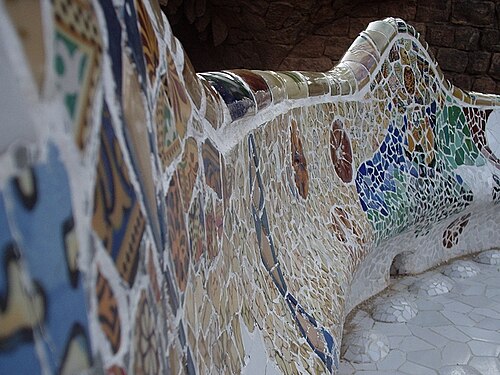
 Mosaics by Louis Comfort Tiffany (1915)
Mosaics were used by many Art Nouveau artists of different movements, especially of Catalan Modernisme (Hospital de Sant Pau, Palau de la Música Catalana, Casa Lleó-Morera and many others). Antoni Gaudí invented a new technique in the treatment of materials called trencadís, which used waste ceramic pieces.
Colourful Maiolica tile in floral designs were a distinctive feature of the Majolica House in Vienna by Otto Wagner, (1898) and of the buildings of the works of the Russian Abramtsevo Colony, especially those by Mikhail Vrubel.
Textiles and wallpaper
- Silk and wool tapestry design, Cyclamen, by Hermann Obrist, an early example of the Whiplash motif based on the stem of a cyclamen flower (1895)
 Page on the Water Lily, from the book by Eugène Grasset on ornamental uses of flowers (1899)
 Textile design by Koloman Moser (1899)
 Fashion plate by Félix Fournery (c.1900)
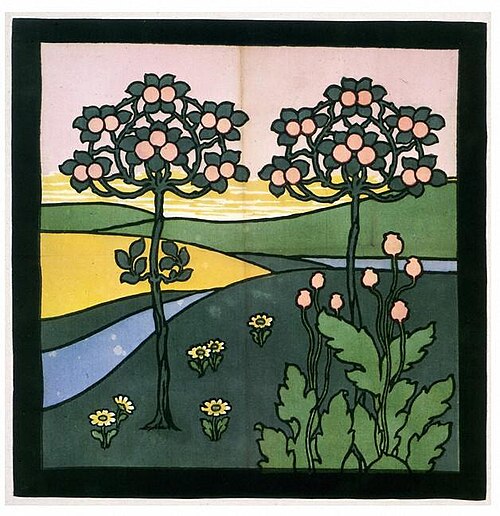 Printed cotton from the Silver Studio, for Liberty department store (1904)
 The Shepherd tapestry by János Vaszary (1906) combined Art Nouveau motifs and a traditional Hungarian folk theme
 A carpet by Victor Horta in the collection of the King Baudouin Foundation
Textiles and wallpapers were an important vehicle of Art Nouveau from the beginning of the style, and an essential element of Art Nouveau interior design. In Britain, the textile designs of William Morris had helped launch the Arts and Crafts movement and then Art Nouveau. Many designs were created for the Liberty department store in London, which popularized the style throughout Europe. One such designer was the Silver Studio, which provided colourful stylised floral patterns. Other distinctive designs came from Glasgow School, and Margaret Macdonald Mackintosh. The Glasgow school introduced several distinctive motifs, including stylised eggs, geometric forms and the "Rose of Glasgow".
In France, a major contribution was made by designer Eugène Grasset who in 1896 published La Plante et ses applications ornamentales, suggesting Art Nouveau designs based on different flowers and plants. Many patterns were designed for and produced by for the major French textile manufacturers in Mulhouse, Lille and Lyon, by German and Belgian workshops. The German designer Hermann Obrist specialized in floral patterns, particularly the cyclamen and the "whiplash" style based on flower stems, which became a major motif of the style. The Belgian Henry van de Velde presented a textile work, La Veillée d'Anges, at the Salon La Libre Esthéthique in Brussels, inspired by the symbolism of Paul Gauguin and of the Nabis. In the Netherlands, textiles were often inspired by batik patterns from the Dutch colonies in the East Indies. Folk art also inspired the creation of tapestries, carpets, embroidery and textiles in Central Europe and Scandinavia, in the work of Gerhard Munthe and Frida Hansen in Norway. The Five Swans design of Otto Eckmann appeared in more than one hundred different versions. The Hungarian designer János Vaszary combined Art Nouveau elements with folkloric themes.[226]
Museums
There are 4 types of museums featuring Art Nouveau heritage:
- Broad-scope museums (not specifically dedicated to Art Nouveau but with a large collection of items in this style). Art Nouveau monuments are italicised;
- House-museums of Art Nouveau artists (all but Alphonse Mucha museum are Art Nouveau monuments);
- Museums dedicated to local Art Nouveau movements (all are Art Nouveau monuments);
- Other Art Nouveau buildings with museum status or featuring a museum inside (not dedicated to local Art Nouveau movements/specific artists).

















There are many other Art Nouveau buildings and structures that do not have museum status but can be officially visited for a fee or unofficially for free (e.g. railway stations, churches, cafes, restaurants, pubs, hotels, stores, offices, libraries, cemeteries, fountains as well as numerous apartment buildings that are still inhabited).
Posterity
Criticized for "its primitive extravagances", Art Nouveau started to fade away after 1911.[230] In histories of European architecture in the 20th century, from the 1930s to the 1950s, influential historians, like Nikolaus Pevsner, Sigfried Giedion and Henry-Russell Hitchcock, did not take Art Nouveau into consideration. This left the first versions of Pevsner's The Genius of European Architecture without a mention of Hector Guimard or Antoni Gaudí. The first major works dealing with Art Nouveau were published at the end of the 1950s, with Johnny Watser.
Influence on Art Deco
 Entry for the House for an art lover competition, by Charles Rennie Mackintosh (1900)[231]
 Secessionist exterior of the Bazil Assan House (Strada Scaune no. 21–23, currently Strada Tudor Arghezi) in Bucharest, by Marcel Kammerer (1902–1911), demolished in the late 1950s or the 1960s to make space for the National Theatre Bucharest[232]
 Secessionist putto with two cornucopias with floral cascades, very similar to the ones found in a lot of Art Deco of the 1910s and 1920s, by Michael Powolny, designed in c.1907, produced in 1912, ceramic, Kunstgewerbemuseum Berlin[234]
 Via Statuto no. 12 (Art Deco) in Milan, Italy, by Giovanni Greppi (1919), similar to Charles Rennie Mackintosh's buildings
 Art Deco door with spirals and sinuous lines, of the Mihai Zisman House (Calea Călărașilor no. 44) in Bucharest, by Soru (1920)
 Art Deco Rolls Royce radiator figurine, similar to Art Nouveau ethereal figures of women in graceful wavy garments, designed by Charles Robinson Sykes (1920s), in the Antique and Classic Car Museum, Torre Loizaga, Galdames, Spain
 Art Deco museum design, similar to Josef Hoffmann's Secessionist buildings, part of a series of sketches known as Une cité moderne, by Robert Mallet-Stevens (1922)
 Art Deco balconies with sinuous bases of Avenue Richerand no. 1 in Paris, unknown architect (c.1930)
 Sinuous curves on the façade of Avenue Montaigne no. 26 in Paris, by Louis Duhayon and Marcel Julien (1937)[235]
Art Nouveau was one of the factors that led to Art Deco, a style created as a collective effort of multiple French designers to create a new modern style around 1910. This is because Art Nouveau broke the supremacy of 19th-century revivalism and eclecticism, opposing academic conventions. Through its various manifestations, it invented new ornamental systems, no longer dependent on historical formulae, through curvy plant forms in most of the world, geometric decoration in Austria-Hungary and the UK, and reinterpretations of national tradition in the countries of Northern, Central and Eastern Europe. The idea of creating a new style, with new ornaments and shapes, was a significant contribution that Art Nouveau brought to the invention of Art Deco. Another aspect taken from Art Nouveau is the emphasis put on domestic luxury.
Some of the fine details and sinuous lines of Art Nouveau are also found in Art Deco architecture and design of the 1920s, but slightly simplified. Similarly, the flat colours and visible outlines popularized by Art Nouveau posters are very often used in Art Deco illustration. Compared to many Art Nouveau designs, where the vegetal motifs seem to grow and morph on the object or architectural ornament, most Art Deco works have a clear compositional structure, similar to Neoclassicism.
Aside from ideas taken from Franco-Belgian Art Nouveau, influence came also from the geometric motifs and volumes found in the UK and Vienna. The flowers, spirals and squares found here are very similar to the ones found in Art Deco. Charles Rennie Mackintosh even anticipated Art Deco forms in his later creations. One of the Secessionist works that best anticipates the style is the Stoclet Palace in Brussels, with its ziggurat-shaped setbacks, the vertical slit of the staircase window, and the overall simplicity and modest ornamentation.[236]
Revivals
 Cover of the San Francisco Oracle, vol. 1, no. 5, from facsimile edition, an example of a psychedelic rock poster, unknown author (1966 or 1967)


 Strada Dimitrie Racoița in Bucharest, unknown architect (c.2010)
 Gustav Klimt's The Kiss printed on various objects in the window of a shop in Salzburg, Austria (2019)
During the 1960s, postmodernism was born. This was and is a movement that questions modernism (the status quo after World War II), and promoted the inclusion and reinterpretation of elements of historic styles in new designs. Although several international exhibitions on Art Nouveau happened in the 1950s, a successful revival appeared in the 1960s, and especially in the 1970s with the rise of postmodernism. Aside from exhibitions, this revival might be connected with the "flower power" generation that set the tone at the time recognized its own life ideals in the floral ornament and the erotically "emancipated" art themes of the years around 1900.
Art Nouveau was also one of the main sources of inspiration for many posters of psychedelic rock from the same period. Leading proponents of the 1960s psychedelic art movement were San Francisco poster artists such as Rick Griffin, Victor Moscoso, Bonnie MacLean, Stanley Mouse, Alton Kelley, and Wes Wilson. Compared to the earthy colours that characterize Art Nouveau, these posters had highly saturated colours put in contrast, and also highly stylised text, sometimes hard to read. This style flourished from about 1966 to 1972.
Gustav Klimt's iconic paintings are found today on many kitschy souvenirs: mugs, plates, napkins, key chains, and so on. The Kiss has been printed on countless sizes and materials. In a similar situation are Alphonse Mucha's posters.
One of the artists who found in Art Nouveau a major source of inspiration was the Austrian painter and architect Friedensreich Hundertwasser. He took inspiration from multiple sources, including Egon Schiele, Baroque and Persian miniature, and the curvy ornamentation of Art Nouveau.[238]
See also
Notes
References
- ↑Heilbrunn Timeline of Art History, Metropolitan Museum of Art, Art Nouveau
- 123Sembach, Klaus-Jürgen, L'Art Nouveau (2013), pp. 8–30
- ↑Sterner (1982), 6.
- 12Victor HortaArchived 19 April 2019 at the Wayback Machine – Encyclopædia Britannica
- 12345World Heritage Centre, UNESCO. "Major Town Houses of the Architect Victor Horta (Brussels)". whc.unesco.org. Archived from the original on 13 May 2013. Retrieved 26 December 2019.
- ↑Oudin, Bernard, Dictionnaire des Architectes Victor Horta article
- ↑"Art Nouveau", Heilbrunn Timeline of Art History, Metropolitan Museum of Art
- ↑Vigne, Georges, Hector Guimard – Le geste magnifique de l'Art Nouveau, (2016), Editions du Patrimoine, Centre des Monuments National, p. 194
- 12345Duncan (1994), pp. 23–24.
- 123456Gontar, Cybele. Art Nouveau. In Heilbrunn Timeline of Art HistoryArchived 15 May 2021 at the Wayback Machine. New York: The Metropolitan Museum of Art, 2000 (October 2006)
- 12Madsen, S. Tschudi (1977). Art Nouveau (in Romanian). Editura Meridiane. pp. 7, 71.
- 1234Michèle Lavallée, "Art Nouveau", Grove Dictionary of ArtOxford University Press, accessed 11 April 2008.
- ↑Vervliet, Raymond; Rijksuniversiteit Gent (1982). "III. De wereld van de schone schijn. Opkomst, bloei en verval van de Art Nouveau". De literaire manifesten van het fin de siècle in de Zuidnederlandse periodieken 1878-1914 (in Dutch). Brussel: Digitale Bibliotheek voor de Nederlandse Letteren. p. 110. Retrieved 25 May 2026.
Deze affiche werd in kleur gereproduceerd in het belangrijke werk van R. Schmutzler, Art Nouveau (New York, 1962), p. 149. Ook afgebeeld in het tijdschrift Forum, XIII (1958), p. 324.
- ↑Aleksandra Galant (23 August 2023). "Secesja – harmonia, perfekcja, delikatność". audycjekulturalne.pl (in Polish). Retrieved 29 September 2024.
- ↑Demian (7 May 2019). "Rețeaua Art Nouveau – experți europeni în patrimoniul arhitectural, la Oradea". Archived from the original on 9 July 2020. Retrieved 6 May 2020.
- ↑Fahr-Becker 2015, pp. 335–358.
- ↑Bouillon, Jean-Paul, Journal de l'Art Nouveau (1985), p. 6
- ↑"Chair | Mackmurdo, Arthur Heygate | V&A Explore the Collections". 1883. Archived from the original on 27 February 2020. Retrieved 27 February 2020.
- ↑Lingenheim, Claire. Art nouveau and Industrie(PDF) (in French). Accadémie Strasbourg. Archived(PDF) from the original on 20 January 2022. Retrieved 20 January 2022.
Viollet le Duc is the spokesman a rationalist mouvement where architecture becomes a true science, in which form stems from function.
- ↑Froissart-Pezone, Rossella (2005). L'Art dans tout. Paris: CNRS éditions.
- ↑Recht, Roland (2000). "Viollet-le-Duc et Gottfried Semper: Conceptions du patrimoine monumental". Revue Germanique Internationale (in French) (13): 155–168. doi:10.4000/rgi.780. Archived from the original on 20 January 2022. Retrieved 20 January 2022.
Nature as a model
- ↑Bressani, Martin (2014). Viollet le Duc, materials and building techniques (in French). Paris: Editions du Patrimoine.
Construction for an architect means using materials for their quality and their own nature
- ↑Pauliac, Laurence (2005). Viollet-le-Duc et la restauration de la polychromie (in French). Montréal: Université de Montréal.
It is fascinating to see how the style of his mural paintings at Notre Dame are precursors of Art Nouveau
- ↑Viollet-le-Duc, Entretiens sur l'architecture
- ↑Bouillon 1985, p. 24.
- ↑Interview in L'Écho de Paris, 28 December 1891, cited in Bouillon (1985)
- ↑Bouillon 1985, p. 26.
- ↑Lahor 2007, p. 30.
- ↑Fahr-Becker 2015, pp. 91–93.
- ↑Oudin, Bernard, Dictionnaiare des Architectes (1994), p. 237
- ↑Sembach, L'Art Nouveau p. 47
- 12Culot and Pirlot, Bruxelles Art Nouveau (2005), pp. 74–75.
- ↑BEKAERT, GEERT (1985). L'influence de Viollet-le-Duc sur l'architecture en Belgique et aux Pays-Bas vers 1900. Septentrion. p. 38.
- ↑Horta, Victor (1925). Discours de Victor Horta à l'Académie Royal de Belgique.
- ↑Sembach, L'Art Nouveau- L'Utopie de la Réconciliation (1991) pp. 46–47
- ↑Lahor 2007, p. 127.
- ↑Culot & Pirlot 2005, p. 74.
- ↑Culot & Pirlot 2005, p. 74–75.
- ↑Fahr-Becker 2015, p. 143.
- ↑Sachar, Brian (1984). An Atlas of European Architecture. Van Nostrand Reinhold. p. 27. ISBN 978-0-4422-8149-6.
- ↑Champigneulle, Bernard (1976). Art Nouveau. Barron's Educational Series. pp. 115, 121. ISBN 978-0-8120-5111-7.
- ↑Cite web Unesco websiteArchived 28 May 2020 at the Wayback Machine
- ↑Culot and Pirlot (2005), p. 20
- ↑Fahr-Becker 2015, p. 152.
- 12Bouillon 1985.
- ↑Hector GuimardArchived 25 February 2021 at the Wayback Machine – Art Nouveau World
- ↑Fahr-Becker 2015, p. 74.
- ↑Martin Eidelberg and Suzanne Henrion-Giele, "Horta and Bing: An Unwritten Episode of L'Art Nouveau", The Burlington Magazine, vol. 119, Special Issue Devoted to European Art Since 1890 (Nov. 1977), pp. 747–752.
- ↑Duncan (1994), pp. 15–16, 25–27.
- ↑Fahr-Becker 2015, pp. 391–413.
- ↑Sarnitz, August, Otto Wagner (2018), pp. 49–50
- ↑Sarnitz, August, Hoffmann, (2016), p. 14
- ↑Fahr-Becker 2015, pp. 296–27.
- ↑Fahr-Becker 2015, pp. 179–188.
- ↑Texier 2012, pp. 86–87.
- ↑Lahor 2007, p. 104.
- ↑Duncan (1994), p. 37.
- ↑Fahr-Becker 2015, p. 136.
- ↑Fahr-Becker 2015, pp. 136–137.
- ↑Fahr-Becker 2015, p. 140.
- ↑Culot & Pirlot 2005, p. 87.
- ↑Lahor 2007, p. 91.
- ↑Sterner (1982), pp. 38–42.
- 12Riley 2004, p. 323.
- 12Fahr-Becker 2015, p. 171.
- 12Fahr-Becker 2015, pp. 170–171.
- ↑Fahr-Becker 2015, pp. 166–167.
- ↑Hodge, Susie (2020). The Short Story of Women Artists. Laurence King Publishing. p. 21. ISBN 978-1786276551.
- ↑Goudie, Lachlan (2020). The Story of Scottish Art. Thames & Hudson. p. 250. ISBN 978-0-500-29695-0.
- ↑"V&A · Arts and Crafts: An introduction". Archived from the original on 15 February 2020. Retrieved 29 February 2020.
- ↑Art Nouveau by Rosalind Ormiston and Michael Robinson, 58
- ↑"Art Nouveau – Art Nouveau Art". 22 February 2013. Archived from the original on 22 February 2013.
- ↑Art Nouveau by Ormiston and Robinson, 61
- ↑Lahor 2007, p. 160.
- ↑Muter, Grant (1985). "Leon Solon and John Wadsworth". Journal of the Decorative Arts Society (9): 41–49. JSTOR 41809144.
- ↑He was commissioned by the Wardle family of dyers and printers, trading as Thomas Wardle & Co, and Bernard Wardle and Co.The Wardel Pattern Books RevealedArchived 3 December 2013 at the Wayback Machine
- ↑A. Philip McMahon, "review of F. Schmalenbach, Jugendstil", Parnassus, vol. 7 (Oct. 1935), 27.
- ↑Reinhold Heller, "Recent Scholarship on Vienna's "Golden Age", Gustav Klimt, and Egon Schiele", The Art Bulletin, vol. 59 (Mar. 1977), pp. 111–118.
- 12"Association of Visual Artists Vienna Secession – Official Website". Archived from the original on 25 April 2019. Retrieved 16 August 2019.
- ↑Lahor 2007, p. 52.
- ↑Bad NauheimArchived 16 July 2019 at the Wayback Machine – Art Nouveau European Route
- ↑MoscowArchived 11 April 2021 at the Wayback Machine – Art Nouveau World
- 12Junghanns, Kurt (1982). Der Deutsche Werkbund. Sein erstes Jahrzehnt (in German). Henschelverlag Kunst und Gesellschaft. p. 140. ISBN 388520097X.
- ↑Henry van de VeldeArchived 8 August 2019 at the Wayback Machine – Werkbundarchiv
- ↑Pevsner, Nikolaus; Fleming, John; Honour, Hugh, eds. (1999). A Dictionary of Architecture and Landscape Architecture (Paperback) (5th ed.). London: Penguin Books. p. 880. ISBN 978-0-14-051323-3.
- ↑BerlinArchived 11 April 2021 at the Wayback Machine – Art Nouveau World
- ↑Lahor 2007, p. 63.
- ↑"The "Coup de Fouet" magazine, vol. 27 (2016), pp. 14–25"(PDF). Archived(PDF) from the original on 28 July 2019. Retrieved 28 July 2019.
- ↑Lahor 2007, p. 120.
- 12Oudin, Bernard, Dictionnaire des Architectes (1994), pp. 33–34
- 12Sembach, L'Art Nouveau (2013), pp. 203–213
- 123"Stoclet House". UNESCO World Heritage Centre. 4 July 2009. Archived from the original on 21 July 2016. Retrieved 24 July 2019.
- ↑"Cities". Art Nouveau European Route.
- 1234"The "Coup de Fouet" magazine, vol. 23 (2014), pp. 2–35"(PDF). Archived(PDF) from the original on 14 July 2020. Retrieved 7 July 2019.
- ↑Ödön LechnerArchived 11 April 2021 at the Wayback Machine – Art Nouveau World
- ↑"The Coup de Fouet magazine, vol. 8 (2006), pp. 37–41"(PDF). Archived(PDF) from the original on 23 August 2019. Retrieved 7 July 2019.
- ↑"The Coup de Fouet magazine, vol. 14 (2009), p. 16"(PDF). Archived(PDF) from the original on 16 July 2020. Retrieved 7 July 2019.
- ↑Aladár Körösfői-KrieschArchived 11 April 2021 at the Wayback Machine – Art Nouveau World
- ↑Archived 10 July 2019 at the Wayback Machine The Gödöllő Artists' Colony – article by David A. Hill
- ↑PragueArchived 11 April 2021 at the Wayback Machine – Art Nouveau World
- 123"The Coup de Fouet magazine, vol. 13 (2009), pp. 36–41"(PDF). Archived(PDF) from the original on 16 July 2020. Retrieved 7 July 2019.
- ↑Constantin, Paul (1972). Arta 1900 în România (in Romanian). Editura Meridiane. p. 93.
- ↑"Turist în București: Lipscani 72 si 74". Retrieved 12 October 2022.
- 12Celac, Carabela & Marcu-Lapadat 2017, p. 85.
- ↑Florea, Vasile (2016). Arta Românească de la Origini până în Prezent. Litera. pp. 297, 302, 305, 306, 313, 317. ISBN 978-606-33-1053-9.
- ↑Elena Olariu... p. 16
- ↑"Oradea, capitala Art Nouveau a Romaniei, celebreaza 'Ziua Internațională Art Nouveau 2019'". infooradea.ro. 7 June 2019. Archived from the original on 23 May 2021. Retrieved 23 May 2021.
- ↑"Heritage of Timisoara – Cladiri". heritageoftimisoara.ro. Archived from the original on 16 May 2021. Retrieved 23 May 2021.
- ↑Ungvári, Zrínyi Imre. "The Art Nouveau public buildings of Tîrgu Mureș". wondersoftransylvania.com. Archived from the original on 23 May 2021. Retrieved 23 May 2021.
- ↑"Str. Mitropoliei nr. 20". Patrimoniu.Sibiu.ru. Archived from the original on 23 May 2021. Retrieved 23 May 2020.
- ↑"Sicilian Liberty – Italianate Art Nouveau – Best of Sicily Magazine". Bestofsicily.com. Archived from the original on 29 January 2020. Retrieved 15 February 2022.
- ↑Henry R. Hope, review of H. Lenning, The Art Nouveau, The Art Bulletin, vol. 34 (June 1952), 168–171 (esp. 168–169): In 1952, Discussing the state of Art Nouveau, the author noted that Art Nouveau was not yet an acceptable study for serious art history or a subject suitable for major museum exhibitions and their respective catalogs. He predicted an impending change
- ↑"Storia di Milano ::: Palazzi e case liberty". Archived from the original on 15 June 2012. Retrieved 2 August 2019.
- ↑Riley 2004, p. 310.
- ↑"Art Nouveau World – Serbia". Retrieved 8 September 2022.
- ↑"AFaces and Blossoms of Art Nouveau in Serbia". 9 June 2019. Retrieved 8 September 2022.
- 12ChronologyArchived 25 July 2019 at the Wayback Machine - Official website of Casa Milà
- ↑James Grady, "Special Bibliographical Supplement: A Bibliography of the Art Nouveau", in The Journal of the Society of Architectural Historians, vol. 14 (May 1955), pp. 18–27.
- ↑CronologiaArchived 19 September 2020 at the Wayback Machine – Official website of Palau Güell
- 123Duncan (1994), p. 52.
- 12"World Heritage List: Palau de la Música Catalana and Hospital de Sant Pau, Barcelona". UNESCO. Archived from the original on 6 January 2022. Retrieved 19 March 2022.
- ↑McCully, Marilyn (1978). Els Quarte Gats: Art in Barcelona Around 1900. Princeton University Press. p. 64.
- ↑Riley 2004, p. 311.
- ↑Casa do Major PessoaArchived 11 August 2020 at the Wayback Machine - Sistema de Informação para o Património Arquitetónico
- 12345"The Coup de Fouet magazine, vol. 11 (2008), pp. 2–7"(PDF). Archived(PDF) from the original on 18 July 2020. Retrieved 7 July 2019.
- ↑Francisco Augusto da Silva RochaArchived 31 October 2020 at the Wayback Machine – Art Nouveau World
- ↑LisbonArchived 17 March 2021 at the Wayback Machine – Art Nouveau World
- ↑PortoArchived 5 March 2021 at the Wayback Machine – Art Nouveau World
- ↑"Art Nouveau World". Archived from the original on 21 March 2021. Retrieved 11 April 2021.
- ↑Martin, T. & Pusa, E. 1985, p. 12.
- ↑National Museum of FinlandArchived 26 July 2019 at the Wayback Machine – Museums of EU
- 12"Art Nouveau European Route: Helsinki". www.artnouveau.eu. Archived from the original on 26 April 2016. Retrieved 2 January 2016.
- ↑"Magnus Schjerfbeck". Museum of Finnish Architecture. Archived from the original on 15 February 2020. Retrieved 15 February 2020.
- ↑Palmberg, Albert (April 1908). "The control of tuberculosis in Finland". British Journal of Tuberculosis. 2 (2): 109–114. doi:10.1016/S0366-0850(08)80065-8. Archived from the original on 15 February 2022. Retrieved 26 March 2019.
- ↑von Bonsdorff, Axel (1926). "Experiences of the sanocrysin treatment at Nummela Sanatorium in Finland". Acta Medica Scandinavica. 64: 123–130. doi:10.1111/j.0954-6820.1926.tb14017.x.
- 123Riley 2004, p. 312.
- 12"Art Nouveau European Route: Ålesund". www.artnouveau.eu. Archived from the original on 4 June 2016. Retrieved 2 January 2016.
- ↑StockholmArchived 11 April 2021 at the Wayback Machine – Art Nouveau World
- ↑AarhusArchived 11 April 2021 at the Wayback Machine – Art Nouveau World
- ↑"Baltiska utställningen 1914". Archived from the original on 24 October 2020. Retrieved 24 November 2020.
- ↑Duncan, Alistair, Art Déco, Thames and Hudson (1988), pp. 147–48
- 12Fahr-Becker 2015, pp. 189–192.
- ↑"Ukrainian modern architecture". Archived from the original on 16 April 2013. Retrieved 8 December 2023.
- ↑"Art Nouveau European Route: Riga". www.artnouveau.eu. Archived from the original on 23 July 2020. Retrieved 7 July 2019.
- ↑"Historic Centre of Riga". UNESCO. Archived from the original on 22 June 2020. Retrieved 11 March 2016.
- 12"The Coup de Fouet magazine, vol. 16 (2010), pp. 2–10"(PDF). Archived(PDF) from the original on 25 July 2019. Retrieved 7 July 2019.
- ↑Journel 2015, p. 49.
- ↑Ecole d'art et Style sapinArchived 26 July 2019 at the Wayback Machine – La Chaux-de-Fonds
- ↑"Fondation Le Corbusier". Archived from the original on 14 March 2014. Retrieved 28 July 2019.
- ↑Lahor 2007, p. 167.
- ↑Koeper, H.F. "Louis Sullivan". Encyclopædia Britannica. Archived from the original on 27 July 2019. Retrieved 27 July 2019.
- ↑Craven, Jackie (15 November 2018). "About Louis Sullivan, Architect". ThoughtCo. Archived from the original on 27 July 2019. Retrieved 27 July 2019.
- ↑Fahr-Becker 2015, pp. 325–330.
- 1234"Art Nouveau European Route: Buenos Aires". www.artnouveau.eu. Archived from the original on 23 July 2020. Retrieved 7 July 2019.
- ↑"Art Nouveau European Route: Map". www.artnouveau.eu. Archived from the original on 17 April 2019. Retrieved 7 July 2019.
- ↑"Art Nouveau European Route: Rosario". www.artnouveau.eu. Archived from the original on 23 July 2020. Retrieved 7 July 2019.
- 12"The Coup de Fouet magazine, vol. 10 (2012), pp. 44–47"(PDF). Archived(PDF) from the original on 16 July 2020. Retrieved 7 July 2019.
- ↑DK Eyewitness Top 10 Mexico City. London: DK / Penguin. 2012. ISBN 9780756694562. Archived from the original on 12 February 2022. Retrieved 12 February 2022– via Google Books.
- ↑Rough Guides Snapshot: Mexico City. London: Rough Guides / Penguin. 2016. ISBN 9780241290705. Archived from the original on 15 February 2022. Retrieved 12 February 2022.
- ↑"Art Nouveau European Route: Havana". www.artnouveau.eu. Archived from the original on 23 July 2020. Retrieved 7 July 2019.
- ↑"The Coup de Fouet magazine, vol. 12 (2008), pp. 28–29"(PDF). Archived(PDF) from the original on 15 July 2019. Retrieved 15 July 2019.
- ↑"Art Nouveau European Route: Lüderitz". www.artnouveau.eu. Archived from the original on 23 July 2020. Retrieved 7 July 2019.
- ↑"Art Nouveau European Route: Valparaiso". www.artnouveau.eu. Archived from the original on 23 July 2020. Retrieved 7 July 2019.
- ↑Villino SilveiraArchived 11 April 2021 at the Wayback Machine – Art Nouveau World
- ↑HarbinArchived 11 April 2021 at the Wayback Machine – Art Nouveau World
- ↑"The Coup de Fouet magazine, vol. 30 (2018), pp. 77–83"(PDF). Archived(PDF) from the original on 15 February 2022. Retrieved 7 July 2019.
- ↑Palacio de Bellas ArtesArchived 11 April 2021 at the Wayback Machine – Art Nouveau World
- ↑"AATC Artists – Ze'ev Raban". Archived from the original on 10 May 2004. Retrieved 12 January 2020.
- ↑Mishofy, Alec (2019). Secularizing the Sacred. Brill.
- ↑Richard (10 September 2018). "Les tombes du Père Lachaise - Ernest Caillat". paristoric.com. Archived from the original on 3 August 2020.
- 12Croitoru-Tonciu, Monica (2022). Alfred Popper - 1874-1946 - (re)descoperirea unui arhitect (in Romanian). SIMETRIA. p. 60. ISBN 978-973-1872-51-3.
- 12Ducher, Caractéristique des Styles (1989), pp. 198–199
- 123Duncan (1994), pp. 27–28.
- ↑Renault and Lazé, (2006) Les Styles de l'architecture et du mobilier, pp. 108–109
- ↑Fahr-Becker 2015, pp. 74–85.
- ↑"Maison". pop.culture.gouv.fr. Retrieved 8 September 2023.
- ↑Constantin, Paul (1972). Arta 1900 în România (in Romanian). Editura Meridiane. p. 93.
- ↑"Rodin, a Japanese Dream"(PDF). Archived from the original(PDF) on 26 July 2011. Retrieved 30 June 2010. Edmond Lachenal produced editions of Rodin's sculptures
- ↑Jennifer Opie, "A Dish by Thorvald Bindesbøll", in The Burlington Magazine, vol. 132 (May 1990), p. 356.
- ↑Claire Selkurt, "New Classicism: Design of the 1920s in Denmark", in The Journal of Decorative and Propaganda Arts, vol. 4 (Spring, 1987), pp. 16–29 (esp. 18 n. 4).
- ↑Danuta A. Boczar, "The Polish Poster", in Art Journal, vol. 44 (Spring, 1984), pp. 16–27 (esp. 16).
- ↑Danuta Batorska, "Zofia Stryjeńska: Princess of Polish Painting", in Woman's Art Journal, vol. 19 (Autumn, 1998–Winter, 1999), pp. 24–29 (esp. 24–25).
- ↑Pehnt, Wolfgang (1973). Expressionist Architecture, Thames and Hudson, ISBN 0-500-34058-7, p.19. Taut's mention of "earth-crust architecture" and what Poelzig deemed, "important to remodel the earth's surface sculpturally".
- ↑Lahor 2007, p. 99.
- ↑An Introduction to the Work of Alphonse Mucha and Art NouveauArchived 18 January 2012 at the Wayback Machine, lecture by Ian C. Johnston of Malaspina University-College, Nanaimo, British Columbia.
- ↑Fraser, Julie. H. "Recycling art"Archived 11 April 2015 at the Wayback Machine style2000.com.
- ↑Lahor 2007, p. 112.
- ↑Lahor 2007, pp. 120–121.
- 12Sato 2015, p. 43.
- ↑Bétard, Daphne, "La révolution Nabie", in Les Nabis et le décor, Beaux-Arts Éditions, pp. 8–21
- ↑"The Coup de Fouet magazine, vol. 31 (2019), p. 34"(PDF). Archived(PDF) from the original on 7 August 2019. Retrieved 15 August 2019.
- ↑Riley 2004, p. 318.
- 123Riley 2004, p. 320.
- ↑Riley 2004, p. 322.
- ↑Riley 2004, p. 324.
- 12"Art Nouveau Jewelry". Archived from the original on 23 November 2016. Retrieved 22 November 2016.
- ↑Misiorowski, Elise B.; Dirlam, Dona M. (1 January 1986). "Art Nouveau: Jewels and Jewelers". Gems & Gemology. 22 (4): 209–228. Bibcode:1986GemG...22..209M. doi:10.5741/GEMS.22.4.209. ISSN 0016-626X. S2CID 67802910.
- ↑ThistleArchived 15 March 2021 at the Wayback Machine – Art Nouveau World
- ↑IrisArchived 15 March 2021 at the Wayback Machine – Art Nouveau World
- 12Renault and Lazé, Les styles de l'architecture et du mobilier (2006), pp. 107–111
- ↑Bony, Anne, L'Architecture Moderne (2012), pp. 36–40
- ↑"World Heritage List: Works of Antoni Gaudí". UNESCO. Archived from the original on 5 October 2021. Retrieved 19 March 2022.
- ↑Agustí Querol SubiratsArchived 11 April 2021 at the Wayback Machine – Art Nouveau World
- ↑ButterflyArchived 28 February 2021 at the Wayback Machine – Art Nouveau World
- ↑PeacockArchived 16 March 2021 at the Wayback Machine – Art Nouveau World
- ↑SwanArchived 11 April 2021 at the Wayback Machine – Art Nouveau World
- ↑OwlArchived 11 April 2021 at the Wayback Machine – Art Nouveau World
- ↑BatArchived 11 April 2021 at the Wayback Machine – Art Nouveau World
- ↑DragonArchived 11 April 2021 at the Wayback Machine – Art Nouveau World
- ↑BearArchived 11 April 2021 at the Wayback Machine – Art Nouveau World
- ↑AtlantArchived 11 April 2021 at the Wayback Machine – Art Nouveau World
- ↑CaryatidArchived 11 April 2021 at the Wayback Machine – Art Nouveau World
- ↑PuttiArchived 21 January 2021 at the Wayback Machine – Art Nouveau World
- ↑GargoyleArchived 11 April 2021 at the Wayback Machine – Art Nouveau World
- ↑Riley 2004, p. 302.
- ↑Lucie-Smith, 160
- ↑Riley 2004, p. 308.
- ↑van Lemmen, Hans (2013). 5000 Years of Tiles. The British Museum Press. p. 223. ISBN 978-0-7141-5099-4.
- ↑"Immeuble". pop.culture.gouv.fr. Retrieved 8 September 2023.
- ↑"Magasin". pop.culture.gouv.fr. Retrieved 16 January 2024.
- ↑Mariana Celac, Octavian Carabela and Marius Marcu-Lapadat (2017). Bucharest Architecture - an annotated guide. Ordinul Arhitecților din România. p. 85. ISBN 978-973-0-23884-6.
- 12Riley 2004, pp. 314–15.
- ↑Edmond Lachenal and His Legacy, by Martin Eidelberg, Claire Cass, Hudson Hills Press; illustrated edition (25 February 2007)
- ↑TimelineArchived 19 August 2013 at the Wayback Machine, accessed 1/23/08
- ↑Journal of UralNIIProject RAASN – 2014. – № 2. – p. 27—32. – ISSN 2074-2932 (in Russian)
- ↑Riley 2004, p. 328.
- ↑"Official website of Lenin Birthplace Museum Reserve". Archived from the original on 15 February 2022. Retrieved 31 May 2020.
- ↑Macedo, Gisela (21 March 2019). "Resucitada una de las primeras obras de Gaudí". El Periódico. Retrieved 3 June 2021.
- ↑"Haworth Art Gallery"Archived 21 June 2017 at the Wayback Machine on the Hyndburn Borough Council website
- ↑Criticos, Mihaela (2009). Art Deco sau Modernismul Bine Temperat - Art Deco or Well-Tempered Modernism (in English and Romanian). SIMETRIA. p. 79. ISBN 978-973-1872-03-2.
- ↑Criticos, Mihaela (2009). Art Deco sau Modernismul Bine Temperat - Art Deco or Well-Tempered Modernism (in English and Romanian). SIMETRIA. p. 80. ISBN 978-973-1872-03-2.
- ↑Simina Stan (9 May 2022). "Vila Basile G. Assan din București". Ziua Mondiala Art Nouveau. Retrieved 14 April 2023.
- ↑Criticos, Mihaela (2009). Art Deco sau Modernismul Bine Temperat - Art Deco or Well-Tempered Modernism (in English and Romanian). SIMETRIA. p. 81. ISBN 978-973-1872-03-2.
- ↑Wilhide, Elizabeth (2022). Design - The Whole Story. Thames & Hudson. p. 105. ISBN 978-0-500-29687-5.
- ↑"26, avenue Montaigne". pss-archi.eu. Retrieved 27 September 2023.
- ↑Criticos, Mihaela (2009). Art Deco sau Modernismul Bine Temperat - Art Deco or Well-Tempered Modernism (in English and Romanian). SIMETRIA. pp. 79–80. ISBN 978-973-1872-03-2.
- ↑"Boekhandel Intellect en stadswoning". inventaris.onroerenderfgoed.be. 20 June 2023. Retrieved 11 February 2024.
- ↑Wolf, Norbert (2015). Art Nouveau. Prestel. p. 277. ISBN 978-3-7913-8155-8.
Bibliography
- Bony, Anne, L'Architecture Moderne, Paris, Larousse (2012) ISBN 978-2-03-587641-6
- Bouillon, Jean-Paul (1985). Journal de l'Art Nouveau. Paris: Skira. ISBN 2605000699.
- Celac, Mariana; Carabela, Octavian; Marcu-Lapadat, Marius (2017). Bucharest Architecture - an annotated guide. Order of Architects of Romania. ISBN 9789730238846.
- Culot, Maurice; Pirlot, Ann-Marie (2005). Bruxelles Art Nouveau (in French). Brussels: Archives d'Architecture Moderne. ISBN 2-87143-126-4.
- Duncan, Alastair, Art Nouveau, World of Art, New York: Thames and Hudson, 1994. ISBN 0500202737
- Fahr-Becker, Gabriele (2015). L'Art Nouveau (in French). H.F. Ullmann. ISBN 9783848008575.
- Heller, Steven, and Seymour Chwast, Graphic Style from Victorian to Digital, new ed. New York: Harry N. Abrams, Inc., 2001. pp. 53–57.
- Huyges, René, L'Art et le monde moderne, Volume 1, Librarie Larousse, Paris, 1970
- Journel, Guillemette Morel (2015). Le Corbusier- Construire la Vie Moderne (in French). Editions du Patrimoine: Centre des Monument Nationaux. ISBN 978-2-7577-0419-6.
{{cite book}}: CS1 maint: publisher location (link) - Lahor, Jean (2007) [1901]. L'Art nouveau (in French). Baseline Co. Ltd. ISBN 9781859956670.
- Ormiston, Rosalind; Robinson, Michael (2013). Art Nouveau – Posters, Illustration and Fine Art. Flame Tree Publishing. ISBN 9781847862808.
- Plum, Gilles (2014). Paris architectures de la Belle Époque (in French). Éditions Parigramme. ISBN 9782840968009.
- Renault, Christophe and Lazé, Christophe, Les Styles de l'architecture et du mobliier, Éditions Jean-Paul Gisserot, 2006 (in French). ISBN 9782877474658
- Riley, Noël (2004). Grammaire des Arts Décoratifs (in French). Flammarion.
- Sarnitz, August (2018). Otto Wagner (in French). Cologne: Taschen. ISBN 9783836564328.
- Sato, Tamako (2015). Alphonse Mucha: The Artist as Visionary. Cologne: Taschen. ISBN 9783836550093.
- Sembach, Klaus-Jürgen (2013). L'Art Nouveau: L'Utopie de la Réconciliation (in French). Taschen. ISBN 9783822830055.
- Sterner, Gabriele, Art Nouveau, an Art of Transition: From Individualism to Mass Society, 1st English ed. (original title: Jugendstil: Kunstformen zwischen Individualismus und Massengesellschaft), translated by Frederick G. Peters and Diana S. Peters, publisher Woodbury, N.Y.: Barron's Educational Series, 1982. ISBN 0812021053
- Texier, Simon (2012). Paris: Panorama de l'architecture. Parigramme. ISBN 9782840966678.
- Thiébaut, Philippe (2018). Mucha et l'Art Nouveau (in French). Paris: Éditions du Chêne. ISBN 9782812318061.
- Vigne, George (2016). Hector Guimard: Le geste magnifique de l'Art Nouveau (in French). Paris: Editions du Patrimoine - Centre des monuments nationaux. ISBN 9782757704943.
Further reading
- Art Nouveau Grange Books, Rochester, England, 2007, ISBN 978-1-84013-790-3.
- William Craft Brumfield. The Origins of Modernism in Russian Architecture (Berkeley: University of California Press, 1991) ISBN 0-520-06929-3.
- Debora L. Silverman (1992), Art Nouveau in Fin-de-siècle France: Politics, Psychology, and Style.
- Fiell, Charlotte; Fiell, Peter (2005). Design of the 20th Century (25th anniversary ed.). Köln: Taschen. pp. 55–60. ISBN 9783822840788. OCLC 809539744.
- Auslander, Leora (1996). Taste and Power: Furnishing Modern France. University of California Press. ISBN 9780520920941– via Google Books.
- L'Art appliqué: Le Style moderne, revue internationale, Éditeur: H. Laurens (Paris) 1903–04, Bibliothèque nationale de France(in French)
- Modern'style (Art Nouveau): Le Dictionnaire Pratique de Menuiserie – Ebénisterie – Charpente, Par J. Justin Storck, édition de 1900(in French)
- Goss, Jared (2014). French Art Deco. Metropolitan Museum of Art. ISBN 9780300204308– via Google Books.
External links
- Art Nouveau Teaching resource on the Art Nouveau movement from the National Gallery of Art in Washington, D.C.
- Réseau Art Nouveau Network, a European network of Art Nouveau cities
- Art Nouveau European Route, a non-profit association for the international promotion and protection of Art Nouveau heritage
- Europeana virtual exhibition of Art Nouveau
- Art Nouveau
- Art movements
- Decorative arts
- Modern art
- Art movements in Europe
- Belle Époque
- 19th century in the arts
- 20th century in the arts
- Gilded Age