
الحرب العراقية الإيرانية
 | This article may be too long to read and navigate comfortably. When this tag was added, its readable prose size was 26,000 words. (April 2024) |
| الحرب العراقية الإيرانية | |||||||||
|---|---|---|---|---|---|---|---|---|---|
| جزء من الحرب الباردة ، وتداعيات الثورة الإيرانية ، والصراع العراقي الكردي ، والصراع بالوكالة بين إيران والمملكة العربية السعودية | |||||||||
من أعلى اليسار إلى أسفل اليمين :
| |||||||||
| |||||||||
| المتحاربون | |||||||||
 إيران إيران |
.svg/1280px-Flag_of_Iraq_(1963%E2%80%931991).svg.png) العراق العراق | ||||||||
 الحزب الديمقراطي الكردستاني الاتحاد الوطني الكردستاني المجلس الأعلى الإسلامي الكردستاني حزب الدعوة الإسلامية حزب الله [1] متطوعون شيعة [أ] الحزب الديمقراطي الكردستاني الاتحاد الوطني الكردستاني المجلس الأعلى الإسلامي الكردستاني حزب الدعوة الإسلامية حزب الله [1] متطوعون شيعة [أ]    |
 DRFLA [8] [9] MEK KDPI [10] قوة الخلاص [11] متطوعون عرب [ب] DRFLA [8] [9] MEK KDPI [10] قوة الخلاص [11] متطوعون عرب [ب]  | ||||||||
| القادة والزعماء | |||||||||
| أبرز القادة الإيرانيين : | أبرز القادة العراقيين: | ||||||||
| الوحدات المعنية | |||||||||
| انظر ترتيب المعركة | انظر ترتيب المعركة | ||||||||
| قوة | |||||||||
|
بداية الحرب: [25] [26]
أكثر:
|
بداية الحرب: [25] [26]
أكثر:
| ||||||||
| الضحايا والخسائر | |||||||||
|
القتلى العسكريون:
أكثر:
|
القتلى العسكريون: أكثر:
| ||||||||
|
القتلى المدنيون: 100000+ [ملاحظة 4] إجمالي القتلى: 450000 [54] -500000 [24] | |||||||||
.jpg/1280px-Children_In_iraq-iran_war4_(cropped).jpg)


الحرب العراقية الإيرانية ، والمعروفة أيضًا باسم حرب الخليج الأولى ، كانت صراعًا مسلحًا بين إيران والعراق استمر من سبتمبر 1980 إلى أغسطس 1988. بدأت الأعمال العدائية النشطة بالغزو العراقي لإيران واستمرت لمدة ثماني سنوات تقريبًا، حتى قبول قرار مجلس الأمن التابع للأمم المتحدة رقم 598 من قبل الجانبين . استشهد المنطق الأساسي للعراق للهجوم على إيران بالحاجة إلى منع روح الله الخميني - الذي قاد الثورة الإيرانية في عام 1979 - من تصدير الإيديولوجية الإيرانية الجديدة إلى العراق. كانت هناك أيضًا مخاوف بين القيادة العراقية لصدام حسين من أن إيران، الدولة الدينية التي يتكون سكانها في الغالب من المسلمين الشيعة ، ستستغل التوترات الطائفية في العراق من خلال حشد الأغلبية الشيعية في العراق ضد الحكومة البعثية ، التي كانت علمانية رسميًا ويهيمن عليها المسلمون السنة . وكانت العراق ترغب أيضًا في استبدال إيران كقوة فاعلة في الخليج الفارسي ، وهو ما لم يكن يُنظر إليه كهدف يمكن تحقيقه قبل الثورة الإسلامية بسبب التفوق الاقتصادي والعسكري لإيران البهلوية فضلاً عن علاقاتها الوثيقة مع الولايات المتحدة وإسرائيل .
جاءت الحرب العراقية الإيرانية في أعقاب تاريخ طويل من النزاعات الحدودية الإقليمية بين الدولتين ، ونتيجة لذلك خططت العراق لاستعادة الضفة الشرقية لشط العرب التي تنازلت عنها لإيران في اتفاقية الجزائر عام 1975. وزاد الدعم العراقي للانفصاليين العرب في إيران في أعقاب اندلاع الأعمال العدائية؛ ويُعتقد أن صدام كان يرغب في ضم محافظة خوزستان ذات الأغلبية العربية في إيران .
في حين كانت القيادة العراقية تأمل في الاستفادة من الفوضى التي أعقبت الثورة في إيران وتوقعت نصراً حاسماً في مواجهة إيران الضعيفة بشدة، لم يحقق الجيش العراقي تقدماً إلا لمدة ثلاثة أشهر، وبحلول ديسمبر/كانون الأول 1980، كان الغزو العراقي قد توقف. وبدأ الجيش الإيراني يكتسب زخماً ضد العراقيين واستعاد جميع الأراضي المفقودة بحلول يونيو/حزيران 1982. وبعد دفع القوات العراقية إلى خطوط الحدود قبل الحرب، رفضت إيران قرار مجلس الأمن التابع للأمم المتحدة رقم 514 وشنت غزواً للعراق. واستمر الهجوم الإيراني اللاحق داخل الأراضي العراقية لمدة خمس سنوات، حيث استعاد العراق زمام المبادرة في منتصف عام 1988 ثم شن سلسلة من الهجمات المضادة الكبرى التي أدت في النهاية إلى انتهاء الحرب في طريق مسدود.
ثماني سنوات من الإرهاق من الحرب والدمار الاقتصادي وانخفاض الروح المعنوية والجمود العسكري وتقاعس المجتمع الدولي تجاه استخدام أسلحة الدمار الشامل من قبل القوات العراقية على الجنود والمدنيين الإيرانيين ، فضلاً عن زيادة التوترات العسكرية بين إيران والولايات المتحدة، كل ذلك توج بقبول إيران لوقف إطلاق النار الذي توسط فيه مجلس الأمن التابع للأمم المتحدة . في المجموع، قُتل حوالي 500000 شخص خلال الحرب الإيرانية العراقية، وتحملت إيران الحصة الأكبر من الضحايا، باستثناء عشرات الآلاف من المدنيين الذين قتلوا في حملة الأنفال المتزامنة التي استهدفت كردستان العراق . لم تسفر نهاية الصراع عن تعويضات أو تغييرات حدودية، ويُعتقد أن الخسائر المالية المجمعة التي تكبدها كلا المقاتلين تجاوزت تريليون دولار أمريكي . [55] كان هناك عدد من القوات بالوكالة تعمل لصالح كلا البلدين: كان العراق والميليشيات الانفصالية العربية الموالية للعراق في إيران مدعومة بشكل خاص من قبل المجلس الوطني للمقاومة الإيرانية . في حين أعادت إيران تأسيس تحالف مع الأكراد العراقيين ، بدعم أساسي من الحزب الديمقراطي الكردستاني والاتحاد الوطني الكردستاني . خلال الصراع، تلقى العراق وفرة من المساعدات المالية والسياسية واللوجستية من الولايات المتحدة والمملكة المتحدة والاتحاد السوفييتي وفرنسا وإيطاليا ويوغوسلافيا والأغلبية العظمى من الدول العربية . وبينما كانت إيران معزولة نسبيًا إلى حد كبير، فقد تلقت قدرًا كبيرًا من المساعدات من سوريا وليبيا والصين وكوريا الشمالية وإسرائيل وباكستان واليمن الجنوبي .
وقد قورن الصراع بالحرب العالمية الأولى من حيث التكتيكات التي استخدمها كلا الجانبين، بما في ذلك حرب الخنادق واسعة النطاق مع الأسلاك الشائكة الممتدة عبر خطوط دفاعية محصنة، ومواقع المدافع الرشاشة المأهولة، وهجمات الحراب ، وهجمات الموجات البشرية الإيرانية ، والاستخدام المكثف للأسلحة الكيميائية من قبل العراق ، والهجمات المتعمدة على الأهداف المدنية. أدت الخطابات حول الاستشهاد التي صيغت في السياق الإسلامي الشيعي الإيراني إلى الاستخدام الواسع النطاق لهجمات الموجات البشرية وبالتالي كان لها تأثير دائم على ديناميكيات الصراع. [56]
خلفية
العلاقات الإيرانية العراقية

في أبريل 1969، ألغت إيران معاهدة 1937 بشأن شط العرب وتوقفت السفن الإيرانية عن دفع الرسوم للعراق عندما استخدمت شط العرب. [57] زعم الشاه أن معاهدة 1937 كانت غير عادلة لإيران لأن جميع حدود الأنهار تقريبًا حول العالم كانت تمر عبر نهر التالوج ، ولأن معظم السفن التي استخدمت شط العرب كانت إيرانية. [58] هدد العراق بالحرب بسبب التحرك الإيراني، ولكن في 24 أبريل 1969، أبحرت ناقلة إيرانية ترافقها سفن حربية إيرانية ( عملية أرواند المشتركة ) في شط العرب، ولم يفعل العراق - كونه الدولة الأضعف عسكريًا - شيئًا. [59] كان إلغاء إيران لمعاهدة 1937 بمثابة بداية فترة من التوتر العراقي الإيراني الحاد الذي شهد إراقة دماء كبيرة واستمر حتى اتفاقية الجزائر عام 1975. [ 59]
تحسنت العلاقات بين حكومتي إيران والعراق لفترة وجيزة في عام 1978، عندما اكتشف عملاء إيرانيون في العراق خططًا لانقلاب مؤيد للسوفييت ضد حكومة العراق. وعندما أُبلغ صدام بهذه المؤامرة، أمر بإعدام العشرات من ضباط جيشه، وفي إشارة إلى المصالحة، طرد من العراق روح الله الخميني ، وهو زعيم منفي للمعارضة الدينية للشاه. [60] [61]
بعد الثورة الإيرانية
تأججت التوترات بين العراق وإيران بسبب الثورة الإسلامية الإيرانية وظهورها كقوة إسلامية ، على النقيض من القومية العربية العراقية . [62] وعلى الرغم من هدف العراق باستعادة شط العرب [ملاحظة 5] ، بدا أن الحكومة العراقية ترحب في البداية بالثورة الإيرانية ، التي أطاحت بالشاه محمد رضا بهلوي ، الذي كان يُنظر إليه على أنه عدو مشترك. [63] كانت هناك اشتباكات متكررة على طول الحدود الإيرانية العراقية طوال عام 1980، حيث اشتكى العراق علنًا من 544 حادثًا على الأقل وذكرت إيران ما لا يقل عن 797 انتهاكًا لحدودها ومجالها الجوي. [64]

دعا آية الله روح الله الخميني العراقيين إلى الإطاحة بحكومة البعث، وهو ما قوبل بقدر كبير من الغضب في بغداد. [63] في 17 يوليو 1979، وعلى الرغم من دعوة الخميني، ألقى صدام خطابًا أشاد فيه بالثورة الإيرانية ودعا إلى صداقة عراقية إيرانية قائمة على عدم التدخل في الشؤون الداخلية لكل منهما. [63] عندما رفض الخميني عرض صدام بالدعوة إلى الثورة الإسلامية [60] في العراق، شعر صدام بالفزع. [63] اعتُبرت الإدارة الإسلامية الإيرانية الجديدة في بغداد تهديدًا وجوديًا غير عقلاني لحكومة البعث، وخاصة لأن حزب البعث، ذو الطبيعة العلمانية، مارس التمييز ضد الحركة الشيعية الأصولية في العراق وشكل تهديدًا لها، حيث كان رجال الدين فيها حلفاء لإيران داخل العراق والذين اعتبرهم الخميني مضطهدين. [63]
ربما كان الاهتمام الأساسي لصدام بالحرب نابعًا أيضًا من رغبته في تصحيح "الخطأ" المفترض في اتفاقية الجزائر ، بالإضافة إلى تحقيق رغبته أخيرًا في أن يصبح القوة العظمى الإقليمية. [60] [65] كان هدف صدام هو استبدال مصر كـ "زعيمة العالم العربي" وتحقيق الهيمنة على الخليج الفارسي. [66] [67] لقد رأى ضعف إيران المتزايد بسبب الثورة والعقوبات والعزلة الدولية. [68] استثمر صدام بكثافة في الجيش العراقي منذ هزيمته أمام إيران في عام 1975، حيث اشترى كميات كبيرة من الأسلحة من الاتحاد السوفييتي وفرنسا. بين عامي 1973 و1980 وحدهما، اشترى العراق ما يقدر بنحو 1600 دبابة وناقلة جنود مدرعة وأكثر من 200 طائرة سوفيتية الصنع. [69]
بحلول عام 1980، كان العراق يمتلك 242000 جندي، وهو ما يجعله في المرتبة الثانية بعد مصر في العالم العربي، [70] و2350 دبابة [71] و340 طائرة مقاتلة. [72] وبعد أن شاهد تفكك الجيش الإيراني القوي الذي أحبطه في عامي 1974 و1975، رأى فرصة للهجوم، مستخدمًا تهديد الثورة الإسلامية كذريعة. [73] [74] أفادت الاستخبارات العسكرية العراقية في يوليو 1980 أنه على الرغم من الخطاب الحربي الإيراني، "من الواضح أنه في الوقت الحاضر، لا تمتلك إيران القوة لشن عمليات هجومية واسعة النطاق ضد العراق، أو الدفاع على نطاق واسع". [75] [76] قبل أيام من الغزو العراقي وفي خضم المناوشات الحدودية المتصاعدة بسرعة، أكدت الاستخبارات العسكرية العراقية مرة أخرى في 14 سبتمبر أن "تنظيم نشر العدو لا يشير إلى نوايا عدائية ويبدو أنه يتخذ وضعًا دفاعيًا أكثر". [77]
وقد زعم بعض الباحثين الذين كتبوا قبل فتح الأرشيفات العراقية التي كانت مصنفة سابقًا، مثل أليستير فينلان، أن صدام انجر إلى صراع مع إيران بسبب الاشتباكات الحدودية والتدخل الإيراني في الشؤون الداخلية العراقية. وذكر فينلان في عام 2003 أن الغزو العراقي كان من المفترض أن يكون عملية محدودة من أجل إرسال رسالة سياسية إلى الإيرانيين للابتعاد عن الشؤون الداخلية العراقية، [78] بينما ذكر كيفن م. وودز وويليامسون موراي في عام 2014 أن توازن الأدلة يشير إلى أن صدام كان يبحث عن "ذريعة مناسبة للحرب" في عام 1980. [74]
في 8 مارس 1980، أعلنت إيران سحب سفيرها من العراق، وخفضت مستوى علاقاتها الدبلوماسية إلى مستوى القائم بالأعمال ، وطالبت العراق بالقيام بالمثل. [63] وفي اليوم التالي، أعلنت العراق أن السفير الإيراني شخص غير مرغوب فيه ، وطالبت بانسحابه من العراق بحلول 15 مارس. [79]
الإستعدادات العسكرية الإيرانية
في إيران، أدت عمليات التطهير الشديدة للضباط، بما في ذلك عمليات الإعدام العديدة التي أمر بها صادق خلخالي ، قاضي المحكمة الثورية الجديد ، ونقص قطع الغيار للمعدات الأمريكية والبريطانية الصنع في إيران، إلى شل الجيش الإيراني الذي كان قوياً ذات يوم . بين فبراير وسبتمبر 1979، أعدمت الحكومة الإيرانية 85 من كبار الجنرالات وأجبرت جميع الألوية ومعظم الألوية على التقاعد المبكر. [63]

بحلول سبتمبر/أيلول 1980، قامت الحكومة الثورية بتطهير حوالي 12 ألف ضابط من كافة المستويات من الجيش. [63] وقد أدت عمليات التطهير هذه إلى انخفاض حاد في القدرات العملياتية للجيش الإيراني. [63]
في عشية الثورة في عام 1978، كان الخبراء الدوليون في العلوم العسكرية قد قدروا أن القوات المسلحة الإيرانية كانت خامس أقوى جيش في العالم. [80] ومع ذلك، بحلول عشية الحرب مع العراق، كان الجيش الإيراني الهائل مؤخرًا عبارة عن قشرة خارجية لما كان عليه في السابق، بعد أن ضعف بشدة بسبب الخسائر في الأفراد ذوي الخبرة. وصل معدل الفرار إلى 60٪، ودُمر سلك الضباط ونُفي أو سُجن أو أُعدم جنوده وطياره الأكثر مهارة. عندما حدث الغزو، تم إطلاق سراح العديد من الطيارين والضباط من السجن، أو تم تخفيف أحكام الإعدام الخاصة بهم لمحاربة العراقيين. طوال الحرب، لم تتمكن إيران أبدًا من التعافي تمامًا من هذا الهروب لرأس المال البشري . [81]
تمت ترقية العديد من الضباط الصغار إلى رتبة جنرالات، مما أدى إلى زيادة تكامل الجيش كجزء من النظام بحلول نهاية الحرب. [81] وفي الوقت نفسه، اكتسبت منظمة شبه عسكرية جديدة مكانة بارزة في إيران، وهي الحرس الثوري الإسلامي . [82] تم إنشاء الحرس الثوري [g] (IRGC) لحماية النظام الجديد والعمل كقوة موازنة للجيش، وقد تم تدريبه للعمل فقط كميليشيا وكافح للتكيف حسب الحاجة بعد الغزو العراقي، حيث رفض في البداية القتال جنبًا إلى جنب مع الجيش النظامي، مما أدى إلى العديد من الهزائم. لم تبدأ المجموعتان في تنفيذ عمليات مشتركة حتى عام 1982. [83]
تأسست ميليشيا شبه عسكرية إضافية ردًا على الغزو، وهي "جيش العشرين مليونًا"، والمعروف باسم الباسيج . [84] كانت قوات الباسيج مسلحة بشكل سيئ وكان أفرادها تتراوح أعمارهم بين 12 و70 عامًا. وغالبًا ما كانوا يتصرفون بالاشتراك مع الحرس الثوري، ويطلقون ما يسمى بهجمات الموجات البشرية وحملات أخرى ضد العراقيين. [84] كانوا تابعين للحرس الثوري، وكانوا يشكلون معظم القوة البشرية التي استُخدمت في هجمات الحرس الثوري. [60]
كتب ستيفن بيليتير في كتابه الصادر عام 1992 تحت عنوان "الحرب الإيرانية العراقية: الفوضى في الفراغ" :
ولقد أساءت وسائل الإعلام الشعبية في الغرب والعديد من العلماء تفسير الموجة البشرية إلى حد كبير. فلم يكتف الإيرانيون بتجميع أعداد كبيرة من الأفراد وتوجيههم نحو العدو وإصدار الأوامر بالهجوم. بل كانت الموجات تتألف من فرق مكونة من اثنين وعشرين رجلاً كما ذكرنا آنفاً [استجابة لدعوة الخميني إلى الناس بالهروب للدفاع عن إيران، نظم كل مسجد اثنين وعشرين متطوعاً في فرقة واحدة]. وقد تم تكليف كل فرقة بهدف محدد. ففي المعركة كان أفرادها يندفعون إلى الأمام لإنجاز مهامهم، الأمر الذي أعطى انطباعاً بأن الموجة البشرية تتدفق على خطوط العدو. [85]
وعلى الرغم من إهمال النظام الجديد، ففي بداية الصراع، كانت إيران لا تزال تمتلك ما لا يقل عن 1000 دبابة عاملة وعدة مئات من الطائرات العاملة، وكان بإمكانها استغلال المعدات للحصول على قطع الغيار. [ح] [83] وقد حدت العقوبات المستمرة إلى حد كبير من قدرة إيران على الحصول على العديد من الأسلحة الثقيلة الإضافية، بما في ذلك الدبابات والطائرات. [81]
الإستعدادات العسكرية العراقية

بالإضافة إلى ذلك ، لم تشكل المنطقة المحيطة بشط العرب أي عقبة أمام العراقيين، حيث كانوا يمتلكون معدات عبور النهر. استنتج العراق بشكل صحيح أن دفاعات إيران عند نقاط العبور حول نهري الكرخة وكارون كانت غير مأهولة بالرجال وأن النهرين يمكن عبورهما بسهولة. كما تم إبلاغ الاستخبارات العراقية أن القوات الإيرانية في محافظة خوزستان ، والتي كانت تتكون من فرقتين قبل الثورة، لم تعد تتكون الآن إلا من عدة كتائب سيئة التجهيز وقليلة القوة . لم يتبق سوى عدد قليل من وحدات الدبابات بحجم السرية في الخدمة. [61]
كانت المخاوف الوحيدة التي كانت لدى العراقيين تتعلق بسلاح الجو التابع للجمهورية الإسلامية الإيرانية (المعروف سابقًا باسم سلاح الجو الإمبراطوري الإيراني ). وعلى الرغم من تطهير العديد من الطيارين والقادة الرئيسيين، فضلاً عن نقص قطع الغيار، فقد أظهر سلاح الجو قوته خلال الانتفاضات والتمردات المحلية. كما كانوا نشطين بعد المحاولة الأمريكية الفاشلة لإنقاذ رهائنها ، عملية مخلب النسر . وبناءً على هذه الملاحظات، قرر قادة العراق تنفيذ غارة جوية مفاجئة ضد البنية التحتية لسلاح الجو الإيراني قبل الغزو الرئيسي. [61]
خوزستان
من المقبول على نطاق واسع بين العلماء [ من؟ ] أن العراق كان يسعى إلى ضم، [86] أو على الأقل إقامة سيادة على، [24] إقليم خوزستان الإيراني ، لكن صدام حسين نفى ذلك علنًا في نوفمبر 1980. [87]
الصراعات الحدودية التي أدت إلى الحرب
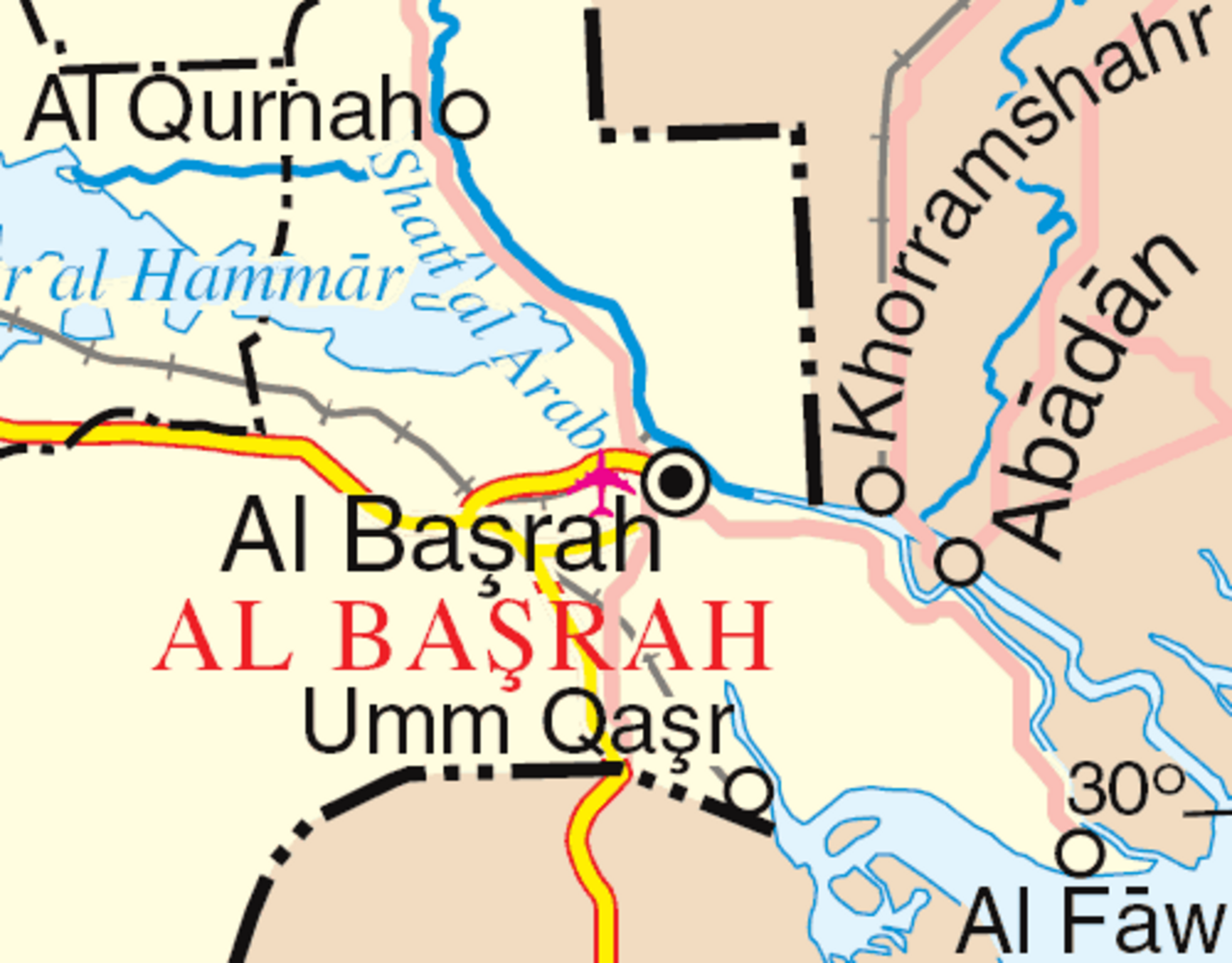
في 10 سبتمبر 1980، استعادت العراق بالقوة أراضي في زين القوس وسيف سعد التي وعدت بها بموجب شروط اتفاقية الجزائر لعام 1975 لكن إيران لم تسلمها قط، مما أدى إلى إعلان إيران والعراق أن المعاهدة باطلة ولاغية، في 14 سبتمبر و17 سبتمبر على التوالي. ونتيجة لذلك، كان النزاع الحدودي الوحيد المعلق بين إيران والعراق في وقت الغزو العراقي في 22 سبتمبر هو مسألة ما إذا كانت السفن الإيرانية سترفع الأعلام العراقية وتدفع رسوم الملاحة العراقية لجزء من نهر شط العرب يمتد لعدة أميال. [88] [89]
مسار الحرب
| This section may contain an excessive amount of intricate detail that may interest only a particular audience. (June 2024) |
1980: الغزو العراقي


شنت العراق غزوًا واسع النطاق لإيران في 22 سبتمبر 1980. شنت القوات الجوية العراقية ضربات جوية مفاجئة على عشرة مطارات إيرانية بهدف تدمير القوات الجوية الإيرانية . [63] فشل الهجوم في شل القوات الجوية الإيرانية: في حين أنه ألحق الضرر ببعض البنية التحتية للقواعد الجوية الإيرانية، إلا أنه لم يدمر عددًا كبيرًا من الطائرات. لم يتمكن سلاح الجو العراقي من الضرب بعمق إلا ببضع طائرات من طراز ميج-23 بي إن وتو -22 وسو -20 ، [90] وكانت إيران قد بنت ملاجئ طائرات محصنة حيث تم تخزين معظم طائراتها المقاتلة.
في اليوم التالي، شنت العراق غزوًا بريًا، فشنت ثلاث هجمات متزامنة على جبهة طولها 644 كيلومترًا (400 ميل). [63] كان صدام يأمل أن يؤدي الهجوم على إيران إلى توجيه ضربة لهيبة إيران بحيث يؤدي إلى سقوط الحكومة الجديدة، أو على الأقل إنهاء دعوات إيران للإطاحة به. [63]
من بين الفرق العراقية الستة التي غزت براً، أُرسلت أربع فرق إلى خوزستان، التي كانت تقع بالقرب من الطرف الجنوبي للحدود، لقطع شط العرب [ملاحظة 5] عن بقية إيران وإنشاء منطقة أمنية إقليمية. [63] : 22 غزت الفرقتان الأخريان الجزء الشمالي والوسطى من الحدود لمنع أي هجوم مضاد إيراني. [63] عملت فرقتان من الفرق العراقية الأربع، واحدة آلية والأخرى مدرعة، بالقرب من الطرف الجنوبي وبدأت حصار مدينتي الموانئ المهمتين استراتيجياً عبادان وخرمشهر . [63] : 22
قامت الفرقتان المدرعتان بتأمين المنطقة التي تحدها مدن خرمشهر والأهواز وسوسنغرد وموسيان . [63] : 22 وعلى الجبهة الوسطى، احتل العراقيون مهران ، وتقدموا نحو سفوح جبال زاغروس ، وتمكنوا من قطع طريق غزو طهران وبغداد التقليدي من خلال تأمين الأراضي أمام قصر شيرين ، إيران . [63] : 23 وعلى الجبهة الشمالية، حاول العراقيون إنشاء موقع دفاعي قوي مقابل السليمانية لحماية مجمع النفط العراقي في كركوك . [63] : 23 فشلت الآمال العراقية في انتفاضة من قبل العرب العرقيين في خوزستان ، حيث ظل معظم العرب العرقيين موالين لإيران. [63]
وصف باتريك بروجان القوات العراقية التي تقدمت إلى إيران عام 1980 بأنها "سيئة القيادة وتفتقر إلى الروح الهجومية". [91] : 261 ربما وقع أول هجوم معروف بالأسلحة الكيماوية من قبل العراق على إيران أثناء القتال حول سوسنغرد. [92] شغل عدنان خير الله منصب وزير الدفاع العراقي طوال الحرب العراقية الإيرانية، وتم تعيينه نائبًا للقائد الأعلى للقوات المسلحة، بعد صدام حسين فقط. [93] [94] وفي هذا المنصب، لعب دورًا حاسمًا في إعادة بناء وتحديث الجيش العراقي. [93]

ورغم أن الغزو الجوي العراقي فاجأ الإيرانيين، إلا أن القوات الجوية الإيرانية ردت في اليوم التالي بهجوم واسع النطاق على القواعد الجوية والبنية التحتية العراقية في عملية كامان 99. وهاجمت مجموعات من طائرات إف-4 فانتوم وإف -5 تايجر المقاتلة أهدافًا في جميع أنحاء العراق، مثل المنشآت النفطية والسدود ومصانع البتروكيماويات ومصافي النفط، وشملت قاعدة الموصل الجوية وبغداد ومصفاة نفط كركوك. وقد فوجئ العراق بقوة الرد، مما تسبب في خسائر فادحة للعراقيين واضطراب اقتصادي، لكن الإيرانيين تكبدوا خسائر فادحة بالإضافة إلى فقدان العديد من الطائرات وأطقم الطائرات بسبب الدفاعات الجوية العراقية.
بدأت طائرات الهليكوبتر الحربية من طراز AH-1 Cobra التابعة لطيران الجيش الإيراني في شن هجمات على الفرق العراقية المتقدمة، جنبًا إلى جنب مع طائرات F-4 Phantoms المسلحة بصواريخ AGM-65 Maverick ؛ [60] وقد دمرت العديد من المركبات المدرعة وأعاقت تقدم العراق، رغم أنها لم توقفه تمامًا. [95] [96] وفي الوقت نفسه، تم صد الهجمات الجوية العراقية على إيران بواسطة طائرات F-14A Tomcat المقاتلة الإيرانية، باستخدام صواريخ AIM-54A Phoenix ، والتي أسقطت عشرات المقاتلات العراقية المصنوعة في الاتحاد السوفيتي في أول يومين من المعركة. [95] [ مشكوك فيه - ناقش ]
لقد أجرت القوات العسكرية الإيرانية النظامية وقوات الشرطة ومتطوعو الباسيج والحرس الثوري عملياتهم بشكل منفصل؛ وبالتالي فإن القوات العراقية الغازية لم تواجه مقاومة منسقة. [63] ومع ذلك، في 24 سبتمبر، هاجمت البحرية الإيرانية البصرة ، العراق، ودمرت محطتين نفطيتين بالقرب من ميناء الفاو العراقي ، مما قلل من قدرة العراق على تصدير النفط. [63] تراجعت القوات البرية الإيرانية، التي تتكون في المقام الأول من الحرس الثوري، إلى المدن، حيث أقامت دفاعات ضد الغزاة. [97]
في 30 سبتمبر، شنت القوات الجوية الإيرانية عملية السيف الحارق ، حيث ضربت وألحقت أضرارًا بالغة بمفاعل أوزيراك النووي الذي كان مكتملًا تقريبًا بالقرب من بغداد. [63] وبحلول الأول من أكتوبر، تعرضت بغداد لثماني هجمات جوية. [63] : 29 وردًا على ذلك، شنت العراق ضربات جوية ضد أهداف إيرانية. [63] [95]
كانت الحدود الجبلية بين إيران والعراق سبباً في جعل الغزو البري العميق مستحيلاً تقريباً، [98] فاستُخدمت الضربات الجوية بدلاً من ذلك. وكانت الموجات الأولى من الغزو عبارة عن سلسلة من الضربات الجوية التي استهدفت المطارات الإيرانية. كما حاول العراق قصف طهران، عاصمة إيران ومركز قيادتها، لإخضاعها. [63] [90]
معركة خرمشهر الأولى

في الثاني والعشرين من سبتمبر، بدأت معركة مطولة في مدينة خرمشهر، أسفرت في النهاية عن مقتل حوالي 7000 شخص من كل جانب. [63] وانعكاسًا للطبيعة الدموية للصراع، أطلق الإيرانيون على خرمشهر اسم "مدينة الدم". [63]
بدأت المعركة بغارات جوية عراقية ضد نقاط رئيسية وتقدم فرق آلية نحو المدينة في تشكيل يشبه الهلال. وقد تباطأت هذه الفرق بسبب الهجمات الجوية الإيرانية وقوات الحرس الثوري التي استخدمت بنادق عديمة الارتداد وقذائف صاروخية وزجاجات مولوتوف . [99] غمر الإيرانيون مناطق المستنقعات المحيطة بالمدينة، مما أجبر العراقيين على المرور عبر شرائح ضيقة من الأرض. [99] شنت الدبابات العراقية هجمات بدون دعم من المشاة، وخسرت فرق مضادة للدبابات الإيرانية العديد من الدبابات. [99]
بحلول 30 سبتمبر، تمكن العراقيون من إبعاد الإيرانيين عن ضواحي المدينة. في اليوم التالي، شن العراقيون هجمات مشاة ومدرعات على المدينة. بعد قتال عنيف من منزل إلى منزل ، تم صد العراقيين. في 14 أكتوبر، شن العراقيون هجومًا ثانيًا. بدأ الإيرانيون انسحابًا متحكمًا من المدينة، شارعًا تلو الآخر. [99] بحلول 24 أكتوبر، تم الاستيلاء على معظم المدينة، وتم إجلاء الإيرانيين عبر نهر كارون. بقي بعض الثوار ، واستمر القتال حتى 10 نوفمبر.
توقف تقدم القوات العراقية
ورغم الاستيلاء على خرمشهر، فإن المعركة أخرت العراقيين بما يكفي للسماح بنشر الجيش الإيراني على نطاق واسع. [63] وفي نوفمبر/تشرين الثاني، أمر صدام قواته بالتقدم نحو دزفول والأهواز ، وفرض حصار على المدينتين. ومع ذلك، تعرض الهجوم العراقي لأضرار بالغة بسبب الميليشيات الإيرانية والقوة الجوية. فقد دمرت القوات الجوية الإيرانية مستودعات إمدادات الجيش العراقي وإمدادات الوقود، وكانت تخنق العراق من خلال حصار جوي. [95]
لم تنضب إمدادات إيران، على الرغم من العقوبات، وكثيراً ما كان الجيش يستغل قطع الغيار من المعدات الأخرى ويبدأ في البحث عن قطع الغيار في السوق السوداء. في 28 نوفمبر، أطلقت إيران عملية مورفاريد (اللؤلؤة)، وهي هجوم جوي وبحري مشترك دمر 80٪ من البحرية العراقية وجميع مواقع الرادار الخاصة بها في الجزء الجنوبي من البلاد. عندما حاصر العراق عبادان وحفر قواته حول المدينة، لم يتمكن من حصار الميناء، مما سمح لإيران بإعادة إمداد عبادان عن طريق البحر. [100]
كانت الاحتياطيات الاستراتيجية العراقية قد استنفدت، وبحلول ذلك الوقت كانت تفتقر إلى القوة اللازمة لشن أي هجمات كبرى حتى قرب نهاية الحرب. [63] وفي السابع من ديسمبر، أعلن حسين أن العراق سيتخذ موقفًا دفاعيًا. [63] وبحلول نهاية عام 1980، دمر العراق حوالي 500 دبابة إيرانية غربية الصنع واستولى على 100 دبابة أخرى. [101] [102]
1981: التعادل السلبي
خلال الأشهر الثمانية التالية، كان كلا الجانبين على موقف دفاعي، باستثناء معركة دزفول ، حيث احتاج الإيرانيون إلى مزيد من الوقت لإعادة تنظيم قواتهم بعد الأضرار التي لحقت بهم بسبب تطهير 1979-1980. [63] خلال هذه الفترة، تألف القتال بشكل أساسي من مبارزات المدفعية والغارات. [63] حشدت العراق 21 فرقة للغزو، بينما ردت إيران بـ 13 فرقة من الجيش النظامي ولواء واحد فقط . من بين الفرق النظامية، تم نشر سبعة فقط على الحدود. وتورطت الحرب في حرب خنادق على غرار الحرب العالمية الأولى بالدبابات والأسلحة الحديثة في أواخر القرن العشرين. ونظرًا لقوة الأسلحة المضادة للدبابات مثل RPG -7 ، كانت المناورة المدرعة من قبل العراقيين مكلفة للغاية، وبالتالي تحصنوا بدباباتهم في مواقع ثابتة. [60] [83]
كما بدأت العراق في إطلاق صواريخ سكود على دزفول والأهواز ، واستخدمت القصف الإرهابي لنقل الحرب إلى السكان المدنيين الإيرانيين. [100] كما شنت إيران عشرات من "هجمات الموجات البشرية".
معركة دزفول

في 5 يناير 1981، أعادت إيران تنظيم قواتها بما يكفي لشن هجوم واسع النطاق، عملية النصر. [99] [103] [104] شن الإيرانيون هجومهم المدرع الرئيسي من دزفول في اتجاه سوسنغرد ، المكون من ألوية دبابات من فرقة قزوين 16، وخراسان 77 ، وفرقة خوزستان المدرعة 92 ، [104] واخترقوا الخطوط العراقية. [63] : 32 ومع ذلك، كانت الدبابات الإيرانية قد اندفعت عبر الخطوط العراقية بجناحيها غير المحميين ودون دعم المشاة؛ [60] ونتيجة لذلك، تم قطعهم بواسطة الدبابات العراقية. [63]
في معركة دزفول التي تلت ذلك، كادت الفرق المدرعة الإيرانية أن تُمحى في واحدة من أكبر معارك الدبابات في الحرب. [63] وعندما حاولت الدبابات الإيرانية المناورة، علقت في طين المستنقعات، وتم التخلي عن العديد من الدبابات. [99] خسر العراقيون 45 دبابة من طراز T-55 و T-62 ، بينما خسر الإيرانيون 100-200 دبابة من طراز Chieftain و M-60 . أحصى المراسلون ما يقرب من 150 دبابة إيرانية مدمرة أو مهجورة، بالإضافة إلى 40 دبابة عراقية. [63] قُتل 141 إيرانيًا خلال المعركة. [104]
كانت المعركة قد أمر بها الرئيس الإيراني أبو الحسن بني صدر ، الذي كان يأمل أن يعزز النصر موقفه السياسي المتدهور؛ ولكن بدلاً من ذلك، أدى الفشل إلى تعجيل سقوطه. [63] : 71 حدثت العديد من مشاكل إيران بسبب الصراع السياسي الداخلي بين الرئيس بني صدر، الذي دعم الجيش النظامي، والمتشددين الذين دعموا الحرس الثوري الإسلامي. وبمجرد عزله وانتهاء المنافسة، تحسن أداء الجيش الإيراني.
وقد انشغلت حكومة الجمهورية الإسلامية في إيران بالقتال الداخلي بين النظام ومنظمة مجاهدي خلق في شوارع المدن الكبرى في إيران في يونيو/حزيران 1981 ومرة أخرى في سبتمبر/أيلول. [91] : 250–251 في عام 1983، بدأت منظمة مجاهدي خلق تحالفًا مع العراق في أعقاب اجتماع بين زعيم منظمة مجاهدي خلق مسعود رجوي ونائب رئيس الوزراء العراقي طارق عزيز . [105] [106] [107] [108]
في عام 1984، ترك بني صدر التحالف بسبب خلاف مع رجوي . وفي عام 1986، انتقل رجوي من باريس إلى العراق وأقام قاعدة على الحدود الإيرانية. [ملاحظة 6] أصبحت معركة دزفول معركة حاسمة في الفكر العسكري الإيراني. تم وضع قدر أقل من التركيز على الجيش بتكتيكاته التقليدية، وتم وضع المزيد من التركيز على الحرس الثوري بتكتيكاته غير التقليدية. [99] [109]
الهجوم على H3
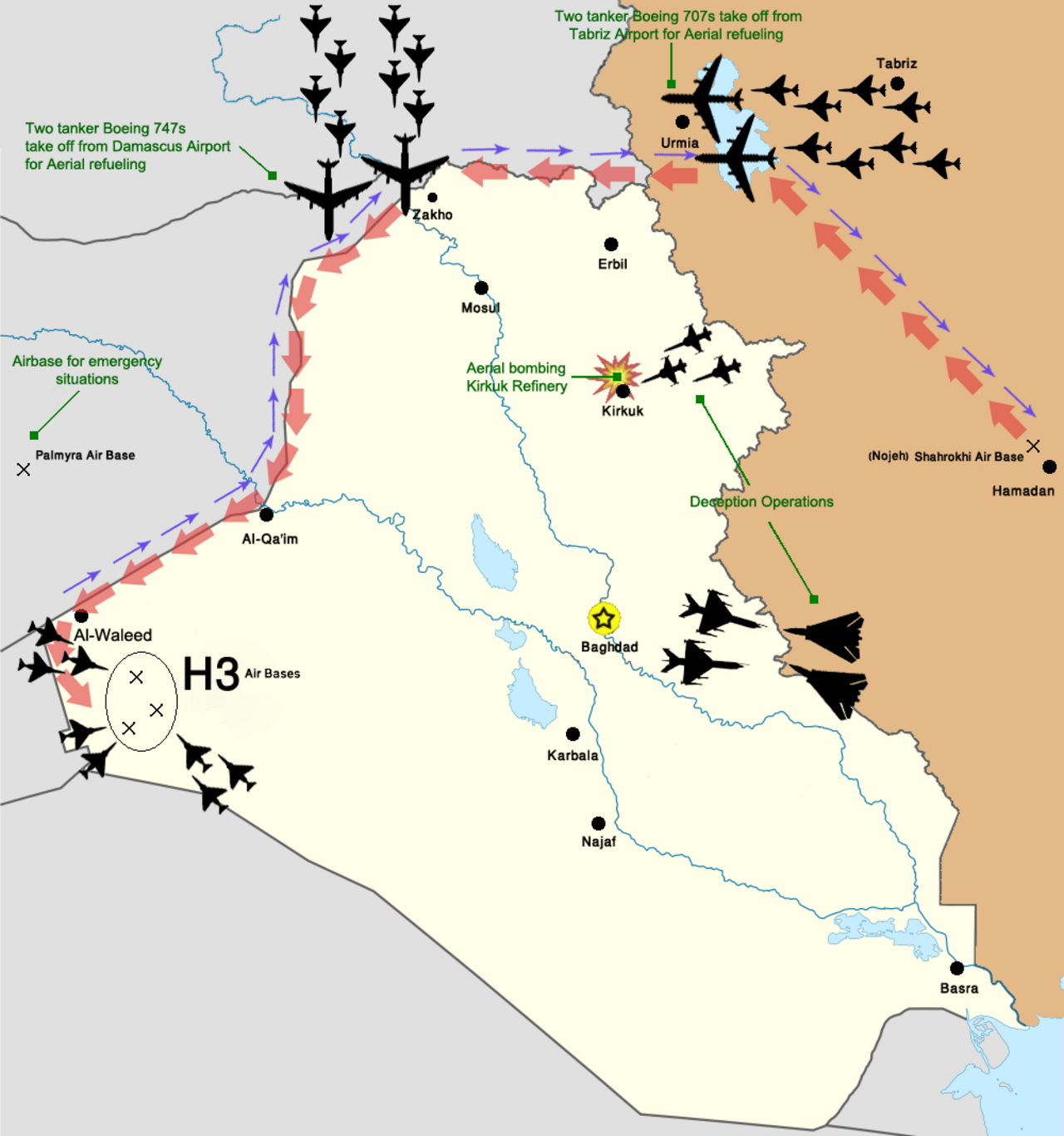
تم نقل القوات الجوية العراقية، التي تضررت بشدة من قبل الإيرانيين، إلى قاعدة H-3 الجوية في غرب العراق، بالقرب من الحدود الأردنية وبعيدًا عن إيران. ومع ذلك، في 3 أبريل 1981، استخدمت القوات الجوية الإيرانية ثماني قاذفات مقاتلة من طراز F-4 Phantom وأربع طائرات F-14 Tomcats وثلاث طائرات تزود بالوقود من طراز Boeing 707 وطائرة قيادة واحدة من طراز Boeing 747 لشن هجوم مفاجئ على H3 ، مما أدى إلى تدمير 27-50 طائرة مقاتلة وقاذفة عراقية. [110]
وعلى الرغم من نجاح هجوم القاعدة الجوية H-3 (بالإضافة إلى هجمات جوية أخرى)، اضطرت القوات الجوية الإيرانية إلى إلغاء هجومها الجوي الناجح الذي استمر 180 يومًا. بالإضافة إلى ذلك، تخلت عن محاولتها السيطرة على المجال الجوي الإيراني . لقد ضعفت بشكل خطير بسبب العقوبات والتطهير قبل الحرب وتضررت أكثر بسبب التطهير الجديد بعد أزمة عزل الرئيس بني صدر . [111] لم تستطع القوات الجوية الإيرانية النجاة من المزيد من الاستنزاف، وقررت الحد من خسائرها، والتخلي عن الجهود للسيطرة على المجال الجوي الإيراني . ستقاتل القوات الجوية الإيرانية من الآن فصاعدًا في موقف دفاعي، في محاولة لردع العراقيين بدلاً من الاشتباك معهم. بينما ظلت القوات الجوية العراقية ضعيفة طوال عامي 1981 و1982، إلا أنها في غضون السنوات القليلة التالية أعادت تسليح نفسها وتوسعت مرة أخرى، وبدأت في استعادة المبادرة الاستراتيجية. [112]
مقدمة لهجمات الموجات البشرية
عانى الإيرانيون من نقص الأسلحة الثقيلة، [83] : 225 ولكن كان لديهم عدد كبير من القوات التطوعية المخلصة، لذلك بدأوا في استخدام هجمات الموجات البشرية ضد العراقيين. عادة، يبدأ الهجوم الإيراني بقوات الباسيج المدربة بشكل سيئ والتي تشن هجمات الموجات البشرية الأولية لإغراق أضعف أجزاء من الخطوط العراقية بأعداد كبيرة (في بعض الأحيان حتى تطهير حقول الألغام جسديًا). [83] [113] يتبع ذلك مشاة الحرس الثوري الأكثر خبرة، الذين يخترقون الخطوط العراقية الضعيفة، [83] [97] ويتبعهم الجيش النظامي باستخدام القوات الميكانيكية، والتي تتنقل عبر الثغرة وتحاول تطويق العدو وهزيمته. [83] [99]

وفقًا للمؤرخ ستيفن سي. بيليتير، كانت فكرة "هجمات الموجات البشرية" الإيرانية فكرة خاطئة. [114] بدلاً من ذلك، كانت التكتيكات الإيرانية تتألف من استخدام مجموعات من فرق المشاة المكونة من 22 رجلاً ، والتي تقدمت لمهاجمة أهداف محددة. ومع تقدم الفرق للأمام لتنفيذ مهامها، أعطى ذلك انطباعًا بـ "هجوم الموجة البشرية". ومع ذلك، ظلت فكرة "هجمات الموجة البشرية" مرادفة تقريبًا لأي هجوم أمامي مشاة واسع النطاق تنفذه إيران. [114] سيتم استخدام أعداد كبيرة من القوات، بهدف سحق الخطوط العراقية (عادةً الجزء الأضعف، والذي عادة ما يكون مأهولًا بالجيش الشعبي العراقي )، بغض النظر عن الخسائر. [83]
وفقًا للجنرال العراقي السابق رعد الحمداني ، فإن هجمات الموجات البشرية الإيرانية كانت تتألف من "مدنيين" مسلحين يحملون معظم معداتهم الضرورية إلى المعركة وغالبًا ما كانوا يفتقرون إلى القيادة والسيطرة والخدمات اللوجستية . [115] غالبًا ما كانت العمليات تُنفذ أثناء الليل وأصبحت عمليات الخداع والتسلل والمناورات أكثر شيوعًا. [100] كما كان الإيرانيون يعززون القوات المتسللة بوحدات جديدة للحفاظ على زخمهم. بمجرد العثور على نقطة ضعف، كان الإيرانيون يركزون كل قواتهم في تلك المنطقة في محاولة لاختراقها بهجمات الموجات البشرية. [115]
كانت هجمات الموجات البشرية، على الرغم من كونها دموية للغاية (حيث مات عشرات الآلاف من الجنود في هذه العملية)، [113] عندما استُخدمت مع التسلل والمفاجأة، سببًا في هزائم عراقية كبرى. وبينما كان العراقيون يحفرون دباباتهم ومشاتهم في مواقع ثابتة محصنة، كان الإيرانيون يتمكنون من اختراق الخطوط وتطويق فرق بأكملها. [83] إن حقيقة أن القوات الإيرانية استخدمت حرب المناورة من خلال مشاتها الخفيفة ضد الدفاعات العراقية الثابتة كانت غالبًا العامل الحاسم في المعركة. [97] ومع ذلك، لعب الافتقار إلى التنسيق بين الجيش الإيراني والحرس الثوري الإيراني ونقص الأسلحة الثقيلة دورًا ضارًا، وغالبًا ما كان معظم المشاة غير مدعومين بالمدفعية والدروع. [83] [97]
عملية الإمام الثامن
بعد توقف الهجوم العراقي في مارس 1981، لم يكن هناك تغيير كبير في الجبهة بخلاف استعادة إيران للأرض المرتفعة فوق سوسنغرد في مايو. بحلول أواخر عام 1981، عادت إيران إلى الهجوم وأطلقت عملية ثامن الأئمة (الإمام الثامن)، [116] منهية الحصار العراقي لعبادان في 27-29 سبتمبر 1981. [63] : 9 استخدم الإيرانيون قوة مشتركة من مدفعية الجيش النظامي مع مجموعات صغيرة من المدرعات، بدعم من مشاة الباسداران (الحرس الثوري الإسلامي) والباسيج. [111] في 15 أكتوبر، بعد كسر الحصار، تعرضت قافلة إيرانية كبيرة لكمين من قبل الدبابات العراقية، وخلال معركة الدبابات التي تلت ذلك خسرت إيران 20 من طراز Chieftains ومركبات مدرعة أخرى وانسحبت من الأراضي التي اكتسبتها سابقًا. [117]
عملية طريق القدس
في 29 نوفمبر 1981، بدأت إيران عملية طريق القدس بثلاثة ألوية من الجيش وسبعة ألوية من الحرس الثوري. فشل العراقيون في تسيير دوريات بشكل صحيح في مناطقهم المحتلة، وشيد الإيرانيون طريقًا بطول 14 كم (14000 م؛ 8.7 ميل) عبر الكثبان الرملية غير المحروسة، وشنوا هجومهم من الخلف العراقي. [99] تم استعادة بلدة بستان من الفرق العراقية بحلول 7 ديسمبر. [63] : 10 بحلول هذا الوقت، كان الجيش العراقي يعاني من مشاكل معنوية خطيرة، [63] تفاقمت بسبب حقيقة أن عملية طريق القدس كانت أول استخدام لتكتيكات "الموجة البشرية" الإيرانية، حيث هاجمت مشاة الحرس الثوري الخفيفة مرارًا وتكرارًا المواقع العراقية، وفي كثير من الأحيان دون دعم من المدرعات أو القوة الجوية. [63] أدى سقوط بستان إلى تفاقم المشاكل اللوجستية للعراقيين، مما أجبرهم على استخدام طريق ملتوي من الأهواز إلى الجنوب لإعادة إمداد قواتهم. [63] قُتل في العملية 6000 إيراني وأكثر من 2000 عراقي. [63]
1982: انسحاب عراقي وهجوم إيراني

أدرك العراقيون أن الإيرانيين يخططون للهجوم، فقرروا استباقهم بعملية الفوز العظيم [118] في 19 مارس. وباستخدام عدد كبير من الدبابات والمروحيات والطائرات المقاتلة، هاجموا الحشود الإيرانية حول ممر الرغابية. ورغم أن صدام وجنرالاته افترضوا أنهم نجحوا، إلا أن القوات الإيرانية ظلت في الواقع سليمة تمامًا. [60] ركز الإيرانيون الكثير من قواتهم من خلال جلبها مباشرة من المدن والبلدات في جميع أنحاء إيران عبر القطارات والحافلات والسيارات الخاصة. لم يكن تركيز القوات يشبه الحشد العسكري التقليدي، ورغم أن العراقيين اكتشفوا تراكمًا سكانيًا بالقرب من الجبهة، إلا أنهم فشلوا في إدراك أن هذه كانت قوة مهاجمة. [115] ونتيجة لذلك، لم يكن جيش صدام مستعدًا للهجمات الإيرانية القادمة. [60]
عملية الفتح المبين
كان الهجوم الإيراني الرئيسي التالي، بقيادة العقيد علي صياد شيرازي ، هو عملية الفتح المبين . في 22 مارس 1982، شنت إيران هجومًا فاجأ القوات العراقية: باستخدام مروحيات شينوك ، هبطوا خلف الخطوط العراقية، وأسكتوا مدفعيتهم، واستولوا على مقر عراقي. [60]
وتبع ذلك قيام الحرس الثوري والجيش النظامي بمحاصرة الفرقتين العراقيتين التاسعة والعاشرة المدرعة والأولى الآلية التي كانت تتمركز بالقرب من مدينة شوش الإيرانية . وشن العراقيون هجومًا مضادًا باستخدام فرقتهم المدرعة الثانية عشرة لكسر الحصار وإنقاذ الفرق المحاصرة. وتعرضت الدبابات العراقية للهجوم من قبل 95 طائرة مقاتلة إيرانية من طراز إف-4 فانتوم وإف-5 تايجر، مما أدى إلى تدمير جزء كبير من الفرقة. [119]
كانت عملية الفتح المبين انتصارًا إيرانيًا؛ حيث تم طرد القوات العراقية من شوش ودزفول والأهواز. ودمرت القوات المسلحة الإيرانية 320-400 دبابة ومركبة مدرعة عراقية في نجاح باهظ التكلفة. في اليوم الأول فقط من المعركة، خسر الإيرانيون 196 دبابة. [60] وبحلول هذا الوقت، تم استعادة معظم محافظة خوزستان. [63]
عملية بيت المقدس

استعدادًا لعملية بيت المقدس ، شن الإيرانيون العديد من الغارات الجوية على القواعد الجوية العراقية، مما أدى إلى تدمير 47 طائرة (بما في ذلك طائرات ميراج إف-1 المقاتلة العراقية الجديدة من فرنسا)؛ وقد أعطى هذا الإيرانيين تفوقًا جويًا على ساحة المعركة مع السماح لهم بمراقبة تحركات القوات العراقية. [60]
في 29 أبريل، شنت إيران الهجوم. وهاجم 70 ألفًا من أفراد الحرس الثوري والباسيج عدة محاور - بستان، وسوسنغرد، والضفة الغربية لنهر كارون، والأهواز. شن الباسيج هجمات موجات بشرية، أعقبها دعم الجيش النظامي والحرس الثوري جنبًا إلى جنب مع الدبابات والمروحيات. [60] وتحت الضغط الإيراني الشديد، تراجعت القوات العراقية. وبحلول 12 مايو، طردت إيران جميع القوات العراقية من منطقة سوسنغرد. [63] : 36 استولى الإيرانيون على عدة آلاف من القوات العراقية وعدد كبير من الدبابات. [60]
تراجع العراقيون إلى نهر الكارون، ولم يتبق في حوزتهم سوى خرمشهر وبعض المناطق النائية. [83] أمر صدام بوضع 70 ألف جندي حول مدينة خرمشهر. أنشأ العراقيون خط دفاع تم بناؤه على عجل حول المدينة والمناطق النائية. [60] لتثبيط عمليات إنزال الكوماندوز المحمولة جواً، وضع العراقيون أيضًا مسامير معدنية ودمروا سيارات في المناطق التي من المحتمل استخدامها كمناطق إنزال للقوات. حتى أن صدام حسين زار خرمشهر في لفتة درامية، وأقسم أن المدينة لن تُتخلى عنها أبدًا. [60] ومع ذلك، كانت نقطة الإمداد الوحيدة لخرمشهر عبر شط العرب [ملاحظة 5] ، وبدأت القوات الجوية الإيرانية في قصف جسور الإمداد إلى المدينة، بينما ركزت مدفعيتها على الحامية المحاصرة.
معركة خرمشهر الثانية

في الساعات الأولى من صباح يوم 23 مايو 1982، بدأ الإيرانيون في التقدم نحو خرمشهر عبر نهر الكارون . [63] قاد هذا الجزء من عملية بيت المقدس فرقة خراسان 77 بالدبابات جنبًا إلى جنب مع الحرس الثوري والباسيج. ضرب الإيرانيون العراقيين بضربات جوية مدمرة وقصف مدفعي ضخم، وعبروا نهر الكارون، واستولوا على رؤوس الجسور ، وشنوا هجمات موجات بشرية تجاه المدينة. انهار حاجز صدام الدفاعي؛ [60] في أقل من 48 ساعة من القتال، سقطت المدينة واستسلم 19000 عراقي للإيرانيين. قُتل أو جُرح ما مجموعه 10000 عراقي في خرمشهر، بينما تكبد الإيرانيون 30000 ضحية. [120] خلال عملية بيت المقدس بأكملها، تم أسر 33000 جندي عراقي من قبل الإيرانيين. [60]
حالة القوات المسلحة العراقية
لقد كان القتال قد أرهق الجيش العراقي: فقد انخفض عدده من 210 آلاف إلى 150 ألف جندي؛ وقُتل أكثر من 20 ألف جندي عراقي وأُسر أكثر من 30 ألف جندي؛ وتراجعت قوة فرقتين مدرعتين من أصل أربع فرق نشطة وثلاث فرق ميكانيكية على الأقل إلى أقل من قوة لواء؛ واستولى الإيرانيون على أكثر من 450 دبابة وناقلة جنود مدرعة. [121]
كما تركت القوات الجوية العراقية في حالة سيئة: بعد أن خسرت ما يصل إلى 55 طائرة منذ أوائل ديسمبر 1981، لم يكن لديها سوى 100 طائرة مقاتلة قاذفة وطائرة اعتراضية سليمة . كشف أحد المنشقين الذي طار بطائرته ميج 21 إلى سوريا في يونيو 1982 أن القوات الجوية العراقية لم يكن لديها سوى ثلاثة أسراب من القاذفات المقاتلة القادرة على شن عمليات في إيران. كان سلاح الجو العراقي في حالة أفضل قليلاً، ولا يزال بإمكانه تشغيل أكثر من 70 طائرة هليكوبتر. [121] وعلى الرغم من ذلك، لا يزال العراقيون يمتلكون 3000 دبابة، بينما تمتلك إيران 1000 دبابة. [60]
في هذه المرحلة، اعتقد صدام أن جيشه كان محبطًا للغاية ومتضررًا لدرجة أنه لم يعد قادرًا على التمسك بخوزستان ومساحات كبيرة من الأراضي الإيرانية، وسحب قواته المتبقية، وأعاد نشرها دفاعًا على طول الحدود. [63] ومع ذلك، استمرت قواته في احتلال بعض المناطق الحدودية الإيرانية الرئيسية، بما في ذلك الأراضي المتنازع عليها التي دفعته إلى غزوها، ولا سيما مجرى شط العرب المائي. [60] [122] وردًا على إخفاقاتهم ضد الإيرانيين في خرمشهر، أمر صدام بإعدام الجنرالات جواد شطناه وصلاح القاضي والعقيدين ماسة والجليل. [115] كما تم إعدام ما لا يقل عن اثني عشر ضابطًا رفيعي المستوى خلال هذا الوقت. [111] أصبح هذا عقابًا شائعًا بشكل متزايد لأولئك الذين خذلوه في المعركة. [115]
الاستجابة الدولية المبكرة
في أبريل 1982، أغلق النظام البعثي المنافس في سوريا ، إحدى الدول القليلة التي دعمت إيران، خط أنابيب كركوك-بانياس الذي سمح للنفط العراقي بالوصول إلى ناقلات النفط على البحر الأبيض المتوسط، مما أدى إلى خفض الميزانية العراقية بمقدار 5 مليارات دولار شهريًا. [63] كتب الصحفي باتريك بروجان، "بدا الأمر لبعض الوقت أن العراق سيختنق اقتصاديًا قبل هزيمته عسكريًا". [91] : 260 ترك إغلاق سوريا لخط أنابيب كركوك-بانياس العراق مع خط الأنابيب إلى تركيا كوسيلة وحيدة لتصدير النفط، إلى جانب نقل النفط بواسطة شاحنات الصهاريج إلى ميناء العقبة في الأردن. [123]
كان خط الأنابيب التركي بسعة 500000 برميل فقط يوميًا (79000 متر مكعب / يوم)، وهو ما لم يكن كافيًا لدفع ثمن الحرب. [124] : 160 أنقذت المملكة العربية السعودية والكويت ودول الخليج الأخرى العراق من الإفلاس [63] من خلال تزويده بقروض تتراوح قيمتها بين 37 و60 مليار دولار. [91] [125] [126] [127] : 263 [ يحتاج إلى توضيح ] على الرغم من أن العراق كان معاديًا في السابق تجاه دول الخليج الأخرى، إلا أن "تهديد الأصولية الفارسية كان أكثر خوفًا". [124] : 162-163 [91] : 263 كانوا ميالين بشكل خاص إلى الخوف من النصر الإيراني بعد أن أعلن آية الله الخميني أن الملكيات غير شرعية وشكل غير إسلامي للحكم. [63] تم استقبال بيان الخميني على نطاق واسع باعتباره دعوة للإطاحة بالملكيات الخليجية. [63] كتب الصحفيان جون بولوك وهارفي موريس:
لقد كان للحملة الإيرانية الشرسة، والتي بدت في ذروتها وكأنها تجعل من الإطاحة بالنظام السعودي هدفاً للحرب على قدم المساواة مع هزيمة العراق، تأثير على المملكة [العربية السعودية]، ولكن ليس التأثير الذي أراده الإيرانيون: فبدلاً من أن يصبح السعوديون أكثر ميلاً إلى المصالحة، أصبحوا أكثر صرامة، وأكثر ثقة في أنفسهم، وأقل ميلاً إلى السعي إلى التسوية. [124] : 163
وقيل إن المملكة العربية السعودية زودت العراق بمليار دولار شهريًا بدءًا من منتصف عام 1982. [124] : 160
بدأ العراق في تلقي الدعم من الولايات المتحدة ودول غرب أوروبا أيضًا. فقد حصل صدام على دعم دبلوماسي ومالي وعسكري من الولايات المتحدة، بما في ذلك القروض الضخمة، والنفوذ السياسي، والمعلومات الاستخباراتية عن الانتشار الإيراني التي تم جمعها بواسطة أقمار التجسس الأمريكية. [128] اعتمد العراقيون بشكل كبير على لقطات الأقمار الصناعية الأمريكية وطائرات الرادار للكشف عن تحركات القوات الإيرانية، وقد مكنت العراق من نقل القوات إلى الموقع قبل المعركة. [129]
مع النجاح الإيراني في ساحة المعركة، زادت الولايات المتحدة من دعمها للحكومة العراقية، وزودتها بالمعلومات الاستخباراتية والمساعدات الاقتصادية والمعدات والمركبات ذات الاستخدام المزدوج ، فضلاً عن تطبيع علاقاتها بين الحكومات (التي انقطعت أثناء حرب الأيام الستة عام 1967 ). [128] في مارس 1982، وقع الرئيس رونالد ريجان مذكرة دراسة الأمن القومي 4-82 - التي تسعى إلى "مراجعة السياسة الأمريكية تجاه الشرق الأوسط" - وفي يونيو وقع ريجان على توجيه قرار الأمن القومي (NSDD) الذي شارك في كتابته مسؤول مجلس الأمن القومي هوارد تيتشر ، والذي قرر: "لا تستطيع الولايات المتحدة أن تسمح للعراق بخسارة الحرب أمام إيران"، [130] [131] وأن الولايات المتحدة "ستفعل كل ما هو ضروري لمنع العراق من الخسارة". [132]
في عام 1982، أزال ريغان العراق من قائمة الدول "الداعمة للإرهاب" وباع أسلحة مثل مدافع الهاوتزر إلى العراق عبر الأردن. [128] باعت فرنسا للعراق أسلحة بملايين الدولارات، بما في ذلك مروحيات غازيل ومقاتلات ميراج إف-1 وصواريخ إكسوسيت . باعت كل من الولايات المتحدة وألمانيا الغربية للعراق مبيدات حشرية وسموم مزدوجة الاستخدام يمكن استخدامها في صنع أسلحة كيميائية . [128]
ولم تكن إيران تمتلك الأموال اللازمة لشراء الأسلحة بالقدر الذي كان العراق يمتلكه. وكانت تعتمد على الصين وكوريا الشمالية وليبيا وسوريا واليابان لتزويدها بكل شيء من الأسلحة والذخائر إلى المعدات اللوجستية والهندسية. [133]
اقتراح وقف إطلاق النار
في 20 يونيو 1982، أعلن صدام أنه يريد رفع دعوى من أجل السلام واقترح وقف إطلاق النار الفوري والانسحاب من الأراضي الإيرانية في غضون أسبوعين. [134] ورد الخميني قائلاً إن الحرب لن تنتهي حتى يتم تنصيب حكومة جديدة في العراق ودفع التعويضات. [135] وأعلن أن إيران ستغزو العراق ولن تتوقف حتى يتم استبدال نظام البعث بجمهورية إسلامية . [63] [122] دعمت إيران حكومة في المنفى للعراق، المجلس الأعلى للثورة الإسلامية في العراق ، بقيادة رجل الدين العراقي المنفي محمد باقر الحكيم ، والتي كانت مكرسة للإطاحة بحزب البعث. لقد جندوا أسرى الحرب والمعارضين والمنفيين والشيعة للانضمام إلى لواء بدر ، الجناح العسكري للمنظمة. [60]
تم اتخاذ قرار غزو العراق بعد الكثير من المناقشات داخل الحكومة الإيرانية. [63] أراد فصيل واحد، يضم رئيس الوزراء مير حسين موسوي ، ووزير الخارجية علي أكبر ولايتي ، والرئيس علي خامنئي ، [136] ورئيس أركان الجيش الجنرال علي صياد شيرازي وكذلك اللواء قاسم علي ظهير نجاد، قبول وقف إطلاق النار، حيث تم استعادة معظم الأراضي الإيرانية. [63] على وجه الخصوص، عارض الجنرال شيرازي وظهير نجاد غزو العراق لأسباب لوجستية، وذكروا أنهم سيفكرون في الاستقالة إذا "استمر الأشخاص غير المؤهلين في التدخل في إدارة الحرب". [63] : 38 وكان من وجهة النظر المعارضة فصيل متشدد بقيادة رجال الدين في المجلس الأعلى للدفاع ، وكان زعيمه المتحدث السياسي القوي للمجلس ، أكبر رفسنجاني . [63]
كما كانت إيران تأمل أن تؤدي هجماتها إلى إشعال ثورة ضد حكم صدام من قبل السكان الشيعة والأكراد في العراق، مما قد يؤدي إلى سقوطه. وقد نجحت في القيام بذلك مع السكان الأكراد، ولكن ليس الشيعة. [60] لقد استولت إيران على كميات كبيرة من المعدات العراقية، والتي كانت كافية لإنشاء العديد من كتائب الدبابات، وامتلكت إيران مرة أخرى 1000 دبابة، وتمكنت أيضًا من الحصول سراً على قطع غيار أيضًا، بما في ذلك تلك المتعلقة بطائرة F-14 Tomcat. [83] [137]
في اجتماع لمجلس الوزراء في بغداد، اقترح وزير الصحة رياض إبراهيم حسين أن يتنحى صدام مؤقتًا كوسيلة لتسهيل قبول إيران لوقف إطلاق النار، ثم يعود بعد ذلك إلى السلطة. [124] : 147 سأل صدام، منزعجًا، عما إذا كان أي شخص آخر في مجلس الوزراء يوافق على فكرة وزير الصحة. وعندما لم يرفع أحد يده مؤيدًا، اصطحب رياض حسين إلى الغرفة المجاورة، وأغلق الباب، وأطلق النار عليه بمسدسه. [124] : 147
إيران تغزو العراق والتكتيكات العراقية للرد

في الغالب، ظل العراق في موقف دفاعي لمدة السنوات الخمس التالية، غير قادر وغير راغب في شن أي هجمات كبرى، بينما شنت إيران أكثر من 70 هجومًا. تغيرت استراتيجية العراق من الاحتفاظ بالأراضي في إيران إلى حرمان إيران من أي مكاسب كبرى في العراق، فضلاً عن التمسك بالأراضي المتنازع عليها على طول الحدود. [61] بدأ صدام سياسة الحرب الشاملة ، حيث جهز معظم بلاده للدفاع ضد إيران. بحلول عام 1988، كان العراق ينفق 40-75٪ من ناتجه المحلي الإجمالي على المعدات العسكرية. [138] كما ضاعف صدام حجم الجيش العراقي بأكثر من الضعف، من 200000 جندي (12 فرقة وثلاثة ألوية مستقلة) إلى 500000 (23 فرقة وتسعة ألوية). [63] بدأ العراق أيضًا في شن غارات جوية ضد المدن الحدودية الإيرانية، مما أدى إلى زيادة كبيرة في الممارسة بحلول عام 1984. [61] : 2
بحلول نهاية عام 1982، تم إعادة إمداد العراق بمعدات سوفييتية وصينية جديدة ، ودخلت الحرب البرية مرحلة جديدة. استخدم العراق دبابات T-55 وT-62 وT-72 التي حصل عليها حديثًا، بالإضافة إلى نسخ صينية، وقاذفات صواريخ محمولة على شاحنات BM-21 ، وطائرات هليكوبتر Mi-24 لإعداد دفاع من النوع السوفييتي بثلاثة خطوط، مليء بالعقبات مثل الأسلاك الشائكة وحقول الألغام والمواقع المحصنة والمخابئ. بنى سلاح المهندسين القتالي الجسور عبر العوائق المائية، وزرع حقول الألغام، وأقام سواتر ترابية، وحفر الخنادق، وبنى أعشاش المدافع الرشاشة، وأعد خطوط دفاع وتحصينات جديدة. [61] : 2
بدأ العراق في التركيز على استخدام الدفاع في العمق لهزيمة الإيرانيين. [83] أنشأ العراق خطوط دفاع ثابتة متعددة لاستنزاف الإيرانيين من خلال الحجم الهائل. [83] عندما يواجه هجومًا إيرانيًا كبيرًا، حيث ستغمر الموجات البشرية دفاعات المشاة المحصنة في الأمام، كان العراقيون غالبًا ما يتراجعون، لكن دفاعاتهم الثابتة كانت تستنزف الإيرانيين وتوجههم إلى اتجاهات معينة، وتجذبهم إلى الفخاخ أو الجيوب. ثم تعمل الهجمات الجوية والمدفعية العراقية على تثبيت الإيرانيين، بينما تعمل الدبابات وهجمات المشاة الآلية باستخدام الحرب المتنقلة على دفعهم إلى الوراء. [129]
في بعض الأحيان، كان العراقيون يشنون "هجمات استكشافية" على الخطوط الإيرانية لاستفزازها لشن هجماتها في وقت أقرب. وفي حين كانت هجمات الموجات البشرية الإيرانية ناجحة ضد القوات العراقية المحصنة في خوزستان، فقد واجهت صعوبة في اختراق خطوط الدفاع العراقية في العمق. [60] كان للعراق ميزة لوجستية في دفاعه: كانت الجبهة تقع بالقرب من القواعد العراقية الرئيسية ومستودعات الأسلحة، مما يسمح لجيشه بالإمداد بكفاءة. [91] : 260، 265 وعلى النقيض من ذلك، كانت الجبهة في إيران بعيدة بشكل كبير عن القواعد الإيرانية الرئيسية ومستودعات الأسلحة، وعلى هذا النحو، كان على القوات والإمدادات الإيرانية أن تسافر عبر سلاسل جبلية قبل الوصول إلى الجبهة. [91] : 260
لقد ضعفت القوة العسكرية الإيرانية مرة أخرى بسبب عمليات التطهير الواسعة النطاق في عام 1982، والتي نتجت عن محاولة انقلاب أخرى مزعومة. [139]
عملية رمضان (معركة البصرة الأولى)
كان الجنرالات الإيرانيون يرغبون في شن هجوم شامل على بغداد والاستيلاء عليها في حين تسمح إمدادات الجيش الإيراني بمثل هذا الهجوم. وقد رفض الإيرانيون هذا الاقتراح باعتباره غير عملي [122] واتخذوا القرار بالاستيلاء على منطقة تلو الأخرى من العراق، على أمل أن يضطر العراق إلى الانسحاب من الأراضي الحدودية المتنازع عليها والبدء في المفاوضات لإنهاء الحرب. [122]
في 13 يوليو 1982، بدأت إيران هجومها في جنوب العراق، بالقرب من البصرة. [63] أطلق عليها اسم عملية رمضان ، وشارك فيها أكثر من 180 ألف جندي من كلا الجانبين، وكانت واحدة من أكبر المعارك البرية منذ الحرب العالمية الثانية . [61] : 3 أملت الاستراتيجية الإيرانية أن يشنوا هجومهم الأساسي على أضعف نقطة في الخطوط العراقية. ومع ذلك، تم إبلاغ العراقيين بخطط المعركة الإيرانية ونقلوا جميع قواتهم إلى المنطقة التي خطط الإيرانيون لمهاجمتها. [121] تم تجهيز العراقيين بالغاز المسيل للدموع لاستخدامه ضد العدو، وكان هذا أول استخدام كبير للحرب الكيميائية خلال الصراع، مما أدى إلى إلقاء فرقة مهاجمة بأكملها في حالة من الفوضى. [139]

هاجم أكثر من 100 ألف من قوات الحرس الثوري وقوات الباسيج المتطوعين الخطوط العراقية. [63] كانت القوات العراقية قد تحصنت في دفاعات هائلة، وأقامت شبكة من المخابئ ومواقع المدفعية. [63] استخدمت قوات الباسيج الموجات البشرية، بل واستخدمت أيضًا لتطهير حقول الألغام العراقية والسماح للحرس الثوري بالتقدم. [63] اقترب المقاتلون من بعضهم البعض لدرجة أن الإيرانيين تمكنوا من الصعود إلى الدبابات العراقية وإلقاء القنابل اليدوية داخل الهياكل. وبحلول اليوم الثامن، اكتسب الإيرانيون 16 كيلومترًا (9.9 ميلًا) داخل العراق واستولوا على عدة جسور. كما استخدم الحرس الثوري الإيراني دبابات T-55 التي استولوا عليها في معارك سابقة. [83]
توقفت الهجمات ولجأ الإيرانيون إلى التدابير الدفاعية. وعند رؤية ذلك، استخدم العراق مروحياته من طراز Mi-25 ، إلى جانب مروحيات Gazelle المسلحة بصواريخ Euromissile HOT ، ضد أرتال من المشاة الميكانيكية والدبابات الإيرانية. أثبتت فرق "الصيد والقتل" هذه من المروحيات، التي تم تشكيلها بمساعدة مستشارين من ألمانيا الشرقية ، أنها مكلفة للغاية بالنسبة للإيرانيين. وقعت معارك جوية بين طائرات ميج العراقية وطائرات فانتوم F-4 الإيرانية. [139]
في 16 يوليو، حاولت إيران مرة أخرى التقدم شمالاً وتمكنت من صد العراقيين. وعلى بعد 13 كيلومترًا فقط (8.1 ميلًا) من البصرة، حاصرت القوات الإيرانية سيئة التجهيز من ثلاث جهات عراقيين مسلحين بأسلحة ثقيلة. وتم القبض على البعض، بينما قُتل العديد. ولم يمنع العراقيين من هزيمة الإيرانيين إلا هجوم في اللحظة الأخيرة شنته مروحيات AH-1 كوبرا الإيرانية. [121] ووقعت ثلاث هجمات مماثلة أخرى حول منطقة طريق خرمشهر-بغداد نحو نهاية الشهر، لكن لم تكن أي منها ناجحة بشكل كبير. [83]
كان العراق قد حشد ثلاث فرق مدرعة، الثالثة والتاسعة والعاشرة، كقوة هجوم مضاد لمهاجمة أي اختراقات. وقد نجحوا في هزيمة الاختراقات الإيرانية، لكنهم تكبدوا خسائر فادحة. وكان لا بد من حل الفرقة المدرعة التاسعة على وجه الخصوص، ولم يتم إصلاحها أبدًا. وقد ارتفع إجمالي عدد الضحايا ليشمل 80.000 جندي ومدني. وتم تدمير أو التخلي عن 400 دبابة ومركبة مدرعة إيرانية، بينما خسر العراق ما لا يقل عن 370 دبابة. [142] [143]
العمليات النهائية لعام 1982
بعد فشل إيران في عملية رمضان، لم تنفذ سوى عدد قليل من الهجمات الأصغر. شنت إيران هجومين محدودين بهدف استعادة تلال سومر وعزل الجيب العراقي في نفط شهر على الحدود الدولية، وكلاهما جزء من الأراضي المتنازع عليها والتي لا تزال تحت الاحتلال العراقي. ثم هدفت إلى الاستيلاء على بلدة مندلي الحدودية العراقية . [121] خططوا لمفاجأة العراقيين باستخدام رجال ميليشيا الباسيج وطائرات الهليكوبتر العسكرية وبعض القوات المدرعة، ثم مد دفاعاتهم وربما اختراقها لفتح طريق إلى بغداد لاستغلالها في المستقبل. [121]
خلال عملية مسلم بن عقيل (1-7 أكتوبر)، [ملاحظة 7] استعادت إيران 150 كيلومترًا مربعًا (58 ميلًا مربعًا) من الأراضي المتنازع عليها الممتدة على طول الحدود الدولية ووصلت إلى مشارف مندلي قبل أن توقفها طائرات الهليكوبتر العراقية والهجمات المدرعة. [100] [121] خلال عملية محرم (1-21 نوفمبر)، [ملاحظة 8] استولى الإيرانيون على جزء من حقل بيات النفطي بمساعدة طائراتهم المقاتلة وطائرات الهليكوبتر، ودمروا 105 دبابة عراقية و70 ناقلة جنود مدرعة و7 طائرات مع خسائر قليلة. كادوا يخترقون الخطوط العراقية لكنهم فشلوا في الاستيلاء على مندلي بعد أن أرسل العراقيون تعزيزات، بما في ذلك دبابات تي-72 الجديدة تمامًا ، والتي تمتلك دروعًا لا يمكن اختراقها من الأمام بصواريخ تاو الإيرانية . [121] كما أعاقت الأمطار الغزيرة التقدم الإيراني. توفي 3500 عراقي وعدد غير معروف من الإيرانيين، مع مكاسب طفيفة فقط لإيران. [121]
1983-1984: الجمود وحرب الاستنزاف

بعد فشل هجمات صيف عام 1982، اعتقدت إيران أن الجهد الكبير على طول عرض الجبهة بالكامل سيحقق النصر. في عام 1983، شن الإيرانيون خمس هجمات كبرى على طول الجبهة. لم يحقق أي منها نجاحًا كبيرًا، حيث شن الإيرانيون هجمات "موجة بشرية" أكثر ضخامة. [63] بحلول هذا الوقت، قُدِّر أنه لا يزيد عدد الطائرات المقاتلة الإيرانية التي كانت لا تزال تعمل في أي وقت من الأوقات عن 70 طائرة. كانت إيران تمتلك مرافق إصلاح طائرات الهليكوبتر الخاصة بها، المتبقية من قبل الثورة، وغالبًا ما استخدمت طائرات الهليكوبتر للدعم الجوي القريب. [121] [145]
كان الطيارون المقاتلون الإيرانيون يتمتعون بتدريب متفوق مقارنة بنظرائهم العراقيين، حيث تلقى معظمهم تدريبًا من ضباط أمريكيين قبل ثورة 1979 ، [146] واستمروا في الهيمنة في القتال. [147] ومع ذلك، فإن نقص الطائرات وحجم الأراضي/المجال الجوي المحمي والاستخبارات الأمريكية المقدمة للعراق سمحت للعراقيين باستغلال الثغرات في المجال الجوي الإيراني. لم تواجه الحملات الجوية العراقية معارضة كبيرة، حيث ضربت أكثر من نصف إيران، حيث تمكن العراقيون من اكتساب التفوق الجوي نحو نهاية الحرب. [148]
عملية قبل الفجر
في عملية ما قبل الفجر ، التي بدأت في 6 فبراير 1983، حول الإيرانيون التركيز من القطاعات الجنوبية إلى القطاعات الوسطى والشمالية. باستخدام 200000 جندي من "الاحتياطي الأخير" من قوات الحرس الثوري، هاجمت إيران على طول امتداد 40 كم (25 ميلاً) بالقرب من العمارة، العراق ، على بعد حوالي 200 كم (120 ميلاً) جنوب شرق بغداد، في محاولة للوصول إلى الطرق السريعة التي تربط شمال وجنوب العراق. توقف الهجوم بسبب 60 كم (37 ميلاً) من المنحدرات الجبلية والغابات وسيول الأنهار التي غطت الطريق إلى العمارة، لكن العراقيين لم يتمكنوا من إجبار الإيرانيين على التراجع. وجهت إيران المدفعية نحو البصرة والعمارة ومندلي . [145]
تكبد الإيرانيون عددًا كبيرًا من الخسائر أثناء تطهير حقول الألغام واختراق الألغام المضادة للدبابات العراقية ، والتي لم يتمكن المهندسون العراقيون من استبدالها. بعد هذه المعركة، قللت إيران من استخدامها لهجمات الموجات البشرية، على الرغم من أنها ظلت تكتيكًا رئيسيًا مع استمرار الحرب. [145]
وفي أبريل/نيسان 1983، شنت إيران المزيد من الهجمات في قطاع مندلي-بغداد الشمالي الأوسط، لكن فرق المشاة والميكانيكيين العراقيين صدت هذه الهجمات. وكانت الخسائر كبيرة، وبحلول نهاية عام 1983، قُدِّر عدد القتلى الإيرانيين بنحو 120 ألفًا والعراقيين بنحو 60 ألفًا. وكانت إيران هي المتفوقة في حرب الاستنزاف . ففي عام 1983، كان عدد سكان إيران يقدر بنحو 43.6 مليون نسمة مقابل 14.8 مليون نسمة في العراق، واستمر التفاوت في النمو طوال الحرب. [61] [149] [150] : 2
عمليات الفجر
من أوائل عام 1983 إلى 1984، أطلقت إيران سلسلة من أربع عمليات والفجر، والتي بلغ عددها في النهاية 10. خلال عملية الفجر 1 ، في أوائل فبراير 1983، هاجم 50000 جندي إيراني غربًا من دزفول وواجههم 55000 جندي عراقي. كان الهدف الإيراني هو قطع الطريق من البصرة إلى بغداد في القطاع الأوسط. نفذ العراقيون 150 طلعة جوية ضد الإيرانيين، بل وقصفوا دزفول والأهواز وخرمشهر انتقامًا. تم تفكيك الهجوم المضاد العراقي من قبل الفرقة المدرعة 92 الإيرانية. [145]

خلال عملية الفجر 2 ، وجه الإيرانيون عمليات التمرد بالوكالة في أبريل 1983 من خلال دعم الأكراد في الشمال. وبدعم كردي، هاجم الإيرانيون في 23 يوليو 1983، واستولوا على مدينة حاج عمران العراقية وحافظوا عليها ضد هجوم مضاد بالغاز السام العراقي. [ بحاجة لمصدر ] حرضت هذه العملية العراق على إجراء هجمات كيميائية عشوائية ضد الأكراد لاحقًا. [145] حاول الإيرانيون استغلال الأنشطة في الشمال بشكل أكبر في 30 يوليو 1983، خلال عملية الفجر 3. رأت إيران فرصة لاكتساح القوات العراقية التي تسيطر على الطرق بين مدن الحدود الجبلية الإيرانية مهران ودهلوران وعيلام . شن العراق غارات جوية، وزود طائرات هليكوبتر هجومية برؤوس حربية كيميائية. وعلى الرغم من عدم فعاليتها، فقد أظهرت اهتمام هيئة الأركان العامة العراقية وصدام المتزايد باستخدام الأسلحة الكيميائية. في النهاية، قُتل 17000 شخص على الجانبين، [ بحاجة لتوضيح ] دون أي مكسب لأي من البلدين. [145]
كان محور عملية الفجر 4 في سبتمبر 1983 هو القطاع الشمالي في كردستان الإيرانية. حيث تجمعت ثلاث فرق إيرانية نظامية والحرس الثوري وعناصر الحزب الديمقراطي الكردستاني في ماريفان وسردشت في خطوة لتهديد مدينة السليمانية العراقية الكبرى . كانت استراتيجية إيران هي الضغط على القبائل الكردية لاحتلال وادي بانجوين، الذي كان على بعد 45 كم (28 ميلاً) من السليمانية و140 كم (87 ميلاً) من حقول النفط في كركوك . لوقف المد، نشر العراق مروحيات هجومية من طراز مي-8 مزودة بأسلحة كيميائية ونفذ 120 طلعة جوية ضد القوة الإيرانية، مما أوقفهم على بعد 15 كم (9.3 ميل) داخل الأراضي العراقية. [145]
قُتل 5000 إيراني و2500 عراقي. [145] اكتسبت إيران 110 كيلومتر مربع (42 ميلًا مربعًا) من أراضيها في الشمال، واكتسبت 15 كيلومترًا مربعًا (5.8 ميلًا مربعًا) من الأراضي العراقية، وأسرت 1800 أسير عراقي بينما تخلى العراق عن كميات كبيرة من الأسلحة الثمينة والمواد الحربية في الميدان. رد العراق على هذه الخسائر بإطلاق سلسلة من صواريخ سكود-بي على مدن دزفول ومسجد سليمان وبهبهان . أدى استخدام إيران للمدفعية ضد البصرة أثناء احتدام المعارك في الشمال إلى إنشاء جبهات متعددة، مما أدى فعليًا إلى إرباك العراق وإرهاقه. [145]
تغيير في تكتيكات إيران
في السابق، كان الإيرانيون يفوقون العراقيين عددًا في ساحة المعركة، لكن العراق وسع نطاق التجنيد العسكري ، متبعًا سياسة الحرب الشاملة، وبحلول عام 1984، كان الجيشان متساويين في الحجم. وبحلول عام 1986، كان عدد جنود العراق ضعف عدد جنود إيران. وبحلول عام 1988، كان عدد جنود العراق مليون جندي، مما جعله رابع أكبر جيش في العالم. وكان عدد بعض معداته، مثل الدبابات، يفوق عدد المعدات الإيرانية بما لا يقل عن خمسة إلى واحد. ومع ذلك، ظل القادة الإيرانيون أكثر مهارة من الناحية التكتيكية. [83]
بعد عمليات الفجر، حاولت إيران تغيير التكتيكات. ففي مواجهة الدفاع العراقي المتزايد في العمق، فضلاً عن زيادة الأسلحة والقوى العاملة، لم يعد بإمكان إيران الاعتماد على هجمات الموجات البشرية البسيطة. [99] أصبحت الهجمات الإيرانية أكثر تعقيدًا وتضمنت حرب مناورة واسعة النطاق باستخدام المشاة الخفيفة في المقام الأول. شنت إيران هجمات متكررة، وأحيانًا أصغر حجمًا لكسب الأرض ببطء واستنزاف العراقيين من خلال الاستنزاف. [97] أرادوا دفع العراق إلى الفشل الاقتصادي من خلال إهدار المال على الأسلحة والتعبئة الحربية، واستنزاف سكانهم الأصغر من خلال استنزافهم حتى الموت، بالإضافة إلى خلق تمرد مناهض للحكومة . لقد نجحوا في كردستان، ولكن ليس في جنوب العراق. [60] [97] [139]
دعمت إيران هجماتها بالأسلحة الثقيلة عندما أمكن ذلك وبتخطيط أفضل، على الرغم من أن العبء الأكبر من المعارك كان لا يزال يقع على عاتق المشاة. عمل الجيش والحرس الثوري معًا بشكل أفضل مع تحسن تكتيكاتهم. [60] أصبحت هجمات الموجات البشرية أقل تواتراً، على الرغم من استمرار استخدامها. [115] لإلغاء ميزة الدفاع العراقي في العمق والمواقع الثابتة والقوة النارية الثقيلة، بدأت إيران في التركيز على القتال في المناطق التي لا يستطيع العراقيون استخدام أسلحتهم الثقيلة فيها، مثل المستنقعات والوديان والجبال، واستخدام تكتيكات التسلل بشكل متكرر. [115]
بدأت إيران تدريب القوات على التسلل والدوريات والقتال الليلي وحرب المستنقعات وحرب الجبال. [99] بدأوا في تدريب الآلاف من قوات الكوماندوز التابعة للحرس الثوري في الحرب البرمائية ، [151] حيث أن جنوب العراق مستنقعي ومليء بالأراضي الرطبة. استخدمت إيران الزوارق السريعة لعبور المستنقعات والأنهار في جنوب العراق وأنزلوا قوات على الضفاف المقابلة، حيث كانوا يحفرون ويقيمون جسورًا عائمة عبر الأنهار والأراضي الرطبة للسماح للقوات الثقيلة والإمدادات بالعبور. تعلمت إيران أيضًا دمج وحدات حرب العصابات الأجنبية كجزء من عملياتها العسكرية. [99] على الجبهة الشمالية، بدأت إيران العمل بكثافة مع البيشمركة، العصابات المسلحة الكردية. [99] نظم المستشارون العسكريون الإيرانيون الأكراد في مجموعات غارات مكونة من 12 عصابة مسلحة، والتي ستهاجم مراكز القيادة العراقية وتشكيلات القوات والبنية التحتية، بما في ذلك الطرق وخطوط الإمداد والمباني الحكومية. [99] أصبحت مصافي النفط في كركوك هدفًا مفضلًا، وكثيرًا ما تعرضت للقصف بصواريخ محلية الصنع من صنع البيشمركة. [99]
معركة المستنقعات
بحلول عام 1984، أعيد تنظيم القوات البرية الإيرانية بشكل جيد بما يكفي لكي يبدأ الحرس الثوري عملية خيبر ، [145] [152] التي استمرت من 24 فبراير إلى 19 مارس. [124] : 171 في 15 فبراير 1984، بدأ الإيرانيون في شن هجمات ضد القسم المركزي من الجبهة، حيث تم نشر الفيلق الثاني للجيش العراقي: واجه 250.000 عراقي 250.000 إيراني. [63] كان هدف هذا الهجوم الرئيسي الجديد هو الاستيلاء على طريق البصرة - بغداد السريع، وقطع البصرة عن بغداد وإعداد المسرح لهجوم نهائي على المدينة. [60] افترضت القيادة العليا العراقية أن الأهوار فوق البصرة كانت حواجز طبيعية للهجوم، ولم تعززها. ألغت الأهوار الميزة العراقية في الدروع، وامتصت قذائف المدفعية والقنابل. [60] قبل الهجوم، هبطت قوات الكوماندوز الإيرانية على متن طائرات هليكوبتر خلف الخطوط العراقية ودمرت المدفعية العراقية. شنت إيران هجومين تمهيديين قبل الهجوم الرئيسي، عملية الفجر 5 والفجر 6. [145]
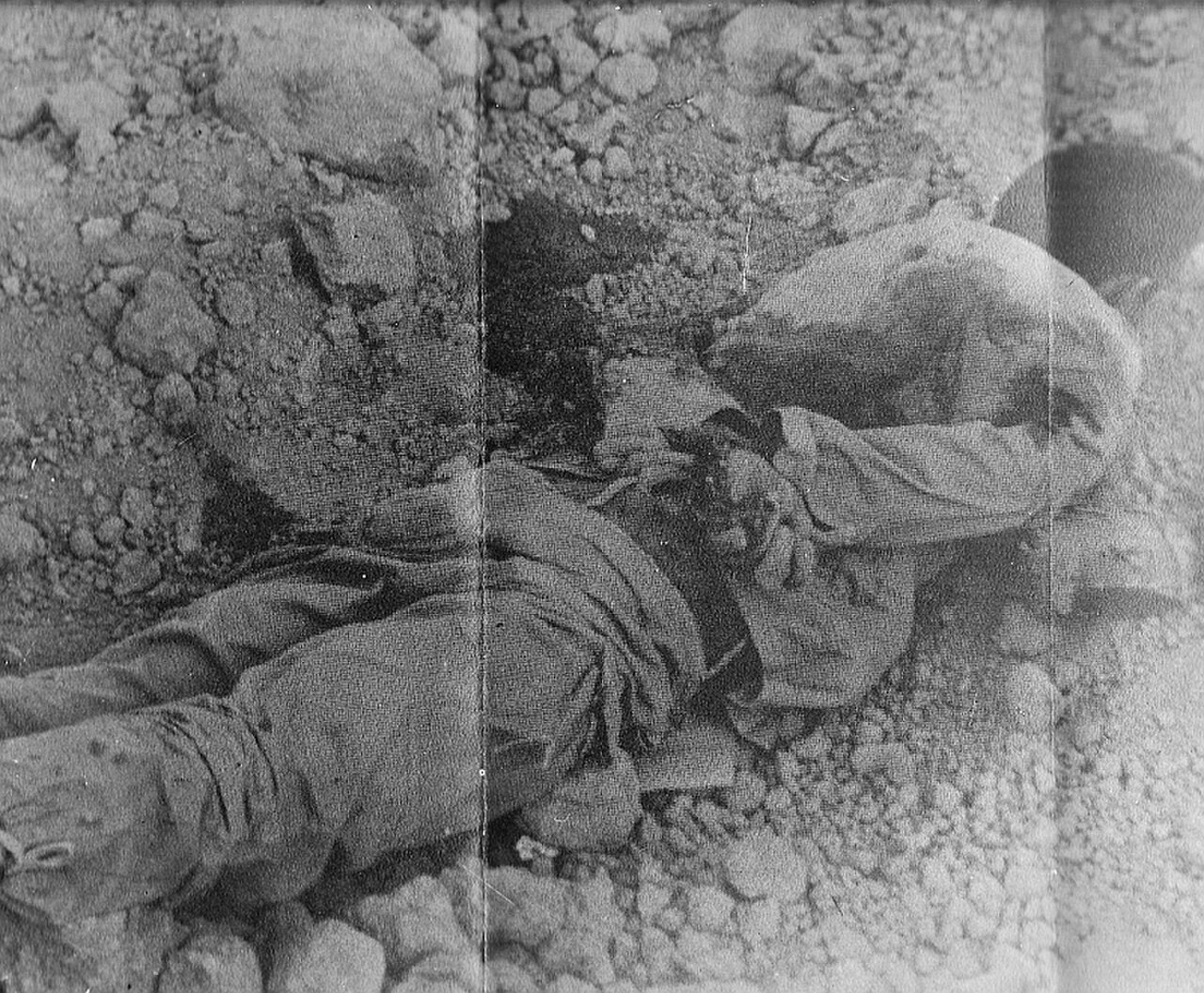
بدأت عملية خيبر في 24 فبراير بعبور المشاة الإيرانيين مستنقعات الحويزة باستخدام الزوارق البخارية وطائرات الهليكوبتر للنقل في هجوم برمائي . [60] هاجم الإيرانيون جزيرة مجنون الحيوية المنتجة للنفط عن طريق إنزال القوات عبر طائرات الهليكوبتر على الجزر وقطع خطوط الاتصال بين العمارة والبصرة. [152] ثم واصلوا الهجوم باتجاه القرنة . [60] بحلول 27 فبراير، استولوا على الجزيرة، لكنهم تكبدوا خسائر كارثية في المروحيات لصالح القوات الجوية العراقية. في ذلك اليوم، اعترضت الطائرات المقاتلة العراقية ( ميج وميراج وسوخوي) مجموعة ضخمة من المروحيات الإيرانية التي تنقل قوات الحرس الثوري. فيما كان في الأساس مذبحة جوية، أسقطت الطائرات النفاثة العراقية 49 من أصل 50 مروحية إيرانية. [60] في بعض الأحيان، دار القتال في المياه التي يزيد عمقها عن 2 متر (6.6 قدم). قام العراق بتمرير كابلات كهربائية حية عبر المياه، مما أدى إلى صعق العديد من القوات الإيرانية بالكهرباء ثم عرض جثثهم على التلفزيون الرسمي. [145]
بحلول 29 فبراير، وصل الإيرانيون إلى مشارف القرنة وكانوا يقتربون من الطريق السريع بين بغداد والبصرة . [60] لقد خرجوا من المستنقعات وعادوا إلى الأراضي المفتوحة، حيث واجهتهم المدفعية العراقية والدبابات والقوة الجوية وغاز الخردل . قُتل 1200 جندي إيراني في الهجوم المضاد. تراجع الإيرانيون إلى المستنقعات، رغم أنهم ما زالوا متمسكين بها إلى جانب جزيرة مجنون. [60] [63] : 44

شهدت معركة الأهوار دفاعًا عراقيًا كان تحت ضغط مستمر منذ 15 فبراير. وقد ارتاحوا باستخدامهم للأسلحة الكيميائية والدفاع المتعمق ، حيث قاموا بتقسيم الخطوط الدفاعية: حتى لو اخترق الإيرانيون الخط الأول، فإنهم عادة ما كانوا غير قادرين على اختراق الخط الثاني بسبب الإرهاق والخسائر الفادحة. [124] : 171 لقد اعتمدوا إلى حد كبير على Mi-24 Hind "لمطاردة" القوات الإيرانية في الأهوار. [60] قُتل ما لا يقل عن 20000 إيراني في معارك الأهوار. [145] استخدمت إيران الأهوار كنقطة انطلاق لهجمات / تسللات مستقبلية. [60]
بعد مرور أربع سنوات على الحرب، بلغت الخسائر البشرية التي تكبدتها إيران 170 ألف قتيل و340 ألف جريح. وقُدِّرت الخسائر البشرية التي تكبدتها القوات العراقية بنحو 80 ألف قتيل و150 ألف جريح. [60]
حرب الناقلاتو الحرب المدن
وبسبب عجزها عن شن هجمات برية ناجحة ضد إيران، استخدمت العراق قوتها الجوية الموسعة الآن لتنفيذ قصف استراتيجي ضد السفن الإيرانية والأهداف الاقتصادية والمدن من أجل إلحاق الضرر باقتصاد إيران ومعنوياتها. [60] [153] أرادت العراق أيضًا استفزاز إيران للقيام بشيء من شأنه أن يتسبب في تورط القوى العظمى بشكل مباشر في الصراع على الجانب العراقي. [61]
الهجمات على الشحن
,_USS_William_H._Standley_(CG-32)_and_USS_Guadalcanal_(LPH-7)_escort_tanker_Gas_King_in_the_Persian_Gullf_on_21_October_1987_(6432283).jpg/1280px-USS_Hawes_(FFG-53),_USS_William_H._Standley_(CG-32)_and_USS_Guadalcanal_(LPH-7)_escort_tanker_Gas_King_in_the_Persian_Gullf_on_21_October_1987_(6432283).jpg)
بدأت ما يسمى بحرب الناقلات عندما هاجمت العراق محطة النفط وناقلات النفط في جزيرة خرج في أوائل عام 1984. [63] كان هدف العراق من مهاجمة الشحن الإيراني هو استفزاز الإيرانيين للرد بإجراءات متطرفة، مثل إغلاق مضيق هرمز أمام جميع حركة المرور البحرية، وبالتالي جلب التدخل الأمريكي؛ هددت الولايات المتحدة عدة مرات بالتدخل إذا تم إغلاق مضيق هرمز. [63] ونتيجة لذلك، اقتصر الإيرانيون على هجماتهم الانتقامية على الشحن العراقي، وتركوا المضيق مفتوحًا للمرور العام. [63]
وأعلن العراق أن جميع السفن المتجهة إلى أو القادمة من الموانئ الإيرانية في المنطقة الشمالية من الخليج العربي معرضة للهجوم. [63] واستخدموا طائرات الهليكوبتر من طراز إف-1 ميراج وسوبر إيتندارد وميج-23 وسو-20/22 وسوبر فريلون المسلحة بصواريخ إكزوسيت المضادة للسفن بالإضافة إلى صواريخ جو-أرض سوفييتية الصنع لفرض تهديداتهم. وقصف العراق مرارًا وتكرارًا منشأة تصدير النفط الرئيسية الإيرانية في جزيرة خرج، مما تسبب في أضرار جسيمة متزايدة. وكرد فعل أولي على هذه الهجمات، هاجمت إيران ناقلة كويتية تحمل نفطًا عراقيًا بالقرب من البحرين في 13 مايو 1984، بالإضافة إلى ناقلة سعودية في المياه السعودية في 16 مايو. [63]
ولأن العراق أصبح غير ساحلي أثناء الحرب، فقد اضطر إلى الاعتماد على حلفائه العرب، وفي المقام الأول الكويت، لنقل نفطه. هاجمت إيران ناقلات النفط التي تحمل النفط العراقي من الكويت، ثم هاجمت لاحقًا ناقلات النفط من أي دولة خليجية تدعم العراق. وزادت الهجمات على سفن الدول غير المقاتلة في الخليج العربي بشكل حاد بعد ذلك، حيث هاجمت كلتا الدولتين ناقلات النفط والسفن التجارية للدول المحايدة في محاولة لحرمان خصمهما من التجارة. [63] أدت الهجمات الإيرانية على الشحن السعودي إلى إسقاط طائرات إف-15 السعودية لاثنين من مقاتلات إف-4 فانتوم الثانية في 5 يونيو 1984. [63]
ولم تلحق الهجمات الجوية والقوارب الصغيرة أضراراً تُذكَر باقتصادات دول الخليج العربي، ونقلت إيران ميناء الشحن الخاص بها إلى جزيرة لارك في مضيق هرمز. [154]
فرضت البحرية الإيرانية حصارًا بحريًا على العراق، باستخدام فرقاطاتها البريطانية الصنع لإيقاف وتفتيش أي سفن يُعتقد أنها تتاجر مع العراق. وقد عملت هذه الفرقاطات في ظل إفلات شبه كامل من العقاب، حيث لم يتلق الطيارون العراقيون تدريبًا كافيًا لضرب الأهداف البحرية. هاجمت بعض السفن الحربية الإيرانية ناقلات النفط بصواريخ من سفينة إلى سفينة، بينما استخدمت سفن أخرى راداراتها لتوجيه الصواريخ المضادة للسفن البرية إلى أهدافها. [155] بدأت إيران تعتمد على البحرية الجديدة للحرس الثوري ، والتي استخدمت زوارق سريعة من طراز بوغامار مزودة بقاذفات صواريخ ومدافع رشاشة ثقيلة. كانت هذه الزوارق السريعة تشن هجمات مفاجئة ضد ناقلات النفط وتسبب أضرارًا جسيمة. كما استخدمت إيران مقاتلات ومروحيات من طراز إف-4 فانتوم 2 لإطلاق صواريخ مافريك والصواريخ غير الموجهة على ناقلات النفط. [60]
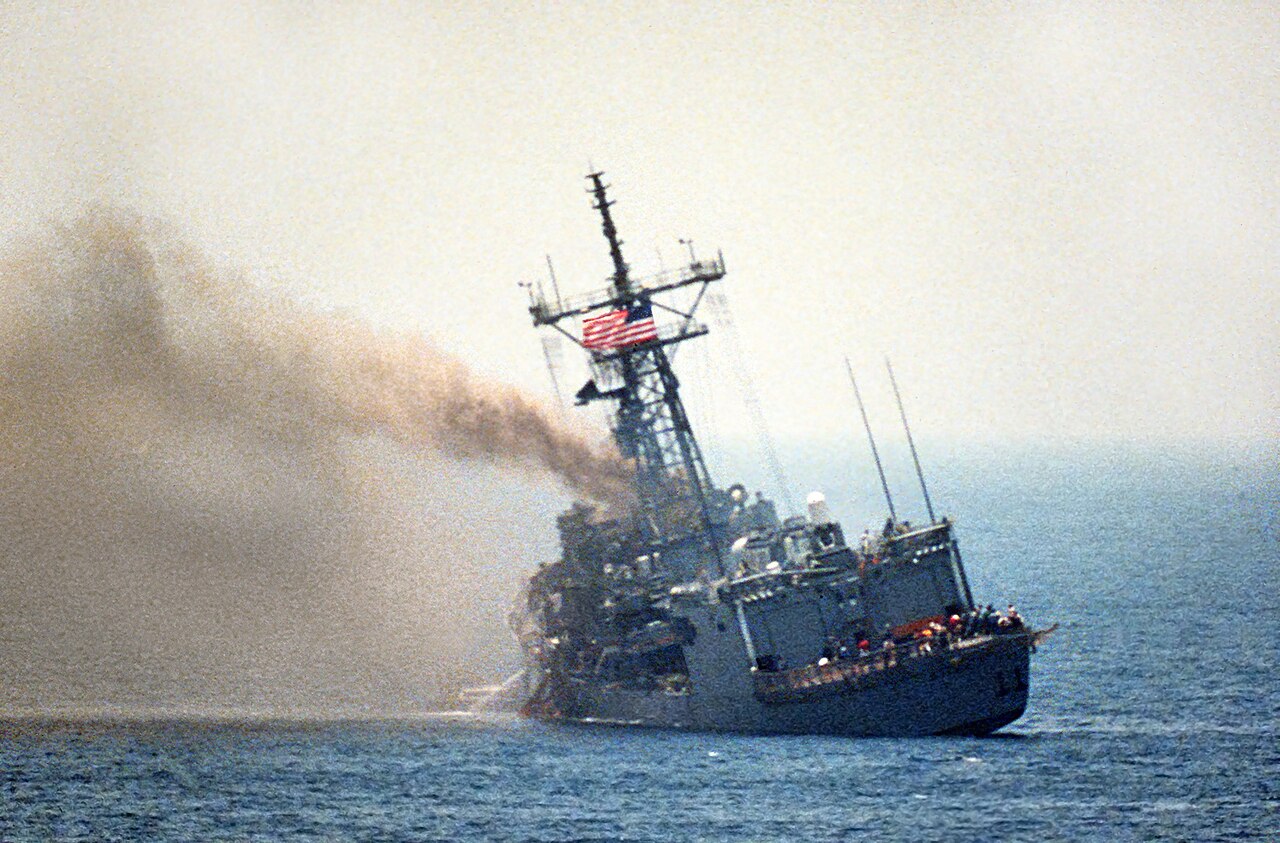
في 17 مايو 1987، تعرضت سفينة تابعة للبحرية الأمريكية ، ستارك ، لهجوم بصاروخين مضادين للسفن من طراز إكزوسيت أطلقتهما طائرة عراقية من طراز ميراج إف-1 . [156] [157] وقد أُطلقت الصواريخ في نفس الوقت تقريبًا الذي تلقت فيه الطائرة تحذيرًا لاسلكيًا روتينيًا من ستارك . [158] لم تكتشف الفرقاطة الصواريخ بالرادار، وأصدر المراقب تحذيرًا قبل لحظات فقط من ضربها. [159] أصاب كلا الصاروخين السفينة، وانفجر أحدهما في أماكن الطاقم، مما أسفر عن مقتل 37 بحارًا وإصابة 21. [159]
قدرت شركة لويدز أوف لندن ، وهي سوق تأمين بريطانية، أن حرب الناقلات ألحقت أضرارًا بـ 546 سفينة تجارية وقتلت حوالي 430 بحارًا مدنيًا. وكان الجزء الأكبر من الهجمات موجهًا من قبل العراق ضد السفن في المياه الإيرانية، حيث شن العراقيون ثلاثة أضعاف عدد الهجمات التي شنها الإيرانيون. [61] : 3 لكن هجمات الزوارق السريعة الإيرانية على الشحن الكويتي دفعت الكويت إلى تقديم التماس رسمي إلى القوى الأجنبية في 1 نوفمبر 1986 لحماية شحنها. وافق الاتحاد السوفيتي على استئجار ناقلات النفط بدءًا من عام 1987، وعرضت البحرية الأمريكية توفير الحماية للناقلات الأجنبية التي أعادت رفع العلم الأمريكي بدءًا من 7 مارس 1987 في عملية إرنست ويل . [63] [158] لم تكن الناقلات المحايدة المتجهة إلى إيران محمية بموجب عملية إرنست ويل، مما أدى إلى تقليل حركة ناقلات النفط الأجنبية إلى إيران، لأنها كانت معرضة لخطر الهجوم الجوي العراقي. اتهمت إيران الولايات المتحدة بمساعدة العراق. [60] [128] [61]
خلال مسار الحرب، هاجمت إيران سفينتين تجاريتين سوفييتيتين. [160]
تعرضت السفينة العملاقة سي وايز ، وهي أكبر سفينة تم بناؤها على الإطلاق، لقصف بصواريخ إكزوسيت العراقية أثناء نقلها النفط الخام الإيراني من الخليج العربي. [161]
هجمات على المدن
وفي الوقت نفسه، بدأت القوات الجوية العراقية أيضًا في تنفيذ غارات قصف استراتيجية ضد المدن الإيرانية. وبينما شن العراق العديد من الهجمات بالطائرات والصواريخ ضد المدن الحدودية منذ بداية الحرب وغارات متفرقة على المدن الإيرانية الرئيسية، كان هذا أول قصف استراتيجي منهجي ينفذه العراق أثناء الحرب. وسيُعرف هذا باسم حرب المدن . وبمساعدة الاتحاد السوفييتي والغرب، أعيد بناء القوات الجوية العراقية وتوسيعها. [112] وفي الوقت نفسه، قلصت إيران بشدة عمليات قواتها الجوية بسبب العقوبات ونقص قطع الغيار. استخدم العراق قاذفات استراتيجية من طراز Tu-22 Blinder و Tu-16 Badger لتنفيذ غارات طويلة المدى وعالية السرعة على المدن الإيرانية، بما في ذلك طهران. تم استخدام قاذفات مقاتلة مثل MiG-25 Foxbat و Su-22 Fitter ضد أهداف أصغر أو أقصر مدى، بالإضافة إلى مرافقة القاذفات الاستراتيجية. [112] تم استهداف أهداف مدنية وصناعية بالغارات، [162] وألحقت كل غارة ناجحة أضرارًا اقتصادية بسبب القصف الاستراتيجي المنتظم. [112]
ردًا على ذلك، نشر الإيرانيون طائراتهم من طراز F-4 فانتوم لمحاربة العراقيين، وفي النهاية نشروا أيضًا طائرات F-14. وبحلول عام 1986، وسعت إيران أيضًا شبكة دفاعها الجوي بشكل كبير لتخفيف الضغط على القوات الجوية. وبحلول وقت لاحق من الحرب، لم تُستخدم الهجمات الجوية العراقية إلا على عدد أقل من الأهداف الأكثر أهمية. [163] بدءًا من عام 1987، أمر صدام أيضًا بعدة هجمات كيميائية على أهداف مدنية في إيران، مثل مدينة سردشت . [164]

كما شنت إيران عدة غارات جوية انتقامية على العراق، في حين قصفت في المقام الأول المدن الحدودية مثل البصرة. كما اشترت إيران بعض صواريخ سكود من ليبيا ، وأطلقتها على بغداد. وقد ألحقت هذه الصواريخ أيضًا أضرارًا بالعراق. [60]
في 7 فبراير 1984، أثناء حرب المدن الأولى، أمر صدام قواته الجوية بمهاجمة إحدى عشرة مدينة إيرانية؛ [63] وتوقف القصف في 22 فبراير 1984. وتشير التقديرات إلى مقتل 1200 مدني إيراني خلال الغارات في فبراير وحده. [60]
الوضع الاستراتيجي في عام 1984
بحلول عام 1984، قُدِّرت خسائر إيران بنحو 300 ألف جندي، بينما قُدِّرت خسائر العراق بنحو 150 ألف جندي. [61] : 2 واتفق المحللون الأجانب على أن إيران والعراق فشلا في استخدام معداتهما الحديثة بشكل صحيح، وفشل كلا الجانبين في تنفيذ هجمات عسكرية حديثة يمكن أن تكسب الحرب. كما تخلى كلا الجانبين عن المعدات في ساحة المعركة لأن فنييهما لم يتمكنوا من إجراء الإصلاحات. وأظهرت إيران والعراق القليل من التنسيق الداخلي في ساحة المعركة، وفي كثير من الحالات تُرِكَت الوحدات للقتال بمفردها. ونتيجة لذلك، بحلول نهاية عام 1984، كانت الحرب في طريق مسدود. [61] : 2 [165] وقع هجوم محدود شنته إيران (فجر 7) في الفترة من 18 إلى 25 أكتوبر 1984، عندما استعادوا مدينة مهران الإيرانية ، التي احتلها العراقيون منذ بداية الحرب. [63] [139]
الهجمات العراقية 1985-1986
وبحلول عام 1985، كانت القوات المسلحة العراقية تتلقى الدعم المالي من المملكة العربية السعودية والكويت ودول الخليج الأخرى، وكانت تبرم صفقات شراء أسلحة ضخمة من الاتحاد السوفييتي والصين وفرنسا. وللمرة الأولى منذ أوائل عام 1980، شن صدام هجمات جديدة.
في السادس من يناير 1986، شن العراقيون هجومًا محاولين استعادة جزيرة مجنون. وسرعان ما وجدوا أنفسهم في مأزق أمام 200 ألف جندي مشاة إيراني، معززين بفرق برمائية. [145] ومع ذلك، تمكنوا من اكتساب موطئ قدم في الجزء الجنوبي من الجزيرة. [90]
كما شنت العراق حرب مدن أخرى بين 12 و14 مارس، حيث ضربت ما يصل إلى 158 هدفًا في أكثر من 30 بلدة ومدينة، بما في ذلك طهران. وردت إيران بإطلاق 14 صاروخ سكود لأول مرة، تم شراؤها من ليبيا . وتم تنفيذ المزيد من الهجمات الجوية العراقية في أغسطس، مما أسفر عن سقوط مئات الضحايا المدنيين الإضافيين. استمرت الهجمات العراقية ضد ناقلات النفط الإيرانية والمحايدة في المياه الإيرانية، حيث نفذ العراق 150 غارة جوية باستخدام طائرات سوبر إيتندارد وميراج إف-1 الفرنسية التي تم شراؤها بالإضافة إلى مروحيات سوبر فريلون المسلحة بصواريخ إكزوسيت . [153]
عملية بدر

هاجم العراقيون مرة أخرى في 28 يناير 1985؛ فهُزموا، ورد الإيرانيون في 11 مارس 1985 بهجوم كبير موجه ضد طريق بغداد البصرة (أحد الهجمات الكبرى القليلة التي أجريت في عام 1985)، وأطلقوا عليه اسم عملية بدر (بعد معركة بدر ، أول انتصار عسكري لمحمد في مكة). [63] [166] حث آية الله الخميني الإيرانيين على الاستمرار، معلنًا:
"إن اعتقادنا هو أن صدام يريد أن يعيد الإسلام إلى الكفر والشرك... فإذا انتصرت أميركا... ومنحت صدام النصر فسوف يتلقى الإسلام ضربة لن يستطيع معها أن يرفع رأسه طويلاً... إن القضية هي قضية الإسلام في مواجهة الكفر، وليس قضية إيران في مواجهة العراق." [167]
كانت هذه العملية مشابهة لعملية خيبر، وإن كانت تتطلب تخطيطًا أكثر. استخدمت إيران 100 ألف جندي، مع 60 ألف جندي إضافي في الاحتياط. قاموا بتقييم التضاريس المستنقعية، ورسموا نقاطًا حيث يمكنهم إنزال الدبابات، وبنوا جسورًا عائمة عبر المستنقعات. كما تم تجهيز قوات الباسيج بأسلحة مضادة للدبابات . [145]
وقد أدى ضراوة الهجوم الإيراني إلى اختراق الخطوط العراقية. ففي 14 مارس/آذار، تمكن الحرس الثوري، بدعم من الدبابات والمدفعية، من اختراق شمال القرنة. وفي تلك الليلة نفسها، وصل 3000 جندي إيراني وعبروا نهر دجلة باستخدام الجسور العائمة واستولوا على جزء من الطريق السريع بين بغداد والبصرة 6 ، وهو ما فشلوا في تحقيقه في عمليتي الفجر 5 و6. [60]
رد صدام بشن هجمات كيميائية ضد المواقع الإيرانية على طول الطريق السريع وببدء حرب المدن الثانية المذكورة أعلاه ، بحملة جوية وصاروخية ضد عشرين إلى ثلاثين مركزًا سكانيًا إيرانيًا، بما في ذلك طهران. [63] تحت قيادة الجنرال سلطان هاشم أحمد الطائي والجنرال جمال زنون (كلاهما يعتبر من بين أكثر القادة العراقيين مهارة)، شن العراقيون هجمات جوية ضد المواقع الإيرانية وحاصروها. ثم شنوا هجومًا كماشة باستخدام المشاة الآلية والمدفعية الثقيلة. [60] تم استخدام الأسلحة الكيميائية، كما غمر العراقيون الخنادق الإيرانية بأنابيب مصممة خصيصًا لتوصيل المياه من نهر دجلة.
تراجع الإيرانيون إلى مستنقعات الحويزة أثناء تعرضهم للهجوم من قبل المروحيات، [60] واستعاد العراقيون الطريق السريع. أسفرت عملية بدر عن سقوط 10000 إلى 12000 قتيل عراقي و15000 قتيل إيراني. [63]
الهجمات المضادة الإيرانية

كان فشل هجمات الموجات البشرية في السنوات السابقة قد دفع إيران إلى تطوير علاقة عمل أفضل بين الجيش والحرس الثوري [63] وتشكيل وحدات الحرس الثوري إلى قوة قتالية أكثر تقليدية. لمكافحة استخدام العراق للأسلحة الكيميائية، بدأت إيران في إنتاج ترياق . [145] كما قاموا بإنشاء ونشر طائراتهم بدون طيار محلية الصنع، مهاجر 1 ، المجهزة بستة صواريخ آر بي جي 7 لشن الهجمات. تم استخدامها في المقام الأول في المراقبة، حيث تم استخدامها لما يصل إلى 700 طلعة جوية . [168]
خلال بقية عام 1986، وحتى ربيع عام 1988، زادت كفاءة القوات الجوية الإيرانية في الدفاع الجوي ، مع إصلاح الأسلحة أو استبدالها واستخدام أساليب تكتيكية جديدة. على سبيل المثال، كان الإيرانيون يدمجون بشكل فضفاض مواقع صواريخهم المضادة للطائرات والصواريخ الاعتراضية لإنشاء "حقول قتل" فقدت فيها العشرات من الطائرات العراقية، وهو ما تم الإبلاغ عنه في الغرب على أنه استخدام القوات الجوية الإيرانية لطائرات إف-14 كـ " طائرات إنذار مبكر صغيرة ". ردت القوات الجوية العراقية بزيادة تعقيد معداتها، ودمجت كبسولات إلكترونية مضادة حديثة ، وإغراءات مثل القش والصواريخ المضيئة ، والصواريخ المضادة للإشعاع . [152]
وبسبب الخسائر الفادحة التي تكبدتها القوات العراقية في حرب المدن الأخيرة، قللت من استخدامها للهجمات الجوية على المدن الإيرانية. وبدلاً من ذلك، أطلقت صواريخ سكود، التي لم يتمكن الإيرانيون من إيقافها. ولأن مدى صواريخ سكود كان قصيراً للغاية بحيث لا يصل إلى طهران، فقد حولتها إلى صواريخ الحسين بمساعدة مهندسين من ألمانيا الشرقية، فقاموا بتقطيع صواريخ سكود إلى ثلاثة أجزاء وربطوها ببعضها البعض. وردت إيران على هذه الهجمات باستخدام صواريخ سكود الخاصة بها. [168]
بالإضافة إلى المساعدة الأجنبية الواسعة النطاق للعراق، تعطلت الهجمات الإيرانية بشدة بسبب نقص الأسلحة، وخاصة الأسلحة الثقيلة حيث فقدت كميات كبيرة منها أثناء الحرب. لا تزال إيران قادرة على الحفاظ على 1000 دبابة، غالبًا عن طريق الاستيلاء على الدبابات العراقية والمدفعية الإضافية، لكن العديد منها كانت بحاجة إلى إصلاحات لتكون جاهزة للعمل. بحلول هذا الوقت، تمكنت إيران من شراء قطع غيار من مصادر مختلفة، مما ساعدها على استعادة بعض الأسلحة. لقد استوردوا سراً بعض الأسلحة، مثل أنظمة الدفاع الجوي المحمولة RBS-70 . [60] باستثناء دعم الولايات المتحدة للعراق، في مقابل استخدام إيران لنفوذها للمساعدة في تحرير الرهائن الغربيين في لبنان ، باعت الولايات المتحدة سراً لإيران بعض الإمدادات المحدودة. في مقابلة ما بعد الحرب مع أكبر رفسنجاني، ذكر أنه خلال الفترة التي كانت إيران ناجحة فيها، دعمت الولايات المتحدة إيران لفترة قصيرة، ثم بدأت بعد فترة وجيزة في مساعدة العراق مرة أخرى. [122] تمكنت إيران من الحصول على بعض الأسلحة المتقدمة، مثل صواريخ TOW المضادة للدبابات ، والتي كانت تعمل بشكل أفضل من القذائف الصاروخية . وقد قامت إيران فيما بعد بهندسة هذه الأسلحة وإنتاجها بنفسها. [60] [153] ومن المؤكد أن كل هذا ساعد في زيادة فعالية إيران، على الرغم من أنه لم يقلل من التكلفة البشرية لهجماتها. [60] [153]
معركة الفاو الأولى
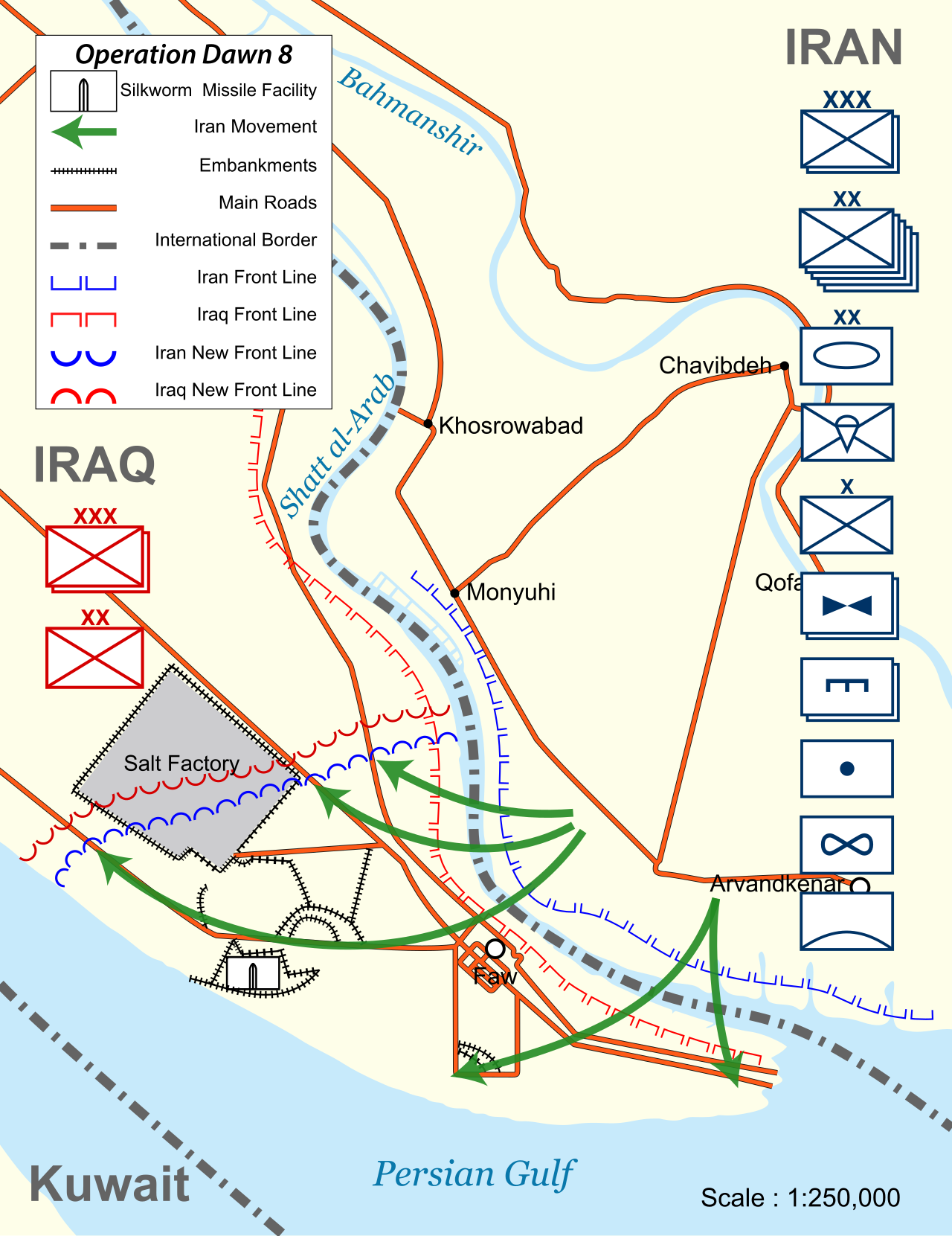
في ليلة 10-11 فبراير 1986، أطلق الإيرانيون عملية الفجر 8، [169] حيث تقدم 30 ألف جندي في خمس فرق من الجيش ورجال من الحرس الثوري والباسيج في هجوم مزدوج للاستيلاء على شبه جزيرة الفاو في جنوب العراق، المنطقة الوحيدة التي تلامس الخليج الفارسي . [63] كان الاستيلاء على الفاو وأم قصر هدفًا رئيسيًا لإيران. [122] بدأت إيران بهجوم خادع على البصرة، والذي أوقفه العراقيون. [63] [151]
وفي الوقت نفسه، هبطت قوة برمائية ضاربة عند سفح شبه الجزيرة. فرَّت المقاومة، التي كانت تتألف من عدة آلاف من جنود الجيش الشعبي العراقي غير المدربين تدريبًا جيدًا ، أو هُزمت، وأقامت القوات الإيرانية جسورًا عائمة تعبر شط العرب [ملاحظة 5] ، مما سمح لـ 30 ألف جندي بالعبور في فترة زمنية قصيرة. [151] وقادوا شمالًا على طول شبه الجزيرة دون معارضة تقريبًا، واستولوا عليها بعد 24 ساعة فقط من القتال. [63] [124] : 240 [83] وبعد ذلك حفروا أنفسهم وأقاموا دفاعات. [83]
لقد صدم الاستيلاء المفاجئ على الفاو العراقيين، حيث كانوا يعتقدون أنه من المستحيل على الإيرانيين عبور شط العرب. في 12 فبراير 1986، بدأ العراقيون هجومًا مضادًا لاستعادة الفاو، والذي فشل بعد أسبوع من القتال العنيف. [63] [83] في 24 فبراير 1986، أرسل صدام أحد أفضل قادته، الجنرال ماهر عبد الرشيد ، والحرس الجمهوري لبدء هجوم جديد لاستعادة الفاو. [63] وقعت جولة جديدة من القتال العنيف. انتهت محاولاتهم مرة أخرى بالفشل، مما كلفهم العديد من الدبابات والطائرات. [63] تم القضاء على فرقتهم الميكانيكية الخامسة عشرة بالكامل تقريبًا. [60] كان الاستيلاء على الفاو وفشل الهجمات المضادة العراقية بمثابة ضربات لهيبة نظام البعث، ودفع دول الخليج إلى الخوف من أن إيران قد تفوز بالحرب. [63] شعرت الكويت على وجه الخصوص بالتهديد من وجود القوات الإيرانية على بعد 16 كم (9.9 ميل) فقط، وزادت من دعمها للعراق وفقًا لذلك. [124] : 241
في مارس 1986، حاول الإيرانيون متابعة نجاحهم بمحاولة الاستيلاء على أم قصر ، والتي كانت ستفصل العراق تمامًا عن الخليج وتضع القوات الإيرانية على الحدود مع الكويت. [63] [122] فشل الهجوم بسبب النقص الإيراني في الدروع. [63] بحلول هذا الوقت، كان 17000 عراقي و30000 إيراني ضحايا. [63] انتهت معركة الفاو الأولى في مارس، لكن العمليات القتالية العنيفة استمرت في شبه الجزيرة حتى عام 1988، ولم يتمكن أي من الجانبين من إزاحة الآخر. وتعثرت المعركة في طريق مسدود على غرار الحرب العالمية الأولى في مستنقعات شبه الجزيرة. [115]
معركة مهران
بعد الاستيلاء الإيراني على الفاو مباشرة، أعلن صدام عن هجوم جديد ضد إيران، مصمم للتوغل في عمق الدولة. [60] [ مطلوب صفحة ] تم اختيار مدينة مهران الحدودية الإيرانية ، على سفح جبال زاغروس، كهدف أول. في 15-19 مايو، هاجم الفيلق الثاني للجيش العراقي، بدعم من طائرات الهليكوبتر الحربية، المدينة واستولى عليها. ثم عرض صدام مبادلة مهران بالفاو. [60] [ مطلوب صفحة ] رفض الإيرانيون العرض. ثم واصل العراق الهجوم، محاولًا التوغل في عمق إيران. تم صد هجوم العراق بسرعة بواسطة مروحيات AH-1 Cobra الإيرانية بصواريخ TOW ، والتي دمرت العديد من الدبابات والمركبات العراقية. [60] [ مطلوب صفحة ]
حشد الإيرانيون قواتهم على المرتفعات المحيطة بمهران. وفي الثلاثين من يونيو، استخدموا تكتيكات الحرب الجبلية لشن هجومهم، واستعادوا السيطرة على المدينة بحلول الثالث من يوليو. [60] [ الصفحة مطلوبة ] أمر صدام الحرس الجمهوري باستعادة المدينة في الرابع من يوليو، لكن هجومهم لم يكن فعالاً. كانت الخسائر العراقية فادحة بما يكفي للسماح للإيرانيين بالاستيلاء على أراضٍ داخل العراق أيضًا، [60] [ الصفحة مطلوبة ] واستنزفت الجيش العراقي بما يكفي لمنعهم من شن هجوم كبير على مدى العامين التاليين. [60] [ الصفحة مطلوبة ] كانت هزائم العراق في الفاو ومهران بمثابة ضربات شديدة لهيبة النظام العراقي. أصبحت القوى الغربية، بما في ذلك الولايات المتحدة، أكثر تصميماً على منع خسارة عراقية. [60] [ الصفحة مطلوبة ]
الوضع في نهاية عام 1986
ومن خلال أعين المراقبين الدوليين، كانت إيران متفوقة في الحرب بحلول نهاية عام 1986. [151] وفي الجبهة الشمالية، بدأ الإيرانيون في شن هجمات باتجاه مدينة السليمانية بمساعدة المقاتلين الأكراد، ففاجأوا العراقيين. ووصلوا إلى مسافة 16 كم (9.9 ميل) من المدينة قبل أن يتم إيقافهم بهجمات كيميائية وهجمات عسكرية. كما وصل جيش إيران إلى تلال ميماك، على بعد 113 كم (70 ميل) فقط من بغداد. [151] وتمكن العراق من احتواء هجمات إيران في الجنوب، لكنه كان تحت ضغط شديد، حيث كان الإيرانيون يسحقونهم ببطء.
ردت العراق بشن حرب أخرى على المدن . ففي إحدى الهجمات، تعرضت مصفاة النفط الرئيسية في طهران للقصف، وفي واقعة أخرى، ألحقت العراق الضرر بصحن القمر الصناعي الإيراني في أسد آباد، مما أدى إلى تعطيل خدمة الهاتف والتلكس الإيرانية في الخارج لمدة أسبوعين تقريبًا. [151] كما تعرضت مناطق مدنية للقصف، مما أسفر عن سقوط العديد من الضحايا. واستمر العراق في مهاجمة ناقلات النفط عن طريق الجو. [60] وردت إيران بإطلاق صواريخ سكود والهجمات الجوية على أهداف عراقية.
واستمر العراق في مهاجمة جزيرة خرج وناقلات النفط والمرافق أيضًا. أنشأت إيران خدمة نقل ناقلات النفط من 20 ناقلة لنقل النفط من خرج إلى جزيرة لارك، تحت حراسة طائرات مقاتلة إيرانية. وبمجرد نقل النفط إلى لارك، يتم نقله إلى ناقلات بحرية عابرة للمحيطات، وعادة ما تكون محايدة. [170] كما أعادوا بناء محطات النفط التي تضررت بسبب الغارات الجوية العراقية ونقلوا الشحن إلى جزيرة لارك، بينما هاجموا ناقلات النفط الأجنبية التي تحمل النفط العراقي، حيث منعت إيران وصول العراق إلى البحر المفتوح بالاستيلاء على الفاو. وبحلول ذلك الوقت، كانوا يستخدمون دائمًا تقريبًا الزوارق السريعة المسلحة التابعة للبحرية التابعة للحرس الثوري الإيراني ، وهاجموا العديد من الناقلات. [60]
تصاعدت حرب الناقلات بشكل كبير، حيث تضاعفت الهجمات تقريبًا في عام 1986، ونفذت العراق أغلبها. حصل العراق على إذن من الحكومة السعودية لاستخدام مجالها الجوي لمهاجمة جزيرة لارك، على الرغم من أن الهجمات كانت أقل تواترًا هناك بسبب المسافة. أصبحت حرب الناقلات المتصاعدة في الخليج مصدر قلق متزايد للقوى الأجنبية، وخاصة الولايات المتحدة. [170]
في أبريل 1986، أصدر آية الله الخميني فتوى تنص على أن الحرب يجب أن تُربح بحلول مارس 1987. وزاد الإيرانيون من جهود التجنيد، وحصلوا على 650 ألف متطوع. [145] وظهر العداء بين الجيش والحرس الثوري مرة أخرى، حيث أراد الجيش استخدام هجمات عسكرية أكثر دقة ومحدودية، بينما أراد الحرس الثوري تنفيذ هجمات كبرى. [145] بدأت إيران، الواثقة في نجاحاتها، في التخطيط لأكبر هجماتها في الحرب، والتي أطلقوا عليها "هجماتهم النهائية". [145]
استراتيجية الدفاع الديناميكية للعراق
في مواجهة الهزائم الأخيرة التي مني بها العراق في الفاو ومهران، بدا وكأنه يخسر الحرب. فقد هدد جنرالات العراق، الغاضبون من تدخل صدام، بتمرد شامل ضد حزب البعث ما لم يُسمح لهم بإجراء العمليات بحرية. وفي إحدى المرات القليلة خلال حياته المهنية، استسلم صدام لمطالب جنرالاته. [83] [ الصفحة مطلوبة ] حتى هذه النقطة، كانت الاستراتيجية العراقية تتمثل في الصمود في مواجهة الهجمات الإيرانية. ومع ذلك، أدت الهزيمة في الفاو إلى دفع صدام إلى إعلان الحرب بأنها " الدفاع الديناميكي "، [60] [ الصفحة مطلوبة ] والإعلان عن ضرورة مشاركة جميع المدنيين في المجهود الحربي.
حاولت الحكومة دمج الشيعة في المجهود الحربي من خلال تجنيد العديد منهم كجزء من حزب البعث. [83] [ الصفحة المطلوبة ] وفي محاولة لموازنة الحماسة الدينية للإيرانيين والحصول على دعم الجماهير المتدينة، بدأ النظام أيضًا في الترويج للدين، وعلى السطح، الأسلمة ، على الرغم من حقيقة أن العراق كان يديره نظام علماني. أصبحت مشاهد صدام وهو يصلي ويؤدي الحج إلى الأضرحة شائعة على التلفزيون الذي تديره الدولة. وبينما كانت الروح المعنوية العراقية منخفضة طوال الحرب، إلا أن الهجوم على الفاو أثار الحماسة الوطنية، حيث خشي العراقيون الغزو. [83] [ الصفحة المطلوبة ]
كما قام صدام بتجنيد متطوعين من دول عربية أخرى في الحرس الجمهوري، وحصل على الكثير من الدعم الفني من الدول الأجنبية أيضًا. [60] [ الصفحة المطلوبة ] وفي حين استنفدت القوة العسكرية العراقية في المعارك الأخيرة، من خلال المشتريات والدعم الأجنبي الضخم، تمكنوا من توسيع جيشهم إلى أبعاد أكبر بكثير بحلول عام 1988. [60] [ الصفحة المطلوبة ]
وفي الوقت نفسه، أمر صدام بشن حملة الأنفال في محاولة لسحق المقاومة الكردية، التي تحالفت الآن مع إيران. وكانت النتيجة مقتل مئات الآلاف من الأكراد العراقيين، وتدمير القرى والبلدات والمدن. [171]
بدأ العراق في محاولة إتقان تكتيكات المناورة الخاصة به. [83] [ الصفحة المطلوبة ] بدأ العراقيون في إعطاء الأولوية لمهنية جيشهم. قبل عام 1986، كان الجيش العراقي النظامي القائم على التجنيد والجيش الشعبي العراقي القائم على المتطوعين ينفذان الجزء الأكبر من العمليات في الحرب، دون تأثير يذكر. تم توسيع الحرس الجمهوري، الذي كان في السابق حرسًا بريتوريًا نخبويًا ، كجيش تطوعي ومليء بأفضل جنرالات العراق. [83] لم يعد الولاء للدولة شرطًا أساسيًا للانضمام. بعد الحرب، وبسبب جنون صدام، تم نقل الواجبات السابقة للحرس الجمهوري إلى وحدة جديدة، الحرس الجمهوري الخاص . [83] [ الصفحة المطلوبة ] تم إجراء ألعاب حرب كاملة النطاق ضد مواقع إيرانية افتراضية في الصحراء العراقية الغربية ضد أهداف وهمية. تكررت على مدار عام كامل حتى حفظت القوات المشاركة هجماتها بالكامل. [83] قامت العراق ببناء جيشها على نطاق واسع، حتى أصبحت تمتلك رابع أكبر جيش في العالم، وذلك بهدف التغلب على الإيرانيين من خلال حجمهم الهائل. [83] [ الصفحة المطلوبة ]
1987–88: تجدد الهجمات الإيرانية
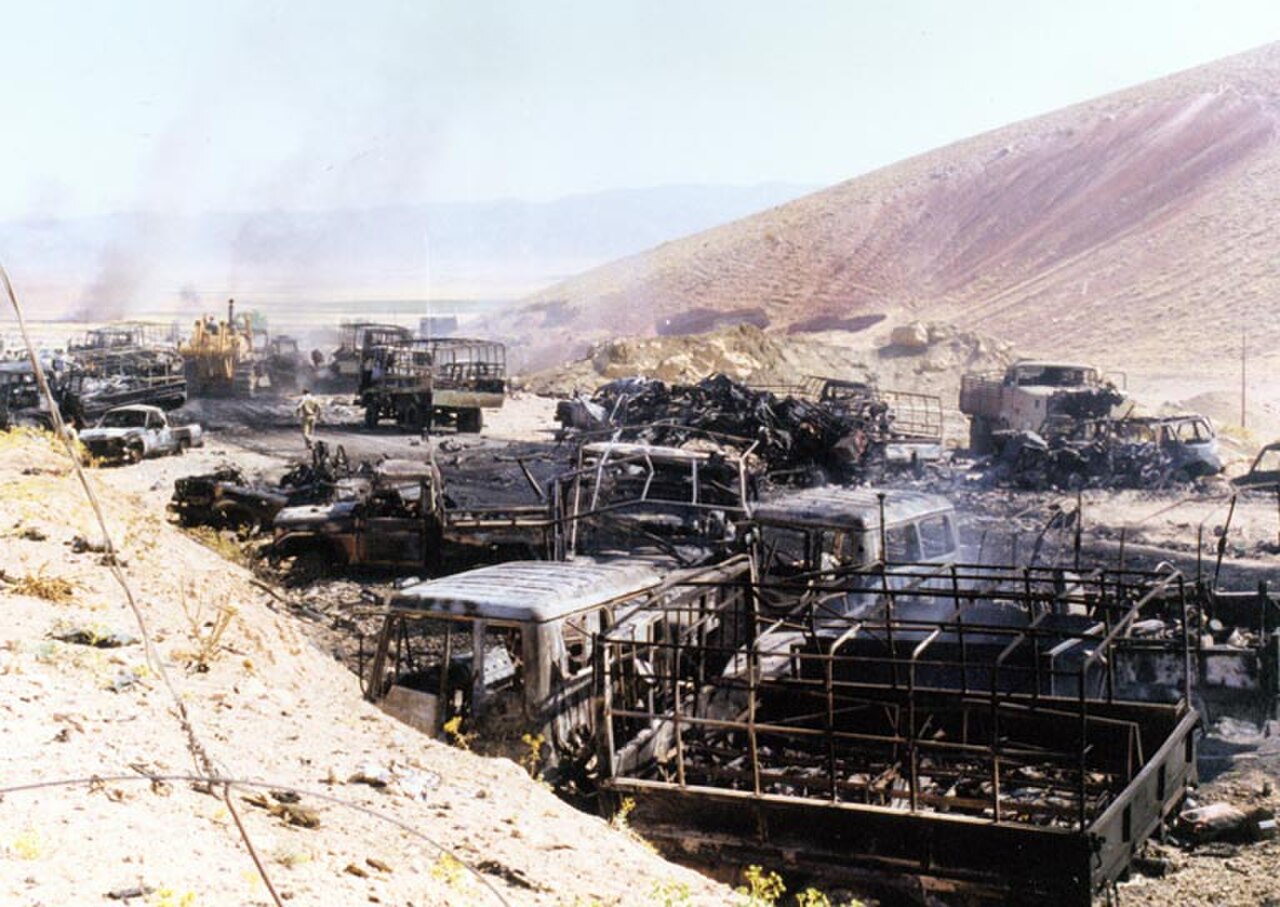
وفي الوقت نفسه، واصلت إيران الهجوم بينما كان العراقيون يخططون لضربتهم. وفي عام 1987، جددت إيران سلسلة من الهجمات البشرية الكبرى في كل من شمال وجنوب العراق. وكان العراقيون قد حصنوا البصرة بشكل متقن بخمس حلقات دفاعية، مستغلين الممرات المائية الطبيعية مثل شط العرب والممرات الاصطناعية، مثل بحيرة السمك ونهر جاسم، إلى جانب الحواجز الأرضية. كانت بحيرة السمك بحيرة ضخمة مليئة بالألغام والأسلاك الشائكة تحت الماء والأقطاب الكهربائية وأجهزة الاستشعار. وخلف كل ممر مائي وخط دفاعي كانت هناك مدفعية موجهة بالرادار وطائرات هجومية برية وطائرات هليكوبتر، وكلها قادرة على إطلاق الغاز السام أو الذخائر التقليدية. [60]
كانت الاستراتيجية الإيرانية تتلخص في اختراق الدفاعات العراقية وتطويق البصرة، وقطع المدينة وكذلك شبه جزيرة الفاو عن بقية العراق. [151] وكانت خطة إيران تتلخص في ثلاث هجمات: هجوم تحويلي بالقرب من البصرة، والهجوم الرئيسي وهجوم تحويلي آخر باستخدام الدبابات الإيرانية في الشمال لتحويل الدروع الثقيلة العراقية بعيدًا عن البصرة. [60] وفي هذه المعارك، أعادت إيران توسيع جيشها من خلال تجنيد العديد من المتطوعين الجدد من الباسيج والباسداران. [151] وقد جلبت إيران ما بين 150 ألفًا و200 ألف جندي إجماليًا إلى المعارك. [83]
عملية كربلاء 4
في 25 ديسمبر 1986، أطلقت إيران عملية كربلاء 4 ( كربلاء تشير إلى معركة كربلاء التي خاضها الحسين بن علي ) . [172] ووفقًا للجنرال العراقي رعد الحمداني، كان هذا هجومًا تحويليًا. [115] شن الإيرانيون هجومًا برمائيًا على جزيرة أم الرصاص العراقية في نهر شط العرب، الموازية لخرمشهر. ثم أقاموا جسرًا عائمًا واستمروا في الهجوم، واستولوا في النهاية على الجزيرة بنجاح مكلف لكنهم فشلوا في التقدم أكثر. كان لدى الإيرانيين 60.000 ضحية، بينما كان لدى العراقيين 9.500. [145] بالغ القادة العراقيون في تقدير الخسائر الإيرانية لصدام، وكان من المفترض أن الهجوم الإيراني الرئيسي على البصرة قد هُزم تمامًا وأن الأمر سيستغرق من الإيرانيين ستة أشهر للتعافي. عندما بدأ الهجوم الإيراني الرئيسي، عملية كربلاء 5، كان العديد من القوات العراقية في إجازة. [115]
كربلاء-5 (معركة البصرة السادسة)
حصار البصرة ، واسمه الرمزي عملية كربلاء-5 ( بالفارسية : عملیات کربلای ۵ )، كانت عملية هجومية نفذتها إيران في محاولة للاستيلاء على مدينة البصرة الساحلية العراقية في أوائل عام 1987. كانت هذه المعركة، المعروفة بخسائرها البشرية الفادحة وظروفها الشرسة، أكبر معركة في الحرب وثبت أنها بداية نهاية الحرب الإيرانية العراقية. [173] [174] وبينما عبرت القوات الإيرانية الحدود واستولت على الجزء الشرقي من محافظة البصرة، انتهت العملية إلى طريق مسدود.
كربلاء-6
في نفس الوقت الذي نفذت فيه عملية كربلاء 5، شنت إيران عملية كربلاء 6 ضد العراقيين في قصر شيرين في وسط إيران لمنع العراقيين من نقل الوحدات بسرعة للدفاع ضد هجوم كربلاء 5. نفذ الهجوم مشاة الباسيج وفرقة عاشوراء 31 التابعة للحرس الثوري وفرقة خراسان المدرعة 77 التابعة للجيش . هاجم الباسيج الخطوط العراقية، مما أجبر المشاة العراقية على التراجع. حاصرت هجمة مضادة مدرعة عراقية الباسيج في حركة كماشة. هاجمت فرق الدبابات الإيرانية، وكسرت الحصار. أوقف الهجوم الإيراني هجمات الأسلحة الكيميائية العراقية الجماعية. [175]
التعب الإيراني من الحرب
كانت عملية كربلاء 5 بمثابة ضربة قاسية للجيش الإيراني ومعنوياته. [139] بالنسبة للمراقبين الأجانب، بدا أن إيران كانت مستمرة في تعزيز قوتها. بحلول عام 1988، أصبحت إيران مكتفية ذاتيًا في العديد من المجالات، مثل صواريخ تاو المضادة للدبابات، وصواريخ سكود الباليستية ( شهاب-1 )، وصواريخ سيلك وورم المضادة للسفن، وصواريخ أوغاب التكتيكية، وإنتاج قطع غيار لأسلحتها. حسنت إيران دفاعاتها الجوية بصواريخ أرض-جو مهربة. [60] كانت إيران تنتج حتى طائرات بدون طيار وطائرات بيلاتوس بي سي-7 المروحية للمراقبة. [60] ضاعفت إيران مخزوناتها من المدفعية، وكانت مكتفية ذاتيًا في تصنيع الذخيرة والأسلحة الصغيرة. [176]
في حين لم يكن الأمر واضحًا للمراقبين الأجانب، فقد أصبح الجمهور الإيراني متعبًا من الحرب وخائب الأمل بشكل متزايد من القتال، وانضم عدد قليل نسبيًا من المتطوعين إلى القتال في عامي 1987 و1988. ولأن المجهود الحربي الإيراني اعتمد على التعبئة الشعبية، فقد تراجعت قوتهم العسكرية بالفعل، ولم تتمكن إيران من شن أي هجمات كبرى بعد كربلاء 5. ونتيجة لذلك، ولأول مرة منذ عام 1982، تحول زخم القتال نحو الجيش النظامي. ولأن الجيش النظامي كان يعتمد على التجنيد الإجباري، فقد جعل ذلك الحرب أقل شعبية. بدأ العديد من الإيرانيين في محاولة الهروب من الصراع. وفي وقت مبكر من مايو 1985، اندلعت مظاهرات مناهضة للحرب في 74 مدينة في جميع أنحاء إيران، والتي سحقها النظام، مما أسفر عن إطلاق النار على بعض المتظاهرين وقتلهم. [177]
اعترفت القيادة بأن الحرب وصلت إلى طريق مسدود، وبدأت في التخطيط وفقًا لذلك. [83] لم يتم التخطيط لمزيد من "الهجمات النهائية". [60] أعلن رئيس مجلس الدفاع الأعلى أكبر رفسنجاني خلال مؤتمر صحفي انتهاء هجمات الموجات البشرية. [178] أعلن محسن رضائي ، رئيس الحرس الثوري الإيراني، أن إيران ستركز حصريًا على الهجمات المحدودة والتسللات، بينما تقوم بتسليح ودعم جماعات المعارضة داخل العراق. [151]
على الجبهة الداخلية الإيرانية، فرضت العقوبات، وانخفاض أسعار النفط، والهجمات العراقية على منشآت النفط الإيرانية والشحن، خسائر فادحة على الاقتصاد. وفي حين لم تكن الهجمات نفسها مدمرة كما اعتقد بعض المحللين، فإن عملية الإرادة الصادقة التي قادتها الولايات المتحدة ، والتي حمت ناقلات النفط العراقية وحلفائها، ولكن ليس الناقلات الإيرانية، دفعت العديد من الدول المحايدة إلى وقف التجارة مع إيران بسبب ارتفاع التأمين والخوف من الهجوم الجوي. [60] [128] [61] وانخفضت الصادرات النفطية وغير النفطية الإيرانية بنسبة 55٪، ووصل التضخم إلى 50٪ بحلول عام 1987، وارتفعت معدلات البطالة بشكل كبير. [60] وفي الوقت نفسه، كانت العراق تعاني من ديون ساحقة ونقص في العمال، مما شجع قيادتها على محاولة إنهاء الحرب بسرعة. [139]
الوضع الاستراتيجي في أواخر عام 1987

بحلول نهاية عام 1987، امتلك العراق 5550 دبابة، أي ما يفوق عدد الإيرانيين بستة إلى واحد، و900 طائرة مقاتلة، أي ما يفوق عدد الإيرانيين بعشرة إلى واحد. [60] بعد عملية كربلاء 5، لم يتبق للعراق سوى 100 طيار مقاتل مؤهل. لذلك، بدأ العراق في الاستثمار في تجنيد الطيارين الأجانب من دول مثل بلجيكا وجنوب إفريقيا وباكستان وألمانيا الشرقية والاتحاد السوفيتي . [ 179] كما جددوا قوتهم البشرية من خلال دمج المتطوعين من الدول العربية الأخرى في جيشهم. كما أصبح العراق مكتفيًا ذاتيًا في الأسلحة الكيماوية وبعض الأسلحة التقليدية وتلقى الكثير من المعدات من الخارج. [60] ساعد الدعم الأجنبي العراق في تجاوز مشاكله الاقتصادية وديونه الضخمة لمواصلة الحرب وزيادة حجم جيشه. [60]
وبينما كانت الجبهتان الجنوبية والوسطى في طريق مسدود، بدأت إيران في التركيز على تنفيذ هجمات في شمال العراق بمساعدة البيشمركة ( المتمردون الأكراد ). واستخدم الإيرانيون مزيجًا من تكتيكات شبه حرب العصابات والتسلل في الجبال الكردية مع البيشمركة. وخلال عملية كربلاء 9 في أوائل أبريل، استولت إيران على أراضٍ بالقرب من السليمانية، مما أثار هجومًا مضادًا شديدًا بالغاز السام. وخلال عملية كربلاء 10 ، هاجمت إيران بالقرب من نفس المنطقة، واستولت على المزيد من الأراضي. وخلال عملية نصر 4، حاصر الإيرانيون مدينة السليمانية، وبمساعدة البيشمركة، تسللوا لأكثر من 140 كيلومترًا داخل العراق وداهموا وهددوا بالاستيلاء على مدينة كركوك الغنية بالنفط وحقول النفط الشمالية الأخرى. [139]
حرب الطائرات وناقلات النفط
ومع الجمود على الأرض، بدأت حرب الطائرات/الناقلات تلعب دورًا رئيسيًا بشكل متزايد في الصراع. [170] أصبحت القوات الجوية الإيرانية صغيرة جدًا، حيث لم يكن لديها سوى 20 طائرة فانتوم من طراز إف-4، و20 طائرة تايجر من طراز إف-5، و15 طائرة توم كات من طراز إف-14 قيد التشغيل، على الرغم من أن إيران تمكنت من إعادة بعض الطائرات التالفة إلى الخدمة. كانت القوات الجوية الإيرانية، على الرغم من معداتها المتطورة ذات يوم، تفتقر إلى المعدات والأفراد الكافيين لدعم حرب الاستنزاف التي تطورت، وكانت غير قادرة على قيادة هجوم مباشر ضد العراق. [152]
كانت القوات الجوية العراقية تفتقر في الأصل إلى المعدات الحديثة والطيارين ذوي الخبرة، ولكن بعد توسلات القادة العسكريين العراقيين، قلل صدام من نفوذه السياسي على العمليات اليومية وترك القتال لمقاتليه. بدأ السوفييت في تسليم طائرات وأسلحة أكثر تقدمًا إلى العراق، بينما قام الفرنسيون بتحسين التدريب لأطقم الطيران والموظفين الفنيين وقدموا باستمرار أساليب جديدة لمواجهة الأسلحة والتكتيكات الإيرانية. [152] ومع ذلك، أسقطت الدفاعات الجوية الأرضية الإيرانية العديد من الطائرات العراقية. [60] [152]
تحول الجهد الجوي العراقي الرئيسي إلى تدمير القدرة الحربية الإيرانية، وخاصة حقول النفط في الخليج العربي وناقلات النفط وجزيرة خرج، وبدءًا من أواخر عام 1986، بدأت القوات الجوية العراقية حملة شاملة ضد البنية التحتية الاقتصادية الإيرانية. [152] بحلول أواخر عام 1987، كان بإمكان القوات الجوية العراقية الاعتماد على الدعم الأمريكي المباشر لإجراء عمليات بعيدة المدى ضد الأهداف الإيرانية للبنية التحتية والمنشآت النفطية في عمق الخليج العربي. تتبعت سفن البحرية الأمريكية وأبلغت عن تحركات الشحن والدفاعات الإيرانية. في الضربة الجوية العراقية الضخمة ضد جزيرة خرج، التي تم تنفيذها في 18 مارس 1988، دمر العراقيون ناقلتين عملاقتين لكنهم فقدوا خمس طائرات لصالح طائرات إف-14 توم كات الإيرانية، بما في ذلك طائرتان من طراز توبوليف تو-22 بي وواحدة من طراز ميكويان ميج-25 آر بي. [152]

استمرت الهجمات على ناقلات النفط. نفذت كل من إيران والعراق هجمات متكررة خلال الأشهر الأربعة الأولى من العام. كانت إيران تشن حرب عصابات بحرية فعليًا باستخدام زوارقها البحرية السريعة التابعة للحرس الثوري الإيراني، بينما هاجم العراق بطائراته. في عام 1987، طلبت الكويت إعادة رفع علم الولايات المتحدة على ناقلاتها. وقد فعلت ذلك في مارس، وبدأت البحرية الأمريكية عملية الإرادة الصادقة لمرافقة الناقلات. [170] وكانت نتيجة عملية الإرادة الصادقة أنه بينما كانت ناقلات النفط التي تنقل النفط العراقي / الكويتي محمية، فإن الناقلات الإيرانية والناقلات المحايدة التي تشحن إلى إيران ستكون غير محمية، مما يؤدي إلى خسائر لإيران وتقويض تجارتها مع الدول الأجنبية، مما يلحق المزيد من الضرر بالاقتصاد الإيراني. [170]
نشرت إيران صواريخ سيلك وورم لمهاجمة السفن، لكن لم يتم إطلاق سوى عدد قليل منها بالفعل. تنافست كل من الولايات المتحدة وإيران على النفوذ في الخليج. لثني الولايات المتحدة عن مرافقة الناقلات، قامت إيران سراً بزرع ألغام في بعض المناطق. بدأت الولايات المتحدة في مرافقة الناقلات التي تم تغيير علمها، لكن واحدة منها تضررت بلغم أثناء وجودها تحت الحراسة. وبينما كان ذلك بمثابة انتصار للعلاقات العامة لإيران، زادت الولايات المتحدة من جهودها في تغيير العلم. وبينما قامت إيران بزرع ألغام في الخليج العربي، تم تقليص هجماتها بالزوارق السريعة، حيث هاجمت في المقام الأول الناقلات التي لا تحمل علمًا والتي تبحر في المنطقة. [170]
On 24 September, US Navy SEALS captured the Iranian mine-laying ship Iran Ajr, a diplomatic disaster for the already isolated Iranians. Iran had previously sought to maintain at least a pretense of plausible deniability regarding its use of mines, but the Navy SEALS captured and photographed extensive evidence of Iran Ajr's mine-laying activities.[180] On 8 October, the U.S. Navy destroyed four Iranian speedboats, and in response to Iranian Silkworm missile attacks on Kuwaiti oil tankers, launched Operation Nimble Archer, destroying two Iranian oil rigs in the Persian Gulf.[60] During November and December, the Iraqi air force launched a bid to destroy all Iranian airbases in Khuzestan and the remaining Iranian air force. Iran managed to shoot down 30 Iraqi fighters with fighter jets, anti-aircraft guns, and missiles, allowing the Iranian air force to survive to the end of the war.[60]
On 28 June, Iraqi fighter bombers attacked the Iranian town of Sardasht near the border, using chemical mustard gas bombs. While many towns and cities had been bombed before, and troops attacked with gas, this was the first time that the Iraqis had attacked a civilian area with poison gas.[181] One quarter of the town's then population of 20,000 was burned and stricken, and 113 were killed immediately, with many more dying and suffering health effects over following decades.[164]
1988: Final Iraqi offensives
By 1988, with massive equipment imports and reduced Iranian volunteers, Iraq was ready to launch major offensives against Iran.[83] In February 1988, Saddam began the fifth and most deadly war of the cities.[63] Over the next two months, Iraq launched over 200 al-Husayn missiles at 37 Iranian cities.[63][176] Saddam also threatened to use chemical weapons in his missiles, which caused 30% of Tehran's population to leave the city.[63] Iran retaliated, launching at least 104 missiles against Iraq in 1988 and shelling Basra.[145][176] This event was nicknamed the "Scud Duel" in the foreign media.[60] In all, Iraq launched 520 Scuds and al-Husseins against Iran and Iran fired 177 in return.[68] The Iranian attacks were too few in number to deter Iraq from launching their attacks.[176] Iraq also increased their airstrikes against Kharg Island and Iranian oil tankers. With their tankers protected by U.S. warships, they could operate with virtual impunity.[60][170] In addition, the West supplied Iraq's air force with laser-guided smart bombs, allowing them to attack economic targets while evading anti-aircraft defenses. These attacks began to have a major toll on the Iranian economy and morale and caused many casualties.[60][122][170]
Iran's Kurdistan Operations
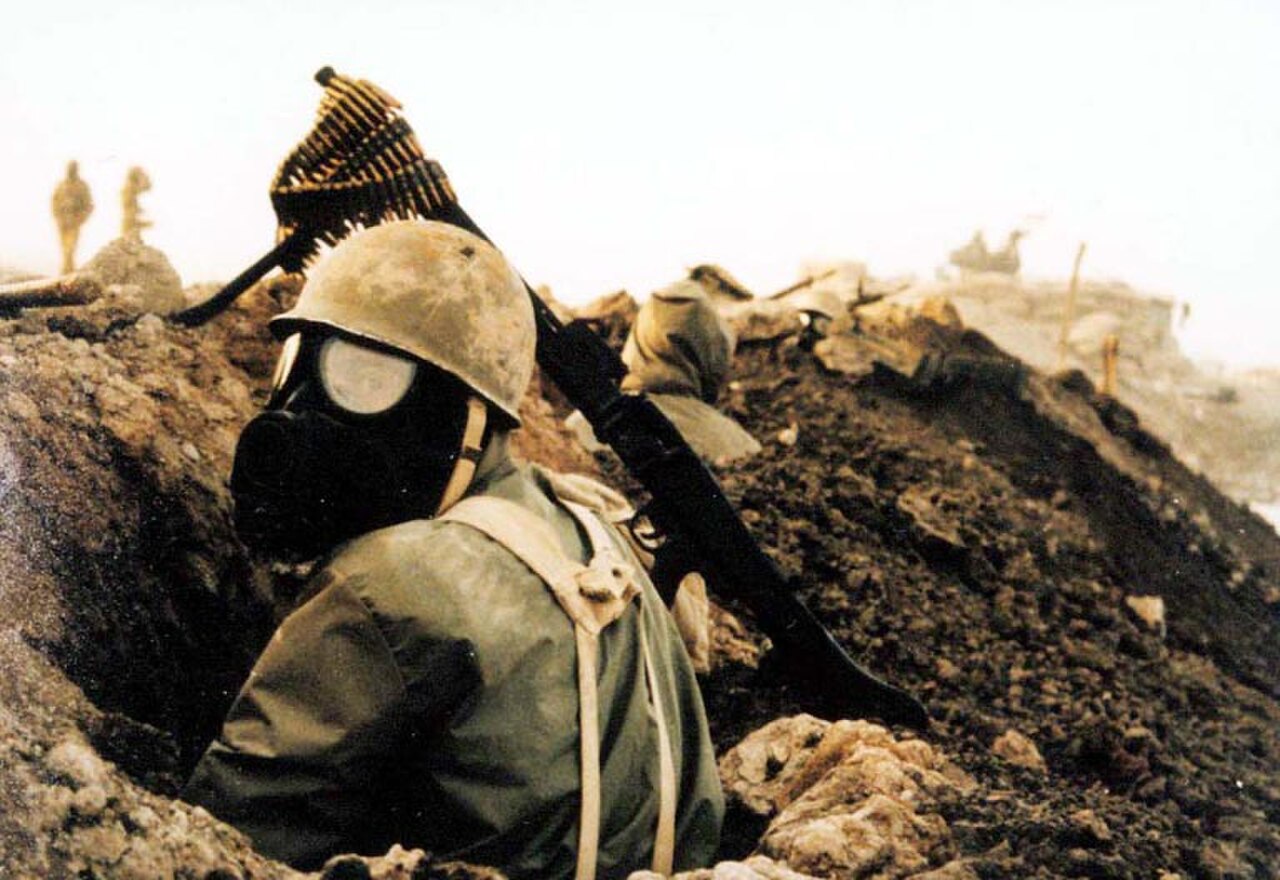
In March 1988, the Iranians carried out Operation Dawn 10, Operation Beit ol-Moqaddas 2, and Operation Zafar 7 in Iraqi Kurdistan with the aim of capturing the Darbandikhan Dam and the power plant at Lake Dukan, which supplied Iraq with much of its electricity and water, as well as the city of Suleimaniya.[91]: 264 Iran hoped that the capture of these areas would bring more favourable terms to the ceasefire agreement.[122] This infiltration offensive was carried out in conjunction with the Peshmerga. Iranian airborne commandos landed behind the Iraqi lines and Iranian helicopters hit Iraqi tanks with TOW missiles. The Iraqis were taken by surprise, and Iranian F-5E Tiger fighter jets even damaged the Kirkuk oil refinery.[60] Iraq carried out executions of multiple officers for these failures in March–April 1988, including Colonel Jafar Sadeq.[115] The Iranians used infiltration tactics in the Kurdish mountains, captured the town of Halabja and began to fan out across the province.[115]
Though the Iranians advanced to within sight of Dukan and captured around 1,040 km2 (400 sq mi) and 4,000 Iraqi troops, the offensive failed due to the Iraqi use of chemical warfare.[91]: 264 The Iraqis launched the deadliest chemical weapons attacks of the war. The Republican Guard launched 700 chemical shells, while the other artillery divisions launched 200–300 chemical shells each, unleashing a chemical cloud over the Iranians, killing or wounding 60% of them, the blow was felt particularly by the Iranian 84th infantry division and 55th paratrooper division.[115] The Iraqi special forces then stopped the remains of the Iranian force.[115] In retaliation for Kurdish collaboration with the Iranians, Iraq launched a massive poison gas attack against Kurdish civilians in Halabja, recently taken by the Iranians, killing thousands of civilians.[182] Iran airlifted foreign journalists to the ruined city, and the images of the dead were shown throughout the world, but Western mistrust of Iran and collaboration with Iraq led them to also blame Iran for the attack.[182]
Second Battle of al-Faw
On 17 April 1988, Iraq launched Operation Ramadan Mubarak (Blessed Ramadan), a surprise attack against the 15,000 Basij troops on the al-Faw peninsula.[83] The attack was preceded by Iraqi diversionary attacks in northern Iraq, with a massive artillery and air barrage of Iranian front lines. Key areas, such as supply lines, command posts, and ammunition depots, were hit by a storm of mustard gas and nerve gas, as well as by conventional explosives. Helicopters landed Iraqi commandos behind Iranian lines on al-Faw while the main Iraqi force made a frontal assault. Within 48 hours, all of the Iranian forces had been killed or cleared from the al-Faw Peninsula.[83] The day was celebrated in Iraq as Faw Liberation Day throughout Saddam's rule. The Iraqis had planned the offensive well. Prior to the attack, the Iraqi soldiers gave themselves poison gas antidotes to shield themselves from the effect of the saturation of gas. The heavy and well executed use of chemical weapons was the decisive factor in the victory.[183] Iraqi losses were relatively light, especially compared to Iran's casualties.[115] Ra'ad al-Hamdani later recounted that the recapture of al-Faw marked "the highest point of experience and expertise that the Iraqi Army reached."[184] The Iranians eventually managed to halt the Iraqi drive as they pushed towards Khuzestan.[60]
To the shock of the Iranians, rather than breaking off the offensive, the Iraqis kept up their drive, and a new force attacked the Iranian positions around Basra.[63] Following this, the Iraqis launched a sustained drive to clear the Iranians out of all of southern Iraq.[91]: 264 One of the most successful Iraqi tactics was the "one-two punch" attack using chemical weapons. Using artillery, they would saturate the Iranian front line with rapidly dispersing cyanide and nerve gas, while longer-lasting mustard gas was launched via fighter-bombers and rockets against the Iranian rear, creating a "chemical wall" that blocked reinforcement.[60]
Operation Praying Mantis
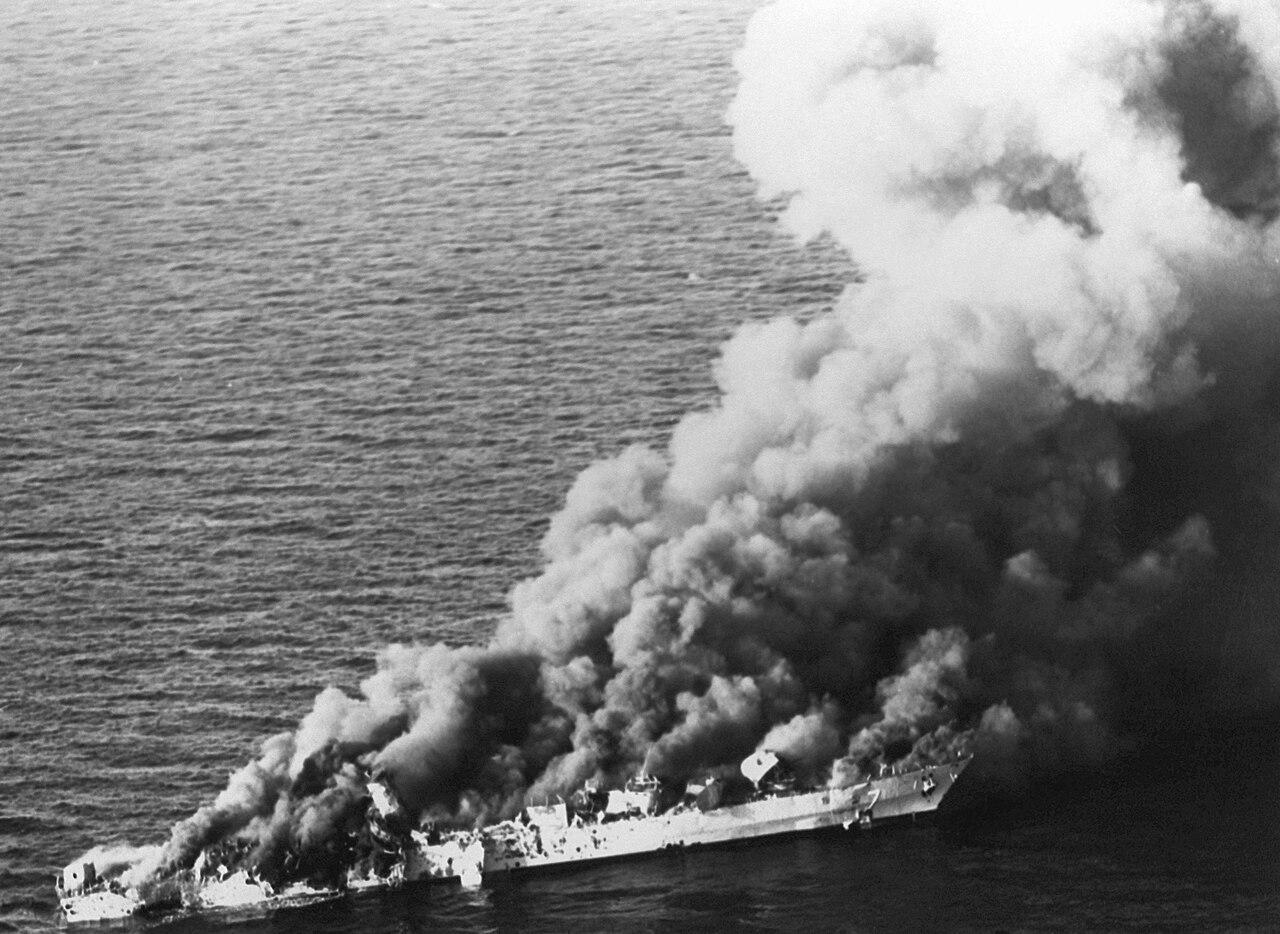
The same day as Iraq's attack on al-Faw peninsula, the United States Navy launched Operation Praying Mantis in retaliation against Iran for damaging a warship with a mine. Iran lost oil platforms, destroyers, and frigates in this battle, which ended only when President Reagan decided that the Iranian navy had been damaged enough. In spite of this, the Revolutionary Guard Navy continued their speedboat attacks against oil tankers.[83] The defeats at al-Faw and in the Persian Gulf nudged Iranian leadership towards quitting the war, especially when facing the prospect of fighting the Americans.[83]
Iranian counteroffensive
Faced with such losses, Khomeini appointed Rafsanjani as the Supreme Commander of the Armed Forces, though he had in actuality occupied that position for months.[176] Rafsanjani ordered a last desperate counter-attack into Iraq, which was launched 13 June 1988. The Iranians infiltrated through the Iraqi trenches and moved 10 km (6.2 mi) into Iraq and managed to strike Saddam's presidential palace in Baghdad using fighter aircraft.[60] After three days of fighting, the decimated Iranians were driven back to their original positions again as the Iraqis launched 650 helicopter and 300 aircraft sorties.[176]
Operation Forty Stars
On 18 June 1988, the People's Mujahedin of Iran (MEK) conducted a military operation known as Operation Forty Stars (Persian: عملیات چلچراغ).[186] In four days, the People's Mujahedin of Iran wiped out a Pasdaran division, seizing Mehran and building a bridgehead twelve miles into Iran.[187][176] According to the MEK, Iraqi soldiers did not participate in the operation. Baghdad also said it was not involved in the battle.[186]
Tawakalna ala Allah operations
On 25 May 1988, Iraq launched the first of five Tawakalna ala Allah Operations,[115] consisting of one of the largest artillery barrages in history, coupled with chemical weapons. The marshes had been dried by drought, allowing the Iraqis to use tanks to bypass Iranian field fortifications, expelling the Iranians from the border town of Shalamcheh after less than 10 hours of combat.[63]: 11 [91]: 265 [176]

On 25 June, Iraq launched the second Tawakal ala Allah operation against the Iranians on Majnoon Island. Iraqi commandos used amphibious craft to block the Iranian rear,[60] then used hundreds of tanks with massed conventional and chemical artillery barrages to recapture the island after 8 hours of combat.[115][176] Saddam appeared live on Iraqi television to "lead" the charge against the Iranians.[176] The majority of the Iranian defenders were killed during the quick assault.[115] The final two Tawakal ala Allah operations took place near al-Amarah and Khaneqan.[115] By 12 July, the Iraqis had captured the city of Dehloran, 30 km (19 mi) inside Iran, along with 2,500 troops and much armour and material, which took four days to transport to Iraq. These losses included more than 570 of the 1,000 remaining Iranian tanks, over 430 armored vehicles, 45 self-propelled artillery, 300 towed artillery pieces, and 320 antiaircraft guns. These figures only included what Iraq could actually put to use; total amount of captured materiel was higher. Since March, the Iraqis claimed to have captured 1,298 tanks, 155 infantry fighting vehicles, 512 heavy artillery pieces, 6,196 mortars, 5,550 recoilless rifles and light guns, 8,050-man-portable rocket launchers, 60,694 rifles, 322 pistols, 454 trucks, and 1,600 light vehicles.[176] The Iraqis withdrew from Dehloran soon after, claiming that they had "no desire to conquer Iranian territory".[60] History professor Kaveh Farrokh considered this to be Iran's greatest military disaster during the war. Stephen Pelletier, a Journalist, Middle East expert, and author, noted that "Tawakal ala Allah ... resulted in the absolute destruction of Iran's military machine."[60]
During the 1988 battles, the Iranians put up little resistance, having been worn out by nearly eight years of war.[91]: 253 They lost large amounts of equipment.[60] On 2 July, Iran belatedly set up a joint central command which unified the Revolutionary Guard, Army, and Kurdish rebels, and dispelled the rivalry between the Army and the Revolutionary Guard. However, this came too late and, following the capture of 570 of their operable tanks and the destruction of hundreds more, Iran was believed to have fewer than 200 remaining operable tanks on the southern front, against thousands of Iraqi ones.[176] The only area where the Iranians were not suffering major defeats was in Kurdistan.[139]
Iran accepts the ceasefire
Saddam sent a warning to Khomeini in mid-1988, threatening to launch a new and powerful full-scale invasion and attack Iranian cities with weapons of mass destruction. Shortly afterwards, Iraqi aircraft bombed the Iranian town of Oshnavieh with poison gas, immediately killing and wounding over 2,000 civilians. The fear of an all out chemical attack against Iran's largely unprotected civilian population weighed heavily on the Iranian leadership, and they realized that the international community had no intention of restraining Iraq.[188] The lives of the civilian population of Iran were becoming very disrupted, with a third of the urban population evacuating major cities in fear of the seemingly imminent chemical war. Meanwhile, Iraqi conventional bombs and missiles continuously hit towns and cities, destroying vital civilian and military infrastructure, and increasing the death toll. Iran replied with missile and air attacks, but not sufficiently to deter the Iraqis.[176]

With the threat of a new and even more powerful invasion, Commander-in-Chief Rafsanjani ordered the Iranians to retreat from Haj Omran, Kurdistan on 14 July.[176][189] The Iranians did not publicly describe this as a retreat, instead calling it a "temporary withdrawal".[189] By July, Iran's army inside Iraq had largely disintegrated.[60] Iraq put up a massive display of captured Iranian weapons in Baghdad, claiming they captured 1,298 tanks, 5,550 recoilless rifles, and thousands of other weapons.[176] However, Iraq had taken heavy losses as well, and the battles were very costly.[115]
In July 1988, Iraqi aircraft dropped bombs on the Iranian Kurdish village of Zardan. Dozens of villages, such as Sardasht, and some larger towns, such as Marivan, Baneh and Saqqez,[190] were once again attacked with poison gas, resulting in even heavier civilian casualties.[191] On 3 July 1988, the USS Vincennes shot down Iran Air Flight 655, killing 290 passengers and crew. The lack of international sympathy disturbed the Iranian leadership, and they came to the conclusion that the United States was on the verge of waging a full-scale war against them, and that Iraq was on the verge of unleashing its entire chemical arsenal upon their cities.[188]
At this point, elements of the Iranian leadership, led by Rafsanjani (who had initially pushed for the extension of the war), persuaded Khomeini to accept a ceasefire.[63] They stated that in order to win the war, Iran's military budget would have to be increased eightfold and the war would last until 1993.[176] On 20 July 1988, Iran accepted Resolution 598, showing its willingness to accept a ceasefire.[63]: 11 A statement from Khomeini was read out in a radio address, and he expressed deep displeasure and reluctance about accepting the ceasefire,
Happy are those who have departed through martyrdom. Happy are those who have lost their lives in this convoy of light. Unhappy am I that I still survive and have drunk the poisoned chalice...[63][124]: 1
The news of the end of the war was greeted with celebration in Baghdad, with people dancing in the streets; in Tehran, however, the end of the war was greeted with a somber mood.[124]: 1
Operation Mersad and end of the war
Operation Mersad (مرصاد "ambush") was the last big military operation of the war. Both Iran and Iraq had accepted Resolution 598, but despite the ceasefire, after seeing Iraqi victories in the previous months, Mujahadeen-e-Khalq (MEK) decided to launch an attack of its own and wished to advance all the way to Tehran. Saddam and the Iraqi high command decided on a two-pronged offensive across the border into central Iran and Iranian Kurdistan.[60] Shortly after Iran accepted the ceasefire, the MEK army began its offensive, attacking into Ilam province under cover of Iraqi air power. In the north, Iraq also launched an attack into Iraqi Kurdistan, which was blunted by the Iranians.[60]
On 26 July 1988, the MEK started their campaign in central Iran, Operation Forough Javidan (Eternal Light), with the support of the Iraqi army. The Iranians had withdrawn their remaining soldiers to Khuzestan in fear of a new Iraqi invasion attempt, allowing the Mujahedeen to advance rapidly towards Kermanshah, seizing Qasr-e Shirin, Sarpol-e Zahab, Kerend-e Gharb, and Islamabad-e-Gharb. The MEK expected the Iranian population to rise up and support their advance; the uprising never materialised but they reached 145 km (90 mi) deep into Iran. In response, the Iranian military launched its counter-attack, Operation Mersad, under Lieutenant General Ali Sayyad Shirazi. Iranian paratroopers landed behind the MEK lines while the Iranian Air Force and helicopters launched an air attack, destroying much of the enemy columns.[60] The Iranians defeated the MEK in the city of Kerend-e Gharb on 29 July 1988.[176] On 31 July, Iran drove the MEK out of Qasr-e-Shirin and Sarpol Zahab, though MEK claimed to have "voluntarily withdrawn" from the towns.[60][176] Iran estimated that 4,500 MEK were killed, while 400 Iranian soldiers died.[192]

The last notable combat actions of the war took place on 3 August 1988, in the Persian Gulf when the Iranian navy fired on a freighter and Iraq launched chemical attacks on Iranian civilians, killing an unknown number of them and wounding 2,300.[176] Iraq came under international pressure to curtail further offensives. Resolution 598 became effective on 8 August 1988, ending all combat operations between the two countries.[189] By 20 August 1988, peace with Iran was restored.[189] UN peacekeepers belonging to the UNIIMOG mission took the field, remaining on the Iran–Iraq border until 1991. The majority of Western analysts believe that the war had no winners while some believed that Iraq emerged as the victor of the war, based on Iraq's overwhelming successes between April and July 1988.[60] While the war was now over, Iraq spent the rest of August and early September clearing the Kurdish resistance. Using 60,000 troops along with helicopter gunships, chemical weapons (poison gas), and mass executions, Iraq hit 15 villages, killing rebels and civilians, and forced tens of thousands of Kurds to relocate to settlements.[176] Many Kurdish civilians fled to Iran. By 3 September 1988, the anti-Kurd campaign ended, and all resistance had been crushed.[176] 400 Iraqi soldiers and 50,000–100,000 Kurdish civilians and soldiers had been killed.[176][193]
At the war's conclusion, it took several weeks for the Armed Forces of the Islamic Republic of Iran to evacuate Iraqi territory to honor pre-war international borders set by the 1975 Algiers Agreement.[60] The last prisoners of war were exchanged in 2003.[194][195]
The Security Council did not identify Iraq as the aggressor of the war until 11 December 1991, some 11 years after Iraq invaded Iran and 16 months following Iraq's invasion of Kuwait.[196][197]
Aftermath
Casualties

The Iran–Iraq War was the deadliest conventional war ever fought between regular armies of developing countries.[73] Encyclopædia Britannica states: "Estimates of total casualties range from 1,000,000 to twice that number. The number killed on both sides was perhaps 500,000, with Iran suffering the greatest losses."[24] Iraqi casualties are estimated at 105,000–200,000 killed,[35][45][49][50] while about 400,000 had been wounded and some 70,000 taken prisoner.[37][49] Thousands of civilians on both sides died in air raids and ballistic missile attacks.[68] Prisoners taken by both countries began to be released in 1990, though some were not released until more than 10 years after the end of the conflict.[194] Cities on both sides had also been considerably damaged. While revolutionary Iran had been bloodied, Iraq was left with a large military and was a regional power, albeit with severe debt, financial problems, and labour shortages.[139]
According to Iranian government sources, the war cost Iran an estimated 200,000–220,000 killed,[35][44][37][45] or up to 262,000 according to the conservative Western estimates.[35][36] This includes 123,220 combatants,[35][44] 60,711 MIA[35] and 11,000–16,000 civilians.[35][44] Combatants include 79,664 members of the Revolutionary Guard Corps and additional 35,170 soldiers from regular military.[44] In addition, prisoners of war accounted for 42,875 Iranian casualties, captured and kept in Iraqi detention centres from 2.5 to more than 15 years after the war was over.[46]
According to the Janbazan Affairs Organization, 398,587 Iranians sustained injuries that required prolonged medical and health care following primary treatment, including 52,195 (13%) injured due to the exposure to chemical warfare agents.[46] From 1980 to 2012, 218,867 Iranians died due to war injuries and the mean age of combatants was 23 years old.[46] This includes 33,430 civilians, mostly women and children.[46] More than 144,000 Iranian children were orphaned as a consequence of these deaths.[46] Other estimates put Iranian casualties up to 600,000.[39][40][41][42][198][199][200]
Both Iraq and Iran manipulated loss figures to suit their purposes. At the same time, Western analysts accepted improbable estimates.[201] By April 1988, such casualties were estimated at between 150,000 and 340,000 Iraqis dead, and 450,000 to 730,000 Iranians.[201] Shortly after the end of the war, it was thought that Iran suffered even more than a million dead.[44] Considering the style of fighting on the ground and the fact that neither side penetrated deeply into the other's territory, USMC analysts believe events do not substantiate the high casualties claimed.[201] The Iraqi government has claimed 800,000 Iranians were killed in action, four times more than Iranian official figures,[35] whereas Iraqi intelligence privately put the number at 228,000–258,000 as of August 1986.[202] Iraqi losses were also revised downwards over time.[50]
Peace talks and postwar situation
.jpg/1280px-Iran_2007_229_Golestan_War_Heros_(1732762968).jpg)
With the ceasefire in place, and UN peacekeepers monitoring the border, Iran and Iraq sent their representatives to Geneva, Switzerland, to negotiate a peace agreement on the terms of the ceasefire. However, peace talks stalled. Iraq, in violation of the UN ceasefire, refused to withdraw its troops from 7,800 square kilometres (3,000 sq mi) of disputed territory at the border area unless the Iranians accepted Iraq's full sovereignty over the Shatt al-Arab waterway. Foreign powers continued to support Iraq, which wanted to gain at the negotiating table what they failed to achieve on the battlefield, and Iran was portrayed as the one not wanting peace.[203]
In response, Iran refused to release 70,000 Iraqi prisoners of war, compared to 40,000 Iranian prisoners of war held by Iraq. They continued to carry out a naval blockade of Iraq, although its effects were mitigated by Iraqi use of ports in friendly neighbouring Arab countries. Iran began to improve relations with many of the states that opposed it during the war. Because of Iranian actions, by 1990, Saddam had become more conciliatory, and in a letter to the future fourth President of Iran Rafsanjani, he became more open to the idea of a peace agreement, although he still insisted on full sovereignty over the Shatt al-Arab.[203]
By 1990, Iran was undergoing military rearmament and reorganization, and purchased $10 billion worth of heavy weaponry from the USSR and China, including aircraft, tanks, and missiles. Rafsanjani reversed Iran's self-imposed ban on chemical weapons, and ordered the manufacture and stockpile of them (Iran destroyed them in 1993 after ratifying the Chemical Weapons Convention).[citation needed] As war with the western powers loomed, Iraq became concerned about the possibility of Iran mending its relations with the west in order to attack Iraq. Iraq had lost its support from the West, and its position in Iran was increasingly untenable.[203] Saddam realized that if Iran attempted to expel the Iraqis from the disputed territories in the border area, it was likely they would succeed.[60]
Shortly after his invasion of Kuwait, Saddam wrote a letter to Rafsanjani stating that Iraq recognised Iranian rights over the eastern half of the Shatt al-Arab, a reversion to status quo ante bellum that he had repudiated a decade earlier,[204] and that he would accept Iran's demands and withdraw Iraq's military from the disputed territories. A peace agreement was signed finalizing the terms of the UN resolution, diplomatic relations were restored, and by late 1990-early 1991, the Iraqi military withdrew. The UN peacekeepers withdrew from the border shortly afterward. Most of the prisoners of war were released in 1990, although some remained as late as 2003.[203] Iranian politicians declared it to be the "greatest victory in the history of the Islamic Republic of Iran".[203]
Most historians and analysts consider the war to be a stalemate.[49][205][194] Certain analysts believe that Iraq won, on the basis of the successes of their 1988 offensives which thwarted Iran's major territorial ambitions in Iraq and persuaded Iran to accept the ceasefire.[60] Iranian analysts believe that they won the war because although they did not succeed in overthrowing the Iraqi government, they thwarted Iraq's major territorial ambitions in Iran, and that, two years after the war had ended, Iraq permanently gave up its claim of ownership over the entire Shatt al-Arab as well.[60]
On 9 December 1991, Javier Pérez de Cuéllar, UN Secretary General at the time, reported that Iraq's initiation of the war was unjustified, as was its occupation of Iranian territory and use of chemical weapons against civilians:
That [Iraq's] explanations do not appear sufficient or acceptable to the international community is a fact...[the attack] cannot be justified under the charter of the United Nations, any recognized rules and principles of international law, or any principles of international morality, and entails the responsibility for conflict. Even if before the outbreak of the conflict there had been some encroachment by Iran on Iraqi territory, such encroachment did not justify Iraq's aggression against Iran—which was followed by Iraq's continuous occupation of Iranian territory during the conflict—in violation of the prohibition of the use of force, which is regarded as one of the rules of jus cogens...On one occasion I had to note with deep regret the experts' conclusion that "chemical weapons ha[d] been used against Iranian civilians in an area adjacent to an urban center lacking any protection against that kind of attack."[206]
He also stated that had the UN accepted this fact earlier, the war would have almost certainly not lasted as long as it did. Iran, encouraged by the announcement, sought reparations from Iraq, but never received any.[203]

Throughout the 1990s and early 2000s, Iran and Iraq relations remained balanced between a cold war and a cold peace. Despite renewed and somewhat thawed relations, both sides continued to have low level conflicts. Iraq continued to host and support the Mujahedeen-e-Khalq, which carried out multiple attacks throughout Iran up until the 2003 invasion of Iraq, including the assassination of Iranian general Ali Sayyad Shirazi in 1998, cross border raids, and mortar attacks. Iran carried out several airstrikes and missile attacks against Mujahedeen targets inside of Iraq, the largest taking place in 2001, when Iran fired 56 Scud missiles at Mujahedeen targets.[207]
According to General Hamdani, Iran continued to carry out low-level infiltrations of Iraqi territory, using Iraqi dissidents and anti-government activists rather than Iranian troops, in order to incite revolts. After the fall of Saddam in 2003, Hamdani claimed that Iranian agents infiltrated and created numerous militias in Iraq and built an intelligence system operating within the country.[115]
In 2005, the new government of Iraq apologised to Iran for starting the war.[208] The Iraqi government also commemorated the war with various monuments, including the Hands of Victory and the al-Shaheed Monument, both in Baghdad. The war also helped to create a forerunner for the Coalition of the Gulf War, when the Gulf Arab states banded together early in the war to form the Gulf Cooperation Council to help Iraq fight Iran.[139]
Economic situation
The economic loss at the time was believed to exceed $500 billion for each country ($1.2 trillion total).[55][209] In addition, economic development stalled and oil exports were disrupted. Iraq had accrued more than $130 billion of international debt, excluding interest, and was also weighed down by a slowed GDP growth. Iraq's debt to the Paris Club amounted to $21 billion, 85% of which had originated from the combined inputs of Japan, the USSR, France, Germany, the United States, Italy and the United Kingdom. The largest portion of Iraq's debt, amounting to $130 billion, was to its former Arab backers, with $67 billion loaned by Kuwait, Saudi Arabia, Qatar, UAE, and Jordan.[citation needed]
After the war, Iraq accused Kuwait of slant drilling and stealing oil, inciting its invasion of Kuwait, which in turn worsened Iraq's financial situation: the United Nations Compensation Commission mandated Iraq to pay reparations of more than $200 billion to victims of the invasion, including Kuwait and the United States. To enforce payment, Iraq was put under a comprehensive international embargo, which further strained the Iraqi economy and pushed its external debt to private and public sectors to more than $500 billion by the end of Saddam's rule. Combined with Iraq's negative economic growth after prolonged international sanctions, this produced a debt-to-GDP ratio of more than 1,000%, making Iraq the most indebted developing country in the world. The unsustainable economic situation compelled the new Iraqi government to request that a considerable portion of debt incurred during the Iran–Iraq war be written off.[210][211][212][213]
Science and technology
The war had its impact on medical science: a surgical intervention for comatose patients with penetrating brain injuries was created by Iranian physicians treating wounded soldiers, later establishing neurosurgery guidelines to treat civilians who had suffered blunt or penetrating skull injuries.[214] Iranian physicians' experience in the war informed the medical care of U.S. congresswoman Gabby Giffords after the 2011 Tucson shooting.[214][215]
In addition to helping trigger the Persian Gulf War, the Iran–Iraq War also contributed to Iraq's defeat in the Persian Gulf War. Iraq's military was accustomed to fighting the slow moving Iranian infantry formations with artillery and static defenses, while using mostly unsophisticated tanks to gun down and shell the infantry and overwhelm the smaller Iranian tank force; in addition to being dependent on weapons of mass destruction to help secure victories. Therefore, they were rapidly overwhelmed by the high-tech, quick-maneuvering Coalition forces using modern doctrines such as AirLand Battle.[139]
Domestic situation
Iraq
At first, Saddam attempted to ensure that the Iraqi population suffered from the war as little as possible. There was rationing, but civilian projects begun before the war continued.[63] At the same time, the already extensive personality cult around Saddam reached new heights while the regime tightened its control over the military.[63]
After the Iranian victories of the spring of 1982 and the Syrian closure of Iraq's main pipeline, Saddam did a volte-face on his policy towards the home front: a policy of austerity and total war was introduced, with the entire population being mobilised for the war effort.[63] All Iraqis were ordered to donate blood and around 100,000 Iraqi civilians were ordered to clear the reeds in the southern marshes. Mass demonstrations of loyalty towards Saddam became more common.[63] Saddam also began implementing a policy of discrimination against Iraqis of Iranian origin.[60]
In the summer of 1982, Saddam began a campaign of terror. More than 300 Iraqi Army officers were executed for their failures on the battlefield.[63] In 1983, a major crackdown was launched on the leadership of the Shia community. Ninety members of the al-Hakim family, an influential family of Shia clerics whose leading members were the émigrés Mohammad Baqir al-Hakim and Abdul Aziz al-Hakim, were arrested, and 6 were hanged.[63]
The crackdown on Kurds saw 8,000 members of the Barzani clan, whose leader (Massoud Barzani) also led the Kurdistan Democratic Party, similarly executed.[63] From 1983 onwards, a campaign of increasingly brutal repression was started against the Iraqi Kurds, characterised by Israeli historian Efraim Karsh as having "assumed genocidal proportions" by 1988.[63] The al-Anfal Campaign was intended to "pacify" Iraqi Kurdistan permanently.[63] By 1983, the Barzanis entered an alliance with Iran in defense against Saddam Hussein.[216]
Gaining civilian support
To secure the loyalty of the Shia population, Saddam allowed more Shias into the Ba'ath Party and the government, and improved Shia living standards, which had been lower than those of the Iraqi Sunnis.[63] Saddam had the state pay for restoring Imam Ali's tomb with white marble imported from Italy.[63] The Baathists also increased their policies of repression against the Shia. The most infamous event was the massacre of 148 civilians of the Shia town of Dujail.[217]
Despite the costs of the war, the Iraqi regime made generous contributions to Shia waqf (religious endowments) as part of the price of buying Iraqi Shia support.[124]: 75–76 The importance of winning Shia support was such that welfare services in Shia areas were expanded during a time in which the Iraqi regime was pursuing austerity in all other non-military fields.[124]: 76 During the first years of the war in the early 1980s, the Iraqi government tried to accommodate the Kurds in order to focus on the war against Iran. In 1983, the Patriotic Union of Kurdistan agreed to cooperate with Baghdad, but the Kurdistan Democratic Party (KDP) remained opposed.[218] In 1983, Saddam signed an autonomy agreement with Jalal Talabani of the Patriotic Union of Kurdistan (PUK), though Saddam later reneged on the agreement.[63] By 1985, the PUK and KDP had joined forces, and Iraqi Kurdistan saw widespread guerrilla warfare up to the end of the war.[63]
Iran

Israeli-British historian Ephraim Karsh argued that the Iranian government saw the outbreak of war as chance to strengthen its position and consolidate the Islamic revolution, noting that government propaganda presented it domestically as a glorious jihad and a test of Iranian national character.[63] The Iranian regime followed a policy of total war from the beginning, and attempted to mobilise the nation as a whole.[63] They established a group known as the Reconstruction Campaign, whose members were exempted from conscription and were instead sent into the countryside to work on farms to replace the men serving at the front.[63]
Iranian workers had a day's pay deducted from their pay cheques every month to help finance the war, and mass campaigns were launched to encourage the public to donate food, money, and blood.[63] To further help finance the war, the Iranian government banned the import of all non-essential items, and launched a major effort to rebuild the damaged oil plants.[63]
According to former Iraqi general Ra'ad al-Hamdani, the Iraqis believed that in addition to the Arab revolts, the Revolutionary Guards would be drawn out of Tehran, leading to a counter-revolution in Iran that would cause Khomeini's government to collapse and thus ensure Iraqi victory.[115][219] However, rather than turning against the revolutionary government as experts had predicted, Iran's people (including Iranian Arabs) rallied in support of the country and put up a stiff resistance.[60][61]
The IRGC grew as an organization to encompass not just military concerns but also matters of economic, religious, and educational importance.[220] The organization's growth during the war is vital to understanding the organization's role in Iranian society and how it has evolved since its initial formation in 1979. Domestically, the IRGC dealt with suppressing uprisings by Kurds, Baluchs, Turkmen, and the Mojahedin-e-Khalq (MEK) which broke with Khomeini in June 1981. While initially dealing with internal threats to the revolution in its first few years, the IRGC focused its attention on external threats at the outbreak of the war in 1980. In January of 1981, the IRGC would take control of the Basij to aid in the fight against Iraqi forces.[220] The Basij helped bolster the prominence and legitimacy of the IRGC during the war as a vehicle for indoctrination and through its contributions to the defense of Iran. The transformation of the IRGC organized its command structure which allowed for the organization to match the force of Iran's regular military and its first abroad deployment during the war began the sponsoring of other armed groups in the region through its command of the Quds force.[221]
Civil unrest
In June 1981, street battles broke out between the Revolutionary Guard and the left-wing Mujaheddin e-Khalq (MEK), continuing for several days and killing hundreds on both sides.[124]: 250 In September, more unrest broke out on the streets of Iran as the MEK attempted to seize power.[63] Thousands of left-wing Iranians (many of whom were not associated with the MEK) were shot and hanged by the government.[91]: 251 The MEK began an assassination campaign that killed hundreds of regime officials by the fall of 1981.[124]: 251 On 28 June 1981, they assassinated the secretary-general of the Islamic Republican Party, Mohammad Beheshti and on 30 August, killed Iran's president, Mohammad-Ali Rajai.[124]: 251 The government responded with mass executions of suspected MEK members, a practice that lasted until 1985.[63]
In addition to the open civil conflict with the MEK, the Iranian government was faced with Iraqi-supported rebellions in Iranian Kurdistan, which were gradually put down through a campaign of systematic repression.[63] 1985 also saw student anti-war demonstrations, which were crushed by government forces.[63]
Economy
In September 2020, Ali Fadavi announced that Iran spent $19.6 billion in the war.[222] The war furthered the decline of the Iranian economy that had begun with the revolution in 1978–79.[63] Between 1979 and 1981, foreign exchange reserves fell from $14.6 billion to $1 billion.[63] As a result of the war, living standards dropped dramatically,[63][91]: 252 and Iran was described by British journalists John Bulloch and Harvey Morris as "a dour and joyless place" ruled by a harsh regime that "seemed to have nothing to offer but endless war".[124]: 239
Though Iran was becoming bankrupt, Khomeini interpreted Islam's prohibition of usury to mean they could not borrow against future oil revenues to meet war expenses. As a result, Iran funded the war by the income from oil exports after cash had run out. The revenue from oil dropped from $20 billion in 1982 to $5 billion in 1988.[91]: 252 French historian Pierre Razoux argued that this sudden drop in economic industrial potential, in conjunction with the increasing aggression of Iraq, placed Iran in a challenging position that had little leeway other than accepting Iraq's conditions of peace.
In January 1985, former prime minister and anti-war Islamic Liberation Movement co-founder Mehdi Bazargan criticised the war in a telegram to the United Nations, calling it un-Islamic and illegitimate and arguing that Khomeini should have accepted Saddam's truce offer in 1982 instead of attempting to overthrow the Ba'ath.[63] In a public letter to Khomeini sent in May 1988, he added "Since 1986, you have not stopped proclaiming victory, and now you are calling upon population to resist until victory. Is that not an admission of failure on your part?"[91]: 252 Khomeini was annoyed by Bazargan's telegram, and issued a lengthy public rebuttal in which he defended the war as both Islamic and just.[63]
By 1987, Iranian morale had begun to crumble, reflected in the failure of government campaigns to recruit "martyrs" for the front.[63] Israeli historian Efraim Karsh points to the decline in morale in 1987–88 as being a major factor in Iran's decision to accept the ceasefire of 1988.[63]
Not all saw the war in negative terms. The Islamic Revolution of Iran was strengthened and radicalised.[223] The Iranian government-owned Etelaat newspaper wrote, "There is not a single school or town that is excluded from the happiness of 'holy defence' of the nation, from drinking the exquisite elixir of martyrdom, or from the sweet death of the martyr, who dies in order to live forever in paradise."[224]
Comparison of Iraqi and Iranian military strength
Iran's regular Army had been purged after the 1979 Revolution, with most high-ranking officers either having fled the country or been executed.[225]
At the beginning of the war, Iraq held a clear advantage in armour, while both nations were roughly equal in terms of artillery. The gap only widened as the war went on. Iran started with a stronger air force, but over time, the balance of power reversed in Iraq's favour (as Iraq was constantly expanding its military, while Iran was under arms sanctions). Estimates for 1980 and 1987 were:[226]
| Imbalance of Power (1980–1987) | Iraq | Iran |
|---|---|---|
| Tanks in 1980 | 2,700 | 1,740 (~500 operable) |
| Tanks in 1987 | 4,500+ | 1,000 |
| Fighter aircraft in 1980 | 332 | 445 (205 operable) |
| Fighter aircraft in 1987 | 500+ | 65 (serviceable) |
| Helicopters in 1980 | 40 | 500 |
| Helicopters in 1987 | 150 | 60 |
| Artillery in 1980 | 1,000 | 1,000+ (~300 operable) |
| Artillery in 1987 | 4,000+ | 1,000+ |
The conflict has been compared to World War I[227]: 171 in terms of the tactics used, including large-scale trench warfare with barbed wire stretched across trenches, manned machine gun posts, bayonet charges, human wave attacks across a no man's land, and extensive use of chemical weapons such as sulfur mustard by the Iraqi government against Iranian troops, civilians, and Kurds. The world powers United States and the Soviet Union, together with many Western and Arab countries, provided military, intelligence, economic, and political support for Iraq. On average, Iraq imported about $7 billion in weapons during every year of the war, accounting for fully 12% of global arms sales in the period.[228]
The value of Iraqi arms imports increased to between $12 billion and $14 billion during 1984–1987, whereas the value of Iranian arms imports fell from $14 billion in 1985 to $5.89 billion in 1986 and an estimated $6 billion to $8 billion in 1987. Iran was constrained by the price of oil during the 1980s oil glut as foreign countries were largely unwilling to extend credit to Iran, but Iraq financed its continued massive military expansion by taking on vast quantities of debt that allowed it to win a number of victories against Iran near the end of the war but that left the country bankrupt.[229]
Despite its larger population, by 1988 Iran's ground forces numbered only 600,000 whereas the Iraqi army had grown to include 1 million soldiers.[230]
Foreign support to Iraq and Iran
During the war, Iraq was regarded by the West and the Soviet Union as a counterbalance to post-revolutionary Iran.[124]: 119 The Soviet Union, Iraq's main arms supplier during the war, did not wish for the end of its alliance with Iraq, and was alarmed by Saddam's threats to find new arms suppliers in the West and China if the Kremlin did not provide him with the weapons he wanted.[124]: 119, 198–199 The Soviet Union hoped to use the threat of reducing arms supplies to Iraq as leverage for forming a Soviet–Iranian alliance.[124]: 197
During the early years of the war, the United States lacked meaningful relations with either Iran or Iraq, the former due to the Iranian Revolution and the Iran hostage crisis and the latter because of Iraq's alliance with the Soviet Union and hostility towards Israel. Following Iran's success in repelling the Iraqi invasion and Khomeini's refusal to end the war in 1982, the United States made an outreach to Iraq, beginning with the restoration of diplomatic relations in 1984. The United States wished to both keep Iran away from Soviet influence and protect other Gulf states from any threat of Iranian expansion. As a result, the U.S. began to provide limited support to Iraq.[124]: 142–143 In 1982, Henry Kissinger, former Secretary of State, outlined U.S. policy towards Iran:
The focus of Iranian pressure at this moment is Iraq. There are few governments in the world less deserving of our support and less capable of using it. Had Iraq won the war, the fear in the Gulf and the threat to our interest would be scarcely less than it is today. Still, given the importance of the balance of power in the area, it is in our interests to promote a ceasefire in that conflict; though not a cost that will preclude an eventual rapprochement with Iran either if a more moderate regime replaces Khomeini's or if the present rulers wake up to geopolitical reality that the historic threat to Iran's independence has always come from the country with which it shares a border of 1,500 miles [2,400 km]: the Soviet Union. A rapprochement with Iran, of course, must await at a minimum Iran's abandonment of hegemonic aspirations in the Gulf.[124]: 142–143
Richard Murphy, Assistant Secretary of State during the war, testified to Congress in 1984 that the Reagan administration believed a victory for either Iran or Iraq was "neither militarily feasible nor strategically desirable".[124]: 178
Support to Iraq was given via technological aid, intelligence, the sale of dual-use chemical and biological warfare related technology and military equipment, and satellite intelligence. While there was direct combat between Iran and the United States, it is not universally agreed that the fighting between the United States and Iran was specifically to benefit Iraq, or for separate issues between the U.S. and Iran. American official ambiguity towards which side to support was summed up by Henry Kissinger when he remarked, "It's a pity they can't both lose."[231]
More than 30 countries provided support to Iraq, Iran, or both; most of the aid went to Iraq. Iran had a complex clandestine procurement network to obtain munitions and critical materials. Iraq had an even larger clandestine purchasing network, involving 10–12 allied countries, to maintain ambiguity over their arms purchases and to circumvent "official restrictions". Arab mercenaries and volunteers from Egypt[232] and Jordan formed the Yarmouk Brigade[233] and participated in the war alongside Iraqis.
Iraq
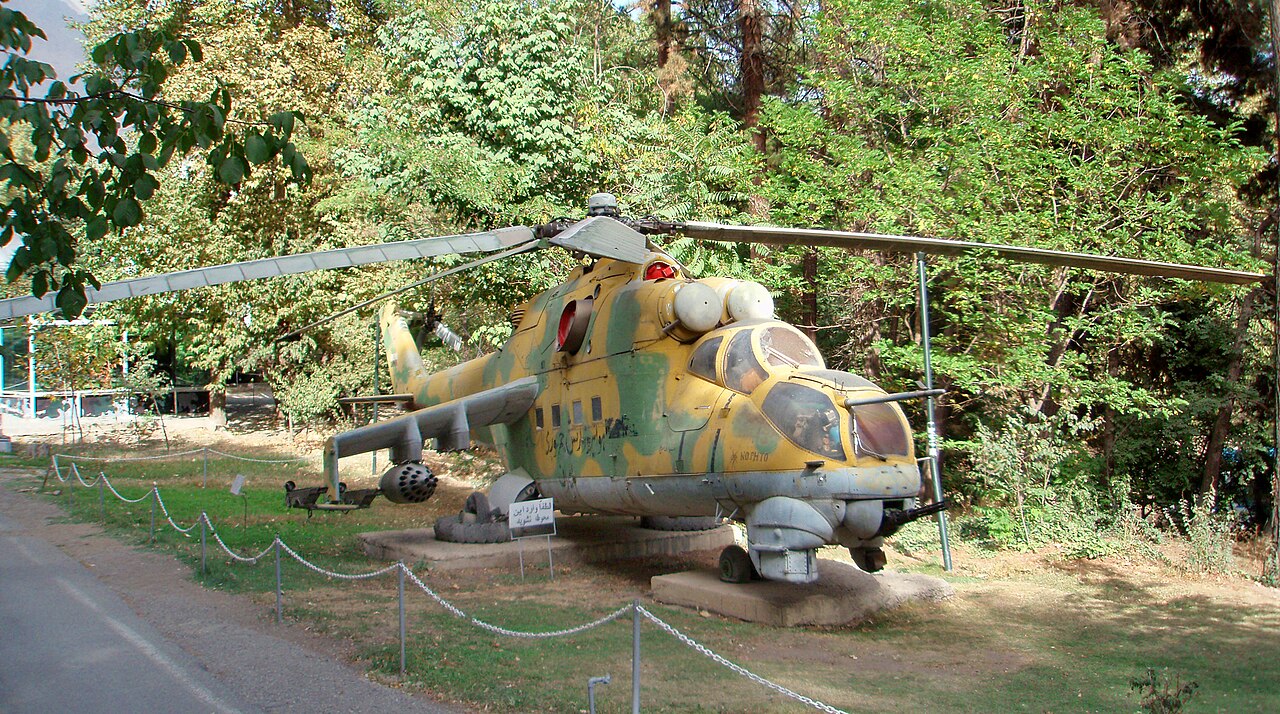
According to the Stockholm International Peace Institute, the Soviet Union, France, and China together accounted for over 90% of the value of Iraq's arms imports between 1980 and 1988.[234]
The United States pursued policies in favour of Iraq by reopening diplomatic channels, lifting restrictions on the export of dual-use technology, overseeing the transfer of third-party military hardware, and providing operational intelligence on the battlefield[citation needed]. France, which from the 1970s had been one of Iraq's closest allies, was a major supplier of military hardware.[124]: 184–185 The French sold weapons equal to $5 billion, which made up well over a quarter of Iraq's total arms stockpile.[124]: 184–185 Citing French magazine Le Nouvel Observateur as the primary source, but also quoting French officials, the New York Times reported France had been sending chemical precursors of chemical weapons to Iraq, since 1986.[235] China, which had no direct stake in the victory of either side and whose interests in the war were entirely commercial, freely sold arms to both sides.[124]: 185, 187–188, 192–193
Iraq also made extensive use of front companies, middlemen, secret ownership of all or part of companies all over the world, forged end-user certificates, and other methods to hide what it was acquiring. Some transactions may have involved people, shipping, and manufacturing in as many as 10 countries.[236] Support from Great Britain exemplified the methods by which Iraq would circumvent export controls. Iraq bought at least one British company with operations in the United Kingdom and the United States, and had a complex relationship with France and the Soviet Union, its major suppliers of actual weapons.
Turkey took action against the Kurds in 1986, alleging they were attacking the Kurdistan Workers' Party (PKK), which prompted a harsh diplomatic intervention by Iran, which planned a new offensive against Iraq at the time and were counting on the support of Kurdish factions.[237]
Sudan supported Iraq directly during the war, sending a contingent to fight at the frontlines. The Sudanese unit consisted to a large degree of Ugandan refugees from the West Nile Region, recruited by Juma Oris.[238]
The United Nations Security Council initially called for a cease-fire after a week of fighting while Iraq was occupying Iranian territory, and renewed the call on later occasions. However, the UN did not come to Iran's aid to repel the Iraqi invasion, and the Iranians thus interpreted the UN as subtly biased in favour of Iraq.[209]
Financial support
Iraq's main financial backers were the oil-rich Persian Gulf states, most notably Saudi Arabia ($30.9 billion), Kuwait ($8.2 billion), and the United Arab Emirates ($8 billion).[citation needed] In all, Iraq received $35 billion in loans from the West and between $30 and $40 billion from the Persian Gulf states during the 1980s.[125]
The Iraqgate scandal revealed that a branch of Italy's largest bank, Banca Nazionale del Lavoro (BNL), in Atlanta, Georgia, relied partially on U.S. taxpayer-guaranteed loans to funnel $5 billion to Iraq from 1985 to 1989. In August 1989, when FBI agents raided the Atlanta branch of BNL, branch manager Christopher Drogoul was charged with making unauthorised, clandestine, and illegal loans to Iraq—some of which, according to his indictment, were used to purchase arms and weapons technology.[239] According to the Financial Times, Hewlett-Packard, Tektronix, and Matrix Churchill's branch in Ohio were among the companies shipping militarily useful technology to Iraq under the eye of the U.S. government.
Iran
While the United States directly fought Iran, citing freedom of navigation as a major casus belli, it also indirectly supplied some weapons to Iran as part of a complex and illegal programme that became known as the Iran–Contra affair. These secret sales were partly to help secure the release of hostages held in Lebanon, and partly to make money to help the Contras rebel group in Nicaragua. This arms-for-hostages agreement turned into a major scandal.
Israel supported Iran in its war against Iraq through the supply of military equipment including spare parts for fighter jets, missile systems, ammunition and tank engines.[240] Israel's motivations for supporting Iran stemmed from a fear of what would have become if Iraq came out victorious and as an opportunity to create business for the Israeli arms industry.[241]
North Korea was a major arms supplier to Iran, often acting as a third party in arms deals between Iran and the Communist bloc. Support included domestically manufactured arms and Eastern-Bloc weapons, for which the major powers wanted deniability. Among the other arms suppliers and supporters of Iran's Islamic Revolution, the major ones were Libya, Syria, and China. According to the Stockholm International Peace Institute, China was the largest foreign arms supplier to Iran between 1980 and 1988.[242]
Syria and Libya, breaking Arab solidarity, supported Iran with arms, rhetoric and diplomacy.[243] However, Libya then distanced itself from Iran from 1987, criticizing Tehran's attitude and restoring diplomatic relations with Iraq.[244][245]
Aid to both countries
Besides the United States and the Soviet Union, Yugoslavia also sold weapons to both countries for the entire duration of the conflict. Likewise, Portugal helped both countries;[176]: 8 it was not unusual to see Iranian and Iraqi flagged ships anchored at Setúbal, waiting their turn to dock.
From 1980 to 1987, Spain sold €458 million in weapons to Iran and €172 million[clarification needed] to Iraq. Weapons sold to Iraq included 4x4 vehicles, BO-105 helicopters, explosives, and ammunition. A research party later discovered that an unexploded chemical Iraqi warhead in Iran was manufactured in Spain.[176]: 8 [246]
Although neither side acquired any weapons from Turkey, both sides enjoyed Turkish civilian trade during the conflict, although the Turkish government remained neutral and refused to support the U.S.-imposed trade embargo on Iran. Turkey's export market jumped from $220 million in 1981 to $2 billion in 1985, making up 25% of Turkey's overall exports. Turkish construction projects in Iraq totaled $2.5 billion between 1974 and 1990. Trading with both countries helped Turkey to offset its ongoing economic crisis, though the benefits decreased as the war neared its end and accordingly disappeared entirely with Iraq's invasion of Kuwait and the resulting Iraq sanctions Turkey imposed in response.[247]
U.S. involvement
American support for Ba'athist Iraq during the Iran–Iraq War, in which it fought against post-revolutionary Iran, included several billion dollars' worth of economic aid, the sale of dual-use technology, non-U.S. origin weaponry, military intelligence, and special operations training.[248][249] The U.S. refused to sell arms to Iraq directly due to Iraq's ties to terrorist groups, but several sales of "dual-use" technology have been documented; notably, Iraq purchased 45 Bell helicopters for $200 million in 1985. Total sales of U.S. dual-use technology to Iraq are estimated at $500 million.[250][251]
U.S. government support for Iraq was not a secret and was frequently discussed in open sessions of the Senate and House of Representatives.[252] American views toward Iraq were not enthusiastically supportive in its conflict with Iran, and activity in assistance was largely to prevent an Iranian victory. This was encapsulated by Henry Kissinger when he remarked, "It's a pity they both can't lose."[231]
U.S. embargo
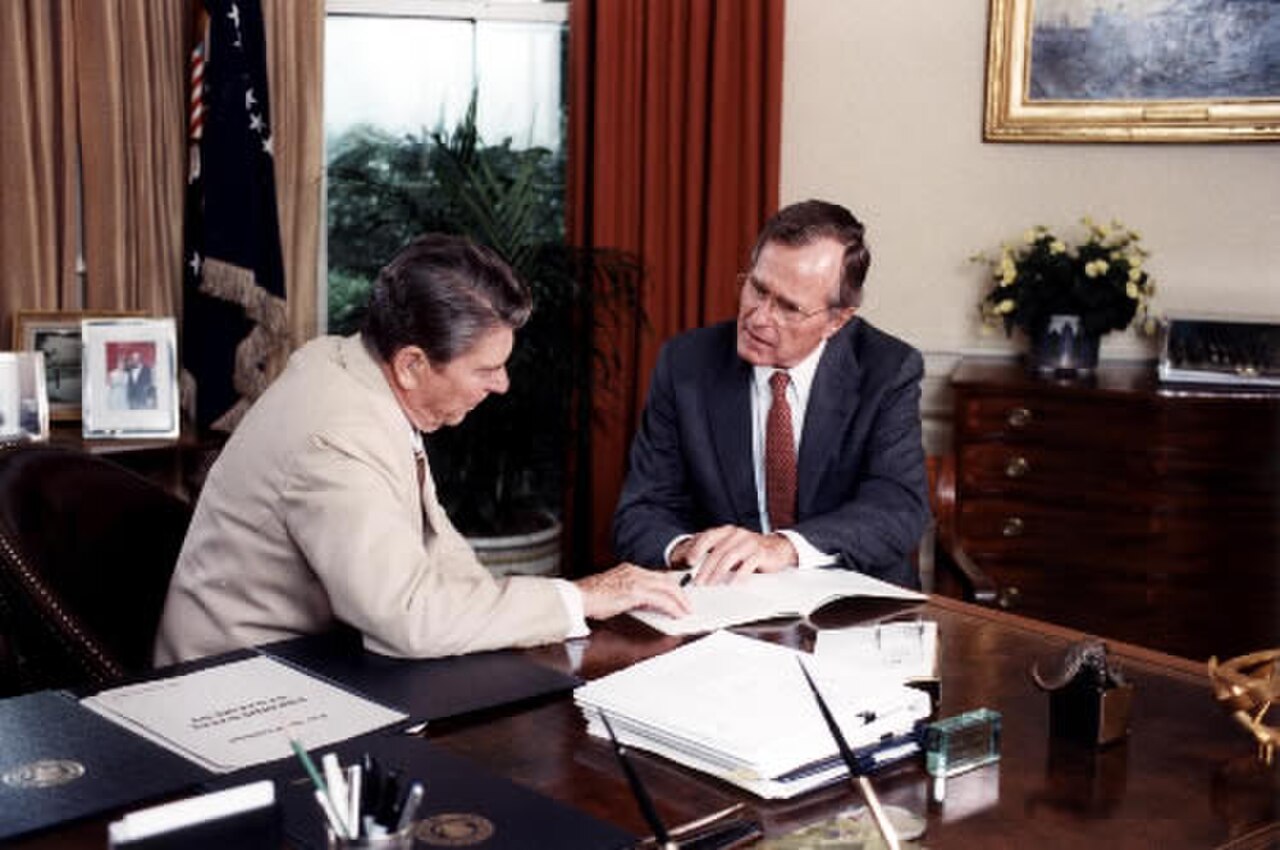
A key element of U.S. political–military and energy–economic planning occurred in early 1983. The Iran–Iraq war had been going on for three years and there were significant casualties on both sides, reaching hundreds of thousands. Within the Reagan National Security Council concern was growing that the war could spread beyond the boundaries of the two belligerents. A National Security Planning Group meeting was called chaired by Vice President George Bush to review U.S. options. It was determined that there was a high likelihood that the conflict would spread into Saudi Arabia and other Gulf states, but that the United States had little capability to defend the region.[253]
It was determined that a prolonged war in the region would induce much higher oil prices and threaten the fragile world recovery which was just beginning to gain momentum. On 22 May 1984, President Reagan was briefed on the project conclusions in the Oval Office by William Flynn Martin who had served as the head of the NSC staff that organized the study. The full declassified presentation can be seen here.[253]
The conclusions were threefold: firstly, oil stocks needed to be increased among members of the International Energy Agency and, if necessary, released early in the event of oil market disruption; second, the United States needed to reinforce the security of friendly Arab states in the region; and thirdly, an embargo should be placed on sales of military equipment to Iran and Iraq. The plan was approved by the President and later affirmed by the G-7 leaders headed by Margaret Thatcher in the London Summit of 1984.
U.S. knowledge of Iraqi chemical weapons use
According to Foreign Policy, the "Iraqis used mustard gas and sarin prior to four major offensives in early 1988 that relied on U.S. satellite imagery, maps, and other intelligence. ... According to recently declassified CIA documents and interviews with former intelligence officials like Francona, the U.S. had firm evidence of Iraqi chemical attacks beginning in 1983."[254]
Iraqi attack on U.S. warship
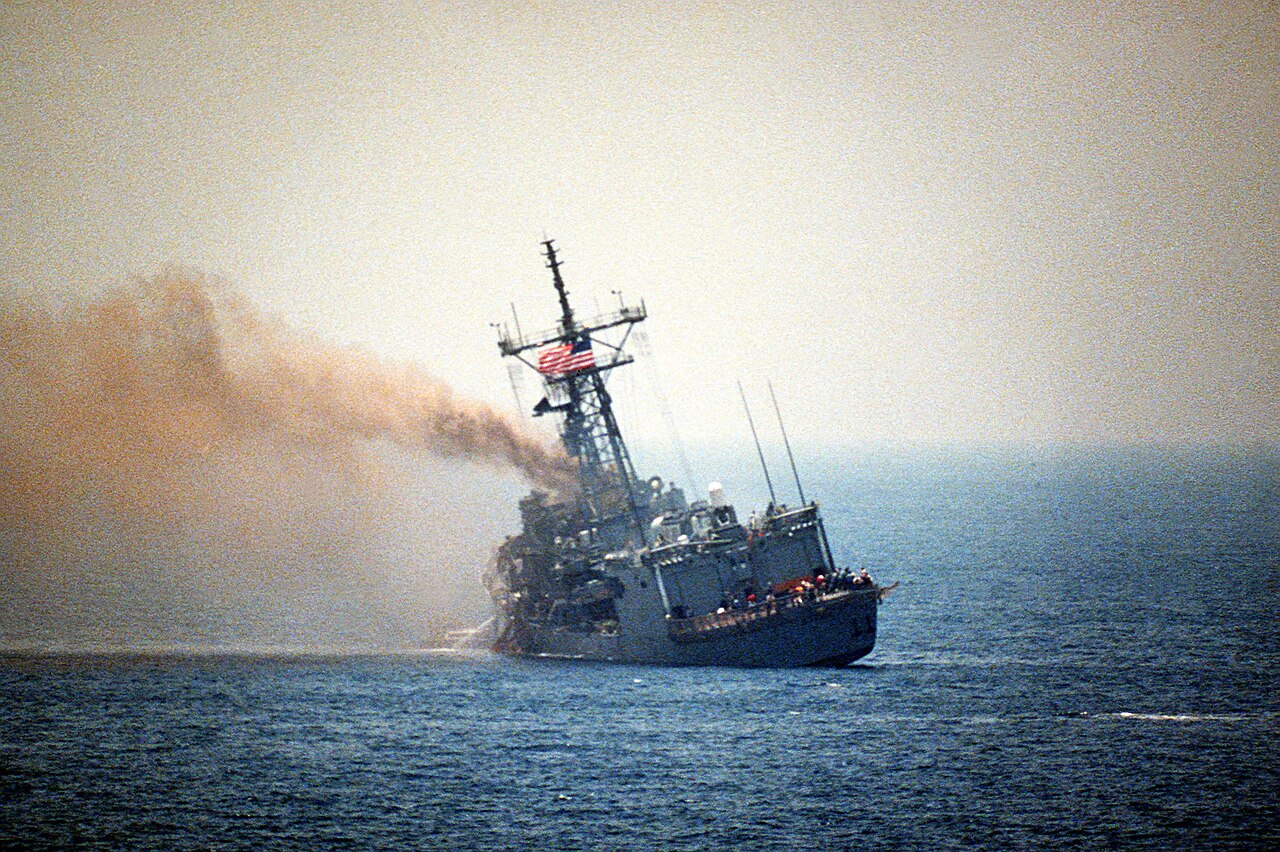
On 17 May 1987, an Iraqi Dassault Mirage F1 fighter jet launched two Exocet missiles at USS Stark, a Perry class frigate.[255] The first struck the port side of the ship and failed to explode, though it left burning propellant in its wake; the second struck moments later in approximately the same place and penetrated through to crew quarters, where it exploded, killing 37 crew members and leaving 21 injured. Whether or not Iraqi leadership authorised the attack is still unknown. Initial claims by the Iraqi government that Stark was inside the Iran–Iraq War zone were shown to be false, and the motives and orders of the pilot remain unanswered.[256]
Though American officials claimed that the pilot who attacked Stark had been executed, an ex-Iraqi Air Force commander since stated he had not been punished, and was still alive at the time.[256] The attack remains the only successful anti-ship missile strike on an American warship.[257][258] Due to the extensive political and military cooperation between the Iraqis and Americans by 1987, the attack had little effect on relations between the two countries.
U.S. military actions toward Iran
U.S. attention was focused on isolating Iran as well as maintaining freedom of navigation. It criticised Iran's mining of international waters, and sponsored UN Security Council Resolution 598, which passed unanimously on 20 July, under which the U.S. and Iranian forces skirmished during Operation Earnest Will. During Operation Nimble Archer in October 1987, the United States attacked Iranian oil platforms in retaliation for an Iranian attack on the U.S.-flagged Kuwaiti tanker Sea Isle City.[158]
On 14 April 1988, the frigate USS Samuel B. Roberts was badly damaged by an Iranian mine, and 10 sailors were wounded. U.S. forces responded with Operation Praying Mantis on 18 April, the U.S. Navy's largest engagement of surface warships since World War II. Two Iranian oil platforms were destroyed, and five Iranian warships and gunboats were sunk. An American helicopter also crashed.[158]
Iran Air Flight 655
In the course of escorts by the U.S. Navy, the cruiser USS Vincennes shot down Iran Air Flight 655 on 3 July 1988, killing all 290 passengers and crew on board. The American government claimed that Vincennes was in international waters at the time (which was later proven to be untrue), that the Airbus A300 had been mistaken for an Iranian F-14 Tomcat, and that Vincennes feared that she was under attack.[256]: 260–273 [257] The Iranians maintain that Vincennes was in their own waters, and that the passenger jet was turning away and increasing altitude after take-off. U.S. Admiral William J. Crowe later admitted on Nightline that Vincennes was in Iranian territorial waters when it launched the missiles. At the time of the attack, Admiral Crowe claimed that the Iranian plane did not identify itself and sent no response to warning signals he had sent. In 1996, the United States expressed their regret for the event and the civilian deaths it caused.[68][257]
Iraq's use of chemical weapons
| Year | Number of usage | Chemical agent used | Casualties* | ||||
|---|---|---|---|---|---|---|---|
| Mustard | Nerve | Blood | Choking | Killed | Injured | ||
| 1980 | 4 | Yes | — | 20 | 1 | ||
| 1981 | 6 | 101 | Unknown | ||||
| 1982 | 12 | Unknown | |||||
| 1983 | 64 | ||||||
| 1984 | Unknown | Yes | Yes | Yes | 40 | 2,225 | |
| 1985 | 76 | 77 | 11,644 | ||||
| 1986 | 102 | 102 | 4,720 | ||||
| 1987 | 43 | 442 | 9,440 | ||||
| 1988 | 34 | Unknown | |||||
| * The actual casualties may be much higher, as the latency period is as long as 40 years.[260] | |||||||
In a declassified 1991 report, the CIA estimated that Iran had suffered more than 50,000 casualties from Iraq's use of several chemical weapons,[261] though current estimates are more than 100,000 as the long-term effects continue to cause casualties.[68][262] The official CIA estimate did not include the civilian population contaminated in bordering towns or the children and relatives of veterans, many of whom have developed blood, lung and skin complications, according to the Organization for Veterans of Iran. According to a 2002 article in the Star-Ledger, 20,000 Iranian soldiers were killed on the spot by nerve gas. As of 2002, 5,000 of the 80,000 survivors continue to seek regular medical treatment, while 1,000 are hospital inpatients.[263][264]
According to Iraqi documents, assistance in developing chemical weapons was obtained from firms in many countries, including the United States, West Germany, the Netherlands, the United Kingdom, and France. A report stated that Dutch, Australian, Italian, French and both West and East German companies were involved in the export of raw materials to Iraqi chemical weapons factories.[265] Declassified CIA documents show that the United States was providing reconnaissance intelligence to Iraq around 1987–88 which was then used to launch chemical weapon attacks on Iranian troops and that the CIA fully knew that chemical weapons would be deployed and sarin and cyclosarin attacks followed.[266]
On 21 March 1986, the United Nations Security Council made a declaration stating that "members are profoundly concerned by the unanimous conclusion of the specialists that chemical weapons on many occasions have been used by Iraqi forces against Iranian troops, and the members of the Council strongly condemn this continued use of chemical weapons in clear violation of the Geneva Protocol of 1925, which prohibits the use in war of chemical weapons." The United States was the only member who voted against the issuance of this statement.[267][note 9] A mission to the region in 1988 found evidence of the use of chemical weapons, and was condemned in Security Council Resolution 612.
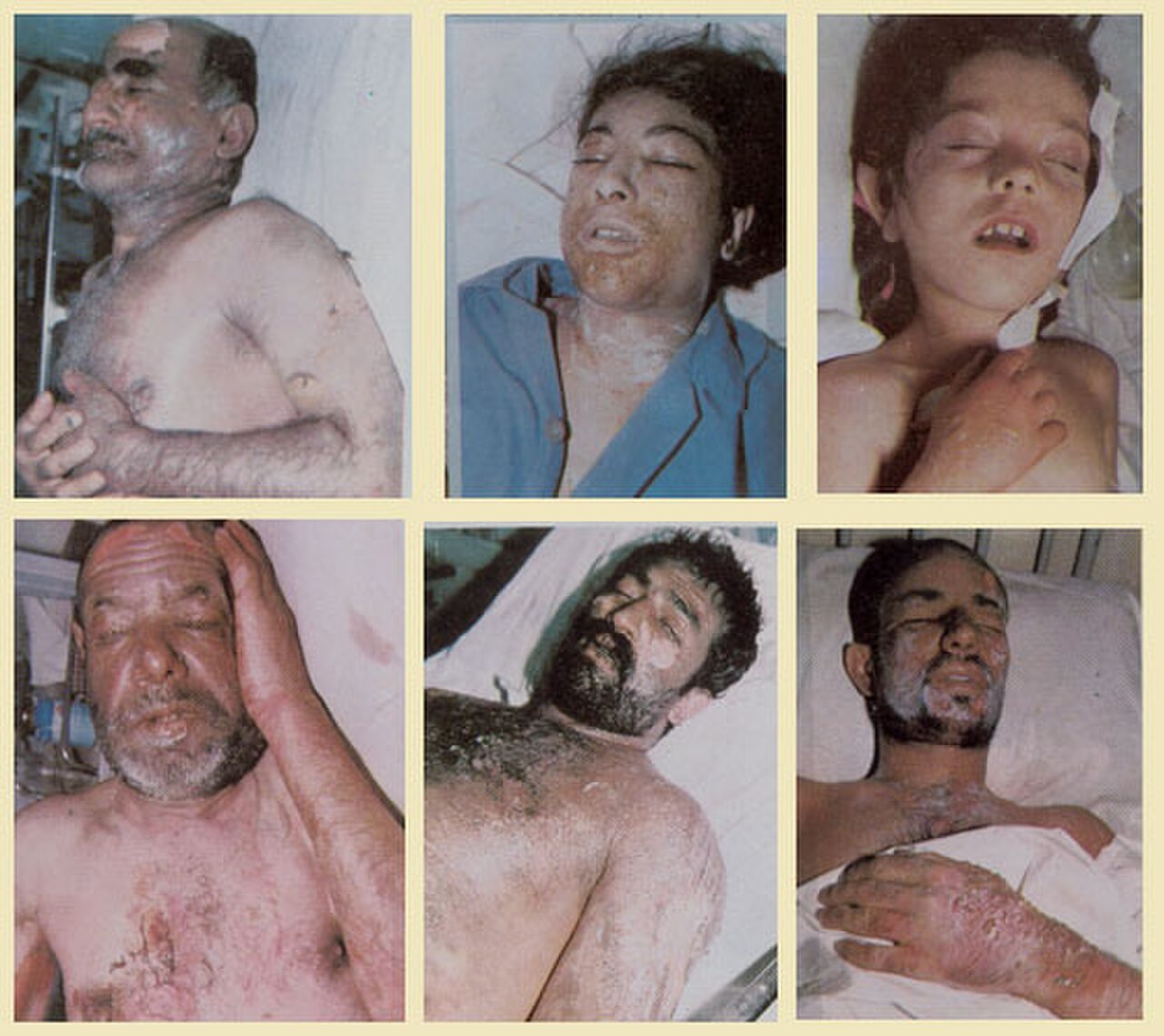
According to W. Patrick Lang, senior defense intelligence officer at the U.S. Defense Intelligence Agency, "the use of gas on the battlefield by the Iraqis was not a matter of deep strategic concern" to Reagan and his aides, because they "were desperate to make sure that Iraq did not lose". He claimed that the Defense Intelligence Agency "would have never accepted the use of chemical weapons against civilians, but the use against military objectives was seen as inevitable in the Iraqi struggle for survival".[183] The Reagan administration did not stop aiding Iraq after receiving reports of the use of poison gas on Kurdish civilians.[268][269]
The United States accused Iran of using chemical weapons as well,[256]: 214 though the allegations have been disputed. Joost Hiltermann, the principal researcher for Human Rights Watch between 1992 and 1994, conducted a two-year study that included a field investigation in Iraq, and obtained Iraqi government documents in the process. According to Hiltermann, the literature on the Iran–Iraq War reflects allegations of chemical weapons used by Iran, but they are "marred by a lack of specificity as to time and place, and the failure to provide any sort of evidence".[270]: 153
Analysts Gary Sick and Lawrence Potter have called the allegations against Iran "mere assertions" and stated, "No persuasive evidence of the claim that Iran was the primary culprit [of using chemical weapons] was ever presented."[270]: 156 Policy consultant and author Joseph Tragert stated, "Iran did not retaliate with chemical weapons, probably because it did not possess any at the time".[271] Documents uncovered after the 2003 invasion of Iraq show that Iraqi military intelligence was not aware of any large-scale chemical attacks by Iranian forces, although a March 1987 document describes five small-scale chemical attacks perpetrated by the Iranians (four involving mustard gas and one involving phosgene, with the likely source being captured Iraqi munitions), and there are also reports of Iranian use of tear gas and white phosphorus.[272]
At his trial in December 2006, Saddam said he would take responsibility "with honour" for any attacks on Iran using conventional or chemical weapons during the war, but that he took issue with the charges that he ordered attacks on Iraqis.[273] A medical analysis of the effects of Iraqi mustard gas is described in a U.S. military textbook and contrasted effects of World War I gas.[274]
At the time of the conflict, the United Nations Security Council issued statements that "chemical weapons had been used in the war". UN statements never clarified that only Iraq was using chemical weapons, and according to retrospective authors "the international community remained silent as Iraq used weapons of mass destruction against Iranian[s] as well as Iraqi Kurds."[275][276][128] A 1987 UN report conducted at the behest of both belligerents discovered weapon fragments that established Iraqi responsibility for chemical attacks on Iranian soldiers and civilians, but could not substantiate Iraq's allegations of Iranian chemical weapons use: "Iraqi forces have been affected by mustard gas and a pulmonary element, possibly phosgene. In the absence of conclusive evidence of the weapons used, it could not be determined how the injuries were caused."[277]
Evidence suggests that these Iraqi chemical casualties were likely the result of "blowback," whereas the evidence that Iraq submitted to the UN—such as two Iranian 130 mm shells that UN specialists found had "no internal chemical-resistant coating" and were "normally used for filling with high explosives"—did not withstand scrutiny; UN official Iqbal Riza later acknowledged that Iraq's evidence was "clearly fabricated." However, the report's phrasing—"chemical weapons were again used against Iranian forces by Iraqi forces ... now also Iraqi forces have sustained injuries from chemical warfare"—contributed to an erroneous perception that Iran and Iraq were equally at fault.[277]
In response to further Iraqi chemical attacks on Kurdish civilians after the August 1988 ceasefire with Iran, United States senators Claiborne Pell and Jesse Helms called for comprehensive economic sanctions against Iraq, including an oil embargo and severe limitations on the export of dual-use technology. Although the ensuing legislation passed in the U.S. Senate, it faced strong opposition within the House of Representatives and did not become law. In a rare rebuke, Secretary of State George Shultz condemned Iraq's "unjustified and abhorrent" chemical attacks, which Shultz's assistant Charles E. Redman characterized as "unacceptable to the civilized world." Even after these pronouncements, however, the State Department advised against sanctions.[278]
Comparison to other conflicts
| Events leading up to the Iraq War |
|---|
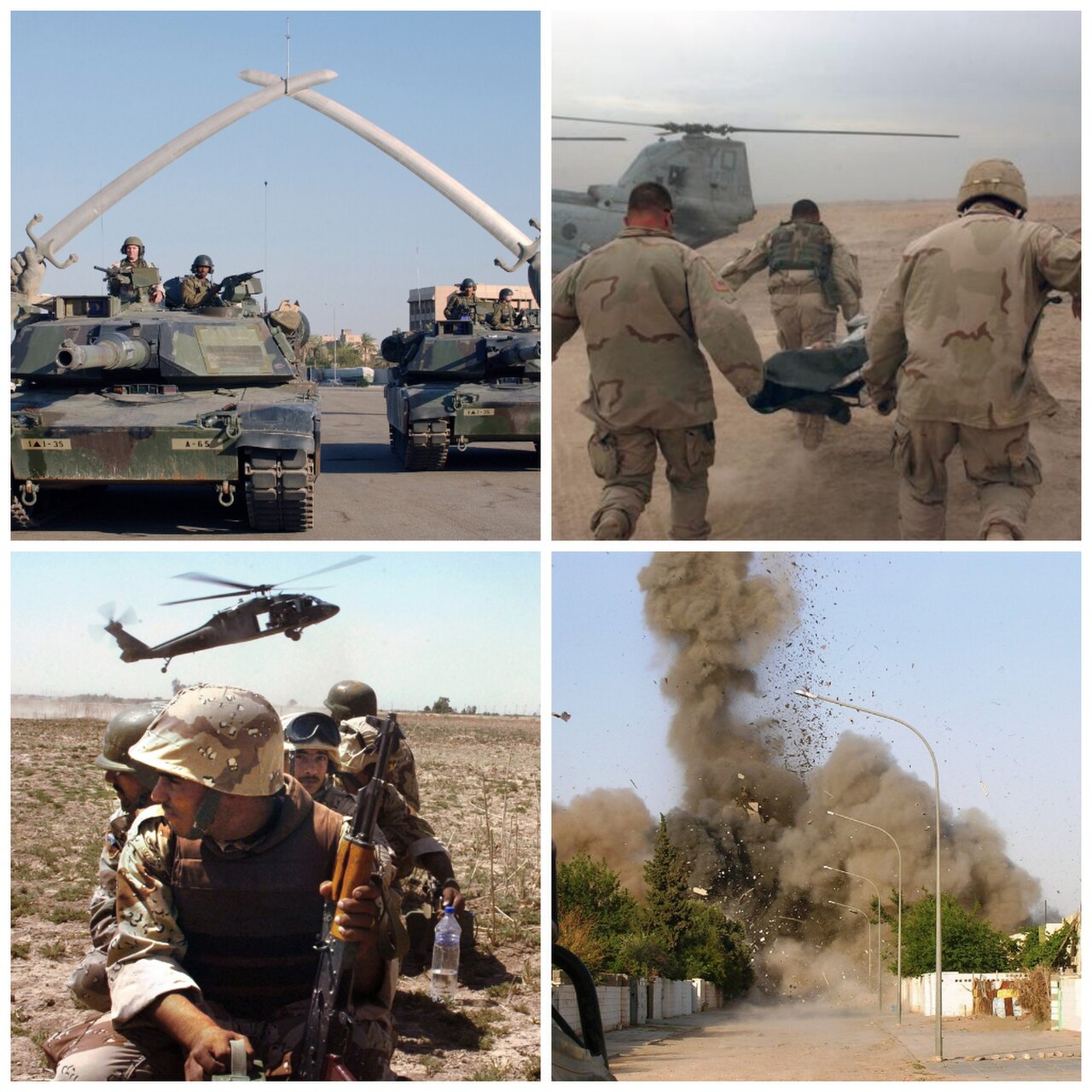 |
|
Bruce Riedel describes the Iran–Iraq War as "one of the largest and longest conventional interstate wars" of the twentieth century and "the only war in modern times in which chemical weapons were used on a massive scale."[55] Kanan Makiya writes that "there has not been anything like it in the long history of Iraqi–Iranian relations, just like there had been nothing like World War I in the history of Europe."[279]
Iran's attack on the Osirak nuclear reactor in September 1980 was the first attack on a nuclear reactor and one of only a small handful of military attacks on nuclear facilities in history. It was also the first instance of a pre-emptive attack on a nuclear reactor to forestall the development of a nuclear weapon, though it did not achieve its objective, as France repaired the reactor after the attack.[280] (It took a second pre-emptive strike by the Israeli Air Force in June 1981 to disable the reactor, killing a French engineer in the process and causing France to pull out of Osirak. The decommissioning of Osirak has been cited as causing a substantial delay to Iraqi acquisition of nuclear weapons.[281][282][283][284][285])
The Iran–Iraq War was the first conflict in the history of warfare in which both forces used ballistic missiles against each other.[281] This war also saw the only confirmed air-to-air helicopter battles in history with the Iraqi Mi-25s flying against Iranian AH-1J SeaCobras (supplied by the United States before the Iranian Revolution) on several separate occasions. In November 1980, not long after Iraq's initial invasion of Iran, two Iranian SeaCobras engaged two Mi-25s with TOW wire-guided antitank missiles. One Mi-25 went down immediately, the other was badly damaged and crashed before reaching base.[286][287]
The Iranians repeated this accomplishment on 24 April 1981, destroying two Mi-25s without incurring losses to themselves.[286] One Mi-25 was also downed by an Iranian F-14A Tomcat.[288] The Iraqis hit back, claiming the destruction of a SeaCobra on 14 September 1983 (with YaKB machine gun), then three SeaCobras on 5 February 1984[287] and three more on 25 February 1984 (two with Falanga missiles, one with S-5 rockets).[286] After a lull in helicopter losses, each side lost a gunship on 13 February 1986.[286] Later, a Mi-25 claimed a SeaCobra shot down with YaKB gun on 16 February, and a SeaCobra claimed a Mi-25 shot down with rockets on 18 February.[286]
The last engagement between the two types was on 22 May 1986, when Mi-25s shot down a SeaCobra. The final claim tally was 10 SeaCobras and 6 Mi-25s destroyed. The relatively small numbers and the inevitable disputes over actual kill numbers makes it unclear if one gunship had a real technical superiority over the other. Iraqi Mi-25s also claimed 43 kills against other Iranian helicopters, such as Agusta-Bell UH-1 Hueys.[287] Both sides, especially Iraq, also carried out air and missile attacks against population centres.
In October 1986, Iraqi aircraft began to attack civilian passenger trains and aircraft on Iranian soil, including an Iran Air Boeing 737 unloading passengers at Shiraz International Airport.[264] In retaliation for the Iranian Operation Karbala 5, Iraq attacked 65 cities in 226 sorties over 42 days, bombing civilian neighbourhoods. Eight Iranian cities came under attack from Iraqi missiles. The bombings killed 65 children in an elementary school in Borujerd. The Iranians responded with Scud missile attacks on Baghdad and struck a primary school there. These events became known as the war of the cities.[68]
The war of the cities resumed and peaked in 1988, when Iraq dropped 40 tons of high explosives on Tehran using modified Scud missiles (dubbed "al-Husayn" missiles) over seven weeks, causing panic among civilians and prompting almost 1 million residents of Tehran to temporarily flee their homes. Nevertheless, scholars have noted that this still "ranks as one of the smallest strategic bombing campaigns in history," paling in comparison to strategic bombing during World War II, which saw 1.2 million tons of bombs dropped on German cities in 1944 alone, or more recent events such as the so-called "Christmas bombings" of North Vietnam, which saw 20,000 tons of bombs dropped on Hanoi and Haiphong in a mere eleven days. In total, 10,000–11,000 civilians died as a result of the aerial bombardment of Iranian cities with the majority of those deaths occurring in the final year of the war.[289]
Despite the war, Iran and Iraq maintained diplomatic relations and embassies in each other's countries until mid-1987.[112]
Iran's government used human waves to attack enemy troops and even in some cases to clear minefields. Children volunteered as well. Some reports mistakenly have the Basijis marching into battle while marking their expected entry to heaven by wearing "Plastic Keys to Paradise" around their necks, although other analysts regard this story as a hoax involving a misinterpretation of the carrying of a prayer book called "The Keys to Paradise"(Mafatih al-Janan) by Sheikh Abbas Qumi given to all volunteers.[113]
According to journalist Robin Wright:
During the Fateh offensive in February 1987, I toured the southwest front on the Iranian side and saw scores of boys, aged anywhere from nine to sixteen, who said with staggering and seemingly genuine enthusiasm that they had volunteered to become martyrs. Regular army troops, the paramilitary Revolutionary Guards and mullahs all lauded these youths, known as baseeji [Basij], for having played the most dangerous role in breaking through Iraqi lines. They had led the way, running over fields of mines to clear the ground for the Iranian ground assault. Wearing white headbands to signify the embracing of death, and shouting "Shaheed, shaheed" (Martyr, martyr) they literally blew their way into heaven. Their numbers were never disclosed. But a walk through the residential suburbs of Iranian cities provided a clue. Window after window, block after block, displayed black-bordered photographs of teenage or preteen youths.[290]
Iran and Iraq's modern relationship
The relationship between Iraq and Iran has warmed immensely since the downfall of Saddam Hussein, out of mostly pragmatic interests, as they share a common enemy in the Islamic State. Significant military assistance has been provided by Iran to Iraq, resulting in Iran holding a large amount of political influence in Iraq's newly elected Shia government. Iraq is also heavily dependent on the more stable and developed Iran for its energy needs, so a stable Iraq is an interest for Iran, foreign policy wise.[291]

The Iran–Iraq War is regarded as being a major trigger for rising sectarianism in the region, as it was viewed by many as a clash between Sunni Muslims[292][293][294] (Ba'athist Iraq and other Arab States) and the Shia revolutionaries that had recently taken power in Iran.[295] There remains lingering animosity however despite the pragmatic alliance that has been formed as multiple government declarations from Iran have stated that the war will "affect every issue of internal and foreign policy" for decades to come.[296]
The sustained importance of this conflict is attributed mostly to the massive human and economic cost resulting from it, along with its ties to the Iranian Revolution.[296] Another significant effect that the war has on Iran's policy is the issue of remaining war reparations. The UN estimates that Iraq owes about $149 billion, while Iran contends that, with both the direct and indirect effects taken into account, the cost of the war reaches a trillion.[297]
Iran has not vocalized the desire for these reparations in recent years, and has even suggested forms of financial aid.[297] This is due most likely to Iran's interest in keeping Iraq politically stable, and imposing these reparation costs would further burden the already impoverished nation. The most important factor that governs Iraq's current foreign policy is the national government's consistent fragility following the overthrow of Saddam Hussein. Iraq's need for any and all allies that can help bring stability and bring development has allowed Iran to exert significant influence over the new Iraqi state despite lingering memories of the war.[298]
Currently, Iraq is between two opposing interests, one with Iran, who can provide a reliable source of power as well as military support to the influential Shia militias and political factions, and the other with the United States, who can offer Iraq significant economic aid packages, along with military support in the form of air and artillery strikes. If Iraq is seen to be pulled too far into one side's orbit, then the benefits offered to them by the other side will likely be gradually reduced or cut off completely. Another significant factor influencing relations is the shared cultural interests of Iraq and Iran's citizens to freely visit the multitude of holy sites located in each country.[299]
Legacy and memory

The war is known in Iran as the Defā-e Moqaddas ("Sacred Defence") and the Jang-e Tahmili ("the Imposed War").[300][55] The war is known in the Arab world and a few other regions as the First Gulf War (Arabic: حرب الخليج الأولى). That name, or simply the 'Gulf War', was used by Western sources also, until it was used to refer to the conflict between the American-led coalition and Iraq in 1991. The Iran–Iraq War was rarely referred to as the Persian Gulf War until the 1990–1991 Persian Gulf War, after which the previous war was dubbed the First Persian Gulf War.[301]
Besides the Iran–Iraq war, the 1990 Iraq–Kuwait conflict, as well as The Iraq War from 2003 to 2011 have all been called the Second Persian Gulf War.[301] State media in Iraq dubbed the war Saddam's Qadisiyyah (قادسية صدام, Qādisiyyat Ṣaddām), in reference to the seventh-century Battle of al-Qādisiyyah, in which Arab warriors overcame the Sasanian Empire during the Muslim conquest of Iran.[302]
"We are armed with Allahu Akbar", the 1979 Iranian Islamic revolutionary military march song performed by IRGC troops in front of Ayatollah Khomeini in Jamaran Husinie, made a cultural impact during the war.[303]
See also
- 1986 Iquique arms factory explosion
- 1988 executions of Iranian political prisoners
- Disabled Iranian veterans
- Iraq–United States relations
- Iraqi embassy bombing in Beirut
- Iran–Contra affair
- Iran–Iraq border
- Iran–Iraq relations
- Iran–Saudi Arabia proxy conflict
- Iran–United States relations
- Iranian involvement in the Iraq War
- Israel in the Iran–Iraq War
- Operation Babylon
- Rahian-e Noor
- Reagan Doctrine
- Women in the Iran–Iraq War
Notable Iranian veterans
- Abbas Ka'bi
- Abbas Mohtaj
- Abdolrahim Mousavi
- Abu al-Fazl Hassan Baygi
- Ahmad Kazemi
- Ahmad Meyghani
- Ahmad Reza Pourdastan
- Ahmad Salek
- Ali Abdollahi
- Ali Akbar Ahmadian
- Ali Fadavi
- Ali Mohammad Bozorgvari
- Ali Sayad Shirazi
- Ali Shamkhani
- Alireza Afshar
- Alireza Sabahifard
- Alireza Tangsiri
- Amir Ali Hajizadeh
- Ataollah Salehi
- Bahram Hooshyar
- Bijan Najdi
- Esmaeil Kousari
- Esmail Qaani
- Farzad Esmaili
- Gholam Ali Jafarzadeh
- Gholam Ali Rashid
- Gholamhossein Gheybparvar
- Habibollah Sayyari
- Hamid Chitchian
- Hamid Taqavi
- Hassan Firouzabadi
- Hassan Ghazizadeh Hashemi
- Hassan Hassanzadeh Amoli
- Hassan Shateri
- Hooshang Samadi
- Hossein Alaei
- Hossein Allahkaram
- Hossein Dehghan
- Hossein Hamadani
- Hossein Hassani Sa'di
- Hossein Lashkari
- Hossein Nejat
- Hossein Salami
- Kavous Seyed-Emami
- Kazim Mousavi
- Kioumars Heydari
- Mansour Haghdoust
- Mansour Sattari
- Mehdi Khazali
- Mohammad Ali Allahdadi
- Mohammad Ali Jafari
- Mohammad-Ali Rahmani
- Mohammad Bagher Ghalibaf
- Mohammad Forouzandeh
- Mohammad-Hassan Nami
- Mohammad Hejazi
- Mohammad Hussayn Ahmadi Shahroudi
- Mohammad-Hossein Dadras
- Mohammad-Hossein Malekzadegan
- Mohammad Jamali-Paqaleh
- Mohammad Marandi
- Mohammad Pakpour
- Mohammad Reza Zahedi
- Mohammad Salimi
- Mostafa Izadi
- Nader Ghazipour
- Nasir Hosseini
- Nasser Shabani
- Qasem Soleimani
- Qodratollah Mansouri
- Sabir Jabbari
- Sajjad Kouchaki
- Shahram Rostami
- Yahya Rahim Safavi
Notable Iranian casualties
- Abdolbaghi Darvish
- Ahmad Keshvari
- Ahmad Motevasselian
- Ali Eghbali Dogahe
- Hassan Abshenasan
- Hasan Aghareb Parast
- Hossein Khalatbari
- Hossein Kharrazi
- Hossein Qajeyi
- Javad Fakoori
- Mehdi Bakeri
- Mehdi Zeinoddin
- Masoud Monfared Niyaki
- Mohammad Boroujerdi
- Mohammad Hossein Fahmideh
- Mohammad Ebrahim Hemmat
Notable Iraqi veterans
Notable Iraqi casualties
Persons
- Frans van Anraat
- Morteza Avini, prominent photographer of the Iran–Iraq War, creator of Revayat-e Fath
- Kaveh Golestan
- Ebrahim Hatamikia, Iranian filmmaker
- List of Iranian commanders in the Iran–Iraq War
- Marjane Satrapi, French-Iranian author
Memoirs
- Eternal Fragrance (Last Sunday)
- Noureddin, Son of Iran
- One Woman's War: Da (Mother)
Stories
Relevant conflicts
Notes
- ^ Pollack gives the figure as 1,000 for fully operational tanks in April of 1988. Cordesman gives the figure as 1,500+ operational tanks in March 1988 (1,298 were captured by the Iraqis by July 1988, 200 were still in the hands of the Iranians, and an unknown number were destroyed), with an unknown number in workshops.
- ^ Estimates of Iranian casualties during the Iran–Iraq War vary.[35][36][37][38][39][40][41][42][43]
- ^ Estimates of Iraqi casualties during the Iran–Iraq War vary.[45][47][48][49][50][51]
- ^ The total 100,000+ civilians killed during the war does not include 50,000–200,000 Kurdish civilians killed in the Al-Anfal genocide.[52][53]
- ^ a b c d Called Arvand Rood (اروندرود) in Iran and Shatt al-Arab (شط العرب) in Iraq
- ^ Massoud Rajavi
- ^ Muslim ibn Aqil referring to the Muslim figure.
- ^ Muharram referring to the first month of the Islamic calendar, during which the operation took place.[144]
- ^ This was a "decision" rather than a resolution.
- ^ from:
- ^ from:[12][13]
- ^ Also: 1983–1988 Kuwait terror attacks, 1981 Iraqi embassy bombing in Beirut, Lebanon hostage crisis, 1983 Beirut barracks bombings and 1985–86 Paris attacks.
- ^ Iraq claimed victory following a successful 1988 counter-offensive aimed at expelling Iranian forces from Iraq which compelled Iran to submit to a ceasefire the same year, and also due to the country becoming the dominant power in the Middle East as a result of the conflict, while Iran also claimed victory for expelling Iraqi forces from Iran following 1982 offensives, despite failing in its later-goal to overthrow the Iraqi government and also despite suffering higher military and economic losses than Iraq.[20][21]
- ^ After the war concluded, Iraq continued to maintain control over the entire Shatt al-Arab and other Iranian territories it had occupied along the border, covering an area of 9,600 km². It was not until 16 August 1990 that Iraq agreed to return these occupied territories back to Iran and to divide sovereignty over the Shatt al-Arab. This restored the border to the terms established by the 1975 Algiers Agreement.[22][23][24]
- ^ Arabic: حرب الخليج الأولى, romanized: Ḥarb al-Khalīj al-ʾAwlā; Persian: جنگ ایران و عراق, romanized: Jang-e Irān va Erāq
- ^ Also known in Iran as the Sepah-e-Pasdaran
- ^ A resort that became increasingly necessary as the war continued. Though Iran could and did acquire weapons from multiple foreign manufacturers; the pre-revolution arsenal was composed overwhelmingly of US made weaponry, meaning obtaining additional spare parts was not an option.
.svg/1280px-Flag_of_Afghanistan_(1980%E2%80%931987).svg.png)


.svg/1280px-Flag_of_Egypt_(1972%E2%80%931984).svg.png)


.svg/1280px-Flag_of_Tunisia_(1959%E2%80%931999).svg.png)
References
 | This article cites its sources but its page references ranges are too broad or incorrect. (September 2020) |
Citations
- ^ Nimrod Raphaeli (11 February 2009). "The Iranian Roots of Hizbullah". MEMRI. Archived from the original on 11 February 2009.
- ^ "Memoires of Afghan volunteers in Iran–Iraq war published (tehrantimes.com)". 7 October 2018. Archived from the original on 17 June 2021. Retrieved 3 February 2021.
- ^ "'Mohsen, the Japanese' chronicles life of Afghan volunteer fighter in Iran–Iraq war (tehrantimes.com)". 16 December 2020. Archived from the original on 7 February 2021. Retrieved 3 February 2021.
- ^ "Iran's Shia Diplomacy: Religious and Foreign Policy in the Islamic Republic" (PDF). Archived (PDF) from the original on 6 July 2023. Retrieved 30 August 2023.
- ^ Shaery-Eisenlohr, Roschanack (2011). Shi'ite Lebanon: Transnational Religion and the Making of National Identities. Columbia University Press. ISBN 9780231144278. Archived from the original on 27 April 2023. Retrieved 21 March 2023.
- ^ Williamson Murray, Kevin M. Woods (2014): The Iran–Iraq War. A Military and Strategic History. Cambridge University Press. ISBN 978-1-107-06229-0 p. 223
- ^ a b c "Iran's Islamic Revolutionary Guard Corps (Project Muse)". Archived from the original on 9 July 2022. Retrieved 30 August 2023.
- ^ Johnson, Rob (2010). The Iran–Iraq War. Palgrave Macmillan. ISBN 978-1137267788 – via Google Books.[permanent dead link]
- ^ Murray, Williamson; Woods, Kevin M. (2014). The Iran–Iraq War: A Military and Strategic History. Cambridge University Press. ISBN 978-1107062290 – via Google Books.
- ^ Entessar, Nader (2010). Kurdish Politics in the Middle East. Lanham: Lexington Books. p. 48. ISBN 9780739140390. OCLC 430736528.
Throughout much of the 1980s, the KDPI received aid from the Ba'thi regime of Saddam Hussein, but Ghassemlou broke with Baghdad in 1988 after Iraq used chemical weapons against Kurds in Halabja and then forced Kurdish villagers to...
- ^ van Bruinessen, Martin (15 August 1986). The Naqshbandi Order as a Vehicle of Political Protest among the Kurds (With Some Comparative Notes on Indonesia). New Approaches in Islamic Studies. Jakarta: Indonesian Institute of Sciences. pp. 1–3. Archived from the original on 16 August 2023. Retrieved 19 July 2023 – via Academia.edu.
- ^ Middleton, Drew (4 October 1982). "Sudanese Brigades Could Provide Key Aid for Iraq; Military Analysis". The New York Times. Archived from the original on 8 December 2019. Retrieved 8 December 2019.
- ^ "Iraq–Iran war becoming Arab-Persian war? (The Christian Science Monitor)". The Christian Science Monitor. 5 February 1982. Archived from the original on 8 December 2019. Retrieved 8 December 2019.
- ^ "Jordan's call for volunteers to fight Iran misfires (The Christian Science Monitor)". The Christian Science Monitor. 11 February 1982. Archived from the original on 8 December 2019. Retrieved 8 December 2019.
- ^ Schenker, David Kenneth (2003). Dancing with Saddam: The Strategic Tango of Jordanian–Iraqi Relations (PDF). The Washington Institute for Near East Policy / Lexington Books. ISBN 0-7391-0649-X. Archived from the original (PDF) on 23 January 2017.
- ^ "Jordanian Unit Going To Aid Iraq 6 Hussein Will Join Volunteer Force Fighting Iranians (The Washington Post)". The Washington Post. Archived from the original on 8 December 2019. Retrieved 8 December 2019.
- ^ Dictionary of modern Arab history, Kegan Paul International 1998. ISBN 978-0710305053 p. 196.
- ^ Iran–Iraq War Timeline. Part 1
- ^ Berridge, W.J. "Civil Uprisings in Modern Sudan: The 'Khartoum Springs' of 1964 and 1985", p. 136. Bloomsbury Academic, 2015 [ISBN missing]
- ^ Mylroie, Laurie (1989). "Iraq's Changing Role in the Persian Gulf". Current History. 88 (535): 89–99. doi:10.1525/curh.1989.88.535.89. ISSN 0011-3530. JSTOR 45316185. S2CID 249695060. Archived from the original on 21 July 2023. Retrieved 21 July 2023.
- ^ "The 'beauty' and the horror of the Iran–Iraq war". BBC News. 26 September 2015. Archived from the original on 14 June 2018. Retrieved 21 July 2023.
- ^ Malovany, Pesach (2017). Wars of Modern Babylon: A History of the Iraqi Army from 1921 to 2003. University Press of Kentucky. p. 443. ISBN 9780813169453.
- ^ Coll, Steve (15 August 1990). "Saddam offers to conclude full peace with Iran". The Washington Post. Archived from the original on 9 June 2023. Retrieved 8 June 2024.
- ^ a b c d "Iran–Iraq War". Encyclopædia Britannica. Archived from the original on 30 August 2021. Retrieved 2 September 2021.
- ^ a b Pollack, p. 186.
- ^ a b c d Razoux, Pierre (2015). The Iran–Iraq War. Harvard University Press. p. 515, 540. ISBN 978-0674915718. Archived from the original on 17 February 2023. Retrieved 29 January 2023.
- ^ Farrokh, Kaveh, 305 (2011)
- ^ Pollack, p. 187.
- ^ Farrokh, Kaveh, 304 (2011)
- ^ "The state of the air combat readiness of Iran ... • corporal_historian_23". Archived from the original on 2 October 2018. Retrieved 9 December 2018.
- ^ Pollack, p. 232.
- ^ Cordesman, Anthony H. The Lessons of Modern War: The Iran–Iraq War. Boulder, CO: Westview Press, 1990. Chapter 10: "In fact, Iraq had captured so much equipment that it was able to put on an incredible show on the outskirts of Baghdad. Rather than include all of Iraq's gains, it included the equipment that could either be used immediately or be easily reconditioned. Iraqi sources claimed that since March, Iraq had captured a total of 1,298 tanks, 155 armored infantry fighting vehicles, 512 heavy artillery weapons, 6,196 mortars, 5,550 recoilless rifles and light guns, 8,050 rocket propelled grenades, 60,694 rifles, 322 pistols, 6,156 telecommunications devices, 501 items of heavy engineering equipment, 454 trucks, 1,600 light vehicles and trailers, 16,863 items of chemical defense gear, and 16,863 caskets... After its recent defeats, Iran was virtually defenseless in the south. It was down to less than 200 tanks."
- ^ a b c d Razoux, Pierre (2015). The Iran–Iraq War. Harvard University Press. pp. 543–544. ISBN 978-0674915718. Archived from the original on 17 February 2023. Retrieved 29 January 2023.
- ^ Pollack, p. 3.
- ^ a b c d e f g h i j k Hiro, Dilip (1991). The Longest War: The Iran–Iraq Military Conflict. New York: Routledge. p. 205. ISBN 978-0-415-90406-3. OCLC 22347651.
- ^ a b c d Rajaee, Farhang (1997). Iranian Perspectives on the Iran–Iraq War. Gainesville: University Press of Florida. p. 2. ISBN 978-0-8130-1476-0. OCLC 492125659.
- ^ a b c d e Mikaberidze, Alexander (2011). Conflict and Conquest in the Islamic World: A Historical Encyclopedia. Santa Barbara, CA: ABC-CLIO. p. 418. ISBN 978-1-59884-336-1. OCLC 775759780.
- ^ Hammond Atlas of the 20th Century (1999), pp. 134–135.
- ^ a b Dunnigan, A Quick and Dirty Guide to War (1991)
- ^ a b Dictionary of Twentieth Century World History, by Jan Palmowski (Oxford, 1997)
- ^ a b Clodfelter, Micheal, Warfare and Armed Conflict: A Statistical Reference to Casualty and Other Figures, 1618–1991
- ^ a b Chirot, Daniel: Modern Tyrants : the power and prevalence of evil in our age (1994)
- ^ "B&J": Jacob Bercovitch and Richard Jackson, International Conflict : A Chronological Encyclopedia of Conflicts and Their Management 1945–1995 (1997), p. 195.
- ^ a b c d e f g Abrahamian, Ervand (2008). A History of Modern Iran. Cambridge; New York: Cambridge University Press. pp. 171–175, 212. ISBN 978-0511984402. OCLC 171111098.
- ^ a b c d e Potter, Lawrence G.; Sick, Gary (2006). Iran, Iraq and the Legacies of War. Basingstoke: Palgrave Macmillan. p. 8. ISBN 978-1-4039-7609-3. OCLC 70230312.
- ^ a b c d e f g Zargar, Moosa; Araghizadeh, Hassan; Soroush, Mohammad Reza; Khaji, Ali (December 2012). "Iranian casualties during the eight years of Iraq–Iran conflict". Revista de Saúde Pública. 41 (6). São Paulo: Faculdade de Higiene e Saúde Pública da Universidade de São Paulo: 1065–1066. doi:10.1590/S0034-89102007000600025. ISSN 0034-8910. OCLC 4645489824. PMID 18066475.
- ^ a b c Hiro, Dilip (1991). The Longest War: The Iran–Iraq Military Conflict. New York: Routledge. p. 251. ISBN 978-0-415-90406-3. OCLC 22347651.
- ^ Rumel, Rudolph. "Centi-Kilo Murdering States: Estimates, Sources, and Calculations". Power Kills. University of Hawai'i. Archived from the original on 11 October 2017. Retrieved 26 March 2019.
- ^ a b c d e f Karsh, Efraim (2002). The Iran–Iraq War, 1980–1988. Oxford, England: Osprey Publishing. p. 89. ISBN 978-1-84176-371-2. OCLC 48783766.
- ^ a b c Koch, Christian; Long, David E. (1997). Gulf Security in the Twenty-First Century. Abu Dhabi: Emirates Center for Strategic Studies and Research. p. 29. ISBN 978-1-86064-316-3. OCLC 39035954.
- ^ Black, Ian (23 September 2010). "Iran and Iraq remember war that cost more than a million lives". The Guardian. Archived from the original on 2 January 2017. Retrieved 14 December 2016.
- ^ Rumel, Rudolph. "Lesser Murdering States, Quasi-States, and Groups: Estimates, Sources, and Calculations". Power Kills. University of Hawai'i. Archived from the original on 4 October 2012. Retrieved 16 May 2012.
- ^ Sinan, Omar (25 June 2007). "Iraq to hang 'Chemical Ali'". Tampa Bay Times. Associated Press. Archived from the original on 17 October 2015. Retrieved 9 February 2013.
- ^ Pfetsch & Rohloff 2013, p. 154.
- ^ a b c d Riedel, Bruce (2012). "Foreword". Becoming Enemies: U.S.–Iran Relations and the Iran–Iraq War, 1979–1988. Rowman & Littlefield Publishers. p. ix. ISBN 978-1-4422-0830-8.
The Iran–Iraq War was devastating—one of the largest and longest conventional interstate wars since the Korean conflict ended in 1953. A half million lives were lost, perhaps another million were injured, and the economic cost was over a trillion dollars. ... the battle lines at the end of the war were almost exactly where they were at the beginning of hostilities. It was also the only war in modern times in which chemical weapons were used on a massive scale. ... The Iranians call the war the 'imposed war' because they believe the United States imposed it on them and orchestrated the global 'tilt' toward Iraq in the war.
- ^ Gölz, "Martyrdom and Masculinity in Warring Iran. The Karbala Paradigm, the Heroic, and the Personal Dimensions of War." Archived 17 May 2019 at the Wayback Machine, Behemoth 12, no. 1 (2019): 35–51, 35.
- ^ Karsh, Efraim The Iran–Iraq War 1980–1988, London: Osprey, 2002 pp. 7–8
- ^ Bulloch, John and Morris, Harvey The Gulf War, London: Methuen, 1989 p. 37.
- ^ a b Karsh, Efraim The Iran–Iraq War 1980–1988, London: Osprey, 2002 p. 8
- ^ a b c d e f g h i j k l m n o p q r s t u v w x y z aa ab ac ad ae af ag ah ai aj ak al am an ao ap aq ar as at au av aw ax ay az ba bb bc bd be bf bg bh bi bj bk bl bm bn bo bp bq br bs bt bu bv bw bx by bz ca cb cc cd ce cf cg ch ci cj ck cl cm cn co cp cq Farrokh, Kaveh (2011). Iran at War: 1500–1988. Oxford: Osprey Publishing. ISBN 978-1-78096-221-4.
- ^ a b c d e f g h i j k l m n o "Iran–Iraq War 1980–1988". History of Iran. Iran Chamber Society. Archived from the original on 11 October 2017. Retrieved 29 June 2012.
- ^ Asadzade, Peyman (2019). "War and Religion: The Iran−Iraq War". Oxford Research Encyclopedia of Politics. doi:10.1093/acrefore/9780190228637.013.812. ISBN 978-0190228637. Archived from the original on 23 October 2020. Retrieved 21 April 2020.
- ^ a b c d e f g h i j k l m n o p q r s t u v w x y z aa ab ac ad ae af ag ah ai aj ak al am an ao ap aq ar as at au av aw ax ay az ba bb bc bd be bf bg bh bi bj bk bl bm bn bo bp bq br bs bt bu bv bw bx by bz ca cb cc cd ce cf cg ch ci cj ck cl cm cn co cp cq cr cs ct cu cv cw cx cy cz da db dc dd de df dg dh di dj dk dl dm dn do dp dq dr ds dt du Karsh, Efraim (2002). The Iran–Iraq War: 1980–1988. Osprey Publishing. pp. 1–8, 12–16, 19–82. ISBN 978-1-84176-371-2.
- ^ Murray, Williamson; Woods, Kevin M. (2014). "A context of 'bitterness and anger'". The Iran–Iraq War, A Military and Strategic History. Cambridge University Press. pp. 58–59 (e-book, page numbers approximate). ISBN 978-1107062290.
- ^ Murray, Williamson; Woods, Kevin M. (2014). "A context of 'bitterness and anger'". The Iran–Iraq War, A Military and Strategic History. Cambridge University Press. pp. 61–62 (e-book, page numbers approximate). ISBN 978-1107062290.
Certainly Saddam believed that the oil-rich areas of Arabistan (Khuzestan) were within his reach, a goal his intelligence services seemed delighted to further.
- ^ "Britannica Online Encyclopedia: Saddam Hussein". Archived from the original on 3 May 2015. Retrieved 28 October 2012.
- ^ Makiya, Kanan (1998). Republic of Fear: The Politics of Modern Iraq (Updated ed.). University of California Press. p. 273. ISBN 978-0520921245.
- ^ a b c d e f Rajaee, Farhang, ed. (1993). The Iran–Iraq War: The Politics of Aggression. Gainesville: University Press of Florida. ISBN 978-0-8130-1177-6.
- ^ Murray, Williamson; Woods, Kevin M. (2014). "The opponents". The Iran–Iraq War, A Military and Strategic History. Cambridge University Press. pp. 71–73 (e-book, page numbers approximate). ISBN 978-1107062290.
- ^ Makiya, Kanan (1998). Republic of Fear: The Politics of Modern Iraq (Updated ed.). University of California Press. pp. 33–34. ISBN 978-0520921245.
- ^ Murray, Williamson; Woods, Kevin M. (2014). "The opponents". The Iran–Iraq War, A Military and Strategic History. Cambridge University Press. pp. 77–79 (e-book, page numbers approximate). ISBN 978-1107062290.
- ^ Murray, Williamson; Woods, Kevin M. (2014). "The opponents". The Iran–Iraq War, A Military and Strategic History. Cambridge University Press. pp. 79–80 (e-book, page numbers approximate). ISBN 978-1107062290.
- ^ a b Fürtig, Henner (2012). "Den Spieß umgedreht: iranische Gegenoffensive im Ersten Golfkrieg" [Turning of the Tables: the Iranian counter-offensive during the first Gulf War]. Damals (in German) (5): 10–13.
- ^ a b Murray, Williamson; Woods, Kevin M. (2014). "1980: The Iraqi invasion begins". The Iran–Iraq War, A Military and Strategic History. Cambridge University Press. pp. 104–106 (e-book, page numbers approximate). ISBN 978-1107062290.
While the evidence now available suggests the skirmishes were more a convenient excuse for war, questions still remain.
- ^ Murray, Williamson; Woods, Kevin M. (2014). "A context of 'bitterness and anger'". The Iran–Iraq War, A Military and Strategic History. Cambridge University Press. pp. 59–61, 63 (e-book, page numbers approximate). ISBN 978-1107062290.
- ^ Brands, Hal (2012). "Saddam Hussein, the United States, and the invasion of Iran: was there a green light?". Cold War History. 12 (2). Routledge: 334. doi:10.1080/14682745.2011.564612. ISSN 1468-2745. S2CID 154354622. Archived from the original on 15 February 2022. Retrieved 15 February 2022.
- ^ Murray, Williamson; Woods, Kevin M. (2014). "1980: The Iraqi invasion begins". The Iran–Iraq War, A Military and Strategic History. Cambridge University Press. pp. 103–106 (e-book, page numbers approximate). ISBN 978-1107062290.
- ^ Finlan, Alistair (2003). Essential Histories – The Gulf War 1991. New York: Routledge. p. 1. ISBN 0-203-57971-2.
- ^ National Intelligence Daily (PDF) (Report). Central Intelligence Agency. 10 March 1980. Archived from the original (PDF) on 5 November 2010.
- ^ Farmanfarmaian, Roxane (14 February 2011). "What makes a revolution succeed?". Al Jazeera. Archived from the original on 5 November 2012. Retrieved 1 October 2012.
- ^ a b c "National Security". Pars Times. Archived from the original on 15 May 2013. Retrieved 8 September 2012.
- ^ Ottolenghi, Emanuelle (3 September 2011). "The Pasdaran: Inside Iran's Islamic Revolutionary Guard Corps". Foundation for Defense of Democracies. Archived from the original on 25 June 2012. Retrieved 13 October 2012.
- ^ a b c d e f g h i j k l m n o p q r s t u v w x y z aa ab ac ad ae af ag ah ai Pollack, Kenneth M. (2004). "Iraq". Arabs at War: Military Effectiveness, 1948–1991. Lincoln: University of Nebraska Press. ISBN 978-0-8032-8783-9.
- ^ a b Alfoneh, Ali (6 October 2010). "The Basij Resistance Force". The Iran Primer. United States Institute of Peace. Archived from the original on 20 January 2013. Retrieved 13 October 2012.
- ^ The Iran–Iraq War: Chaos in a Vacuum. Stephen C. Pelletiere Parameter error in {{ISBN}}: Missing ISBN. [page needed]
- ^ Murray, Williamson; Woods, Kevin M. (2014). "A context of 'bitterness and anger'". The Iran–Iraq War, A Military and Strategic History. Cambridge University Press. pp. 61–62 (e-book, page numbers approximate). ISBN 9781107062290.
Certainly Saddam believed that the oil-rich areas of Arabistan (Khuzestan) were within his reach, a goal his intelligence services seemed delighted to further.
- ^ Ariane M. Tabatabai, No Conquest, No Defeat: Iran's National Security Strategy, Oxford University Press, 2020, p. 198. [ISBN missing]
- ^ Murray, Williamson; Woods, Kevin M. (2014). "A context of 'bitterness and anger'". The Iran–Iraq War, A Military and Strategic History. Cambridge University Press. pp. 62–63 (e-book, page numbers approximate). ISBN 978-1107062290.
On 7 September 1980, Iraq accused Iran of shelling Iraqi villages in the territories of Zain al-Qaws and Saif Saad on 4 September 1980. Iraq demanded that the Iranian forces in those territories evacuate and return the villages to Iraq. Tehran gave no reply. Iraqi forces then moved to 'liberate' the villages, and on 10 September announced that its forces had done so in a short, sharp military engagement. ... On 14 September 1980, Iran announced it would no longer abide by the 1975 Algiers Agreement. Given the scene that was set, it was no surprise that on 17 September, five days before the invasion, Iraq declared the accords null and void. ... On 22 September, Iraqi units crossed the frontier.
- ^ Makiya, Kanan (1998). Republic of Fear: The Politics of Modern Iraq (Updated ed.). University of California Press. p. 270. ISBN 978-0520921245.
There remains the issue of sovereignty over Shatt al-Arab. ... Granted that this might have been a genuine motive for abrogating the 1975 treaty, and reclaiming title to the whole Shatt, what was the point of the invasion on September 22? Iraq had taken back by unilateral action on September 10 the only strips of territory it still claimed under the treaty. There was no longer any 'territory' as such on the other side to conquer. The Ba'th had already followed the Shah's example of 1971 when he unilaterally took over the three islands in the Gulf.
- ^ a b c Cordesman, Anthony H.; Wagner, Abraham (1990). The Lessons of Modern War: Volume;– The Iran–Iraq Conflict. Westview Press. p. 444 567102. ISBN 978-0-8133-0955-2.
- ^ a b c d e f g h i j k l m n o p Brogan, Patrick (1989). World Conflicts: A Comprehensive Guide to World Strife Since 1945. London: Bloomsbury. ISBN 0-7475-0260-9.
- ^ Robinson, Julian Perry; Goldbat, Jozef (May 1984). "Chemical Warfare in the Iran–Iraq War 1980–1988". History of Iran. Iran Chamber Society. Archived from the original on 1 January 2016. Retrieved 1 November 2012.
- ^ a b Ghareeb, Edmund A.; Dougherty, Beth (2004). Historical Dictionary of Iraq. Lanham, Maryland: Scarecrow Press. p. 135. ISBN 0-8108-4330-7.
- ^ Georges Malbrunot (16 October 2007). "Majid: 'Saddam is no longer the lion I knew'". Le Figaro.
- ^ a b c d Cooper, Thomas; Bishop, Farzad (9 September 2003). "Persian Gulf War: Iraqi Invasion of Iran, September 1980". Arabian Peninsula and Persian Gulf Database. Air Combat Information Group. Archived from the original on 21 February 2014. Retrieved 9 September 2012.
- ^ Modern Warfare: Iran–Iraq War (film documentary).
- ^ a b c d e f Wilson, Ben. "The Evolution of Iranian Warfighting during the Iran–Iraq War" (PDF). Archived from the original (PDF) on 29 October 2013.
- ^ Eckholm, Leif (1 August 2011). "Invading Iran: Lessons From Iraq". Policy Review. 168. Stanford University Hoover Institution. Archived from the original on 8 May 2013. Retrieved 1 October 2012.
Invading forces would need to be prepared for a deeply embedded and enduring insurgency, due to extreme challenges presented by terrain, and resolve...
- ^ a b c d e f g h i j k l m n o Wilson, Ben (July–August 2007). "The Evolution of Iranian Warfighting During the Iran–Iraq War: When Dismounted Light Infantry Made the Difference" (PDF). Infantry. U.S. Army: Foreign Military Studies Office. Archived from the original (PDF) on 29 October 2013.
- ^ a b c d Aboul-Enein, Youssef; Bertrand, Andrew; Corley, Dorothy (12 April 2012). "Egyptian Field Marshal Abdul-Halim Abu Ghazalah on the Combat Tactics and Strategy of the Iran–Iraq War". Small Wars Journal. Ghazalah's Phased Analysis of Combat Operations. Small Wars Foundation. Archived from the original on 1 January 2016. Retrieved 6 October 2012.
- ^ Tucker, A.R. (May 1988). "Armored warfare in the Gulf". Armed Forces, p. 226.
- ^ "Irano–Irakskii konflikt. Istoricheskii ocherk." Niyazmatov. J.A. – M.: Nauka, 1989.
- ^ Dennis, Simon Dunstan (2009). The Six Day War, 1967: Jordan and Syria (1st ed.). Oxford: Osprey Publishing. p. 22. ISBN 978-1-84603-364-3.
- ^ a b c Jafari, Mojtaba (26 July 2019). "Nasr Offensive Operation". Archived from the original on 15 July 2014. Retrieved 13 October 2012.
- ^ Shay, Shaul (October 1994). The Axis of Evil: Iran, Hizballah, and the Palestinian Terror. Routledge. ISBN 978-0765802552.
The organizations' ties with Iraq (mainly Rajavi's meeting with Tariq Aziz in January 1983) were exploited to demonstrate the organizations betrayal due to its willingness to join forces with Iran's enemies on the outside.
- ^ Piazza 1994, p. 16: "At the beginning of January of 1983, Rajavi held a highly publicized meeting with then Deputy Prime Minister of Iraq Tarqi Aziz, which culminated in the signing of a peace communique on January 9 of that year. Rajavi, acting as the chairman of the NCR, co-outlined a peace plan with Aziz based on an agreement of mutual recognition of borders as defined by the 1975 Algiers Treaty."
- ^ "Iraqi Visits Iranian Leftist in Paris". The New York Times. 10 January 1983. Archived from the original on 16 August 2021. Retrieved 30 December 2021.
The Deputy Prime Minister of Iraq and the exiled leader of an Iranian leftist group met for four hours today and said afterward that the war between their countries should brought to an end. The conversations between Deputy Prime Minister Tareq Aziz of Iraq and Massoud Rajavi, leader of the People's Mujahedeen, an organization that includes a guerrilla wing active in Iran, were described by Mr. Rajavi as the first of their kind. He said the exchange of views had been "an important political turning point on the regional level and for the world in relation to the Iran–Iraq War"
- ^ Shay, Shaul (1994). The Axis of Evil: Iran, Hizballah, and the Palestinian Terror. Routledge. ISBN 978-0765802552.
Despite the mortal blow inflicted on the organization, the Iranian regime continued to regard the Mujahidin as a real threat, and therefore continued to persecute its followers and damage their public image. The organizations' ties with Iraq (mainly Rajavi's meeting with Tariq Aziz in January 1983) were exploited to demonstrate the organizations betrayal due to its willingness to join forces with Iran's enemies on the outside.
- ^ "Iran–Iraq War bogs down in rain, conflicting claims". The Christian Science Monitor. 20 January 1981. Archived from the original on 31 December 2013. Retrieved 5 October 2013.
- ^ "Assault on Al-Wallid". Imperial Iraniasn Air Force. Archived from the original on 11 October 2017. Retrieved 9 September 2012.
- ^ a b c Cordesman, Anthony. "Lessons of Modern Warfare: The Iran Iraq War Chapter V" (PDF). Archived (PDF) from the original on 11 September 2009. Retrieved 4 May 2013.
- ^ a b c d e Cooper, Tom. "Bombed by Blinders Part 1". Archived from the original on 30 June 2017. Retrieved 20 April 2013.
- ^ a b c Khomeini: life of the Ayatollah Archived 24 September 2015 at the Wayback Machine By Baqer Moin
- ^ a b Pelletiere, Stephen (1992). The Iran–Iraq War: Chaos in a Vacuum. Abc-Clio. ISBN 978-0275938437.
- ^ a b c d e f g h i j k l m n o p q r s t u v Woods, Kevin. "Saddam's Generals: A Perspective of the Iran–Iraq War" (PDF). Archived from the original (PDF) on 3 April 2013.
- ^ Iran Yearbook. Moini-Biontino. 1988. p. 125. ISBN 978-3927073005. LCCN sn89044105.
- ^ "Tactical Evolution in the Iraqi Army: The Abadan Island And Fish Lake Campaigns of the Iran-Ipaq War" (PDF). Archived (PDF) from the original on 3 December 2013. Retrieved 18 August 2014.
- ^ Firestone, Reuven (2008). Who are the real chosen people?: The Meaning of Chosenness in Judaism, Christianity, and Islam (2008 hardcover ed.). Woodstock, VT: SkyLight Paths Publishing. p. 143. ISBN 978-1-59473-248-5.
- ^ "Iran at war". Reuters. 31 May 2012. Archived from the original on 8 August 2014. cited in Farrokh, Kaveh. "Review: Wall Street Journal and Reuters". Archived from the original on 16 August 2018. Retrieved 25 November 2012.
- ^ Keegan, John (2004). The Iraq war. New York: Knopf. ISBN 978-1-4000-4199-2.
- ^ a b c d e f g h i j Thomas Cooper and Farzad Bishop (9 September 2003). "Fire in the Hills: Iranian and Iraqi Battles of Autumn 1982". Arabian Peninsula & Persian Gulf Database. Air Combat Information Group. Archived from the original on 22 August 2014. Retrieved 17 September 2009.
- ^ a b c d e f g h i "Viewpoints of the Iranian political and military elites". Archived from the original on 3 March 2016. Retrieved 10 June 2013.
- ^ Murray, Williamson; Woods, Kevin M. (2014). "1983–1984: A war of attrition". The Iran–Iraq War, A Military and Strategic History. Cambridge University Press. pp. 252–253 (e-book, page numbers approximate). ISBN 978-1107062290.
- ^ a b c d e f g h i j k l m n o p q r s t u v w x y z aa Bulloch, John; Morris, Harvey (1989). The Gulf War: Its Origins, History and Consequences (1st published ed.). London: Methuen. ISBN 978-0-413-61370-7.
- ^ a b "Annex D: Iraq Economic Data (1989–2003)". Comprehensive Report of the Special Advisor to the DCI [Director of Central Intelligence] on Iraq's WMD. Vol. 1 of 3. Central Intelligence Agency. 27 April 2007. Archived from the original on 1 November 2012. Retrieved 3 November 2012.
- ^ Darwich, May, ed. (2019), "The Iran–Iraq War (1980–1988)", Threats and Alliances in the Middle East: Saudi and Syrian Policies in a Turbulent Region, Cambridge: Cambridge University Press, pp. 54–91, doi:10.1017/9781108656689.004, ISBN 978-1-108-49362-8, retrieved 14 November 2023
- ^ "The Gulf War, 1991". Archived from the original on 8 November 2016. Retrieved 14 November 2023.
- ^ a b c d e f g King, John (31 March 2003). "Arming Iraq and the Path to War". U.N. Observer & International Report. Archived from the original on 18 September 2017. Retrieved 6 January 2005.
- ^ a b Williams, Scott (June 2002). The Battle of al-Khafji (PDF) (Master's thesis). Monterey, CA: Naval Postgraduate School. Archived from the original on 13 April 2013. Retrieved 21 September 2012.
- ^ Yaphe, Judith (2013). "Changing American Perspectives on the Iran–Iraq war". The Iran–Iraq War: New International Perspectives. Routledge. ISBN 9780415685245.
- ^ Battle, Joyce. Shaking Hands with Saddam Hussein: The U.S. Tilts toward Iraq, 1980–1983 Archived 2012-02-04 at the Wayback Machine, National Security Archive Electronic Briefing Book No. 82. George Washington University National Security Archive, 25 February 2003.
- ^ "Declaration of Howard Teicher" (PDF). Case No. 93-241-CR-HIGHSMITH. United States District Court: Southern District Florida. 31 January 1995. Archived (PDF) from the original on 26 May 2012. Retrieved 4 April 2009. . Plain text version Archived 23 April 2013 at the Wayback Machine
- ^ "Importer/Exporter TIV Tables". armstrade.sipri.org. Archived from the original on 25 November 2015. Retrieved 13 April 2013.
- ^ Iraq Vows to Quit Iran, Fight Israel Archived 16 November 2018 at the Wayback Machine AP 10 June 1982
- ^ Iran Says Iraqis' Withdrawal Won't End War Archived 23 October 2017 at the Wayback Machine New York Times 22 June 1982
- ^ Mearsheimer, John J.; Walt, Stephen M. (12 November 2002). "Can Saddam Be Contained? History Says Yes". International Security. Belfer Center for Science and International Affairs. Archived from the original on 18 January 2008.
- ^ "Navy Theft Ring Linked to Iran Undetected for Years", Los Angeles Times, 16 July 1985, archived from the original on 23 December 2022
- ^ Cordesman, Anthony H. (1999). Iraq and the War of Sanctions: Conventional Threats and Weapons of Mass Destruction (1st published ed.). Westport, Connecticut: Praeger. ISBN 0-275-96528-7.
- ^ a b c d e f g h i j k l Dunn, Brian (3 June 2009). "The First Gulf War". Archived from the original on 16 November 2018. Retrieved 23 November 2012.
- ^ Jupp, Michael (19 December 1988). "Child-Soldier Treaty Has Wide Support". The New York Times. Archived from the original on 15 September 2018. Retrieved 9 February 2017.
- ^ Special to The Christian Science Monitor (7 August 1985). "Giving one's life to the cause of Islam and Iran. Guarding the revolution's Islamic standards". The Christian Science Monitor. Archived from the original on 7 October 2013. Retrieved 5 October 2013.
- ^ O'Ballance, E. (1988). The Gulf War. Brassey's. p. 95 [ISBN missing]
- ^ Zabih, S. (1988). The Iranian Military in Revolution and War. New York: Routledge. p. 181 [ISBN missing]
- ^ Naficy, Hamid (2012). A Social History of Iranian Cinema The Globalizing Era, 1984–2010. Duke University Press. p. 11. ISBN 978-0-8223-4878-8.
- ^ a b c d e f g h i j k l m n o p q r s t u Aboul-Enein, Youssef; Bertrand, Andrew; Corley, Dorothy (23 April 2012). "The 'Dawn of Victory' campaigns to the 'Final Push': Part Three of Three". Small Wars Journal. Small Wars Foundation.[permanent dead link]
- ^ Bergquist, Ronald E. (1988). The Role of Airpower in the Iran–Iraq War. Alabama: Air University Press. p. 56. ISBN 978-1-234-87718-7.
- ^ Razoux, Pierre (2015). The Iran–Iraq War. Cambridge, MA: The Belknap Press of Harvard University Press. pp. 568–572. ISBN 978-0-674-08863-4.
- ^ Segal, David (28 January 2009). "The Iran–Iraq War: A Military Analysis". Foreign Affairs. 66 (Summer 1988). Archived from the original on 28 November 2018. Retrieved 16 March 2019.
- ^ "Iraq Population 2021 (Demographics, Maps, Graphs)". Archived from the original on 13 April 2024. Retrieved 14 September 2021.
- ^ "Iran Population 2021 (Demographics, Maps, Graphs)". Archived from the original on 27 September 2021. Retrieved 14 September 2021.
- ^ a b c d e f g h i "Phase Five: New Iranian Efforts at "Final Offensives", 1986–1887" (PDF). The Lessons of Modern War – Volume II: Iran–Iraq War. Center for Strategic and International Studies. Archived from the original (PDF) on 7 June 2013. Retrieved 21 September 2012.
- ^ a b c d e f g h Thomas Coper and Farzad Bishop (9 September 2003). "Persian Gulf War, 1980–1988: The Mother of All Build-Ups". Arabian Peninsula and Persian Gulf Database. Air Combat Information Group. Archived from the original on 15 November 2013. Retrieved 9 September 2012.
- ^ a b c d Cordesman, Anthony (May 1990). "The Lessons of Modern War Vol II". Archived from the original on 5 July 2013. Retrieved 10 March 2013.
- ^ Dugdale-Pointon, T.D.P. (27 October 2002). "Tanker War 1984–1988". Archived from the original on 24 January 2010. Retrieved 17 January 2008.
- ^ Wars in Peace: Iran–Iraq War (film documentary). Wars in Peace. 1995. Archived from the original on 1 April 2016. Retrieved 14 November 2015.
- ^ Formal Investigation into the Circumstances Surrounding the Attack on the USS Stark (FFG 31) on 17 May 1987 (PDF) (Report). JAG Manual Investigations. U.S. Navy Judge Advocate General's Corps. 3 September 1987. Archived (PDF) from the original on 1 May 2011. Retrieved 13 July 2010.
- ^ Pokrant, Marvin (1999). Desert Storm at Sea: What the Navy Really Did. Westport, CT: Greenwood Press. p. 43. ISBN 978-0-313-31024-9.
- ^ a b c d Kelley, Stephen Andrew (June 2007). Better Lucky Than Good: Operation Earnest Will as Gunboat Diplomacy (Master's thesis). Monterrey, CA: Naval Postgraduate School. hdl:10945/3463.
- ^ a b Formal Investigation into the Circumstances Surrounding the Attack of the USS Stark in 1987 (PDF) (Report). OSD/JS FOIA Library. Office of the Secretary of Defense and Joint Staff. Archived from the original (PDF) on 10 February 2013.
- ^ "Iran: Gradual Superpower Involvement". Country Study & Guide. AllRefer. Archived from the original on 28 June 2011. Retrieved 2 August 2011.
- ^ Ross, William. "Seawise Giant". Relevant Search Scotland. Archived from the original on 9 August 2011. Retrieved 2 August 2011.
- ^ Tucker, Spencer C. (2010). The Encyclopedia of Middle East Wars: The United States in the Persian Gulf, Afghanistan, and Iraq Conflicts [5 volumes]: The United States in the Persian Gulf, Afghanistan, and Iraq Conflicts. ABC-CLIO. ISBN 978-1-85109-948-1.
- ^ Cooper, Tom. "Bombed By Blinders Part 2". Archived from the original on 22 August 2012. Retrieved 30 April 2013.
- ^ a b Daraghai, Borzou (19 March 2007). "1987 Chemical Strike Still Haunts Iran". Los Angeles Times. Archived from the original on 15 October 2015. Retrieved 16 April 2013.
- ^ Rubin, Barry (2009). Conflict and Insurgency in the Middle East. Taylor & Francis. ISBN 978-0203881873.
- ^ Wright, Robin (1989). In the name of God: The Khomeini decade. New York: Simon and Schuster. pp. 126, 133. ISBN 978-0-671-67235-5.
- ^ A speech on 4 April 1985 by Ruhollah Khomeini in Persian quoted in Brumberg, Daniel (2001). Reinventing Khomeini: The Struggle for Reform in Iran. Chicago: University of Chicago Press. pp. 132–134. ISBN 978-0-226-07758-1.
- ^ a b نگاهی به نقش ناشناخته "تلاش" و "مهاجر" در کربلای 5 و والفجر 8 [Looking at the unrecognised role of (the drones) 'effort' and 'immigrant' in Dawn Operations 5 and 8]. Mashregnews (in Persian). 2 October 2011. Archived from the original on 23 October 2015. Retrieved 9 October 2012.
- ^ Pollack, Kenneth, M (2002). The Arabs at War: Military Effectiveness, 1948–1991. Lincoln: University of Nebraska Press. p. 217. ISBN 0-8032-3733-2.
{{cite book}}: CS1 maint: multiple names: authors list (link) - ^ a b c d e f g h Cordesman, Anthony. "Lessons of Modern War: The Iran–Iraq War" (PDF). Archived (PDF) from the original on 4 January 2014. Retrieved 28 May 2013.
- ^ Rubin, Michael (Spring 2003). "Are Kurds a pariah minority?". Social Research. Pariah Minorities. 70 (1). The New School: 295–330. doi:10.1353/sor.2003.0028. JSTOR 40971614. S2CID 141846747.
- ^ Silverstein, Adam J. (2012). Islamic History: A Very Short Introduction. Oxford University Press. ISBN 978-0-19-160934-3.
- ^ Pollack, Kenneth M. (2004). "Iraq". Arabs at War: Military Effectiveness, 1948–1991. Lincoln: University of Nebraska Press. ISBN 978-0803287839.
- ^ "www.fatehan.ir". Archived from the original on 24 October 2017. Retrieved 26 September 2017.
- ^ "Iran–Iraq war". Archived from the original on 23 September 2012. Retrieved 13 October 2012.
- ^ a b c d e f g h i j k l m n o p q r s t u v w x "The Combination of Iraqi offensives and Western intervention force Iran to accept a cease-fire: September 1987 to March 1989" (PDF). The Lessons of Modern War – Volume II: Iran–Iraq War. Center for Strategic and International Studies. Archived from the original (PDF) on 7 June 2013. Retrieved 6 October 2012.
- ^ "Anti-war protests reported in Iran". Spokane Chronicle. Associated Press. 10 May 1985. Archived from the original on 3 September 2015. Retrieved 20 June 2015.
- ^ Sciolino, Elaine (5 July 1987). "Human Wave raid loses Iran's favor". The New York Times. Archived from the original on 6 November 2017. Retrieved 9 February 2017.
- ^ "Kaveh Farrokh | Western, Pakistani and Egyptian pilots flying Iraqi Combat Aircraft during the Iran–Iraq War". Archived from the original on 16 November 2018. Retrieved 29 September 2018.
- ^ Murray, Williamson; Woods, Kevin M. (2014). "1987–1988: An end in sight?". The Iran–Iraq War, A Military and Strategic History. Cambridge University Press. pp. 318–320 (e-book, page numbers approximate). ISBN 978-1107062290.
- ^ Mohammadi, Karim. "The Forgotten Victims of the Iran–Iraq War". Archived from the original on 11 October 2017. Retrieved 16 April 2013.
- ^ a b "1988: Thousands die in Halabja gas attack". On This Day. BBC. Archived from the original on 10 February 2018. Retrieved 9 September 2012.
- ^ a b Tyler, Patrick (18 August 2002). "Officers Say US Aided Iraq in war despite use of gas". The News York Times. Archived from the original on 20 January 2018. Retrieved 9 February 2017.
- ^ Murray, Williamson; Woods, Kevin M. (2014). "1987–1988: An end in sight?". The Iran–Iraq War, A Military and Strategic History. Cambridge University Press. pp. 334–335 (e-book, page numbers approximate). ISBN 978-1107062290.
- ^ Crist, David (2012). The Twilight War: The secret history of America's thirty-year conflict with Iran. New York: Penguin Press. p. 434 (Photo plates). ISBN 978-1-59420-341-1.
- ^ a b Piazza 1994: "On June 19, 1988, the NLA launched its offensive entitled Chetel Setareh or “40 Stars” in which twenty-two organized brigades of Mojahedin recaptured the city of Mehran, which the regime had wrested from Iraqi control after the Mojahedin had set up its “provisional government” there. The Mojahedin claimed that absolutely no Iraqi soldiers participated in this operation, and Iraqi Culture and Information Minister, Latif Nusayyif Jasim, later denied that Iraq had deployed air units to help the NLA or had used chemical weapons to drive the Islamic Republic’s troops from Mehran."
- ^ Razoux, Pierre (2015). The Iran–Iraq War. Harvard University Press. ISBN 9780674915718. Archived from the original on 25 November 2023. Retrieved 5 January 2024.
- ^ a b Iran's strategic intentions and capabilities. Diane Publishing. p. 211. ISBN 978-1-4289-9255-9.
- ^ a b c d Dodds, Joanna; Wilson, Ben (6 June 2009). "The Iran–Iraq War: Unattainable Objectives". Middle East Review of International Affairs. 13 (2). Archived from the original on 6 October 2014. Retrieved 17 January 2019.
- ^ "Archived copy" (PDF). Archived (PDF) from the original on 10 August 2016. Retrieved 28 October 2017.
{{cite web}}: CS1 maint: archived copy as title (link) - ^ "Iran Reports New Iraqi Gas Raids; And Says Cities May be Hit Next". The New York Times. 2 April 1988. Archived from the original on 7 October 2013. Retrieved 5 October 2013.
- ^ "Mersad operation". Special Edition. Tebyan. 27 July 2005.
- ^ Wong, Edward (5 April 2006). "Hussein charged with genocide in 50,000 deaths". The New York Times. Archived from the original on 24 June 2018. Retrieved 9 February 2017.
- ^ a b c Molavi, Afshin (2005). The Soul of Iran: A Nation's Journey to Freedom (Revised ed.). England: W.W. Norton & Company. p. 152. ISBN 978-0-393-32597-3.
- ^ Fathi, Nazila (14 March 2003). "Threats And Responses: Briefly Noted; Iran–Iraq Prisoner Deal". The New York Times. Archived from the original on 13 August 2018. Retrieved 9 February 2017.
- ^ Tarock, Adam (1998). The superpowers' involvement in the Iran–Iraq War. Commack, NY: Nova Science Publishers. p. 208. ISBN 978-1-56072-593-0.
- ^ "Iran–Iraq War: Legal and International Dimensions". iranreview.org. Archived from the original on 20 April 2018. Retrieved 31 July 2015.
- ^ Hammond Atlas of the 20th Century (1996), pp. 134–135
- ^ War Annual: The World in Conflict [year] War Annual [number].
- ^ "B&J": Jacob Bercovitch and Richard Jackson, International Conflict: A Chronological Encyclopedia of Conflicts and Their Management 1945–1995 (1997), p. 195
- ^ a b c Pelletiere, Stephen C.; Johnson, Douglas V. (10 December 1990). Lessons Learned: Iran–Iraq War (PDF). Fleet Marine Force Reference Publication. Washington, D.C.: U.S. Marine Corps. pp. 117–119. OCLC 37998429. Archived from the original (PDF) on 3 November 2013. Retrieved 2 November 2013.
- ^ Murray, Williamson; Woods, Kevin M. (2014). "1987–1988: An end in sight?". The Iran–Iraq War, A Military and Strategic History. Cambridge University Press. pp. 300–301 (e-book, page numbers approximate). ISBN 978-1107062290.
- ^ a b c d e f Tarock, Adam (1998). The Superpower's Involvement in the Iran Iraq War. Nova Publishers. ISBN 978-1560725930. Archived from the original on 18 January 2023. Retrieved 12 November 2020.
- ^ "Iran–Iraq war 1980–1990". Archived from the original on 10 April 2019. Retrieved 10 March 2013.
- ^ Segal, David (28 January 2009). "The Iran–Iraq War: A Military Analysis". Foreign Affairs. 66 (Summer 1988). Archived from the original on 28 November 2018. Retrieved 16 March 2019 – via www.foreignaffairs.com.
- ^ Further Report of the Secretary-General on the Implementation of Security Council Resolution 598 (PDF) (Report). U.N. Secretary General's. 9 December 1991. Archived (PDF) from the original on 30 January 2012. Retrieved 23 May 2012.
That [Iraq's] explanations do not appear sufficient or acceptable to the international community is a fact. Accordingly, the outstanding event under the violations referred to is the attack of 22 September 1980, against Iran, which cannot be justified under the charter of the United Nations, any recognized rules and principles of international law or any principles of international morality and entails the responsibility for conflict.
S/23273, items 6, 7, and 8
Even if before the outbreak of the conflict there had been some encroachment by Iran on Iraqi territory, such encroachment did not justify Iraq's aggression against Iran—which was followed by Iraq's continuous occupation of Iranian territory during the conflict—in violation of the prohibition of the use of force, which is regarded as one of the rules of jus cogens.
...On one occasion I had to note with deep regret the experts' conclusion that "chemical weapons ha[d] been used against Iranian civilians in an area adjacent to an urban center lacking any protection against that kind of attack" (s/20134, annex). The Council expressed its dismay on the matter and its condemnation in Resolution 620 (1988), adopted on 26 August 1988. - ^ "Iraq accuses Iran of Scud missile attack". Los Angeles Times. 19 April 2001. Archived from the original on 11 January 2012. Retrieved 21 April 2013.
- ^ Black, Ian (23 September 2010). "Iran and Iraq remember war that cost more than a million lives". The Guardian. London. Archived from the original on 2 January 2017. Retrieved 14 December 2016.
- ^ a b "Iran–Iraq War". Encarta. MSN. 20 August 1988. Archived from the original on 6 April 2009. Retrieved 1 March 2009.
- ^ Weiss, Martin A. (29 March 2011). Iraq's Debt Relief: Procedure and Potential Implications for International Debt Relief (PDF) (Report). Congressional Research Service. Archived (PDF) from the original on 24 September 2015. Retrieved 20 June 2015 – via Federation of American Scientists.
- ^ Truman, Edwin M. (28 April 2003). "Op-ed: The Right Way to Ease Iraq's Debt Burden". Financial Times. Archived from the original on 13 July 2011. Retrieved 2 August 2011. Re-published by Peterson Institute for International Economics
- ^ "UAE waives billions of Iraqi debt". BBC News. 6 July 2008. Archived from the original on 22 July 2008. Retrieved 12 August 2009.
- ^ "Iraq war reparations to Kuwait could be reduced: UK". Reuters. 4 August 2009. Archived from the original on 26 January 2021. Retrieved 1 July 2017.
- ^ a b Healy, Melissa (24 January 2011). "Advances in treatment help more people survive severe injuries to the brain". Los Angeles Times. ISSN 0458-3035. Archived from the original on 13 October 2016. Retrieved 12 October 2016.
- ^ Amirjamshidi, Abbass (2003). "Minimal debridement or simple wound closure as the only surgical treatment in war victims with low-velocity penetrating head injuries: indications and management protocol based upon more than 8 years follow-up of 99 cases from Iran–Iraq conflict". Surgical Neurology. 60 (2): 105–110, discussion 110–111. doi:10.1016/S0090-3019(03)00358-6. PMID 12900110.
- ^ Entessar, Nader (1992). Kurdish Ethnonationalism. Lynn Rienner Publishers. p. 131. ISBN 978-1-55587-250-2.
- ^ "The Dujail Massacre". The Indian Express. 31 December 2006.
- ^ Katzman, Kenneth (1 October 2010). The Kurds in Post-Saddam Iraq (PDF) (Report). Congressional Research Service. p. 2. Archived (PDF) from the original on 15 August 2011. Retrieved 2 August 2011 – via Federation of American Scientists.
- ^ Murray, Williamson; Woods, Kevin M. (2014). "1980: The Iraqi invasion begins". The Iran–Iraq War, A Military and Strategic History. Cambridge University Press. pp. 107–109 (e-book, page numbers approximate). ISBN 978-1107062290.
- ^ a b Tracy Samuel, Annie (2021). The Unfinished History of the Iran–Iraq War: Faith, Firepower, and Iran's Revolutionary Guards. Cambridge: Cambridge University Press. ISBN 978-1-108-47842-7. Archived from the original on 26 April 2024. Retrieved 26 April 2024.
- ^ "Iran's Revolutionary Guards". Council on Foreign Relations. Archived from the original on 20 October 2021. Retrieved 26 April 2024.
- ^ "ببینید | اعلام رسمی هزینههای جنگ تحمیلی توسط عالیترین مقام نظامی کشور برای اولین بار". خبرآنلاین. 27 September 2020. Archived from the original on 28 October 2020. Retrieved 30 January 2021.
- ^ Nasr, Vali Nasr (2007). The Shia revival: How Conflicts Within Islam Will Shape the Future (New ed.). New York: W.W. Norton. p. 140. ISBN 978-0-393-32968-1.
- ^ Column in Etelaat, 4 April 1983, quoted in Molavi, Afshin (2005). The soul of Iran a nation's journey to freedom (Revised ed.). England: W.W. Norton & Co. ISBN 978-0-393-32597-3.
- ^ "در گفت و گو با هوشنگ صمدی، فرمانده تکاوران نیروی دریایی مستقر در خرمشهر مطرح شد/ گلایه های ناخدای خونین شهر از کیمیا – دولت بهار". Archived from the original on 3 June 2016. Retrieved 27 May 2016.
- ^ "The Arming, and Disarming, of Iran's Revolution". The Economist (International ed.). 19 September 1987. pp. 56–57.
- ^ Abrahamian, Ervand (2008). A History of Modern Iran (3rd print ed.). Cambridge, UK: Cambridge University Press. ISBN 978-0-521-52891-7.
- ^ Murray, Williamson; Woods, Kevin M. (2014). "1981–1982: Stalemate". The Iran–Iraq War, A Military and Strategic History. Cambridge University Press. pp. 171–173 (e-book, page numbers approximate). ISBN 978-1107062290.
- ^ Murray, Williamson; Woods, Kevin M. (2014). "Conclusion". The Iran–Iraq War, A Military and Strategic History. Cambridge University Press. pp. 350–354 (e-book, page numbers approximate). ISBN 978-1107062290.
- ^ Murray, Williamson; Woods, Kevin M. (2014). "1987–1988: An end in sight?". The Iran–Iraq War, A Military and Strategic History. Cambridge University Press. pp. 328–330 (e-book, page numbers approximate). ISBN 978-1107062290.
- ^ a b McCarthy, Andrew C. (3 March 2012). "It's a Pity Somebody Has to Win". National Review Online. Archived from the original on 30 March 2013. Retrieved 7 November 2012.
- ^ Rajaee, Farhang, ed. (1997). Iranian perspectives on the Iran–Iraq War. Gainesville: University Press of Florida. ISBN 978-0-8130-1476-0.
- ^ Jessup, John E. (1998). An encyclopedic dictionary of conflict and conflict resolution, 1945–1996. Greenwood Publishing Group. ISBN 978-0-313-28112-9.
- ^ SIPRI Database Archived 28 July 2011 at the Wayback Machine Indicates that of $29,079 million of arms exported to Iraq from 1980 to 1988 the Soviet Union accounted for $16,808 million, France $4,591 million, and China $5,004 million (Info must be entered)
- ^ Ibrahim, Youssef M. (21 September 1990). "Confrontation in the Gulf; French Reportedly Sent Iraq Chemical War Tools". The New York Times. Archived from the original on 13 June 2020. Retrieved 1 January 2019.
- ^ United Nations Special Commission, "Annex D: Actions by Iraq to Obstruct Disarmament", UNSCOM's Comprehensive Review, James Martin Center for Nonproliferation Studies, archived from the original on 3 January 2013
- ^ Entessar, Nader (1992), p. 134
- ^ Leopold 2005, p. 44.
- ^ Safire, William (19 May 1992). The Administration's Iraq Gate Scandal (Report). Congressional Record. Archived from the original on 20 June 2015 – via Federation of American Scientists.
- ^ Seale, Patrick (2 November 1980). "Israel sends spares for US arms to Iran". The Observer. London. p. 9.
- ^ Marshall, Jonathan; Scott, Peter Dale; Hunter, Jane (1987). The Iran–Contra Connection: Secret Teams and Covert Operations in the Reagan Era. Black Rose Books Ltd. ISBN 978-0-921689-15-7.
- ^ SIPRI Database Archived 28 July 2011 at the Wayback Machine Indicates that of $5,044 million of arms exported to Iran from 1980 to 1988 China count for $1,958 million (Info must be entered)
- ^ Terrill, W. Andrew (Spring 2015). "Iran's Strategy for Saving Asad". Middle East Journal. 69 (2). Middle East Institute: 222–236. doi:10.3751/69.2.13. S2CID 142964464.
- ^ "La Libye 'rééquilibre' sa position au profit de l'Irak". Le Monde (in French). 12 September 1987. Archived from the original on 11 March 2023. Retrieved 11 March 2023.
- ^ "La guerre du Golfe Le colonel Kadhafi critique la France et l'Iran". Le Monde (in French). 25 April 1987. Archived from the original on 11 March 2023. Retrieved 11 March 2023.
- ^ El camino de la libertad: la democracia año a año (1986) [The Path of Liberty: Democracy Year to Year] (in Spanish). El Mundo. pp. 27–32.
- ^ Fuller, Graham E. (2008). The New Turkish Republic: Turkey as a Pivotal State in the Muslim World. Washington, D.C.: United States Institute of Peace Press. pp. 40, 49. ISBN 978-1-60127-019-1.
- ^ Friedman, Alan. Spider's Web: The Secret History of How the White House Illegally Armed Iraq, Bantam Books, 1993. [ISBN missing]
- ^ Timmerman, Kenneth R. The Death Lobby: How the West Armed Iraq. New York, Houghton Mifflin Company, 1991. [ISBN missing]
- ^ Sciolino, Elaine (1991). The Outlaw State: Saddam Hussein's Quest for Power and the Gulf Crisis. John Wiley & Sons. p. 168. ISBN 9780471542995.
Under pressure from the Reagan administration, the [Export–Import Bank of the United States] began extending short-term loans to cash-starved Iraq for American-made spare parts and consumer goods. Iraq was also keenly interested in more than credits and rice, but the Reagan administration repeatedly told Iraq not even to ask for weapons. Iraq had more than enough arms from Moscow, Paris, and other capitals to fight Iran, and weapons sales to a country with a history of terrorism and antagonism to Israel would never receive congressional approval. ... In some instances, items that could be used for military purposes did go through. In 1985, for example, the United States approved a $200 million sale of 45 Bell helicopters to Iraq, on condition they would be used only for civilian purposes. But administration officials learned later that the Iraqi Army took possession of at least some of the helicopters, painted them in military colors, and used them to ferry VIP delegations and journalists to the war front.
- ^ Byrne, Malcolm (2013). "Critical Oral History: A new approach to examining the United States' role in the war". The Iran–Iraq War: New International Perspectives. Routledge. ISBN 9780415685245.
- ^ Koppel, Ted. "The USS Vincennes: Public War, Secret War", ABC Nightline. 1 July 1992.
- ^ a b "Presentation on Gulf Oil Disruption 5–22–84" (PDF). Archived from the original (PDF) on 4 March 2016. Retrieved 21 August 2013.
- ^ "Exclusive: CIA Files Prove America Helped Saddam as He Gassed Iran". Foreign Policy. 26 August 2013. Archived from the original on 15 September 2014. Retrieved 1 January 2019.
- ^ Boring, War Is (27 July 2016). "In 1987, a Secret Iraqi Warplane Struck an American Frigate and Killed 37 Sailors". Archived from the original on 17 August 2016.
- ^ a b c d Fisk, Robert (2005). The Great War for Civilisation: The Conquest of the Middle East. New York: Alfred A. Knopf. ISBN 1-84115-007-X.
- ^ a b c Martins, Mark S. (Winter 1994). "Rules of Engagement for Land Forces: A Matter of Training, Not Lawyering" (PDF). Military Law Review. 143: 43–46. Archived (PDF) from the original on 11 October 2017. Retrieved 29 December 2017.
- ^ Peniston, Bradley (2006). No Higher Honor: Saving the USS Samuel B. Roberts in the Persian Gulf. Persian Gulf: Naval Institute Press. pp. 61–63. ISBN 1-59114-661-5. Archived from the original on 22 June 2012. Retrieved 4 June 2006.
- ^ Qasemi, Hamid Reza (2016), "Chapter 12: Iran and Its Policy Against Terrorism", in Alexander R. Dawoody (ed.), Eradicating Terrorism from the Middle East, Policy and Administrative Approaches, vol. 17, Springer International Publishing Switzerland, p. 210, doi:10.1007/978-3-319-31018-3, ISBN 978-3-319-31018-3
- ^ Wright, Robin (20 January 2014). "Iran Still Haunted and Influenced By Chemical Weapons Attacks". Time. ISSN 0040-781X. Archived from the original on 13 June 2018. Retrieved 30 September 2017.
- ^ Wright, Robin (2008). Dreams and Shadows: The Future of the Middle East. New York: Penguin Press. p. 438. ISBN 978-1-59420-111-0.
- ^ Bryant, Terry (2007). History's Greatest War (1st ed.). Chandni Chowk, Delhi: Global Media. ISBN 978-8189940638.
- ^ Fassihi, Farnaz (27 October 2002). "In Iran, grim reminders of Saddam's arsenal". New Jersey Star-Ledger. Archived from the original on 13 December 2007. Retrieved 10 January 2020.
- ^ a b Center for Documents of The Imposed War, Tehran. (مرکز مطالعات و تحقیقات جنگ)[full citation needed]
- ^ "Iraqi Scientist Reports on German, Other Help for Iraq Chemical Weapons Program". Federation of American Scientists. Archived from the original on 13 May 2019. Retrieved 10 May 2013.
- ^ Harris, Shane; Aid, Matthew M. "Exclusive: CIA Files Prove America Helped Saddam as He Gassed Iran". ForeignPolicy.com. Archived from the original on 26 August 2013. Retrieved 27 August 2013.
- ^ United Nations Security Council (12 March 1986). Report of the mission dispatched by the Secretary-General to investigate allegations of the use of chemical weapons in the conflict between the Islamic Republic of Iran and Iraq S/17911 (PDF) (Report). Security Council Report. S/17911 and Add. 1. Cited in Hurd, Nathaniel. "U.S. Diplomatic and Commercial Relationships with Iraq, 1980 – 2 August 1990".
- ^ Galbraith, Peter W.; Van Hollen, Christopher Jr. (21 September 1988). Chemical Weapons Use in Kurdistan: Iraq's Final Offensive (Report). Report to the U.S. Senate Committee on Foreign Relations. UNHCR. p. 30. Archived from the original on 18 December 2019. Retrieved 3 November 2012.[clarification needed]
- ^ Pear, Robert (15 September 1988). "U.S. Says It Monitored Iraqi Messages on Gas". The New York Times. Archived from the original on 30 January 2018. Retrieved 9 February 2017.
- ^ a b Potter, Lawrence; Sick, Gary (2004). Iran, Iraq, and the legacies of war. MacMillan. ISBN 1-4039-6450-5.
- ^ Tragert, Joseph (2003). Understanding Iran. Indianapolis, Indiana: Alphan. p. 190. ISBN 1-59257-141-7.
- ^ Murray, Williamson; Woods, Kevin M. (2014). "Introduction". The Iran–Iraq War, A Military and Strategic History. Cambridge University Press. p. 2. ISBN 9781107062290.
- ^ Rasheed, Ahmed (19 December 2006). "Saddam admits Iran gas attacks". The Australian. Archived from the original on 27 May 2007. Retrieved 18 December 2006.
- ^ Sidell, Frederick R.; Urbanetti, John S.; Smith, William J.; Hurst, Charles G. "Chapter 7: Vesicants". Medical Aspects of Chemical and Biological Warfare. Office of The Surgeon General, Department of the Army, United States of America. Archived from the original on 12 January 2006. Retrieved 17 January 2019.
- ^ "Iraq vii. Iran–Iraq War". Encyclopædia Iranica. 15 December 2006. Archived from the original on 13 September 2017. Retrieved 8 February 2012.
- ^ Hiltermann, Joost (17 January 2003). "America Didn't Seem to Mind Poison Gas". Global Policy Forum. Archived from the original on 10 March 2016. Retrieved 18 January 2010.
- ^ a b Hiltermann, Joost R. (2007). A Poisonous Affair: America, Iraq, and the Gassing of Halabja. Cambridge University Press. pp. 165–166, 170–172. ISBN 9780521876865.
- ^ Sciolino, Elaine (1991). The Outlaw State: Saddam Hussein's Quest for Power and the Gulf Crisis. John Wiley & Sons. p. 171. ISBN 9780471542995.
- ^ Makiya, Kanan (1998). Republic of Fear: The Politics of Modern Iraq (Updated ed.). University of California Press. p. 261. ISBN 9780520921245.
- ^ Cohen, Marsha (6 August 2010). "Iran: Eyes on the Skies Over Bushehr Nuclear Reactor". Inter Press Service News Agency. Archived from the original on 7 August 2011. Retrieved 2 August 2011.
- ^ a b Schneider, Barry (1980). "Iran Attacks an Iraqi Nuclear Reactor". Radical Responses to Radical Regimes: Evaluating Preemptive Counter-Proliferation. McNair Paper. National Defense University Library. Archived from the original on 11 October 2017. Retrieved 2 August 2011.
- ^ "Osiraq: Iraq Special Weapons Facilities". Federation of American Scientists. Archived from the original on 1 September 2009. Retrieved 2 August 2011.
- ^ Reiter, Dan (July 2005). "Preventive Attacks Against Nuclear Programs and the "Success" at Osiraq"" (PDF). Nonproliferation Review. Viewpoint. 12 (2). The Monterey Institute of International Studies, Center for Nonproliferation Studies: 355–371. doi:10.1080/10736700500379008. ISSN 1746-1766. S2CID 144450978. Archived (PDF) from the original on 2 October 2012. Retrieved 3 November 2012.
- ^ Raas, Whitney; Long, Austin (Spring 2007). "Osirak Redux? Assessing Israeli Capabilities to Destroy Iranian Nuclear Facilities" (PDF). International Security. 31 (4). Belfer Center for Science and International Affairs: 7–33. doi:10.1162/isec.2007.31.4.7. S2CID 57560777. Archived (PDF) from the original on 6 July 2012. Retrieved 6 November 2012.
- ^ پايگاه هشتم شكاري (in Persian). Airtoair. Archived from the original on 8 July 2011. Retrieved 2 August 2011.
- ^ a b c d e Yakubovich, Nikolay. Boevye vertolety Rossii. Ot "Omegi" do "Alligatora" (Russia's combat helicopters. From Omega to Alligator). Moscow, Yuza & Eksmo, 2010, ISBN 978-5-699-41797-1, pp. 164–173.
- ^ a b c Goebel, Greg (16 September 2012). "Hind in Foreign Service / Hind Upgrades / Mi-28 Havoc". The Mil Mi-24 Hind & Mi-28 Havoc. Archived from the original on 13 November 2013. Retrieved 16 September 2012.
- ^ "I Persian Gulf War: Iraqi Invasion of Iran, September 1980". Archived from the original on 8 August 2016. Retrieved 10 April 2018.
- ^ Murray, Williamson; Woods, Kevin M. (2014). "1987–1988: An end in sight?". The Iran–Iraq War, A Military and Strategic History. Cambridge University Press. pp. 330–331 (e-book, page numbers approximate). ISBN 978-1107062290.
- ^ Wright, Robin (2001). Sacred Rage: The Wrath of Militant Islam (Updated ed.). New York: Simon & Schuster. p. 37. ISBN 978-0-7432-3342-2.
- ^ "Iran–Iraq War, 30 Years Later: From Foes to Allies with U.S. In Between". Newsweek. 20 August 2018. Archived from the original on 31 October 2018.
- ^ Review, Catholic (19 January 2012). "Iraqi Christians were safer under Saddam". Archdiocese of Baltimore. Archived from the original on 5 July 2022. Retrieved 15 August 2022.
- ^ "Iraqi Christians want a stronger state and weaker militias – opinion". The Jerusalem Post | JPost.com. 24 April 2022. Archived from the original on 15 August 2022. Retrieved 15 August 2022.
- ^ "Iraqi Christians' long history". BBC News. 1 November 2010. Archived from the original on 2 June 2021. Retrieved 15 August 2022.
- ^ Faily, Lukman. "Reflecting on the Iran–Iraq War, Thirty Years Later". Archived from the original on 31 October 2018.
- ^ a b Tabatabai, Arianne (Summer 2017). "What the Iran–Iraq War Tells Us about the Future of the Iran Nuclear Deal". International Security. 42: 152–185. doi:10.1162/ISEC_a_00286. S2CID 57559579 – via EBSCO host.
- ^ a b Barzegar, Kayhan (2004). "The New Iraqi Challenge to Iran". The Iranian Hub.
- ^ Takeyh, Ray (Summer 2010). "The Iran–Iraq War: A Reassessment". The Middle East Journal. 64 (3): 365–383. doi:10.3751/64.3.12. S2CID 144891295.
- ^ Barzegar, Kayhan (Winter 2008). "Iran's Foreign Policy in Post-Invasion Iraq". Middle East Policy. 15 (4): 47–58. doi:10.1111/j.1475-4967.2008.00368.x.
- ^ Khosronejad 2013, p. 3.
- ^ a b "Iraq War | Summary, Causes, Combatants, & Facts". Encyclopedia Britannica. Archived from the original on 21 January 2019. Retrieved 20 January 2019.
- ^ Lewental, D. Gershon (November 2014). "'Saddam's Qadisiyyah': Religion and history in the service of state ideology in Baʿthi Iraq". Middle Eastern Studies. 50 (6). Taylor & Francis: 891–910. doi:10.1080/00263206.2013.870899. S2CID 143904965.
- ^ "سرودی حماسی که به تیتراژ "خبر" تبدیل شد/ ما مسلح به "الله اکبر"یم – خبرگزاری مهر | اخبار ایران و جهان | Mehr News Agency". خبرگزاری مهر | اخبار ایران و جهان | Mehr News Agency (in Persian). 5 March 2021. Archived from the original on 5 March 2021. Retrieved 20 January 2022.
Sources
- Brogan, Patric k (1989). World Conflicts: A Comprehensive Guide to World Strife Since 1945. London: Bloomsbury. ISBN 0-7475-0260-9.
- Bulloch, John; Morris, Harvey (1989). The Gulf War: Its Origins, History and Consequences (1st ed.). London: Methuen. ISBN 978-0-413-61370-7.
- Lewental, D. Gershon (November 2014). ""Saddam's Qadisiyyah": Religion and history in the service of state ideology in Baʿthi Iraq". Middle Eastern Studies. 50 (6). Taylor & Francis: 891–910. doi:10.1080/00263206.2013.870899. S2CID 143904965.
- Farrokh, Kaveh (2011). Iran at War: 1500–1988. Oxford: Osprey Publishing. ISBN 978-1-78096-221-4.
- "Phase Five: New Iranian Efforts at "Final Offensives", 1986–1887" (PDF). The Lessons of Modern War – Volume II: Iran–Iraq War. Center for Strategic and International Studies. Archived from the original (PDF) on 7 June 2013. Retrieved 21 September 2012.
- "Iran–Iraq War 1980–1988". History of Iran. Iran Chamber Society. Archived from the original on 15 January 2010. Retrieved 29 June 2012.
- Karsh, Efraim (2002). The Iran–Iraq War: 1980–1988. Osprey Publishing. pp. 1–8, 12–16, 19–82. ISBN 978-1-84176-371-2.
- Piazza, James A. (October 1994). "The Democratic Islamic Republic of Iran in Exile". Digest of Middle East Studies. 3 (4): 9–43. doi:10.1111/j.1949-3606.1994.tb00535.x.
- Pollack, Kenneth M. (2004). "Iraq". Arabs at War: Military Effectiveness, 1948–1991. Lincoln: University of Nebraska Press. ISBN 978-0-8032-8783-9.
- Wright, Edwin M. (January 1942). "Iran as a Gateway to Russia". Foreign Affairs. 20 (2). Council on Foreign Relations: 367–372. doi:10.2307/20029156. JSTOR 20029156. Archived from the original on 6 June 2013.
- Pelletiere, Stephan C. (1992). The Iran–Iraq War: Chaos in a Vacuum. Praeger Publishers. ISBN 978-0-275-93843-7.
- Pfetsch, Frank R.; Rohloff, Christoph (2013). National and International Conflicts, 1945–1995: New Empirical and Theoretical Approaches. Routledge. ISBN 9781136357817.
- Timmerman, Kenneth R. "Chapter 7: Operation Staunch". Fanning the Flames: Guns, Greed & Geopolitics in the Gulf War. Archived from the original on 13 March 2013. Retrieved 17 September 2015 – via Iran Brief. (syndicated by New York Times Syndication Sales, 1987, published in book form as "Öl ins Feuer Internationale Waffengeschäfte im Golfkrieg" Orell Füssli Verlag Zürich and Wiesbaden 1988 ISBN 3-280-01840-4
- Leopold, Mark (2005). Inside West Nile. Violence, History & Representation on an African Frontier. Oxford: James Currey. ISBN 978-0-85255-941-3.
Further reading
- Khosronejad, Pedram (2013). Unburied Memories: The Politics of Bodies of Sacred Defense Martyrs in Iran. Taylor & Francis. ISBN 9781135711603.
- Chubin, Shahram, and Charles Tripp. Iran and Iraq at War (Routledge, 2020) online review Archived 13 December 2022 at the Wayback Machine
- Murray, Williamson; Woods, Kevin (2014). The Iran–Iraq War: A Military and Strategic History. New York: Cambridge University Press. ISBN 978-1-107-06229-0. OCLC 877852628.
- Razoux, Pierre; Elliott, Nicholas (2015). The Iran–Iraq War. Cambridge, MA: The Belknap Press of Harvard University Press. ISBN 978-0-674-08863-4. OCLC 907204345.
- Nelson, Chad E. (2018). "Revolution and War: Saddam's Decision to Invade Iran". Middle East Journal. 72 (2): 246–266. doi:10.3751/72.2.14. ISSN 1940-3461. S2CID 149704506.
- Cooper, Tom (July–August 2002). "'Floggers" in Action: Early MiG-23s in Operational Service". Air Enthusiast. No. 100. pp. 56–67. ISSN 0143-5450.
External links
 Media from Commons
 Quotations from Wikiquote
 Data from Wikidata

- Iran–Iraq: Background to the War Archived 20 October 2020 at the Wayback Machine (Video on YouTube: AP Archive)
- Iran–Iraq War; Photos Archived 26 January 2021 at the Wayback Machine by Alfred Yaghobzadeh
Iran–Iraq War | |||||||||||||||||
|---|---|---|---|---|---|---|---|---|---|---|---|---|---|---|---|---|---|
| Participants & supporters | |||||||||||||||||
| Timeline |
| ||||||||||||||||
| Related | |||||||||||||||||
 Category Category | |||||||||||||||||

 Iraq topics Iraq topics | |||||||||||
|---|---|---|---|---|---|---|---|---|---|---|---|
| |||||||||||
| |||||||||||
| |||||||||||

| Biography | .jpg/1280px-Iraq,_Saddam_Hussein_(222).jpg) | |
|---|---|---|
| Books | ||
| Propaganda | ||
| Family |
| |
| Media | ||
| Category:Saddam Hussein | ||
| Politics |  | |
|---|---|---|
| Positions | ||
| Books | ||
| Family |
| |
| Related | ||
| Category | ||
| Diplomatic posts |
|
|---|---|
| Diplomacy |
|
| Conflicts | |
| Incidents after 1979 |
|
| Legislation |
|
| Groups and individuals |
|
| Related |
|
| Category | |

| Diplomatic posts | |
|---|---|
| Conflicts | |
| Incidents |
|
| Iraq War |
|
| Military relations | |
| Legislation | |
| Related |
|
| Category:Iraq–United States relations | |
| Diplomatic posts | |
|---|---|
| Diplomacy | |
| Conflicts | |
| Incidents |
|
| Legislation | |
| Related | |
| Category:North Korea–United States relations | |

| Diplomatic posts | |
|---|---|
| Diplomacy | |
| Incidents | |
| Conflicts | |
| Legislation | |
| Related | |
| Category:Syria–United States relations | |

| Diplomatic posts | |
|---|---|
| Diplomacy | |
| Conflicts | |
| Incidents |
|
| Iranian relations with GCC member states | |
| Related |
|
| Category:Iran–Saudi Arabia relations | |

| Diplomatic posts | |
|---|---|
| Diplomacy | |
| Conflicts | |
| Incidents |
|
| Individuals | |
| Related | |
| Category:Iran–United Kingdom relations | |

| Background | |
|---|---|
| Conflicts | |
| Incidents |
|
| Iranian relations with GCC member states | |
| Related topics |
|
| Category:Iran–Saudi Arabia proxy conflict | |
